




Abstract
The ‘archival turn’ has prompted historical scholarship to reevaluate the positivist sourcing of knowledge, especially in contentious contexts. The archive’s configuration, and attendant mechanisms of classification, apprehension, and attribution indicate colonial governance just as much as inscribed histories and discourses. Scholarship on the Zionist movement in early-20th century Palestine has been slow to adopt the analytical shift from archive as source to archive as subject. This article examines archiving, forms of classification, and the organization of settler colonial history in the context of the Zionist movement’s leftist pole. Cases from the author’s fieldwork are used to introduce the term archives of apprehension: how the informational practices and anxiety over territorial reversibility that settler colonial archives are built upon in fact preserve the collective indigenous presence that colonization tries to marginalize. The article concludes by considering how historical sociology can better instrumentalize such archives to learn about the emergence and endurance of entangled settler/native socialites.
Jo’ara, Daliyat al-Ruha, Umm al-Dafuf, al-Kafreyn, al-Rihaniyya, Abu Shusha, Sabarin, and Umm al-Zinat. Eight Arab villages are displayed prominently on a map hung on the wall of Kibbutz Ein Hashofet. I came across the regional map of the Marj Ibn Amir (Jezreel Valley) of Northern Palestine in which the colony was established (Image 1) on a research visit to the site’s archive in 2011. The colony was settled by members of Hashomer Hatzair [the Young Guard], the avowedly socialist-leftist Zionist movement that established more than 70 colonies across Palestine in the first half of the 20th century, most in close proximity to, or composed of, neighboring Palestinian villages (Sabbagh-Khoury, in press). On the map lie the names of the neighboring Palestinian villages, all of which were later displaced and depopulated prior to or during the establishment of the Israeli state in 1948.
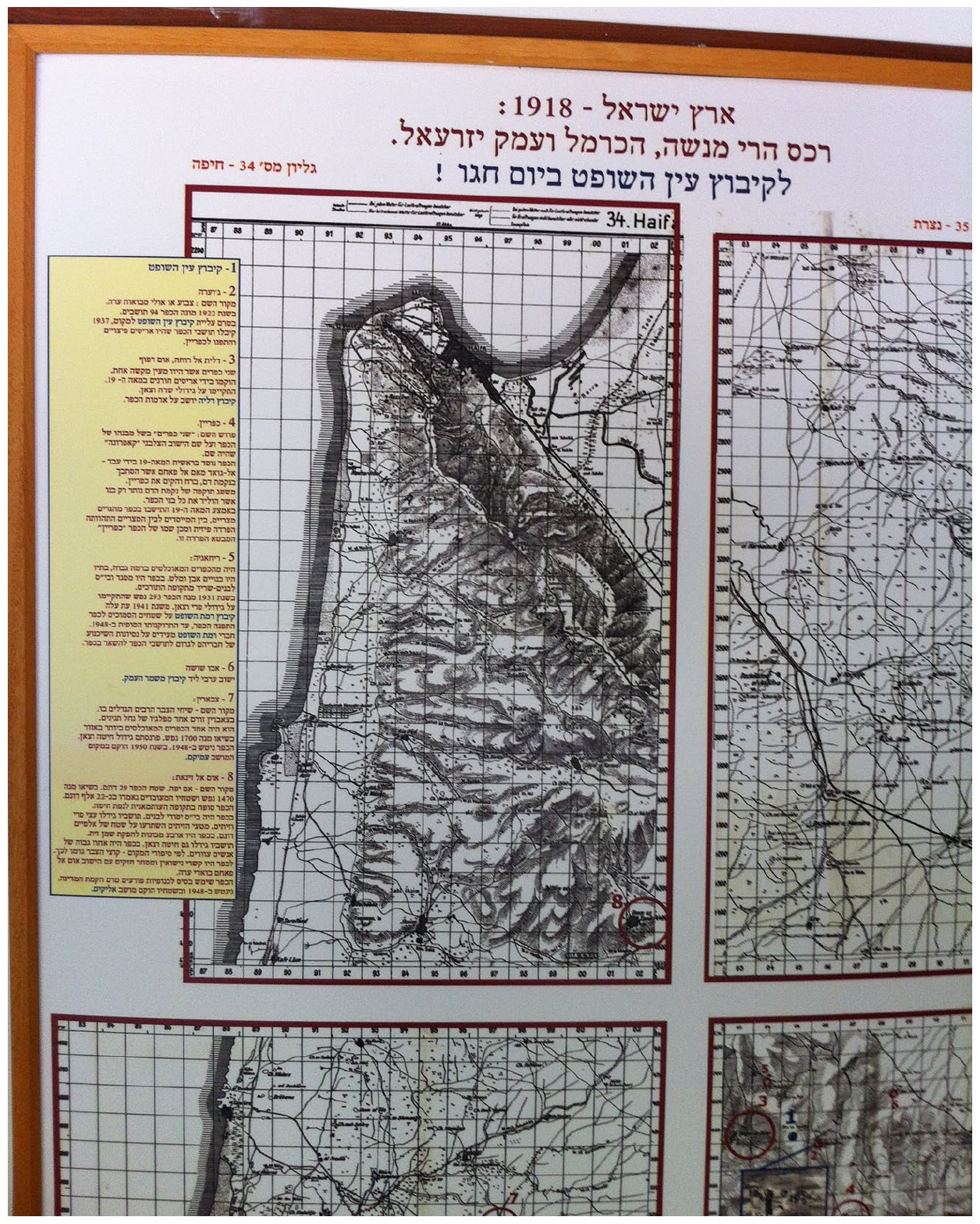
Map of the ‘Mountains of Menashe, Carmel and the Jezreel Valley’, Kibbutz Ein Hashofet archive.
The kibbutz’s archivist directed me to the map to learn about the lands upon which Ein Hashofet was established. The map, through naming and the vividness of its detail, more closely resembled a Palestinian map than any other kibbutz-generated map I had encountered in previous research contexts. The existing literature and my own experience as a Palestinian scholar in Israel predisposed me to anticipate the villages’ concealment in kibbutz archival materials, considering the ostensible Zionist–Israeli denial of Palestine and the collective existence of Palestinians. After all, most scholarship on Zionist–Israeli memory practices finds that the approximately 418 depopulated Palestinian villages (Khalidi, 2006) and Zionist perpetration of violence have been subject to systematic physical and discursive erasure (Beinin, 2005; Benvenisti, 2002; El-Haj, 2001; Gardi, 2011; Kadman, 2015).
Kibbutz archives, assembled partly by records from each colony’s ‘Arab expert’ in charge of interacting with the neighboring Palestinian villages, contain an extraordinarily detailed record of indigenous life on the rural frontier – a pivotal site of intricate socio-politico-economic interactions entailing intense settler expansion and indigenous replacement – otherwise inaccessible (Sleiman, 2016). Colonial ethnography and reconnaissance inscribed the indigenous into the settler record. Material on Palestinian villages and their inhabitants is thereby bountiful in these sites. An ostensible paradox of the archive as a purported repository of history emerges: on one hand, such archive is a manipulated articulation of historical events that seeks to extol the project of ‘land redemption’ (ge’ulat ha-karka), but on the other hand, it also contains the history of violence enacted against the colonized, however discursively maligned such history is rendered. The presence of the villages on a large map in the kibbutz archive, and furthermore, in Israeli archives writ large, offers a different paradigm: one of hyper-presence. This discovery leads to questions around what the conspicuous disclosure of indigenous life and violent histories in settler archives reveal about settler colonial sovereignty, as well as the possible resources for future material decolonization.
In this article, I show how the Zionist left archived as a means of appropriating land and ultimately eliminating neighboring Palestinians from desired space, and in doing so, preserved both a history of indigenous presence and of settler violence. I describe this process as archives of apprehension (herein AA): information-gathering on the indigenous as a reconnaissance and ethnographic practice of settler colonial conquest, and apprehension as an affective state of anxious archival subjects concerned with the reversibility of settler territorial sovereignty. Kibbutz archives during the British Mandate period and shortly after were organized as a practice of colonization. Local examples from Hashomer Hatzair, the putatively radical leftist faction within the Zionist settlement movement, and other forms of apprehension, such as the Haganah Village Files project in 1940s Mandatory Palestine, show how AA include what colonization so often aims to eliminate. Even as leftist Zionist archives reflect a selectivity around terms of perpetration and guilt, they document encounters with and observations of the indigenous, whose resistance shaped inclusion and exclusion in the archive.
This article’s theorizing emerges in response to an epistemic context in Israeli social science and history in which the critical archival theories long in play in the study of transatlantic slavery and settler colonialism in the Americas and Antipodes (Lara-Millán et al., 2020) have only recently trickled into the historical study of Palestine/Israel – generally by way of cultural studies – as positivism largely reigns in historiographic methods. AA can partially recover histories of Palestinian villages and their inhabitants, especially regarding records of life on the ‘frontier’, a populated rural zone marked by a collision over land between Jewish settlers, Palestinians, and British forces. I argue that these AA can reconstruct the historicity of a protracted colonization otherwise unpreserved.
Theorizing the archives of apprehension
That the archive is an ‘epistemological experiment’ rather than a repository of facts (Stoler, 2002) perfectly encapsulates the epistemic turn in late-20th century historiography. Then, historians, anthropologists, and sociologists increasingly began exploring archives as colonial spaces, reading the archives of colonizers as sources of knowledge about both colonizer and colonized, as active renderings of events preserved through the process of governing (see Dirks, 2015; Bastian, 2006; Pels, 1997). A growing literature on the archive and transatlantic slavery exposes archives’ limitations, marked as they are with violence and the invisibility of marginalized subjects (Fuentes, 2016; Lowe, 2015). But there is also an awareness of the opportunities to ‘fill in the gaps’ (Hartman, 2018). Still, methodological concerns around evidence and validity accompany lingering debates over power (Lara-Millán et al., 2020; Skarpelis, 2020; Steedman, 2002).
Whereas colonial archives were focused on creating archives for colonial governance, settler colonial archives, such as those in the United States, subsumed and obscured the histories of native dispossession within the history of the state’s emergence (Adams-Campbell et al., 2015: 111). Through both acknowledging and disavowing indigenous communities, the settler colonial archive apprehends and de-politicizes representations of colonial subjects as a means of establishing territorial sovereignty.
In the case of Palestine/Israel, archives have often been treated as repositories for extracting content on territorial conflict. Most scholars have relied on, and continue to rely on, elite sources in national Israeli, British, and Arab archives and therefore depict a macropolitical account of 1948 based on details of battles and war maneuvers, diplomacy, elite decisions and planning, or demographic and geographic accounts of transformation. This approach sidelines the ambivalences, contingency, and local variation; moreover, it largely neglects constitutive interactions between settlers and the indigenous that preceded the watershed moment of the 1948 war.
To grasp micro- and meso-level processes of macro-level change, it is beneficial to consider the resources produced in AA. Instrumentalizing AA for historical sociological work entails examining archival forms and processes of meaning making, alongside attempting to historically situate their functions in the constitution of settler sovereignty. AA are ‘conflict archives’, in which political violence – physical and epistemic – is synchronically documented and encoded (Luft, 2020). These partial and fragmented archives vitally disclose otherwise unknowable aspects of indigenous life on the frontier, and ultimately of settler colonial governance (including mechanisms of classification and attribution). In preserving phenomenological moments of the past, AA become central to colonizers’ self-understandings as they work to displace indigenous sovereignty and ensure the irreversibility of settler accumulation. AA should be formulated and reconstructed as a set of tools, to trace colonization practices and to potentially re-appropriate indigenous historicity.
Methodology
My historical sociological findings derive from more than 6 years of fieldwork in eight archives in Israel: three local kibbutz archives of the Hashomer Hatzair settlement movement (Mishmar ha-Emek, Hazorea, and Ein Hashofet) in the Jezreel Valley, which intensively documented interactions with the ultimately depopulated neighboring Arab villages; and five national archives (Yad Yaari Research & Documentation Center, Pinhas Lavon Institute for Labor Movement Research, Haganah Historical Archives, Israel State Archives, and the Central Zionist Archives), dedicated to the history of Zionist settlement. My years of archival mining engaged systematic analyses of assembly minutes, protocols, interview files, photographic collections, correspondences, memoirs, eulogies, books that the kibbutzim and other historians produced on their own initiative, and recurring newsletters. I reconstruct the settlement processes on the frontier between 1936 and 1956, the zenith of the process of Zionist colonization and Palestinian resistance, using also post hoc recollections recorded between the 1960s and 1990s and preserved in the archives.
Through my fieldwork in kibbutz archives tracing rural land approporiation, I transformed my relationship from one of positivist extraction to one of ethnographic participant-observation, realizing that these archives can be useful in explicating the informational mechanisms of settler colonial rule and the Palestinian past.
Settler colonial ethnography in the kibbutz archive
AA shape not just what is known, but how one knows what one knows, and thus how one governs or is governed. The archiving of materials displays a political sense of governing, produces meaning, and shapes how the present is constituted by the past. Bourdieu (1994) recognized as much when he determined that archives constitute a form of ‘informational capital’: ‘the state claims responsibility for all operations of totalization and of objectivation, through . . . writing as an instrument of accumulation of knowledge (e.g., archives)’ (p. 7). Knowledge about the indigenous population that state institutions – or local agents positioned at the embryonic stage of a state-on-the-way – collect, classify, and archive is thus vital to establishing sovereignty over territories and populations. To classify and attribute meaning is to determine a movement or organization’s need to mobilize resources to carry out claims to territory and governance.
A self-perceived socialist Zionist movement, Hashomer Hatzair’s vast archival material documents the creation of their leftist settler colonies in the first half of the 20th century. The movement’s central archive was created as early as 1937 at Merhavia, another Hashomer Hatzair colony, with discrete archives for each kibbutz colony officially founded in 1968. Even so, settlers across the colonies – carrying collective cultural capital and national consciousness – retained materials from the early decades of the century in local archives, as can be seen in this directive sent from the Hakkibutz Ha’artzi settlement movement, of which Hashomer Hatzair was a part, to colony secretariats and regional militia commanders in June 1948:
. . . [W]e feel it is our duty to mention and bring to your attention the special purpose of collecting archival material, which is given as a role to the kibbutz during this period. We are also aware of the many worries and hardships that the kibbutz is engrossed in. However, it is precisely during the war that the archives should be instituted and processed, as one of the commands of war. Let us nurture ourselves in the sense of history, learn to appreciate every note, written instruction, command, diary, newsletter, friend’s letter, photograph, etc., and carefully and diligently collect in anticipation of the future (reiyah merḥika), because these are documentary assets to the people, the movement, and the kibbutz, from where the pages of history will at one time be recorded and written. (cited in Gardi, 2011: 10)
The archived materials proffer a strikingly detailed vision of the colonies before, during, and after the 1948 war. The information they hold – on Arab villages that neighbored the Jewish colonies, Arab inhabitants, the Arab ‘way of life’, quotidian kibbutz happenings, and interactions between Jewish settlers and Palestinians – can mostly not be sourced elsewhere in any form. The kibbutzim also published newsletters documenting local and national news. From such differing modes of textual production, we can construct an overall picture based on reconstruction in hindsight and documentation produced synchronically at times of conflict. 1
Prior to Israel’s founding in 1948, Zionist colonial nuclei in the populated frontier prepared for land purchase by gathering detailed information about Palestinian villages – geography, topography, demography, political activity, customs, and culture – a strategy that enabled the Zionist movement’s, albeit minimal, initial foothold in late-Ottoman and Mandatory Palestine. The Zionist colonies – among them those of Hashomer Hatzair – came to constitute pockets of semi-sovereign rule nested within British imperial rule (Sabbagh-Khoury, in press). The numerous archives – many of them first transferred from Europe – created by Zionist organizations constituted a key piece of the developing semi-sovereignties, even before a national sovereignty was contentiously attained. The archival institutions and ethnographic practices of apprehension that appeared throughout the Zionist movement contributed to a colonial informational ‘field’ used to entrench surveillance and control (Steinmetz, 2008). The goal was to ascertain territorial irreversibility in the rural frontier, and to consolidate contiguous presence outside urban centers (Sabbagh-Khoury, in press). These AA, then, would merge the history of the settler colonizer and the indigenous as dialectically intertwined, especially on the constitutive violence enacted against the indigenous population in practices of land control and resistance to replacement.
Classification and attribution in the kibbutz archive
The division of files and containers in the kibbutz archives indicates a classificatory schema mobilized consistently in local kibbutz governance of indigenous land and population. Compartmentalization and meaning attribution were accomplished slightly differently in each kibbutz, reflecting the identification of political opportunity and threat among the settlers as they mobilized to claim land and defend it. Yet, despite minor differences in labeling and dividing materials into categories, conceptual classifications remained consistent among the kibbutzim.
Archivists used five main categories to catalog documents – many created through the practice of colonial ethnography – relevant to settler/native interactions. First is the ‘Security and Israeli Wars’ or ‘Security’ folder, with each file denoting a discrete war. Second is the ‘War of Independence’ folder, maintained separate from other wars. Third is the ‘Origins’ folder, containing materials on the founding of the kibbutz. Fourth, the ‘Farm and Economy – Land Clearance and Drainage’, or ‘Land’ folder, containing files on the process of land acquisition. This category is often replete with correspondences between the kibbutz and purchasing institutions such as the Jewish National Fund and Palestine Land Development Company, and later with the Custodian of Absentee Property, who completed a census of the lands claimed by each kibbutz. The fifth category is the ‘Our Relations with the Arab Neighbors’, or ‘Our Relations with the Arab Environment’ folder, which contains materials on the uprooted Arab villages on or beside which the kibbutzim are located.
Files in these categories contain seminar or research papers, most of which comment on kibbutz relations with the Arab neighbors, as well as clippings from kibbutz newspapers that discuss, for example, the role of kibbutzim in the ‘War of Independence’, whether kibbutz settlers took part in the deportation of Arab villagers, or the issue of property left by the Palestinian refugees. In addition, kibbutz settlers and archivists preserved newspaper clippings referring to the 1948 war, many published after the critical 1988 publication of historian Benny Morris’ Birth of the Palestinian Refugee Problem, 1947–1949, which re-awakened discussion about the past. In addition to the listed categories, materials relevant to the conflict can be found in the early kibbutz leaders’ personal files, stored separately from the five categories. When these leaders were active with the so-called ‘Arab Question’, related documents could sometimes be found in corresponding folders.
The file and folder classifications indicate the consciousness woven into these AA and that of the Zionist left (and others) in Palestine at the time, documenting and attributing political opportunity or threat to an unfolding series of contentious events. Elsewhere (Sabbagh-Khoury, n.d.), I explain the following three constituent factors in this consciousness: (1) colonial informational capital was transferred with a specifically Jewish practice of archiving from Europe to Palestine; (2) the oppression of European Jewry, and their exclusion from historiographic institutions, prompted meticulous archival practices; and (3) classification struggles among Zionist factions over whose labor most realized Jewish nationalism. These factors motivated settlers to document their actions and distinguish themselves in the avowedly ‘revolutionary’ movement to create a Jewish state.
These configurations reflect a certain logic regarding settler colonial relations. The naming of categories – wording like ‘security’ or ‘neighbors’ – and the discursive employment of them documents how kibbutz settlers organized and produced information about Palestinians with whom they were interacting. The term ‘security’ is symptomatic of the settler’s lens that the indigenous resistance to territorial dispossession was a security matter (cf. Morris, 2001: 161), which instantiated their denial of implication or causality in the violence of settler colonization. Terming Arabs ‘neighbors’ placed the settlers – who professed a belief in the ‘brotherhood of all peoples’ – on equal terms with a population they would expel, with the backing of Zionist militias and British officials. The diligent record of land purchases/sales represents the level of detail used to justify colonization by purchase (Sabbagh-Khoury, in press). Such examples underscore the informational processes constituted by patterned dispositions and practices in a movement attempting to make contentious territorial claims.
Each kibbutz archive sorted in revealing ways. At Hazorea, one file created after 1948 was kept on the ‘Arab Minority’, that is, the newly classified Palestinian citizens of Israel. This discursive and physical separation in the archive between the Palestinians as collective and the ‘Arab Minority’ reflects the fractured re-grouping of Palestinians created from the 1948 Nakba (the expulsion and exile of around 700,000 Palestinians). Another example from the same archive is the Palestinian refugees of the Nakba classified under the category of the ‘Arab Question’. This classification, rather than in the ‘Our Relations with the Arab Neighbors’ or the ‘Land’ folders, displaced the refugee issue onto an abstracted macro-level regional or politico-state realm, rather than one of people expelled from their land because of kibbutz practices of colonization and intimidation. This schema indicates how these settlers framed the refugee issue as an inevitable problem created during a war with invading Arab armies in which they were not complicit. Furthermore, in the three kibbutzim, where the ‘Our Relations with the Arab Neighbors’ file detailed when the two peoples interacted at events like weddings and holiday celebrations, land purchases were kept separate. This served to de-politicize the Palestinians, dislodging land appropriation from the Palestinians as agential actors rather than being a tripartite relation between settlers, the indigenous, and land. The classification of land issues away from relations with the Arabs dislodged dispossession as a prime feature of settler colonialism.
Other examples can help elaborate the developing settler consciousness: In the Ein Hashofet archive, the ‘War of Independence’ record accompanied those of the 1967, Gulf, and other wars, while in Hazorea, the same file belonged to the ‘Security’ folder. In the Mishmar ha-Emek archive, the ‘The Battle of Mishmar ha-Emek’ file, recounting struggles between Palestinian anti-colonial fighters and settlers, was separate from the ‘Arab-Jewish Relations’ file. These classifications encapsulate the logic that saw 1948 as a point in a series of just wars with surrounding Arab states, or as a security issue, not as one event in an enduring process of replacement (Sabbagh-Khoury, in press). These archives’ classification consistently depicted settler colonialism rather as a national conflict between two populations over resources – one desiring peaceful settlement and the other a hostile population rejecting collaboration – rather than an asymmetrical struggle between settler colonizers (backed by imperial violence) and deeply rooted indigenous Palestinians attempting to stall displacement.
Traces of violence
Sovereignty leaves traces of its violence (Gordon, 2008; Trouillot, 1995), and AA make literal these traces that document settlement practices, frontier interactions, and disruptions to indigenous social life.
Kibbutz settlers faced the question of how to frame the story of the existence and ultimate ‘disappearance’ of the Palestinian villages nested beside them. Representational discourses of the Arab villages shaped how settlers perceived the history of the indigenous and their ‘exit’. As Hashomer Hatzair settlers articulated indigenous life, their information-gathering practices became a legitimation mechanism as they attempted to reconfigure Palestinian history as pre-history, 2 and as they became intensely interested in the question of Palestinian ethnic origins. 3
The settler colonial archive captures the displaced Palestinian villages just as it restructures the historical narrative. Representations of the Palestinian villages and their inhabitants persisted in the archive despite systematic endeavors to silence what preceded (e.g. the destruction of property, renaming of places). This is especially true in photographs (Azoulay, 2011; Sela, 2009). Many of the kibbutz archives contain media collections with images of the later-displaced Palestinian villages and kibbutz members’ encounters with the Arabs in the vicinity. At Kibbutz Ein Hashofet’s archive, for instance, I located photographs of the one-time Arab locality Jo’ara, a hilltop village which the kibbutz-colony subsumed in 1937 after its residents were displaced (see Image 2). Neither Jo’ara nor its displacement appear in most Israeli and Palestinian historical sources on the depopulated Arab villages (e.g. Walid Khalidi’s, 2006, authoritative work All That Remains does not include Jo’ara; among the many encyclopedic compilations of the destroyed village, only Al-Dabbagh’s (2006) Arabic work Our Country Palestine mentions Jo’ara). And yet, detailed records of this village and others that elsewhere are lost remain in the kibbutz archive.
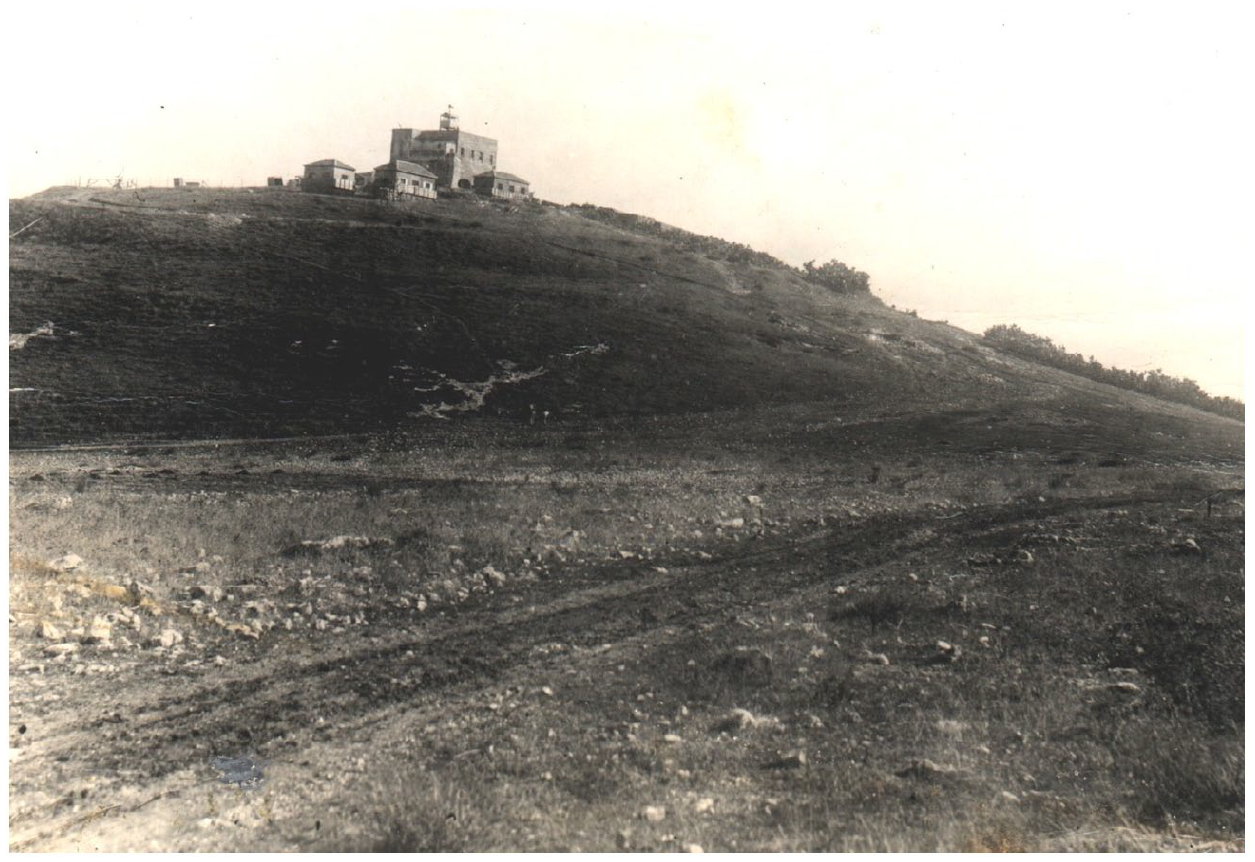
Photograph of Jo’ara buildings, captured by kibbutz settler. Original caption: ‘View of Jo’ara from afar’. Ein Hashofet archive, circa 1937–1945.
AA extend beyond the local kibbutz archives. Another instance is in the project of the ‘Village Files’, a compilation of documents containing detailed information about the Palestinian villages and cities in Mandatory Palestine collected by the Haganah (Zionist pre-state militia) between 1943 and 1948. 4 The project’s astounding levels of cartographic, visual, and discursive detail can still be found in the Haganah Historical Archives (a 2010 publication by the archives (Salomon, 2010) details the project in-depth). Facilitated by hundreds of Haganah scouts, reconnaissance commanders, and intelligence officers, the settler militia apparatus – inclusive of leftist kibbutz settlers and ‘Arab experts’ – sought to apprehend the ‘basic structure of the Arab village’ (Moshe Pasternak in Pappé, 2006: 12). Even as the settlers’ goals for the files morphed over time (Jawad, 2016), scouts surveyed the villages’ topographic, geographic, architectural, socio-cultural, and political features, including infrastructural elements (roads, land quality, water sources) and demographic data (including religious affiliations and age details of the male population). Informants sketched village maps and viewpoints (see Images 3 and 4 for an example of aerial and front-facing drawings produced on the Arab village of Yazur in 1944). In my fieldwork, investigating the Hashomer Hatzair colonies at the Haganah Historical Archives, I encountered thousands of files detailing a range of information about the Palestinian villages, among them those that neighbored the kibbutzim I examined. Files detailed anything from Abu Zreik village’s newly planted fruit trees, or the number of students (60) enrolled in its girl’s school; 5 to the locations of the 29 Arab coffee houses in Haifa where political activity was presumed to take place; 6 to the names and ages of the Arab ‘activists’ in Tantura obtained from an informant. 7 Image 5 depicts the first page of the Abu Zreik file (Abu Zreik village neighbored Kibbutz Hazorea), whose minute categorizations of location, origin, water sources, tribal structure, and so on, are characteristic of the apprehension practices.
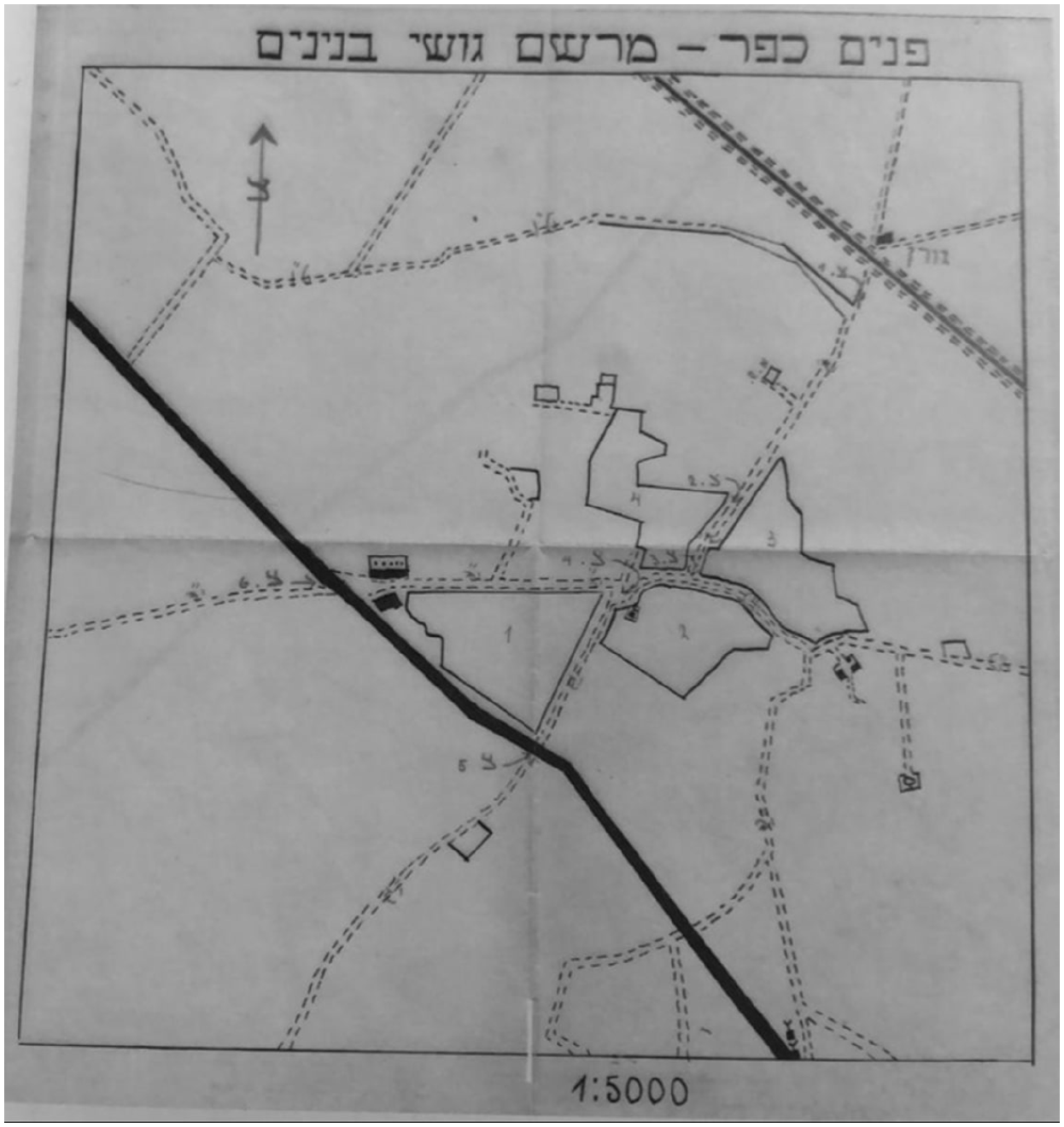
‘Interior village – Sketch of the Building Blocks, 1:5000’, Yazur Folder, casing ‘Interior of the village’, n.d., Haganah Historical Archives.
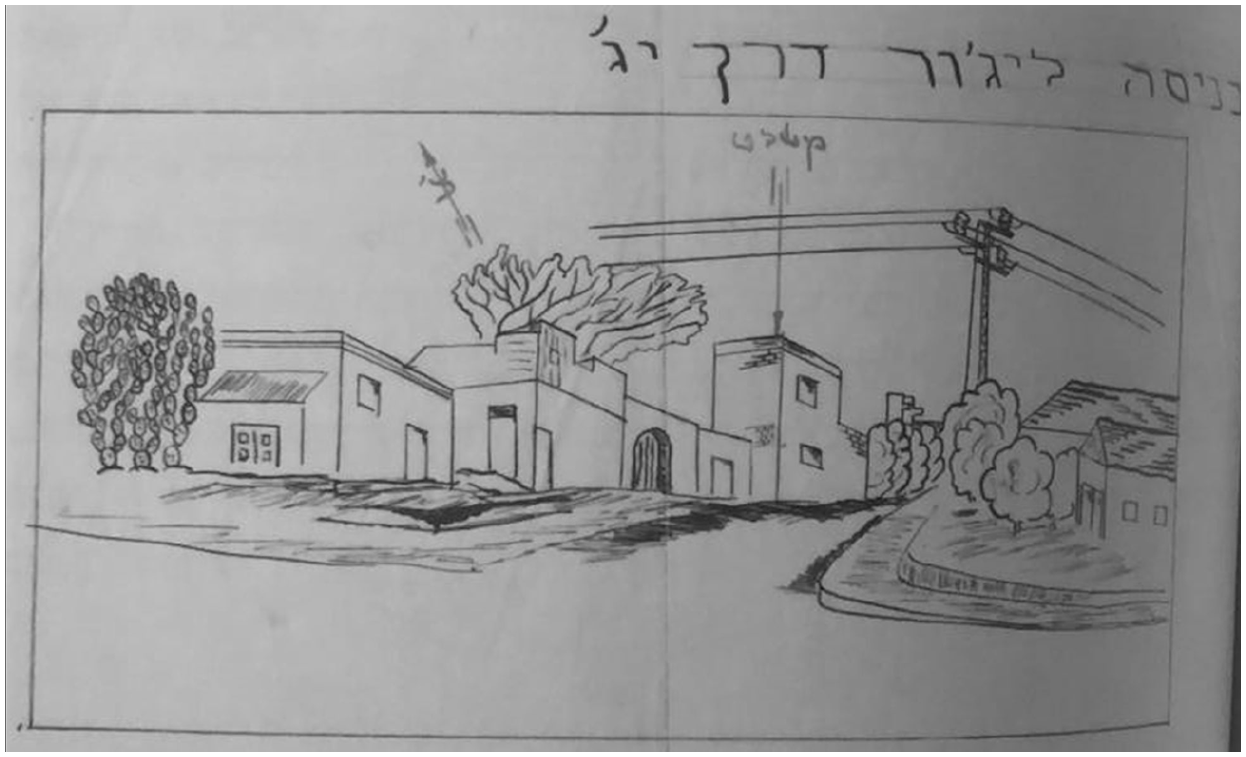
‘Perspectival sketch of entrance to Yazur, Path 13’, Yazur Folder, casing ‘Interior of the village’, n.d., Haganah Historial Archives.
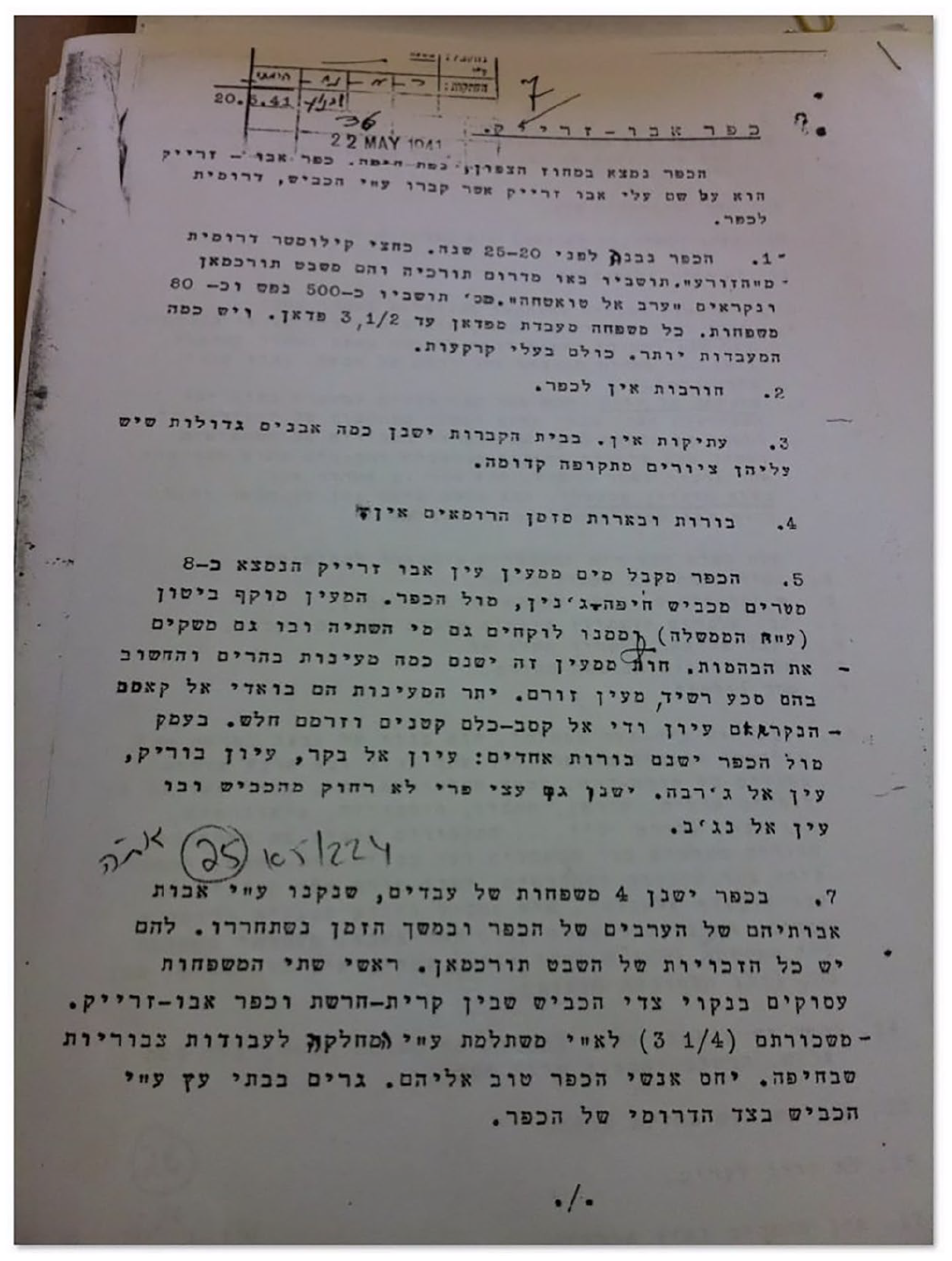
‘Abu Zreik Village’, Haganah Historical Archives file no. 224, Survey of Arab Settlements, 20 May 1941.
Settler apprehension was similarly evidenced in the ‘Custodian of Absentee Property’ files, assembled after Israel’s founding in 1948 and held in the Israel State Archives. These files contain broad overviews of Palestinian property appropriated by the new state, first under emergency declarations that property had been abandoned by absentees (both internally displaced persons, or (‘present-absentees’) and refugees) who left their lands after 29 November 1947, the date the United Nations (UN) adopted the resolution to partition Palestine. These records detail the state’s first census of property, natural features, the built environment, land areas, and so on. Codifying and legitimizing state nationalization (confiscation) of large swaths of land, these bureaucratic records testify – quite accurately – to the depth of dispossession in their quantification of land dunams appropriated. They became a crucial resource for me in reconstructing the Palestinian land and property appropriated by the rural colonies (Sabbagh-Khoury, in press).
Efforts to apprehend the Palestinians are important resources not least because they outline how Zionist leftists on the frontier understood themselves. There are four possible explanations for the relative hyper-inclusion of settler colonial violence and indigenous life. First, including the Arab neighbors’ presence and their relations with the kibbutz contributed to the construction of the settlers’ ‘brotherhood of people’ ideology, a value Hashomer Hatzair often professed alongside their value of class liberation. For these leftist Zionists, the archive reflected and produced their self-perception: by preserving the Palestinian villages in archival form, even as the villages were being depopulated, they simultaneously recognized and disavowed the settlement’s role in the villages’ destruction. The constant colonial anxiety over impermanence – reinforced by persistent violent skirmishes – required iterative re-affirmations of the colony’s legitimacy and the Zionist militias’ attempts to secure it. Second, the inclusion forms part of an appropriation-cum-substantiation process: settlers did not express feeling jeopardized by their explicit inclusion of the Arab past. They legitimated their practices of territorialization, and their right to claim space, by de-linking Palestinians (as non-sovereign, non-historical, unrooted, and unproductive) from the land (Sabbagh-Khoury, in press). The kibbutz settlers substantiated their claims by linking themselves to a contiguous Jewish history extending to ancient time to position their claim to land as indisputable. They also aligned their right to belonging with Hashomer Hatzair’s socialist–Zionist claims that land belonged to those who productively worked it. Therefore, the Palestinians – whom these settlers believed to be unproductive despite their long history of cultivation – were not deemed legitimate possessors of the desired space, and their inclusion in archival form posed no threat of retribution. Third, some leftist Zionist settlers expressed on a few occasions and in various locations across the archives affects of uneasiness and haunting (Gordon, 2008) over their own actions and/or over the sordid fate of their previous Arab neighbors. 8 Including the Palestinians in the archives, then, may be one way the settlers attempted to preserve this past and all its fissures, to depict what they termed an inevitable, unintentional outcome. And last, hyper-inclusion in the AA fits entirely the Zionist ‘policy of detail’: ‘ . . . Palestine was not only the Promised Land . . . . It was a specific territory with specific characteristics, that was surveyed down to the last millimeter, settled on, planned for . . . in detail’ (Said, 1979: 36).
Exceptional case
Given the scholarship on archives vis-à-vis European colonialism and the transatlantic slave trade, it is not surprising that settler colonial AA preserve what colonial settlers and the institutions that buttressed them attempted to erase: collective indigenous existence. In fact, the paradox seemingly unravels. Documenting the violence of settler colonial domination and land conquest contributes to a settler group or nation-state’s symbolic power. Zionism, however, involves specificities that nonetheless render the phenomenon paradoxical, which is to say ostensibly contradictory but ultimately well founded. The paradox is twofold: first, the hyper-inclusion of violence against the indigenous and indigenous life writ large in the AA, and, second, the inherent resources of contestation – of colonization’s inevitability and settler sovereignty’s legitimacy – available through this preservation. The case of Palestine/Israel is an exceptional case (Ermakoff, 2014), attaining significance as it typifies overlooked features of an empirical class, signaling objects of inquiry left unexplained in more normative settler colonial informational fields.
First, the scale, tactics, and temporality of erasure in Palestine differ from those in other settler colonial cases, which determines the contours of its AA. Genocidal eradication (though never complete elimination) of natives in regions of what became the United States, and attendant practices of concentration, assimilation, and liquidation differ in scale and kind from the ethnic cleansing, dispossession, and segregation of Palestinians: Palestinians remained in large numbers in a frontier that constituted part of a smaller land mass with greater density than, say, the southwestern region of present-day America. Zionist settlers in the rural frontier consistently expressed feelings of threat over territorial reversibility until their Arab neighbors were displaced. Daily interactions between Zionist settlers and Palestinians on the frontier were commonplace for decades. Land tenure rendered Zionist territorial accumulation initially a case of colonialism by purchase (not sheer plunder). Colonization was protracted partly because British policies around protecting cultivators slowed expulsion. Thereby, the constitution of Zionist sovereignty was gradated due to the continued presence of the British Government as well as Palestinian resistance to expulsion. Apprehension – both anxiety over the reversibility of territorial claims and the attempt to garner knowledge about the indigenous – developed over time, as expulsion on the frontier was generally never sudden.
Second, the day-to-day work of colonizing on the rural frontier prior to 1948 was implemented largely by communal colonies such as those of Hashomer Hatzair, many of which avowedly espoused egalitarian values and a binational vision for Palestine. Socialist Zionist settlers practiced more ‘inclusive’ archival techniques than most other settler colonial movements (e.g. those in the United States), partly because they did not envision the wholesale elimination of the Palestinians from historic Palestine and ultimately supported binationalism, even though they sought, participated in, and benefited from expelling their one-time neighbors.
Third, Zionism was constituted as a national movement before the formation of a nation-state (Elkins and Pedersen, 2005: 3). Many AA and the events documented within preceded the stage of mass violence and dispossession in 1947–1948, and before the state’s institutionalization following the British Government’s departure. In this way, apprehension became central to the constitution of local semi-sovereignty, where access to informational capital dictated defensive and offensive capabilities. Elsewhere, even if settlers acted on their own behalf, all were initially backed by imperial governments (European monarchies) in the ‘Old World’. Moreover, by the time most Zionist settler colonies were established, Palestinians had articulated nationalist politics.
Finally, whereas in other cases efforts at some material and/or symbolic reconciliation or acknowledgment of past injustices have been extended (e.g. in Canada and Australia; Luker, 2017) – despite potential ongoing forms of erasure and colonization – in Palestine/Israel denial endures alongside continuous dispossession and national de-sovereignization.
In all, the Zionist archives reflect different epistemological concerns than do settler colonial archives elsewhere that contain the history of dispossessed natives. The paradox in the Zionist archives is therefore more pronounced, even as the pattern of practice remains commensurate across historical cases. Settler apprehension – both attempts at informational accumulation and anxiety over settler impermanence – constituted the gradated formation of semi-sovereignty in the rural frontier. To gain control over land, ensure territorial contiguity, suppress anti-colonial dissent, and convince the British that Zionist settlement was beneficial, informational practices of apprehension became a key mechanism. It is in this scope of detail – information gathered across the settler colonial apparatus and preserved in AA – that the seeds for a praxis of recovery lie.
Recovery in the settler colonial archive?
Zionist settler historiography has a dual function: to inhibit claims of settler illegitimacy, on one hand, and to preserve the history of settler violence, on the other hand. Thereby, AA are a significant, but totally inadequate, resource that can be called upon to revive a past elsewhere denied.
It might appear counterintuitive to seek out indigenous history in documents recording actions intended to foreclose the future of such history. Zionist settlers archived their actions to concretize Jewish sovereignty and the labor of those who made its emergence possible. They also engaged in various ethnic cleansing mechanisms when territorial security was threatened (Pappé, 2006). The logics and subjectivities of those who configured these spaces unmask settler colonial discourses and the contingencies of violence, while revealing cracks in the frames, moments of ambivalence, and inconsistencies between ideology and practice. Moreover, scholars must excavate archival sources (Skarpelis, 2020) to reassert the role of indigenous peoples as dynamic subjects in history, beyond relations of vertical domination. We need to understand how to write Palestinian history from fragments and traces, from archives that, as Elkins (2015) articulates ‘conceal as much as they reveal’ (p. 852). How can one employ such a tool as a praxis of recovery?
The social history and political life of the Jewish settler colonies in Palestine are well-documented, especially compared to Palestinian society and life on the ‘frontier’. Rural Palestinian fellahin (agricultural cultivators/sharecroppers) – most of the village inhabitants neighboring Hashomer Hatzair colonies – were poorer and less educated than the urban population; the Palestinian literacy rate in 1931 was recorded as 22%, compared to 86% among Jewish inhabitants (Khalidi, 2007: 14). This faction of Palestinian society has already been mostly left out of written history. But with the majority of Palestinians in 1948 being dispersed, together with martial law imposed and fear of political repression by Israeli forces, the already-rare sources of Palestinian history were obliterated – a process repeated with the 1967 Israeli occupation of the West Bank and Gaza (Swedenburg, 1989). The scarcity of Palestinian sources on the frontier makes the kibbutz archives a significant historical resource despite the selective and elusive process of documentation that constituted their production (Jawad, 2016).
Despite the inclusive presence of materials about Palestine and Palestinians, scholars must be careful when using AA, drawing conclusions, or simplistically aligning findings to functionalist renderings of historical events. 9 In many cases, life depicted in these sources differs from the living memories of Palestinians. These archives lack a phenomenological proximity to the vivid texture of life in the villages (cf. Davis, 2011). Relying on the archive as an exclusive source for writing the history of Palestine and Zionism is problematic. AA produce information about the indigenous through a reconnaissance episteme, through encounters in which the indigenous emerged only in relation to settlement. The archive, then, should not form the sole basis for recovering suppressed histories, and cannot holistically compensate for the erased histories of indigenous life in this case and others.
Reading the archive must be attentive to political concerns and intentionality. First, such work requires skepticism about the archive’s evidence, entry of data, collection, and attribution. Archival assembly and classification involve social action, requiring scrutinization. In reconstructing the approximately 68 massacres committed by Zionist forces around 1948, Jawad (2007) utilizes oral history methodology, rather than solely archival, to compile eyewitness testimony. This approach demonstrates that a comprehensive historical account of indigenous experience (the relation between settler colonization and state-making, no less) is not fully ascertainable through sole adherence to positivist archival methods (cf. Hughes and Smith, 2018; Hunt, 2016; Luker, 2017).
Second, information contained within archives often mirrors societal cleavages and hierarchies (such as gender). Accounts of Palestinian women and peasantry, for instance, are absent or based on Eurocentric understandings of life and labor. The work of the analyst is to nonetheless strive to trace how social categories operate in time and space (Scott, 1986).
A significant challenge in any historiographic endeavor is the risk of presentism – to use the settler colonial archive especially opens one up to the danger of a functionalist or teleological reading that assimilates all social action under a singular ‘logic’ or structure. So, third, care should be extended to an analysis attentive to plasticity, dynamism, and the interplay between context and contingency. In this mold, Stoler’s ‘along the archival grain’ methodological reading urges us to consider how perception and practice temporally emerge. The historical sociologist’s role is not simply to attempt an iterative debunking, but to grasp the epistemic guidelines by which historical actors made sense of their own worlds and acted in them. In the Hashomer Hatzair archives, for instance, one can find countless resources that rely on a discourse of ‘friendly’ or ‘neighborly’ relations between the settlers and the Palestinian village inhabitants. Reading along the archival grain here would entail contextualizing how these ‘good relations’ emerged within protracted and systematic attempts at land purchase, confiscation, and expulsion, in which settlers attempted to de-politicize Palestinian claims to land and displace their own implication in violence. It means taking seriously settler epistemes not as inevitable or essential, but dependent on historical conditions.
AA thus need to cross-fertilize with extant indigenous sources to reinscribe Palestinians (and specifically rural Palestinians) into history. Even so, scholars who use archives uncritically – without carefully considering the archive as a technology of colonial governance – are liable to reproduce essentialist renderings rather than properly historicizing social actors; their dynamic forms of sociality; and cultural, economic, and political practices.
AA have shaped my own historical sociological scholarship on Hashomer Hatzair land appropriation efforts in two ways. In the AA, diaries play an important role in circumventing official nationalist historiography. Kibbutz settlers’ journals reveal otherwise invisible historical threads. Kibbutz Mishmar ha-Emek’s archive preserved one kibbutz settler’s diary documenting daily life for 6 months during the 1936 Great Arab Revolt, a crucial period in Palestinian history when many revolted against British imperial rule and Zionist settler colonization. The diary tells of contentious relations between the kibbutz and neighboring Palestinian village al-Kafreyn. While little is documented elsewhere about these specific Palestinian’s social actions amid the revolt, this journal gives an account of the al-Kafreyn inhabitants’ actions during the revolt when British forces accused them of burning neighboring kibbutz fields and imposed fines on them:
The Kafreyn [villagers] left the village, leaving only six people to maintain the property. Six hundred and seventy people were scattered to four nearby villages and sent a delegation to the Arab Higher Committee to receive instructions. They explained that they left the village because they cannot bear the collective punishment imposed on them.
10
The author continues,
[A]ll the residents of the village, numbering 720 people, were forced to leave after they announced to the government that they are not guilty of the burning. Also, it has been said that the police officer Mr. Cohen had acted aggressively and hit the villagers during the investigation.
11
Ultimately, these villagers did return to the village after 10 days, as planned. This single entry is of upmost significance in reconstructing the process of settler colonization. First, it is the indigenous resistance (whether by al-Kafreyn or others) – the agentic act of burning fields to delay colonization – that becomes the reason for including the indigenous. The knowledge presented – that the Arab villagers neighboring the colony fled out of fear of collective punishment – buttresses the oft-referenced trope repeated by displaced Palestinian refugees who were later interviewed about the 1948 Nakba that ensued years later, when the villagers became permanently displaced: ‘We left in order to return’. When I conducted oral histories with original refugees from al-Kafreyn and nearby villages, some respondents discussed how they left in 1948, as in the 1930s, intending to soon return. 12 In my interviews and in existing scholarship, there is no mention of villagers temporarily fleeing during the 1936–1939 Great Arab Revolt; this absence is not so unusual given the nature of traumatic memory reconstruction. And yet, such new insight from the archive can fill unexplained gaps, leading to a compound comprehension of how the conditions of Palestinian fleeing in 1948 – and with it, the real intent to return following appeasement – had historical precedent.
In another fitting example, we learn of how kibbutz settlers interacted with the indigenous during protracted colonizing processes, and of indigenous responses. During the 1930s and 1940s, Kibbutz Hazorea awaited the expulsion of Arabs from neighboring Qira village, whose land the Jewish settlers sought as they cultivated professedly ‘friendly’ relations with their Arab neighbors (Sabbagh-Khoury, in press). In early 1948, settlers made two failed attempts to evict the Qira inhabitants. On 1 February 1948, by order of the regional Haganah commander Michael Hermoni, three Hazorea settlers staged an attack from Qira against Hazorea (Sabbagh-Khoury, in press). Close to the village, they ‘fired volleys at the kibbutz – as if Qira inhabitants did the deed, for which they would expect retaliation by the Haganah’ (Morris, 2001: 84–85). In a perverse false-flag reversal of warfare, the kibbutz attacked itself to make the Arab inhabitants fear a punitive response in the hopes that the Arabs would flee. Hermoni did mention this incident in his personal notes, but presented the event as though the kibbutz was attacked by Qira in his official log as regional commander. 13 Qira inhabitants’ fear of reprisal is implied in their reaction – hiding in caves. Two days after the Hazorea-staged violence, Haganah fighters repeated the tactic by staging an attack on the nearby Jewish settlement of Yoqne’am from the direction of Qira village. This act still did not compel the inhabitants to leave (Morris, 2001: 84).
That March, two Hazorea settlers were murdered, and, although kibbutz leadership did not suspect Qira inhabitants of having perpetrated them, they nonetheless saw the event as license to depopulate Qira. One of Ha-Zorea’s field guards, Yehuda Burstein, is recorded as having a ‘friendly conversation’ with Qira inhabitants, in which he ‘advised’ them to leave for fear of reprisal. He told them ‘there was anger in Hazorea’. Following his advice, on 13 March, Qira inhabitants fled their village never to return. Just days later, the kibbutz settlers proceeded to Qira and dismantled the walls and roofs of shacks previously inhabited by the inhabitants (Sabbagh-Khoury, in press).
Contrasting these archival records, a conversation between two kibbutz settlers recorded decades later in 1976 and kept in the Hazorea archive revised this story:
Before they were gone, people of Qira came to Yehuda Burstein who, with promises of compensation, money, property, etc., tried to convince them to release the land. They came bringing him the keys to their homes. They said: take the keys. We entrust them to you. We are sure you will keep them for us. Naturally he refused, he knows why.
14
The Qira inhabitants’ practice of offering village keys to a settler whom they expected would guard their properties until their return illustrates a gap between their assumption that displacement was temporary – as had happened in previous clashes in which the entire villages’ inhabitants would leave their place but soon return – and the strategic logic that guided the kibbutz settlers’ actions to permanently displace their neighbors, despite having cultivated relations.
These cases illustrate the dangers and resources implicit in AA, rife with inaccuracies and obfuscatory representations. And yet, we learn how settlers represented themselves – namely, as genial neighbors – as they practiced land conquest and plotted expulsion to guarantee secure territorial contiguity in the Valley. We also learn of how Palestinian inhabitants treated the settlers as trusted neighbors amid a tragic moment of risk, an aspect understudied in the history of the Palestinian Nakba. Namely, we are made aware of the uneven distribution of uncertainty implicit in settler colonization.
Conclusion
Zionism is often misperceived as a coherent project with an overarching ideology and practice. Examining archives of apprehension disaggregates this notion of a ‘unified’ Zionism. The movement’s contours were indeed shaped through the overarching process of territorial colonization, but also by incohesive settler movements, settler interactions with Palestinian peasants and landowners, collaboration between settler organizations and the British Empire, Palestinian rootedness, resistance, and other modes of practice. Scholarship has scarcely drawn on these AA and their fissures to reconstruct the types of violence that constituted gradated control of the rural villages and the population management techniques used to subjugate their inhabitants over time and space. But the conspicuous disclosures of violence render these archives productive spaces of reconstruction. Examination of settler colonial archives ironically can reinscribe the Palestinian peasants into history as agents, not merely objects or passive victims of the Zionist movement, British Government, or Israeli state practices. Moreover, these records disclose elements of the Palestinian Nakba, shedding light on the circumstances that led Palestinians to flee and/or face expulsion.
Analyzing AA affects the research agenda for scholars of Palestine and Palestinians, as well as other settler colonial contexts. One mode of examining the history of Zionist colonization is through focusing solely on Palestinian society’s resistance to displacement and to British imperial violence. But the frontier was not merely a site of resisting the colonization process but also a place of more intricate social and economic interactions. Few studies based on these AA trace the interactions between Palestinians and Zionist settlers on the frontier before 1948. Understanding how the colonial past shapes the colonial present should be attuned to the material and symbolic aspects of everyday life that emerge through interactions. AA offer tools to challenge the inevitability of colonization and the violence of dispossession. Through the attempt to collect and eternalize settler national sovereignty, such a process paradoxically and dialectically preserves indigenous collective presence and practice. AA subvert the totalizing nature of settler colonization.
Footnotes
Acknowledgements
The author extends her gratitude to Joel Beinin, Joseph Kaplan Weinger, J. Kēhaulani Kauanui, Zachary Lockman, Alejandro Paz, Yehouda Shenhav, the anonymous reviewers, and the journal’s editors for their generative and generous feedback. Gadi Algazi, Seth Anziska, Dafna Hirsch, Benny Nuriely, and Tom Pessah read an earlier version, for which she thanks them too.
Funding
The author received no financial support for the research, authorship, and/or publication of this article.
