



Abstract
By exploring carefully selected education-related debates that have taken place in and through news media in five European countries, the current study investigates the role of inter-ethnic tensions in organizing public imaging of justice in educational matters. It focuses in particular on analysing in what ways and on what levels of moral reasoning justice-related tensions in the realm of education are permeated with inter-ethnic conflict. The results show that among the various justice-related controversies in educational matters, tensions around the imagined ‘who’ of (in)justice, the alleged winners and losers of educational policies, and the perceived victims and victimizers are absolutely crucial, determining the preferred definition of (in)justice as well as the choice of principles that should govern the realization of justice. Current analysis also shows how claiming victimhood by members of majorities pairs with ‘shifting blame’ and turning minorities into the agents of majoritarian suffering.
Introduction
In this contribution, I focus on exploring the role of imagined, or socially constructed, inter-group tensions in informing what Nancy Fraser (2003) calls ‘folk paradigms of justice’, that is, ‘transpersonal normative discourses’ that constitute a ‘moral grammar’ drawn upon by various actors to evaluate social arrangements (p. 223), in the realm of education. By exploring education-related debates that have taken place in news media in five European countries, I investigate how the construction of inter-group tensions informs public imaging of justice in educational matters. I focus in particular on analysing how, and on what levels of (moral) reasoning, media representation of justice-related tensions in the realm of education is permeated with, even dominated by, the representation of tensions between ethnic and racial groups. In particular, I investigate how questions about the supposed ‘what’ of justice (e.g. redistribution vs recognition vs representation) and the ‘how’ or ‘why’ of justice (e.g. according to the principles of need, merit or equality) are intertwined, in news media discourse, by the imagined ‘who’ of justice; and how the ‘who’ gets its shape in the debate itself.
Questions about the ‘who’ of justice are by no means new. Most theories of justice deal with justice relations among people belonging to a single political community – usually a nation state (Fraser, 2009; Walzer, 1983). With enhanced globalization and accelerating human mobility, the growing incidence of multiple, multi-layered citizenships that co-exists with rising statelessness (cf. Bauböck, 2010), and the emergence of alternative identity-based sources of belonging (Yuval-Davis, 2011), the distinction of who is ‘in’ and who is ‘out’, while vital for (non-)realization of justice, has become increasingly difficult to draw. In Europe, this has given an impetus to calls for all-encompassing ‘global’ or ‘cosmopolitan’ justice as well as a revival of ethno-nationalism and xenoracism with their fixation on reconstructing exclusive ethnic or racial identities, and a predilection to delimit the scope of justice along ethno-national boundaries. In both cases, the predominance of the ethno-national or racial lens obscures other social tensions, such as tensions pertaining to gender and sexual inequalities and/or social class tensions.
My investigation into how (imagined) inter-group tensions inform media debates about justice in the realm of education is based on three premises. First, I build on the assumption that justice is not merely an abstract moral ideal of universal reach, deduced from abstract (philosophical) paradigms, but rather, a continuously re-enacted and re-constructed ‘lived’ experience, embedded in firm legal, political, moral, social, economic and cultural institutions, and reflected in public attitudes, discourses and individual experiences (Fraser, 2003; cf. Clayton and Opotow, 2003; Opotow, 2018). Under the current historical conjuncture, marked by a sense of growing insecurity, the rise in populism and ethno-nationalism, and the growth of powerful counter-movements, such as BLM but also religious fundamentalisms, investigation into the inter-group tensions underpinning debates about justice gains particular urgency. Second, I recognize education as an important site of struggles for justice, where controversies over the primacy of different types of claims to justice, different understandings of similar claims, moral grounds on which claims are made and/or the claims of different social groups are particularly heightened. For example, given its contribution to the eradication of persistent inequalities, (fair) distribution of life chances, promotion of social mobility and protection against social risks, education is instrumental in the realization of social justice. Simultaneously, however, given its share in the reproduction of social identities and positionings, it is also an important source of injustice (cf. Francis et al., 2017; Power, 2012; Walzer, 1983). Third, I assume that media, news media in particular, play an active role in not only reinforcing but also shaping public sensitivities to (in)justice (Kelly, 2011; Piotrowski and Ruitenberg, 2016) and/or (in)justice suffered by specific social categories. By creating, selecting, steering and shaping information for public consumption, news media generate points of view, influence perceptions, enhance aspirations, strengthen anxieties, (re)construct group boundaries, promote social agendas, frame problems and contribute to strengthening or undermining support for specific policies, practices and ideologies (Fitzgerald and Housley, 2016). Through the media, politics is able to direct public attention towards some and away from other objective or putative conditions and thus contributes to a specific rank-ordering of ‘social problems’ that demand public attention. Various stakeholders may also mobilize the media, and/or public opinion via the media, for strategic advantage, for example, during periods of important social reform. Finally, the media – alternative media, in particular – often constitute an important outlet for popular discontent with existing policies and practices. Focusing on media debates on education allows tapping into those aspects of justice and justice-related tensions that have become salient in various national contexts and most reflective of the current norms and ways of life, and thus most likely to be(come) constitutive and/or reflective of the ‘folk paradigms of justice’. While I recognize the role of the geo-political conjuncture in which the media debates are situated (cf. Barnett, 2016), in the current analysis, I try to disentangle the universal, or common, elements of the debates to get a better understanding of the zeitgeist in which educational debates take place.
Justice-related tensions in the realm of education – theoretical overview
While in most countries of the Global North, there is a political consensus that social injustice in education needs addressing, there is no clarity as to what justice in education should entail or how it could be achieved (Blackmore, 2013; Francis et al., 2017; McMenamin, 2018). Education debates are permeated with a variety of alternative, often competing, conceptions of justice that either focus on different facets of justice altogether or (implicitly) prioritize between the various forms of injustice suffered by different groups. Simultaneously, there is a growing consensus that a single conception of justice is insufficient (Blackmore, 2013; Francis et al., 2017). Various researchers explore, and modify, pluralist notions of justice, such as Fraser’s (2009) three-dimensional framework that distinguishes between intertwined facets of justice as redistribution, recognition, and representation, 1 or the capabilities approach developed by Sen (1999). Such conceptions emphasize the multifaceted nature of justice and the fact that different tenets of justice are interrelated in a complex and tensioned manner. In some cases, different types of justice claims may mutually reinforce one another; in others, the realization of some justice claims may ‘crowd out’ other claims or claims of other community members. For example, while parental freedom to choose ‘the kind of education that shall be given to their children’ is a human right (UN General Assembly, 1948) and an embodiment of representative justice (Power, 2012), it is also a mechanism that helps privileged classes extend educational opportunities to their children, often at the expense of children from more vulnerable social milieus, ethnic and racial minority children in particular (Blackmore, 2013). Simultaneously, the choice of a specific type of education for their children (e.g. a vocational school) by parents with low socio-economic status (SES) might reflect their adaptive preferences, that is, aspirations and expectations crafted to their (disadvantaged) circumstances, rather than resulting from their true freedom of choice (Sen, 1999).
Interplay or ‘crowding’ out may also take place within the various understandings of the same dimension of justice. Especially relevant for an educational setting is the situation in which recognition as a member of a specific minority group (recognition of difference) collides with the individual need for uniqueness and longing for self-definition that may or may not encompass the minority status (recognition of concrete individuality) (cf. Keddie, 2012). What matters is, ultimately, what a person is recognized for: is recognition granted to a person on the basis of his or her common humanity? Or is it the possession of a unique feature that defines her or his membership in a specific collectivity? While being considered a member of a specific minority group may offer the individual a possibility to use ‘group-rights’ or ‘group-differentiated rights’, it may also constitute a form of mis-recognition, especially when people who share a common experience and common interest within a given group are ascribed a group identity according to the logic of biological or cultural essentialism.
Further tensions are likely to arise with respect to the moral grounds of various claims and/or procedural principles that govern different domains of justice. For example, with respect to recognition, distinction can be made between respect rooted in the recognition of needs (in relationships shaped by an appeal to love/care), equality (in legally shaped relationships), and the meritocratic conception of esteem in terms of desert and the execution of various roles in society (Honneth, 2004). Within popular conceptions of distributive justice, three principles are commonly evoked: equity, equality and need (Deutsch, 2014; Miller, 1999; Walzer, 1983). Which of the principles is applicable to educational settings may depend on the broader vision of justice and the imagined function of education (cf. McMenamin, 2018). Still, none of the principles is unambiguous. Moreover, as Deutsch (2014) notes, ‘in any possible allocation situation, the three principles might be in conflict’ (p. 31). When discussing justice in education, Walzer (1983) points to unresolvable tensions between simple equality, requiring similar treatment for all children, and the necessity of differential treatment, either due to their disadvantage (questions of need) or because of their interests and capacity (related to desert). To resolve the tension, Walzer develops a concept of complex equality that recognizes the plurality of criteria for justice. Other authors emphasize the multifaceted nature of equality and differences between equality of welfare, of resources, of opportunity for welfare or advantage, or of capabilities (cf. Gosepath, 2011). Other principles governing justice are similarly complex, multifaceted. Miller (1999) distinguishes, for example, between basic needs – understood as the conditions required for a decent life in any society – and societal needs – understood as the larger set of requirements for a decent life in the society to which one inhabits. While the former is non-negotiable, the latter varies – its definition will depend, among others, on dominant conceptions of the decent life. However, as Fraser (1989) notes, what is considered ‘legitimate social need’ is subject to continuous struggles between groups with unequal resources.
This brings to the fore the issue of tensions between justice claims of various groups. Studies in social psychology emphasize how shared conceptions of justice within a moral community solidify a group, whereas differential perceptions of what constitutes (in)justice may fuel inter-group conflict (Clayton and Opotow, 2003; Deutsch, 2014). Some of the central questions concern whether the justice claims of different groups are mutually exclusive and – crucially – whose perspective is (implicitly) prioritized. Relevant here become the relations of power and domination, exercised, for example, through the exclusion of certain voices (by ignoring them or missing them out) (cf. Benhabib, 2004) or through misrepresenting common interests in a way that imposes a specific vision of the common good that serves the interests of the dominant group (cf. Pettit, 2004). Within socio-psychological studies, attention is drawn to processes of moral exclusion that place certain individuals and categories of people outside the moral community and beyond the boundary of fair treatment and full participation in political, economic and social life (cf. Deutsch, 2014). In studies on justice in education, the questions of power and domination are not new, either. Choules (2007) draws attention to how dominant groups use specific discourses of justice (charity, human rights) to secure the status quo and defend their own privileged position; Bush and Salterelli (2000) offer an account of how education can constitute a weapon in cultural repression; and Keddie (2012) discusses the implications of the processes of (mis)framing for drawing the boundaries of belonging and determining who and what counts in matters of justice (cf. Fraser, 2009). The point I want to highlight is that the perceived ‘who’ of justice, and the various perspectives on the scope of justice, are conducive for tensions between the various facets of (in)justice as well as tensions between the principles, or moral grounds, with reference to which justice is being done (or not). I thus argue that among the various justice-related controversies in the realm of education, the tensions around the imagined ‘who’ of justice, the (alleged) winners and losers of educational policies, and the perceived victims and victimizers are crucial, often traversing and fuelling other tensions. Most often, such boundaries are drawn between ethnic/racial/cultural majorities and groups constructed as minorities. Recent revivals of ethno-nationalism and xenoracism in Europe highlight the continued relevance of race as a signifier and lens through which (changing) social reality is constructed (Hall, 2021 (1997); Hall et al., 1978).
One way to explore inter-group tensions in relation to justice is by investigating what Fraser (2003) calls ‘folk paradigms of justice’ understood as ‘transpersonal normative discourses’ that constitute a ‘moral grammar’ drawn upon by various actors to evaluate social arrangements (p. 223). Fraser justifies the need for such an all-encompassing evaluation by the cultural heterogeneity of society. Since it is impossible to regard society as a culturally homogeneous whole in which justice claims ‘can be adjusted ethically, by appeal to a single shared value horizon’, claims to justice should be explored, or evaluated, ‘across divergent value horizons, no single one of which can reasonably claim to trump all the others’ (Fraser, 2003: 223). In this article, I use ‘mediated’ debates on education as quasi-proxies for ‘folk paradigms of justice’ in the realm of education. This rests on the assumption of the active role of the media in shaping the ‘habits of thinking’ (Kelly, 2011) and the (re-)constitution of group boundaries. By exploring carefully selected education-related debates taking place in news media in five European countries, I investigate the role of inter-group tensions in organizing public imaging of justice in educational matters. In particular, I analyse how, and on what levels of (moral) reasoning, justice-related tensions in the realm of education are permeated with, or even dominated by, tensions in inter-group relations or – more precisely – by the social construction of inter-group relations. I focus explicitly on tensions between ethnic/racial, cultural and religious minority groups and the (White) majority. This is dictated by the fact that even though ethnic/racial, cultural and religious minorities constitute the alleged beneficiaries of the politics of difference, they nonetheless continue to be disproportionally affected by school failure, school segregation and educational exclusion (cf. Pantea, 2015). These are also the groups for whom the negotiation of identities and manoeuvring between the various value sets, definitions of ‘knowledge’ and standards according to which ‘aptitude’ and ‘excellence’ are evaluated might be most challenging.
The scope of the study
The current study is a part of a larger research project on justice in Europe. 2 The analysis presented here constitutes a synthesis of findings from five country reports on media constructions of justice and justice-related tensions in the realm of minority education. In each of the participating countries (Austria, Hungary, the Netherlands, Portugal, the United Kingdom), researchers were requested to analyse a collection of carefully selected news and social media items relating to recent or on-going controversies touching upon compulsory education, and the ways (in)justice within formal educational systems affects youth belonging to ethnic and cultural minorities. While such a thematic narrowing limits the scope of the issues analysed and does not capture all the diffuse ideas about justice in education, it facilitates a comparison of debates that are grounded in very heterogeneous socio-political contexts, and helps identify tensions that hold across different European societies (see Table 1).
Overview of debates analysed per country.
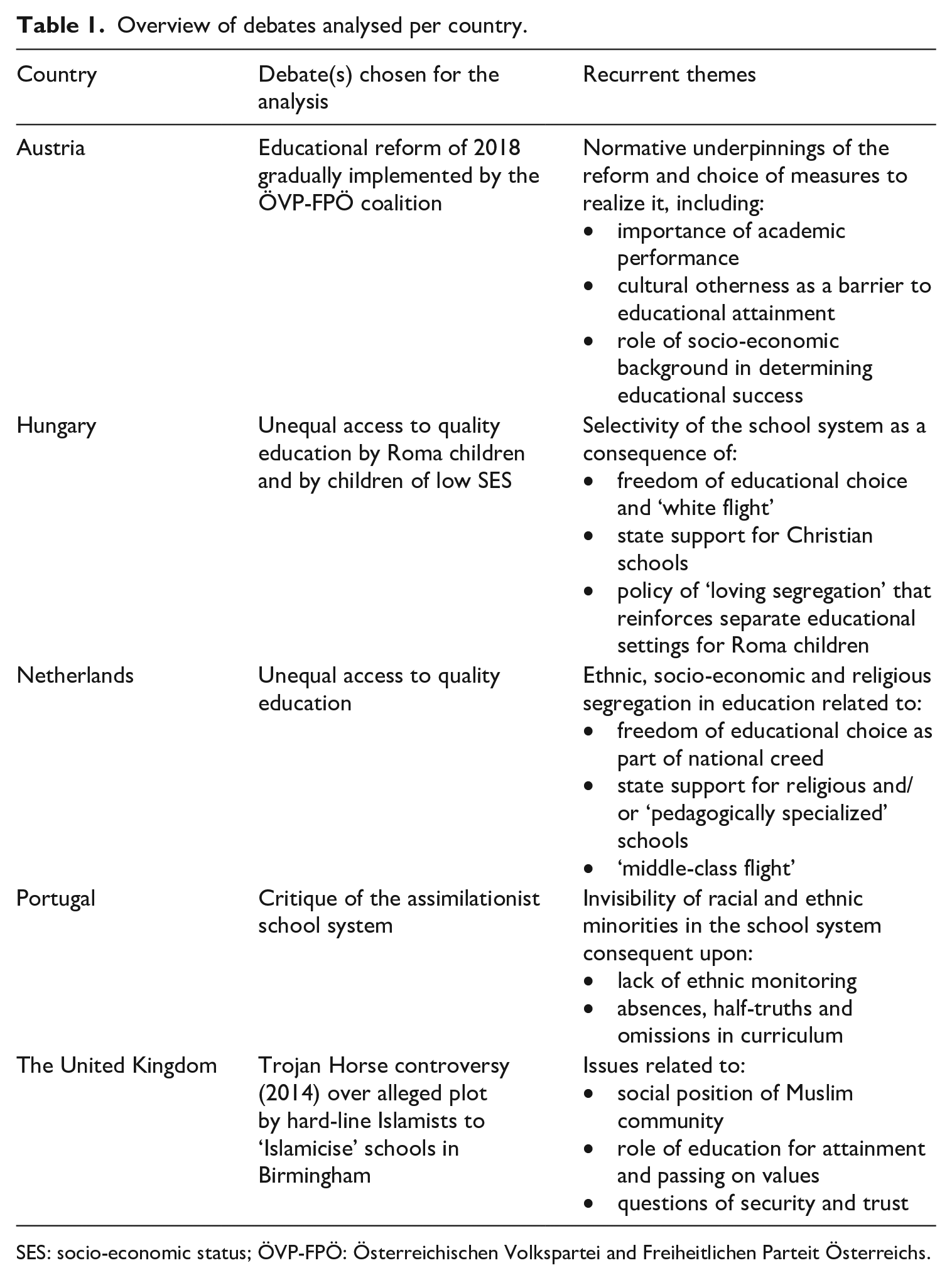
SES: socio-economic status; ÖVP-FPÖ: Österreichischen Volkspartei and Freiheitlichen Parteit Österreichs.
While researchers were free to choose a debate that best reflected justice-related tensions in (minority) education, all were asked to follow a similar methodology in data selection and analysis. The choice of news media was driven by the specificity of the media landscape in a given country, characterized, among other things, by (1) the level of media concentration, ownership, degree of pluralism and/or the breadth of the ideological spectrum of the mainstream media 3 ; (2) the popularity of specific outlets among the different sections of the population (with respect to SES); (3) the ideological profile (left-centre-right and independent); and (4) the format of the various media (traditional print and/or broadcast and exclusively digital). Balance was sought between media outlets representing different ideological stances 4 ; mainstream media and media addressing a specific target audience; and – to a lesser extent – traditional media and social media, understood as digital platforms for the creation and sharing of user-generated content. When sampling media items for analysis, attention was paid not to the ‘representativeness’ of specific items for the debate as a whole, which would lead to overrepresentation of dominant and/or culturally and socially permissible standpoints, but to their unique contribution to the pool of perspectives and arguments presented by a variety of actors involved: journalist and commentators, educators, academics, politicians, parents and citizens. The presence of multimodal content and/or online comments by audiences constituted an additional selection criterion. In each country, between 23 and 52 news items were analysed, together with the accompanying hyperlinked material (such as tweets, video clips, etc.) and a selection of audience comments (with the exception of the United Kingdom, between 63 and 272 per country study).
The analysis of the selected news items involved qualitative content analysis with elements of discourse analysis, where content analysis entailed systematic searching for underlying meanings, patterns and processes and careful mapping of themes and arguments used to convey a specific vision of justice, and where ‘discourse analysis’ came to the fore in our specific attention to both explicit and implicit meanings conveyed by the texts, for example via metaphors, allusions, similes, semantic and syntactic choices but also by omissions, as well as our focus on the (broader) context of communication. In all countries, our analysis was guided by questions about (1) discursive construction of (in)justice and descriptions of events that were interpreted by the content co-producers – journalists, sources quoted, commenting readers – through the lens of justice; (2) moral evaluations of actors, events, concepts as well as moral arguments evoked to support specific standpoints, or to justify or question the normative rightness of claims; (3) justice-related conflicts and tensions, such as those between different moral principles, visions of justice, social groups or institutions deemed responsible for the realization of justice; (4) causal interpretations, explanations or attributions of responsibility for grievances; (5) solutions advocated to address grievances; resolve conflicts; prevent or elevate injustice and secure justice. More details on the criteria that informed the choice of media, the sampling procedure and the analytical strategy can be found in Lepianka (2019).
Despite a shared methodology in data collection and analysis, the choice to analyse the salient debates in the investigated countries makes a straightforward comparison of case findings challenging. Each of the debates is submerged in very specific geo-political, social and temporal conjunctures that cannot be easily generalized to other contexts (cf. Barnett, 2016). Therefore, in this contribution, the various country cases are not directly compared but used to highlight tensions that emerged in the process of constant comparison and repeated re-reading of the case studies.
Results
What kind of injustice or whose injustice?
This contribution was anchored in Fraser’s (2009) tripartite framework of justice as recognition, redistribution and representation. Generally, the analysis showed that the way news media frame the various facets of justice in debates on education overlaps with how the various elements of Fraser’s framework are conceptualized in educational research, thus confirming the usefulness of Fraser’s analytical lens in disentangling the various forms of injustice that take place in the realm of education (cf. Keddie, 2012; Mills, 2013). Simultaneously, the investigation confirmed assertions by other researchers (cf. Milles et al., 2016) that Fraser’s tripartite typology is not necessarily exhaustive to account for all types of injustice in the realm of education. Alternative claims to justice, such as claims to procedural justice, epistemic justice or historical justice, often traverse the ideal-typical facets of redistribution, recognition and representation (for more detail, see Lepianka, 2021). Most importantly, the analysis exposed how tensions over the ‘what’ of justice in education, that is, the specific understandings of what is ‘just’ and ‘unjust’, are wrapped, albeit often indirectly, in tensions over whose well-being, if anyone’s, is, or should be, prioritized and on what moral grounds.
In Austria, for example, the more conservative media and their audiences emphasize how recognition of minority cultures and needs allegedly violates the principles of just distribution through preferential treatment of minority pupils and schools that accommodate them (e.g. through remedial teaching). A similar controversy is present in the Netherlands and Hungary, where the freedom of (White, middle-class, Dutch/Hungarian) parents to choose schools for their children is defended on the grounds, among others, of the educational abilities, achievements and aspirations of the (White, middle-class, Dutch/Hungarian) children that are likely to sink in ‘mixed’ schools focused on addressing the needs of the often mediocre and unruly pupils from weaker milieus (ethnic minorities in the Netherlands; Roma in Hungary).
Such arguments are opposed, sometimes fiercely, by more liberal, usually left-wing, media and their audiences who draw attention to the privileged position of certain types of schools, often denominational, and policies that prioritize freedom of educational choice (representative justice) over equal opportunities (distributive justice). The parental prerogative to choose the most suitable education for their children is thus criticized as disproportionately benefitting already privileged groups at the cost of children from weaker milieus, mostly children of colour (Netherlands) or Roma (Hungary), who are bound to suffer from the adverse consequences of the ‘white’ and ‘middle class’ flight and the ensuing educational segregation: strengthening inequalities in educational attainment, opportunity and social mobility. Moreover, in both the Netherlands and Hungary, it is often asserted that freedom of educational choice is not identical for all parents, but conditioned on parental resources in the form of economic, social and cultural capital: The freedom of school choice is relative and does not apply to everybody; I hear stories of [minority] parents who say they have been discouraged from [sending their kids] to schools with many ethnic Dutch. Even if you look at the school admission policy in Amsterdam (. . .) it seems that the freedom of school choice is limited. (Hülya Kosar-Altinyelken, social scientist, interviewed by Lorianne van Gelder for the Dutch left-wing Het Parool, 13 December 2016)
Yet, inter-group tensions underpin not only the representation of the potentially conflicting facets of justice (redistribution vs recognition, freedom of choice/representation vs redistribution) but also tensions between the various principles of or moral grounds for justice. For example, much of the Austrian debate on proposed educational reforms revolves around the fairness of the whole educational system and whether or not, or to what extent, it should aim at increasing educational attainment through uniform (‘equalizing’) standards and procedures that reward hard work, discipline and achievement (meritocracy) or, alternatively, through addressing individual needs and securing equality of opportunity through systemic redistribution (Tiefenbacher and Perschy, 2019). In essence, the tension touches upon the question whose interests the system should secure and/or whose needs it should accommodate: those of White middle-class children, whose economic and cultural capital allows for meritocratic competition, or those of minority children, often in need of remedial classes.
To a certain extent, such debates echo the tension between the principle of simple equality that requires similar treatment of all children, and the necessity to treat at least some children differently, either due to their disadvantage (principle of need) or because of their interests and capacity (desert) (Walzer, 1983). Only, in the debates analysed, the endorsement of equal/different and desert/need-based treatment of children is often underpinned by the presence/absence of neo-racism or classism (cf. Balibar, 1991), and entwined with questions of power, privilege, and victimhood. Thus, in Austria, the arguments for the reform that is supposed to revive the importance of standards and meritocracy in education, often entwine with claims, forwarded by right-wing and/or conservative media, that the presence of children who deviate from the Austrian majority in terms of culture, religious affiliation, language acquisition, and – allegedly – discipline and morality, negatively influences the school system, both in terms of knowledge transmission (educational quality) and safety (drugs, violence). The hard-working (implicitly White Austrian) students are here portrayed as victims of ‘the experiments of the leftist educational planners’ (‘Neue Regierung . . . ’ in a far-right blog Unzensuriert.at, 18 December 2017), cheated of their educational opportunities. In Hungary, on the contrary, the conservative pro-government media, tend to argue their support for segregated education by reference to the threat the ‘uncultivated’ and ‘morally deprived’ Roma children may pose to non-Roma as well as the well-being of the Roma children themselves. Particularly striking here is the rhetoric of ‘loving segregation’ that attempts to justify the necessity of segregated education by cultural otherness and special educational needs of Roma children ‘to practice the different rules of human co-existence’ and ‘[to learn] how to wash their hands and use the toothbrush’ (Gergely Szilvay in conservative Mandiner.keresztény, 4 June 2015). Through its essentializing quality, this rhetoric constitutes a form of mis-recognition; it can be also interpreted as a form of naturalization of the supposed inferiority of ethnic and racial minorities, observed as well in Portugal (Bicas et al., 2019), and/or naturalization of social inequality, which justifies differential treatment. Telling in this context is a comment by a reader of a Dutch left-wing political blog, who reflects on his own school experience: The goal [attending a segregated school] was to make sure you were among ‘our kind of people’, and not between the ‘plebs’. ( . . .) I know that I sound unbearably elitist, but it also makes sense not to confront children at a too early age with all the complications of diversity in social class and ethnic background. (Reader’s comment to an article by Erik Flentge, in Joop.nl, 4 April 2017)
Equally contentious are grievances of the historically oppressed groups, Afro-descendants and Roma in Portugal or post-colonial citizens in the Netherlands, which often tap into epistemic injustice, understood as unfair treatment in issues of knowledge, understanding and participation in practices of communication and deliberation (Fricker, 2007), and/or the injustice of mis- and non-recognition, for example, when their unique contribution to the national community is silenced or denied. Recognitive injustices are evoked particularly strongly in discussions about the assimilative agenda of schools, practices of obliterating ‘uncomfortable’ historical figures, events and processes and/or discriminating between ‘better’ and ‘lesser’ languages and cultural backgrounds. In Portugal, attention is drawn to the differential status of the vernacular versions of Portuguese, their exclusion from school curricula and how speaking non-standard versions of Portuguese, such as Cape Verdean Creole, is likely to disqualify one as a discursive partner; in the Netherlands and Austria, criticism is raised against the double standards applied when evaluating pupils’ multilingualism (Western vs non-Western languages). Problematized also is the lack of rhetorical space and means by which minority groups could contribute to Portuguese/Dutch canonical historiography with stories of exploitation, plundering, prosecution and extermination, and – more importantly – the consequences such ‘whitening of the program and the silencing of blacks as thinkers’ (Joana Gorjão Henriques in centrist Jornal Público, 16 September 2017) has on the sense of self-esteem and belonging of minority children: [In textbooks], ‘the central character is always a white child’ (. . .) A geography textbook (. . .) conveys the idea that non-whites ‘appeared’ in the country ‘spontaneously’. Non-white children continue to be treated as foreign and not Portuguese. ‘A non-white child born in Portugal reads that and wonders: why do I need to integrate?’ (. . .) ‘Based on what right are non-white children erased from schoolbooks? [Deprived of] the right to exist in their own country?’ (Joana Gorjão Henriques quoting researcher Nina Vigon Manso in Jornal Público, 9 September 2017)
Such claims are, however, often off-set by majoritarian grievances of minoritization. Channelled through right-wing or conservative media and in audience’s comments, a majoritarian sense of mis-recognition seems to result from the perceived disdain with which (ethnic, religious, cultural) minorities treat (supposedly) majoritarian values and ways of life, and the undue recognition of minority claims by government and/or state institutions – either now or in the past. On one hand, attention is thus drawn to homophobic comments and/or unfair treatment of girls and women by Muslims that violate the (supposedly) majoritarian sense of equality (e.g. in the United Kingdom and Austria). On the other hand, majoritarian grievances are underpinned by a feeling of being abandoned by policy and politics overwhelmed with the consequences of insufficiently regulated migration and inadequate (too lenient) integration policies that result in the apparent ‘surrender’ of the authorities to minorities’ sense of entitlement (Lepianka et al., 2019). One of these consequences is the alleged minoritization of national values, culture and language by ‘foreigners’ in schools. In the Austrian media, concerns are raised about Austrians who are becoming de facto ‘outsiders’ in ‘foreign classes’, classes dominated by pupils with migrant backgrounds. This concern is well captured in some readers’ comments: ‘Alright, so now half of the students [in classrooms overall] are not Austrians! That means that in a couple of years, the real Austrians will be a minority!’ (comment on an article in right-wing Kronen Zeitung, 12 September 2018), or ‘It won’t take much longer and we will be foreigners in our home country’ (comment on an article in Kronen Zeitung, 13 September 2018). In similar vein, in the Netherlands, media attention was given to the case of Mees, a 13-year-old Dutch boy discriminated against by his classmates as ‘the only boy with blond hair and blue eyes’ in a ‘black’ school (Roelf Jan Duin in right-wing AD, 18 October 2016). Then, there are the grievances of mis-recognition experienced through ‘misplaced’ and thus unjustified, in the eyes of the racial majority, accusations of racism as well as complaints about a growing number of ‘controversial issues’ that teachers – afraid of radicalizing (ethnic) youth – no longer discuss: Until recently, it was the Second World War, the Holocaust, Judaism and terrorism that were not discussed, nowadays this also applies to IS, Syria (. . .) racism and slavery. (Column by Nausicaa Marbe in right-wing Telegraaf, 2 February 2017)
The pertinent question of victimhood
In many of the analysed debates, one of the central, albeit often unspoken, questions, revolves around the issue of victimhood. Establishing who is the victim of policy (past or present), institutional failures and (in)action of some ‘other’ seems to constitute one of the necessary conditions to re-establish justice. In the more progressive, independent or left-wing media, minority members are usually portrayed as victims of (structural) neglect and institutional discrimination that prevents them from developing their talents and capabilities. In Hungary, they are presented as victims of governmental policy that serves the isolation-aspirations of the majority and, in particular, the interests of religiously minded elites. In Portugal, minorities are seen as victims of historically embedded institutional racism. In the United Kingdom, particular attention is drawn to the mis-recognition of the Muslim community in the form of false accusations and stigmatization through associations with terrorism and extremism; Muslim communities are also recognized as an object of witch-hunts by government officials, demonization and scapegoating.
If a minority group is construed as a victim by conservative, right-wing media, they are seen as a victim of self-exclusion and – in the case of Muslims – Islamic fundamentalism and extremism. In the United Kingdom, in the context of the Trojan Horse controversy, Muslim children were seen as victims of their own communities that prevent them from flourishing and, by cutting them off from the wider society, make them ‘vulnerable to segregation and emotional dislocation’ (Douglas Murray in centre-right The Spectator, 4 June 2014). Similarly in the Netherlands, right-wing audiences tend to blame Muslim parents for the educational lack of success, and in Hungary, pro-governmental media accuse Roma parents of ‘holding their children back’ (Tamás Velkai in conservative pro-government Mandiner, 24 April 2015). The consequences of such rhetoric might be far-reaching: a belief that somebody suffers harm or inequality as a result of their voluntary decisions and is thus responsible for their disadvantageous position may go hand-in-hand with a denial or relativization of injustices they might be suffering (cf. Gosepath, 2011).
Moreover, as illustrated in the preceding section, in much conservative, right-wing discourse, a discursive reversal of victimhood takes place, with the racial/ethnic majority featured as sufferers, unjustly deprived of what is their due: ‘Always but adapt to the minorities’, says a Dutch media user, ‘by which ordinary and talented pupils are [op]pressed’ (‘Slechte school prestaties . . . ’ in a rightist blog Geenstijl.nl, 7 January 2018). Such rhetoric may be indicative of the resistance of privileged groups to becoming aware of their privilege (Choules, 2007). It also underscores the immense moral power of victimhood and its appeal as a moral ground of justice. Particularly important here is the implied blamelessness of the victim, for example, in the opposition between sufferer and threat, and the moral consequences of viewing the issue of victimhood through an ‘either/or’ lens (cf. Clayton and Opotow, 2003; Deutsch, 2014). Enns (2012) stresses how absolving the victim from co-responsibility for shaping the socio-historical context in which injustice is taking place and/or searching for a better future, may ultimately deprive them of agency as moral actors. Our case studies show how claiming victimhood, especially by a majority, may thus deny victimhood to the other, the racial, ethnic or cultural minority, turning them into agents of majoritarian suffering. In Dutch and Austrian discourse, for example, this denial of the status of victim to Muslim minority groups takes the form of ‘blaming the victim’, making them responsible not only for their own position but also the position of the ‘new’ victim – the majority. Thus, ‘blaming the victim’ combines with ‘shifting blame’.
Such shifts in (media) discourse are hard to ignore, considering how media are shaped by the biases/agendas of the people and institutions involved and the broader culture. Moreover, since media have become a major site of political and ideological struggles among groups competing to frame reality in a way that emphasizes their definition of the ‘problem’, those who have access to institutional power have a huge advantage. This seems particularly true in countries in which media are deprived of independence, such as Hungary, but it is also apparent in Austria and the Netherlands, two countries where right-wing populism is increasingly winning the hearts of the public.
Differences between countries
Despite considerable differences between the socio-political and cultural contexts and the fact that in each country, a different minority-related controversy was investigated, the themes and arguments of the debates proved strikingly similar. Most of the observable cross-country differences in the discursive construction of justice-related tensions seem related to the peculiarities of the national educational systems (support for religiously grounded schools in Hungary and the Netherlands) and/or stem from the particular focus of the debates analysed. For example, conflict between freedom of choice in education versus redistribution of equal opportunities is hotly debated in the Netherlands and Hungary but absent in Portugal, which focuses instead on the conspicuous invisibility of minorities (Roma, Afro-descendants) in their school system. The latter is particularly interesting when contrasted with the ‘hypervisibility’ of Muslims in Dutch and Austrian debates – visibility that far exceeds the share of the Muslim minority in both societies. Other cross-country differences relate to the prominence of certain claims and/or their specific manifestation. For example, Austrian controversies over the primacy of specific ‘justice’ principles (merit vs need vs equality) in securing ‘just’ education, boosted by the imminent reforms to the Austrian educational system, do not exhibit similar intensity in other countries. Moreover, in Portugal, and to a lesser extent in the Netherlands, the question of ‘fairness’ brings up the issue of redress for descendants of post-colonial subjects – not an issue in Austria and Hungary. Those differences reflect the specific geo-political conjuncture in which the various debates take place (Barnett, 2016), which is reflected in the discursive representation of the group(s) construed as ‘other’: Muslim in Austria, Britain and the Netherlands; post-colonial subjects in Portugal and the Netherlands; Roma in Portugal and Hungary. Who is identified as ‘the other’ hence influences attribution of responsibility for current grievances and the repertoire of the imagined remedies.
Nonetheless, current analysis suggests that with respect to the discursive construction of justice, especially in delimiting inter-group tensions, differences between the various ideological camps the analysed media outlets seek to represent (left vs right wing, liberal vs conservative) are more pronounced than differences between countries. Generally, regardless of the medium they were published in, the media items analysed showed less eclecticism and nuancing in representing inter-group tensions than anticipated.
Conclusion
An analysis of ‘mediated’ debates on education provides a useful lens to explore those issues of (in)justice which occupy public minds, and what competing visions of what might constitute a just state of affairs concerning education are likely to affect public support for existing and future education policies. In this contribution, I focused on exploring how the construction of inter-ethnic tensions informs ‘folk paradigms of justice’ in the realm of education and how questions about the supposed ‘what’ of justice (e.g. redistribution vs recognition vs representation) and the ‘how’ or ‘why’ of justice (e.g. the principles of need, merit or equality) are intertwined, in news media discourse, by the imagined ‘who’ of justice.
The analysis of selected education-related debates that took place in news media in five European countries confirms the initial supposition that the various understandings of justice (the ‘what’ of justice) and/or moral grounds for the realization of justice (the ‘how’ and the ‘why’ of justice) are entwined with tensions between justice claims of different ethnic, racial and cultural groups. It also shows that among the various justice-related controversies in the realm of education, tensions around the imagined ‘who’ of justice, the (alleged) winners and losers of educational policies, and the perceived victims and victimizers are crucial. For example, the analysis highlights how, especially in the more polarized settings (left-wing vs right-wing media), injustices experienced by different groups (majority vs minorities) tend to be evaluated along different dimensions of justice and/or according to different (moral) standards. To illustrate, remedies/policies aimed at satisfying the recognitive grievances of minority members are framed in the conservative and/or right-wing media as violating the principles of equal or meritocratic distribution, and as such disadvantageous for White, middle-class children. Striking as well is the presence of a belief, voiced again in more conservative or right-wing media outlets, that some forms of inequality are natural, ‘deserved’ and/or inevitable, and thus no injustice at all. Another important finding revolves around the issue of victimhood. Current analysis shows how claiming victimhood, for example, by a majority, may be paired with denying the victimhood of ‘the other’, in this case minority, or even turning them into the agents of majoritarian suffering; that is, perpetrators of harm.
The results of the media analysis seem thus to echo the finding of social psychologists on the intersection of justice and identity. According to Clayton and Opotow (2003), identity affects whether and why people care about justice and determines whose justice matters. What is perceived as just/unjust, whether or not the perceived injustice matters, which dimensions or aspects of justice are attended to, or what (distributive) principles are chosen to evaluate (in)justice can depend on the degree of one’s identification with a group. The analysis of public discourse presented in this contribution also shows that what is discursively framed as fair and unfair in matters of education, and what kind of justice is seen by the public as worth pursuing, differs according to the perspective taken (majority vs minority), and especially the perceived status of various groups as insiders or outsiders of the assumed moral community. This means that fostering social justice in education, and especially securing broad public support for any measures chosen, requires first of all a widening of the scope of justice, that is, redefining the boundaries of justice. The media material investigated for this study provides few examples of how to break through the us–them rhetoric and successfully embrace diversity in education. Nonetheless, the literature on justice and conflict resolution offers some hopeful hints on how programmes aiming at conflict resolution, mediation and restorative justice could help enhance awareness of the intimate connection between conflict and injustice, expand one’s moral inclusion, and develop insights into the processes involved in forgiveness and reconciliation (cf. Coleman et al., 2014; Opotow, 2018).
Footnotes
Acknowledgements
I would like to thank ETHOS researchers whose country reports informed this study: Mara Bicas, Maria Paula Meneses and Laura Brito (University of Coimbra, Portugal); Susan Divald (University of Bristol, the United Kingdom); Jing Hiah and Simon de Jong (Utrecht University, the Netherlands); Agnes Kende (Central European University, Hungary); Wanda Tiefenbacher and Livia Perschy (European Training and Research Center for Human Rights and Democracy, Graz, Austria).
Funding
The author disclosed receipt of the following financial support for the research, authorship, and/or publication of this article: The research presented in this contribution was funded by the EU Horizon 2020 research and innovation programme (under grant agreement No. 727112).
