



Abstract
People (re)act differently when facing the pandemic. Multiple opinions about COVID-19 and related issues prevail, both in personal meetings and in (social) media. This article aims to illuminate different ideal types and handling strategies in early stages of the pandemic. A thematic Braun and Clark, and Weber inspired analysis of qualitative data from an international web-based survey was carried out in two steps. First, five ideal types related to handling the COVID-19 pandemic were constructed: the Stickler for the rules, the Challenger, the Fact hunter, the Idealist, and the Entertainer. Second, the ideal types were represented throughout four themes: Divided opinions on politico-medico restrictions, Multifaceted picture of the pandemic, Social media as a lookout point and source of insight, and The future between hope and fear. The results illustrated the complexity of people’s understanding of, (re)actions to and handling of the pandemic.
Introduction
In light of the pandemic, medico-political COVID-19 strategies are deployed to control COVID-19 cases by isolation of ill persons, contact tracing, prevention, and minimisation of the virus’ spread through hand hygiene, respiratory etiquette, and physical distancing (World Health Organization (WHO), 2020). In general, the voices of the privileged positions in society have greater power than the less privileged positions, also in terms of disease understandings and defining related strategies (Boelsbjerg and Glasdam, 2022; Bourdieu, 1996; Chang et al., 2016). However, both governments (Gjerde, 2021; Nygren and Olofsson, 2021; Ortega and Orsini, 2020; Seing et al., 2021) and individuals (re)act differently when facing diseases or crises (Boelsbjerg and Glasdam, 2022; Chang et al., 2016). Individuals’ strategies related to new life situations, such as the pandemic, are based on habitus, capital, and social position in society (Bourdieu, 1995). Individuals’ strategies are also related to the strategy of their country of residence (Seing et al., 2021; Stjernswärd et al., 2021a). The current pandemic has earned the title of ‘infodemic’ due to the massive amount of information circulating through varied channels (Gallotti et al., 2020). Across the globe, different political strategies are deployed during the crisis engendered by the pandemic, also illuminating underlying ideologies and paradoxical tensions. While some countries such as Brazil displays a mix of neoliberal authoritarianism, the denial of science and a collapse of public health leadership (Ortega and Orsini, 2020), other countries display an initial move from liberalism with the safeguarding of individual freedom towards more interventionist biopolitical approaches as the spread progressed, with subsequent restrictions of freedom and economic progress in favour of safeguarding lives (Gjerde, 2021). In other countries, the governments rely on its population’s individual responsibility, voluntary action, and restricted regulations from the government, as seen in Sweden (Nygren and Olofsson, 2021). From a global perspective, (inter)national political strategies seem to function as biopolitical management tactics to handle the COVID-19 spread, aiming to discipline individuals, incorporating the ‘new normal’ for social and infectious prophylactic ‘right’ behaviour in the countries’ respective populations (Marusek et al., 2021; Timotijevic, 2020; Wagner et al., 2021).
Communication through social media is an integrated part of public health interventions by (inter)national health organisations and health authorities in the handling of the pandemic (Li et al., 2020). Considering COVID-19 and related management strategies, institutions and individuals isolated through lock-down, quarantine and other restrictive measures may have increased the use of social media for information and communication purposes (Vraga and Bode, 2021). The consumption of COVID-19 information through social media can be beneficial to keep informed and prevent the virus’s spread. It can also lead to privacy breaches and information overload adding to the COVID-19 ‘infodemic’ (Gallotti et al., 2020). Media portrayals and contents of health-related issues affect people’s social constructions and perceptions of health and disease and allow people to share, evaluate, and challenge information by experts (Lupton, 2013). Digital technologies have led to a blurring of private and public spheres and the co-creation of health related material by private and institutional actors (Svalastog et al., 2017). Traditional views on health and disease can mix with competing, alternative views, co-created by digital visitors. These may in turn affect people’s understanding of and reactions to public health information and interventions that do not take these variated views into consideration (Svalastog et al., 2017), with people compiling different strategies for handling the pandemic.
Articulations about COVID-19 reveal something about the individuals that express them, their strategies, and cultural contexts and ideologies the individuals subscribe to. Multiple opinions about COVID-19 and related issues prevail, both in personal meetings and in (social) media. Altogether, these articulations draw a complex picture of the understanding of, and strategies related to the pandemic, both at individual and societal levels. Therefore, to understand the complexity of the pandemic, it is important to explore people’ strategies related to COVID-19. One way to understand strategies is to construct ideal types (Weber, 1978), which can shed light on human strategies through the construction of extreme characters or characteristics, expanding on the understanding of people’s (inter)actions during crises. Inspired by Weber, Tengland (2012), for instance, constructed ideal types of health promotion approaches, namely behaviour-change interventions, and empowerment, which were then discussed in terms of ethical dilemmas and autonomy. An ideal type is formed from characteristics and elements of the given phenomena, but it is not meant to correspond to all the characteristics of any one case. The idea is to stress certain elements common to most cases of the given phenomenon. The use of the word ‘ideal’ refers to the world of ideas where ideal types are idea-constructs that help put the seeming chaos of social reality in order. It is a methodological utopia that cannot be found empirically anywhere in reality, but it allows empirical reality to be ordered intellectually in a valid manner (Weber, 2012). The construction of ideal types can be related to a society’s characteristics in terms of social reality, historically defined ways of thinking and living, and particular behaviours. In that way, constructions of ideal types offer to understand the current pandemic and related phenomena, including individuals’ and organisations’ (inter)actions. This article aims to illuminate the different ideal types related to handling early stages of the COVID-19 pandemic.
Method
The method was based on a Braun and Clarke (2006) and Weber (1978, 2012, 2017) inspired thematic analysis of qualitative comments from an international survey about COVID-19 and social media.
Data collection
The survey’s main aim was to explore people’s use of social media related to information on COVID-19, with focus on sources, types, and effects of COVID-19 information, including the collection of both qualitative and quantitative data. The survey was a structured online questionnaire with 29 questions with multiple choice or Likert-type scale response alternatives. It included socio-demographic questions, such as age, sex, country of residence, educational level, and employment status. Links to the survey were set up on Lund University’s (Sweden) website and spread through snowballing online, including the use of the authors’ networks and social media platforms (e.g. Facebook, Twitter, Instagram). The quantitative data has been reported in other articles (Stjernswärd et al., 2021a, 2021b); Most survey questions, which focused on uses of social media (e.g. types, sources, reliability) to locate COVID-19 information and its effects on users, included a space for free text answers, where informants could freely complete/comment upon the multiple choice/Likert-type scale answers and add further reflections related to COVID-19, related information, and social media (‘You are welcome to comment upon/develop your answer here’). The only specified inclusion criteria for participation was age (⩾ 18 years). The survey was available in eight languages from April 7th-28th 2020. The qualitative data was unexpectedly ample and rich. The current article focussed on qualitative data consisting of the participants’ free text answers, with specific focus on discursive diversity in the form of different articulations about strategies related to the pandemic.
Participants
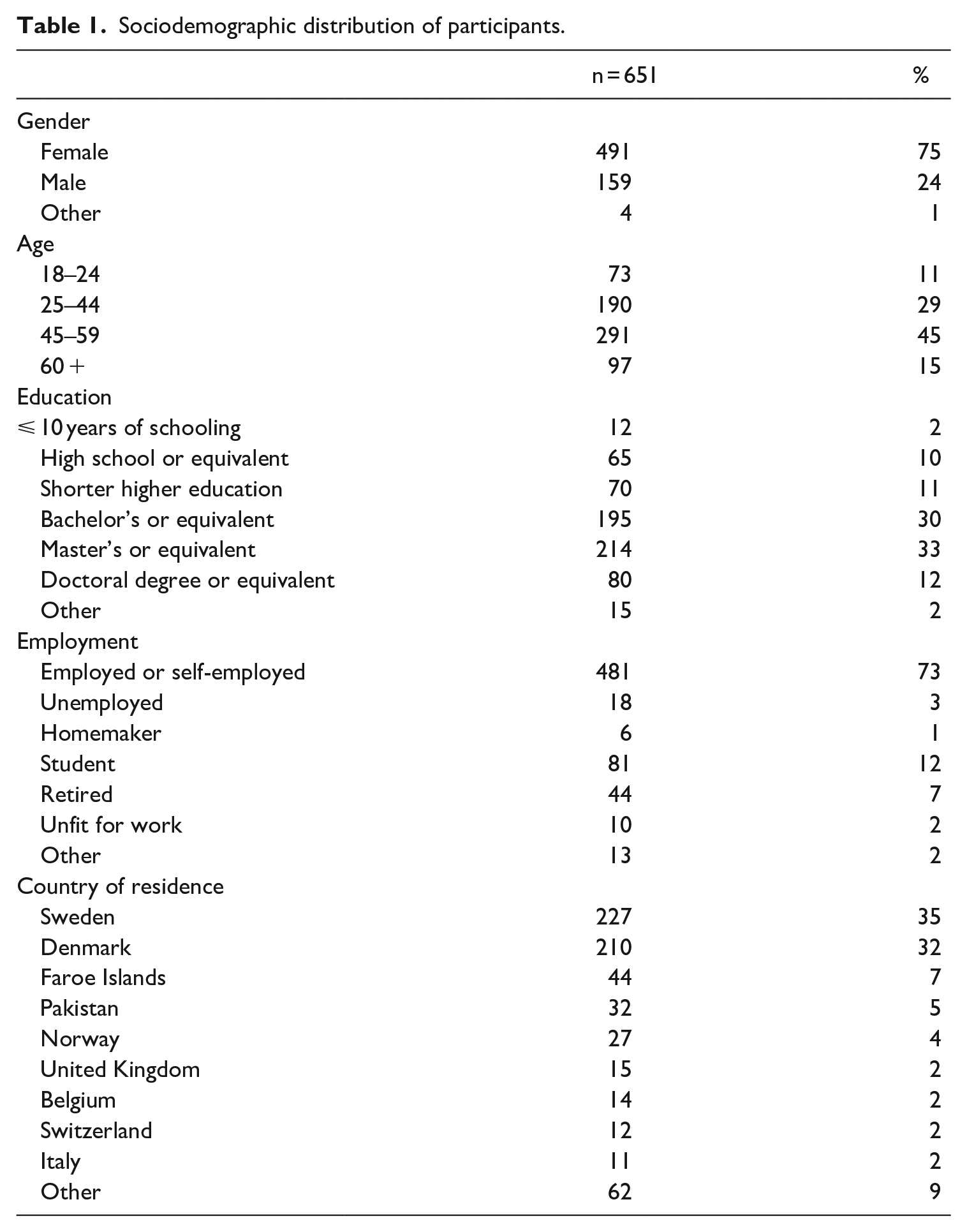
Out of the main study’s total sample of 943 participants, 651 participants replied with one or more free-text comments. In the current sub-sample (n = 651), 57% of the participants responded with 1-3 comments, 22% with 4-5 comments, and 21% with ⩾ 6 comments (range 6-16). The current sub-sample was largely like the total sample in terms of sociodemographic characteristics (Table 1), with residents from 29 countries.
Sociodemographic distribution of participants.
Analytical strategy
The thematic analysis was a creative process, methodically inspired by Braun and Clarke (2006) and theoretically inspired by Weber (1978, 2012, 2017). The analytical process followed two analytical steps, inspired by Glasdam (2007). All comments from the questionnaire were exported to a word document (103 A4 pages), which was read several times for familiarisation with the empirical material. The comments were treated as a unified narrative expression of spontaneously written responses to the questionnaire, and as such, the comments were considered as articulations on COVID-19. The analysis’ first step focused on discursive diversity in the material, inspired by Weber’s (1978, 2012, 2017) concept of ideal types to understand different strategies to handle the COVID-19 situation. The construction of ideal types emphasised certain elements that were common features of the phenomenon, clarifying patterns of behaviours, and so on. by putting things at the forefront and isolating these properties in their extreme. An ideal type was formed by the one-side accentuation of one or more points of view and by the synthesis of a diffuse, discrete, more or less present and occasionally absent, concrete individual phenomena, which were arranged according to those one-sidedly emphasised viewpoints into a unified analytical construct. The analysis did not focus individuals or their nationality, but different patterns of articulations that arose in the comments. It meant that it was not possible to point back to individual respondents. As such, the ideal types were qualitative constructions, based on different patterns in the written articulations. It also meant that individuals in principle can be represented in one or more ideal types (Glasdam, 2007). We focused prevalent traits among the articulations in a one-sided way, combining them into an ideal image and setting them in relation to a thought expression manifesting itself there. The ideal types were hence not formed out of a nexus of purely conceptual thought, but were created, modified, and sharpened through the empirical analysis of articulations about handling the COVID-19 situation. Therefore, the comments were sorted through a process, where the empirical material was broken down and reduced, to code and reorganise the contents.
Through this process, it was possible to construct different patterns of articulations about the pandemic through which we constructed five ideal types, pointing to different kinds of strategies. The analysis’ second step was based on similarities and differences within and across the five constructed ideal types in terms of themes that these different ideal types echoed through their articulations. Initial themes were thus constructed based on the coded material. The themes were reviewed and further developed in a consensual process of analysis among the authors, also making sure that the themes appropriately reflected the empirical material. Both researchers initially carried out the described steps separately, then co-jointly. In that way, the four themes were refined, defined and named: Divided opinions on politico-medico restrictions, Multifaceted picture of the pandemic, Social media as a lookout point and source of insight, and The future between hope and fear. Quotes that clearly exemplify the themes and the respective ideal types and articulations in question served as illustrations of the analysis.
Ethical considerations
The study adhered to the ethical principles of the Declaration of Helsinki (World Medical Association (WMA), 2013). Participation was voluntary. Data was collected anonymously through a web-based, public survey link, which included information about the study. Responding to the survey implied a written informed consent by ticking an approval box.
Results
The five constructed ideal types related to handling the COVID-19 pandemic’s early stages, consisting of the Stickler for the rules, the Challenger, the Fact hunter, the Idealist, and the Entertainer, have their voices represented throughout the themes, which come through as central issues of concern in the empirical material. In short, the Stickler for the rules was characterised by being adamant in following rules and recommendations, while the Challenger challenged these in different ways, and the Fact Hunter self-handedly sought proofs and a nuanced picture based on (scientific) facts. For the Idealist, the pandemic formed the basis of visions for a brighter future, while the Entertainer reacted to the situation with a humorous and entertaining tone putting forward both praise, support, and criticism.
Divided opinions on medico-political strategies
The Stickler for the rules articulated behaviours or appeals towards behaviours in line with the official COVID-19 related rules of the ‘new normal’ pertaining to social distancing and thorough hand hygiene, both from private and professional perspectives. Such articulations could be understood as a reflection of individuals’ strategy and adaptation to new behavioural rules and calls to others to comply with these rules.
Use masks. Wash your hands. Stay at home. (Stickler for the rules)
For the Stickler for the rules, it seemed necessary and right to strictly follow the rules. Concurrently, the Stickler for the rules took on the role of prompting others to follow these rules. Among other things, the Stickler for the rules used social media in this upbringing project, both from professional and private roles: I’m constantly updated especially on the measures applied for the containment of the virus as I take care of the Facebook page of the municipality and I keep in contact with the population, also I chair a group of volunteers. (Stickler for the rules)
However, the Challenger perceived the Stickler for the rules as interpreting the rules too strictly: I get tired of people’s judgmental behaviour towards others. The way people glorified their own behaviour. Their doomsday perception. (Challenger)
The Challenger contradicted its country’s strategy and underlying political agenda pertaining to the COVID-19 pandemic. This thus represented an expression of disagreement with the respective country’s dominating discourse on COVID-19: I personally don’t agree with Sweden’s strategy on the Corona crisis. I feel that the broadcasting of information in Swedish media is vastly different from international media. (Challenger) I’m deeply concerned about potential vaccine mandates and untested extensions of ‘social distancing’;[. . .] that people remain suspicious and paranoid and that all this definition of our existence will make us more susceptible to future diseases. Symbiosis with nature is completely forgotten! (Challenger)
The Challenger met the dominating medico-political COVID-19 strategy using a diversity of defiant strategies. As multiple countries with varied political approaches to handling the pandemic are represented in the articulations, the Challenger’s opposition to the respective country’s dominating strategy can refer to strict versus liberal approaches, which per se may differ radically. One strategy was to ignore or go against official advice: It is important to do what I usually do. Otherwise, I have no life anymore. (Challenger)
Another challenging strategy from the Challenger entailed articulations of views on disease and treatment that deviated from the dominant medical view. This strategy was questioning the dominant COVID-19 strategy per se: I miss knowledge about the strengthening of our immune system, the strengthening of our thoughts and feelings and its meaning in relation to disease. (Challenger)
A third kind of strategy was in line with the medical logic but was critical of the lack of use of historical knowledge and experiences: I miss information from healthcare, social and traditional media about what you can do yourself to, for example, breathe easier. (Challenger)
Moreover, a fourth strategy that could be viewed as expanding the dominant medico-political discourse on COVID-19 entailed faith and turning to religion: My confidence levels go up and down bcz of my Islamic point of view like signs of Qimat or signs of Imam Mehdi’s zahoor. (Challenger)
The Fact hunter did not accept the medico-political explanations and restrictions unconditionally but supported the medical logic in handling COVID-19. The Fact hunter tried to get an overview of the COVID-19 situation through scientific facts and assessed both the situation and the strategies in relation to these facts, whether as layman or in professional roles. Healthcare professionals, for instance, sought facts to carry out their job and keep abreast of scientific findings and political strategies in relation to COVID-19: I [physician] don’t completely agree with the Danish strategy based on the Danish Health and Medicines Authority’s recommendations. I believe that we should have listened more to the WHO and looked at countries like South Korea, Taiwan and Vietnam, which have managed to contain diseases more effectively. (Fact hunter) The intensification is due to a Facebook forum for physicians–provides a lot of information from very good sources. (Fact hunter)
Also, the Entertainer used humour as a political voice, with jokes being seemingly more harmless for exposing political views than direct critique, which can include a questioning of strategies pertaining to the pandemic: [Posted on social media] Jokes about Trump. (Entertainer)
Moreover, both the Idealist and Challenger were questioning COVID-19 as the actual main problem in society, where the Idealist focused on for example, climate and public health and hoped that the pandemic could pave the way for a better global and planetary future, while the Challenger addressed issues such as the economy, which risked being overthrown by governmental measures. However, it did not necessarily imply that the Idealist did not support the medico-political strategy in the pandemic: One question I haven’t been able to find an answer to is how much the economic consequences have influenced the decisions in the different countries! (Challenger) The climate is a bigger concern than corona. (Idealist)
The Stickler for the rules regarded the Challenger as a communicator of untrue and false information, ranging from conspiracy theories and ignorance to religious dystopia: There is an incredible amount of wet, unscientific nonsense and pictures/videos where protective equipment is used and removed in ways that are directly wrong. Very unfortunate. (Stickler for the rules)
Further, the Stickler for the rules contradicted the Fact hunter and Challenger and pointed to the necessity of following the authorities’ recommendations and decrees, rather than acting on one’s own, individual opinion about the COVID-19 situation. The Stickler for the rules also tried to influence the state to impose stricter rules than the prevailing ones, and so took on the role of rule writer: These aren’t issues that are up to everyone to decide on; therefore, you should listen to official updates [. . .] and follow this advice. (Stickler for the rules)
Multifaceted picture of the pandemic
The Fact hunter expressed a quest for knowledge and comprehension, which entailed gathering information from differing perspectives, and not limiting oneself to single sources or points of view on the subject: Information from the Guardian, for instance, to obtain other perspectives than the Danish one. (Fact hunter)
In addition, the Fact hunter displayed an active pursuit for information and experiences related to the COVID-19 situation from different countries, both by sharing experiences from one’s own country of residence and scanning information about the situation in other countries. Sharing and comparing information across different countries was also a way to gain knowledge about the consequences of differing COVID-19 strategies: Reflections about the situation we ourselves and others find ourselves in and the consequences of the Swedish authorities’ standpoint [.....] plus comparisons between information from the Swedish authorities with crisis information from their British counterpart. (Fact hunter)
The Challenger challenged the Fact hunter, problematising the data’s evidence because COVID-19 was new to everyone: As it’s a completely new situation and a new virus, it’s difficult to know what’s reliable. Even if it comes from an authority such as the Public Health authority, the information has been revised in recent weeks and therefore it’s difficult to assess the reliability. (Challenger)
The Challenger criticised scientific knowledge for being ‘guesswork’ and ‘beliefs’ more than scientifically justified. Such articulations thus went against the Fact Hunter, which proclaimed the trustworthiness of (scientific) facts: The large amount of conflicting information, incorrect information, and confusing statements can lead to confusion among people who are less able to figure out what’s going on. Neither politicians, the media nor scientists always do their jobs well in this regard. (Challenger)
The Stickler for the rules also articulated a wish to obtain ‘redress’ or share a ‘fair’ picture of the situation in one’s own country for others to see how ‘it really was’. This motivated the sharing of information on the COVID-19 situation in one’s own country of residence and pointed to an apprehension of other people’s understanding of the situation in the country in question as not being in line with ‘reality’, that is, as incorrect, or misleading: To give relatives and friends in the USA a correct picture of the situation in Sweden. (Stickler for the rules)
The Idealist saw the pandemic from a perspective that could facilitate global, social change, adding an expectant outlook on the situation: The world is developing into a better place to be. That we gain some new insights into our way of being in the world and the way we treat it. (Idealist)
For the Entertainer, art represented a means to understand and reflect over COVID-19, as art offers an inherent freedom to speak against different ideas, attitudes and common-sense knowledge in society and opens viewpoints on COVID-19: I find new insights and opportunities for reflection on the situation in art and literature, etc. (Entertainer)
Social media as a lookout point and source of insight
Social media represented platforms to support varied viewpoints. The Challenger articulated social media as a place for auxiliary opinions to flourish: I thought there was very little focus on taking into account the weak and vulnerable–and more focus on the rights and demands of the resourceful. Social media is used as a platform for a growing mob that does not recognise the authorities, because the many injunctions limit their options. (Challenger)
People sought facts to understand and handle their everyday life during the COVID-19 pandemic. The Fact hunter pinpointed that social media platforms should not be the sole, nor necessarily trusted, information channel: I would never derive a decision base for myself and/or my family situation from information on social media. I’d **always** make sure to find reliable sources, either in the form of trustworthy news sites, the WHO, researchers, and/or medical professionals. (Fact hunter)
The Fact hunter, whether seen from a private or professional perspective, had great confidence in the medical sciences and associated developments; facts which could be accessed also through (social) media: Due to a predominance of researchers in my twitter feed, there are many links to publicly available peer-reviewed studies and analyses from prominent researchers, thus social media is a good gateway to reliable information. (Fact hunter) Faroese radio and television use experts in infectious disease, the national doctor and others in the epidemic commission. They set rules that we then abide by. It feels safe. (Fact hunter)
The Fact hunter pointed to an idea that (medical) facts made people feel safe in relation to COVID-19. Contrarily, politicians could make people feel unsafe, as political moves made it difficult for people to differentiate between medical facts and political strategies. Social media represented platforms for participation in the pandemic related information flow: [Motivation for posting on social media] A desire to spread factual information, rather than rumours. (Fact hunter) Although I mostly use official, health professional sources, I find it difficult to navigate what is health professional initiated and what are political decisions and efforts. (Fact hunter)
The Challenger also pointed to a process of actively seeking, thinning out, and critically assessing information, not least in social media. It indicated acts of sorting out facts from opinions, and benchmarking own reflections against others’, while pinpointing the democratic rights of freedom of expression and opinion. Reading about others’ thoughts on COVID-19 was expressed as a way to calibrate one’s own knowledge and reflections on the subject against other people’s understanding of the situation.
Those I follow [on social media], I trust that they stand for what they think. Then you’re allowed to think differently. You sort out the lunatics and those who only run their own agenda. I think it’s going well, but I realise that I, like others, streamline my flow with others who may not feel like me but who think like me. (Challenger)
Also, the Idealist used social media platforms to sermonise and share opinions: [Shared on social media] To assert opinions leading to reflection/to put pressure on solutions after the coronavirus/to influence more ecology/to give a voice to people whom one cannot hear on TV/to broadcast messages asking for help. (Idealist)
The Stickler for the rules understood the strategies of the Challenger and Idealist as interpreted through social media postings as other people’s simplistic and shallow understanding of the situation. These generated expressions of frustration. The Stickler for the rules understood loyalty to the medico-political strategy as a safety strategy to achieve good outcomes for humanity: I get angry if people behave selfishly and don’t follow the authorities’ recommendations. I get angry with people who take advantage of the situation and try to beat/exploit others. (Stickler for the rules)
The Entertainer used social media platforms for distraction and making people laugh by sharing jokes, funny stories, satire, music, and poems about the COVID-19 situation: I think especially on social media, there are many people who take a humorous, positive approach to the lockdown. (Entertainer) [Posted on social media] Artists (musicians and writers) with life-affirming messages in the time of the corona. (Entertainer)
The future between hope and fear
The Idealist pictured the COVID-19 crisis as an opportunity to reflect upon and re-consider individuals’ and society’s lifestyle and to change the world for the better. The Idealist saw an opportunity to overthrow or re-think current and future societal orientations: I feel hopeful that this will bring a wakeup call that our society as a whole can rethink that way on. Life of consumerism is not sustainable. We need a break in our habits to understand that we’re in this together. (Idealist)
The Idealist expressed hopes of global and societal improvements. These encompassed climate issues and the organisation of healthcare services, but also individual acts of solidarity towards fellow citizens. There were expressions of appreciation of the simple things in daily life and of things previously taken for granted: I hope that we take something with us in life after this experience together. As human beings but also on a level greater than ourselves. Climate change, consumption, etc. (Idealist)
The Idealist was not free of worries or criticism. The critique was at times based on a social critical approach to many years of economic governance in Western countries, which has sought to solve the world’s problems through economic profit thinking, with unfortunate consequences for the climate and the healthcare system. Nonetheless, the Idealist expressed hope for the future and a belief in gaining collective knowledge and wisdom from the crisis: In the short term, I look to the future with concern [. . .]. In the long term, I look to the future with confidence in view of the discussions about our healthcare, crisis preparedness and society. I hope that our rulers realise the shortcomings of the healthcare policy that has been pursued in recent decades and equip rather than slim down healthcare. (Idealist)
Opposite, the Challenger saw the COVID-19 pandemic as a threat to the current societal organisation and way of living in Modern societies, where the Challenger could point critically at a country’s prevailing ideology: I don’t think the virus is the most dangerous part of this crisis. The financial impacts on society will be colossal and we’ll see suicide and mental health issues spike. Is it worth it? (Challenger) The economic consequences [. . . ]! (Challenger)
However, the Stickler for the rules went against the Idealist’s hopeful tone and outlook, expressing a more mitigated view and concerns about the future. Opposite to the Idealist, the Stickler for the rules also expressed a longing for things to return to what they were, a disillusionment regarding potential lifestyle and societal changes: I worry because our power is limited, and the world could get much worse. It’s high stakes. (Stickler for the rules) [Shared on social media] Thoughts on twitter that I want things to be like before. (Stickler for the rules)
Entertainment in different formats was regarded as a meaningful way to keep up the mood and hope during the pandemic: Poems and short videos are snapshots that can hopefully help people keep up the mood in a difficult time, and perhaps it can have artistic significance in the long run. (Entertainer)
The Entertainer contemplated the COVID-19 situation through a humorous lens. At times, it tended to downplay everyday problems related to the pandemic and emphasised the need for entertainment and humour, which were easily accessible through social media, to handle the crisis: I have laughed at an incredible number of jokes and funny movie clips [about COVID-19]. (Entertainer)
As expressed by the Entertainer, humour served different purposes. Through jokes and satire about COVID-19 and the global crisis, humour helped keep the painful reality at a distance, while still acknowledging the situation’s seriousness: [Posted on social media] Get a chance to laugh a little at the misery. (Entertainer)
Humour was also used to displace the challenging, and at times unbearable, present.
Get your mind off the ugly with humour. (Entertainer)
Furthermore, humour was used to show and share random and fun moments from daily life during the pandemic and to brighten daily life through uplifting and meaningful contents: Sometimes a little boasting. We got a semi-viral spread on LinkedIn when we donated some alcohol to the children’s clinic. No eyes dry. (Entertainer) [Posted jokes on social media] For entertainment and encouragement. (Entertainer)
The Entertainer seemed to function as a parallel or extended strategy in relation to the other types’ strategies, with an ability to amplify their messages.
Discussion
The ideal types articulated strategies to handle the pandemic and echoed themes representing issues at stake in dealing with early stages of the pandemic in daily life. First, we discuss how the constructed ideal types fit into the dominant medico-political discourse, while both supporting and contradicting each other. Second, we discuss the ideal types’ representation in social media in relation to the phenomenon of apomediation. Third, we discuss how the ideal types’ respective strategies can be regarded as reflections of different health behaviours and handling strategies during early stages of the pandemic. Finally, we discuss the study’s methods.
The results showed how the ideal types’ strategies fit into or challenged the dominant medico-political discourse and that they both supported and contradicted each other. Such contradictions or tensions were also visible for some of the ideal types. The Challenger’s articulations, for instance, could oppose national strategies in diverse countries, whose governments deployed more or less opposing management strategies and political approaches to the pandemic. However, by challenging the national strategies as opponents of the government in their country, they can support or not support the WHO’s (2020) international recommendations. Hence articulations from the Challenger could paradoxically oppose both strict or liberal strategies as also Seing et al. (2021) showed. Apparently, the Stickler for the rules, Fact Hunter and Idealist generally subscribed to and consolidated the dominant (national) medico-political strategy regarding COVID-19 (Glasdam and Stjernswärd, 2021; Seing et al., 2021). They more or less accept the discourse’s medico-political premises and adapt to the ‘new normal’’s health behavioural rules (Timotijevic, 2020). Nonetheless, although individuals behind the articulations are not in focus, the informants’ diverse contextual backgrounds must be taken into consideration as they represent a range of diverging countries with their respective strategies to handle the pandemic, going from strict governmental and legal restrictions to more liberal approaches relying on the individual citizen’s sense of responsibility to follow protective and/or authoritative recommendations. It may seem that many people in a global health crisis are first and foremost loyal to their own nation’s local political strategies rather than the recommendations of international health organisations (Béland et al., 2021; Ortega and Orsini, 2020). An international study including 14 countries with advanced economies shows that most people approve of their respective national response to COVID-19 (Devlin and Connaughton, 2020). Unlike the other types, the Idealist demanded that the COVID-19 situation’s gravity leads to reflection and action on a wide range of societal issues. Issues that have been downgraded to conditions for economic gain in a long-standing neoliberal governance of society, for example, healthcare (Glasdam and Oute, 2019; Sakellariou and Rotarou, 2017) and climate (Shilomboleni, 2020). The Challenger threatened and challenged the dominant medico-political strategy related to COVID-19, with resistance always being a possible consequence of any exercise of power (Foucault, 1995). Thus, depending on the national context, the different ideal types can support or oppose the national strategy and by extension challenge international recommendations (Stjernswärd et al., 2021a; Béland et al., 2020; Devlin and Connaughton, 2020). The Entertainer, however, both consolidated and challenged the medico-political strategy using humour, art, and literature. Arts and humour can be powerful tools for fending off or transforming undesirable situations into desired, controllable situations, while also indirectly ridiculing individuals’ priorities or mocking human frailties behind a compassionate outward expression (Bergson, 2009). They can also be tools to create hope (Falanga et al., 2020). The results showed that the pandemic has not rendered humans powerless, as also Higgens et al. (2020) argue. No one can predict this crisis’s future and the ‘Coronacene’s’ outcomes, for instance in terms of societal power shifts (Higgins et al., 2020). It also applies to the power of the various ideal types in relation to their potential ability to influence and change the dominant medico-political strategy and logic regarding COVID-19, and thus the power balance in society as such. Societal power relations may nonetheless affect the ability to be heard depending on social precondition (Bourdieu, 1995, 1996); The ideal types illustrate the dynamics between a diversity of experiences and opinions on COVID-19 and related handling strategies. How these contradictions reflect in people’s actual behaviour, for example, health behaviours, can however not be answered in the current study. All ideal types function as meaning-makers during crises, and can serve as therapeutic vehicles for empowerment, solidarity, and collective action in adopting the situation (Gupta, 2020). Understanding and listening to different voices in society contributes to illuminating the myriad of intertwined psychological and social complexities related to COVID-19, taken into consideration that what is understood as (true) information, misinformation, or disinformation is dependent on the viewpoint of information consumers and influences affecting their perspectives (Glasdam and Stjernswärd, 2020).
The current results showed that multiple voices on COVID-19 were articulated through social media. Social media can function as a breeding ground and extended mouthpiece to make one’s voice heard, facilitating freedom of opinion and speech (Wolfsfeld et al., 2013). Technologies that ease access to health information and services online can facilitate active participation, openness, social networking, collaboration, coined as apomediation by Eysenbach (2008). Apomediation refers to a process of disintermediation where intermediaries, for example, healthcare professionals giving ‘relevant’ information to patients, are functionally replaced by apomediaries in the form of network/group/collaborative filtering processes that can guide consumers to high quality information, services, or experiences. The power has moved from access to management of information, as information societies are characterised by a plethora of data and knowledge, with a subsequent democratisation of the knowledge-power relationship (Pulido et al., 2020). Through apomediation, questions relating to autonomy, expertise, bias, and credibility are displaced from more traditional authoritative roles such as healthcare professionals and authorities to the health seekers themselves and peers. They are also shifted from contents such as scientific facts to opinions and individual experiences (Eysenbach, 2008). All ideal types in the current study articulated active searching, sharing, and assessments of COVID-19 information online, speaking for autonomy in locating and assessing credibility of such information, and they articulated both support and criticism of the dominant medico-political COVID-19 discourse. Examples include hunting and balancing facts from multiple sources, which may include navigation help from apomediaries. For instance, healthcare professionals turned to closed Facebook groups for what they assess as trustworthy, topical COVID-19 data. In that sense scientists themselves locate relevant information through preferred web-based channels instead of using intermediaries (e.g. Medline brokers), supporting the idea of apomediation (Eysenbach, 2008).
The ideal types’ strategies may give rise to reflections upon the hypothesis of these types as reflections of different health behaviours and handling strategies during the pandemic’s early stages. When facing unexpected circumstances, people’s habitus provides a practical mastery of uncertain situations, enabling people to cope with unforeseen and constantly changing situations (Bourdieu, 1996). Adaptation strategies are for instance seen in studies of people with various diseases, where medical strategies are adjusted in relation to what makes sense and is possible for the individuals in relation to their actual life, in line with habitus, capital and social position in Bourdieu’s terminology (Boelsbjerg and Glasdam, 2022; Bønnelycke et al., 2019). Common psychosocial responses to outbreaks such as COVID-19 include fear, anxiety, depression, stress, and stigmatisation (Chew et al., 2020). Nonetheless, positive changes on perspective on life and life priorities are also observed (Chew et al., 2020), which the Idealist, the Challenger and the Entertainer also articulated. Seeking social support is a common coping strategy, also when facing outbreaks such as COVID-19 (Chew et al., 2020). Social media and people’s social networks, including fellow humans through acts of solidarity, can be sources of support during the pandemic (Ni et al., 2020). The current results showed articulations expressing a wish to support and concurrently offer distractions as seen with the Entertainer and Idealist. However, the environment, including social (media) networks, can be sources of negative stress, confusion, and panic (Gallotti et al., 2020). Navigating the plethora of COVID-19 related information can be confusing and generate strong emotions in consumers, especially as all kinds of information and opinions on the matter are easily available through social media (Ahmed, 2020). All ideal types adhered to, negotiated, and/or demanded regulated health behaviours regarding COVID-19, whether in line with the dominant medico-political discourse or not, and represent a wish to be heard and contribute during the pandemic, in their respective ways. Every voice has the power to produce noise in one form or another, while simultaneously generating resistance, acceptance, or indifference. The current results also illustrated areas of agreement and controversy across the different ideal types. However, handling strategies are not only guided by conscious decisions, but are also governed by structural factors such as for example, social origin and social position, which often operate on more or less unconscious levels (Bourdieu, 1996). The construction of ideal types in the current study is not based on nor considered such social factors, making it difficult to know who the persons behind the constructions are in terms of social position. The current study’s focus was primarily to shed light on the variety of different articulations and ideal types, and not on individuals.
Finally, we discuss methodological choices and their significance for the current results. A creative approach, with Weber’s (1978, 2012, 2017) ideal types as theoretical, analytical lens and Braun and Clarke (2006) as analytical method, was chosen for the current study, which consisted of the analysis of qualitative comments from a quantitative survey. However, both strengths and limitations with the chosen method and approach will be addressed below. The researchers’ analytical approach, working separately then co-jointly and with ongoing discussions, might have strengthened the results’ reliability. The use of quotes enhances transparency of the analysis, showing the researchers’ interpretation of the empirical material, and supporting the results’ trustworthiness. Data collection and snowballing online facilitates cost-beneficial access to large samples, but limitations include the risk of self-selected participants and excluding individuals with limited or no access to such capital, with subsequent implications for the construction of ideal types (Rice et al., 2017). The construction of ideal types was based on how and what individuals spontaneously articulated regarding their thoughts, experiences, and actions regarding COVID-19. The articulations do not show how people act on COVID-19 related information in real life besides what they articulate about it, which is a known limitation with web-based surveys. They allow a swift collection of data about perceptions and attitudes, but not of behavioural data (Rice et al., 2017). Since the analyses do not differentiate the results in relation to the informants’ respective nationality/country of residence, the effects of the different strategies shown across the ideal types can be essentially different and even contradictory depending on the respective national governance strategies deployed to handle the pandemic. The analyses have not focused on the effects of the ideal types’ strategies, solely on the strategies themselves. Further, the construction of ideal types has neither considered the individuals nor the individuals’ life conditions such as social origin, social class, education, work, and culture, which could have strengthened the results. It is hence not possible to reach a comprehensive image of the singular individuals behind the comments, which is why future interviews are motivated to get a deeper and more nuanced picture of individuals’ strategies. The current findings and further empirical studies could be used as a basis for the further development of the current ideal type constructions. Future studies could focus on comparisons of ideal types within and across countries with differing political governance and approaches to handle the pandemic, to expand on the current results. It could be useful to develop the current ideal types with a Bourdieu-inspired approach, where also social position and dispositions are considered in the constructions to widen the range of articulations on and perceptions of the studied phenomenon (Bourdieu, 1996; Glasdam, 2007). In addition, this study calls for further research aiming to give voice to the ‘voiceless’, for example, studies of people not using social media, and studies of non-privileged people in society.
Conclusion
The current study showed five constructed ideal types, consisting of the Stickler for the rules, the Challenger, the Fact hunter, the Idealist, and the Entertainer, related to the handling of the COVID-19 pandemic, giving an idea of the complexity of human experiences of COVID-19 and how these were expressed, also through social media. The results showed that the ideal types echoed issues at stake in handling early stages of the pandemic, namely Divided opinions on politico-medico restrictions, Multifaceted picture of the pandemic, Social media as a lookout point and source of insight, and The future between hope and fear. The ideal types could be heard, or at least pronounced, and social media could facilitate such processes. The different ideal types illuminated how humans sought and perceived COVID-19 related information, how they articulated handling strategies related to COVID-19, and how such information also could be (re)acted upon through social media. All ideal types together illustrated the complexity of peoples’ understanding of the COVID-19 pandemic and the complexity of (their articulations of) how they acted upon and tried to handle the situation. The ideal types’ actual potential to remodel power relations, behaviours, and political landscapes can however not be shown through the current study, which opens up for further studies to develop the currently constructed ideal types in order to expand the understanding of how people (inter)act during crises, also depending on their respective social and cultural contexts. Considering the variety of management strategies and political approaches deployed globally to face the pandemic, the relevance of and potential tensions within and across the constructed ideal types and management strategies motivate further studies on the subject.
Footnotes
Acknowledgements
Thanks to all participants in the study. Thank you to the translators, Ulrika von Arenstorff, Hege Aspen, Lavinia Giarré, Giulia Grillo Mikrut, Irene Recavarren, Sidsel-Marie Glasdam, Elizabeth Mary Pinto Ferreira, Janike Schanche, and Frederik Pahus Pedersen. Thank you for comments on the draft of the questionnaire, Karin Persson, Sebastian Pinto Bonnesen, and Martin Lindström. Thank you for patient and persistent technical support related to Sunet’s Survey & Report, Ola Stjärnhagen. Thank you for practical support related to Excel, Michael Lorenz.
Funding
The author(s) disclosed receipt of the following financial support for the research, authorship, and/or publication of this article: Open access funding provided by Lund University.
