



Abstract
Local support is instrumental to natural resource extraction. Examining militarization beyond the battlefield, this article discusses the organization of volunteers in three controversial resource extraction projects. Drawing on the political ecology of counter-insurgency and 4 years of research that examined wind energy development in Mexico, coal mining in Germany, and copper mining in Peru, this article examines the weaponization of volunteers in environmental conflicts. It is argued that political acquiescence to natural resource extraction is manufactured by various means of coercion and reward, meanwhile volunteerism – or the appearance thereof – seeks to manipulate people’s ambitions and desires. The manufacturing of volunteerism expresses a ‘local’ counterinsurgency approach, designed to counter-resistance groups by articulating a form of counter-organizing to defend extractive development projects (and transnational capital). The fact remains, however, that these groups often qualify for welfare programs, are paid, or are recipients of ‘donations’ to ensure a supportive presence in the target areas. Volunteerism, in the conventional sense, is ‘hybridized’ with paid work posturing as unpaid to organize legitimacy. Discussing counter-organizations and their relationship to armed and unarmed volunteerism, the article details how communities are divided to support natural resource extraction in times of widespread ecological and climate crises.
Introduction
Referring to the Normand invasion of Saxony, Michael Foucault (2003 [1975]) asks the simple, yet fundamental, question that is central to colonization: ‘How do you expect – they say – a few tens of thousands of wretched Normans, lost in the lands of England, to have survived, and to have established and actually maintained a permanent power?’(p. 150) This question concerning 11th century inter-European colonization aims to unravel the roots of colonial conquest by pointing to the micromechanics of political struggle. How does any external power – transnational companies, national or foreign governments – invade a land, control its natural resources, and establish political legitimacy over its peoples? The article explores this question through three controversial environmental conflicts – wind energy development in Mexico, coal mining in Germany, and copper mining in Peru. Particularly, it examines the fabrication and utilization of volunteers in these contexts.
The contention is that colonialism never ceased (Churchill, 2012; Tuck and Yang, 2012), as exemplified by state control and evolving counter-insurgency warfare techniques (Dunlap and Jakobsen, 2020). A practice of scientific violence developed in the Colonial Wars, counter-insurgency currently remains the leading theory of conflict management employed by the militaries (Moe and Müller, 2017; Owens, 2015), police forces (Bachmann et al., 2015; Williams, 2007 [2004]), and, importantly for this article, resource extraction companies (see Brock, 2020b; Brock and Dunlap, 2018; Dunlap, 2018a, 2019a; Dunlap, 2020; Dunlap and Fairhead, 2014; Verweijen and Dunlap, 2021). Counter-insurgency is concerned with political control or, said simply, managing people. The ‘local turn’ in counterinsurgency warfare reveals the renewed emphasis on these techniques that employ ‘bottom-up, community-based, and civil society approaches’ to divide populations for both political and natural resources control (Kilcullen, 2010: 160; Moe and Müller, 2017). Examining these approaches, this article explores how (corporate) counterinsurgency is employed to manage people in environmental conflicts through manufacturing and weaponizating ‘volunteerism’.
Counter-insurgency is a type of war – ‘low-intensity’ or ‘asymmetrical’ combat – and style of warfare that emphasizes intelligence networks, psychological operations, media manipulation, security provision, and social development to maintain governmental and extractive legitimacy (Department of the Army, 2014; Dunlap, 2018a). Counterinsurgency is social warfare (Dunlap, 2014a, 2019a), combining the brute force of ‘hard’ conventional warfare and ‘soft’ strategies that form a larger mutually reinforcing governmental-corporate strategy, disciplining, enchanting, and engineering the ‘hearts’ and ‘minds’ of target populations. This frequently includes the pre-emptive and systematic targeting of nonviolent protesters (Brock, 2020b; Crosby and Monaghan, 2018; Dunlap, 2014b) to enforce the present trajectory of political economy.
Examining militarization beyond the battlefield, this article argues that political acquiesces to natural resource extraction are manufactured by intervening into the social fabrics of communities, which includes creating real and deceptive forms of ‘volunteerism’. Falling within larger strategies of coercion and reward (see also Furnaro, 2019), companies build on the ambitions of select individuals, while manipulating the wants and needs of local populations to gain a ‘social license to operate’ (Kirsch, 2014: 6; Seagle, 2012). This article demonstrates how profit-oriented resource extraction companies intervene to fabricate various ‘pure’ and ‘hybridized’ shades of volunteerism in the service of legitimacy construction to seize natural resources. While further blurring – even manipulating – the boundaries of paid and unpaid work (see Shachar et al., 2019; Taylor, 2004), this article argues that community development and volunteerism remain instrumental to processes of resource colonization.
Fieldwork on wind energy development in Mexico, lignite coal mining in Germany, and copper mining in Peru was conducted between December 2014 and April 2018. Each case study has been detailed in previously published articles (Brock and Dunlap, 2018; Dunlap, 2018a, 2019a; Dunlap, 2020), which draw on anthropological methods and maintain a commitment to opposition groups in each site. The methods employed were participant observation, semistructured, informal, and oral history interviews. Time varied within research sites, with over 5 months in Mexico and 2 months in Peru. In Mexico, activities were prioritized around Indigenous land defenders, specifically through participation in communal assemblies, fishing activities, religious pilgrimages, and communitarian police (policía comunitaria, see Dunlap, 2019b). Fieldwork in Germany included touring the extraction site, working with land defenders as well as attending events of the mining company. In Peru, however, substantially more time was spent interviewing company representatives. In Mexico, 123 semistructured and oral history interviews were collected across multiple sites, while in Germany 22 and in Peru 47. This was complemented by more than 50 informal interviews in each site and secondary research materials such as journal articles, newspapers, online resources, and/or company promotional materials. In Germany, research was led by Andrea Brock, who engaged in a larger research project on biodiversity offsetting in Europe (see Brock, 2018, 2020a, 2020b), while research in Mexico and Peru was carried out with interpreters and friends, ‘Mr. X’ and Carlo Fernández Valencia. The conflictive and dangerous nature of this research makes research participant anonymity a priority, which has led to changes in names and people being referred to by broad identity categories – ‘farmer’, ‘woman’, and ‘civil servant’ – and due to the sensitive information revealed by ‘Jim’, the time, date, and interview numbers are purposely omitted.
This article proceeds by discussing the confluence of colonization, counter-insurgency, and development. This section seeks to frame struggles over natural resource extraction as struggles against colonial/statist control embedded with the imperative of resource control and extraction, which has changed in modalities and adjusted tactics over time to continue the acquisition of natural resources in different territories. The following section offers background to the three cases of wind energy development in Mexico, coal mining in Germany, and copper mining in Peru. This includes outlining how the respective energy extraction companies intervened in local populations in each site. The next section discusses how the companies divide communities, weaponize people, and pacify opposition to capture wind, coal, and copper resources in three geographically and culturally distinct regions. Demonstrating the ‘local turn’ or widespread application of counter-insurgency beyond the battlefield, the conclusion reflects on the category of volunteerism within these conflicts.
Counter-insurgency and development
Counter-insurgency is the doctrinal praxis of colonial pacification and state formation. Responding to the limitations of conventional warfare that sought to bomb, beat, and coerce ‘the enemy’, counter-insurgency emerges as a liberal, enlightened form of warfare that employs non-military means to address the tactical stalemate (and atrocious human right violations) of conventional warfare. While there is a coercive and terroristic element of military force, or threat thereof, in counter-insurgency doctrine, the liberal approach shifts toward harnessing the productive energy of populations, to fuse and integrate the values of the state system (‘coloniality’) and capitalism into target populations. The ‘village’ in the Vietnam War serves as a classic example, which military practitioners saw they could not eliminate through bombing, as the villagers kept rebuilding their homes and social fabrics. The US military response instead was to intervene in village life, by creating situations to ‘develop’ the peasants (Cullather, 2006). This entailed creating new and controlled ‘strategic hamlets’ or ‘model villages’ that would ‘protect’ the people from the Vietcong by placing them into suburbanized villages where they would be introduced to export-oriented agriculture, telecommunication technologies, and South Vietnam nationalist programs.
The strategic hamlet and other rural reconstruction schemes employed and manufactured volunteers. The military would deploy ‘cadre teams’ of ‘volunteers from public service such as civic action, information, youth agriculture credit, and health’ workers to organize hamlet activities (Donnell and Hicky, 1962: 2). Volunteer cadre teams assisted village resettlement into strategic hamlets and, along with military personnel, organized social and nationalist programs that would blur volunteerism, work, and forced labor (see Cullather, 2006; Farmer, 1978 [1963]). Men would receive military training to form paramilitary ‘guard system’ units, while women would volunteer in ‘community development labor programs and in “political” or civic training’ (Donnell and Hicky, 1962: 8). Strategic hamlets programs would eventually break down, yet this militarized suburban model took less coercive forms in low-intensity conflict areas throughout the world in the form of rural reconstruction and community development. Dripping with colonial paternalism, the ‘Peace Corps’ volunteer programs served as an exemplar of spreading ‘volunteers from public service’ to create spheres of political influence and socio-cultural restructuring, known as ‘development’ (see Dunlap and Fairhead, 2014; Latham, 2000). Rural development plans in Colombia (Escobar, 2012 [1995]), Guatemala (Copeland, 2012) and, later, through Millennium Village schemes (Wilson, 2014) were notable examples that combined development, volunteerism, and imperial influence. Strategic hamlets, model villages, and community development serve as foundational antecedents to reviving the ‘local turn’ in counterinsurgency that operationalizes volunteerism.
In colonized or urban spaces, counterinsurgency takes on an increasingly normalized and participatory form. Crime, gangs, religious extremists, revolutionary ideology, and social movements become the prime targets of interest (Bachmann et al., 2015; Moe and Müller, 2017; Williams et al., 2013). Against the backdrop of consumer/surveillance technologies – from cellphones to artificial intelligence (AI) devices – governments are increasingly trying to spread different types of participatory and decentralized governance, or administrative decentralization strategies (Bachmann et al., 2015; Light, 2003). The ideas are to advance strategies of inclusion, self-identification and surveillance, or ‘inclusionary control’ (Dunlap and Fairhead, 2014: 945), to enlist the emotional, psychological, and material support of populations to the imperatives and programs of governments. Strategies of inclusionary control can take on different scales – local, regional, and national initiatives – yet are designed to capture peoples’ ‘hearts’ and ‘minds’, which means ‘persuading people their best interests are served by your success’, ‘convincing them that you can protect them, and that resisting you is pointless’ (Kilcullen, 2006, 31). The ‘softer’ strategies, which combine with militarized force, come in the form of community policing (Kirsch and Grätz, 2010; Williams, 2007 [2004]), community health clinics (Munger, 2013), proxy or Astroturf NGOS (Kraemer et al., 2013), and the formation of Neighborhood Watch or other pronounced extra-judicial groups (Bachmann et al., 2015; Brock and Dunlap, 2018; Kirsch and Grätz, 2010; Williams, 2007). This is about organizing governance from within people – ‘from below’ – that animates development pacification strategies (see Bachmann et al., 2015; Dunlap and Fairhead, 2014; Moe and Müller, 2017), which increasingly deploys initiatives that blur ‘pure’ sociological categories of paid/unpaid work and formal/informal voluntary activities (Shachar et al., 2019). Operating under the guise of philanthropy, humanitarian assistance, and development (Berman, 1983; González, 2010; Moe and Müller, 2017; Price, 2014), the participatory and counter-organizing initiatives defy categories and take on multiple forms.
This participatory and bottom-up counter-insurgency approach is clarified in General Brigadier Kitson’s (2010 [1971]) Low-Intensity Operations, as he discusses the ‘preparatory period’. Inspired by colonial war campaigns in Malaya, Kenya, and Northern Ireland, the preparatory period formally articulates a strategy of permanent low-intensity war against a population by pre-emptively profiling segments of, or entire, populations (see Dunlap, 2014b, 2016). Related to organizing volunteers, Kitson (2010) the preparatory period implies ‘counter-organization’ that ‘involves putting the government’s view over to the population by action rather than by propaganda’ (p. 79). This entails ‘doing work that can help remove the sources of grievance and at the same time making contact with the people.’ This could range from paramilitary groups, such as the Ulster Volunteer Force (UVF), ‘teaching’, ‘setting up clinics, advising on simple construction works, and working on agricultural projects’ (Kitson, 2010: 79). The preparatory period is the first teleological phase of countering insurgency.
The recent Insurgencies and Counterinsurgencies manual (Department of the Army, 2014), in chapter ‘Indirect Methods for Countering Insurgencies’, elaborates the counter-organization under the rubric of Integrated Monetary Shaping Operations. Integrated monetary shaping operation’s (IMSO) is defined as ‘the coordinated use of money, goods, or services to support’ the goals of security forces (or mining companies), using ‘developmental assistance, infrastructure, and governance support projects to win the support of an Indigenous populace and erode support for the adversary’ (Department of the Army, 2014: 10–11). Offering various activities and points of civil intervention, IMSO is the concerted use of ‘money, goods, or services’ to capture the ‘hearts’, ‘minds’, and ‘acquiescence’ of target populations to establish a permanent power or, in the case of extraction companies, secure a ‘social license to operate’. IMSO appears identical to corporate social responsibility (CSR) initiatives that employ infrastructural investments, social development and attempt to organize volunteers alongside resource extraction projects (Brock and Dunlap, 2018). IMSO directly and indirectly weaponizes not only social development, public relations, and infrastructure itself (see Dunlap, 2019a) but also people and their real or manufactured developmental aspirations. Weaponization can take various subtle forms in conflicts and has a wide spectrum of intensity: tacit support (from ceasing protests to promoting the company) or forming counter-organizations to combat protesters in opposition to governments and resource extraction companies (see also Verweijen, 2017). Integrated monetary shaping operations is a method of invasion or, more accurately, re-invasion that constructs an apparatus of legitimacy to gain a foothold in territories by recruiting various people and institutions to manufacture a democratic style of voluntary acceptance of natural resource extraction. Keeping these political technologies and processes in mind, the next section briefly reviews various forms of volunteerism in three diverse environmental conflicts.
Extractive land grabbing and volunteerism: Mexico, Germany and Peru
The imposition of resource extractives takes three different, yet related forms in Oaxaca, the Rhine land, and Islay province. The contextual and geographic specificities all, however, share structural political commonalities and interventions. The section below briefly outlines wind energy development in Mexico, coal mining in Germany, and copper mining in Peru to understand the ways in which people are weaponized in environmental conflicts.
Mexico: capturing the wind
The unique geographical features and positioning of the Isthmus of Tehuantepec region, known locally as the ‘Istmo’, between the Gulf of Mexico and the Pacific Ocean have triggered a wind rush in the region (Howe and Boyer, 2015). Beginning with the 2003 USAID sponsored report, Wind Energy Resource Atlas of Oaxaca (Author, 2019b), the map located ‘excellent’ wind sources in the region, which the International Finance Corporation (IFC, 2012) later called ‘the best wind resources on earth’ (p. 1). The Mexican government claims that the Istmo is capable of producing 10,000 MW of wind energy in an area of 100,000 ha (Navarro and Bessi, 2015). When discussing the coastal Istmo, it is useful to think of it in two sections: the North and the South. The northern part of the region is inhabited largely by Zapotec (Binníza) Indigenous people, while the southern side is predominately Ikoot (Huave) territory. These territories overlap and, since 2004, wind energy development has resulted in the construction of 1,728 wind turbines with double of this amount planned to be inserted overtime (Author, 2019b) (Figure 1).
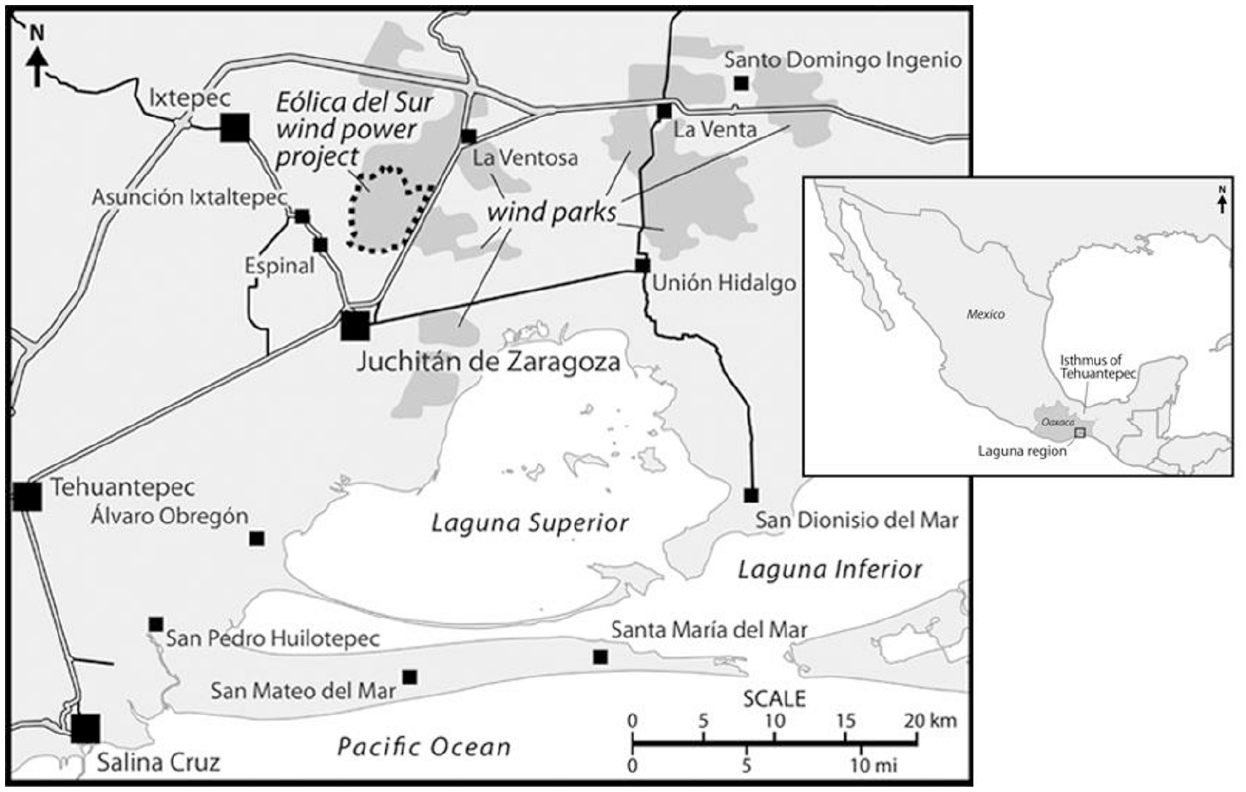
Map of the Coastal Isthmus of Tehuantepec.
The desire for work, social development, and prosperity are some of the reasons that helped create a foothold and support for wind projects in the region. In towns like La Ventosa (in the Northern Istmo), many of these promises remained unfulfilled and limited, benefiting only a minority of the population (see Dunlap, 2017, 2019b), in other towns and fishing communities around the Lagoon Superior of the south. Land deals were facilitated by approaching regional politicians and elites. This process included individualized negotiations that used middlemen, known as ‘Coyotes’, to approach people individually to sign contracts as well as approaching collective land commissioners (comisariado) and social property – ejidos and communal land – holders to negotiate large land plots (see Dunlap, 2017, 2019b). While not all land deals were contested, many were rife with accounts of various forms of deception – false promises, taking advantage of Indigenous language difference and illiteracy – coercion, intimidation, unequal benefit sharing and, at the least with participating land owners, complaints of payment disparities between wind projects within Mexico and the rest of the world (Dunlap, 2017, 2018a, 2018b, 2019; Avila-Calero, 2017; Lucio, 2016). The result was deception, coercion, and various forms of ‘adverse incorporation’ (Borras and Franco, 2013; Hall et al., 2015). Wind parks arrived promising prosperity and sustainable development, yet it resulted in exacerbating existing inequality, conflict, and various other socioecological impacts.
Meanwhile, the south coastal towns took a position of total rejection, which complemented desires for greater benefit sharing and community control over wind parks. Regional governance in Oaxaca, already organized on decentralized corporatist lines (Mackinlay and Otero, 2004; Rubin, 1997), relied on clientelist politics that wind company funds would support and adapt as a means to facilitate wind energy development. Politicians and the electoral system were identified as the method to ensure and legitimize wind energy development in Indigenous territories around the Lagoon. This led local collectives and community councils (cabildos) to reject not only the wind companies but electoral politics in general.
Mexican corporatism and clientelism defined the initial politics of wind energy development in the region, while the Federal Government and its neoliberal economic policy elevated Foreign Direct Investment (FDI) and renewable energy development as a national priority. This was complemented by state and regional politicians who served to benefit politically and materially from facilitating and contracting land deals. By 2011, wind projects planned near the Lagoon created a climate of political corruption, which triggered protest, road blockades, riots, an autonomous project, and a communitarian police (polícia comunitaria) (see Author, 2018b). Once civil discord reached a certain level in 2013 around fishing communities, integrated monetary shaping operations began to take hold, investing into repairing water infrastructure, while sponsoring schools, artistic/public relations events, deforestation programs, and, most importantly, different farmer, fishermen, and land owners’ groups
1
in support of the wind parks (Dunlap, 2018a, 2019b; Lucio, 2016). IMSO initiatives were supported by social scientists researching how to introduce ‘possible solutions to deactivate the social movements that have arisen around this project’ (Author, 2018a: 645). Because people (both Indigenous and non-Indigenous) were organizing in defense of the land, seas and cultural integrity, local politicians, backed by wind company money, organized groups of people to counter these claims of land defenders. Forms of implicit volunteerism emerged through clientelism; meanwhile, politicians began a process of counter-organization, attempting to present fisherman and farmers as (‘pure’) volunteer supporters of the wind energy development on the Lagoon Superior. A Zapotec land defenders in Juchitán explains: The government gives them the money for temporary work. So in the [free, prior and informed consent (FPIC)
2
] consultation, the fishermen are saying: ‘We are not against the wind energy projects as long as they keep giving us benefits’. So on Monday there is going to be a consultation and the unions are going to transport agitators [acarreados] in favor of the project there. That is why in this deliberative phase of the authorization process for construction they are giving those 250 people the support of temporary work. They have also received [through welfare schemes] lead weights and fishing line for their fishing nets, but they are not fishermen. They are really people working to counter the work of the [Popular Assembly of Juchiteco People] APPJ. They go and sell those weights to the fishermen. So some fishermen have said to me: ‘This guy came [to my town] and sold me a package of weights and fishing mesh and I know he is not a fisherman because he drives a Moto taxi’. So for example if a kilo of weights is worth 200 pesos, they are selling them for 50 or 40 peso a kilo.
3
Organizing volunteer supporters was accomplished through union organizing and welfare schemes with money emanating from corporate and governmental forces. The fishing equipment, however, was not used and could be monetized by selling it to fishermen fighting wind energy development. Simultaneously, volunteerism comes in the form of these groups openly supporting the companies in words and public statements: establishing themselves as token symbols of support. This is one example of organizing volunteers to counter a collective of land defenders – the APPJ – and manufacturing the social license to operate wind parks in the region. When these fishing groups stopped receiving benefits, it resulted in public denunciations against the wind companies and road blockades, 4 breaking the manufactured facade of voluntary support.
Volunteerism merges with clientelism, further blurring the boundaries of paid work and informal volunteerism. This is also complemented by not only sponsoring token civil works projects but sponsoring religious festivals and events. A land defender explains: They have even divided us within our religions and our culture. We have the celebration of la Vela
5
that is a big party for the fishermen. They created an imitation of the three crosses and look for a new Mayordomo who was financed by the wind energy companies to make their own la Vela.
6
Through the politicians and their clientelist networks, the wind companies actively worked to infiltrate every aspect of social life. They bought over people by sponsoring parties, offering gifts, creating photo exhibitions – ‘The Winds of Change’ – that reconcile Zapotec culture with wind energy development and deployed activist social media tactics to refute the claims of land defenders (Dunlap, 2018c, 2019b).
In Álvaro Obregón, where inhabitants totally rejected the wind projects – taking action to defend themselves – the counter-organization was a ‘police force’ with a paid wage. The police force was headed by the previous politician and his affiliate network, who called themselves the Constitutionalists, and locally as Los Contras (The ones against). The town was split between the Communitarian council (cabildo comunitario) and the Constitutionalists. Regional politics were contested, creating a struggle for political legitimacy and land control. The struggle for legitimacy was immersed within cultural context with the local system of civil cargos. The cargo system is the voluntary work to maintain communal life (Stephen, 2013: 300), which includes the role of village policing (see Author, 2018b). The communitarian police practiced the cargo system in their rebellion, yet this struggle for legitimacy fused with cultural context. Even if it was known that the constitutionalist was paid, the Constitutionalists attempted to appear voluntary and legitimate ‘police’ actors. Various techniques were employed to manufacture legitimacy, not only blurring public and private sector involvement but in some areas dissolving the categories between paid work and volunteerism through clientelist relationships and orderings.
Germany: mining the coal
The German state of North Rhine Westphalia (NRW) is home to the largest lignite coal deposit (55 billion tons) in Europe. The Hambach mine is one of the three lignite mines in the region and the world’s largest opencast lignite mine as well as Europe’s ‘biggest hole’ (Michel, 2005: 16). The Hambach mine is operated by RWE, Germany’s second largest energy company comprised various private, public, and institutional shareholders (RWE, 2019). Germany’s largest utility provider, RWE has investments across the energy sector in nuclear, natural gas, renewable energy, and thermal (coal) power plants. Although a highly biodiverse old-growth forest, the Hambacher Forest is currently being cleared to give way to the expansion of the Hambach mine. This expansion, or, in the words of RWE, ‘migration’, refers to the processes of burying previously mined areas with mining backfill to create an environmental restoration and ‘offset’ site called the Sophienhöhe (Brock, 2020a). Lignite coal electricity generation was elevated to ‘strategic military status’ in Nazi Germany under the 1935 Law, which was adopted to strengthen wartime capabilities and, consequently, allowed the eviction of entire communities for coal excavation (Michel, 2005: 29). The Federal Mining Act, revised in 1980, stipulates the compulsory relinquishment of private property to mining companies [. . . ] by eminent domain whenever public welfare is served, particularly for providing the market with raw materials, securing employment in the mining industry, stabilizing regional economies, or promoting sensible and orderly mining procedures. (Michel, 2005: 41–42)
The land was grabbed in the 1970s and as the mine migrated, caused the continuous displacement of villages in the name of ‘public welfare’ (Figure 2).
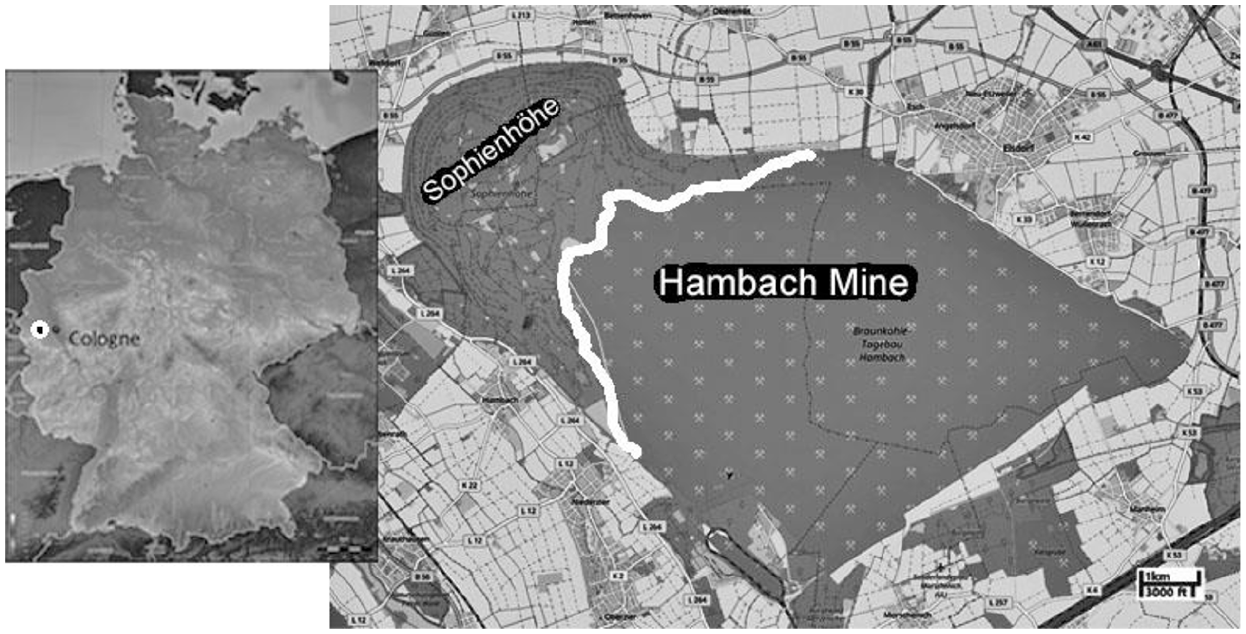
Germany and the Hambach Mine.
Excavation of the Hambach mine began in 1978 and is scheduled to be completed by 2045. The total mining area covers 85 km2 or 8500 ha (Brock, 2020a). In total, the mine extracts more than 1 million tons of coal and cubic meters of overburden a day (Brock, 2020a). RWE is the single largest European emitter, responsible for twelve percent of CO2 emissions in Germany (IWR, 2012), and among the three Rhinish mines produces 14% of all electricity in Germany. Throughout its lifetime, the Hambach mine has been responsible for the resettlement of six villages, displacing over 5000 people and creating social tensions in the displaced communities. By 2026, a total of 42,000 people will have lost their homes in the Rhinish coal region (see Brock and Dunlap, 2018).
RWE is legally required under the German Nature Protection Law (Naturschutzgesetz) and the European Habitats Directive to cultivate the mining area and to put offsets into place (additional compensation measures known as Ausgleichsmaßnahmen, see Brock, 2020a). To clear out the Hambacher Forest, RWE had to build ‘bat highways’: 700 ha of ‘bat infrastructure’ that would connect remaining fragments of old woodland to allow the Bechstein’s bat to circulate around the mine. Other compensation measures included a €4 million ‘green bridge’ over the nearby A61 highway to serve ‘as a crossing aid for the bats’ (Brock, 2020a). RWE’s biodiversity management plan also included the recultivated area at the north of the mine, called Sophienhöhe. This 13 km2 of the artificial low mountain was praised for its ecological success in recreating habitat for a number of (threatened) species. It seems worthy to note that this area, with its height of 280 m, was also a convenient way to dispose of the mine’s first 6 years of overburden (composed initially of 2.2 billion m3) (Imboden and Moczek, 2015). The migration of the mine caused the gradual displacements of villages, resettlements of homes, air pollution, and environmental destruction, which in turn triggered resistance.
Resistance against these socioecological impacts began in the 1970s and continues into the present in the form of citizen initiatives, mass-protests, and a forest occupation attempting to block the expansion of the mine. Environmental activists initiated a campaign against RWE’s three coal mines in the Rhineland, with annual climate camps and mass-civil disobedience since 2010. The forest occupation started in April 2012. In November of that year, land defenders were forcefully removed by over 500 police officers over a 4-day period. A local villager then bought a piece of land next to the forest after the eviction to host a permanent protest camp that would serve as a base camp for the struggle (see 00113921221086828X and Author, 2018). This allowed the Hambacher Forest to be reoccupied, as land defenders built tree houses, road barricades, and tree platforms. Diverse techniques were employed to protect the forest from the migration of the mine, ranging from tree-spiking to the placement of ‘potential improvised explosive devices’, 7 sabotaging coal-transportation infrastructure (i.e. short-circuiting power lines; burning pumping stations, radio-masts, and electrical transformers), and the ambushing of security-police patrols with stones, slingshots, fireworks, and Molotov cocktails (Anonymous, 2016: 91). Since 2012, the occupation of the forest has been evicted (and reoccupied) three times. Land defenders suffered violent repression, as exemplified by the death of a journalist during an (unsuccessful) eviction in 2018 (Deutsche Welle (DW), 2018). This resurgence of activism to save what remains of the Hambacher Forest and stop the largest coal mine in Europe has resulted in various responses by the RWE to pacify resistance against the project.
Interventions into the populations first targeted leaders of municipalities, police departments, churches, and sports associations. This was followed by various payments 8 and benefits offered to politicians, the regional police force, and civil servants by placing them as a chair or board members in the RWE group. Then, RWE engaged in a widespread sponsorship campaign of social events, schools, sports leagues, churches through proxy NGOs, or astroturf organizations (see 00113921221086828X and Author, 2018).
In this case, the manufacturing of volunteerism took two forms. First, RWE employed astroturfing to safeguard their lignite mining activities (Brock and Dunlap, 2018). This is the construction of supposedly independent citizens' initiatives to defend lignite coal in the Rhineland under the slogan: ‘Our territory – our future’ (Brock, 2018; Unser Revier, n.d.). ‘The initiative claims to oppose the lobbying efforts of NGOs and “aggressive environmental groups” (Unser Revier, n.d.), but it was quickly revealed to have close ties with RWE’ (Brock and Dunlap 2018: 39). Volunteerism takes the form of ‘independent citizen’ initiatives, which are sponsored groups, which are complemented by ‘two Facebook groups, “For lignite coal and jobs, against eco-extremism” and “RWE-workers for fair reporting,” where coal proponents have been posting threats to activists’ (Brock and Dunlap, 2018: 43). These groups serve as a meeting point for RWE supporters, employees, and climate change deniers, where they publish verbal attacks against coal critics, denounce activists as ‘eco-terrorists’ and pose (death) threats. Beyond this culture of fear created by concrete practices of threat, intimidation and coercion by police and RWE security (see Brock and Dunlap, 2018). Other threats received by antimine organizers included nighttime phone calls by supporters of RWE (Brock and Dunlap, 2018), being almost driven over by RWE’s company cars, receiving verbal threats against their family, and the owner of the land hosting the Hambach encampment reported his garage being broken into and his car being (severely) vandalized twice (see Brock and Dunlap, 2018). A subtle extrajudicial element then emerges, which speculatively emanates from a combination of RWE employees, security guards, off-duty police, or antienvironmentalists in the region that further blurs the mobilization of volunteerism or paid mining activists.
RWE offers public tours of their mines and power stations, which are usually attended by hundreds of people. Local tourist associations and civil society groups such as the Johanniter-Unfallhilfe and the Schützenverein promote the events, while selling local products (like cakes, sausages, coffee, and beer) to the mine tourists, gaining some of the proceeds in return. The company also organizes guided hikes through the nature restoration site, the Sophienhöhe (see Brock, 2020a). Throughout these events, volunteers regularly express their enthusiasm for violence against land defenders, as when the bus driver comments: ‘No digger should ever stop for those activists who chain themselves onto it’ (Brock and Dunlap, 2018: 43). Volunteers are actively mobilized by the company to perform public relation exercise in a cruel celebration of the mine, while land defenders are under constant surveillance and attack by the regional police and RWE’s private security forces. The line between paid mining activists and volunteers blurs, begging the question: how exactly do residents internalize and re-project counter-insurgency and hegemonic strategies from RWE? Adding onto Taylor (2004), one could say that social engineering further blurs the lines of formal/informal, paid/unpaid work, and the temporal continuum where these are situated.
Peru: getting to the copper
The proposed Tía Maria mine is located in the southwest corner of Peru above the Tambo Valley in the Islay province. Southern Copper Peru, a subsidiary of Grupo México, began assessing the mineral reserve situated above the agricultural Tambo Valley in 2000. Extensive geological and geochemical studies were conducted in 2003, followed by The Ministry of Energy and Mines’ (MEM) approval for an environmental impact assessment (EIA) in 2006 (Castillo Fernández et al., 2011). Eighty-five percent of the Islay province is concessioned to extractive corporations, while 96.2% of the Tambo Valley is under concession (Sullivan, 2015). Mine concessions sit above the Tambo Valley and the Tambo River, together creating a green oasis that is surrounded by desert and ocean and forms part of Peru’s agricultural belt. The Tambo Valley retains a strong agrarian economy and culture, providing more than 40,000 jobs (Romero, 2017), which the mine is generally understood as threatening and displacing. Southern entered the Tambo Valley by approaching the national political bodies, local municipal leaders and, eventually, civil society groups. The President of the civil society group, The Broad Front of Defense and Development Interests in the Islay Province, at the time, Catalina Torocahua, explained that in ‘2006 the mine became known as a result of usurping city boundaries’ and by ‘2007 the company entered formally to talk with the authorities: Mayors and leaders’. 9
The Tía Maria project sought to extract 120,000 tons of copper cathodes (among other non-disclosed minerals such as gold) per year for 18 years with a 1.4 billion dollar investment and three mining and processing sites. The first mining site is ‘La Tapada’ in the Pampa Yamayo, which is located closest to Cocachacra, El Fiscal, and the Tambo River. Southern claims La Tapada is 3 km away from the Tambo River, while independent investigators demonstrate it is actually 1.2 km away; still more, locals claim that it is 500–700 m away. The second is the ‘Tía Maria’ site in the Cachuyo area that according to the company is 7 km from the Tambo Valley and, the third, the processing and leaching site in the Pampa Cachendo that is 11 km away. Figure 3 demonstrates yet another set of river distance numbers by The Ministry of Energy and Mines (MEM).
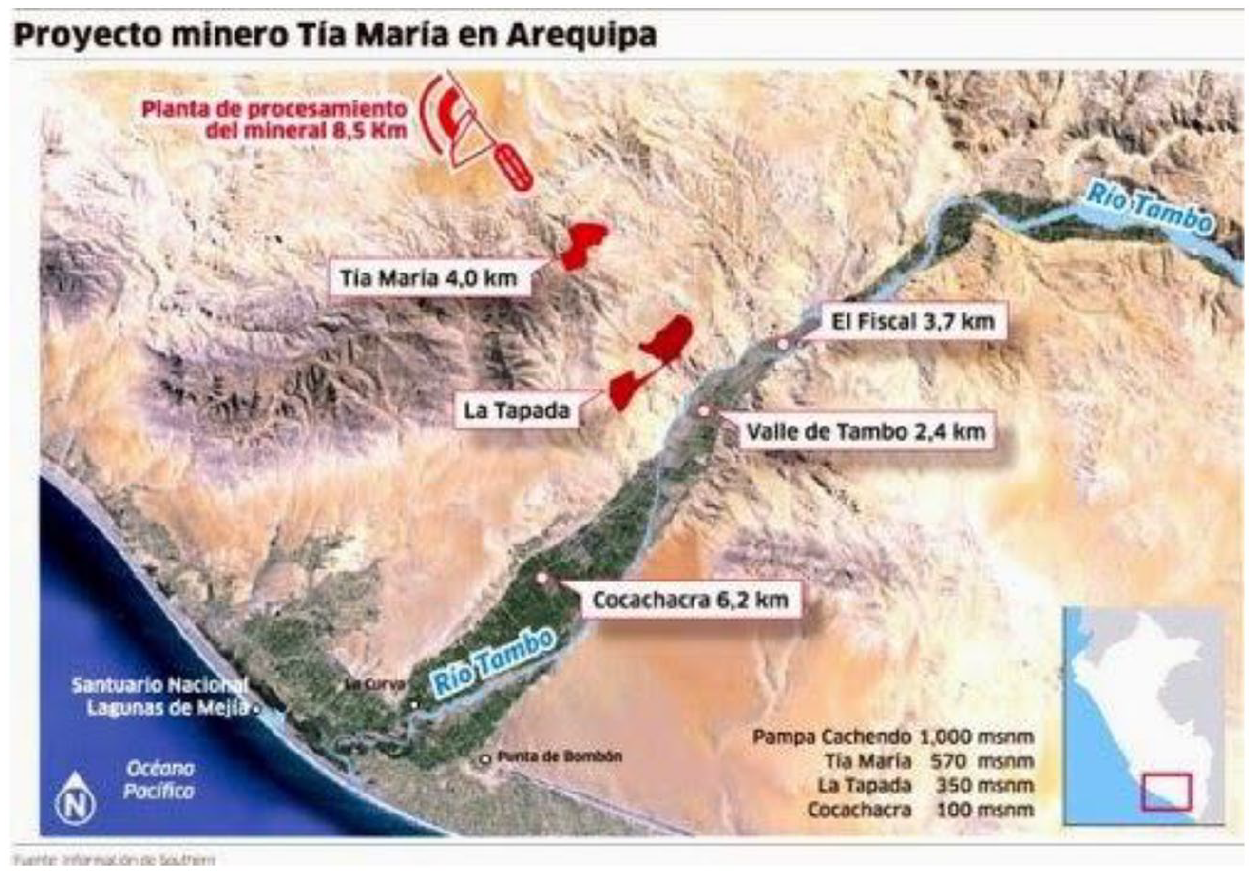
Peru and the Tambo Valley.
Since 2012, the MEM is responsible for approving EIAs instead of the Ministry of the Environment (Lust, 2014). After negotiations with government officials and civil servants in 2005, three public consultations (audiencias públicas) were approved in the Tambo Valley to publicly inform the population on the mining project. It is during the third consultation in August 2009 that the Tía Maria conflict officially began. People began rioting, throwing rocks and plastic chairs at Southern Copper Peru representatives after indicating a preference to use the ground and river water, not sea water with a desalination plant at the mine (Jaskoski, 2014; Romero, 2017). What began here, would turn into a protracted conflict in the valley that, since 2011, has resulted in eight deaths – seven protesters and one police officer – hundreds of injuries and President Ollanta Humala declaring a 60-day State of Emergency, on 9 May 2015 (Dunlap, 2019a).
Sustained organizing, demonstration, and road blockades have resulted in repeated police and, later, military intervention; meanwhile, the Southern Copper Peru engaged in a comprehensive monetary shaping operation in the region in January 2013. ‘Plan Reencuentro’, was the first of three social interventions, that would invest 100 million soles (approximately USD 30.6 million) into disseminating Tía Maria information with 46 employees going door-to-door, offering to paint people’s houses, and giving away new concrete floors (Romero, 2017). Carlos Aranda, the head of public relations for Southern Copper Peru, explains: ‘[W]e started doing things, like paint your house, because after the violence a lot of the houses were left in really bad shape with graffiti and you know that sort of thing’. Plan Reencuentro was terminated when local collaborators with the initiative were harassed and their cars vandalized. The second initiatives, ‘Future Arrived’ (El Futuro Llegó) emerged in 2015, while the second EIA was under review. This initiative, however, ended with an indefinite strike and declaration of a State of Emergency. After the 60-day state of emergency, Southern Copper began a comprehensive national media campaign until the governor and media invited them back into the Tambo Valley (Author, 2019a). According to Romero (2017), Southern retains ‘control over more than thirteen existent local radios that exist in the Islay Province and Tambo Valley’ and had hundreds of journalists and media-related representatives on their payroll (p. 58).
Then enters Valleunido in 2016, Southern’s ‘community relations’ third wave. Valleunido – ‘Valley United’ – consisted of 27 people responsible for the ‘information centers’, going door-to-door every day with information brochures and implementing social development projects with the goal, in the words of ‘Tía Maria’s Social Relations Manager’: to have ‘the Tía Maria project viewed as an opportunity and not as a threat’. Largely recruiting people Indigenous to the Valley, Valleunido developed a corporate culture (see Dugger, 1989) that allowed members to co-create the group name, through training and brainstorming sessions to better reach the population and create a collective identity. Valleunido’s community interventions were implemented under the program Construyamos Confianza Proyecto Tía Maria (Project Tía Maria Building Trust), which approached the community on six socioecological fronts: Agriculture, livestock, home improvement, education, health, and information centers (Oficinas Informativas) that were scattered all over the valley, located on mains streets and, in Cocachacra, behind the Peruvian National Police (PNP) station. Construyamos Confianza, similar to previous interventions, would invest money into people and the community such as paint, concrete floors, bags of fertilizer, and water tanks in exchange for a signature. Vallunido denied this signature was to demonstrate ‘social license’. People, however, were convinced otherwise: ‘they did not give you things because it is a gift, “no,”, they did it in order to collect signatures to bring it to Lima and present the documents that the people signed here to agree with the mine’, but ‘everybody knows that this is blackmail taking advantage of people's needs’ (Author, 2019: 22). Regardless, we continue to see a gray area through development interventions, where politically and financially backed social engineering campaigns merge and create various levels of informal volunteerism through fabricating clientelism via development, participation in social programs, and interventions in schools (see Dunlap, 2019a).
Valleunidos commissioned three impact reports. According to Carlos Aranda – the national head of community relations for Southern – they can be summarized as: (1) ‘They do not like you’; (2) ‘we showed improvement . . . . [but] Yeah not so good’; and (3) ‘this last one is a bit better. We are actually . . . pinpointing areas where we have to improve’. Representatives at Southern were explicit about employing German and Dutch anthropologists and, more frequently, sociologists in an attempt to guide, but also monitor the impact of their development interventions. Social development interventions, designed to convince people that mining was in their best interest, were organized and their persuasive impact was measured primarily by sociologists. 10 This is the weaponization of social science for natural resource extraction and ecologically degrading development (Author, 2019d). The operations of Valleunido, Internal Affairs and their integrated monetary shaping approach specialize in the social engineering of populations to convince them to relinquish their natural resources. In this sense, these interventions sought to organize the social acceptance of the Tía Maria mine, employing social development and the distribution of funds backed by police violence to imbue acquiescence, stop people from protesting and accept the existence of the mine.
Manufacturing volunteers: organizing locals and gaining social license
The imposition of resource extraction takes three different, yet related forms in Oaxaca, the Rhine land, and Islay province. The contextual specificities, however, share structural commonalities. All the extraction projects had governmental support from the Mexican, German, and Peruvian State. The state takes principal responsibility for dispensing coercive repression against opposition groups, which was justified as
In Oaxaca, coercive repression was dispensed officially by the state and unofficially through the networks of politicians and elites acquainted with organized crime (see Dunlap, 2019b, 2019c; Dunlap and Correa-Arce, 2022; Lucio, 2016). Repression in Germany was dispensed by police, private security guards and, as mentioned, vandalism by unknown RWE supporters. Germany, like Oaxaca, had the support of local politicians, whereas in Peru, local politicians exhibited noticeably more opposition against the mining project initially, yet ‘mining candidates’ still served an important point of intervention to divide localities and legitimize their operations (Romero, 2017: 54). Political support in general, but especially locally, remains key to opening up the public sector institutions thereby opening a field of volunteer possibilities. Repressive police, military and (rumored) mine security, and mercenary forces originated outside to the Tambo Valley (Dunlap, 2019a), whereas efforts to organize local collaborators were more successful in Oaxaca and the Rhineland. Meanwhile, all of the public relations, development, and social programs were orchestrated by the companies, which included the use of social scientists’ knowledge to sculpt and measure their interventions to convince and ‘deactivate’ opposition in the target populations (Dunlap, 2018a: 645). Development operations were conducted with the implicit or active support of local politicians, who sought to employ, offer ‘gifts’ and mobilize segments of the population in support of resource extraction, creating a blurred space where paid work and volunteerism emerged.
In each extractive conflict, the companies approached influential local politicians and elites first, who then negotiated various levels of local collective and individual benefits from the projects. In Germany, nearly the entire region’s institutional system was integrated into RWE’s operations before large-scale protests and forest defense would take hold, while in Oaxaca and Peru, negotiations between the companies and local elites happened without the knowledge or consent of the population at large, focusing only on relevant individuals to make the project operational. This selective focus by the companies and political intermediaries might have been procedural or designed to pre-empt resistance. The intention remains unclear. This failure of public consultation (and consent), however, resulted in significant project delays, social destabilization, and deaths of land defenders (and one police), and thus required substantial investments into ‘community relations’ and company image revitalization. During consultations in Juchitán and Tambo Valley oppositional accounts claim that students, select land owners, employees, and friends or family members of employees were paid or brought into support of the companies during the consultation processes (Dunlap, 2017, 2018c, 2019a), yet the ideas was that people were freely volunteering their consent in these so-called democratic procedures.
The tactics employed were structurally speaking the same. Since World War II, RWE has a long-standing private–public relationship with the West German state, Southern Copper and the wind companies, on the contrary, were both transnational corporations setting up operations in new localities. The difference between the internal colonization of RWE and the transnational colonization of the other case studies only altered the speed at which these companies established footholds in the region through elite consent and regional collaboration with the extractive projects, which in the case of Peru had their own private contracts with the police and military forces (Dunlap, 2019a). Internal and external colonization, like paid and unpaid work often blur. When local politicians failed to control social upheaval, the companies resorted to operationalizing corporate social responsibility initiatives that mimic the guidelines of integrated monetary shaping operations, the principle difference was the intent: development versus population or group control. A questionable opposition given the history of development (Duffield and Hewitt, 2009; Escobar, 2004), especially as we witness ‘hard’ coercive techniques matched with ‘soft’ social technologies of pacification to ‘buy-off’ and convince populations that their best interests lay with the extractive operations and that resistance is pointless.
The process of convincing and organizing consent and, later (paid and unpaid), ‘volunteers’ depended on socioenvironmental factors. The ambition for social and material status creates a significant foothold to intervene into people (Dugger, 1989; Dunlap, 2014a), which is intimately wedded to the ideology of progress (Dunlap, 2014b). The ‘coordinated use of money, goods, or services to support’ extractive operations manufactures volunteers (FM-3.24), organizes social license and can potentially isolate determined opposition. The effectiveness of these strategies is to re-frame the conflict: land grabbing as development; mining as prosperity; and alternatives as unrealistic. This includes creating jobs or paying people – officially, unofficially or in clientelist gray areas – to support controversial extractive operations. This entails employing people from the town or region to provide the general public with a feeling or perception of volunteerism. This exemplifies not only ‘the blurred setting of corporate volunteering’, outlined by Itamar Shachar et al. (2019: 254, 252), but also a range of real, imagined, or manufactured ‘mix of altruistic and calculated or “egoistic” motivations’ that ‘scattered across a range of feelings of commitments’ toward the company, fellow employees and potential benefits for the region. Extractive volunteering, like other industries, manufactures legitimacy by creating a ‘popular perception as a pure engagement that is altruistic and autonomous’ (Shachar et al., 2019: 253), yet in actuality operates in various gray or ‘hybrid’ spaces backed by subjectivity persuasion (with social scientists and propaganda), payments, clientelism, and the town-wide allure of social development benefits.
The seemingly voluntary commitment of individuals for promoting an extractive project stems from the lived perception that green or conventional resource extraction will improve the region. Paid workers distributing information, goods (paint, fertilizer bags, water tanks, etc.) and social amenities (health clinics, technical workshops, veterinarians, etc.) in theory creates networks of volunteers that openly promote mining projects or cease protesting. Familial relationships can subtly become domains of voluntary labor for corporate endeavors, when family members are volunteering for potential anticipated jobs associated with natural resource extraction projects or are employed to promote a particular extractive project. Familial relationships predicated on supporting one another – finding work, career advancement, and so on – can politically split families to create social conflict or lead opponents to support family members participating with mining companies even if they are opposed. As cultural values are torn (see Dugger, 1989), family values can potentially subordinate socio-ecological values predicated on protecting landscapes and agrarian practices. While opposition was ardent in all three sites, these socioculture tears manifested in equally large numbers of people taking the ‘gifts’ from companies and continuing to organize and protest against these projects in Mexico and Peru. Besides offing an ambiance of volunteerism for legitimacy construction, people were recruited to convince the populations and manufacture situations of voluntary consent around multi-billion dollar extractive investments. Volunteerism operates on two levels. First, in the traditional sense, by doing voluntary work or supporting friends and family members working for the company. Second, in a passive sense, where people volunteer support, and conceivably ‘work’ for the company, by not protesting and organizing themselves. In Peru, company representatives interpreted this as measured progress resulting from their integrated monetary shaping (development) operations (see Dunlap, 2019a). The possibility of continuing resource extraction not only depends on police-military force but also on sociocultural interventions that seek to convince populations from the ‘bottom-up’ by employing grassroots and community-based organizing tactics, of which various axes and ‘hybrid’ shades of volunteerism emerge.
In the above-mentioned cases, people were caught between political repressions, (material) poverty, (increasing) social fragmentation, and the possibility to gain monetary, food, or collective benefits. This speaks to immediate needs and desires that often result in separating and subordinating different cultural values that can allow people to acquiesce and even publicly support extractive operations (Dugger, 1989; Dunlap, 2014a). In a context where coercive force is always present, territories experience an influx of development experts, social scientists, and public relation consultants that generate knowledge for resource colonization and acquisition strategies. People from within the region, on the contrary, are located and employed to widen cracks of curiosity, ambitious desires, and oppositional doubt to organize support within target areas. The effectiveness of money in dividing and ‘buying-off’ communities is predicated on the conquest of cultural values, building on pre-existing sociopoliticoecological interventions and subsequent institutional conditioning that subordinates different cultural value systems as a means to implement capitalist markets. Long-term socio-ecoloigcal interests are sold, in many instances, to short-term gains. Counterinsurgency is the technique at the center of these affairs. Companies are trying to construct unequal or profitable trade deals for land and natural resources in exchange for (token or menial) social development that reflects favorable cost-benefit analysis. The success of territorial colonization then hinges on compartmentalizing the rational best interest of each actor, which serves to manufacture or purchase legitimacy to set up extractive operations. Counter-insurgency, volunteerism, favors, and indifference are central to the success of extractive operations.
Conclusion
This article has sought to animate the complexities and micromechanics of resource colonization, as it relates to the manufacturing of ‘social license’ and volunteers. Reviewing the cases of wind energy development in Oaxaca, coal mining in the Rhine land, and copper mining in the Islay province, this article has sought to reveal the tactics, strategies, and mechanisms by which companies continue to divide, conquer, and operationalize people in environmental conflicts. In each case, state and governmental structures were instrumental for imposing and enforcing natural resource capture against the desire of communities. This desire to resist extraction remains somewhat marginal around the immediate surroundings of the Hambach mine, yet concerns regarding climate catastrophe and energy transition are present at the national level. The inverse is true in Mexico and Peru, where popular local opposition is supplanted by national concerns promoting extractivist development models and renewable energy infrastructure (Dunlap, 2017; Lust, 2014). State and company interventions, articulating strategies of coercion and reward, are designed to socially engineer the political feasibility of natural resource extraction in target regions, where locating, finding mutual interest and organizing collaborators from within the population remains instrumental. This entails strategically distributing funds with corporate social responsibility/integrated monetary shaping initiatives to organize volunteers around a diverse continuum of formal and informal remuneration through employment opportunities, social development, donations, sponsoring events, and paying officials.
Political structures are central to facilitating extraction. Approaching these environmental conflicts from the lens of colonization, the state and political structure emerge as a structure of ecological conquest. While Peru initially showed signs of resistance from municipal leaders, ‘mining candidates’ were organized and funded in the elections and were instrumental to Southern Coppers’ current efforts at wearing down local opposition. The organization of networks of collaborators and volunteers highlights the complications of building extractive legitimacy, which seeks a foothold, remembering Foucault (2003) above, to ‘established and actually maintained a permanent power’ to execute resource extraction. While money, specifically through integrated monetary shaping operations, was used to manufacture acceptance and approval, volunteerism emerged through clientelist networks, manifesting as reciprocating favors, supporting friends and family members working for the company. Simultaneously, people volunteer support, and conceivably ‘work’ for the company, by not protesting and organizing themselves. When the public relations’ objective of the company is to institute social passivity regarding the issue of extraction, where political indifference and inaction articulate a form of energetic, but also material volunteerism to the cause of companies.
Asymmetrical conflicts subsist on social isolation, fragmentation, and the blurring of interests to organize extraction, if not statist rule (see Gelderloos, 2017). This reveals the importance of Indigenous and non-Indigenous land defenders defending their cultural values – not subordinating them to degrading socioecological practices promoted by capitalist development – and, this includes, finding alternatives to development (see Escobar, 2012; Kothari et al., 2018). This is the first step to de-linking oneself from destructive political economies and rooting land defense, which starts by subverting assimilation into extraction operations. Recognizing corporate social responsibility/integrated monetary shaping operations employment of volunteerism, or the appearance thereof, remains central to unraveling the weaponization of people (and their agency) in the service of land grabbing and projects of socioecological degradation. This by no means condemns modernization in its entirety, but instead recognizes the layers of industrial dependence and socio-ecological costs inherent in colonial systems – past and present – that require increasingly sophisticated methods of coercion and control to continue the process of planetary socio-ecological degradation.
Footnotes
Funding
The author received no financial support for the research, authorship, and/or publication of this article.
