




Abstract
This article proposes a pragmatist theorising of different repertoires of valuation as an analytical grid to understand how actors of participatory projects assess the value of citizen expert participation. It conducts justification analysis on interview data from 21 projects that engage citizens as lay experts in Finland to illustrate how this analytical approach helps explain the contradicting meanings assigned to the concept as well as the resulting possibilities for participation. The article identifies two main conflicts in which different justifications for citizen expertise become explicit: debates over who can be a citizen expert and what the scope of their participation should be. Our results show how in the Finnish context, industrial justifications are often used to bolster claims for the right to participate. However, the industrial value-base is also the most reoccurring object of critique, suggested to create a narrow and above-defined role of a citizen-engineer for the citizen experts. The article illustrates how the diverse justifications might lead to contradicting constructions of citizen expertise, contributing to conflicting expectations, ambiguous and tokenistic participation, and feelings of exclusion among policy actors. It argues for justification analysis as a tool to identify and compare these undergirding valuations across policy fields and contexts.
Introduction: the coinciding interest in participation and expertise
The simultaneous rise in popularity of participatory initiatives (e.g. Polletta, 2016) and evidence-based policy making (e.g. Cairney, 2016) has set the concept of expertise in motion. Traditional forms of expertise have been joined with, and partially challenged by, participatory innovations that engage citizens as experts in different phases of democratic decision making (Liberatore and Funtowicz, 2003; Rabeharisoa et al., 2014). Groups as diverse as patients (Epstein, 1995; Eyal, 2013), service users (Alanko and Hellman, 2017; Barnes, 2009) or local residents (Fischer, 2000) are invited to participate in public governance as ‘experiential experts’.
However, the very term ‘citizen expert’ entails a conflict of values: the person participating as a citizen expert is expected to be, at the same time, a citizen and an expert on a specific experience or issue. They are invited to participate both because they hold insight on a specific matter and because it is everyone’s right to be included. As a result, the term epitomises democracy’s delicate balancing act between civic participation and expert assessment (Collins and Evans, 2002; Strassheim, 2015), leading to some key questions for democracy: Should citizen expertise be primarily interpreted and evaluated as a form of civic participation or of expertise? What is the vision of democracy that is supported through the inclusion of citizen experts?
This article suggests that in order to understand the variety of forms of citizen expertise, we need to look more closely at the participatory projects’ implicit premises. In particular, we argue that we need to explore how the policy makers and the actors of participatory projects defend the value of citizen experts’ participation and balance between the built-in contradiction of the role. To establish this, we employ the tools of justification analysis (Boltanski and Thévenot, 1999; Ylä-Anttila and Luhtakallio, 2016) to show how different regimes of justification are drawn upon both in order to defend and to assemble critique towards citizen expertise. We analyse interview data from 21 projects that engage citizens as lay experts in social welfare and in urban and regional policies in Finland, and ask how actors of Finnish participatory projects answer the question ‘what is the value of citizen expert participation for democracy’?.
While the participation literature is ripe with different frameworks with which to categorise and evaluate forms of participation (for an overview, see Dean, 2017), this article makes the case for justification analysis as an important addition to the existing analytical toolkit. First, we argue that justification analysis is an apt tool for making visible the often-contradictory expectations for citizen expertise in particular (Cotterell and Morris, 2012; Meriluoto, 2018b) as well as for public participation more broadly (Bishop and Davis, 2002: 15). Second, by focusing on the conflicts between justifications and the connections made between them, we can identify the dominant ways to value citizen expertise that easily appear as neutral (Ylä-Anttila and Luhtakallio, 2016: 21) and, hence, investigate the power relations that shape what kind of roles become feasible through the concept’s use. Third, the framework, as we illustrate, enables comparisons across policy fields, and thus helps bring together the insight of the valuable but now somewhat disconnected analysis on the value of citizen expertise and public participation.
We start by outlining the manifold values public participation can be conceived of having based on earlier literature and the frameworks suggested to analyse them. We then present the theoretical foundations of justification analysis and discuss its strengths as an addition to the existing analytical frameworks. After presenting the six different justifications of citizen expertise through our data, we then focus our analysis on the two main conflicts where the competing justifications clash: debates over who can be a citizen expert and what the scope of their participation should be. Our results show how in the Finnish context, industrial justifications are often used to bolster claims for the right to participate. However, as we also show, the industrial value-base is also the most reoccurring object of critique, suggested to create a narrow and above-defined role of a citizen-engineer for the citizen experts. We conclude how these conflicting and yet implicit justifications may contribute to conflicting expectations, ambiguous and tokenistic participation, and feelings of exclusion and frustration among policy actors.
Justifications for citizen experts
Along with the growing scope of participatory measures, different typologies have been suggested to describe the meaning of public participation. Starting from a broad distinction between ‘intrinsic’ and ‘instrumental’ values of participation (e.g. Blaug, 2002; Smith, 2009: 8–9), empirical analyses have developed nuanced classifications, each carrying distinct objectives and, hence, the assumption of the potential value of public participation. For example, in their analysis of 17 participatory projects in England, Barnes et al. (2007) identify four discourses that valued public participation differently and subsequently created distinct roles for the people involved – the empowered public, consuming public, stakeholder public and responsible public. In looking specifically at the value of participation, Hendriks and Lees-Marshment (2019) observe that the political elite equally values the information gathered via participatory measures as well as the possibility it provides to ‘connect to the everyday people’ (p. 603). Analysing the views of people associated with participatory innovations in social policy in the United Kingdom, Dean (2019) finds three ‘normative orientations’: participation as collective decision-making, participation as knowledge transfer and participation as agonism.
In his overview of different typologies, Dean (2017) points out how most of the existing analytical frameworks are either normative and classify participation by evaluating its ‘success’ (see also Arnstein, 1969; Hendriks and Lees-Marshment, 2019: 599), or categorise participation based on ‘institutional design features’ such as the selection of participants (e.g. Fung and Wright, 2001). As a way forward, Dean proposes a typology that moves beyond these to categorise modes of participation in connection to their undergirding theoretical basis. Bishop and Davis (2002) make a similar attempt to overcome the context-specific typologies by looking at the different strains of literature on participation to theorise five participation types: consultation, partnership, standing, consumer choice and control.
In this article, we propose a methodological step forward in analysing public participation and citizen expertise in particular. We argue that in order to be able to detect and analyse conflicting demands and expectations within participatory innovations and to facilitate comparisons across context and policy fields, but avoid assigning the role of ‘an outside evaluator’ to the researcher (see Celikates, 2018), we need a typology that (1) looks at the value the people involved in participatory measures assign to participation and (2) provides broad, shared categories for the classification of these values.
We suggest the tools of justification analysis (Ylä-Anttila and Luhtakallio, 2016), stemming from French pragmatist sociology (Boltanski and Thévenot, 1999) to create a common framework to examine the justifications driving participatory innovations and what sort of participation these normative grounds enable composing (see also Meilvang et al., 2018). We deem this approach particularly suitable for initiatives such as citizen expertise, where a built-in contradiction of values and expectations is evident.
Justification theory, founded on the work of Luc Boltanski and Laurent Thévenot (1999), investigates how conflicts in everyday situations are resolved. In their analysis of disputes, Boltanski and Thévenot suggest that people draw on different ‘orders of worth’ when justifying their own actions and arguments and evaluating those of others. According to the literature’s premise, an argument’s value is judged based on how well it meets the situation-specific criteria of worth. Via an extensive analysis of Western historical and contemporary texts, Boltanski and Thévenot originally identified six orders of worth (a seventh one – green worth (Thévenot et al., 2000) – was later added to the conceptual toolkit). Each of the orders taps into a specific form of common good that it considers to reign supreme (Boltanski and Thévenot, 1999). The orders are employed as valuation devices to determine the value of different arguments and actions, and compare their value against each other (Eranti, 2018; Lamont, 2012; Lamont and Thévenot, 2000: 51).
The orders can be summarised as follows (Boltanski and Thévenot, 1999):
Civic worth, valuing equality, mutual respect and collective welfare.
Industrial worth, valuing efficiency and productivity.
Market worth, valuing monetary gains and competitiveness in the market.
Worth of fame, valuing popularity and celebrity.
Domestic worth, valuing tradition and heritage.
Worth of inspiration, valuing novelty, innovation and creativity.
We connect these somewhat abstract realms of justifications to the context of participatory innovations and citizen expertise by discussing the empirical findings of previous research on citizen expertise with the justification framework as our lens.
By its very name, citizen expertise has brought forth a conflict for the civic values most often drawn upon to justify participatory initiatives. With the term ‘expert’ front and centre, it carries an industrial justification, valuing citizen expertise as a means to gain citizen input or ‘lay knowledge’ on a specific theme (Fischer, 2000, 2009; Sullivan and Skelcher, 2002), challenging the clear-cut distinction between scientific expertise and experience (Demszky and Nassehi, 2012; Krick, 2015; Rabeharisoa et al., 2014 ).
In social welfare contexts, and particularly in projects among marginalised and disadvantaged people where civic values of collective welfare, equality and solidarity are customarily very dominant (e.g. Eliasoph, 2016), prior research has shown a novel double demand for citizen expert participants. Nowadays, they are expected to bring forth objective and generalisable knowledge, hence justifying their participation strongly based on industrial values of efficiency (Cotterell and Morris, 2012; see also Meriluoto, 2018b; Richard-Ferroudji, 2011). The new expert role is in stark contrast to the civic value-base, where the representation of authentic, real-life experiences is primary.
If the industrial justification valuing expertise has come to challenge the civic justifications in social welfare contexts, in urban and regional policies and planning, the current has flown in the opposite direction. There, a previously very technical, industrially evaluated regime is now increasingly critiqued with civic values, making demands for more ‘participatory planning’ (Meilvang et al., 2018: 13). In urban and regional projects, the inclusion of citizen expertise is valued as an important feature of local democracy (Ertiö, 2015). Recently, critical (Brenner, 2009; Marcuse, 2009) or radical (Dikeç and Swyngedouw, 2017) scholars have even theorised how civic values, such as fostering activist networks and ensuring planning as a space for ongoing agonistic pluralism, should be prioritised over industrial values in urban planning (e.g. McAuliffe and Rogers, 2018).
To empirically analyse such cases of coexisting and conflicting justifications in public argumentation, Ylä-Anttila and Luhtakallio (2016) have developed justification theory into a method titled justification analysis. The focus in justification analysis is on publicly made claims, which are built by tapping into one of the orders of worth identified by Boltanski and Thévenot and evaluated for their value with regard to the related common good – for example, efficiency in the industrial order or collective welfare and equality in the civic order. These orders also clash in meta-level arguments about which order of worth should be applied to the situation at hand (Boltanski and Thévenot, 1999; Lamont, 2012; Ylä-Anttila and Luhtakallio, 2016: 2). These conflicts – such as whether citizen expertise should primarily be evaluated as a means of knowledge-production or as a tool of empowerment – provide an avenue towards investigating the ‘neutral-appearing’ dominant justifications when participatory projects spur (Ylä-Anttila and Luhtakallio 2016: 25) and demonstrate the power of these justifications in determining what kind of participation is feasible and acceptable.
Our analysis builds on the following conclusions from earlier literature: first, that the involvement of citizen experts carries a built-in conflict of values and, second, that many analyses have identified disappointments, contradictions and unmet expectations among participants in citizen expert initiatives (Cotterell and Morris, 2012; Glasby and Beresford, 2006; Meriluoto, 2018a). Subsequently, we hypothesise that as participation is assigned distinctly different values, these different justifications have a bearing on how the citizen expert’s role is constructed in participatory projects and what forms of participation become possible through this role. We venture into exploring precisely these conflicts in our analysis.
Context, data and methods
In this article, we concentrate on two cases of citizen expertise in Finnish public administration in the 2000s: experts-by-experience in social welfare and residents in urban and regional policy projects. The concept of expertise-by-experience – with its roots in the 1970s self-help movements (Lawton, 2003) and the ‘third way’ health and social care reforms in the United Kingdom (Barnes and Cotterell, 2012) – was introduced in Finland in the 2000s. It was adopted by public and civil society organisations (CSOs) as a result of its promotion by the Ministry of Social Affairs and Health, which embraced it as a tool in participatory social work and a means to provide ‘real life evidence’ to policy making (Alanko and Hellman, 2017; Meriluoto, 2018a). Today, the concept refers equally to paid professionals and volunteers and, in its broadest meaning, indicates a person who has undergone social or health-related difficulties and is acting as an expert based on those experiences.
The other empirical case of the study comprises Finnish urban and regional policy projects. Strongly influenced by the European Union, their aim is to develop a cross-sectoral approach to local issues through a combination of broad policy programmes and local-level projects based on partnerships and, often, direct resident participation (Andersen and Van Kempen, 2001; Kuokkanen, 2016a; Pinson, 2009). These projects serve various purposes, from regenerating ‘worse-off’ neighbourhoods to ‘augmenting the employability’ of marginalised groups, enhancing regional competitiveness and developing services (Piattoni and Polverari, 2016; Skelcher et al., 2013).
The experts-by-experience interviewed were involved in either civil society or public sector organisations, and their concrete roles and tasts varied across contexts and organisations. In social welfare contexts, they most commonly acted as experts in project steering groups or in various co-production workshops where either public social services or other civil society-organised support mechanisms were being innovated or developed. Some also co-organised peer-support groups and others sought to influence political decision makers directly by acting as public advocates for the specific hardship they had undergone. In urban and regional policy projects, in turn, diverse co-production workshops were also the citizen experts’ most common form of participation. In these workshops, they were invited to develop ‘their neighbourhood’ or the local services, but oftentimes also the participatory measures themselves (Kuokkanen, 2016b). In underprivileged neighbourhoods, these workshops were often not so much directed at developing services, but at ‘developing’ the people involved by, for example, inviting them to plan and organise local events and to feel ‘empowered’ through the process (Junnilainen, 2019; Luhtakallio and Mustranta, 2018).
Our empirical analysis is based on a combination of two datasets of semi-structured interviews (see Table 1). Altogether, they contain 101 interviews with citizen experts, social welfare professionals, project managers, public officials and activists from 21 projects.
Description of data.
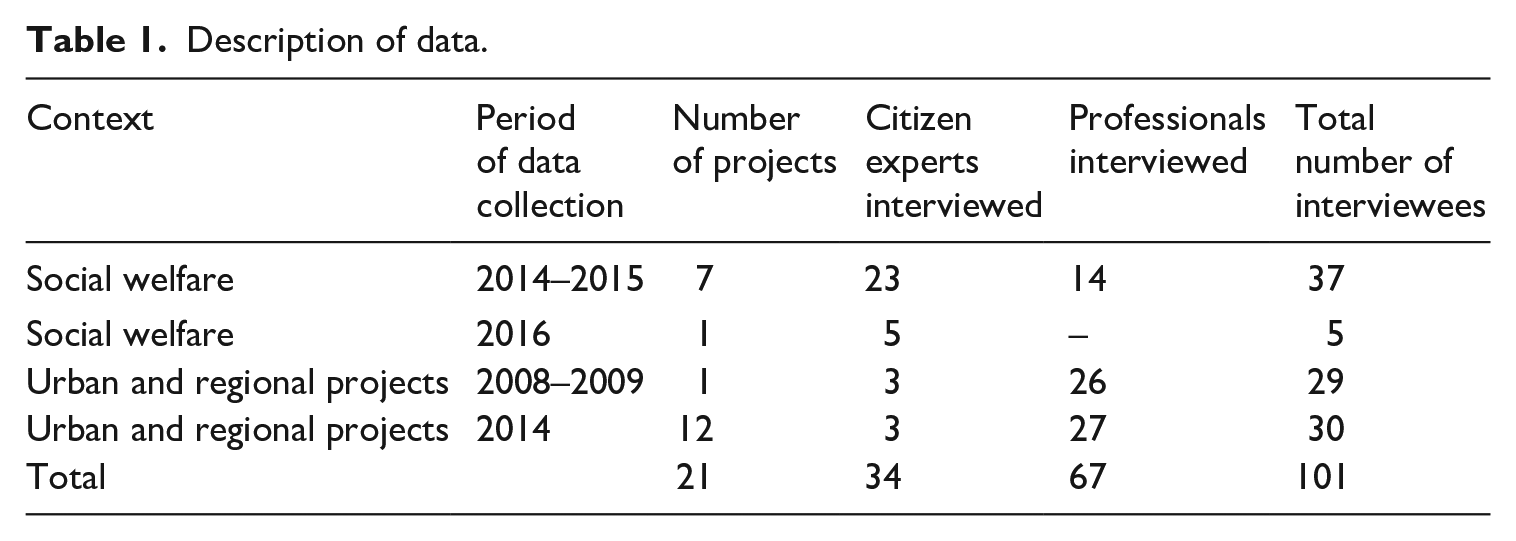
Both datasets were produced as parts of research projects with a broader focus on participatory governance. However, citizen expertise was a theme that the interviewees spontaneously brought up in both cases. We ventured into analysing specifically these projects in very different contexts and institutional environments not because of their seamless comparability, but because we were surprised by how similar justifications the actors in these different projects employed when they talked about the value of citizen expertise. Moreover, the urban or regional and social policy contexts are, among youth policies (see Boldt, 2021), the fields where participatory measures are being implemented the most in the Finnish context. Our argument emerged out of a need for a tool to make sense of these similar-looking value-assessments with a lens that is not context-specific nor tied to a prior normative commitment.
Following justification analysis as our method, we identified passages where our interviewees justified the need for citizen expertise. We then categorised their different ways of valuating citizen experts’ involvement by using Boltanski and Thévenot’s orders of worth as our classes. We labelled these as either justifications (justifying by tapping into a specific value-base) or critiques (calling the value-base into question). Next, we explored the instances of critique more closely to discover the conflicts between different justifications. We identified two main conflicts where different justifications could not coexist but had to be placed in order. These were debates over (1) who can act as a citizen expert and (2) what the scope of their participation should be.
The excerpts used are differentiated by using the identifiers ‘experts-by-experience’ for the first dataset and ‘urban’ or ‘regional projects’ for the other dataset. To ensure interviewee anonymity, the background organisation of the interviewee is presented on a general level as either a civil society or a public sector organisation.
Analysis: justifications for citizen expertise
In the following, we use justification analysis to discern how our interviewees argued for citizen expertise. Why was it worthy and relevant to include citizen experts in the policy process? Unsurprisingly, the most pertinent justifications our interviewees used to define the value of citizen expertise were civic and industrial. Subsequently, our analysis focuses on how these justifications were articulated among our interviewees and how they translate to different roles for the citizen expert. We then show their significance in the context of the projects studied and illustrate the usefulness of the analytical framework by investigating how these justifications were weighted in the two main conflicts identified in our data.
We only focus on the public justifications – that is, the ones that draw upon some form of common good identified by Boltanski and Thévenot (1999) – our interviewees employed when justifying the inclusion of citizen experts. While our interviewees also regularly illustrated the individual benefits or the feelings of comfort when explaining their participation in projects (see Thévenot, 2007), our focus in the following is on the forms of common good the citizen experts’ involvement is presented to bring about.
Civic worth: the empowered member of the community
I think as a concept, it’s far more beautiful than if we were to talk about, say, victims. It is appreciative. It’s the expertise that gives you an idea that ‘we value your experience’. (Expert-by-experience, CSO, social welfare)
The above quote illustrates one of the most reoccurring justifications for the inclusion of citizen experts, especially among social welfare practitioners and policy makers: by inviting marginalised citizens to act as partners, their confidence is meant to be strengthened, and they are to feel ‘empowered’ (see also Eliasoph, 2016; Junnilainen, 2019; Luhtakallio and Mustranta, 2018). When the citizen experts’ inclusion is justified in this manner, the primary significance of citizen expertise is to serve as a means of recognition, and the focus is on the citizen experts’ feelings of worth. Their participation is worthwhile and well-founded if it makes people feel good about themselves, and the role crafted is that of ‘a healing citizen’.
In urban and regional projects, the civic value of citizen experts’ inclusion is primarily in the commonality and help for others it enables fostering. Citizen expertise is conceived of as a platform for altruism and a means for people with certain knowledge or experiences to make use of them for the benefit of others. Here, the role crafted for the citizen experts is that of a community-builder.
What draws me to this is the commonality. I know it’s a trendy word right now, but the city needs an even more communal way of thinking – this point of view of taking care of things that are common. (Project actor, CSO, urban project)
As in the empowerment justification above, the role’s focus is on feelings – in the ‘sense of commonality’ or ‘mutual understanding’ brought forward with the inclusion of citizen expertise (see also Barnes et al., 2007: 10). What becomes central in the citizen experts’ involvement is not so much the content of their knowledge and expertise, but the act of sharing them, which is thought to help build community and enforce mutual understanding among people. This justification was most popular among local practitioners and policy makers that placed high hopes on ‘building cohesion’ through participatory practices.
The third recurring civic justification for citizen experts’ inclusion was to defend it as a means to ensure the political rights of every citizen. It was quite common for interviewees in both our datasets to pinpoint how ‘not all voices are currently being heard’ in our society and to identify the inclusion of citizen experts as a means to fix this.
Why do you think we now have experts-by-experience all over all of a sudden?
Well, I’d like to think that it is because we have finally realised that it is very important that people can have an impact on their own lives. [. . .] It is proof that you can have an impact by doing things, that you don’t just have to wait for things to happen. That you can also do stuff yourself and act. (Expert-by-experience, CSO, social welfare)
The political justification, contrary to the two other civic forms of justification, does not emphasise feelings or personal transformations, but rather the potential to have an impact, subsequently crafting the citizen expert’s role as a markedly political citizen. Similar to what Dean (2019) identifies as ‘participation as agonism’, citizen experts’ inclusion is deemed valuable because it is a channel especially for marginalised people to get their hitherto silenced voices heard. This justification was particularly present among civil society actors and activists.
Industrial worth: the citizen-engineer
If you think about why it [expertise-by-experience] is important, it’s because it brings forward experiential knowledge, which is different from book knowledge. And when you combine these, you get the best possible kind of knowledge so that we can genuinely develop our service system. (Expert-by-experience, CSO, social welfare)
The industrial values of efficiency and usefulness were an equally prominent justification in our data for the citizen experts’ involvement and was particularly recurrent among practitioners and public officials. Citizen expertise was justified because it enabled developing more efficient public services or provided grounds for more knowledge-based decisions. As the interviewee above explains, the value of citizen expertise lies in the knowledge it enables producing.
In contrast to the civic justification, the industrial justification steers the focus on the contribution the citizen experts can provide and the kinds of knowledge and expertise they bring forward. For the most part, the citizen experts’ role based on industrial justifications was to incorporate a ‘user perspective’ in service production and policy making. Their practical contributions were thought to result in services and policy decisions that would be significantly more responsive of local needs. The expertise expected of them concerned practical issues connected to their everyday life, such as local services, as the following project actor explains: What we sought from these different stakeholders was a specific kind of know-how – and that know-how is specifically the local knowledge. And it means answering these very little questions, in fact. Like, for example, what kind of fish there are in [the local lake] according to historical knowledge. (Project actor, public sector, regional project)
Contrary to the civic justifications, the industrial justification places little value on participation itself. Instead, it values the results of participation: the usefulness, reliability and objectivity of the knowledge produced.
While the civic and industrial justifications were by far the most prominent in our data, we nonetheless also identified justifications from other ‘worlds’ identified by Boltanski and Thévenot. Our interviewees drew on what we identify as ‘the market worth’ when they justified citizen experts’ participation by explaining how it ‘cuts public sector costs’ or ‘lessens the workload in public administration’. 1 When drawing on ‘the worth of fame’, the value of citizen experts’ participation was identified in the public esteem it ensured for the organisation, as citizen participation was something that ‘needed to be done these days’. ‘Domestic worth’ was visible in justifications that connected citizen expert participation to the organisations’ or national traditions of civic involvement, calling it ‘a new name for something we have always done’. Finally, ‘the inspired worth’ justified citizen expertise through its novelty: it was something new and innovative and, hence, intrinsically valuable. Equally, it was celebrated as a means to foster the innovativeness of citizens.
We summarise the different values of citizen experts’ participation in Table 2. Alongside the justifications for citizen experts’ involvement, we present the justifications as objects of critique and the roles that are crafted for the citizen experts’ through these justifications.
The values of citizen experts’ participation, objects of critique and roles of citizen experts.
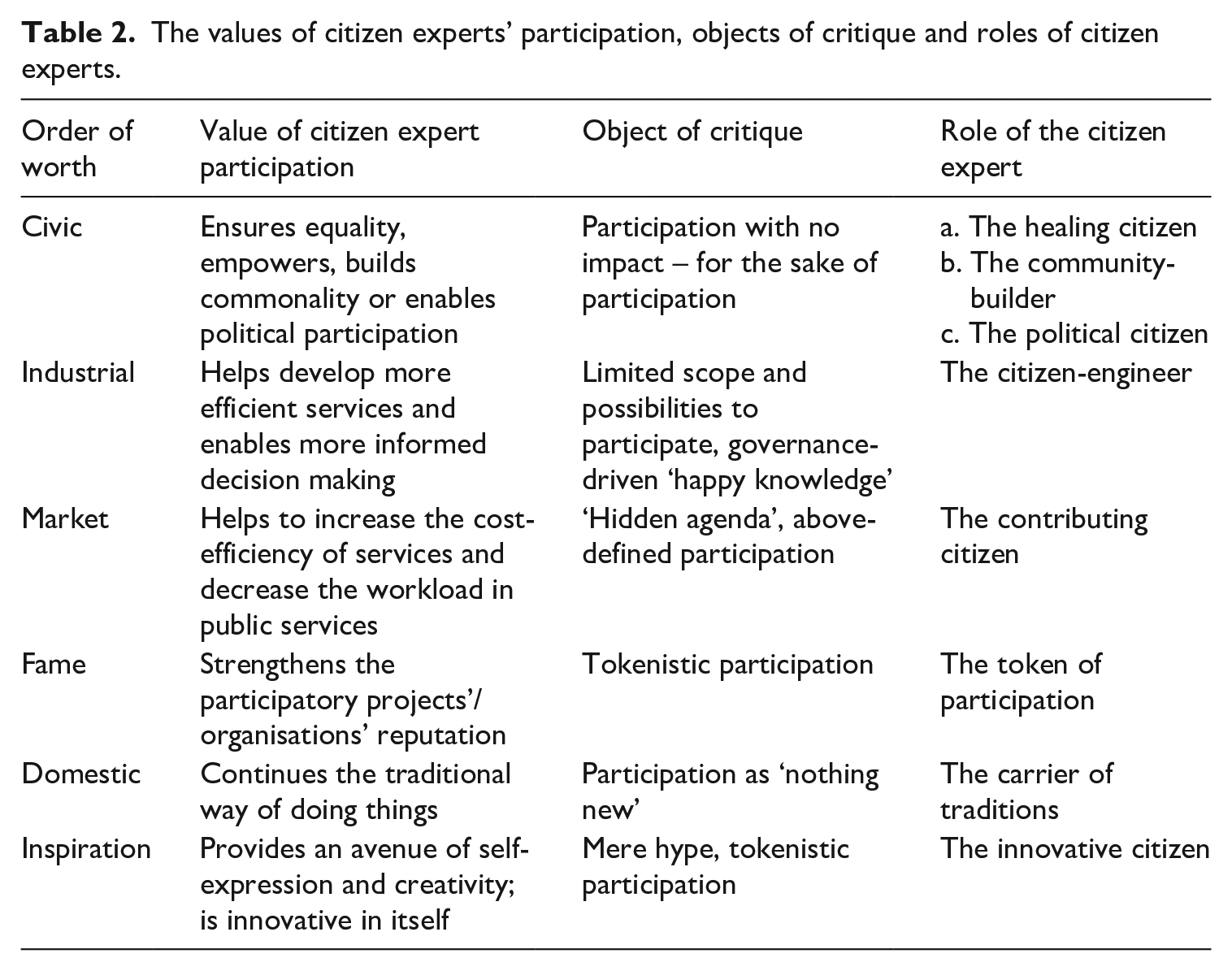
Crucially, the different ways to value citizen expertise can coincide: for example, it is perfectly possible to value citizen expertise as a way to gain experiential knowledge (industrial) while appreciating its possibilities to highlight marginalised voices (civic) and foster the creativity (inspiration) of citizens. However, the primacy of these justifications becomes an object of debate when a conflict emerges – when someone is not happy with the status quo and calls the premises of the current situation into question (see also Meriluoto, 2021). We will next focus on the two central conflicts emerging from our data.
Conflicts between worths
Moments of conflict are key for the analyses of justifications and valuation. When different justifications need to be placed in order, the actors come to articulate the often-implicit value-bases and they are put to the test against one another. When discussing citizen expertise, two main questions created a situation where two or more modes of valuation were irreconcilable: (1) who can act as a citizen expert and (2) what they should be able to do in this role.
Who can act as a citizen expert? Industrial experts and civic participants
The mutual order of the civic and industrial modes of valuation – already in tension in the very concept of citizen expertise – came to be debated when the question over who can act as a citizen expert emerged. If industrial values were given primacy, citizen expertise was primarily justified instrumentally, which subsequently allowed for evaluating its usefulness: it became feasible to define how, where and when citizen experts are ‘worth being listened to’. In the following interview quote, a practitioner from a social welfare organisation discusses how they consider citizen experts to be ‘equal partners’. Crucially, however, this is not because they have a right to be considered as equal, but because they have acquired knowledge and contribute information that is useful: I call the six experience-based evaluators with whom I’ve worked the most, upper-level evaluators. They’re involved in a lot: they’ve been to international seminars, are sitting in these esteemed working groups. So, I hear a lot of information from them that I otherwise wouldn’t. I see us as equal partners. (Practitioner, CSO, social welfare)
The civic critique of this industrial valuation of citizen expertise reoccurred in our data. Experts-by-experience, for example, critiqued how additional training – even education from social studies – was needed in order to be recognised as a valuable participant, as the following excerpt illustrates: In this organisation, you’d need to have a social studies degree before your opinions can be valued. The talk of co-operation, maybe it wasn’t so true after all, because at the end, you need to have education and a degree in order to be heard. (Expert-by-experience, CSO, social welfare)
A similar industrial primacy is visible in some urban projects where actors questioned whether residents would have competence on issues that ‘go beyond their nearest environment’. Residents were also supposed to ‘refine’ their knowledge from personal and emotional to something more generalisable and ‘proactive’ for it to be considered ‘useful’.
The industrial emphasis on the expertise of citizen experts speaks about the participatory culture the Finnish projects are embedded in. The right to participate politically (a civic value) was almost without fail bolstered with industrial claims of efficiency and usefulness. As it seems to be ‘the kind of talk they [decision-makers] will now listen to’, the citizens’ political messages are presented as ‘citizen expert contributions’, as they are thought to receive more weight and attention that way. As characteristic for the Finnish political culture, packaging the point of view as knowledge rather than opinions is believed to be better received (Luhtakallio, 2012).
This primacy of industrial values has had direct and profound consequences for the citizen experts. As the values of usefulness and productivity were introduced from the industrial realm, it became possible to evaluate and choose participants according to similar criteria than any other experts, evaluating their capacity to produce objective, generalisable and reliable knowledge, and placing these as a prerequisite for their participation.
Conflicting scopes of participation: ‘it’s just for show, they don’t actually listen’
The second key conflict that brought forth the different justifications concerned the scope of citizen experts’ participation. In these debates, civic values were drawn upon in efforts to widen their possibilities to participate. By emphasising the right to participate and pitting it against ‘the hidden agendas’, as one of our interviewees labels them, the limits of the citizen experts’ participation become debatable. The main objects of critique curbing the citizen experts’ ‘true possibilities’ to participate were industrial-based justifications, which limited the citizen experts’ role, and the fame- and inspiration-based justifications, which were criticised as leading to tokenistic participation.
The industrial justifications left some of our interviewees feeling that their participation was limited to very specific tasks where their input was deemed useful, as the following expert-by-experience explains. This clashed with the civic value of everyone’s voice being valuable.
In my opinion, the experts-by-experience are usually only given pre-defined tasks. [. . .] The public officials think about what kind of a speech they want to order, according to what some doctor or another wants to hear. (Expert-by-experience, CSO, social welfare)
In the above quote, there is a silent conflict between being allowed to say only what someone wants to hear and being able to say what one wants. A similar conflict was reoccurring among practitioners organising citizen experts’ participation. Some of them felt that industrial justifications led to ‘small slices’ of possibilities to participate, as the following project actor, who critiques the ‘technical involvement’ of people in strategic doses and makes a demand for a much more comprehensive participatory culture, notes: I think this is such a new thing that it still requires a lot of thinking from our public servants. I mean that participation can be much more than just technically involving people. I think the city still does a lot of this ‘okay, let’s involve the citizens’, and then we give them these small slices: ‘come and take part in this or that, join our workshops and fill out these post-it notes, and then we’ll see whether we’ll have any use for them or not’. (Project actor, public sector, urban project)
If the industrial justifications were critiqued for the too narrow possibilities for participation they enabled, the fame- and inspiration-based arguments were criticised for creating no real possibilities to participate at all. Many citizen experts described a feeling of co-optation as the result of organising participation primarily for reasons of popularity and fame. They felt that their participation was used to advance decisions that had already been made elsewhere, referring to it as ‘a play’ or ‘PR work’. Citizen expertise when based on fame, in their view, was merely a rhetorical device to make governance processes appear participatory and, hence, bolster their legitimacy. The novelty-based justifications, on their part, were critiqued for not being justifications at all, but instead a blind following of what ‘everyone seems to be doing’, leading to ‘empty roles’ where neither the value of citizen expertise nor the content of the role were thought through. This was often also recognised by public officials, as the following excerpt shows: We’ve had plenty of these citizen participation initiatives, and the government even has its own high-profile programme for this. I used to go to its seminars, and, well, it was pretty in vain, the whole thing. I think it is completely idle chit-chat. Within this theme of civic participation . . . there is a lot of eloquent rhetoric, but very little possibilities to have a real impact for the citizens, and very little willingness to do anything about it among politicians. (Public official, urban project)
In the fame- and novelty-based justifications, the citizen experts’ participation is advanced because it is considered ‘good practice’, but their knowledge is seldom recognised, as it is not relevant for the image-purposes of the organisation. These tokenistic experts are invited to be present, but their knowledge has very little impact. Their purpose is to serve as physical evidence of how the trendy participatory norm of good governance has been met, as the following interviewee notes: I think now expertise-by-experience has become a trendy catchword, and everyone wants to use it. Even the funder wants to see it everywhere. So, as a result, we’re being asked to meetings and are forgotten in the corner. We’re not really included, but hey, they can put it in their report that we were there. (Expert-by-experience, CSO, social welfare)
As the above quote shows, the fame- and novelty-based tokenistic forms of participation were put into question by contrasting them with civic values. In contrast to serving as physical evidence of good practice, the interviewees above state how they should ‘have possibilities for real impact’ and ‘really be included’, hence politicising the boundaries of limited citizen expert participation by suggesting civic values instead as the appropriate measure of worth.
Discussion and conclusion
In this article, we have investigated how the inclusion of citizen experts is justified in Finnish civic engagement projects. In particular, we have looked into project actors’ – the practitioners’ and the citizen experts’ – ways of valuating citizen expert inclusion with the help of justification analysis (Boltanski and Thévenot, 1999; Ylä-Anttila and Luhtakallio, 2016). By identifying different ways of justifying citizen experts’ involvement, we have sought to understand the different expectations of their role in participatory initiatives. We have investigated the meaning of these justifications through two main conflicts that emerged from our data: debates over who can act as a citizen expert and what the scope of their participation should be. These questions are the situations where ‘push comes to shove’ and all the various goods that could be attained through the inclusion of citizen experts need to be put in order of importance.
Our analysis shows, first, that in the Finnish participatory culture, industrial values are often put first, creating the need to bolster other justifications with claims of usefulness and efficiency. This, as we show, creates the (often narrowly defined) role of an expert for the citizen experts and leads to possibilities to limit the scope of their participation. The prevalence of the industrial justification and, hence, the creation of the role of ‘a citizen-engineer’, indicates that despite the popular, close to normative rhetoric of collaborative practices in policy making, the citizen experts are frequently tasked with feeding ‘reliable and policy-relevant input’ into decision making. What is ‘reliable’ or ‘policy-relevant’ remains at the discretion of the administration, however. The vision of democracy sustained, thus, is collaborative and co-production oriented, placing citizen experts in the realm of ‘apolitical’ governance where knowledge, not opinions or value-judgements, is what is valuable.
The other justifications, while rarer, were nonetheless present in our datasets. Their presence is crucial, as they exemplify the messiness of the multiple logics driving the inclusion of citizen experts. Different policy actors place different value on citizen experts’ participation but shift between these valuations from one situation to another. This confusion explains the sometimes contradictory demands posed upon citizen experts in different stages and contexts of policy making, and the ambivalent roles they are expected to hold. When these multiple value-bases become visible, the myriad of different constructions of citizen expertise becomes intelligible. The identification of these contradictory regimes of valuation helps us understand some experiences of disappointment among both the participants and practitioners of participatory governance. Their feelings of being sidelined, co-opted or working for mere appearances may reflect a mismatch in the actors’ ways to justify citizen expertise.
Crucially, policy actors can strategically manoeuvre between different justifications – particularly civic and industrial – to construct citizen expertise in a certain manner. If it is beneficial for the project to construct the citizen experts’ role as limited and complementing, it becomes appealing to justify it by tapping into industrial valuations and envision the participants’ role as contributors of relevant knowledge. Conversely, the existing citizen expert constructions were also regularly critiqued by our interviewees, politicising the ‘neutral appearing’ demands for citizen expertise from the point of view of civic values.
Our analysis shows how there was notably little difference between justifications in different policy fields. What seemed to affect the way citizen expertise was justified was most of all the organisational context in which citizen expertise was constructed (civil society/public sector – grassroots activism/governance) and the specific purposes the project in question had envisioned for itself. The analysis shows how public officials and public sector actors tended to emphasise industrial valuations, as their key concern was ‘the smooth running of the governance process’. The CSO actors and citizens, in turn, often drew on civic justifications, as their main objective was to carve out room for their voices to be heard.
This article has suggested an approach for analysing the undergirding valuations of citizen experts’ inclusion. As urged by Dean (2017) and Bishop and Davis (2002), we propose justification analysis as a framework with which to go beyond context-specific typologies when analysing participatory measures. Such a theory-informed framework, which is nonetheless built on extensive empirical reading, would, in our view, prove useful when analysing participatory measures across contexts and policy fields. Providing concepts for classification that are general enough so as to be identifiable across context, but specific enough so as to be meaningful, can help us move beyond case-specific descriptive categories towards a more substantive discussion on why civic participation is organised and with what consequences. Moreover, as the framework investigates the actors’ own value-assessments, it enables analyses that look beyond ‘institutional design features’ (Dean, 2017: 214) into the different foundations of participatory projects without collapsing into an evaluation of the participatory measures’ ‘success’ based on a predetermined normative standpoint (Meilvang et al., 2018: 14).
Such a fine-grained analytical tool is sorely needed in order to deepen the analysis of citizen expertise and civic engagement more broadly. A more detailed exploration of their valuations reveals how different policy actors envision citizens’ roles and the foundations of legitimacy in a democracy. By bringing the actors’ own value-bases to the fore, we can give the actors of participatory projects the tools to debate the conditions of their participation as political choices rather than neutral and inevitable ‘matters of fact’. The approach may also prove fruitful when inciting participatory professionals to make the participatory practices’ underlying assumptions explicit and to further consider how citizen expertise might feel valuable to all actors. A key question for future meaningful use of citizen expertise in decision making is how to institutionalise mechanisms that recognise and value different forms of knowledge, and also encourage the expression of disaccord, emotions and embodied forms of knowledge which are currently seldom recognised as policy relevant. This would require, first and foremost, setting up spaces for an open debate about the undergirding assumptions pertaining to citizen participation, enabling participants to question the boundaries of their participation as well.
Footnotes
Acknowledgements
The authors warmly thank Dr Eva Krick for organising the workshop ‘The Role of Expertise in Policy-making – Empirical Scholarship and Normative Analysis’, at the University of Oslo in May 2018, for which the first version of this manuscript was prepared. Dr Krick has also caringly commented the manuscript and been the inspiring driving force behind the present section on lay and citizen expertise. Previous versions of the manuscript have also benefitted from comments by Dr Ellen Stewart and Dr Marc Geddes, as well as theoretical exchanges with Professors Eeva Luhtakallio and Veikko Eranti. The authors also thank the reviewers and editors of Current Sociology for thoughtful and detailed comments which significantly contributed to sharpening the article’s argument.
Funding
The authors disclosed receipt of the following financial support for the research, authorship and/or publication of this article: This research has received funding from the following sources: Academy of Finland (grant no. 565266): ‘Superdemocracy’: A Critical Assessment of the Participatory Turn; European Research Council (ERC) under the European Union’s Horizon 2020 research and innovation program (grant agreement no. 804024): Imagining Democracy: European Youth Becoming Citizens by Visual Participation; Academy of Finland (grant no. 251978): The Democratic Impact of Administrative Reforms – Temporary Governance Instruments in Regional Development (ProDem); and Finnish Cultural Foundation, two individual research grants for Kanerva Kuokkanen.
