




Abstract
This article examines the incidents of discrimination, harassment and violence experienced by lesbian, gay, bisexual and trans (LGBT) individuals in Germany, Portugal and the UK. Using a large cross-national survey and adopting an intra-categorical intersectional approach, it documents how the likelihood of experiencing discrimination, harassment and violence changes within LGBT communities across three national contexts. Moreover, it explores how individual characteristics are associated with the likelihood of experiencing such incidents. The results show that trans people are more at risk compared to cisgender gay, lesbian and bisexual individuals to experience discrimination, harassment and violence. However, other factors, such as socioeconomic resources, also affect the likelihood of individuals experiencing such incidents. The three countries in our study show some nuanced differences in likelihood levels of experiencing discrimination, harassment and violence with regard to differential categories of sexual orientation and gender identity.
Introduction
Just over 50 years ago, most Lesbian, Gay, Bisexual and Trans (LGBT) individuals were criminalised in the vast majority of countries around the world and were socially excluded from their societies because of their sexual orientation and/or gender identity. Recent decades have witnessed an arguably impressive advancement in LGBT rights, albeit mostly in more developed countries (Mendos, 2019). LGBT individuals in these countries have gained more recognition, as well as varying degrees of rights and forms of legal protection, which have aimed to eliminate discrimination and inequality against them. While these developments have significantly improved the lives of LGBT individuals, research continues to document that LGBT people still experience hostility and discrimination in their everyday lives (FRA, 2014).
Adopting an intra-categorical intersectional and comparative approach, this article aims to explore the extent to which LGBT people in three European countries (Germany, Portugal and the UK) experience incidents of three forms of hostility: discrimination, harassment and violence (DHV). This article considers self-reported experiences of DHV in relation to differences within and between gender identity and sexual orientation, along with other social characteristics. It also compares these incidents across three different national contexts and discusses the potential reasons why these national differences exist.
Using cross-sectional data for three European countries from the LGBT Survey conducted by the European Union Agency for Fundamental Rights (FRA), this article makes an original contribution to existing knowledge in several ways. First, it explores the diversity within LGBT communities in their experiences of negative incidents such as discrimination, harassment and violence. Second, it explores how other social characteristics, such as socioeconomic status, gender, ethnicity, disability and age may shape the likelihood of experiencing such negative incidents. Finally, it draws comparisons across national contexts, in order to better understand international differences within Europe.
The article shows that trans individuals are more likely to experience incidents of discrimination, harassment and violence than cisgender LGB individuals in all three countries. Sources of social division such as gender, ethnicity, socioeconomic status, disability and age also affect the likelihood of experiencing such negative incidents. Indeed, those who have greater socioeconomic resources are less likely to experience such incidents. Finally, the article shows that the countries included show nuanced patterns of DHV directed against LGBT people. These findings make a case for the use of the intersectional approach to gain a more sophisticated and granular perspective on the inequalities faced by LGBT people who are uniquely positioned by their sexuality and gender identity, as well as the national contexts they live in.
Theoretical framework
Adopting an intra-categorical intersectional approach
Examining how DHV incidents are experienced differently within LGBT communities and the impact of different national contexts and other social factors on the likelihood of experiencing these incidents is essential to protect LGBT individuals from DHV and their disruptive effects. Such considerations warrant an approach that pays attention to differences and diversity across sexual and gender identities. Intersectionality is such an approach and acts as a lens (a) to explore the differences between gay, lesbian, bisexual and trans individuals, (b) to examine how age, social class, gender, ethnicity and disability may shape LGBT individuals’ experiences of DHV incidents, and (c) to highlight and explore the context-dependent nature of these factors by exploring national variations in the experiences of LGBT people.
Intersectionality gained prominence as a response to the lack of attention given to the lived experiences of black women in research on gender and race. Feminist scholars, most notably Crenshaw (1989) and Collins (2002), explored how the experiences of those who are located at the intersections of multiple minority identities (i.e. experiences of black women) were ignored and went unexamined, although these intersections produced unique experiences that were distinct from those located at other intersections. Since then, the intersectional lens has been adopted by researchers who look at intersections of other identities such as sexuality and disability, along with gender, race and class (Parent et al., 2013).
Intersectionality has become a threshold concept for understanding differences in power and inequality within social groups (May, 2015) and has been particularly influential in LGBT studies during the past decade. Many researchers have pointed out that LGBT research had failed to adequately attend to diversity among the different categories of the umbrella term LGBT and to examine how these are intersected by other sources of identity and social division (Hall et al., 2021; King et al., 2018; Taylor et al., 2010; Westwood, 2016). Utilising an intersectional lens enables the exploration of multiple and sometimes the divergent ways that power, privilege and inequality shape LGBT people’s lives.
In what has now become a field-defining article, McCall (2005) delineated three modes of intersectional analysis: the anti-categorical, the intra-categorical and the inter-categorical. In line with the purposes of this article and the specific group it explores, we adopt what McCall calls an intra-categorical approach in our study. McCall describes this approach as interrogating ‘the boundary-making and boundary-defining process’ but also acknowledging ‘the stable and even durable relationships that social categories represent’ (McCall, 2005: 1774). This is critical for our study because we aim to explore the diversity within the LGBT communities and approach the analytic categories critically, but unlike the anti-categorical approach, we use these categories to examine inequalities related to self-reported sexual orientation and gender identity rather than deconstruct these identities entirely.
Whilst our study has overlaps with McCall’s (2005) inter-categorical approach in its treatment of categories, it differs from this approach by looking at the experiences of specific social groups and exploring some complexity without bringing in ‘the full range of dimensions of a full range of categories’ (McCall, 2005: 1781). Our study solely focuses on sexual and gender identity minority categories without a comparison to dominant categories (heterosexual cisgender individuals). We examine divisions within this existing group, exploring how intra-group differences occur within different contexts. We also look at the effects of other social identities such as gender, class, ethnicity and age for the LGBT community as a whole to explore how other forms of social division may diversify the experiences of LGBT individuals. While the differences between these approaches proposed by McCall are not always clear-cut, for its treatment of analytical categories and its treatment of complexity, our study is most similar to the intra-categorical approach.
Intersectionality and discrimination, harassment and violence
In this article, we identify discrimination, harassment and violence or threat of violence (DHV) as behaviours stemming from homophobia, biphobia and transphobia, themselves premised on hetero-cisnormative social structures, institutions and practices 1 (Worthen, 2016). These can be subtle at times yet still damaging, or they can be overt and confrontational, enacted with the aim of causing harm to individuals physically as well as emotionally. Research on LGBT individuals in the US shows that experiences of discrimination, harassment and violence can create stress and anxiety (Almeida et al., 2009) and can also lead to disruptions in the lives of LGBT individuals by shaping life-course trajectories (Fredriksen-Goldsen et al., 2017) as well as generating a process of cumulative disadvantage. Eliminating incidents of DHV is vital not only to create a safer environment but also full equality for LGBT people.
Following previous studies using intra-categorical intersectionality (McCall, 2005), we highlight three significant directions in research that can help to document a variety of experiences amongst LGBT individuals. The first requires separating categories of identity: L, G, B and T. For instance, research from the UK argues that bisexual individuals experience unique forms of discrimination and exclusion (Bayrakdar and King, 2021) and they are not only discriminated by heterosexuals but also by the other members of LGBT communities (Barker et al., 2012). Similarly, Meyer (2012) argues that LGBT research on hate crime has predominantly focused on homosexuality and heteronormativity and despite the evidence on gendered forms of anti-queer violence, most studies have overlooked the intersections of gender identity and sexual orientation in LGBT research. Reviewing studies from across the world and empirical evidence from the US, Worthen (2013) explains how attitudes towards L, G, B, T individuals may differ through various mechanisms and suggests that trans individuals experience negative attitudes in unique forms, such as transphobia, and related to gender non-conformity. Following the steps of these researchers, we compare intra-categorical differences within and between LGBT people in our analysis.
The second research direction requires exploring the diverse experiences of LGBT people according to intersecting forms of social division such as class, ethnicity and disability. Recent literature shows that lesbian women are more likely to experience bullying at the workplace compared to gay men, suggesting that discrimination on the basis of sexual orientation may differ according to gender (Hoel et al., 2014). Meanwhile, research with older gay men suggests that they can be victims of discrimination or harassment when they do not conform to heteronormative representations of masculinity in the workplace in the UK (Ozturk et al., 2020). In other words, there is also a complex relationship between gender norms and how DHV is experienced according to sexual orientation.
Diverse patterns of discrimination, harassment and violence can be also found at the intersections of sexual orientation and ethnicity. The evidence suggests that there is a higher risk of discrimination and marginalisation for LGBT individuals from minority ethnic groups (Cyrus, 2017; Whitfield et al., 2014). While the evidence from the UK is somewhat patchy, it also suggests a higher chance of discrimination and harassment both in mainstream society and in their respective LGBT and ethnic communities (Dick, 2009; McKeown et al., 2010). That said, it has also been argued that counteracting stereotypes about being black and being gay may reduce the negative treatment of individuals situated at the intersections of multiple minority membership in the US. Pedulla (2014) argues that the effects of double minority membership are not always negative and being gay may counteract the negative stereotypes of employers about black identity. All in all, over 20% of all hate crimes in the UK are thought to be associated with more than one protected characteristic (Creese and Lader, 2014), suggesting that multiple minority statuses might have an additional effect on the likelihood of experiencing discrimination, harassment and violence. Similarly, class is an important intersecting factor, with studies suggesting that individuals from working-class backgrounds might have fewer resources to protect themselves from such negative experiences (Veenstra, 2013). While potentially differential effects of these identities (with the exception of gender) across L, G, B, T individuals are beyond the scope of this article, we look at the effects of these factors on LGBT people as a whole and document how class, ethnicity, disability and age shape experiences of DHV.
The third research direction requires an understanding of diverse experiences by exploring the role of ‘context’ in LGBT lives. This area is relatively underexplored, possibly due to a lack of data sources that allow the exploration of LGBT experiences in a comparative manner. That said, studies that explore LGBT experiences comparatively highlight that context matters and may shape the experiences in the labour market (Arabsheibani et al., 2007), health services (Mulé, 2007), and in terms of citizenship rights (Hines and Santos, 2018). Several researchers explain differences in the levels of acceptance of homosexuality across countries by religiosity, economic development and wealth, family-based welfare systems, existence (or lack) of LGBT equality legislation, a history of communism, and levels of sexual permissiveness (Kohut et al., 2013; Štulhofer and Rimac, 2009; Valfort, 2017). It is argued, for instance, that Protestant countries are less sexually restrictive than Catholic and Eastern Orthodox countries, therefore fewer negative attitudes towards homosexuality are exhibited publicly (Štulhofer and Rimac, 2009). Moreover, Takács and colleagues (2016) argue that southern European countries with more (traditional) family-oriented values and welfare systems have lower acceptance levels towards adoption by same-sex couples.
LGBT lives and contextual factors: Germany, Portugal and the UK
Germany, Portugal and the UK are the focus of this article as they encompass countries covered by the CILIA LGBTQI+ Study from which it emanates. While all three countries are democracies with LGBT equality in their policy landscape, they do have enough contrastive legislative and cultural features which make them interesting cases to compare in terms of LGBT equalities, while being similar enough to make a sensible comparison.
Evidence regarding the acceptance of LGBT people in these countries is mixed, possibly because of the differences in survey design and question wording. National studies show more positive attitudes in general to international studies. One study from Britain shows that 66% of the population thinks sexual relations between same-sex adults are not wrong at all (Albakri et al., 2019). Similarly, a report shows 88% of the respondents were partly or entirely in favour of marriage equality in Germany months before it was granted (Küpper et al., 2017). One OECD report (Valfort, 2017), which uses comparable data from the European Social Survey (from 2001 to 2014), suggests that more respondents in Germany (around 60%) think that homosexuality is justifiable than in the UK (around 50%) and Portugal (40%). Smith and colleagues (2014) show that Germany and the UK show much higher acceptance rates compared to Portugal, as do several other studies (Kohut et al., 2013; Štulhofer and Rimac, 2009; Takács et al., 2016).
The FRA report based on the dataset we use in this study presents descriptive results on discrimination, harassment and violence across Europe (FRA, 2014). While the report shows a lower likelihood of discrimination experienced by LGBT individuals in the UK and Germany than the EU average, the reports of discrimination are slightly more common in Portugal. For violence, the exact same pattern exists, albeit with very small differences in actual numbers. While further work on the attitudes towards LGBT individuals is necessary, analyses from different sources suggest that acceptance levels in Germany and the UK are similar, whilst Portugal appears to be slightly lower. 2
With regard to legislation, the countries included in this article have been at the forefront of LGBT rights in Europe. The constitutional protection against sexual orientation discrimination is enshrined only in Portugal, while all three countries have laws forbidding discrimination against LGBT individuals in employment, social protection, education, and in access to goods and services (Mendos, 2019; TGEU, 2013). While offences committed on the basis of sexual orientation or gender identity are criminal acts in all three countries, targeting LGBT people on the basis of their gender identity/sexuality is considered as aggravating circumstances and subject to enhanced sentences in the UK and Portugal. Similarly, incitement of hatred, violence, or discrimination based on sexual orientation or gender identity is a criminal offence in the UK and Portugal. 3 Overall, although all three countries have developed legislation and policies to protect LGBT people, Portugal and the UK appear to offer further protections compared to Germany by including hate crime and hate speech against them as criminal offences.
With regard to culture, religion and values, the countries in our study differ considerably. Roseneil and colleagues (2013) argue that Catholicism, the heritage of a recent dictatorship and a familial based welfare system undermined the development of strong social movement activism in Portugal. Although the LGBT movement gained momentum with support from the EU, the strong tradition of Catholicism and family values is still likely to affect attitudes towards LGBT rights. In the UK, where active campaigning started in the 1950s, an increasingly open LGBT culture started to form in the 1970s. While progress has not been linear, especially with a backlash promoted by the Thatcher governments of the 1980s (Weeks, 2007), support for LGBT rights has been strong, particularly since the late 1990s. Germany seems to be positioned between the UK and Portugal in terms of the normalisation of LGBT lives. After the devastating losses of the Nazi regime, the LGBT movement started to gain momentum in the 1970s in West Germany and the 1980s in East Germany. German Unification has been a catalyst for a further change with the help of transnational organisations including the EU (Davidson-Schmich, 2017). That said, progress has been realised under the government of socially conservative Christian Democrats and certain rights such as marriage equality came into effect later than other countries (Ayoub, 2015), perhaps partly due to the strong family focus of the corporatist welfare state.
Data
This study uses the FRA EU-LGBT survey on the experiences of LGBT individuals in Europe (FRA, 2012). It includes information collected via an online questionnaire about individuals who are 18 or over and self-identify as LGBT. We use the data from respondents who reside in Germany, Portugal and the UK. While based on a purposive convenience sample, this dataset provides the largest number of cases for LGBT individuals across Europe, which offers a rare opportunity for studying LGBT inequalities in a comparative fashion (Fric, 2019; Van der Star et al., 2021).
The total number of cases for each country after omitting those with missing data are 19,868 for Germany, 2063 for Portugal, and 6592 for the UK (see Table 1). Due to the differences in the country-specific recruitment strategies based on purposive convenience sampling, the sample size for Germany is much larger than the other countries. FRA adopts strategies to calculate target sample sizes per country, by LGBT group, and by age category and include weights for researchers. The weights calculated by FRA adjust the sample for varying sizes of L, G, B and T groups to the EU average in the data to avoid over/underrepresentation of certain groups within countries. FRA furthermore adjusts the sample sizes proportionately to the population size of each country, therefore countries with large samples are not overrepresented in pooled models.
Cases numbers by LGBT identity and country.
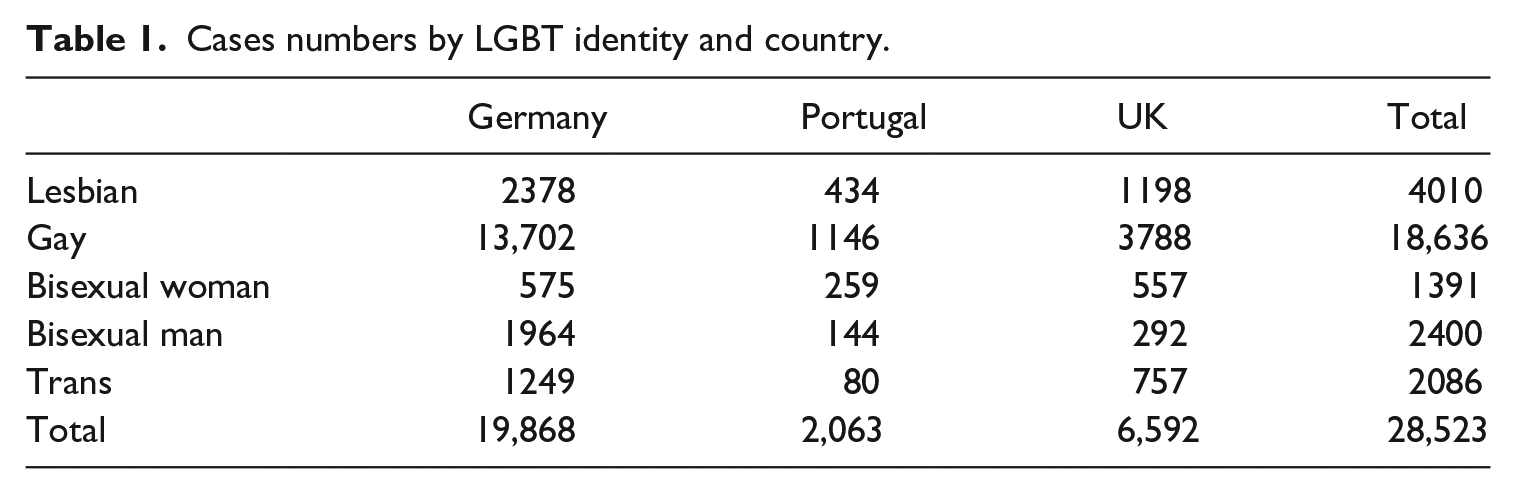
The dataset enables us to examine three different kinds of incidents: having experienced discrimination, having been harassed, having experienced (or been threatened with) violence. These measures are based on self-reports and therefore arguably cover a wider range of incidents than official crime statistics. Many LGBT individuals do not report DHV incidents to police services as they do not think it will make a difference (FRA, 2012). Self-reported measures are also more suitable for our purposes as they can be easily compared across different countries. For discrimination we use the following questions from the survey:
In the last 12 months, in the country where you live, have you personally felt discriminated against or harassed on the basis of sexual orientation grounds? (for LGB individuals)
In the last 12 months, in the country where you live, have you personally felt discriminated against or harassed because of being perceived as LGBT? (for trans individuals)
For harassment and violence, the information available in the survey is not measured in the same way. Instead, the respondents are first asked about whether they have experienced these incidents for any reason, and then, in two questions, whether the most recent and the most serious incidents of harassment in the last 12 months happened partly or completely because they were perceived to be LGBT. Therefore, it is possible that some LGBT-targeted harassment and violence were not captured in the dataset. The questionnaire defines harassment as ‘unwanted and disturbing behaviour towards you such as name-calling or ridiculing that did not involve actual violence or the threat of violence.’
For sexual orientation and gender identity, we created a variable which differentiates between gay, lesbian, bisexual woman, bisexual man and trans individuals. To create this variable, we first make use of the LGBT category variable available in the dataset, which includes lesbian, gay, bisexual and trans categories. Using this variable together with the sex assigned at birth variable, we divide the bisexual category by sex. The way the data are made available did not allow us to differentiate between trans men and women.
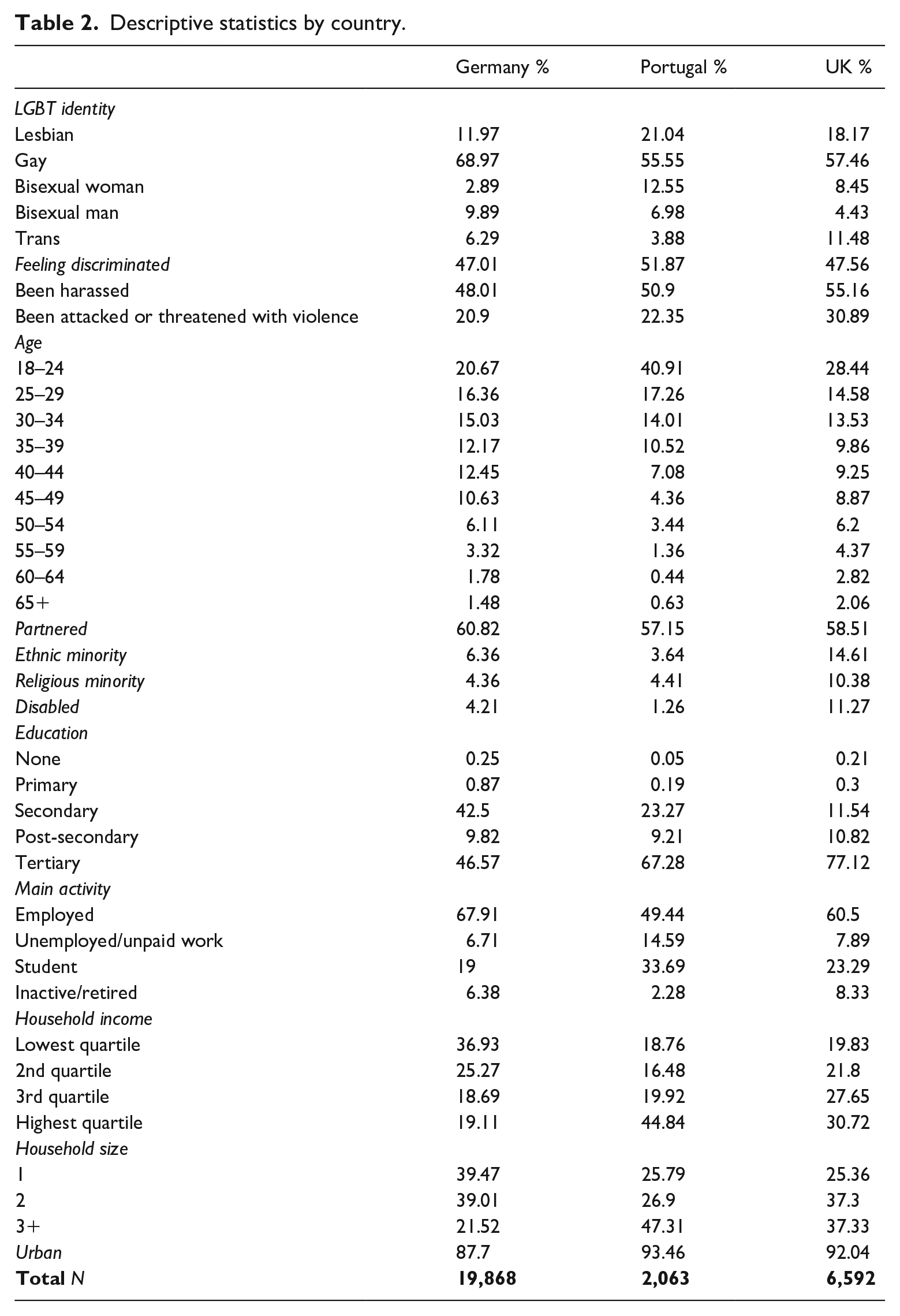
We utilised a range of variables on demographic and socioeconomic characteristics: age, partnership, ethnic and religious minority status, disability, main economic activity, household income, household size and living in an urban area (see Table 2).
Descriptive statistics by country.
Methods
We used logistic regression to examine the likelihood of experiencing discrimination, harassment and violence across the three national contexts. We present the models on the likelihood of experiencing discrimination (Table 3), of being harassed (Table 4) and of experiencing (or being threatened with) violence (Table 5). We then ran pooled models for all three national contexts (available on request), and present the predicted probabilities based on these models to show how the likelihood of experiencing discrimination, harassment and violence may differ across countries and between lesbian, gay, bisexual, trans individuals. As these predictions are based on the pooled model, they show how each outcome may differ from one country to the other and allow us to see how country context may make a difference. All the models are weighted to adjust for the country size and for varying groups sizes of LGBT communities across the countries.
Results
Table 3 shows the results for the logistic regression models for experiencing discrimination. These models show quite similar patterns amongst lesbian, gay, bisexual and trans individuals across countries. The reference category for the LGBT identity variable is ‘lesbian’, therefore the coefficients show the effects for each category in comparison to women who self-identify as lesbians. In all three countries, bisexual men are the least likely to experience discrimination. The likelihood of being discriminated against is also lower for gay men and bisexual women compared to lesbians. These are significant in all three countries. While there is no significant difference in the likelihood of discrimination between lesbians and trans individuals in Portugal, trans individuals in Germany and the UK are significantly more likely to experience discrimination. Overall, in terms of the likelihood of discrimination, lesbians and trans individuals are more at risk compared to other groups, particularly trans individuals in Germany and the UK.
Logistic regression models for discrimination.
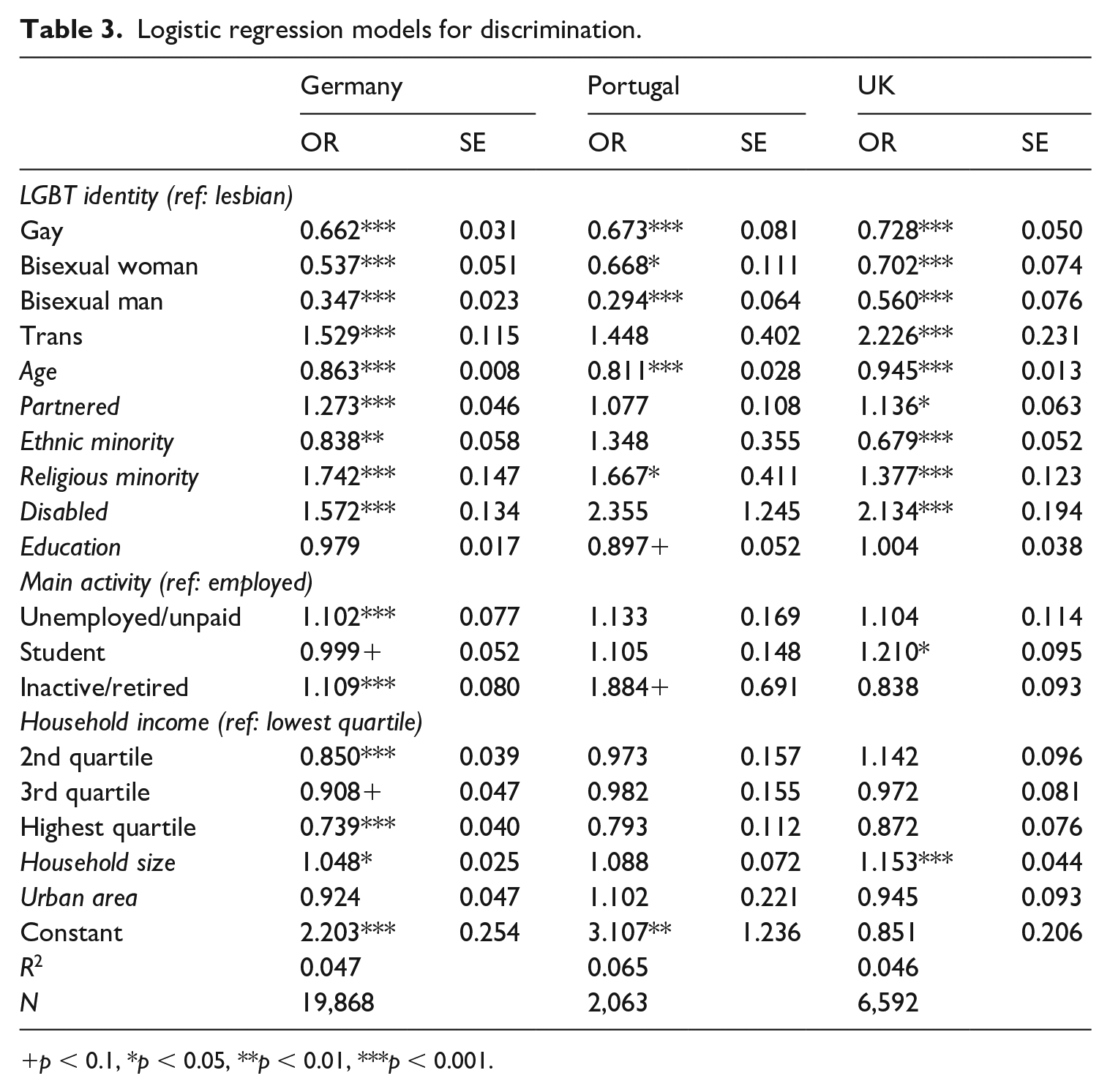
p < 0.1, *p < 0.05, **p < 0.01, ***p < 0.001.
We see a negative age effect, which suggests that the likelihood of discrimination decreases by age. Having a partner is associated with an increase in the experience of discrimination in Germany and the UK, suggesting that increased visibility of having a partner may affect the likelihood of discrimination. This effect is smaller in size and not significant in Portugal. LGBT individuals from minority ethnic backgrounds appear to be less likely to experience discrimination in Germany and the UK, whereas religious minority status is linked with a higher likelihood of discrimination in all national contexts. It is important to remember that ethnic minority and religious minority status are likely to be correlated and the effect of ethnicity in the model is net of a minority religion effect. When we exclude the religious minority variable from our model (not presented in the article), the negative effect of the ethnicity variable becomes much smaller and insignificant for Germany, but not for the UK. While our models do not explain the mechanisms behind these patterns, the positive effect of ethnicity in the UK echoes Pedulla’s (2014) argument concerning stereotypes about sexual minorities counteracting stereotypes about ethnic minority background. That said, it is important to note that such stereotypes are likely to differ across national contexts based on institutional differences, culture and the characteristics of ethnic minority populations. Having a disability also significantly increases the likelihood of discrimination in LGBT communities in Germany and the UK.
The coefficients for education, employment status and earnings show that there seems to be a strong negative association between socioeconomic resources and the likelihood of experiencing discrimination but only in Germany where those employed are less likely to experience discrimination than those who are unemployed or economically inactive. High earnings also have a clear negative effect. In the UK, those with a degree are less likely to experience discrimination, but this difference is significant only at the 0.1 confidence level. In Portugal, socioeconomic resources do not seem to have a clear effect. Overall, individuals with higher socioeconomic resources might be able to avoid discrimination to some extent in Germany, but we do not see a similar pattern for those in Portugal and the UK. Finally, living in an urban area does not have a significant effect on the likelihood of being discriminated against.
Table 4 shows the models examining the likelihood of harassment across the three national contexts and shows very similar patterns to those regarding discrimination. Lesbians are more likely to experience harassment compared to gay men and bisexual individuals in all three countries, except gay men in Portugal and trans individuals in Germany and the UK. Trans individuals are more likely to experience harassment than gay, lesbian and bisexual individuals, but only in the UK. It is important to note that when we run the regression on any kind of harassment regardless of whether it happened because the respondent was perceived to be LGBT or not, we see that trans individuals are more likely to experience harassment (model not presented here). In other words, trans people experience more harassment, although they may not consider some of these experiences are related to their trans identity.
Logistic regression models for harassment.
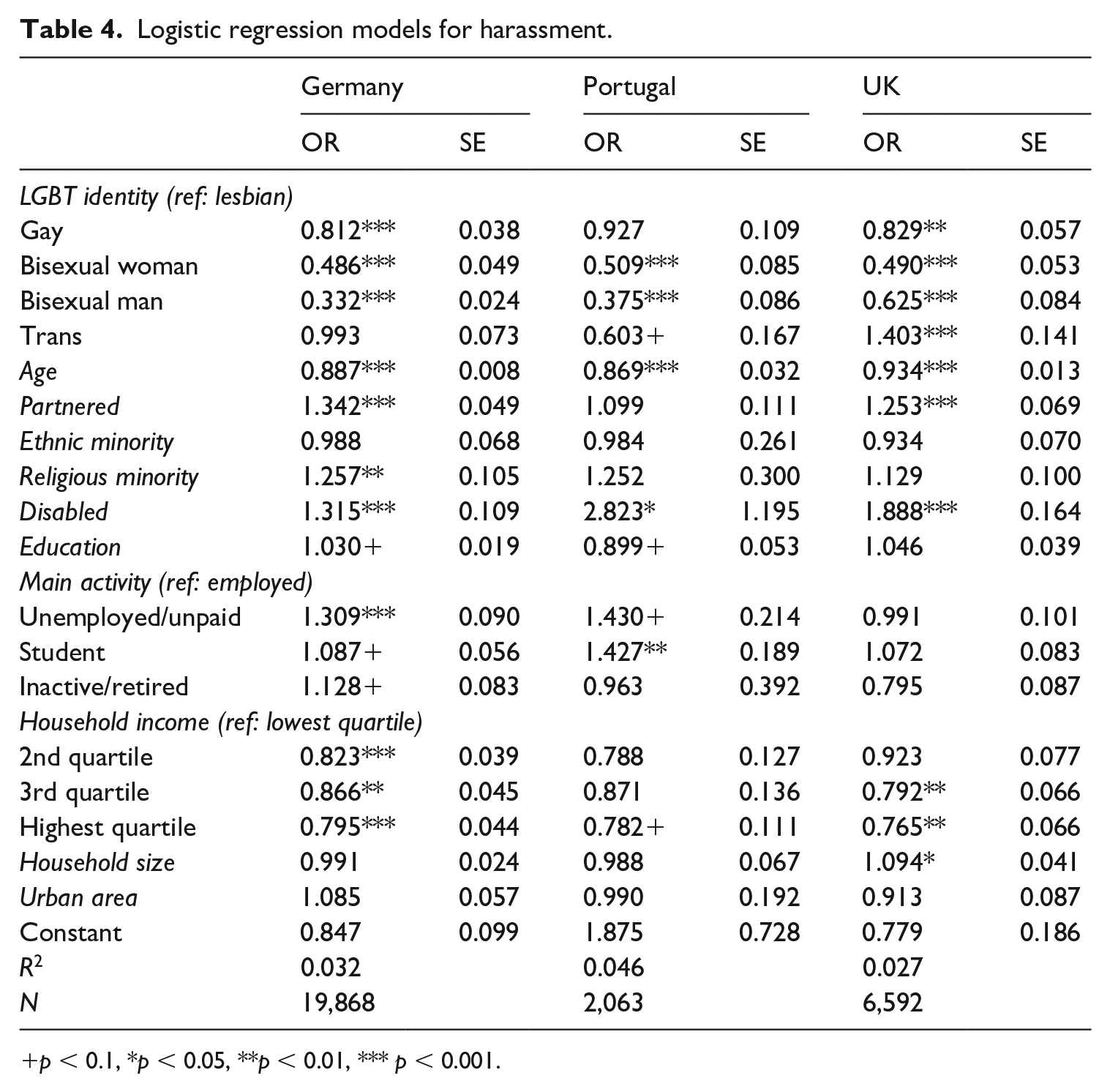
p < 0.1, *p < 0.05, **p < 0.01, *** p < 0.001.
Regarding the other variables in our model, we see very similar patterns in the models for harassment and discrimination. Being older has a negative effect on the likelihood of experiencing harassment in all countries. Those from a religious minority are more likely to experience harassment in Germany, while ethnic minority status does not appear to have any significant effect in any of the three countries. Having a disability is linked with an increased likelihood of harassment in all three countries. Similarly, in all three countries, individuals either in employment or with high household income are less likely to experience harassment, suggesting that economic resources might be linked to a lower likelihood of experiencing harassment.
Table 5 shows that patterns of experiencing violence are quite different than those of discrimination and harassment. Our results show that gay men are more likely to experience violence compared to lesbians in all three countries. While both bisexual men and women are less likely to experience violence than lesbians in Germany, this is true only for bisexual women in Portugal and the UK. Overall it seems like there is a gendered pattern which puts cisgender gay and bisexual men at greater risk of violence. The coefficients for trans individuals show that they are more likely than any of the other groups to experience violent attacks or be threatened with it in Germany and the UK, albeit this effect is not statistically significant in Portugal. These effects are particularly large in Germany and the UK showing that trans individuals appear to be more vulnerable compared to the other gender/sexual minority groups with regard to experiencing violence.
Logistic regression models for violence.
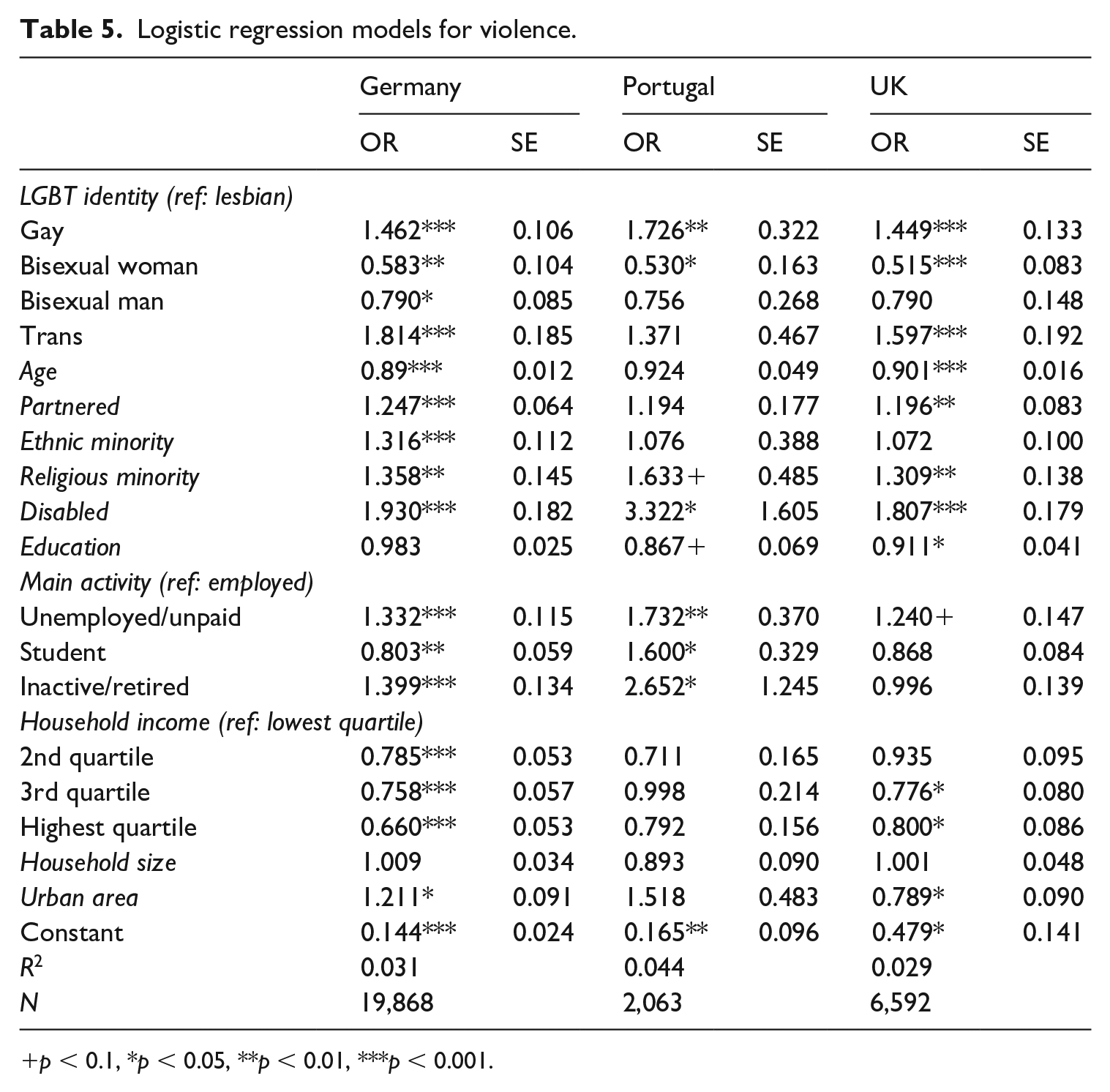
p < 0.1, *p < 0.05, **p < 0.01, ***p < 0.001.
The variables measuring other social characteristics show similar effects in terms of experiencing violence as previous models. Age has a negative impact on experiencing violence in Germany and the UK. Religious minority status and disability are linked with an increased likelihood of experiencing violence, the latter being considerably large. Socioeconomic resources also have an impact in all three countries. Higher education in Portugal (at confidence level 0.1) and the UK, and employment and/or higher earnings in all three countries are linked with a lower likelihood of experiencing violence. LGBT people from ethnic minorities are more likely to experience violence in Germany, although the effect of ethnicity is not significant for Portugal and the UK.
Finally, Figures 1–3 present the predicted probabilities of experiencing discrimination, harassment and violence based on the pooled models, allowing us to make further comparisons between them. Figure 1 shows that as indicated previously in the regression models, trans individuals and lesbians are more likely to experience discrimination compared to the other groups. Regarding the differences between the countries, all three have very similar patterns wherein trans individuals are the most likely to experience discrimination and bisexual men the least likely.
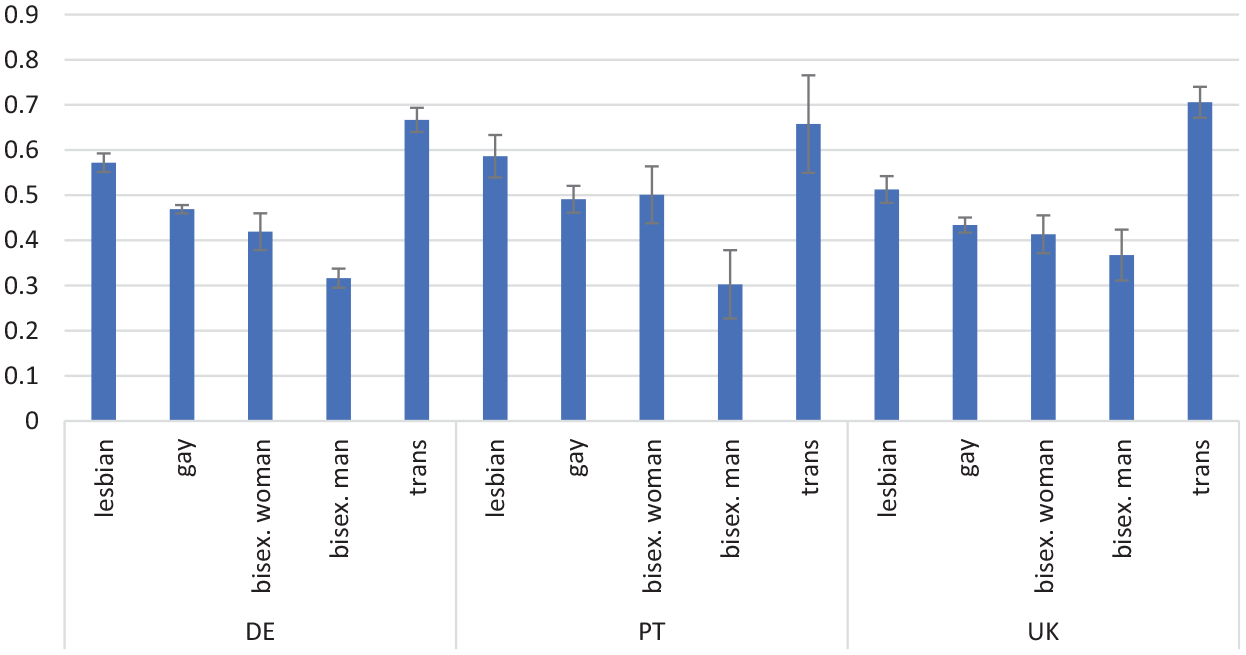
Predicted probabilities of experiencing discrimination.
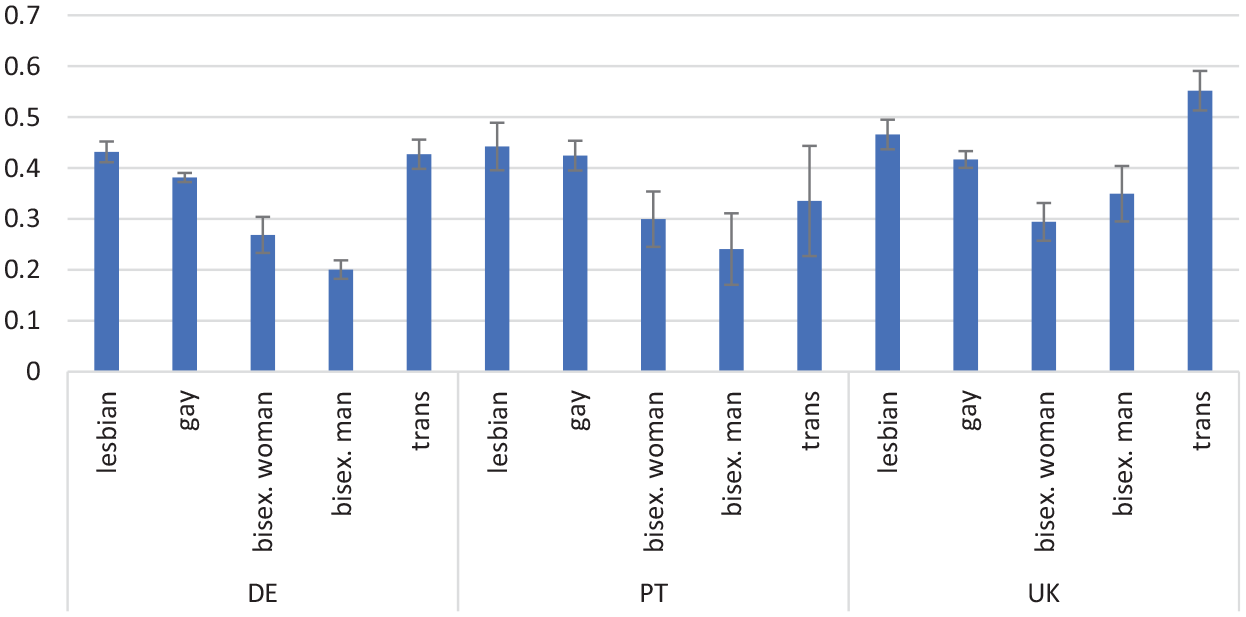
Predicted probabilities of experiencing harassment.
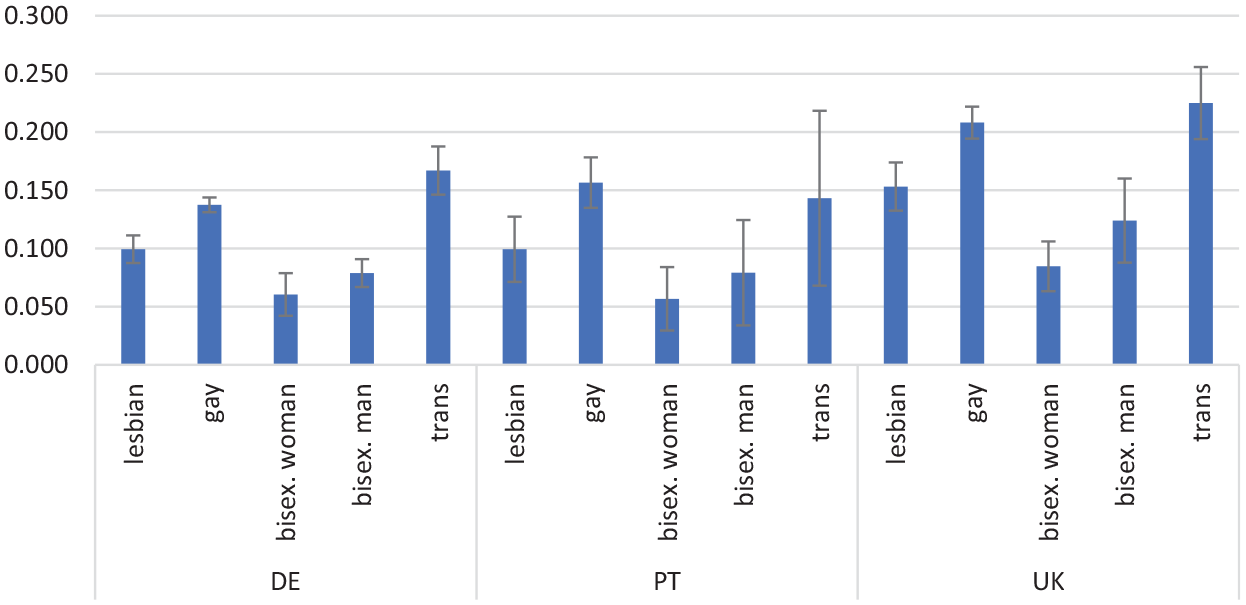
Predicted probabilities of experiencing violence or threat.
Figure 2 shows the predicted probabilities for harassment, which reveal different patterns to Figure 1. Bisexual men and women are the least likely to experience harassment in all three countries. Trans individuals in the UK are more likely to experience harassment compared to other groups in the UK and compared to trans individuals in Portugal and Germany. While gay men and lesbian women in Portugal and lesbian women and trans individuals in Germany are the most likely groups to experience harassment within their countries.
Finally, Figure 3 shows the likelihood of violence across national contexts. Gay men and trans individuals are by far the most likely to experience violent attacks or be threatened with violence in all three countries. The country comparison shows that the predicted probabilities for violence are the highest for trans individuals in Germany and the UK, while gay men seem to be more likely to experience violence than trans individuals in Portugal although this difference is not significant. Overall, LGBT individuals in the UK are the most likely to experience violent incidents on average.
Discussion and conclusions
In this article, we have explored the self-reported experiences of discrimination, harassment and violence among LGBT individuals in three European countries: the UK, Germany and Portugal. Using an intra-categorical intersectional lens, we have contributed to the literature on LGBT lives in three ways. Our results show that trans individuals are more at risk of experiencing negative incidents compared to cisgender gay, lesbian and bisexual individuals in all three countries, with the exception of the incidents of harassment in Portugal. Among cisgender LGB individuals, lesbians seem to be more at risk compared to other groups in experiencing discrimination and harassment, while gay men are more at risk of experiencing violence in all three countries. This may suggest gendered patterns for different forms of DHV for gay and lesbian individuals. While the data does not tell us specifically why such patterns occur, these patterns are in line with previous research. For example lesbians report higher rates of bullying in the workplace than gay men (Hoel et al., 2014). It is possible that the kind of DHV experiences overlaps with certain groups. For example, gay men may be more likely to be exposed to aggression as they are seen as a threat to masculinity (Parrott et al., 2008).
These nuanced experiences indicate that intra-categorical intersectionality is a useful and necessary approach for exploring LGBT lives. Using different intersectional approaches identified by McCall (2005) and looking at different conjunctions of intersecting identities is a promising path for future research. For example, in our analysis we have found that older age and higher socioeconomic resources reduce the likelihood of experiencing DHV. While ethnicity did not have a clear effect net of religious minority identity, having a religious minority identity increased the likelihood of DHV for LGBT individuals. Similarly LGBT individuals with disabilities also have an increased likelihood of experiencing DHV. Looking in further depth at how the effect of socioeconomic resources, ethnic and religious minority or disability intersect and differ within and between categories of gender identity and sexual orientation has the potential to disentangle further some of these complexities.
Exploring the national and cross-national contexts, we see that all three included in our analysis show similar patterns in the likelihood of LGBT individuals’ experiences of discrimination, harassment and violence. While with regard to the incidents of discrimination our data do not show a clear difference among the three countries, the most striking differences concern the rates of violence and harassment, which are higher in the UK, particularly for trans individuals and gay men. These results suggest some support for the role of contextual factors in explaining the experience of DHV incidents among LGBT people and highlight the need for further comparative research, particularly on to what extent contextual factors account for different forms of incidents.
Our study reveals some very interesting results, albeit with several data limitations. While the dataset used in this study has information on exceptionally high numbers of individuals who identify as LGBT and allows us to conduct a quantitative analysis of LGBT inequality, it does not claim to be representative. While it is based on purposive convenience sampling, the sample sizes are large enough to control for a series of variables which can introduce selection bias. We control for age, gender, socioeconomic background, ethnicity, disability and partnership. We also use weights in our study and include the variables that may adjust for some of the selection problems. That said, the success of such measures remains open to question as there are no population statistics on the socioeconomic and demographic characteristics of the LGBT population in any country.
Several authors also point out that the validity in survey research on LGBT individuals might be affected by other issues such as mischievous respondents, temporal nature of sexuality, using a single dimension of sexuality and non-disclosure (e.g. low participation levels from those with privacy concerns or who are not out) (Cimpian, 2017; Savin-Williams and Joyner, 2014). It is also possible that the online survey may not reach economically less advantaged individuals without internet access, leading to some degree of underestimation of the prevalence of DHV. We do not have a reason to expect that the level of underestimation will differ across L, B, G, T groups or across countries; however, until we have reliable and sizeable data from registers or representative surveys, it will not be possible to fully assess bias in LGBT surveys.
It is also notable that queer, intersex and other sexual and gender minorities (QI+) are not included in the survey. As documented in this study, as well as others (Giffney and O’Rouke, 2016), the experiences within LGBTQI+ communities are diverse, and these can only be documented if they are captured in research data. The fact that the most recent report from FRA (2020) includes intersex individuals is a positive step and shows a commitment to inclusivity. Finally, the survey we use in this study is from 2012, and since then, there have been further advances towards LGBT equality which are likely to impact the attitudes towards LGBT individuals as well as backlash and a climate of populism in certain regions. Therefore, it is possible that the levels of discrimination, harassment and violence have changed and not necessarily for the better.
Studies that make use of LGBT quantitative data in an intersectional and comparative fashion are rare. Despite being almost a decade old, the FRA EU-LGBT dataset proves to be a valuable source which allowed us to examine LGBT equalities in a comparative manner towards filling this gap. Moreover, it shows the potential of intersectional approaches in quantitative studies, where adequate and large-scale datasets are available. The next instalment of the FRA EU-LGBT survey will create new opportunities to examine more complex intersectional identities, as well as examining trends across time. Similarly, general population data with better sexual orientation and gender identity data as well as large numbers of cases for other social identities such as ethnicity will create opportunities to explore inter-categorical analyses where intersections of sexuality, gender, ethnicity, disability and class could be examined simultaneously. We hope that this study will make a significant contribution to the development of research looking at cross-national intersectional differences in relation to LGBT lives and the advancement of our understanding of diversity and in/equalities.
Footnotes
Funding
This work was supported by NORFACE (New Opportunities for Research Funding Agency Cooperation in Europe) under the grant number 462-16-080/3724 (CILIA-LGBTQI+ Project: Comparing Intersectional Life Course Inequalities amongst LGBTQI+ Citizens in Four European Countries).
