




Abstract
This article explores contrasting social constructions of the ‘value of children’ in a rural village in Northern Sierra Leone. It investigates how the meanings of childhood, its temporal extension and children’s (present and future) roles are differently interpreted in the context of humanitarian intervention. Drawing on ethnographic fieldwork and participatory research with children, it explores how child work and education are conceptualised by a range of different actors (local authorities, families and international NGOs). The analysis sheds light on the tensions which arise between children’s ‘present usefulness’ to family livelihoods through their work at home and their potential future utility through their ‘work’ at school. Taking two case study exemplars, it shows how international NGOs’ humanitarian constructions of African children as innocent victims, ‘emotionally priceless’ and rights bearing can be locally reconfigured and appropriated for economic gain. The article demonstrates marginalised children’s active role in blurring boundaries between emotional, monetary, global and local valuations of what children ‘should’ do and be. It also highlights how the ‘humanitarian value’ of childhood constitutes the bedrock upon which Sierra Leone’s alternative futures are being actively imagined and contested along ‘North–South’ transactions.
Introduction
In recent years, a wide-ranging body of scholarship has interrogated the sociological value of childhood – the meanings, roles and social positions attributed to children by multiple stakeholders (e.g. families, policy-makers, international organisations) in different societies (e.g. Bolotta and Vignato, 2017; Bühler-Niederberger, 2010; Cheney and Sinervo, 2019; Martin et al., 2016). In her seminal work on children’s value in early 20th-century America, sociologist Viviana Zelizer (1994) described the conceptual shift from an economic-utilitarian interpretation of children’s societal role to the public emotionalisation of their non-monetisable value. The social concept of the ‘useful child’, expected to contribute to the family economy, she argued, has gradually given way to today’s ‘useless child’, who is economically worthless – indeed remarkably costly to its parents – yet ‘emotionally priceless’. This emotionalisation of children’s value is linked to Western capitalist societies’ progressive stratification and ensuing intergenerational contract. With the introduction of compulsory schooling, and in the broader context of global neoliberal reform, children’s ‘economic uselessness’ in the present, the (public and/or private) investment required to support their education, is legitimised in anticipation of longer-term gains. This human capital approach to children’s value and education shifts the focus to children’s future becoming through their gradual integration into productive market-based societies (Devine, 2013). However, research suggests the teleological trajectory of this economic-to-emotional transition in childhood’s value is misplaced outside of the West’s middle-class contexts (Bolotta, 2020a; Cheney and Sinervo, 2019; Imoh, 2016). This is especially true where structural conditions of widespread poverty and weak state support make children’s contribution to the household economy in the present essential for family survival.
Notwithstanding, in many parts of the Global South, the neoliberal Western standard of children’s ‘emotional pricelessness’ has come to predominance through international aid intervention. Images of suffering children capture the moral imperative of humanitarian action (Malkki, 2015). Moving photos of starving babies, walking skeletons with distended stomachs, have become iconic since the Nigerian-Biafran war, one of the first televised conflicts in contemporary history. As a quintessential embodiment of victimhood, such decontextualised images of childhood vulnerability articulate specific aesthetics, emotions and politics that trigger feelings of compassion and persuade public opinion of the need for immediate lifesaving actions in an era of children’s rights (Bolotta, 2020a). Beginning in the postcolonial period, emotional representations of (African, Asian and Latin American) children’s ‘victimhood’ and future human capital value have been thus drawn upon by Western donors and international non-governmental organisations (NGOs) to offer educational support and combat ‘child labour’ in the Global South. Tensions can arise however between competing local and global, economic and emotional valuations of children’s present and future roles. This article examines these often-conflicting constructions of children’s societal value in a rural village of Northern Sierra Leone. We explore how the meanings of childhood, its temporal extension and children’s expected roles in the family and society are differently interpreted by local and international stakeholders in the context of humanitarian child-focused initiatives.
Located in West Africa (see Figure 1), Sierra Leone attained international attention as a result of a protracted civil war (1991–2002) that saw the massive deployment of child soldiers. The more recent outbreak of Ebola in 2014 caused further disruption in all elements of life. Within a context of post-conflict and post-epidemic reconstruction, international NGOs are integral structures of the society, while the World Bank’s funds constitute the major portion of the nation’s GDP. The world’s leading child-focused aid agencies – from Save the Children and UNICEF to World Vision and Oxfam – operate in the country to provide protection and care services to children. Most of these organisations have their headquarters in Europe or North America, are funded by Western institutional donors, and constitute transnational vectors of humanitarian capital in one of the poorest countries of the world. 1 The humanitarian, Western construct of Sierra Leonean children as ‘innocent victims’ emphasises children’s ‘emotional pricelessness’ (Bolotta, 2020a; Cheney, 2010; Rosen, 2007). At the same time, it provides Northern donors with a legitimate rationale for setting conditions on aid, and when it is deemed necessary, the potential to withdraw support on the grounds of violations of children’s rights (Valentin and Meinert, 2009: 26).
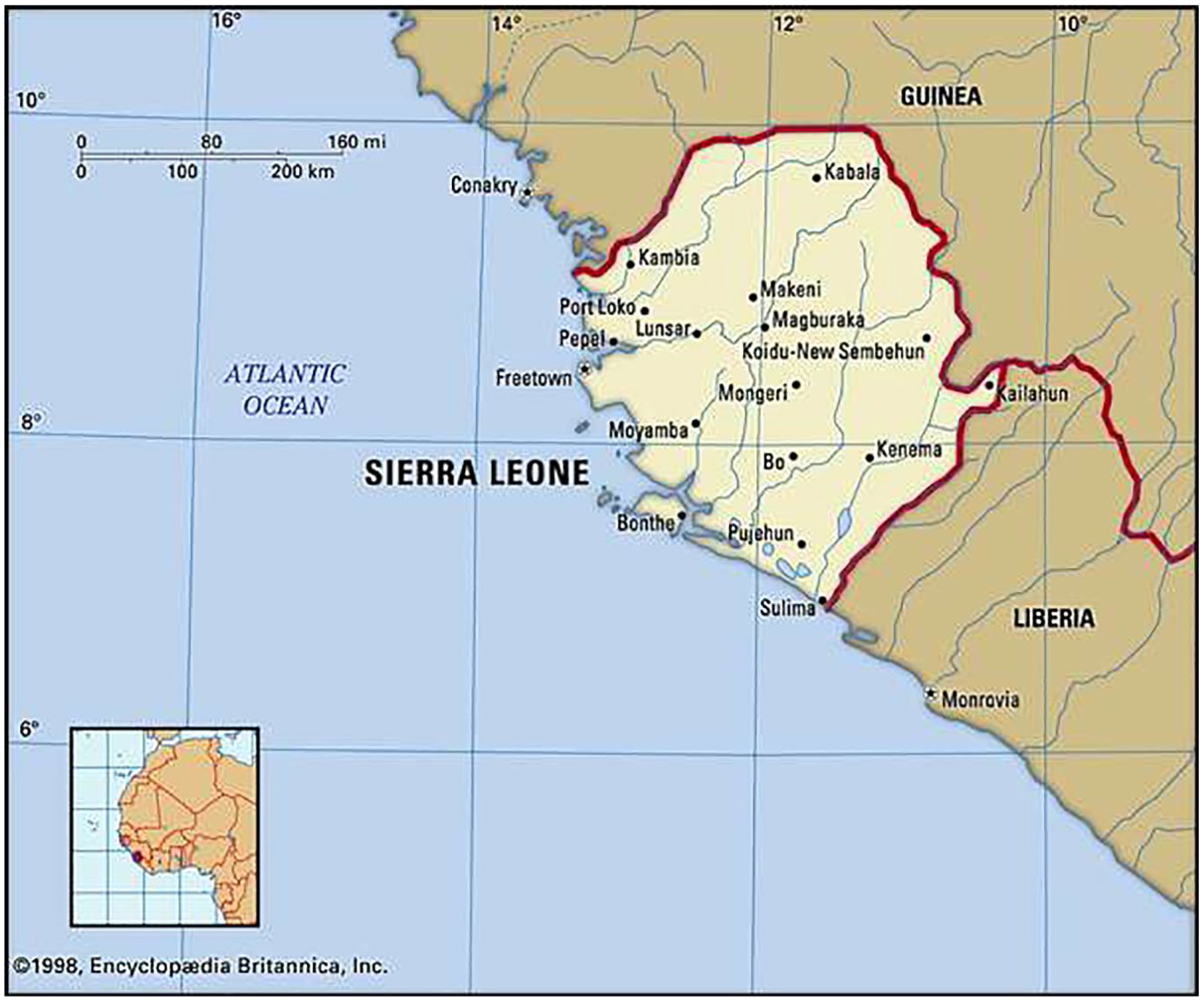
Map of Sierra Leone ©1998, Encyclopaedia Britannica, Inc.
Drawing on ethnographic fieldwork carried out in 2018 in a rural village of Northern Sierra Leone, we explore how children’s roles and social position are conceptualised in this context by a range of different actors (local authorities, families and NGO aid workers). Taking two case study exemplars, we detail how different approaches to the societal valuation of ‘childhood’ and children’s ‘usefulness’ shape children’s daily experiences in the West African nation’s most deprived rural areas. The analysis shows how international humanitarian constructions of children as innocent victims, ‘emotionally priceless’ and rights bearing can be locally reconfigured and appropriated for (familial) economic gain. It also highlights how children actively work within the parameters of these discourses and can draw on them to improve their life conditions. In doing so, this article demonstrates marginalised children’s role as brokers of ‘alternative modernities’ (Imoh, 2016) and mediators of seemingly irreconcilable perspectives in a wider context of structural inequality. We contend that the ‘humanitarian value’ of childhood constitutes the bedrock on which Sierra Leone’s alternative futures are being actively imagined and contested along ‘North–South’ transactions.
‘Dangerous innocents’: The contested ‘value’ of children in rural Sierra Leone
Measures of child well-being, as well as cultural conceptions of life stages and corresponding child roles in the family, vary considerably across the Global South. In many sub-Saharan African regions, the likelihood of infants and toddlers dying prematurely – whether as a result of famine, environmental hazard, or the incidence of (elsewhere banal) dysentery – is such that phenomena such as parents’ ‘selective neglect’ of the offspring’s most vulnerable members is often a necessity to maximise other siblings’ chances of survival (e.g. Scheper-Hughes, 1989). In a world region where children constitute the vast majority of the population, child mortality rates are demographically mitigated by equally impressive numbers in birth rates. 2 This simultaneous abundance and vulnerability of children also partly explains why ‘seniority’ and the ritual preservation of kinship entities such as the descent group acquire cultural priority over the ‘individual child’ and its unavoidably fragile life (Bolotta and Vignato, 2017). In West Africa’s agrarian areas, children’s economic contribution to these collective formations (households, lineages) is often a structural requirement – children are core to family livelihood strategies. In rural Sierra Leone, a child who does not work is traditionally considered a bad child. Relatedly, parents who do not train their children in work might be considered neglectful (Shepler, 2014: 32). As soon as they can walk, children are thus expected to take up responsibilities within the household and in the community as part of a social system promoting interdependence and communal relatedness (Bledsoe, 1990). Within this context, ‘elders’ are traditionally considered the guarantors of the lineage’s sacred genealogy and, as a result, of the social order. Elders are in charge of political, economic and educational decisions in the community as much as in the household, and ‘good children’ are expected to respect, care and repay elders for their sacrifices. Significantly, Sierra Leone is described in the literature as a ‘gerontocracy’, where childhood and youth as social concepts are constructed in opposition to elders 3 (Durham, 2000; Shepler, 2014: 28).
In postcolonial Sierra Leone, this relational valuation of childhood has been increasingly contested, in the context of humanitarian interventions which have proliferated in recent years. Western NGOs constitute powerful, transnational producers of global discourses about the value of childhood, education and the society’s (developmental) future (e.g. Shaw, 2014). These discourses are often entrenched in a set of ‘bio-political’ technologies (Foucault, 1975), health policies and education programmes that are aimed at reconstructing local childhoods and societies according to the presumed universal standard of the ‘modern child’. Underpinned by the United Nations Convention on the Rights of the Child (UNCRC), the emotionally ‘priceless’, developmental and human capital approach to children’s value has come to predominance in the region. The essentialised and emotional portrait of ‘the African child’ as an ‘innocent victim’ to be saved (Bolotta, 2020a) has thus become an iconic trope for the region, and one of the main political-economic loci of local–international interactions/tensions.
Yet, the humanitarian portrayal of childhood’s innocence was brutally contradicted by children’s massive, often voluntary, and highly effective armed participation in Sierra Leone’s civil war (1991–2002) – a conflict largely derived from historical patterns of colonial oppression, foreign capital’s predation of the country’s natural resources, state corruption, and subsequent crises in youth education and employment. Significantly, the war was described as a ‘crisis of youth’ (Abdullah, 2002; Peters, 2011). Sierra Leone’s postwar period represented the political theatre of one of the most significant confrontations between local and humanitarian valuations of modern childhood life (Peters, 2011; Shepler, 2014). Sierra Leoneans had witnessed family members being mercilessly killed by young combatants. In the postwar period, questions were raised about international aid agencies’ emotional representation of these youths as manipulated ‘victims’, portrayed in terms of their ‘stolen childhood’ (Rosen, 2007). The humanitarian capital flowing into the country after the war was mostly invested in ‘sensitisation programmes’ 4 focused on assumed innocent child soldiers’ psychological rehabilitation, educational aspirations, and on the promotion of their rights. In contrast, many Sierra Leonean adults believed that financial help to families and communities, and the consolidation of elders’ pre-war moral control over ‘guilty youth’s violent potentialities’ were needed to prevent further conflict (Bolten, 2012; Peters, 2007; Rosen, 2007). At stake here is a marked tension between emotional and economic, local and global interpretations of the value of childhood: its duration, roles and assumptions regarding the intrinsic nature of children as innocent/vulnerable or guilty/dangerous. Not surprisingly, such tensions between ‘elders’ and ‘children’, ‘traditions’ and ‘modernities’, constitute an important focus of scholarship in the wider field of African studies (Comoraff and Comaroff, 2005; Diouf, 2003).
When the traumatic memory of the 11-year civil war finally started to fade, in 2014 Sierra Leone suffered another unspeakable tragedy: the Ebola virus. The outbreak killed almost 4000 people and saw the deployment of an impressive international humanitarian apparatus with the objective to prevent the spread of the epidemic to the Global North. The humanitarian response to Ebola also affected how childhood was locally understood and socially constructed (Denis-Ramirez et al., 2017). Children’s ritual initiation into adulthood 5 was officially banned, while sanitation, hygiene practices and biomedical approaches to health and nutrition feature prominently in child-focused aid programmes ever since.
At the time of our research, in 2018 – 16 years after the end of the civil war, and two years following the Ebola epidemic – several NGOs and international aid agencies were moving from a short-term emergency-response to a long-term development plan underpinned by children’s rights. 6 What is the ‘value’ of childhood in this particular context? In the following sections, we shall examine children’s and adults’ response to such humanitarian interventions in a rural village of Northern Sierra Leone. Drawing on case studies of two children, our analysis focuses on two interrelated areas of intergenerational, economic and political tension in the definition of children’s value: ‘child labour’ and children’s ‘education’. We explore how the ‘humanitarian emotionalisation’ of children’s vulnerability and related discourses on children’s rights are being differently interpreted, enacted and contested by both children and adults in this context. This analysis, we argue, encapsulates the micro-political effects of Sierra Leone’s contemporary interactions with the ‘developed world’s humanitarian reason’ (Fassin, 2012). More broadly, critically considering these interactions remains crucial to understanding how the modern ‘value’ of children is negotiated in the neoliberal world’s margins.
Methodology: Child-centred ethnography in a ‘humanitarian village’
This article draws on a three-month ethnographic study that was conducted in 2018 in a rural village of Northern Sierra Leone, where child-focused international NGOs have a substantial and long-standing presence.
The inhabitants of the village, for which we use the pseudonym Gbantrani, were mostly Temne-speaking, illiterate farmers. Temne people constitute the majority group in Sierra Leone’s northwestern and central areas. Their language, Temne, belongs to the Mel branch of the Congo-Niger languages, which are widespread throughout West Africa, although some can speak English, Sierra Leone’s official language since the colonial era (Bangura, 2017). The economy of Gbantrani rested on semi-subsistence agriculture, rice farming, but also palm oil production – an increasingly strategic sector within Sierra Leone government’s economic development plans, attracting major international corporations from both the West and the East. Polygamous Muslim and monogamous Christian extended families, genealogically interconnected through patrilineal systems of descent, were organised in the village in about 150 intergenerational households, comprising several family units, individuals and children sharing the same housing compound (a set of homes made of mud and thatch) and chiefly organised farm lands. The village was surrounded by palm tree plantations and thick bush areas. The nearest town was two-hours’ walk through the bush.
Ethnographic and qualitative data were collected through child-centred research techniques (e.g. child-led tours in the village), participant observation and individual and focus group interviews with children, their families and other key stakeholders, including international NGO aid workers. Interview case studies comprised four intergenerational families, 7 consisting of in-depth interviews with children (2 boys and 2 girls, aged between 7 and 12 years), their parents/guardians (4), an older sibling (4) and grandparents (4). Additionally, research involved individual interviews with the village’s elders (2), and with schoolteachers (2) and NGO staff (4) working in the community. The research followed the ethical procedures approved by the University College Dublin Human Ethic Research Committee, including informed consent to participation. Child assent was sought using child-friendly and age-appropriate language (Phelan and Kinsella, 2013). Access to the research site was mediated by an international NGO, which offered logistical support and transportation to/from the village. This created a challenge between our autonomous role as researchers and the village’s inhabitants’ (mis)perception of the research process as intimately linked to Western aid agencies’ work. Notwithstanding, children’s and their families’ interpretation of our role in the field provided deep opportunities for ethnographic investigation into local conceptualisations of the ‘glocal value’ of childhood in international humanitarianism.
Despite its remoteness and considerable distance from the capital Freetown, Gbantrani was a cosmopolitan crossroad of development workers and mainly white ‘experts’: nutritionists, medical doctors, psychologists, missionaries and palm oil international companies. As we arrived in the village on a torrid afternoon of January 2018, we were struck by the humanitarian shape of this otherwise ‘exotic’ locale. The mud walls of almost all the houses had chalk alphanumeric abbreviations on them, vaccination acronyms (almost incomprehensible to Gbantrani’s inhabitants) dating back to the Ebola crisis. At the time of our stay, two years after the crisis, the village had become a focal point for further humanitarian rationality in various fields, including children’s education, labour and rights. Funded by Western donors, NGOs ran child-focused educational programmes in the village school. These drew on the UNCRC and on emotional representations of African children’s ‘victimhood’ (Bolotta, 2020a), in addition to the legal principle that all children have the right to education and leisure.
In spite of Gbantrani’s inhabitants repeatedly voicing to us their expectation that ‘rich white people’s (opotho) organisations’ would provide financial help, NGOs’ mission in Gbantrani was solely to deliver educational programmes, underpinned by a framework of children’s rights. Follow-up conversations with NGO aid workers confirmed the intention to change attitudes towards child development and awareness of children’s rights rather than facilitate economic dependence. This shift from material assistance to ‘aid recipients’ development training’ in global humanitarianism reflects the adoption of ‘post-charity and post-socialist’ models of welfare in Western neoliberal democracies (Sennett, 2013). Ethnographic immersion in the field confirmed however that Gbantrani’s inhabitants hoped that the presence of foreign organisations in their village would result in direct financial support. As these expectations were not entirely met, the village’s elders began to express some reticence towards NGO initiatives, including children’s rights discourse: Let me not tell you lies, there are changes in the way the children are behaving presently. The cause of this problem is what people are bringing from your country, what opotho [white men] are teaching them. When we try to educate them, they will object that this is what is happening at ropotho [white man countries)]. (Elders, group interview)
Participant observation in Gbantrani further highlighted how ‘education’ and ‘child labour’ emerged as particularly sensitive areas of contestation in the valuation of ‘childhood’. Initially, for example, when we began enquiring into children’s everyday activities, adults in the village stated that all children attended school, and that, after school, they spent their time doing homework and playing around – despite this was clearly not the case. Gbantrani’s inhabitants, not quite convinced of our role as (white) ‘researchers’, believed that opotho in the country couldn’t but be humanitarians or missionaries. They were concerned that we would categorise children’s activities such as wood gathering, processing palm fruits and the like through the discourse of ‘child labour’ as referred to by NGOs. Also noteworthy, in our presence, they tended to dramatise children’s suffering, making disabled or malnourished children more visible as an emotional strategy to secure our economic support. As the participatory element of our ethnography evolved, and we began helping children in their daily, extra-scholastic tasks (fetching water or doing the laundry in the river), our position as researchers became clearer, and alternative social realities started to emerge. In fact, children were simultaneously engaged in both ‘adult’ and ‘child’ activities, ‘emotional’ and ‘economic’ roles, depending on the observer’s cultural perspective and on the social stage the children were acting on (a children’s rights training at school or a day on the farm). Children proved surprisingly competent in moulding their self-expression according to context. As we will show, however, NGOs’ child-focused programmes and underlying discourses created both tensions and opportunities. The latter revolved around the economic value of humanitarian representations of children’s ‘emotional pricelessness’ in contrast to local representations of children’s ‘usefulness’.
For the purposes of this article we wish to focus on two children (Moses and Mariatu), highlighting how some of these tensions played out in their lives. Before considering these two specific case studies, however, it is important to consider more broadly how ‘education’ and ‘child labour’ were differently conceptualised in the context of Gbantrani. In the following sections we approach this through the lens of the children and adults in the village, including elders and aid workers.
‘The road to success is education’
After the civil war, education was invoked by several parties (development agencies, government representatives and international funders) as the resolution to the ‘crisis of youth’ and the intergenerational conflict that were perceived to have underpinned the war (Shepler, 2014). As Gbantrani’s elders told us during an interview: We know that the road to success now is education. For this country to progress, we need to be educated.
Despite these official statements that echoed development organisations’ normative discourse, education (like childhood) was a highly contested concept in Gbantrani, with significant discrepancies in local and international interpretations of its role in shaping children’s value.
Gbantrani’s primary school, a mud structure which had collapsed several times over past decades, was a meaningful example of such contradictions. It was simultaneously codified as a village school, a Catholic missionary school, a government school and a humanitarian space of NGOs’ intervention. Crumpled UN posters on hygiene norms were displayed on the school mud walls; in each class, a signboard listed the acronyms of key humanitarian organisations (e.g. UNICEF, WHO); school textbook content included biomedical notions of health and illness, as well as children’s rights-focused units. Yet, children we spoke to were not clear on their meaning.
In Gbantrani’s school, moreover, as in all of the country’s government schools, teaching was conducted through the medium of English (as opposed to Temne, Gbantrani’s majority idiom, and one of Sierra Leone’s 52 spoken languages), with textbooks and colonially inherited national examinations that reflected Western, middle-class values and urban lifestyles, disconnected from the children’s everyday experience. 8 Schoolteachers received NGO-sponsored training that focused on early-grade literacy instruction and assessment, and were encouraged to promote children’s participation in the classroom. However, evident were some tensions between NGOs’ normative conception of schooling as ‘civilised children’s only work’ (Valentin and Meinert, 2009) and the dual obligations of children within the household’s economy, the latter defined by aid workers as ‘child labour’. Further, NGO discourses on education as the key to success, combined with a children’s rights focus that emphasised the realisation of individualised fulfilment of these goals, challenged the communal relatedness (that underpinned everyday action and survival) within the community’s tightly woven kinship systems (Devine et al., forthcoming).
Both elders and children in Gbantrani expected that (British-like) education could bring wealth and prosperity. While they viewed state education, materialised by the village’s muddy school building, as an unreliable and clientelist system, they hoped that Western NGOs’ ‘enlightened’ educational methods (Valentin and Meinert, 2009) could help Gbantrani’s children become as knowledgeable, ‘civilised’ – and ultimately – rich and powerful ‘as the NGOs’ white people’. As Christopher, a class-3 boy, told us: The school makes us kachemp [brilliant]. If I complete education, I will become the country’s president.
Many children dreamt of becoming NGO workers because, as Abdulai (9-year-old, class-2 boy) said, ‘they have nice cars’. In practice, NGO native employees came primarily from Sierra Leone’s capital city, where the devaluation of the ‘uncivilised rural’ over the ‘cosmopolitan urban’ is historically more pronounced. Other children declared that they would be able to help their family and the whole Gbantrani collective by becoming lawyers and medical doctors. Or, as Mohammed (10-year-old, class-3 boy) told us: ‘If I get education, I will just sit down in the village doing nothing but blof [brag].’ In addition, the idealisation of Western education, and aid workers’ commitment to rescue the ‘innocent victims’ from ‘child labour’, contributed to the stigmatisation of farm work. Many schoolchildren, in fact, drew social status boundaries between themselves as ‘students’ and the ‘others’ – namely farmers and unschooled children – in spite of all spending most of their time outside of school farming with their parents (see also Jackson, 2004: 148). As a group of Gbantrani’s youths explained to us: If you don’t go to school and don’t learn how to speak English properly, you’ll just end up being a farmer. You’ll not become a civilised person, and your skin will not be as soft and white as yours. (Youths, group interview)
Children’s ‘neoliberal aspirations’ (Martin et al., 2016; Shaw, 2014) of individual success, wealth and self-affirmation were utopian dreams in a context of widespread poverty and scarce job opportunities. They stood in contrast with traditional values of intergenerational care, social relatedness and young people’s moral debts to the community’s elders. In a country where the level of youth unemployment is at a record high (nearly 70% of the total youth population), and even university graduates end up being frustrated farmers or socially demonised okada drivers (motorcycle taxi drivers) (Bürge, 2011), it is likely that children’s ambitious dreams may not be realised. Historically, this mismatch between children’s unrealistic expectations and actual job opportunities was one of the primary causes of the civil war’s ‘crisis of youth’ (Shepler, 2014: 96).
While these tensions will undoubtedly increase as disparities between the educational levels of generations widen, the related tension between children’s division of their present time became especially acute with respect to humanitarian discourses of ‘child labour’, and children’s ‘economic uselessness’ in the present.
‘Child labour’ in Gbantrani
Children in Gbantrani were active contributors to local community survival, especially necessary in a context of non-existent state support. After (and frequently even during) school, they fetched water and fire wood, wandered around naked carrying mud bricks and wood boards, or headed pans full of fruits to sell in surrounding villages. They pounded their school uniforms against stones at the stream, and took care of babies and younger children as proper parents would do. While they were working alongside adults, children were assigned ‘age-appropriate roles’. They were provided with work tools in proportion to their physical size, so small boys carried miniature machetes while following their parents in the bush.
Several children in Gbantrani told us how proud they felt in their ability to contribute to their community’s survival through their household and other duties. Indeed, it was this contribution that enhanced their social status. In Gbantrani’s inhabitants’ experience, in other words, children’s present economic value (hence usefulness) was simultaneously at the core of their emotional worth. These are for example Ibrahim’s and Mabinty’s words: When I go to my father to the farm, this makes me very happy. (Ibrahim, 10-year-old boy) I’m happy when I help my mother to cook and when I take care of my younger brothers. (Mabinty, 8-year-old girl)
Children’s contribution to the household’s economy could hardly be described as ‘child exploitation’, and was not considered as such by the village’s inhabitants. In fact, the analytical distinction between work as an adult responsibility and play as a children’s realm is the product of a particular understanding of children’s value. Historically it emerged in Global North capitalist economies with the introduction of compulsory schooling, consolidating middle-class/elite descriptions of schooling as the ‘real work of children’ (Nieuwenhuys, 1996). In many Southern agrarian contexts, on the other hand, work, play and socialisation are deeply blended realities, for work is part of children’s cultural tasks. Yet, their cultural learning through such work contravenes international NGOs’ norm of children’s value as ‘economically useless but emotionally priceless’ (Zelizer, 1994).
During the child-focused trainings that we observed at school, NGO aid workers explained that children had the right not to work and that their only ‘job’ had to be school education. The issue of children’s out-of-school activities was thus a significant area of contention between local inhabitants and aid agencies.
In addition, evident in these narratives were tensions in the temporal valuation of childhood’s economic value as a period of training and preparation for both present and future survival. Children’s potential as human capital for long-term sustainability (through alternate routes of employment away from the farm) threatened the immediate survival needs of families living in extreme poverty. The more individualistic and egalitarian view of children embedded in NGOs’ programmes, furthermore, challenged local cultural norms that locate children’s position in hierarchical, intergenerational and interdependent social structures (Valentin and Meinert, 2009: 25).
Although NGOs’ Western conceptualisation of ‘child labour’ was open to question, the economic exploitation of childhood in Gbantrani was a distinct possibility when local expectations of children’s age-appropriate work roles were abused by some. While clearly not confined to Sierra Leone, this possibility is more likely in contexts of extreme poverty and political violence. For example, a family head could abuse his power position and deploy the cultural norm of children’s due gratitude and respect to elders in order for his child to deal with ‘adult tasks’ far ahead of time. In these cases, NGOs’ emotional discourses highlighting children’s vulnerability, innocence and rights could be effectively incorporated into children’s own agency strategies. The first of our ethnographic case studies provides a meaningful exemplification of this.
Moses: Children’s rights as emotional capital
At the time of our research, Moses was a 10-year-old boy, residing in Gbantrani for three years after his parents’ death. His mother died of a snakebite while working on the farm; his father passed away from malaria. In the aftermath of these tragedies, the family of Moses’s maternal aunt decided to adopt the child. This was not unusual. Many children in Gbantrani did not live with their biological parents. They were entrusted to people outside the kin group for a period during times of crisis and intense need. In Gbantrani all children have seen members of their family passing away with regularity – during the Ebola crisis especially.
Fosterage and informal adoption are widely reported in anthropological literature on kinship in West Africa, and orphans, as Shepler (2014: 36) underlined, are almost non-existent in Sierra Leone due to these inter-family fosterage practices. While this highlights the strengths of Gbantrani’s ‘communal relatedness’ in terms of kinship obligations and reciprocal care (Devine et al., forthcoming), it also brought considerable challenges, exacerbated by extreme poverty. A parentless child might end up being adopted by families exclusively looking at him or her as an addition to the household’s workforce.
Unlike other children in Gbantrani, Moses worked 8 to 10 hours a day and was involved in very heavy tasks before and after school time. He had an incredible strength and mastered his work with unbelievable expertise, and without a single complaint. While he carried several pounds of mud blocks on his head or gathered up wood and dried brush with his machete, he made great efforts in showing no fatigue. He was fiercely trying to show everybody that he was a young ‘man’. Moses, indeed, was already an initiated member of the men’s secret society.
One afternoon, while we were walking together to the stream, Moses told us he had a secret to share. He said he felt unhappy in the village because his uncle forced him to work ‘too much’, ‘even when I am sick’. If he asked to be released from daily work obligations, he added, he got flogged and was left without food for days. It is clear that Moses shared his story with us as he expected the opotho to offer help. In the village, Moses generally behaved with the severe dignity of a man, as expected from boys who have been initiated into ‘manhood’. However, he was evidently aware that opotho were especially sensitive to emotional expressions of childhood suffering, that the latter could be deployed as ‘emotional capital’ (Cottingham, 2016) to elicit humanitarian support, and that we looked at him as the ‘innocent victim’ we were perhaps unwittingly looking for (Bolotta, 2020b). He thus decided to share with us his emotional ‘weakness’, and his affective strategy eventually paid off.
Concerned, and in line with ethical guidelines, we asked him whether he shared his struggles with the schoolteachers, but he replied they would report that back to his uncle, which would result in a double punishment. The school headteacher had indeed a close relationship with Moses’s family, and systematically chose the boy when some ‘child work’ needed to be done in the school compound. We then discussed a number of alternatives, including seeking the assistance of NGOs. On the one hand, Moses referred to the risks of doing so: ‘They don’t know anyone in the village and don’t know how to talk with people.’ Further probing revealed his concerns over family reputation, elder authority and control, especially sensitive given the implementation of the humanitarian aid programme. On the other hand, Moses recognised that an ‘NGO’s white man once taught me about the right of the child’. He said he didn’t completely understand that opotho’s words at first, but in his opinion: Children have the right to find some rice at home; they are not expected to deal with jobs meant for ‘adults’; they must be released from work when they are sick; and they cannot be beaten too often.
His views here reflect the multilayered significance of the concept of rights through a child’s eyes. As Hanson and Nieuwenhuys (2013: 4) underlined, rights are not exclusively those defined by international institutions. Children, indeed, ‘engage, interpret and give meaning to their rights’ in the socio-cultural contexts they inhabit and according to local moral categories of good and wrong. Although Moses, as other Gbantrani children we spoke to, considered it appropriate to discipline children who are ‘selfish, spoiled and not respectful to elders’, the act of flogging, in his opinion, had to be more symbolic than real. As he made clear, moreover, children have ‘the right to be released from work when they are sick’, while caregivers deserving filial respect as ‘elders’ are only those who work tirelessly for the community’s children to always find rice at home.
Moses proposed that the best solution was to contact his elder siblings who were studying in Freetown. He said they were very kind, and came to visit him during the Christmas holiday. However, ‘the uncle is the only one I can talk with them through and when I do he is always next to me’. By incorporating his older siblings into the research (at Moses’s suggestion) direct contact was made with them to resolve his situation. Subsequently Moses moved to live with his family in Freetown.
Moses has been able to make good use of ‘the emotional register of humanitarianism’ (Fassin, 2012), and to bend the abstract logic of the children’s rights discourse to his will and daily struggles, ultimately improving his quality of life. We also see Moses’s own capacities as agentic within the confines of his ‘child status’ to effect positive change. The tensions and opportunities arising from the humanitarian emotionalisation of childhood’s value in Gbantrani, however, could give rise to a range of opportunistic strategies that were also gendered, as our next case study shows.
Mariatu and her ‘secret sister’: Marriage strategies for alternative futures
Mariatu was a gracious 12-year-old girl. Over the previous five years, four of her six younger brothers had passed away. Her biological father contracted a serious disease, which made him blind and unable to support his large family. She was then entrusted to her father’s elder brother, an illiterate farmer who ‘made the investment’ to provide for Mariatu’s education.
Mariatu’s foster family appeared very supportive of the girl’s involvement in the NGOs’ education programmes. They hoped that, thanks to Western aid agencies’ support, she could become rich and thus save the whole family from ruin. Over several conversations with Mariatu and her uncle, we were struck by their seemingly complete adherence to NGOs’ discourses on the emotional value of childhood, ‘gender equality’ and the ‘girl child’s rights’, including the importance of schooling to prevent early pregnancy. As Mariatu stated during an interview: Women and men, we are all the same. I want to complete my education because if I am able to complete my education I will have money and a job.
Her uncle, a tireless worker with no days off, looking incredibly older than his 29 years, envisioned Mariatu’s success in the NGO sector, convinced that girls and boys have equal rights to access education: When they are in school, boys and girls do the same thing. I want Mariatu to be educated. If she gets education, I hope she can get employment with an NGO.
Every time we met the man in the village, he shook our hands energetically with a big cheery smile, begging us to keep our eyes on Mariatu. He was keen to have long conversations with the opotho about his ‘daughter’, never missing an opportunity to stress how much she had suffered in her young life. As with Moses, and many others in Gbantrani, Mariatu’s uncle employed the emotional value of childhood as ‘symbolic capital’ (Bourdieu, 1986) in the hope of gaining privileged attention for his (adopted) daughter and, ultimately, access to aid agencies’ financial support.
During formal interviews, Mariatu’s and her uncle’s responses reflected NGOs’ ‘emotionally priceless’ and human capital approach to childhood and education. Indeed, after years of interactions with multiple aid agencies, Gbantrani’s inhabitants were often able to provide what appeared to be ‘right answers’. However, as our ethnography bears out, girls’ everyday life in Gbantrani was shaped by constructions of gender quite in conflict with Western, middle-class ideals of women’s equality. As is common in patrilineal rural societies, notions of femininity were associated with the domestic sphere (childcare, cooking, domestic work). Girls commonly achieved social recognition as ‘women’, first through initiation into women’s secret societies, and later, more fully, through marriage and motherhood. In many cases, poor families strategically ‘married off’ young girls in order to secure bride price, establish alliances with more influent lineages, and grant their daughters better chances of survival. It is relevant to note that exchange of children between lineages and families increasingly involves formal education. Members external to the kin group who offer to pay for school fees or to host a child in a village with school facilities or NGO support obtain moral debits on that child and her group (Bledsoe, 1990).
Backstage, indeed, Mariatu’s family simultaneously adopted different strategies to capitalise on the ‘usefulness’ of the household’s female children. One afternoon, while attending an NGO ‘awareness training on early pregnancy’ in the village, we overheard a few children talking about Mariatu’s elder sister and her choice to ‘marry a big man’. While Mariatu’s uncle told us the heart-breaking story of the girl’s dead brothers several times, no one ever told us Mariatu had a 15-year-old married sister. In the following weeks, as our mutual trust grew, we decided to gently address the topic with Mariatu and ask her if she had a sister. Mariatu nervously glanced around before saying: ‘She is a stupid! She decided to go and live with an old man in another village just because he has money. I told her not to go but she said it was the right thing for her future.’ According to Mariatu, her uncle supported his daughter’s move, however reluctantly, because ‘that man is good and will help our family’. We initially assumed that Mariatu was angry because her sister was too young to leave school and marry an old man, or because her uncle agreed with (or perhaps forced) her marriage, but there were other reasons for her disappointment. As she cunningly explained to us: ‘My sister got just a farmer. I’ll get an NGO job. This way, I will marry an opotho who will bring me to the white men’s countries.’
While her sister left school to (secretly) marry a local ‘big man’, Mariatu chose participation in education and the NGO aid programme as a route to greater social capital and its potential exchange for a higher status marriage. Mariatu’s ‘usefulness’ stems from her value in terms of marriage prospects. This was enhanced through the appropriation of Western humanitarian discourses on ‘gender equality’ and the emotional vulnerability of the ‘girl child’ that in her view garnered favour with NGOs, and with it the possibility of marriage to an opotho. More broadly, Mariatu’s case highlights the potential instrumentalisation of the ‘humanitarian value’ of childhood as a (patrilineal) kin group’s survival strategy in contexts of abject poverty. Across rural Sierra Leone’s impoverished communities, as elsewhere in Sub-Saharan Africa (e.g. Henderson, 2013), young girls might indeed simultaneously invest in education and their ‘sexual capital’ as a form of agency in the face of poverty, hunger and limited opportunities (Henderson, 2013).
Conclusion: The emotional price of childhood
The modern idea of a linear transition of childhood’s value from ‘economic usefulness’ to ‘emotional pricelessness’ (Zelizer, 1994) is globally articulated through child-focused humanitarianism as ‘the West’s new Verb’, especially in (but not limited to) postcolonial Africa (Fassin, 2012). Yet, the top-down implementation of this idea is significantly complicated by alternative valuations of ‘childhood’ in many contexts of the Global South, where harsh socio-economic conditions prevent many children from enjoying the supposedly universal rights of education and leisure (Valentin and Meinert, 2009: 25).
In Gbantrani, NGO intervention and the humanitarian emotionalisation of children as ‘innocent victims’ (Bolotta, 2020b) have been reconfiguring Sierra Leone’s gerontocratic structure and intergenerational conflict in new and old ways. This is generating opportunities, constraints, hopes and frustrations on the bedrock of the country’s never-ending recovery. These confrontations over childhood’s economic and emotional values are particularly pronounced in relation to children’s education and children’s work.
After Sierra Leone’s civil war, the normative discourse, sponsored by international donors and Western aid agencies’ initiatives, identified schools as places where the atrocities of a still-to-be-metabolised past could be resolved and children’s ‘emotional innocence’ restored. In order to eliminate the risk of children turning into warriors, the provision of formal education had to be ensured, especially in the country’s neglected rural areas. In Gbantrani, however, the children’s rights programmes offered by international aid agencies did not quite match aid recipients’ expectations of direct financial help, generating significant tensions. Further, such aid programmes could inappropriately boost children’s ‘neoliberal aspirations’ (Martin et al., 2016) within an economic context disintegrated by foreign capital. Children’s idealisation of ‘white people’s education’ and concomitant devaluation of the local communities’ only available source of living – agricultural labour – was one of the most visible side effects of this, despite the fact that even the most educated youths in rural Sierra Leone need to return to farming after graduation. Over time this may create the potential for an exacerbation of Sierra Leone’s intergenerational conflict, if aspirations towards improved life circumstances remain unfulfilled.
Within a ‘human capital approach’ to education (Devine and Cockburn, 2018), the emphasis is on children’s becoming and the society’s economic futurity. In contrast, for Gbantrani’s inhabitants the emphasis was on children’s indispensable usefulness in the present. Children’s participation in their household’s economy – indistinctly labelled as ‘child labour’ within most NGOs’ children’s rights policy – constituted thus a related area of contention. Contrary to assumptions in the metropole (Connell, 2015), Gbantrani’s children declared themselves to be happy to help their families. Work activities not only constituted for children socialisation and cultural learning opportunities, but could also be experienced by some as ‘play’ (Reynolds, 1991). In other words, in Gbantrani work was experienced as a situated social field where cultural, emotional and economic valuations of childhood were deeply intertwined.
There was considerable discrepancy in Gbantrani between international organisations’ often decontextualised and universal formulations of rights and the everyday lived realities of children. Yet, in particular situations – as in the case of Moses – humanitarian representations of children’s ‘emotional pricelessness’ and the discourse of children’s rights could be appropriated with positive effect and enacted as part of children’s strategies of resistance to ‘gerontocratic abuse’. Moses’s interpretation of children’s rights as ‘the right to find some rice at home’ appears widely understandable. The story of Mariatu and her ‘secret sister’, however, shows how children’s (gendered) interpretations of their own ‘humanitarian value’ and rights do not necessarily match Western donors’ expectations and frameworks. Mariatu saw NGO programmes as an easier route to higher status marriage (including early marriage), rather than as emancipatory pathways to women’s liberation. Across the Global South, the right to marriage, head families, to beg, take up arms and to work have all emerged as issues that children want to see addressed. These demands evidently complicate normative conceptualisations of children’s value and Western-centric universalistic translations of children’s rights (Hanson and Nieuwenhuys, 2013: 7) in contexts of structural poverty.
This article demonstrated that childhood is underpinned simultaneously by economic, emotional and political values for both Gbantrani’s local inhabitants and international aid organisations. The humanitarian value of childhood as innocent and ‘emotionally priceless’, however signified, continues to be the dominant paradigm shaping rural Sierra Leone’s ‘alternative futures’ (Shaw, 2014). Gbantrani’s inhabitants appropriated humanitarian constructions of the ‘suffering child’ in their interactions with aid workers and opotho (and ourselves as researchers) as a way to elicit compassion and, ultimately, financial help. Rather than focus on economic support, Western aid organisations propose schools as places where childhood’s innocence can be nourished, gender equality realised and children’s potential cultivated. Yet, Northern institutional donors, financial institutions and missionary organisations historically envision education as part of broader religious, political and economic agendas (e.g. Comaroff, 1996). Further, although humanitarian figurations emphasise childhood’s ‘emotional pricelessness’, the reification of African children in terms of ‘victimhood’ and suffering (Bolotta, 2020c) is also monetised by development agencies as part of their fundraising strategies (e.g. child-sponsorship programmes). This ‘commodification’ of children’s emotional value (Cheney and Sinervo, 2019) – elsewhere described as the ‘moral economy of childhood’ (Bolotta, 2017) – serves to redirect global resource flows and sentiments through the essentialised image of the suffering child. As our ethnography has shown, children’s agency is both constrained and enabled by these processes.
While many NGOs do essential work, which has greatly improved children’s life conditions in rural Sierra Leone, humanitarianism is not value-free and is itself conditional upon foreign donors’ financial support. Several adults in Gbantrani connected NGOs’ increasing influence to children’s emerging disrespect towards social seniority, but as one of the elders confided in us: ‘We are poor so we cannot select what we like, we have to get the whole packet and look grateful and happy.’ Of course, children’s rights violations do not occur only in the Global South. Northern countries, however, are rarely formally sanctioned given their relative independence from the international donor community (Valentin and Meinert, 2009: 25). The humanitarian emotionalisation of non-normative childhoods, and a top-down implementation of children’s rights risk harnessing long-standing colonial imaginaries of the North–South divide. The adult/Northerner’s offer of conditional help to the infantilised/Southerner is not value-neutral and imposes particular political-economic agendas and cultural regimes (Burman, 2017).
Navigating through such complex colonial and postcolonial orders, Sierra Leonean children for their part highlight their ability to act as skilful, generational brokers of reinvented traditions and multiple modernities. They do so striving to make sense of the humanitarian value of childhood in the shadow of the wider neoliberal world’s hegemonic structures.
Footnotes
Funding
This research was funded with a grant from the Irish Government. However the content within this publication is entirely the responsibility of the authors and does not necessarily reflect Irish Aid.
