




Abstract
Why does the military remain one of the most trusted institutions despite, in some cases, their history of violence, corporate abuses and bloody interventions to overthrow the state and punish parts of society? This article analyses the interaction between individual factors and support for the armed forces in Argentina, Brazil and Chile to understand current forms of opinion and trust-shifts in post-authoritarian societies. It explores whether in these three democracies, support for the military is explained by the extent to which citizens support other political institutions, democracy, partisan ideologies, and novel military missions, such as the armed forces combating crime. The empirical results suggest that trust in congress and the police are statistically significant factors explaining variance in the outcome in the three case studies. The findings then vary by country. Support for democracy is positively correlated with trust in the military in Brazil but negatively associated with confidence in the military in Chile, where support for military intervention when there are increasing levels of crime is also statistically significant with confidence in the armed forces. In both Brazil and Chile, individuals supporting the armed forces are more likely to support the military participating in countering crime. These findings have important implications for the study of military sociology and politics.
Introduction
Why does the military remain one of the most trusted institutions despite, in some cases, their history of violence, corporate abuses and bloody interventions to overthrow the state and punish parts of society? This article analyses citizen attitudes towards the armed forces focusing on the comparative study of three democracies in South America: Argentina, Brazil and Chile. These post-authoritarian societies offer interesting similarities, such as low public support for political institutions (i.e. congress, the president, police and political parties), and populist leaders using the military to avert social crises, as well as differences especially with regard to their armed forces’ contemporary missions and roles ranging from harsh domestic security measures to iron-fist and often brutal measures of riot and protest control.
Trust in the military is assumed as being ‘not a uniform perception’ across the public (Tiargan-Orr and Eran-Jona, 2016). We know that certain factors can diminish societal trust in the military, including a lack of knowledge and little interest in the armed forces and security matters, and, more importantly, overall dissatisfaction with political processes (Garb, 2015). On the other hand, certain features have shown to increase military trust among the citizenry, such as institutional credibility and trustworthiness, and the military as a desirable career occupation (Birsen Ör, 2010). Recent studies have shown as well that support for the military performing specific tasks (from military missions abroad to overthrowing elected governments) differs from attitudes towards the institution itself (Berndtsson et al., 2015).
Studying these relationships is particularly relevant in today’s scenario of protests against liberal democratic models, military intervention in domestic politics, and a lack of societal support for traditional channels of representation. Interest in examining whether public support for military coups under high levels of crime and similar measures of corruption covaries with support for the armed forces has recently garnered interest among social science scholars (see Levitsky, 2018). The extent to which the public perceives democracy as the best form of government and what effect this has in explaining trust towards the military remains, however, underexplored.
The article aims to fill this gap in the military sociology subfield and explain whether, and to what extent, trust in the armed forces is explained by factors such as trust in other political institutions, political ideology, commitment to democracy, coup justifications and the militarization of crime. The empirical findings reveal that trust in the armed forces covaries positively with confidence in congress and political order institutions such as the police. Those who identify politically with the right-wing are also more likely to trust the military. As well, support for democracy is positively correlated with trust in the military in Brazil but negatively associated with confidence in the military in Chile, where military interventions under high levels of crime are also statistically significant with confidence in the armed forces. In both Brazil and Chile, individuals supporting the armed forces are more likely to support the military participating in countering criminal violence.
The article begins by outlining theories of military sociology and public perception of the armed forces. Second, it debates related issues affecting confidence in the armed forces in South America. Third, it presents the hypotheses. The fourth section describes the data. The fifth section presents the results of the multiple linear regression model. The conclusion comments and reviews on how we can advance the study of military sociology and politics in light of the empirical results.
Public opinion, the armed forces and society
The sociological study of the armed forces and society is more prevalent thanks to the overlapping efforts of scholars shaping the field since the mid-twentieth century (Janowitz, 1960; Lang, 1965; Lasswell, 1941; Segal and Wechsler Segal, 1983). These accounts regarded the military and civil spheres as interactive and partially coterminous (see Kestnbaum, 2009). However, much of their focus was on military organization and social life within the barracks, their families, communities and the settings where they socialized the most. The democratic reforms that came with the third wave of democratization remained aligned with this line of study emphasizing the iterative relationships between the political elites and the military. Janowitz (1960), who set the cornerstone that founded the subfield of military sociology, accomplished the not minor challenge of attracting intellectual rigour and excitement to the comparative study of military organizations. What remained understudied, however, were societal perspectives as a third research pillar, autonomous from the political elites and the armed forces (Caforio and Nuciari, 2018). Military sociologist Charles Moskos (1976: 55) argued, for example, that the term ‘armed forces and society’ needed to capture a broader sense and more inclusive connotations than the civil–military relations divide.
Recent efforts to fill the gap, for example, emphasize the commonalities at the intersection of democratic transformations, the state, political culture, and civilians and citizenship (Sarigil, 2015). Sociologists have paid more attention to the convergence between the military and civilian orientations in social science research undertaken in and outside military contexts (Carreiras et al., 2016). Still, little is known on a comparative basis about how the public perceives their armed forces. Even in the developed economies enjoying higher levels of democratic governance, accountability and transparency, the public is said only to have a partial understanding of the underlying realities of the military. The fissure occurs as the public creates among themselves an ‘intuition’ about their armies given their long history (Hines et al., 2015). Moreover, in nations where the military once held power, citizens might have a different perception of the armed forces as an institution versus the military as government (Fitch, 2012).
On top of knowing little about the armed forces, what strikes one the most is that endorsements and views on the military can be instigated under certain conditions that many seem unaware of. Public attitudes, in this sense, are prompted by different sources of information, sometimes in highly predictable ways. Golby et al. (2018) found that public opinion is influenced when a discourse of military legitimacy and accomplishment has been previously enforced among the public. Views are even more in line with the authorities when the armed forces themselves have made public announcements in favour or against specific governance issues, i.e. military interventions abroad, budgets, or military expenditure (Kim, 2014).
Studies that focus on public attitudes towards political institutions show that political awareness variables (e.g. education and political participation) can have a positive impact on public confidence, whereas in countries with weak levels of democracy, higher political awareness leads to increased distrust (Çakir and Şekercioğlu, 2016). To reveal fully the military’s impact on public opinion, it is necessary to consider traditional political awareness variables (such as those related to regime change, organizing coups and repressing protests), together with less conventional variables such as how the military affects elections and appeals to public opinion for self-interested motives (Brooks, 2019).
Most of this literature is useful for the study of the armed forces in emerging democracies as it tells us that comparing public opinion on diverse aspects related to military policy reveals divisions among domestic audiences, especially where the armed forces are performing alternate tasks, such as fighting crime. Why is the military so popular in certain societies then? The impact of several political, social and personal factors indicates that there is a significant variance in confidence in the military across certain political groups, i.e. nationalists, pro-religion, right-wing, and also because of individual characteristics such as interpersonal trust and support for democracy (Sarigil, 2015). Although the reasons that influence the level of confidence in the military are often nationally specific, we can also identify some generally shared factors, such as the military’s participation in previous major wars, peacekeeping operations and crisis (disaster) management operations (Malešič and Garb, 2018). Through a series of variables measuring stereotypes, support for the troops, stigma, symbolic capital and social inequality, MacLean and Kleykamp (2014) found that US service members who were deployed on missions abroad were viewed more favourably than either those who were not deployed or private contractors who were deployed. Similarly, Jacobson (2009) found that military missions condition support for the armed forces, including popularity, assessments of progress and partisan division. In this vein, Pion-Berlin and Dudley (2020: 15) noted that ‘the US public is both enamored with the military and ignorant about it, while at the same time considerably distrustful of political leaders’. On the other hand, cynicism towards the military may be due to the lack of citizens’ military experience (especially in all-volunteer military recruitment), criticism of the military in the media, the communication gap between the military and civil society, as well as instances of military corruption and scandals (Malešič and Garb, 2018).
The military can appeal to public opinion to gain more support openly, affecting the stability of post-authoritarian democracies. Empirical research has shown that highly politicized military structures among transitional states have a deleterious effect on the quality of government (Tusalem, 2014). While under autocracies, domestic attitudes towards the military can vary, the public in civilian regimes tend to be more sceptical of the military. In the latter scenario, the citizenry is cynical of using military force, for example, for conflict initiation or regime toppling (Weeks, 2012). As well, policymakers and leaders with a prior military background are most likely to have a militarized preference in their policies (Horowitz and Stam, 2014).
In Latin America, military coups and coup attempts since the 1990s have been in part due to the military’s more significant role in daily social and political life, in combination with the failure of political coalitions to establish and maintain control over political power and national policy. This failure has allowed for competing models of civil–military relations to emerge either under liberal or socialist models for democracy that frequently rely on the military to avert unfavourable political situations (Diamint, 2015). Currently, politicians pursue a militarized policy in various ways – but most notably, for the ultimate social control of their territories from what they perceive as internal security threats. New forms of coercion, including regular and irregular armed forces with overarching powers, ultimately gain legitimacy and sustain citizen allegiance, posing a direct challenge to state authority. Militarization of certain societal aspects (i.e. security) has undermined progress in conducing the armed forces in democratic ways, further entangling the study of new attitudinal preferences towards those that hold the power of arms.
Transitions and democracy dilemmas
The question of societal support towards the armed forces in South America is a conundrum. The brutal military regimes in the second half of the twentieth century imposed martial law and led a harsh assault on human rights and civil liberties. The dictatorships that followed in the wake of Brazil’s 1964 coup d’état left deep wounds and indelible memories among victims of torture, imprisonment and the families of the disappeared. The breakdown of democracy was supported, however, by groups in society which at first urged the need for the coups, and later sided with the civil–military regimes. For some in the public, the armed forces swept away corrupt and inept elected regimes, replacing them with the juntas of ‘modernizing patriots’ (Needler, 1969), which later led to theorizing on the ‘bureaucratic-authoritarian states’ (O’Donnell, 1978). The de facto governments embraced neoliberalism and capital accumulation for the elites, who cared little for resuming democratic life (Sankey and Munck, 2016).
The ‘corrosive effect’, as Huntington (1991) put it, led authoritarian reformers, including some from inside the military, to move towards democracy as they saw the negative aspects of the military’s political involvement in seemingly unsolvable political problems and increasing repression under dictatorship. In theory, the pro-democracy and pro-capitalism dual transition was contingent on the return to ‘solidarity, unity, and sense of common purpose’, to allow citizens to accept all groups of society now living under the same or similar commitments (Centeno, 1994: 137). However, the shift to democratic rule evidenced with the third wave did not change much the divide in public opinion (see Montalvo, 2009). The conservative nature of the military regimes forged strong relations within the most well resourced pockets of society, especially the urban rich and middle classes, business owners and landlords. In Chile, for example, the national referendum lost by the dictator General Augusto Pinochet in 1988 revealed, nonetheless, a staggering 44% of the electorate in favour of eight more years of the dictator as president.
After the democratic transitions, and despite the armed forces losing direct control of the state apparatus, different opinion polls have recorded sustained levels of support for the military in Latin America (see Lagos, 2008; Malešič and Garb, 2018; Montalvo, 2009). Unlike other institutions, the armed forces have been shown to surmount the feeling of distrust towards politics in general. Some will argue that the military has been able to influence public opinion, securing institutional advantages and an upbeat public image (Carranza, 1997).
Positive support from the public has also encouraged political figures to draw closer to the military to attract voters identified with the military. Governments in Brazil have relied on the armed forces to protect them in return for continued military spending. Through congressmen and women sponsoring pro-armed forces’ interest (the bancada militar, in Spanish and Portuguese), political parties have averted the passing of new laws, preserving the corporate status quo. Most recently, for example, the presidential election in Brazil of former army captain turned legislator, Jair Bolsonaro, exposed the danger of mixing populism, apologetic discourses for the military dictatorship and extreme politics, altogether with open support from factions in the armed forces (Hunter and Power, 2019). The bancada militar in Brazil’s lower chamber, for example, rallied consensus behind securing social security for the armed forces during the country’s biggest crisis of social spending (see Neves, 2019).
Public attitudes toward the military might also have the potential to influence the decision-making of politicians regarding the role and mission of the forces (Gürsoy, 2015). The recent wave of criminality sweeping the region has encouraged some military and civilian leaders to deploy soldiers to internal security tasks combating crime and violence, complementing and sometimes replacing the traditional policing bodies. The reaction among educated observers has been mostly critical, as many argue that the military is not trained to deal with public security as they are with all-out war scenarios. Also, to those politicians who fought actively against the authoritarian regimes, devolving prerogatives to the military is almost unthinkable (e.g. in Chile and Argentina). However, to lay citizens, security is one of the most worrying issues besetting their daily lives.
Since the return to democracy in Brazil and Chile, most notably, the elected authorities have fired and replaced military officers not aligning for different reasons with the shift towards democratization and civilian control (Cardoso, 2012; Solar, 2019a). Nevertheless, populist politicians can encourage the military to have a particular persuasion or input in political affairs offering them rewards and advances in their careers. Politicians thus can promise financial and institutional resources to the security agencies and draconian national security in light of the public’s support for the military. After the Argentinean dictatorship (1976–1982), for example, policy towards the armed forces was in the main left untouched; the service branches were sidelined to secondary roles by the ensuing governments, which kept them in duties other than internal security (i.e. peacekeeping). Right-wing president Mauricio Macri, nevertheless, offered the military new powers to extend their jurisdiction to counter drug-trafficking and secure borders, hand-in-hand with an increase in fiscal resources (Pardo, 2018).
In South America, political parties tend to be one of the least trusted institutions, thus indicating the ongoing societal rejection of formal and liberal forms of democratic representation. Negative public opinion towards politicians has had a radical effect. Since the third wave, governments have more chance of being abruptly overthrown by mass popular upheaval rather than by other forces or the military. Although the military in South America is apolitical and non-deliberative by constitutional mandate, they tend to put themselves in-between clashing social actors and the power of the president, sometimes marching against their commander-in-chief, other times harshly suppressing civil upheaval, or on other occasions staying quartered and not pursuing any action. Evidence from recent military actions in South American politics suggests that the armed forces will purposefully avoid tarnishing their reputation, and even less risk being associated with untrustworthy politicians who seem to have lost their way in ruling the country (Pion-Berlin and Trinkunas, 2010).
In Brazil, before President Dilma Rousseff was removed from office in 2016, a minority of right-wing groups asked for military intervention in light of the huge political corruption scandal Lava Jato and the accusations directed against Rousseff for violating budgetary rules. Bolsonaro praised the dictatorship during the impeachment of Rousseff and was supported during his campaign by the armed forces’ opposition to the Partido dos Trabalhadores (PT), the ruling party between 2003 and 2016. Bolsonaro’s cabinet includes many former military officers, most notably the vice-president, retired army general Antônio Hamilton Mourão. When officers represent a constituency and act like politicians, ‘they cannot be trusted by voters or by other politicians to be neutral servants of the state and guardians of society’, argues Kohn (1997: 145). Can the military still be seen as the decisive guardian of the nation-state despite the atrocities experienced under praetorian regimes? Whether this idea is shared among parts of the public that support the armed forces is at least extremely worrisome for democratization.
In the next sections, the article seeks to understand if societal support for military coups in the event of high levels of corruption and delinquency is correlated with support for the armed forces. Latin America is today the most violent region in the world (in terms of homicides per capita), and the frequent host to intricate corruption scandals. Unlike other public institutions, and despite many times being a party to these corrupt and violent schemes, the military has in the main held on to its strong popular support. The military’s perceived culture based around leadership, discipline and competence can have a strong effect on public confidence and support (see Shaw, 2012; Solar et al., 2020). In the United States, for example, the military has honed public support based on the conviction that their senior officers are trustworthy professionals. Krebs et al. (2018) reported that greater deference to the armed forces’ performance was paid by males, by those who are more conservative, by Republican voters, by older, wealthier citizens, and by military veterans. In Latin America, the armed forces are seen as the more capable and trustworthy of the state’s security forces, with local authorities many times employing retired military officers to join their police departments and other key structures of civic life (Albertus, 2018; Puck, 2020). New roles and missions have endowed the armed forces with broader skills in traditional and human security challenges allowing them to advance further in their careers, and for some even to jump into a career in politics (McCann, 2017; Solar, 2015, 2019b, 2019c). One of the reasons for this is that the military is usually equated with discipline, social capital and charismatic authority (see Shaw, 2012). Those joining the military and police services usually come from military families, and the middle and working classes. In Brazil, for example, the model of service selection makes conscription dependent on the socio-economic demographics of the population recruited from nearby each military unit (McCann, 2017). Unlike other countries where national crises triggered a surge in enrolment (i.e. in the United States after 9/11), in Chile, for example, the national reconstruction period following the devastating 2010 earthquake had no such effect on enlistment. The overall number of volunteers for conscription diminished between 2007 and 2012 from 32,007 to 21,000, although the yearly eligible quotas of around 12,000 youths were fulfilled (Gobierno de Chile, 2020).
Hypotheses
To further confirm public support for the armed forces (dependent variable), the article hypothesizes statistical relationships using five explanatory factors. It focuses on these factors because they are considered key in elucidating variance in trust in the armed forces, considering both the theories and the empirical facts outlined in the previous sections. Whereas recent research has demonstrated some of these ultimately shaping preferences when studying trust in the armed forces, the article explores whether this is also the case for each of the three countries included in the statistical models. From the literature review presented above, the following testable hypotheses are derived.
Trust in institutions
Measures of political trust are meant to show us different perceptions of central and local political institutions (i.e. the president, congress and political parties), protective institutions (i.e. the armed forces) and institutions of civil order (i.e. the police) (see Schneider, 2017). Because populism has proven resilient and in ascendancy in South America (Doyle, 2011), citizens might see the armed forces as an outsider actor willing to establish political order when politicians bring the house down. This naturally raises the question of whether levels of public trust in the military are explained by varying levels of confidence in the traditional institutions of liberal democracy. Therefore, we should expect that:
Hypothesis 1: Those who have less confidence in political institutions will be more likely to trust the military.
Ideology
Currently in the region, political parties enjoy less trust than any other political institution. The effects on representative democracy and social participation in politics are extremely serious as it speaks poorly of the integrity, competence and responsiveness from parties to citizens (see Carlin, 2014). Public sympathy for the military, on the other hand, can constrain the extent to which politicians control the armed forces (Dixon, 2019). Both left- and right-wing parties, not only in South America but elsewhere, tend to establish bridges to the military and make pledges, including helping veterans, improving working conditions, and overall support for servicemen and women. Nevertheless, in light of the right-wing past of the dictatorships in Argentina, Brazil and Chile, and the current bancadas militares sitting at the extreme right of politics, we can assume:
Hypothesis 2: Those who identify politically with the right will be more likely to trust the military.
Support for democracy
Although the military as an institution might be well regarded by the public, the article posits that few support the idea of living again under military rule or other forms of autocratic governance instead of direct liberal democracy (see Wike et al., 2017). Furthermore, the armed forces’ increased perception that the costs of them governing would entail deep cynicism and public antipathy, might lead senior officers to eschew a return of military rule (see Barracca, 2007), not least in light of international opposition to failed military coups in Ecuador (2000) and Venezuela (2002) and more recent intervention in Honduras (2009) and Bolivia (2019). Thus, one might anticipate:
Hypothesis 3: Individuals who support democracy will be more likely to have a pro-military attitude.
Coup justification
The statements provided so far assume a pro-democracy perspective within the citizenry.
Although there are clear signs of popular dissatisfaction and ‘democratic fatigue’ on top of worrying levels of inequality and corruption, in the last four decades Latin America has become the third most democratic region in the world, behind North America and Europe (Zovato, 2020). If that is the case, one would expect there to be minimal support for a coup at the hands of the military. Two possible conditions are more prevalent regarding military interventions, which deserve attention: whether a coup is justified under high levels of crime or corruption. Stepan (1971) argued that because the military conducted a coup and assumed power, punishing swathes of the populace harshly, future public support for coups would be moderate. Citizens might have respect for the armed forces, but they do not want them intervening, despite the political disorder. Thus, one might anticipate:
Hypothesis 4: Individuals supporting the armed forces will not support military coups in cases of high levels of crime or corruption.
Militarization of security
Citizens might well associate the armed forces with one of the few political institutions well organized and capable to defeat violent crime when other order and criminal justice institutions have failed. Across Latin America, politicians have resorted to the military to supplant corrupt police forces (i.e. Mexico and in Central America), while in Argentina, Brazil and Chile, the armed forces have joined the domestic security agencies to patrol borders and other urban and rural territories believed to be dominated by drug-trafficking and other criminal organizations. The military, for its part, has revamped its structures and bureaucracies to perform these new duties incorporating new discourses to fight the so-called threats of the twenty-first century. Accordingly, one can assume that:
Hypothesis 5: Individuals supporting the military participating in countering criminal violence will be more likely to support the armed forces.
Data and measures
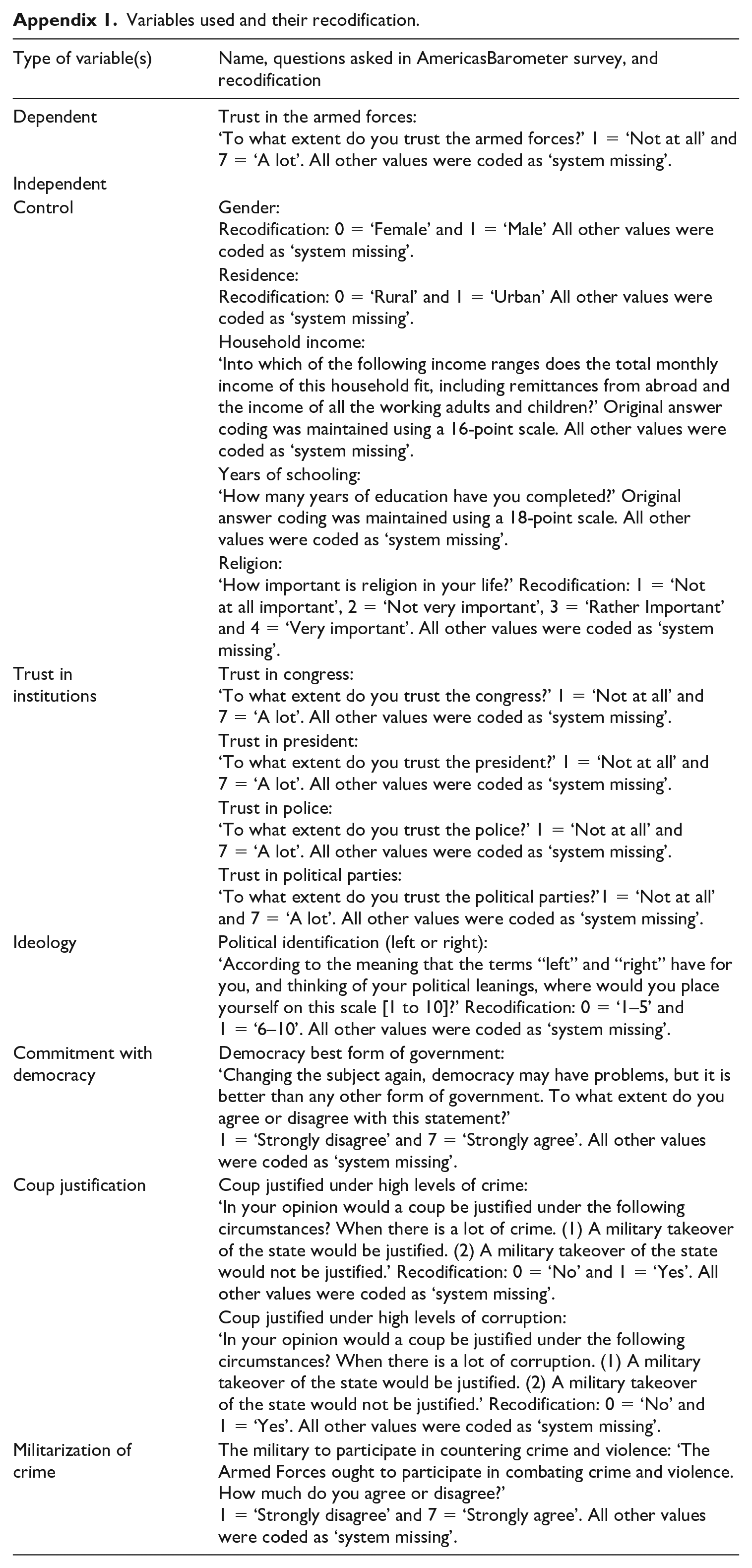
The article uses data from the 2016/2017 wave of the AmericasBarometer by the Latin American Public Opinion Project (LAPOP). The survey includes the study of 34 countries in the Western Hemisphere, stratified nationally with a representative sample in each state. The survey allows for comparison between countries as it uses a standard questionnaire (see LAPOP, 2016a) in Spanish and Portuguese. This article uses as its dependent variable the question, ‘To what extent do you trust the armed forces?’, making no explicit distinction between active-duty or reserve. It is suggested, nevertheless, that public perception in these countries will be mainly towards the armed forces as an institution, thus putting a focus on the active-duty force. The predictors of trust in the armed forces were divided into five categories, measuring trust in institutions, partisan ideology, commitment to democracy, coup justification and militarization of crime (see Appendix 1 for the variables, survey questions, coding and recoding procedures used in the statistical calculations). The article uses five control variables: gender (reference category: male), residence (reference category: urban), household income, years of schooling and religion.
Results and discussion
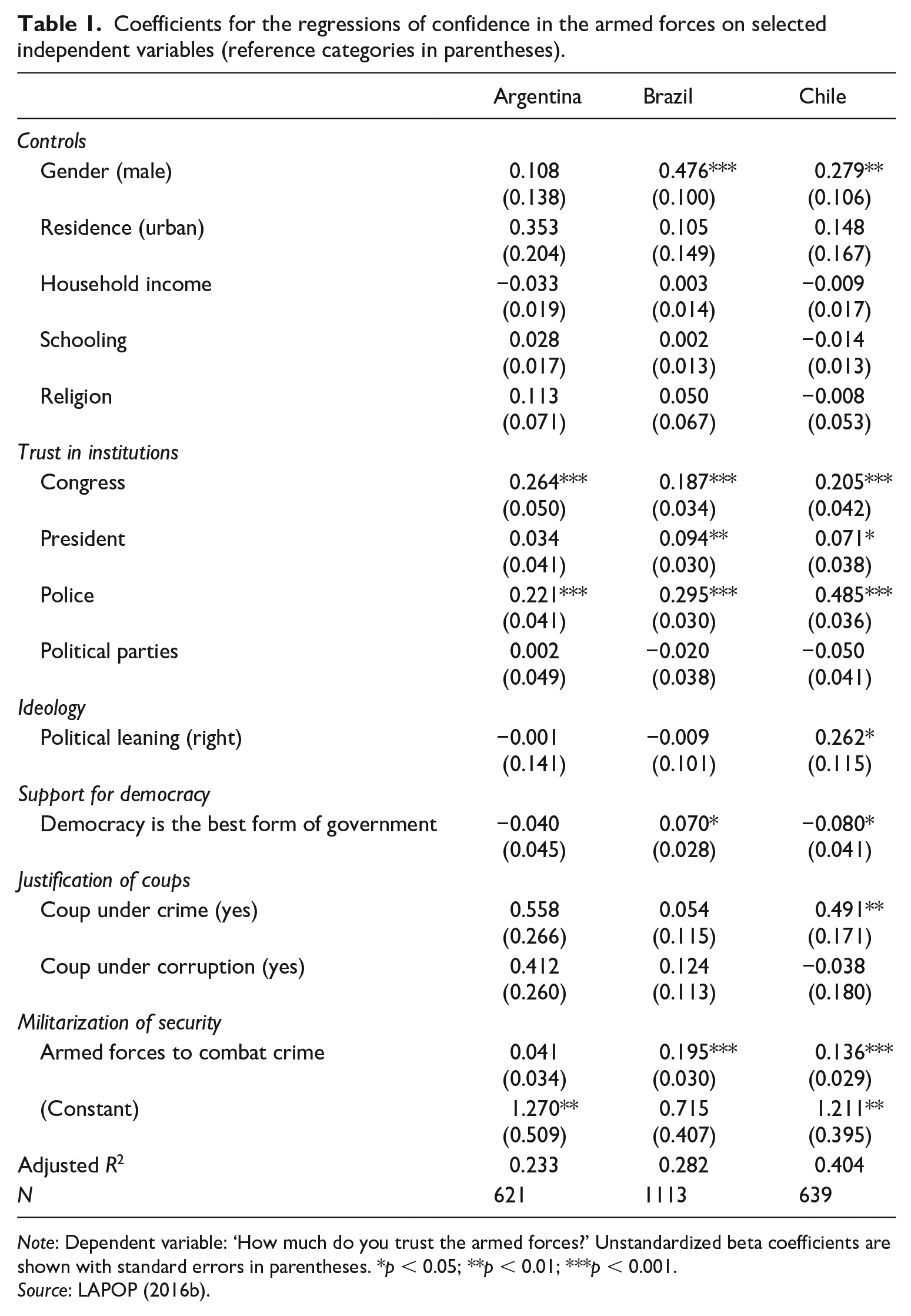
Table 1 shows the linear regression coefficients for each country-model. The adjusted R-square values when the control and independent variables are taken all together explain up to 40% (Chile) of the variation in the outcome. After controlling for the socio-economic and demographic individual characteristics, the results of the analysis yield statistical evidence only supporting that being a voting-age male in Brazil and Chile is statistically correlated with trust in the armed forces.
Coefficients for the regressions of confidence in the armed forces on selected independent variables (reference categories in parentheses).
Note: Dependent variable: ‘How much do you trust the armed forces?’ Unstandardized beta coefficients are shown with standard errors in parentheses. *p < 0.05; **p < 0.01; ***p < 0.001.
Source: LAPOP (2016b).
To test Hypothesis 1 (the negative association between trust in political institutions and the armed forces), the model included confidence measures in four institutions (congress, the president, the police and political parties) as predictors of trust in the armed forces. In all three countries, congress and the police were statistically significant and showed a positive correlation with trust in the military. In Brazil and Chile, the figure of the president was a statistically significant predictor of the confidence in the armed forces. The particularities of these three societies might explain why support for institutions is associated with confidence in the institutions of order, when these are, in fact, not very democratic. Other studies have considered that because the military played a crucial role in the establishment of republican regimes, people might see them as the guardians of democracy. The results show that for the public, it is not a contradiction to support some political institutions while having a strong military (see Sarigil, 2015). Support for the figure of the president can be explained partially since in the Americas citizens have voted for right-wing candidates that once in power cherished strong support for and from the military (Macri in Argentina, Bolsonaro in Brazil, Trump in the United States, Morales in Guatemala, Hernández in Honduras and Piñera in Chile, among others). Support for the police, on the other hand, might be explained by the recent emphasis on community-oriented policing practices that have tended to garner more public trust and convey the perception of effectiveness in imposing order together with the armed forces assuming jobs in daily policing (see Malone and Dammert, 2020).
Hypothesis 2 proposed the idea that right-wing sympathizers would have more trust in the armed forces. This only proved to be the case in Chile. The road to militarism in Chile during the late 1960s and early 1970s went hand-in-hand with the immediate response of the right-wing parties against the government of socialist president Salvador Allende (Angell, 1974). Attitudes towards democracy and authoritarianism before, during and after military rule have seen the right-wing parties partner up with military corporate interests, supported by wealthy elites and technocrats in government (see Navia and Osorio, 2019). The bancada militar has been able to produce a sense of frustration blaming liberal social reforms, calling for social mobilization and political opposition. Retired military officers have joined right-wing political parties and shown strong support for conservative politics.
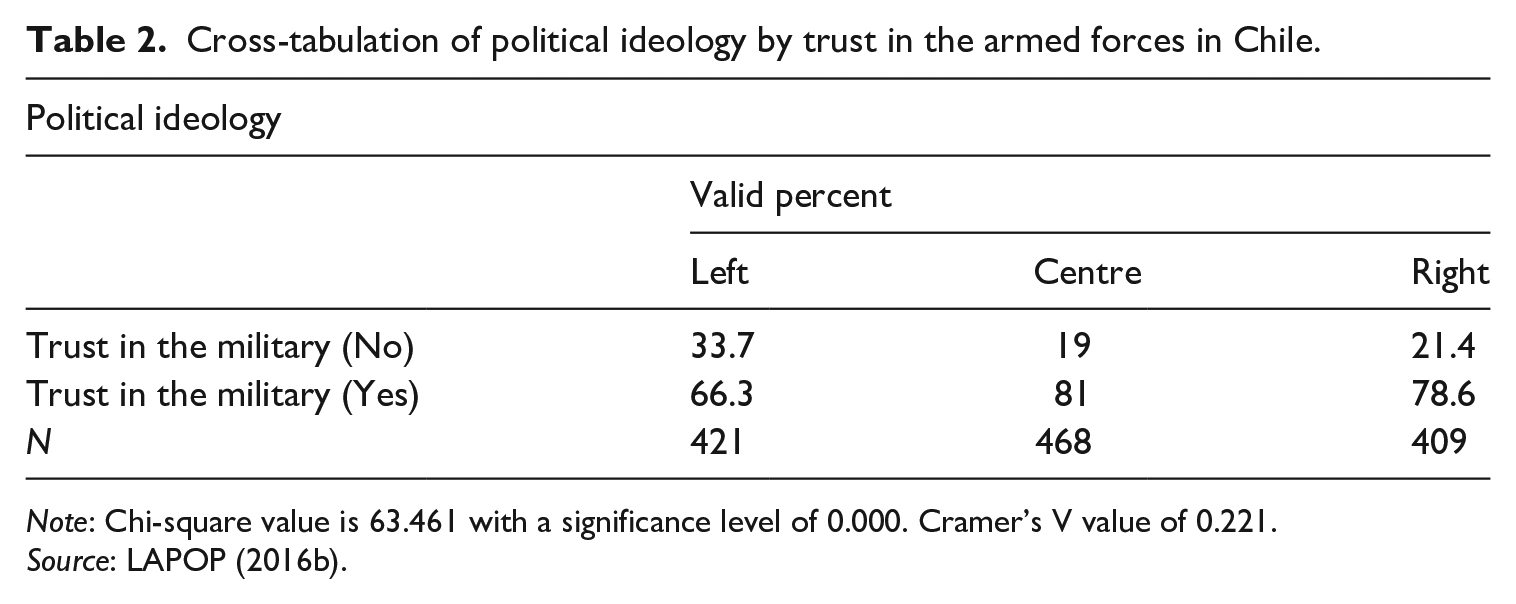
Because of the right-wing political ideology behind the military dictatorship, one would think that support for the armed forces is split between respondents identified with the left (meaning less trust in the armed forces) and those identifying themselves with the right (more trust in the armed forces). Table 2 shows the cross-tabulation of two variables: political ideology by trust in the armed forces in Chile. I recoded the political ideology variable, which initially was on a 10-point scale (where 1 = left and 10 = right), into three categories, left, centre and right. The original 7-point scale variable measuring support in the armed forces (where 1 = no support and 7 = a lot of support) was recoded into a dichotomous variable showing either trust or no trust in the armed forces. Results show that a majority trusts the armed forces regardless of ideological preference, including 66% of those on the left, 81% of those in the centre and 88.5% of those on the right.
Cross-tabulation of political ideology by trust in the armed forces in Chile.
Note: Chi-square value is 63.461 with a significance level of 0.000. Cramer’s V value of 0.221.
Source: LAPOP (2016b).
The above idea leads to discussion of Hypothesis 3 (a positive relationship between democracy as the best form of government and being pro-military). The results revealed statistically significant coefficients in Brazil with a positive association, and in Chile, with a negative association. For the latter case, we can support the idea that cynicism towards democracy reinforces popular societal trust in the military. Democracy is failing to speak to citizens in South America, and in Chile, they can find justifications for the military as ultimate protectors of the republic, even if against the rules imposed by democracy. In Brazil, the results are similar to those found in other post-authoritarian societies, where despite the latest zero-sum game between democrats, populist leaders and generals, a positive relationship between support for democracy and support for the military exists (see Sarigil, 2015).
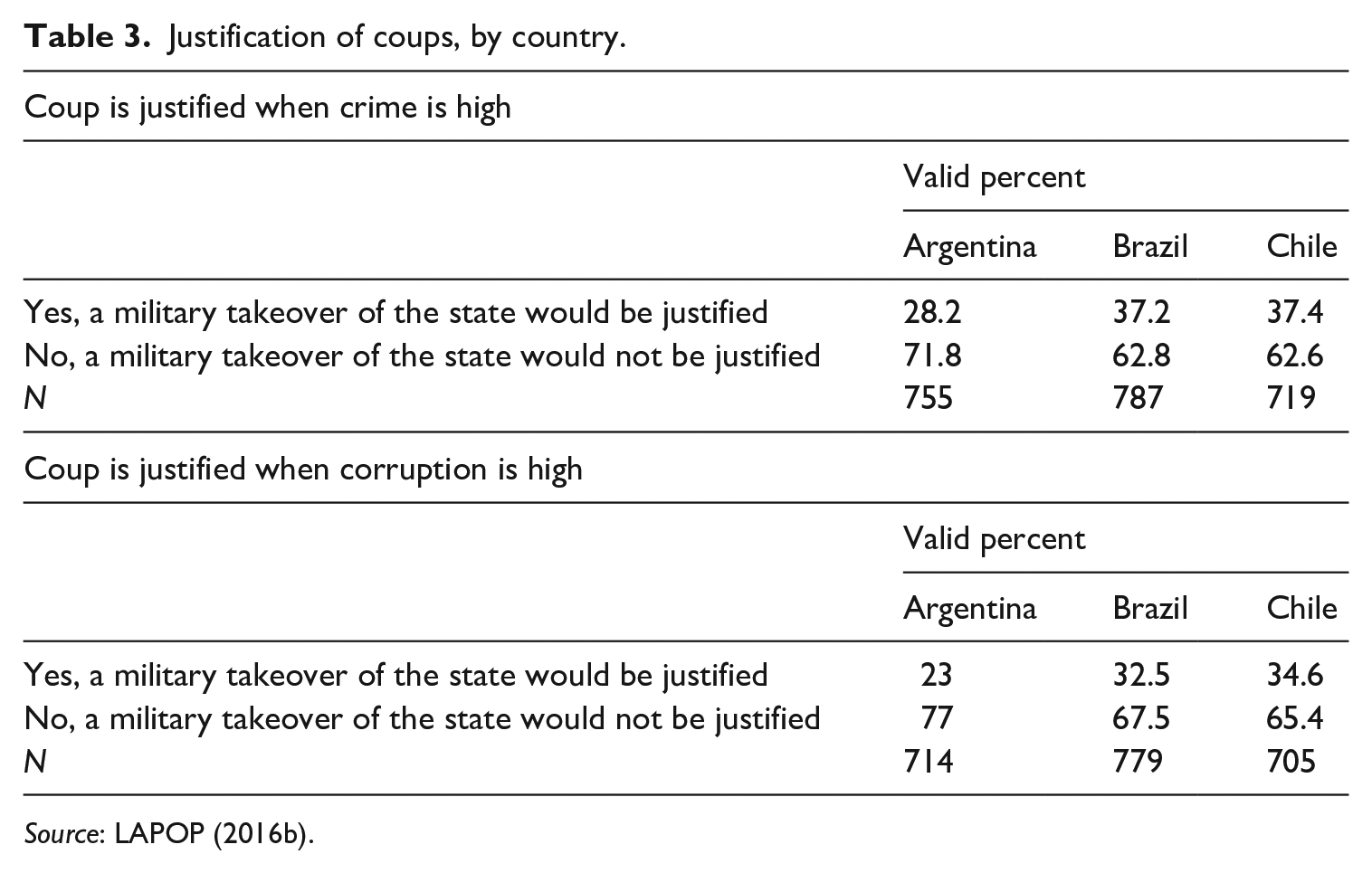
Table 3 shows the frequency statistics for the selected coup justification variables. The AmericasBarometer respondents were asked whether a coup is justified when crime is high, or whether a coup is justified when corruption is high. Respondents in Argentina, Brazil and Chile were mostly against coups of all sorts, reaching a high of 77% of respondents in Argentina being against a coup due high levels of corruption. In the case of Chile, most respondents were against both a coup under crime (62.6%) and a coup in light of corruption being very high (65.4%). However, when considering Hypothesis 4, support for a coup under high levels of crime is statistically significantly associated with higher trust in the armed forces in Chile. These results show that even in countries that use their armed forces for combating crime only at a very peripheral level (a policy enforced more evidently by the right-wing government of Piñera), the military is viewed as the guardian of the republic in the case of dramatic events. Chileans have one of the highest perceptions of crime in the Americas, when, in fact, real victimization levels are among the lowest in the region, similar to those in Costa Rica and Uruguay (Zechmeister, 2014). If things were to turn sour, we can argue that those supporting the military would also support a coup to stop rampant crime, which is, to say the least, particularly worrying.
Justification of coups, by country.
Source: LAPOP (2016b).
Lastly, for Hypothesis 5, whether individuals supporting the armed forces are more likely to support the military participating in countering criminal violence, the hypothesis is confirmed for Brazil and Chile. The militarization of crime and violence in Brazil has been mostly targeted at urban megacities by both left- and right-wing governments. The militarization of the favelas, for example, has seen hundreds of deaths at the hands of the state actors, including the army, but mostly as a result of police abuse and ‘death squads’ who have punished the more impoverished communities in the slums caught between gangs, state actors and clandestine militias. The authorities have praised the ‘sacrifice’ made by the armed forces in keeping the country safe. President Bolsonaro recently advocated that ‘democracy and liberty exist only when your armed forces want them to’ (Viga Gaier, 2019).
In Chile, the contribution of the armed forces to the policing bodies in the fight against organized crime happens mainly in the zones bordering Peru and Bolivia in the porous Atacama Desert where major drug-trafficking routes are concentrated. The military contributes mostly with material means, including aerial manned and non-manned vehicles, radars, logistics and transport. The large amount of money for the resources involved will provide more temptation in the ranks to participate in corruption, which would mirror the ill fate of their counterparts in the region’s most troubled hot spots. Recently, the military assumed riot control duties during the social protests of October 2019 (the estallido social, in Spanish) where they fired rubber bullets and used extreme force to disperse demonstrators. A local public opinion survey revealed a temporary drop in public trust in the armed forces from 50 to 24% from June to December (CEP, 2020).
Conclusion
Most sociological military studies have aimed to transcend the limits of the institutional and broaden our range of interdisciplinary interpretation of societal, organizational and cultural perspectives on the armed forces (see Soeters et al., 2014). Since the end of the Cold War, analysing the armed forces in relation to their professional and bureaucratic ethos sharply separated them from civilian cultures and structures (in a sense, the Janowitzean tradition). Such a range of notions have, however, been zealously reformulated (see Burk, 1993; Kniskern and Segal, 2015). Moskos accurately pointed out that many of the studies on the sociology of the military remained stuck in the ‘sociology of active-duty forces’ (2005: 666). This article built upon such a theoretical basis bringing in public opinion studies to primarily argue that societal support for the armed forces is an essential link to the study of the current state of perceptions towards the military from a sociological standpoint.
Civil–military relations scholars would argue that progress in the way we approach emerging issues in the armed forces advances ‘consonant with democratic consolidation: one depends on the other’ (Bruneau and Croissant, 2019: 229). In South America, although societies are against a coup in the event of high levels of corruption or high criminality, which is an excellent sign (see Table 2), these were not the reasons for the military takeovers in the late twentieth and early twenty-first century. Instead, the military acted amid severe political and economic crises. In that sense, the article reviewed, among other covariates to confidence in the military, whether people showing support for military intervention would also show support for the military. Only in Chile did such a relationship turn out to be statistically significant. In these times of populism hitting hard the governing credentials of advanced and developing nations, no country is impermeable to a democratic breakdown. In Argentina, Brazil and Chile, elected democrats have revamped their military institutions, downsized corporate privileges, reformed civilian control, and partially changed financing mechanisms that have led to corruption and fiscal embezzlement. Yet, ongoing institutional corruption and brute violence taints the men in uniform and speaks poorly of civilian oversight and military–society relationships.
The research concludes that trust in congress and the police (in Argentina, Brazil and Chile), support for democracy (in Brazil), being rightist (in Chile) and an advocate for the militarization of crime (in Brazil and Chile) are significant predictors of variances in confidence in the armed forces. The research found no evidence to suggest that residence, income, schooling and religion are strong predictors affecting confidence in the military. Still, there are many questions military sociologists and social science scholars should seek to answer from qualitative and quantitative perspectives. Enquiring into the military’s relationship with society would elicit a greater understanding of ‘civilian images of the military and military images of civilians’ (see Fitch, 2012: 53). Why and to what extent do citizens see the military as the ultimate defenders of the patria? Why is society keen to separate the military from the less popular political institutions that make up the political system? And, finally, why does the infamous idea of the military keeping democracy from collapse, which populist politicians have encouraged, and more worryingly, that the armed forces have echoed, still hold for some states?
Footnotes
Appendix
Variables used and their recodification.
| Type of variable(s) | Name, questions asked in AmericasBarometer survey, and recodification |
|---|---|
| Dependent | Trust in the armed forces: ‘To what extent do you trust the armed forces?’ 1 = ‘Not at all’ and 7 = ‘A lot’. All other values were coded as ‘system missing’. |
| Independent | |
| Control | Gender: Recodification: 0 = ‘Female’ and 1 = ‘Male’ All other values were coded as ‘system missing’. |
| Residence: |
|
| Household income: |
|
| Years of schooling: |
|
| Religion: |
|
| Trust in institutions | Trust in congress: |
| Trust in president: |
|
| Trust in police: |
|
| Trust in political parties: |
|
| Ideology | Political identification (left or right): |
| Commitment with democracy | Democracy best form of government: |
| Coup justification | Coup justified under high levels of crime: |
| Coup justified under high levels of corruption: |
|
| Militarization of crime | The military to participate in countering crime and violence: ‘The Armed Forces ought to participate in combating crime and violence. How much do you agree or disagree?’ |
Acknowledgements
I wish to thank Alan Angell, Markus Hochmüller, the two anonymous reviewers and the editors at Current Sociology for helpful comments and suggestions made to the article.
Funding
The author received no financial support for the research, authorship, and/or publication of this article.
