




Abstract
Globalization and cross-border studies have changed the ways in which sociological theorists think about space. Rather than viewing society as integrated, placing individual and collective actors in clearly bounded spaces nested within each other, this article combines several differentiation theories of society as a first step towards achieving an abstract language that can account for a plurality of comprehensive social contexts, thus relating actors to socio-spatial contexts in various ways. Starting with Simmel, the article discusses how some social contexts, such as the state, use the territory to gain exclusivity, whereas other social contexts are non-territorial in nature. Further types combine social and spatial differentiation. The article expands on Simmel’s socio-spatial forms with the help of newer systems theories proposed by Luhmann and Walby and Bourdieu’s field theory. The article provides cross-border and transnational studies with a comprehensive typology of socio-spatial forms. The argument contributes to global studies by considering a plurality of content-differentiated globalization logics and by clarifying the relationship between macro-social contexts and actors. In organizations, networks and professions, content differentiation, spatial segmentation and actors’ contestation intertwine.
Introduction
Globalization and cross-border studies have changed the ways that researchers in the social sciences think about space. These studies consider contexts beyond the nation-state, such as zones of graduated sovereignty (Ong, 1999), transnational migratory and professional fields (Faulconbridge and Muzio, 2012; Levitt and Glick Schiller, 2004), ‘world-systems’ (Wallerstein, 1979), networks of global cities (Sassen, 2007) and entangled macro-regions (Boatcă, 2015). Sociology as a discipline contributes important conceptual tools to the theorizing of global and transnational 1 structures and processes (Tilly, 1984).
Yet sociology has not overcome the period in history during which it was established, namely, European nation-state formation. Social contexts that comprehensively frame individual and collective action 2 are studied primarily as ‘countries’, that is, as societies bounded by a nation-state or as sub-units of a nation-state – a practice that has been criticized as methodological nationalism (Chernilo, 2011). Take fictitious cardiologist Dr Jia, for example. 3 Dr Jia is a Chinese physician who lives and works in Hong Kong. Sociologists might agree that, as a subject of sociological research, Dr Jia must be studied within the Chinese society that she calls home. From a cross-border perspective, however, Dr Jia is also embedded in other comprehensive social contexts. She works in the professional field of cardiology. Her medical knowledge is part of what might be called a ‘universal’ scientific truth regime (Brante, 2010). The languages of English, Cantonese and Mandarin, all of which Dr Jia uses on a regular basis, constitute publics overlapping with several countries. And her daily practice is structured by institutional frameworks, such as health policy, that converge with global standards, even though they may appear to be national (Liu et al., 2020; Meyer et al., 1997; Sassen, 2007).
Broadening an analysis to consider ‘the global’ does not avoid methodological nationalism, as can be shown for Wallerstein’s world-systems theory. Conceptually, Wallerstein argues that the modern ‘world-economy’ is a system differentiated into core-states and (semi-)peripheral areas (Wallerstein, 1974: 348–349). Wallerstein explains that the concept of class is ambiguous, as class conflict can be enacted only within the nation-state; class struggle in the periphery really is about global exploitation (Wallerstein, 1979: 200). Most empirical research on the political economy of the capitalist world-system does, however, compare countries worldwide (Korzeniewicz and Moran, 2009) rather than areas defined by a global division of labor, as Wallerstein’s theory would suggest. This is just one example of a macro-theory of globalization struggling to account for the ways in which individual and collective action is embedded in comprehensive contexts. Many sociological theories with a global scope consider the People’s Republic of China (PRC) within world economic relations, but they resort to methodological nationalism when discussing examples like Dr Jia and her political options. Thus, Dr Jia would be placed within the PRC even though she lives in the postcolonial administrative region of Hong Kong. At best, regional studies will connect her with several bounded spaces, such as Hong Kong as part of China as part of East Asia within a global economy.
This article posits that the problem of methodological nationalism will not be resolved by variations in scale. Instead, a closer look at the diversity of comprehensive contexts and the ways in which actors relate to contexts is warranted. Rather than thinking of society as integrated, placing individual and collective actors in clearly bounded socio-territorial spaces nested within each other –like a set of Russian dolls (Pries, 2005) – this argument uses differentiation theories 4 of society to show that actors are embedded in a plurality of socially differentiated entities (Walby, 2009). These entities do not differ only in their social content and form but also in the ways that they make use of space and how actors relate to them: social forms can be bounded like the nation-state, but they can also be non-territorial or connect social content and space in various forms. For example, Dr Jia’s connection to scientific knowledge may be seen as abstract and non-spatial, whereas her professional affiliation is a complex combination of spatial regions and social specialization: she meets colleagues at conferences of the European Cardiological Society while at the same time practicing in an internationally renowned local hospital.
The argument in this article starts with the work of Georg Simmel, who has offered a comprehensive typology of the ways in which space acts as an abstract social form, structuring – but not determining – social relations. With the help of Simmel, we can see that the socio-spatial embeddedness of Dr Jia varies, depending on whether we study her embeddedness in the Chinese state, in universalizing scientific knowledge, in the profession of cardiology, or in a transnational network of sites of cardiological practice.
Simmel’s views are enlightening in terms of socio-spatial forms, but other theories are better suited as I work towards a sociological theory of society that addresses global and cross-border phenomena in a concise manner. Rather than taking into account only one body of theory, this discussion uses several newer systems and field theories, most of which have not been fully debated in the English language. 5 While this compromises conceptual consistency, a combination of heterogeneous theories can also offer advantages. Uwe Schimank finds that an integrated theory of society must combine the differentiation, inequality and culture school of thought (Schimank, 2015: 247; Schwinn, 2004). He attempts this within an action-theoretical framework. Sylvia Walby (2009) uses complexity theory to distinguish between two very different types of systems: institutional domains and regimes of inequality. Since global and cross-border studies identify contexts that vary maximally in socio-spatial form, in content and dynamics, and in the ways that they relate to actors, this article explores the complementary strengths and weaknesses of communication and action-based differentiation theories.
The many questions resulting from a combination of theories built on diverging premises cannot be resolved within the scope of a single article. Instead, this discussion considers what heterogeneous differentiation theories contribute to sociological theories of global and cross-border phenomena. The interest of macro-social globalization theories in disentangling global forms from more local political agency is addressed here with the help of Niklas Luhmann’s systems theory, which focuses on content-differentiated communication. 6 As Luhmann uses the term, ‘content-differentiated’ (German: Sachdimension der Kommunikation) means that systems differ in terms of their immanent logic and intrinsic meaning. From this perspective, systems of self-reproducing communication – such as the economy, science, religion, health and others – are seen as likely to achieve a global scope. But Luhmann’s theory does not say much about the ways in which actors contest and change social contexts. I am using Pierre Bourdieu’s field theory and Walby’s regimes of inequality to address the interest of country-comparative and transnational researchers in political contestation. Dr Jia is embedded in competitive relationships with colleagues (Bourdieu’s fields) and gendered and racial classifications (Walby’s regimes of inequality), which she reproduces and changes in her daily practice. Each of the differentiation theories contributes a specific angle to three closely related aspects: comprehensive social contexts vary not only (a) in socio-spatial form but also (b) in kind, which has implications for (c) the ways in which social actors are embedded in those social contexts (Weiß, 2017a).
Simmel’s analysis of socio-spatial forms
Many sociological theories of society treat territorial entities as clearly demarcated and as containing within them smaller territorial units as well as other elements such as persons (Pries, 2005). Action theories are prone to viewing social persons as ‘contained’ within their body and as situated in one locale in the territory. Radical (de-)constructivism, on the other hand, looks at cultural codes or identities whose connection with materiality and/or territorial location is ambiguous. Using metaphors such as fluid (Mol and Law, 1994), ‘spacing’ (Löw, 2008) and assemblage (Amelina, this issue), constructivist theories fuse the material aspects of space with its social and symbolic dimensions (Soja, 1996). Thus human agency merges with that of technical and other material agents (Latour, 2005).
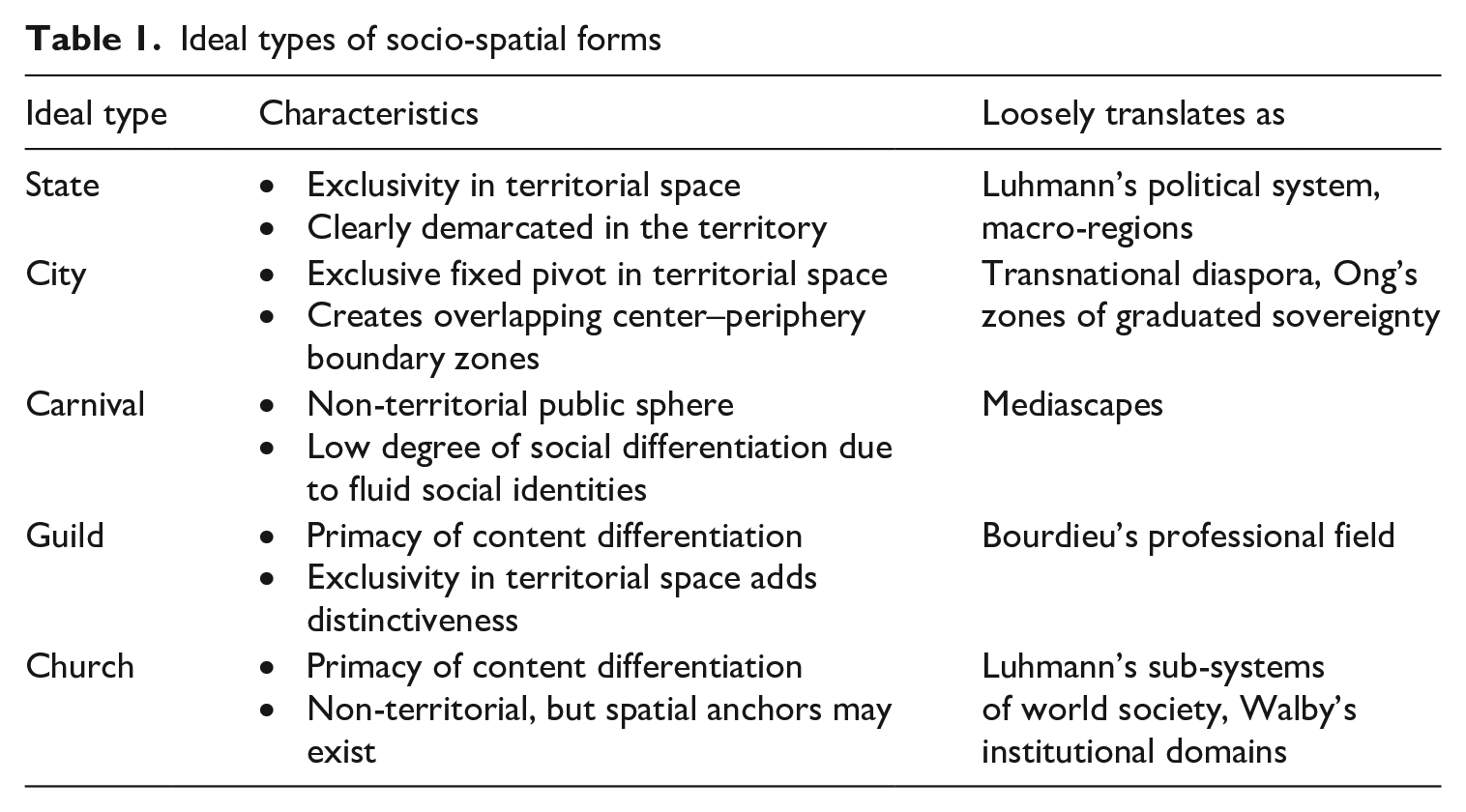
It is not easy to map the terrain between these conceptual extremes. Some intermediary approaches continue to see space as bounded (for example, in macro-regions), but on a scale smaller or larger than the nation-state (Brenner, 1999). Transnational migration research considers pluri-local or multi-local connections between multiple locales in more than one nation-state (Pries, 2005). Others replace clear-cut borders with looser concepts of space and consider overlapping boundary zones – for example, when studying citizenship (Hammar, 1990). Rather than opting for one of these approaches, this article works towards a comprehensive and abstract typology of socio-spatial forms (see Table 1) by building on four ideal types – state, city, church, guild – suggested by Simmel (2009: 545–548) as early as 1908.
Ideal types of socio-spatial forms
Simmel’s sociology of space is part of his overarching interest in giving what was at that time the new discipline of sociology a distinctive domain (Lichtblau, 2005: 80; Simmel, 1890). According to Simmel, sociology should abstract from historically specific findings in order to enable the study of abstract ‘forms in which interactions take place between human beings’ (Simmel, 1896: 167). With this goal in mind, Simmel published studies on various social forms (Vergesellschaftungsformen), such as hierarchy, the quantitative properties of groups, and space (Simmel, 1908). From today’s vantage point, 7 Simmel does not offer a substantial contribution to the study of global and cross-border phenomena, but his interest in developing a framework for understanding abstract socio-spatial forms offers an exhaustive typology of the ways in which comprehensive social contexts make use of space.
Simmel starts his argument with the ideal type of the ‘state’, which he sees as a social form characterized by a specific and exclusive relation to the spatial realm: To the degree in which a social structure is blended or, so to speak, in solidarity with a certain expanse of ground, it has a character of uniqueness or exclusivity that is likewise not attainable in any other way. Certain types of bond can be realized in their complete sociological form only in such a way that inside the spatial realm, which is filled by one of its exemplars, there is no room for a second. (Simmel, 2009: 546)
This argument shows that some social entities use the material properties of the territory to support social claims for uniqueness. If sociology considers only Simmel’s ideal type of the state, methodological nationalism is the result, which presumes a mutual exclusiveness of territorial and social units (Pries, 2005).
In Simmel’s argument, the ideal type of the state is just one option that stands in sharp contrast to another, namely, the ideal type of the church. Even though religions may establish ‘anchors’ in a territory, such as church buildings, Simmel emphasizes that religion is a purely social and thus non-spatial socio-spatial form.
Rather than building an entire theory on one of these extremes, state or church, Simmel offers a typology of four socio-spatial forms. In particular, he argues that the relationship between social forms and territory need not be either mutually exclusive (state) or mostly distinct (church), but that social differentiation and territorial differentiation can be combined. Simmel’s ideal type of the ‘guild’ is differentiated according to a content-specific logic; for example, the bakers’ guild differs from the butchers’ guild, though both inhabit the same territorial unit. Still, territorial differentiation matters for guilds: the bakers’ guild in Cologne can be distinguished from the bakers’ guild in Antwerp. Simmel’s ideal type of the ‘city’ is similar to that of the state in that it borrows specificity from a location in the spatial realm. However, in contrast to the state, the city acts as a center for its periphery. Several cities then create overlapping peripheries and border zones rather than the clear-cut boundary lines that separate states.
Even though Simmel considered the effect of spatial distance and mediated communication on social forms, he did not foresee the virtual spaces that are emerging in social media today. Therefore, I have added a fifth ideal type, the ‘carnival’, 8 to Simmel’s typology for the purposes of this discussion. Social media establish public spheres corresponding to the ideal types of the city and the state, but their connection to the territory is as loose as that of the church. In addition, virtual space enables actors to change their identities in a carnivalesque fashion.
Simmel contributes important arguments to an analysis of cross-border and global phenomena. Firstly, he shows that the methodologically nationalist notion that the social is always contained within a bounded territory is true in just one extreme type – that is, the state. Yet while many nation-states are reflective of this type, and much sociological research is and should be country-comparative, other socio-spatial forms also matter. Secondly, Simmel shows that some comprehensive social contexts are in fact non-spatial and should be studied as such. Cases in point might include financial markets and universalist religions. Cross-border phenomena are, however, best addressed by intermediary types, such as the city, the guild and the carnival. Transnational diasporas, for example, exhibit the characteristics of the ideal type of the city in that they organize themselves around a symbolic or geographic center with a diffuse boundary zone for those who belong to one or the other focal point (Pries, 2005). In cyberspace, the geography of that center loses importance (in the carnival), but social networks still operate using identity-based interaction (Greschke, 2012). Upon looking at transnational professional fields, one may discern a professional logic (the craft) that is mostly non-territorial but intertwined with a secondary spatial logic (the guild), which is contingent on specific local, historical and material conditions (Weiß, 2016).
Simmel is astute in his distinguishing of socio-spatial forms, and his idea of society as overlapping social relations is compatible with a differentiation-theoretical approach to a theory of (world) society, but Simmel’s focus is on micro-social relations (Lichtblau, 2005: 82). In the discussion that follows, Simmel’s ideal types will be used to organize a dialogue among several newer differentiation theories. These theories bring distinct sensibilities to an analysis of the global. These sensibilities are combined here in order to work towards a sociological theory that concisely addresses global and cross-border socio-spatial forms.
Luhmann’s content-differentiated systems
In English-language sociology, systems theories tend to be identified with Parsons, functionalism and an evolutionary approach to modernization. 9 By focusing on communication rather than action, German systems theorist Luhmann (1995, 2012) proposes a radically different 10 constructivist systems theory in which neither value-based integration nor territorial space is of primary importance. Following Simmel’s lead, the argument in this article does not detail the substantial contributions of the Luhmann school to our understanding of global and cross-border phenomena; 11 instead, it focuses on the merits of Luhmann’s theoretical language, which is inherently non-territorial and universalizing.
Luhmann’s theory of society considers functionally differentiated sub-systems of world society. These emerge consecutively over time, as differentiations of religion, law, economy, politics, arts, science, intimacy, education, sports and mass media (Stichweh, 2005: 163–177). They achieve autonomy through a specific code that distinguishes communication within the sub-system from its environment. For example, the health system focuses on health; therefore, an event in the health system might be a broken leg in need of medical treatment. In the economic system, the event becomes an insurance claim in need of payment. The judiciary will see a case of litigation. The religious system may observe an act of God. As systems constitute their own content-specific logic of communication, health considerations do not speak to economic scarcity, nor do they relate to religious content. In a functionally differentiated world society, sub-systems use generalized symbolic media specific to each system and do not communicate directly with each other.
In contrast to theories of the global, which privilege one institutional domain such as the political economy or culture, Luhmannian world-society theory considers multiple systems and their functionally differentiated logics with the help of an overarching and consistent systems-theoretical language. Luhmannian systems theory recog-nizes the importance of the economic system as a driver of globalization, but it also considers a plurality of further globalization dynamics. For example, several sub-systems of world society use symbolically generalized media such as money, power or truth as their code, which gives these systems an inherently universalizing logic (Bongaerts, 2008: 358). Studies of specific systems add new components to globalization dynamics, such as Werron’s (2007, 2010) work on world sports, which emerged together with an establishment of events, criteria and publics, enabling global comparison. The rapid expansion of communication technology in the nineteenth century first increased national closure, as a means to reduce the suddenly globalizing competition. Only then did the national segments start to compete with each other, thus enabling the emergence and diffusion of international standards. Also, Luhmannians have taken up arguments from neo-institutional world-polity theory and have studied the diffusion of social forms, standards and self-descriptions (Holzer et al., 2014).
With respect to socio-spatial forms, Luhmann offers an important corrective to the discipline of sociology, which often takes the nation-state as the given unit of analysis. As systems are differentiated by content, not by space, payment for a good or service is payment for a good or service, irrespective of the location where it takes place; consequently, the territory does not matter at all for most sub-systems. Thus, Luhmann privileges a socio-spatial form that Simmel would call the church, even though Luhmann himself would view churches as organizations.
Within his mostly non-territorial theory, the relevance of space for specific systems can be clarified. Luhmann uses the term ‘segmentation’ for an earlier form of societal differentiation and in contrast to functional differentiation. Segmentation is now a secondary differentiation logic characteristic of the political sub-system of world society that differs from other systems by including and excluding whole persons rather than the partial aspects of actors observed by other sub-systems. Inclusion and exclusion of whole persons is clarified by territorial segmentation in order to ensure collective decision making, the loyalty of citizens and a monopoly of power. This again impacts other societal systems, thus creating a threshold of inequality at state borders (Bommes, 2000). Consequently, the political system utilizes territorial segmentation much as suggested by Simmel and the ideal type of the state.
The intermediary socio-spatial forms that were discussed above as the ideal types of the city and the guild also matter within this systems theory. Luhmannian systems theory considers not only the functionally differentiated sub-systems of world society but also lower-level systems such as interaction systems and organizations. As interaction systems depend on co-presence, they are often enabled by specific socio-material action settings and bodily co-presence (Weichhart, 2004). So, while Dr Jia is a cardiologist no matter what location she finds herself in, she will need the infrastructure of a hospital to apply fully her professional knowledge in treating patients. Sub-systems of world society do not depend on interaction systems, but interaction systems can constitute secondary orders through, for example, informal networks (Holzer, 2014) or processes of regionalization (Kuhm, 2000: 24). Empirical research on ‘clusters of innovation’ (Amin and Cohendet, 2004) shows that epistemic communities can spread across the globe, but face-to-face interaction at conferences adds an important element to long-distance and mediated communication. In a similar vein, research on the vernacularization of human rights (Levitt and Merry, 2009) shows that these rights are universal points of reference, but the ways these rights are realized depend on more local actor constellations.
Another lower-level system, organizations, combines logics of city and guild. With respect to their goals, organizations are non-territorial and use the code of several sub-systems of world society. But organizational systems have members, for which they specify positions (Burzan et al., 2008). While the sub-systems of world society follow a universalizing logic in that they are open to any individual who may become partially included within a system’s communication, organizations include a limited number of performers (Weiß, 2006). To select their members, organizations use logics related to the goal of the organization, as well as contingent criteria, such as efficiency or legitimating semantics. Empirical studies in organizational sociology often find that the ‘rational’ logic of goal-attaining organizations is articulated with gendered (Acker, 1990), racialized (Gomolla and Radtke, 2002) and other institutionally discriminating logics (Alvarez, 1979). This prompts us to turn to Walby’s regimes of inequality in the next section.
Viewing all of these arguments together, the merits of Luhmann’s systems-theoretical language become apparent. By putting communication and its content in the center, the theory achieves a global scope without falling victim to the simple up-scaling tendencies criticized in the introduction. Instead, a large number of sub-systems of world society can be analyzed not only with respect to their histories but also considering their specific content and globalization dynamics. Luhmannian systems theory also shows the exceptionality of the ideal type of the state that makes exclusive use of a clearly bounded territorial unit including and excluding whole persons as (non-)citizens. And Luhmannians analyze very particular combinations of social form and space by recognizing the importance of lower-level systems and contingent secondary orders. Professions, for example, are not compelled to regionalize, but regionalization may contingently result from proximity (city), territorial segmentation (guild), or shared cyberspace settings (carnival). So, while Dr Jia is a cardiologist first and foremost, she is also a Chinese citizen who interacts with fellow citizens and professional peers in Hong Kong, in the venues offered by the European Cardiological Association and – increasingly – in virtual space.
However, viewing the social only through the lens of communication also has limits (Albert, 2016: 47). In particular, how actors are included and excluded by systems has provoked an intense (German-language) debate (Farzin, 2006; Nassehi, 2000; Schimank, 2015; Schwinn, 2004). According to Luhmann, sub-systems of world society normally observe persons only partially in those properties that relate to the code of the particular system. It is difficult to understand agency-based political disputes and their impact on comprehensive social contexts within the scope of this communication-based systems theory.
Action-based differentiation theories: Bourdieu’s field theory and Walby’s regimes of inequality
Luhmannian systems theory enables us to consider a plurality of social contexts, with various socio-spatial forms and with globalizing dynamics that depend on their specific content and history. However, the ways that actors are embedded in these contexts are discussed, within the framework of Luhmannian systems theory, only from the perspective of the systems. To better understand how actors are not only (partially) observed by social systems but also involved in changing social contexts, we now turn to agency-based differentiation theories, namely, Bourdieu’s field theory and Walby’s regimes of inequality.
Bourdieu’s theory (1985, 1990, 1996) offers a maximal contrast to Luhmann’s systems theory; Bourdieu’s main interest is in a class theory of state-bounded societies. Nonetheless, one of Bourdieu’s core concepts, ‘field’, considers contestation between actors as following differentiated logics in the fields of art, academia, politics and others. Therefore, Bourdieu’s field theory is discussed in German-language sociology as offering an alternative to Luhmannian differentiation theory (Bongaerts, 2008; Kieserling, 2008; Nassehi and Nollmann, 2004). Internationally, the work of researchers around the world has broadened Bourdieu’s field theory and given it a global scope. 12
Bourdieu sees actors as related to social contexts through their implicit knowledge of a social context (their habitus) and their ongoing contestation of the rules of that social context. Participants in a field come to incorporate a shared understanding of the rules of the game (illusio) through participation in that field’s struggles (Bourdieu, 1996). Newcomers to the field of art must, for example, learn the unwritten rule that art is created for art’s sake alone. Whether fields are nationally bounded – as Bourdieu thought – or achieve a global or transnational scope (Buchholz, 2016; Carroll, 2009; Go and Krause, 2016) depends on whether or not their illusio works transnationally and whether contestation of the illusio achieves a global dimension (Buchholz, 2008: 219). The fictional Dr Jia can be used to illustrate this possibility as well. Following increasing political violence in Hong Kong, the well-informed, highly skilled and reasonably wealthy Dr Jia uses a business trip to leave China for Germany, where she applies for asylum. A methodologically nationalist analysis will view Dr Jia from the perspective of the German nation-state, where she is a foreigner with a very limited (and limiting) visa. A differentiated analysis of socio-spatial forms might ask whether Dr Jia’s cultural capital from Hong Kong can work transnationally (Nohl et al., 2014). Because the educational system in Hong Kong is modeled on that of Great Britain, Dr Jia’s professional credentials will be recognized partially in Germany. Also, Dr Jia’s upper-class habitus appeals to potential employers in Germany who hold a similarly privileged position (Weiß, 2014).
One’s belonging to a field is dynamic, as the rules of the game are contested: the orthodoxy of a field benefits from established rules and tries to exclude any and all challengers (Bourdieu, 1994). Avant-garde actors, on the other hand, establish themselves by fighting for ‘new’ heterodox rules. Thus, fields are not clearly demarcated, but their influence diminishes empirically where actors become indifferent to the field-specific illusio. Since Dr Jia has been trained according to British standards and is an active member of the European Cardiological Association, she could position herself with avant-garde cardiologists whose professionalism transcends the borders of the nation-state. She could try to participate in the globalization of medicine (Ackerly et al., 2011), much like the small but growing number of the corporate elite who hold multiple memberships or interlocking directorates in more than one nation-state (Carroll, 2009).
Whether aspiring members become part of a field and whether avant-garde actors are successful in changing the rules of the game depends not only on contentions about the field’s internal logic and the relative status of newcomers but also on resources drawn from other fields or accumulated in social space. Bourdieu (1996) finds, for example, that upper-class socialization and endowment is conducive to artists’ neglect of economic restraints. This is why Bourdieu sees fields as being relatively – rather than completely – autonomous from hierarchies in a broader class society. Buchholz (2016) adds that relative autonomy may also be a useful concept for understanding vertical differentiation processes, for instance, when national fields differentiate from empires or when multi-scalar fields emerge from national ones. In the field of art, for example, a global scale emerges as select artists from the Global South gain access to global markets after staying in the North for extended periods of time, accumulating social capital. Their relative success comes at the price of selling their art as ‘ethnic’ (Buchholz, 2008).
This discussion of Bourdieu’s field theory shows that actors are invested in social contexts through implicit knowledge and long-term processes of socialization and contestation. This inherent ‘locality’ of whole persons is often seen as an impediment to placing actors in more than just the nation-state (Bongaerts, 2008: 322). However, the nation-state and nationally bounded educational institutions do not have a monopoly on framing processes of contestation. Rather, the socio-spatial forms of the city and the guild can overlap with the borders of national segmentation. Also, actors may have a strategic interest in changing the rules of a field to incorporate former strangers. This may result in fields achieving a partially transnational or global scope.
Moreover, socialization into shared contentions happens not only in guild fields. Church systems of general belief also frame actors’ contestation of relative position. For example, Dr Jia’s struggle to find a new position does not happen only within a nationally bounded social space, Germany, and the potentially transnational professional field of medicine. She will also have to deal with ascribed classifications such as race and gender, namely, Walby’s (2009) regimes of inequality.
Walby’s systems theory builds on the same complexity theories in the natural sciences (Maturana and Varela, 1980) as Luhmann’s systems theory, but the former focuses on the inequality between actors rather than on content-differentiated communication. Walby distinguishes between institutional domains – economy, polity, civil society and violence – and regimes of inequality, such as gender, ethnic and class regimes. Walby views the regimes of inequality from an intersectional perspective, and all systems, domains and regimes change each other’s environment, which results in a ‘coevolution of complex adaptive systems in changing fitness landscapes’ (Walby, 2009: 90–94). With respect to socio-spatial form, regimes of inequality conform best to Simmel’s church: the dualist classifications to which gender and ethnic regimes refer are non-territorial even though they may have anchors in the territory.
In order to function as self-reproducing systems, regimes of inequality must have ‘ontological depth’ (Walby, 2009: 19). Gender relations, for example, cannot be mapped onto one institutional domain (Walby, 2009: 62). Rather, women are challenged by male domination in civil society and the state’s withdrawal from suppressing ‘private’ violence in the domain of violence. Arguably, women have a better chance of finding jobs with social benefits in a social democracy than in neoliberal states (Walby, 2015). This means that the domains of economy and polity intersect.
Where Walby talks of ontological depth, Bourdieu might see ‘symbolic power’ (1991). That is, Bourdieu would concur with the view that regimes of inequality are built around dualistic classifications but might suggest that they must be enacted through habitual practice and are institutionalized. Bourdieu uses the concept of symbolic power for relations of domination that both the dominant and the oppressed accept as self-evident (Wacquant, 1994). Only when established relations of symbolic power are challenged do they become visible, and only then does symbolic struggle appear. 13 This is why it is valuable to imagine Dr Jia moving from her established position in Hong Kong to become a refugee in Germany. This upsets the invisible relations of symbolic power that frame her position. After fleeing, she must resort to symbolic struggle to renegotiate her position, which makes relations of symbolic power visible (Nohl, Schittenhelm and Schmidtke, 2014). She now finds herself on the wrong side of a global dichotomy between Caucasians and Asians. This dichotomy is partially institutionalized by the exclusionary logic of citizenship (Boatcă, 2015), but in- and exclusions differ depending on institutional domain. In the economic domain, (partial) exclusion from her profession could prompt Dr Jia to sell traditional Chinese medicine in order to conform to her clients’ expectations. In a different setting, a civil society setting, Dr Jia could be viewed and treated in much the same way as a nanny or au pair.
Combining content-differentiated systems, fields and regimes of inequality
Empirical research on global and transnational social forms poses a challenge to sociology as a discipline. The field evolved during an era of intense nation-state formation and imperial ambitions (see Patel and Araujo, this issue), and the assumption that actors are embedded in clearly bounded nation-states tacitly informs much of sociology. Critiques from postcolonial studies and other globalization scholarship have been convincing, but they have yet to result in theories that go beyond national borders and consider diverse relations between actors and comprehensive social contexts that go beyond the nation-state frame.
This article started with the argument that contexts beyond the nation-state are heterogeneous – not only in socio-spatial form but also in kind. A plurality of socially differentiated entities can best be studied by differentiation theories. Several recent systems and field theories have gone beyond the nation-state by studying world society, global fields and inequalities. Rather than considering only one of these theories, this article argues for a combination of communication- and action-based differentiation theories: their complementary strengths and weaknesses 14 result in the broadening of our theoretical vocabulary.
With respect to global studies, an argument based on Luhmann shows that it is not enough to focus on one globalization logic; indeed, even the four institutional domains suggested by Walby may not suffice. Instead, Luhmann’s insistence on functional differentiation allows for a broad range of heterogeneous globalization dynamics. The economic system that trades in scarcity with the help of the universal medium of money follows a logic of globalization other than a territorially segmented political system (Albert, 2016; Bommes, 2000) or the emerging system of world sports (Werron, 2010). While the financial economy may be non-territorial, it is anchored in global cities, and must negotiate policy with national polities and cities (Sassen, 2007). Taking actor-based differentiation theories into account, content-differentiated systems might also overlap with regimes of inequality, as Boatcă (2015) has aptly shown by connecting the work of Wallerstein with postcolonial studies.
As systems theories privilege structure over agency, they should be combined with arguments from actor-based differentiation theories. As Bourdieu’s field theory shows, actors are invested in some social contexts through incorporated knowledge and ongoing contestation. Actors are not only observed partially by systems, as Luhmann would argue, but they actively reproduce some social contexts, thereby changing their content and membership.
The argument also contributes to cross-border and transnational studies: Simmel’s socio-spatial forms were used to mediate between the extremes of the bounded nation-state and the non-territorial church as an ideal type of social context. Simmel’s ideal type of the guild and his city were found in organizations, interaction systems and professional fields. Organizations combine the logic of several sub-systems with secondary orders, such as semantic classifications stemming from regimes of inequality. Schools may, for example, reach organizational goals with the help of ethnic classifications (Gomolla and Radtke, 2002). Interaction systems may add another secondary logic to organizations, as interactions are more likely in situations of spatial proximity. Thus, networks and regions add a spatial component to organizations. Spatial proximity can be seen as territorial when following center–periphery logics within Simmel’s guild, or as mediated in the newly proposed ideal type of the carnival. Finally, professional fields follow Simmel’s guild in combining content differentiation with territorial segmentation.
In terms of country comparison, all theories consider the continued relevance of the nation-state. Simmel acknowledges the state, as do Luhmannians, Bourdieu and Walby. The argument proposed here shows that an analysis of global and cross-border forms must consider the continued relevance of the state in interaction with other socio-spatial forms. Theories of society must consider the heterogeneous logics of a diversity of comprehensive contexts and the various ways in which these contexts relate to actors.
Several questions remain. In this article, one entity – the nation-state – was deconstructed, but another entity – the human agent – was taken for granted. 15 How might the discussion change if the embeddedness of agents in small-scale contexts, such as the family, was considered in addition to comprehensive contexts? The arguments proposed in this article would benefit from engaging with relational sociology and the gendered assumptions implied by the idea of autonomous agency.
Also, by imagining the state as a bounded national welfare-state, the proposed theory represents a Northern perspective on social contexts. In terms of the Eurocentrism of sociological theory, the article offers a ‘revisionist’ perspective rather than a radical critique. How might a less Eurocentric analysis of the nation-state and our role in global and cross-border social contexts shape the arguments presented in this article? I posit that it is time for Northern theorists to broaden our particular theoretical traditions by not only accepting critique but also learning from it.
Footnotes
Acknowledgements
I would like to thank the anonymous reviewers for their enlightening comments and Andreas Niederberger, Bettina Mahlert, Tobias Werron, and the co-editors for stimulating intellectual debate.
Funding
The author received no financial support for the research, authorship, and/or publication of this article.
