




Abstract
This article addresses the relationship between profession, organisation and spatial (geographical) setting, more specifically the relationship between welfare sector professionals’ conditions for work amidst governance change. In previous research, the conditions for welfare sector professionals’ work have largely been studied without taking the employing organisations or the local and regional situation into consideration. In this article, the authors question and seek to counteract this de-contextualised approach. They do so by showing that the circumstances of the specific workplace context are essential in understanding welfare sector professionals’ working conditions, especially so in current governance contexts characterised to varying degrees by marketisation, via processes and structures which facilitate choice, competition, privatisation and devolution. This line of argument is illustrated in relation to how upper secondary teachers in Sweden experience their conditions for work and employment in eight schools across three different ‘market types’. The authors contend that whilst different conditions in different workplaces can to some extent always be expected, current governance agendas in the welfare sector seem to exacerbate these differences. The article’s theoretical contribution, therefore, is in the privileging of local contextual dynamics. The authors suggest a stronger emphasis on spatially-informed frames of reference in future studies of conditions for welfare sector professionals.
Introduction
‘Welfare professions, encompassing public sector occupational groups such as doctors, nurses, teachers and social workers, constitute one of the backbones in the development of the Nordic welfare states’, Kamp (2016: 1) asserts. This importance makes the circumstances surrounding the work and employment conditions of such professions highly relevant both in their own right, but also in terms of their importance for society as a whole – in the Nordic states, and elsewhere. The teaching profession is an example of a welfare sector profession, and as such constitutes a large occupational group. Its significance lies largely in its role in educating citizens, with education being an essentially democratic mission.
In previous research on the conditions of professional work, the specific workplace context has often been left out of the analysis process, by which omission implying that such conditions can be understood as homogeneous. In response, calls for more contextualised studies have been made (see Adams, 2015; Muzio et al., 2013; Svensson, 2008). As an example, Adams (2017: 84), whilst discussing professions in relation to self-regulation, emphasises the importance of contextualisation as there are variations ‘across time and place’. She continues by recommending future research to ‘explore variations . . . across professions, time and region’. Our novel contribution is to address this recommendation by empirically illustrating welfare sector professionals’ working conditions taking specific workplace, local and regional aspects into consideration, conditions which, we argue, are becoming increasingly heterogeneous.
This investigation of local conditions is particularly important today given that the education sector as a place for education and schooling, but also as a place for work and employment, has been and is changing, and is now characterised by privatisation and marketisation through choice and competition, also involving devolutionary initiatives. Leicht (2016) discusses professions as being ‘attacked’ by three broad-sweeping social and cultural forces, one being ‘market fundamentalism’. Known for its social-democratic traditions and ‘coordinated’ market economy, Sweden, the empirical example used in this article, has been shaped along with many other countries, by a common neoliberal trajectory (Ellem et al., 2019). Indeed, Milner (2018: 189) goes as far as to say that Sweden makes up one of the ‘most highly marketised school systems in the world’. This marketised system has its origins with the so-called school choice reform in the early 1990s, which opened up the opportunity for private actors to own and operate schools (SOU, 1991/92:95; SOU, 1992/93:230). The increasing privatisation of schooling evident worldwide (Sahlberg, 2015) has taken place in Sweden through differentiating the distribution of schooling, including opening up the system to differentiation in employment, as well as in terms of redistribution of financial responsibility. A voucher system is in place, where each school is allocated funding based on number of students. The national government has devolved school funding responsibility to each of the country’s 290 municipalities. Each municipality decides, amongst other things, how much of their total resources to allocate to education, including the funding of non-public schools, based on the student voucher system. The municipalities provide some two-thirds of funding, with approximately one-third coming from national sources. At the same time, non-public schools can be for-profit, and thus make profit based on the income from the vouchers. In Table 1 we summarise the main differences before and after the choice, competition, privatisation, marketisation and devolution governance reforms (hereafter referred to as ‘marketisation reforms’); this table is, of course, a simplification, but is used to help demonstrate key changes in teachers’ employment landscape. For a more detailed explanation, see Lundström and Parding (2011).
The employment landscape of schools in Sweden, ‘before’ and ‘after’ the devolutionary and school choice reforms.
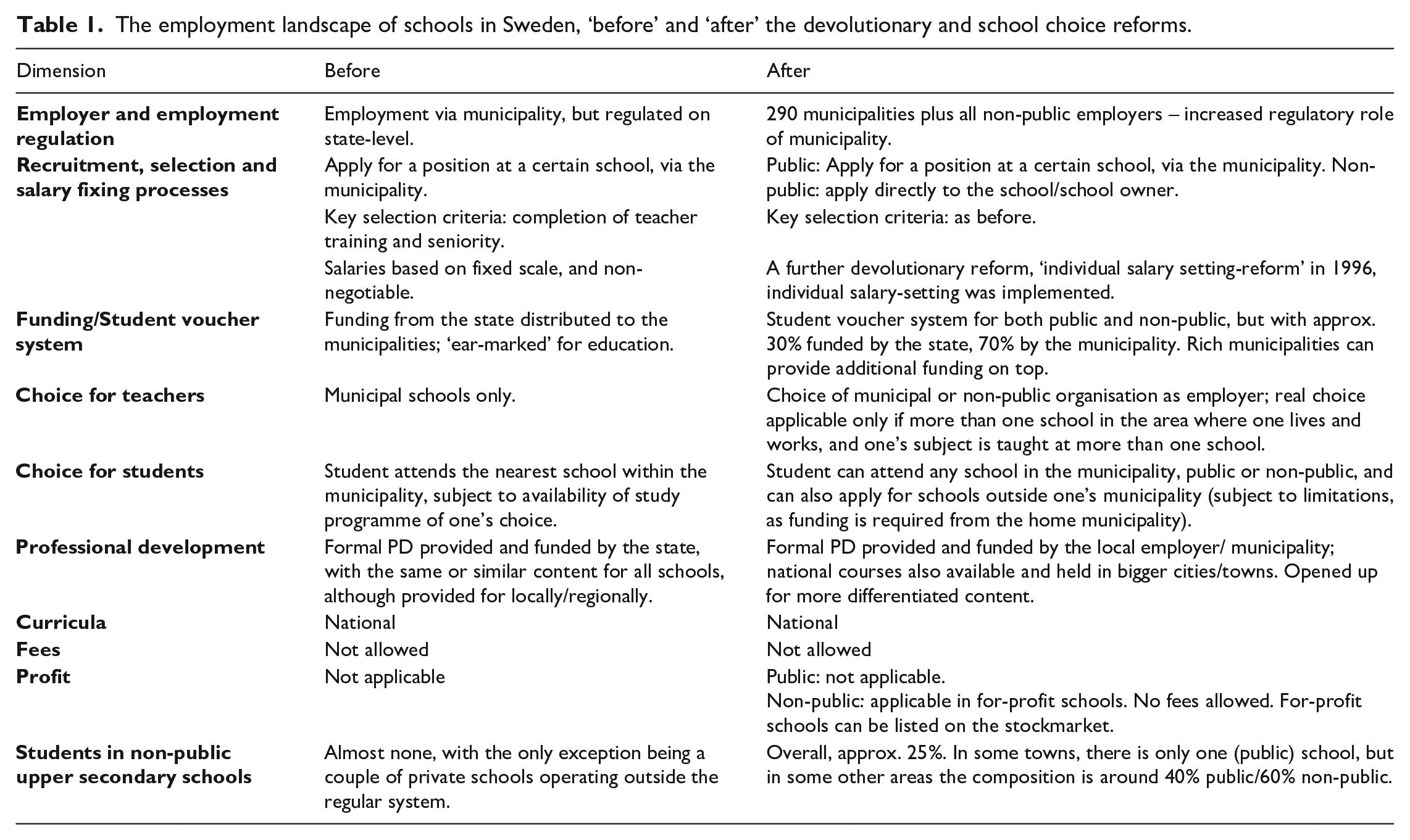
Just ahead of the school choice reforms, a key devolutionary governance initiative in relation to teacher employment was also established in Sweden (Proposition, 1990/91:18). While teachers have always been employed by one of the 290 municipalities, they can now also be employed by a non-public employer, ranging from for-profit limited companies, to not-for-profit organisations. In addition, salaries were previously based on a scale set on a national level, even though teachers were still employed by individual municipalities. These reforms constitute a clear structural change to the teacher labour market and suggest a greater likelihood of differentiated conditions across municipalities, and across schools. Moreover, in 2013 the so-called ‘first teacher’ reform was introduced, to increase the status of the profession, intended to improve ‘quality’ but effectively also stratifying different groups of teachers (Alvehus et al., 2019). The impact can also be described in terms of differentiation. For example, salaries for teachers in the very same school can now be significantly differentiated, providing some 450 euros extra per month for ‘first teachers’, without the position necessarily being clearly differentiated from the other teachers at the school. However, parallel with these marketisation trends, there are also examples of centralised governance: for instance, the national curriculum and the national school inspectorate, part of what Hardy et al. (2019) say has constituted an environment of ‘fast policy’ for teachers in Sweden. Thus, it can be argued that various changes to the governance and organisation of work are taking place simultaneously. Welfare sector professionals can therefore be said to be situated in a kind of ‘institutional crowdedness’ (Blomgren and Waks, 2015), reflected in a range of governance reforms.
The aim of this article is to examine and explain teachers’ work and conditions for work in different local employment settings. The contribution we make is to show how place of work impacts on conditions for work, and thus to demonstrate how the labour market for teachers today is indeed characterised by differentiation, with nationwide policy reform creating unequal and complex effects on the ground, as it is interpreted, translated and enacted in relation to a range of situated, professional, material and external contexts (Ball et al., 2012). This includes geographical location.
First, we present the theoretical framework through which our empirical data have been analysed, with key concepts being working conditions as they relate to governance change, space and place. We then outline our methodological considerations, explaining the project on which the article is based. Subsequently, we present our analysis of eight workplaces, emphasising the ways in which they are embedded in their respective local and regional settings. Finally, we discuss how teachers’ working conditions can be understood as they relate to current governance agendas of choice, competition, privatisation, marketisation and devolution.
A spatially informed frame of reference on welfare sector professionals’ work
In many of our previous studies, we have used sociology of professions as the theoretical lens through which we have analysed welfare sector professionals’, including teachers’, working conditions, as they relate to governance change (see, for example, Lundström and Parding, 2011; Parding and Berg-Jansson, 2018). This framework has advantages in terms of explaining why working conditions are experienced the way they are, which governance logic(s) characterise organisations, and what logic(s) professionals themselves identify with. However, this framework does not highlight the variety of specific workplace contexts in which professionals are situated which, as noted above, has been identified as a current limitation of the literature (Adams, 2015; Muzio et al., 2013; Svensson, 2008). Commonly, when space is considered it is misunderstood as a flat stage on which social life occurs or conflated with ‘levels’ within organisations. Scale is commonly conceived of as a ladder, entailing sequential stepping up and down from one rung (scale) to another, from the local through regional to national and global. A more accurate sense conceives of scale as interconnected, where what happens at one scale influences what happens at others in a mutually causal manner (Herod et al., 2007; McGrath-Champ et al., 2010). Therefore, as a means of developing the knowledge on conditions surrounding welfare sector professionals, this article contributes with a more contextualised and geographically informed lens through which to view their conditions for work and employment.
As Ellem (2016: 932) states, ‘where work literally takes place is important’. Indeed, in a recent special issue in Current Sociology the editors call for a ‘socio-spatial thinking . . . in . . . sociological imagination’ (Fuller and Löw, 2017: 469). Certainly, geographical circumstances can be said to permeate working life. Authors in Rainnie et al. (2007), drawing on Soja (1989), explain that ‘the importance of this interplay between the social and the spatial, between the physicality of place and the social relationships that constitute it . . . is that the interplay itself unfolds differently in different places. . .at different times’. Referred to as the ‘socio-spatial dialectic’ (Soja, 1989), such interactive differences are also shaped by how a place is connected to broader economic and political relationships (McGrath-Champ et al., 2010). Thus, space and geography permeate all aspects of social life, including work, and indeed the education sector, and the associated dimensions of teachers’ work and employment. We therefore adopt a spatially-informed frame of reference in order to explain the findings presented in this article, to develop an understanding of how and why teachers describe the conditions surrounding their work in the way that they do.
The ‘economic landscape’, that is, the configuration of settlements, their linkages and connections (including physical and non-physical) must be arranged such that ‘production’ (which in the sense used here, includes education) can occur. This requires a particular configuration of key resources – a sufficient supply of workers (e.g. teachers) who can access their workplace (schools), funds (municipal and national), materials (learning resources), and suitable links (including digital links) to allow connections and flows between a school and other necessary places. The intersection of these elements and their embedding in a particular urban (or non-urban) landscape is referred to by Harvey (1982) as a ‘spatial fix’. An urban settlement’s growth or decline is usually lead by economic activity other than school education, by the exploitation (and sometimes subsequent exhaustion) of natural resources, the creation of manufacturing, the rise of new service industries (such as a major concentration of data centres), with services (education, health and so on) attending to (following, supporting) that. However, as we will explain later, Sweden’s school choice reform appears to be actively reshaping the economic landscape.
Literature on geography and education, in regard to teachers specifically, remains fairly scant. Brock (2016) emphasises the impact of geography on education, and thus governance and organisation of the education sector. There are a number of examples in recent research demonstrating how geography of education is useful in explaining the differentiated manifestation of current governance agendas (see Brock, 2016; Curran and Kitchin, 2019; Yoon et al., 2017). In the context of Sweden, there are signs of a beginning focus on studies of the education sector with geographically inspired perspectives (see Beach et al., 2019). However, there is less research focused on the professionals who work within welfare sector organisations. We propose that geographical factors indeed affect the employees too, the teachers; a proposition supported by international research which suggests, for one thing, that teachers themselves can be subject to the pressures of choice-based systems, drawn to and from particular geographical areas by the attractiveness and range of schooling options available (Doherty et al., 2013). Another point in which teachers’ experiences have been argued to differ with regard to geographical context, from the Australian context, is in relationships with superiors (McGrath-Champ et al., 2019), with greater ‘care’ apparent particularly in remote areas, where ‘the nexus between work and life outside work is often unclear as so much of remote life is intertwined with the workplace – socially, professionally and physically’ (Brasche and Harrington, 2012: 120). In our own previous research in this context, we found that how teachers describe their conditions for work clearly links back to local and regional circumstances; a differentiation in working conditions was identified (Parding et al., 2017). A contribution made in this article is to further develop this body of work through a focus on the welfare sector professionals working in the education sector – the teachers.
It is also clear that these spatial differences cannot be understood in isolation from the policy context which overlays, interacts with, and can in turn be changed by them. For instance, in the work of McGrath-Champ et al. (2019), devolutionary policy was seen to have changed the work of principals across a range of geographical locations in the Australian states of New South Wales and Western Australia – but in different ways, with space and place mediating the nature of engagement with policy. Research on the impact of recent neoliberal policy moves for school staff has also explored the effects of increased ‘choice’ between schools, both as a result of devolution (e.g. Fitzgerald et al., 2018), or other market-oriented policy moves such as increases in the range of school type and the encouragement of parents to move between these (Stacey, 2019). Also relevant here are differences for teachers in relation to working conditions and employment conditions, which come with having differing school sectors and systems within which a teacher might work (e.g. public, private for-profit or not-for profit), rather than simply the public sector as an employer. For instance, sectoral differences can mean significant differences in material workplace resources (Stacey, 2019). Moreover, a recent investigation made by one of the teacher unions in Sweden showed that teachers in non-public schools have lower salary levels than teachers in public schools (Bergling, 2018). This is not always the case globally, however. For instance in Australia, a country with a long history of both public and non-public employers for teachers, salary levels are frequently reversed, with the independent schools’ salary scale, for instance, indicating an additional AU$10,000 (or around 15%) per year in comparison with that of the public school system (Independent Education Union, 2017; NSW Teachers Federation, 2017). This discrepancy further indicates that current education sector reforms and governance systems play out differently in different contexts.
In this article we examine the current differences between school workplaces in Sweden, and in doing so ‘[take] context seriously’ (Ball et al., 2012: 19) – particularly in relation to devolutionary and market-based policy change and local geographical circumstances. In this way, we pull out particular aspects of current pertinence, both politically and theoretically, whilst also maintaining a concern with the complexity of, and important differences between, schools as workplaces. In doing so, our research questions are as follows: How do teachers describe their workplace, as a place of employment? What challenges and opportunities do teachers identify in terms of conditions for work? Can any significant differences between sectors be identified, and if so what are they? How can these issues be further understood by applying and developing a spatially-informed frame of reference? And what might be the implications of such an analysis for studies of professions?
Methodological considerations
In this article, we examine teachers working in the three most common ‘market types’ 1 in one Swedish region. These three school markets form a geographically contiguous area, and each school market consists of at least one municipality, but often two or more. In 2009 there were a total of 94 markets, which by 2014 had been reconfigured into 83 local school markets (SNAE, 2016), suggesting that school markets are a dynamic construct, shaped and reshaped by the influence of students’ school choice and associated factors.
Our school selection was strategic, based on both purposive and convenience dimensions. Previous research has focused on the most heavily competition-laden (commonly metropolitan or large urban) areas. We purposely sought to counter-balance this existing focus by instead situating our study in terms of the three most common ‘market types’: smaller regional centre (SRC), smaller local centre (SLC), and larger local centre (LLC). On these grounds, eight schools, including both public and non-public, were selected within these three market types.
In the SRC there were both public and non-public schools and we selected two public and two non-public schools. These are referred to as ‘SRC public school 1’, ‘SRC public school 2’, ‘SRC non-public school 1’, and finally ‘SRC non-public school 2’. The SLC is a regional municipality where there was only one school: a public school (referred to as ‘the SLC school’). In the LLC, we aimed for two public and two non-public schools. However, only one non-public school was willing to participate in the study, producing a total of three schools in this market type. These schools are referred to as ‘LLC public school 1’, ‘LLC public school 2’, and ‘LLC non-public school’. At each workplace, we requested interviews with four teachers plus the principal, and with two exceptions that was the final outcome. A total of 30 teachers and 8 principals were interviewed. Of 8 principals, half were female, and half male. Of the teachers, 17 were female, and 13 male. The respondents had varying degrees of years in the profession, ranging from fairly new in the profession, to some 30 years.
The interviews were semi-structured, with topics including: organisation of work, governance of work, conditions for professional development, ethics and the market, including enabling and constraining factors related to school choice. The interviews lasted approximately one hour each; some were individual, and some were carried out in pairs, as it suited the interviewees. All interviews were tape recorded and transcribed verbatim. In addition, we took field notes, documenting our impression of the school as a workplace, which we use for descriptions below.
The interview study was led by the first author, who was responsible for designing the interview guide, and also carried out a large majority of the interviews. In addition, two other participants in the research team also took part in conducting interviews and transcribing interviews. After this initial compilation, the authors read, re-read and analysed the interviews. The analysis followed the steps of coding and analysing qualitative interviews described by Gibbs (2007), running from descriptive codes to thematic and finally analytical levels. Practically, the analysis rendered the following thematic codes: the devolved and privatised (or municipal) management of work, school attractiveness, workplace facilities, and finally conditions for development and learning.
The study was conducted taking into account ethical guidelines for information, consent, confidentiality and usage. The generalisations made from this qualitative study are analytical. Thus, our findings can be of relevance for other professional groups with similar circumstances, as well as teachers in other, similar governance contexts.
Findings – ‘It becomes very different’
In Table 2, we summarise some of the basic ‘contextual’ characteristics from each of the three market types as well as the eight selected workplaces. This table is presented as a reference point from which we build the analysis of our qualitative data.
Contextual characteristics of the three market types and the selected workplaces.
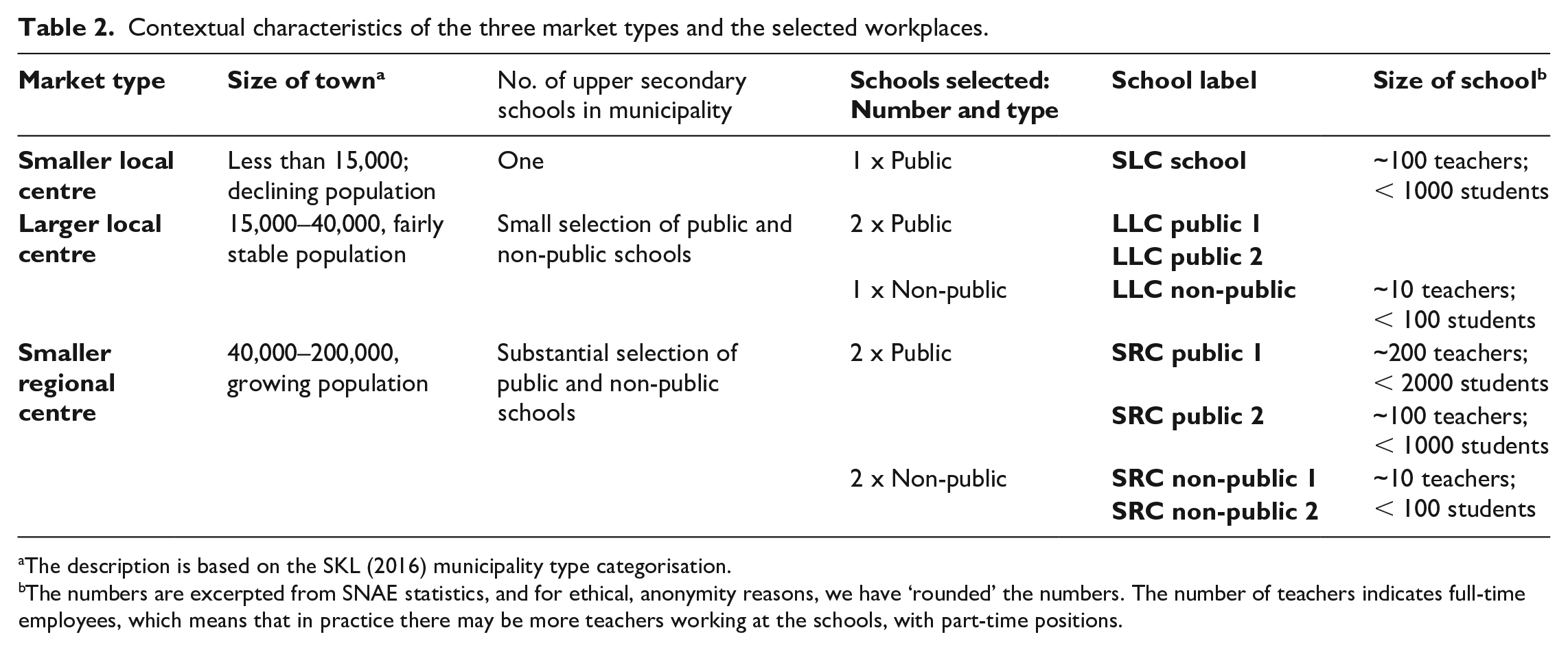
The description is based on the SKL (2016) municipality type categorisation.
The numbers are excerpted from SNAE statistics, and for ethical, anonymity reasons, we have ‘rounded’ the numbers. The number of teachers indicates full-time employees, which means that in practice there may be more teachers working at the schools, with part-time positions.
We begin our analysis with the ‘external’ context (Ball et al., 2012) of devolution and privatisation, as this is our primary concern. However, we then broaden our analysis to draw out other dynamics as a way of organising the themes which arose within our analysis. We do this as a way of highlighting how governance reforms are not the only force impacting the conditions of work for teachers; such changes must be understood in relation to, and as affecting, other contextual variables. Indeed, it will become clear in what follows that although we have separated these themes, they are essentially and unavoidably interrelated, and cannot be fully understood in isolation. We further develop this point in our discussion and conclusion.
Devolution and privatisation
Our data indicate that the prevailing political party can impact on conditions for schools, implying a differentiation between municipalities with different political parties in power. Some interviewees in non-public schools describe a form of exclusion; for example, not having been invited to municipal open-house days for Year 9 students considering which upper secondary programme and school to apply for. One principal, in SRC non-public school 1, concludes that this has an impact on the conditions for non-public schools: ‘This is about the municipality; how they act is not insignificant.’ Furthermore, in municipalities where there is an ageing population and/or population decline, there are thus fewer taxpayers, and the financial situation can be very difficult, as is the case for the municipal SLC school. Two of the respondents reflect on the current situation: ‘Right now it is very much the financial situation that mirrors everything. So teaching comes, it comes as priority two right now.’ When asked about how long the situation has been like this the respondent says that: ‘Well, it has been like this the last five years, and it has imprinted us very much with fewer teaching positions and cuts.’
The respondents describe that the current situation is especially present for some study programmes: those that are under investigation of having to close down, continuing on to say that their situation is not unique:
There have been cut-downs, I don’t see that that is linked to our school, rather that is how it is, something that all smaller municipalities . . . struggle with.
As schools are, to a large extent, funded locally by the municipality, this affects teachers’ working conditions and employment conditions, as will be illustrated via the coverage of school facilities; it is also intertwined with factors such as professional development and school attractiveness, also discussed below. In terms of how schools are governed, a varied picture emerges. In public, municipal schools, there are a number of management layers, from the highest municipal management level, down to the school principal. One teacher at SRC public school 1 comments that:
In a huge organisation, there are municipal goals, and there are goals at the school level, and there are the SNAE [Swedish National Agency for Education] goals, so there are very many goals impacting in one way or the other.
There are other goals too, the interviewee explains, concluding that: ‘there are many things governing and leading us’. This seems to create a kind of fuzziness, indicating the geographical scale of governance in municipal schools, with multi-way interactions between different scales (often expressed as organisational ‘levels’) becoming evident. In smaller, non-public schools, these matters seem clearer; one teacher at LLC non-public school describes their vision and concludes that: ‘that vision, is fairly widely accepted, and something we work for, together. It is top-down, but well anchored I feel.’ In this employing organisation, decisions and goal-setting seem to be described as undertaken at fewer scales, reflecting the contrasting organisational structure of smaller schools and lesser involvement of the municipality. Another respondent, in another of the non-public, and smaller, workplaces (SRC non-public 1) signals a very similar view:
Here one has rather extensive influence, as it [the workplace] is so small it is pretty easy if something is not good, we can talk about it, and then rather quickly take action.
Furthermore, principals in larger and municipal schools are currently described as far away from everyday work in public schools, for instance in making classroom visits. One teacher in LLC public school 1 states that: ‘it is very seldom the principal is out and about in the school and visits classes’. This was reported to not even happen once a year. On the other hand, in the smaller non-public schools, a contrasting picture emerges, where such activities are part of principals’ daily work, and they even teach sometimes. One principal in SRC non-public school 2 stated, in a description confirmed by the teachers interviewed: ‘I try to do one round a day, at least one round a day, where I visit the entire school so to speak, in classrooms and such.’ This implies that principals who govern and organise work this way may know more about what actually happens in the classrooms, and these principals may thus be able to follow up and support their teachers to a larger extent in these smaller non-public schools. The non-public schools also stand out as places that enable swiftness, for example, from a suggestion to a decision and implementation, perhaps reflecting the size of the workplace and fewer layers of governance, but also to some extent a difference in regulation. In contrast, cumbersome and slow decision-making and action characterise public schools, arising from the larger size of organisations and more layers of governance.
Reflecting other devolutionary governance reforms over the last couple of decades, yet another example is regulation in terms of how many hours per week teachers are in the classroom. As one teacher in LLC public school 1 says: ‘I have heard of schools where they try to squeeze the maximum [teaching hours] from the teachers’. This teacher goes on to describe how different employers interpret the regulation differently in terms of how much teaching time there should be, and how much time for preparation and follow-up after class there should be. As the same teacher concludes: ‘It becomes very different in different schools’. This evidence explicitly illustrates the current differentiation in governance and working conditions.
School attractiveness
Whilst all of the eight schools are described by the teachers as workplaces one would choose to stay with, a closer look shows differences. Some schools get many applications when announcing a teaching position vacancy, indicating school attractiveness, whereas others do not. A principal in SRC public school 1 describes how the school is a highly attractive choice for teachers as well as students: ‘I most often have quite a number of applicants’. She describes how even without advertising for positions, she has: ‘many who throughout the year send their CVs and come to present themselves. . . . There are many who are interested in working at this school.’ At the other end of the scale, in the same SRC, a principal at a small non-public school (non-public 2) has almost a contradictory situation, even when advertising for a position: ‘There are not so many who apply’. Actually, the three non-public schools in our study have not needed new teachers lately, rather they have had to let people go, due to fewer students. It seems the non-public schools in this study, which are all substantially smaller than the public schools, sometimes can only offer part-time positions due to low numbers of students. This can be assumed to lower the attractiveness, especially in tandem with the employment insecurity surrounding smaller schools, with low and/or declining student numbers. It seems that in these schools, teachers also feel a pressure to attract and retain students. ‘We may be able to make it for three years. We were on the border, they talked about closing the school down about ten years ago.’ The respondent says that there is no undue pressure at the school, but also describes how school reputation is important, and that it is important that the students like the school.
It should also be noted that depending on where a municipality is geographically positioned, there may be ample opportunities to choose employers and workplaces, whereas in other places there is only one choice, reflecting how geographic realities can mean that many school markets remain small (Curran and Kitchin, 2019). In the SLC, there is only one upper secondary school, a public one, which means that if one lives in the town, there is only one employment option. At the same time, there seems to be a partly transient teaching population, with a steady share of newly graduated teachers working at the school, as a stepping-stone position until they manage to get a position at a first-choice locality:
It depends on where one comes from, and one’s family situation. We have quite a few teachers from [a town some 100 kilometres away] who, when finishing university, perhaps work [here] for a while, commuting here, and if they have a partner there and are established there, they may not take the leap and move here.
Weekly commuting seems to be the only real option in these cases. The interplay of social and spatial processes is evident here: the range of employment offered in a location and its perceived ‘attractiveness’ shape a physical-space decision. Whether the teacher’s commute transforms into a decision to relocate can build – or not – the place where they work, with the capacity to boost or diminish ‘attractiveness’, as noted previously by Doherty et al. (2013). Even in the LLC, where there are several schools, one of the municipally-employed teachers (LLC public school 1) says that with her subject focus, there is only one choice of school. This shows that the choice of employer and school may not always be a real choice; local geographical circumstances constrain or enable social life, just as social life shapes the local geography.
These teacher–workforce dynamics closely reflect students’ changing school choice patterns through which they now commonly attend school outside their residential domain, to access what they perceive to be more well-resourced schools and superior learning programmes. As acknowledged by the Swedish National Agency for Education (SNAE, 2016), some places or regions ‘gain’ while other ‘lose’. The contrast to the pre-education reform era is that ‘school choice’, with its attendant fortunes and effects on teachers’ work, now seems to ‘lead’ rather than ‘follow’ the ‘remaking’ of the economic landscape.
Workplace facilities
In terms of workplace facilities, there are indeed differences between the eight workplaces, both within and between sectors. As an example, in one of the LLC workplaces, public school 1, the facilities we as researchers are met with can be described as being in ‘mint’ condition. One interviewee comments:
I actually think we have very good conditions for what we are set to do . . . . If you look at the average school in the country, I think we are very well resourced. We have extensive possibilities to buy stuff too, so when it comes to that I can’t come up with a thing to complain about really.
Another teacher gives a similar response: ‘currently, I can’t complain actually’. This teacher described how technology (including computer access for students) is working well, and that other materials such as books are up to date and in good condition, which can partly be explained by the municipality’s good economic circumstances which are buoyed up by the operation of a large and prosperous industrial company in the area: ‘it is thanks to that we are sponsored by X [a large company]’. The principal seems to share this view, describing how the teacher teams usually get what they ask for in budget discussions. In fact, mirroring these accounts, the municipality in which the school is situated is described as ‘affluent’. On the other hand, the workplace in the SLC market type seems to be experiencing quite the opposite. In fact, we, as researchers, are met by rather run-down premises, seemingly both old and suffering from a shortage of maintenance. There, both the principal and the teachers describe how the municipality’s budget is affecting the school negatively. ‘Well it pretty much looks the same as in 1991 when I went here myself’, there are ‘fewer classrooms than ever’. Further to that, computers and other technical appliances leave much to be desired. With a municipal budget in deficit, there are discussions about cutting programmes at the school, highlighting how the financial position of a municipality impacts upon the budgeting requirements of public schools in Sweden today. This can create competition within the workplace, for instance between teacher teams competing for minimal resources. In addition, as teachers with different specialisations will be more (or less) linked to certain programmes of study, they are in a precarious situation if changes to a school’s educational programmes take place. There are also other impacts. In relation to the pedagogical vision of the SLC school, one teacher says:
I miss a pedagogical vision. As it has been the last few years, we have been very focused on survival, so the pedagogical vision has ended up entirely behind the economy and budget.
The same teacher continued to describe how the budgetary issues have, over the last few years: ‘shaped us very much’. The principal agrees, stating that the municipality is ‘extremely in the red’. The situation, facility-wise, but also more generally, is linked to the circumstances of being a politically governed organisation, being one part of an entire budget – one that is dependent on local taxes, which themselves depend on the age and financial contribution of the local population.
Learning and development opportunities
We have previously shown a general dissatisfaction with conditions for professional development, with how work is organised impacting on the possibilities for more informal day-to-day learning; for instance, having work-stations close by other subject colleagues is important in enabling teachers to share and build new knowledge (Parding and Berg-Jansson, 2018). What we see here is again rather different conditions, reflecting changed governance, whereby each employer decides on what professional development is to take place, and how work is organised to accommodate this.
At the larger schools, which are more often public, there are ample possibilities to learn and share with subject colleagues on a daily basis. Furthermore, there is also the possibility to sub-specialise, which opens up more focused learning and development. One teacher in LLC public school 1 says that for him to be able to keep up to date, the sub-specialisation is essential: ‘I have history, civics and geography, but to my great pleasure I have been able to secure that now I only teach in civics; international relations.’ A contrasting picture comes from teachers in the smaller schools, which are more often non-public, where there may be only one teacher in each subject, making daily learning and sharing of experiences in how to teach and develop teaching in one’s subject difficult. One teacher in SRC non-public school 1 describes how she misses the possibility to learn and develop in this sense: ‘I am alone in my subject, and at other schools one has an exchange with other English teachers for example.’ At the same school, another teacher talks about other schools, where there are several teachers in each subject: ‘It is enormously appealing’. Another teacher at the same school summarises:
And this is the small school’s dilemma, that we are alone in our subject, so one does not get that input that one could get from colleagues in one’s subject.
It is also clear that the financial situation of the school seems to have a major impact on professional development activities, especially so if the school is geographically peripheral – with long distances to other schools or formal professional development opportunities. In public schools, this links closely to the financial situation of the entire municipality. At the SLC school, one of the teachers exemplifies this:
There are restrictions in terms of what budgetary resources there are. A lot of good professional development is arranged at different places [at a significant distance] and in the best of worlds we could go.
This quote illustrates how the employer’s budget constrains the opportunities to participate in formal professional development, as well as how geography is implicated in the kinds of opportunities that can be taken up.
Discussion: The profession, the organisation(s) and spatiality
In this article, we have examined how teachers experience their conditions for work and employment in eight schools in a selection of the three most common market types in Sweden. We have considered these conditions primarily in the light of current governance agendas of marketisation via devolution and privatisation. However, we contend that the conditions for teachers’ work cannot be understood as affected only by these governance reforms; that many contextual dynamics, only some of which we have been able to highlight here, must be taken into account. Given the dearth of research on the impact of geographic context for welfare sector professionals (Parding and Berg-Jansson, 2016), we highlight this aspect as particularly important for the future development of the field. Yet it works in tandem with others.
For instance, the material context (Ball et al., 2012) of schools across different market types conveys the scalar nature of marketisation with national-state funding intersecting in complex ways with municipal funding. Non-state funding can also emanate from either local or supra-local scale/s, further highlighting the geographical dimension and how it intersects with material realities in schools. This interweaving of contextual dimensions can also be seen when considering school size. Here, again, it is not only the geographical context that determines the size of a school. Although geography is certainly one factor, the size of a school can also be affected by the governance context of marketisation, as shown by the experience of the teachers and principal at SRC non-public school 2 with its declining enrolments. This factor then goes on to have further effects, as the size of a school can in turn affect opportunities for learning and development, with more or fewer colleagues to learn from within the workplace. Yet again, opportunities for learning and development can also be affected by rurality, if the distance to these opportunities becomes a barrier. Whereas it is usually ‘other’ economic activity that drives the remaking of ‘spatial fixes’, in the early part of the twenty-first century in Sweden’s school education system, the patterns and opportunities for teachers along with attendant dynamics of school choice and funding have been recast as key imperatives shaping the economic landscape.
What we seek to highlight, then, is how the relationships between different aspects of context for the welfare sector professional group of teachers are complex and interwoven. As Ball et al. (2012: 21) noted in their study, different contextual dimensions ‘can overlap and are inter-connected. For example, school intake is presented as “situated”, but intake in turn can shape professional factors such as values, teacher commitments and experiences.’ In this article, we have further developed such arguments and highlighted a broader range of connections between different dimensions. We do not claim that we have exhausted the contextual complexity in our data, nor in relation to school marketisation in Sweden; after all, ‘theorizing policy enactment [is] always going to be complex and slippery and in many ways an incomplete and impossible project’ (Ball et al., 2012: 148). However, what we have done is to highlight some of the key relationships evident through participants’ interview data, so as to emphasise the ongoing work needed in understanding welfare sector professionals’ work as fundamentally related to the contexts within which it takes place. Our investigation of the school education sector reveals a stark case of Sweden’s social democratic fabric being intersected by neoliberal influences, alongside other sectors (Ellem et al., 2019).
Indeed, by drawing out these contextual interrelationships, we are also able to highlight how these dimensions are not simply a matter of unidirectional cause and effect. For instance, given our attention to geography, we can highlight in particular a socio-spatial dialectic: it is not only policy that affects geography, but geography that affects policy. For example, we note that in one of the public LLC schools, its subject focus and location within a municipality in which a major and prosperous heavy industry is located means that devolution reforms can be ‘used’ in favour of these companies and the development of future human resources. This shows how local economic activity can work within the current policy context in order to differentially affect resourcing. Through these insights we give traction to calls for spatial awareness in research on professions (Adams, 2017) and in sociology (Fuller and Löw, 2017). This provides opportunity to finesse understandings of devolution. Whilst devolution entails shifting previously centralised powers to more local levels, as seen in Swedish school choice reforms (Lundström and Rönnberg, 2015), here too, there is a ‘two-way’ current between the social and the spatial. This assists in understanding the great diversity in marketised versions of education that have been laid out over the face of different countries, not only because institutions, governance and politics differ, but because the social and physical landscape shapes these imperatives differently. We consider that what may be needed is a geography of professions, extending out beyond the teacher workforce to consider other professional groups such as doctors, nurses and other welfare sector professionals. Even though we have previously discussed changes in professionalism in the context of school choice (Lundström and Parding, 2011; Parding and Berg-Jansson, 2018), future research might also further consider whether the differentiation in teachers’ employment and working conditions also brings differentiated professionalism; in terms of hybrid professionalism for instance (cf. Noordegraaf, 2007).
This is even more necessary given that our analysis of teachers highlights how governance reform is changing the relationship between the profession and the organisation. Where previously there was essentially one employer, the state as one actor, now there is a number of more or less similar and different employing bodies. This means that teachers, or groups of teachers, can experience very different conditions and issues, plausibly making the teaching profession collectively less strong. It is not the profession and the organisation, but rather many organisations, and thereby a stratification of teachers faced with different kinds of issues, as touched upon in Parding et al. (2017). In our analysis, only a glimpse of the complexities of the relationship between profession and organisation has been unveiled. For further analyses, a focus on such complexities, in terms of relational dynamics between both individual and between and within groups of professionals, and their employing organisations (whether public, non-public for-profit, non-public-not-for-profit, with their respective logics) would be highly useful. The changing governance landscape makes for shifting ground between professions and new forms of organisations, and in this new settlement, new relational dynamics require attention, using a geography of professions that is sensitive to the contours of this new terrain.
Conclusion
This study has revealed that not only have neoliberal reforms in the Swedish education sector further differentiated teachers’ employment and working conditions, their impact has been differentiated by geography. In all, we identify our contributions as consisting of four key points. First, we have shown how reforms of choice and privatisation have had differential effects for the working and employment conditions for teachers in upper-secondary schools in Sweden. Second, we have highlighted that it is not only these reforms in and of themselves that have meant a further differentiation of these conditions – the effects have played out differently in relation to different, interrelated dimensions of each context. Third, we emphasise the importance of geography in understanding such complexity – an area of scholarship that has been missing from the field of the sociology of professions. And finally, we argue that these findings are particularly significant for the welfare sector professions and their changing organisational landscape, where there is a social justice requirement for the equitable resourcing of public goods, such as health and education.
For further research, we identify merit in encompassing the full array of Swedish school market types in a spatially-sensitive study of teachers. We also call for greater attention to geography in relation to welfare sector professionals’ work in contexts beyond teaching, and beyond Sweden, so as to decipher if and how professionalism is enacted.
Footnotes
Acknowledgements
The authors acknowledge the work of Anna Berg-Jansson for early input to this project, as well as the helpful comments of the two anonymous reviewers.
Funding
The research upon which this article is based was supported by the Swedish Foundation for International Cooperation in Research and Higher Education (2013-5450) and the Swedish Research Council for Health, Working Life and Welfare (2013-0177).
