



Abstract
Several studies have described the condition of asylum seekers as being on the threshold or in-between structures. Victor Turner’s concept of liminality and Agamben’s state of exception have been used extensively to analyse this condition, mostly to show the negative implications of the ambiguous legal (non-) status. This article argues that the condition of liminality provides an intensified doubleness of impossibility and possibility for action, which casts a different light on conceptualizing agency. Without disregarding the downside of this liminal, in-between condition, the article shows that the lack of ‘normalized’ connectedness to the new structure combined with physical distance from the past structure, enables reflection and feeds the power of imagination. This can lead to alternative (yet conditional) forms of agency, such as delayed agency and agency from marginal positions. Through the narratives of asylum seekers living in Dutch asylum seeker centres, the article shows the potential of transforming non-places, such as asylum seeker centres, into those in which existential meanings can emerge (even if partial). Considering these sources of agency has great implications for the short-term well-being of asylum seekers and the long-term inclusion of refugees in their countries of residence.
Introduction
The issue of asylum seekers in Europe has become increasingly urgent in recent years. Despite the treacherous journeys asylum seekers make to get to Europe, crossing the border does not guarantee a safe future. The growing support for rightist anti-migrant political parties across Europe has made it difficult for politicians to be receptive towards asylum seekers. By the end of the 1980s, several countries, including the Netherlands, had chosen to isolate asylum seekers in remote asylum seeker centres while considering their applications. Inspired by Agamben (1998), Augé (1995) and Diken (2004), we refer to these centres as ‘zones of indistinction’ or ‘non-places’, where, according to Agamben (1998: 168–169), asylum seekers ‘lead a life in a permanent state of exception and [in] detention centres into which they are forced without trial’. In these camps ‘the state of exception begins to become the rule’. This state of exception or in-betweenness is associated with the condition of ‘limbo’ or ‘liminality’ in many studies (Hynes, 2009; Knudsen, 2009; Smyth and Kum, 2010). Victor Turner (1994: 4) explored liminality as a transitional period from one state to another, a ‘period of margin’ that is regarded as ‘an interstructural situation’.
The poor living conditions and restrictive policies within these camps have been addressed by many scholars from different disciplines. Several studies have focused on the effects of the long waiting period inherent in the asylum procedure and/or the dire living conditions (e.g. Dupont et al., 2005; Geuijen, 1998; Kohlmann, 2003; Van Dijk et al., 2001). They have shown how the long interval of uncertainty affects psychological health regarding stress (Dupont et al., 2005: 27), fear, feelings of insecurity and the sense of total dependency (Geuijen, 1998). Van Dijk et al. (2001) argue that placing asylum seekers in secluded areas leads to feelings of pain, sorrow, stress, grief and loss. Griffiths (2014) argues that the waiting time becomes destructive when it is intertwined with the experience of directionless stasis. Geuijen (1988) and Larruina and Ghorashi (2016) refer to asylum seeker centres as total institutions (Goffman, 2007) designed to discourage asylum seekers from entering Europe.
Fresia and Von Känel (2016) argue that research on refugee camps has been strongly influenced by Agamben’s description of them and his considering refugees as the pure expression of bared life. Yet there is increasing research showing ‘that camp life could never be completely reduced to bare life and refugees are not passive victims’ (Fresia and Von Känel, 2016: 253). These authors argue that various forms of agency exist within these camps, from forms of protest and contestation (Agier, as cited in Fresia and Von Känel, 2016) to working as humanitarian actors for other marginalized groups (Ramadan, 2013) to being active in transnational contexts (Horst, 2006). Malkki (1997) showed how refugee-ness had a central place in the narratives of Hutu camp refugees as a ‘valued and protected’ status and a ‘refusal of being naturalized’. Claiming the liminal status provided refugees ‘a categorical purity’: neither a citizen of the present nor the past. ‘One’s purity as a refugee had become a way of becoming purer and more powerful as a Hutu’ (Malkki, 1997: 63). Inspired by this line of work, we aim to show the possibilities for refugees’ agency within the impossible structures of an asylum seeker centre.
This research was part of a project ‘de Werkelijkheid’ 1 (the reality), which was financed by three organizations (Dutch Refugee Council, Vrolijkheid and UAF). We were asked to research asylum seekers’ living conditions in a Dutch asylum seeker centre (AZC). By using Turner’s (1994) concept of liminality as a potential source of pain and creativity, we sought to gain access to a more comprehensive and layered understanding of refugees’ challenges and resilience strategies in AZCs.
Asylum seekers in the Dutch context
In Dutch society, as well as internationally, reception of asylum seekers is the subject of heated debate. The Dutch policy of receiving asylum seekers has become increasingly restrictive over the past decades (Ten Holder, 2012). The Agency for the Reception of Asylum Seekers (COA), a governmental organization tasked with arranging shelter for asylum seekers in the Netherlands, has used the slogan ‘sober yet human’ (sober doch humaan) to describe its reception of asylum seekers (Geuijen, 1998). A 2010 government coalition agreement described its asylum and immigration policy as ‘strict but just’ (streng maar rechtvaardig). Balancing the cost-conscious and human sides of reception has been a great challenge for the COA and subsequent governments. It has meant dealing with the contradictory demands of control, low costs and humanitarian approaches, with the consequences for asylum seekers living in AZCs apart from the rest of the society. However, the policies of the recent decades show that the rationales behind these centres were mainly financial (keeping costs as low as possible by having centres for large numbers of asylum seekers) and political (discouraging asylum seekers from coming to the Netherlands).
The lack of privacy and limitations on freedom in these centres have been major themes in the academic literature on AZCs (Geuijen, 1998: 262–263; Van Dijk et al., 2001). Dupont et al. (2005: 32) described the pressures asylum seekers go through, how they feel like prisoners, lacking a future perspective. Furthermore, Van Dijk et al. (2001: 290) wrote that asylum seekers experience intense feelings of loneliness and miss having social networks; while some are with their families, others are on their own (Dupont et al., 2005: 35). Living apart from society, in AZCs that are not easily accessible, limits asylum seekers’ possibilities for making connections and building relationships (Geuijen, 1998: 262) and for making a meaningful start on a new life (Smets and Ten Kate, 2008: 328).
Some scholars have also focused on asylum seekers’ coping strategies inside the AZCs. According to Van Dijk et al. (2001: 292), some asylum seekers try to focus on the present and occupy themselves with ‘meaningful activities, such as raising their children or voluntary work within the centre’, while others become increasingly passive. Geuijen (1998: 266) described three categories of coping strategies. First, is engagement: committing to several activities and building a social network. Second, is apathy: becoming passive, especially after long periods of waiting, with no prospects for the future. Third, is the development of a negative attitude and behaviour that may manifest in hindering and opposing AZC staff. Dupont et al. (2005: 34) explain that asylum seekers in AZCs must develop strategies to ‘kill time’ to reduce stress and deal with the uncertainty. Without opportunities to study or work, alcohol and drugs are often used to make time go by (Dupont et al., 2005: 28). The reality of AZCs has proven to be far from accommodating of positive opportunities, especially for asylum seekers without residence permits (getting a residence permit takes four to five years on average).
Theoretical framework
A major discussion in sociology has been theorizing the conditions and space for agency considering the structural constraints. The challenge is to articulate social actors’ practices in their everyday interactions, considering the structures that both constrain and enable those (inter)actions. Practice theory has been insightful in attending to individual actions without losing sight of the embeddedness of these actions within larger structures. Although practice theory does not ignore power, it does not make it central to the theoretical framework. However, in Giddens’ work, power gains relative attention in a dual manner: ‘power as organized into the cultural or institutional order (which Giddens calls “domination”), and “power” as an actual social relation of real on-the-ground actors (which Giddens calls power)’ (Ortner, 2006: 5). In his theory of structuration, Giddens defines the structure–agency relation as an ongoing and interdependent connectedness. According to Giddens (1984: 25), ‘the constitution of agents and structures are not two independently given sets of phenomena … but represent a duality’. With his concept of ‘duality of structure’, he argues that social structure is both the means and the outcome of social action. Thus, ‘structure is not to be equated with constraint, but is always both constraining and enabling’ (Giddens, 1984: 25). This implies that individuals have the space to act in various ways. In what Giddens refers to as ‘the dialectic of control’ (1979: 145ff.), ‘he argues that systems of control can never work perfectly, because those being controlled have both agency and understanding and thus can always find ways to evade and resist’ (Ortner, 2006: 5).
Another approach of power that problematizes the notion of agency is Foucault’s, which is not about domination or resistance, but about routinization, formalization and legalization of everyday practice. In this characterization, power is no longer a manipulable source but a web of relations capturing advantaged and disadvantaged alike (Hardy and O’Sullivan, 1998). When power is seen as domination, assuming that there are dominators and dominated parties, strategies to resist its impact seem more tangible and observable. A discursive approach of power, in which power is present in the normalizing processes of everyday life, implies a different approach of resistance or agency. What are the bases of resistance when power is everywhere? How can one still discern power structures? To put it differently, what is left of agency? This point has been raised mainly by feminist scholars (Ghorashi and Sabelis, 2013). Their major question has been: What happens to emancipation and liberation when there are no bad guys to blame? Foucault’s opponents argue that ‘the Foucauldian attack on agency removes the possibility of using power for particular objectives, especially the possibility of the powerless achieving empowerment’ (Hardy and Clegg, 1999 [1996]: 381).
Yet, other scholars consider there to be more space for agency, even within the Foucauldian notion of power. ‘[B]ecause there are competing discourses, socialization into any one discourse is never complete, and resistance to specific discursive regimes is thus possible’ (Foucault, in Clarke et al., 2009: 325). Although the power of discourse lies particularly in its tacit impact regarding positioning through the often taken-for-granted disciplining of individuals’ actions and interactions, its impact is not absolute since individual positioning involves ‘a number of intersecting discourses’ (Hall, 1991: 10). This approach of discursive power comes close to Giddens’ emphasis on the fact that individuals ‘are partially “knowing subjects” (see, e.g., 1979: 5) who are able to reflect to some degree on their circumstances and by implication to develop a certain level of critique and possible resistance’ (Ortner, 2006: 7–8). This does not mean that individuals are conscious and in charge of their actions at all times; ‘unintended consequences of action’ are possible (Giddens, 1984: 294, in Den Hond et al., 2012: 244). Despite these limitations, agency includes the capacity that a person ‘could have acted otherwise’ (Giddens, 1984: 12).
Reflection on a more relational level could also be considered a source of agency within normalized and omnipresent power structures in which every individual action is embedded. ‘Strong reflexivity’ (Harding, 1993: 70–71) resulting from intersubjective negotiations of contrasting positionalities could also provide a particular form of agency (see also Ghorashi and Ponzoni, 2014). Agency would then refer to the ‘capacity [of individuals] to be reflexive about their situation – their “discursive consciousness” – and to act on it to “make a difference” ’ (Zanoni and Janssens, 2007: 1376). Another somewhat broader sense of intentional agency is Sewell’s definition, which considers agency as a capacity ‘for desiring, for forming intentions, and for acting creatively’ (Ortner, 2006: 136). Agency, in this way, could also capture desires, dreams or particular goals that can serve either as a source of inspiration (delayed agency) or as a directive form of action that requires knowledge and the ability to play the system well. But agency for the ‘less powerful’ or ‘less resourceful’ can also be about ‘having desires to play their own serious games even as more powerful parties seek to devalue and even destroy them’ (Ortner, 2006: 147). This could entail choosing a position ‘on the margin of the power’ (Ortner, 2006: 147) or ‘to step aside’, meaning stepping into the margins of discursive power to produce counter-narratives to the dominant societal discourses (Collins, 1991; Janssens and Steyaert, 2001). Ortner (2006: 152) describes this as an ‘enactment of a personal project’, what Collins would call ‘a collective project’.
In sum, agency, which is always connected to different approaches of power, can be defined in various ways: (1) actively getting things done; (2) actively resisting against visible forms of power; (3) resisting normalized structures through reflective consciousness; (4) maintaining a delayed form, inspired by dreams and desires without immediate actions; or (5) choosing marginality in relation to power.
Agency and the liminal condition
Turner based his conceptualization of the term liminality on the earlier work of Arnold van Gennep, who defined a threefold structure of rites de passage regarding separation, liminality and aggregation (Turner, 1994). Rites de passage indicates a transition between states, ‘a relatively fixed or stable condition’ referring to a legal status or a condition in which an individual is situated in a specific structure in time (Turner, 1994: 4). The outcome of this stage as well as its duration is unclear; it is an uncertain juncture with no way back. Thus, Turner sees liminality as being in-between phases. The conditions of individuals facing liminality are unavoidably ambiguous because ‘[l]iminal entities are neither here nor there; they are betwixt and between the positions assigned and arrayed by law, custom, convention, and ceremonial’ (Turner, 1969: 95). Turner argues that, in the liminal period, the subject of rites de passage is invisible (Turner, 1994: 6). This structural ‘invisibility’ is typified as no longer classified and not yet classified (Turner, 1994: 6). Additionally, the subjects of the ‘rite’ are often secluded from culturally defined and structured states and statuses. They are in another place and hidden. Finally, liminal personas have nothing. They have no status, property, rank or position in a kinship system – their condition is poverty (Turner, 1994: 9).
A different perspective on the liminal condition is that the processes of undoing, termination and breakdown are accompanied by ‘processes of growth, transformation, and the reformulation of old elements in new elements’ (Turner, 1994: 9). Garsten (1999: 601) describes the liminal position as a ‘seedbed of cultural creativity, where old perspectives … are contested and new ones created’, signifying that it comprises opportunities as well as risks for individuals. She further clarifies it as being in-between social structures: structural bonds are lacking, providing space to reflect, change position and make alterations in one’s life. Turner argues that liminality stimulates subjects to ‘think about their society, their cosmos, and the powers that generate and sustain them. Liminality may be partly described as a stage of reflection’ (Turner, 1967: 105).
The concept of liminality serves merely as a metaphor for understanding the double-edged lives of asylum seekers in AZCs. However, it is important to consider the following: (1) Turner’s model was initially used to describe rituals in pre-industrial societies, a different context than found here. (2) Turner’s liminal condition has the predictable outcome of a ritual order, in which separation is always followed by reincorporation. This is not the case with the life of asylum seekers in AZCs, which is open-ended with unpredictable outcomes. 2 (3) A central concept in Turner’s (1969: 96) liminality model is ‘communitas’, which refers to a group experience of (temporary) togetherness, social equality and solidarity. This sense of togetherness has never been mentioned in any scholarly work on AZCs, perhaps because of the competition for limited resources and the fear of sharing stories of the past that might be misused by formal authorities. 3 Despite these limitations, we found the liminality model a useful metaphor for rethinking asylum seekers’ agency related to the five variations of agency mentioned earlier.
Methodology
To grasp the reality of life in AZCs and to enable a deeper understanding of asylum seekers’ daily experiences, we chose a combination of participant observation, in-depth interviews and literature reviews. We took the epistemological position of constructivist grounded theory (Charmaz, 2006), assuming that knowledge production is a mutual interrelationship between researchers, participants and their situatedness in a certain time and space. This particular approach of grounded theory allows researchers to focus on the relationships and voices of participants. This approach together with the combination of methods is particularly effective for studying subtle nuances in behaviour and attitudes to create an in-depth understanding of life in an AZC (Babbie, 2010: 326). Two junior researchers conducted the research, with close supervision by a senior researcher.
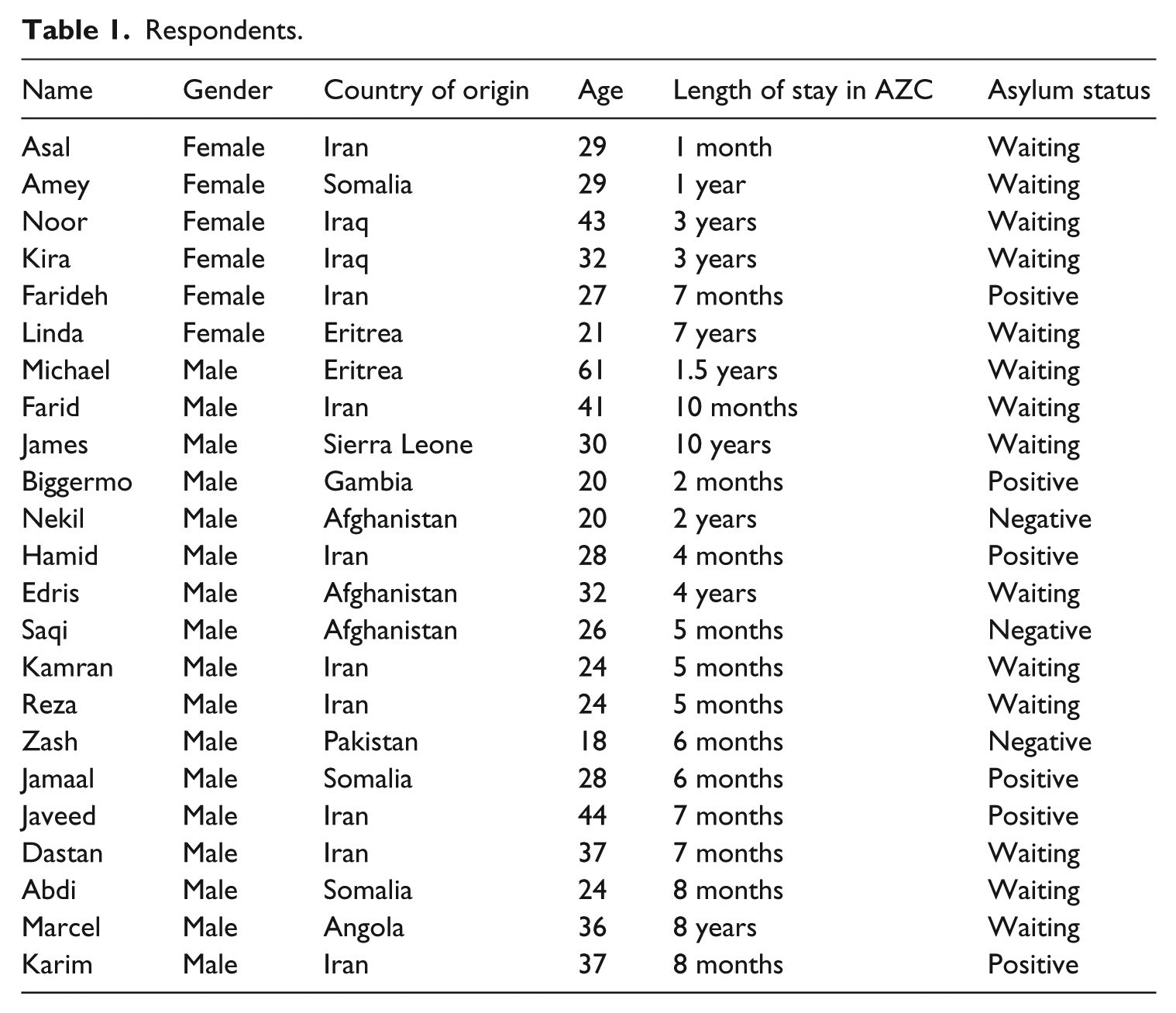
Most interviews took place in one AZC in the centre of the Netherlands, though some were conducted in two other AZCs. The main research site was chosen because it was average in terms of facilities and location (neither in the city nor completely remote). The fieldwork took three months, March–May 2011. Although the aim was to interview as diverse a group as possible, diversity was limited because of the criterion for English or Dutch language abilities; we did not want to include interpreters due to the sensitivity of the research. We conducted 23 interviews with AZC residents (17 men, 6 women; see Table 1). The number of women interviewed was influenced by gender ratios and women’s visibility in the centres. The gender make-up of the centres in our research reflected that of asylum seekers in the Netherlands in 2011: 64% men, 36% women (Centraal Bureau voor de Statistiek, 2012). Women’s limited visibility, which made it harder for us to build contacts and trust, was partially connected to their feelings of non-safety. Violence and trafficking happen regularly in Dutch AZCs (Kramer and Cense, 2004). Moreover, most women preferred to spend time in their rooms: studying, watching movies and/or taking care of their children. However, we were allowed to approach residents in common areas only. By participating in a group called Women’s Activities, we met and had informal group conversations with women. Six women wanted to be formally interviewed, while others preferred informal conversations because they felt shy or uneasy speaking in Dutch or English in the more formal setting of a recorded interview. Being present and participating in Women’s Activities, however, did help us get to know more female residents and get a better sense, a richer and more complete picture, of the space. Though we interviewed more men than women, the narratives of both had quite similar patterns (ambitious and hoping for a great future).
Respondents.
Data analysis
Data analysis involved reviewing field notes and recorded interviews as well as the literature and documentation on the COA and the asylum procedure. We identified the main concepts, themes and topics discussed in the interviews and found in our field notes. We discussed the identified patterns intensively and selected themes that captured the most visible patterns in the data. This was important for ensuring that the patterns chosen were co-constructed and included both participants’ and researchers’ voices (Charmaz, 2006).
Suspended lives on the threshold
Residing in an AZC is like standing on a threshold – in limbo between leaving one’s country of origin and becoming a legal resident of a new country. Dutch AZCs are often located in areas that are physically apart from society. The AZC where we conducted interviews was a former military base situated between several villages and a nature reserve. A large fence surrounded the AZC, creating the feeling of literally being separated from the rest of society. In our interviews with residents, what dominated was their feelings of despair and loss of control. But we also heard their attempts to make their stay in such a ‘non-place’ as meaningful as possible.
Passing the days in the AZC
How people spend their time in AZCs differs. Some described fully packed days; others used terms like boredom and emptiness to characterize their lives. Abdi, who is from Somalia and is awaiting a decision, described his days as follows: I’m cleaning the centre every day for one hour. I’d rather do voluntary work than stay at home. I don’t attend classes, but in my spare time I educate myself. I study the Dutch language. … During the nights, I can’t sleep, I read books or do my studies. I’ve lived here for 10 months now, a long time. Keeping yourself busy is the best. … Next week I start cycling. I don’t have a bike yet. I asked COA, but they told me we don’t pay for that, you have to pay for it yourself. Now I saved money over three months, so I can pay for it myself. Next week I get my bike. I’m excited!
Linda from Eritrea is staying in the AZC with her nine-year-old son. During their time in the Netherlands, they have been put out on the streets twice because of negative decisions on their asylum application. At the time of the interview, she was awaiting another decision. She described her daily activities as follows: I’m busy with my son. Sometimes I pick him up from school, I make food for him. I’m worried about him: What will his future look like? He only knows the Netherlands, he only speaks that language. He understands me, but he doesn’t talk back in my language. … I watch movies from my country and sometimes attend activities of De Vrolijkheid [a volunteer organization working in AZCs]. I crochet with other women over there. That’s it. I don’t have anything to do. I do have some friends, I go to their houses or they come to me, but everyone has their own problems.
In Zash’s (from Pakistan) stories about his life, emptiness dominated: There are no facilities here for us asylum seekers. We only have internet. I go there at four o’clock, sit there, go home, get up, talk to someone, and at four o’clock, back to the internet. I am the supervisor over there. This is the routine, and I don’t like this routine.
As the narratives show, there were differences in how people took the initiative to fill their days with meaningful activities. Respondents who had not yet received a negative decision and had been in the Netherlands for a relatively short period of time seemed better able to motivate themselves to stay active compared to those who had been in the Netherlands for a longer time and were still waiting for their status to be clarified. The longing for a meaningful life was still strong among those who had resided in an AZC for a longer time, but taking the initiative seemed to have waned, influenced by the waiting and the AZC setting. This agrees with Griffiths’ (2014: 1997) findings showing the destructive aspect of waiting or suspended time for detainee asylum seekers, which they considered ‘irrational, meaningless and endless time … a timeless present, whilst the world and the people around them continue forward’.
Taking the initiative and being dependent
A lack of control over one’s own life was a major issue for respondents. Although asylum seekers were relatively free to leave the centre, they often had no means or reason to do so. As a result, they were dependent upon the AZC’s offerings.
I walk. Yes, I walk to … . It’s a two-hour walk, one hour to … and one hour back. … No, I don’t go by bus. I only have 50 euros a week, so I walk … . I try to save money for a bicycle. You need a bicycle, without a bicycle, you’re very limited. (Abdi, Somalia)
Residents often stay near the AZC because of money. Many said they had been admitted to Dutch courses but had had to decline because of the course and transportation costs: I’d like to learn Dutch but have had no option until now. I have an invitation from the VU [a university in Amsterdam], for example, but I have to pay 400 euros. How can I pay that from 55 euros a week? And then also the transport we need to pay. So we get the invitation, but can’t go. (Farid, Iran)
Confusion about what one can and cannot do was an issue mentioned by some, most explicitly by Saqi (Afghanistan): Now I don’t understand what my situation is … . I don’t know when and if I can go, I want to go there because I can start my life over there. I don’t know if I can stay here, or go there. When I know that, I can start learning the language. It is shameful for me that I can’t speak Dutch with you now.
Dependency on the Dutch asylum procedure has had a great impact on our respondents, bringing about feelings of losing control over one’s life. Although in some situations work or study was possible, the rules were unclear and the options were limited. It was not just the impossibilities but the lack of clarity about the possibilities that created a source of frustration. Javeed (Iran) provided an example: I asked the COA to put the books in the library, so people can read each other’s books. But they said no, it’s not possible. I don’t know why. They say that in the library, people only come to learn the language, it’s not like a library outside. They say I have to go to another library. But unfortunately other libraries do not have books in Farsi and only a few in English. Also I asked the COA if they would let us use some of the buildings for our celebrations. It would be very good, mentally I mean. But again they said no, we can’t do this, and they don’t explain why.
Karim (Iran) also described the COA’s influence on initiating activities: They [the COA] all talk about procedures and rules. When you go to the COA, you have to wait and wait and wait. The standard answer in the AZC is ‘I don’t know. I have to check’. … The COA people should use the possibilities they have more, better. There are a lot of possibilities, but they say they can’t do them. There are many volunteers, for example, who want to do something, but they [the COA] cannot arrange … . I hear all the time ‘the COA can’t do …’.
Lack of status
The lack of legal status was a central issue in our conversations with respondents. For many, non-status was accompanied with feelings of insecurity and passivity: I don’t do many things. My problem is my status. I think about this the whole day. I know that a lot of things can be fun, like going to the city, to a bar or the cinema. But now that’s difficult. Everything is a problem. (Edris, Afghanistan)
Nekil (Afghanistan) was also very focused on his status: I go crazy. I don’t know. I don’t know what will happen in the future … I have no status. I don’t know if I can stay in the Netherlands. I am always thinking about my future. … When I stay three or five years in this situation, I will lose my life. Because all the time I’m thinking, all the time I’m sad. I can’t do anything. I’m losing my life here in the Netherlands. My life is finishing.
If and when they will gain legal status is unknown and out of their hands. This lack of control affected their thoughts and self-narratives: It gives me a very bad feeling … I feel I am nothing, I am nothing. I feel I am nothing now. (Saqi, Afghanistan)
For asylum seekers, life in limbo is combined with lack of legal status, social exclusion, and financial and legal limitations on mobility, study and work. As newcomers, they have difficulty understanding the structural forces (explicit and implicit) surrounding them (Healey, 2006). Lack of knowledge about the Dutch system adds to their incomprehension of the asylum procedure, its rules and regulations. All these combine to limit asylum seekers’ agency to negotiate their positions, leading to frustration and depression for the majority. In this way, our findings support studies showing the limitations of life in AZCs. Respondents described ‘being nothing’ due to being in the non-status zone as the most painful aspect of their situation. This brings to mind Agamben’s (1998) qualification of bare life as being located at the margins of law.
Exclusion from the Dutch structure makes asylum seekers’ situation even more unbearable; their lack of knowledge about the system limits their sources of agency. Due to the particular nature of their in-betweenness, asylum seekers cannot take an engaged position regarding the existing negative discourse on asylum seekers and the previously mentioned contradictory aspects in policy and politics (constraining costs and restrictions contrasted with the ideal of a just and humane policy). Thus, asylum seekers are not able to show the kind of agency that requires having resources to play the game well and negotiate one’s position. This does not mean they do not resist their situations. When they feel their situation is unbearable, desperation can lead to extreme forms of resistance, including suicide. Thus, paradoxically, one manifestation of active agency can lead to absolute destruction.
Suspended time to reflect
In her intriguing article on time and migration, Griffiths writes about ‘productive and reflective’ (2014: 1996) aspects of waiting time as infeasible possibilities for her respondents who were under control of ‘the “cruel power” of deportation’ (2014: 2000). Only one of 160 detainees in her research had anything positive to say about the time spent in detention. The number of positive narratives in our research was higher, which was connected to our respondents’ greater chances for positive outcomes compared to the more desperate condition of detainees in Griffiths’ research.
Finding new perspectives and room to reflect
Some respondents mentioned explicitly that this waiting period helped them reflect on the past: As I said, for myself, I’m able to look back, and I’m now able to talk about it. Because I can now look back, this has made me decide to change my religion. … It is something that fulfils my needs. I feel this urge because I think I have found something. Earlier I felt empty. … Right now, this is the best thing I can do for myself, and I’m really happy about it. I feel that I’m doing something that is really correct. And I’m proud of what I’m doing. … In a way it feels like now I can do things that I wasn’t able to do before. So, yes, I’m happy. (Dastan, Iran)
Besides reflection enabled by being in a threshold situation, several people discussed other coping methods, such as training themselves to approach their dire situation from a different angle: Now I am not crying, because I cried too much in my life. I decided to stop crying. … I want to start a new life. I give myself positive energy (she laughs out loud). Q: How do you do that? Learning about new thoughts, finding new friends, going to new cities, don’t think about the past but just about the future. It really feels like a new chance, a new future for me. … But also, here, every place has its own problems. But you have to know how to look at these problems, how to create chances. … In Iran, everyone knows you, you cannot speak open, freely. Here everything is clear, people are free. (Asal, Iran)
Or, using their imagination: If you want to be strong … if your mind is strong, your body feels strong. That’s why, every day, I imagine myself as superman. I tell myself, ‘You can do it’. That’s why I think I’m able to do everything in the 44 years that I’ve lived. (Javeed, Iran)
In these narratives, respondents emphasize the importance of their mind-set in dealing with stressful situations. They stressed that severe limitations in one’s life do not have to limit one’s inner world and powers of imagination. Yet, we must emphasize that having this kind of constructive approach to unbearable structures is conditional, depending on the duration of the wait and the space for hope. These positive narratives come mainly from respondents who have not been in the AZCs for long and/or who did not have to wait long for their residence permit. Despite the caveats, these narratives show the ability of our respondents to find ways to replace the emptiness of ‘non-place’ with meaningful activities or choices, some even ‘existential’, like changing one’s religion (see also Griffiths, 2014: 2000).
The energy of dreams and ambitions
Dreams and ambitions was a theme in our conversations with respondents. For example, Farideh (Iran) discussed the importance of studying for her. She was highly educated in Iran and wanted to contribute to science by following her plans and dreams. She spoke very enthusiastically: I’m always thinking about winning the Nobel Prize, this is my biggest dream. I love it! Of course, there are a lot of good professionals, but this is what I dream of.
Abdi, a young man who had worked as a cameraman in Somalia, was thinking of becoming a pilot: My dream for the future is to become a pilot. I will be a pilot. Being a pilot is my number one dream. I would like this very much. In a big plane, or a military plane, it doesn’t matter to me, all pilots are the same. Yes, that’s what I will be in the future. My dream will come true!
Biggermo (Gambia) wanted to professionalize his skills as a soccer player: Where I’m from, Kolole, soccer teams never succeeded in bringing a trophy home. It always went to other teams. When I played with them, we did succeed in bringing one home. That was so big! As a captain of the team, I succeeded in bringing us to a division level. I hope that I’ll find a soccer team here soon. That will also help me learn the language. I’m young, so I can learn a lot of new techniques. Maybe I can play at a high level.
Through these narratives, respondents communicated that a key aspect of remaining positive while awaiting a decision on their status was to use the time to reflect and change, continuing to imagine new possibilities for themselves. Despite the negative aspects – despair, loss, grief – that came along with the wait, vitality, imagination and creativity also emerged, enabling some respondents to retain some control over their lives. Some respondents were able, if only partially, to use the time and space available to rethink their past and plan for their future. Being part of the in-between structures of the past and the future combined with the lack of routine obligations and responsibilities gave them the opportunity to think beyond the limitations of ‘normal’ structures. This shows the doubleness of asylum seekers’ agency in our study: lacking agency to act regarding their position within legal or societal structures enabled in them an agency rooted in finding themselves outside normalizing societal structures. In this way, their marginal position as asylum seekers created chances for reflection and fed their imagination and aspirations. These narratives demonstrate that respondents can be quite resourceful (keeping in mind the conditional aspects mentioned earlier) in dealing with the impossibilities they face.
Power and agency in limbo
This article aims to show what happens to the space for agency when one is in-between structures, in limbo, and not knowledgeable enough about the structure one is part of (Giddens, 1979) and, thus, not yet normalized by it (Foucault, in Larruina and Ghorashi, 2016). We argue that non-attachment to the new structure, even while being defined by it, can provide a different kind of duality of structure: a threat of complete exclusion by expulsion and a freedom of imagination due to the lack of structural participation in the new society. The condition of liminality can potentially create an intensified and contrasting doubleness of impossibility and possibility for action, bringing a different light to the conceptualization of agency.
Through the narratives above, we show that asylum seekers’ lack of knowledge and limited resources in the new structure limits their opportunities – their agency – to negotiate their position or play the game right to improve their position. However, their in-between position makes them more resourceful in thinking and acting outside the given structures. Thus, having limited societal resources due to lack of (normalized) connectedness to the new structure and physical distance from the past structure allows for alternative forms of agency. Their in-between condition enables asylum seekers to dream bigger than ‘usual’ and to reflect upon their past in a ‘freer’ manner, allowing them to imagine further than either past or present structures would ‘normally’ allow. This, however, does not mean that we downplay the severity of the painful side of limbo. Halilovich (2013) refers to the notion of ‘embodied pain’ because of the combination of čekanje (waiting, anticipating the news) and the continuous presence of sikiranje (worry) in the disrupted lives of asylum seekers. Pain as embodied metaphor has been addressed by other studies (Coker, 2004; Svenberg et al., 2009) as well, showing the depth of disruption caused by the condition of in-betweenness. In these studies, however, this notion is not limited to the asylum period when one is waiting for legal status; it is ‘a traveling pain’ (Coker, 2004), ‘a companion in exile’ (Svenberg et al., 2009: 283), because of the disruption of forced migration.
Acknowledging the asylum structure’s constraining effects on asylum seekers (and realizing that pain may become an existential condition of exile), our aim here is to show that, even in the most dire situations, like those of our respondents, structural constraints are not complete; individuals can always find ways to evade and resist (Giddens, 1979; Ortner, 2006). This consideration is particularly important when the structures of inequality or exclusion are considered so evasive that any source of agency is either denied or ignored, which often leads to seeing asylum seekers and refugees as passive victims (Ghorashi, 2005).
This article highlights two types of agency discussed earlier – the delayed agency and agency from marginal positions. As we noted, these types of agency are quite vulnerable due to the often long-term state of uncertainty within asylum procedures. Being able to feel the freedom of in-betweenness, is mostly a feature of the early years of asylum seeking (Ghorashi, 2003); too often, it can change to devastating desperation when the condition of uncertainty continues for a long time. However, we argue that emphasizing the various forms of refugees’ agency (despite the intensity of structural constraints) and being receptive towards their positive energy in the early years of their stay can help guide them more effectively towards realizing their dreams in one form or another. 4 This is even more imperative than before because of the number of refugees entering European societies.
Based on earlier studies, it is unfortunately accurate to state that many of the dreams and ambitions expressed by our respondents will prove unrealistic, even smashed, once they are included in Dutch society (Ghorashi and Van Tilburg, 2006). Nonetheless, there are many first-generation refugees in the Netherlands who, against all odds, have been able to achieve their dreams (famous Dutch writer, CEO of an international organization, member of the Dutch parliament, full professor). However, their start as refugees was quite different from those of asylum seekers who have arrived since the beginning of the new century. 5 By taking asylum seekers’ aspirations for the future seriously, others can begin to see them not as victims of their situations but as agents who are eager to build a new, meaningful life. We argue that, specifically in harsh situations, it is essential to keep focusing on and asking about refugees’ possibilities and dreams in order to support and enable their imaginative potential as a possible source of agency. This deserves more attention from all stakeholders – including scholars – involved in the process of refugees’ integration into their new societies.
Conclusion
In this article we broadened the possibilities of adapting the concept of liminality in relation to the condition of asylum seekers during their stay in AZCs. Their non-status condition, long waiting periods and lack of opportunities to pursue meaningful activities during their stay have dominated the focus of most studies on the subject. The flip side of liminality as a source of creativity and reflection inspired us to ask other kinds of questions and to listen to asylum seekers’ narratives differently. An example of this was Edris, who seemed quite depressed at the time of the interview. After asking about his dreams, however, we saw a different side of him. He started walking around, talking enthusiastically about his passion for colour. One respondent even expressed surprise at our questions about dreams and ambitions because no one had yet asked such questions. A multilateral approach to exploring life in limbo and asking different types of questions enabled us to see the other side of life in an AZC. We discovered that living in limbo or being out of place could also provide the advantage of reflection and feed the power of imagination. This does not mean that we ignore the severity of our respondents’ dire life conditions, their lack of resources in an unequal power relation or the constraints of the structure they are part of. But following Giddens’ line of reasoning, we argue for the enabling side of the structure, however impossible it may seem, to show that marginality and agency are not dichotomous situations. We have shown, through our respondents’ narratives, the possibility of transforming an AZC (at least partially) from a ‘non-place’ (Augé, 1995) or ‘state of exception’ (Agamben, 1998) – spaces empty of meaningful social existence – to an ‘existential space’ (Augé, 1995: 80) – a space in which existential meanings to life will emerge. However, we stress once again the conditional aspect of this possibility (the waiting time and the space for hope).
The reality of politics and policies in most societies, including welfare states such as the Netherlands, seems to have been to emphasize financial and control rationales, pushing the humanitarian side of the situation to the margins. Diken argues that ‘the notion of human rights … is drawn into a crisis whenever it is confronted with real people without qualities except, that is, that of being human: the refugees’ (Arendt, 1979: 299, in Diken, 2004: 83). Yet, considering the complexity of the legitimization of these processes, how these rationalities of exclusion and inclusion will be challenged or produced remains to be seen. Meanwhile, asylum seekers and refugees ‘need to be treated in a more constructive way, with government policy seeking to allow [them] to achieve their full potential, rather than view them as a “problem issue” ’ (Healey, 2006: 269).
Footnotes
Funding
This research received funding from the Dutch Refugee Council, Vrolijkheid and UAF.