




Abstract
Correctional officers (COs) face high rates of workplace violence compared to other professions. Yet, research remains limited about how COs’ responses to working in unpredictable carceral environments relate to victimization. Using self-report data from COs working in male facilities in a Southern state prison system (N = 253), we examine the relationship between role responses and threats and physical assaults. Results showed that depersonalization, corruption, and erosion of authority were positively associated with threats, while counter workplace behaviors revealed a negative association. Although role responses were not directly associated with assaults, COs who were threatened had greater odds of being assaulted. Various demographic and occupational controls were also related to both outcomes. Findings fill key knowledge gaps and inform safety interventions.
Introduction
Correctional officers (COs) face exceptionally high rates of workplace victimization compared to other professions (Brower, 2013; Crawley, 2004; Goulette et al., 2022; Konda et al., 2013; Regehr et al., 2021; Taylor & Swartz, 2021; U.S. Bureau of Labor Statistics, 2016). The heightened risk of CO victimization is intrinsically linked to the nature of their work as violence is an unfortunate but enduring reality in carceral settings. COs are responsible for managing the care, custody, and control of a large population with complex risks and needs stemming from substance abuse, mental health, violence, trauma, and gang involvement (Butler et al., 2019; Camp et al., 2003; Ferdik & Smith, 2017; Morgan, 2009). Research reveals strong associations between exposure to carceral violence and mental health issues among COs, including PTSD, suicide risk, depression, anxiety, and sleep disorders (Boudoukha, 2013; Ellison et al., 2022; Lerman et al., 2022; Spinaris et al., 2012; St. Louis et al., 2023). Some individuals resort to harmful coping mechanisms, such as drug and alcohol abuse, which can negatively impact relationships and work performance (Brower, 2013; Crawley, 2004). Beyond individual impacts, violence and the fear of victimization can increase job stress and officer turnover, leading to lower job satisfaction and reduced organizational commitment (Dowden & Tellier, 2004; Griffin, 2006; Higgins et al., 2012; Lambert & Hogan, 2010; Taxman & Gordon, 2009). To enhance safety and minimize the consequences of carceral violence, it is essential to better understand factors associated with CO victimization.
Although prior work has advanced our understanding of CO safety, critical gaps remain. First, studies have predominantly focused on perceived risks rather than actual incidents (Ferdik, 2016; Ferdik & Smith, 2017; Goulette et al., 2022; Lambert et al., 2018). Second, research rarely examines threats of violence, despite the potential for threats to precede physical violence and lead to their own distinctive harms as another form of victimization (Ellison & Gainey, 2020; McKendy et al., 2021; Steiner & Wooldredge, 2017). If threats represent an initial step in the victimization process, their exclusion from prior studies further limits our understanding of CO safety risks. Third, while demographic and occupational factors are well-studied (Gordon et al., 2013; Konda et al., 2013; Lambert et al., 2018; Liu & Taylor, 2019; Sorensen et al., 2011; Steiner & Wooldredge, 2017; Taxman & Gordon, 2009), we know little about how responses to challenging work environments—including the exercise of authority, workplace conduct, attitudes, and relationships—are associated with being threatened or assaulted (Ellison et al., 2022; Goulette et al., 2022; Stichman & Gordon, 2015; Wooldredge, 2020).
To address these research gaps, this study examines the associations between role responses and victimization, net of individual and occupational controls, focusing on both threats and physical assaults against COs. 1 We conceptualize role responses—including counter workplace behaviors, depersonalization, corruption, and erosion of authority—as COs’ current emotional and behavioral enactments of their role in response to the demands of correctional work. Importantly, these role responses are conceptualized as present-oriented patterns of functioning that may co-occur with victimization and shape vulnerability to threats or violence. As such, role responses and victimization may exist in complex, reciprocal relationships with implications for staff, incarcerated populations, and organizations. This study offers a more holistic exploration of factors that can affect CO safety to meaningfully inform violence prevention and reduction strategies.
Correctional Officer Role Responses and Victimization
As observed by Liebling (2011), “prison work is all about the use of power and authority, deployed through human relationships. The stakes are high: The difference between good and bad practice can have life-threatening consequences” (p. 485). Particularly in male facilities, COs must walk a careful line in navigating their authority to balance safety, security, and legitimacy where their power, in practical terms, is limited (Arnold et al., 2007; Stichman & Gordon, 2015). To be sure, order is maintained in large part through the compliance of those incarcerated as staff cannot reasonably, or consistently, fully control carceral environments where they are significantly outnumbered (Brower, 2013; Goldsmith & Halsey, 2018; Liebling, 2011). The threat of violence is omnipresent in male prisons given thriving underground economies, the presence of gangs, and other high-risk and vulnerable populations (Copes et al., 2010; Ferdik, 2016; Haney, 2006; Wooldredge, 2020). Incarcerated men often segregate and organize along racial and/or gang lines for protective and governance purposes which also increases their collective agency to resist perceived overreaches of authority, including through violence (Bosworth & Carrabine, 2001; Goodman, 2008; Skarbek, 2014). Given that both COs and incarcerated populations are capable of exercising dominance, a “give and take” approach is necessary to achieve a semblance of safety and security (Crewe, 2007; Goldsmith et al., 2016; Goldsmith & Halsey, 2018). Within these complex power dynamics, COs develop various responses to manage and respond to the stresses and risks inherent in their role which can have important safety implications. These responses likely exist in dynamic, reciprocal relationships with victimization experiences, where workplace behaviors may both influence and emerge from encounters with threats and violence.
Counter workplace behaviors often emerge from a deeply embedded occupational culture characterized by insularity, group solidarity, and hypermasculine ideals (Arnold et al., 2007; Logan et al., 2022; McKendy et al., 2021). COs may adopt aggressive, disrespectful, and neglectful tactics toward incarcerated people, and even peers, to project strength and maintain control in unpredictable settings (Burton & Johnson, 2023; Goldsmith et al., 2016). The pressure to appear resilient can lead COs to suppress their emotions and present a tough veneer as an adaptive strategy in environments where displaying vulnerability could be perceived as weakness (Haney, 2006; Lambert et al., 2018). On one hand, these counter workplace behaviors could deter some instances of victimization through overt displays of dominance that discourage challenges to authority (Ellison et al., 2022). Conversely, these behaviors may also manifest or increase in severity following victimization to prevent repeated threats or violence. This strategy presents a complex trade-off, however, as Liebling (2011) notes in discussing the “paradox of coercive power.” For example, while strong displays of authority may potentially reduce immediate victimization risk, they can weaken legitimacy and create hostile interactions over time that encourage resistance—including violence (Arnold et al., 2007; Goulette et al., 2022; Ross et al., 2016).
Erosion of authority represents a complex response to the prison environment where COs may underuse their power or selectively enforce rules (McCarthy, 2016; Sykes, 1956). The exercise of authority is an essential aspect of correctional work that manifests not just in disciplinary actions, but in daily interactions where decisions to apply or ignore formal rules arise (Liebling, 2011; Worley & Worley, 2016). This strategy may be a protective mechanism in response to burnout, stress, or even on-the-job victimization. However, when COs fail to establish themselves as legitimate authorities, they may become more vulnerable to victimization (Wooldredge, 2020; Wooldredge & Steiner, 2016). Research suggests that COs who project confidence—whether through their legitimate power, personal respect from those incarcerated, or demonstrated competence—report lower perceived risk of violence (Stichman & Gordon, 2015). Yet, negotiating appropriate uses of authority is challenging, as COs must strike a delicate balance between inappropriate appeasement and reasonable accommodations (Goldsmith et al., 2016; Liebling, 2011). The selective non-enforcement of rules, while necessary to some degree for maintaining smooth operations, can lead to what McCarthy (2016) terms “nonfeasance”—a failure to act according to one’s responsibilities that may ultimately corrupt CO authority and heighten their vulnerability for harm.
Corruption of authority represents a more severe compromise of CO power, often emerging through what McIlwain (2004) calls “soft capture”—the gradual erosion of professional boundaries through minor infractions that go unchecked within the organizational culture. This process can be particularly insidious in prison environments where underground economies and gang presence create opportunities for staff to be drawn into inappropriate relationships or illegal activities (Goldsmith et al., 2016; McCarthy, 2016). The trafficking of contraband, for example, can compromise CO safety by introducing weapons or substances that fuel violence, creating opportunities for extortion, and undermining legitimate authority (Copes et al., 2010; Goldsmith & Halsey, 2018). In a recent qualitative study of CO injuries, Goulette et al. (2022) found that when discussing incidents of intentional officer victimization, staff overwhelmingly attributed these events to CO corruption and misconduct. Participants emphasized how involvement in trafficking contraband (e.g., drugs, cell phones) and engaging in inappropriate relationships, directly led to CO injuries. These compromises of authority may be especially tempting for COs who feel undervalued, leading some to seek alternative forms of compensation (Goldsmith et al., 2016; Goldsmith & Halsey, 2018).
Depersonalization represents another response to the stresses of correctional work characterized by emotional detachment and desensitization to violence and the needs of the incarcerated population (Arnold, 2005; Arnold et al., 2007; Walker et al., 2017). While some degree of emotional distance may serve as a healthy coping mechanism—enabling COs to handle highly stressful situations and violent incidents—research suggests this role response can become problematic when it extends beyond immediate crises (Boudoukha et al., 2013; McKendy et al., 2021). COs often describe becoming “numb” to traumatic incidents, viewing them simply as “part of the job,” which can lead to concerning levels of detachment where they “can’t give a shit about anything” (Arnold, 2005; McKendy et al., 2021). This emotional distancing, while partly rooted in prison culture that encourages stoicism, may also reflect what Walker et al. (2017) term a “façade of capability”—masking genuine emotional reactions and difficulties coping. Depersonalization may be a coping response to being threatened or assaulted, while simultaneously may also increase victimization risk. Emotional detachment, for example, may lead to reduced awareness of interpersonal dynamics and subtle warning signs of potential conflict. Additionally, appearing overly detached or uncaring could damage rapport with incarcerated persons and diminish legitimate authority that helps prevent victimization (Arnold, 2005). And, as Goldsmith and Halsey (2018) note, depersonalization can contribute to security complacency that creates vulnerabilities.
To enhance CO safety and minimize the consequences of carceral violence, it is crucial to broaden understanding of victimization risks. While prior research has documented how various responses including counter workplace behaviors, depersonalization, and erosion and corruption of authority emerge from the complex power dynamics and stresses inherent in correctional settings (Goldsmith & Halsey, 2018; Liebling, 2011; McKendy et al., 2021), their implications for CO victimization remain understudied. On the one hand, counter workplace behaviors may serve as unfortunate deterrents to initial or repeat victimization, despite their negative impacts on legitimacy and procedural fairness (Ellison et al., 2022). On the other hand, such aggressive and disrespectful acts might invite direct challenges as acts of resistance to perceived abuses of power (Arnold et al., 2007; Liebling, 2011). While both erosion and corruption of authority may be at times welcomed by and benefit some incarcerated groups, these adaptive strategies create a slippery slope that can lead to conflict and extortion, enhancing CO vulnerabilities (Goldsmith & Halsey, 2018; Goulette et al., 2022). Similarly, although depersonalization may help COs cope with immediate stressors, including violence, it could compromise their ability to maintain the awareness and relationships necessary for safety (Arnold, 2005; McKendy et al., 2021). Accordingly, the current study examines the association between these role responses and victimization, considering both threats and physical assaults, to move the literature forward and inform comprehensive carceral safety strategies.
Current Study
The broad aim of this exploratory study is to enhance knowledge regarding the complex relationships between role responses and CO victimization. Drawing from structured interview data from 253 COs in male facilities across a Southern state, we examine how different role responses—counter workplace behaviors, depersonalization, corruption, and erosion of authority—are associated with both threats and physical assaults. We include a set of demographic and occupational characteristics as controls, as these factors are consistently associated with victimization risk in prior research (e.g., Gordon et al., 2013; Konda et al., 2013; Lambert et al., 2018; Liu & Taylor, 2019; Sorensen et al., 2011; Steiner & Wooldredge, 2017; Taxman & Gordon, 2009) and account for known sources of variation while helping to isolate the associations between role responses and victimization.
Our work advances the literature in three key ways. First, we move beyond demographic and workplace predictors to examine whether associations exist between various role responses and victimization, recognizing the inherent complexity of these relationships. Given the limited prior research in this area, an important first step is to establish whether such associations are present. Future longitudinal research will be needed to disentangle temporal ordering and causal processes, which cannot be assessed with the cross-sectional design used here. Second, we focus on reported incidents rather than perceived risks, shedding important light on actual victimization patterns. Third, we examine threats independently and as a correlate of physical assaults—an understudied aspect of victimization despite the potential for threats to be associated with violence and pose their own adverse harms. These contributions advance theoretical understanding and inform correctional safety interventions.
Data and Methods
The data for this study come from structured, quantitative interviews with 253 COs employed by a large Southern state prison system in 2017. The original purpose of the project was to understand how stress influences CO wellbeing, including psychological and physiological health. 2 Given the breadth of information collected, however, these data are well suited to examine additional outcomes including on-the-job experiences, like victimization. The target population for this study included line COs who regularly interact with, supervise, and manage incarcerated populations. Prisons were selected to ensure variability in security level and proximity to researchers. This approach enabled data collection across 10 different male state prisons. Study participants were recruited using stratified proportionate random sampling techniques based upon the number of employed COs within each of the 10 institutions, with a target goal of 250 completed interviews. In total, 261 COs were approached to participate in this study, with 256 agreeing to participate and subsequently completing an interview, resulting in a participation rate of 98%. 3 Interviews were voluntary and were conducted face-to-face in private conference rooms inside prison administration buildings during the study participants’ shifts. Listwise deletion was used for cases with missing data on study variables. In total, three individuals were removed from the analysis which resulted in a final sample of 253 officers.
Victimization Measures
Sample characteristics are provided in Table 1. Our two dichotomous dependent variables reflect whether COs reported having ever been (1) threatened with physical harm or (2) physically assaulted by an incarcerated person. Threats reflect the occurrence of a self-reported, behaviorally defined event (i.e., being threatened with physical harm), rather than officers’ perceptions of fear or risk, and may or may not have been formally reported or documented. Assault was defined as any physical contact, such as hitting with a hand (open or closed), or other object, kicking or stomping, striking or stabbing, and similarly aggressive acts that are designed to inflict harm or pain. Nearly two-thirds of COs (64%) had been personally threatened and approximately 36% had been assaulted by incarcerated persons during their employment.
Sample Characteristics.
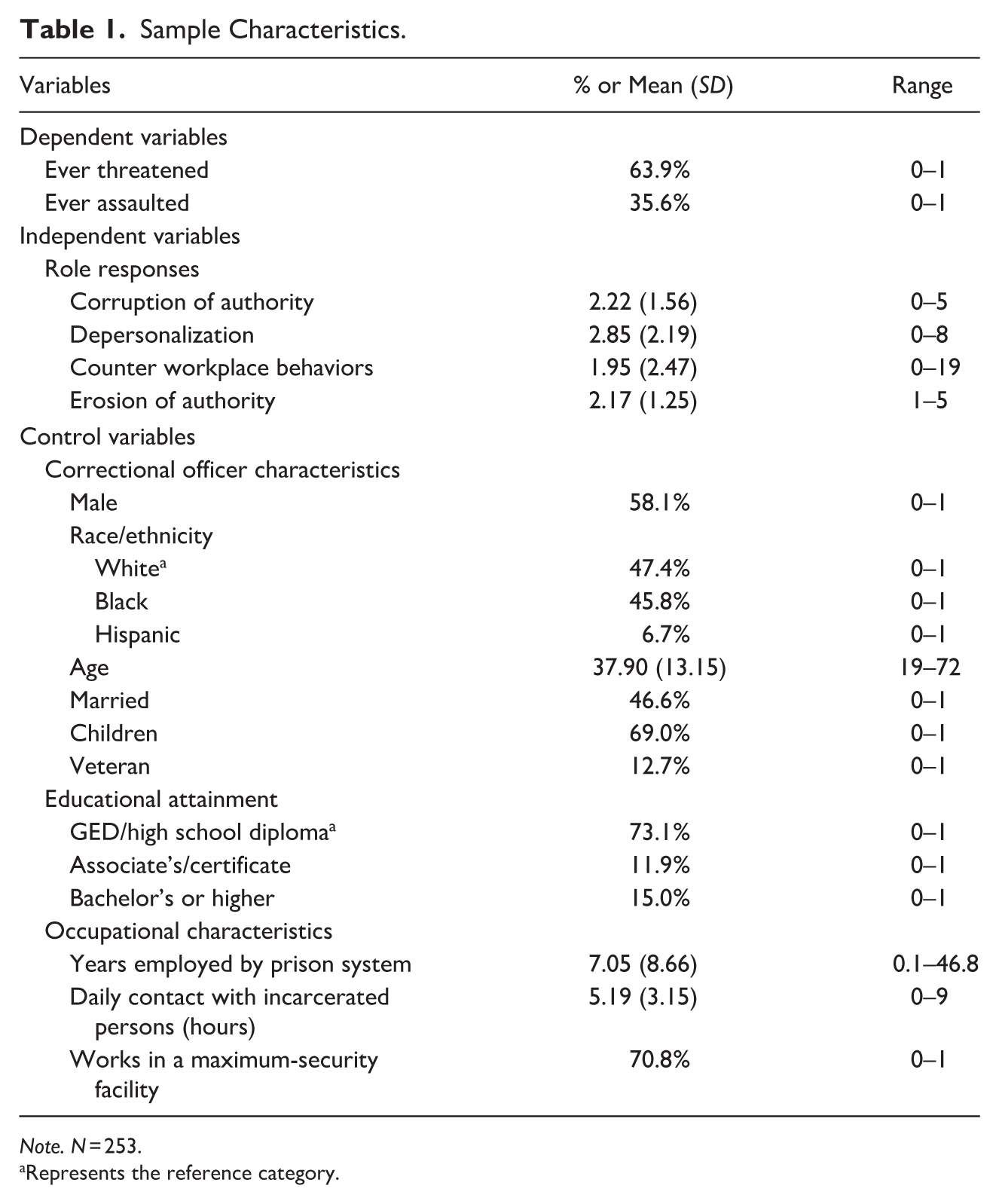
Note. N = 253.
Represents the reference category.
Role Response Measures
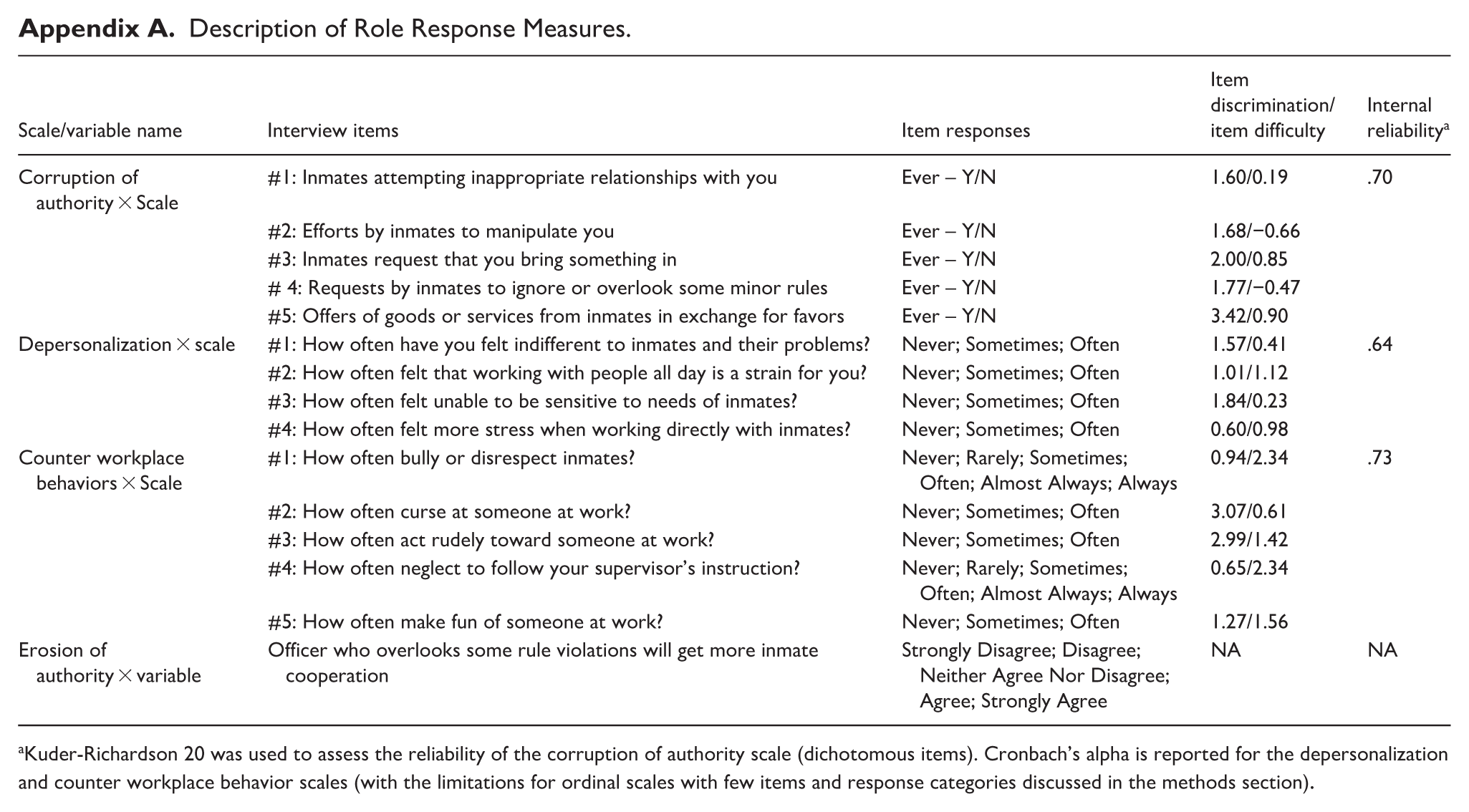
Our key independent variables are CO role responses which include (1) corruption of authority, (2) depersonalization, (3) counter workplace behaviors, and (4) erosion of authority. Scales were developed by the research team, with items conceptually grounded in correctional scholarship and constructed in accordance with standard scale development practices (see Appendix A for detailed descriptions of all scale items).
The corruption of authority scale comprised five binary items reflecting COs’ experiences with efforts to erode professional boundaries, such as inappropriate relationship attempts by incarcerated persons, manipulation, contraband solicitations, requests for favors, and requests to overlook rule violations (Range = 0–5; Mean = 2.22, SD = 1.56). The depersonalization scale centered on emotional detachment and desensitization, consisting of four ordinal items including how often COs felt indifference toward incarcerated persons, insensitivity to their needs, and greater stress and strain from working with this population (Range = 0–8; Mean = 2.85, SD = 2.19). The counter workplace behavior scale comprised five ordinal items measuring aggressive and neglectful CO behaviors including how often COs reported engaging in bullying or disrespecting incarcerated persons, cursing, making fun of others, acting rudely, and neglecting to follow supervisors’ instructions (Range = 0–19; Mean = 1.95, SD = 2.47).
The corruption of authority, depersonalization, and counter workplace behavior constructs included items measured either dichotomously or on ordinal scales. Because traditional statistics for continuous items would be inappropriate for these measurement levels, we used item response theory (IRT) statistics to evaluate psychometric properties—specifically item discrimination (e.g., an item’s ability to differentiate between respondents with varying trait levels) and item difficulty (e.g., precision of measurement across different trait levels). We applied the two-parameter logistic IRT model for corruption of authority items and the generalized partial credit IRT model for depersonalization and counter workplace behavior items. These analyses were conducted using SPSS and MPlus.
Discrimination and difficulty scores for items comprising these three scales are presented in Appendix A. Discrimination scores within each scale were acceptable. Difficulty scores were generally acceptable, though some extreme behaviors in the counter workplace behavior scale showed expected patterns. For example, the item “How often do you bully or disrespect inmates?” with response options ranging from “Never” (0) to “Always” (5) yielded a high difficulty score (2.34), indicating greater propensity toward bullying behavior is required to endorse higher categories. Less than 2% of COs endorsed “Often,” “Almost Always,” or “Always” on this item. While this reflects the extreme nature of such behaviors—uncharacteristic of the vast majority of COs—these items were retained to capture the full range of counter workplace behaviors that may relate to victimization risk. Measures of internal reliability are also included in Appendix A. 4 Scale scores were calculated by summing across the items within each scale. Supplemental analyses excluding higher-difficulty items yielded substantively identical results, indicating that findings are not driven by individual items or specific scale components.
Erosion of authority, generally defined as underuse of correctional officer power, was measured with a single item assessing COs’ level of agreement with the statement: “An officer who overlooks some rule violations will get more cooperation in the long run.” Responses ranged from strongly disagree to strongly agree (Range = 1–5; Mean = 2.17, SD = 1.25). Originally, four theoretically-derived items measured on 5-point Likert scales were assessed using traditional psychometric statistics including item-total correlations and Cronbach’s alpha. However, the internal reliability was poor (Cronbach’s α = 0.39; McDonald’s ω = 0.44) as items were not strongly intercorrelated and did not cohere to a central construct. Therefore, the single item with the greatest face validity was selected to represent this construct.
Correctional Officer and Occupational Controls
We controlled for a series of individual demographics (e.g., sex, race/ethnicity, age, marital status, children, veteran status, educational attainment) and occupational characteristics (e.g., tenure, daily contact with incarcerated persons, facility security-level) in analyses. These variables are included as empirically grounded controls based on prior research linking demographic and occupational characteristics to correctional officer victimization (Gordon et al., 2013; Konda et al., 2013; Lambert et al., 2018; Liu & Taylor, 2019; Sorensen et al., 2011; Steiner & Wooldredge, 2017; Taxman & Gordon, 2009). Approximately 58% of COs were male, 47% were White, 46% were Black, and 7% were Hispanic. They ranged in age from 19 to 72 years old, with an average age of 38 (SD = 13.15). Nearly half of COs reported being married (47%) and over two-thirds reported having children (69%). Military veterans comprised roughly 13% of the sample. Slightly less than three-quarters of COs reported a high school diploma or GED as their highest level of education completed (73%), 15% earned a bachelor’s degree or higher, and 12% earned an associate’s degree or related certificate. Consistent with prior research, White officers and high school diploma/GED served as reference categories.
With respect to occupational controls, we first accounted for how long COs were employed by the agency in years (Range = 0.1–46.8; Mean = 7.05, SD = 8.66). We also controlled for how many hours per day COs spent having direct contact with incarcerated persons (Range = 0–9; Mean = 5.19, SD = 3.15). And finally, we included a binary measure to account for whether COs worked in a maximum-security facility. Over 70% of COs were assigned to a maximum-security prison. The facilities designated as maximum-security housed large, multi-custody populations and employed the majority of line staff.
Analytic Strategy
Given the dichotomous measurement of our dependent variables, logistic regression was employed to examine associations between CO role responses and both threats and physical assaults, net of individual and occupational controls. Two separate logistic regression models were estimated. The first model examined the odds of being threatened with physical harm. The second model examined the odds of being physically assaulted while also accounting for whether COs had been threatened. Multicollinearity was assessed in both models, with no concerns identified (VIFs ≤ 2). Post-hoc power analyses confirmed adequate power to detect small to medium effect sizes with our sample of 253 COs (i.e., sensitivity analyses using the Wald test in GPower 3.1). Since COs were clustered within 10 facilities, we specified our models to estimate clustered robust standard errors. 5 Finally, while we used α < 0.05 as our significance threshold, we also considered effects slightly above this threshold given the exploratory nature of this research (see Table 2).
Logistic Regression Model Estimates.
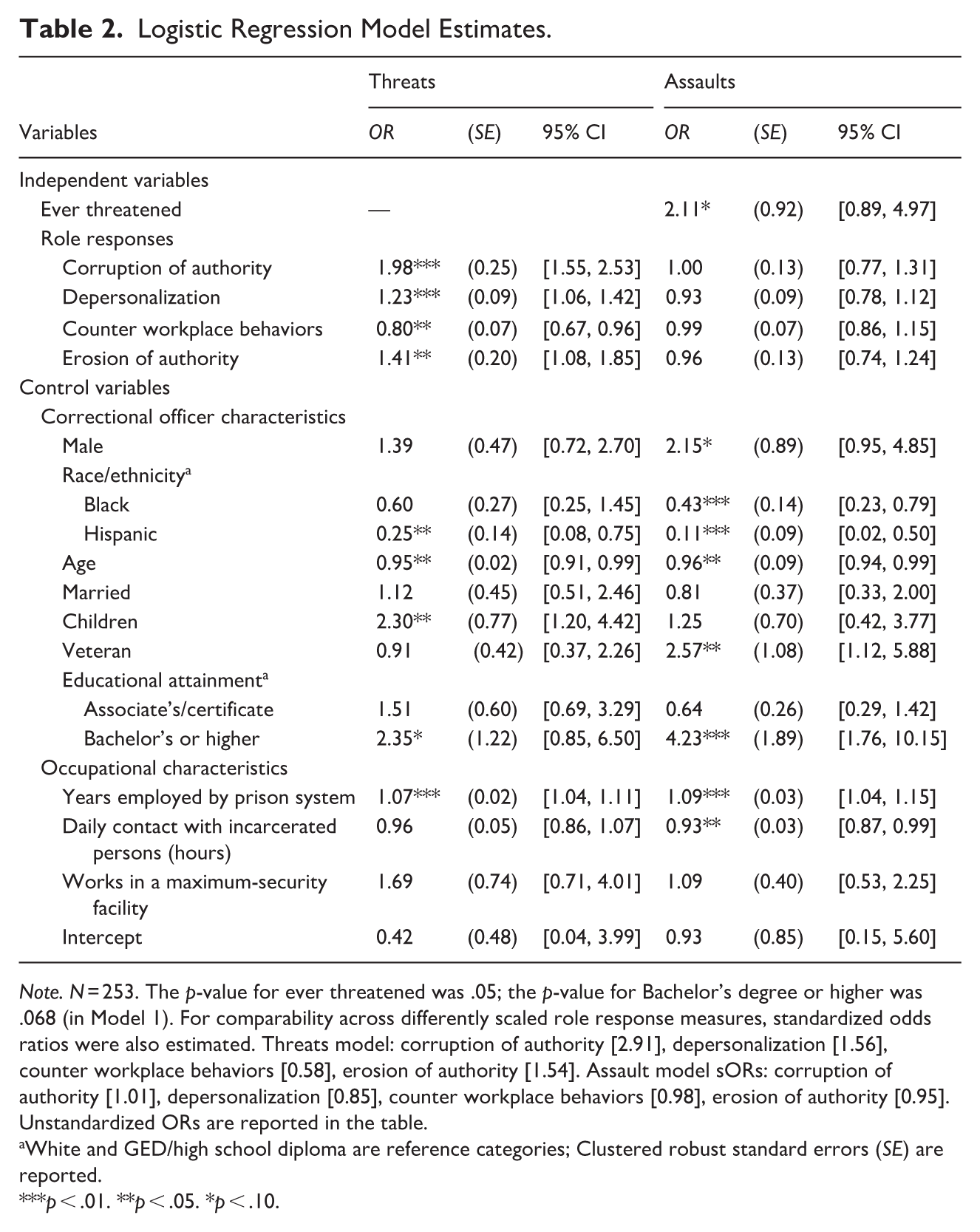
Note. N = 253. The p-value for ever threatened was .05; the p-value for Bachelor’s degree or higher was .068 (in Model 1). For comparability across differently scaled role response measures, standardized odds ratios were also estimated. Threats model: corruption of authority [2.91], depersonalization [1.56], counter workplace behaviors [0.58], erosion of authority [1.54]. Assault model sORs: corruption of authority [1.01], depersonalization [0.85], counter workplace behaviors [0.98], erosion of authority [0.95]. Unstandardized ORs are reported in the table.
White and GED/high school diploma are reference categories; Clustered robust standard errors (SE) are reported.
p < .01. **p < .05. *p < .10.
Results
Logistic regression model estimates are presented in Table 2. To address our first research objective, we examined associations between role responses and threats of physical harm (Model 1). Results confirmed that corruption of authority, depersonalization, counter workplace behaviors, and erosion of authority were significantly associated with threats against COs, net of individual and occupational controls. Specifically, corruption of authority, depersonalization, and erosion of authority were positively associated with being threatened. For every unit increase in these variables, there was a 98%, 23%, and 41% increase in the odds of having been threatened, respectively. On the other hand, for every unit increase in counter workplace behaviors, there was a 20% decrease in the odds of having been threatened.
Several individual and occupational controls were also significantly related to threats in Model 1. The odds of Hispanic COs being threatened was 75% less than their White counterparts. For every additional year in COs’ age, there was a 5% decrease in odds of being threatened. In contrast, the odds of parents being threatened was 230% greater than that of their peers without children. Educational attainment was also significantly associated with having been threatened. Indeed, those with a bachelor’s degree or higher had 235% greater odds of being threatened relative to COs who had earned only a high school diploma or GED. The longer a CO had been employed, the more likely they were to be threatened; there was a 7% increase in odds for each additional year employed.
Moving to our second research objective, Model 2 examined associations between role responses and physical assaults, net of individual and occupational controls (see Table 2). In the assault model, we also accounted for whether COs had a history of being threatened. Of note, none of the role response measures were significantly associated with physical assaults. However, results revealed that the odds of being physically assaulted were 211% greater among COs who had been threatened than those who were never threatened.
Numerous individual and occupational controls were significantly associated with physical assaults. Males had 215% greater odds of being physically assaulted on the job than females. Both Hispanic and Black COs were less likely than their White counterparts to have been assaulted; the odds were 57% and 89% lower, respectively. Additionally, for every year increase in age, COs had 4% lower odds of being assaulted. In contrast, military veterans had 257% greater odds of experiencing a physical assault than non-veterans and COs with a bachelor’s degree or higher had 423% greater odds of assault than their counterparts who had attained only a high school diploma or equivalent. Finally, tenure on the job was significantly associated with assaults; the odds increased by 9% for each additional year of employment.
Discussion
To manage the pervasive and compounding stresses of correctional work, some COs may exhibit role responses characterized by counter workplace behaviors, depersonalization, corruption, and erosion of authority, which may relate to their risk of victimization in complex ways. Using structured interview data from 253 COs, we examined how role responses are associated with both threats and physical assaults, while accounting for their interrelationship. Research on CO victimization has largely emphasized individual and occupational predictors, with limited empirical attention to role responses; this study provides a more holistic empirical examination of these associations within a single analytical framework. By focusing on self-reported victimization events rather than perceived risk, we capture actual experiences of threats and physical assaults. Finally, by examining threats both independently and as a correlate of physical assaults, we highlight an understudied aspect of victimization that may pose distinct harms and carry implications for prevention. Although the cross-sectional design precludes causal inference, establishing whether these associations exist represents an important first step for future longitudinal research.
Our findings revealed complex associations between role responses and victimization. Most notably, different role responses had varying associations with threats of harm. Depersonalization, corruption, and erosion of authority were all positively associated with being threatened. There are several plausible explanations for these findings that warrant further investigation. For example, COs who become emotionally detached or compromise their authority may be less attuned to interpersonal dynamics and warning signs of conflict (Arnold, 2005; Goldsmith et al., 2016; Goulette et al., 2022; McKendy et al., 2021). These responses could also signal perceived weakness or create opportunities for exploitation that increase threat risk (Copes et al., 2010; Goldsmith & Halsey, 2018). Importantly, we must also consider that being threatened might precipitate or intensify these response strategies, creating reciprocal relationships that perpetuate cycles of vulnerability and harm. In contrast, counter workplace behaviors were negatively associated with threats, indicating that projecting a tough, dominant image may serve as an effective—albeit problematic—short-term deterrent strategy that could ultimately undermine legitimate authority and fuel resistance (Ellison et al., 2022; Liebling, 2011).
While role responses were significantly associated with threats, they were not directly associated with physical assaults. However, COs who reported being threatened had greater odds of being physically assaulted compared to those who had never been threatened. One explanation for this finding is that, in prison, threats are typically made with the intention of follow-through. This suggests that threats may serve as an important warning sign for escalating conflict and potential violence. To further explore these relationships, we conducted an exploratory mediation analysis to determine whether role responses might indirectly affect physical assaults through their associations with threats. 6 While role responses were associated with threats, and threats were associated with assaults, the pathway from responses to assaults through threats was not statistically significant. Although our data cannot determine what takes place between a threat and an act of violence, threat occurrences present a key opportunity for harm intervention.
The significant associations between individual/occupational controls and victimization risk reveal important patterns that warrant attention. In line with prior work, both threats and physical assaults were significantly related to race/ethnicity, age, education, and tenure, suggesting consistent risk factors across types of victimization (Gordon et al., 2013; Konda et al., 2013; Lambert et al., 2018; Liu & Taylor, 2019; Sorensen et al., 2011; Steiner & Wooldredge, 2017; Taxman & Gordon, 2009). Hispanic and Black COs faced lower victimization risk compared to White peers, potentially reflecting differences in communication styles, cultural competency, or relationship-building approaches. The protective effect of age may stem from greater experience in de-escalation and conflict management, while the increased risk associated with higher education could reflect assignments to more challenging posts or different approaches to authority. The connection between longer tenure and increased odds of victimization suggests cumulative exposure risk that merits attention to prevention strategies throughout COs’ careers. Notably, some characteristics were uniquely associated with specific types of victimization—parents were more likely to experience threats, while male COs and veterans faced higher risk of physical assault, perhaps reflecting the influence of masculine cultural norms and military training on approaches to authority. Working in a maximum-security facility and being married were not significantly associated with either being threatened or assaulted.
COs who spent more hours per day in direct contact with incarcerated persons had lower odds of being physically assaulted, suggesting that sustained interaction may facilitate relationship-building or skill development that reduces conflict escalation. This finding contrasts with Steiner and Wooldredge’s (2017) research showing increased assault risk with more incarcerated persons spoken to during shifts. The difference may reflect distinct measurement approaches—total contact hours versus number of conversations—potentially capturing different supervisory functions. Sustained contact may allow COs to develop interpersonal skills and legitimate authority that facilitate conflict resolution, as suggested by Wooldredge and Steiner’s (2016) finding that communication promotes compliance through respect and fairness. This protective effect warrants further investigation.
Policy Implications
These findings offer several recommendations for improving safety in carceral settings. First, threats should be taken seriously as potential precursors to physical violence (McKendy et al., 2021; Steiner & Wooldredge, 2017). Institutions should develop clear protocols for reporting and responding to threats—even where such threats already constitute formal misconduct—by explicitly framing them as legitimate safety concerns and ensuring confidential, non-punitive reporting processes, particularly in correctional environments where cultural norms may discourage reporting. Second, supervisors should be attentive to signs of problematic role responses and intervene supportively to break potential cycles of vulnerability, recognizing that such responses may both contribute to and result from victimization experiences. This could include regular check-ins, mentorship programs, and creating opportunities for COs to process job-related stress in healthy ways (Brower, 2013). Third, although challenging to address deeply embedded correctional cultures, institutions should work to shift from hypermasculine, paramilitary approaches toward more trauma-informed, team-oriented environments (Rodriguez et al., 2024). Fourth, ongoing training should emphasize skill development that promotes safety while maintaining legitimate authority, including effective communication, boundary-setting, and building professional rapport (Ferdik & Smith, 2017; Florida Criminal Justice Standards and Training Commission, 2024). Finally, these efforts should be coupled with early intervention strategies for COs showing signs of what McIlwain (2004) calls “soft capture” to prevent the gradual erosion of professional boundaries that often precedes more serious compromises of authority.
Future Research and Limitations
Future research should continue to examine how COs’ responses to their work environment are associated with victimization as well as broader personal and organizational outcomes. Longitudinal studies are needed to disentangle the temporal relationships between role responses and victimization, as our cross-sectional design cannot establish causal ordering. Given our finding that threats are significantly associated with physical assaults, more attention should be paid to understanding the progression between verbal threats and physical violence and vice versa, including identifying intervention points that could halt escalation. While counter workplace behaviors were associated with reduced odds of threats in our study, it is crucial that this response is not endorsed as a safety strategy. Future work should examine this further by assessing the long-term impacts of counter workplace behaviors on CO safety and other consequences. Longitudinal studies that follow CO cohorts from academy training through their careers would be especially valuable in understanding how role responses develop over time and in relation to safety and other individual and organizational outcomes. Such research could help identify critical intervention points and inform targeted prevention strategies. Additionally, rich, qualitative interviews could provide deeper insights into how COs experience and navigate the complex relationships between workplace responses and safety concerns.
Several limitations should be acknowledged when interpreting these findings. Most importantly, our cross-sectional design prevents us from establishing temporal ordering or causal relationships between role responses and victimization. The associations we observe could reflect responses leading to victimization, victimization precipitating responses, or both processes occurring simultaneously in complex feedback loops. Additionally, our reliance on self-report data may be subject to recall bias and social desirability effects, which may be heightened by the on-site interview context despite the use of private interviews, confidentiality assurances, and external researchers; however, this approach also facilitated high participation and data completeness on a sensitive topic. The study was conducted in a single state prison system, which may limit generalizability to other correctional contexts with different organizational cultures, policies, or demographics. Findings are most applicable to large multi-custody state prison systems, with diverse populations and workforces. Finally, our measures of role responses, while theoretically grounded, represent operationalizations of complex behavioral and psychological processes that may vary considerably across individuals and situations. These measures should be refined in future studies to move beyond the exploratory nature of this research, particularly for the single-item erosion of authority measure.
Conclusion
This study advances understanding of CO safety by exploring associations between role responses and victimization. While some responses may provide short-term protection, others are associated with vulnerabilities that increase risk, and the strong connection between threats and physical assaults underscores the need for early intervention. Understanding these relationships can assist administrators in better supporting CO safety through targeted training, mentorship, and organizational interventions that promote healthy workplace responses. Addressing these issues can create safer institutions for all staff and incarcerated individuals.
Footnotes
Appendix
Description of Role Response Measures.
| Scale/variable name | Interview items | Item responses | Item discrimination/item difficulty | Internal reliability a |
|---|---|---|---|---|
| Corruption of authority × Scale | #1: Inmates attempting inappropriate relationships with you | Ever – Y/N | 1.60/0.19 | .70 |
| #2: Efforts by inmates to manipulate you | Ever – Y/N | 1.68/−0.66 | ||
| #3: Inmates request that you bring something in | Ever – Y/N | 2.00/0.85 | ||
| # 4: Requests by inmates to ignore or overlook some minor rules | Ever – Y/N | 1.77/−0.47 | ||
| #5: Offers of goods or services from inmates in exchange for favors | Ever – Y/N | 3.42/0.90 | ||
| Depersonalization × scale | #1: How often have you felt indifferent to inmates and their problems? | Never; Sometimes; Often | 1.57/0.41 | .64 |
| #2: How often felt that working with people all day is a strain for you? | Never; Sometimes; Often | 1.01/1.12 | ||
| #3: How often felt unable to be sensitive to needs of inmates? | Never; Sometimes; Often | 1.84/0.23 | ||
| #4: How often felt more stress when working directly with inmates? | Never; Sometimes; Often | 0.60/0.98 | ||
| Counter workplace behaviors × Scale | #1: How often bully or disrespect inmates? | Never; Rarely; Sometimes; Often; Almost Always; Always | 0.94/2.34 | .73 |
| #2: How often curse at someone at work? | Never; Sometimes; Often | 3.07/0.61 | ||
| #3: How often act rudely toward someone at work? | Never; Sometimes; Often | 2.99/1.42 | ||
| #4: How often neglect to follow your supervisor’s instruction? | Never; Rarely; Sometimes; Often; Almost Always; Always | 0.65/2.34 | ||
| #5: How often make fun of someone at work? | Never; Sometimes; Often | 1.27/1.56 | ||
| Erosion of authority × variable | Officer who overlooks some rule violations will get more inmate cooperation | Strongly Disagree; Disagree; Neither Agree Nor Disagree; Agree; Strongly Agree | NA | NA |
Kuder-Richardson 20 was used to assess the reliability of the corruption of authority scale (dichotomous items). Cronbach’s alpha is reported for the depersonalization and counter workplace behavior scales (with the limitations for ordinal scales with few items and response categories discussed in the methods section).

Funding
The authors disclosed receipt of the following financial support for the research, authorship, and/or publication of this article: This project was supported by the National Institute of Justice, Office of Justice Programs, U.S. Department of Justice (Award No. 2014-IJ-CX-0026). The opinions, findings, and conclusions or recommendations expressed in this publication are those of the authors and do not necessarily reflect those of the Department of Justice.
Declaration of Conflicting Interests
The authors declared no potential conflicts of interest with respect to the research, authorship, and/or publication of this article.