



Abstract
Intrafamilial child sexual abuse (CSA) is a serious social and health issue. Traditional explanations focusing on antisocial tendencies and atypical sexual interests are insufficient to fully understand this crime. This study compared individuals who committed intrafamilial and extrafamilial CSA in Portugal to identify risk factors influencing offenses against related versus unrelated children. One hundred ten participants, 51 of whom had perpetrated intrafamilial CSA, completed empathy, sexual attitude, and social desirability scales. Cognitive empathy, misattributions of pleasure, and sexual drive/preoccupation emerged as predictors of intrafamilial CSA. Lower cognitive empathy and less misattributed pleasure were associated with a higher likelihood of intrafamilial abuse, whereas greater sexual drive/preoccupation was linked to a decreased probability of such offences. Findings inform CSA prevention and intervention.
Keywords
Intrafamilial child sexual abuse (ICSA) refers to abusive sexual acts committed by individuals who have a biological or marital relationship with the victim, such as a father, grandfather, stepfather, or uncle (Loinaz Calvo et al., 2019). In contrast, individuals who perpetrated extrafamilial child sexual abuse (ECSA) are individuals outside the victim’s family circle, including family friends, babysitters, teachers, neighbors, or strangers (Loinaz Calvo et al., 2019). These two forms of child sexual abuse (CSA) have various physical and psychological consequences for victims in both the short and long term (García-Montoliu et al., 2024; Gekoski et al., 2016; Hailes et al., 2019; Muratoglu et al., 2018; Stroebel et al., 2012), despite the mistaken belief that extrafamilial abuse is less harmful.
ICSA is a unique silent pandemic, and it is a common form of abuse, although victimization rates vary widely, ranging from 10.5% to 71% of victims of sexual offences (Aslan et al., 2025). Despite these numbers, reports fail to capture the full scope of the social phenomenon, with estimates suggesting that ICSA rates are significantly underreported (Gewehr et al., 2021). Victims often do not report due to several factors, namely the normalization of abuse (e.g., Lewin et al., 2023), feelings of guilt and shame, fear of retaliation, and social stigma (e.g., Alaggia et al., 2019). Cultural factors (e.g., taboos surrounding sexuality and respect for family authority), power dynamics, and lack of support also discourage disclosure (e.g., Alaggia et al., 2019; Anderson, 2016; Katz et al., 2022). Furthermore, exposure to ICSA is more common among girls, with the perpetrator being male in 93.5% of cases (Koçtürk & Yüksel, 2019; Muratoglu et al., 2018).
While the prevalence and impact of CSA underscore the urgent need for comprehensive prevention strategies, research has predominantly focused on victimization, often emphasizing support and recovery initiatives for survivors (e.g., Carmo et al., 2025). However, effective prevention also requires a deeper understanding of the individuals who commit these offenses. Increasing attention is being directed toward perpetrators, particularly through explanatory models of deviant sexual behavior (e.g., Seto, 2019; Ward & Beech, 2016). Addressing perpetrators’ characteristics, motivations, and risk factors is essential not only for reducing recidivism but also for preventing initial offending—an area that remains critical for public safety and child protection.
Factors Associated With Child Sexual Abuse
With regard to etiological models for explaining deviant sexual behavior, Ward and Hudson (1998) outlined the various existing theories at different “levels,” determined by characteristics such as the complexity of the theory, the temporality of the factors involved (e.g., developmental factors that describe a predisposition to crime, in contrast with environmental factors linked to proximity to the sexual offense), and the explanatory depth and breadth of the theory (Ward & Hudson, 1998). In this way, there are several theories that seek to understand the phenomenon, with the motivation–facilitation model of sexual offending against children (Seto, 2019) having gained greater visibility in recent years.
The motivation–facilitation model of sexual offending against children (Seto, 2019) provides greater emphasis on the interaction between facilitating factors and situational factors in explaining the clinical phenomena associated with sexual crimes (Dangerfield et al., 2020). This model highlights paraphilia, high sex drive, and intense mating effort as primary motivations for sexual offenses, as well as trait (e.g., antisocial personality) and state (e.g., intoxication) factors that can facilitate acting on these motivations when opportunities exist. The motivations are not considered sufficient conditions for the occurrence of a crime, as an individual with high self-control would be able to inhibit such motivations. Self-control, however, depends on emotional state, exposure to stressors, and other dynamic factors such as intoxication (Seto, 2019). Thus, in combination with motivational factors, the author posits that facilitating factors must also be present for a sexual offense to occur. Facilitating factors enable the overcoming of internal inhibitions and may include, for example, deficits in self-regulation, male hostility, negative affect, and/or alcohol use. Finally, situational factors are also crucial within this model, as they create the opportunity to offend (i.e., access to the target) (Seto, 2019).
However, while these factors are central to existing explanations of CSA, they may not fully capture the dynamics of intrafamilial offending (Seto et al., 2015). This is because antisocial tendencies or psychopathic traits are low among these individuals (e.g., Pullman et al., 2017; Rice & Harris, 2002; Seto et al., 2015; Sousa et al., 2024b), as well as the presence of pedophilic sexual interests (e.g., Pullman et al. 2017; Seto et al., 2015). For example, Sousa et al. (2024b) reported a prevalence of psychopathic traits of 8.3%, while the prevalence of pedophilic sexual interests was only residual (Sousa et al., 2024)—a rate considerably lower than that found in international studies (Gouveia et al., 2024). Moreover, studies have highlighted that psychopathic traits are not a predictive factor in ICSA (Sousa et al., 2024b).
Factors Associated With Intrafamilial Child Sexual Abuse
Research has shown that family-related factors—such as the quality of the spousal relationship, parent–child interactions, and overall family functioning—can help explain why some men abuse relatives (Seto et al., 2015). According to these family-centered theories, intrafamilial child sexual abuse may occur when the parental relationship has deteriorated, leading to the mother being emotionally and sexually unavailable, or when there are lower parental care and attention (i.e., individuals with weaker bonds to related children are more likely to perpetrate abuse; Seto et al., 2015). Additionally, weak kinship cues—such as a father’s doubt about biological relatedness or frequent absences around the time of conception—may also play a role (Seto, 2008). Moreover, other variables have been studied to explain ICSA, including empathy and victim-specific empathy (e.g., Cardona et al., 2018; Ferretti et al., 2021; Hockley & Langdon, 2015; Sohn et al., 2022; Sousa et al., 2023), and offense-supportive attitudes and beliefs (Boillat et al., 2017; Feelgood et al., 2005; Hazama & Katsuta, 2019; Merdian et al., 2014; Petruccelli et al., 2022).
Empathy and Victim-Empathy in the Perpetration of Intrafamilial Child Sexual Abuse
Literature suggests that empathy is a multidimensional construct, encompassing several distinct components (see Cohen & Strayer, 1996; Hogan, 1969; Jolliffe & Farrington, 2004). These include general empathy, defined as a reduced capacity to understand, share, and respond to others’ emotions and perspectives across a broad range of social contexts; cognitive empathy, which refers to the ability to recognize and understand the mental states of others (Hogan, 1969); affective empathy, understood as the capacity to identify others’ emotional states, to emotionally resonate with those experiences, to feel compassion or concern for others, and to experience personal distress in response to another’s suffering (Shamay-Tsoory et al., 2009); and victim empathy, which involves the ability to understand and acknowledge a victim’s emotions and experiences related to sexual abuse, including beliefs about the victim’s role, emotional responses during the abuse, and wishes regarding future occurrences (Sousa, Cunha, et al., 2025). As a consequence, there is ongoing debate concerning the role of empathy and victim empathy in ICSA.
Some researchers have reported that individuals who perpetrated CSA exhibit general empathy deficits (e.g., Hockley & Langdon, 2015; Sohn et al., 2022), while other studies suggest only the presence of cognitive empathy deficits (e.g., Morrow, 2020; Tibbels et al., 2022). In a recent study, Sousa et al. (2023) found that individuals who perpetrated ICSA are more likely to score less in cognitive empathy than extrafamilial (Sousa et al., 2023), with general empathy and affective empathy not being predictors for this type of offense. Otherwise, some research indicates that individuals who perpetrated CSA experience empathy deficits only toward their specific victim (Marshall et al., 2001) while displaying levels of general empathy comparable to other samples, such as community samples and individuals with nonsexual convictions (Teuma et al., 2003). A meta-analysis focused on the differences between ICSA and extrafamilial CSA showed that individuals who perpetrated ICSA presented more victim empathy than individuals who perpetrated extrafamilial CSA (Seto et al., 2015). Researchers who support this viewpoint argue that the lack of empathy toward victims does not stem from a general empathy deficit, but rather from a set of beliefs supporting the offense. These beliefs serve to protect the individual’s self-concept, preventing them from seeing themselves as capable of perpetuating such acts (e.g., Marshall & Marshall, 2019; O’Shaughnessy, 2009).
Attitudes That Support the Offense in the Perpetration of Intrafamilial Child Sexual Abuse
The attitudes that support the offense have also been referred to as cognitive distortions and relate to cognitions that minimize and justify the offending behavior of men who perpetrated sex crimes (e.g., Abel et al., 1984). This factor has been one of the key elements in explaining deviant sexual behavior and recidivism (see Seto et al., 2023), particularly among individuals who perpetrated CSA. Cognitive distortions (CD) help individuals rationalize, excuse, or minimize the harm of their abusive actions and often arise from the conflict between their sexual interests and social norms (e.g., Abel et al., 1984). Typical CDs include a sense of uncontrollability, viewing the world as dangerous, feeling entitled to commit abuse (e.g., perceiving oneself as superior due to social status or personal traits), seeing children as sexual beings, minimizing or rationalizing the harm of sexual abuse (e.g., believing some abusive acts are less harmful or downplaying the damage caused), and holding distorted views of women as unknowable or as sexual objects (see Ward et al., 2006).
Studies focused on the differences between ICSA and extrafamilial CSA showed that individuals who perpetrated ICSA presented lower attitudes that support the offense than extrafamilial CSA (Seto et al., 2015; Sullivan et al., 2011). A meta-analysis by Seto et al. (2015) confirmed that ECSA exhibit greater problems, specifically being more likely to hold offense-supportive attitudes and beliefs (d = 0.12) compared to ICSA. These results are in line with the antisocial tendencies observed in ECSA (Pullman et al., 2017; Seto et al., 2015; Sousa et al., 2024b) as well as with the general pattern that ICSA are at lower risk of reoffending (Seto et al., 2015). Given the complex and often conflicting findings in the current literature on CSA—particularly regarding distinctions between intrafamilial and extrafamilial perpetration, there is a clear need for further research to refine and replicate existing risk models, as well as to better identify and understand the characteristics of individuals who commit these offenses.
Current Study
Recent research has increasingly emphasized the psychological characterization of individuals who perpetrate ICSA, recognizing its distinct features and the importance of tailoring interventions accordingly (e.g., Sousa et al., 2023, 2024a, 2024b). This focus aligns with the principle of need outlined by Bonta and Andrews (2017), which emphasizes that effective rehabilitation depends on targeting criminogenic needs—dynamic risk factors directly linked to the likelihood of reoffending. According to this principle, interventions should prioritize modifying these risk factors (e.g., cognitive distortions, empathy deficits, impulsivity) rather than focusing on non-criminogenic needs, such as low self-esteem or anxiety, which may not directly influence recidivism. Moreover, prevailing explanatory models of deviant sexual behavior—particularly those centered on pedophilic interests and antisocial traits (e.g., Seto et al., 2015)—have shown limited applicability in explaining ICSA, where the relational context, emotional dynamics, and cognitive distortions often differ markedly from ECSA. For this reason, focusing on these two variables in the study of intrafamilial abuse would be statistically uninformative and potentially misleading, introducing instability rather than clarifying the relationships under study.
Given these limitations, the present study aims to examine which psychological variables significantly predict the perpetration of ICSA in comparison to ECSA. Specifically, it investigates the role of cognitive empathy, misattributions of pleasure, and sexual drive/preoccupation in differentiating between these two perpetrator profiles. By doing so, the study seeks to contribute to the refinement of risk models and the development of more targeted assessment and intervention strategies for individuals convicted of ICSA.
Method
Participants
To be eligible to participate in the study, individuals must be male, at least 18 years old, currently convicted of CSA, and residing in Portugal. Additionally, participants were required to have sufficient reading and writing skills to complete the psychometric assessments. No exclusion criteria were defined. To calculate the sample size, the software G*Power 3.0 (Faul et al., 2007) was used. Considering a medium effect size (Cohen’s d = 0.50) and a statistical power of 0.80, 109 participants were required.
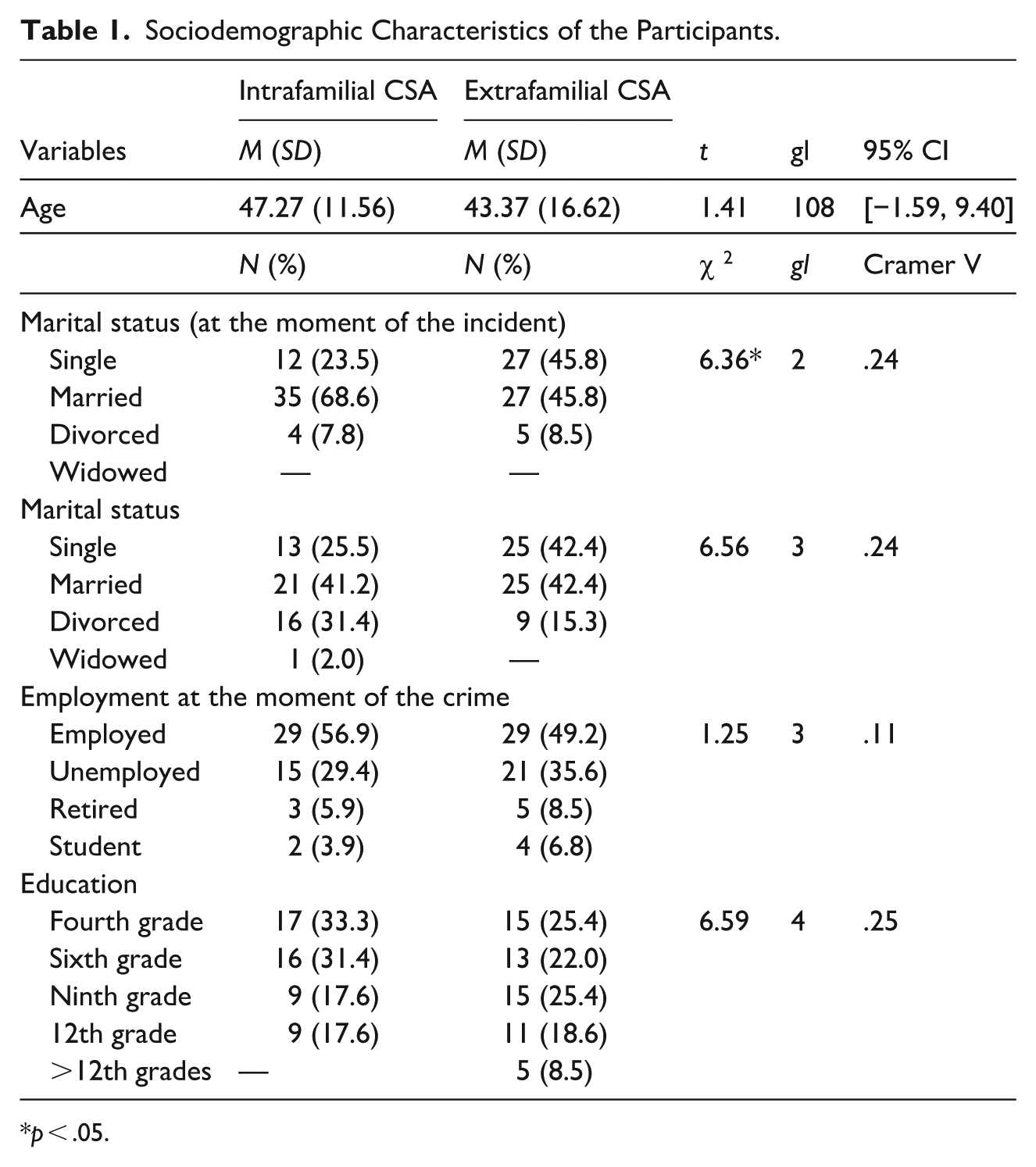
The sample comprised 110 individuals convicted of CSA, with 59 (53.6%) assigned to the group of men who perpetrated the extrafamilial CSA and 51 (46.4%) to the group of men who perpetrated the ICSA. The mean ages of the participants were 43.37 (SD = 16.62) and 47.27 (SD = 11.56), respectively. Regarding marital status at the time of the crime, the extrafamilial group had an equal percentage of single (n = 27, 45.8%) and married individuals (n = 27, 45.8%). In contrast, in the intrafamilial group, more than half of the participants were married (n = 35, 68.6%).
Around half of the participants in both the extrafamilial and intrafamilial groups were employed at the time of the crime (see Table 1). The participants’ education levels were also quite diverse. The sample consisted of individuals who were either incarcerated (n = 66; 60%) or serving sentences in the community (n = 44; 40%). Table 1 presents the characteristics of the participants.
Sociodemographic Characteristics of the Participants.
p < .05.
Instruments
Sociodemographic and Juridical Questionnaire
A questionnaire was created to gather data on sociodemographic and legal variables, including age, marital status (i.e., single, married, divorced, widowed), prior participation in intervention programs, education level, employment status (i.e., employed, unemployed, retired, student), and type of sentence. The inclusion of both current marital status and marital status at the time of the offense is justified because the former is relevant for characterizing the sample, while the latter may serve as a situational factor influencing the perpetration of a sexual crime.
Hanson Sex Attitude Questionnaire (HSAQ)
The Portuguese adaptation of the Hanson Sex Attitude Questionnaire (HSAQ; Hanson et al., 1994; Portuguese version by Sousa, Gouveia, et al., 2025) is a 9-item self-report instrument designed to assess cognitive distortions related to CSA and sexuality. Exploratory factor analysis revealed two independent factors: Misconceptions about CSA (4 items; “Some children are so willing to have sex that it is difficult to stay away from them”) and Sexual Drive/Preoccupation (5 items; “Sex is a necessary part of intimacy.” Items are rated on a 5-point Likert scale (1 = strongly disagree to 5 = strongly agree), with higher scores reflecting greater cognitive distortions. In the original study, the internal consistency of the Portuguese version ranged from moderate (α = .67) to high (α = .74). Moreover, in the present study, the instrument showed high internal consistency (α = .73, α = .70). This scale was selected due to its validation for the Portuguese context, its good psychometric properties (Sousa, Gouveia, et al., 2025), and its widespread use in this area of research (e.g., D’Urso et al., 2019; Sousa, Gonçalves, & de Castro-Rodrigues, 2024).
Basic Empathy Scale—Adapted (BES Adapted)
The BES Adapted (Pechorro, Ray et al., 2015) is a 7-item self-report scale designed to assess empathy. Factor analysis identified two components: affective empathy (3 items), which reflects emotional responsiveness (e.g., “I get caught up in other people’s feelings easily”), and cognitive empathy (4 items), which relates to understanding others’ emotions (e.g., “I can usually figure out when my friends are scared”). Responses are rated on a 5-point scale (1 = strongly disagree to 5 = strongly agree), with higher scores indicating greater empathy. The original scale demonstrated acceptable reliability (α = .764), while the Portuguese version showed good psychometric properties (α = .74–.80) (Pechorro, Ray et al., 2015). In this study, internal consistency values were .64 (affective empathy), .72 (cognitive empathy), and .69 (total score). This scale was selected since its validation for the Portuguese context and its sound psychometric properties (Pechorro, Ray et al., 2015).
Victim Empathy Distortion Scale (VES)
The VES (Beckett & Fisher, 1994; Portuguese version by Sousa, Cunha, et al., 2025) is a 28-item questionnaire assessing an individual’s perception of how their offenses impact victims. The Portuguese adaptation comprises two factors: positive misattributions of pleasure in CSA (18 items; “Enjoyed what happened”) and negative attributions of CSA (10 items; “Was afraid in the situation”). Higher scores on the first factor indicate stronger cognitive distortions about CSA, while higher scores on the second reflect greater awareness of the harm caused. Responses are rated on a 5-point scale (0 = strongly disagree to 4 = strongly agree). The scale demonstrates strong psychometric properties, with Cronbach’s alpha values of .94 (F1) and .87 (F2) (Sousa, Cunha, et al., 2025). In this study, Cronbach’s alpha ranged from .70 (F1) to .73 (F2). Given its validation for the Portuguese population, strong psychometric properties, and widespread application in the field, this scale was deemed appropriate for the present study (see Sousa et al., 2022).
Marlowe-Crowne Social Desirability Scale—Short Form (MCSDS-SF)
The MCSDS-SF is a 12-item scale (Ballard, 1992; Pechorro, Vieira et al., 2012) designed to assess participants’ tendency to respond in a socially desirable manner (e.g., “No matter who I’m talking to, I’m always a good listener”). Respondents classify each item as either true or false. The Portuguese version has demonstrated adequate internal consistency (Pechorro, Vieira et al., 2012), with a Kuder-Richardson reliability coefficient of .60. In the present study, the coefficient alpha was .72. This scale was adopted based on its validation for the Portuguese population and its satisfactory psychometric performance (Pechorro, Vieira et al., 2012).
Procedure
This research was conducted as part of a broader project conducted in Portugal examining the sociodemographic and psychological profiles of men convicted of CSA. The study received approval from the Ethics Committee of the University of Minho and the General Directorate of Reintegration and Prison Services, Ministry of Justice (DGRSP-MJ). Initially, we obtained from the DGRSP-MJ a list of prisons and reintegration teams with the highest number of individuals convicted of CSA. Data were collected in six prisons across the country and four reintegration teams in the North of Portugal (i.e., probation services). Meetings were then arranged with these institutions to explain the study’s aims and request their collaboration in identifying eligible participants. The research team subsequently contacted potential participants to schedule sessions within the prisons’ or reintegration teams’ facilities. Eligible individuals were informed in detail about the study procedures. Those who voluntarily agreed to participate, understanding the anonymous and confidential nature of the research and acknowledging no compensation or risk involved, provided written informed consent. Finally, institutional records were reviewed to collect pertinent sociodemographic and criminal background information. Data collection took place during 2021 and 2022, and ethical procedures concerning privacy and data protection were followed.
Data Analysis
Data analysis was conducted using IBM SPSS Statistics Version 29. Since normality and homogeneity assumptions were not met, parametric and nonparametric tests were applied. When results were consistent across tests, parametric tests were preferentially reported (Fife-Schaw, 2000). To address the issue of missing data, we employed mean imputation. Initially, descriptive statistics, including central tendency and dispersion measures, were used to summarize participants’ socio-demographic and penal characteristics. Next, chi-square tests and difference analyses were performed to assess associations and differences between individuals who perpetrated intrafamilial versus extrafamilial CSA across various variables. Pearson’s correlation tests were also conducted. Finally, a binary logistic regression analysis examined the relationship between BES dimensions, VES dimensions, cognitive distortions, and the dependent variable (intrafamilial vs. extrafamilial CSA perpetrators). Variables showing significant group differences as well as social desirability scores were included as covariates to control for potential confounding effects. Marital status was treated as a categorical variable, while all other variables included in the model were treated as continuous.
Results
Sociodemographic and Juridical Characteristics
The results showed no statistically significant differences between the groups in terms of sociodemographic variables, except for marital status at the time of the incident, χ2(2) = 7.78, p = .020, with a small effect size (V = .26). Among men who perpetrated ICSA, there was a higher proportion of individuals who were married at the time of the incident. In contrast, among men who perpetrated extrafamilial CSA, there was an equal distribution between those who were single and those who were married.
Correlations
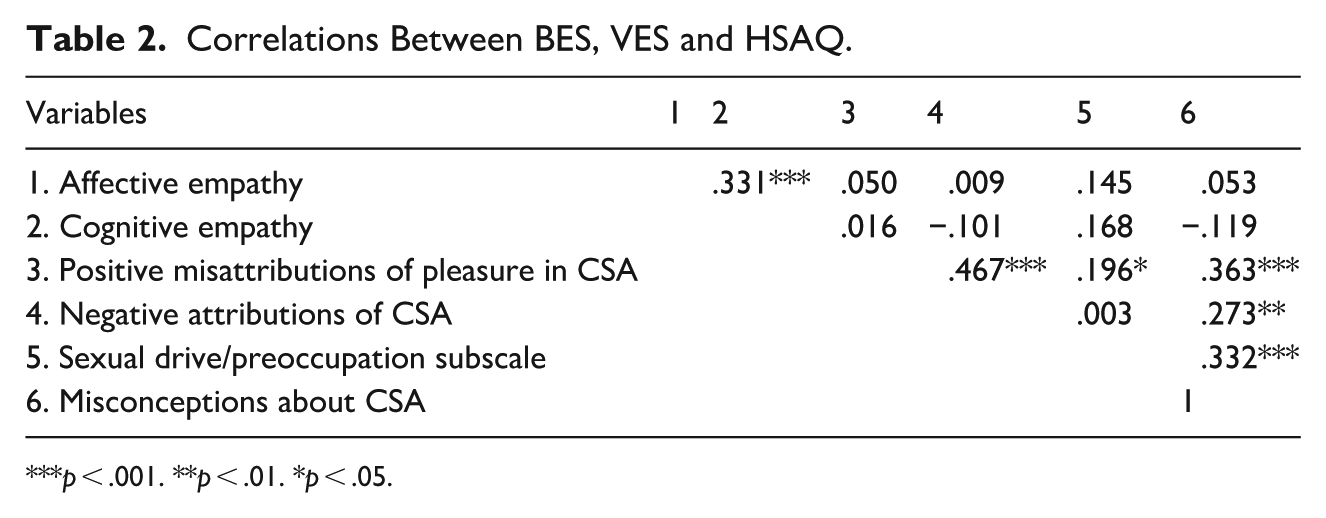
The correlations between the variables are presented in Table 2. The results showed no statistically significant correlation between empathy and empathy toward victims, nor between empathy and cognitive distortions. However, a significant positive correlation was found between positive misattributions of pleasure in CSA (victim empathy) and both subscales of the cognitive distortions scale, and between negative attributions of CSA and “sexual drive/preoccupation” subscale of the cognitive distortions scale. Individuals who held more distorted beliefs about their offense—perceiving it as something positive for the victim—also exhibited greater distortions in their beliefs about sexual drive/preoccupation and CSA-related cognition. Furthermore, individuals who recognized CSA as having adverse short- and long-term effects on the victim also demonstrated more distorted beliefs about CSA.
Correlations Between BES, VES and HSAQ.
p < .001. **p < .01. *p < .05.
Crime Type as a Function of Empathy Dimensions, Empathy Toward Victims, and Cognitive Distortions
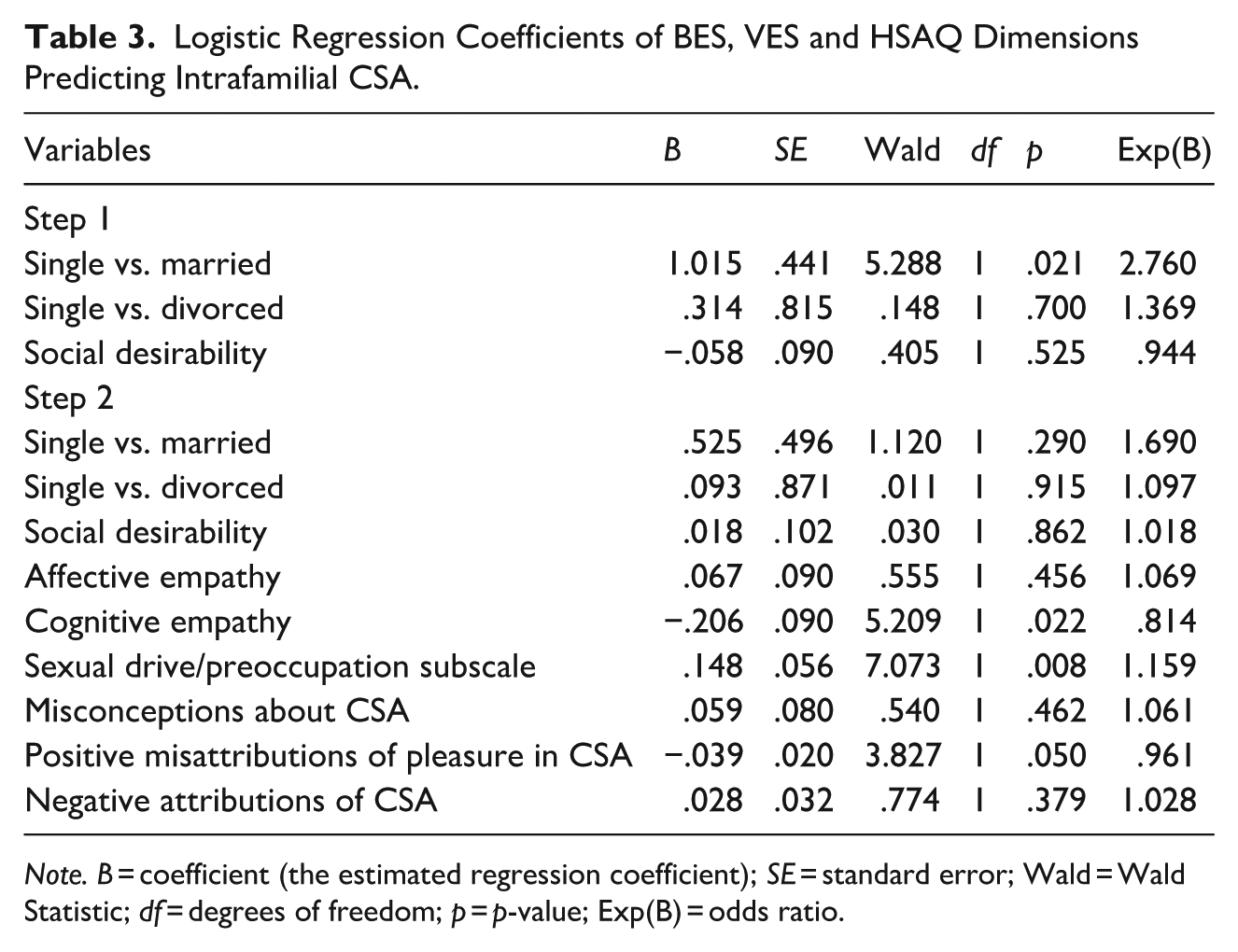
One binary logistic regression was conducted to find predictors of men who perpetrated ICSA (Table 3). BES dimensions, VES dimensions, and cognitive distortions were entered into as predictors after controlling for the variable that revealed statistically significant differences between the two groups, namely the marital status at the moment of the crime. Social desirability was also included as a control variable. Marital status at the moment of the incident and social desirability were entered at the first step, followed by the BES and VES dimensions and cognitive distortions variables.
Logistic Regression Coefficients of BES, VES and HSAQ Dimensions Predicting Intrafamilial CSA.
Note. B = coefficient (the estimated regression coefficient); SE = standard error; Wald = Wald Statistic; df = degrees of freedom; p = p-value; Exp(B) = odds ratio.
The variables included in the first step did not produce a statistically significant model, χ2(3) = 5.850, p = .119. The role of such variables produced a pseudo-R2 between 0.5% (Cox and Snell) and 0.7% (Nagelkerke), revealing that the model accurately classified 60.4% of the cases.
When we added the BES and VES dimensions and the cognitive distortions variables to this analysis, the model was statistically significant, χ2(9) = 22.074, p = .009, with this variable producing a pseudo-R2 between 18.8% (Cox & Snell) and 25.1% (Nagelkerke). The model accurately classified 67.0% of the cases. Three variables contributed significantly to the model: cognitive empathy (OR = 0.814; 95% CI [0.682, 0.971]), VES F1 (OR = 0.961; 95% CI [0.924, 1.000]), and “sexual drive/preoccupation” (OR = 1.159; 95% CI [1.040, 1.293]).
For almost each unit increase in cognitive empathy score and in the “positive misattributions of pleasure in child sexual abuse” dimension, the odds of being a man who perpetrated ICSA decrease by a factor of .814 and .961, respectively. Moreover, for almost each unit increase in the “sexual drive/preoccupation” dimension, the odds of being a man who perpetrated ICSA increase by a factor of 1.159.
Discussion
Many of the most recent models explaining deviant sexual behavior against children have highlighted key variables such as deviant sexual interests and antisocial tendencies (Seto, 2019). However, these variables do not seem to adequately explain sexual abuse perpetrated within the family, as research has shown that such individuals do not exhibit high levels of deviant sexual interests or antisociality (e.g., Pullman et al., 2017; Rice & Harris, 2002; Seto et al., 2015; Sousa et al., 2024b). Thus, the present study aimed to characterize a group of individuals convicted of sexual offenses to understand the individuals’ patterns in victim option, namely potential differences between extrafamilial and intrafamilial perpetrators.
The results revealed that empathy and empathy for victims are not correlated concepts in the present sample, indicating that a lack of empathy toward abuse victims is not related to a general difficulty in being empathetic. Furthermore, positive misattributions of pleasure in their CSA (i.e., empathy for victims) were positively correlated with cognitive distortions of CSA and sex preoccupation. In part, these findings seem to support the view that the lack of empathy for victims may stem from beliefs supporting the offense rather than a general absence of empathy (e.g., Teuma et al., 2003). Distorted cognitions specifically related to the abusive situation may impede the development of empathy toward victims, consistent with Bandura’s moral disengagement model (Bandura, 1999). Bandura explained that individuals typically do not engage in harmful behavior until they have morally justified their actions to themselves (Bandura, 1999, p. 194). The model describes various self-regulatory mechanisms, including “displacement of responsibility” and “disregard or distortion of consequences,” which serve to inhibit empathy toward victims. These results are also consistent with explanatory models of deviant sexual behavior that emphasize the role of cognitive distortions in the perpetration of sexual crimes, such as the Integrative Theory of Sexual Offending (Marshall & Barbaree, 1990).
Previous findings from this sample revealed the existence of an empathy deficit in this population, with cognitive empathy (i.e., the ability to identify emotional states; Hogan, 1969) functioning as a predictor of sexual offenses against children (Sousa et al., 2023). Taking these findings together, individuals who commit CSA seem to exhibit empathy deficits, but these deficits do not appear to be the factor contributing to their lack of empathy for victims. However, surprisingly, the correlation results also revealed that individuals who recognized CSA as having negative short- and long-term consequences on the victim also exhibited more distorted beliefs about CSA. On the other hand, these results also seem to suggest that the way men who commit CSA perceive their victim is different from how they view victims in general, as observed in other studies (e.g., Varker & Devilly, 2007).
The regression results revealed that individuals with less cognitive empathy but more victim empathy (i.e., the idea that the victimized child did not enjoy the abuse) are more likely to perpetrate ICSA. On the other hand, those with beliefs related to high sexual drive or preoccupation are more likely to choose family members as victims. These results partially support the literature suggesting that individuals who perpetrate ICSA exhibit lower cognitive empathy (Sousa et al., 2023) and greater empathy for victims (Seto et al., 2015). However, they contradict findings that emphasize these individuals hold fewer offense-supportive beliefs (Seto et al., 2015). However, it is important to emphasize that the beliefs in which intrafamilial participants scored higher are not related to CSA, as studied by Seto et al. (2015), but rather to sexual preoccupation (i.e., “Sex makes all relationships stronger”). Together, these results seem to highlight the role of variables that may be crucial to interpersonal difficulties, which hinder the search for appropriate partners, rather than the presence of antisocial tendencies (i.e., beliefs that support CSA). In other words, the lack of cognitive empathy and the confusion between sex and intimacy may compromise the establishment of satisfying sexual and intimate relationships with peers (Decety et al., 2018; Morrow, 2020), leading to the perpetration of CSA. Specifically, Ward and Siegert’s (2002) theory reinforces the presence of five pathways that may lead to deviant sexual behavior, with the third pathway seemingly aligning with our results. That is, considering that individuals who commit CSA crimes exhibit difficulties in emotional identification (i.e., cognitive empathy), these challenges may include dysfunctional coping styles (e.g., using sex to deal with certain situations). As a result, individuals may resort to sexual aggression impulsively or sporadically as a means of achieving sexual gratification or coping with stressful circumstances (Ward & Siegert, 2002). At the same time, and somewhat surprisingly, men who committed ICSA were more likely to be in a relationship compared to those who committed ECSA. One possible explanation is that, although these individuals may enter and maintain intimate relationships, these relationships are not necessarily healthy or fulfilling. They may lack the emotional, cognitive, or interpersonal skills required to foster positive relational dynamics, such as effective communication, empathy, or conflict resolution. Furthermore, the results also highlight that although the motivation–facilitation model of sexual offending against children (Seto, 2019) is not as capable of explaining abuse perpetrated within the family, variables such as high sexual drive, considered a motivational factor, may also be implicated in these cases.
Practical Implications
These results have practical, policy, and research implications. In practical and policy terms, the findings suggest that prevention and intervention programs should explicitly address cognitive processes employed to avoid empathic responding, and that assessment protocols should systematically evaluate these mechanisms to inform individualized risk management strategies (Brown et al., 2013). Moreover, the results highlight the need for services and policy frameworks to prioritize interventions that promote the development of social and intimate competencies, as well as emotional identification and regulation skills. Given that these individuals are aware that their behavior is harmful, policies and treatment programs should support the implementation of approaches that provide adaptive pathways to meet relational and emotional needs (e.g., intimacy and affection) in prosocial ways. Accordingly, a shift from exclusively risk-reduction paradigms toward integrated models that combine risk management with the promotion of well-being is warranted. Evidence-based approaches such as the Good Lives Model (Ward & Gannon, 2006) and Schema Therapy (Young et al., 2003) may therefore be prioritized within correctional, forensic, and community rehabilitation settings, as both have demonstrated positive outcomes among individuals who have perpetrated offenses, including CSA-related crimes (e.g., Mallion et al., 2020; Sousa, Gonçalves, & de Castro-Rodrigues, 2024; Sousa, Gouveia, Cunha, & de Castro Rodrigues, 2024).
In research and policy terms, our results underscore the need for continued and more systematic investigation of the relationships between general empathy, victim-specific empathy (both toward their own victims and toward victims of CSA more broadly), and cognitive distortions. Despite their relevance for assessment and intervention planning, these mechanisms remain underexplored, limiting the ability of practitioners and policymakers to develop evidence-informed prevention and rehabilitation strategies. Advancing knowledge in this area would support a more accurate characterization of this population and contribute to identifying the developmental pathways and contextual factors underlying these deficits, which is essential for designing targeted interventions aimed at reducing risk and preventing sexual recidivism. Accordingly, future research agendas should prioritize longitudinal designs and the integration of mixed-methods and qualitative approaches to better capture the complexity of these processes and to inform policy frameworks, clinical guidelines, and risk assessment practices.
Limitations
Despite the valuable contributions of this study, certain limitations should be acknowledged. First, there are some limitations related to our sampling. For instance, our sample consisted exclusively of men, making it unclear whether the findings apply to women. Additionally, although our goal was to differentiate individuals who committed CSA based on subtypes (intrafamilial vs. extrafamilial), the group sizes were small. Future studies with larger samples, particularly focusing on these subtypes, are needed for further validation. Second, the fact that all the instruments used were self-reported may introduce some response bias. However, using a social desirability measure to control this in linear regression is a mitigating factor for this limitation. Furthermore, despite the good psychometric properties of the instrument used to assess victim empathy, future studies should include other measures to evaluate this construct. Future studies should incorporate indirect measures to assess the constructions under analysis. Additionally, the absence of longitudinal data or recidivism information limits the ability to draw causal inferences and constrains the practical implications concerning long-term risk. These limitations should be more explicitly acknowledged to appropriately contextualize the findings and guide future research.
Conclusion
The present study provides some clarification in an area where the more recent explanatory models of deviant sexual behavior fall short, particularly in the context of familial sexual abuse. Furthermore, three variables are examined, which have been widely debated regarding their role in the perpetration of such crimes: empathy, victim empathy, and cognitive distortions. In this regard, cognitive empathy, victim empathy, and beliefs related to concern and sexual desire play a role in the perpetration of ICSA offenses. In addition, the lack of correlation among most of these variables raises questions that need further exploration to develop more effective interventions.
Footnotes
Author Contributions
M.S. conceptualizing, data analysis, funding; original draft; O.C. supervision; A.R.C. Supervision; R.A.G. conceptualizing; A.C.R.: conceptualizing, supervision.
Declaration of Conflicting Interests
The authors declared no potential conflicts of interest with respect to the research, authorship, and/or publication of this article.
Funding
The authors disclosed receipt of the following financial support for the research, authorship, and/or publication of this article: This work was funded by Fundação para a Ciência e Tecnologia (FCT), under HEI- Lab R&D Unit (UID/05380/2025, UIDP/05380/2020, and UID/PRR/05380/2025;  , https://doi.org/10.54499/UIDP/05380/2020, and https://doi.org/10.54499/UID/PRR/05380/2025 https://doi.org/10.54499/UIDB/05380/2020). This work was also conducted at CIPsi, School of Psychology, University of Minho, supported by Fundação para a Ciência e a Tecnologia (FCT; UID/01662/2020) through the Portuguese. This work is funded with national funds from FCT—Fundação para a Ciência e Tecnologia, I.P., in the context of the R&D Unit: UID/04810/2025—William James Center for Research.
Ethical Approval and Informed Consent
This study was approved by the University of Minho Research Ethics Committee (approval no. CEICSH 057/2021) on May 31, 2021. All participants provided written informed consent prior to participating.
Data Availability Statement
The data that supports the findings of this study are available on request from the corresponding author (M.S.). The data is not publicly available due to their containing information that could compromise the privacy of research participants.*