



Abstract
This study examined whether patterns of maltreatment predicted reoffending among 5,194 justice-involved youth (JIY) from a large Texas juvenile probation department. Using latent class analysis on five maltreatment types (physical abuse, emotional abuse, sexual abuse, neglect, and exposure to domestic violence), we empirically identified three classes: “Poly-victimization” (17.8%; high across all types), “Psychological Maltreatment” (15.3%; high emotional abuse and neglect), and “Low Maltreatment” (66.9%; low/moderate across types). JIY in the “Poly-victimization” and “Psychological Maltreatment” classes were more likely to engage in general and violent reoffending within 1 year controlling for covariates. These findings highlight the varying importance of different maltreatment patterns and underscore the need to prioritize interventions for JIY with complex maltreatment histories in order to reduce future offending.
Introduction
Youth who experience child maltreatment are at an elevated risk of various negative outcomes, including offending behavior (Cho & Lee, 2022; Malvaso et al., 2017; van der Put et al., 2015). However, maltreatment experiences vary across affected youth. Some experience multiple types of maltreatment, while others experience only one. Even among those with the same number of maltreatment exposures, the specific forms can differ—for example, some may experience both physical and emotional abuse, whereas others may experience sexual abuse and neglect. This variation underscores the complexity and heterogeneity of maltreatment experiences, suggesting that patterns of maltreatment may play a significant role in shaping the risk of offending. Despite this, there is limited understanding of which maltreated youth are most likely to engage in offending behavior, particularly among justice-involved youth (JIY). The present study aimed to enhance understanding of the maltreatment-offending link by identifying typologies of maltreatment experiences among JIY. Specifically, we utilized latent class analysis (LCA), a person-oriented approach, to identify empirically derived typologies/classes that capture the heterogeneity among JIY with respect to five types of child maltreatment: physical abuse, emotional abuse, sexual abuse, neglect, and exposure to domestic violence. Additionally, we investigated the extent to which class membership predicted general and violent reoffending during a 1-year follow-up period.
The Maltreatment-Offending Link
From a developmental perspective, maltreatment disrupts normal development processes, with offending behavior being one specific outcome of this disruption (Cicchetti & Toth, 2005). Although a growing body of research has examined the detrimental effects of maltreatment (Cho & Lee, 2022; Li et al., 2015; Mersky et al., 2012), including specific types (Mersky & Reynolds, 2007; van der Put et al., 2015), on youth offending, the findings are inconsistent, making it premature to draw definitive conclusions about the maltreatment-offending relationship. One line of research found that physical abuse, emotional abuse, sexual abuse, and neglect were all associated with an increased risk of engaging in general offending (Leach et al., 2016; Malvaso et al., 2017) and violent offending (Fox et al., 2015), while another line of research showed that neglect, emotional abuse, and physical abuse were not associated with the risk of either violent or non-violent offending (Silva et al., 2012), over and above other forms of maltreatment.
While there is no consensus on a precise definition of maltreatment (Laajasalo et al., 2023), existing studies suggested that physical abuse, emotional abuse, sexual abuse, and neglect are four maltreatment subtypes often examined in empirical research related to offending behavior. Mixed findings in this literature may partly result from a failure to consider the complex patterns of maltreatment when examining its effect on offending. Two main approaches are typically used. The first examines the association between a single type of maltreatment and offending without accounting for other types (e.g., Mersky & Reynolds, 2007; van der Put et al., 2015), while the second examines the association of one type of maltreatment after controlling for the others (e.g., Fox et al., 2015; Leach et al., 2016; Malvaso et al., 2017; Silva et al., 2012). Both are variable-oriented approaches that overlook heterogeneity in maltreatment experiences, as they focus exclusively on relationships between variables rather than characteristics of individuals (Bergman & Magnusson, 1997). They indicate whether a specific type of maltreatment is associated with offending, but not how different types of maltreatment co-occur and shape offending behavior. Indeed, the co-occurrence of maltreatment is not the exception but rather the norm among JIY (Baglivio & Epps, 2015).
Typologies of Maltreatment Experiences
In recent years, there has been a growing body of research focused on identifying groups of individuals with similar characteristics of maltreatment experiences using finite mixture modeling techniques, such as LCA (Rivera et al., 2018). LCA is considered a person-oriented approach that creates empirically derived typologies, grouping individuals who share similar characteristics within each class. Although research increasingly uses LCA to classify justice-involved individuals by maltreatment patterns, few studies have explored class differences in reoffending. Due to notable differences in sample characteristics (e.g., mixed-gender vs. exclusively male, youth vs. adult, and populations from the US, Australia, China, or Austria), maltreatment measures (e.g., Child Trauma Questionnaire, UCLA Posttraumatic Stress Disorder Reaction Index—Adolescent Version, or Traumatic Experiences Screening Instrument), and the number of LCA indicators (ranging from 5 to 26), making meaningful comparisons across existing studies is challenging (Aebi et al., 2015; Charak et al., 2019; Debowska & Boduszek, 2017; Ford et al., 2013; Papalia et al., 2022; Zhang & Zheng, 2018).
Nevertheless, existing studies have consistently identified three classes for youth (Aebi et al., 2015; Charak et al., 2019; Ford et al., 2013; Papalia et al., 2022) and three classes (Debowska & Boduszek, 2017) or four classes (Zhang & Zheng, 2018) among adults. Furthermore, studies consistently identify a class with a relatively high probability of endorsing all types of maltreatment included in the model, referred to as poly-victimization (Charak et al., 2019; Debowska & Boduszek, 2017; Ford et al., 2013; Papalia et al., 2022), emotional, physical, and sexual maltreatment class (Aebi et al., 2015), or high sexual abuse with multiple maltreatment (Zhang & Zheng, 2018). Among studies focusing on JIY, the proportion of subjects classified in this group ranged from 5.3% to 20%. Likewise, a class with a relatively low probability of endorsing all types of maltreatment is also consistently identified and has been labeled in various ways, including no/mild maltreatment (Aebi et al., 2015), mixed adversity (Charak et al., 2019), low adversity (Ford et al., 2013), low/rare maltreatment (Papalia et al., 2022), low abuse (Debowska & Boduszek, 2017), or minimal maltreatment (Zhang & Zheng, 2018). Among studies focusing on JIY, the proportion of youth classified in this group ranged from 40.0% to 74.2%.
All studies have examined class differences on various psychopathology outcomes and generally showed that the poly-victimization class and the other class(es) demonstrated worse psychopathology outcomes compared to the low maltreatment class. In contrast, only two studies have investigated class differences in offending behavior, finding that the poly-victimization class tended to have a higher proportion of individuals who were re-incarcerated or reoffended compared to the low maltreatment class (Aebi et al., 2015; Zhang & Zheng, 2018). According to the general strain theory (GST; Agnew, 1992), maltreatment may be experienced as unjust or as a threat to youths’ goals, values, needs, and/or identities, leading to heightened negative emotions such as anger and frustration. These emotions create pressure to take corrective action, with crime being one possible response. Thus, GST provides a useful framework for understanding why maltreatment is linked to offending.
The Present Study
In the present study, we utilized LCA on a large archival dataset from the Harris County Juvenile Probation Department (HCJPD) in Houston, Texas, to (1) empirically identify distinct classes of maltreatment experiences among JIY and (2) examine the extent to which class membership predicted general and violent reoffending during a 1-year follow-up period. This study expands previous research in several important ways. First, existing studies applying LCA to identify maltreatment typologies among JIY often relied on relatively small samples (Aebi et al., 2015; Charak et al., 2019; Ford et al., 2013; Papalia et al., 2022), while our dataset included over 5,000 JIY. Since LCA is inherently exploratory (Nylund-Gibson & Choi, 2018), a large sample size is essential for robust and reliable estimation. Second, although most researchers generally recognize four primary types of maltreatment—physical abuse, emotional abuse, sexual abuse, and neglect—exposure to domestic violence is increasingly acknowledged as a fifth type (Laajasalo et al., 2023). However, few studies have simultaneously considered all five types of maltreatment when identifying class membership (Rivera et al., 2018). Third, while prior research using a person-oriented approach has frequently focused on psychopathology as an outcome for justice-involved samples, little attention has been given to the likelihood of future reoffending, despite its significant public relevance. Only two studies have investigated class differences in offending behavior (Aebi et al., 2015; Zhang & Zheng, 2018); however, both exclusively included males, limiting the generalizability of their findings. This study is among the first to use LCA to explore differences in the likelihood of reoffending across maltreatment classes within a diverse sample of JIY representing mixed genders and racial/ethnic backgrounds. As LCA is an exploratory method, we did not propose specific hypotheses.
Method
Sample
The data came from a centralized database maintained by HCJPD, which contains records of all alleged offenses involving youth under its jurisdiction. It contains information for 94,897 youth who had at least one contact with HCJPD between January 1, 2006, and June 30, 2024. HCJPD has implemented the Positive Achievement Change Tool (PACT) since September 2017. As we used data from JIY who completed the full PACT after court disposition, the sample size was narrowed down to 6,846. Further refinement was made by limiting the sample to JIY under 17 years old at the time of completing the PACT, allowing for a 1-year follow-up period, resulting in a sample size of 5,233. Asian JIY (n = 32) and those with missing race/ethnicity data (n = 7) were excluded from the analysis due to the relatively small sample sizes, as their inclusion would lead to estimates with substantial uncertainty, making interpretation difficult. Consequently, the final sample included 5,194 JIY. Ethical and administrative approvals were obtained from the University of Houston Committee for the Protection of Human Subjects and the jurisdiction officials. The data are available at the Open Science Framework (OSF): https://osf.io/3gna7/?view_only=23a0d924287f487a9f0f75e62db00f6c.
Assessments
Maltreatment
The present study utilized the first ever full PACT assessment for each JIY to extract maltreatment measures. This allows appropriate temporal order for testing the impact of latent groups on the likelihood of reoffending. Please refer to “Maltreatment Assessment in the Juvenile Justice Settings” and Supplemental Table S1 for details about assessing maltreatment. Supplemental Figure S1a shows the frequency distribution for each type of maltreatment. For example, 107 JIY had experienced three out five types of emotional abuse listed in Supplemental Figure S1a. Experiencing more than one event was generally uncommon across the three types of abuse and domestic violence, making it challenging to model using LCA. Therefore, these events were dichotomized. While multiple types of neglect were not rare, neglect was also dichotomized to facilitate the interpretation of results.
Recidivism
Recidivism was defined as having a new record of arrest that is a misdemeanor B or higher severity based on county court records. The new arrest was categorized as a violent offending (e.g., homicide, assault, violent sexual offenses, and other delinquency against persons) or any type of reoffending (e.g., violent offenses and property offenses). Youth younger than 17 years old were tracked for 1 year from the date they received the court disposition or completed a stay or commitment at a residential facility according to the court disposition.
Covariates
All covariates were extracted from the full assessment of PACT. The following variables were included as covariates, as theoretical and empirical evidence supports their role as antecedents of maltreatment experiences (Younas & Gutman, 2023).
Demographics
Gender was measured as male = 1, with female as the reference group = 0. Race/ethnicity was assessed through two dichotomous variables for Black (= 1) and Hispanic (= 1), with White serving as the reference group.
Socioeconomic Status (SES)
ES was measured using a single item that assessed the combined annual income of the youth and their family. Income was categorized into four groups: below the poverty level, at or above the poverty level, two times above the poverty level, and three times above the poverty level. These categories were coded from 0 to 3, with higher values reflecting higher SES.
Parental Substance Use
A single item was used to assess parental problem history. Response options included no problem history, alcohol problem history, drug problem history, physical health problem history, mental health problem history, and employment problem history. Parental substance use was categorized by distinguishing JIY whose parents had a history of alcohol or drug problems (= 1) from those whose parents did not (= 0).
Parental Mental Illness
A single item was used to assess parental problem history. Response options included no problem history, alcohol problem history, drug problem history, physical health problem history, mental health problem history, and employment problem history. Parental mental illness was categorized by distinguishing JIY whose parents had mental health problem history (= 1) with those whose parents did not (= 0).
Parental Incarceration
Family incarceration was assessed using two items: one measuring the incarceration history of family members and the other measuring their current incarceration status. Both items had identical response options: no jail history, mother, father, older sibling, younger sibling, or other family members. Parental incarceration was categorized by distinguishing JIY whose mother, father, or both had a history of or were currently incarcerated (= 1) from those whose parents had no incarceration history or were currently not incarcerated (= 0).
Divorce
Parental separation/divorce was measured using a single item assessing current living arrangements. JIY currently living with both biological mother and biological father (= 0) were distinguished from those who did not live with both biological parents (= 1).
Analytical Plan
Because all variables involved in the present study were categorical, we used R to obtain frequency distribution for each variable (R Core Team, 2021). We estimated five LCA models with the number of latent classes ranging from one to five. To determine how many classes to retain, we jointly considered statistical fit indices, substantive interpretability, and classification diagnostics (Nylund-Gibson & Choi, 2018). Statistical fit indices included the Bayesian information criterion (BIC), sample-size adjusted Bayesian information criterion (SABIC), and consistent Akaike information criterion (CAIC), with a lower value indicating a superior fit. BIC is the most reliable index for model comparison (Nylund et al., 2007). In addition to the three approximate fit indices, the Vuong-Lo-Mendell-Rubin adjusted likelihood ratio test (VLMR-LRT; Lo et al., 2001) and the bootstrapped likelihood ratio test (BLRT; McLachlan & Peel, 2000) were also considered. The two likelihood-based tests evaluate the fit between adjacent class models. A non-significant
After selecting the final class solution, we applied the Block, Croons, and Hagenaars (BCH; Bolck et al., 2004) method to examine class differences on general and violent reoffending separately, controlling for gender, race/ethnicity, SES, parental substance use, parental mental illness, parental incarceration, and divorce using linear probability model. Linear probability model is appropriate for binary outcome variable as linear regression coefficients are directly interpretable regarding probabilities (Gomila, 2021). For the interpretation of recidivism, we centered all predictors except the latent class variable. Analyses associated with LCA were conducted using Mplus Version 8.11 (Muthén & Muthén, 1998−2017). Please refer to “The BCH Method” in the Supplemental Material for details. Given the major defects of p-values, we followed the recommendations of statisticians (McShane et al., 2024; Rafi & Greenland, 2020) by focusing on confidence intervals, emphasizing the uncertainty of statistical findings.
Results
Descriptive Statistics
The frequency distribution for the types of maltreatment after dichotomizing is presented in Supplemental Figure S1b. The most prevalent maltreatment was neglect (43.0%), followed by emotional abuse (23.0%), physical abuse (22.3%), domestic violence (16.0%), and sexual abuse (8.8%). Additionally, the majority of JIY (60.2%) experienced at least one type of maltreatment. During the 1-year follow-up period, 1,518 (29.2%) JIY engaged in general reoffending, while 699 (13.5%) engaged in violent reoffending. Among maltreated JIY, 32.7% engaged in general reoffending, compared to 24.0% of non-maltreated JIY. Similarly, 15.6% of maltreated JIY engaged in violent reoffending, compared to 10.3% of their non-maltreated counterparts.
The sample consisted of 963 (18.5%) female JIY and 4,231 (81.5%) male JIY. The proportion of Black JIY was 46.6%, followed by Hispanic (44.9%) and White (8.6%). Regarding SES, 29.5% of JIY were below the poverty level, 54.9% were at or above the poverty level, 12.2% were two times above the poverty level, and 3.4% were three times above the poverty level. Additionally, 8.1% reported parental substance use, 3.7% reported parental mental illness, 39.4% reported parental incarceration, and 85.2% reported parental separation/divorce.
Class Enumeration
Table 1 presents fit statistics for the five LCA models. Given the convergence issue, the LCA model with five classes was not evaluated. Fit indices did not converge on a single solution for the remaining LCA models. The three-class model had the lowest BIC, whereas the four-class model showed the lowest ABIC and CAIC. However, the reduction in ABIC and CAIC for the four-class model compared to the three-class model was minimal. Because BIC is considered the most reliable criterion for comparing LCA models, the information criteria suggested a three-class solution. Nevertheless, neither the LMR nor the BLRT tests reached the statistical significance threshold of .05, favoring the four-class solution.
Fit Statistics for LCA Models.
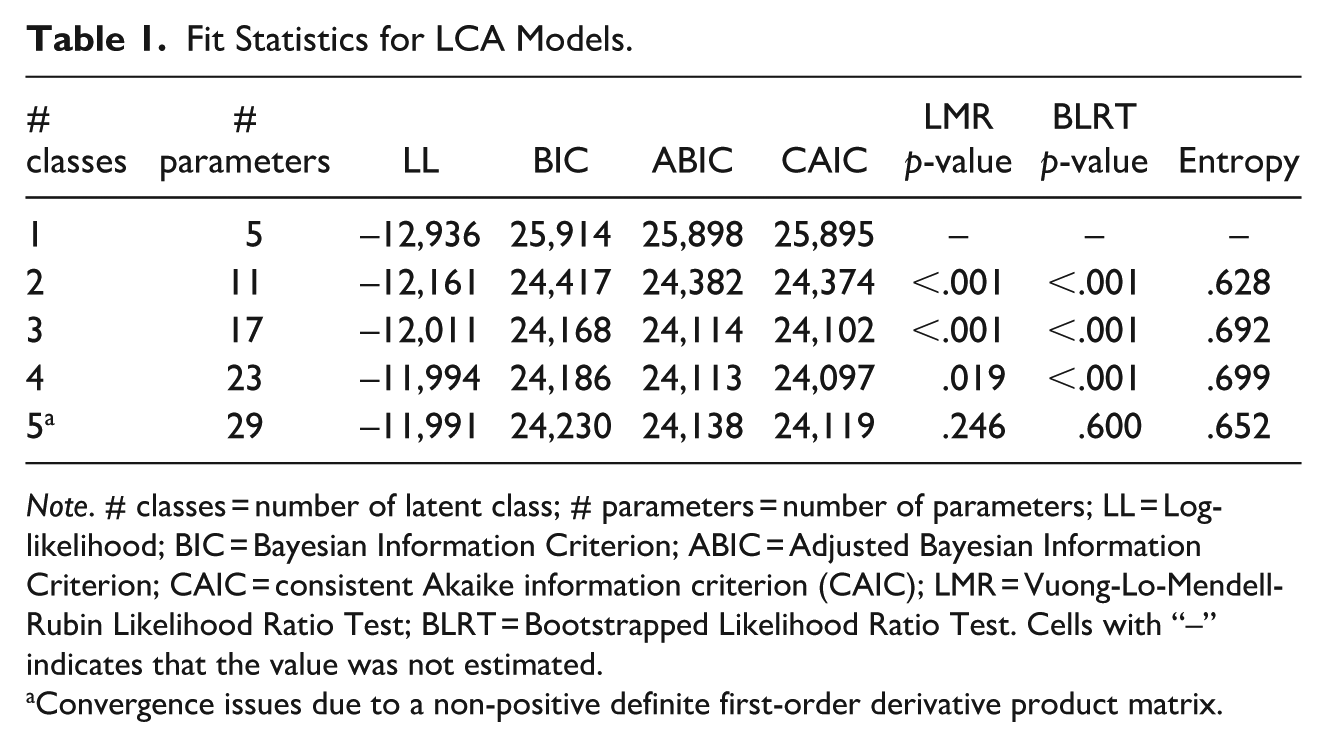
Note. # classes = number of latent class; # parameters = number of parameters; LL = Log-likelihood; BIC = Bayesian Information Criterion; ABIC = Adjusted Bayesian Information Criterion; CAIC = consistent Akaike information criterion (CAIC); LMR = Vuong-Lo-Mendell-Rubin Likelihood Ratio Test; BLRT = Bootstrapped Likelihood Ratio Test. Cells with “–” indicates that the value was not estimated.
Convergence issues due to a non-positive definite first-order derivative product matrix.
Figure 1 illustrates the conditional item probabilities for the three- and four-class solutions. The patterns of conditional item probabilities for Class 2 and Class 3 in the three-class solution were generally similar to those in the four-class solution. The conditional item probabilities for Class 1 and Class 4 in the four-class solution were generally similar, except for emotional abuse. In the four-class solution, Class 1 had a probability of 1 for emotional abuse, whereas Class 4 had a probability of 0. It is apparent that the four-class solution is simply an expanded version of the three-class solution. Thus, the three-class solution was chosen due to its lower BIC, greater parsimony (fewer parameters), and better substantive interpretability.
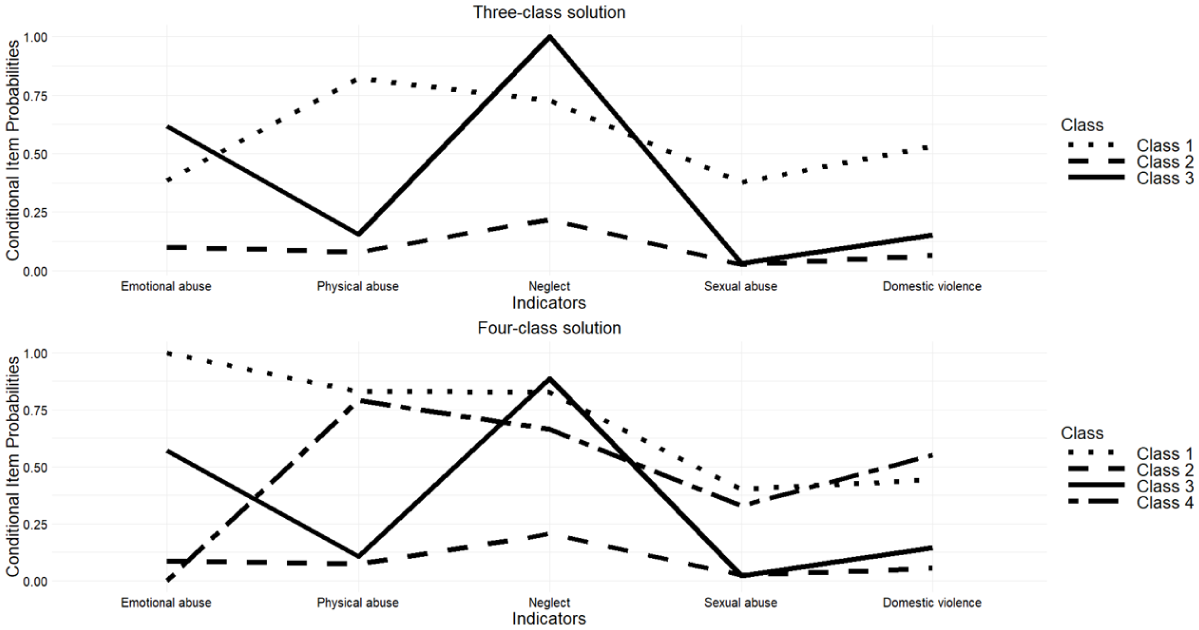
Conditional item probability plots for the three- and four-class unconditional LCA models.
Inspection of Figure 1 confirmed that the three latent classes exhibited meaningful qualitative differences in maltreatment experiences. Class 1 was characterized by high response probabilities for five types of maltreatment and was thus labeled the “Poly-victimization” class (17.8%). Class 2 was characterized by low response probabilities for all types of maltreatment and was thus labeled the “Low Maltreatment” class (66.9%). Class 3 was characterized by high response probabilities for emotional abuse and neglect and was thus labeled the “Psychological Maltreatment” class (15.3%).
As shown in Table 1, the entropy value for the three-class solution was 0.692, exceeding the recommended cutoff (>0.60). Supplemental Table S2 displays the average posterior probabilities, also exceeding the recommended cutoff (>0.70). Collectively, these results indicate that the three-class solution exhibited sufficiently good classification.
Class Differences on Recidivism
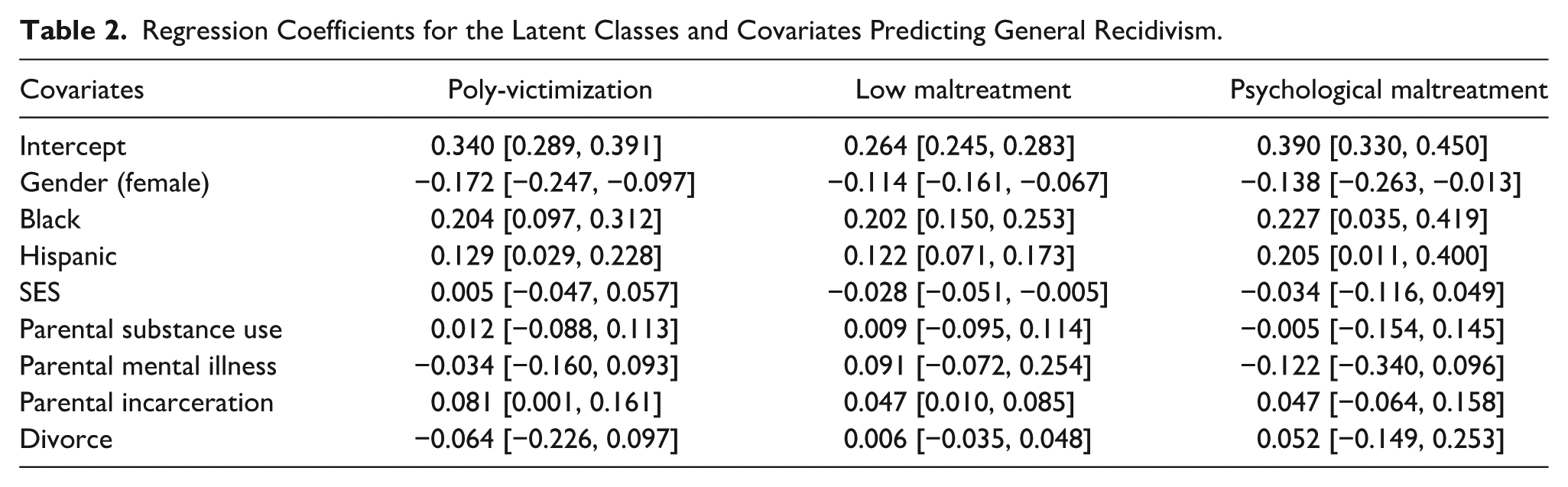
Table 2 presents regression coefficients for the latent classes and covariates predicting general recidivism. JIY in the “Psychological Maltreatment” class had the greatest probability (.390) of engaging in general recidivism, followed by those in the “Poly-victimization” class (.340) and the “Low Maltreatment” class (.264), controlling for relevant covariates. The difference in general recidivism between the “Poly-victimization” class and the “Low Maltreatment” class was 0.076 (95% CI [0.021, 0.132]), indicating that, on average, JIY in the “Poly-victimization” class had a 7.6% higher likelihood of engaging in general reoffending compared to those in the “Low Maltreatment” class. Likewise, the difference in general recidivism between the “Low Maltreatment” class and the “Psychological Maltreatment” class was –0.126 (95% CI [–0.193, –0.059]), indicating that, on average, JIY in the “Psychological Maltreatment” class had a 12.6% higher likelihood of engaging in general reoffending compared to those in the “Low Maltreatment” class. The difference in general recidivism between the “Poly-victimization” class and the “Psychological Maltreatment” class was –0.050 (95% CI [–0.139, 0.039]), suggesting that every likelihood from 13.9% lower to 3.9% higher of general recidivism for JIY in the “Poly-victimization” class compared to the “Psychological Maltreatment” class is at least reasonably compatible with our data given all the assumptions used to compute it.
Regression Coefficients for the Latent Classes and Covariates Predicting General Recidivism.
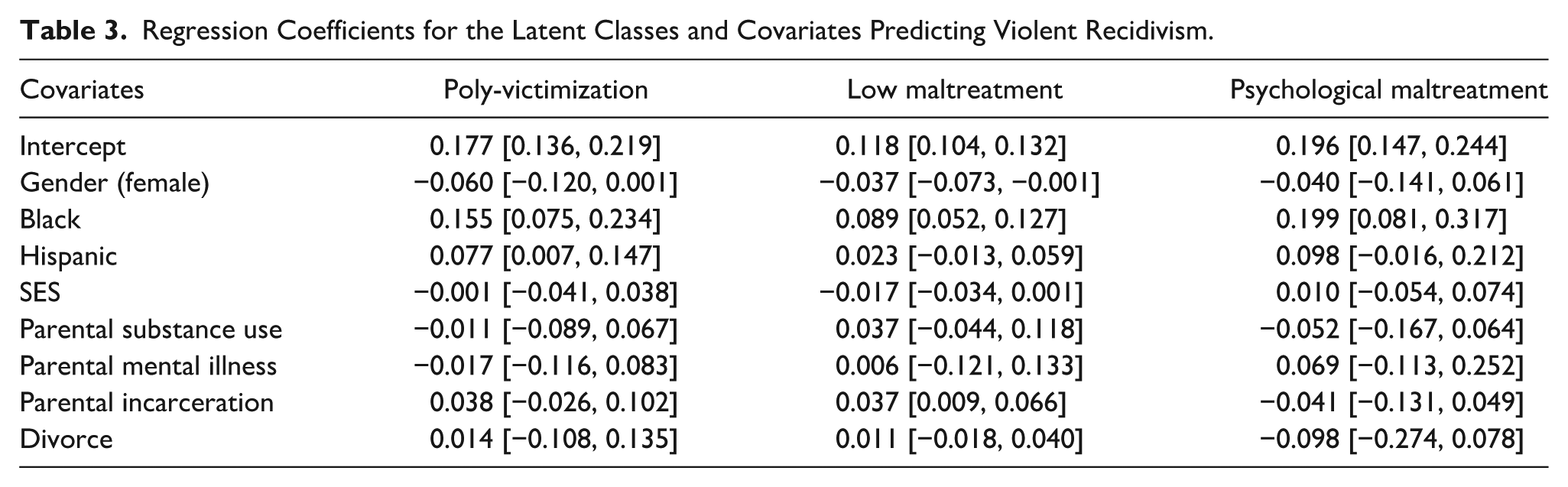
Results for violent reoffending are shown in Table 3. Controlling for covariates, the probability of JIY engaged in violent reoffending was 0.177 (95% CI [0.136, 0.219]), 0.118 (95% CI [0.104, 0.132]), and 0.196 (95% CI [0.147, 0.244]) for the “Poly-victimization” class, the “Low Maltreatment” class, and the “Psychological Maltreatment” class, respectively. The difference in violent recidivism between the “Poly-victimization” class and the “Low Maltreatment” class was 0.059 (95% CI [0.015, 0.104]), suggesting that JIY in the “Poly-victimization” class were, on average, 5.9% more likely to engage in violent reoffending compared to those in the “Low Maltreatment” class. Similarly, the difference in violent recidivism between the “Low Maltreatment” class and the “Psychological Maltreatment” class was –0.078 (95% CI [–0.131, –0.024]), indicating that JIY in the “Psychological Maltreatment” class were, on average, 7.8% more likely to engage in violent reoffending compared to those in the “Low Maltreatment” class. Finally, the difference in violent recidivism between the “Poly-victimization” class and the “Psychological Maltreatment” class was –0.018 (95% CI [–0.090, 0.054]), suggesting that the data are reasonably compatible with a range of outcomes, from 9.0% lower to 5.4% higher general recidivism for JIY in the “Poly-victimization” class compared to the “Psychological Maltreatment” class, given the assumptions underlying this estimate.
Regression Coefficients for the Latent Classes and Covariates Predicting Violent Recidivism.
Discussion
This study examined typologies of five types of maltreatment (physical abuse, emotional abuse, sexual abuse, neglect, and exposure to domestic violence) among JIY and their influence on the likelihood of general and violent reoffending during the 1-year follow-up period. Specifically, we identified three latent classes of maltreatment experiences, including a “Poly-victimization” class, a “Low Maltreatment” class, and a “Psychological Maltreatment” class. JIY in the “Poly-victimization” class and in the “Psychological Maltreatment” class were more likely to engage in general and violent reoffending compared to those in the “Low Maltreatment” class. In contrast, the differences in general and violent reoffending between JIY in the “Poly-victimization” class and the “Psychological Maltreatment” class were inconclusive.
Typologies of Child Maltreatment for JIY
The LCA results indicated that a three-class solution best fitted the data, aligning with previous LCA research for JIY (Aebi et al., 2015; Charak et al., 2019; Ford et al., 2013; Papalia et al., 2022). In terms of maltreatment patterns, youth in the “Low Maltreatment” class showed a relatively low probability of endorsing all five types of maltreatment, whereas those in the “Poly-victimization” class demonstrated a relatively high probability of endorsing all five types. Both the “Low Maltreatment” and “Poly-victimization” classes have been consistently identified in prior studies, although researchers have referred to them by different names. Additionally, fewer youth were classified into the “Poly-victimization” class (17.8%) compared to the “Low Maltreatment” class (66.9%), which is also consistent with existing evidence. These findings suggest two distinct groups of JIY who share similar maltreatment experiences within each group.
In contrast, inconsistent findings across studies typically arise from the third class other than the “Low Maltreatment” and “Poly-victimization” classes. Compared to the “Poly-victimization” class, this class was characterized by a lower probability of all maltreatment experiences (Ford et al., 2013), by a relatively lower probability of sexual abuse (Aebi et al., 2015), by lower probabilities of emotional abuse, sexual abuse, neglect, and exposure to domestic violence (Charak et al., 2019), and by lower probabilities of sexual abuse and neglect (Papalia et al., 2022). Our findings showed that the “Psychological Maltreatment” class was featured by lower probabilities of physical abuse, sexual abuse, and exposure to domestic violence, but higher probabilities of emotional abuse and neglect compared to the “Poly-victimization” class. Significant variations in sample characteristics and maltreatment measures make meaningful comparisons across studies challenging. Nevertheless, our findings, along with previous research, suggest the presence of a distinct class separate from the “Low Maltreatment” and “Poly-victimization” classes. This class represents a notable proportion of JIY who share similar patterns of maltreatment experiences.
Class Membership Differences in Reoffending
While the three empirically identified classes were derived based on statistical fit indices, substantive interpretability, and classification diagnostics, their practical utility remains uncertain without examining their predictive power in relation to offending among JIY. Youth in the “Poly-victimization” class and the “Psychological Maltreatment” class had higher likelihood of engaging in general and violent reoffending during the 1-year follow-up period compared to those in the “Low Maltreatment” class, after controlling for relevant covariates. Our finding generally aligns with previous research focused on male justice-involved individuals and based on bivariate associations that did not account for relevant covariates (Aebi et al., 2015; Zhang & Zheng, 2018). Importantly, our results are more robust due to the use of a large mixed-gender sample, the inclusion of evidence-based covariates, and the use of a prospective study design.
Our findings are generally consistent with GST (Agnew, 1992), which posits that strains such as maltreatment increase the risk of reoffending. Although GST is a useful framework for understanding the effects of maltreatment on offending and is widely employed in existing research when examining the maltreatment-offending link, it is not well-suited for explaining the nuanced class differences in reoffending. For instance, it does not account for why the proportion of reoffending was highest in the “Psychological Maltreatment” class, followed by the “Poly-victimization” class and the “Low Maltreatment” class. GST emphasizes explaining one phenomenon through another but overlooks characteristics such as the quantity, quality, and severity of the strain. As a result, some researchers shifted the focus from the maltreatment-offending link to the cumulative nature of maltreatment itself.
The cumulative risk perspective—the more risk factors youth are exposed to, the worse the outcome—has been applied to explain why the poly-victimization class exhibits poorer developmental outcomes compared to the low maltreatment class (Charak et al., 2019; Papalia et al., 2022; Zhang & Zheng, 2018). However, this perspective is likewise limited in addressing the issue.
First, cumulative risk is not a theoretical framework for explaining developmental phenomena but rather a descriptive approach to capturing the impact of risk on development (Appleyard et al., 2005; Evans et al., 2013). Second, the cumulative risk hypothesis was derived from findings applying general linear models, representing a variable-oriented approach, whereas LCA represents a person-oriented approach. Variable-oriented approaches emphasize identifying relations between variables (between cumulative risk index and developmental outcome) and assume that these relationships apply across all people. In contrast, person-oriented approaches focus on individuals as a whole and assume qualitative differences exist between groups of people. Because the two approaches differ, it is not appropriate to generalize conclusions across them. Third, the cumulative risk perspective indicates that the exposure to multiple risk factors is detrimental to youth irrespective of the particular pattern or combination (Evans et al., 2013). However, our findings, along with previous studies (Aebi et al., 2015; Zhang & Zheng, 2018), demonstrate that the combinations of multiple risk exposures matter. Lastly, if the cumulative risk perspective were appropriate for interpreting LCA results, one would expect the poly-victimization class to consistently exhibit worst developmental outcomes, followed by the other class(es), with the low maltreatment class demonstrating the fewest problems. However, our findings in terms of the inconclusive effects of the “Psychological Maltreatment” class and the “Poly-victimization” class on reoffending, together with prior mixed findings (Aebi et al., 2015; Zhang & Zheng, 2018), indicate that this expectation does not hold. In fact, the cumulative risk perspective and findings derived from person-oriented approaches together suggest that both the number of risk exposure and the pattern of risk are important for predicting reoffending. Given the limitations of both GST and cumulative risk in explaining class differences in reoffending, it would be valuable for researchers to develop theories of offending that emphasize individual characteristic differences.
Practical Implications
Given the high prevalence of maltreatment experiences among JIY, implementing evidence-based interventions addressing these experiences holds significant potential for reducing reoffending rates. Evidence-based interventions shown to effectively reduce maltreatment include the Parent–Child Interaction Therapy (PCIT; Chaffin et al., 2004), the Triple P-Positive Parenting Program (Triple-P; Sanders et al., 2014), and Multisystemic Therapy for Child Abuse and Neglect (MST-CAN; Swenson et al., 2010). Given the complexity of these interventions, however, it is impractical to offer maltreatment-focused interventions to every maltreated JIY.
The findings of the current study provide valuable guidance on identifying which groups of JIY should be prioritized for interventions. Given that JIY in the “Poly-victimization” and the “Psychological Maltreatment” classes are at an elevated risk of engaging in both general and violent reoffending, they should be prioritized for maltreatment interventions. Existing research further indicates that the classes other than the low maltreatment class not only face a higher risk of offending behavior but also tend to exhibit various psychopathological issues (Aebi et al., 2015; Charak et al., 2019; Debowska & Boduszek, 2017; Ford et al., 2013; Papalia et al., 2022; Zhang & Zheng, 2018). Youth in these classes often experience multiple forms of maltreatment. Evidence-based parenting programs show significant promise in addressing these problems by reducing the recurrence of maltreatment, improving physical and mental well-being, and preventing future offending. Importantly, since JIY in these two classes represent about one-third of the population, interventions can strike a balance between feasibility and the depth of support provided.
Limitations
Some limitations should be noted when interpreting the findings. First, the sample is not representative of JIY in the jurisdiction and all JIY in the country, despite its relatively large size (N = 5,194). Screening and assessing maltreatment experiences has not become routine at intake for JIY. The current study used the PACT as the primary source for extracting measures of maltreatment and relevant covariates. However, JIY who completed the full PACT are exclusively those who have committed more severe delinquent behaviors. As a result, the propensity of reoffending is presumably higher for our sample compared to the general population of JIY. However, the unrepresentative sample does not necessarily weaken our findings, as the implications of the current study are drawn by considering it in conjunction with findings from previous research.
Second, the current study used retrospective self-report measures of child maltreatment. An alternative approach is to use prospective, officially substantiated measures of maltreatment, such as Child Protective Services records. A meta-analysis of 16 studies found that prospective and retrospective measures of childhood maltreatment identified different groups of individuals (Baldwin et al., 2019). As a result, it is unlikely that the findings of this study can be generalized to prospective measures of childhood maltreatment. Since both approaches have their strengths and weaknesses, and given the incongruence between them, future research should explore the patterns of prospective measures among JIY and examine how class differences relate to the likelihood of reoffending.
Third, child maltreatment is a complex phenomenon characterized not only by its multifaceted nature but also by its chronicity and the developmental timing of its occurrence. Research utilizing a person-oriented approach has uncovered interesting patterns of maltreatment when considering both the chronicity and the developmental timing of these experiences (Ziobrowski et al., 2020). Our understanding of how JIY are clustered based on their maltreatment experiences would be significantly enhanced if future research could consider both the chronicity and the developmental timing of these experiences.
Conclusion
What patterns of maltreatment characterize JIY? Do these patterns influence reoffending? Addressing these questions is essential for designing individualized interventions aimed at reducing the recurrence of maltreatment and, ultimately, preventing reoffending in the future. Using LCA, we empirically identified three distinct classes of JIY, each defined by unique maltreatment patterns. The likelihood of engaging in general and violent reoffending varied across these classes, with the “Poly-victimization” and the “Psychological Maltreatment” classes showing a higher risk of reoffending compared to the “Low Maltreatment” class. Given the complexity of evidence-based interventions shown to effectively reduce maltreatment recurrence—and the high prevalence of maltreatment among JIY—our findings highlight the importance of prioritizing individuals in the at-elevated-risk classes for intervention efforts, ensuing a balance between efficacy and efficiency. The person-oriented approach offers valuable insights into characterizing JIY according to their maltreatment experiences and identifying those most in need of targeted intervention.
Supplemental Material
sj-docx-1-cad-10.1177_00111287251398033 – Supplemental material for Child Maltreatment and Recidivism: Do Maltreatment Patterns Influence General and Violent Reoffending?
Supplemental material, sj-docx-1-cad-10.1177_00111287251398033 for Child Maltreatment and Recidivism: Do Maltreatment Patterns Influence General and Violent Reoffending? by Nan Li, Matt Shelton and Elena L. Grigorenko in Crime & Delinquency
Footnotes
Declaration of Conflicting Interests
The authors declared no potential conflicts of interest with respect to the research, authorship, and/or publication of this article.
Funding
The authors disclosed receipt of the following financial support for the research, authorship, and/or publication of this article: This research was supported by the Eunice Kennedy Shriver National Institute of Child Health and Human Development (P20HD091005; principal investigator: Elena L. Grigorenko). The funder had no role other than financial support.
Ethical Considerations
Ethical and administrative approvals were obtained from the University of Houston Committee for the Protection of Human Subjects (STUDY00000134) and Harris County Juvenile Probation Department.
Consent to Participate
Not applicable.
Consent for Publication
Not applicable.

Supplemental Material
Supplemental material for this article is available online.
Author Biographies
References
Supplementary Material
Please find the following supplemental material available below.
For Open Access articles published under a Creative Commons License, all supplemental material carries the same license as the article it is associated with.
For non-Open Access articles published, all supplemental material carries a non-exclusive license, and permission requests for re-use of supplemental material or any part of supplemental material shall be sent directly to the copyright owner as specified in the copyright notice associated with the article.
