




Abstract
Drawing on 12,396 police misconduct complaints from New York spanning 2015 to 2019, I use exponential random graph modeling to examine structural differences amongst police misconduct networks based upon type and severity of misconduct. Officers with a greater history of misconduct allegations are more likely to be co-involved in complaints. Co-involvement is clustered, and the networks for the use of force are particularly so. Homophily is present in all subnetworks, and gender homophily has a stronger association with the use of force than with other forms of misconduct ties. Brokerage is particularly crucial to the abuse of authority network. These findings might aid police leaders to create diverse policing teams and to target officers whose misconduct causes the most harm, recognizing that different types of misconduct have unique network dynamics.
Introduction
Policing’s “Anna Karenina” principle might be rendered as, “Good cops resemble one another, but every bad cop is bad in their own way.” The category of police misconduct encompasses a wide array of actions and omissions. For example, assault, drug dealing, and racial harassment are all very different offenses; when committed by police, though, they all could be police misconduct. While one might expect some similarities in etiology given the culture and role of the police, the misconduct actions themselves are very different social phenomena. Studies of police misconduct have increasingly focused on social ties between officers and the networked structures that link officers who commit misconduct together. This strand of research bridges macro-scale research on police culture and individual-focused accounts of risk and protective factors for misconduct. This network research has generally studied misconduct generally or focused on use of force. But specificity for other types of misconduct is also helpful. This present study endeavors to parse out differences in network structure and characteristics between different types of misconduct. Combining a network perspective in police misconduct research with theoretical work on co-offending and criminal networks, I develop hypotheses about how co-offending will vary across types of misconduct, as reflected in network structure. This study uses a dataset of civilian-filed complaints of misconduct against members of the New York Police Department (NYPD) to then test these hypotheses.
Individual, Structural, and Networked Theories of Police Misconduct
Traditionally, studies of police misconduct have adopted either a micro- or macro-scale perspective. The former examine what factors about individual officers are associated with greater misconduct; ceteris paribus, how is manipulating a certain trait in an individual officer associated with more or less of a certain behavior? Common individual correlates of misconduct include gender (Boateng et al., 2023; Gaub, 2020), race (Kane & White, 2012; Wood et al., 2019), age (Fyfe & Kane, 2005), prior education and experience (Kane & White, 2012; Paoline & Terrill, 2007), and previous police conduct (Donner, 2019; Rozema & Schanzenbach, 2019). Macro-level analyses use organizational and ecological factors to explain why officers commit misconduct. One form of this approach has been to use the individual correlates-of-misconduct approach, but asking what characteristics of a police agency are associated with misconduct; these traits include size, pre-hiring screening, and accountability mechanisms (Huff et al., 2018), and the existence of internal affairs or professional standards units and in-service training (Eitle et al., 2014). Yet other studies have focused on cultural sources of misconduct. Police learn their occupation via both formal and informal training and mentorship; hence, some research examines whether field training officers (Chappell, 2007; Getty et al., 2016) or peers in the workgroup affect officers’ own propensity for misconduct (Chappell & Piquero, 2004; Ingram et al., 2013, 2018). These approaches recognize that social relationships, as well as individual characteristics, shape officers’ behavior.
Network methodologies are widely used throughout criminology (Faust & Tita, 2019). Victimization, co-offending, and competition, to name only a few examples, are all relational and can define a tie from one actor to another. Network research in police misconduct has begun to apply these same techniques. Police officers have a variety of ties with their colleagues. They might co-offend by committing misconduct together. They might be linked as colleagues by working on the same team or responding to the same call-for-service. Each of these relations can be studied as a source of officer behavior. The first strand of police misconduct network research has looked at the structure of police misconduct co-offending across a police force (Wood et al., 2019) or clusters of officers repeatedly co-offending together (Cubitt, 2023; Jain et al., 2022). Another set of studies examines whether an officers’ co-offending ties—that is, with whom they commit misconduct—are predictive of other behaviors, such as use of force (Ouellet et al., 2019) or firearms use (Ouellet et al., 2023; Zhao & Papachristos, 2020). Finally, some research analyzes other types of social ties and whether these social ties—such as being on the same team (Quispe-Torreblanca & Stewart, 2019) or responding to the same 911 calls (Simpson & Kirk, 2023) as misconduct prone officers or being partnered with a police officer who is then injured on duty (Zhao & Papachristos, 2024)—affect an officer’s subsequent rate of misconduct.
The focus in these works has generally been on all misconduct taken together (Cubitt, 2023; Jain et al., 2022; Quispe-Torreblanca & Stewart, 2019; Simpson & Kirk, 2023). When research in this strand gets more specific, it usually tends to examine use of force (Ouellet et al., 2019; Zhao & Papachristos, 2024) or shooting in particular (Ouellet et al., 2023; Zhao & Papachristos, 2020). Wood et al. (2019) do differentiate between civilian-facing complaints and internal complaints, the latter of which often reflect more administrative matters. Yet within civilian-facing misconduct, most of these works do not differentiate between types of misconduct, or if they do, they focus on use of force. But do the similar characteristics that give the use of force its network structure—such as the wide-ranging discretion to use it, police cultural influences, and the informal learning about its appropriate use—also shape other types of civilian-facing misconduct such as discourtesy or the abuse of police authority?
Theories of Co-offending
Criminological theory proffers several explanations for why people co-offend and commit crime in groups. While not all police misconduct is criminal, these theoretical perspectives from the study of crime more generally can inform the study of co-offending by police. Typical explanations for co-offending can be classified as influence, selection, and instrumental (Bright et al., 2022). Deviant peers might influence other officers, so that they come to see certain misconduct as acceptable and to imitate these behaviors; seeing how others reward or reinforce these behaviors further encourages co-offending (Chappell & Piquero, 2004). This process of social learning encourages co-offending ties since the social contact with a co-offender encourages the deviant act in the first place (Conway & McCord, 2002; Warr, 1996). Of course, this social contact might also occur via self-selection based on other traits (Tillyer & Tillyer, 2015). In the policing context, for example, more aggressive and impulsive officers might seek out proactive specialty units, which are especially prone to misconduct (Gaub et al., 2021). Thirdly, other perspectives have considered co-offending as an instrumental, rational choice. For example, one might choose a co-offender who is more skilled at a particular offense type (McGloin &Nguyen, 2012). Offenders will choose a co-offender who raises their expected reward (Weerman, 2003), offset by the increased risk of apprehension from including more people in the offending group (Erickson, 1973; McCarthy et al., 1998).
Weerman (2003) synthesizes these perspectives into a social exchange theory of co-offending. The choice to offend together involves the exchange of social goods (Foa & Foa, 1974), both tangible and intangible. In an instrumental sense, one might choose a co-offender who can contribute unique skills or services to the group, or one who will increase the expected “catch” of the offense, even when divided up—financial gain is a key goal for criminal offending (Nguyen & Bouchard, 2013). This social exchange perspective also captures the social learning theory of co-offending. Co-offending garners non-monetary social goods, such as appreciation or acceptance by the group (Weerman, 2003). Differential reinforcement of deviant behaviors via the conferment of social goods encourages the development of differential associations and further co-offending. Indeed, co-offending often results in worse acquisitive outcomes across the group and a higher chance of apprehension (Tillyer & Tillyer, 2015). Intangible gains might play an important role in encouraging co-offending, especially in a setting like police use of force, which is largely non-acquisitive. Officers might engage in misconduct to fit the social norms of their workgroups (Ingram et al., 2013, 2018) or their training officers (Getty et al., 2016) to gain approval and trust.
From these theories of co-offending, I develop several hypotheses about police involvement in misconduct networks. As police misconduct is largely non-acquisitive and co-offending is risky, officers who co-offend are likely to be motivated by other social exchange goods, such as social solidarity or acceptance with the group (Weerman, 2003). Hence, they are likely to engage in within relatively stable social groups, rather than opportunistically seeking out co-offenders to increase their expected return. In network terms, this hypothesis would be reflected in co-offending being relatively rare and greater clustering within the network of being co-named in complaints (H1). Second, both by means of selection (Tillyer & Tillyer, 2015) and social influence (Conway & McCord, 2002; Warr, 1996), police might be more likely to co-offend with those who are socially similar to them. This effect is observed in other criminal networks, too (Charette & Papachristos, 2017). Hence, I expect to see significant homophily effects amongst observed officer traits, such as age, gender, and race (H2). Finally, criminal expertise is related to instigation and co-offending—co-offenders are more likely to follow someone who is skilled (McGloin & Nguyen, 2012). As such, I predict that police officers with a greater history of misconduct—those who are skilled at it, relatively speaking—will be more likely to involve themselves in misconduct with others (H3).
Different Offense Types, Different Networks?
While this question has not been addressed in the police misconduct networks literature, other criminological research on networks has examined differences in structure across different offense types. Patterns of co-offending vary across different types of criminal offenses (Bright et al., 2022; Bright, Lerner, et al., 2024; Bright, Sadewo, et al., 2024). For example, property offenses like burglary or robbery are more likely to feature co-offending, while sexual offenses are particularly unlikely to (Bright et al., 2022). Moreover, the types of crime in which an offender engages differ between those central to and those on the periphery of a co-offending network (Morselli et al., 2015). Specialization—the tendency to predominately commit one offense or offense type—is connected to network structure. Co-offenders with a higher degree of specialization in their types of group offending are likely to have denser networks (McGloin & Piquero, 2010). Crime type affects network stability—that is, whether one’s co-offenders change over time. Stability in co-offending networks is high amongst recidivists (Grund & Morselli, 2017; McGloin et al., 2008), and there is a lot of specialization in co-offending relationships (Grund & Morselli, 2017). Crime type matters to the likelihood of tie formation, too; if there are more offenders engaged in the same type of crime as the index offender’s previous offending, then the likelihood of a stable co-offending relationship is lower because there are more available co-offending partners to switch to (Charette & Papachristos, 2017). The offender’s degree is likely to be higher depending on the popularity of their specialty, so to speak. Thus, from the literature on the relationships between crime type, co-offending, specialization, and network structure, we have good reason to believe that the network structures of police misconduct co-offending might also differ based on the type of offense.
Within the structure of a criminal network, individuals can occupy more or less critical positions. Those who are particularly important to linking together various parts of a network are termed brokers. Rather than simply instigating offending with many others (McGloin & Nguyen, 2012), brokers bridge structural gaps in criminal networks. They connect both individuals and groups engaged in offending (DellaPosta, 2023; Pasquet-Clouston & Bouchard, 2023) and enable the flow of information, illicit goods, or norms and beliefs that influence offending. Brokers are critical in the study of drug trafficking networks (Morselli, 2010; Pasquet-Clouston & Bouchard, 2023), mafias (DellaPosta, 2023), and gangs (Girn et al., 2025). In the policing context, the latter is most relevant—brokers may spread norms and practices that encourage misconduct between disparate groups of officers. For example, Zhao and Papachristos (2020) examine the connections between officers who are brokers in a use-of-force network and shootings. The removal of brokers is also important for preventing further offending; this strategy is effective in other crime contexts (Bright et al., 2017) and a focus on brokers may capitalize on network spillovers to prevent police misconduct (Sierra-Arévalo & Papachristos, 2021).
Drawing on this literature, I make several hypotheses about how network structures will differ between types of police misconduct. First, co-offending can utilize others’ criminal expertise (McGloin & Nguyen, 2012) but raises the risk of apprehension (McCarthy et al., 1998). Hence, co-offending ought to be more likely in misconduct types that require a high degree of skill, such as use of force or abuse of authority, than in other types of misconduct. (H4). Additionally, because co-offending raises the risk of apprehension, joint participation in and knowledge of a violent act gives participants leverage over one another, which can encourage trust and commitment to one another as co-offenders and tighter clustering (Campana & Varese, 2013; DellaPosta, 2023; Portes & Sensenbrenner, 1993). Hence, co-involvement in use of force, as compared to other forms of misconduct, will exhibit greater clustering (H5). Since violent misconduct might encourage tighter clustering and co-offending only in high-trust groups, these groups might exhibit more homophily with regards to social characteristics (H6). Finally, because co-offending is more common and trust is needed to reduce the likelihood of apprehension, brokerage will also be more prevalent in the use-of-force network (H7).
Data and Methods
The CCRB Complaint Dataset
To test these hypotheses about police misconduct, co-offending, and network structure, this study uses data from the Civilian Complaint Review Board (CCRB), which investigates civilian complaints about NYPD officers in four specified categories: force, abuse of authority, discourtesy, and offensive language (the “FADO” categories) (CCRB, 2021). The CCRB can then recommend disciplinary action to the NYPD commissioner, who has the final authority to impose discipline (CCRB, 2021). The data was publicly released following a lawsuit by the New York Civil Liberties Union (2021) and has already been used in numerous research studies examining clusters of misconduct (Joseph, 2021), racial and geospatial inequities in misconduct (NYU Public Safety Lab, 2020), gender and misconduct (Cubitt et al., 2022), and machine learning approaches to predict misconduct (Cubitt & Birch, 2021). This paper builds upon these analyses by examining the differences in network structure based upon both the type of misconduct and officer characteristics in the NYPD.
Civilian-facing misconduct is critical to address because it harms the legitimacy of the police. These interactions between police and the public are “teachable moments” (Oliveira et al., 2021), which can both worsen and improve perceptions of police legitimacy (Myhill & Bradford, 2012). The procedurally unjust treatment of civilians can lead to feelings of alienation and less compliance with the law (Tyler, 2004). Similarly, discrimination and bias undermine policing’s distributive fairness and legitimacy (Tankebe, 2013). These consequences ripple out from individual encounters. Individual perceptions of legitimacy are not just shaped by one’s own encounters with the police, but also by “vicarious marginalization” via the encounters of others (Bell, 2017, p. 2104). Police violence and misconduct provoke legal cynicism, which is deeply connected to the notion of police legitimacy (Tyler, 2004). High amounts of legal cynicism result in less solved crime (Kirk & Matsuda, 2011) and more victimization (Kane, 2005). Police misconduct is a key driver of this cycle of marginalization, which can result in further harms from crime, too. Hence, focusing on these types of complaints is critical to abate misconduct’s harms. But this focus on FADO offenses is not without analytical drawbacks. On-duty misconduct occurs within teams to which an officer has been assigned; hence, they have less choice over a co-offending partner than they would off-duty. (Of course, they still have the choice to offend or not.) I choose to use this dataset nonetheless, though, given the lack of access to other datasets of similar scope and scale and the centrality of on-duty, civilian-facing misconduct to policing’s legitimacy.
The original dataset contains all complaints of FADO police misconduct against NYPD officers investigated by the CCRB from 1978 through 2021. The data were obtained and made public by the New York Civil Liberties Union (New York Civil Liberties Union, 2021). A complaint refers to an entire alleged incident of misconduct by NYPD officers against a member of the public; an allegation refers to a specific action committed by single officer. Hence, each complaint contains one or more allegations against one or more officers. For example, a complaint alleging that one officer used excessive force and discourteous language, and another refused to provide first aid, would contain three allegations against two officers in one complaint. The entire dataset contains 279,644 allegations. The data are at the allegation level; in addition to containing unique identifiers for the allegation, complaint, and officer, the dataset contains information on the officer, affected party, location, date, and circumstances of the allegation.
This analysis treats allegations as a proxy for actual misconduct. While this issue is debated, misconduct allegations are considered a reasonable proxy for misconduct behavior in much of the recent literature (Cubitt, 2023; Cubitt et al., 2022; Ouellet et al., 2019; Rozema & Schanzenbach, 2019; Wood et al., 2019). Some misconduct might not be reported, and some allegations might be spurious, but there is likely some important signal about the quality of an officer’s conduct within whatever noise those limitations might cause. Similarly, using only substantiated complaints would also have its limitations, as many police misconduct adjudication processes may be designed to uphold very few complaints (Cheng & Qu, 2022; Rushin, 2019), and the rate at which complaints are upheld may vary based on complainant race (Headley et al., 2020). Since all CCRB investigations are in response to civilian allegations, these complaints are unlikely to be a proxy for how aggressively the department’s internal affairs bureau proactively seeks out corruption. Because the allegations, though, are not all proven, I refer to a co-involvement network, rather than a co-offending one—the officers were involved in the same complaint, but not necessarily both offenders.
For the purposes of my analysis, I restrict this dataset to misconduct occurring between January 1, 2015 and January 1, 2020. Prior to 2015, the CCRB counted allegations at the allegation-offender-victim level; for example, an officer who made a discourteous remark to three people would have three allegations recorded (CCRB, 2022). From 2015, allegations have been recorded on an allegation-offender level; that example would result in only one allegation. Limiting the data to allegations made in 2015 and later ensures each allegation reflects a consistent approach by the CCRB. Ending the study period at the start of 2020 excludes misconduct which occurred during the 2020 COVID lockdown and large-scale racial justice protests in New York. Given the volume of misconduct complaints and COVID, the CCRB did not investigate many of these allegations until well into 2021 (Hawkins, 2021). Hence, data from 2020 would likely be underrepresented since the data set only contains fully investigated allegations. This dataset comprises 12,396 complaints, with 42,423 unique allegations against 12,463 officers. The median number of allegations per complaint was 2, ranging from a single allegation to 38 in one complaint. While each allegation is (by definition) made against a single officer, the number of officers named per complaint range from 1 to 12, with a median of 1. The distribution of officers named per complaint is right-skewed.
Analytic Strategy
The section “Overall Network Structures’’ presents summary statistics on the overall misconduct co-involvement network; the sections “Network Structures by Type of Misconduct’’ and ‘‘Brokerage by Misconduct Type’’ include descriptive statistics and an analysis of brokerage for the overall complaint network and sub-networks defined by type. These statistics include information on the ties between officers, each officer’s number of ties, and transitivity (how tightly connected the network is). Then, the remaining results present a set of exponential-family random graph models (ERGMs).
ERGMs simulate the likelihood of observing the network in the actual data compared to a family of random graphs in which two nodes form a tie with some probability p; ERGMs estimate the effect of structural properties of the actual graph, nodal covariates, and edge covariates on the likelihood of tie formation, via comparison to these random graphs (Lusher et al., 2013). These types of models have particularly been used to study police misconduct networks (Wood et al., 2019). To more formally define the model, let us take
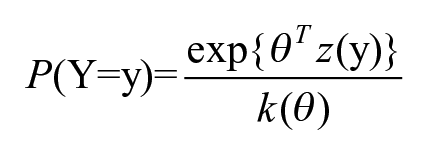
where the vector θ contains model coefficients, the vector
From this equation, one derives the logit model to determine the likelihood of a given tie,
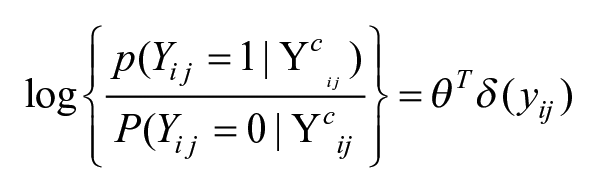
where δ(yij) is a vector of the change in network statistics if Yij were to change from 1 to 0 (Wasserman & Pattison, 1996). Thus, the coefficients for covariates in the ERGM are the conditional effect that a change in that covariate would have on the likelihood of a tie forming between two nodes. I conducted these analyses in R version 4.1.2 (R Core Team, 2021), using the “sna” (Butts, 2020), “network” (Butts, 2015), and “ergm” (Handcock et al., 2021) packages.
Results
Overall Network Structures
As shown in Figure 1, the modal officer in the data received just one allegation and one complaint. The median number of allegations received was 2 (M = 3.4, SD = 3.9) and the median number of complaints was 1 (M = 1.7, SD = 1.3). The most-offending officers received 18 complaints in the data set, one of whom was named in 62 allegations—the maximum number of allegations for any one officer.
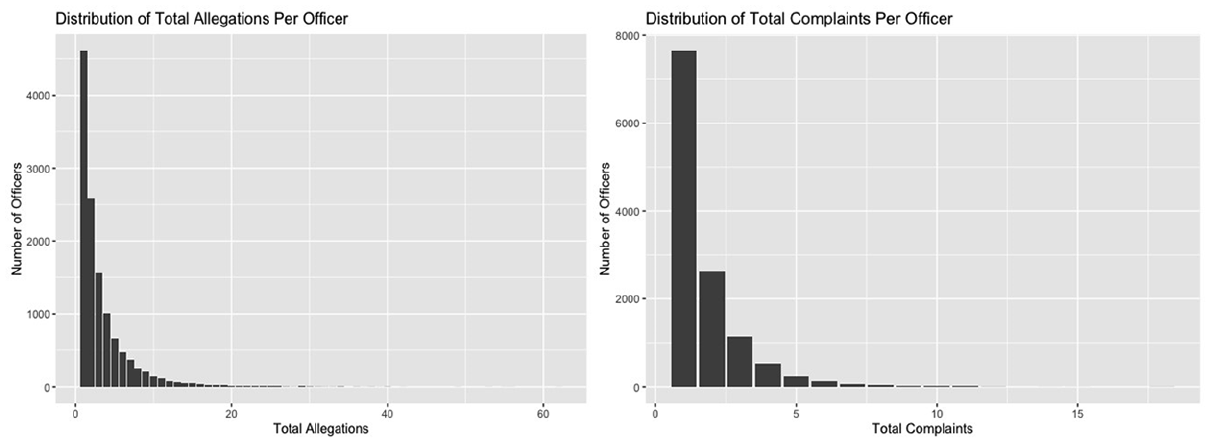
Most officers were named in only one or two allegations or complaints.
A tie exists between two officers i and j in a misconduct co-involvement network if at least one complaint includes allegations against both officers i and j—that is, they are “co-named” in a complaint. The overall misconduct network during the 5 years under study contains 28,692 ties between the 12,463 officers, resulting from the 5,758 complaints in which two or more officers were named—roughly 46% of complaints involved multiple officers. The mean degree of this network is 2.30; that is, the average officer is co-named in complaints with just over two other officers.
Officer degree ranged from 0 to 24; Figure 2 shows the distribution of officer degree, which is heavily right-skewed. Most officers are connected to no or only one other officer, while some officers are highly connected.
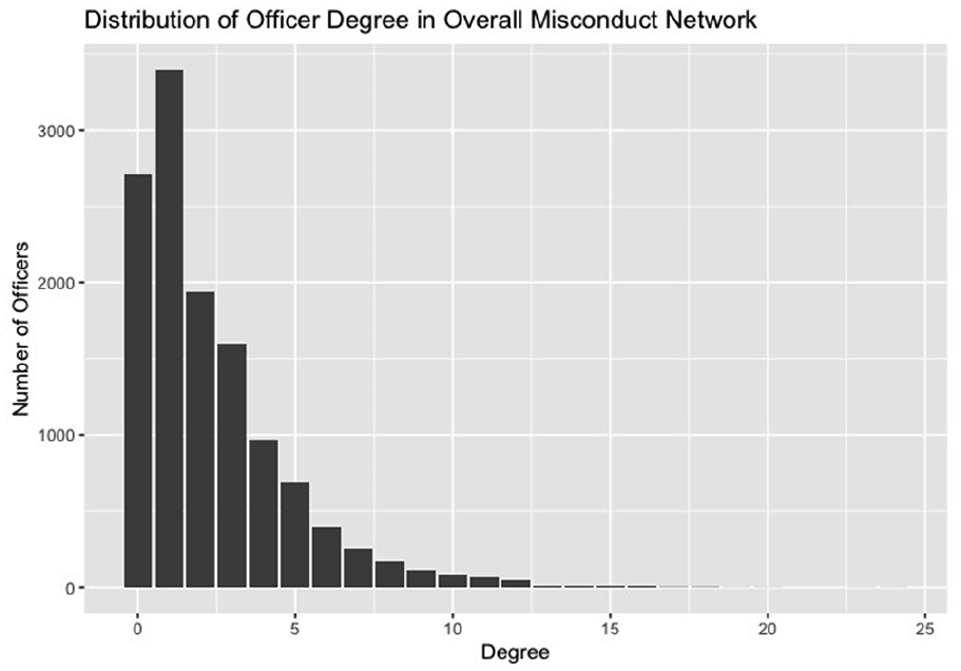
The distribution of officer degree is right-skewed.
The network of all complaints from 2015 through 2019 contains 76,744 triangles—sets of three officers i, j, and k, in which officer i has been co-named in a complaint with officer j, j with k, and k with i. The transitivity of the overall misconduct network is 0.52. 1 Thus, this network is fairly clustered—if two officers are each linked in complaints with a third officer, then there is a greater than 50% chance that those two officers are themselves co-named in a complaint.
Network Structures by Type of Misconduct
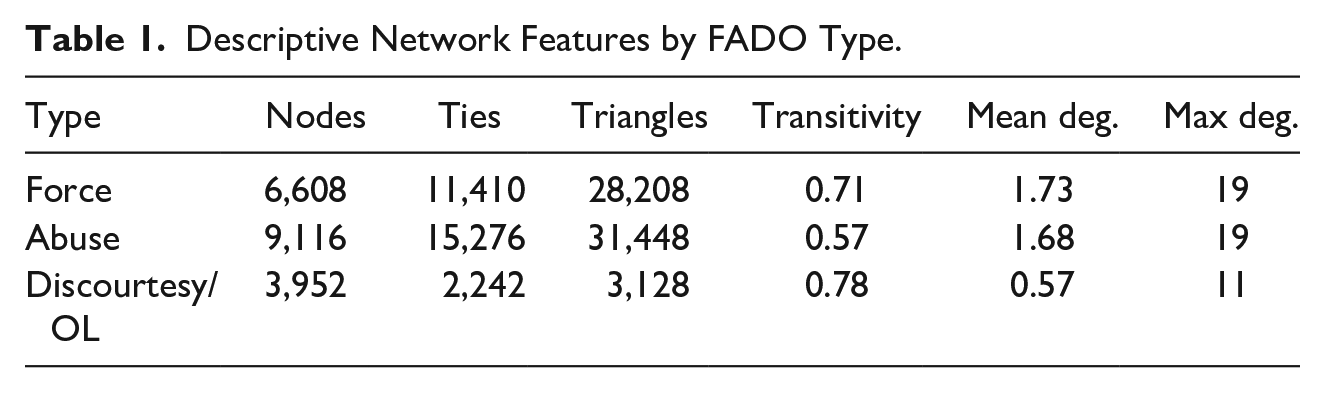
A tie exists in a misconduct network of a certain type between two officers i and j if at least one complaint contains allegations against both officers for that particular type of misconduct. These networks disregard ties that are formed by heterogeneous forms of misconduct, where officers might be co-named for different types of misconduct in the same incident, which are ultimately a very small portion of complaints. I examine the differences in network structure amongst the FADO types of misconduct, summarized in Table 1. Since the relative sparsity of the discourtesy and offensive language networks can cause model fitting issues, I combine these networks into one. Moreover, conceptually, offensive language misconduct offenses are a subset of discourtesy offenses that refer to some protected characteristic. The force and abuse of authority networks are both less sparse than the discourtesy and offensive language network with regard to mean degree (1.73 and 1.68, vs. 0.57) and density (0.0004 and 0.0005, vs. 0.0003). Interestingly, the discourtesy/offensive language network still exhibits high transitivity. This observation might be an artifact of relatively few such cases occurring in groups. Since there are so many isolates in this network, when there is a triple of officers joined in the network, the most likely explanation is that they all offended together in the same incident, and they are all very likely to be joined to one another. The distributions of officer degree are all right-skewed.
Descriptive Network Features by FADO Type.
Brokerage by Misconduct Type
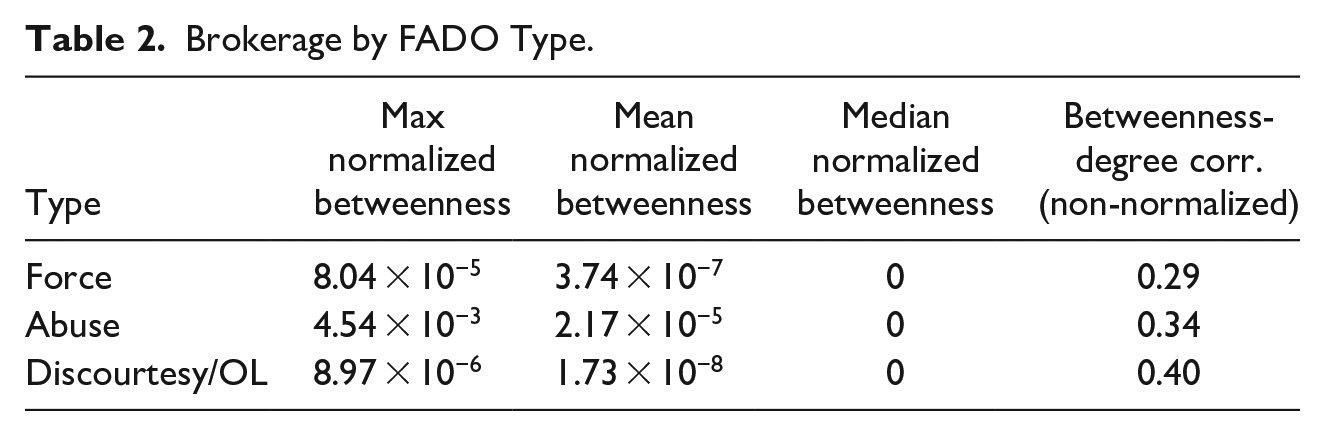
I examine brokerage across networks using betweenness centrality, or the extent to which an officer lies on the shortest path in the network connecting two other officers. This metric has been used in analyses of brokerage in criminal networks (Girn et al., 2025; Morselli, 2010) and police misconduct networks (Zhao & Papachristos, 2020); it is one of the most effective metrics for targeting interventions in criminal networks (Bright et al., 2017). First, I calculate the maximum, mean, and median normalized betweenness centralities (i.e., accounting for network size) for each misconduct type, to give a sense of the distribution of betweenness centrality. (Given the highly right-skewed distribution of betweenness in each, the median for all networks is 0.) I also examine the correlation between betweenness and degree centralities for each network—in essence, what amount of betweenness is explained simply by the number of connections, versus the importance of them. These results are presented in Table 2. The abuse of authority network has the greatest maximum and mean normalized betweenness centralities, indicating a greater role for brokers in that network, while the discourtesy and offensive language network has the least. That network also has the greatest correlation between degree and betweenness centralities, indicating that brokerage in that network may be more connected to simply having co-offended with a greater number of other officers.
Brokerage by FADO Type.
Overall Network Model
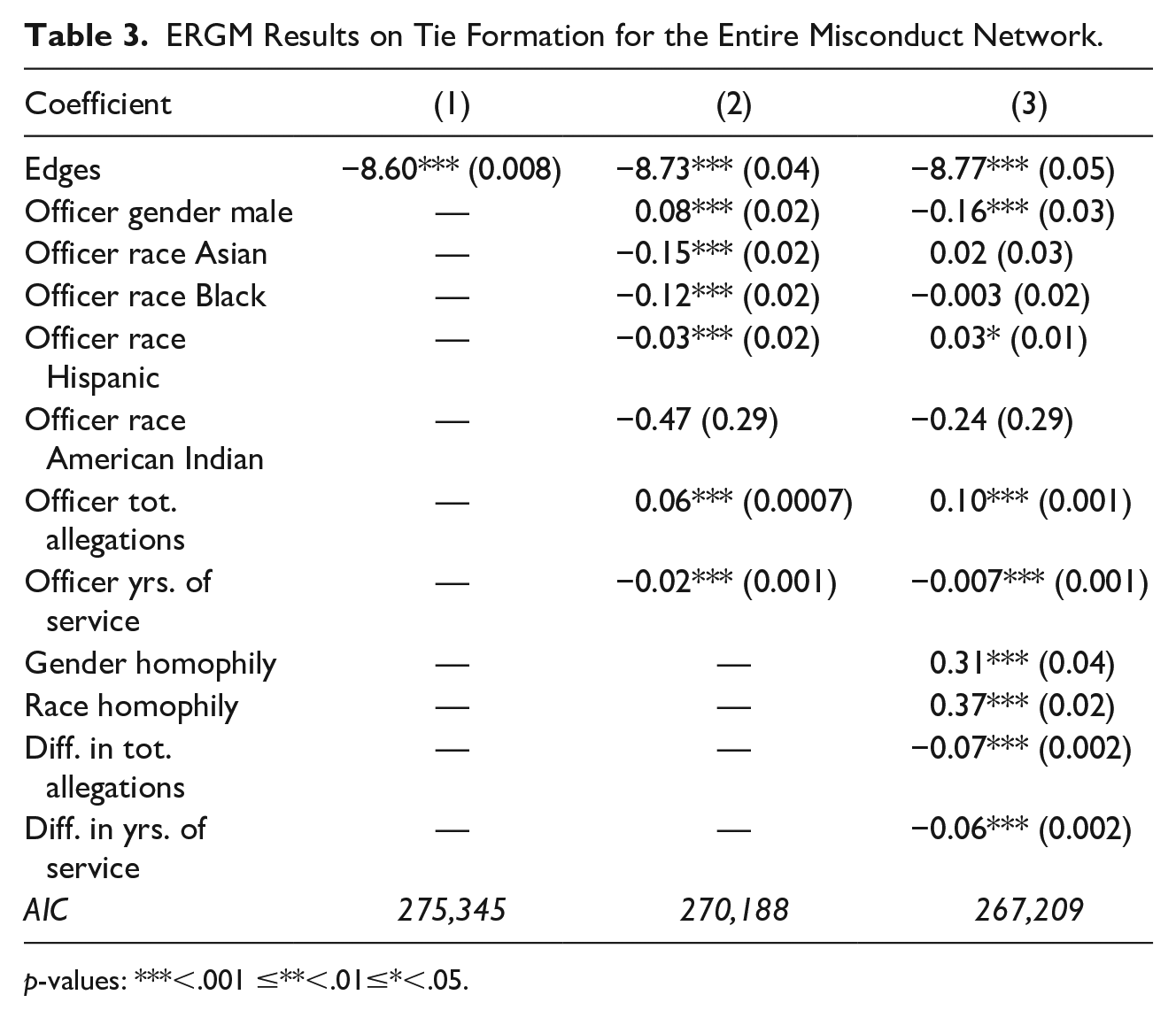
Table 3 presents modeling results for tie formation in the entire co-complaint network. The first model fits only the edges parameter (i.e., ties between officers without any individual or dyadic covariates). The second model includes individual officer nodal covariates, and the third includes both homophily and individual covariates. I have excluded a triad term from these models, as estimating them requires Markov Chain Monte Carlo estimation. With such a large and relatively sparse network, this technique leads to inferential degeneracy (Handcock, 2003). The exclusion of this term should have only minimal impact on the other coefficients, as Faust (2007) shows that triad structure is highly constrained by other network attributes, which I am able to model. The conditional probability of a tie occurring between any two given officers is quite low (just a fraction of 1% in each of the three models). This result is not unexpected, given the immense size of the co-complaint network and the NYPD as a whole.
ERGM Results on Tie Formation for the Entire Misconduct Network.
p-values: ***<.001 ≤**<.01≤*<.05.
In the model with only individual characteristics, Asian, Black, Hispanic, and Native American officers are all less likely to form ties than white officers; this effect disappears for all (with Hispanic officers slightly more likely to form ties) once racial homophily is included in model (3), though. Being of the same race increases the likelihood of a tie between two officers by approximately 43%. Thus, the higher likelihood of white officers to form ties may be a combined effect of the higher likelihood of all officers to form ties with same-race peers and a larger number of white officers. Officer gender is significant, but reverses sign when gender homophily is included in the model. Two officers being of the same gender is associated with an increased likelihood of a tie between them by approximately 36%. When not considering homophily, male officers form more ties; when gender homophily is included, though, male officers are actually conditionally less likely to form ties. This reversal in sign may be explained by most patrol officers being men.
A greater length of service at the close of the sample time period is significantly associated with fewer ties, though this effect is quite small in size. Officers with more total allegations are more likely to form ties; this effect is larger once homophily is accounted for. Officers who entered the NYPD at roughly the same time are more likely to commit misconduct together, and a greater difference in total allegations of misconduct is associated with a lower likelihood of tie formation. Examining the AIC, we see that the model (3) performs best.
Tie Formation and Type of Misconduct
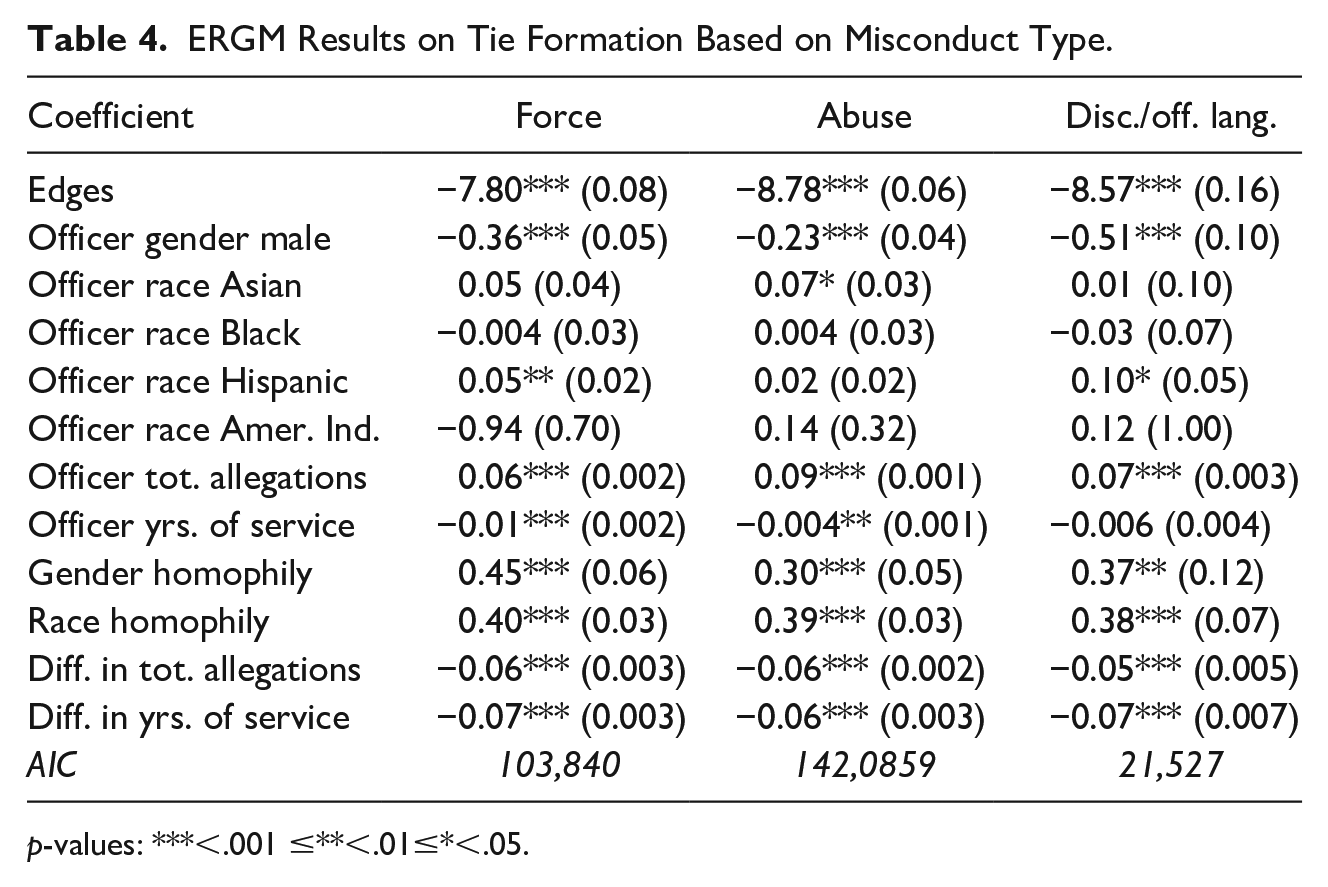
Table 4 presents the results of the full model (incorporating homophily and individual officer characteristics) for the three networks by FADO category. The full model outperformed those with just homophily or nodal covariates, as shown in Table 3; hence, I do not fit those other models for misconduct networks broken down by severity or FADO category.
ERGM Results on Tie Formation Based on Misconduct Type.
p-values: ***<.001 ≤**<.01≤*<.05.
Male officers are less likely to form ties in all networks, though this effect is larger in the discourtesy/offensive language network. An officer’s total allegations received are associated with an increased likelihood of forming ties in all networks, at a similar magnitude to the effect of total allegations in the overall network. Finally, more senior officers have a very slightly reduced chance of tie formation in the force and abuse of authority networks. Asian officers are slightly more likely to form ties in the abuse of authority network, and Hispanic officers to do so in the force and discourtesy/offensive language ones.
Officer homophily is significant in each model across all characteristics. Gender homophily is particularly associated with a greater likelihood of ties in the force network, and racial homophily is associated with a higher likelihood of tie formation in roughly equal magnitude across categories. Similarly, homophily in total allegations and tenure are both associated with slightly higher probabilities of tie formation, in comparable magnitude across subnetworks.
Robustness Check for Inter-Precinct Variation
To assess whether differential risk distributions by precinct affected the overall model results, I also ran the full ERGM (model 3 in Table 3) for each of the 77 NYPD precincts individually. 2 Figure 3 presents the distribution of p-values for the covariates which were significant in the overall model. Some are significant in most all precinct models, while others are only significant in a few.
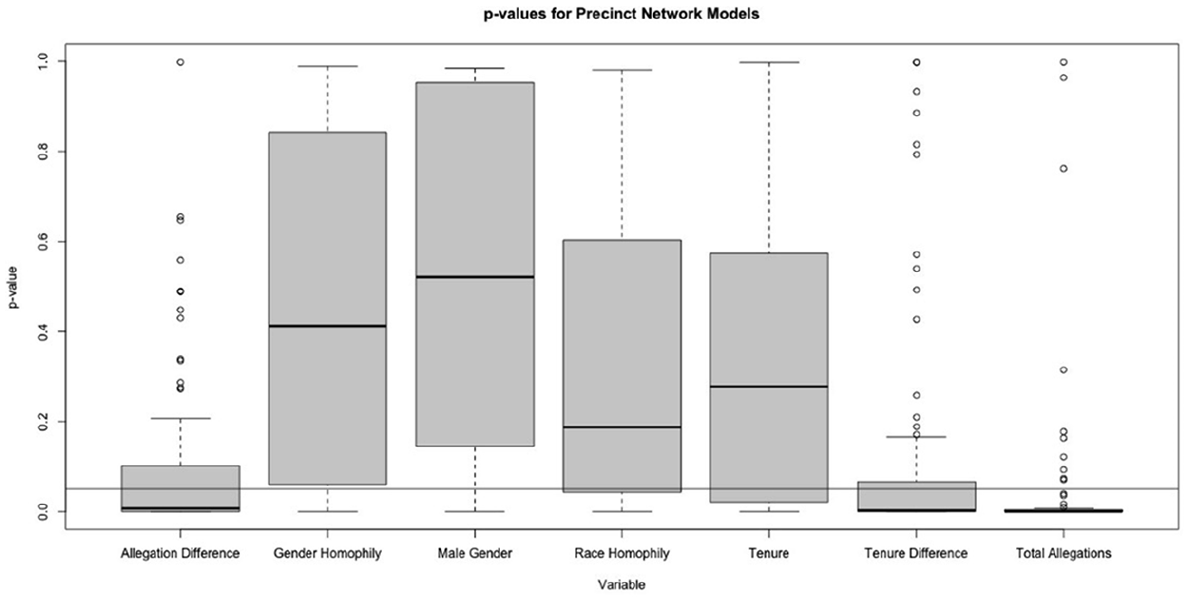
The effects for some variables were not significant in some intra-precinct ERGMs.
For all precincts in which a covariate was significant in the intra-precinct model, Figure 4 presents the coefficients. All significant coefficients in the precinct models are consistent with the overall model; there is no coefficient (save for one outlier in years of service) in which a precinct shows an opposite-direction coefficient. While there is some heterogeneity as to coefficient size, there is not as to direction.
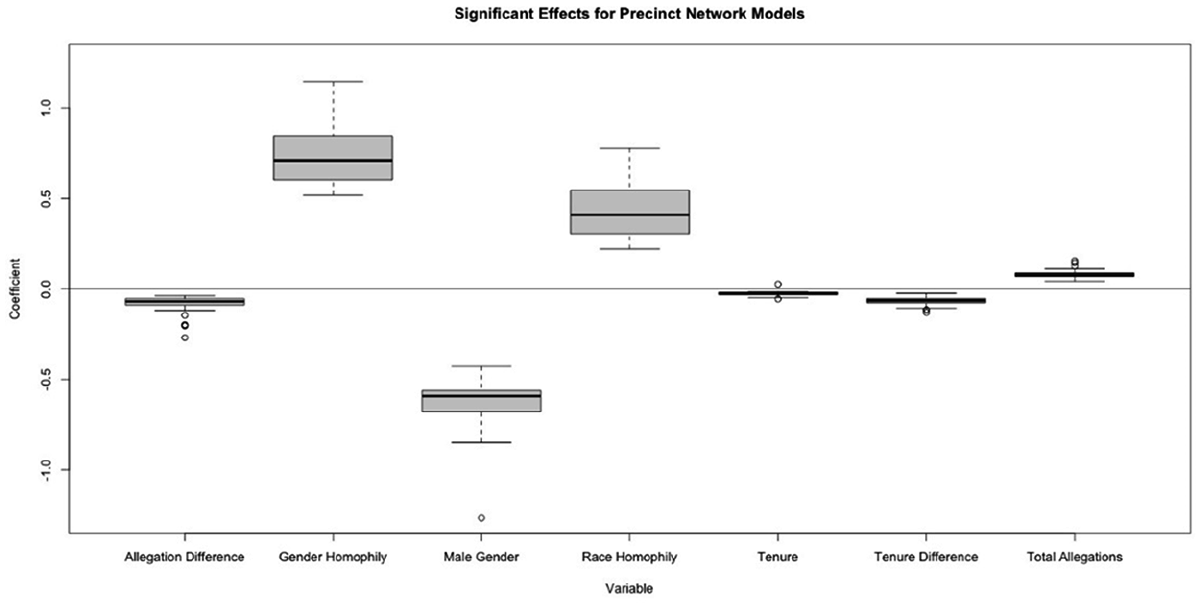
The significant coefficients for all variables were in the same direction in the precincts models as in the overall model.
Discussion
Hypotheses
I begin the discussion with a review of the hypotheses and the applicable results, then move to the broader implications. These results provide mixed support for the hypothesis, H1, that co-offending will be rare. By some measures, co-involvement in complaints is not rare: Just over 46% of complaints name more than one officer, which aligns with prior research (Wood et al., 2019). But from another viewpoint, co-involvement is rare: The overall network of police misconduct in New York is sparse, as the edge coefficients in Table 1 show, and the distribution of degree is heavily right-skewed. Further supporting H1, the overall network of complaints was quite clustered. The rate of triadic closure was 52%. This statistic is quite high and indicates a tightly-knit network. The overall co-involvement network also showed homophily by race, gender, and tenure, supporting H2. There may be at least some degree of selection based on pre-existing traits that affects misconduct (Tillyer & Tillyer, 2015), though this analysis cannot control for police assignment (Gaub et al., 2021). While there are some relatively small associations between race and tie formation (particularly for Hispanic officers), the impact of race on tie formation is largely with regard to homophily, not the race or ethnicity of the individual officer. Officers with a greater number of prior misconduct allegations are more likely to form ties. This result support H3 and indicates that these officers might have greater expertise and be more attractive co-offenders.
Network structures also vary by type of misconduct. As predicted in H4, co-involvement is much less common in the offensive language and discourtesy network. The discourtesy and offensive language network is much sparser, with lower mean degree and density (see Table 1 and accompanying text). Clustering is quite high in the use of force network, supporting H5—violence might indeed provoke a special type of bonding amongst co-offenders (Campana & Varese, 2013). Complicating this finding, though, is the high level of clustering in the offensive language and discourtesy network. This clustering might be an artifact of how rare co-involvement is in that network—if any officers are co-named in a complaint, that complaint likely forms a larger cluster. Finally, gender homophily, though not other types, is stronger in the use of force network (β = .45 vs. β = .30 and .37). This result lends some support to H6; gender homophily might be most salient in the force network given the relationship between police use of force and masculinity (Goff & Rau, 2020). The results around brokerage are equivocal—while it appears least important in the discourtesy and offensive language network, it is most critical in the abuse of authority network, which does not confirm H7. As such, brokerage may be most important at spreading norms about how to properly use police powers, such that it most influences the abuse of authority subnetwork.
Misconduct Co-involvement and the Broader Co-offending Literature
Many of these findings about police misconduct echo the general literature on co-offending. A relatively small number of officers are responsible for a disproportionately large amount of misconduct complaints and allegations, concurring with pre-existing research (Brandl & Stroshine, 2012; Rozema & Schanzenbach, 2019). Hence, some officers likely have much greater misconduct expertise, so to speak, as McGloin and Nguyen (2012) discuss in the general criminal context. For most officers who are named in a complaint, they are not named with other officers; if they are, it is usually with one other officer. Officers who do co-offend might do so with only one trusted contact to minimize risk (McCarthy et al., 1998). This feature of the network is emphasized by the high level of clustering. For officers who co-offend with more than one other officer, the known co-offender might serve as a bridge of trust and knowledge to select another co-offender while minimizing risk (Nieto et al., 2022); indeed, these results are echoed by the right-skewed distributions of betweenness centrality found in each subnetwork—some officers are brokers that connect disparate parts of the network. But a critical limitation is that the network’s high triadic closure might signal induced co-offending due to the structure of the police department—that is, those officers are assigned to work together. Brokerage may be due to both offending behavior and patterns of assignment throughout the police department (Zhao & Papachristos, 2020); nonetheless, a focus on these officers may be most effective for curtailing misconduct and changing behaviors (Sierra-Arévalo & Papachristos, 2021; Zhao & Papachristos, 2020).
These results broadly support the argument that misconduct networks and co-offending patterns will vary between types of misconduct. This finding is similar to network analyses of criminal offending generally, which find differences in network structures across offense types (Bright et al., 2022; Bright, Lerner, et al., 2024; Bright, Sadewo, et al., 2024; Morselli et al., 2015). This finding mimics the specialization seen in criminal co-offending more generally, too (Grund & Morselli, 2017). These differing network structures indicate that more serious misconduct, such as the use of force, is undertaken more often individually or in smaller, tightly-connected groups. These patterns are reminiscent of the efficiency-security trade-off in criminal networks (Morselli et al., 2007), whereby smaller, more clustered networks provide greater security for riskier activities. While these misconduct co-involvement networks are less efficient, this efficiency is less of a concern than avoiding apprehension for non-acquisitive misconduct such as the use of excessive force. These differences might also reflect differences in how these behaviors occur—one officer uttering a rude remark can draw a discourtesy or offensive language allegation, but an abuse of authority offense might likely require the cooperation or at least tacit approval of other officers present. Additionally, abuse of authority or use of force might require some expertise, which makes officers more likely to seek out co-offenders. For example, in the correctional context, Schultz (2023) discusses how correctional officers might seek out an officer who is particularly skilled in avoiding apprehension for the use of force.
Policy Implications
From a policy standpoint, these results advise a targeted approach focused on those officers with the most misconduct expertise, who might be attractive co-offenders. As Chalfin and Kaplan (2021) argue, police misconduct is necessarily concentrated amongst few officers by virtue of its sparsity and rarity. But the socially-networked nature of policing means that discipline and deterrence might have spillover effects, broadening their impact (Sierra-Arévalo & Papachristos, 2021). If, as Ouellet et al. (2019) and Quispe-Torreblanca and Stewart (2019) find, police misconduct and use of force are contagious, high-degree officers pose the risk of being super-spreaders. Indeed, this type of social learning is found in co-offending across crime types (Bright, Lerner, et al., 2024; Bright, Sadewo, et al., 2024). These misconduct-prone officers are also the most attractive potential co-offenders. Hence, whether adopting a social learning (Chappell & Piquero, 2004; Conway & McCord, 2002) or criminal expertise (McGloin & Nguyen, 2012) paradigm for co-offending, a focus on the most-connected officers for discipline, re-training, or reassignment will likely be most effective. Police leaders could integrate network measures, such as proximity to problem officers, into early intervention systems for problem officers (Gullion & King, 2020; Walker et al., 2001). This strategy could reduce misconduct’s harms most effectively by targeting the officer’s whose removal would have the largest impact on others. Similarly, targeting the brokers identified in each subnetwork may provide a particularly effective way to disrupt criminal networks (Bright et al., 2017).
The differences in co-offending patterns and network structure based on type and severity of misconduct have important policy implications for this strategy. Police managers could prevent harm most efficiently by focusing on officers involved in clusters of serious misconduct, and these officers might differ from those who are simply named in the most complaints. While I have not undertaken a full analysis of the “power few” of police misconduct (Sherman, 2007), the officers with the top five betweenness scores—that is, the most important brokers—were different for each misconduct type. Given the differences in harm by type of misconduct (e.g., discourtesy is usually less serious than a use of force), this finding indicates a split between the extent of an officer’s co-involvement and the harm caused by that officer’s ties throughout the entire network. In concert with this targeted approach, the development and use of a police misconduct harm index, like that used for crime more generally (Sherman et al., 2016), may help focus resources on those officers who are both central to misconduct networks and causing the most harm.
Similarly, the clustering and homophily more often found in serious misconduct types such as use of force could have implications for police personnel assignment practices. These clusters might reflect specific units in need of intervention (Gaub et al., 2021; Jain et al., 2022). More frequent reassignment of officers identified as being part of these clusters might help mitigate their formation. Of course, such a policy has trade-offs, such as a reduced ability for officers to get to know their patrol areas, or the risk of spreading misconduct by reassigning super-spreader officers (Quispe-Torreblanca & Stewart, 2019) or fomenting a sense of organizational injustice in managerial practices (Wolfe & Piquero, 2011). Similarly, workgroups that are diverse with regard to race and gender will minimize homophilous working environments and might thereby reduce misconduct ties. Indeed, some evidence points to gender diversity reducing use of force complaints (Schuck & Rabe-Hemp, 2016) and to racial diversity reducing substantiated misconduct complaints (Hong, 2017). Gender and racial diversity alone are not solutions to police misconduct, but they might bring improvement.
Finally, these results highlight the importance of misconduct types within networked police misconduct research. Just as network analyses of individuals and criminal groups might separate out crime types (Bright, Lerner, et al., 2024; Bright, Sadewo, et al., 2024), so too might separating out different types of misconduct be advisable in future network research on police misconduct. Research on police misconduct networks should also draw on more general research on criminal co-offending. The most appropriate type of policy intervention, too, might vary based upon the type of misconduct. For example, a network-based intervention might be more appropriate for a heavily-networked behavior like the use of force; an intervention focused on individual behavioral change might be more appropriate for offensive language offenses, which tend to be committed by single officers.
Limitations and Further Research
This analysis has several limitations resulting from the nature and structure of the data itself. While the use of complaint data as a proxy for actual misconduct is well-founded in the literature (Chalfin & Kaplan, 2021; Wood et al., 2019), the misconduct complaints may well include some amount of noise, such as complaints that are truly unfounded or vexatious. Similarly, changes in how complaints are investigated (such as the NYPD’s rollout of body-worn cameras) may affect how good of a proxy complaints are for misconduct—though cameras may do so in a positive direction, discouraging malicious or nonsensical complaints. This issue also limits the policy applications of this network approach. Police departments afford officers extensive due process rights before disciplinary action is taken (NYPD, 2021); an analysis which identifies problematic officers could not lead to disciplinary consequences if those complaints are not substantiated (though perhaps it could lead to interventions like training or reassignment).
Additionally, I cannot observe the actual process of instigation and co-offending. A criminal expertise model of co-offending, for example, focuses on the dynamics of planning and the choice to seek out a co-offender (McGloin & Nguyen, 2012). Yet if the instigation process is spontaneous and simultaneous in police misconduct events, such as the use of force, this model would be inapt. Similarly, officers who are assigned to teams have much less choice in the selection of co-offender than in other criminal contexts. Hence, some findings—particularly the high rate of triadic closure—may be influenced by officers who are assigned to work together repeatedly, particularly those in specialist units who are more likely to work in a stable group compared to patrol officers on a rotating shift pattern. Additionally, some clusters of misconduct could be an artifact of repeated complaints (potentially vexatious or unfounded) against a specific group of officers who share the same assignment. Nonetheless, even if clustering and triadic closure is driven in part by assignment, the practical implications of this are still important for identifying and remedying these problem spots; indeed, the spillover effects of disrupting misconduct (Sierra-Arévalo & Papachristos, 2021) might be greatest in these units that consistently work with each other.
Future research might code a set of more detailed qualitative data to examine in greater detail the dynamics of instigation and co-offending in police misconduct, especially in workplaces where one has limited choice over co-workers. I also flatten these allegations across a 5-year period to create as comprehensive a co-involvement network as possible; this choice precludes the use of time-varying strategies for understanding selection and influence, such as stochastic actor-oriented models (Weerman, 2011). Such models, which further research might use, would help parse out selection effects, where misconduct-prone officers associate more with each other, from one officer’s behaviors influencing another’s.
The largest threat to the internal validity of the modeling is potential omitted variable bias due to different risk for misconduct across officers’ assignments. For example, if a high-crime precinct where officers were expected to make many arrests were more likely to be homogeneous with regard to officer race or gender, then these models likely overstate the effect size of officer demographic homophily on misconduct tie formation. Some of this concern is abated by the findings of NYU Public Safety Lab (2020), which noted that precincts with a larger Black population still experienced disproportionate misconduct complaints even after accounting for different rates of police activity by precinct. Similarly, as a robustness check, I construct misconduct networks for each of the 77 precincts and model misconduct ties using the same ERGM approach as for the whole network (‘‘Robustness Check for Inter-Precinct Variation’’). The within-precinct networks show that p-values range widely, and effects that are significant in the overall model are only significant in some precincts. These effects, though, when significant, all occur in the same direction and approximate magnitude. Hence, the overall effects mask some heterogeneity between precincts regarding whether effects are significant, but the direction of the associations remains consistent. Of course, there may be even further variation in both conditions and officer behavior within precincts, but this is the smallest consistent unit of analysis available in this data.
The external validity of the study hinges on how applicable results from the NYPD might be to other police forces. These findings will likely be applicable to similar urban departments, where officers are assigned in partners to patrol stable areas. Many law enforcement agencies, though, diverge from this model; many rural officers patrol alone over large distances. Future research might examine how network dynamics of police misconduct vary with agency size, type, and function.
Conclusion
Social network analysis makes a crucial contribution to research on police misconduct by bridging individual and cultural theories. Work in other areas of criminology has found differences in network structure between offense types; as one moves from the core to periphery of a co-offending network, the types of offenses and offenders change (Bright et al., 2022; Bright, Lerner, et al., 2024; Bright, Sadewo, et al., 2024). There is a wealth of literature, too, on the dynamics of co-offending. From this, we know that co-offending relationships involve a fair degree of stability and specialization (Grund & Morselli, 2017; McGloin & Piquero, 2010). This study leverages these literatures to examine the network of co-involvement in misconduct complaints amongst NYPD officers. While network analysis holds promise for developing new strategies to combat police misconduct, the differences between types of misconduct matter for developing effective policy interventions. Network analyses could identify high-harm clusters of officers, which could also be tied into existing early-intervention systems. Using network analysis for this sort of targeting of high-harm officers demands attention to the way that networks might differ between different forms of misconduct, just as network analyses of other criminal phenomena do. Of course, in focusing only on civilian-facing misconduct, I survey a limited portion of police misconduct. This analysis also focuses on a set of behaviors which police managers, civilians, and lawmakers have all agreed are proscribed; police actions that are both lawful and in accordance with policy might still have profound social costs. Nonetheless, these results can hopefully guide police departments in most effectively using social network methodologies to tackle different types of civilian-facing misconduct to reduce harm.
Footnotes
Acknowledgements
I am grateful to Paolo Campana, Justice Tankebe, Lawrence Sherman, Aili Malm, and two anonymous reviewers for helpful comments on this project.
Declaration of Conflicting Interests
The author declared no potential conflicts of interest with respect to the research, authorship, and/or publication of this article.
Funding
The author disclosed receipt of the following financial support for the research, authorship, and/or publication of this article: This research was funded by the Gates Cambridge Trust, Gates Foundation Grant OPP 1144.
