



Abstract
Though age is always included in studies of sentencing as a control variable, there is relatively little in-depth investigation of the age and sentencing relationship itself, or how it varies across race/ethnicity or gender groups. However, the age-sentencing relationship may differ by race/ethnicity and gender. We examine sentencing data from 2011 to 2019 from Pennsylvania courts, focusing on the role of defendant age in predicting jail and prison incarceration and length. We examine differences in the age-sentencing relationship between Black, White, and Hispanic defendants, as well as men and women, and then examine age differences within race/ethnic and gender groups. We find that the age-sentencing relationship is conditioned in complex ways by race/ethnicity and gender.
Introduction
Aging and the life course are fundamentally related to criminal behavior, though the exact nature of the relationship differs across societies and times (Greenberg, 1985; D. J. Steffensmeier et al., 1989; D. Steffensmeier et al., 2020; D. Steffensmeier & Streifel, 1991). Similarly, the pattern by which punishment severity varies by age is also considered somewhat conventional wisdom in criminal sentencing research. Prior research has found a curvilinear age-sentencing relationship among adults, with sentencing severity being lesser for the youngest adult offenders, most severe for those in their mid-to late 20s, and then declining steadily after the 30s (D. Steffensmeier et al., 1995, 1998, 2017).
Notably, there is relatively little in-depth investigation of the age and sentencing relationship itself beyond a few key studies, and many of these use data from the 2000s or 1990s and earlier (see reviews by Ryon et al., 2017; D. Steffensmeier et al., 2017). However, age is almost universally included in sentencing studies models as a continuous, linear control variable (Ryon et al., 2017). Sometimes, following D. Steffensmeier et al. (1995) and Wheeler et al. (1982), a curvilinear term is added.
The role of defendant age in criminal sanctioning continues to be an important question. The U.S. Supreme Court has recognized the legitimacy of considering defendant age at criminal sentencing, especially youthfulness, in Graham v. Florida (2010 560 U.S. 48) and Miller v. Alabama (2012 567 U.S. 460). In addition, the proportion of elderly prison inmates has increased substantially, and these older offenders present greater health costs to prisons (Stal, 2013; Williams & Abraldes, 2007), perhaps leading to a contemporary reluctance in court to incarcerate them. Additionally, aging may soften perceptions of dangerousness and criminality that lead to more punitive sentences (D. Steffensmeier & Motivans 2000).
However, the age-sentencing relationship may differ by race/ethnicity and gender. Given the presence of criminalizing stereotypes of young Black and Hispanic boys and men (Bridges & Steen, 1998; Rios, 2011; Steen et al., 2005), young Black and Hispanic male defendants may not benefit from leniency compared to White male youth or emerging adults. In addition, research has demonstrated that gender dampens race–ethnic sentencing differences and pretrial outcomes (Demuth & Steffensmeier, 2004; D. Steffensmeier & Demuth, 2006; D. Steffensmeier et al., 2017). Gender may therefore also flatten age differences within and between race and ethnic groups. Alternately, perhaps courts might see young White women as more amenable to rehabilitation, and less dangerous and blameworthy than young Black or Hispanic women.
Using sentencing data from the Pennsylvania Commission on Sentencing (PCS) for the years 2011 to 2019, this study makes several contributions to our understanding of the age-sentencing relationship. First, we examine differences in the age-sentencing relationship between Black, White, and Hispanic defendants, as well as men and women by way of age-group specific interaction terms. Few prior studies have investigated whether the age-sentencing relationship itself differs across race/ethnicity and gender categories. Second, we examine age differences within race/ethnic and gender groups to see if the shape of the age-sentencing relationship differs within these intersecting social statuses. The prior studies most notably addressing these specific questions are D. Steffensmeier et al. (1998) and D. Steffensmeier et al. (2017). We go beyond these studies with more recent sentencing data and larger numbers of female, Black, and Hispanic defendants. We also analyze more finely differentiated age categories than D. Steffensmeier et al. (2017), allowing us to study how race/ethnicity conditions the sentencing of specific age groups.
Third, we provide a more detailed look at the effects of age on specific sentencing outcomes beyond merely incarceration and its length, which are the focus of most sentencing studies in general and age and sentencing particularly (Ryon et al., 2017). We know of no study of age and sentencing, or how this relationship differs by race/ethnicity and gender, that has differentiated between county jail and state prison incarceration. Research has suggested that jail sentences and prison sentences are qualitatively and practically different punishments. Research has shown that failing to differentiate between these two types of incarceration not only conflates two qualitatively different punishments, but also can obscure distinctive patterns of disparity between them (Holleran & Spohn, 2004; Yan et al., 2025). Studies that do distinguish between jail and prison have treated age only as a control variable.
Age and Sentencing: Expectations
Age is widely recognized to be a key social status that connects to perceptions of the focal concerns of sentencing (D. Steffensmeier et al., 1998, 2017; D. Steffensmeier & Motivans, 2000). Survey data from judges showed that they frequently mentioned age as something they considered when assessing each of the focal concerns of sentencing (J. T. Ulmer et al., 2023). The focal concerns perspective posits that sentencing decisions center around a few key perceptions of defendants and criminal cases. First, blameworthiness revolves around a defendant’s moral culpability in connection with the criminal offense, and fitting punishment to the harm and/or moral wrongfulness of the offense. Next, protection of the community emphasizes the goals of incapacitation and general deterrence, reflecting actor assessments about offenders’ future behavior, such as dangerousness or recidivism. Third, practical constraints and consequences include concerns about the organizational constraints of the court and burdens on the correctional system and the public, and as well as practical consequences of the sentence (both desired and undesired) for defendants, such as family and employment disruption. Some scholars have proposed a fourth focal concern, rehabilitative potential or “redeemability” (Galvin & Ulmer, 2022; Maruna & King, 2009; Painter-Davis & Ulmer, 2020; J. T. Ulmer et al., 2023). This latter concern encompasses the goal of addressing defendant needs and fostering their rehabilitation, not just to prevent recidivism, but to help defendants as an end in itself (J. T. Ulmer et al., 2023).
Two U.S. Supreme Court decisions recognize the concern for youthfulness in sentencing. In Miller v. Alabama (2012) and Graham v. Florida (2010), the U.S. Supreme court held that youthful age is a legitimate consideration at sentencing, due to young people’s lesser maturity and impulse control. According to Justice Elena Kagan (Miller v. Alabama (2012 567 US 460): “Mandatory life without parole for a juvenile precludes consideration of his chronological age and its hallmark features—among them, immaturity, impetuosity, and failure to appreciate risks and consequences.” The logic of these Supreme Court precedents therefore implies reduced blameworthiness or culpability for youthful defendants. Awareness has also grown in the criminal justice system since the 2000s that the cognitive development of impulse control may be incomplete even among late adolescents and emerging adults (Monahan et al., 2015). Younger offenders may be perceived as having greater rehabilitative potential and as more malleable and amenable to rehabilitative efforts (Wu & Spohn, 2009).
There are many reasons why older offenders would also receive less serious sanctions. D. Steffensmeier and Motivans (2000, p. 5143) note: “aging tends to soften attributions such as danger, unconventionality and commitment to “street life” that contribute to harsher sentencing of younger defendants.” Incarceration may be seen as harsher punishment for older offenders because time for them may be seen as a diminishing resource (D. Steffensmeier et al., 2017). Judges and prosecutors may view older defendants as less of a danger to the community and more likely to trigger practical considerations (D. Steffensmeier et al., 2017; D. Steffensmeier & Motivans, 2000).
However, according to Ryon et al. (2017, p. 2), “the relative lack of focused attention to age in any domain of sentencing research is surprising given the increasing importance of age in the context of criminal justice process and outcomes.” A few notable studies depart from research that simply includes age as a control variable and focus on how age influences sentencing.
Specifically, D. Steffensmeier et al. (1995) examined the effects of age on incarceration and its length using Pennsylvania data from 1989 to 1992, finding an inverted U-shape relationship, with both the youngest and older defendants receiving more lenient sentencing net of legally relevant controls. They found that defendants aged 18 to 19 years were notably less likely to be incarcerated than those in their early 20s. Those aged 20 to 29 years were the age group with the highest odds of incarceration. Then, incarceration odds declined slightly among those in their 30s, and then more dramatically in the 40s, 50s, and beyond. For length, D. Steffensmeier et al. (1995) found that offenders 18 to 19 years received modestly shorter sentences than those in their 30s, while those aged 20 to 29 years received the longest sentences of any age group. Then, sentence lengths declined steadily for offenders in their 40s, and sharply for those 50 years and beyond.
Other subsequent studies have parsed out the age-sentencing relationship more thoroughly by concentrating on older defendants. D. Steffensmeier and Motivans (2000), using Pennsylvania data from 1990 to 1994, found that defendants in their 60s and 70s benefitted the most from greater leniency. While the pattern was reflected among both male and female defendants, the so-called “elder advantage” was greater among male defendants. Their findings were also consistent with prior research, noting that defendants in their 20s were more likely to receive incarceration, and faced longer incarceration sentences, compared to the older age groups.
Blowers and Doerner (2015) investigated whether there were differences within the elderly population for sentencing differences, using federal sentencing data from 2001 to 2003 focusing only on defendants over 50. They found that middle-aged defendants had the highest odds of incarceration, and the odds dropped significantly as defendants moved into the “middle-old” and “old-old” categories. While they found evidence of leniency for older defendants regarding incarceration, these findings did not extend to sentence length (Blowers & Doerner, 2015).
Wu and Spohn (2009) conducted a meta-analysis to determine whether there is an empirical consensus that older defendants are treated more leniently than younger defendants. Their analysis focused only on studies that assessed the relationship between age and sentence length, and not the incarceration decision. They found that linear age (as opposed to specific age categories) did not have a significant effect on the sentence length decision across studies. Further, Wu and Spohn (2009, p. 395) concluded that the finding of a small and non-significant effect size for linear age on sentence length, “appeared to accord with the assertion that research on the age effect should shift its focus from a linear relationship to a curvilinear one.” Recent research has continued to support the notion that the relationship between age and sentencing is curvilinear, finding a curvilinear age relationship in Florida sentencing data regarding the decision to withhold adjudication for felony convictions (Ryon et al., 2017).
Do Race/Ethnicity and Gender Condition the Age-Sentencing Relationship?
The relationship of age to perceptions of blameworthiness, dangerousness/community protection, practical considerations, and rehabilitative potential potentially differs by race/ethnicity and gender. Perhaps concerns about severe sanctions for youth, or concerns for diverting older offenders from incarceration, only apply to certain groups—perhaps these concerns are racialized and gendered. Perceptions of sentencing’s focal concerns can be shaped by the intersection of age, race/ethnicity, and gender (D. Steffensmeier et al., 2017). The influence of one status on sentencing outcomes, such as age, is likely to be conditioned by others, like race/ethnicity or gender (Ghavami & Peplau, 2013).
The racial threat perspective supports the notion that racial minorities as a group may face harsher sentences, as social control institutions exert repression against groups seen as threatening (Blalock, 1967; Blumer, 1958). However, there is relatively little direct discussion within the racial threat framework on how age and sex may interact to produce disparate outcomes for racial and ethnic minorities. Liska and Chamlin (1984) emphasize the importance of perceived criminal threat in producing racial and ethnic disparities in criminal justice system treatment. The focal concerns perspective, in turn, argues that age and gender can condition such perception of criminal threat, such as when young racial and ethnic minority men in particular are cast as criminal (D. Steffensmeier et al., 1998, 2017). While the racial threat perspective does not specify whether racial and ethnic minorities seen as threatening are sentenced more harshly regardless of age or gender, the focal concerns perspective therefore complements the racial threat view by recognizing that racial disparities can be conditional on other social statuses (D. Steffensmeier et al., 1998, 2017).
This focus on how social statuses condition each other in shaping inequalities is also emphasized by intersectional theory. Intersectional criminology focuses on the impact of “interconnected identities and statuses of individuals and groups in relation to their experiences with crime, the social control of crime, and any crime-related issues” (Potter, 2013, p. 305). Originally based on the writings of Crenshaw (1989), intersectionality was presented as a framework to recognize and understand the unique experiences Black women have compared to Black men and White women in areas of discrimination. Women of color experience a multiplicative identity where Black women are typically oppressed within both the Black community (as a women) and broader society based on two subordinated statuses (Potter, 2013, p. 308; Wing, 1997). This perspective is particularly important as we analyze sentencing outcomes, as all of the defendant’s identities—age, sex, and race—may be implicitly considered as part of the sentencing process. The intersectional perspective points to the importance of assessing whether gender along with race/ethnicity conditions the effects of age.
Limited research has addressed whether race/ethnicity and gender condition the age-sentencing relationship. The few studies that do so have mixed findings. These mixed findings are likely due to using data from different time periods (and none later than 2003–2010) and jurisdictions (federal courts, Pennsylvania, and Florida), and they do not all focus on the same dependent variables. Furthermore, many studies differ in their categorizations of age groups.
D. Steffensmeier et al. (1995, 1998) used Pennsylvania sentencing data from 1989 to 1992, and focused on overall incarceration and length. D. Steffensmeier et al. (1998) confirmed the overall curvilinear effect of age on sentencing in earlier work (D. Steffensmeier et al., 1995), and noted that, “the inverted U-shaped age pattern holds across both race and gender comparisons” (D. Steffensmeier et al., 1998, p. 777). They differentiated age groups as: 18 to 20, 21 to 29, 30 to 39, 40 to 49, and 50+ years. D. Steffensmeier et al. (1998) found that black males aged 18 to 29 years were sentenced more harshly than any other age-race-gender combination. Furthermore, the influence of the offender’s age on sentencing was greater among males compared to females (D. Steffensmeier et al., 1998). D. Steffensmeier et al. (1998) however, did not examine whether the youngest Black males (18–19) were sentenced more leniently than those in their 20s.
Doerner and Demuth (2010) analyzed how race/ethnicity, gender, and age interacted to influence federal imprisonment and length decisions, using U.S. District Court data for 2000 to 2001. Their age groupings were: 18 to 20, 21 to 29, 30 to 39, 40 to 49, 50 to 59, and 60+ years. Though they did not examine how race/ethnicity or gender conditioned the age-sentencing relationship, they did find that young Black and Hispanic males (21–29 years old) were significantly more likely to be imprisoned compared to young White males, and also received significantly longer sentences.
Ryon et al. (2017) focused on the effect of age on the withholding of formal adjudication status among convicted felons sentenced to probation, using 2000 to 2006 data from Florida, and the same age groupings as Doerner and Demuth (2010). As with studies of incarceration and length, they found that the youngest and oldest offenders benefitted from adjudication being withheld, while those in their 20s, 30s, and 40s were strongly less likely to see this benefit. However, Ryon et al. (2017) found that the age-withholding adjudication relationship did not differ by gender and race/ethnicity
D. Steffensmeier et al. (2017) examined the conditional effects of race/ethnicity, gender, and age on overall incarceration and length using Pennsylvania data from 2003 to 2020, and relatively broad age groups (18–20, 21–34, 35–49, and 50+ years). They found that while the curvilinear relationship of age was evident overall, this varied somewhat by gender and race/ethnicity. They noted the joint effects of status characteristics (i.e., young adult and male and Black) were considerably larger than the main effects of individual status characteristics. In particular, young offenders (aged 18–20 years) received added leniency among some groups (all females and White males) but not others (Black and Hispanic males). This finding that certain groups receive more or less leniency at different ages emphasizes the importance of studying how social statuses interact with one another in sentencing.
Stereotypes associated with one status may heighten or soften the labels associated with another status in the consideration of the focal concerns (D. Steffensmeier et al., 2017). Age may soften perceptions of criminality of White male youth but less so for male youth of color. Black and Hispanic males in particular may be less likely to benefit from perceptions of youth, and may be seen as socially “older” than their years (D. Steffensmeier et al., 2017). By contrast, young White male defendants may be seen as less threatening, and as having greater rehabilitation potential (Painter-Davis & Ulmer, 2020). Given the presence of criminalizing stereotypes of young Black and Hispanic males (Bridges & Steen, 1998; Rios, 2011; Steen et al., 2005), young Black and Hispanic male defendants may not benefit from leniency compared to White male youth or emerging adults. Young Black and Hispanic men might be seen by judges and prosecutors, who are predominantly White in Pennsylvania, as more dangerous, more criminally inclined, and as having less rehabilitative potential.
However, some argue that aging blunts criminal stereotypes of Blacks and Hispanics, and decreases perceptions of criminality and dangerousness (D. Steffensmeier et al., 2017). Public fear of crime is especially linked to young people of color, who are often portrayed in the media as hostile, aggressive, and violent (Rios, 2011). By contrast, it appears that these fears of crime are more muted among older Black and Hispanic men where advanced age seems to temper stereotypes of dangerousness and risk to the community.
In addition, the literature exhibits a long-standing consensus that women are sentenced more leniently than men (e.g., D. Steffensmeier et al., 1993; J. T. Ulmer, 2012; Zatz, 2000)). Less age differentiation in sentencing among women might also be expected among women of color as well as White women. Some research has demonstrated that gender moderates race–ethnicity sentencing differences such that race-ethnicity influences male but not female sentencing and pretrial outcomes (Demuth & Steffensmeier 2004; D. Steffensmeier & Demuth, 2006; D. Steffensmeier et al., 2017). That is, Black and Hispanic female defendants benefit from leniency overall compared to their male counterparts, and are sentenced similarly to White women (Spohn & Beichner 2000).
The Present Study
We first investigate the overall age-sentencing relationship to jail, prison, and their length to assess a baseline by which to judge variations in the effects of age by race/ethnicity and gender. We then examine differences in the age-sentencing relationship between Black, White, and Hispanic defendants, as well as men and women. Finally, we analyze age differences within race/ethnic and gender groups to see if the shape of the age-sentencing relationship differs within these intersecting social statuses.
We expect that only Black and Hispanic defendants in the 40s and older, and not Black and Hispanic youth, will receive more lenient sentencing outcomes. In other words, we expect that White teens and emerging adult males, along with older white males, to see more lenient sentencing outcomes compared to those in their mid-late 20s. We expect little or no such curvilinearity in the age-sentencing relationship for male defendants of color; only Black and Hispanic defendants in their 40s, and over 50 would see more lenient sentence outcomes.
As found in some prior studies (Spohn & Beichner,2000; D. Steffensmeier & Demuth, 2006; D. Steffensmeier et al., 2017), gender may neutralize and flatten age differences within and between race and ethnic groups. One might expect that women as a group will be uniformly sentenced less severely than men, and that therefore women’s sentences will show little age differentiation, and have no differences by race/ethnicity.
However, a competing hypothesis is that young Black and Hispanic women will be sentenced more severely than young White women. Courts might see young White women as more amenable to rehabilitation, and as less dangerous and blameworthy than Black or Hispanic young women. Black and Hispanic young women may not benefit as much from perceptions of youthfulness that might reduce blameworthiness, soften perceptions of criminality, and increase perceptions of rehabilitative potential.
Data and Methods
We analyze sentencing data from the Pennsylvania Commission on Sentencing’s (PCS) general release files for the years 2011 to 2019. The PCS collects information on all misdemeanor and felony convictions in the Courts of Common Pleas in Pennsylvania. The data contain detailed information about the convicted offense, the demographic information of defendants, the sentence, and how the sentence aligns with the guideline recommendation. We limit the data to only the most serious conviction offense in a judicial proceeding (i.e., sentences for a single defendant before a specific judge on the same date). We also omit DUI offenses, as the sentencing of these offenses leave little court discretion because they are governed by mandatory minimums.
Dependent Variables
First, we estimate the effects of defendant age on the type of sanction/sentence decision. For this first outcome, we estimate multinomial logistic regressions predicting whether an individual received probation (or other alternatives to incarceration 1 ) or jail incarceration, with state prison as the reference. Our second dependent variable is the minimum length of an incarceration sentence. An analysis of skew for our sentence length dependent variable reveals that sentence length is positively skewed; most incarceration sentences tend to be shorter, but lengthy sentences for more serious convictions shift the distribution from normal. We therefore use the natural log of the minimum sentence length, which more normalizes the distribution, and allows a proportional interpretation of the predictors’ effects.
Key Predictors
Our focal predictors are measures of defendant age, race/ethnicity, and gender. We first include age in years as a continuous variable, along with a squared term to capture the inverted U-shape curvilinearity found in previous research. Then, we approximately follow the age categorization by D. Steffensmeier et al. (1995), including dummy variables for the following age categories: Less than 20, 20 to 24, 25 to 29 (as a reference category), 30 to 39, 40 to 49, and 50 years or older. We measure race using dummy variables for Black, Hispanic, and White/other. We follow previous research efforts (Bontrager et al., 2005; Word & Perkins, 1996) to correct mistakenly specified Hispanic ethnicity in administrative records, coding those individuals as Hispanic whose surname is identified by the US Census Bureau as “Heavily Hispanic.” In addition to race, we also control for an individual’s sex (female = 1 and male = 0).
Control Variables
We include a standard set of control variables based on prior research using Pennsylvania sentencing data, as well as other sentencing studies (e.g., Johnson, 2005, 2006; Painter-Davis & Ulmer, 2020; D. Steffensmeier et al., 1995, 2017; J. T. Ulmer & Johnson, 2004). We include the minimum number of months recommended by the sentencing guidelines for a defendant with a given prior record and offense gravity score (Engen & Gainey, 2000). Because this guideline minimum variable is skewed (as is sentence length), we use its natural log, adding a value of 0.1 to 0 values (when the guidelines recommend 0 incarceration) so that these 0 values can be logged. Although the guideline recommendation accounts for the individual’s prior record score, we also include prior record separately as prior research has suggested that it exerts an influence on sentencing decisions beyond its multiplicative effect in the guideline recommendation (J. Ulmer et al., 2016). Furthermore, we control for the mode of disposition by using a dummy variable coded 1 to identify if a case was sentenced following a bench or jury trial. We include a set of variables that differentiate between violent, drug, weapon, and property offenses, with “other” offenses as the reference.
Results
Table 1 shows the descriptive statistics.
Descriptive Statistics: Pennsylvania Sentences, 2011 to 2019 (N = 682,873).
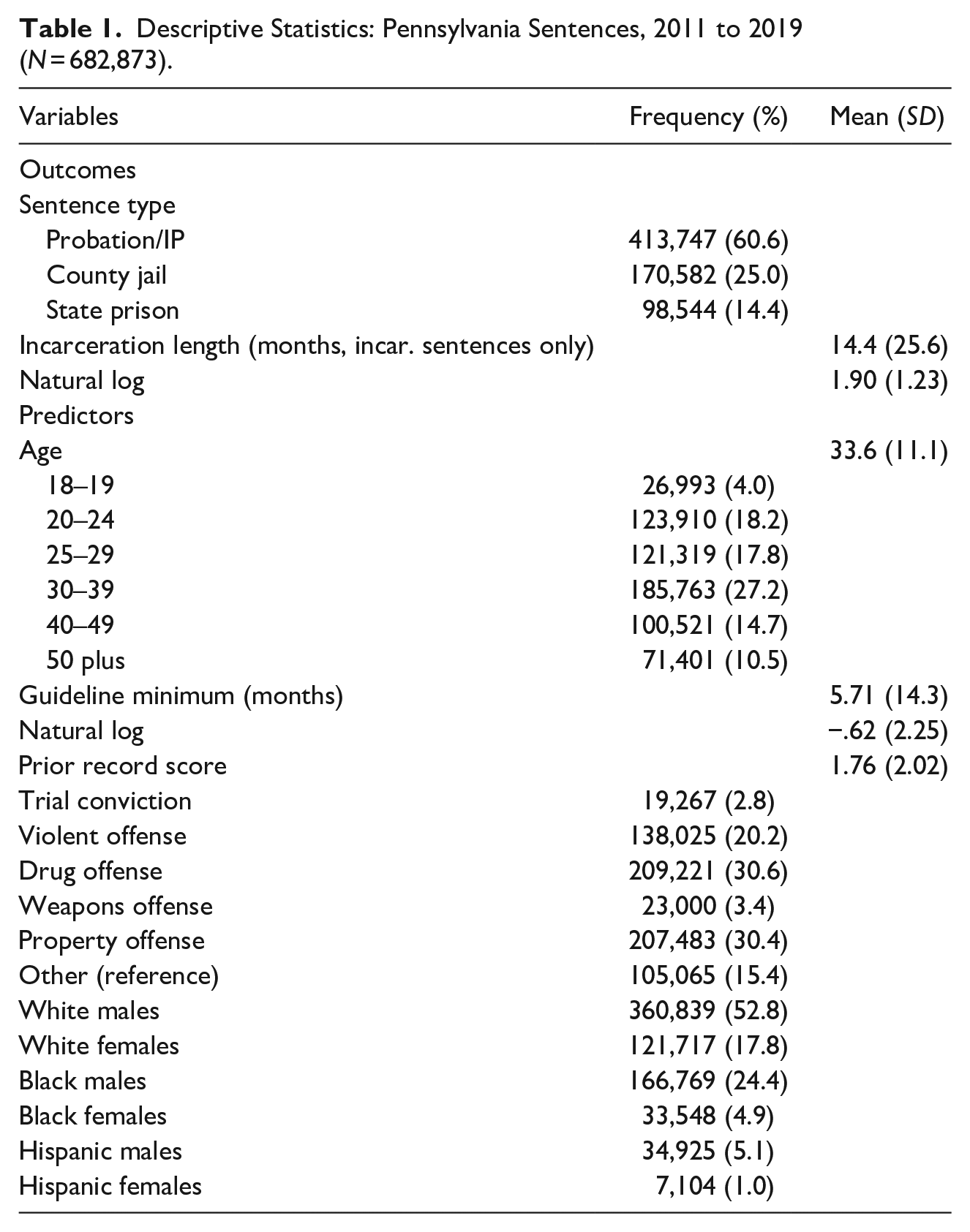
Most sentences, 60%, were probation or other alternatives to incarceration. About 39% of defendants were incarcerated, with 25% to jail and 14% to state prison, and the mean sentence length was about 14 months. The mean age of defendants was about 33 years. Four percent of defendants, 26,993, were ages 18 to 19 years. About 18% were aged 20 to 24 years and a similar proportion aged 25 to 29 years (the reference group in all analyses). The largest group of offenders were in their 30s, but there are substantial numbers of offenders in their 40s and 50s as well. There are also adequate numbers of Hispanic and female offenders to support analyses that differentiate by race/ethnicity and gender. Specifically, about 18% of defendants were White and female, and 4.9%, or 33,548 defendants were Black and female. There were 34,925 Hispanic males and 7,104 Hispanic females.
Age Differences by Race/Ethnicity and Gender
Table 2 presents our full multinomial logistic regression models for sentence type, and OLS models for logged incarceration length. These models show the direct effects of age groups, and or race/ethnicity and gender groups. All models include robust standard errors clustered by county.
Multinomial Logistic and OLS Regressions Predicting Sentence Type and Length (Probation/Intermediate Sanctions as Reference).
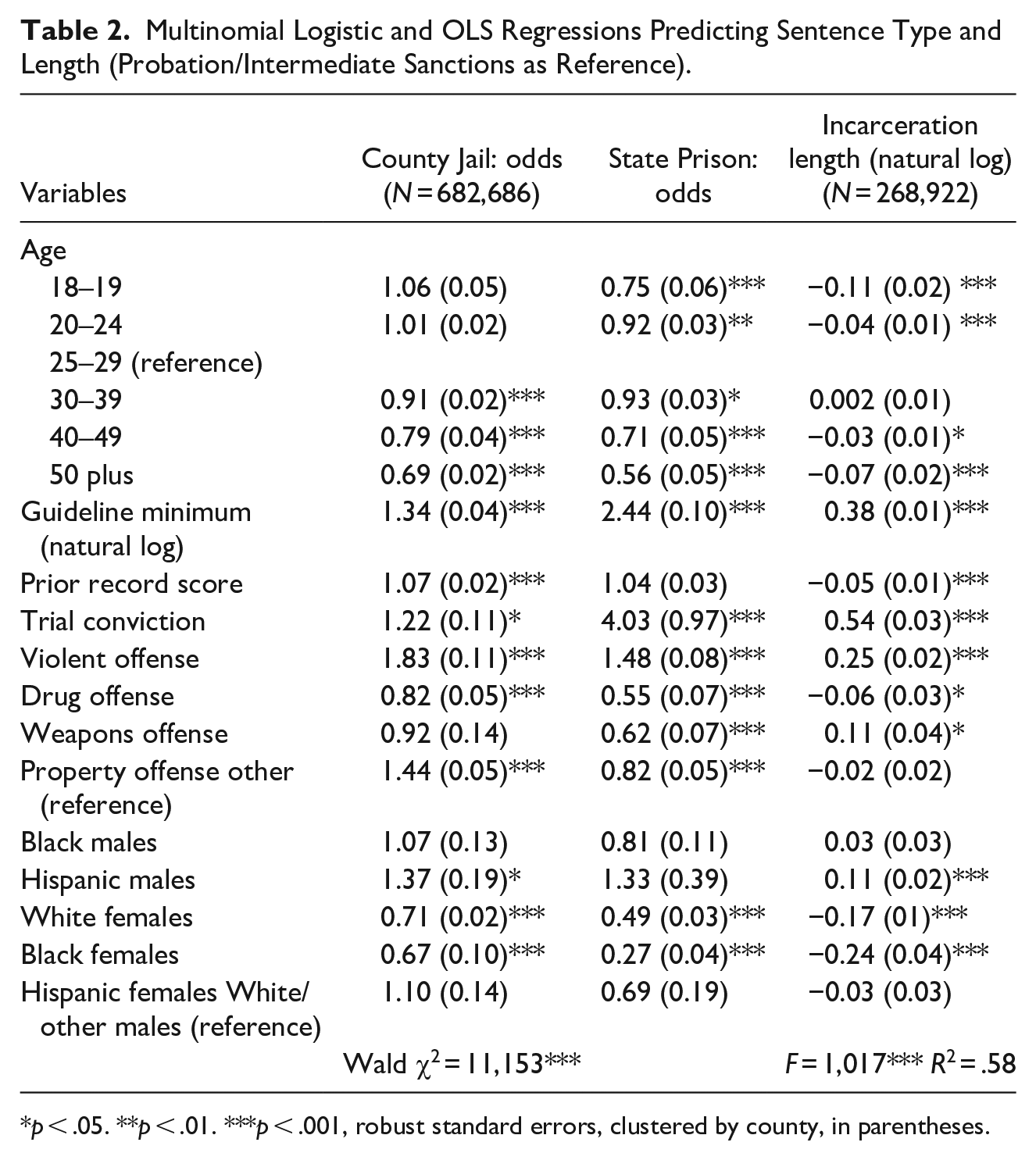
p < .05. **p < .01. ***p < .001, robust standard errors, clustered by county, in parentheses.
In the models of sentence type, the age group effects are the odds of defendants in specific age groups, compared to those aged 25 to 29 years (the reference age group) receiving county jail or state prison relative to non-incarceration sentences. The youngest defendants are not significantly different from those in their late 20s in the chances of going to jail, but they are moderately less likely to go to state prison. Those aged 20 to 24 years are not very different in the types of sentences they receive than those in their later twenties (the difference for 20–24 years old in state prison is statistically significant, but substantively small). Those in their 30s are very slightly but significantly less likely to go to jail and prison compared to those in their late 20s. Those in their 40s and especially 50s are notably less likely to be incarcerated compared to those in their late 20s.
The OLS model of incarceration length very much resembles the curvilinear effects found by D. Steffensmeier et al. (1995). Conditional on the decision to incarcerate defendants, teenage defendants receive notably shorter sentences (about 11% less than those in their late 20s), and those 20 to 24 years also receive slightly shorter terms than those in their late 20s. The sentence lengths of those in their late 20s and 30s are statistically similar, and those in their 40s receive only slightly shorter sentences than those in their late 20s. Those 50 years and older have significantly shorter (7%) sentences than those in their late 20s, but their incarceration sentences are not as short as those in their teens.
We next turn to our main inquiry, which is the extent to which race/ethnicity and gender condition the age-sentencing relationship. Table 3 summarizes results from models that tested interaction terms for age groups by race/ethnicity and gender. 2 Shown are the average marginal effects (and OLS coefficients for sentence length) of these age × Black, age × Hispanic, and age × female interaction terms testing differences in the effects of age groups between race/ethnic groups and gender. We present average marginal effects for interaction terms in the multinomial logistic regression models because interpretations of odds ratios for interaction terms can be misleading in interpretation, especially for interaction effects (Mood, 2010). Unlike odds ratios, for binary variables AMEs can be interpreted as the average change in the absolute probability of an outcome occurring given the presence of a given characteristic. Because these analyses required estimating 25 interaction terms per model and because we are concerned about finding significant results by chance, we use a Bonferroni adjustment. That is, we considered as statistically significant only those interaction terms that were significant at the p ≤ .002 level (.05/25 = .002).
Age, Race/Ethnicity, and Gender Interactions.
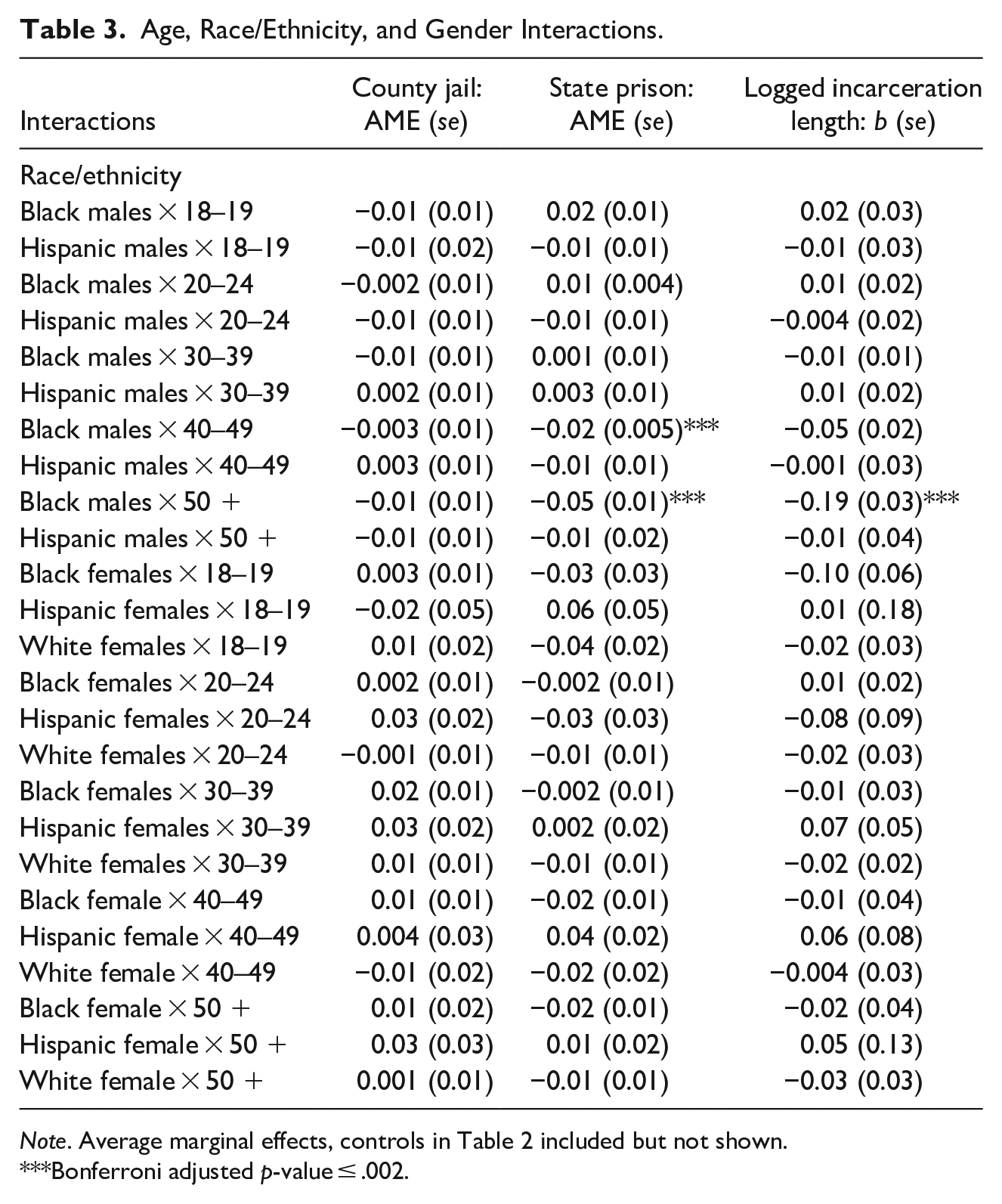
Note. Average marginal effects, controls in Table 2 included but not shown.
Bonferroni adjusted p-value ≤ .002.
The table displays few instances of race, ethnicity, and gender interactions with age, pointing to little heterogeneity in the association of age with sentencing. There is one interesting set of exceptions. Aging is associated with less imprisonment and shorter sentences for older Black men. Black men aged 50 years and over are 5% less likely to receive state prison sentences than their White male counterparts, and they receive substantially shorter (−19%) incarceration sentences than White men 50 years and over. Also, Black men in their 40s are 2% less likely to go to prison than their White male counterparts. Thus, it appears that the sentencing of specific age groups does not vary greatly by race and ethnicity. However, one consistent age group sentencing difference by race stands out: less state prison and shorter incarceration terms for older Black men compared to their White age peers.
Age Differences Within Race, Ethnic, and Gender Groups
Our final set of analyses, shown in Table 4, replicate the models in Table 3 separately for White males and females, Black males and females, and Hispanic males and females. While the interactions in Table 3 depicted differences in age effects between race/ethnic and gender groups, Table 4 shows the age differences within each race/ethnic/gender group.
Age Group Sentencing Differences Within Race/Ethnicity and Gender Groups.
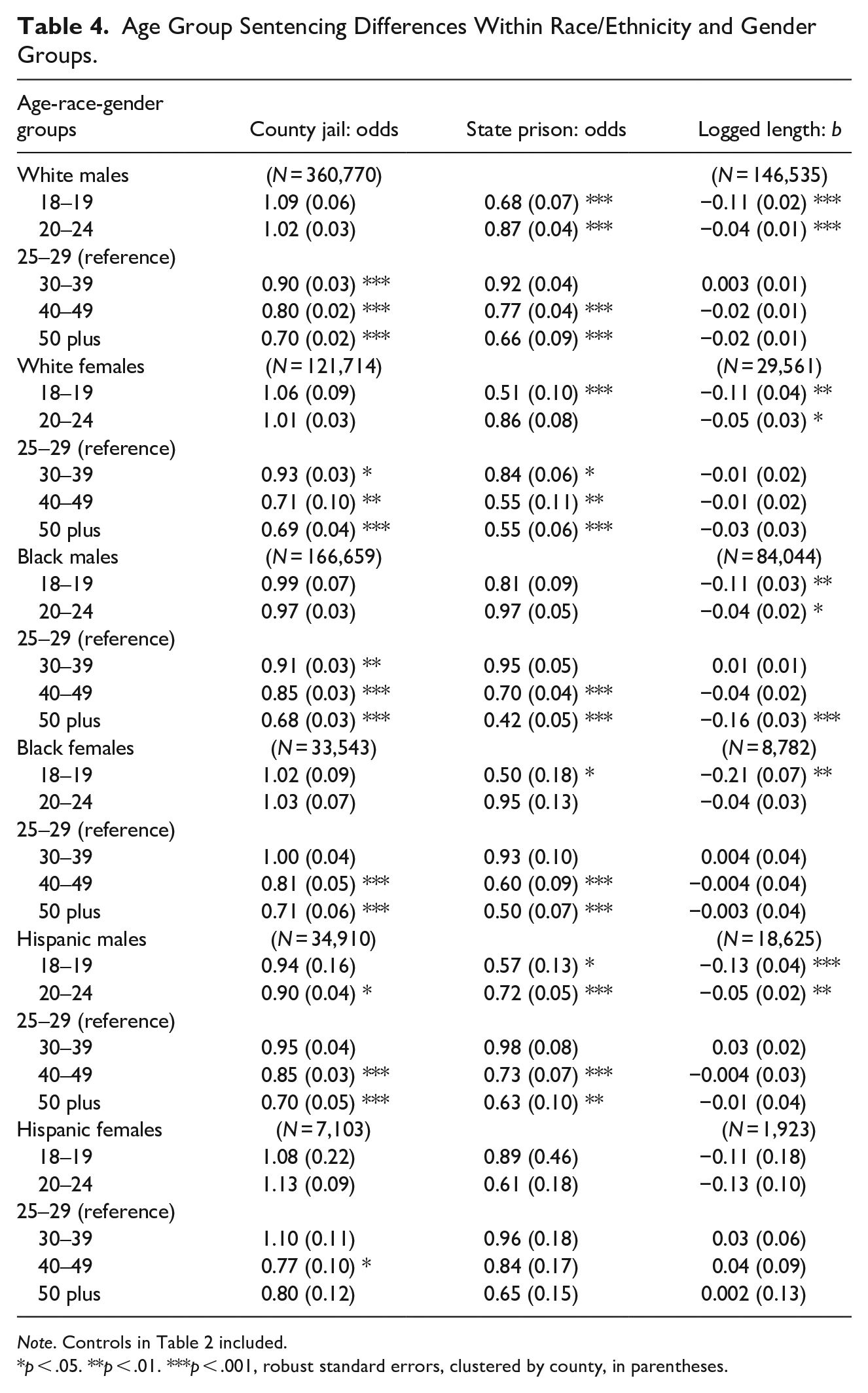
Note. Controls in Table 2 included.
p < .05. **p < .01. ***p < .001, robust standard errors, clustered by county, in parentheses.
There are several differences across the groups in the sentencing patterns connected to age. While older (40s, 50+ years) Black, White, and (to a lesser extent) Hispanic men are less likely to jail or prison, probation (and are thus more likely to receive non-incarceration sentences), the youngest Black males are conspicuous in that they are not significantly advantaged in terms of incarceration. The same is not true of White and Hispanic 18 to 19 years old men, who are significantly less likely to receive prison (and the youngest Hispanic males are modestly less likely to go to jail) compared to the same-ethnicity 25 to 29 years old. Thus, late teen and emerging adult Black males are roughly equally likely to go to jail or prison as Black men in their late 20s. But White and Hispanic late teens and emerging adults are meaningfully less likely to receive prison sentences.
Another contrast is that Black men in their 50s and up receive meaningfully shorter sentences (about 16% less) than those in their late 20s, but this is not true of White and Hispanic men. The oldest White and Hispanic men’s sentence lengths are not significantly different from their late 20s counterparts. Furthermore, in contrast to the sentence type decision, the youngest groups of Black males receive significantly shorter sentences than their 25 to 29 years counterparts, as do younger White and Hispanic men. So, youthful Black men are not advantaged in the incarceration decision, but when they are incarcerated, it is to shorter sentences than those in their late 20s.
White and Black women show substantial age differences in sentencing, but not Hispanic women. Among White women, those in their late teens have about half the odds of prison as 25 to 29 years old White women, and, if incarcerated, they receive 11% shorter sentences. White women in their early 20s receive significantly shorter sentences as well. The likelihood of being sent to jail or prison declines steadily after 30 years for White women, but older White women do not receive shorter sentences when they are incarcerated. Among Black women, those in their late teens have half the odds of prison as those in their late 20s. Black women in their 40s and 50+ years are notably advantaged in avoiding jail and especially prison. Conditional on incarceration, teenage Black women receive 21% shorter sentences than those in their late 20s, but unlike for older Black men, there are no sentence length advantages for older Black women. For Hispanic women, there are almost no significant age differences. Only Hispanic women in their 40s are significantly advantaged in avoiding jail. Several of the age group effect sizes for Hispanic women are similar to those of White and Black women, but they likely do not reach statistical significance due to the comparatively smaller numbers of cases with Hispanic women defendants and lower statistical power in the models, given the control variables.
Discussion
There has been surprisingly little focused investigation of the age and sentencing relationship (see Ryon et al., 2017; D. Steffensmeier et al., 2017), even though age is a ubiquitous control variable in studies of sentencing. The role of defendant age in criminal sanctioning continues to be an important question, however. Our findings indicate that prior understandings of the role of age in sentencing gloss over more complexity across specific sentencing outcomes and groups.
Our findings present both continuities with and differences from prior research. We found evidence of the persistence of the hypothesized understanding of age as a curvilinear, inverted U-shape effect on prison sentences and sentence length, but found that this relationship does not characterize county jail sentences. Differentiating between jail and prison reveals that the age-sentencing relationship is different for these two outcomes, and the effects of age are conditioned differently by race and gender across these sanctions. Overall, those under 30 years are about equally likely to go to jail, but prison displays the more typical curvilinear effect where the youngest defendants significantly avoid prison (except young Black males).
Our examination of age group differences within race/ethnic and gender categories uncovered more divergences from the presumed inverted U-shape curvilinear pattern of age and sentencing severity. We again see the importance of differentiating between jail and prison sentences, which prior studies of age and sentencing have failed to do. In Hypothesis 1a, we expected that the curvilinear age/sentencing relationship would only characterize White males. Instead, this pattern, where the youngest and oldest groups both receive sentencing leniency, characterized the sentencing of: (1) White men and women for state prison, (2) Black men for sentence length, (3) Black women for state prison, and (4) Hispanic men for state prison. It did not characterize any group for county jail, and it did not characterize the sentencing of Hispanic women at all. In fact, there was virtually no age differentiation in sentencing for Hispanic women.
We found that Black males were distinctive in two ways with respect to age and sentencing. First, all Black males under 30 years are about equally likely to be sentenced to jail or prison. Among other groups, the youngest defendants are much more likely to avoid state prison, but this is not true among Black males. Second, we find that Black males in their 40s and 50+ years are uniquely sentenced more leniently across all outcomes, and in fact are sentenced more leniently than older White men. By contrast, the age-sentencing patterns for Hispanic men most resembled those of White men.
Hypothesis 1b predicted that the youngest groups of Black and Hispanic male defendants would not be sentenced more leniently relative to their Black and Hispanic male counterparts in the late 20s. This was true among Black but not Hispanic men. Black men stood out from all other groups in that the youngest Black males were not advantaged in the state prison decision. Among every other group except Hispanic women, defendants in their late teens and to a lesser extent those in their early 20s were about as likely to go prison as those 50 years and older. This contrasts with findings from Doerner and Demuth (2010), who found that the youngest Black males (18–20 years) received significantly less severe federal sentences compared to Black males 21 to 29 years old.
This finding coincides with arguments that young Black men are less likely to benefit from perceptions of youth, and may be seen as socially “older” than comparably aged White male youth (D. Steffensmeier et al., 2017). Given the criminalizing stereotypes of Black males (Steen et al., 2005), these may affect courts’ evaluation of young Black men with regard to the focal concerns of perceived dangerousness, blameworthiness, practical constraints, rehabilitative potential. Young Black men in their teens, 20s, and 30s may be seen as more crime-prone and dangerous, more morally disreputable, less amenable to rehabilitation, and as less harmed by the collateral consequences of incarceration (Rios, 2011; D. Steffensmeier et al., 2017). Courts may therefore be less reluctant to send them to state prison.
Hypothesis 1c expected that only the oldest groups of Black and Hispanic men would be sentenced more leniently relative to their Black and Hispanic male counterparts in the late 20s. This was only partially true. Among Black males, those in their 40s and especially 50+ years are the only ages significantly less likely to go to state prison, and Black men 50 years and over also receive substantially shorter incarceration sentences compared to Black men in their late 20s, a finding which corresponds to prior research (Doerner & Demuth, 2010; D. Steffensmeier et al., 2017). But an unexpected and novel finding is that older black males received more lenient sentences than their White counterparts. Prior studies have not found such a pattern. Another contrast with prior research is that older White and Hispanic men are not advantaged in terms of incarceration length. 3 Older White and Hispanic men are less likely to be incarcerated, but when they are, their terms are about the same as those in their late 20s.
These results are consistent with the argument that aging blunts criminal stereotypes of African Americans (D. Steffensmeier et al., 2017; D. Steffensmeier & Motivans, 2000). Older Black men and women were conspicuously more likely to be diverted from incarceration, and Black men received much shorter sentences when they were incarcerated—20% shorter than those of white men. These findings imply that aging strongly affects prosecutors’ and judges’ assessment of focal concerns among African American defendants. Black male youth and emerging adults do not seem to benefit from leniency as those in other groups do, but middle aged and older Blacks may be seen as much less threatening, as more settled and stable members of the community, and as more amenable to rehabilitation. Another possibility is that prosecutors and judges consider the defendant’s physical health as part of their assessment of the practical constraints and consequences of punishment (D. Steffensmeier et al., 1995, 1998). Studies have documented racial disparities in health conditions and health outcomes in later life, and emphasized poorer health outcomes, shorter life expectancy, and limited access to quality healthcare among African Americans (Cagney et al., 2005; Farmer & Ferraro, 2005; Gilbert et al., 2022; Phelan & Link, 2015).
We expected that there would be less age differentiation in sentences among women defendants compared to men (Hypothesis 2a). This was somewhat true, in that there were fewer significant age differences within Black, White, and Hispanic women compared to men. We found no significant interaction effects between age groupings and race/ethnicity and gender—indicating no significant differences in the effects of age groups between Black, White, and Hispanic women, supporting Hypothesis 2a and 2b.
Hypothesis 2c expected that young White women defendants would be sentenced more leniently relative to their female counterparts in the late 20s, but young Black and Hispanic women would not. This prediction was not fully supported, in that the youngest Black as well as White women were substantially less likely to be sent to state prison, and received notably shorter sentences compared to Black and White women in their late 20s. Teen and emerging adult Hispanic women were not sentenced differently than Hispanic women in their late 20s, and in fact there were almost no age differences in the sentencing of Hispanic women. Still, our results were inconsistent with the hypothesis that youth only benefits White women at sentencing—young Black women were also very likely to avoid the most severe incarceration (state prison) and were given on average shorter sentences than older Black women.
There are a few limitations to the current research. First, this study only focused on individual-level factors and did not consider county- and courtroom-contexts. Future research should investigate variation in the role of age in sentencing decisions while also considering how judge and county-level characteristics might condition the effects of age on sentencing. For example, population age differences or offending patterns might vary between county jurisdictions, conditioning differences in the age-sentencing relationship. Second, this is a study of one U.S. state, but studies should examine the age-sentencing relationship across different states or even national legal systems. For example, this study focused on a sentencing guidelines state, but future research should investigate age and sentencing in states without this state-level policy constraint on court sentencing discretion. In addition, like most sentencing studies, we lack data on important pre-conviction processes and instances of prosecutorial discretion, such as charging, pretrial release, and the likelihood of conviction by guilty plea or trial. It is important to examine the potentially complex role of age, and how it may intersect with race/ethnicity and gender, in these decisions as well.
Since archival sentencing data cannot demonstrate the subjective decision processes of judges and others (Lynch, 2019; J. T. Ulmer, 2012), qualitative research should complement quantitative analyses of age and sentencing. Qualitative inquiry could ask judges directly how they factor age into their sentencing decisions, and how this might vary by race/ethnicity and gender. Evidence exists that judges consider age in connection with the focal concerns of sentencing (D. Steffensmeier et al., 1995; J. T. Ulmer et al., 2023), but uncovering their rationales and justifications for giving either more lenient or harsher sentences to certain age groups, and differing perceptions of age status by race/ethnicity and gender would improve understanding of age and sentencing.
Conclusion
Our results are consistent with recent research on judges’ perceptions of focal concerns. Judges frequently reported considering age as an indicator of multiple focal concerns, but they considered age in complex and perhaps contradictory ways (J. T. Ulmer et al., 2023). Our analyses also support the intersectionality perspective, in that age should not be considered as a single characteristic that is examined in isolation from other defendant characteristics. Rather, as long noted, defendant social statuses intersect and call out differential criminal punishment outcomes (D. Steffensmeier et al., 1998, 2017; Spohn, 2000).
Our findings also illuminate policy questions regarding whether courts consider age in sanctioning in the way that the U.S. Supreme Court has envisioned. Do they advantage youthfulness as per Graham v. Florida (2010 560 U.S. 48) and Miller v. Alabama (2012 567 U.S. 460)? Our findings suggest they do, but with some key exceptions. The youngest defendants are not meaningfully advantaged in county jail sentences, and the youngest Black males stand out among other youth in the lack of leniency regarding prison sentences. Thus, the recognition of youthfulness as a factor warranting leniency appears to bypass Black male youth at least in one very consequential punishment decision. Furthermore, youth appear no more likely to be spared jail sentences than those in their late 20s, who are most likely to be incarcerated.
In addition, the proportion of elderly prison inmates has increased substantially, and these older offenders present greater health costs to prisons (see Stal, 2013; Williams & Abraldes, 2007). Our findings show that courts continue to be reluctant to incarcerate older offenders, and suggest that courts are mindful of resource burdens on the correctional system. In addition, the finding that courts are especially reluctant to sentence older Black men to jail or prison raises the question of whether this group suffers unique health disparities, and whether older Black defendants may need more targeted health care resources.
Overall, this study suggests that conceptualizing the age-sentencing relationship in the traditional curvilinear U-shape manner oversimplifies this relationship and neglects complexity across sentencing outcomes and groups. It is important to examine these variations to more fully understand the nuanced nature in which age is relevant for the sanctioning process.
Footnotes
Declaration of Conflicting Interests
The author(s) declared no potential conflicts of interest with respect to the research, authorship, and/or publication of this article.
Funding
The author(s) received no financial support for the research, authorship, and/or publication of this article.
