




Abstract
Generally, Americans support the right to bear arms. However, a less studied inquiry is whether the public believes citizens should be allowed to take up arms secretly. We assess if Americans support a public gun registry so that they can know who around them (i.e., in their own neighborhood) owns firearms. To do so, we embedded a split-ballot experiment into a national survey (n = 1,000) to assess support for registries for either handguns or AR-15 style rifles. Our results reveal that support for a gun registry is high (more than 60% of the sample supports it) and support does not vary based on the type of firearm. Furthermore, sources of support for registries are assessed and discussed.
Gun regulation implicates – and also serves – multiple constitutional liberties and interests. Too often, the gun debate is presented as if there are constitutional rights on one side (that of gun owners) and only nebulous policy “interests” on the other.
Two facts about guns in America by now are broadly familiar. The first is that the United States contains the most heavily armed citizenry in the world, with more than 100 million Americans owning guns (Pew Research Center, 2023) and approximately 400 million firearms in circulation (Mascia & Brownlee, 2023). The second is that the rate of firearm homicide and suicide is much higher in the U.S. than other high-income countries (Grinshteyn & Hemenway, 2019). Indeed, in 2023 alone, over 43,000 Americans were killed by gunshot wounds, 56% from suicide and the remaining 44% from homicides, accidents, and other gun-related incidents (Gun Violence Archive, 2024). Moreover, the number of mass shootings has increased in the last decade (Gun Violence Archive, 2023), and firearms have become the number one cause of death for children in America (Davis, 2023). Importantly, the burden of gun deaths in the country “falls not only directly on the victims themselves but also can impact their families, friends, and communities. These more indirect costs include medical care, grief, fear, hopelessness, and PTSD” (Hemenway & Nelson, 2020, p. 29).
Although America’s gun culture is not new (Yamane, 2022), it has evolved into one that is less socially innocuous than in the past. One notable shift has been the rising popularity and politicization of the AR-15, a firearm that is owned by approximately 20% of gun owners but reviled by gun-control advocates who view them as unnecessary, excessively lethal, and a key contributor to the problem of mass shootings (Debusmann, 2023). Indeed, the AR-15 “has become a stark symbol of the nation’s gun violence epidemic” (Frankel et al., 2023).
A second important shift is that the majority of firearms today are owned for protection (Berrigan et al., 2022; Pew Research Center, 2023), reflecting an implicit readiness among most gun owners to use their firearms against others in the event of a real or perceived threat. Perhaps not coincidentally, the transition in America’s gun culture from being primarily about hunting and sport to protection has occurred during a time when Americans’ trust in one another has been continuously declining (Brady & Kent, 2022; Putnam, 2000). At times, the combination of distrust and protective gun ownership has been disastrous for innocent Americans. For example, early in 2023, 20-year-old Kaylin Gillis was shot and killed by a man in Hebron, New York after mistakenly pulling her car into the wrong driveway (Timsit, 2023). Just 2 days prior, 16-year-old Ralph Yarl was shot and injured for a similar act of turning into the wrong driveway (Paquette et al., 2023). Moreover, such tragedies occasionally occur even in the absence of a perceived threat. For example, during a similar time as the previous two examples, a family in Texas was slaughtered with an AR-15 after asking their neighbor to reduce the noise he was making so their baby could sleep (Doubek, 2023).
Incidents such as these—along with the prevalence of criminal gun violence in the country—have contributed to high levels of gun-related anxiety in the United States. According to a recent poll, more than 8 in 10 Americans view gun violence as a “very big” or “moderately big” problem in the U.S. Moreover, 45% of parents are at least somewhat worried about their children getting shot (Gramlich, 2023), a fear experienced more acutely by non-White parents from low-income and urban areas, reflecting the fact that gun violence disproportionately affects communities of color (Grinshteyn & Hemenway, 2019; Kalesan et al., 2019). What is clear, is that the large majority of Americans believe that firearms inflict far too much harm and that something should be done to address this problem.
Where Americans disagree, however, is the role that gun legislation and gun access plays in solving this problem. Poll data suggests that the public is evenly divided in their opinion about whether guns make society more or less safe, with 49% of people positioning themselves on each side of the debate (Schaeffer, 2023). Gun rights advocates tend to believe that the more law-abiding gun owners there are in a community, the lower the likelihood of criminal victimization (Kleck & Gertz, 1995; Lott, 2013), or, at the very least, that owning a gun will keep an individual and their family safe from crime (Carlson, 2015). Thus, those on this side of the debate tend to prefer minimal restrictions on firearms access. Conversely, many others believe that the more firearms there are in circulation, the greater the likelihood that they will end up in the wrong hands (i.e., the hands of criminals, children, or those with severe mental illness), resulting in more gun violence and accidents (Cook, 2020; Wozniak, 2017). Additionally, pro-control scholars maintain that access to firearms increases the harm and lethality of altercations (Zimring, 2020). Importantly, because guns are designed to efficiently inflict lethal harm, others in the pro-control camp—particularly those who are unfamiliar with firearms—may be apprehensive about guns even in the hands of their law-abiding neighbors (Schutten et al., 2023; Sola & Pickett, 2024).
Despite the magnitude of America’s gun violence problem, the general trend in recent years has been for the Supreme Court to expand gun rights. For example, the DC v. Heller (2008) decision endorsed the right to bear arms as the right to bear arms for self-defense irrespective of service in a militia. Moreover, the outcome of the NYSRPA v. Bruen (2022) decision was that “the Court for the first time in history expanded the Second Amendment right to allow citizens to carry a gun in public spaces” (Spitzer, 2023, p. 58). Notably, the Bruen decision also adopted a new metric for determining the constitutionality of contemporary gun regulations. Namely, for a firearm regulation to be considered constitutional, “the government must demonstrate that the regulation is consistent with the Nation’s historic tradition” (NYSPRA v. Bruen, 2022). In other words, new gun regulation must align with a historical precedent, a strict requirement considering U.S. gun laws have historically been relatively loose (Charles, 2023; Spitzer, 2023). Some argue that this decision “has rendered the right to bear arms the most protected of rights in the Constitution” (Bridges, 2022, p. 70).
What these decisions demonstrate is that for better or worse, Americans likely will always be able to purchase a firearm for protection. When it comes to perceptions of safety, this works in the favor of those who believe that guns make themselves, their families, and society safer. On the other hand, as Second Amendment rights continue to expand, America’s gun culture will continue to be imposed on those who have no desire to live in a heavily armed country. This raises an important question: What measures can be put in place to increase the perceived safety of gun-averse Americans who feel threatened by firearms? When it comes to gun policy, increasing perceptions of safety (not just actual safety) is critical for enhancing the wellbeing and life satisfaction of members of the public (Eller & Frey, 2019; Hemenway et al., 1995) and thus is a worthwhile policy goal in its own right.
To that end, in the current study we explore public support for one such policy that aims to enhance perceptions of safety for gun-averse individuals: a public gun registry that would allow people to determine whether those living near them own a firearm(s). Such a policy would empower those who are apprehensive about guns to avoid gun-dense areas but would not undermine the ability of pro-gun individuals to exercise their right to bear arms for self-defense. In other words, the desired goal of this policy would be to maximize perceptions of safety for gun owners and non-owners alike, unlike the current state of gun rights that tend to prioritize the perceived safety of gun advocates. Due to the polarizing nature of AR-15s and their connection in the public imagination to mass violence, we also are interested in whether the public is especially supportive of an AR-15 registry. Recent experimental evidence suggests that even those who are traditionally pro-gun do not desire to live next to those who own AR-15s (Sola & Pickett, 2024).
To achieve our research objectives, we use a split-ballot experiment conducted with a national sample of 1,000 U.S. adults to examine whether the public supports the implementation of a public gun registry and whether support for such a policy increases when it is described as a registry for AR-15s compared to handguns.
Theoretical Background
Guns and Perceived Safety
On the surface, the modern gun debate reflects a shared cultural anxiety about crime and personal security (Joslyn, 2020). Pro-gun individuals advocate for a well-armed citizenry as the solution to America’s problem of gun violence. Moreover, gun ownership in the name of protection from crime is now the dominant reason for why people own guns. Indeed, around 40% of American households contain a firearm and approximately 90% of the owners of these firearms cite protection as either a major (72%) or minor (19%) reason for owning their gun(s) (Pew Research Center, 2023). For many Americans, gun ownership has become a normalized adaptation to real concerns about instability, crime, and gun violence in the country.
For many others, the problem of gun violence has only intensified the call for increased restrictions on firearms. This reaction is most evident in the wake of highly publicized mass shootings, such as the recent incident in Lewiston, Maine where a gunman used an AR-15 to kill 17 people and injure another 13 (Hernandez et al., 2023). Moreover, due to different degrees of exposure to guns (Schutten et al., 2023), many people view guns as dangerous even in the hands of non-criminals (Hemenway et al., 1995; Kleck et al., 2009). Indeed, advocates of stricter gun control tend to be apprehensive about a society where individuals, untrained or undertrained, possess lethal weapons, raising concerns about the unintended consequences of a heavily armed citizenry (Filindra et al., 2020), especially because there often is no way of knowing whether those around you own or are carrying a gun.
Seeing as debates about gun regulation center shared concerns about personal safety, “[i]t would be reasonable to assume. . .that the enormity of gun violence as a social problem would bode well for evidence-based scholarly interventions into the gun debate” (Carlson, 2020, p. 184). In other words, the successful enactment of gun regulations should chiefly depend on whether evidence suggests they are effective in curbing gun violence. However, evidence-based interventions have been hard to come by. This is because although on the surface the gun debate is about safety, gun attitudes are the product of a confluence of factors that often are only tangentially related to calculated and informed decisions about the risks associated with owning versus not owning a gun (Kahan & Braman, 2003). Indeed, gun-risk perceptions are intertwined with racial attitudes (Filindra & Kaplan, 2016, 2017; Higginbotham et al., 2023; Schutten et al., 2022a), social identities (Kleck, 1996; Lacombe, 2019; Lacombe et al., 2019) and sociocultural perceptions of the meaning of liberty, individualism, and the role of government in society (Braman & Kahan, 2006; Celinska, 2007; Haner et al., 2019; Kahan & Braman, 2003). Moreover, the decision to own a gun as an adult often is conditional on childhood socialization into gun ownership (Cao et al., 1997; Schutten et al., 2023), so pro- or anti-gun attitudes occasionally may be adopted without much thought or deliberation.
Therefore, as gun scholars have begun to recognize that Americans’ perceptions of guns hinge not only on what they do but also on their symbolic meanings (Cassino & Besen-Cassino, 2020; Mencken & Froese, 2019; Metzl, 2019; Siegel & Boine, 2020; Yamane, 2017), they also have learned that gun attitudes tend to be unaffected by scholarly evidence. Instead, people engage in motivated reasoning when evaluating gun-related research and typically only accept evidence that is consistent with their preconceived notions (Kahan & Braman, 2003; Kahan et al., 2017; Pierre, 2019). Accordingly, although both sides believe that evidence matters, they adhere to opposite “truths” about the role of guns in society and assume that the other side is ignoring the facts (Carlson, 2020).
For pro-gun individuals, there are several reasons why they might discount scholarly evidence about the role of guns in making communities and homes less safe (e.g., Hemenway, 2011). For one, attitudes about the safety benefits of guns are often nuanced. For example, according to the 2015 National Firearms Survey, approximately 40% of gun owners answered “it depends” to a question about whether guns make a home safer or more dangerous (Mauri et al., 2019). Indeed, many people believe that whether a firearm increases the safety of a home is conditional on factors such as the proficiency, temperament, and mental health status of the owner, as well as whether the firearm is safely stored (Pallin et al., 2021; Sola & Pickett, 2024). Therefore, pro-gun individuals are likely to disregard blanket statements about the risks of having a gun in the home and may argue that the average risk is inflated by the misuse of firearms by irresponsible, untrained, and mentally unhealthy persons. However, even pro-gun Americans who believe a gun in their home makes it safer may perceive that a gun next door has the opposite effect (Sola & Pickett, 2024).
In a similar vein, psychological research suggests that the majority of humans tend to believe that they are above average on many skills (Kruger & Dunning, 1999). For example, around 75% of people believe that they are a better driver than the average person (Williams, 2003). In the context of gun ownership, a “better-than-average” effect (Roy & Liersch, 2013) also is likely at play. Accordingly, even if a gun owner were to agree that in the aggregate, guns make homes and society more dangerous, they could at the same time believe that this does not apply to themselves because of their superior abilities, and thus advocate for the protection of gun rights: “A gun in my hand makes me safer, even if other people cannot be trusted with firearms.”
The key takeaway is that regardless of the evidence, gun rights advocates likely will continue to believe that guns make their homes safer, and gun control proponents will continue to believe that there are too many firearms in the U.S. Accordingly, for the purposes of maximizing public perceptions of safety, what matters most is not necessarily whether the evidence suggests that a gun law will improve safety, but whether people believe that it will. However, because Americans are divided on whether guns increase or decrease safety (Schaeffer, 2023) and such attitudes are largely impervious to evidence (Carlson, 2020), determining legislation that maximizes feelings of safety is challenging.
Gun Ownership as a Negative Externality
An important difference between the two sides of the gun debate, however, is that when it comes to perceived safety, one side imposes a negative externality on the other (Brunson, 2019; Cook, 2020; Metcalf, 2018). A negative externality is “the imposition of a cost on a party as an indirect effect of the actions of another party. Negative externalities arise when one party. . .makes another party worse off, yet does not bear the costs from doing so” (Eldridge, 2023). In the context of guns, when people decide to take up arms for self-defense, they simultaneously contribute to an overall sense of insecurity and unease among gun-averse individuals (i.e., a negative externality). Indeed, while proponents of gun rights often argue that guns make those who own them feel safer (Kleck, 1996), an oft-overlooked consideration is whether “guns in Household A make other households (B, C. . .Z) feel more or less safe” (Hemenway et al., 1995, p. 124, emphasis in original). After all, although many Americans have normalized guns, they are objects that are designed to inflict lethal harm efficiently and with little effort. Ironically, the same characteristics that make firearms desirable tools for self-protection among those who are familiar with them, are what invoke fear among others.
The question, then, is how can the psychological costs of guns be minimized for those who do not own them and/or do not feel safe around them? Passing meaningful gun control legislation, especially on the national level, is exceedingly difficult (Bridges, 2022; Charles, 2023; Spitzer, 2023). Although most people support the Second Amendment (Barron, 2018), many Americans also may believe they have the right to know how likely they (or their children and/or spouse) are to be exposed in their daily lives to firearms in the hands of others. This may be especially true in a society where trust in one another has been declining for years (Brooks, 2020; Putnam, 2000; Rainie & Perrin, 2019). As Siegel and Blocher (2020) argued, “Gun laws . . . serve many constitutional values” (p. 11), and “in enacting gun laws, the government acts for a majority of citizens who believe that not only their families’ physical safety, but their communities’ fundamental freedoms—to travel, to speak, to learn, to pray, and to vote without fear or intimidation—are at stake” (p. 15).
One possible way to enhance the perceived safety of gun-averse individuals is to create more transparency about the dynamics of gun ownership in communities. With the proliferation of firearms in the country, one of the central concerns for those who are fearful of guns is that there often is no way of knowing how many people around them own guns. Moreover, because restrictions on concealed carry generally have loosened over time (Cook & Goss, 2020), an unknown percentage of pedestrians also can be packing heat at any given moment. Indeed, uncertainty of safety, even in the absence of a direct threat, engenders anxiety and emotional distress (Brosschot et al., 2016). However, if people had more knowledge about how many people around them owned guns, people could self-select into communities and social groups that have levels of gun ownership that they were comfortable with, communities where a lack of trust in one another becomes less significant. For example, those who are fearful of guns can opt to live in a neighborhood with fewer guns, or perhaps in an apartment complex that bans guns—an issue that is currently being adjudicated by the courts (Triplett, 2023)—whereas those who believe that guns make society safer can opt to live amongst people who are heavily armed.
Moreover, evidence suggests that people especially do not want to live near owners of military-style weapons, such as AR-15s (Sola & Pickett, 2024). Indeed, the argument that guns are a negative externality particularly is true for AR-15s. Unlike handguns, many people fail to see why anyone would need to own an AR-15, when a handgun should be sufficient for the purposes of self-defense (Washington Post, 2023). Moreover, AR-15s have become inextricably linked in the public and political discourse to the problem of mass shootings (Debusmann, 2023), with some remarking that they are “a weapon to hunt people” (Scudder, 2023). Because of this, not only is the firearm itself feared, but people also may be particularly distrustful of anyone who would own such a weapon (Sola & Pickett, 2024).
In light of the issues raised above, the current study examines popular support for a public registry of firearms that would create more transparency for gun-averse individuals without infringing on the rights of gun-owning Americans. It is important to note that the prospective legislation herein is not the same as a traditional gun registry—one where law enforcement agencies keep a record of firearms and their owners. Rather, this registry would be one that is intended to be public, designed for the sole purpose of allowing individuals to know whether those around them own guns.
In addition to gauging public support for such a policy, we also are interested in understanding whether the degree of support is increased when it is framed as a registry for AR-15s compared to a handgun registry. We focus specifically on handguns and AR-15s because, in theory, if a public firearm registry were created to enhance perceived safety, people would likely be most interested in protective or military-styles weapons. Indeed, handguns are used in the majority of gun-crimes (U.S. Department of Justice, 2023) and AR-15s are connected in the public mind to mass and school shootings (Franklin, 2023). Conversely, other firearms such as shotguns and rifles are primarily used for hunting and infrequently used in crimes and thus likely inspire less public anxiety.
The prospective gun registry is akin to other registries aimed at disclosing potentially threatening individuals within neighborhoods, such as criminal registries like gun offender registries, white-collar crime registries, and sex-offender registries (Jasperson et al., 2022; Kernsmith et al., 2009; Zucker, 2014). Notably, popular support for such registries exists despite evidence suggesting that they do little to improve community safety or prevent crime (Agan, 2011; Platt, 2013; Zgoba & Mitchell, 2021). Wilson (2013) explains this paradox, attributing public support for registries to the illusion of control. Indeed, she argues that support for registries primarily stems from “individuals’ need to perceive control over anxiety-provoking threats . . . [T]he implementation of such registries, rather than providing any real instrumental advantage, serves to bolster feelings of self-efficacy and minimize public anxiety” (Wilson, 2013, p. 509). In other words, registries tend to make people feel safer, irrespective of actual safety benefits.
Within this context, it is possible that the public is willing to endorse registries that aim to alleviate any anxiety-provoking threat, even those that are non-criminal. Indeed, although most guns are not involved in crime, firearms are designed to inflict lethal harm. Therefore, those who live near gun owners are required to put a lot of trust in them to use and store their firearm responsibly. However, because laws that require firearm training are scarce, many gun owners are untrained or undertrained (Rowhani-Rahbar et al., 2018). Moreover, those who live in gun-owning homes but who do not personally own the firearm are even less likely to receive firearm safety training. Specifically, whereas around 60% of gun owners have undergone safety training, only 14% of non-owners in gun owning homes have received training (Rowhani-Rahbar et al., 2018). Similarly, because safe storage laws in the U.S. are minimal, unsecure gun storage is common (Anestis et al., 2023). Importantly, experimental evidence suggests that most Americans are apprehensive about interacting with gun-owning neighbors who do not safely store their weapon (Sola & Pickett, 2024).
The challenge for gun averse individuals is that it is difficult to know who around them own guns, and even more difficult to know which of those gun owners are trained and responsible. This concern may be particularly pertinent when considering whether those around you own military-style rifles like AR-15s (Sola & Pickett, 2024). Moreover, given that concealed carry is legal in every U.S. state, it is also impossible to know whether those around you are wielding a firearm. Therefore, rather than living in perpetual uncertainty, a public gun registry would enable gun-averse individuals to avoid gun-dense areas altogether without restricting the ability of pro-gun individuals to own and use firearms.
Is Gun Registration Politically Possible?
Fierce debate has swirled around gun registries for decades. In the 1930s, President Franklin D. Roosevelt’s Attorney General Homer Cummings (1937, p. 9) famously stated, “Show me the man who doesn’t want his gun registered and I will show you a man who shouldn’t have a gun.” Although FDR and Cummings were successful in creating a national registry for certain types of guns (e.g., fully-automatic firearms, short-barreled rifles, and shotguns), they failed in their efforts to establish a handgun registry (Giffords Law Center to Prevent Gun Violence, 2024). However, the issue was far from settled. Nearly 50 years later, President Ronald Reagan signed the Firearms Owners’ Protection Act of 1986, banning the federal government from maintaining a national gun registry (Congressional Research Service, 2024). Although this would seem like a death knell for gun registries, the debate still rages on today with politicians such as Congresspersons Eric Swalwell and the late Shelia Jackson Lee demanding legislation for a national gun registry (Ericswalwell, 2024; Ruiz, 2021). Importantly, this federal ban does not apply to the states who retain the discretion to legislate registration. Although seven states have chosen to prohibit the registration of firearms, eight states require registration in various ways. Most notably, Hawaii mandates the registration of all firearms with the local county police department within 5 days of acquisition (ARMS Directory, 2023, Giffords Law Center to Prevent Gun Violence, 2024).
The gun registration policy we are assessing differs from the policies above in one key regard: The information is not concealed in a government or law enforcement agency but instead would be available to the public. Undeniably, this disclosure of so-called private information might be viewed as intrusive. Such a claim, however, must be placed within the context of how vast personal information is publicly available on various government websites. Beyond registries for specific crimes (e.g., sex offenses), virtually every county makes available the criminal record of every defendant, which can be accessed within minutes. Additionally, voter registration information, including party affiliation, is readily and publicly available. Even more telling, ownership of property, which a gun registry would disclose, also is made available by county auditors. For example, housing records, which report when a house was built, who lives at the address, the purchase price of the house when sold, taxes paid annually, and a photo of the home, are available to anyone with access to the internet. Thus, ownership registries that are accessible to the public widely exist across United States.
Admittedly, what the current study proposes is novel. Still, any reform involves two essential ingredients. One is identifying the reform, in this case a publicly accessible registry of gun ownership. Once an initiative is raised, it moves from the impossible to the possible. The current federal ban may seem immutable, but so did other prohibitions in the past (e.g., same-sex marriage, women’s suffrage). Americans under age 30 strongly favor gun control; future changes in gun policy seem likely (Institute of Politics, 2018). More salient, blue states already are amenable to passing gun legislation, especially if it promises to enhance gun safety. A second ingredient is demonstrating public support. Such data give a reform credibility because it shows that its implementation might yield political capital (Enns, 2016; Erikson et al., 2002; Pickett, 2019). With former Surgeon General, Doctor Vivek Murthy recently declaring “firearm violence an urgent public health crisis in America” and pushing for warning labels to be placed on guns, calls for innovative and increased firearm risk reduction prevention strategies are likely to grow, including the discussion around gun registries (The U.S. Surgeon General’s Advisory, 2024, p. 32). Importantly, the current paper contributes to both of these ingredients.
Current Study
This study aims to achieve three primary objectives. First, we seek to gauge the level of public support for the implementation of a public gun registry. Second, we aim to determine whether support for such a policy varies based on how it is framed—specifically, whether the registry is described as targeting handguns or AR-15s. Third, we are interested in identifying what theoretical predictors underlie support for, or opposition to, such a policy.
The literature on gun attitudes suggests that several factors may predict support for a gun registry, which is likely to be perceived as a form of gun control. For example, robust evidence indicates that racial and political attitudes shape gun control preferences, with both racial prejudice and political conservatism being associated with opposition to gun control (e.g., Burton, Logan et al., 2021; Filindra & Kaplan, 2016, 2017; O’Brien et al., 2013; Schutten et al., 2022a; Wozniak, 2017). Similarly, although the evidence is less robust, instrumental concerns such as fear of crime and past victimization may also influence attitudes toward a public gun registry (Burton, Logan, et al., 2021; Filindra et al., 2020; Heath et al., 1997; Verrecchia et al., 2021; Wozniak, 2017). Theoretically, individuals who fear crime or have been the victim of crime may be more likely to support the registry, perceiving it as a tool that could enhance their sense of security and ability to avoid future victimization.
An additional factor of relevance is gun ownership status (Miller, 2019; Wolpert & Gimpel, 1998). Theoretically, this association could be in either direction. Non-gun owners may support the policy because they want to know who around them owns guns. On the other hand, gun owners may also express support so that they can surround themselves with other gun owners. Of course, they may also reject the proposed policy due to concerns about privacy and freedom. Finally, one’s location of residence—such as living in the South or residing in a rural area—may also shape attitudes about the prospective gun policy (Kleck et al., 2009).
In light of the above discussion, in the analyses that follow, we account for a wide array of variables such as political ideology, racial attitudes, fear of crime, past victimization, gun ownership status, location of residence, and several demographic characteristics.
Methods
The study uses national-level survey data (n = 1,000 respondents) collected from July 24, 2023, to July 30, 2023, by YouGov. The University of Texas at Dallas Institutional Review Board (IRB) reviewed and approved the collection of these data (IRB# IRB-23-662). Due to their credibility, rigor, and prominence in online opt-in survey research, scholars have published YouGov data in prestigious social science, medical, and public health journals (Almeling & Gadarian, 2013, Boudreau & MacKenzie, 2014; Factor et al., 2013). More specific to the current paper, YouGov data have been used to examine issues related to gun politics (Schutten et al., 2022a), gun ownership and gun control (Burton, Logan, et al., 2021; Filindra & Kaplan, 2017; Schutten et al., 2023), and school shootings (Burton, Pickett, et al., 2021; Jonson et al., 2021; Schutten et al., 2022b).
YouGov uses a sampling design whereby their online panel of more than two million individuals is eligible to participate in survey requests for incentives. The advantage of this large and diverse panel is a high likelihood that individuals can be matched to unique and representative sampling frames (such as the American Community Survey [ACS]). The sampling strategy used for the current study proceeded in three stages. Stage one involved building a synthetic sampling frame constructed from the 2019 ACS (a probability sample representative of the U.S. population). The ACS sampling frame served as the reference from which YouGov drew a matched sample from their online panel. Stage two consisted of matching the recruited sample on age, race, gender, and education to the synthetic sampling frame (from the ACS) built in stage one. This process was carried out using nearest neighbor matching which starts with an individual in the synthetic sampling frame and searches (statistically) for the individual(s) in YouGov’s panel with the fewest deviations on the matching variables (age, gender, race, and education; Stuart, 2010). Finally, stage three consisted of a weighting procedure that adjusts for any remaining differences between the matched and target sample members (Rivers, 2007).
A feature of opt-in survey panels is that the response rate is sometimes misleading because the vendor works to get enough responses for the given survey. This issue is not a serious concern given research finding a weak relationship between response rates and nonresponse bias (Pickett et al., 2018). Moreover, nonresponse bias is less of a concern for relationships than univariate prevalence estimates (Heggestad et al., 2015) and note that the assumption is that the matching and weighting process used by YouGov, along with the regression models, renders nonresponse ignorable. That is, the assumption is that there is not a direct relationship between the propensity to respond and our outcome variable after adjusting for the matching and weighting variables and the controls in the regression model. Unless some unmeasured factor influences both the propensity to respond and our specific outcome variable, net of all the adjustments (matching, weighting, and statistical control), non-response will not bias our results. Nonetheless, the response rate YouGov provided to us for our survey is 87.9%. This is nearly double what a recent meta-analysis found for online survey response rates (Wu et al., 2022).
Although concerns have been raised regarding selection bias in opt-in panels, empirical assessments suggest that YouGov data yield results comparable to probability-based surveys, such as the General Social Survey (GSS). Specifically, Graham et al. (2021, p. 1) found that YouGov estimates tend to align closely with those from the GSS, with less than 10% of coefficients exhibiting statistically significant differences. Furthermore, YouGov has demonstrated greater accuracy than Gallup in predicting electoral outcomes (FiveThirtyEight, 2021), despite Gallup’s assertion that its panel is one of the few truly representative research panels in the U.S. (Gallup, n.d.). These findings underscore the robustness of YouGov’s methodology and the generalizability of its data to the broader U.S. population (Ansolabehere & Schaffner, 2014; Kennedy et al., 2016).
To examine how well YouGov’s three-stage sampling design did in procuring respondents representative of the U.S. population, it is instructive to examine the similarities in demographic characteristics between our weighted YouGov sample and the U.S. Census/ACS. Note, again, that the U.S. Census and ACS are probability samples that are nationally representative. When compared to estimates from the U.S. Census and American Community Survey (in parentheses), our weighted sample is similar to the U.S. population: non-Hispanic White, 62.8% (60.8%); male, 48.7% (49.2%); aged 65+, 21.2 (22.2%); college degree, 33.7% (33%); Northeast, 17.7% (17.5%); Midwest, 21.3% (20.6%); South, 37.7% (38.4%); and West, 23.2% (23.6%) (“QuickFacts,” 2023; U.S. Census Bureau, n.d.). Compared to the Pew Research Center’s estimates of party identification among registered voters (in parentheses), the weighted sample also resembles the U.S. population: Republican, 26.1% (30%), Democrat, 35.1% (27%). Additionally, the prevalence of personal gun ownership (31.7%) in our sample approximates that in the general population (32%; Pew Research Center, 2023). The similarity of our sample to the U.S. population—socio-demographically, geographically, politically, and in terms of gun ownership—should increase confidence in the generalizability of findings to American adults.
Measures
Experimental Procedure
Americans are especially concerned about living near people who own AR-15s (Sola & Pickett, 2024). AR-15s are widely associated with gun violence and with mass shootings specifically. Additionally, along with handguns, AR-15s are owned primarily for non-hunting, non-sport reasons (Guskin et al., 2023). A key question is whether support for gun registries is limited to AR-15s or extends to handguns, which also are associated with interpersonal violence. To test this, we use a split-ballot experiment design to test whether support for a gun registry varies based on the type of firearm considered by the respondents. Specifically, information (in our case, images of guns and text) was randomly assigned to the respondents that were split into two groups by the randomization. This type of design is regularly used to embed experimental methods into public opinion survey research (Gilens, 2002; Petersen, 2008).
For our study, one group of respondents (n = 500) received at random a photograph depicting a wall display of several handguns in a gun store with the following text: When civilians own handguns, like those pictured below, do you think there should be a public registry of owners, so that other people can find out if someone living near them owns such a weapon?
The other experimental group (n = 500) received a photograph at random showing a wall display of several AR-15 style weapons in a gun store with the following text: When civilians own AR-15 rifles, like those pictured below, do you think there should be a public registry of owners, so that other people can find out if someone living near them owns such a weapon?
After receiving one of the two randomly assigned images and text of either AR-15 style weapons or handguns, the respondents were asked to indicate if they believe that “Yes, there should be a registry” or “No, there shouldn’t be any registry.” This question is the primary outcome variable of the study—Support for a Public Gun Registry (coded as 0 = No, 1 = Yes). For the multivariate models discussed below, the randomized treatment variable is coded such the AR-15 Image = 1 (received handgun image = 0).
One key benefit of the split-ballot experiment is that it establishes, on average, the equivalence of the respondent groups assessing each type of evidence or recommendation (Petersen, 2008). Consequently, any variations in support levels among respondents across different experimental conditions can be attributed to the causal impact of the information presented (i.e., the wording of the questions). As such, a direct comparison of the relationships between theoretical predictors and support across the experimental groups can be made (Bansak, 2021). For example, if a variable shows a positive association with support in one scenario but a negative association in another, this indicates moderation—reflecting an interaction effect between that variable and the randomized treatment (Bansak, 2021).
Additional Independent and Control Variables
Beyond the treatment variable created with the split ballot design, the analyses include a variety of other theoretically relevant variables. These variables, including their coding and question wordings, have been used in other published research examining support for gun related policy (Burton, Pickett, et al., 2021; Jonson et al., 2021).
The respondents’ levels of Conservatism (1 = very liberal, 5 = very conservative) and Republicanism (1 = strong Democrat, 7 = strong Republican) are captured with two variables. Racial attitudes were also measured with two multiple-item measures. Racial Resentment (factor loadings = 0.719–0.852, α = .901) is a five-item mean index adapted from Kinder and Sanders (1996). An example item from the scale is “It is really a matter of some people not trying hard enough; if Blacks would only try harder, they could be just as well off as Whites.” White Nationalism (factor loadings = 0.768–0.864, α = .895) is a mean index comprised of four items, such as “We need to keep the U.S. a mostly White nation, which is what God meant it to be.” This measure was adapted from the work of Graham et al. (2021) and Kaufmann (2019).
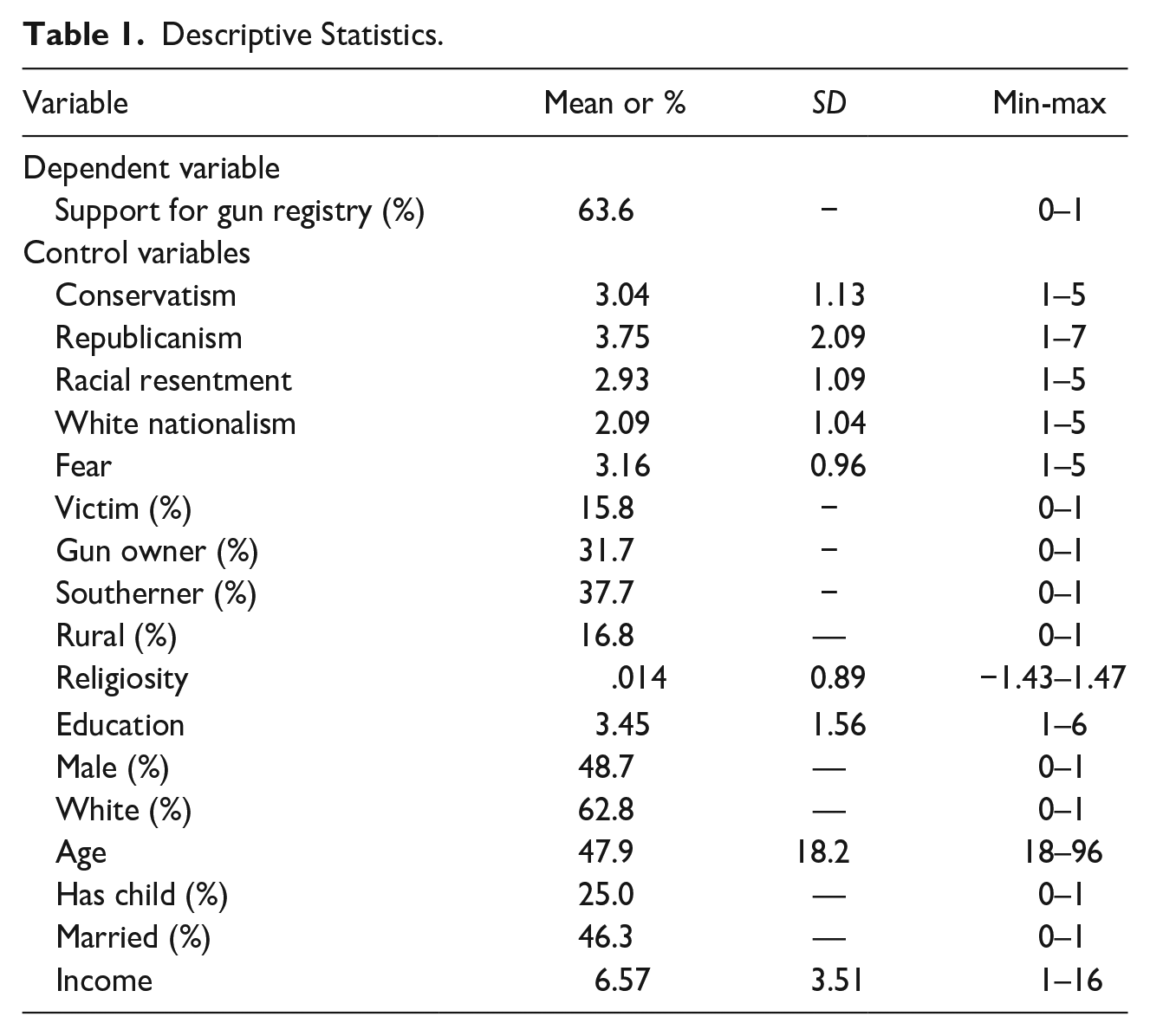
Beyond political and racial measures, we also account for the respondents’ Fear of Crime. Specifically, respondents were asked how afraid or unafraid they were that in the next 5 years, someone will try to “steal money or property from you,” “break into your house,” “rob or mug you on the street,” “rape or sexually assault you,” or “murder you.” This variable was adapted from Schutten et al. (2022a). These items were combined into a mean-index (factor loadings = 0.676–0.821, α = .863). Additionally, we also account for a host of socio-demographic variables that prior research finds are related to guns and public opinion (Burton, Logan, et al., 2021; Schutten et al., 2023). Most prominently, we control for whether the respondents individually own a firearm. Thus, Gun Owner is coded such that 0 = not a gun owner and 1 = gun owner. We also control for Religiosity, a standardized three-item mean index (factor loadings = 0.736–0.866, α = .870) based on questions about the importance of religion in respondents’ lives, their frequency of church attendance, and their frequency of praying. Other control variables consist of Education (1 = no high school, 6 = graduate degree), the respondents’ region of residence (1 = Southerner), whether the respondent has children (1 = Has a Child), marital status (1 = Married), Age (in years), sex (1 = Male), race (1 = White), previous victimization experiences (of the respondent or someone in their household) in the past 5 years (1 = Victim), geographic location of residence (1 = Rural), and a linearly imputed measure of Income (1 = <$10 K, 16 = $500K). Table 1 provides the descriptive statistics for all the variables.
Descriptive Statistics.
Analytic Strategy
The analyses proceed in the following way. First, the weighted frequencies are calculated to assess public opinion toward a public gun registry policy. Support is measured globally (i.e., combining support for a handgun registry and an AR-15 registry) in addition to specific support for the registry policy in each experimental condition (i.e., whether the respondents receive the AR-15 or handgun image). Moreover, to explore support for a registry policy more comprehensively, the sample is disaggregated into several demographic subgroups (e.g., race, gender, and education level) and support measured in each.
Second, multivariate analyses assesses whether support for the registry policy varies by the type of gun image and text received by the respondent in the split ballot experiment. A binary logistic regression framework using robust standard errors examines sources of support for a registry policy, including the randomized treatment variable and the additional independent and control variables. Finally, in addition to the main analyses, the significant predictors from the full regression model are disaggregated into subgroups and the treatment effect assessed within each subsample. Using equivalence of coefficients tests (Paternoster et al., 1998), we assess whether the type of gun considered for a registry differs by whether the respondents are from historically anti-gun groups (e.g., liberals) compared to respondents from historically pro-gun groups (e.g., conservatives).
Results
Bivariate Analyses
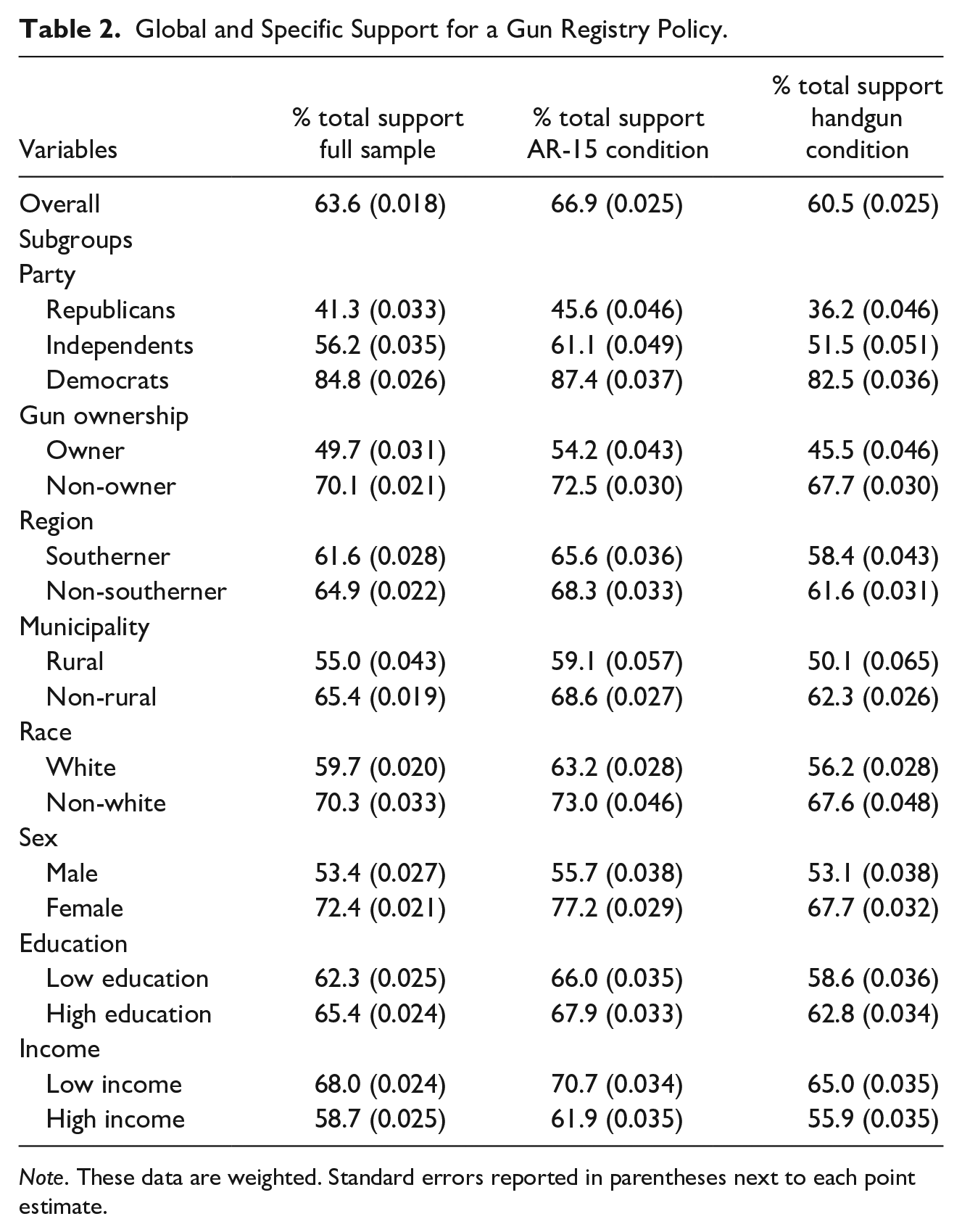
Does the U.S. public support the implementation of a public gun registry? Table 2 reveals that the majority of Americans do. Nearly two-thirds (63.6%) support the use of a registry. In addition to global support, Table 2 shows the levels of support for a registry among a variety of demographic subgroups generally and specifically for respondents in the treatment (i.e., those who received the AR-15 image and were asked about an AR-15 registry) and control (i.e., those who received the handgun image and were asked about a handgun registry) conditions. Regarding the full sample, the greatest levels of support for a registry are among (in order of most support): Democrats (84.8%), females (72.4%), non-Whites (70.3%), and individuals who do not own guns (70.1%). Those expressing the least support are Republicans (41.3%), gun owners (49.7%), males (53.4%), and individuals living in rural areas (55.0%).
Global and Specific Support for a Gun Registry Policy.
Note. These data are weighted. Standard errors reported in parentheses next to each point estimate.
Regarding the type of gun, Table 2 shows that support is slightly higher for an AR-15 registry (66.9%) than for a handgun registry (60.5%), a gap of approximately 6%. This gap widens within certain subgroups (e.g., among Republicans the gap is 9.4%) and shrinks in other subgroups (e.g., among males the gap is 2.6%), but it never reaches 10%. Notably, Republicans are quite unsupportive of a handgun registry (36.2% support), but nearly half are supportive of an AR-15 registry (45.6%). Additionally, nearly half of gun owners (45.5%) are supportive of a handgun registry and over half (54.2%) support an AR-15 registry. Apart from Republicans and gun-owners, within the remaining sub-groups support for an AR-15 registry ranges from 55.7% to 87.4%, and support for a handgun registry ranges from 50.1% to 82.5%. Below, our multivariate analyses probe whether the type of gun the respondent received impacts their level of support for a registry, controlling for many theoretically relevant variables.
Multivariate Analyses
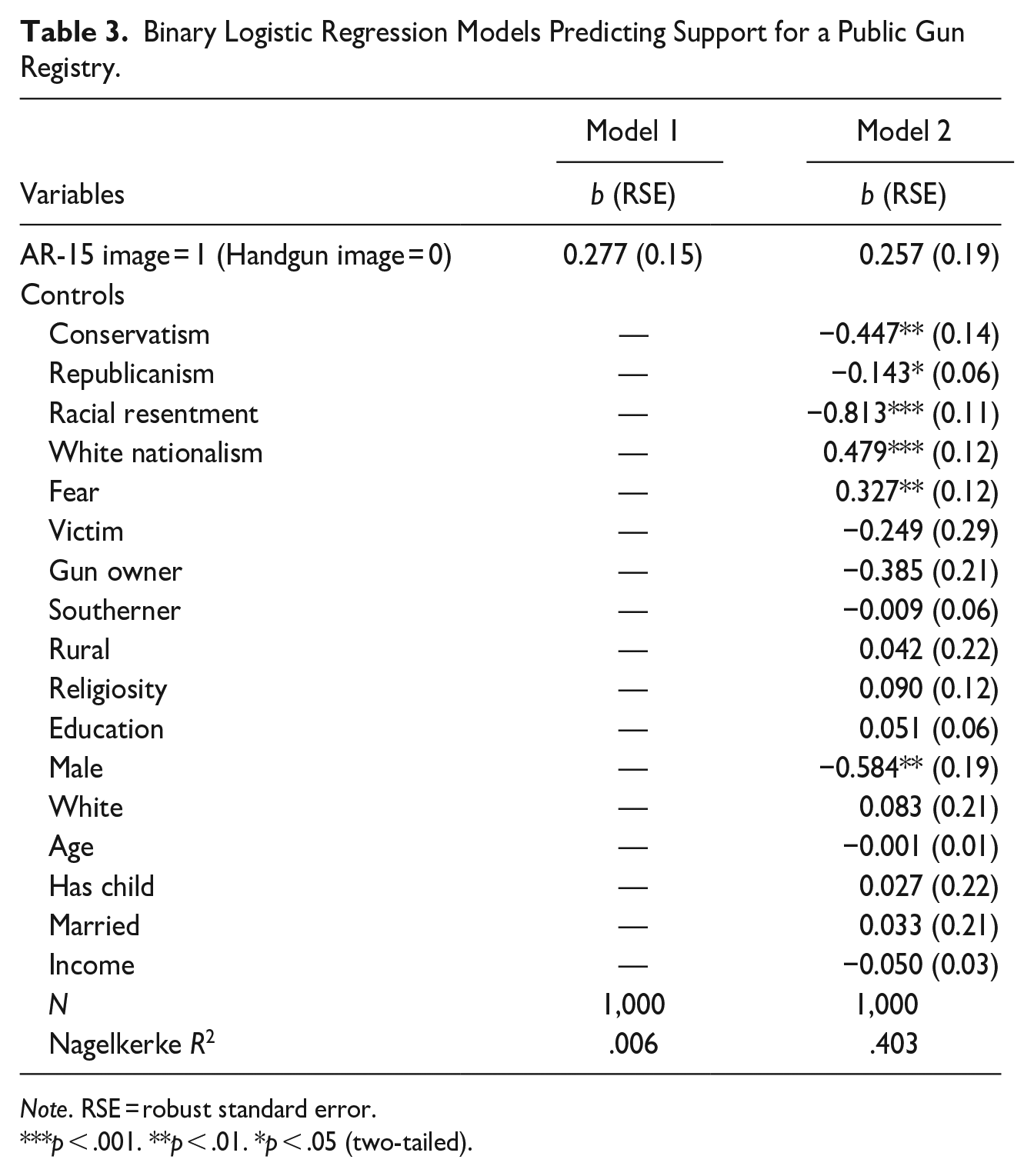
Table 3 shows the results of two binary logistic regression analyses. Note that model assumptions were assessed, including multicollinearity, and they were not found to be violated. The models also were run using an OLS regression framework and the results remained substantively the same. Model 1 assesses the effect of the experimental variable on the outcome. The observed coefficient (.277) is the difference in support for a public gun registry between the respondents in the AR-15 condition versus those in the handgun condition. Importantly, this difference is not statistically significant (p = .069). Thus, the results suggest that although slight bivariate differences in support for an AR-15 registry compared to a handgun registry exist, these differences are not sizeable enough to emerge as statistically significant in a regression analysis, indicating that the type of gun in question (i.e., AR-15 vs. handgun) has little bearing on support for a gun registry.
Binary Logistic Regression Models Predicting Support for a Public Gun Registry.
Note. RSE = robust standard error.
p < .001. **p < .01. *p < .05 (two-tailed).
Model 2 includes the additional independent and control variables. Again, whether a respondent was assigned to the AR-15 or handgun condition had little impact on the outcome (p = .181). Regarding the other variables, the strongest factors associated with support for a public gun registry fall along racial and political attitude lines. Specifically, racial resentment is significantly and negatively associated with support for a public gun registry (b = -0.813). It also is the strongest predictor in the model (β = .343). Conversely, White nationalism is significantly and posittively associated with the outcome (b = 0.479). Furthermore, and as theoretically expected, the respondents on the political right—conservatives and Republicans—are more likely to oppose a public gun registry (b = −0.447 and −0.143, respectively).
Regarding the other variables in the model, two others are significantly associated with the support for a gun registry: fear of crime and sex. Specifically, those with greater levels of fear display increased support for the use of a public registry (b = 0.327) and males are more likely to oppose the registry (b = −0.584). Of note, the male variable was the second strongest predictor in the model (β = −.246) behind racial resentment. Other theoretically germane factors such as gun ownership, prior victimization experiences, and whether someone lives in a rural area were not significantly associated with support for a public gun registry. Because we used a binary logistic regression framework, we estimate the Nagelkerke R2 value, which ranges from 0 to 1 and can be interpreted like an ordinary least squares (OLS) R2 value. The Nagelkerke R2 value for our full model is .403, which indicates a strong association between our predictors and outcome and that the model is specified (Smith & McKenna, 2013).
Disaggregated Analyses
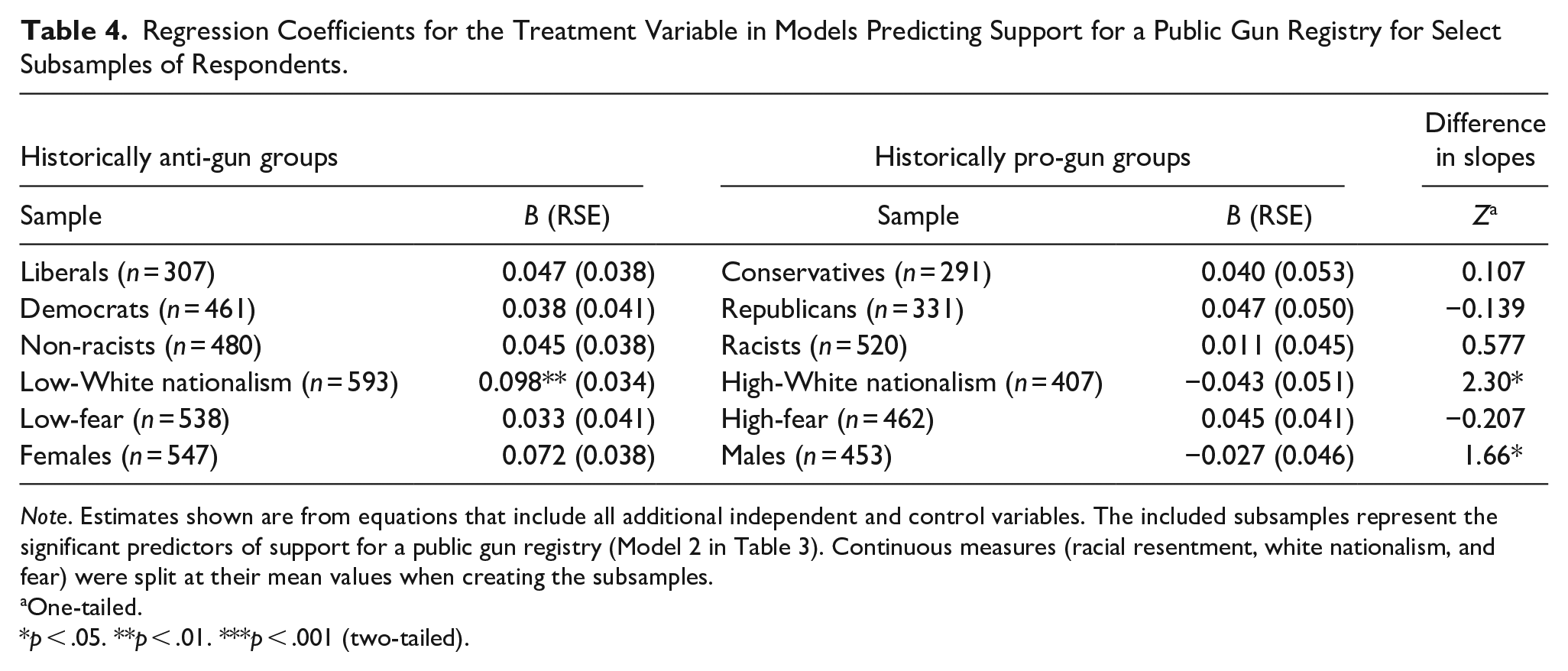
Table 4 presents the resultant coefficients for the experimental variable (i.e., whether a respondent was in the AR-15 condition vs. the handgun image) within subsamples categorized as “traditionally anti-gun groups” and “traditionally pro-gun groups.” The left-hand column of the table shows the coefficient for the traditionally anti-gun subsample and the right-hand column its traditionally pro-gun counterpart. Using best practices to statistically compare regression coefficients (Paternoster et al., 1998), we estimated these models using OLS regression. The models included the full set of variables in Model 2 of Table 3, except the disaggregation variable. Coefficients were then compared between the two groups to assess whether the effect of registry type on support for a registry differs across subsamples. As shown, liberals and conservatives, Democrats and Republicans, those low and those high in racial resentment, and those low and those high in fear did not differ significantly in their support for a registry based on the class of gun to which the registry would apply. The two significant differences that emerged were with the White nationalism and the sex variables. Specifically, in the low-White nationalism subsample, there was significantly more support for a public gun registry if it targets AR-15s rather than handguns. The significant z-score reveals the effect of the experimental variable differed significantly across the subsamples. A similar result was found with females compared to males. Females more strongly support a registry if it targets AR-15s instead of handguns.
Regression Coefficients for the Treatment Variable in Models Predicting Support for a Public Gun Registry for Select Subsamples of Respondents.
Note. Estimates shown are from equations that include all additional independent and control variables. The included subsamples represent the significant predictors of support for a public gun registry (Model 2 in Table 3). Continuous measures (racial resentment, white nationalism, and fear) were split at their mean values when creating the subsamples.
One-tailed.
*p < .05. **p < .01. ***p < .001 (two-tailed).
Discussion
Among those living in Western nations, two of the most pervasive desires are the desire for freedom and the desire for safety (Boutellier, 2004). However, there are “some potential points of tension in these dual desires, especially in the social sphere” (Bottoms, 2004, p. xi). Perhaps nowhere is this tension more pronounced than in the role of gun ownership in America, a topic that firmly lies at the center of debates about both freedom and safety, and one that has become increasingly polarized in recent years (Conley, 2019). As such, policymakers are confronted with the challenge that proposals for gun control often are perceived by some as enhancing safety, while simultaneously perceived by others as encroaching upon not only their safety but also their freedom. Therefore, firearms represent a particularly thorny problem for policymakers and politicians tasked with balancing public safety concerns with constitutional freedoms. Resultingly, implementing meaningful gun control measures is an arduous task.
In this paper, we argued that a promising avenue for future gun policy lies in specifically targeting perceived safety. Typically, prospective gun policies prioritize enhancing actual safety, relegating perceived safety to a secondary consideration. However, we contend that maximizing perceived safety is a viable policy goal in its own right. Indeed, societal wellbeing hinges not only on keeping citizens safe, but also ensuring that they feel safe. An additional advantage of prioritizing perceptions of safety is that it allows for policies that do not necessarily restrict gun access, ownership, or usage, thereby circumventing concerns about infringing on the right to bear arms. In other words, the typical barriers to enacting conventional gun policies may not loom as large for policies that exclusively target the psychological component of firearms in society.
To this end, we examined public support for a public gun registry that would enable citizens to know whether those around them own guns. Such a measure would provide individuals who are uneasy about living near guns the option to avoid or relocate to localities with lower gun densities, while also allowing those favoring gun-dense communities to do the opposite. Additionally, people can make calculated decisions to minimize perceived risks when engaging with their neighbors. For example, a gun-averse parent may ask their gun-owning neighbors to lock away their firearms before allowing their children to spend time at their residence.
Overall, the objective of this policy would be to enhance societal perceptions of safety by accommodating gun ownership preferences while mitigating the negative psychological effects guns may have on those averse to them. Our findings reveal that nearly two-thirds (64%) of Americans endorse this policy, a level of support akin to that observed for other measures such as “banning assault-style weapons” (64% support) and “banning high-capacity ammunition magazines that hold more than 10 rounds” (66% support; Schaeffer, 2023). However, as with most gun policies, a significant gap in support exists between Republicans and Democrats, with 85% of Democrats backing a public gun registry compared to 41% of Republicans.
Despite this political divide, the fact that the majority of Americans (including a non-trivial 40% of Republicans) support this policy speaks to its potential political feasibility. Of particular interest, however, is the level of support among individuals not directly benefiting from the perceived safety advantages of protective gun ownership (i.e., non-owners). Indeed, while the Second Amendment grants pro-gun individuals the freedom to enhance their feelings of safety through acquiring firearms, the proposed registry aims to offer gun-averse individuals a comparable path to perceived safety. Our findings indicate that 70% of non-owners endorse such a policy. Interestingly, approximately half of the gun owners in our sample also express support, indicating a potential interest in self-selecting into communities with fellow gun owners. Alternatively, it is possible that many gun owners understand the dangers posed by firearms if handled incorrectly, and thus may not fully trust other people to engage in responsible ownership.
The likelihood that many Americans perceive the implementation of a public gun registry as a means to enhance perceived safety is underscored by the positive and significant relationship between fear of crime and support for this proposed policy. Additionally, there exists a noteworthy gender gap in support, with 72% of women and 53% of men expressing support—a 19% difference—which may partly reflect the fact that women tend to be more afraid of crime than men (e.g., Callanan & Teasdale, 2009). In other words, it is possible that fear of crime partially mediates the relationship between gender and support for a public gun registry. Future research should explore this possibility.
Interestingly, whether the registry was framed as one for AR-15s or handguns had little bearing on overall support for the policy. To be sure, those in the AR-15 experimental group expressed more overall support for the policy than those in the handgun group (67% and 61%, respectively, a gap of 6%). Moreover, within each demographic subgroup (e.g., males, non-owners, and Southerners), support was always higher among those in the AR-15 experimental group than the those in the handgun group. However, our regression analyses revealed that the experimental treatment effect was not significantly associated with support for the policy. Instead, factors such as fear of crime, political ideology, racial attitudes, and gender took precedence.
The lack of a pronounced gap in support for a handgun versus an AR-15 registry contrasts with the significant disparities observed in public opinion regarding the outright ban of these two types of firearms. Indeed, whereas 64% of Americans support a ban on “assault-style” weapons (Schaeffer, 2023), only 27% support banning the possession of handguns (Gallup, 2023). Why, then, do we not see a comparable gap when it comes to enacting a public gun registry?
One possibility is that Americans may not see AR-15s as significantly more dangerous than handguns. This would explain why support for a public registry was not conditional on gun type. However, when it comes to outright bans, people may differentiate between the two types of firearms, perceiving handguns as dangerous, but AR-15s as both dangerous and unnecessary. Moreover, it is probable that people assume banning handguns would also involve banning almost all protective firearms, undermining the Second Amendment right to bear arms. Conversely, AR-15s may be seen as a subset of firearms that, if banned, would not inhibit people’s ability to purchase and own other guns for self-defense, such as handguns.
There are several theoretical explanations for why people may perceive handguns to be comparatively dangerous to AR-15s. First, the prevalence of handguns in society may contribute to their perceived threat level, despite the clear differences in lethal potential between AR-15s and handguns. Second, the pervasive nature of handgun violence may overshadow the less frequent, albeit catastrophic instances of AR-15-related incidents. Finally, the concealability of handguns introduces a degree of ambiguity and uncertainty that does not apply to AR-15s. In other words, as individuals navigate social spaces, anyone around them could potentially be carrying a concealed handgun. Conversely, the likelihood that those around you are concealing an AR-15 is highly improbable. Therefore, although people may desire to know the prevalence of AR-15s in their communities in order to, for example, make informed decisions about where to send their children to school or whether to take extra precautions during large community gatherings, a public gun registry may alleviate more pervasive anxieties that are specific to handguns.
There are at least two noteworthy policy implications of the study’s findings. One centers around rethinking what firearm privacy entails. It is important to note that the right to privacy is not absolute. There are numerous public registries or records that contain private information of law-abiding U.S. citizens: political affiliation, home ownership, and vital records. Although a gun registry may have some constitutional hurdles, it would be up to legislators and the courts to navigate the delicate balance between public safety and privacy rights if such a policy would be considered. Another implication is to consider less overt types of public registries. For example, although a public registry as discussed in this study might not currently be constitutionally or ethically feasible, registries that provide aggregated and de-identified data, such as gun ownership rates at the neighborhood level could be feasible.
Directions for Future Research
Future research, ideally qualitative in nature, is needed to better understand why some people oppose a public gun registry. For example, what factors contribute to the 30% of non-owners rejecting this proposed policy? It is possible that some are fearful that publicizing the number of guns in a neighborhood could make low-prevalence localities a target for offenders seeking areas with fewer guns. If evidence validates such concerns, this would undermine the intended purpose of the policy, forcing non-owners to choose between living in gun-dense neighborhoods or areas that are susceptible to crime, thus diminishing their sense of security. However, given the prevalence of gun ownership in the U.S., it seems unlikely that any community would be gunless. Moreover, anyone who lives in a low-prevalence neighborhood would be able to make calculated decisions about fortifying their homes in order to balance the low gun density. In any case, before implementing any form of public gun registry, research must first demonstrate that concerns about targeted offending are unfounded. If evidence indicates that criminals indeed target neighborhoods with fewer guns, scholars should propose alternative policies that aim to maximize perceived security without encroaching on gun rights.
Conclusion
Despite the harms caused by gun deaths in the U.S., most Americans support the right to bear arms. Indeed, only about 1 in 10 believe that the Second Amendment should be done away with (Murray, 2023). However, it appears that many Americans do not believe that this right guarantees people the freedom to take up arms secretly. Rather, our study shows that many desire to know who around them owns guns. This is not surprising considering the lethality of firearms and the erosion of social trust that has occurred over the last few decades. To accommodate this preference, the proposed public gun registry herein would enable gun-averse individuals to live and engage with communities where there is a lower likelihood of exposure to firearms. We hope that the current study serves as a catalyst for other research that aims to explore new ways to balance perceptions safety within the U.S., while still respecting the right to bear arms.
Footnotes
Declaration of Conflicting Interests
The author(s) declared no potential conflicts of interest with respect to the research, authorship, and/or publication of this article.
Funding
The author(s) received no financial support for the research, authorship, and/or publication of this article.
