




Abstract
This study examines survey-based and register-based trends in youth delinquency, namely theft and assault, in Finland over the past two decades. Our survey data includes data from five measuring points between 2004 and 2020. Our register data includes all individuals born in Finland between 1986 and 2000 who were alive and who were residing in Finland at the end of 2000. Survey findings indicate that changing routine activities in the form of declining risk routines, truancy, and alcohol consumption were the notable factors behind the declining trends in youth delinquency. With register data, maternal education appears to be the strongest contributor to the observed change, followed by maternal age. Overall, our finding emphasizes changes in the everyday activities of adolescents.
Introduction
One of the more noteworthy developments in criminology in recent decades has been the systematic decline of many traditional forms of crime. In the research literature this is referred to as the “crime drop” phenomenon (e.g., Aebi & Linde, 2010). Declining trends in crime have become evident in several Western societies, particularly concerning homicide and property crime (Farrell et al., 2014, 2018; Miles & Buehler, 2020; Suonpää et al., 2024; van Dijk et al., 2012). In Finland, for example, the homicide rate has decreased by over a third between the late 1990s and the 2010s (Lehti, 2014). Research has also indicated a long-term decline in various forms of property crime in many European countries (e.g., Aebi & Linde, 2010; Farrell et al., 2014).
Similar declining trends are also evident in youth delinquency in number of Western countries, such as Sweden, Spain, Denmark, England and Wales, and the U.S. (e.g., Andersen et al., 2016; Baumer et al., 2021; Fernández-Molina & Bartolomé Gutiérrez, 2020; Griffiths & Norris, 2020; McCarthy, 2021; Puzzanchera, 2022; Svensson & Oberwittler, 2021), along with youth risk behavior in general (Ball et al., 2023). Finland is no exemption, as findings from the Finnish Self-Report Delinquency Studies (FSRD), which have been systematically collected since 1995, demonstrate two significant periods of decline in youth delinquency. The first period of decline, primarily associated with property crime, occurred around the turn of the millennium. The second period of decline took place between 2012 and 2016, with a notable downward trend in most forms of juvenile delinquency, including violent offending and property crime (Kaakinen & Näsi, 2021a; Näsi, 2016). Trends in police-recorded youth crime, however, are more mixed due to variations between types of offences. There is a notable, systematic decline in police-recorded property crime among youths over the past two decades, whereas police recoded violent offending has witnessed an upward trend in the past few years (Kaakinen & Näsi, 2021b; Näsi & Tanskanen, 2017; Pitkänen et al., 2022). Our aim therefore is to better understand factors that have driven these longer-term trends in youth offending in Finland by examining both survey-based and register-based data. Understanding these factors will not only increase our knowledge of the reasons why youth offending has declined, but at the same time it can offer information on factors that may be in play when crime increases. Our focus is on two types of offences, assault and theft, which are the most common forms physical violence and property crime offending.
Comparing trends based on survey data and police-recorded register data is not straightforward. Survey studies often focus on less serious forms of offending in a population-based context, while police-recorded register data includes more serious offences and offenders who may not be reached through survey studies (Aaltonen et al., 2012). For our study we utilized two distinct datasets: the Finnish Self-Report Delinquency Study survey data from 2004 to 2020 and register data on police-recorded solved crimes between 1996 and 2017, focusing on total age cohorts born from 1986 to 2000. Survey data and register-linkage data have different strengths in the analysis of youth crime, and our aim is to exploit these strengths in our analyses. By analyzing survey data, we can explore a wide range of background variables and determine whether changes in these variables contribute to the declining trends in youth delinquency at a population level. Police recorded register data includes all individuals who committed police recorded crime when they were aged 15- to 17-years old between the years 1996 and 2017. The use of register data then allows for examination of the between-cohort changes in offending prevalence in police-recorded crime and how changes in maternal socioeconomic measures and criminality impact children’s offending prevalence. One of the more universal findings in criminology is the intergenerational nature of crime, as host of studies have highlighted the association between parental criminal behavior and their offspring offending (Beaver et al., 2013; Besemer et al., 2017; Frisell et al., 2011; Van de Rakt et al., 2010). Thus, use of the register data provides us with an even more comprehensive overview in understanding the factors behind the youth crime drop in Finland.
To our knowledge, this study is the first to examine changes in youth criminal behavior and related changes in risk factors using a representative survey time series and comprehensive population register data. Relying on these sets of data we focus, in particular, on examining the role of the following; parental control, youth risk behavior, daily routines and activities, mother’s socioeconomic background, and mothers’ offending behavior.
Why the Crime Drop?
The factors behind the general decline in crime have been extensively studied in criminological research. Findings highlight elements such as the improving role of crime prevention measures, advancements in technology for both control and prevention, and the historical increase in self-control and continuing civilization process contributing to the decline in homicide rates (e.g., Bannister et al., 2018; Caneppele & Aebi, 2019; Chen & Zhong, 2021; Eisner, 2014; Elias, 2004; Farrell & Birks, 2018; Farrell et al., 2014; Fernández-Molina & Bartolomé Gutiérrez, 2020; Hunter & Tseloni, 2016; Kivivuori, 2007, pp. 90–100; Matthews & Minton, 2018; McAra & McVie, 2015; McCarthy, 2021; Nilsson et al., 2017; van Dijk et al., 2012). However, Baumer et al. (2021) argue that while previous research has identified and theorized various predictors and factors influencing offending, few studies have focused on examining actual changes in these predictors and their impact on long-term offending trends. A key reason to this is lack of proper data: Svensson and Oberwittler (2021) echo this in relationship to youth offending by stating that “. . .repeated cross-sectional or longitudinal survey data focusing on the etiology of adolescent offending are needed but are rarely available over longer time periods” (Svensson & Oberwittler, 2021, p. 353).
In recent years a small number of prominent studies that rely on repeated cross-sectional survey data have emerged to provide more detailed information concerning individual level factors influencing longer-terms trends in youth offending. Although these studies are limited in number, they have uncovered some shared findings. One notable finding is the role of changing routine activities among youth in the decline of youth delinquency. Van der Laan et al. (2019), Baumer et al. (2021), and Svensson and Oberwittler (2021) have all observed a decline in youth delinquency associated with decreased alcohol consumption among young people, as well as changes in their unstructured social interactions and activities with peers (see also Ball et al., 2023). Baumer et al. (2021) also highlight youths' decreasing preference for risky activities as a significant factor.
Apart from changes in daily activities, Svensson and Oberwittler (2021) observed a hardening attitude among young people toward peer offending over the years. This trend is supported by other studies (Griffiths & Norris, 2020; Kaakinen & Näsi, 2021a) and Svensson and Oberwittler (2021) found that changes in these attitudes partly explained long-term changes in delinquency. However, findings on the impact of the changes of parental control have been more varied (Baumer et al., 2021; Frøyland et al., 2020; Svensson & Oberwittler, 2021; van der Laan et al., 2019), possibly due to differences in the items used to measure parental control across studies. That is, van der Laan et al. (2019) and Svensson and Oberwittler (2021) highlight the increasing importance of parental control and social bonds as protective factors, while Baumer et al. (2021) found no association between after-school parental supervision and declining trends in delinquency. It is therefore interesting to try adding to this existing research by examining parental role from the premise of two different types of data. As noted earlier, survey and register data are likely to reach slightly different groups offenders, as register data is more likely to also include those youth who commit more serious offences. Thus, we also have a wider spectrum of information concerning the parents, allowing us to examine the role of the parent in greater detail.
Numerous studies have also shown that the decline in juvenile delinquency has been particularly noticeable among less delinquent youths, such as those involved in single offences and with low recidivism rates (Griffiths & Norris, 2021; Kaakinen & Näsi, 2021a; McCarthy, 2021; Pitkänen et al., 2022). In Finland, the percentage of youths engaged in criminal activities has significantly decreased. In both 2016 and 2020, approximately 30% of youths reported any form of delinquent behavior in the past year, compared to around 50% in 2012 (Kaakinen & Näsi, 2021a; Näsi, 2016). Preliminary evidence also suggests that more active offenders are engaging in delinquency at an increasing rate (Kaakinen & Näsi, 2021c), indicating a growing polarization among youths as offending behavior becomes more concentrated (Pitkänen et al., 2022).
Theoretical Framework
Our theoretical premise, and our key variables, relies on elements from the classical theories of criminology, namely self-control theory (Gottfredson & Hirschi, 1990), social control theory (Hirschi, 1969), routine activity theory (Cohen & Felson, 1979), and neutralization theory (Matza & Sykes, 1957). With the aim of examining long-terms trajectories in youth offending, we focus on wide range of factors that may contribute to these trends. We also employ both survey and register data, thus further expanding the range of theories our key variables touch upon. The aim is not to critically compare these different theories, but rather focus on better understanding what the key contributing factors in youth offending trends over the past two decades are.
Risky Behavior and Attitudes
The self-control theory, developed by Gottfredson and Hirschi (1990), challenges the prevailing notion that social and economic deprivation is the primary driver of crime. Instead, their theory emphasizes the significance of individual self-control as a determining factor in criminal behavior. According to Gottfredson and Hirschi (1990), self-control is a stable trait that explains between-individual variation in crime and related behaviors over the life course. Our survey data includes a set of questions designed to measure self-control and risk-taking behaviors, a shortened and modified version of the commonly used Grasmick et al. (1993) Low Self-Control Scale. In this study, we examine whether changes in reported levels of self-control and risk-taking among youths are associated with trends in self-reported violence and property crime. That is, does it appear that youth report increasing levels of self-control, and does this contribute in the decline in offending behavior.
The concept of neutralization, introduced by Matza and Sykes (1957), involves the development of justifying techniques to rationalize delinquent behavior. Part of the learning theory approach, it focuses on youths’ attitudes toward crime and offending behavior, particular among peers. Svensson and Oberwittler (2021) found in their study that youths' attitudes toward peer offending were a key explanatory factor in understanding the decline in offending behavior among Swedish youth. We were therefore keen to examine whether neutralization and changes in neutralizing attitudes have an impact on trends in self-reported offending in our study.
Parental Control
The theory of social control, as articulated by Hirschi (1969) in his book Causes of Delinquency, argues that social networks, ties, and key institutions such as family, education, and work function as controlling factors in individuals' behavior. The theory suggests that weaker connections to these societal institutions increase the likelihood of engaging in criminal behavior and violating social norms (Hirschi, 1969). In our study, we specifically focus on the role of parents (Fagan & Bendini, 2016; Hirschi, 1969). Parental control is commonly examined from the perspectives of attachment and supervision (e.g., Ingram et al., 2007), although Wright and Cullen (2001) argue that these aspects are highly interconnected in real-life contexts. A meta-analysis by Hoeve et al. (2012) demonstrated that attachment issues in parent-child relationships are associated with delinquent behavior for both boys and girls. Moreover, Hoeve et al. (2012) found stronger effect sizes for attachment toward mothers compared to fathers. Lippold et al. (2018) discovered that declining warmth and increasing hostility toward both mothers and fathers during adolescence were associated with higher rates of youth delinquency. Additionally, Warr (2005) highlighted the role of parental supervision in shaping the peer groups of children, noting that those with less supervision were more likely to associate with delinquent peers.
This in mind, we approach the social, parental control from two perspectives: With the aid of our survey data we investigate whether changes in levels of parental control associate with changes in self-reported offending trends. Furthermore, as noted in the introduction, one of the more consistent findings in criminological research is the intergenerational association with offending behavior (Beaver, 2013; Besemer er al., 2017; Frisell et al., 2011; Van de Rakt et al., 2010). With the register data the parental role is examined from a slightly different perspective. That is, we examine the maternal role, and cohort-level changes in mothers’ socioeconomic background characteristics and offending behavior and whether these changes can explain changes in their children’s offending behavior. We have information on the mother’s level of education, labor market status, and social assistance recipiency. The data on mother’s history of violent crimes or property crimes provides information on the problematic growth environment.
Routine Activities
Routine Activity Theory (RAT), developed by Lawrence E. Cohen and Richard Felson, is a fundamental criminological framework for examining variation in crime over time, places and individuals. The theory posits that crime occurs when three conditions converge: a motivated offender, a suitable target, and a lack of capable guardianship (Cohen & Felson, 1979). RAT examines crime, both in terms of victimization and offending, within the context of individuals' everyday routines, primarily focusing on legal activities. According to the RAT perspective, young people's routines and lifestyles are reflected in the extent to which they are exposed to crime-prone or criminogenic situations (Baumer et al., 2021). For young people, a significant portion of their daily routine revolves around friends and social interactions, encompassing considerations of where, when, and with whom they spend their time. Therefore, it is essential to investigate whether potential changes in a youth's leisure time routines, including alcohol consumption and activities that may be perceived as risky or negative (see, e.g., Chrysoulakis et al., 2022; Hoeben & Weerman, 2016), are connected to changes in self-reported offending behavior.
Research Questions
We ask the following research questions:
RQ1: Do cohort-level changes in levels of parental control, youths’ risky behavior, daily routines, and attitudes explain declining trends in survey-based data on violence and property crime between 2004 and 2020?
RQ2: Do cohort-level changes in mothers’ socioeconomic background characteristics and offending behavior explain changes in their children’s offending behavior concerning police-recorded thefts and assaults?
Data and Methods
Survey Data
The Finnish Self-Report Delinquency Study, collected since 1995, is a nationally representative system measuring juvenile delinquency in Finland. These surveys present a method of studying self-reported crime, asking young people about the crimes and norm violations they have committed, both over their lifetime and in the past 12 months. The survey is targeted at ninth grade students in primary school and respondents are aged between 15 and 16 years. The latest round of data collection in 2020 served as the ninth round of data collection (Kaakinen & Näsi, 2021a). Although the delinquency survey data has been collected since 1995, it has undergone certain changes concerning some of the key background variables. Therefore, we relied on data only from between 2004 and 2020, as they include items that are suited for comparative analysis. The survey N has been the following: 2004 (N = 5,142), 2008 (N = 5,826), 2012 (N = 4,855), 2016 (N = 6,061), and 2020 (N = 5,674). The response rate has varied between 78% and 86% between 2004 and 2020. The system has maintained a good and stable response rate. The current rate of data collection is every 4 years. All survey samples are based on a random sample of educational institutions, in which the sampling units have been basic education. The sample was ordered from the Statistics Finland register of educational institutions.
The survey items range from unauthorized absence from school, to acts of harm, theft, violence, and substance abuse (see Appendix Table A1 for a detailed description of all the items). Eleven of the survey items have remained the same throughout the measurement history, allowing for a systematic examination of delinquent behavior between 2004 and 2020. In addition, six new survey items, such as illegal online downloading and online bullying (Näsi, 2016) were included in later measuring points. For this article, we focused only on delinquent behavior over the past 12 months.
Register Data
Our second set of data includes all individuals born in Finland between 1986 and 2000 who were alive and residing in Finland at the end of 2000. A total of 906,606 individuals were included in this population, in addition to which the data includes linkages to the children’s parents. Both the children and the parents were then linked to Statistics Finland FOLK data modules, which include various measures of individuals’ sociodemographic background measured on annual basis from year 1987 onwards. In this analysis we used data on both the children and their biological mothers. These population data were then linked with a separate dataset on police-recorded crimes, which includes all solved property and violent crimes from 1996 to 2017.
Variables
Survey Study
In terms of the survey data, the measure of violence is based on a combination of two survey items. These were whether the respondent (in the previous 12 months) had beaten someone up or participated in a fight in a public place. These variables were then recoded as violence, based on whether a respondent had committed at least one of the two acts. In the survey we also collect information on how many times respondents had committed these acts, serving as the number of incidents in the past 12 months. Theft was also based on two separate questions, whether the respondent had stolen something from a store or kiosk or from a school in the previous 12 months. These variables were then recoded as theft, based on whether a respondent had committed at least one of the two acts. In the survey we also collect information on the number of times respondents had committed these acts, serving as the number of incidents in the past 12 months.
In terms of the survey-based background variables, the following variables were included in the analysis: the respondent’s gender (female/male), truancy in the past 12 months (0 = no, 1 = once, 2 = more than once), drunk driving (DUI) in the past 12 months (no/yes), cannabis use in the past 12 months (no/yes), monthly alcohol use in the past 12 months (no/yes), high risk taking (no/yes), risk routines (range 1–5), tendency toward moral neutralization (range 1–5), not living with parent(s) (no, yes), parental unemployment status (no/yes), parental control (range 1–5), and whether the parents had used disciplinary violence against the respondent in the past 12 months (no, yes). (A more detailed description of the items is available in the Appendix Tables A1 and A3).
Register Data
The prevalence of criminal offending is measured as police-recorded offences of theft and assaults committed between the ages of 15 and 17 years. In the data, only cases solved by the police are included. In terms of violence, we include offences that have been registered under the penal codes of “assault” and “petty assault” whereas thefts include penal codes “theft” and “petty theft”. In addition to the crime data, register data includes information on children’s year of birth, age, and sex. Maternal measures included in the study are mother’s highest level of education, employment status, means-tested social assistance recipiency, and criminal history. Maternal socioeconomic variables were measured in the year when the child was 16 years old. Mother’s level of education is a seven-category variable measuring highest level of education obtained. Mothers’ employment status is a binary measure indicating being employed at the end of the year, whereas means-tested social assistance recipiency measures receiving any such benefits during the calendar year when the child was 16. Regarding maternal criminal history, we included the same crime categories as with youths. Due to its relative rarity, maternal offending is measured with a 5-year window when the child was aged 12 to 16 years. See Appendix Table A2. for a more detailed description of the explanatory variables in register data.
Methods
We use a similar analytical strategy to analyze both survey and register data. In both analyses the aim was to examine the extent to which change in offending prevalence can be explained by change in the various independent variables. To assess the influence of these changes, we used nested logistic regression models to calculate observed and predicted rates of adolescents’ violent and property crime. We first present observed rates of crime from a model including only the year (survey) or year of birth (register) as a categorical independent variable, which corresponds to simple cross-tabulation of year and the binary outcome. For the next step, we calculated a fully adjusted model including all measured covariates, and the used marginal standardization (Muller & MacLehose, 2014) to calculate predicted rates of offending from the models. These predictions hold the covariate distributions fixed over time and provide a counterfactual trend of violent and property crime in a scenario where the distributions would have remained constant.
After this, we examined how much the measured covariates, and each individual-level risk factor, contribute to changes youth criminal behavior in 2004 and 2020; that is, are explained by cohort-level changes in individual-level risk factors. Because the interpretation of coefficient changes in nested nonlinear models are problematic due to the scale identification issue (see Mood, 2010), we used the KHB method (Kohler et al., 2011), which considers the rescaling of nonlinear coefficients in nested models. For these analyses, the baseline years are different for register data. For each model, we reported odds ratios and their 95% confidence interval and p-values. For all survey data models, we have calculated cluster-robust standard errors as observations are clustered within schools.
Results
Survey-Based Findings
According to our logistic regression models (Model 1 in Appendix Table A4), the prevalence of both violence and property crimes was at its highest in 2004 and 2008 and decreased after that (see Figure 1). Figure 1 shows both the observed and predicted prevalence rates for property crime and violence between 2004 and 2020. The observed rate shows the actual prevalence rate of the two types of offences during the measured time-period. The predicted prevalence rate then describes the level of offending had all the distributions of independent variables stayed constant over time. The results demonstrate that if the explanatory background variables had stayed constant at each measuring point, there would have been a minor change in the prevalence of violence and the decline in property crime would have been less steep between 2004 and 2020.
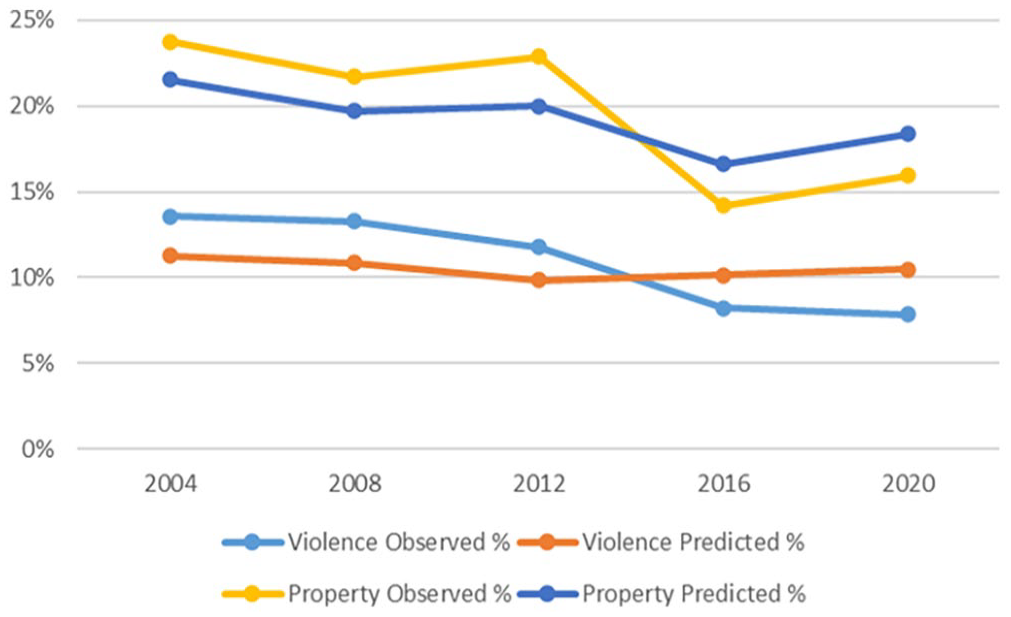
Observed and predicted prevalence of violent and property crime percentages 2004 to 2020. Survey data. Predicted probabilities calculated using marginal standardization to hold background variables constant over time.
In the models without individual-level control variables (Model 1 in Appendix Table A4), there was no difference in prevalence of violent offending between 2004 and 2008 (OR = 0.98, p = .771). Violent offending was less likely in 2012 (OR = 0.80, p = .023), 2016 (OR = 0.54, p < .001), and 2020 (OR = 0.53, p < .001), when compared to 2004. After adding the individual-level variables to the models (Model 2 in Appendix Table A4), only the difference between 2004 and 2012 (OR = 0.83, p = .046) remains statistically significant.
In terms of property crime, 2008 (OR = 0.87, p = .070) and 2012 (OR = 0.94, p = .445) do not differ significantly from 2004. However, the likelihood of property offending is smaller in 2016 (OR = 0.50, p < .001) and 2020 (OR = 0.60, p < .001), and the differences remain statistically significant even after adding the individual-level variables to the models.
In our models, changes in individual-level variables accounted for 83% of the decrease of violent offending between 2004 and 2020 and 54% of the decrease for property crimes (see total indirect effect in Table 1). In the case of both violence and property, the most significant factor behind the observed decrease is monthly drinking (accounts for 31% of the indirect effect for violent crime and 24% for property crime).
The Contribution of Each Variable to the Indirect Effect.
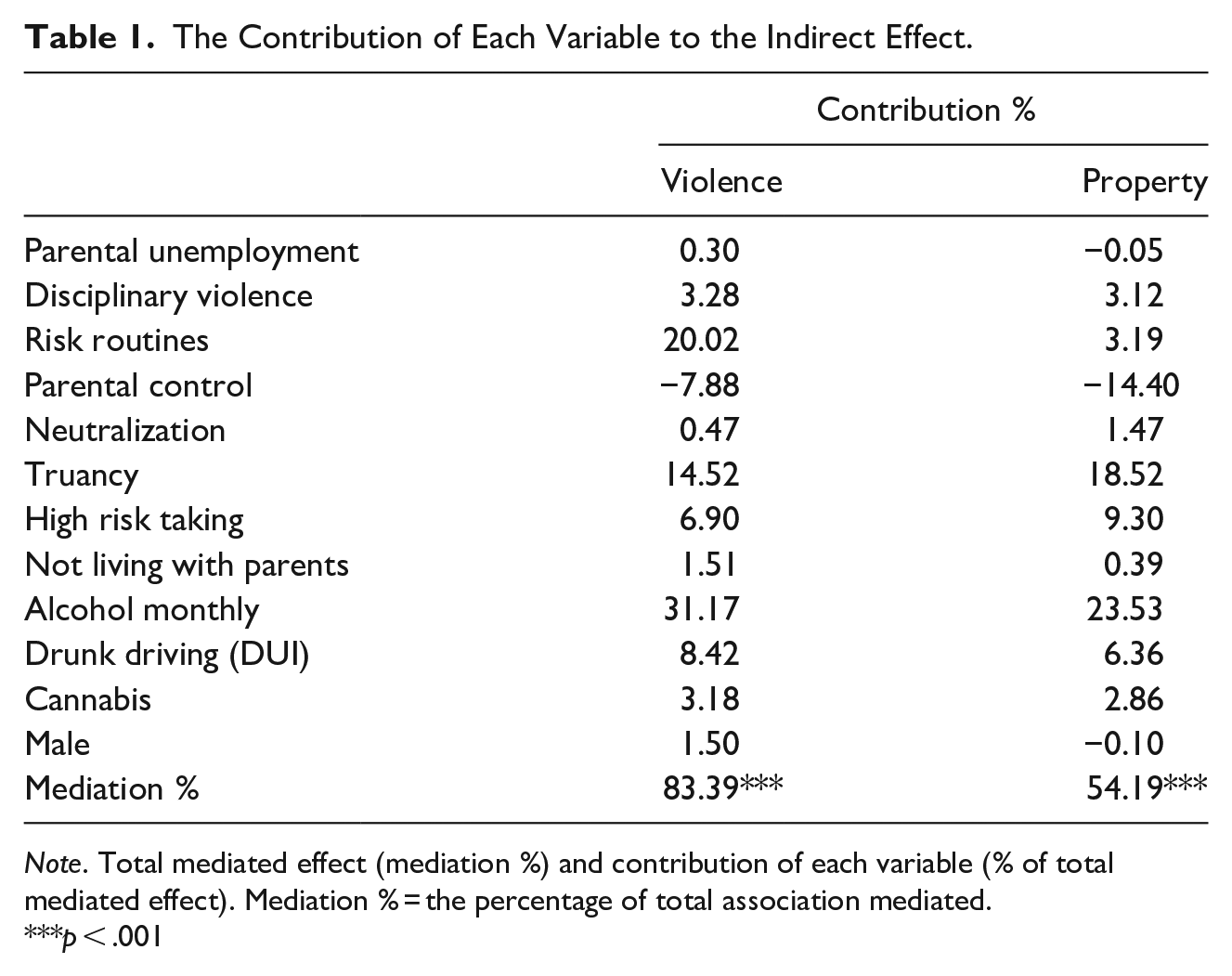
Note. Total mediated effect (mediation %) and contribution of each variable (% of total mediated effect). Mediation % = the percentage of total association mediated.
p < .001
For violent crime, the second most important factor was the change in risk routines (accounts for 20% of the indirect effect) followed by truancy (accounts for 15% of the indirect effect). For property crime, the change in truancy was the second most important factor (accounts for 19% of the indirect effect) followed by the decrease in the high-risk taking tendency (accounts for 9% of the indirect effect).
Moreover, the contribution of parental control to the indirect effect was negative for both violent and property offending (accounts for −8% of the indirect effect for violent crime and −14% for the property crime). This means that the decrease in the offending prevalence between 2004 and 2020 would have been steeper if the parental control had not have decreased simultaneously. Other parenting-related variables did not account for much of the total indirect effect. Overall, our findings indicate that changes in youth behavior and routines plays a much more prominent role in explaining the declining trends in both property crime and violent offending.
Register-Based Findings
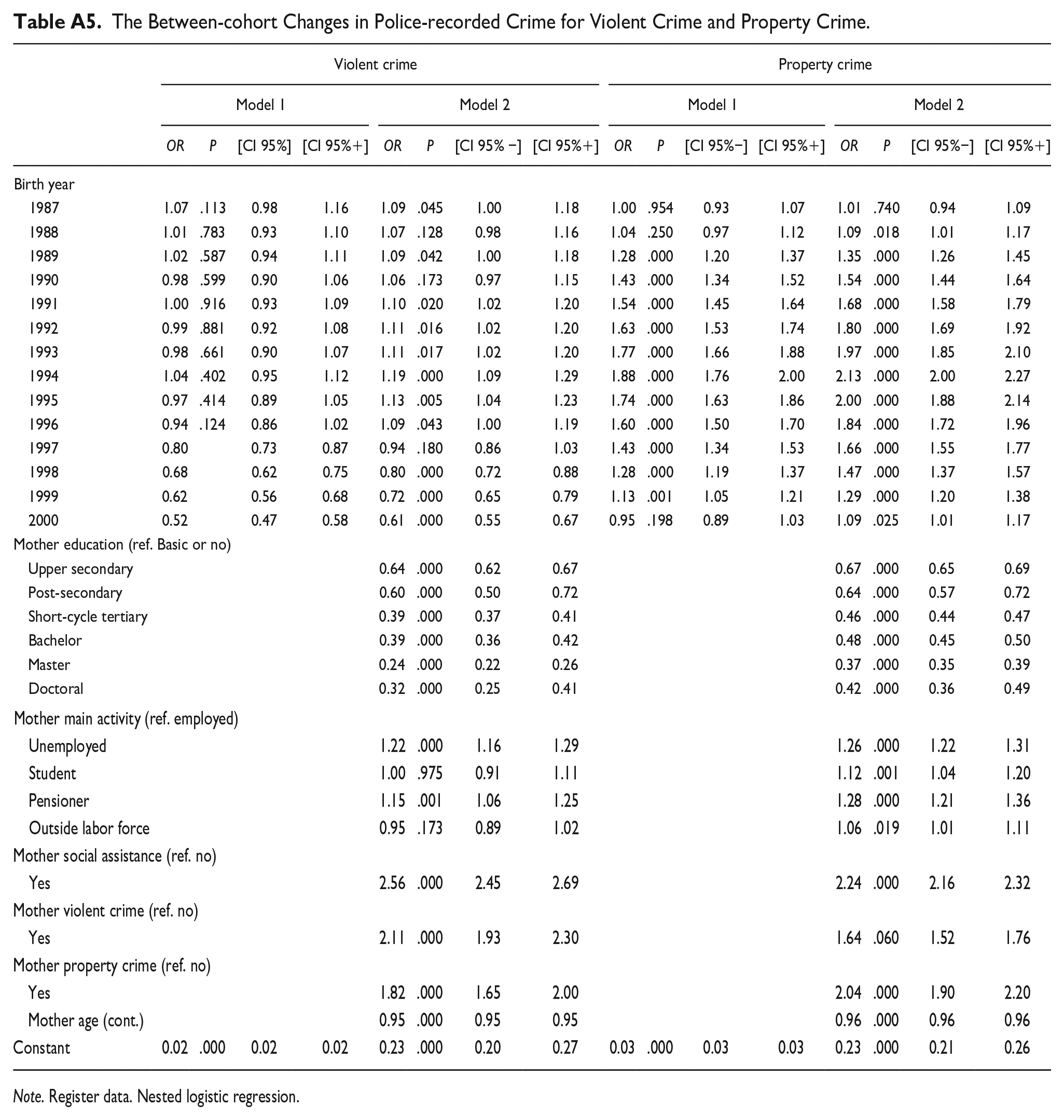
The between-cohort changes in police-recorded crime are slightly different for violent crime and property crime. The prevalence of violent offending during ages 15 to 17 years remained stable at slightly below 2% in cohorts 1986 to 1996, after which the prevalence halved in only 4 years to around 1% in the 2000 cohort. The prevalence of property crime, on the other hand, increased from around 2.5% to almost 5% in the 1994 cohort, but declined to levels comparable with the oldest cohort in the 2000 cohort. However, the mean number of property crime offences was at a clearly higher level in the 1986 cohort (.064), increased up to the 1993 cohort (.079), and then declined to clearly lower levels in the 2000 cohort (.039). In violent crime, the prevalence and mean number of offences develop more similarly (see Appendix Table 5.).
For the next step we fitted regression models for both crime outcomes separately, starting with a model that included only the year of birth dummies, and then included all potential explanatory variables simultaneously in the model. Using this full model, we used marginal standardization to calculate predictions for each birth cohort holding all other independent variables constant. In effect, the plots show a prediction of crime prevalence that would have been observed if there was no change in covariate distributions over time. These plots are presented in Figure 2.
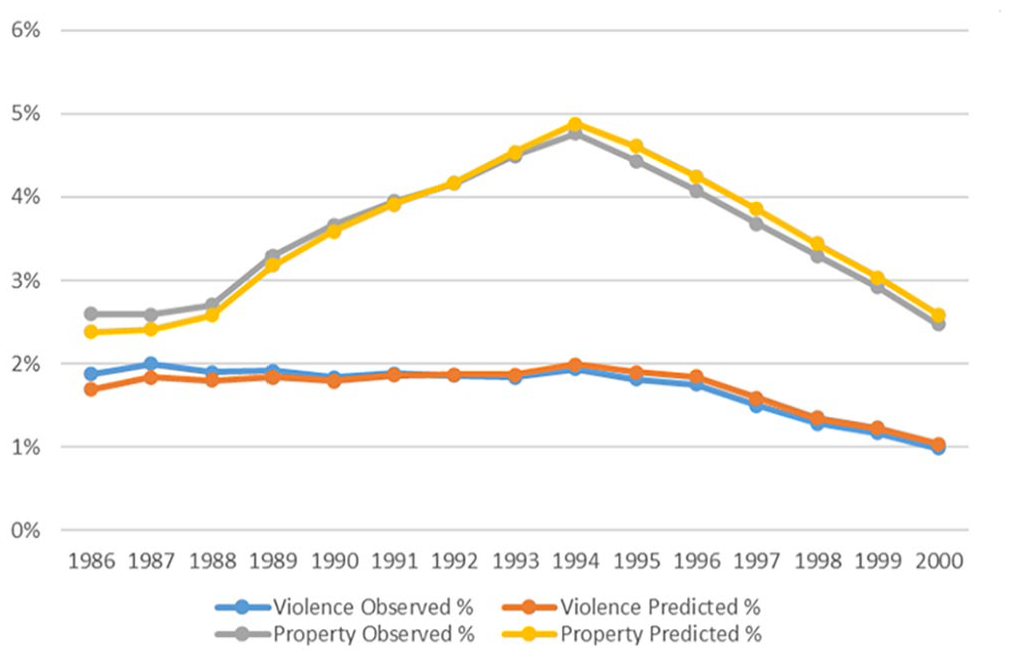
Observed and predicted prevalence of violent and property crime in birth cohorts 1986 to 2000. Predicted probabilities calculated using marginal standardization to hold background variables constant over time.
Model coefficients show that the maternal variables are associated with children’s offending in expected ways for both crime outcomes. Higher level of maternal education is linked to lower likelihood of crime, as is maternal employment. Means-tested social assistance recipiency and maternal offending are associated with a higher likelihood of offspring crime, and there is some evidence of crime type specific continuity in offending, as maternal violent crime is a slightly stronger predictor of adolescents’ violent crime, and vice versa for property crime. Despite these associations, the visual inspection of predicted vs. observed patterns suggest that none of these maternal background variables hold much explanatory power in terms of crime trends.
When examined with the KHB decomposition method (Table 2), the maternal covariates explain 28% of the difference between cohorts 1986 and 2000 in violent crime, but only 7% of change between cohorts 1994 and 2000. For property crime, a comparison between 1986 and 2000 is not very meaningful as the levels are almost the same, but the decrease between cohorts 1994 and 2000 seems mostly unrelated to changes in maternal characteristics, as only 5% of the change can be attributed to changes in the measured covariates. As the mediated share is quite small in two of three comparisons, relative contributions of individual variables appear to be large and are affected by fairly small changes in absolute terms. Of the covariates, maternal education appears to be the strongest contributor to the observed change, followed by maternal age, suggesting that improving educational level and rising maternal age might have contributed to the decreasing prevalence of violence in the birth cohorts. We also ran models using similar measures for fathers. While these variables were generally associated with crime in a similar way to maternal measures, including them did not alter key conclusions on mediation by parental characteristics, and the share mediated remained almost identical to that in models including only maternal covariates. Paternal education was also an important mediator like maternal education, and decreased the share mediated by maternal education, as expected, given that paternal education has also increased over time. Overall, the register-based findings suggest that the variables measured in register data explain the crime drop to a lesser degree than survey-based items.
The Contribution of Each Variable to the Indirect Effect.
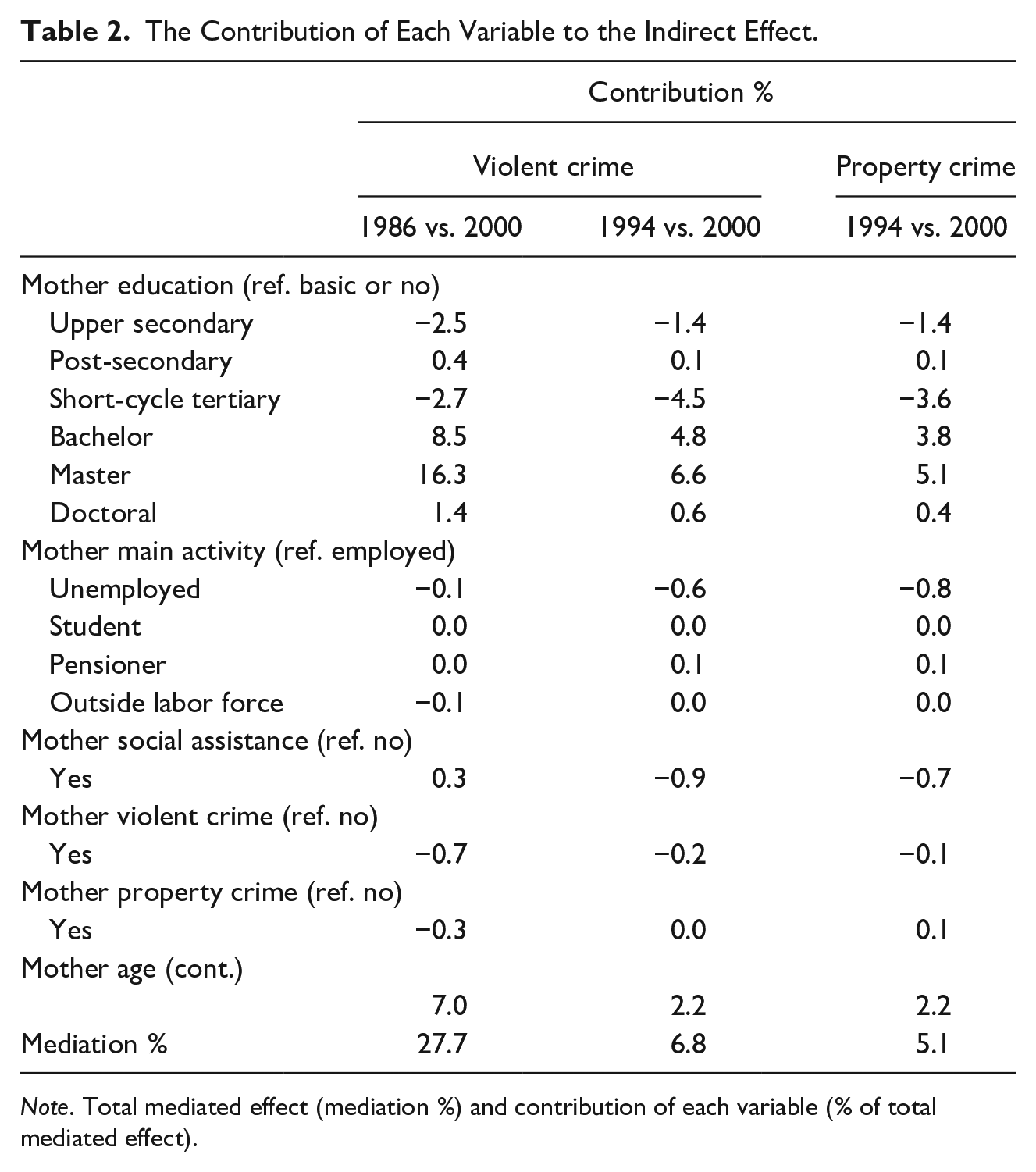
Note. Total mediated effect (mediation %) and contribution of each variable (% of total mediated effect).
Discussion
One of the more notable developments in criminology in recent decades has been the systematic decline of many traditional forms of crime in several Western societies. This decline is commonly noted as the “crime drop” phenomenon. While numerous studies have documented this decline in crime, only in recent years have researchers begun to consider the extent to which changes in individual-level factors may help explain decreasing trends in offending, especially among adolescents (Baumer et al., 2021; Svensson & Oberwittler, 2021; van der Laan et al., 2019, see also Osgood, 2023). To deepen the understanding of the crime crop, this study used both survey data and register data to examine how cohort level changes in individual-level factors help explain between-cohort changes in youth offending behavior in Finland. Our focus was on property crime and violence, specifically theft and assault.
Survey-Based Findings
Findings from the survey data indicated between-cohort changes in youths’ routine activities, and that these changes have played a notable role in the decline in youth offending over the past two decades. Declining risk routines, truancy, and monthly alcohol use had the most notable contribution in the declining trends in youth violent offending. Considering property offending, a decline in high risk taking was also a notable contributing factor. Our findings therefore appear to be in line with findings from recent related studies (Baumer et al., 2021; Svensson & Oberwittler, 2021; van der Laan et al., 2019). Although changes in the risk routines seemed to be more relevant concerning violence compared to property crime, the main contributing factors for the decline were similar for both violence and theft. Our findings are also in line with many of the observations presented by Osgood (2023), who further highlighted the importance of unstructured socializing in explaining deviant behavior.
In addition to routine activity theory, our findings highlight the interplay between elements from several criminological theories. Declining risk routines, in other words, spending less time with older youths, along with a decline in monthly alcohol consumption, indicate that elements from learning theory and social control also play a role. Youth offending commonly takes place in larger social settings or as part of a group, and thus a decline in both unstructured social interactions and alcohol consumption takes away some of these key risk factors (see, e.g., Hoeben & Weerman, 2016).
The role of truancy is also an interesting one. On the surface it can appear as a minor discretion at most, but truancy has been found to be a common denominator behind a wider selection of offending behavior (Henry & Thornberry, 2010; Onifade et al., 2010; Weathers et al., 2021). It would therefore appear that the devil really will find work for idle (adolescent) hands. In less biblical terms, truancy often results in unstructured and unsupervised social activity, which then increases the risk of offending (e.g., Wikström, 2019). Furthermore, decreasing risk taking, along with a decrease in drunk driving seem to suggest a wider pattern of decline in overall risky behavior. Changes in routine activities and between-cohorts decline in youths’ willingness to engage in risky and rule-breaking behavior are thus among the key contributing factors behind the crime drop among adolescents.
Results concerning the parental role were mixed. The contribution of parental control to the indirect effect was negative for both violent and property offending. This meant that a decrease in the offending prevalence between 2004 and 2020 would have been steeper if parental control had not decreased simultaneously. Other variables measuring parental control had a small contributing role in the decline in youth offending. It may be that decreasing parental control was a partial “byproduct” from changes in youths’ behavior because declining risky behavior has meant less need for parental supervision and control. Our findings are slightly different from some of the recent related studies, which argued that increasing parental control was a contributing factor for the decline in youth offending (Svensson & Oberwittler, 2021; van der Laan et al., 2019).
Register-Based Findings
We found that mother’s educational levels have increased between the cohorts, as the proportion of mothers with basic or no education has decreased, while the proportion of mothers with tertiary education has increased at a similar rate. In line with a recent Danish study (Andersen & Nielsen, 2024), our results suggest that educational expansion among women may have contributed to declining youth crime. Interestingly, although mothers’ educational status has improved, their employment status or use of means-tested social assistance has not really changed over time. What increased instead was mothers’ criminal activity regarding both property crime offending and violence, but rates of offending were generally low throughout the follow-up. Furthermore, the mother’s higher level of education was still linked to a lower likelihood of crime for their child, and the same for maternal age. A mother’s social assistance recipiency and maternal offending were associated with a higher likelihood of offspring crime, and there was also evidence of crime type specific continuity in offending, as maternal violent crime was a slightly stronger predictor of adolescents’ violent crime, and vice versa for property crime. Yet, apart from maternal education, neither between-cohort changes in mothers’ SES measures nor mothers’ past criminal activity explained changes in children’s criminality in the observed period. The small explanatory power of maternal factors is somewhat surprising, especially when considering the findings concerning the association between parental SES and offspring criminal behavior. However, in a way, these findings offer support to our findings from the survey data. That is, the key contributing factors behind the decline in police recorded youth offending are not related to changes in maternal (or paternal) socio-economic characteristics.
Conclusions and Suggestions for Future Studies
What our overall findings suggest is that the decline in youth offending was driven more by between-cohort changes in youths’ own behavior and social activities, rather than by an increase in external controlling factors, such as parental control. Although mothers improved educational level (and increased age) did have an association with a decline in violence, it appears that our survey-based findings explained declining trends in youth offending to a greater degree. As noted, our findings are therefore largely in line with findings from other Western countries. Therefore, providing further weight and emphasis to these findings as well. By better understanding why youth crime has declined also provides us with tools to understand why these trends might change in the future.
Why youth engage less in risky behavior and why they use less alcohol, is an interesting and perhaps even integral trend to follow up on. Do external controlling factors just operate in a less direct manner, or is offending behavior merely transitioning to online contexts? Understanding what motivates changes in youth culture, whether it is with substance use or social behavior would be a valuable addition in understanding forces that eventually impact trends in youth delinquency. The likes of Elias (2004) have emphasized long-term processes of civilization, albeit particularly related to homicide. Increase in offending behavior from the 1950s until the turn of the millennium has been referred to as a glitch in the civilization process (Eisner, 2014), and it may be that in the bigger picture crime drop indicates that the long-term civilization process is back on track.
Furthermore, the decline in youths’ delinquent behavior coincides with the constantly growing role of technology and screen time. Indeed, it has been speculated that the impact of smart technology has had a role in changing routines among youths as more screentime leaves less time to undertake other activities, and as a result, it has also played a role in the decline in youths’ delinquent behavior (e.g., Arnett, 2018; Kraus et al., 2020; Twenge & Park, 2019). However, actual evidence is so far more speculative in nature than something that has been empirically tested. The “screen-time hypothesis” therefore is still an aspect that clearly warrants further research in the future. Partly related to this, the impact of factors such as healthy lifestyle choices that promote clean and healthy living as opposed to unhealthy, alcohol-fueled lifestyle have also been brought forward (e.g., Vashishtha et al., 2021). In any case, it appears clear that there is a need to expand our understanding of factors contributing to larger changes in youth culture to really understand changes in various forms of youth risk behavior. Past research has laid a relatively solid understanding of some of the key risk factors for youth offending in general. Less is understood of the factors that promote change in the everyday life of youth, both in terms of social activity and activities, but also their attitudes and what is acceptable or desirable behavior among their peers. In terms of parental control, it would be beneficial if more studies relied on similar measures when looking into parental control, it may well be that our current measures are not sufficient in understanding and capturing the role of parental control.
Although we relied on both survey and register based data, it must be noted that our survey data comprised only five measuring points, even though the time-period examined covers 16 years. With register data, we only have limited options for examining measures of strain that might help to explain changes in police recoded youth offending. Another limitation relates to questions of causality as an observational dataset can only provide information on associations. However, we believe that our analyses provide a more comprehensive picture and overview of some of the key explanatory factors in youth delinquency. Our findings provide a novel contribution to the field, as thus far only a few studies have attempted to explain youth delinquency trends in the past couple of decades. In terms of policy implications, our findings indicate that actions aiming to reduce adolescent alcohol use and alcohol related activities is likely to help reduce many of the most common forms of youth delinquency. In general, focusing on providing youth with better opportunities in participating structured and supervised social activities is a worthwhile investment. In addition, continuous improvement in maternal education has wide range of societal benefits, including serving as protective factor for offspring offending.
Footnotes
Appendix
The Between-cohort Changes in Police-recorded Crime for Violent Crime and Property Crime.
| Violent crime | Property crime | |||||||||||||||
|---|---|---|---|---|---|---|---|---|---|---|---|---|---|---|---|---|
| Model 1 | Model 2 | Model 1 | Model 2 | |||||||||||||
| OR | P | [CI 95%] | [CI 95%+] | OR | P | [CI 95% −] | [CI 95%+] | OR | P | [CI 95%−] | [CI 95%+] | OR | P | [CI 95%−] | [CI 95%+] | |
| Birth year | ||||||||||||||||
| 1987 | 1.07 | .113 | 0.98 | 1.16 | 1.09 | .045 | 1.00 | 1.18 | 1.00 | .954 | 0.93 | 1.07 | 1.01 | .740 | 0.94 | 1.09 |
| 1988 | 1.01 | .783 | 0.93 | 1.10 | 1.07 | .128 | 0.98 | 1.16 | 1.04 | .250 | 0.97 | 1.12 | 1.09 | .018 | 1.01 | 1.17 |
| 1989 | 1.02 | .587 | 0.94 | 1.11 | 1.09 | .042 | 1.00 | 1.18 | 1.28 | .000 | 1.20 | 1.37 | 1.35 | .000 | 1.26 | 1.45 |
| 1990 | 0.98 | .599 | 0.90 | 1.06 | 1.06 | .173 | 0.97 | 1.15 | 1.43 | .000 | 1.34 | 1.52 | 1.54 | .000 | 1.44 | 1.64 |
| 1991 | 1.00 | .916 | 0.93 | 1.09 | 1.10 | .020 | 1.02 | 1.20 | 1.54 | .000 | 1.45 | 1.64 | 1.68 | .000 | 1.58 | 1.79 |
| 1992 | 0.99 | .881 | 0.92 | 1.08 | 1.11 | .016 | 1.02 | 1.20 | 1.63 | .000 | 1.53 | 1.74 | 1.80 | .000 | 1.69 | 1.92 |
| 1993 | 0.98 | .661 | 0.90 | 1.07 | 1.11 | .017 | 1.02 | 1.20 | 1.77 | .000 | 1.66 | 1.88 | 1.97 | .000 | 1.85 | 2.10 |
| 1994 | 1.04 | .402 | 0.95 | 1.12 | 1.19 | .000 | 1.09 | 1.29 | 1.88 | .000 | 1.76 | 2.00 | 2.13 | .000 | 2.00 | 2.27 |
| 1995 | 0.97 | .414 | 0.89 | 1.05 | 1.13 | .005 | 1.04 | 1.23 | 1.74 | .000 | 1.63 | 1.86 | 2.00 | .000 | 1.88 | 2.14 |
| 1996 | 0.94 | .124 | 0.86 | 1.02 | 1.09 | .043 | 1.00 | 1.19 | 1.60 | .000 | 1.50 | 1.70 | 1.84 | .000 | 1.72 | 1.96 |
| 1997 | 0.80 | 0.73 | 0.87 | 0.94 | .180 | 0.86 | 1.03 | 1.43 | .000 | 1.34 | 1.53 | 1.66 | .000 | 1.55 | 1.77 | |
| 1998 | 0.68 | 0.62 | 0.75 | 0.80 | .000 | 0.72 | 0.88 | 1.28 | .000 | 1.19 | 1.37 | 1.47 | .000 | 1.37 | 1.57 | |
| 1999 | 0.62 | 0.56 | 0.68 | 0.72 | .000 | 0.65 | 0.79 | 1.13 | .001 | 1.05 | 1.21 | 1.29 | .000 | 1.20 | 1.38 | |
| 2000 | 0.52 | 0.47 | 0.58 | 0.61 | .000 | 0.55 | 0.67 | 0.95 | .198 | 0.89 | 1.03 | 1.09 | .025 | 1.01 | 1.17 | |
| Mother education (ref. Basic or no) | ||||||||||||||||
| Upper secondary | 0.64 | .000 | 0.62 | 0.67 | 0.67 | .000 | 0.65 | 0.69 | ||||||||
| Post-secondary | 0.60 | .000 | 0.50 | 0.72 | 0.64 | .000 | 0.57 | 0.72 | ||||||||
| Short-cycle tertiary | 0.39 | .000 | 0.37 | 0.41 | 0.46 | .000 | 0.44 | 0.47 | ||||||||
| Bachelor | 0.39 | .000 | 0.36 | 0.42 | 0.48 | .000 | 0.45 | 0.50 | ||||||||
| Master | 0.24 | .000 | 0.22 | 0.26 | 0.37 | .000 | 0.35 | 0.39 | ||||||||
| Doctoral | 0.32 | .000 | 0.25 | 0.41 | 0.42 | .000 | 0.36 | 0.49 | ||||||||
| Mother main activity (ref. employed) | ||||||||||||||||
| Unemployed | 1.22 | .000 | 1.16 | 1.29 | 1.26 | .000 | 1.22 | 1.31 | ||||||||
| Student | 1.00 | .975 | 0.91 | 1.11 | 1.12 | .001 | 1.04 | 1.20 | ||||||||
| Pensioner | 1.15 | .001 | 1.06 | 1.25 | 1.28 | .000 | 1.21 | 1.36 | ||||||||
| Outside labor force | 0.95 | .173 | 0.89 | 1.02 | 1.06 | .019 | 1.01 | 1.11 | ||||||||
| Mother social assistance (ref. no) | ||||||||||||||||
| Yes | 2.56 | .000 | 2.45 | 2.69 | 2.24 | .000 | 2.16 | 2.32 | ||||||||
| Mother violent crime (ref. no) | ||||||||||||||||
| Yes | 2.11 | .000 | 1.93 | 2.30 | 1.64 | .060 | 1.52 | 1.76 | ||||||||
| Mother property crime (ref. no) | ||||||||||||||||
| Yes | 1.82 | .000 | 1.65 | 2.00 | 2.04 | .000 | 1.90 | 2.20 | ||||||||
| Mother age (cont.) | 0.95 | .000 | 0.95 | 0.95 | 0.96 | .000 | 0.96 | 0.96 | ||||||||
| Constant | 0.02 | .000 | 0.02 | 0.02 | 0.23 | .000 | 0.20 | 0.27 | 0.03 | .000 | 0.03 | 0.03 | 0.23 | .000 | 0.21 | 0.26 |
Note. Register data. Nested logistic regression.
Declaration of Conflicting Interests
The author(s) declared no potential conflicts of interest with respect to the research, authorship, and/or publication of this article.
Funding
The author(s) received no financial support for the research, authorship, and/or publication of this article.
