



Abstract
An online romance scam occurs when a criminal creates a fake online identity to manipulate a victim into developing affection and trust before financially exploiting them. It has resulted in billions of dollars in losses globally, impacting victims financially emotionally. Based on focal concern theory, this study is the first to examine the fairness of sentencing for this group of scammers in the United States. The study quantitatively analyzes 148 sentencing cases, which is the current most comprehensive dataset available, obtained from Pacer Monitor. The findings indicate that sentencing outcomes for scammers in the United States are primarily influenced by legal considerations. A comparison with similar studies conducted in China shows a consistent overall conclusion, although there are slight differences in the specific legal factors that have an impact. This study contributes to academic literature by addressing a notable gap in research within Western countries. The application of focal concern theory provides additional contextual insights, enriching the current understanding of this complex issue. Recommendations include prioritizing international collaborations, conducting detailed assessments of victim numbers and defrauded amounts, and proposing specialized laws to address the complexities of online romance scams.
Background of the Study
The popularization of the internet has brought many advantages, including seamless communication and global connectivity. However, it has also led to a rise in cybercrimes, with online fraud, particularly online romance scams, exploiting human psychology and social engineering. These scams involve criminals adopting fake identities to gain victims’ trust and affection, leading to manipulation and theft. Importantly, online romance scams are transnational, involving countries around the globe, encompassing not only Western nations but also non-Western countries (e.g., China, Myanmar). While numerous studies have delved into online romance scams concerning offenders and victims, scant attention has been paid to the sentencing issues surrounding online romance scammers. One notable exception is a study conducted by Wang (2023), which focuses on the sentencing of scammers in China. Given the rise of this problem, it is crucial to thoroughly research and tackle the fairness of imposition of sentencing guidelines, namely the existence of sentencing disparity, particularly those concerning romance scammers in the United States.
The issue of sentencing disparity has been extensively studied by scholars who analyze legal and non-legal factors affecting sentencing outcomes (Brasileiro Dourado & Fischer, 2021; Burrow, 2008; Cassidy & Rydberg, 2020; Franklin & Fearn, 2008; Hartley & Tillyer, 2019; Hester & Hartman, 2017; Lin et al., 2022). This analysis often involves applying established theoretical frameworks, such as attribution theory (Heider, 1958) and organizational efficiency (Dixon, 1995; Engen & Steen, 2000), to understand unjustified disparities in the criminal justice system. One commonly used framework is focal concern theory, which suggests that judges’ sentencing decisions are influenced by perceptions of the defendant’s blameworthiness, community protection, and practical concerns (Steffensmeier et al., 1998). However, judges may resort to perceptual shortcuts like gender, race, or age due to limited resources, affecting their decisions (Albonetti, 1991, 1997). While focal concern theory has been applied to physical crime cases like homicide (Auerhahn, 2007; Auerhahn et al., 2017; Pizarro et al., 2020), robbery (Cassidy & Gibbs, 2019), and sex offenses (Thompson et al., 2020), there’s a notable absence of research on its application to cybercrime convictions in the United States. In a prior study, Wang (2023) examined factors influencing judges’ sentencing decisions by applying focal concern theory for online romance scammers in China, highlighting the importance of legal considerations like operating overseas and defrauded amounts. However, given distinct judicial and societal dynamics in the United States, this study aims to extend Wang’s findings by investigating how judges’ decisions align with focal concern theory factors—defendant blameworthiness, community protection, and practical considerations—in the United States, shedding light on sentencing disparities within this context.
Taken together, considering the limited resources available for studying how romance scammers are sentenced in the United States, this study aims to contribute to the existing literature and social contexts of sentencing cyber-offenders by analyzing 148 verdicts per unique offender from 2016 to 2023 documented on Pacer Monitor, a database providing access to U.S. federal court records, including case dockets, filings, and judgments. Built on the focal concern theory, two major regression analysis will be carried out to examine the specific factors leading to the change in imprisonment length and probability of getting non-imprisonment sanctions. This study signs the initial step toward empirically investigating the potential existence of sentencing disparity among a group of online romance scammers sentenced in the United States. The ultimate aim is to resolve the myths regarding to this understudied aspect of the criminal justice system and contribute to the broader discourse on fairness and equity in sentencing practices for types of cybercrimes.
Literature Review
A Research Gap in Online Romance Scams Literature
Online romance scams, characterized by deceptive practices using false identities and fake relationships, pose transnational and multifaceted harms yet remain underexplored in academia. Researchers have acknowledged this phenomenon (Buse, 2005; Vitola, 2018; Whitty, 2015), which has evolved with internet migration, allowing scammers to target victims more broadly (Rege, 2009). Whitty (2015) outlined five stages of online romance scams involving dynamic social engineering. Scammers’ tactics vary between Western and non-Western countries, with Chinese scammers often using fake investment schemes (Wang & Zhou, 2023). Recent studies emphasize organized crime aspects and victims’ vulnerability (Buchanan & Whitty, 2014; Whitty, 2018), while some apply theoretical frameworks like neutralizations and rational choice (Dickinson & Wang, 2023; Offei et al., 2022; Wang et al., 2021). Emerging scholars are developing models to explain the dynamics of online romance scams and their connections to other crimes (Wang & Topalli, 2022, 2024).
Regardless, there is scant research exploring the post-offending aspects of online romance scams, particularly focusing on how offenders are legally treated when their operations are intercepted by law enforcement. This area of study can encompass a broad spectrum, including an examination of the characteristics of apprehended offenders, the application of sentencing guidelines, and an assessment of the fairness of the resulting sentences. Analyzing the post-offending legal procedures for online romance scams is essential not only for informing academia but also for providing the general public with insights into how these offenders are handled by the legal system and whether they receive appropriate punishments. Furthermore, it is essential to identify and understand the specific characteristics that the court considers in these cases. This exploration can shed light on distinctive factors that may influence legal decisions in the context of romance scams, offering valuable knowledges that extends beyond the considerations typically present in a traditional court setting. Consequently, this research aims to fill this significant gap in the existing online romance scams literature. To improve its structure and scientific rigor, the researcher will utilize a commonly employed legal framework, known as the focal concern theory, to guide the formulation of key research questions and variables.
Brief Overview of Focal Concern Theory
Focal Concern Theory asserts that judges’ sentencing decisions hinge on three primary factors: offender blameworthiness, community protection, and practical constraints (Steffensmeier & Demuth, 2000, 2001; Steffensmeier et al., 1998). Offender blameworthiness considers the extent of responsibility and culpability in committing a crime (Farrell & Holmes, 1991; Steffensmeier et al., 1998), including factors like severity of the offense and harm caused (Jeffries & Bond, 2009). Community protection assesses whether offenders pose future threats based on factors like prior convictions and rehabilitation potential (Huebner & Bynum, 2006; Ulmer & Kramer, 1996; Wang, 2023). Practical constraints involve organizational efficiency, positive relationships, and resource considerations (Steffensmeier et al., 1993, 1998). Extra-legal factors within court culture can influence sentencing outcomes (Kramer & Ulmer, 2002), and individual decisions like pleading guilty can impact case resolution (Ulmer & Bradley, 2006). Lastly, judges may rely on perceptual shortcuts, like race or gender, due to time and information constraints, affecting perceived risk and blameworthiness (Albonetti, 1991).
Existing research on focal concern theory has predominantly focused on physical crimes like drug offenses (Freiburger, 2009), sex offenses (Huebner & Bynum, 2006), and homicide (Pizarro et al., 2020), neglecting the exploration of influential factors specific to cybercrime prosecutions. Marcum et al. (2011) noted longer sentencing for female cyber offenders with convictions for identity theft, fraud, and property destruction, yet subsequent empirical studies on cybercrime sentencing were scarce until Wang’s first sentencing study (2023). Challenges such as limited access to cybercrime legal documents, few prosecuted cases in the United States, and extensive document review time hinder further research progress. However, advancing this research is crucial for comprehending how the justice system addresses cybercrime complexities. As a result, this study aims to analyze legal and extra-legal factors within U.S. legal documents, focusing on sentencing for online romance scammers, thereby bridging gaps in cybercrime research and enhancing the application context of focal concern theory.
Focal Concern Theory and Online Romance Crime Sentencing Outcomes in United States
The investigation into the sentencing of online romance scammers in the United States is prompted by the limited research in this field. In addition, the presence of varying legal systems and guidelines for cybercrime offenders between China and the United States emphasizes the necessity for this inquiry. Previously, Wang’s (2023) study has validated the applicability of focal concern theory to the realm of online romance scams in China. This research is particularly significant as it addresses the distinct nature of prosecutions in a non-Western country. Although there are some unconventional observations, such as the absence of influence from offenders’ prior criminal history, Wang’s (2023) research clearly demonstrates strong support for the focal concern theory. The study underscores the theory’s suitability for cybercrime sentencing cases by emphasizing the careful consideration of specific variables within the focal concern framework.
Significantly, China and the United States handle online romance scam cases differently, particularly in how they select and apply relevant laws. Judges in China predominantly relied on three main statutory laws, specifically Article 266 of the Chinese Criminal Law, along with Interpretations and Opinions guidelines. Consequently, sentencing outcomes for those felony cases (including online romance scams) are primarily decided based on mainly legal or case relevant factors (Wang, 2023). In the United States, participating in online romance scams is considered a felony. Courts determine the applicable federal codes from the U.S. Code based on the specific role of each individual in the criminal activity. Convicted online romance scammers may face charges under various criminal codes in Title 18, such as “fraud by wire, radio, or television” (18 U.S.C. §1343) and “money laundering” (18 U.S.C. §1956), among others. This highlights that sentencing for online romance scammers in the United States can vary depending on the circumstances of the crimes and the offenders involved.
In sum, there are significant differences in how China and the United States handle the sentencing of online romance scammers. The notable disparity in sentencing procedures between China and the United States regarding online romance scammers underscores the need for additional research backed up by appropriate theoretical framework into the specific factors shaping the punishment of fraudsters in the United States, with the goal of advancing and complementing current knowledge in this field of study.
Data and Methodology
Research Questions
In specific, this study aims to answer four major research questions focusing on how factors selected within focal concern theory influence judges’ decisions (imprisonment vs. non-imprisonment) when sentencing online romance fraudsters:
Research Question 1: Does the offender’s blameworthiness affect judges’ decisions on imposing imprisonment and non-imprisonment sanctions?
Research Question 2: Do the focuses on community protection affect judges’ decisions on imposing imprisonment and non-imprisonment sanctions?
Research Question 3: Do the considerations over practical concerns/constraints affect judges’ decisions on imposing imprisonment and non-imprisonment sanctions?
Research Question 4: Are there any extra-legal factors that may impact judicial decisions?
Data Extraction Platforms
This study involved conducting a quantitative analysis using legal cases obtained through manual searches within the Department of Justice (DOJ) and manually downloaded from PACER Monitor. The Department of Justice’s website functions as a central information center for the U.S. federal government’s law enforcement agency. It grants access to a wide array of resources, such as news releases, legal documents, reports, and details about the department’s structure, initiatives, and focal points. It also provides specific guidance on legal affairs, crime prevention, and ways for the public to interact with the justice system. Given its direct ownership by the United States government, it holds absolute authority and legitimacy in housing relevant online romance scam legal cases for search purposes on its platform.
PACER Monitor, or Public Access to Court Electronic Records, is an online platform that provides charged services to legal cases and docket information from federal appellate, district and bankruptcy courts. Although it is a third-party service agency, it provides direct and more flexible connection to the PACER system through giving general users the ability to conduct search and track court records. Multiple research projects have used PACER system to collect relevant legal cases, which further testify its legitimacy and authority (i.e., Greife & Maume, 2020; Greife et al., 2017; Kethineni et al., 2018).
Data Search Strategy
This search strategy is divided into three steps, involving (1) search on DOJ for the news reports containing unique names for those indicted scammers, (2) using DOJ searched names to identify relevant cases on PACER monitor, (3) selecting the correct legal documents that are pertinent to answering research questions in this study.
Initially, the search term “online romance scams” was chosen for the DOJ search based on the prevalent observation that a significant portion of DOJ reports utilized this term for their construction. This initial search yielded 1443 news reports results. To identify unique defendants, the following exclusions criteria was deployed. First, it has been observed that the DOJ contained updated news reports (e.g., arrested, indicted, and sentenced) about the same individual or criminal ring. Therefore, duplicate reports eliminated in this process, as only the names of those scammers are necessary for conducting additional searches. Secondly, certain irrelevant news reports appear in the search results due to an automatic newsfeed about online romance scams at the bottom of the page, despite not being related to the charges of online romance scams. Lastly, some news reports with the keyword merely discuss government-initiated awareness programs or present PDF indictment sheets pointing at the individuals that have already been documented. These should additionally be eliminated from the final search. As a result, this first screening process on DOJ has reduced the news reports from 1443 to 348. Within these 348 individuals, this process unveiled 46 significant criminal rings operating as large scam organizations, with 344 unique offenders.
Upon identifying distinctive names for each individual, these names were then cross-referenced in PACER Monitor, facilitating the identification of 125 distinct cases.
The third phase of screening involves selecting the most relevant legal document from the cases obtained through PACER. Choosing the appropriate legal document is crucial for this study, with options including notices of attorney appearance, waivers of indictment, and bond entries. Through careful examination, sentencing memorandums emerged as the key documents for analysis. These memorandums are presented to judges before sentencing, providing detailed information about the defendant’s background, nature of the offense, mitigating factors, and arguments for a specific sentence. However, not all sentencing memorandums may be available or downloadable due to various reasons, such as untimely submissions or classification as sealed documents. Despite this, the researcher obtained 148 sentencing memorandums from the initial pool of 344 offenders for analysis.
Sample Justifications
When comparing this sample to the 531 Chinese romance fraudsters in Wang’s (2023) study, this study’s sample size is relatively small but remains important and unique. Common law systems like that of the United States typically involve extensive pre-trial proceedings such as discovery, motions, and hearings, which can prolong the legal process. In the United States, many romance scammers are linked to large criminal syndicates involving 20 or more offenders, making rapid court proceedings impractical. Initially, 344 offenders were collected for this study, but only 234 had clear sentencing charges, and among them, only 148 provided sentencing memos detailing their backgrounds and the circumstances of their crimes. Thus, this study’s sample size is constrained by the number of individuals who were both charged and provided sentencing memos, defining the study’s parameters.
Regardless, it is important to recognize that this study is the first to address the sentencing aspects of online romance fraudsters in both government sectors and academia. Current public statistics on online romance scams focus primarily on prevalence and victimization, with little information on apprehension and prosecution rates. Consequently, it remains unknown how many scammers are actually apprehended, prosecuted, or in the process of prosecution. Given this background, the only viable approach for the researcher was to gather all available data from official websites, such as the Department of Justice (DOJ), to attempt to present a comprehensive picture of this issue. Although detailed case information was provided by only 148 offenders, this data is crucial for the paper. These 148 offenders, out of the 344 total collected cases, are sufficient to achieve a confidence level of at least 90%, ensuring that the findings are generalizable to the entire sample despite the limited availability of comprehensive data. The sentencing memos, some extending up to 42 pages, are rich in detail and require the author to manually extract important variables for the quantitative analysis. Consequently, despite the apparent smallness of the sample, the significance of the detailed case information remains crucial, ensuring the generalizability of the findings to the entire dataset.
Variables
Dependent variables
In the selected cases, the imposition of sentencing can take two main forms: mandatory sentencing lengths and non-imprisonment penalties such as probation and home confinement. The first dependent variable is the length of sentencing in months, a numeric measure. The second dependent variable, called non-imprisonment punishments, is binary (0/1), indicating whether offenders were subjected to penalties other than mandatory sentencing. A value of 0 means they did not receive such penalties, while 1 means they did.
Independent variables
The blameworthiness of offenders is closely linked to their culpability and the extent of harm caused (Farrell & Holmes, 1991; Steffensmeier et al., 1998). In consistent with previous research (Wang, 2023), variables such as engaging in overseas fraud, playing a minor role, operating within an organized group, and the amount of defrauded money were initially included as independent variables. These variables consistently appeared in each sentencing memorandum. Except for the defrauded money, which is a numeric variable, the others are all binary variables. In this context, a value of 1 indicates the presence of the characteristic, while 0 indicates its absence (for instance, 1 signifies serving as a minor role, while 0 signifies serving as the principal role).
In addition to the variables previously studied, there are four additional factors unique to sentencing online romance scammers in the United States. These factors consistently appear in each memorandum, highlighting that if present, they may enhance the culpability of offenders. (1) The first additional factor is knowingly and actively engaging (0 means not knowingly and activity engaging and 1 is otherwise). Among the memorandums, there are instances arise where defendants either claimed or were proven to have been initially deceived and coerced into participating in fraudulent activities with a group of fraudsters, unaware that they were engaging in criminal behavior. It is hypothesized that this could serve as a mitigating factor for the court to consider. (2) The second additional variable is recruitment, meaning whether defendants have ever engaged in the behavior of recruiting additional fraudsters into the criminal syndicate (0 means no recruitment and 1 means otherwise). (3) The third additional variable is 10 or more victims, which is a binary variable (0 means less than 10 victims and 1 means 10 or more victims). In nearly half of the sentencing memorandums, having 10 or more victims is considered an aggravating factor, leading to a two-level enhancement. Therefore, assessing whether causing harms to 10 or more victims is linked to sentencing outcomes is crucial. (4) The final variable in this category is opening financial accounts (0 signifies not opening and 1 means opening). Although not explicitly mentioned as an aggravating factor in the memorandums, it consistently appears across all sentencing documents. Hence, it may be worth examining whether it has any associations with sentencing outcomes.
The second main concern, centered around safeguarding the community, involves judges evaluating offenders’ potential future danger and the probability of reoffending (Steffensmeier et al., 1998). Incorporated into a number of prior studies, (1) criminal history is the first variable in this category, with 0 meaning no criminal history and 1 meaning with criminal history. (2) The second variable is the likelihood of recidivism (0 indicates no likelihood, while 1 indicates otherwise). Instead of being inferred from other variables, specific wording in each memo indicates whether recidivism exists for each defendant. (3) The third variable assesses signs of rehabilitation, where 0 indicates presence and 1 indicates absence of such signs. This is specifically derived from factors such as the defendant’s actions during pretrial release, such as obtaining employment or educational qualifications. (4) Another variable, employed, simply indicates whether the defendant had a legitimate job before arrest (0 for employed, 1 for unemployed). Additionally, a number of previous studies have shown that variables related to family or family support can influence judges’ sentencing decisions (e.g., Ulmer et al., 2023). Building on these previous findings, variables related to family or family support will also be included in the current study’s analysis. It has been observed that a few variables consistently appear in each sentencing memorandum: (5) being a key person in the family, (6) having children, and (7) the defendant’s relationship with their family. All three are binary variables indicating the presence of various levels of support from the family, which may potentially deter offenders from committing future crimes. Last, previous research has shown a strong link between pretrial detention and longer sentences (e.g., Oleson et al., 2016; Williams, 2003). Detention decisions usually arise from serious crimes, extensive criminal backgrounds, and perceived risk of reoffending (Williams, 2003). Consequently, the variable, (8) pretrial detention, will be the final one in this category to explore the connection between pretrial detention and sentence duration.
The third focal concern, practical constraints and consequences, reflects judges’ consideration of system efficiency (Hartley et al., 2007). (1) Permanent U.S. resident is the first variable in this category, with 0 is not permanent resident and 1 is. According to the study carried out by Valadez and Wang (2023), noncitizen criminals may burden the court system due to limited resources and the practical costs of imprisoning this group. Thus, this variable is unique in itself to be incorporated as one variable for practical constrains category. (2) The second variable is deceits to agents, encompassing both federal agencies and financial agencies. If incorrect evidence is presented in court due to defendant’s deceptive confessions, it can be hypothesized that court proceedings may be prolonged and require additional resources. The next variable pertains to offenders’ attitudes, which directly impact the utilization of court resources, including factors such as (3) whether they plead guilty (0/1), (4) cooperate (0/1), and (5) accept responsibility (0/1). Such an aspect has been assessed multiple times in prior study and observed a positive connection with sentencing outcomes (Cassidy & Rydberg, 2020; Wang, 2023; Xin & Cai, 2022). Lastly, health problems including substance abuse are pointed out as a factor reflecting important practical constrains as defendants may necessarily need to involve treatments such as cognitive behavior therapy or placements in healthcare institutions (e.g., Steffensmeier et al., 1993; van Wingerden et al., 2016). Thus, (6) health condition is the last variable in this category (0/1).
This study also includes demographic factors of the defendant, categorized as extralegal factors. These include (1) gender (0 for males, 1 for females), (2) age (numeric coding), (3) educational status (0 for non-bachelor’s degree, 1 for bachelor or above degree), and (4) single-parent status (1 for single parent, 0 for non-single parent). Ethnicity is not considered an extralegal factor and will be excluded from the study due to its absence in the sentencing memorandum.
Analytical Strategy
To determine the factors affecting sentencing outcomes, the first model uses negative binomial regression to analyze the relationship between independent variables and the length of imprisonment. This type of regression is chosen to address over-dispersed count outcome variables. In the current dataset, most data points are concentrated between 0 and 52 months, leading to overdispersion. Previous studies have argued that negative binomial regression is among the most popular methods for count data regression in various societal issues (e.g., Kim et al., 2022; Osgood, 2000; Tillyer et al., 2021). Therefore, this model effectively accounts for overdispersion, making it the most suitable regression for the current data.
The second model analyzes the factors influencing the likelihood of offenders receiving probation. Unlike count data, probation is a binary variable coded as 0 or 1. A binary logistic regression model is applied to assess the significant relationships affecting this binary dependent variable. This methodology is most appropriate for this model because the primary outcome measure is dichotomous.
Assessment of Collinearity
To determine whether further investigation was warranted, a collinearity test was conducted on all selected variables to assess the mean Variance Inflation Factor (VIF). The mean VIF score across all variables was found to be 1.75, indicating minimal to no collinearity among the selected variables. This low VIF score supports proceeding with the regression analysis without concern for collinearity issues.
Results from Quantitative Analysis
Description of Summary Statistics
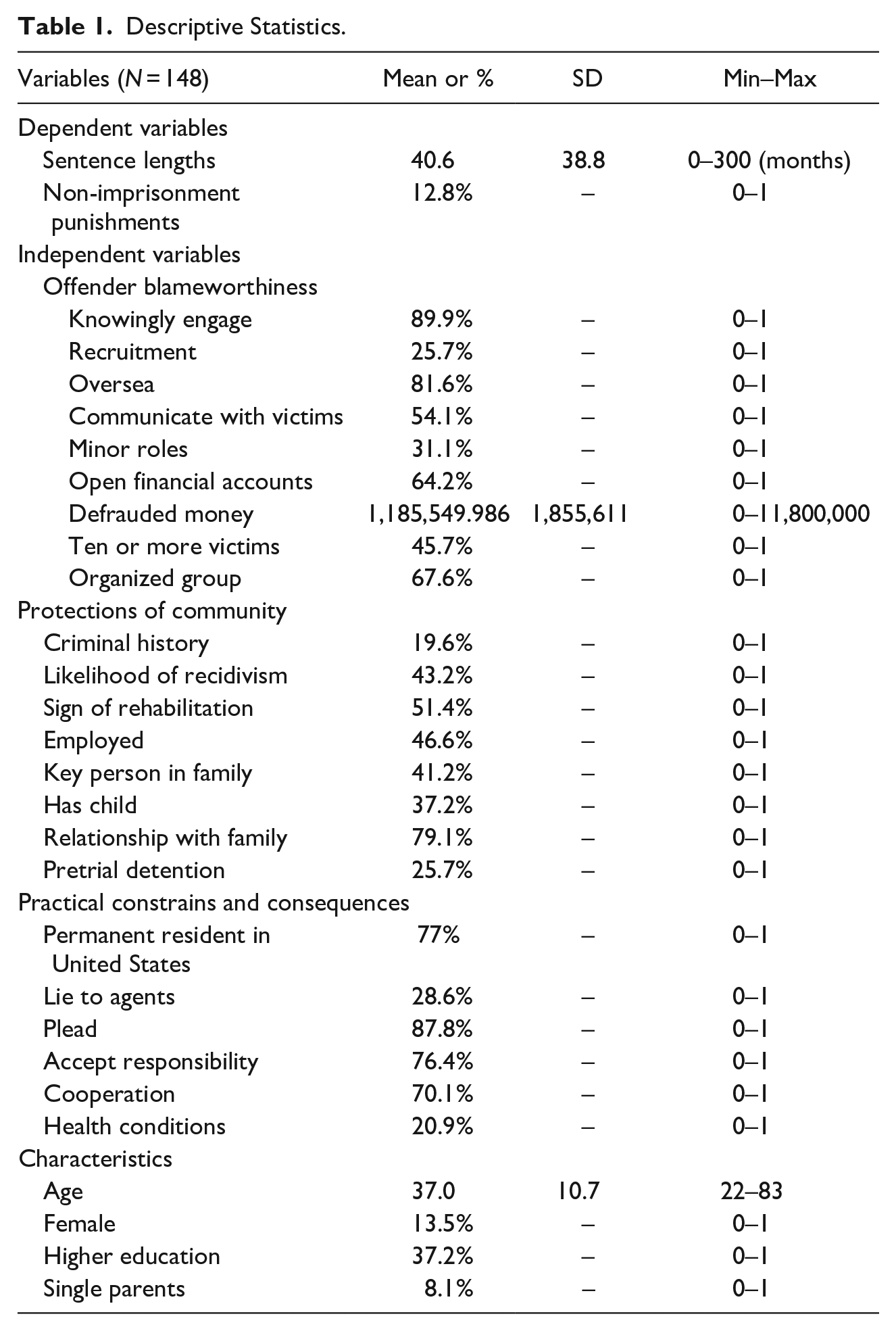
The descriptive table (Table 1) highlights key characteristics of the sample that warrant closer examination. The average sentence length was approximately 41 months, ranging from 0 to 300 months. Around 13% of individuals received non-imprisonment punishments like probation or home confinement. Over half of the sample consisted of defendants playing major roles in criminal syndicates. The average amount defrauded was $1.2 million, emphasizing the effectiveness of persuasion techniques over complex technical methods in online scams. Additionally, more than half of the sample defrauded 10 or more victims, indicating sophisticated operations targeting multiple victims simultaneously. Contrary to physical world felonies, most online romance scammers had no prior criminal history, with only about 20% having minor offenses like DUI or drug possession. Nearly half had legitimate jobs before joining criminal syndicates, adding complexity to understanding their motives. Despite perceptions, 77% of sentenced scammers were U.S. permanent residents. Nearly all opted for a judge trial, impacting sentencing outcomes significantly. Furthermore, about 38% held a bachelor’s degree or higher, raising questions about their choice of criminal activity.
Descriptive Statistics.
Regression Results: Factors Affecting Imprisonment Length
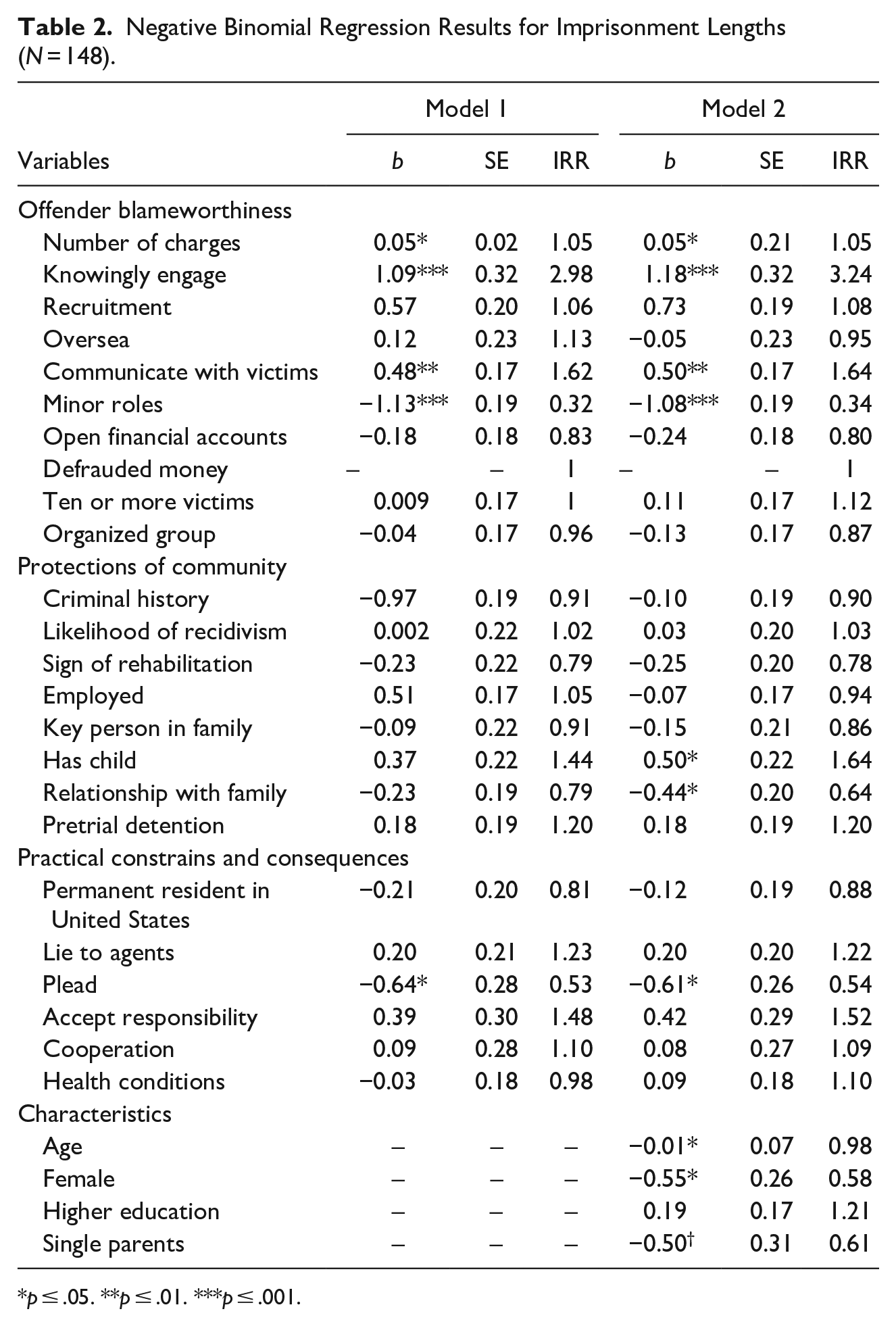
Utilizing a negative binomial regression model, our analysis (see Table 2) reveals significant findings. In Model 1, which isolates variables from focal concern theory without considering control variables, noteworthy associations with imprisonment length emerge. Particularly, a positive correlation exists between the number of charges, knowingly engaging in fraud, and direct communication with victims. Notably, a higher count of charges corresponds to a 5% increase in the likelihood of longer sentences (IRR = 1.05), indicating a moderate effect. This positive association intensifies notably for individuals knowingly involved in fraudulent activities, displaying a nearly threefold increase in sentence lengths compared to non-participants (IRR = 2.98). Moreover, engaging in direct interactions with victims via online platforms amplifies the likelihood of extended sentences by 62% (IRR = 1.62). Lastly, in consistent with established research, defendants assuming minor roles within scams exhibit a 32% lower likelihood of enduring longer sentences compared to their counterparts (IRR = 0.32).
Negative Binomial Regression Results for Imprisonment Lengths (N = 148).
p ≤ .05. **p ≤ .01. ***p ≤ .001.
In the protection of community category, there are no variables exhibiting significant relationships with sentencing lengths.
In the considerations of practical constraints and consequences, defendants who pleaded can experience a 47% lower likelihood of receiving longer imprisonment lengths (IRR = 0.53). This observation aligns with traditional court practices and stands as the sole variable in this category showing a significant relationship with the final imprisonment outcomes.
Upon introducing the control variables into analysis (Model 2), the effects of “has a child” and “relationship with family” become more pronounced than prior model. Specifically, having a good relationship with family can significantly reduce imprisonment length by 36%. Moreover, defendants who are found to have a child during the investigation tend to have a 64% higher likelihood of receiving longer sentences (IRR = 1.64). Although the relationship is rather weak, this finding is particularly counterintuitive, as it contradicts the general belief that having a child may reduce sentence lengths (e.g., Doerner & Demuth, 2014; Tasca et al., 2019). Therefore, a further interaction effect assessment was performed between “has a child” to each control variable. The result indicated that gender has almost non-existed (bhasachild * females = 1, p = .09) influences on the relationship between has a child and receiving longer imprisonment lengths. A slight influence can be seen from age (bhasachild * age = −0.04, p = .04), which indicates that as defendant gets older, the chances of having a child in increasing imprisonment lengths may decrease. Although the statistical significance of this interaction is nearly marginal, further research is warranted to thoroughly investigate the strength and certainty of this relationship.
Regression Results: Factors Affecting Probation
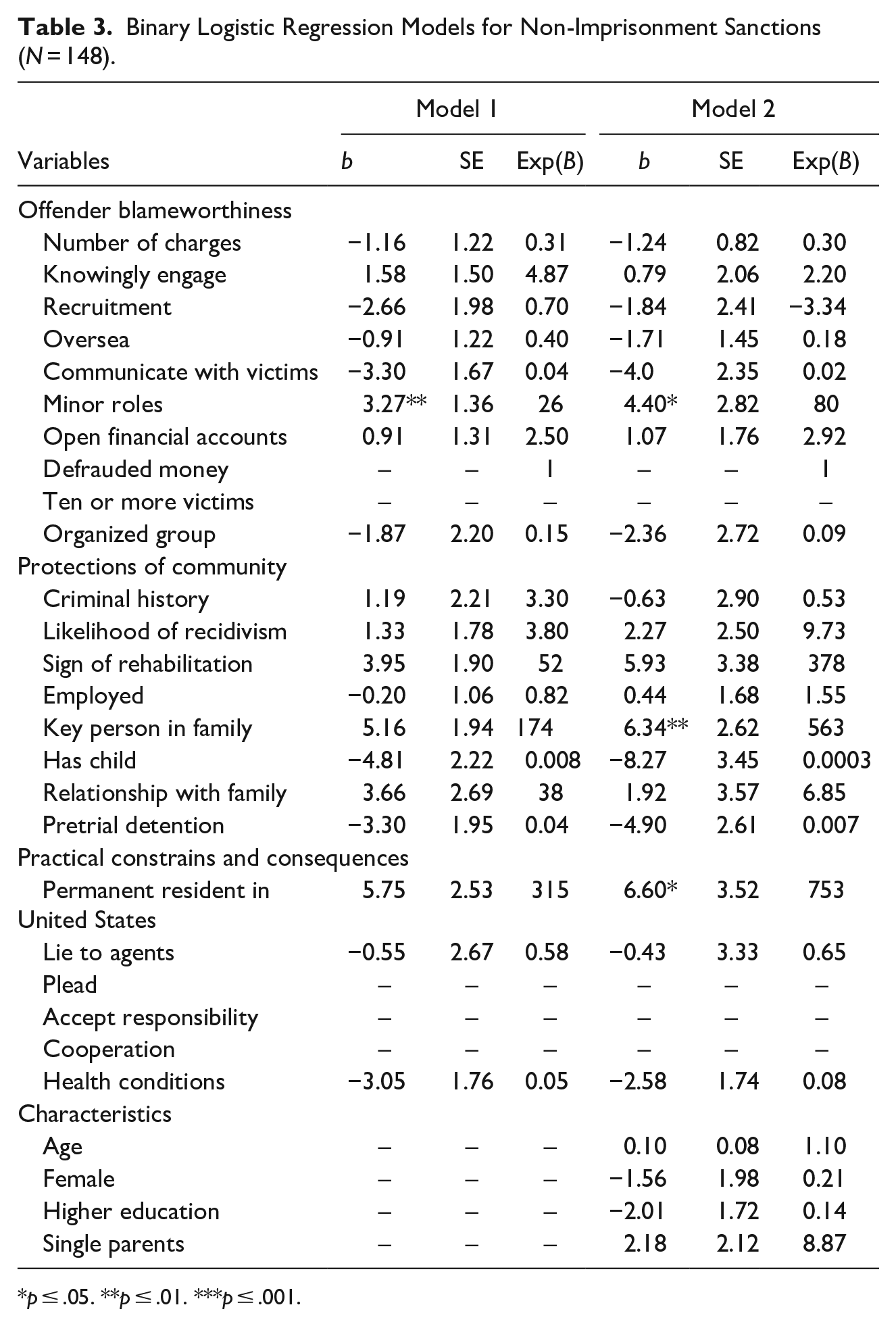
It is worthy to note that only 19 defendants received non-imprisonment sentences. Table 3 presented the results on using binary regression models to assess the relationship between selected variables with chances of getting probation. Specifically, Model 1 in Table 3 demonstrated that only two variables in the categories of offender blameworthiness and protection of the community showed significant effects on non-imprisonment decisions. Specifically, defendants occupying minor roles within the criminal syndicate exhibit a significantly higher likelihood of receiving probation, with a 26-fold increase compared to individuals serving as principal figures leading or facilitating the scam (OR = 26, p = .02). Furthermore, defendants exhibiting significant signs of rehabilitation tend to have a markedly greater possibility of receiving probationary sentences compared to those who do not fulfill this role (OR = 51, p = .03).
Binary Logistic Regression Models for Non-Imprisonment Sanctions (N = 148).
p ≤ .05. **p ≤ .01. ***p ≤ .001.
Additionally, within the realm of practical constraints and consequences, only one variable exhibits a significant relationship with receiving non-imprisonment sanctions. Specifically, individuals residing in the United States are approximately 315 times more likely to receive non-imprisonment sanctions compared to those who do not reside in the United States. However, this relationship demonstrates a moderate to weak effect.
When incorporating control variables into consideration, several notable significances become more pronounced and apparent. The influence of minor roles on whether individuals receive non-imprisonment sanctions diminishes (from p = .01 to p = .05), while the importance of being the key person in the family within the community protection category becomes more pronounced. Specifically, individuals who are identified as the key person in their family are 563 times (p = .02) more likely to receive non-imprisonment sanctions compared to those who are not.
Although it is important to acknowledge these observations, it is worth noting that the odds ratios for variables such as “key persons in the family” and “minor roles” are notably high. This may be attributed to the relatively small sample size and significant differences between groups. This aspect will be discussed in detail in the “Limitation and conclusions” section.
Discussion
Exploring Research Questions: Discussion Insights
This study aims to conduct a preliminary assessment of how certain focal concern variables influence judges’ decisions regarding sentencing outcomes for individuals convicted of offenses related to online romance scams in the United States. Furthermore, this study aims to determine whether the observations identified in Wang’s (2023) study are evident here, and if the findings from this study can enhance or supplement those of Wang (2023). To achieve this objective, the study analyzed and explored a dataset consisting of 148 charged offenders from the period spanning 2016 to 2023. By employing two distinct regression models, the study uncovered several notable associations between variables.
In answering the first research questions, this study found supporting evidence, suggesting that judges place significant emphasis on the scammers’ intentions and actions when executing the scam to assess their level of blameworthiness. A number of prior studies have noted that offenders’ active role in planning and executing the offense (or their level of involvement) can influence judges’ decisions regarding sentencing lengths (e.g., Freiburger, 2009; Glavin & Ulmer, 2022; Monahan & Skeem, 2016; Steffensmeier & Hebert, 1999). Observations from the current study further assess several variables that represent offenders’ level of active engagement in the offense and have found positive outcomes that indicate their blameworthiness. For example, individuals who served as minor roles tend to receive lesser imprisonment lengths than their counterparts, which presents to be consistent with a prior study (Wang, 2023). Although not widely explored by most scholars, playing a minor role is an important mitigating factor in various federal statutes and proposals, such as the Aggravating and Mitigating Role Adjustment Primer (Sections on Aggravting and Mitigating Role). Defendants who knowingly participated in online romance scams received longer prison sentences, a factor not previously explored in prior studies but frequently addressed in various sentencing statutes for a majority of criminal behaviors. Committing a criminal act knowingly implies a greater level of culpability and moral responsibility, which can influence or strengthen decisions regarding sentencing. (e.g., Alexander, 2000; Brown, 2012; Wiley, 1999). Defendants who directly communicated with victims may receive longer prison sentences compared to those who did not. This aspect has not been investigated by previous relevant studies, however the association is logical, particularly in the context of online romance scams. Direct communication suggests a higher degree of deliberate involvement and may have a greater impact on the victim, potentially could aggravate the severity of the offense. In addition, the total number of charges also indicates higher imprisonment length. This too is consistent with work that suggests total number of charges increased the odds of being sent into prison (e.g., Patrick & Marsh, 2011). In terms of non-imprisonment sentences, playing a minor role impacts the likelihood of receiving such a sanction, albeit with less effect compared to imprisonment lengths, similar to findings in Wang (2023).
The findings effectively address the second research question and reveal some interesting observations. Initially, the variables related to the protection of community show no significant association with the length of imprisonment when control variables are not taken into account. However, when control variables are considered, two specific variables, namely having a child and having a good relationship with family, exhibit contrasting relationships with the length of imprisonment. Specifically, individuals who have a child tend to receive longer prison sentences, while those with positive family relationships tend to receive shorter imprisonment terms. To examine the influence of control variables on the relationship between key factors, interaction effects were analyzed. It was found that older defendants with children tended to receive shorter imprisonment lengths. This leniency reflects a broader judicial understanding that older defendants are often perceived as having a reduced likelihood of recidivism and a greater capacity for rehabilitation, particularly if they have strong family ties. The perception that older individuals are more settled and responsible can contribute to judges’ decisions to impose shorter sentences, considering both the defendant’s age and familial responsibilities (Bijleveld et al., 2021; Holmes & D’Amato, 2020; Steffensmeier et al., 1995; Tasca et al., 2019). Moreover, female defendants with strong family relationships also received shorter imprisonment lengths compared to males, aligning with previous research (Beeby et al., 2021; Doerner & Demuth, 2014; Nowacki, 2020; Philippe, 2020; Steffensmeier & Hebert, 1999). The judicial system’s leniency toward women in such contexts can be seen as an acknowledgment of their traditionally primary caregiving roles and the potential negative impact of their incarceration on dependent children and family structures. In sum, these interactions highlight a broader judicial inclination to consider the socio-familial context of defendants when determining sentences in a different context. This approach emphasizes the importance of evaluating the defendant’s broader life circumstances, including their age, gender, and family responsibilities, to arrive at sentencing decisions that not only serve justice but also consider the rehabilitative implications of incarceration (Anderson, 2015; Dinovitzer & Dawson, 2007; van Wingerden et al., 2016).
When examining the third research question, the overall observations are less pronounced compared to the first two research questions. Only two observations reveal significant relationships with imprisonment and non-imprisonment sanction. This potentially suggests that, in cases of online romance scams, the court tends to place more emphasis on the criminogenic factors surrounding the scamming incidents rather than on broader individualized factors. It is evident that defendants who opt for a guilty plea can influence the duration of their imprisonment, when controlling for other variables. This finding is consistent not only with previous research but also with various legal statutes (Albonetti, 1998; Engen & Gainey, 2000; Johnson et al., 2008; King et al., 2005; Kramer & Ulmer, 2009). It suggests that individuals convicted after a trial are more prone to incarceration and longer sentences compared to those who plead guilty, even when considering individual or circumstantial factors. The observations from this study provide additional contextual background on this aspect of research. Moreover, being a permanent resident in the United States has a more pronounced impact on the likelihood of receiving non-imprisonment sanctions when controlling for other variables. Further interaction effect tests, similar to those conducted previously, reveal that older individuals who are permanent residents in the United States tend to receive non-imprisonment sanctions more frequently than their counterparts (p = .08). While indicating a relationship of moderate to weak strength, this effect underscores the significance of age in this context. This is a reasonable observation as permanent residents, particularly older ones, may have established stronger community ties and responsibilities. Judges might consider the potential disruption to the offender’s family and community if they were to be imprisoned. This consideration aligns with the broader judicial philosophy of minimizing harm to dependents and utilizing the offender’s existing support networks to aid in their rehabilitation (Griffiths et al., 2007; Steefensmeier & Demuth, 2000; Taylor, 2016).
In answering the fourth research question, being older or female significantly correlates with reduced imprisonment time. However, no extralegal factors appear to influence the likelihood of receiving non-imprisonment sanctions. Notably, ethnicity data was not collected for this study. This decision was based on the observation that over 90% of defendants in the dataset are from the same ethnic background, primarily African or African American, as inferred from publicly available pictures. Moreover, neither the sentencing memo nor the indictment sheet provides clear indications of the defendants’ ethnicity, aside from referencing their respective regions or countries of origin. Therefore, this variable was omitted from the analysis.
Comparing current findings to Wang’s (2023) study on Chinese online romance scammers, differences in legal systems and judges’ interpretations contribute to varying results. Variables like operating overseas, fraudulent earnings, and employment status show differing significance, reflecting operational distinctions between China and the United States. Specifically, the emergence of online romance scams in China, particularly during the initial wave of online fraud, diverged significantly from those in Western countries. It underwent indigenization and integrated unique Chinese characteristics, evolving into a scam known as Sha Zhu Pan (or Pig Butchering Scam). This variant operates distinctly through cryptocurrency platforms (Wang, 2023, 2024). Hence, it becomes clear why only 40% of scammers operated overseas, with the majority operating domestically, as found in Wang (2023), in contrast to the current sample where approximately 80% of the scammers are from overseas operations. As for the fraudulent earning, the Criminal Law in China categorizes fraudulent earnings and commissions into three specific groups based on their amount and severity. However, the U.S. federal code lacks such explicit categorizations and interpretations. Therefore, it’s possible that the lack of significance in the current dataset for scammers in the United States could be attributed to issues related to categorization.
Research Implications
Drawn from aforementioned discussions, the primary task for future researchers is to utilize diverse methodologies to further examine the observations highlighted in response to each research question in the current study. Given the importance of offenders’ intentions and actions highlighted in the first research question, future empirical studies should quantify how judges consider these factors in sentencing. This can involve content analysis of sentencing transcripts to identify patterns in judicial reasoning, as well as surveys or interviews with judges to understand the weight placed on defendants’ intentions and actions. Such analyses might reveal that detailed planning and active execution of a scam correlate with longer sentences, reinforcing the significance of culpability and moral responsibility in judicial decisions. Furthermore, the second research question explores how family relationships and roles may affect sentencing lengths, particularly concerning age and gender among online romance scammers. This observation is intriguing considering that scammers can profoundly impact victims’ lives and families. Despite this, judges pay considerable attention to these factors when sentencing such cases. Future studies should verify this observation by interviewing experienced judges or qualitative analyzing extensive sentencing records, focusing on scammers’ family involvement and background information in relation to sentencing lengths and their demographic information (e.g., the analysis on gender differences in sentencing, focusing on comparing sentencing lengths for male and female defendants with similar family backgrounds). The observations addressing the third research question indicate that practical constraint factors have a less pronounced impact on sentencing, except for plea deals and permanent residency status. Future researchers should use more comprehensive and larger datasets with detailed information on existed or additional practical constraint factors to further assess, for example, whether scammers’ cooperation/facilitation with the court affects their sentencing lengths. Lastly, the current datasets lack ethnicity data for scammers. To address this gap, future research should aim to obtain datasets that include detailed ethnicity information. This will allow for a more comprehensive analysis of how ethnicity might influence sentencing decisions in cases of online romance scams, providing a clearer understanding of potential biases or disparities in judicial outcomes.
In addition, the second large avenue of research that warrants exploration involves investigating additional factors not examined in the current study. These factors may correlate with the variables already included or interact with them, potentially influencing sentencing decisions. To do so, researchers can potentially gain chances to have direct interactions with the court or the judges who handle online romance scam cases. By directly engaging with these judges, researchers can potentially gain valuable insights into the thought processes, considerations, and factors that influence sentencing decisions in online romance scam cases. This approach may provide a deeper understanding of the judicial perspectives and considerations that shape legal outcomes in online romance scam prosecutions. Further investigation in this direction could provide valuable insights.
Practical Implications
This study also points to a few practical implications that can be considered when apprehending and sentencing online romance scammers. In reviewing the legal proceedings of several cases, the court highlighted the challenge wherein despite indictments against some scammers, they managed to flee to foreign countries like Nigeria, resulting in pending final charges lasting for years and exhausting court resources. Based on such a factual observation, it is recommended for law enforcement agencies in the United States to enhance police collaboration, particularly through organizations like Interpol. Given the complex nature of online romance scams, which often involve perpetrators either operate or flee across borders to exploit victims and evade punishments, a coordinated approach is essential in such a scenario. Countries should prioritize information sharing, joint investigations to disrupt criminal networks, apprehend offenders, and provide better protection for individuals vulnerable to these scams.
Furthermore, following the successful apprehension and indictment of offenders in court, a significant lack of clarity emerges regarding specific information regarding the number of victims and the precise amount of money defrauded or earned by each scammer. Often, within a crime syndicate, only half of the scammers are provided with specific information regarding the number of victims they targeted and the amount of money they defrauded. The language becomes rather ambiguous on sentencing memo or indictment sheet when it comes to commissions earned by those scammers. As a result, based on this observation, it is recommended that the court allocate resources toward conducting additional investigations to address the identified lack of clarity surrounding specific details related to victims and monetary amounts in cases involving apprehended offenders. This effort can potentially help ensure a more comprehensive understanding of the extent of the scamming activities and the involvement of each perpetrator within a crime syndicate.
Lastly, considering the ubiquitous and heinous nature of online romance scams, it is suggested that legislative bodies at both federal and state levels could take steps to create unified legislation targeting online fraud. Such legislation should address crimes involving techniques used in cyberspace (e.g., non-verbal persuasions, anonymity) and physical space (e.g., money laundering). Developing legislation for a specific type of crime can be challenging, but a unified approach would be beneficial in tackling the complexities of online fraud. Similar to the Computer Abuse and Fraud Act (1986), this speculated criminal legislation should firstly provide clear definition for online fraud as a distinct criminal offense within the legal framework to understand the nature and scope of this type of crime. Secondly, it should provide clear penalties and sentencing guideline instructions for prosecutors and judges regarding to the potential mitigation and aggravating circumstances. It should be admitted that the process of achieving this goal may take an extended period, and there is a possibility for significant amount challenges. Nonetheless, persistent efforts from both the academic, law enforcement, and legislative bodies toward unified legislation for online fraud are warranted to uphold justice in the dynamic realm of cyberworld.
Limitation and Conclusion
This research is not without limitations. It is important to note that the observed relationships may be correlational, and there may be other relevant variables influencing such outcomes. However, because of the restricted information available in the legal documents, certain variables like the presence of attorneys, court-level factors, judges’ attitudes, and more specific aspects related to individuals’ backgrounds are not included. Furthermore, the variable for defrauded money may not be rigorously documented by the memo as it’s conceivable that the loss could be attributed to collaborative efforts rather than solely to an individual fraudster. Despite these constraints, these limitations offer potential avenues for resolution in future studies.
Building upon previous research analyzing the sentencing considerations influencing online romance scammers’ sentencing in China (Wang, 2023), this current analysis has uncovered specific sentencing factors in cases adjudicating romance scammers in the United States. While preliminary, the results largely indicate a fair and impartial landscape among judges in the United States when handling complex online romance scam cases. Crucially, this study aims to shed light on future research, court investigations, and legislative efforts into individual scammers, advocating for a more evidence-based understanding of their actions and fostering fairer and more effective judicial practices in addressing the complexities of online romance scams.
Footnotes
Declaration of Conflicting Interests
The author declared no potential conflicts of interest with respect to the research, authorship, and/or publication of this article.
Funding
The author received no financial support for the research, authorship, and/or publication of this article.
