



Abstract
On May 22 to 23, 2023, a workshop held at the Max Planck Institute for the Study of Crime, Security and Law explored the gap between macro-level sociological perspectives and micro-level rational choice perspectives in criminology. The current special issue is the fruit of that effort. Three main themes—structural and cultural constraints, economic opportunities and criminal justice involvement, and moral and ethical contexts—are examined in seven empirical contributions. Together, the studies underscore the notion that while rational choice and sociological theories are often viewed as conflicting and examined separately, they are in fact compatible, and even complementary, aspects of larger social processes. Future research is encouraged to adopt a comprehensive approach encompassing both micro and macro explanations.
Introduction
The study of crime is inherently complex, which is in no small part due to the multitude of underlying factors that operate at both macro and micro levels, from individual decision-making processes to broader social and structural influences (Matsueda, 2013a, 2013b, 2017; Thomas et al., 2022). Developing an encompassing understanding of the dynamics of criminal behavior may therefore require an interdisciplinary approach. This is not without challenges and theoretical perspectives often have widely divergent points of departure rooted in their respective disciplinary traditions. For example, as economist Duesenberry (1960, p. 233) once famously remarked: “economics is all about how people make choices; sociology is all about why people don’t have any choices to make.” This juxtaposition also speaks to the dichotomy between micro-level choice theories and macro-level sociological perspectives within the realm of criminology. However, we argue, divergent as they may be, these perspectives are not as incompatible as they are often portrayed. Linking them to bridge the gap between macro and micro processes in understanding crime is the primary objective of this special issue, with a particular focus on the role of choice.
Central to our exploration is the examination of how social-structural characteristics may shape individuals’ expectations and preferences related to crime. Through empirical analyses and the proposition of theoretical frameworks, contributions to the special issue delve into the mechanisms through which cultural norms, ideological contexts, and opportunity structures both influence and constrain choices related to criminal conduct. The different contributions examine a diverse range of violent and non-violent behaviors, employing varied methodologies and datasets to enrich the discourse. In the next section, we provide some of the theoretical scaffolding for the different empirical contributions to the issue as well as an overview of the key themes addressed in it.
Choice and Crime: Motivating the Special Issue
This special issue is premised on the assumption that the criminal justice system is built on the foundational principle of choice, a theme dating back to the very origins of the field of criminology (e.g., Beccaria, 1764), and consistently explored in criminological research and theory since (Akers, 1990; Becker, 1968; Grigoryeva & Matsueda, 2018; Hirschi, 1986; Loughran et al., 2016). Neglecting choice in criminological theory creates a disconnect with criminal law, prompting significant questions for public policy (Nagin, 2007). This position, along with the mounting evidence linking choice processes to criminal behavior, has motivated influential criminologists to emphasize the need to prioritize and further develop the role of choice in research and theory (Nagin, 2007; Paternoster, 2010; van Gelder, 2013).
Access to unique panel datasets, such as the Pathways to Desistance study, and methodological advances, like survey experiments and immersive technologies, have propelled research on choice in criminology. This work has largely developed along two different tracks. Along one track, researchers have illuminated how perceptions of crime-related risks, costs, and benefits—the core of deterrence and rational choice perspectives—are shaped, maintained, and evolve over time based on relevant information, such as prior offending experiences and interactions (or lack thereof) with the law (Anwar & Loughran, 2011; Lochner, 2007; Matsueda et al., 2006). There has been a growing interest in understanding how developmental processes and life experiences influence preferences and perceptions of crime across the life span (Thomas et al., 2022; Thomas & Vogel, 2019). This work emphasizes not only the central role of choice processes in the onset and persistence of criminal behavior, but also emphasizes its importance for understanding desistance (see Paternoster & Bushway, 2009; Thomas et al., 2021).
Along the other track, researchers have demonstrated the role of choice as a nexus connecting individual and situational characteristics in generating crime, with a particular focus on individual decision-making processes at the level of the crime event (Barnum et al., 2021; Clarke & Cornish, 1985; van Gelder & de Vries, 2012, 2014). Specifically, researchers have shown how situational stimuli inherent to criminal opportunities (e.g., provocation and presence of peers) can impact heuristic and cognitive abilities (Barnum & Nagin, 2021; Pickett, 2018; Pogarsky et al., 2017), affective and emotional experiences (Barnum & Solomon, 2019; Herman et al., 2024; van Gelder et al., 2022), and social interactions (Barnum & Pogarsky, 2022; Thomas & Nguyen, 2022). These processes, in turn, shape the assessments of criminal opportunities and influence the way individuals weigh this information during the commission of a crime.
Both research tracks have identified some of the core mechanisms underlying criminal choice, offering insights into both long-term developmental trajectories and situational variation in choice processes. Nonetheless, despite these advances, an important criticism of choice-based theories remains: Research has largely been restricted to internal decision-making processes and thereby largely overlooked the influence of structural conditions known to promote crime (Cullen, 2017). Sampson’s (2012) critique of micro-level choice-based models of crime further underscores this point: “[T]here is something odd about the way many social scientists approach individual choice, almost as if they are spooked into thinking that choice renders the environment impotent” (p. 374).
There is thus a need to bridge the macro–micro divide by extending conventional choice approaches to incorporate social-structural processes beyond individual characteristics and immediate situations (Coleman, 1990; Hechter & Kanazawa, 1997). We believe that such integration of social-structural forces can inspire the next wave of decision-making research in criminology characterized by a more critical and holistic approach. Next, we explore the central challenges such a critical and holistic approach faces: the examination of social-structural processes and their impact on individual criminal decision-making (Matsueda, 2013a, 2017; Thomas et al., 2022; see also Coleman, 1990).
Choice, Social Structure, and Crime: A Multilevel Rational Choice Approach
Over two centuries ago, Smith (1904 [1776]) postulated that the “understandings of the greater part of men are necessarily formed by their ordinary employments. The man whose whole life is spent in performing a few simple operations. . . generally becomes as stupid and ignorant as it is possible for a human being to become.” The point made by Smith underscores the impact of social-structural factors, such as limited economic opportunities, on (the lack of) personal development. Criminologists have since devoted considerable attention to the role of structural dynamics fundamental to community-level crime perspectives, which emphasize the significance of restricted legitimate opportunities, social disorganization, and both social and physical disorder in the explanation of crime (e.g., Sampson & Raudenbush, 1999; Shaw & McKay, 1942; Wilson & Kelling, 1982). Considerably less attention, however, has been given to how the same structural forces shape individual dynamics related to crime, including choice processes (see Sampson et al., 2002).
Sociologist Coleman (1990) provided one of the first attempts to bridge this macro-micro divide when he introduced a multilevel rational choice framework referred to as Coleman’s Boat. His model is presented in Figure 1. Paths 2 and 4 depict the two traditional strands of research in the social sciences: the typical macro-to-macro effect of social-structural context on macro-outcomes, and the micro-to-micro effect of individual characteristics on individual-outcomes. He subsequently links the two processes with paths 1 and 3 in which the macro-level context influences individual predictors (path 1), which in turn leads to a micro-macro transition (path 3) through a process known as emergence (see also Sawyer, 2001). Emergence occurs when interactions among individuals lead to macro-level phenomena that cannot be fully explained by aggregating individual characteristics or actions.
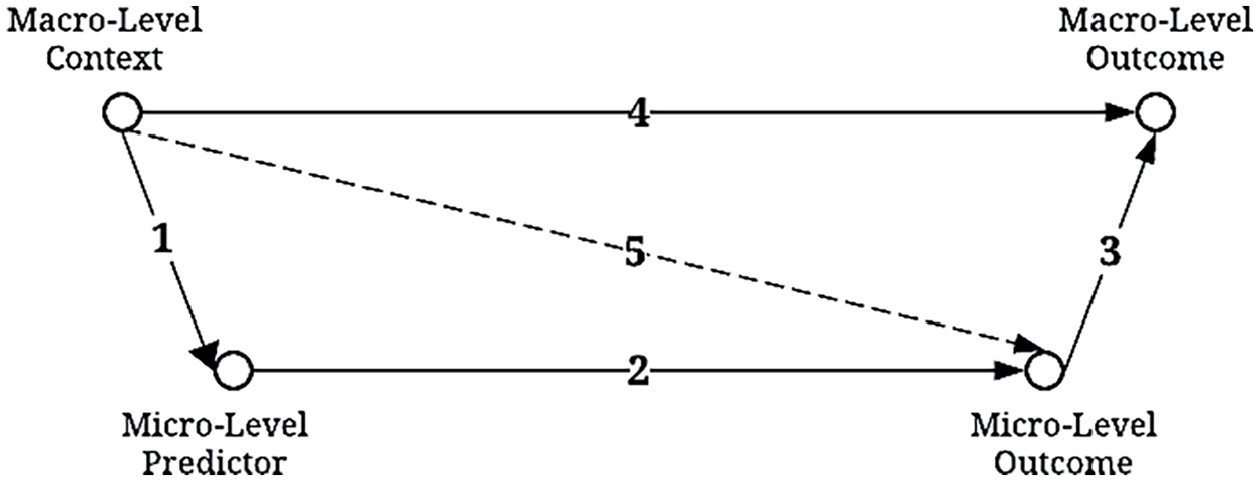
Coleman’s Boat (1990).
Coleman asserts that social structures, institutions, norms, and behaviors often emerge from interactions within a social system, creating feedback loops that reinforce or modify existing interaction patterns and further shape emergent properties. For instance, in urban traffic systems, individual drivers’ decisions contribute to emergent traffic patterns, congestion, and flow dynamics that transcend individual behaviors, which in turn can affect individual driver decisions. In essence, Coleman’s Boat posits that individuals are not isolated actors making decisions in a vacuum but instead their decisions and purposive actions are influenced by the decisions and actions of others within their communities (Coleman, 1990).
Despite being introduced over three decades ago and widely influential in the social sciences, criminology has been slow to embrace the essence of Coleman’s Boat, lagging behind other disciplines in cross-level theoretical integration (for notable exceptions see, e.g., Akers, 2017; Sampson, 2012; Sampson et al., 1997). Thomas et al. (2022, p. 607) emphasize this disparity, highlighting the ongoing disconnect between studies focusing on offending as a rational choice process and those emphasizing the significance of community structural factors. This theoretical and methodological divide mirrors a broader challenge within criminology known as the macro-micro problem, which raises the question of whether explanations of crime should be delineated at the macro-level, the micro-level, or both. However, classical (Beccaria, 1764; Bentham, 2011 [1789]) and modern (Becker, 1968) approaches to these perspectives suggest both macro and micro-level processes are at play. That is, in legitimate societies, laws and punishments influence individuals’ cost-benefit analyses of committing crimes, highlighting the compatibility of rational choice perspectives with structural influences (Matsueda, 2006; McCarthy, 2002; Nagin, 1998).
Recognizing crime is an emergent phenomenon wherein the intricate interplay of individual interactions can cultivate environments conducive to criminal behavior and delinquency, Matsueda (2013a, 2013b) extended Coleman’s Boat by proposing a multilevel rational choice model of crime. Specifically, he introduced path 5 to the diagram presented in Figure 1 to explore how social-structural contexts can influence the flow of information and, consequently, shape individual decision-making processes related to crime. Here Matsueda draws on work outside of criminology (e.g., Granovetter, 2005) to familiarize information cascades as a key mechanism linking social-structural context to individual decisions and behavior (path 5). Information cascades occur when individuals base their decisions not solely on their own private information or preferences but on the actions and decisions of others. This can lead to a domino effect where individuals follow the choices of those who acted before them, even if it contradicts their personal inclinations. In the context of crime, this can result in the proliferation of criminal behavior within social networks and larger societal groups as individuals observe others engaging in illegal activities and opt to follow suit (see McGloin et al., 2021; McGloin & Rowan, 2015; McGloin & Thomas, 2016).
Thomas et al. (2022) provide a seminal test of Matsueda’s adapted multi-level rational choice model of crime, providing the point of departure for the current special issue. Their model is presented in Figure 2. Specifically, they examined the direct and indirect relationships between neighborhood characteristics and individual choice inputs. Two important findings central to the current special issue emerged from their study. First, the authors demonstrated how structural characteristics shape expectations about the risks, costs, and rewards related to crime directly (path 5) and indirectly through perceptions of neighborhood disadvantage and access to legitimate opportunities (paths 1 and 2). As we expand below, several studies in this special issue underscore the possibility, and illustrate the existence, of an association between various social and structural forces and decision maker’s expectations of the (dis)incentives associated with offending.
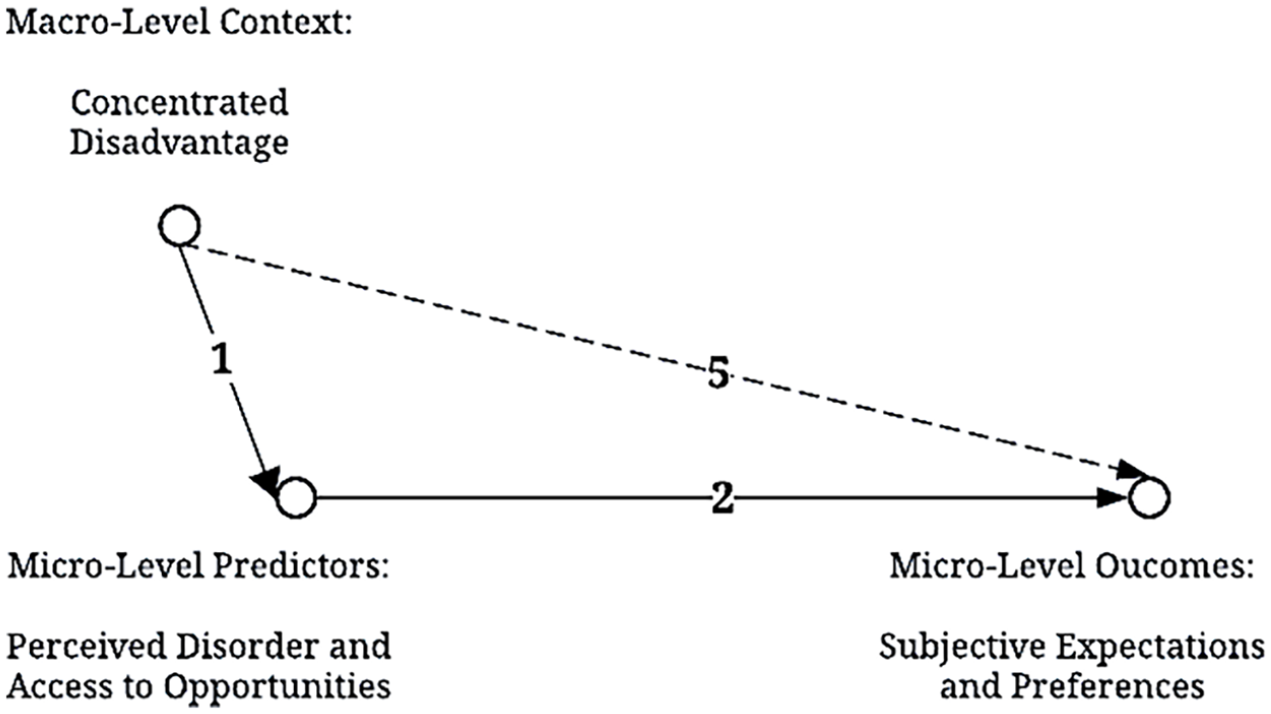
Thomas et al.’s (2023) multilevel rational choice model.
The second finding advances the role of preferences in crime decisions, which Thomas et al. (2022, p. 608) define as reflecting individuals’ valuation of subjective beliefs in their offending decisions. They argue that exposure to high levels of neighborhood disadvantage may shape preferences by influencing individuals’ objective and perceived choice sets. This may result in them becoming either more or less tolerant of the risks and costs associated with crime and assigning varying importance to factors, such as social status and excitement, when making offending decisions. Choice sets therefore represent what individuals consider feasible within a given context, with finite variations across individuals (Kijowski & Wilson, 2023). In line with this, a recurring point of emphasis throughout this special issue is that a wide range of social forces like concentrated disadvantage can constrain perceived choices and alter preferences, thereby influencing decisions and behaviors.
The Special Issue
The findings presented across the seven articles comprising this special issue further emphasize the necessity of integrating principles of choice with relevant social-structural factors to facilitate a deeper understanding of the multilevel causes of crime and enhancing the efficacy of preventive measures. Next, we delineate the principal themes from the special issue. While each paper makes its own important, standalone contribution to the study of choice and crime, we identified three core themes: (1) structural and cultural constraints; (2) economic opportunity and criminal justice involvement; and (3) moral and ethical context.
Structural and Cultural Constraints
The first theme expands on the role of structural disadvantage in crime decisions. Integrating perspectives on co-offending (e.g., McGloin & Rowan, 2015) with Anderson’s (1999) Code of the Street, Wenger et al. (2024) propose a three-level model to explore decision-making fluidity during violent transgressions—examining how minor altercations can escalate to attacks involving fatal injuries. They identify two social forces that escalate interpersonal violence: the presence of co-offenders and adherence to community subcultures tolerant of violence, which are often associated with high levels of disadvantage.
Going beyond immediate community factors, Botchkovar et al. (2024) investigate how the social consequences of war affect individual decision-making. Drawing on data from Ukrainian cities affected by the Donbas war in 2017, they demonstrate how war exposure induces “hot,” and sometimes irrational, decision-making, particularly regarding involvement in violent behaviors.
Both studies underscore the negative impact of social-structural disadvantage, including differential exposure to crime-supporting norms, peer delinquency, and high stress levels, which limit individuals’ perceived choice sets, making crime and violence seem like the most, if not the only, viable option under certain circumstances.
Economic Opportunity and Criminal Justice Involvement
The second theme of the special issue revolves around perceived opportunity structures shaped by access to legitimate employment and involvement with the criminal justice system. Scholars have long studied the link between employment and crime, investigating whether employment encourages desistance from criminal behavior (Sampson & Laub, 1990). However, Jaynes (2024) notes a gap in research regarding relative perceptions of employment in legal and illegal markets, suggesting that improving job quality may not deter crime if illegal job opportunities are perceived as more lucrative. To address this, Jaynes (2024) introduces a new metric, relative labor market utility (RLMU), to account for differences in perceived job quality between legal and illegal markets, emphasizing the importance of considering both when analyzing decision-making processes.
Nguyen et al. (2024) underscore the need to consider characteristics of both legal and illegal work when studying the employment-crime relationship. Using a life-course approach, they find that adolescents who achieve early financial success through crime tend to experience earlier incarceration and delayed educational attainment. Early success in crime thus perpetuates offending, delaying two traditional “turning points” of crime: stable employment and marriage.
In a similar vein, Deitzer et al. (2024) investigate how police contact and involvement with the criminal justice system during adolescence shape opportunity structures by influencing later preferences for crime. Integrating labeling and rational choice theories, they show that early police contact can increase adolescents’ present-oriented preferences, which may lead to sustained offending as they prioritize immediate gains over future prospects.
These studies collectively demonstrate the impact of limited access to legal economic opportunities and early exposure to criminal justice involvement on decision-making styles and preferences for crime. These experiences shape perceived choice sets, limit the prospect of future legal opportunities, and make crime appear as a preferred option.
Moral and Ethical Context
The final theme of the special issue flips the script by exploring social-structural forces that shape decision processes and motivate legal compliance. Drawing on a large-scale school survey in Germany, Kroneberg and Naegel (2024) investigate how community and situational factors can enhance individuals’ moral self-conception, affecting moral judgments and favoring legal action alternatives. They find that students with strong conforming morality are more inclined towards non-violent responses when provoked. Building on this, Herman and Pogarsky (2024) incorporate dual process models of decision-making (Kahneman, 2011), illustrating how moral cues in the environment highlight prosocial outcomes over criminal alternatives. They demonstrate that moral contexts can redirect attention towards more prosocial behavioral options when faced with criminal opportunities, akin to the forces discussed earlier.
While rational choice and deterrence research often emphasizes the role of punishment in crime prevention efforts, these studies highlight alternative crime prevention options (Pogarsky & Herman, 2019) and highlight the ways community and situational factors can enhance individuals’ moral self-conception, affecting moral judgments. By implementing cultural and environmental interventions that emphasize moral and ethical norms, policymakers can enhance deterrence by reducing perceived crime opportunities and promoting legal alternatives.
Conclusion
Together, the contributions to this special issue illuminate several key themes in the study of crime and choice. Structural and cultural constraints emerge as a central focus, with studies highlighting the negative impact of social-structural disadvantage on decision-making processes and perceptions of criminal opportunities. Additionally, economic opportunity and criminal justice involvement are identified as influential factors shaping individuals’ preferences for crime and constraining perceived choice sets. Finally, the moral and ethical context of crime is explored, emphasizing the role of community and situational factors in motivating legal compliance and promoting alternatives to crime.
It is our hope that the contributions to this special issue will entice other researchers to further explore the themes highlighted and attempt to bridge the current gap between divergent theoretical perspectives in criminology. Researchers can build on the findings presented here to continue exploring related themes. These many include, for example, the long-term effects of structural interventions on individuals’ decision-making processes related to crime, unpacking the intersectionality of social identities in influencing preferences for crime, continuing to develop and utilize innovative methodologies to further understand the mechanisms through which social-structural factors influence individual choices in criminal behavior, and conducting comparative studies across different cultural and geographical contexts to identify commonalities and differences in the relationship between social structure, choice, and crime. We believe this integrative theoretical approach can advance our understanding of the complex and multilevel causes of crime and, in turn, enrich our efforts to reduce and prevent it.
Footnotes
Declaration of Conflicting Interests
The author(s) declared no potential conflicts of interest with respect to the research, authorship, and/or publication of this article.
Funding
The author(s) received no financial support for the research, authorship, and/or publication of this article.
