



Abstract
The literature considers individuals who sexually offended children (ISOCs) as a heterogeneous group. In Portugal, ISOCs may be subject to two types of sentences: custodial and non-custodial measures. In the present study, we performed a comparative analysis between 66 male individuals sentenced to prison and 47 male individuals sentenced to community measures for sexual crimes against children, using a set of sociodemographic, penal, and psychological measures. The results showed that the incarcerated ISOCs’ had more static risk factors for sexual and nonsexual recidivism. Only two variables increased the probability of belonging to the incarceration group: having other convictions beyond child sexual abuse and having committed serious sexual offenses. Based on these results, implications for ISOCs’ treatment and sentencing are discussed.
Keywords
Child sexual abuse is a complex phenomenon that could have devastating long-term, negative outcomes on survivors (Gauthier-Duchesne et al., 2022; Hailes et al., 2019; Kays Ebrahim et al., 2022). Additionally, child sexual offending gives rise to fear in the community, which in part could be influenced by misconceptions about individuals who sexually offended children (ISOCs; King, 2019). A common misconception is the belief that all ISOCs have a high probability of recidivating and that psychological treatment is ineffective (Church et al., 2011; Takahashi, 2023).
On this point, the evaluation of treatment effectiveness is challenging due to various factors, including the diversity among individuals who have committed sex crimes and shortcomings in the study design for assigning suitable treatment and control groups (Losel & Schmucker, 2017). So, the literature has presented disparate results: reviews have shown that the treatment is effective, but the effects don’t seem as positive if considering only studies with rigorous designs (e.g., randomized control trials; cf. Walton & Chou, 2015). However, recent research suggests that psychologically specific treatment for sexual offending has some effect in reducing recidivism (Gannon et al., 2019; Holper et al., 2023; Tyler et al., 2021). Despite this recent evidence, the persistence of these misconceptions has profound consequences, particularly concerning judicial, social, political, and clinical decision-making (Harper et al., 2017), leading to the adoption of more punitive measures for ISOCs (Socia et al., 2021).
Punitive measures are more focused on controlling and monitoring ISOCs rather than on rehabilitation (Church et al., 2011), even though literature shows a poor relationship between these measures and a decrease in sexual recidivism (Bouffard & Askew, 2019; Grossi, 2017; Lussier et al., 2024). In contrast, rehabilitative measures such as psychological intervention with child sexual abuse perpetrators have been shown positive effects on the risk reduction of recidivism (e.g., Gannon et al., 2019). Thus, more rehabilitative measures need to be developed and focused on psychological intervention, which implies the implementation of penalties more adjusted to the perpetrator’s needs and characteristics.
To better guide appropriate supervision and the treatment planning of ISOCs, advances in our knowledge about the factors associated with sexual recidivism are of extreme importance (Arbanas et al., 2022; Eher et al., 2019; Seto, 2019). Studies noted that risk factors can be assigned to some dimensions: atypical sexuality, antisociality, and interpersonal deficits (Hanson & Morton-Bourgon, 2005; Smid & Wever, 2019).
Atypical sexuality concerns the existence of paraphilias (Seto, 2019), being pedophilic disorder the most frequent among ISOCs (Arbanas et al., 2022). Pedophilia is defined as the sexual attraction to prepubescent children (American Psychiatric Association, 2015), and although the relationship between pedophilic disorder and child sexual offending is not one-to-one (Seto, 2019)—that is, not all ISOCs have a pedophilic disorder, nor all individuals with a pedophilic disorder committed sexual crimes—it is an important risk factor for committing a sexual crime against children (Jordan et al., 2011; Schippers et al., 2023). Antisociality includes antisocial personality traits, offense-supportive beliefs, lifestyle instability, and a lack of prosocial, structured activities (e.g., being unemployed; Seto, 2019). Individuals with a higher offense-supportive belief concerning oneself, others, the world, and sexuality are at higher risk of recidivism (Szumski et al., 2018). Moreover, studies stated that ISOCs are unable to recognize that their victims are distressed, which under the influence of a substance could lead to deviant behaviors (Coetzee, 2020). Lastly, interpersonal deficits were composed of problems in social skills and difficulties in maintaining stable and positive relationships (Hanson & Morton-Bourgon, 2005). The literature has shown that ISOCs report feelings of loneliness and social isolation, perceiving their social networks as deficient in some way and more fearful of intimacy than individuals who sexually offended adults (Wielinga et al., 2021). As a result of such deficits, perpetrators attempt to meet the need for intimacy in deviant ways (Moulden et al., 2020).
Furthermore, although a few studies have studied the relationship between mental health and child offending, several noted a high prevalence of mental health issues/problems in ISOCs (Arbanas et al., 2022; Eher et al., 2019), showing increased social anxiety (Kanters et al., 2016; Nunes et al., 2012). Given that individuals experiencing a mental disorder often exhibit heightened levels of emotion dysregulation, impulsivity, and increased social isolation—factors closely linked to recidivism—it is crucial to address these aspects in both assessments and treatment approaches (e.g., Biedermann et al., 2023).
The type of sentence applied to ISOCs in Portugal is either prison custody or alternative measures to prison, such as community service or fines. The prison sentence may be suspended and changed to a measure in the community, considering the personality characteristics of the perpetrator, the conditions of the perpetrator’s life, the conduct before and after the crime, and its circumstances (Portuguese Penal Code, 2023). However, sentences cannot be suspended if the prison sentence applied exceeds 5 years. According to the Justice Statistics, 280 convictions for child sexual abuse were reported during 2021, of which 63% were suspended prison sentences, 31% were prison sentences, and 6% were other sentences (e.g., community service; General Directorate of Justice Policy, 2023). In cases of suspended sentences, perpetrators cannot commit any criminal act during the probation period. One or more conduct rules, such as restriction orders (e.g., not exercising a profession that involves contact with children), and mandatory treatment might be added to this general imposition. In addition, the public prosecutor (with judicial agreement) can impose a provisional suspension of the penal process for a specific time, during which the same injunctions and conduct rules are applied (Cunha & Gonçalves, 2018).
From a legal perspective, a judge’s decision in terms of type and length of sentence is frequently influenced by the severity of the criminal act, previous convictions, characteristics of the victim and extralegal factors (e.g., characteristics and beliefs of the judge, emotional manifestations by the victims; Amirault & Beauregard, 2014; Castro Rodrigues et al., 2017, 2023; Hilinski-Rosick et al., 2014; Pereira et al., 2022). As such, more serious offenses, more extensive criminal backgrounds, and more use of violence during the commission of the offense predicted the incarceration of perpetrators of sex crimes (Amirault & Beauregard, 2014; Hilinski-Rosick et al., 2014). However, in addition to legal reasons, it is important to include psychological criteria (e.g., deviant sexual interest, cognitive distortions about victims of sexual abuse; among others) when evaluating the appropriateness of a prison sentence or an alternative measure (Brankley et al., 2021; Cunha & Gonçalves, 2018).
Those characteristics are central to assessing the risk of recidivism and the conditions of the use of imprisonment as a “last resort” solution (Castro Rodrigues et al., 2019). Prison is a source of insecurity for ISOCs. They are subject to different types of threats from other inmates and staff, which influences their ability and willingness to attend intervention programs, undermining the rehabilitative component of the sentence (van den Berg et al., 2018; Wuyts et al., 2023). It is imperative to understand who the perpetrators sentenced to a prison sentence are to understand whether these decisions are based on what is provided by law, the negative effects of imprisonment, and the rehabilitative aim of sentences. In addition, this knowledge will help in the development of specific programs taking into account the context in which they are inserted. The current study aims to identify the characteristics of ISOCs sentenced to prison and alternative measures and acknowledge the predictors of each type.
Method
Participants
Data collection took place in six Portuguese prisons, four probation agencies, and one service for therapeutic intervention for non-custodial sanctions. The participants of the study are 113 ISOCs: 66 (58.4%) in prisons, and 47 (41.6%) in the community, selected according to a non-random convenience sampling process. Inclusion criteria were (a) being male; (b) being older than 16 years old at the time of the offense; (c) having perpetrated sexual violence against children, and (d) having sufficient reading and writing skills to answer the instruments.
The participant’s age averaged 37.21 years (SD = 14.03). At the moment of the offense, nearly half of the participants were married (n = 62; 56.4%) and employed (n = 58, 52.7%). Concerning education level, the percentages of perpetrators with the fourth, sixth, and ninth grade are very similar (29.1%, 26.4%, and 21.8%, respectively). More than one-third of the participants had previous convictions for crimes other than child sexual crimes (n = 40; 36.4%), with only a residual number of individuals with previous convictions for child sexual crimes (n = 5; 4.5%). At present, 24.5% (n = 27) are convicted of crimes other than sexual crime, specifically threats (n = 2), coercion (n = 10), physical integrity offense (n = 2), theft (n = 6), ill-treatment (n = 2), domestic violence (n = 4), possession of a prohibited weapon (n = 2), driving without a legal license (n = 5). disobedience (n = 1), drug trafficking (n = 2), fraud (n = 1), and murder (n = 1). More than half of the participants were serving a prison sentence (n = 73, 64.6%), 35 (31%) were serving a suspended prison sentence, and 5 (4.4%) had provisional suspension of the penal process.
Procedure
We requested and were granted authorization to conduct the current study from the General Direction of Reintegration and Prison Services, Ministry of Justice. After that, different institutions and services concerning the custody of ISOCs were contacted to start collecting data, assisting in the identification of men who fulfilled the previously mentioned inclusion criteria. Each possible participant was then contacted, and all procedures were explained. The men who agree with the voluntary, anonymity, and confidential nature of the study, the nonexistence of financial or any other form of compensation for participating, nor any form of damage derived from the participants signed the informed consent. All the participants completed the measurements, and then the perpetrator’s institutional files were consulted, and relevant information about sociodemographic and penal variables was collected.
Data was collected during 2021 and 2022. All ethical procedures established by the University of Minho Ethics Commission and Portuguese legislation were followed.
Instruments
Brief Symptoms Inventory (BSI)
The BSI (Derogatis, 1993; Portuguese version: Canavarro, 2007) is a 53-item self-report instrument that measures psychopathological symptoms in general and psychological distress, on a five-point scale (0 = not at all to 4 = extremely). The inventory was composed of nine dimensions—somatization, obsession-compulsion, interpersonal sensitivity, depression, anxiety, hostility, phobic anxiety, paranoid ideation, and psychoticism—and three global indexes of distress: the global severity index (GSI), the positive symptom distress index (PSI), and the positive symptom total (PST). The BSI revealed good psychometric properties in the original study with Cronbach’s alpha ranging between .71 and .85 for the nine scales. In this study, the internal consistency revealed accepted to good values, with Cronbach’s alpha ranging from .69 (anxiety and phobic anxiety) to .80 (depression). Only the psychoticism dimension did not show an acceptable value (.52).
Sexual Violence Risk (SVR-20)
The SVR-20 is a structured professional judgment assessment instrument intended for use with individuals who committed sexual offenses (Boer et al., 1997; Portuguese version: Gonçalves & Vieira, 2004). The instrument contains 20 items that are risk factors for recidivism in sexual crimes. Professionals use clinical judgment and file information to rate each of the 20 items as either “not present,” “possibly or partially present,” or “present.” This scoring method is recommended by the authors of the instrument (Boer et al., 1997), but for research purposes, it is permitted to fill out the SVR-20 assigning a numerical value (0, 1, 2) to each item (Ramírez et al., 2009). In this way, a global score for each respondent is provided, making it possible to carry out the statistical analyses. The instrument contains three sections: psychosocial adjustment with eleven items, sex offenses with seven items, and future plans with two items. The psychosocial adjustment refers to the individual’s psychosexual functioning (e.g., the possible presence of sexual deviance), the person’s psychological functioning (e.g., psychopathy and substance abuse), the risk factors which indicate if there has been a failure to adopt two important social roles (e.g., problems of forming or maintaining intimate or stable partner relationships), and items for the individual’s predisposition for antisocial behavior in general (e.g., antecedents of non-sexual violent behaviors). The sexual offenses include items related to previous sexual violence (e.g., frequency and typologies of sexual offenses) and risk factors linked to psychological aspects of sexual violence (e.g., extreme minimization or denial). Lastly, future plans dimension includes items to assess the perpetrator’s life plans (e.g., unrealistic future plans). In this study, two independent professionals with training in the use of SVR-20 coded the instrument based on procedural information and an interview was conducted for the purpose with each participant. Discrepancies between the researchers were discussed and resolved by consensus.
Revised Screening Scale for Pedophilic Interests (SSPI-2)
The SSPI-2 (Seto et al., 2017; Portuguese version: [Gouveia et al., 2023]) is a screening instrument to assess pedophilic sexual interest among contact or noncontact individuals who sexually offended child victims. The SSPI-2 was composed of five items: any boy victim younger than 15 years, more than one child victim younger than 15 years, any child victim below age 12 years, any extrafamilial child victim younger than 15 years, and whether the person admitted to or was charged with a child pornography offense. Each of these items is scored as present or absent, with the total possible score ranging from 0 to 5. The higher the score, the more likely someone will show greater sexual arousal to children than to adults, with a score of 4 or 5 suggesting pedophilic sexual interests (the person is more likely than not to show greater sexual arousal to children). SSPI-2 is highly correlated with measures of pedophilic interest based on the phallometric assessment index. Furthermore, convergent validity results showed that the SSPI-2 is predictive of sexual recidivism (AUC ranged from 0.59 to 0.62).
Victim Empathy Distortion Scale (VES)
The VES is a 28-item questionnaire (Beckett & Fisher, 1994; Portuguese version: [Sousa et al., 2024]) to assess the individual’s understanding of the impact of offending, on victims of sexual abuse. The Portuguese version of the scale has two factors. Factor one comprises 18 items and assesses positive misattributions of pleasure in sexual abuse, and factor 2 assesses negative attributions of child sexual abuse comprising 10 items. The items are rated on a 5-point scale ranging from 0 (strongly disagree) to 4 (strongly agree). VES revealed good psychometric properties [Sousa et al., 2024]. In the current study, the internal consistency revealed good values, with Cronbach’s alpha ranging from .86 (negative attributions) to .92 (positive misattributions).
Sociodemographic and Judicial-Legal Questionnaire
A questionnaire was developed to gather information on demographic (i.e., age and marital status at the moment of the offense, educational level, and occupational status) and juridical-legal variables (i.e., previous convictions; previous convictions for sexual crimes; type of convictions at the moment; sentence length; and participation in specific or non-specific intervention programs). The information was collected from the individuals and their files.
Data analysis
Descriptive statistics (measures of central and dispersion tendency) were performed so that data related to the participants’ juridical, sociodemographic, and psychological characteristics could be described. All the analyses were conducted using the SPSS Version 28. Parametric and nonparametric tests were performed, and when the two tests produced similar conclusions, the results from parametric tests were reported (Fife-Schaw, 2000). To identify the variables that best predict imprisonment, a logistic regression analysis was performed.
Results
Sociodemographic Variables
Overall, the rates of married and single men were the highest among our sample—only a small portion of the sample reported being divorced or separated when the facts occurred. Both in prison and in the community, half of the participants of our sample are employed at the time of the offense. In relation to the level of education, among the imprisoned group, the rates of individuals with elementary school (33.3%) and sixth grade (30.3%) were similar, with only a small proportion of the sample (3%) having a university degree. Besides, the ninth grade (27.7%) and sixth grade (23.4%) are the options with more prevalence among individuals in the community. However, no significant associations were identified among marital status (χ2(2) = 1.442, p = .486), educational level (χ2(4) = 4.279, p = .370), and professional situation when the facts occurred (χ2(3) = 4.597, p = .204; see Table 1).
Differences Between the Groups on Sociodemographic and Penal Characteristics.
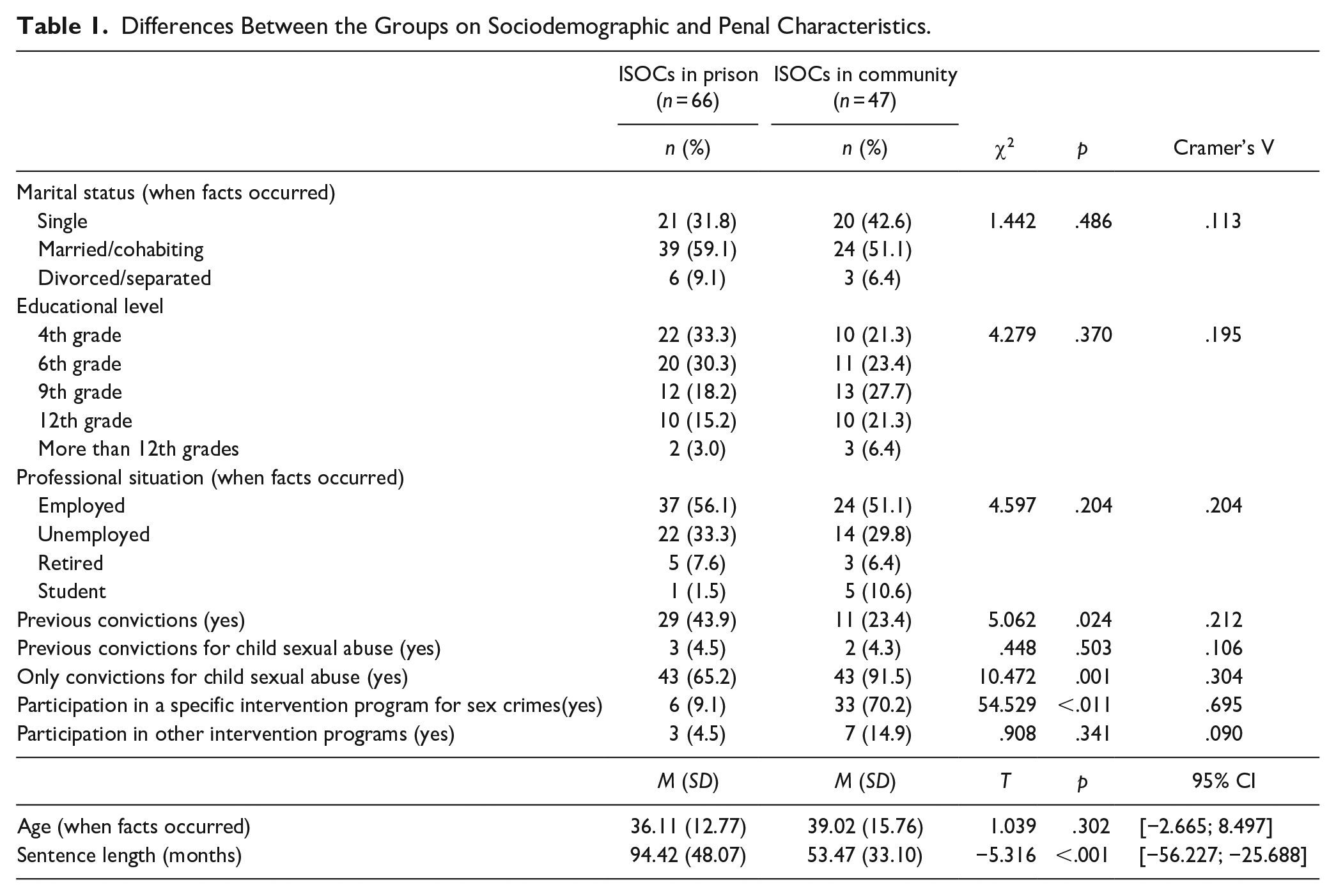
In relation to the age of the participants at the moment of the incident, there were no significant differences between the two groups (t (83,504) = 1.04, p = .302; see Table 1).
Penal variables
In relation to the type of convictions, in the imprisoned group, more than half of the participants (n = 43; 65.2%) had only convictions for child sexual abuse, while in the community only a small proportion of participants having other convictions beyond sexual abuse convictions. A chi-square test revealed that the association between these variables was significant (χ2(1) = 10.472, p = .001), that is, individuals in prison were more likely to be serving other convictions beyond child sexual abuse, than individuals in the community.
Almost half of the sample in prison (n = 29; 43.9%), and less than a quarter of the sample in the community (n = 11; 23.4%) had previous convictions. However, the rates of the two groups are similar in relation to previous convictions for child sexual crimes (4.5% for the imprisonment group and 4.3% for the community group). Chi-square tests revealed that there were significant associations between the type of the sentence and previous convictions (χ2(1) = 5.062, p = .024), but not between the type of the sentence and previous convictions for child sexual abuse (χ2(1) = .448, p = .503). Concerning the sentence length of the two groups, the group of imprisoned men had statistically significantly longer sentences than men sentenced to non-imprisonment measures (t (108.981) = −5.316, p < .001, d = −0.960, 95% CI [−1.358, 0.558]; see Table 1).
Psychological variables
In relation to psychopathology, there were statistically significant differences between the two groups in Positive Symptom Total (t (105) = −3.85, p < .001), depression, t (107) = −2.08, p = .04, anxiety, t (106) = −2.37, p = .02, paranoid ideation, t (107) = −2.51, p = .01, and psychoticism, t (107) = −2.70, p = .008. ISOCs in prison showed more depression, anxiety, paranoid ideation, and psychoticism levels, than individuals in the community.
Results revealed significant differences between individuals imprisoned and in probation on sexual offenses dimension (t (108) = −4.518, p < .001), and future plans (t (106) = −3.402, p < .001), with individuals in prison with more risk factors related to sexual offenses and future plans (see Table 2).
Differences Between the Groups on Psychological Variables.
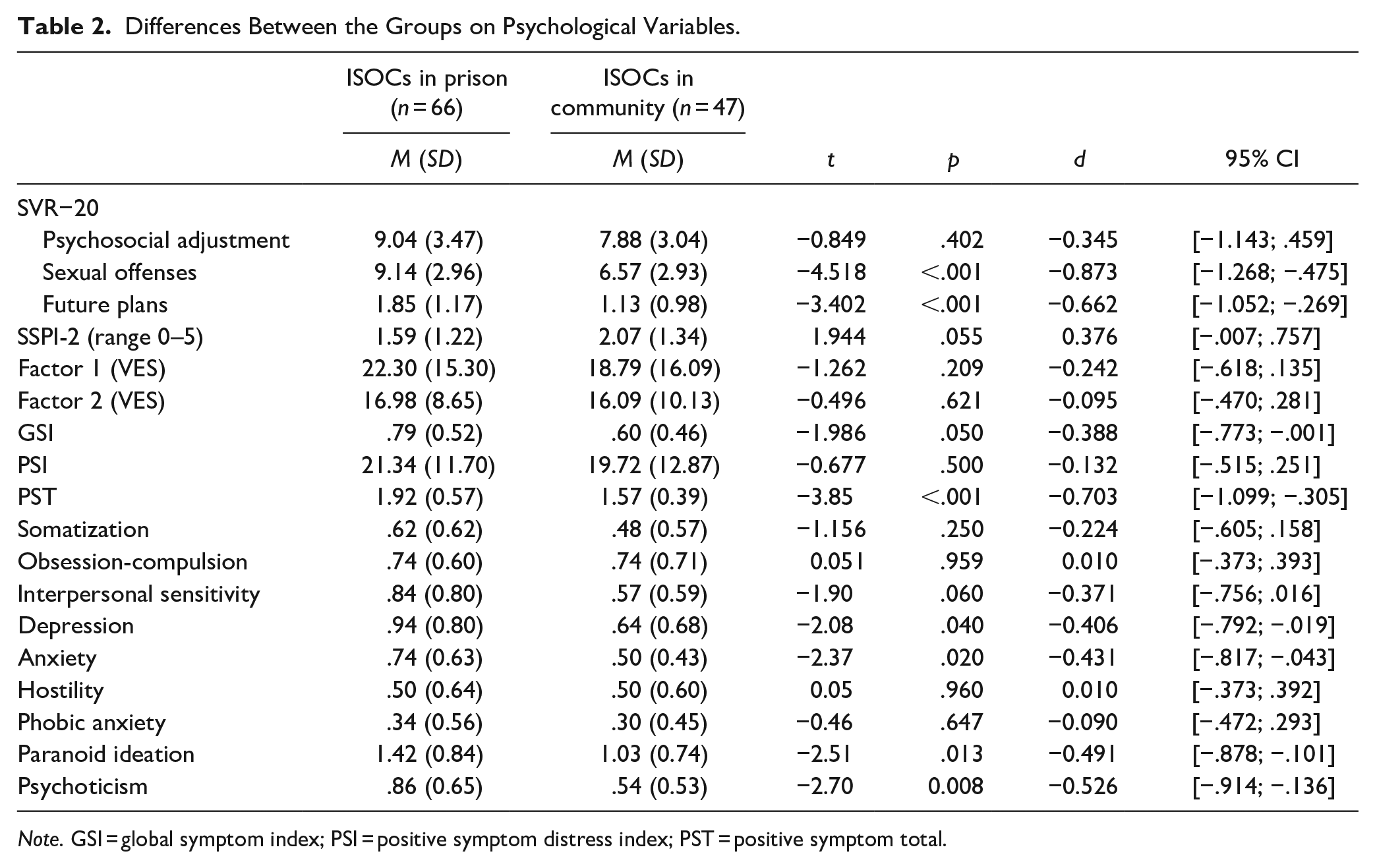
Note. GSI = global symptom index; PSI = positive symptom distress index; PST = positive symptom total.
Concerning risk factors variables, there were no statistically significant differences between the two groups in factor 1, t (110) = −1.262, p < .209, and factor 2 of victim empathy, t (110) = -.496, p = .621. Besides, only 17% of our sample scored 4 or more in the SSPI-2. However, there were marginally significant differences between the two groups in the screening of pedophilic sexual interests, t (109) = 1.944, p = .055. The prevalence of pedophilic sexual interests was marginally higher in the community than in prison (17.8% in the community and 7.6% in prison; see Table 2).
Lastly, there was a significant association between participating in a specific intervention program for the problem of sexual crimes and the type of sentence, χ2(1) = 54.529, p < .001, but not between participating in a non-specific program and the type of sentence χ2(1) = 0.908, p = .341 (see Table 1). The number of individuals participating in problem-specific intervention programs is higher in the community than in prison.
Type of Sentence Prediction
To predict the type of sentence, a binary logistic regression analysis was conducted in two steps. Based on the previous results, four variables were identified to be significantly associated with the type of sentence: previous convictions, having been convicted for other crimes than child sexual abuse in the current sentence, sexual violence risk (i.e., sexual offenses and future plans factors), and pedophilic sexual interests. In step 1, penal variables were included; in step 2, the variables related to risk of sexual violence was included (see Table 3).
Logistic Regression Model.
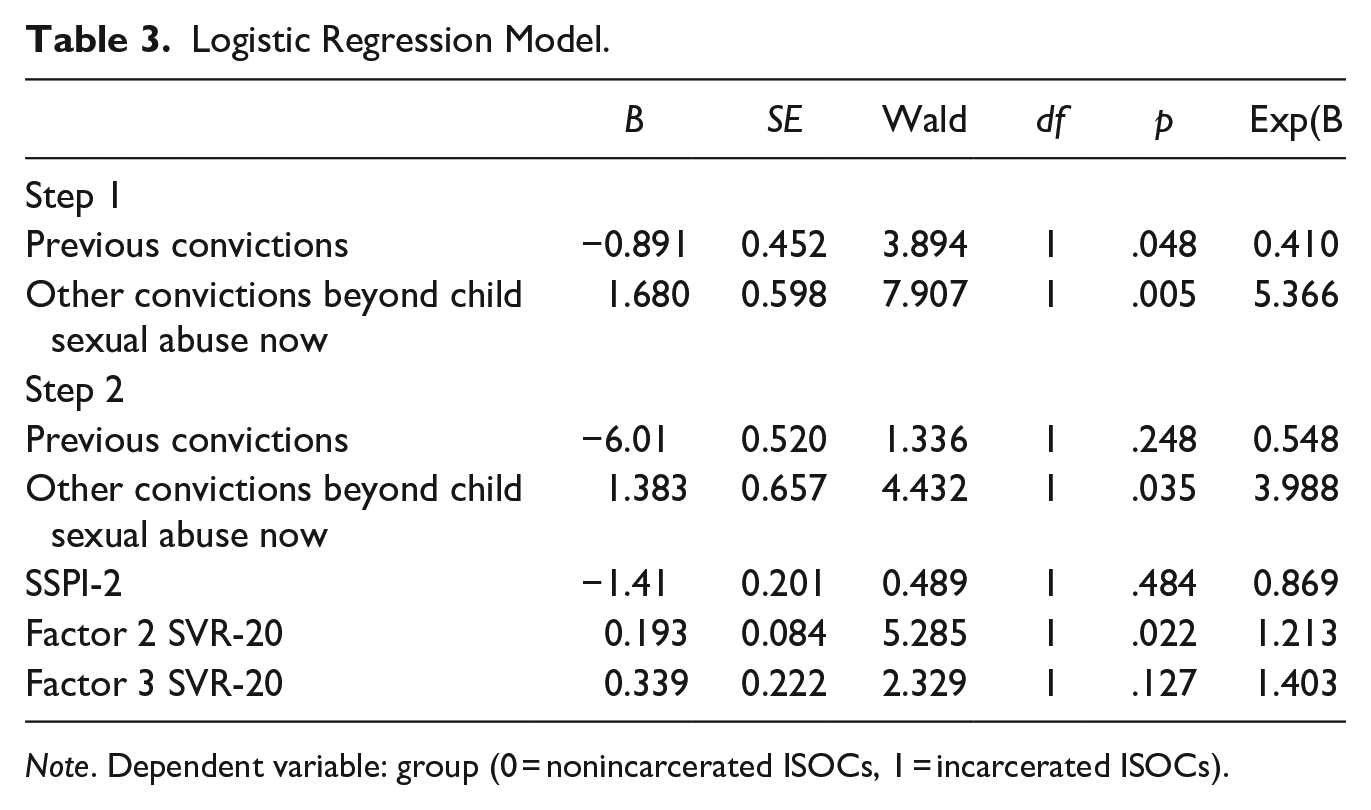
Note. Dependent variable: group (0 = nonincarcerated ISOCs, 1 = incarcerated ISOCs).
The model with the penal variables (Step 1) was statistically significant, χ2(2) = 14.619, p < .001. The role of these variables produced a pseudo-R2 between 13.0% (Cox and Snell) and 17.4% (Nagelkerke), revealing that the model accurately classified 65.7% of the cases. When the other variable (Step 2) was included, the model was also statistically significant, χ2(5) = 28.812, p < .001. This variable produced a pseudo-R2 between 24.0% (Cox and Snell) and 32.2% (Nagelkerke), which indicates that the model accurately classified 72.4% of the cases. Two variables used for the prediction of the type of sentence made a significant contribution to the model: sexual offenses of SVR-20 (OR = 1.213; 95% CI [1.029, 1.429]) and having had only convictions for child sexual abuse (OR = 3.988; 95% CI [1.100, 14.460]). Incarcerated ISOCs are almost four times more likely to currently have other convictions beyond child sexual offending, and for each unit increase in risk factors related to sexual offense, the odds of being incarcerated increased by a factor of 1.2.
Discussion
The present study aimed to analyze the differences between ISOCs sentenced to prison and ISOCs sentenced to community measures in terms of sociodemographic and penal variables, as well as in terms of psychosocial variables. The study also aimed to identify the variables that best predict imprisonment. The results revealed that incarcerated and nonincarcerated ISOCs presented some differences as well as some similarities.
Incarcerated ISOCs had more previous convictions (for other crimes) than nonincarcerated ISOCs, as well as more convictions for other crimes at the same time than child sexual offending convictions. However, there were no differences between the two groups in relation to previous convictions for child sexual offending. Unlike other crimes in which previous convictions are a predictor for committing new crimes, this does not seem to happen with sex crimes (van der Put et al., 2020). In fact, the number of previous convictions for child sexual abuse is low in the two groups, which contradicts the idea that perpetrators of child sexual abuse are at a high risk of recidivism. These ideas are fed by media reports but not supported by scientific literature (Laajasalo et al., 2020). However, and in a worrying way, this “dangerous class” phenomenon about individuals who sexually offended is one of the factors that may contribute to sustaining the use of more severe sentencing practices in some countries (Zatkin et al., 2022). Some political groups have supported these “get-tough” sentencing regimes, without an empirical basis (Cochran et al., 2021). The registration and notification of ISOCs are one tough measure largely supported by the community and lawmakers, even without any scientific evidence to support the effectiveness of these strategies in preventing sexual recidivism (Zgoba & Mitchell, 2023). In displaying this low percentage of sexual recidivists, our results highlight the need to adjust the penalty measures to the reality of the needs of those who commit these crimes avoiding practices and measures based on public opinion.
Incarcerated ISOCs had more risk factors associated with sexual offenses and future plans on SVR-20, which revealed that this group had committed more serious offenses—that is, for example, using threats and physical harm in the offense or having had multiple offense types—and did not reveal realistic plans to the future and also presented more negative attitudes toward treatment than nonincarcerated ISOCs. However, there were no differences between psychosocial problems (e.g., interpersonal and employment problems) in the two groups. In this perspective, our results suggested that the two groups seem to differ more at the level of static factors that cannot be changed (i.e., sexual offenses committed) than dynamic risk factors. Furthermore, there tends to be a higher rate of individuals with pedophilic sexual interests in the community, which is unexpected since pedophilic sexual interests are a crucial risk factor for committing a sexual offense (Hornsveld et al., 2019; Seto, 2019) and non-custodial measures must be for low-risk individuals. These results can be a result of a new concern in the sentencing field (Van Ginneken et al., 2019), in which decisions are more punitive for focusing on factors that the individuals could not control, and a result of a violation of risk-based sentencing (Van Ginneken et al., 2019), where the judgment is decided based on the severity of the offense and not on the perpetrators’ future risk (Hilinski-Rosick et al., 2014). The act of sentencing is subject to various external influences such as judges’ personal beliefs (Pereira et al., 2022). Although sentencing guidelines have been implemented in some countries to reduce bias, deviations have increased slightly after this measure (Hofer, 2007). So, it becomes imperative to enhance the comprehension and self-awareness of sentencing among the judicial system and judges (Castro-Rodrigues et al., 2017). Researchers argue that decision-makers should prefer dynamic risk factors over static factors to respect the perpetrator’s agency and capacity to change (O’Hear, 2020), making the use of psychological assessments of perpetrators crucial at a pre-sentencing stage.
Concerning psychopathology symptoms, incarcerated ISOCs presented more personal distress than nonincarcerated ISOCs. These results are not surprising since the literature has shown that the prison environment is favorable to the development of psychopathology. Custody results in the loss of personal freedoms and opportunities, such as social support, and social status, as well as some bad conditions like violence between prisoners (Bedaso et al., 2020; Bismpas et al., 2020). Specifically, imprisonment for ISOCs can have a lot of additional challenges such as feelings of insecurity developing verbal and physical violence by other inmates and security staff, which can impact the readiness and commitment to treatment (van den Berg et al., 2018; Wuyts et al., 2023). Furthermore, the undermining impact of imprisonment on perpetrators’ mental health and well-being may significantly affect their successful reintegration into society and reoffending/recidivism rates (Gabrysch et al., 2019). This is also one of the factors that lead many researchers to argue that if an effective intervention program can be more readily accessed in the community than in prison, community supervision must be preferred over incarceration (O’Hear, 2020). In addition, community-based programs that target deviant sexual behavior have proven to be more effective than prison-based ones (e.g., Tyler et al., 2021), reinforcing once again the need to assess each perpetrator at a pre-sentencing stage. Nevertheless, it is important that prison interventions address the high psychopathology observed before intervening on the risk factors. This can involve establishing a set of prison measures to guarantee that these people feel safe in their daily lives and, consequently, have the psychological conditions to be predisposed to work on their well-being and future without committing crimes.
Lastly, only two variables assessed predicted imprisonment. One variable was the existence of other convictions beyond child sexual abuse at the moment, in which ISOCs had almost four times more likely to go to prison if they had committed other crimes beyond the sex crime—for example being convicted for child sexual abuse and possession of a prohibited weapon. These results are not unexpected since the existence of other crimes increases the risk of future convictions for other crimes (Goodley et al., 2022). Therefore, these results deserve special attention if we consider that only a minority of the participants attended or are attending intervention programs in the prison context. Thus, to reduce the probability of these people reoffending and to help in the development of their well-being while enforcing the principle of prison sentences of rehabilitation, it is necessary to develop and apply psychological interventions (Sousa et al., 2023).
Besides, only the sexual offenses factor of the risk assessment predicts the incarceration of ISOCs. None of the psychological variables assessed predicted imprisonment, although assessing recidivism risk is extremely important to determine the type of sentence, sentence length, and associated restrictions (Fazel et al., 2022; Monahan & Skeem, 2016). Some research also pointed out that risk assessment should privilege dynamic risk factors, that is, risk factors that can change over time with appropriate treatment (O’Hear, 2020), leaving prison sentences only for those with a high risk of reoffending. In fact, our results suggest that there is a primacy of static risk factors in determining the prison sentence. Failure to consider dynamic risk factors when determining a sentence can let people who pose a high risk and may endanger public safety go free. Just as wrongly, considering people to be at high risk when they are not can lead to unnecessary restrictions on liberty and thus unwarranted stigma (Viljoen et al., 2021). Practical lawyers should consider conducting a pre-sentence risk assessment.
Despite the findings presented here, some limitations should be mentioned. First, a more extensive sample must be used in future studies. Second, our sample was not representative since we have more individuals with prison sentences than in the community. This distribution does not accurately reflect the panorama in Portugal, where community measures are more prevalent. Third, although the risk instrument used was completed in such a way as to minimize bias, such as the use of two psychologists with experience in the instrument and multiple sources of information collection (e.g., interview and individual process), future studies should also include the judges' view of the factors they consider in sentencing someone who commits a sexual offense against a minor.
Conclusion
In sum, the current study revealed that incarcerated and nonincarcerated ISOCs present some differences as well as some similarities. Incarcerated ISOCs had more previous convictions, more convictions beyond child sexual abuse at the moment, more psychopathology symptoms, and more risk factors associated with sexual offenses and future plans than nonincarcerated ISOCs. Moreover, only two static factors predict imprisonment. These results raise the discussion about the need to consider dynamic risk factors to have sentences more adjusted to the needs of each perpetrator and their recidivism risk.
Footnotes
Declaration of Conflicting Interests
The author(s) declared no potential conflicts of interest with respect to the research, authorship, and/or publication of this article.
Funding
The author(s) disclosed receipt of the following financial support for the research, authorship, and/or publication of this article: The study was conducted at the Psychology Research Center (PSI/01662), School of Psychology, University of Minho. Marta Sousa was funded by a Doctoral research grant from the Portuguese Foundation for Science and Technology, grant number 2020.06634.BD.
