




Abstract
The aim of the current study is to contribute to the understanding on whether the victim–offender overlap in intimate partner violence (IPV) is a product of population heterogeneity or state dependency between victimization and offending. The study uses a large data set of Finnish police-recorded IPV victims (N = 13,452) and offenders (N = 13,061) to assess whether IPV victimization and offending are temporally associated over and above stable individual differences. The results indicate that the associations between IPV victimization and offending are not fully explained by population heterogeneity, as they persist in the within-individual analyses for both directions and genders. Gender, however, seems to affect the magnitude and robustness of the associations. Further research is needed on the mechanisms driving these results.
Keywords
Introduction
The co-occurrence of criminal offending and victimization, commonly referred to as the victim–offender overlap, represents a well-established empirical fact in criminological research (Berg & Schreck, 2022; Jennings et al., 2010; Lauritsen et al., 1991). The notion of the same individuals being both victims and perpetrators has been vastly influential in some branches of theory development in criminology (Lauritsen et al., 1991; Singer, 1986), and the general extent of the victim–offender overlap has been extensively studied in various populations. Yet, several aspects of the co-occurrence of criminal offending and victimization remain both empirically understudied and undervalued in the theoretical literature. Moreover, the victim–offender overlap remains a subject of controversy in some research areas. The current study examines the link between victimization and offending in intimate partner violence (IPV).
Although it has long been acknowledged that any theory of crime that does not account for the victim–offender overlap is at least partially inadequate (Reiss, 1981; Schreck et al., 2008), victims and offenders are commonly studied and theorized about as two distinct groups in IPV literature. Apart from explanatory frameworks emphasizing gendered motivations for the use of violence (Dobash & Dobash, 2004; Johnson, 2008), findings of the tendency for the same individuals to be both IPV victims and offenders (e.g., Holmes et al., 2019; Langhinrichsen-Rohling et al., 2012) have overall provoked little reaction in IPV theory development. This is likely due to the lack of empirical research on the victim–offender overlap in IPV addressing the issue of state dependency between victimization and offending, as opposed to confounding risk factors related to population heterogeneity (Aaltonen et al., 2018; Ousey et al., 2011). Understanding the extent to which the co-occurrence of IPV victimization and offending is a function of a causal relationship between victimization and offending, or to which shared risk factors explain the overlap, would be critical for assessing the validity of different theoretical frameworks. Until this issue is addressed, little can be concluded about the theoretical, as well as practical, implications of the victim–offender overlap in IPV.
The aim of the current study is to examine the extent to which a temporal association between IPV victimization and offending can be detected within individuals in a large data set of Finnish police-recorded IPV cases. Specifically, the study aims to capture the state dependency between victimization and offending by comparing periods before and after IPV victimization and offending in a within-individual manner. By using complete and temporarily-precise data in addition to suitable statistical methods, the current study tackles several limitations of prior research and adds to the discussion on the implications of the victim–offender overlap in IPV.
Victim–Offender Overlap in Intimate Partner Violence
There is considerable empirical support for a significant overlap between IPV victimization and offending in the form of individual-level co-occurrence of these experiences (Muftić et al., 2015; Taylor et al., 2019; Tillyer & Wright, 2014) as well as couple-level bidirectional violence (Holmes et al., 2019; Langhinrichsen-Rohling et al., 2012). Prior findings also suggest that that the victim–offender overlap among IPV victims and offenders is not limited to violence between intimate partners, as studies have reported associations between IPV offending and non-IPV victimization over the life course in addition to the overlap between IPV victimization and general criminality (Carbone-Lopez & Kruttschnitt, 2010; Richards et al., 2017). The relevance of studying the victim–offender overlap in the context of intimate relationships is also underlined by empirical findings suggesting that the overall associations between victimization and offending in general are dependent on the relationship between the victim and the offender: specifically, victimization by a family member has the strongest association with future offending (Zimmerman et al., 2017).
Despite evidence pointing to the significance of the victim–offender overlap in IPV, research contributing to understanding the causes of this overlap is sparse. While studies on correlates of IPV tend to suggest similar risk factors for victimization and offending, such as low socioeconomic status, alcohol or substance abuse, and exposure to violence in childhood (e.g., Capaldi et al., 2012), it remains largely unclear how different risk factors contribute to the overlap and whether IPV victimization and offending are associated over and above the effect of shared risk factors. However, findings from the few existing studies that analyze IPV victims, offenders and victim–offenders as three distinct categories have some approximate implications for this discussion. Notably, some studies report similarities between IPV offenders and victim-offenders on one hand, and differences between IPV victims and victim-offenders on the other hand (Spivey & Nodeland, 2021; Tillyer & Wright, 2014), which could indicate that the victim–offender overlap is at least partially attributable to risk factors for IPV offending, such as low self-control (Spivey & Nodeland, 2021) or substance abuse problems (Tillyer & Wright, 2014), which are also relatively prevalent among IPV victims. In some studies, however, IPV victim–offenders stand apart from both exclusive offenders and victims. Generally, findings from these studies show victim–offenders to score the highest among all IPV-involved individuals for various risk factors, such as general crime exposure (Muftić et al., 2015) and adverse childhood experiences (Richards et al., 2017). These findings, in addition to studies suggesting different risk factors for unidirectional and bidirectional IPV (Melander et al., 2010; Renner & Whitney, 2012), could imply that the victim–offender overlap does not simply revert to shared risk factors for IPV victimization and offending, and thus more dynamic explanations for these patterns are needed.
While empirical literature attempting to explain the co-occurrence of IPV victimization and offending mainly concentrates on analyzing shared or varying risk factors for different types of IPV involvement, most conventional theoretical explanations for the victim–offender overlap in IPV focus almost solely on direct dependency between victimization and offending. This is largely due to the tendency in the research field to define IPV as an essentially gender-related phenomenon (e.g., Dobash et al., 1992) and treat victims (mainly females) and offenders (mainly males) as two clearly distinct categories (e.g., Saunders, 2002). As similarities between victims and offenders are difficult to incorporate into this research tradition (e.g., Ross & Babcock, 2010), the victim–offender overlap has been ascribed to female victims using defensive violence toward their primarily violent male partners (Dobash & Dobash, 2004; Johnson, 2008; Saunders, 1986). Although the role of self-defense in motivations for IPV is generally well-established (Babcock et al., 2019; Leisring & Grigorian, 2016), some empirical challenges arise when attempting to explain the existence of the victim–offender overlap solely by female-to-male defensive violence. Most notably, this explanation is not supported by findings showing approximately equal gender distribution among victim-offenders (Muftić et al., 2015; Tillyer & Wright, 2014), no remarkable gender differences in defensive reactions to violence (Babcock et al., 2019; Leisring & Grigorian, 2016), and females also acting as primary aggressors in IPV (Henning et al., 2006; Muftić et al., 2007). Moreover, any explanation for the victim–offender overlap that overlooks similarities between IPV victims and offenders in, for instance, general criminality (Carbone-Lopez & Kruttschnitt, 2010), seems at least moderately inadequate.
Criminological Perspectives on the Victim–Offender Overlap
Although mainstream criminological theory has been criticized for its tendency to treat offenders and victims as distinct classes, and for not making enough effort to account for the victim–offender overlap (e.g., Schreck et al., 2008), there is a growing body of literature addressing the issue of the same individuals being both offenders and victims. Broadly speaking, different explanatory frameworks fall into two categories (Ousey et al., 2011): those explaining the overlap by shared risk factors (or population heterogeneity), and those explaining the overlap by state dependency (or causal associations between victimization and offending). Notably, most of the major criminological theories also fit into these categories, even if they do not explicitly comment on the link between victimization and offending (e.g., Schreck et al., 2008).
As for the explanatory frameworks suggesting the association between victimization and offending to be spurious and a result of shared risk factors, the most influential theoretical perspectives relate to the general theory of crime by Gottfredson and Hirschi (1990), and the lifestyle/routine activities framework (e.g., Lauritsen et al., 1991). While Gottfredson and Hirschi (1990) suggest that the victim–offender overlap is a result of individuals’ low self-control—which puts them at risk of both offending and victimization—the lifestyle/routine activities framework proposes a risky lifestyle to be the corresponding risk factor that increases the probability of both offending and victimization. As individual-level lifestyle is thought to be largely attributable to stable sociodemographic characteristics (e.g., Cohen et al., 1981), and self-control is generally described as a relatively invariable personality trait (e.g., Jo & Bouffard, 2014), both of these frameworks explain the victim–offender overlap by more or less persistent individual differences. As individual-level tendencies toward victimization and offending are largely determined by these differences, experiences of victimization (or offending) are not likely to significantly affect subsequent offending (or victimization).
In contrast to the population heterogeneity perspective, there are various theoretical frameworks that suggest dynamic, causal processes between victimization and offending, resulting in the co-occurrence of these experiences (Ousey et al., 2011). These explanations range from unidirectional causation from one event to another to more dynamic reciprocal processes between experiences of victimization and offending. These frameworks include, for instance, interactionist explanations describing the victim–offender overlap at the situational level (Berg & Felson, 2020), retaliatory offending related to violent subculture (Singer, 1986), and psychological strain caused by victimization resulting in criminal offending (Agnew, 2002). While these frameworks vary in both the suggested imminence of the temporal relationship between victimization and offending and the direction of causation from victimization to offending or vice versa, they all suggest victimization and offending to be associated over and above stable individual differences. Testing the validity of these explanations therefore requires empirical research on the victim–offender overlap to move beyond cross-sectional correlations, in an attempt to examine the potential causal link between victimization and offending.
Temporal Association Between Victimization and Offending
One apparent way of assessing the state dependency between victimization and offending involves examining the temporal association between incidents of crime involvement. Theoretically, if all potentially confounding factors are controlled for, either by adjusting for observed confounders and/or using adequate research designs (e.g., Clare et al., 2019; Huntington-Klein, 2021), a temporal association between victimization and offending is likely to indicate a causal association. Moreover, several explanatory frameworks, such as those related to retaliation (e.g., Aaltonen et al., 2018) or self-defense (e.g., Babcock et al., 2019), imply that causation between victimization and offending is likely to occur in the short term rather than in the long run. In addition, research that allows for identification of the temporal ordering of victimization and offending (e.g., Ousey et al., 2011) is necessary to assess the direction of the potential effect.
Most studies examining the victim–offender overlap within temporal contexts rely on longitudinal survey data collected in several waves. These studies generally report a positive temporal association between victimization and offending in either or both directions (e.g., Jennings et al., 2010; Schreck et al., 2017; Sullivan et al., 2016). However, the findings of Sullivan et al. (2016) also highlight the substantial role of stable individual differences in explaining the victim–offender overlap. Interestingly, Ousey et al. (2011) found a negative association between victimization and offending and vice versa when controlling for unobserved heterogeneity. Overall, these studies point toward a temporal association between victimization and offending, but findings on the direction of the effect are somewhat mixed. This is likely due to challenges caused by long measurement intervals and the lack of potentially relevant information on changes in time-variant confounders occurring between data collection waves (Berg & Schreck, 2022). While testing for some theoretically-relevant state-dependent mechanisms does require long-term follow-up data, capturing the direct link between victimization and offending is likely to be more successful in short-term settings.
Of greater relevance to the current study are a few studies that used temporarily-precise data to allow for assessment of short-term temporal associations between victimization and offending. Notably, in a study by Aaltonen et al. (2018), violent offending and victimization were found to be temporally clustered in a within-individual analysis of Finnish register-based data. Similarly, Sariaslan et al. (2016), using Swedish register data on patients with psychotic disorders, found the risk of offending to be highest during the first week after violent victimization. In addition to studies relying on police-recorded crime, short-term within-individual clustering of victimization and offending has also been found in some studies using self-report measures of crime. In particular, Averdijk and Bernasco (2015) used hourly data of time use among Dutch adolescents and found victimization to be most likely to occur in situations associated with delinquent involvement. Overall, these studies generally highlight that while the significance of stable individual differences in the risk of victimization and offending is evident (e.g., Ousey et al., 2011; Sullivan et al., 2016), analyzing the victim–offender overlap within short-term temporal contexts is also necessary to understand the link between victimization and offending.
Current Study
Despite repeated findings of the association between victimization and offending in IPV, research attempting to assess whether the overlap is a product of population heterogeneity or a direct causal link between victimization and offending is practically non-existent. While studies on the victimization–offending link have pointed out the relevance of this kind of inquiry, IPV research has to date mainly focused on cross-sectional, correlational research. As different theoretical frameworks within IPV literature propose different hypotheses in terms of both the existence of a temporal association between victimization and offending generally and the role of gender in this association, empirical research is also needed to test the validity of different theoretical perspectives.
The aim of the current study is to assess the temporal relationship between IPV victimization and offending, using data on Finnish police-recorded IPV victims and offenders linked to information on individuals’ subsequent IPV offending and victimization. Explicitly, the research question is as follows: Are IPV victimization and offending associated over and above stable individual differences? Using time-to-event modeling rarely employed in research on the victim–offender overlap, the current analysis compares periods 1 year before and after the first occurrence of police-recorded IPV victimization and offending between 2015 and 2018, in order to assess whether victimization/offending is associated with subsequent offending/victimization. Beneficial to this analytic strategy, it allows for the associations to be examined in a within-individual manner.
In order to examine the direction of possible associations between victimization and offending, all analyses are two-fold: both victimization before and after offending, and offending before and after victimization, are considered. Assuming that associations are found between victimization and offending, or vice versa, the population heterogeneity perspective suggests that they are likely to disappear in the within-individual analyses. Conversely, the state dependency perspective posits that the associations are likely to persist in the within-individual models. In addition, the analyses are run separately for males and females to assess the role of gender in the associations.
Data
Source of the Data and Composition of the Data Sets
The data set for the current study draws on police-reported crime data gathered and maintained by Statistics Finland. The Finnish Police is the initial source of the data on all suspected offenses, but police data alone does not contain reliable information to separate IPV offences from other offenses of the same penal code (e.g., IPV assaults from other assaults). To address this shortcoming, Statistics Finland further classifies offenses as domestic violence based on auxiliary population register information on the relationship of the suspect to the victim (e.g., kinship, marriage, same household). Consequently, the classification is not dependent on, for example, police perception of IPV. The data contain several types of non-lethal criminal offenses that can be classified as domestic violence or IPV based on official information. In addition to physical and sexual violence (e.g., assaults, rapes), the data also include a wide range of other types of personal offenses. As the data are based on police statistics, all offenses that the police have recorded as crimes and investigated are included, regardless of criminal justice outcomes. Suspects are referred to as offenders for the sake of consistency with prior literature.
For the purpose of the current study, IPV was defined as any offense in the Statistics Finland domestic violence data in which the offender and the victim were married, formerly married, co-habiting, formerly co-habiting (within 5 years prior to the offense), or had a common child. While Statistics Finland’s definition of co-habiting is limited to mixed-sex couples, the data also include married same-sex couples, thus the analysis is not limited to IPV between female-male couples. Any non-lethal personal offenses (e.g., assaults, attempted homicides, rapes, robberies, extortions, deprivations of personal liberty, menaces, persecutions) by an intimate partner were defined as IPV. A definition of violence that goes beyond mere physical violence is generally favored in the IPV literature, and thus, a broad definition is taken in the main analysis of the current study. The majority of IPV offenses in the complete data were assaults.
The sample used in the main analysis of the current study was restricted to individuals recorded as victims or offenders of IPV between 2015 and 2018. The two-fold analysis was based on two separate data sets of individual IPV victims and offenders that were used as the units of analysis. As the analytic strategy involves comparisons before and after IPV victimization/offending, the possible biasing effect of prior IPV victimization/offending was accounted for by excluding individuals reported as IPV victims (when analyzing offending before and after victimization) or offenders (when analyzing victimization before and after offending) in 2013 or 2014 from the analyses.
Composing the data as described above led to data sets of 14,678 IPV victims and 14,571 IPV offenders. Next, individuals who died at any point during the study period were excluded, as the exact date of death (which could have allowed for censoring due to death in a model-based manner) was not available in the data. In addition, individuals with missing years in their basic Statistics Finland sociodemographic data during the study period were excluded, as this likely indicates periods spent living outside of Finland. Finally, individuals with incomplete data on any sociodemographic variables were also excluded from the final data set. This led to data sets of 13,452 IPV victims and 13,061 IPV offenders linked to information on police-recorded cases of IPV offending and victimization from time periods before and after the reference incident (the first occurrence of victimization/offending) between 2015 and 2018. It should be noted that due to the selection of the reference incidents, the results are not generalizable to all IPV incidents; only to first incidents during the selected time period, which do not necessarily represent an average IPV case, especially in terms of the potential consequences of the event. The composition of the data should be taken into account when interpreting the results.
In addition to the data sets used in the main analysis, described above, additional data sets were composed; these were restricted to individuals who had experienced (for the analysis on offending before and after victimization) or committed (for the analysis on victimization before and after offending) physical assaults by or against an intimate partner during the follow-up period. As these data sets were used in an attempt to control for the between-individual differences in severity of violence, the sample was further restricted to individuals for whom the most severe form of IPV experienced or committed during the follow-up period was basic assault (in the range of minor, basic and aggravated assaults, and attempted homicide). These data sets included 7,204 IPV victims and 7,014 IPV offenders.
Measures
Since the analysis was performed in a two-fold manner, two similarly-composed outcome measures for IPV victimization and offending were used in the models. For the analysis on IPV offending before and after IPV victimization, the outcome measure comprised all cases of police-recorded IPV offending from 1 year preceding and 1 year following the first occurrence of IPV victimization recorded for the individual between 2015 and 2018. Likewise, for the analysis on IPV victimization before and after IPV offending, the outcome measure comprised all cases of police-recorded IPV victimization from 1 year preceding and 1 year following the first occurrence of IPV offending recorded for the individual between 2015 and 2018. In order to control for the potential effect of changing relationships on the opportunity structure of IPV, all offenses defined as IPV against any current or former partner were included in the outcome measures regardless of whether they occurred within the same couple dyad or not. The variables were composed in a time-variant manner with respect to the number of days from the reference incident (for cases occurring during the period following the reference incident), or the reference incident minus 1 year (for cases occurring during the period preceding the reference incident).
Notably, the majority of incidents of co-occurrence of IPV victimization and offending in the data sets occurred on the same day. In the sample of IPV victims, 26.8% of the reference victimization incidents were linked to IPV offending by the victimized individual recorded on the same day; similarly, in the sample of IPV offenders, 27.5% of the offenders were also recorded as IPV victims on the day of the reference incident. As the aim was to assess the causal link from victimization to offending and vice versa, it was necessary to be able to identify the temporal order of these events; consequently, IPV offending and victimization occurring on the same day as the reference incident were excluded from the outcome measures. For the sake of additional analyses, alternative outcome measures were also composed in which all events of IPV victimization and offending occurring on the same day were excluded.
The main predictors of interest were binary indicators of the occurrence of the reference victimization/offending incident. Technically, every individual was allocated to separate and identifiable time periods for before and after the reference incident, permitting the within-individual framework in the analysis. Binary variables were included in the data sets to allow for the identification of the time periods before and after victimization/offending. As the main analytic strategy concerned within-individual comparisons, an extensive set of time-invariant control measures was not needed in the analysis. As for sociodemographic measures, information on total yearly income and marital status (unmarried/married/divorced) recorded at the end of the previous year was used in the main analysis. In addition, information on age and immigrant background was included in the data sets in order to describe the data and to be used in the sensitivity analyses. Descriptive statistics for all the variables are presented in Table A1 in the Supplemental Appendix. In addition, descriptive statistics for the additional data sets restricted to assaults are presented in Table A2 in the Supplemental Appendix.
Analytic Strategy
All the analyses were based on comparisons between two time periods: the year preceding and the year following the reference IPV incident. The analysis begins with descriptive assessment using Kaplan-Meier survival estimates. This analysis was conducted to estimate the cumulative incidence of IPV offending 1 year before and after IPV victimization, and vice versa, for females and males separately. This served as an initial assessment of the crude between-individual temporal associations between IPV victimization and offending. In this analysis, individuals were followed up until the end of the 1-year period, or until the first outcome event (IPV victimization/offending), whichever occurred first.
Next, in order to control for unobserved heterogeneity, a within-individual design was applied. This was performed using stratified Cox proportional hazards regression models (e.g., Beisel et al., 2017; Therneau & Grambsch, 2000) stratified by individuals. The comparisons were made in a within-individual manner by comparing 1-year periods with different exposure to IPV victimization or offending within the same individual. Notably, this modeling strategy automatically controls for population heterogeneity in the form of time-invariant confounders as the comparisons are not made between individuals but within the same individual (e.g., Landén et al., 2021; Molero et al., 2020). In these analyses, the outcome measures of IPV offending and victimization were treated as reoccurring events. Consequently, all individuals were followed up: firstly, from 1 year prior to the reference incident until the reference incident, and secondly, from the reference incident until 1 year after. Censoring occurred at the end of these separate follow-up periods for all individuals. Models were adjusted for within-individual changes in yearly income and marital status occurring between the starting points of the two follow-up periods. These models, too, were estimated for females and males separately, and the results are presented in hazard ratios (HR).
In addition, Cox proportional hazards regression with a frailty term was employed as an alternative modeling strategy to the stratified models in order to assess the robustness of the main results. The frailty model represents a random-effects application to time-to-event modeling (e.g., Murphy, 1995) and accounts for unobserved heterogeneity by explicitly including it in the model as a multiplicative random effect (e.g., Balan & Putter, 2020). Overall results from these additional models are commented on in section 8.3 (“Supplemental analyses”).
All statistical analyses were performed in RStudio (Version 1.4.1103; R version 3.6.3) using the survival package (Version 3.2.7; Therneau et al., 2020). A useful practical guide for analyzing time-variant covariates in Cox models using R is presented by Therneau et al. (2022).
Results
IPV Victimization and Offending Rates Before and After the Reference Incident
The analysis begins with a descriptive comparison of the cumulative incidence of IPV offending 1 year before and after IPV victimization, and vice versa, using the Kaplan–Meier estimation method. Specifically, this method provides estimates for offending and victimization rates before and after IPV victimization/offending by gender. Figures 1 and 2 illustrate the estimated cumulative incidence (one minus the Kaplan–Meier estimator) of IPV offending after IPV victimization for females and males, and Figures 3 and 4 illustrate the estimated cumulative incidence of IPV victimization after IPV offending. For females, the rate of IPV offending after the 1-year follow-up was 1.3% (95% CI [1.1%, 1.5%]) before IPV victimization and 4.3% (95% CI [3.9%, 4.7%]) after IPV victimization; for males, 13.9% (95% CI [12.7%, 15.1%]) and 17.8 % (95% CI [16.5%, 19.2%]) respectively. Conversely, for females, the rate of IPV victimization after the 1-year follow-up was 13.6% (95% CI [12.4%, 14.8%]) before IPV offending and 18.0% (95% CI: 16.6%, 19.3%) after IPV offending; for males, 1.3% (95% CI [1.0%, 1.5%]) and 4.5% (95% CI [4.1%, 5.0%]) respectively. Overall, the results show that the rate of IPV offending is generally much higher among males, and the rate of IPV victimization is higher among females. In addition, the victimization rates are significantly higher after IPV offending, and vice versa, for both genders.
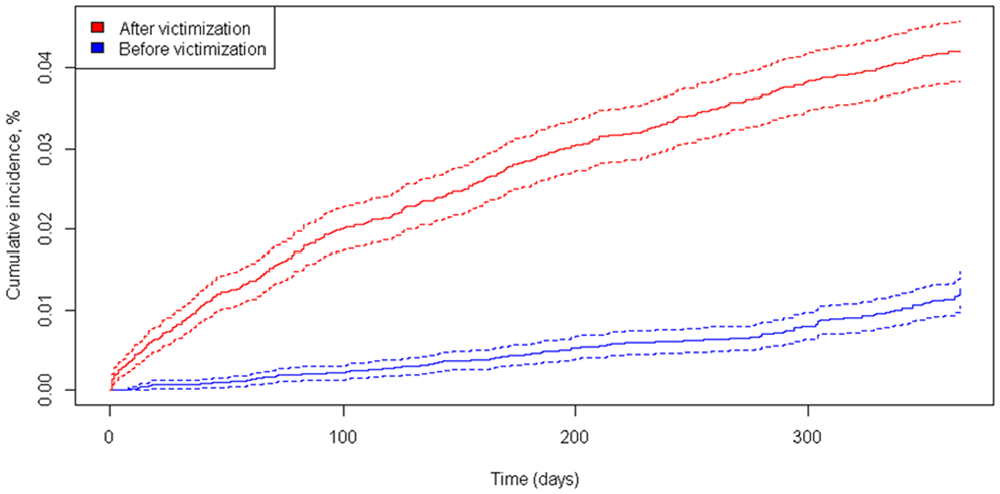
Cumulative incidence (with 95% confidence intervals) of IPV offending 1 year before and after IPV victimization for females (N = 10,366).
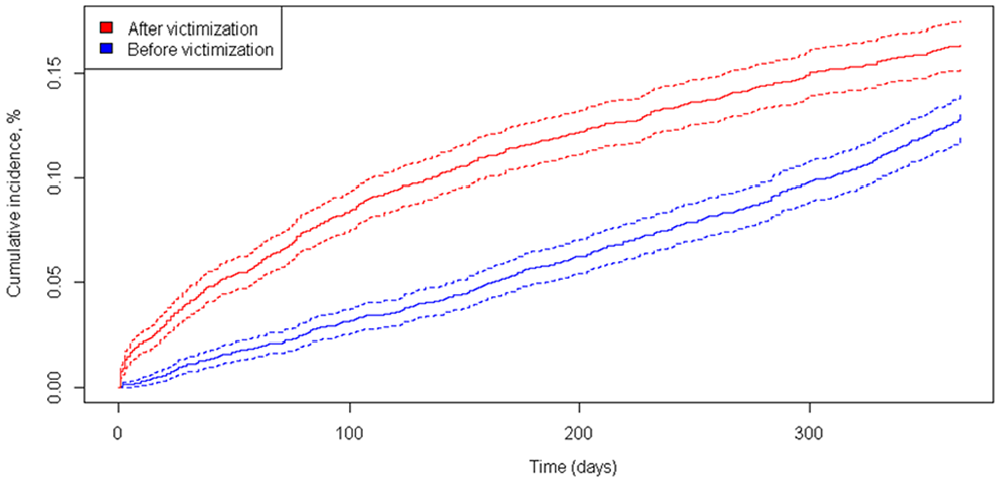
Cumulative incidence (with 95% confidence intervals) of IPV offending 1 year before and after IPV victimization for males (N = 3,086).
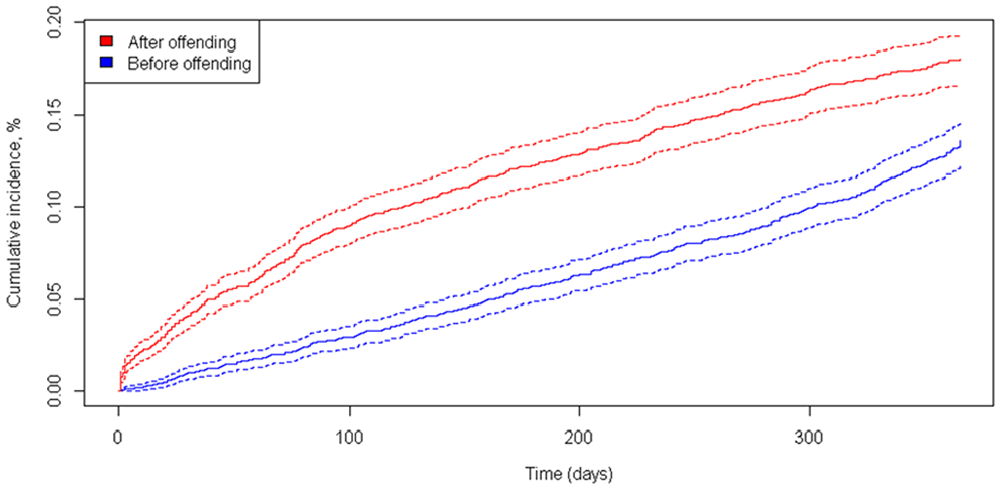
Cumulative incidence (with 95% confidence intervals) of IPV victimization 1 year before and after IPV offending for females (N = 3,115).
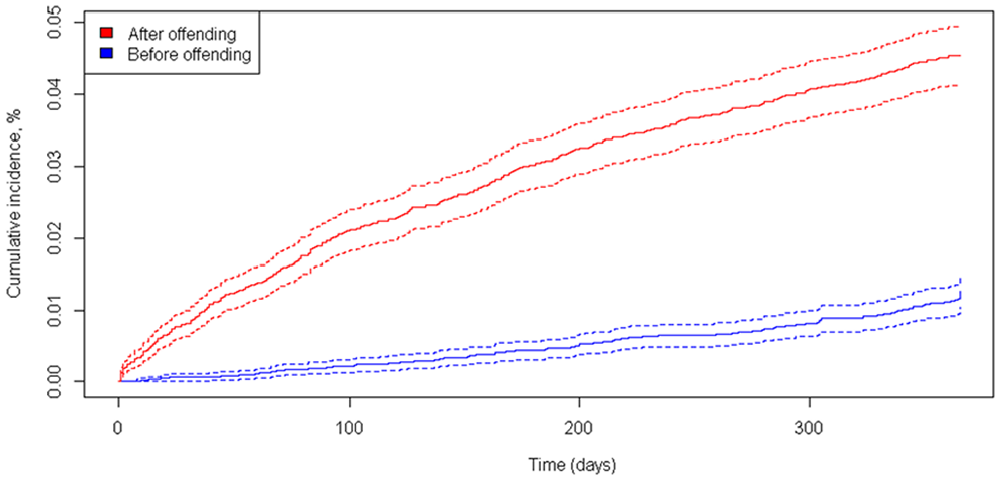
Cumulative incidence (with 95% confidence intervals) of IPV victimization 1 year before and after IPV offending for males (N = 9,946).
Main Results: The Within-Individual Analyses on IPV Offending Before and After IPV Victimization, and Vice Versa
In the next part of the analysis, a within-individual approach was taken in the form of stratified Cox proportional hazards regression models. The main results concerning the within-individual associations are presented in Figure 5 as HRs from four separate regression models. Overall, the results show that the associations between IPV victimization and offending persist in the within-individual models for both direction and genders. As for the victimization-to-offending direction, the risk of IPV offending was significantly higher after IPV victimization in comparison to the time period before victimization for both females (HR: 3.80, 95% CI [3.14, 4.61]) and males (HR: 1.39, 95% CI [1.25, 1.55]), although the magnitude of the association was notably higher among females. Correspondingly, the risk of IPV victimization was significantly higher after IPV offending in comparison to the time period before offending for both females (HR: 1.42, 95% CI [1.27, 1.58]) and males (HR: 4.06, 95% CI: [3.34, 4.93]), with the magnitude of the association being notably higher among males.
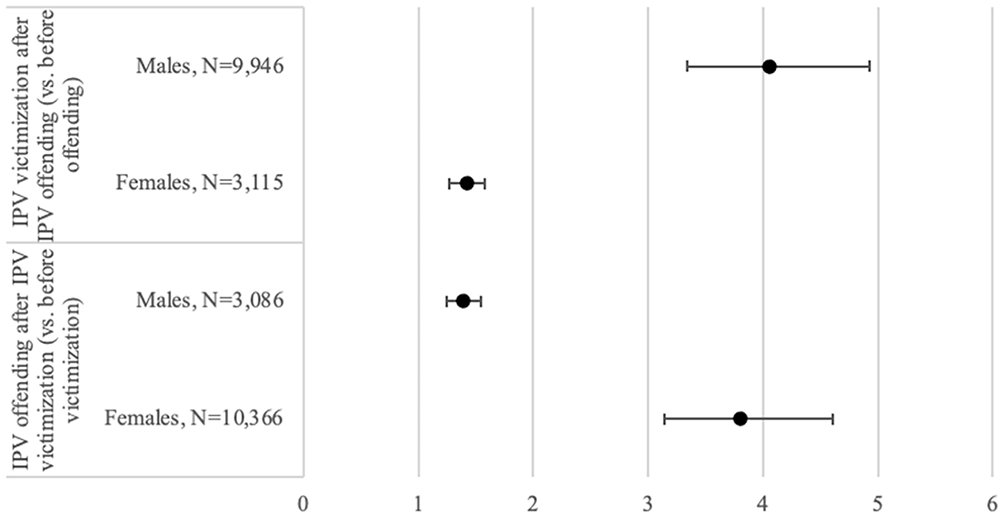
Hazard ratios (with 95% confidence intervals) for the within-individual associations between IPV victimization and IPV offending from four stratified Cox proportional hazards regression models. Complete sample; outcome includes all IPV offending. Adjusted for changes in yearly income and marital status.
Supplementary Analyses
In order to assess the robustness of the main results to the severity of violence, the analysis was subsequently re-run using the sample restricted to individuals associated with physical assault victimization/offending during the follow-up period, for whom the most severe form of IPV experienced or committed during the follow-up period was basic assault. The outcome measures were composed similarly to the main analysis on the complete sample. Overall, the results of this analysis were largely similar to the results of the main analysis. The estimated cumulative incidences of IPV offending before and after IPV victimization, and of IPV victimization before and after IPV offending, for females and males are presented in Table A3 in the Supplemental Appendix. Figure A1 in the Supplemental Appendix presents the within-individual results from this sample. Similarly to the main results, these results show that the associations between IPV victimization and offending persist in the within-individual models for both direction and gender. These results indicate that the associations suggested in the main results persist even when efforts are made to control for the severity of violence.
In order to assess the role of same-day co-occurrences of IPV victimization and offending in the main results, the analysis was also re-run using the alternative outcome measures excluding all cases of IPV victimization and offending occurring on the same day. Using these outcome measures, the estimated cumulative incidences of IPV offending before and after IPV victimization and IPV victimization before and after IPV offending (for both females and males) are presented in Table A3 in the Supplemental Appendix. Figure A2 in the Supplemental Appendix presents the within-individual results using these outcome measures. In comparison to the main results, associations between victimization and offending were notably weaker for the victimization to offending direction for females and offending to victimization for males, and statistically non-significant for the victimization to offending direction for males and offending to victimization for females. Overall, the results highlight the significant role of same-day co-occurrences of victimization and offending in producing the associations reported in the main results. However, it is notable that some associations persist even when same-day co-occurrences are excluded from the outcome measures.
To complement and further assess the robustness of the main results, several sensitivity analyses were run. Firstly, using frailty models as an alternative modeling strategy to control for unobserved heterogeneity led to very similar overall estimates of the victimization–offending associations to those of the main analysis relying on stratified Cox models. Secondly, introducing an interaction term of gender and an indicator for the occurrence of the reference incident into the frailty model on the complete sample of both genders confirmed the findings of gender as a moderating factor in the associations between victimization and offending. Thirdly, the data sets were recomposed by dividing the whole time frame from 2014 to 2019 into periods before and after the reference incident. In this analysis with longer follow-up periods, the association between IPV victimization and subsequent IPV offending disappeared for males in the within-individual models, and similarly, the association between offending and subsequent victimization disappeared for females in the within-individual models. This could suggest that the mechanisms producing the associations between victimization and offending are likely to operate in the short term rather than in the long run when it comes to the victimization–offending link for males and the offending–victimization link for females. On the other hand, the result could also be reflective not of the tendency of these links to be more persistent per se, but of the higher tendency for females to experience IPV repeatedly in the data and the possible consequences of this, which are not accounted for in the current research design.
Finally, all the models were run using non-IPV violent offending and victimization before and after IPV victimization and offending as “placebo outcomes” to see whether IPV victimization was also associated with a higher risk non-IPV offending, and/or IPV offending with a higher risk of non-IPV victimization. Interestingly, statistically significant within-individual associations were found between IPV victimization and subsequent other violent offending for females (HR: 1.13, 95% CI: 1.01, 1.27), and between IPV offending and subsequent other violent victimization for males (HR: 1.15, 95%CI [1.04, 1.27]). The possible implications of these associations for the main findings are diverse. While it is possible that there are causal associations between IPV and other violence, the results of the sensitivity analysis could also suggest that the main results are partially driven by some time-variant individual differences that affect the likelihood of both IPV and non-IPV victimization and offending. On the other hand, it is also possible that these results, overall, are explained by causalities between non-IPV victimization and offending, and non-IPV offending and victimization, combined with simultaneous co-occurrences of IPV and other violent offending as well as IPV and other violent victimization. To assess this possibility, this sensitivity analysis was re-run after excluding all individuals reported as victims (for the analysis on non-IPV offending before and after IPV victimization), or offenders (for the analysis on non-IPV victimization before and after IPV offending) of other (non-IPV) violence, during the time period from 1 year before until 1 year after the reference IPV incident. With this restricted sample, all associations between IPV and other violence disappeared, but the associations between IPV victimization and offending found in the main analysis remained. This suggests that the initial results of this sensitivity analysis were most likely a product of correlations between IPV and other violent offending as well as IPV and other violent victimization.
Discussion
The aim of the current study was to contribute to the understanding of the victim–offender overlap in IPV by assessing the temporal associations between victimization and offending. By adopting a within-individual framework in the analysis to account for unobserved heterogeneity, the current study aimed at tackling several shortcomings and gaps in prior research with the intention of capturing the state dependency between IPV victimization and offending. Notably, the results showed the associations between IPV victimization and offending to persist in the within-individual models. Overall, this suggests that IPV victimization and offending are associated over and above stable individual differences. The associations were particularly strong and robust for the victimization to offending link for females, and for the offending to victimization link for males. As the two data sets of IPV victims and offenders largely consisted of opposite sides of the same mixed-sex couple dyads, it is not surprising that the results of both female IPV offending and male victimization, and male IPV offending and female victimization, mirror each other in all of the analyses. Consistent findings for both directions, however, support the robustness of the results.
The findings on gender as a moderating factor in the temporal associations between IPV victimization and offending are novel and require special discussion. In suggesting particularly strong associations from victimization to offending for females and offending to victimization for males, the current findings are generally consistent with theoretical frameworks arguing the victim–offender overlap in IPV to be largely a product of gender-specific mechanisms, such as self-defense by female victims (Dobash & Dobash, 2004; Johnson, 2008; Saunders, 1986). However, while the current data does not provide tools to assess explanations related to motivations for violence, the supplementary analyses do not provide support for the assumption that the gender differences would be entirely explained by e.g., females experiencing generally more serious violence. Possible alternative mechanisms producing the gender difference could relate to the lower “base-rate” of IPV offending among females (and victimization among males)—speculatively, the additional effect of victimization on subsequent offending may be generally larger among those with a lower risk of offending to begin with. Additionally, it is also possible that societal attitudes toward violence (e.g., higher moral condemnation of violence against women as opposed to violence against men) could play a role in explaining the current results (e.g., Felson & Feld, 2009). This could relate to, again speculatively, generally non-violent women being more likely to react violently toward primarily violent male partners, in comparison to generally non-violent men reacting to violence by female partners.
The current findings have implications for the assessment of potential causal links between IPV victimization and offending. Explicitly, providing that all between- and within-individual confounders are controlled for, a temporal association between victimization and offending is likely to indicate a causal association. The current research design successfully controls for stable between-individual differences but fails to control for unmeasured within-individual changes occurring during the follow-up period. Consequently, concluding on causality based on the current findings would be clearly unjustified. On the other hand, it is notable that the findings provide no evidence on the lack of causal relationships between IPV victimization and offending, particularly for the victimization to offending link for females and the offending to victimization link for males, both of which persisted in all the analyses. To summarize, the current findings are cautiously suggestive toward state dependency between IPV victimization and offending.
To further speculate on the mechanisms behind the main results, the supplementary analysis on the role of same-day co-occurrences of victimization and offending provides some insights. Specifically, in the findings pointing to the overall associations between victimization and offending being largely a product of same-day co-occurrences, it seems that the potential mechanisms producing the associations between victimization and offending—whether they be causal or confounding-based processes—are likely to operate in the short term rather than in the long run. This finding is generally consistent with several explanatory frameworks suggesting associations between victimization and offending (and vice versa) that are likely to actualize in a rather immediate manner, either due to causation (e.g., revenge, self-defense; Aaltonen et al., 2018; Babcock et al., 2019) or confounding (e.g., criminogenic situations; e.g., Averdijk & Bernasco, 2015). On the other hand, it is notable that the associations from victimization to offending for females and offending to victimization for males persisted even once cases of same-day co-occurrences had been excluded, which could indicate associations beyond the immediate temporal settings. This was also supported by findings from the additional sensitivity analysis with longer follow-up periods, in which the associations from victimization to offending for females and offending to victimization for males also persisted.
The major limitations of the present study mainly concern the constraints of relying on official register-based data and police-recorded crime. Notably, IPV is a heavily-underreported crime type, and it is likely that the current findings reflect, to some extent, not only patterns of IPV but also patterns of IPV reporting and recording. Specifically, when assessing the results related to gender, it should be addressed that the findings are likely to be biased by gender differences in IPV reporting patterns, as well as police response and recording practices (e.g., Fagerlund, 2021; Fagerlund et al., 2018). As for the aim of assessing causalities between victimization and offending, it should also be emphasized that there are several possible sources of unmeasured within-individual confounding that could be driving the current results. Most notably, it is possible that the current findings are not a product of causal dependency between IPV victimization and offending, but a product of confounding based on e.g., relationship status changes, that affects both identification of IPV in the current setting and the opportunity structure of partner violence. While the current study attempted to account for this by not restricting the IPV measures to violence occurring within one couple dyad (by including violence between both co-habiting and married partners, as well as former and current partners), future studies should address the shortcomings of the current analysis by using data with temporarily-precise information on beginnings and endings of intimate relationships, including dating relationships, which would allow any potential confounding related to changes of relationship status to be controlled for. Overall, more research is needed in order to further assess within-individual associations between IPV victimization and offending; preferably using data that does not rely solely on police-recorded crime.
While the current results should be assessed cautiously in light of all the limitations, they also point to potential policy implications in suggesting the tentative possibility of causal links between IPV victimization and offending. It is worth noting that the co-occurrence of IPV victimization and offending has been somewhat poorly incorporated into most IPV prevention strategies, which tend to address IPV as primarily unidirectional violence in which the line between victims and perpetrators is clear (e.g., Bohall et al., 2016; Hoppe et al., 2020). The victim–offender overlap, as a phenomenon, may challenge the traditional punitive approach to criminal justice and provide support for, for example, restorative justice practices (e.g., Barocas et al., 2020; Mills et al., 2013) although the use of these practices in IPV cases encounters strong opposition in public discourses. From a preventative point of view, it could be crucial to acknowledge the possibility that violence in itself may lead to more violence on the part of the victimized individual. Moreover, since the current results indicate the temporal associations between victimization and offending are likely to actualize in a somewhat immediate manner, the findings also point to a need for rapid interventions, preferably informed by the criminological understanding of IPV as a complex and diverse phenomenon. Specifically, intervention strategies should take into account that unidirectional and bidirectional violence may be phenomena with distinct etiological natures. Finally, it should be mentioned that as long as there is no empirical research to reliably assess the processes behind the victim–offender overlap in IPV, any preventive efforts addressing the co-occurrence of victimization and offending that are narrowly based on any specific explanatory framework seem to be at least partially inadequate.
To summarize, the present study provides some important insights for assessing different explanations for the victim–offender overlap in IPV. Specifically, the overall findings do not support the idea that associations between IPV victimization and offending could be entirely explained by population heterogeneity and stable individual differences, such as differences in tendencies toward violent behavior and their implications for forming intimate relationships (e.g., assortative mating; Carbone-Lopez & Kruttschnitt, 2010). It should be noted that, interestingly, explanatory frameworks emphasizing similarities between victims and offenders (e.g., Berg & Schreck, 2022) have been very prominent in explaining the victim–offender overlap in general criminology. The current study, however, does not necessarily point to the co-occurrence of victimization and offending in IPV being generally a product of different processes to those of general crime, as the present findings are largely consistent with prior empirical research on general violence and crime in within-individual contexts. While the current study provides a valuable extension to our understanding of the victim–offender overlap in IPV, it is worth carrying out future research to further examine causalities between victimization and offending in the realms of both IPV and crime in general.
Supplemental Material
sj-docx-1-cad-10.1177_00111287231195779 – Supplemental material for The Victim–Offender Overlap in Intimate Partner Violence: A Within-Individual Approach
Supplemental material, sj-docx-1-cad-10.1177_00111287231195779 for The Victim–Offender Overlap in Intimate Partner Violence: A Within-Individual Approach by Maiju Tanskanen in Crime & Delinquency
Footnotes
Declaration of Conflicting Interests
The author declared no potential conflicts of interest with respect to the research, authorship, and/or publication of this article.
Funding
The author received no financial support for the research, authorship, and/or publication of this article.

Supplemental Material
Supplemental material for this article is available online.
Author Biography
References
Supplementary Material
Please find the following supplemental material available below.
For Open Access articles published under a Creative Commons License, all supplemental material carries the same license as the article it is associated with.
For non-Open Access articles published, all supplemental material carries a non-exclusive license, and permission requests for re-use of supplemental material or any part of supplemental material shall be sent directly to the copyright owner as specified in the copyright notice associated with the article.
