



Abstract
Little is known about the link between fatherhood and reoffending among people released from prison. This study examined the association between fatherhood, residential status, and registered reconviction rates using data from a Dutch pre-trial prison cohort sample (N = 845, 42.5% fathers). The results show that fathers who co-resided with a partner and children 6 months after release from prison were significantly less likely to be reconvicted 18 months after release than non-fathers and fathers who did not reside with a partner and children. This paper concludes that fathers’ larger family context and reoffending risk factors need to be viewed in conjunction to understand the relationship between fatherhood and reoffending after release from prison.
Despite the growth in research on the relationship between fatherhood and offending in population samples and high-risk samples, little is known about fatherhood and reoffending among people released from prison. Almost all research findings on the association between fatherhood and criminal behavior are derived from studies that do not explicitly focus on imprisonment. It is unclear whether research findings from these studies also apply to reoffending after release from prison. On the one hand, fatherhood may be important for desistance from criminal behavior (Edin et al., 2004; Laub & Sampson, 2003), also for people released from prison. On the other hand, the potential of fatherhood for desistance may be limited in this context, as fathers recently released from prison have been found to lack detailed and realistic behavioral scripts of what a prosocial fatherhood identity entails (Doekhie & van Ginneken, 2020).
Research findings on the association between fatherhood and offending are based on 1) longitudinal population samples and registered population data, 2) longitudinal samples of high-risk individuals without a focus on imprisonment (e.g., individuals who in the past have been convicted for an offense, have been in a juvenile justice institution, self-reported delinquent behavior, or are from high-risk communities), and 3) prison-based studies examining reoffending after release from prison. Although imprisonment is likely prevalent in population samples and particularly in samples of high-risk individuals, it is generally not taken into account analytically. Evidence based on prison-based studies do not suggest a significant relationship between fatherhood and reoffending after release from prison (Olson & Lurigio, 2014; Raaijmakers et al., 2017). However, available prison-based studies have not accounted for the role of the residential context, which has been found to be a highly relevant factor in the link between fatherhood and offending in studies that do not specifically focus on people released from prison (Mitchell et al., 2018; Savolainen, 2009).
Together, little is known about the link between fatherhood and reoffending after release from prison and the role of individuals’ residential context. Examining these linkages is relevant for three reasons. First, fathers’ re-entry into family life after release from prison is challenging given the limited options for fulfilling the parental role during imprisonment (Venema et al., 2022) and the challenges faced after release. Second, fathers who succeed in maintaining positive family relationships are likely to benefit from this, as involved fatherhood during imprisonment and after release has been associated with various beneficial post-release outcomes (Visher, 2013). Third, although the transition into fatherhood has been linked to desistance, fathers who have recently been imprisoned for a crime are arguably unlikely to have fully desisted from criminal behavior after transitioning into fatherhood (although it may be that some were convicted for a crime committed before transitioning into fatherhood). This means that, to some degree, the potential of fatherhood for desistance has not been unlocked for these individuals.
The purpose of this study was twofold. First, we compared registered reconviction rates of fathers and non-fathers 18 months after release from prison and examined the role of post-release residential status 6 months after release. Second, we explored which family-related factors distinguish post-release co-residential fathers from non-residential fathers. We add to existing research by 1) examining the population of men released from prison; 2) addressing the role of individuals’ post-release residential context, measured by the “family package” (co-residing with a partner and children); 3) relying on official records of reconvictions; and 4) controlling for a wide variety of risk factors associated with reoffending (criminal lifestyle, prison sentence, mental health, substance use, and socio-demographic characteristics). We used data from the Prison Project, a nationwide longitudinal prospective cohort study of male prisoners in the Netherlands (Dirkzwager et al., 2018), which is suitable for this study given the relatively large sample size, the longitudinal nature, the variety of information collected on factors that affect reoffending, and the availability of official registered reconviction data. The Netherlands further provides an interesting national context to examine the link between fatherhood and offending given its relatively low imprisonment rate, mild penal climate, high prevalence of relatively short prison sentences (in 2021, 70% were sentenced to a prison sentence of 3 months or less and 10% were sentenced to a prison sentence longer than a year [Meijer et al., 2022]), and given that most research on this topic is based on data from the United States or the United Kingdom.
Background
Three bodies of research are considered in the following section. The first body of literature includes research examining the association between fatherhood and offending. The second body of literature includes research on the link between fatherhood, residential status and offending behaviors. The studies falling in these two categories do not explicitly measure imprisonment, do not focus on imprisonment analytically, or are based on samples of largely non-imprisoned individuals. The third body of research examines the association between fatherhood and reoffending after release from prison and is based on samples of formerly imprisoned individuals. We further discuss the role of fatherhood in relation to risk factors that are associated with reoffending.
Transition Into Fatherhood and Offending
Life course theory offers a useful framework to understand the potential of fatherhood to reduce criminal activity. Fatherhood can be a significant turning point in an individual’s life course, possibly resulting in high-quality social bonds that support desistance from offending (Edin et al., 2004; Laub & Sampson, 2003). According to the age-graded theory of informal social control, life transitions into conventional social roles such as fatherhood can contribute to a strong bond to society that can reduce criminal behavior (Laub & Sampson, 2003). The structured daily routines, feelings of attachment, increases in social support, increases in supervision, and obligations associated with fatherhood act as a form of informal social control that inhibits criminal behavior. Routine engagement in childrearing activities leaves little time for criminal behavior and reinforces fathers’ paternal identity (Boonstoppel, 2019). Further, fatherhood provides a strong normative behavioral scheme of a prosocial identity that is generally considered incompatible with deviance and offending, therefore forming a useful “hook for change” to refrain from deviant behavior (Giordano et al., 2002). However, research findings do not support an “automatic parenthood effect” on criminal behavior; the cognitive shift toward a prosocial identity following the transition into parenthood is not self-evident, as individuals must actively embrace the prosocial parenthood identity for parenthood to reduce criminal behavior (Giordano et al., 2002). In line with this, a recent qualitative study among high-risk young fathers found that the potential of fatherhood for desistance depended on the degree to which fathers experienced cognitive shifts and changes in daily routines (Boonstoppel, 2019).
The lack of an automatic parenthood effect on criminal behavior is also reflected in conflicting quantitative findings derived from general population and high-risk samples. Some researchers found that having children is associated with reductions in crime among high-risk men (Savolainen, 2009; Zoutewelle-Terovan et al., 2014). A recent study using administrative population data covering more than a million parents found that transitioning into fatherhood was associated with a 20% decrease in arrests in the 3 years after childbirth, but with a sharp increase in domestic violence arrests (Massenkoff & Rose, 2022). The study further provided strong causal evidence for the association between fatherhood and criminal activity by using records of stillbirths as a comparison group. Other researchers, however, did not identify a relation between parenthood (not separated by gender) and offending rates among individuals previously convicted for a criminal offense (Blokland & Nieuwbeerta, 2005). Transitioning into fatherhood has also been associated with increased offending behaviors among at-risk populations, particularly among men who transition into fatherhood during adolescence (Na, 2016; Tremblay et al., 2017) and who have multiple children during adolescence (Wojciechowski, 2021). Becoming a father may lead to increased stress related to parental roles and pressure to financially support children, which may contribute to criminal activity. In sum, there does not seem to be a straightforward relationship between fatherhood and criminal behavior.
Fathers’ Residential Status, Relationship Status, and Reoffending
The potential of fatherhood for reducing criminal behavior is thought to be conditional on fathers’ attachment to the family (Abell, 2018; Boonstoppel, 2019). Likely, only the combined effect of fatherhood and a strong, stable attachment to the family and the paternal role can provide sufficient degrees of informal social control needed to reduce criminal activity. An important proxy for fathers’ attachment to the family and the paternal role is whether fathers co-reside with their children and the other parent. Fathers’ residential status taps into the potential mechanisms of fatherhood for desistance, as it relates to fathers’ structured daily routines, the degree of informal social control, and prosocial identity transformation processes. In line with this, several researchers using data from general population and high-risk samples found that fatherhood is most strongly linked to lower criminal activity among fathers who co-reside with their children (Boonstoppel, 2019; Kerr et al., 2011; Mitchell et al., 2018), whereas non-residential fatherhood is associated with higher criminal activity (Landers et al., 2015; Mitchell et al., 2018). Using longitudinal data of individuals who had been found guilty of an offense in adolescence, researchers identified that the odds of offending decreased as a result of the combined effect of transitioning into fatherhood in adulthood (as opposed to teen fatherhood), co-residence with the child, and high parental orientation (Abell, 2018).
Other researchers have outlined the role of the combined effect of fatherhood and being in a stable union in reducing criminal behavior. Based on analyses of register data of Finnish men who had been previously convicted of a felony offense (a minority was sentenced to imprisonment) researchers found that individuals who transitioned into fatherhood and also lived in a residential union had lower chances of being reconvicted (Savolainen, 2009). Using data from registered offenses of Dutch adult individuals who were institutionalized in adolescence, researchers found that the cumulative effect of being in a committed union and becoming a parent most strongly reduced serious offending (Zoutewelle-Terovan et al., 2014). In both studies, the cumulative effect of transitioning into fatherhood and being in a co-residential relationship was larger than the difference between fathers and non-fathers. Using Norwegian register population data, transitioning into fatherhood was linked to (temporary) decreases in criminal activity among fathers who cohabited with the child’s mother, but with increases in criminal activity among those who did not (Skarðhamar & Lyngstad, 2009).
In sum, research on the impact of fatherhood on criminal activity using samples that do not specifically focus on imprisonment suggests that the effect of fatherhood on criminal activity is conditional on fathers’ attachment to the family and the paternal role, reflected by father-child co-residence and being in a residential union with the other parent. It is unclear whether these research findings also apply to the population released from prison.
Fatherhood and Reoffending After Release From Prison
The potential of fatherhood for desistance from crime may be limited among individuals released from prison. Fathers released from prison may lack detailed and realistic behavioral scripts of what a prosocial fatherhood identity entails within the challenging context of re-entry from prison (Doekhie & van Ginneken, 2020). This would suggest that findings on the link between fatherhood and reoffending from studies that do not directly focus on imprisonment may not be transferable to the population of people released from prison.
Only a few studies provide quantitative evidence of fathers’ offending behavior after release from prison. Studies including men’s paternal status as control variables do not provide evidence that there are differences between fathers’ and non-fathers’ reoffending rates after release from prison (Olson et al., 2016; Olson & Lurigio, 2014; Raaijmakers et al., 2017). A study on formerly incarcerated juvenile offenders found that fathers had a higher risk to be re-incarcerated than non-fathers (Unruh et al., 2003), which is in line with other studies marking teen fatherhood as a risk factor for offending (Na, 2016). However, these studies did not address the role of the broader family context after release, which is highly relevant in fathers’ reintegration process (Visher & Travis, 2003). Higher quality father-child relationships after release have been associated with positive re-entry outcomes such as less substance use, mental health problems, and re-offending (Lösel et al., 2012; Visher, 2013). As discussed, fathers’ residential status has been shown to shape the impact of fatherhood on criminal behavior in population and high-risk samples. This may also hold for the population released from prison. Based on the available evidence, we hypothesize that fathers who have the “family package” (co-residing with a partner and children) are least likely to reoffend after release from prison.
Fatherhood and Other Risk Factors for Reoffending After Release From Prison
A complicating factor is that the relation between fatherhood and reoffending after release from prison is intertwined with other risk factors that explain reoffending. While individuals with many risk factors (e.g., substance use problems, mental health problems, criminal lifestyle) have the highest risk for poor re-entry outcomes, individuals who fulfilled conventional roles before prison are more likely to return to these roles after prison (Visher & Travis, 2003). Such risk factors may be closely linked with fathers’ attachment to the family, their paternal role, and their residential status. This is evidenced by research showing that non-resident fathers experience more risk factors relating to socio-economic problems, mental health problems, substance use problems, illegal behaviors, and criminal convictions than resident fathers (Jaffee et al., 2001).
These risk factors may also influence how families are affected by imprisonment. Having prior convictions and mental health problems have been associated with more negative changes in family relationship quality due to imprisonment (Mowen & Visher, 2016), and fathers’ drug or alcohol use has been associated with decreased chances of father-child co-residence after release from prison (Western & Smith, 2018). Sentence-specific characteristics may further affect the impact of imprisonment on family life after release, as longer prison sentences have been linked to lower father-child relationship quality after release (Visher, 2013).
In sum, it is plausible that any effect of fatherhood and fathers’ residential status on reoffending after release from prison reflects reoffending risk factors rather than the potential of (residential) fatherhood to reduce reoffending. It is therefore important to extensively control for reoffending risk factors. However, many studies on fatherhood and reoffending lack sufficient data to adjust for the role of these factors. In this study, we aim to investigate differences in non-fathers’ and fathers’ reconviction after release from prison while addressing the role of residential status and extensively controlling for risk factors associated with reoffending.
Method
We used data from the Prison Project (Dirkzwager et al., 2018). The Prison Project is a nationwide longitudinal prospective cohort study in the Netherlands that is suited to study the changes in people’s lives before, during, and after imprisonment. The sample consisted of men in prison between the ages of 18 and 65, who were born in the Netherlands and entered one of the thirty Dutch remand centers between October 2010 and April 2011. In addition to self-reports, the Prison Project included information from official registration systems (e.g., from the Ministry of Security and Justice, Dutch Prison Service, and Public Prosecutor’s Service). Participation was voluntary and all participants provided informed consent. The Prison Project contained an in-prison baseline study (P1; 3 weeks after entry), various in-prison follow-up studies among those still in prison (of which we use the P2-survey conducted three after entry in a supplementary analysis), and two post-release follow-up interviews (of which we use the R1-survey conducted 6 months after release). The post-release follow-up data collection ended in April 2015. A detailed description of the Prison Project can be found in Dirkzwager et al. (2018).
We used data from the baseline study (P1), the first post-release follow-up survey conducted 6 months after release from prison (R1), and official registrations of reconvictions. The in-prison baseline study (P1) consisted of two parts: 1) a computer-assisted face-to-face interview (N = 1,904; 67% response rate), and 2) a pencil-and-paper questionnaire (N = 1,748) that contained information on individuals’ fatherhood status. We used the post-prison follow-up questionnaire study conducted 6 months after release (R1) to measure individuals’ post-release family situation (N = 946, 53% response rate). In a supplementary analysis, we also used data from the in-prison follow-up study conducted 3 months after entry into prison (P2). Participants in the P1-sample were representative of the total target population, and participants in the R1-sample were comparable with individuals in the baseline study (see Dirkzwager et al., 2018).
Analytic Sample
As fatherhood status was measured in the pencil-and-paper questionnaire, we restricted the sample to the 1,748 participants who filled out this questionnaire. Given our analytical interest in the family situation during the post-release period, we restricted the sample to the 895 individuals who also participated in the R1-survey. We excluded 46 cases that had missing information on fatherhood status, and 4 cases that had missing information on reconviction after release, leaving a final analytic sample of N = 845 (44% of the baseline sample; see Supplemental Figure S1 for a flow chart of the sample selection).
The analytic sample and baseline sample did not significantly differ on variables of key relevance to this study, including fatherhood status, father-child co-residence before imprisonment, co-residence with a partner before imprisonment, and reconviction rates 18 months after release from prison (p > .05; see Supplemental Table S2 in the Appendix). There were also no significant differences between the analytical and baseline sample in the number of previous convictions and duration of the prison sentence (p > .05). However, individuals in the analytic sample on average were slightly older (p = .002), were slightly higher educated (p = .037), more often had a partner before imprisonment (p = .019), more often had both parents born in the Netherlands (p < .001), and had a higher age of onset (p < .001) than those not included in the analytical sample.
Measures
Reoffending After Release From Prison
The dependent variable of this study was reconviction within 18 months after release from prison. These data were obtained from the Judicial Documentation System from the Dutch Ministry of Security and Justice, which contained information on all crimes that were referred to the prosecutor’s office and led to a conviction, except very low-level crimes that are handled directly by the police (e.g., shoplifting, driving offenses). This information was combined with the date of release from prison based on registered information from the Dutch Prison Service to indicate reconvictions after release from prison. The measurement indicated how many times an individual was reconvicted for an offense by a judge in the 18 months after the date they were released from prison, all with an equal exposure time of 18 months regardless of sentence duration. This measure did not include cases that did not lead to a conviction and cases that were dismissed. We dichotomized the dependent variable as most study participants were reconvicted only once (0 = no reconviction, 1 = one or more reconvictions).
Fatherhood and Post-Release Residential Status
We examined four main independent variables measuring fatherhood and residential status. These include fatherhood status, father-child co-residence status, residential relationship status, and a combined measure of having the “family package” after release (father residing with partner and children). Fatherhood was indicated by whether men reported having biological or non-biological children at the baseline study (0 = non-father, 1 = father). Father-child co-residence was indicated by whether fathers reported to co-reside with children 6 months after release from prison (0 = non-father, 1 = father, not co-resident with child, 2 = father, co-resident with child). Residential relationship status after release from prison was indicated by combining participants’ reports of relationship status and co-residence status (0 = no partner, 1 = non-resident partner, 2 = resident partner). Last, a combined measure was created indicating whether individuals’ family situation was characterized by the “family package” (0 = non-father, 1 = father without family package [not residing with children and partner], 2 = father with family package [residing with partner and children]). Empirically, it was logical to combine co-residence with partners and children, as single-resident fatherhood was uncommon in our sample; most fathers who co-resided with their child also co-resided with a partner (85.3%).
Control Variables
A range of factors that are thought to affect reoffending after release from prison and may also correlate to fatherhood and post-release residential status are included in the analyses. These were measured using data from the baseline survey (P1), the post-release survey (R1), and registered data. The control variables relate to a criminal lifestyle, characteristics of the prison sentence, mental health and substance use, and socio-demographic characteristics.
Criminal Lifestyle
The age of onset indicated the individual’s age at the time of the first registration in the legal system. The registered number of previous convictions was split into five categories representing the quartile distribution with a separate category for no previous convictions (1 = no previous convictions, 2 = 1–2 previous convictions, 3 = 3–6 previous convictions, 4 = 7–13 previous convictions, and 5 = 14+ previous convictions). Self-control was measured at the baseline study using the Brief Self-Control Scale (Tangney et al., 2004). Participants rated the extent to which they agreed with thirteen statements (e.g., “I am good at resisting temptation”) on a five-point scale (1 = strongly disagree, 5 = strongly agree, α = .84). Criminal attitudes were measured using the Criminal Sentiments Scale (Gendreau et al., 1979), and were calculated by taking the average score of 20 items such as “It is okay to break the law as long as you don’t get caught” or “I have very little in common with people who never break the law” (1 = strongly disagree, 5 = strongly agree; α = .85). Pre-prison criminal network ties was assessed with the question “In the 6 months before your arrest, with whom did you discuss criminal activities and exchange knowledge and skills that could be used by you to commit a crime?” with a maximum of five names measured at the baseline survey. We used the number of names mentioned as a proxy for criminal network ties.
Sentence Characteristics
Based on registered data, a dummy variable was created indicating whether or not the individual experienced first-time imprisonment. The registered duration of imprisonment was measured in years. The registered primary offense type was categorized using the standard classification of crimes of Statistics Netherlands and was split into four groups: property crime (e.g., theft, burglary, money laundering, fraud), violent crime (e.g., assault, battery, violent robbery, attempted murder, murder, rape), drug-related crime (e.g., possession or trade of drugs), and other offenses (e.g., illegal possession of weapons, traffic-related crimes, disturbance of public order). Probation supervision indicated whether the individual had been in contact with probation services in the 6 months since his release from prison.
Mental Health and Substance Use
Post-release treatment for a mental health problem was indicated by whether the individual reported having been in treatment for depression, anxiety or phobia, alcohol addiction, drug addiction, ADHD, psychotic disorder, personality disorder, or a different emotional or psychological problem since release from prison. Mental health problems were assessed using the Dutch version of the Brief Symptom Inventory (de Beurs, 2011) measured at the post-release survey. Participants were asked about the extent to which they experienced 53 mental health symptoms in the last week (1 = not experienced at all, 5 = experienced a lot, α = .96). Substance use problems were measured at the post-release follow-up survey, and were dichotomized based on whether individuals reported that alcohol or drug use had repeatedly hindered their functioning in daily life since release from prison (i.e. hindered activities at school, work, or home, led to problems with family or friends, led to such an urgent need for substance use that the individual could not think about anything else, or led to a drastic decrease in important activities).
Socio-Demographic Characteristics
Age upon entry in the remand center in years was measured using registered data. Ethnicity was measured using registered data and indicated whether both of the individual’s parents were born in the Netherlands. Self-reported educational attainment was measured at the baseline survey (0 = primary, 1 = secondary, 2 = tertiary). Last, having a job or being in school, and having loans or debts were binary variables based on individuals’ self-reports measured in the post-release follow-up survey.
Analytical Approach
In total, we estimated four logistic regression models to examine the role of fatherhood and residential status on individuals’ chances of being reconvicted 18 months after release. In the first model, we examined differences between fathers’ and non-fathers’ reconviction rates. In the second model, we examined differences in reconviction rates across father-child co-residence and being in a residential relationship. In the third model, we examined the degree to which having the “family package” (father residing with partner and children) was associated with reoffending. In the last model, we included an additional category for fathers who had the family package before imprisonment (measured at the in-prison baseline survey), but no longer after release. In the logistic regression models, we took all control variables into account as well as whether individuals were in the community, in prison, or in a residential care facility at the time of the R1-survey. In a supplementary analysis (which also includes data from the P2-study) we examined bivariate differences between fathers who had the family package after release and fathers who did not in terms of family characteristics before, during and after imprisonment. All analyses were conducted using Stata 15.0 (StataCorp, 2017). We used multiple imputation by chained equations to avoid selection bias due to missing values in the logistic regression analyses. In total, 7% of cases had missing information on one or more independent variables. We used all variables included in the analytical model in the imputation procedure to estimate the missing values on the independent variables. We constructed 10 datasets with full information that were used to calculate pooled estimates.
Results
Descriptive Statistics
Table 1 shows the descriptive statistics split by fatherhood and residential status. We split the descriptive statistics by whether or not individuals have the family package as we expected the largest differences from the combined influence of father-child co-residence and being in a residential relationship rather than their separate influence. Fathers with the family package (co-resident with a child and partner 6 months after release from prison) formed the smallest group in our sample (7.7%), followed by fathers without the family package (34.3%) and non-fathers (58.1%). Further, reconviction rates 18 months after release from prison were markedly lower among fathers with the family package (15.6%) compared with fathers without the family package (42.9%) and non-fathers (41.6%). Note that these reconviction rates also included individuals who were re-incarcerated at the time of the post-release follow-up survey, and therefore could not co-reside with a child and partner. Therefore, the numbers presented in Table 1 provide an overestimation of the differences in reconviction rates between the groups. When excluding individuals who were imprisoned at the time of the R1-survey (17.9% of the analytic sample), the pattern of differences remained stable, with 33.6% of non-fathers and 34.7% of fathers without the family package being reconvicted 18 months after release from prison, and the percentage of fathers with the family package naturally remaining unchanged (χ2 = 9.02, p = .011).
Descriptive Statistics by Fatherhood and Residential Status 6 Months After Release From Prison (N = 837).
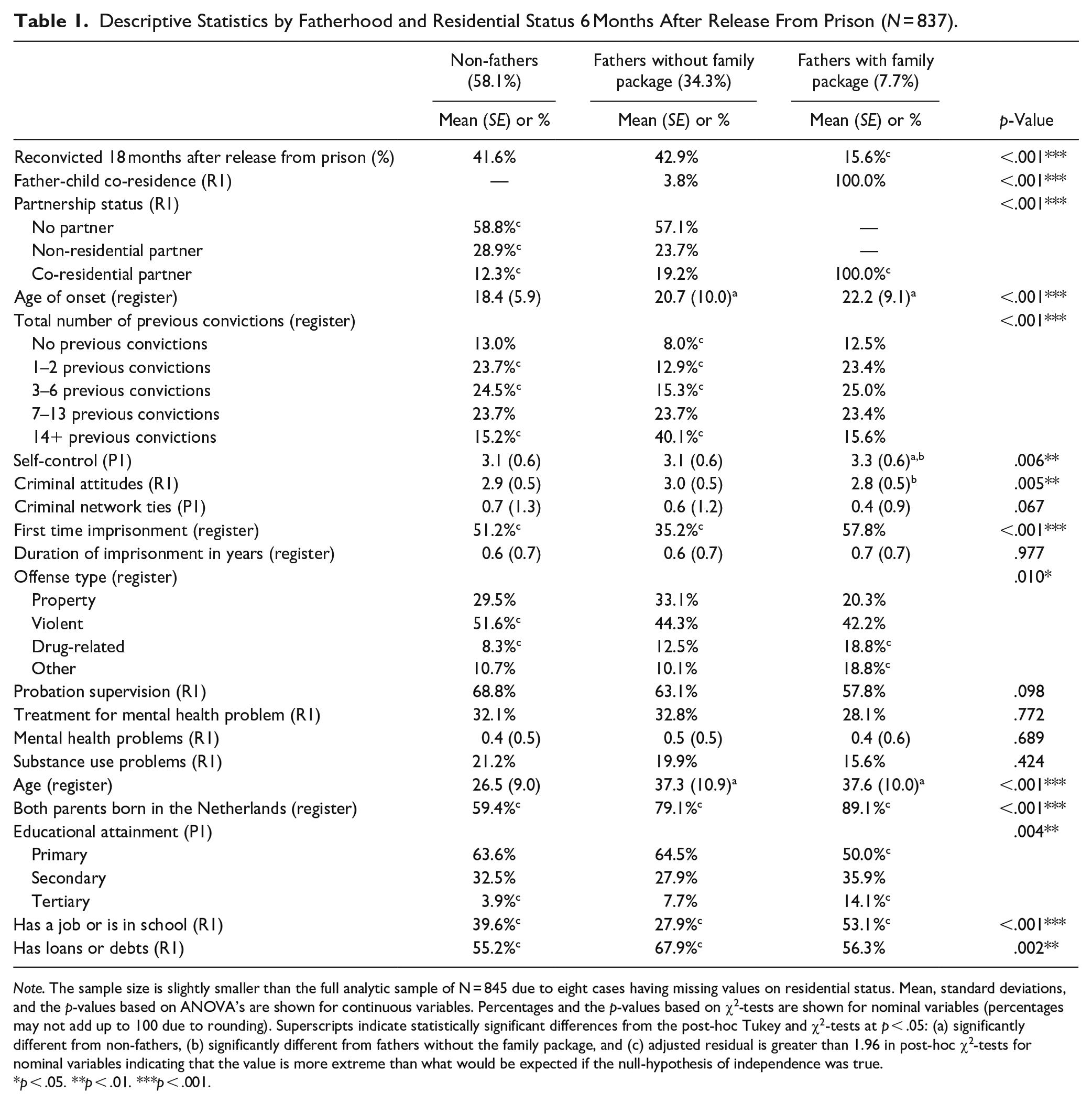
Note. The sample size is slightly smaller than the full analytic sample of N = 845 due to eight cases having missing values on residential status. Mean, standard deviations, and the p-values based on ANOVA’s are shown for continuous variables. Percentages and the p-values based on χ2-tests are shown for nominal variables (percentages may not add up to 100 due to rounding). Superscripts indicate statistically significant differences from the post-hoc Tukey and χ2-tests at p < .05: (a) significantly different from non-fathers, (b) significantly different from fathers without the family package, and (c) adjusted residual is greater than 1.96 in post-hoc χ2-tests for nominal variables indicating that the value is more extreme than what would be expected if the null-hypothesis of independence was true.
p < .05. **p < .01. ***p < .001.
The three groups further differed in terms of factors that may relate to reoffending after release from prison. Fathers with the family package had a higher age of onset, reported having more self-control, had lower scores on criminal attitudes, more often experienced first-time imprisonment, more often convicted of a drug-related crime, were older, more often had both parents born in the Netherlands, had higher educational attainment, and more often reported having a job or being in school after release than the other groups. Fathers without the family package were further characterized by having a relatively high number of previous convictions, and more often reported having loans or debts after release from prison. In sum, fathers with the family package had lower reconviction rates and also scored lower on reoffending risk factors than fathers without the family package and non-fathers.
Multivariate Analyses
Table 2 provides the results from the logistic regression analyses. For parsimony, we only present the coefficients for the primary explanatory variables (the full model including control variables can be found in Supplemental Table S3). The main findings were robust to excluding individuals who were imprisoned at the time of the R1-survey from the analyses (models not presented). In Model 1, we tested whether fathers and non-fathers differed in terms of reconviction 18 months after release from prison, and found no statistically significant differences (p > .05).
Logistic Regression Analyses of the Relationship Between Fatherhood, Residential Status, and Reconviction 18 Months After Release From Prison (N = 845).
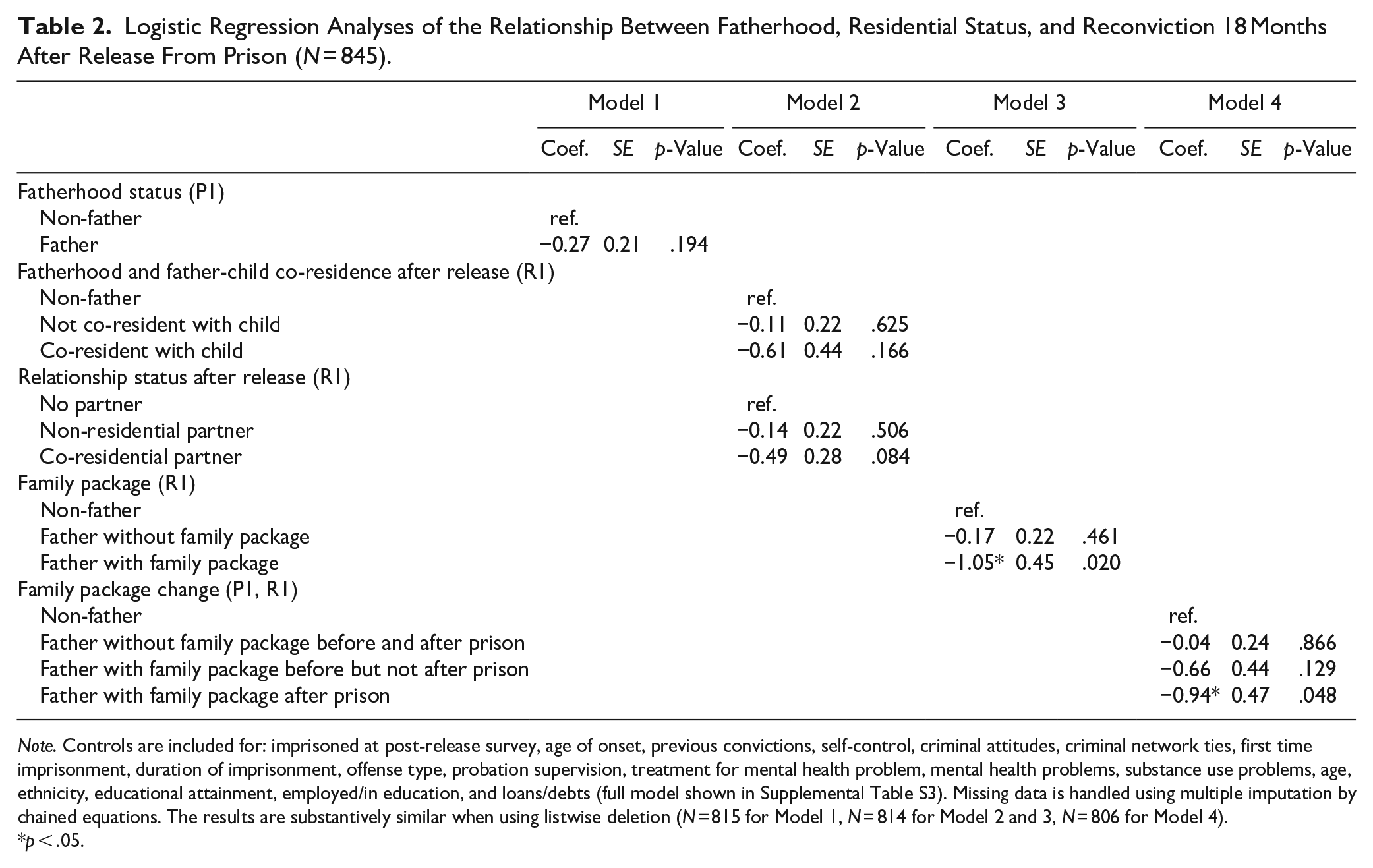
Note. Controls are included for: imprisoned at post-release survey, age of onset, previous convictions, self-control, criminal attitudes, criminal network ties, first time imprisonment, duration of imprisonment, offense type, probation supervision, treatment for mental health problem, mental health problems, substance use problems, age, ethnicity, educational attainment, employed/in education, and loans/debts (full model shown in Supplemental Table S3). Missing data is handled using multiple imputation by chained equations. The results are substantively similar when using listwise deletion (N = 815 for Model 1, N = 814 for Model 2 and 3, N = 806 for Model 4).
p < .05.
In Model 2, we examined the degree to which father-child co-residence and being in a co-residential relationship were associated with reconvictions. Both were not significantly associated with reconviction rates when included in a single model (p > .05). However, in separate models (not presented) where we included father-child co-residence without accounting for being in a co-residential relationship and vice versa, we did find statistically significant differences. When not controlling for residential relationship status, co-resident fatherhood was associated with lower chances of reconviction compared with non-fathers (b = −0.91, odds ratio [OR] = 0.40, p = .023). Similarly, when not controlling for residential fatherhood status, being in a co-residential relationship was associated with lower chances of reconviction compared with not being in a relationship (b = −0.65, OR = 0.52, p = .011). The findings from these separate models were likely caused by the overlap between father-child co-residence and being in a co-residential relationship, given that the findings were not statistically significant after accounting for both residential factors in a single model (as shown in Model 2). This is further evidenced by the observation that almost all fathers who co-resided with their children were also in a co-residential relationship with a partner. These results thus underscore the need to view father-child co-residence and being in a co-residential relationship as a “package” deal.
In Model 3, we tested the degree to which having the family package 6 months after release from prison (fatherhood combined with co-residing with a child and partner) was associated with reconviction rates 18 months after release from prison. In line with our expectations, we found that having the family package was associated with lower chances of being reconvicted (b = −1.05, OR = 0.35, p = .020). Together, the findings from Models 1, 2, and 3 provide support for the idea to consider fatherhood, father-child co-residence, and being in a co-residential relationship in conjunction to understand the association between fatherhood and reoffending after release from prison.
Given the strong link between having the family package before prison and after prison (77.8% of those who had the family package after release also had it before imprisonment; see Table 3), an alternative explanation for the findings from Model 2 could be that having the family package before prison accounted for the association between having the family package after release and reconviction rates. We provided an empirical test for this in Model 4 by creating a separate category for those fathers who had the family package before imprisonment but not after imprisonment (6.9% of the analytic sample). Reconviction rates of fathers who had “lost” the family package did not significantly differ from non-fathers (b = −0.66, OR = 0.52, p = .129). Thus, the findings from Model 4 did not provide support for the alternative explanation that having the pre-imprisonment family package accounts for the findings identified in Model 3.
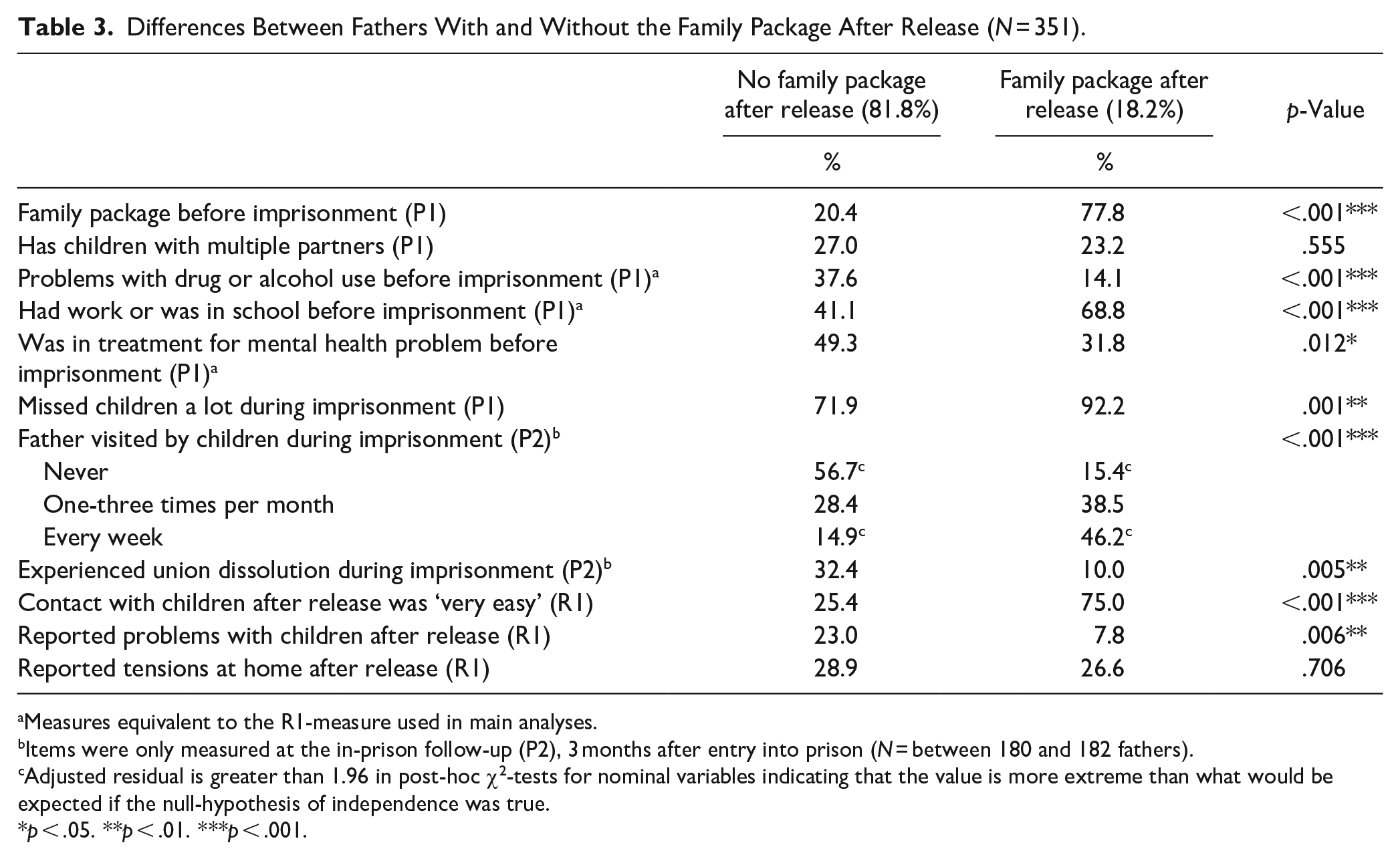
Differences Between Fathers With and Without the Family Package After Release (N = 351).
Measures equivalent to the R1-measure used in main analyses.
Items were only measured at the in-prison follow-up (P2), 3 months after entry into prison (N = between 180 and 182 fathers).
Adjusted residual is greater than 1.96 in post-hoc χ2-tests for nominal variables indicating that the value is more extreme than what would be expected if the null-hypothesis of independence was true.
p < .05. **p < .01. ***p < .001.
Supplementary Analysis: Exploring Differences in Family-Related Characteristics Between Fathers With and Without the Family Package After Release
Given the importance of the family package for reconviction, we further examined the differences between fathers with and without the family package after release in terms of family-related characteristics in a supplementary analysis. The Prison Project data allowed for the exploration of factors tapping into the broader family context which are measured before, during, and after imprisonment. Table 3 presents descriptive statistics of family-related factors split by fathers with and without the full family package. Non-fathers were not included in these supplementary analyses.
Fathers with and without the family package differed on various measures relating to the broader family context. Fathers with the family package after release were more likely to also have had the family package before imprisonment (77.8%) than fathers without the family package after release (20.4%; p < .001). Compared with fathers without the family package, fathers with the family package reported fewer substance use problems (14.1 vs. 37.6%, p < .001), more often having a job or being in school (68.8 vs. 41.1%, p < .001), and less often being in treatment for a mental health problem before imprisonment (31.8 vs. 49.3%, p = .012). Fathers with the family package more often reported missing their children “a lot” during imprisonment than fathers without the family package (92.2 vs. 71.9%, p = .001). The two groups further differed in terms of receiving visits from their children 3 months after entry into prison (measured at the P2-survey, N = 180 fathers); fathers with the family package after release were more likely to have been visited weekly by their child during imprisonment (46.2%) than fathers without the family package (14.9%, p < .001). Conversely, fathers without the family package after release were more likely to never be visited by their children than fathers with the family package (56.7 vs. 15.4%). Furthermore, fathers without the family package were more likely to report union dissolution 3 months after entry into prison than fathers with the family package (32.4% vs. 10.0%, p = .005; (measured at the P2-survey, N = 182 fathers). The percentage of union dissolution during imprisonment was highest among fathers who had “lost” the family package during imprisonment (41.7%; not presented in Table 3). Six months after release from prison, fathers with the family package more often reported that contact with their children was “very easy” (75.0%) compared with fathers without the family package (25.4%, p < .001). Last, fathers with the family package less often reported problems with their children (7.8%) compared with fathers without the family package (23.0%, p = .006).
Discussion
Our study aimed to examine the link between fatherhood, residential status, and reoffending after release from prison. Given the high-risk nature of the prison population and the unique challenges related to fatherhood and imprisonment, it was unclear whether expectations derived from the age-graded theory of informal social control and earlier research findings from samples without a focus on imprisonment also applied to people released from prison. We examined differences between fathers’ and non-fathers’ registered reconvictions 18 months after release from prison and specifically addressed the role of the post-prison residential context 6 months after release from prison. We controlled for a wide variety of risk factors that may explain associations between fatherhood, post-release residential context, and reoffending after release from prison. To do so, we used data from the Prison Project; a Dutch longitudinal cohort study uniquely suited to study the changes in people’s lives before, during, and after imprisonment. Overall, in line with our main hypothesis, the results showed that differences between fathers’ and non-fathers’ reconvictions were conditional on whether fathers co-resided with a partner and with children after release from prison.
Our study resulted in four main findings. First, we found that the dichotomous measure of fatherhood was not associated with reoffending 18 months after release from prison. Father-child co-residence and being in a residential union were also not associated with reoffending after release from prison when they were included in a single model. However, the combination of fatherhood and co-residence with a partner and children was associated with lower post-release reconviction rates, with substantial bivariate differences. These finding are in line with our hypothesis, and with research from population and high-risk samples which have shown that the potential for fatherhood to reduce offending behaviors is concentrated among fathers who co-reside with their children (Abell, 2018; Boonstoppel, 2019; Kerr et al., 2011; Landers et al., 2015; Mitchell et al., 2018) or are in a stable union (Savolainen, 2009; Skarðhamar & Lyngstad, 2009; Zoutewelle-Terovan et al., 2014). Our results thus suggest that research findings from population and high-risk samples also apply to the population of fathers released from prison. It is plausible that the primary mechanisms of fatherhood for desistance (structured daily routines, degree of informal social control, and prosocial identity transformation processes) are strongest among fathers with the family package after release from prison. This outlines the need to consider fatherhood, relationship status, and residential status in conjunction to understand the potential of fatherhood to reduce reoffending after release from prison.
Second, only a minority of fathers’ family situations after release from prison were characterized by the family package (18.2% of all fathers); most fathers did not co-reside with a partner and children after release. Before imprisonment, the percentage of fathers with the family package was 30.6%, suggesting that a substantial portion of fathers lose the family package due to imprisonment. These results are in line with findings from the United States showing decreases in father-child co-residence rates from before to after imprisonment (Western & Smith, 2018). The results show that, also in the Netherlands, imprisonment is associated with decreases in residential fatherhood and that having the “family package” after release from prison is a relatively uncommon living arrangement.
Third, fathers with the family package after release were characterized by fewer overall reoffending risk factors than non-fathers and fathers without the family package. Fathers with the family package after release, on average, were older, had a higher age of onset, were less often convicted for a property crime, reported more self-control, less criminal attitudes, and more often had a job after prison compared with non-fathers and fathers without the family package. This underlines the overlap between fathers’ family characteristics after release and risk factors for reoffending found in earlier studies among young adults in the general population (Jaffee et al., 2001).
Last, in a supplementary analysis we found that fathers with and without the family package differed on a variety of family-related characteristics. Combined, these differences may reflect a stronger attachment to the family and the paternal role before, during, and after imprisonment among fathers with the family package compared with fathers without the family package. Having the family package before imprisonment was strongly related to having the family package after imprisonment, evidencing a pattern of stability. Union dissolution seemed to be the greatest threat to fathers’ post-release attachment to the family.
Several limitations need to be taken into account when interpreting these results. First, the associations identified in our study cannot be interpreted as causal. Despite the longitudinal nature of our data, we cannot fully estimate the impact of fatherhood while controlling for time-invariant characteristics. Selection effects may (partially) drive our results. An alternative explanation for our findings is that fathers who desist from offending after release from prison may be considered as more stable potential partners on the “relationship market”, and are therefore more likely to be in committed relationships characterized by co-residence with a partner and children.
A second limitation is that registered reconviction rates are likely to underestimate actual reoffending behaviors after release from prison. It is therefore important to replicate the findings identified in our study using self-reported reoffending and focusing on other markers of reintegration after release from prison. An avenue for future research could also be to examine different forms of reoffending, as previous studies have found differences in the impact of fatherhood on offending by offense type (Abell, 2018).
A third limitation is that the data contain limited information on relevant family-related factors such as detailed histories of family situations and demographic characteristics of children. Information on the perceived father-child relationship quality, fathers’ engagement in childrearing, and fathers’ attachment to the paternal role was unavailable. It is likely that there are fathers who do not co-reside with their children and partner but who are highly invested in their paternal role, which could theoretically reduce their chances of reoffending after release. It is also possible that there are co-resident fathers who do not consider fatherhood as central to their identity. We could not identify these fathers in this study. Although fathers’ residential status is an important proxy for attachment to the family and the paternal role, it is also a relatively crude measure.
An interesting avenue for further research would be to replicate the study findings among mothers released from prison. Although the mechanisms by which parenthood is thought to reduce criminal activity are similar for men and women, parenthood is often thought to have a greater desistance potential for mothers than fathers. This has been attributed to gender differences in time invested in childcare and societal expectations of caregiving roles (Rodermond et al., 2016). Compared to imprisoned fathers, mothers are more likely to co-reside with their children before imprisonment, and also more often expect to live with their children upon release (Foster, 2010; Glaze & Maruschak, 2010). However, mothers in prison are also more likely than imprisoned fathers to experience a wide variety of risk factors, such as a history of homelessness and abuse, mental health problems, and foster care placements for their children (Glaze & Maruschak, 2010). These factors may complicate mother-child reunification upon release. Thus, it is not straightforward to develop hypotheses about gender differences in the potential of parenthood to reduce reoffending after release from prison.
Notwithstanding the limitations, our study contributes to existing research on the link between fatherhood and reoffending. What distinguishes this study from other research is its unique focus on individuals recently released from prison and the focus on the post-release residential context. Further strengths included that we relied on official records of reconvictions, used longitudinal data, and controlled for a wide variety of risk factors related to reoffending. The key finding of our study is that the association between fatherhood and reoffending after release from prison is conditional on whether fathers have the family package after release (co-residing with a partner and children). The findings of this study have implications for policy and practice. Consistent with previous research, our study highlights the strong link between father involvement during and after imprisonment, and underscores the potential of involved fatherhood after release to reduce reoffending (Lösel et al., 2012; Visher, 2013). This suggests that policies and programs that support father involvement during imprisonment may promote father involvement after release, which, in turn, may contribute to reducing reoffending after release.
The findings further suggest that theoretical explanations derived from the age-graded theory of informal social control regarding the potential of engaged fatherhood to reduce offending also apply to the population of people released from prison. However, it is important to take into account that only a minority of fathers have the family package after release from prison, implying that the role of fatherhood in reducing the likelihood to reoffend after release from prison may be limited for the majority of fathers. Further, our study implies that fatherhood, the broader family context, and reoffending risk factors should be viewed simultaneously, as fathers’ post-release residential status strongly reflected a variety of risk factors that are associated with reoffending. Together, our study contributes to research on the link between fatherhood and offending after release from prison by demonstrating the need to view fathers’ larger family context (before, during, and after imprisonment) and reoffending risk factors in conjunction.
Supplemental Material
sj-docx-1-cad-10.1177_00111287231193991 – Supplemental material for Fatherhood and Reoffending after Release from Prison: The Importance of Co-Residing With a Partner and Children
Supplemental material, sj-docx-1-cad-10.1177_00111287231193991 for Fatherhood and Reoffending after Release from Prison: The Importance of Co-Residing With a Partner and Children by Simon D. Venema, Anja J. E. Dirkzwager, Marieke Haan, Paul Nieuwbeerta, Eric Blaauw and René Veenstra in Crime & Delinquency
Footnotes
Declaration of Conflicting Interests
The author(s) declared no potential conflicts of interest with respect to the research, authorship, and/or publication of this article.
Funding
The author(s) disclosed receipt of the following financial support for the research, authorship, and/or publication of this article: This study is part of a larger project that is funded by the Dutch Custodial Institutional Agencies. The views and opinions expressed in this article are those of the authors and do not necessarily reflect the official policy or position of the Dutch Custodial Institutional Agencies.

Supplemental Material
Supplemental material for this article is available online.
Author Biographies
References
Supplementary Material
Please find the following supplemental material available below.
For Open Access articles published under a Creative Commons License, all supplemental material carries the same license as the article it is associated with.
For non-Open Access articles published, all supplemental material carries a non-exclusive license, and permission requests for re-use of supplemental material or any part of supplemental material shall be sent directly to the copyright owner as specified in the copyright notice associated with the article.
