




Abstract
This study examined how selective rule enforcement on prison units is related to individual misconduct. Selective rule enforcement was operationalized as the unit-level discrepancy between self- and officially reported misconduct. Both survey and administrative data were used from 4,123 individuals incarcerated in 197 units in the Netherlands. Findings showed that the level of selective rule enforcement varied greatly across units, irrespective of regime, with averages above zero. Multilevel regression analyses indicated that, after controlling for important covariates, selective rule enforcement on units was consistently related to the odds of displaying misconduct including verbal, physical, property, and contrabands misconduct. These findings demonstrate the importance of contextual differences and the use of discretion by correctional officers for individual behavior in prison.
More than 10 million people are incarcerated worldwide to protect society (Fair & Walmsley, 2021). Yet incarceration itself poses threats to the safety of the individuals incarcerated and those incarcerating them. Reports of unsafe prisons are ubiquitous and even the Netherlands, which is considered to have a relatively humane prison climate and does not have to cope with pressures of overcrowding (Van Ginneken et al., 2018), faces challenges in terms of maintaining a safe environment for staff and incarcerated individuals. The Federation of Dutch Trade Unions (FNV) has raised alarm about correctional officers in the Netherlands who feel increasingly unsafe (De Vries, 2022). Moreover, a large number of incidents varying from minor misdemeanors to major threats, go undiscovered and unreported, so the problem of prisoners misconduct is actually much larger.
Before an incident becomes a statistic, correctional officers have to be (made) aware of it, and decide to report it. Many incidents may take place outside immediate visibility of staff or cameras. Moreover, group norms in prison may prevent people from reporting victimization when witnessing incidents. Even when correctional officers are aware of rule violations and incidents, they have some discretionary power in deciding how to respond. They are known to use their power strategically, because order in prisons depends as much on relationships as on (the threat of) coercion (Crewe, 2011; Liebling, 2000; Sparks et al., 1996; Sykes, 1958). This body of literature on discretion, power use and legitimacy would suggest that selective underenforcement of rules can contribute to order and safety in prisons. Arguably, selective rule enforcement enhances informal social control through better staff-prisoner relationships, higher legitimacy, and a greater willingness to comply. On the other hand, selective rule enforcement may signal low formal control and give the impression that staff are lax, and non-compliance is acceptable. In order to clarify the relationship between formal social control and levels of misconduct, we examine whether the discrepancy between self-reported and officially reported misconduct on prison units (i.e., selective rule enforcement) is related to individual levels of self-reported misconduct. The lower the discrepancy, the higher the level of formal social control. This contribution answers the following research question: To what extent is selective rule enforcement related to individual misconduct? A combination of survey and administrative data from individuals incarcerated in all prisons in the Netherlands is used to answer this question.
Staff Discretion and Misconduct in Prisons
Correctional officers have considerable discretion when deciding whether and how to report misconduct, even though disciplinary procedures have become more formalized over time (Marquart & Trulson, 2016). Even so, there is an important human factor in the enactment of rules and maintenance of order, which is why correctional officers can be characterized as street-level bureaucrats (Bosma et al., 2018; Haggerty & Bucerius, 2021; Lipsky, 1980). Early research suggests that correctional officers are reluctant to report misconduct they observe (Hewitt et al., 1984). There is evidence that legal and extra-legal factors affect the disciplinary response to misconduct (Butler & Steiner, 2017; Cochran et al., 2017; Flanagan, 1982; Howard et al., 1994; Logan et al., 2017; Meade et al., 2021; Severson, 2019; Steiner & Cain, 2017). Legal factors include the type and severity of misconduct, and misconduct history, while extra-legal factors include age, ethnicity, sex, mental illness, marital status, time served, criminal history, victimization prior to prison, involvement in activities in prison, and staff characteristics.
Some of these extra-legal factors may be indirectly related to the misconduct. For instance, research using national survey data among incarcerated individuals in the US revealed a complex relationship between history of mental illness, gender, misconduct, and disciplinary segregation: violent misconduct mediated the relationship between a lifetime history of mental illness and disciplinary segregation for men, while recent mental health problems was an independent predictor of disciplinary segregation for women (Severson, 2019). Qualitative research conducted in Canadian prisons suggests that when deciding how to deal with infractions, correctional officers make assumptions about people, for example based on their criminal history or the type of unit (Haggerty & Bucerius, 2021). The use of discretion may also be influenced by an officer’s perception of their co-workers in the same unit: some correctional officers may even coordinate selective rule enforcement with each other to avoid inconsistencies (Haggerty & Bucerius, 2021).
The link between extra-legal factors and disciplinary decisions may be understood in light of the focal concerns perspective. This theory suggests that easily observable personal characteristics may lead correctional officers to make an assessment of blameworthiness and dangerousness, which could lead to biased decisions (Steffensmeier et al., 1998). For example, correctional officers may decide which rules to enforce based on a person’s criminal history, or the security level of a unit, because these factors contribute to assumptions around dangerousness or blameworthiness (Haggerty & Bucerius, 2021). Indeed, there is also variation between prisons in the use of disciplinary segregation, due to population composition and the proportion of incarcerated individuals involved in work assignment (Butler & Steiner, 2017). Based on the focal concerns perspective, selective rule enforcement by correctional officers could be explained by their (possibly implicit) assessments of blameworthiness and dangerousness of situations and the people involved in these situations.
Given their reluctancy to report misconduct in general (Hewitt et al., 1984) it is unlikely that correctional officers use their disciplinary discretion to overreport misconduct, that is, to report misconduct that was not committed. Studies on the strategical use of power to preserve order and safety in prison found that this translated into selective underenforcement of rules (Crewe, 2011; Liebling, 2000; Sparks et al., 1996; Sykes, 1958). Procedural justice literature suggests that when people are treated with fairness and respect, people will be more likely to comply with authority’s decisions and rules (Tyler, 1990). An overenforcement of rules, conversely, would then be associated with worse staff-prisoner relations and might provoke more instead of less misconduct. In addition, studies into the Dutch prison context found that incarcerated individuals rated the staff-prisoner relationships and procedural justice relatively positive (e.g., Beijersbergen et al., 2015) which would make overreporting of misconduct by correctional officers unlikely. Therefore, in this study we focus on the possible consequences of the opposite end of selective rule enforcement, indicating an underreporting rather than overreporting of misconduct by staff.
Social Control Mechanisms and Misconduct in Prisons
Importantly, selective rule enforcement may not always be the result of the exercise of discretion. Another explanation for selective rule enforcement is that correctional officers do not observe all misconduct that is committed, or it is not brought to their attention. This also results in a gap between committed misconduct and reported (and sanctioned) misconduct. Based on the social control-opportunity perspective (Steiner & Wooldredge, 2020), the observation and subsequent recording of misconduct requires capable guardians, in the form of correctional officers who observe misconduct, CCTV that is effectively used, or peers who report misconduct. From this, it may be expected that higher levels of formal control result in higher levels of detection of misconduct (and thus, smaller gaps between self-reported and officially recorded misconduct). In addition to increasing the risk of detection, high levels of formal control—the presence of correctional officers and CCTV—may also deter misconduct because it increases the perception of risk associated with rule infractions. Conversely, lower formal control means that individuals perceive a lower likelihood of detection, which increases the attractiveness of misconduct.
Formal Social Control
For evidence on the relationship between formal control and misconduct, we draw on the literature around security levels and misconduct. Higher security typically means that behavior in prisons is more strictly controlled, with less freedom of movement and more staff supervision. In other words, higher security likely means a greater level of formal control. However, the effects of security classification on misconduct are not straightforward, because high-security prisons have a different population composition compared to low-security prisons: high-security prisons tend to incarcerate individuals with a higher risk of misconduct. Considering this, it is perhaps surprising that higher security does not appear to exercise much of a suppressing effect when controlling for confounding effects. Correlational evidence points to a positive association between security level and misconduct, with higher levels of misconduct in higher-security establishments (see Steiner et al., 2014 for a systematic review). Studies using sophisticated, quasi-experimental methods found mixed results on the effects of security level on misconduct. Berk and de Leeuw (1999) found that placement in a maximum-security facility reduced the risk of misconduct, while Tahamont (2019) and Camp and Gaes (2005) found no evidence that higher-security incarceration reduces the risk of serious misconduct of individuals with similar individual risk scores. An important limitation of this research is that it has not been able to establish whether security classification is associated with observed or actual misconduct. Higher security may increase the likelihood of detection of misconduct, as opposed to actual misconduct. Additionally, differences in security classification may be associated with differences in the use of discretion by staff in deciding when to write a report for misconduct. For this reason, it is important to consider officially recorded and self-reported information on misconduct.
Very few studies have compared self-reported misconduct with officially reported misconduct to identify the detection gap (Bosma, Van Ginneken, Sentse, & Palmen, 2020; Hewitt et al., 1984; Steiner & Wooldredge, 2014; Van Voorhis, 1994). These studies suggest that officially reported misconduct appears to underestimate actual behavior, although this likely varies across different types of misconduct. The discrepancy between officially recorded and self-reported misconduct may be due to under-detection or underreporting by correctional officers, or overreporting by incarcerated individuals. Under-detection and underreporting by correctional officers may have consequences for the likelihood that incarcerated individuals engage in misconduct, but this has not yet been investigated.
Informal Social Control
Another relevant element of social control-opportunity theory consists of informal social control, which can be shaped by relationships with peers and staff. In particular, peers may act as guardians, and good relationships may raise the costs of certain types of misconduct (e.g., violence and theft). Furthermore, descriptive group norms more generally may discourage (or encourage) specific behaviors including misconduct. Similarly, staff-prisoner relationships can also serve as an informal control mechanism: better relationships may be associated with greater legitimacy, and more compliance (Beijersbergen et al., 2015; Liebling, 2000; Sparks et al., 1996; Steiner & Wooldredge, 2018). Additionally, good staff-prisoner relationships may increase the chance that staff are (made) aware of problematic behavior on the unit. In line with social control-opportunity theory, then, it can posited that the experience of having positive relationships with peers and correctional officers that are characterized by respect, trust, and fairness can constitute a level of informal social control, which may temper the display of misconduct. Other relevant control mechanisms may be an individual’s level of self-control and stake in conformity, but these are not examined in the current contribution (but see, e.g., Kerley et al., 2011; Kuanliang & Sorensen, 2008).
The Current Study
This study brings attention to differences in officially versus self-reported misconduct across prison units, and how this is related to individual levels of misconduct. Among a national representative sample of incarcerated individuals in the Netherlands we will use multilevel models to examine the association between selective rule enforcement on prison units and individual misconduct. Based on social control-opportunity theory (Steiner & Wooldredge, 2020), it is expected that selective rule enforcement (more self-reported than officially reported misconduct) signals low formal control, and therefore increases the opportunity for and attractiveness of misconduct. On an explorative basis, we will additionally test whether the hypothesized effect of selective rule enforcement differs for various forms of misconduct (i.e., verbal, physical, property, and contraband misconduct). We also control for important covariates of misconduct established by previous studies and theory we discussed earlier (see e.g., Steiner et al., 2014). On the individual level these include perceived levels of informal social control (relationships with fellow incarcerated individuals and staff), sex, nationality, age, detention history, detention length, single cell residence, and index offense. On the unit level these include inmate to staff ratio and type of regime (indicative of security level, see below).
Imprisonment in the Netherlands
The Netherlands have one of the lowest imprisonment rates of the world, at 60 per 100,000 individuals (Fair & Walmsley, 2021). Most people are incarcerated for only short periods of time; the average sentence length in 2021 was 139 days, and 47% were released within 1 month whereas 42% were incarcerated between 1 and 12 months (Dienst Justitiële Inrichtingen [Dutch Custodial Institutions Agency], 2022). The prison climate can be characterized as relatively mild, with good staff-prisoner relationships (Van Ginneken et al., 2018). There are different regimes: the largest are pre-trial detention and regular prison regimes, but there are also extra care units (for individuals with a sexual offense history of mental health needs), individuals who received a persistent offender measure (i.e., a 2-year measure for repeat offending), and minimum security. Men and women are incarcerated separately, and individuals with severe mental health problems (e.g., psychosis) are incarcerated in psychiatric penitentiary institutions (not included in this study). All regimes provide for 43 hr out-of-cell time and activities per week, including 1 hr for social visitation. Individuals who are convicted and incarcerated in a regular prison regime can earn extra time out of cell and other privileges (e.g., an extra hour for social visits) when they show good behavior (Elbers et al., 2022). This means that staff can use their power for disciplinary punishment and decisions about rewards.
Method
Data and Sample
The current study used data from the Dutch Life in Custody (LIC) study. The LIC-study was designed to measure the quality of life in Dutch prisons, collected between January and March 2017 using the Prison Climate Questionnaire (Bosma, Van Ginneken, Palmen, et al., 2020). For this purpose, all individuals incarcerated at the time in each of the 28 penitentiary institutions in the Netherlands who could be approached were invited to participate. The study was explained in person and participants were handed paper questionnaires to complete in private, or offered the opportunity to complete the survey with researcher assistance. The questionnaires were collected again in the same week by the researchers. In total, 4,938 out of 6,088 adult men and women participated, which resulted in a response rate of 81%. Additional permission to match their answers with administrative prison data was given by 4,538 respondents, housed in 244 prison units. More details on participants, recruitment, and procedure of the Life in Custody Study can be found elsewhere (Van Ginneken et al., 2018).
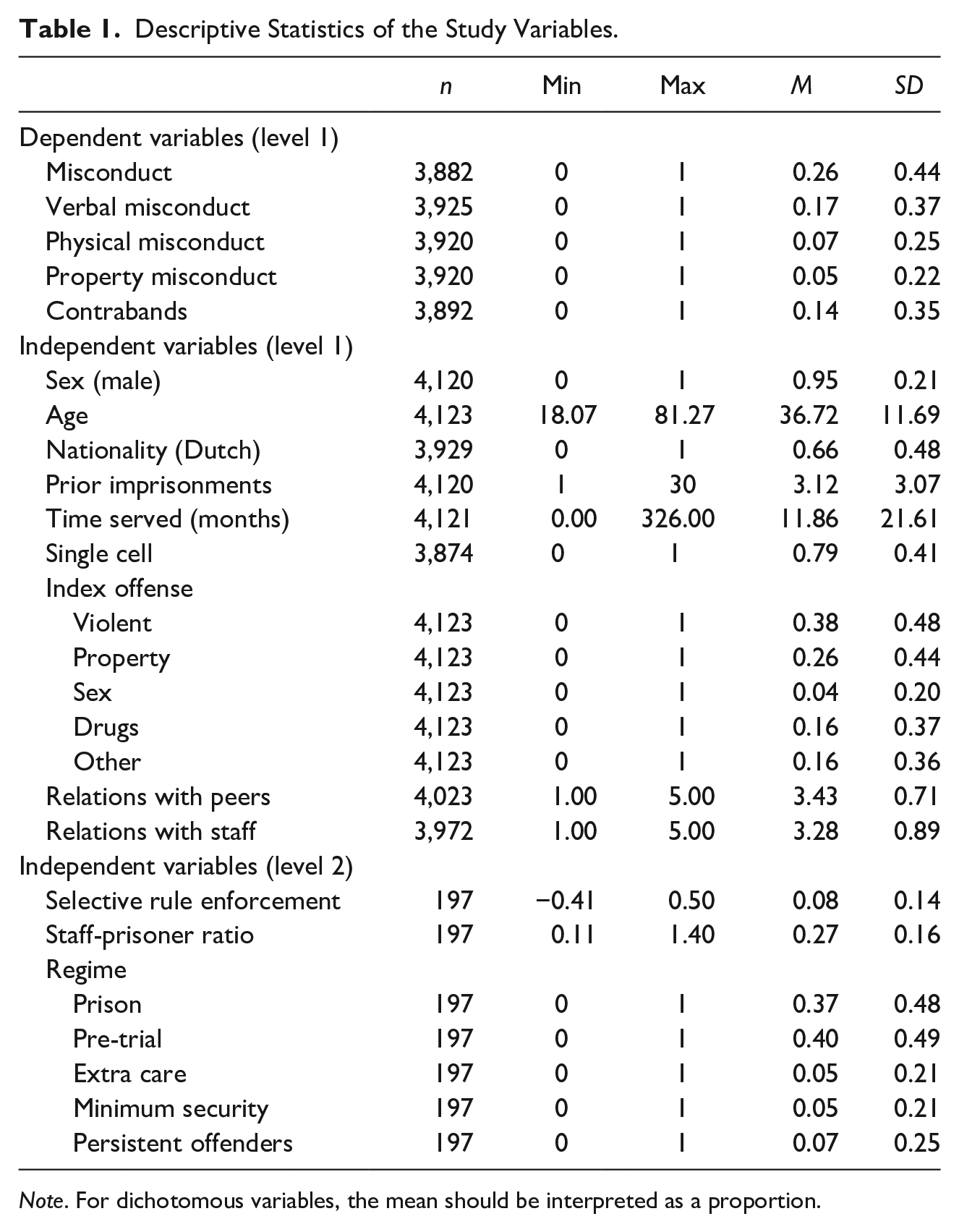
For reasons of validity and reliability in constructing the unit-level measures and conducting multilevel analyses, we excluded units that housed less than 10 incarcerated individuals. In addition, we had to exclude 4 units (111 individuals) for which no unit characteristics were available. Our final sample thus consisted of 4,123 individuals nested in 197 units. The included sample did not significantly differ from the excluded sample on our outcome measure of self-reported misconduct (χ(1) = 0.01, p = .98) nor on important background characteristics including nationality (χ(1) = 2.56, p = .13), type of offense (χ(1) = 0.06, p = .19 to χ(1) = 1.70, p = .82), number of previous incarcerations (t(4533) = −1.52, p = .13), and detention length (t(4534) = 0.53, p = .60). The descriptive statistics of the included sample are reported in Table 1 and described in the results section.
Descriptive Statistics of the Study Variables.
Note. For dichotomous variables, the mean should be interpreted as a proportion.
Measures
Misconduct (Level 1, individual level)
Our dependent variable was measured with the Prison Climate Questionnaire (PCQ; Bosma, Van Ginneken, Palmen, et al., 2020) in which incarcerated individuals were asked if they had never, once, or more than twice engaged in a list of seven types of misconduct in the two previous months (or shorter if their detention period was shorter than 2 months). Items included (1) yelled at or threatened a fellow prisoner, (2) punched, pushed or kicked a fellow prisoner, (3) yelled at or threatened a staff member, (4) punched, pushed, or kicked a staff member, (5) destroyed something that was not theirs, (6) stolen something, and (7) had been in possession of contraband(s), such as a phone, drugs, or weapons. These seven variables were dichotomized into yes/ever or no/never and combined to create one overall dichotomized self-reported misconduct scale (Cronbach’s alpha = .75). In addition, based on the dichotomized items we also created measures for specific types of misconduct, namely verbal misconduct (items 1 and 3), physical misconduct (items 2 and 4), property misconduct (items 5 and 6), and contrabands (item 7).
Informal Social Control (Level 1, Individual Level)
Perceived informal social control was operationalized as social relationships in prison and was measured with two subscales from the PCQ: one subscale measuring relationships with peers, and one subscale examining relationships with staff. The subscale on peer relationships contained five items (e.g., “Incarcerated individuals treat each other respectfully here”). Relationships with staff was measured by four items on experiences with staff members (e.g., “If I have problems, the staff members in this unit help me”) and four items on procedural justice (e.g., “Staff members in this unit treat me fairly”). Respondents rated all items on a 5-point scale ranging from 1 (strongly disagree) to 5 (strongly agree), with higher scores reflecting more positive experiences. The internal consistency of both subscales was generally high, evidenced by Cronbach alpha statistics of .86 for peer relationships and .94 for relationships with staff.
Personal Characteristics (Level 1, Individual Level)
To control for important personal characteristics we included sex (male or female), age at the time of data collection, country of birth (the Netherlands or other), number of times incarcerated in the last 5 years, time served up until data collection, residence in single versus double cell, and index offense (violent, property, sex, or drugs offense, with other offenses as reference category). These variables were retrieved from official prison-registration systems.
Selective Rule Enforcement (Level 2, Unit Level)
We operationalized selective rule enforcement as the discrepancy between self-reported and officially reported misconduct on the prison unit level. The unit level was deemed appropriate and necessary because staff work on units not individuals, and because all incarcerated individuals from the same unit share the same staff. First, the dichotomized measure of self-reported misconduct was aggregated to the unit-level, referencing the proportion of individuals within the unit displaying self-reported misconduct (theoretical range = 0.00–1.00). Second, we retrieved disciplinary reports from official prison records provided by the Dutch Custodial Institutions Agency. To make the data comparable to the self-report data, a period was selected that resembled the 2 months prior to data collection. Based on these records we created a dichotomized misconduct measure for each individual that was then aggregated to the unit level, reflecting the proportion of individuals for whom an official misconduct report was written (theoretical range = 0.00–1.00). As a final step, we subtracted the unit-level proportion score of officially reported misconduct from the unit-level proportion score of self-reported misconduct. This measure of discrepancy between self- and officially reported misconduct on the unit is referred to as selective rule enforcement (theoretical range = −1.00 to 1.00). Higher scores reflect higher proportions of self-reported misconduct than was officially reported and thus indicate lower levels of formal social control. In addition, the bigger the discrepancy, the more selective rule enforcement is at play.
Unit Characteristics (Level 2, Unit Level)
Lastly, to control for relevant unit characteristics we included staff-prisoner ratio (in FTE) and regime. We distinguished between prison regime (reference category), pre-trial detention, extra care (for incarcerated individuals considered vulnerable due to mental health or index offense), minimum security regime, and a regime for people who have frequently offended (incarcerated under a 2-year ISD measure, specific to the Netherlands). These unit characteristics were based on administrative data provided by the Dutch Custodial Institutions Agency.
Analyses
To account for the clustered nature of our data (incarcerated individuals are nested within prison units) and to correct the estimated standard errors for a certain clustering of observations, multilevel methods were applied. Two levels of data were distinguished: the individual level (Level 1) and the unit level (Level 2). First, null models with random intercepts were estimated to see whether the dependent variables (overall and specific types of self-reported misconduct) significantly varied across units, as indicated by the intraclass correlation coefficients (ICC). ICCs were calculated using an adjusted formula for dichotomous outcomes (Wu et al., 2012). Second, multilevel logistic regression models with random intercept and fixed slopes were estimated using full information maximum likelihood with robust standard errors (MLR) estimation. All independent continuous variables were centered around their grand mean before they were included in the multilevel models to allow for easier interpretation of effects (i.e., scores of 0 now refer to the overall sample mean of these variables). All analyses were conducted in Mplus version 8.1 (Muthén & Muthén, 1998-2017).
Results
Descriptive Statistics
The descriptive statistics on each of the variables included in this study are reported in Table 1. With respect to our outcome variables, Table 1 shows that about 26% of the sample had displayed self-reported misconduct in the last 2 months; verbal misconduct and possession of contrabands were most common (17% and 14%, respectively) whereas physical and property misconduct were less commonly displayed (7% and 5%, respectively).
As for background characteristics, the majority of the sample were male (95%), born in the Netherlands (66%), and on average 36.7 years old. Individuals were incarcerated on average three times previously in the last 5 years and had spent on average about a year in prison up until data collection. The index offense they were sentenced for was mostly violent (38%) or property (26%) related. The majority were housed in single cells (79%) within a prison (37%) or pre-trial (40%) regime. Incarcerated individuals reported relatively positive relationships both with peers (M = 3.43) and staff (M = 3.28).
Our measure of selective rule enforcement on units ranged from −0.41 to 0.50 with an average of M = 0.08, indicating that units differed quite a lot on their signaling of formal social control, with the average pointing toward selective rule enforcement (i.e., more self-reported than officially reported misconduct). In more detail, for only 6% of the units there was no selective rule enforcement (discrepancy score = 0). In addition, the discrepancy score was positive (above zero) in 70% of the units and negative (below zero, i.e., more officially reported than self-reported misconduct) in 24% of the units. When looking at selective rule enforcement separately for different regimes (see Figure 1), it appeared that the discrepancy between self-reported and officially reported misconduct was on average largest on extra-care units (M = 0.22) and smallest in pre-trial units (M = 0.06). For each regime type, there was a considerable amount of variation and the average unit scores were all above zero, indicating relatively low (rather than high) levels of formal social control.
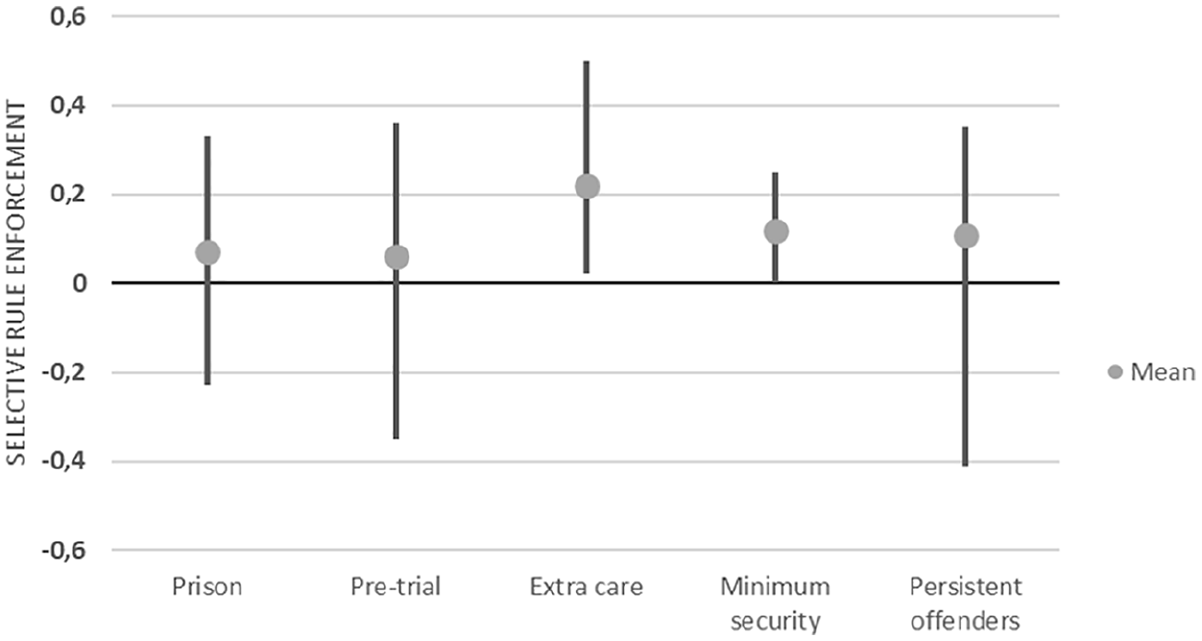
Range of selective rule enforcement per regime type.
Multilevel Logistic Regression Models
Empty Models
We started by running an empty model for each of the dependent variables (overall and subtypes of individual self-reported misconduct) to analyze the extent to which the odds of displaying misconduct varied between prison units. The intraclass correlation coefficient (ICC) revealed that a significant amount of variance in misconduct could be attributed to unit differences. For overall misconduct, the ICC was .06, indicating that 6% of the variance in the odds of displaying misconduct was related to between-unit differences (var = 0.21, p < .001). The ICC for the subtypes of misconduct varied from .06 for verbal misconduct (var = 0.20, p < .01), to .07 for contrabands (var = 0.24, p < .001) and .10 for property and physical misconduct (vars = 0.36, p < .05). The significant amounts of unit-level variances warrant the use of multilevel modeling, besides the inclusion of higher level variables.
Full Models
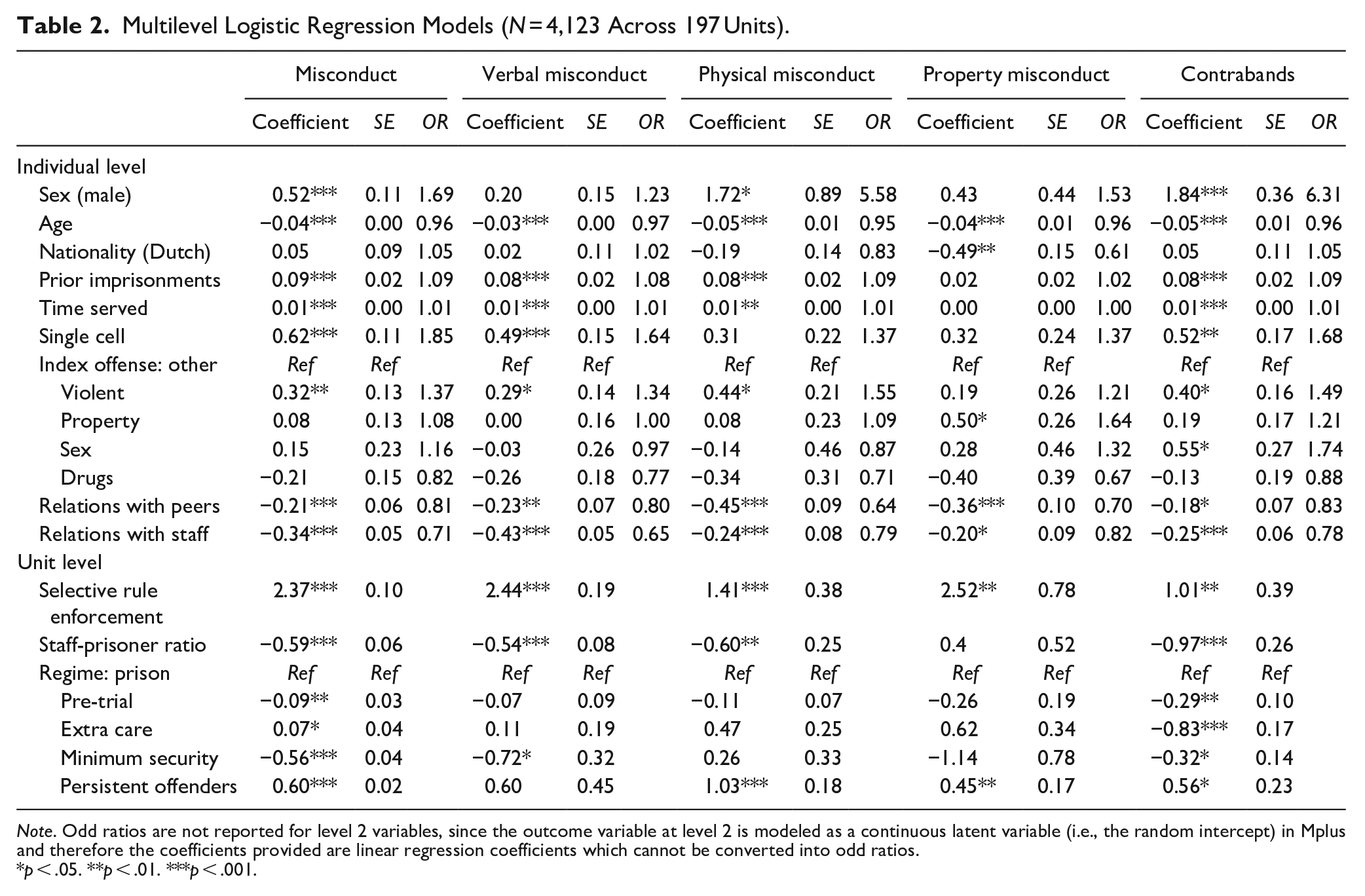
Results from the full multilevel logistic regression models containing all explanatory variables at the individual and the unit level are reported in Table 2. We will first describe our findings for the overall misconduct outcome model, and then highlight any differences with the findings for the models with the subtypes of misconduct as outcome measures.
Multilevel Logistic Regression Models (N = 4,123 Across 197 Units).
Note. Odd ratios are not reported for level 2 variables, since the outcome variable at level 2 is modeled as a continuous latent variable (i.e., the random intercept) in Mplus and therefore the coefficients provided are linear regression coefficients which cannot be converted into odd ratios.
p < .05. **p < .01. ***p < .001.
Overall Misconduct
The odds of displaying misconduct were significantly larger for males (OR = 1.69), younger individuals (ORage = 0.96), and for those who are housed in a single cell (OR = 1.85), who had been incarcerated previously (OR = 1.09), who had been currently incarcerated for a longer time (OR = 1.01), and who had been sentenced for a violent offense (OR = 1.37). Other types of index offenses nor nationality contributed to the odds of displaying misconduct. Further, proxies for perceived informal social control correlated to the odds of displaying misconduct, showing that individuals with better relationships with peers (OR = 0.81) and with staff (OR = 0.71) were significantly less likely to display misconduct.
On the unit level, all variables contributed to the variation in misconduct, with individuals on units with higher levels of selective rule enforcement—indicating lower levels of formal social control—more likely to display misconduct. Similarly, misconduct was more likely on extra care and persistent offender units, and less likely on units with a pre-trial or minimum security regime (as compared to prison regimes). Lastly, individuals on units with higher staff to prisoner ratios were less likely to display misconduct.
Subtypes of Misconduct
The regression models in which a subtype of self-reported misconduct was predicted were very comparable to the overall misconduct model. Importantly, measures of perceived informal social control (i.e., relations with peers and staff) and formal social control (i.e., selective rule enforcement) were consistently strong correlates across all subtypes of misconduct. With regard to individual control variables, models showed that being male significantly increased the odds of displaying misconduct to a particularly great extent when it involved contrabands (OR = 6.31). Further, single cell residence was not (positively) related to physical or property misconduct. The odds of displaying property misconduct were also not predicted by detention history or time served, but they were lower for individuals born in the Netherlands (OR = 0.61).
Also on the unit level, some control variables differed from the main model. Individuals on units with higher staff to prisoner ratios were less likely to display misconduct except for property misconduct. Furthermore, physical and property misconduct were not predicted by regime except for persistent offenders units (higher likelihood of misconduct). For the display of verbal misconduct we only observed significantly lower odds for those on minimum security units. And lastly, individuals on extra care units were only less likely to display misconduct when it involved contrabands.
Discussion
This study set out to examine whether selective rule enforcement, measured as the discrepancy between the proportion of self-reported and officially reported misconduct on prison units, is related to individual levels of misconduct among a national sample of incarcerated individuals in the Netherlands. Results from the multilevel analyses showed that, after controlling for positive relationships with peers and staff and a set of other common correlates of misconduct, selective rule enforcement on prison units was related to higher odds of self-reported misconduct across all subtypes, including verbal, physical, property, and contrabands misconduct. Our findings support the main tenets of social control-opportunity theory (Steiner & Wooldredge, 2020). Selective rule enforcement on prison units was operationalized as the discrepancy between proportions of self-reported and officially reported misconduct on prison units. As such, a greater discrepancy score indicates lower levels of observed formal social control on the unit, which would enhance the opportunity and attractiveness of misconduct for individuals within that unit. The results of this study corroborate this line of argumentation, because greater selective rule enforcement on the unit was associated with more self-reported misconduct by individuals incarcerated on that unit.
Our findings do not support the idea that selective rule enforcement is a useful strategic tool to enhance compliance, following the logic that condoning minor rule violations may create goodwill among incarcerated individuals to obey the most important rules (Haggerty & Bucerius, 2021). If this had been the case, we would have expected that underenforcement would be associated with less rather than more violent misconduct, which is arguably the most serious type of misconduct. Instead, higher levels of selective rule enforcement on units were associated with more self-reported physical (and other types of) misconduct. Indeed, the main findings applied to all forms of misconduct when examined separately, including verbal, physical, property, and contrabands misconduct. Although on average, physical and property misconduct were less common than verbal misconduct and the possession of contrabands, the odds of displaying each subtype were all similarly affected by the level of selective rule enforcement on the prison unit. However, in this study we did not further differentiate between misconduct toward staff and misconduct toward other prisoners. It is still possible that selective rule enforcement encourages compliance in their interactions with staff rather than compliance more generally. Future studies might do well to investigate this in more detail. Similarly, it would be interesting to study the concept of selective rule-enforcement (in this study referencing all types of misconduct) in more detail and examine whether this differs for the various types of misconduct.
Our study also revealed some interesting findings regarding differences in regime and security levels. Previous studies often used the security level of the prison as a proxy for the level of formal social control, and these studies identified more misconduct in higher security prisons (see Steiner et al., 2014). This may be explained by the composition of the population or detection effects: higher security prisons incarcerate individuals with a higher propensity to commit misconduct, while at the same time, the heightened security increases the likelihood that misconduct is being detected (and hence, being reported). In line with this, our study showed lower odds for misconduct on minimum security units. Given that our outcome measures were self-reported, the former explanation is most likely: individuals on minimum security units are being placed there in part because they already are less likely to commit misconduct. Yet, even within this context, lower levels of observed formal social control, as indicated by correctional officer’s use of discretion which we labeled as selective rule enforcement, were related to higher odds of displaying misconduct.
Another noteworthy observation is that there was relatively little variation in the level of selective rule enforcement in minimum-security units, whereas the opposite held true for persistent offender units (referencing Figure 1). This means that the use of discretion by staff in deciding to write a report for misconduct appeared to differ across regimes, to some extent. The same figure also shows that the mean selective rule enforcement was highest with an entirely positive range on extra-care units, which implies that there was consistently more self-reported misconduct than officially recorded misconduct across all extra-care units. A possible explanation is that correctional officers on these units hold assumptions about the extent to which individuals on these units (who require extra care or protection due to mental illness, intellectual disability, or their offense history) can be held responsible for their behavior. Officers may be less likely to report rule violations because they believe that these can be attributed to mental illness or an inability to comply. This supports the focal concerns perspective (Steffensmeier et al., 1998) in the sense that correctional officers make enforcement decisions based on assumptions about blameworthiness. Given the comparatively high staff-to-prisoner ratios on these units and the relatively small unit sizes, it is less likely that the high levels of selective rule enforcement can be explained by under-detection of misconduct. A next step in future studies would be to focus on the possible explanations for why staff use their discretionary power differently across different contexts, such as regime types.
The results also identified consistent, strong, and negative associations between individuals’ relationships with peers and staff and the odds of reporting misconduct. In other words, when individuals perceived relationships with peers and staff more positively, they reported less misconduct. In line with the social control-opportunity perspective and prior research on legitimacy (Beijersbergen et al., 2015; Sparks et al., 1996; Steiner & Wooldredge, 2018, 2020), we anticipated that positive, respectful relationships within the prison unit would serve as an informal social control mechanism that should temper the attractiveness of misconduct and stimulate the willingness to comply. The cross-sectional design of our study, however, precludes us from drawing conclusions on causality. While we have sound theoretical and empirical reasons to assume that our measures of formal and informal social control affect individual misconduct in prison, we cannot rule out the opposite direction in which misconduct contributes to levels of informal and formal social control. Future studies could further investigate the direction of the relationship between compliance and relationships with staff and peers, which may go both ways. That is, misconduct may erode trust and damage relationships, and poor relationships may lower the perceived costs of misconduct. A longitudinal (quasi-experimental) design would help to illuminate the direction of effects that is needed to make causal claims. This can be done, for instance, by linking changes in the assignment of correctional officers to prison units to selective rule enforcement and individual misconduct over the course of a longer period. For this purpose, it would also be helpful to have more information on the composition of staff and their reporting practices. As Haggerty and Bucerius (2021) note, staff operate in shifts, and rule enforcement may vary across shifts.
It should be noted that our proxy for selective rule enforcement is based on differences between unit-level proportion scores of self-reported and officially reported misconduct, but it remains unclear whether these differences can be attributed to under-detection or under-reporting. Possibly, correctional officers did not observe all misconduct, which means that selective rule enforcement is partly due to under-detection. We attempted to correct for this in part by including staff-prisoner ratio as a control variable, to rule out that any effects are due to differences in number of staff relative to the number of prisoners. Alternatively, correctional officers may have exercised their discretion in deciding whether to report misconduct. Prior research has already uncovered various reasons for under-reporting, including pragmatic reasons (e.g., many rules but little time and too few staff to enforce all), and strategic reasons (e.g., underenforcement can contribute to order and compliance; Haggerty & Bucerius, 2021; Liebling, 2000; Sparks et al., 1996). Additionally, assumptions about dangerousness and various extra-legal factors may play a role in reporting decisions (Haggerty & Bucerius, 2021; Steffensmeier et al., 1998).
Individual levels of misconduct were the chosen outcome variable in this study, but there might also be other consequences of selective rule enforcement. One such consequence may be better staff-prisoner relations. Indeed it is argued that, in an attempt to obtain a safe and controlled prison environment, prison staff are willing to overlook certain misbehaviors such as the possession of contrabands (Haggerty & Bucerius, 2021; McCorkle & Korn, 1954; Sparks et al., 1996; Sykes & Messinger, 1960). Future studies should try to reveal the underlying mechanisms and a broader range of consequences of selective rule enforcement, for instance by including the correctional officer’s perspective in these data. In addition, by adding a qualitative (see Haggerty & Bucerius, 2021) and social network (see Sentse et al., 2021) component in this line of research we can learn more about misconduct in prison from multiple viewpoints and the reasons behind decisions to engage in misconduct on the one hand, and to react or act upon that, for instance by writing up an official report, on the other.
Further, it is important to consider the impact of the local and national context of imprisonment on rule enforcement and its consequences. Our study was conducted in the Netherlands and given the differences in prison conditions and policy within and outside Europe it should be examined to what extent our findings also apply to other prison settings. Compared to the United States the prison system in the Netherlands is characterized by a small population and no overcrowding, relatively small units, no shared cells for the majority of incarcerated individuals, and relatively short prison sentences. These differences may have consequences for the opportunity, attractiveness, and detection of misconduct in prison. For example, short prison sentences mean that there is high turn-over in many units, which can have a destabilizing effect on staff-prisoner relationships and peer relationships (and consequently, on informal social control). In a comparative perspective, Dutch prison staff are regarded as friendly rather than authoritarian, and focus on peacekeeping by maintaining good relationships (Kruttschnitt & Dirkzwager, 2011; Liebling et al., 2021). It would be interesting to further compare staff cultures across different countries in relation to rule enforcement. Staff experience and staff attitudes vary across countries, and across prisons and prison units within countries. For example, research in England and Wales revealed stark differences in rule enforcement between public and private prisons, which had an impact on the experience of imprisonment as reported by incarcerated individuals (Crewe et al., 2011).
Policy Implications
The findings of this study have important implications for practice, as they draw attention to the unit conditions that are related to misconduct. It is important that prison staff and management are aware that individual behavior is related to contextual variables in addition to individual characteristics. Indeed, our findings support the idea that staff behavior is related to behavior of incarcerated individuals, and it is plausible that this effect goes in both directions. In order to reduce levels of misconduct in prison, there are roughly two avenues of intervention in relation to selective rule enforcement (which is composed of the unit-level difference between self-reported misconduct and officially recorded misconduct). On the one hand, there is a behavioral norm on each unit (i.e., group norm), which consists of the amount of misconduct displayed by individuals incarcerated on the unit. Descriptive group norms are closely tied to the likelihood of displaying such behavior by individuals within the group and their social status (e.g., trying to fit in). Unit composition can be purposely changed by grouping together individuals based on the behavior they display and the intended group norm (see e.g., Kreager et al., 2016). On the other hand, there is an enforcement norm set by correctional officers, who have discretionary power to write official reports about observed misconduct. This enforcement norm can be altered by offering training and meetings to agree on a consistent and desirable enforcement norm, or by changing staff composition on units based on knowledge about rule enforcement. In other words, prison management can play an active role in the way they train, support, pair, and make aware prison staff of their discretionary power and its possible consequences—via selective rule enforcement and setting a (lax or strict) norm—for behavior of the incarcerated individuals.
Footnotes
Acknowledgements
The authors wish to thank the DJI for their support with the administration of the survey.
Declaration of Conflicting Interests
The author(s) declared no potential conflicts of interest with respect to the research, authorship, and/or publication of this article.
Funding
The author(s) disclosed receipt of the following financial support for the research, authorship, and/or publication of this article: The Life in Custody study was funded by the Dutch Custodial Institutions Agency (DJI) and Leiden University. The opinions, findings, and conclusions expressed in this article are those of the authors and do not necessarily reflect those of the DJI.
