



Abstract
Why does one person radicalize to involvement in terrorist violence within a group-based context, while another engages in this form of violence alone? Existing research remains subject to limitations related to sample size, ideological and geographical range, and contradictory findings. This article draws on a newly-developed dataset to compare group-based and lone-actor terrorists across a range of predictors. Statistically significant bivariate associations and regression analyses suggest that lone actors have fewer criminal antecedents and lower exposure to social settings that enable group-based participation in terrorism. Limited perceived social skills and high social isolation may inhibit their ability to join terrorist groups. Lone actors also have little experience with non-violent activism, and tend to radicalize at a later age.
Introduction
Lone actor terrorism poses a significant threat to European and North American countries. By 2015, lone actor terrorists were responsible for 25% of terrorist attacks in the United States, despite constituting only 6% of perpetrators (Smith, Roberts, et al., 2015). These attacks have also caused more fatalities and injuries than other forms of terrorism (Turner et al., 2023), and have steadily increased in number and lethality since the 1950s (Spaaij, 2010). In Western Europe, lone-actor violence has risen since 2010 (Hemmingby, 2017), and it has constituted the proportionally largest group of perpetrators of fatal right-wing extremist attacks since 2017 (Ravndal et al., 2022). The solitary nature of lone actors has long been hypothesized to make them harder for law enforcement and intelligences services to detect and interdict (Bakker & De Graaf, 2011). Compared to group-based terrorists, lone actors’ relatively simple methods of attack and fewer preparatory activities also make them more likely to successfully carry out their strikes (Gruenewald, Drawve, et al., 2019).
Over the past decade, a considerable body of literature on lone-actor terrorism has emerged. Ground-breaking work by Spaaij (2010) and Gill et al. (2014) has provided insights into the backgrounds, biographical characteristics, and radicalization dynamics of these attackers, as well as the phenomenon’s development over time. Simultaneously, discussions have emerged on how best to conceptualize this form of terrorism. Some authors have argued that small, autonomous cells as well as single individuals should be understood as lone actors, whereas others advance a more minimalist position, centered on an individual extremist acting independently from larger groups (Berntzen & Bjørgo, 2021).
In the absence of specific theoretical frameworks informing the mechanics and distinctiveness of the phenomenon (Baele, 2017), research on lone-actor terrorism has been largely empirical. Comparative research designs have dominated, underlining the lack of a single profile for lone actor terrorists, and offering diverse insights into how this form of violence compares with similar crimes such as non-ideological mass murder (Kenyon et al., 2021). One particular strand of such work has explored whether lone-actor terrorists differ from group-based ones (e.g., Corner & Gill, 2015; Gruenewald et al., 2013; Horgan et al., 2016; Knight et al., 2022). It is to this specific literature that our article contributes, seeking to advance our understanding of why one person who radicalizes and becomes involved in terrorist violence does so as a lone actor, while another engages from a group-based context.
As Monahan (2017) has argued, different forms of terrorism may show different configurations of risk factors. For counterterrorism policymakers and practitioners, greater clarity on how lone-actor terrorists differ from group-based ones can assist with the identification of potential lone-actor terrorists within an active extremist group or movement and contribute to more effective risk management. Insights into the variables that influence radicalization to either lone-actor or group-based terrorism also complement recent work that has begun to study the various potential violent and non-violent outcomes of radicalization processes (LaFree et al., 2018). Increasingly, researchers have begun to ask not just why people radicalize, but how the different outcomes emerging from radicalization can be understood (Knight et al., 2022; LaFree et al., 2018; Schuurman & Carthy, 2023b).
Comparisons Between Lone Actor and Group-Based Terrorists
As mentioned, comparative work on lone-actor terrorism has taken various forms. Scholars have looked for similarities and differences between lone actors (Bouhana et al., 2018; Ellis et al., 2016; Gill et al., 2014; Lindekilde et al., 2019; McCauley & Moskalenko, 2014; Schuurman et al., 2018; Spaaij, 2010), compared lone actors to members of the general public (Clemmow, Schumann, et al., 2020; Sarma et al., 2022), to non-ideologically motivated (mass) murderers (Böckler et al., 2018; Capellan, 2015; Gill et al., 2021), and to group-based terrorists. Our interest lies primarily with the latter category of comparisons, the results of which are summarized below to allow our own findings to be properly contextualized.
Compared to group-based terrorists, lone actors appear to engage in fewer planning and preparatory activities, which corresponds with their generally less sophisticated modes of attack (e.g., firearms rather than explosive devices, see Harris-Hogan et al., 2020; Hemmingby, 2017; Spaaij, 2010). However, lone actors are willing to travel greater distances to reach their targets than group-based terrorists (Knight et al., 2022; Smith, Gruenewald, et al., 2015; Smith, Roberts, et al., 2015). In the U.S., lone actors have shown a greater preference for government targets and suicide tactics, corresponding with more fatal as well as non-fatal casualties than attacks originating from groups (Gruenewald et al., 2013; Gruenewald, Klein, et al., 2019; Phillips, 2017; Turner et al., 2023). The simplicity of most lone-actor plots appears to correlate with a higher likelihood of reaching the execution stage than group-based plots, which tend to be more complex and potentially more deadly but, also, more vulnerable to detection (Strom et al., 2011). An important caveat about the capabilities of lone-actor terrorists is that their lethality appears context dependent, as outside of the United States, terrorist groups, especially those that use suicide tactics (Alakoc, 2017), continue to cause a higher number of fatalities than lone actors (Phillips, 2017).
Whether a radicalized individual engages in terrorism alone or as part of a group has implications for their likelihood to actually carry out their attack, and its lethality if they are able to do so. However, from the perspective of our current study, once a radicalized individual is planning, preparing, or executing a terrorist attack they can be considered to have already become either a group-based or lone-actor terrorist. Hence, the most relevant findings for our own comparison are those detailing differences related to the biographical background and radicalization dynamics of lone-actor and group-based terrorists.
A first notable difference in this regard concerns lone actors’ higher rates of diagnosed mental illness (Corner et al., 2016; Corner & Gill, 2015; Knight et al., 2022; Rostami et al., 2022; Sarma et al., 2022). Lone actors have also been found to be slightly older, more likely to be male, more socially isolated, and less likely to be married than group-based terrorists, as well having higher rates of criminal behavior, higher educational attainment, and greater likelihood of a military background (Gruenewald et al., 2013; Knight et al., 2022; Rostami et al., 2022; Smith, Gruenewald, et al., 2015; Smith, Roberts, et al., 2015). Work by Knight et al. (2022) also suggests that lone actors may have lower self-esteem, fewer social skills, and higher rates of sexual frustration. Finally, lone actors appear more likely than small cells or group-based terrorists to have radicalized primarily online (Kenyon et al., 2023).
It is important to note that these findings are not unanimously supported. For instance, Horgan et al. (2016) did not find lone actors more likely, inter alia, to have past military experience or different criminal histories than extremists who operated in groups. Authors have also been careful to stress that lone actors and group-based terrorists show considerable overlap as well as differences, such as with regard to their beliefs and attitudes (Knight et al., 2022). When comparing lone actors to far-right extremists in the United States Gruenewald et al. (2013) also found similarities in gender, race, criminal record, drug or alcohol abuse rates, parental relationship status, employment, and more. These are useful reminders that lone actors should not be treated as a “category apart,” but as a subset within a broader population of radicalized individuals.
To conclude this brief review of the literature, it is worth touching upon a finding from a different set of comparisons; those between lone-actor terrorists and non-ideologically motivated violent criminals. There appears to be a considerable degree of (sociodemographic) overlap between mass murderers and lone-actor terrorists (Clemmow et al., 2022; Gill et al., 2021), with exposure to different violence-supporting social settings and narratives noted as particularly salient in understanding why an individual may turn to one form of violence or the other. This draws our attention to the importance of considering the broader social context to which an individual is exposed as an important factor in enabling or constraining their opportunities for engaging in a particular form of illegal and violent behavior.
Situating the Present Study
We are not the first to explore differences between lone-actor and group-based terrorists. However, inconsistencies in the existing evidence and several methodological concerns warrant further comparisons. Methodologically, while some studies have employed large-N samples or meta-analyses (Corner & Gill, 2015; Rostami et al., 2022; Sarma et al., 2022), these have tended to focus their comparative approach on mental-health related questions, leaving other aspects of these extremists’ backgrounds and radicalization processes relatively untouched. Perhaps the most relevant benchmark for our own study is Gruenewald et al.’s (2013), which examines differences between 47 lone and 92 group-based actors, all of whom align with a right-wing extremist ideology. However, its focus on one ideological current in one country raises questions about the generalizability of the findings to other national contexts and extremist ideologies. Whereas Smith, Gruenewald et al. (2015) and Smith, Roberts et al. (2015) also utilize large overall sample-sizes (N = 200+), at n = 17 lone actors, their control groups appear more sizeable than their cases. With 9 lone-actor and 15 group-based terrorists, Knight et al.’s (2022) comparison is similarly limited by a relatively small sample size.
We address these limitations in several ways. By comparing 58 group-based terrorists with 45 lone-actor terrorists, we contribute a “large-N” analysis as defined in Kenyon et al.’s (2021, p. 4) meta-analysis of lone-actor terrorism. Because we do not limit our comparison to one particular set of variables, we are able to complement those studies that, while unaffected by sample-size considerations, have focused primarily on mental-health related concerns. Perry et al. (2019) have argued that the heterogeneous nature of lone-actors’ backgrounds and sociodemographic profiles may reflect the different national contexts in which they have been studied. Our dataset includes right-wing and jihadist extremists, and spans European and North-American countries (Table 2), making it a suitable starting point for generating generalizable insights into this phenomenon, and addressing the limited geographical and ideological scope of existing studies. Moreover, by incorporating primary data when coding our lone-actor sample (in the form of autobiographical materials and police investigative files, see Table 1), our findings also help address concerns over lone-actor studies’ “overall lack of primary and high quality, data-driven research” (Kenyon et al., 2021, p. 20).
Types of Sources Utilized for Data Collection.
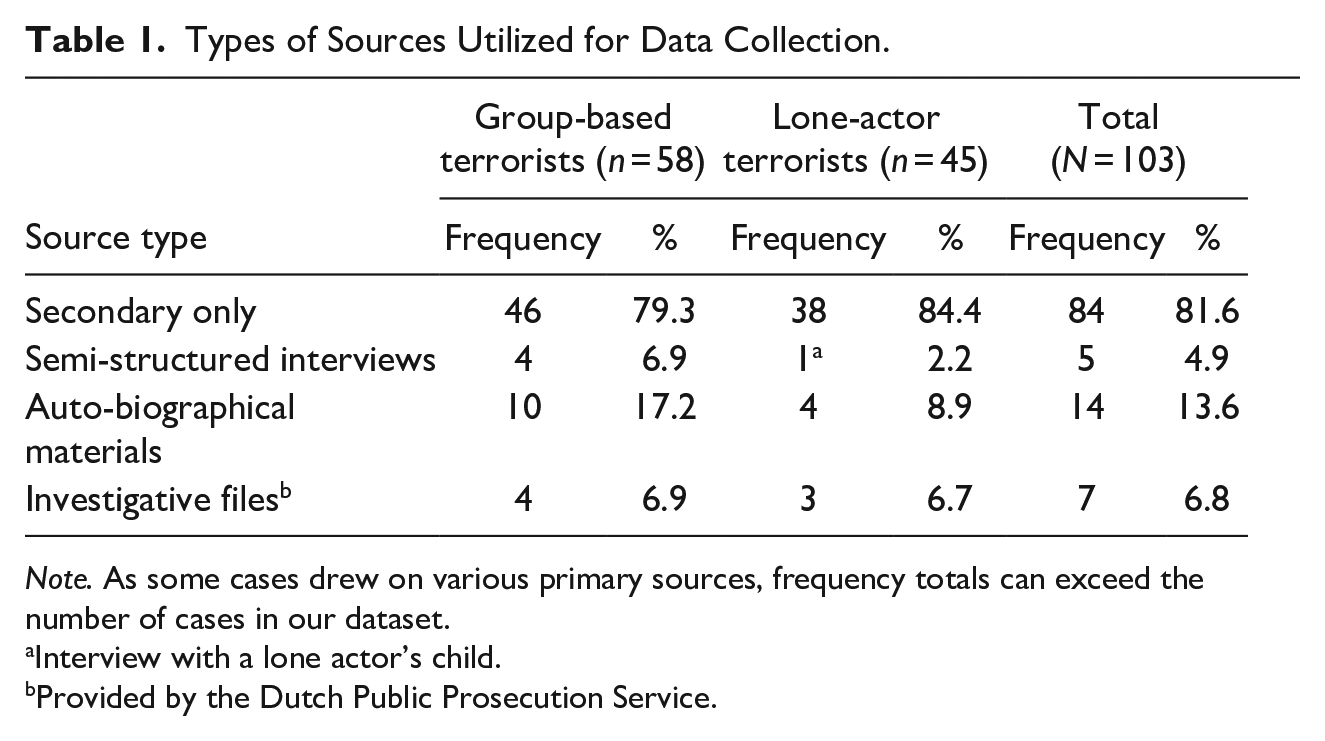
Note. As some cases drew on various primary sources, frequency totals can exceed the number of cases in our dataset.
Interview with a lone actor’s child.
Provided by the Dutch Public Prosecution Service.
Beyond addressing limitations, we also make a unique contribution by leveraging previously identified predictors of radicalization processes leading specifically to involvement in terrorist violence (Schuurman & Carthy, 2023b). This is done by drawing on the “(Non-) Involvement in Terrorist Violence” (NITV) dataset, which was designed to identify the differences between extremists who use terrorist violence, and those who do not. This allows us to narrow our comparison down to factors specifically relevant for understanding involvement in terrorist attacks, as opposed to other manifestations of radicalized worldviews, such as the dissemination of extremist propaganda or providing financial support to extremist organizations (McCauley & Moskalenko, 2017). As terrorist attacks are among the most polarizing radicalization outcomes, our findings are also relevant for the policy and practice of terrorism prevention.
Methodology
The NITV dataset (N = 206) was initially developed to study the differences between radicalized individuals who used terrorist violence (n = 103) and those who did not (n = 103), and instead enacted their extremist views in a variety of other, both legal and illegal, ways. Here, we focus specifically on the “involved in terrorist violence” subsample and compare lone-actor (n = 45) and group-based terrorists (n = 58). To represent the currently most salient terrorist threats, and to cover a sufficiently broad range of countries to generate insights generalizable to the terrorist threat facing Western countries, the NITV dataset was designed to include right-wing extremists as well as jihadists. The terrorist sub-sample represents twelve countries from North America and Europe (Table 2). These countries were not specifically chosen but represent the outcome of our case selection process (see also section on sampling below).
Sample Characteristics (n = 103).
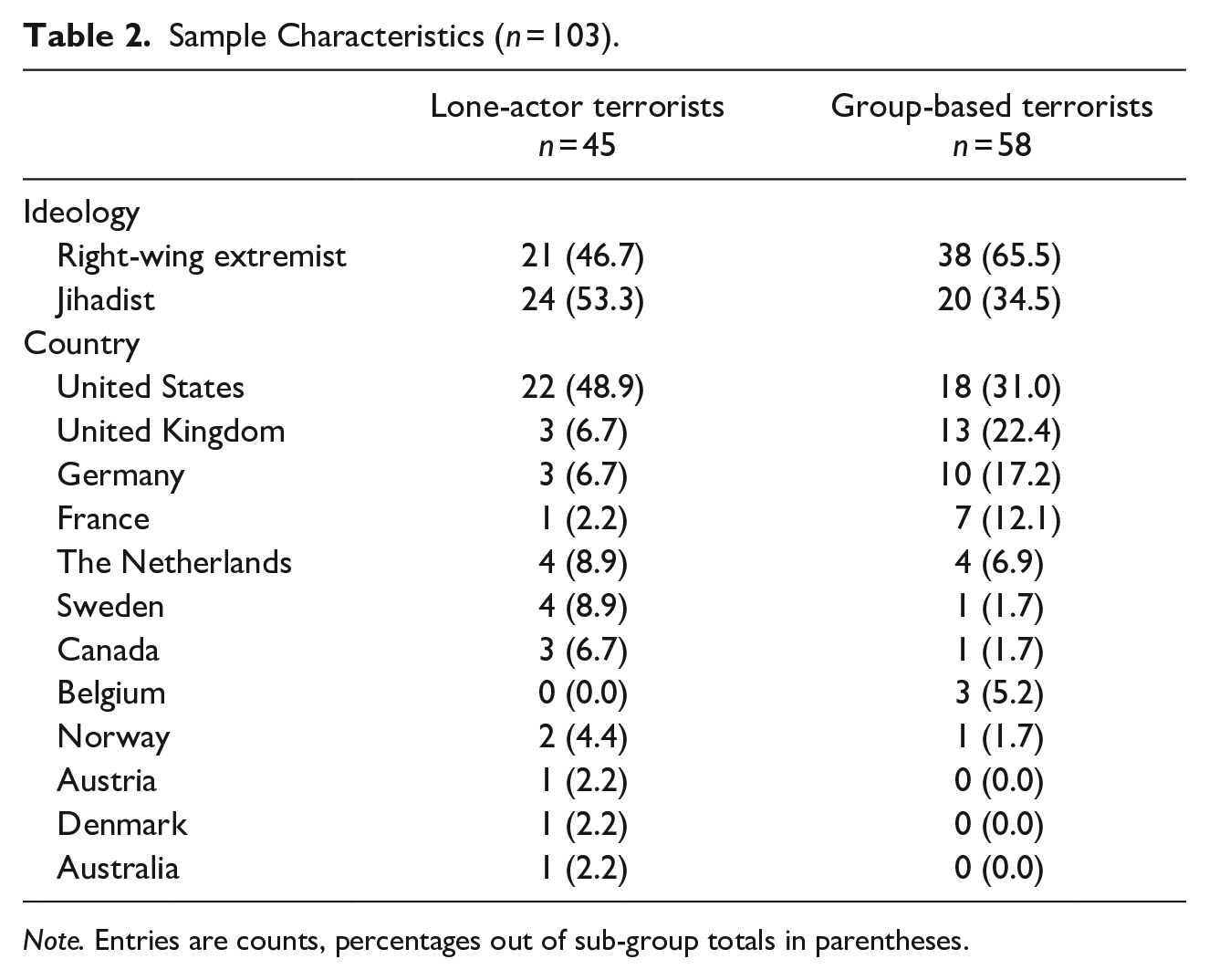
Note. Entries are counts, percentages out of sub-group totals in parentheses.
The full NITV dataset is built on variables drawn from an extensive literature review on (non-) involvement in terrorist violence, spanning publications on political violence and terrorism as well as adjacent fields such as psychology and criminology. The 159 variables included in the codebook considered three levels of analysis:
Structural-level variables considered the influence of the broader social and political context against which extremism and terrorism emerged, asking questions such as whether political parties existed that (partially) represented extremist views.
At the movement and group-level of analysis, we considered whether an individual was a lone-actor or group-based extremist and, for the latter, the characteristics of those groups. No group-level variables were used in the present comparison of group- and lone-actors.
Most variables fell under the individual level of analysis, covering a range of biographical factors such as subjects’ educational accomplishments, details of their upbringing, the specifics of their radicalization processes, and information on the various (radicalized) social milieus in which they were embedded.
Definitions
What constitutes a “lone actor” continues to be debated (Berntzen & Bjørgo, 2021). While some scholars have proposed that lone actors can be small cells of two or three people as well as single individuals (Pantucci, 2011), we argue that such conceptualizations are contradictory and unhelpfully blur the boundaries between these two forms of terrorism. Instead, we adopt a narrower, and more broadly shared, definition of lone actors as individuals who plan, prepare and execute their attacks with a high degree of autonomy and who are not active participants of established terrorist groups or organizations (Borum et al., 2012; Bright et al., 2020; Lindekilde et al., 2019). We also emphasize that while lone actors are, by our definition, not members of established groups, most of them do have ties to a broader extremist movement (e.g., through online platforms) from which they draw inspiration and which makes it relevant to include movement-level variables in our comparison (Hofmann, 2020). The term “lone wolf” is purposefully avoided, as most lone actors, while certainly dangerous, are not as cunning, capable, or totally isolated as this sensationalist moniker implies (Schuurman et al., 2019).
In this article, we draw on the NITV dataset’s sub-sample of radicalized individuals who became involved in terrorist violence. We operationalize such involvement as direct participation in the planning, preparation, or execution of a terrorist attack. Terrorism is defined as the (threatened) use of purposefully shocking violence against civilians or non-combatants to achieve widespread (media) attention, which in turn allows diverse audiences to be alternatively intimidated, coerced, or inspired (Schmid, 2011). By relying on an academic definition of terrorism (rather than criminal-law definitions of the countries included in the dataset) we sought to impute definitional uniformity and reduce reliance on definitions principally intended to enable prosecution, rather than objective assessment.
Sampling
Case selection began by considering all terrorist attacks that had occurred in Europe and North America since the 1980s. Although terrorism is a “low-base rate problem” (Sarma, 2017, p. 283), the impact of terrorist attacks on society is such that numerous publicly available resources, such as datasets, academic publications and government reports, provide overviews of attacks and attackers. To ensure that our sample was not biased towards only those terrorists who garner significant (media) attention, we purposefully sought out lesser-known cases (often those with relatively few casualties, that or which occurred outside of English-speaking countries).
To ensure that individuals selected for inclusion were at least broadly comparable in terms of the sociopolitical context in which they lived and radicalized, we limited our sampling to “homegrown” extremists; individuals with strong ties of belonging to the countries in which they planned, prepared, or executed their attacks, attained, for instance, through citizenship or prolonged residence (Crone & Harrow, 2011). As a result, terrorists who made their way to Europe or North America solely for the purpose of committing an attack, such as those who struck on 9/11, were excluded. Neither did we include European or North American nationals who joined insurgent groups such as the so-called Islamic State as “foreign fighters,” as participation in insurgent warfare in the Middle East is markedly different from engaging in terrorist violence in a Western setting (Duyvesteyn & Fumerton, 2009).
Of approximately 260 cases who were sampled, 206 met our inclusion criteria and could be coded in sufficient detail to warrant further analysis. The sub-sample (n = 103) who became involved in terrorist violence are the focus of the current study.
Data Collection
After the sample were selected, all data were collected, managed, and rendered reliable and valid (see “Statistical Procedure and Bias”) by the study authors. Following established practice for gathering data on hard-to-reach populations (Coggon et al., 2009), primary and secondary sources were accessed (see Table 1). As terrorist attacks draw considerable attention from journalists, academics, policymakers and politicians, the biographies and radicalization pathways of the sample could be reconstructed in considerable detail by relying on publicly available information (e.g., extensive reporting, academic papers, court verdicts, and government reviews).
These secondary sources were supplemented with primary data in the form of autobiographical materials (n = 14), semi-structured interviews, including an interview with a family member of a lone-actor terrorist (n = 5), and police investigative files provided by the Dutch Public Prosecution service (n = 7). All interviews were conducted on the basis of informed consent, and no friends or family members were approached for an interview unless they had spoken publicly about their relationship with the perpetrator(s) (e.g., authoring a book, or writing an article). Where possible, different sources were combined to increase the reliability of coding decisions. Data was anonymized upon input
Ethics approval was granted in November 2019 (Reference: 2019-012-ISGA-Schuurman). Each author was allocated a list of cases, and, between January 2020 and December 2021, all data were collected. A selection of cases underwent inter-rater reliability (IRR) testing (see below). Most variables were coded in a binary fashion, recording either their presence or absence, though changeable phenomena, such as employment or relationship status, were charted using ordinal scales to capture fluctuations in their influence. Where feasible, we divided measurements into a “before” and “after” radicalization onset assessment to capture change over time.
Statistical Procedure and Bias
To assess the reliability of the coding instrument, an eight-month period of inter-rater reliability (IRR) testing was conducted. Cohen’s kappa (κ) was calculated and indicated, on average, “substantial” agreement (M = 0.65, SD = 0.06) and was never lower than “moderate” as defined by Landis and Koch (1977). To account for the influence of uneven distributions of missing data, we followed guidelines set out by Perkins et al. (2018) to ensure that data were missing at random. For variables with more than 5% missing data, missing and non-missing data were compared across age, gender, conviction, and outcome (i.e., group-based or lone-actor involvement in terrorist violence). Where confounding was identified, the variable was omitted from prevalence reporting or carefully caveated. We have provided further details about our missing-data procedure as an online supplement (Supplemental Table 1).
Once missing data were determined to be missing at random, they were removed using listwise deletion. Associations between the various structural, group and movement, and individual-level variables and involvement in terrorist violence were analyzed in SPSS 25 (IBM Corporation, 2017). We also conducted binary logistic regression analysis to identify the combination of variables most strongly associated with being a group-based terrorist or lone-actor terrorist. Effect sizes were interpreted using Cohen’s d and Odds Ratio statistics.
Results
As shown in Table 3, of the variables significantly associated with radicalization leading to involvement in terrorist violence, few were significantly associated with lone-actor terrorism over group-based terrorism. However, eight statistically different findings did emerge.
Descriptive and Inferential Statistics of Variables Associated with Involvement in Terrorist Violence by Perpetrator-Type (N = 103).
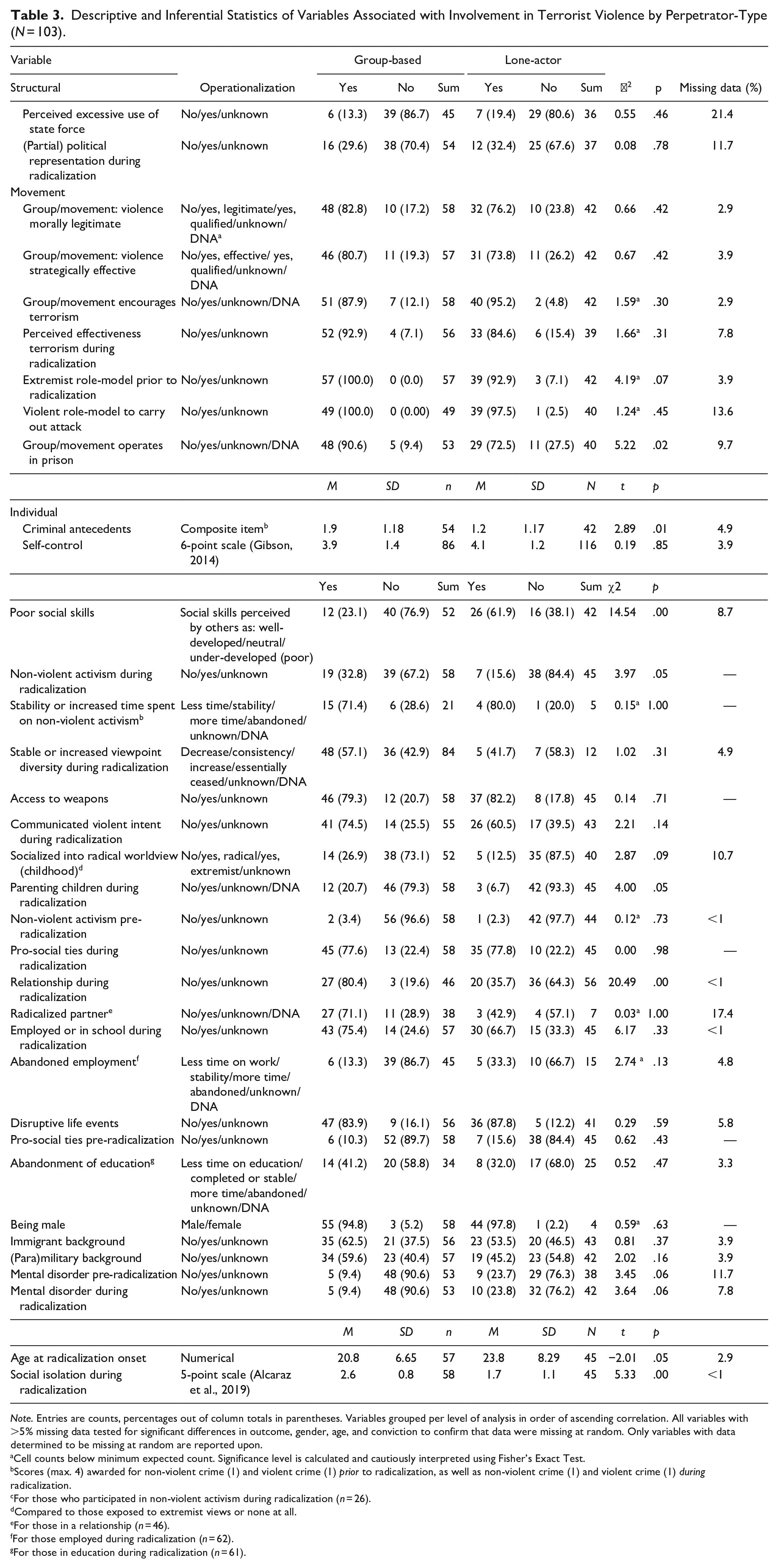
Note. Entries are counts, percentages out of column totals in parentheses. Variables grouped per level of analysis in order of ascending correlation. All variables with >5% missing data tested for significant differences in outcome, gender, age, and conviction to confirm that data were missing at random. Only variables with data determined to be missing at random are reported upon.
Cell counts below minimum expected count. Significance level is calculated and cautiously interpreted using Fisher’s Exact Test.
Scores (max. 4) awarded for non-violent crime (1) and violent crime (1) prior to radicalization, as well as non-violent crime (1) and violent crime (1) during radicalization.
For those who participated in non-violent activism during radicalization (n = 26).
Compared to those exposed to extremist views or none at all.
For those in a relationship (n = 46).
For those employed during radicalization (n = 62).
For those in education during radicalization (n = 61).
Group-based terrorists were more likely than lone actors to be affiliated with an extremist movement that is active in prisons (OR = 0.28). They also had a higher number of criminal antecedents (d = 0.60), better social skills as perceived by others (OR = 5.41) and a higher likelihood of engaging in non-violent activism during their radicalized period (e.g., spreading propaganda or running in local elections on an extremist platform, OR = 0.38). We also found that, during their radicalized period, group-based terrorists were more likely to parent children (OR = 0.27), be in a relationship (OR = 0.06) and were less likely to be socially isolated (d = 0.95). Finally, group-based terrorists tended to experience radicalization onset at a younger age than lone-actor terrorists (d = 0.40).
A binary logistic regression model was used to predict the relationship between the identified variables and the likelihood of cases being either a group-based terrorist or lone-actor terrorist. Using the forward stepwise procedure (p = .05 for entry into the model and .10 for exclusion), three variables emerged that accounted for 74.5% of the variance, with 76.9% of those who became group-based terrorists being identified at a confidence interval of 95%. The full model was statistically significant, χ² (3, n = 94) = 29.69, p < .000 and explained between 27% (Cox and Snell R2) and 36% (Nagelkerke R2) of the variance. As shown in Table 4, the variables in the model were: criminal antecedents, age at radicalization onset, and relationship status. Cases with fewer criminal antecedents who were older at radicalization onset and single during radicalization were more likely to become lone-actor terrorists. No serious multicollinearity (r > .8) was identified.
Binary Logistic Regression Predicting Perpetrator Category.
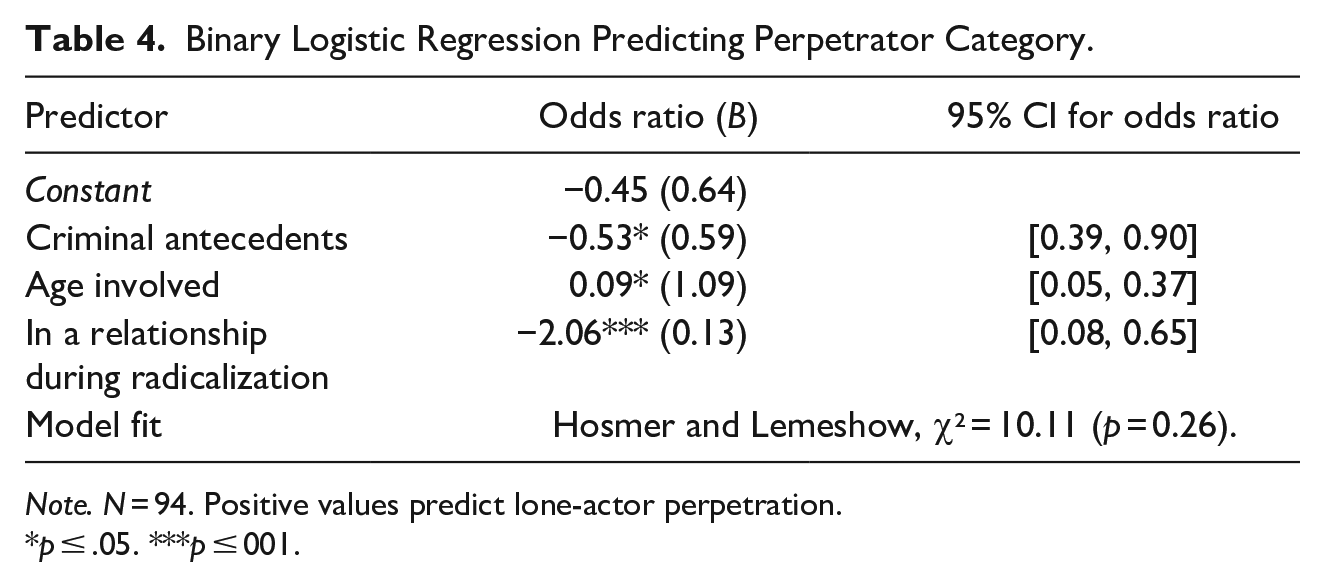
Note. N = 94. Positive values predict lone-actor perpetration.
p ≤ .05. ***p ≤ 001.
Discussion
We discuss our findings in order of their appearance in Table 3, followed by the implications of the regression analysis. While most of our findings can be confidently interpreted in light of existing empirical evidence in the field, some are more challenging and lead to a greater degree of speculation on our part. It is with this latter category of findings that our discussion opens.
Our first, notable difference between lone-actors and group-based terrorists is that the latter were more likely to identify with an extremist movement (or group, in the case of certain group-based actors) which operated in prison(s). This applied to 90.6% of group-based terrorists, compared to 72.5% of lone-actor terrorists. Chermak et al. (2013) found that a prison presence was one of the elements distinguishing violent from non-violent far-right groups in the U.S. Prison has also been identified as a setting that can contribute to an individual’s propensity to engage in terrorist violence (Clemmow, Bouhana, & Gill, 2020). However, as both lone actors and the group-based controls became involved in terrorist attacks, it seems unlikely that the higher prevalence of extremist movements with a prison presence among the controls exerted a propensity-related influence.
Instead, we hypothesize that a prison presence marks extremist movements that actively engage in propaganda and recruitment, who are likely to seek members not just behind bars but outside of them as well (Phillips & Schiele, 2023; Silke & Veldhuis, 2017). This increases the odds that a radicalizing individual will be actively sought out, or come across, the movement in question, essentially generating more opportunities for group-based engagement in extremist or terrorist activities. Conversely, the lower prevalence of extremist movements with a prison presence among lone actors may imply fewer opportunities for lone-actors to engage with like-minded individuals and groups, essentially leaving them with fewer alternatives to going solo. In short, we argue that a movement-level prison presence indirectly reveals something about the broader context in which radicalization takes place, and the opportunities for seeking out, or being sought out by, like-minded individuals.
We believe that the higher number of criminal antecedents associated with group-based terrorists represents a similar dynamic. Research on the so-called “crime-terror nexus” has indicated that criminal and terrorist milieus show considerable overlap (Basra & Neumann, 2016; Ljujic et al., 2017; Makarenko, 2004). Criminals’ skillsets may be sought after by terrorist movements, criminals may be attracted by the promise of redemption offered by extremist ideologies, and imprisonment may provide opportunities for networking between criminals and terrorists, as well as forming a setting conducive to radicalization (Basra & Neumann, 2017; Ilan & Sandberg, 2019). From this perspective, the higher the criminal antecedent score, the more likely these individuals will have frequented extremist social milieus in or outside of prison, or to have been radicalized and recruited by extremist groups. Hence, we see the difference between group- and lone-actors in terms of criminal antecedents as primarily related to the setting in which their subsequent radicalization unfolds, and the degree to which that setting affords personal connections to extremist peers or groups.
The findings also indicate that social competence may represent an important difference in these sub-samples, with lone-actors being perceived as having poorer social skills than group-based terrorists. While it is important to iterate that, with such heterogeneity of data sources, this type of epidemiological exploration is limited in its ability to make causal inferences about learned abilities, the finding has plausibility in the context of the broader literature. As Lindekilde et al. (2019) found, lone actors’ decision to operate by themselves is not always born out of a desire to avoid detection. Individuals with poor social skills may be less likely to be accepted into active terrorist cells or extremist groups, impeding them from following a group-based pathway towards terrorist violence. At least in some cases, committing terrorism as a lone actor may be a last-resort measure, rather than a conscious decision reflecting an intention to go undetected. As such, this finding also supports Schuurman et al.’s (2019) conclusion that lone actors should not, as a category, be viewed as exceedingly capable terrorists, though this does not diminish their ability to pose a very real threat.
That group-based terrorists have a higher likelihood of also engaging in non-violent activism is unsurprising. Not only is it more common for group members to attend things like political rallies or speaking events with their friends, but some forms of non-violent activism that we encountered (such as organizing for (local) elections) are logistically very difficult to accomplish outside of a group context. Group-based terrorists are also more likely to parent children and be in a relationship, and less likely to be socially isolated during their radicalization, than lone actors. We hypothesize that these findings reflect, again, lone actors’ poorer, perceived social skills. Interestingly, while it was observed, at the descriptive level that lone actor terrorists had a higher prevalence of mental disorder than group-based terrorists, this association was shy of significance. Methodological limitations notwithstanding, in line with previous work (Gill et al., 2014; Spaaij, 2010), it may be the case that sub-clinical items such as social isolation are more characteristic of this typology of terrorists than their associated, clinical outcomes, such as poor mental health (Harandi et al., 2017); isolation not just from radicalized peers, but also in terms of a lack of broader affective ties.
Interestingly, we found that the age at radicalization onset was significantly lower for group-based than lone-actor terrorists. This appears to match a broader set of findings reporting that lone actors tend to be (slightly) older than their group-based counterparts at the moment of their arrest or offending (Gruenewald et al., 2013; Knight et al., 2022; Rostami et al., 2022). In the absence, however, of a radicalization theory which implicates age at radicalization onset in radicalization process outcomes, and unable to speculate on its origins based on our data, we present this finding “as is” for now. Here, we re-iterate that exposure in the current study was ascertained by the study authors, and that this coding procedure is limited in its ability to make causal inferences between variables. Although inter-rater reliability testing indicated that agreement across coding decisions was broadly acceptable, is it important to reflect further on the plausibility of this finding in the absence of theory. If found to be a stable difference between lone-actor and group-based terrorists, the age-at-radicalization-onset variable could, indeed, be useful in the context of threat assessment, helping to isolate potential lone actors from a broader pool of radicalized individuals. For now, unfortunately, its provenance remains unclear.
The regression analysis indicates that radicalization to lone-actor rather than group-based terrorism is more likely for individuals with fewer criminal antecedents, who are older at radicalization onset and who are single. If we are correct in our hypothesis that criminal antecedents are a proxy for degree of embeddedness in social networks that provide access to radicalized peers and extremist groups, then the model suggests the particular salience of isolation. Isolation at the individual level, in terms of the absence of a relationship, but also in terms of limited or even absent ties to a broader extremist milieu. The latter point, especially, once again suggests that engaging in lone-actor terrorism may reflect decisions made out of simple necessity rather than a carefully weighed strategic choice. Here too, unfortunately, we are unable to provide a theoretical grounding for the relevance of comparatively older age at radicalization onset. Regardless, the salience of this variable remains notable particularly from a prevention-oriented context, wherein suspects’ age is usually a readily available data point.
This brings us to the policy-relevant implications to arise from our findings. First of all, we urge a reconsideration of the degree to which the decision to engage in terrorism can be understood by primarily considering individual-level factors. Research on terrorism as it developed after the 9/11 attacks has emphasized the characteristics of perpetrators, and the details of their radicalization processes, as a potential source of risk factors that can then be utilized for prevention-oriented policies and practices (Malthaner, 2017; Vergani et al., 2020). As we hypothesize, however, extremists’ decision to engage in terrorism as either a group-based actor or a lone actor at least partially reflects the characteristics of their social environment, particularly in terms of the (lack of) opportunities to engage with, or be recruited by, other radicalized individuals or groups. As such, we join other authors in urging greater attention to the (social) context from which terrorism emerges (Schuurman & Carthy, 2023a; Smith et al., 2020), even for a form of terrorism ostensibly characterized by the isolation of its perpetrators.
Our results also suggests that, in many respects, lone actors are not significantly different from group-based terrorists. Research on terrorism has proven vulnerable to seeing developments in terrorists’ modus operandus or overarching ideological motives, as evidence of the emergence of a fundamentally “new” type of threat (Duyvesteyn, 2004; Schuurman, 2019). Deadly lone-actor attacks, such as those that befell Norway (2011) and New Zealand (2019), have certainly, and understandably, focused particular attention on the threat posed by individual perpetrators (e.g., Gill et al., 2014). However, the numerous commonalities between lone-actor and group-based terrorists that we, as well as other academics (Gruenewald et al., 2013; Knight et al., 2022), have identified, suggest that differences between these two forms of terrorism are nuanced and should not be exaggerated.
This is not only relevant for understanding these forms of political violence, but suggests that policies and practices intended to detect and prevent lone-actor terrorism need not entirely re-invent the wheel. While it is, of course, necessary to attune these efforts to those aspects that seem particular to lone actors (e.g., greater social isolation, higher incidence of diagnosed mental-health issues; Sarma et al., 2022), lessons learned from the prevention of group-based forms of terrorism are likely to still be relevant. As research continues to deepen our understanding of what these similarities and differences are, law enforcement and intelligence agencies’ ability to identify potential lone-actor terrorists within a broader pool of radicalized individuals will continue to improve. We hope that the findings presented here can contribute to such endeavors.
Conclusion
Our results support two broad trends identified in the literature review section. First, in terms of their radicalization process and biographical characteristics, lone actors should not be treated as a completely different category of terrorist offenders. For most of the variables associated with radicalization leading to involvement in terrorist violence, we found no statistically significant differences between group-based and lone-actor terrorists, highlighting more commonalities than differences. However, our findings do support existing research which suggests that lone actors are more socially isolated and older than group-based terrorists. Additionally, we found them to have fewer criminal antecedents, poorer perceived social skills, and a lower probability of engaging in non-violent activism, parenting children, and being in a relationship. Furthermore, we see tentative support for a third element highlighted in the review, being that the setting in which radicalization occurs appears salient to the outcome of this process. In particular, the higher number of criminal antecedents among group-based terrorists arguably makes them more likely to encounter, or be recruited by, radicalized peers or groups due to the overlap between criminal and extremist social milieus, in turn increasing their opportunities for group-based involvement in terrorism.
In terms of implications for further research, we believe that the association between social skills, criminal antecedents, age at radicalization onset and involvement in terrorist attacks as a lone- rather than group-based actor, invites further scrutiny. Deepening our understanding of the extent to which these biographical factors and social settings can influence radicalization outcomes has the potential to significantly advance insights into when, how and for whom terrorism can become an attractive course of action. Our findings’ relevance for prevention-focused work is that they increase opportunities for early detection and intervention. As the characteristics noted above are, in theory, observable well before these individuals engage in attack planning, preparation, or execution, finding and disrupting lone actors before they reach these stages may be more tenable. While lone actors are likely to remain a key terrorist threat, they may not be as undetectable in a pre-attack setting as they are frequently portrayed to be.
Supplemental Material
sj-docx-1-cad-10.1177_00111287231180126 – Supplemental material for Who Commits Terrorism Alone? Comparing the Biographical Backgrounds and Radicalization Dynamics of Lone-Actor and Group-Based Terrorists
Supplemental material, sj-docx-1-cad-10.1177_00111287231180126 for Who Commits Terrorism Alone? Comparing the Biographical Backgrounds and Radicalization Dynamics of Lone-Actor and Group-Based Terrorists by Bart Schuurman and Sarah L. Carthy in Crime & Delinquency
Footnotes
Acknowledgements
We are also thankful for the reviewer feedback that allowed us to improve our work in several regards and to the Dutch Public Prosecution Service for granting access to data on numerous Dutch terrorism cases.
Declaration of Conflicting Interests
The author(s) declared no potential conflicts of interest with respect to the research, authorship, and/or publication of this article.
Funding
The author(s) disclosed receipt of the following financial support for the research, authorship, and/or publication of this article: the Dutch Research Council (VI.Veni.191R.007) and Public Safety Canada (CRF 8000-21053).

Supplemental Material
Supplemental material for this article is available online.
Author Biographies
References
Supplementary Material
Please find the following supplemental material available below.
For Open Access articles published under a Creative Commons License, all supplemental material carries the same license as the article it is associated with.
For non-Open Access articles published, all supplemental material carries a non-exclusive license, and permission requests for re-use of supplemental material or any part of supplemental material shall be sent directly to the copyright owner as specified in the copyright notice associated with the article.
