




Abstract
Antisocial Potential is the key construct of the Integrated Cognitive Antisocial Potential (ICAP) theory, and it has been measured by the antisocial attitude (AA) scale. The ICAP theory is one of the main theoretical frameworks in developmental and life-course criminology. The present study aimed to examine the psychometric properties of the AA scale in the Portuguese adolescent population. Our sample was comprised of 485 participants. The Portuguese version of the AA scale was demonstrated to be a reliable and valid measure of antisocial potential. This is the first study exploring the AA scale outside of the scope of the CSDD and it reveals antisocial potential as a strong predictor of criminal behavior that should be considered in future research.
Keywords
Introduction
Antisocial Potential is the key construct of the Integrated Cognitive Antisocial Potential (ICAP) theory (Farrington, 2003, 2005, 2020). The ICAP theory, one of the main theoretical frameworks in Developmental and Life-Course Criminology, distinguishes between long-term and short-term antisocial potential. Long-term antisocial potential refers to persisting between-individual differences in antisocial potential, which are determined mainly by strain, modeling, and socialization processes. Therefore, the ICAP framework predicts that people can be ordered on a continuum from low to high antisocial potential, in other words, from low to high likelihood of practicing deviant behaviors. Despite the relative stability of antisocial potential over time, absolute values of long-term antisocial potential are expected to change with age, peaking in adolescence and gradually decreasing in adulthood due to within-individual variations in the factors that influence long-term antisocial potential (Farrington, 2003, 2005, 2020). Short-term antisocial potential, on the other hand, refers to within-individual variations in antisocial potential that are determined by motivating and situational factors, such as being bored, angry, drunk, etc. (Farrington, 2003, 2005, 2020).
The ICAP theory proposes that antisocial and criminal behavior is explained by the interaction between the individual and the social environment. When faced with environmental opportunities, individuals with higher levels of immediate antisocial potential have a higher likelihood of acting in a socially deviant manner. Farrington (2003, 2005, 2020) also describes how cognitive processes, such as the subject’s expected utility, play a determining role in whether someone practices antisocial or criminal acts (Figure 1). As a result, individuals with high levels of short-term antisocial potential may act antisocially even when it seems not rational to do so; while individuals with low levels of short-term antisocial potential may tend to refrain from offending even when it seems to be the rational choice.
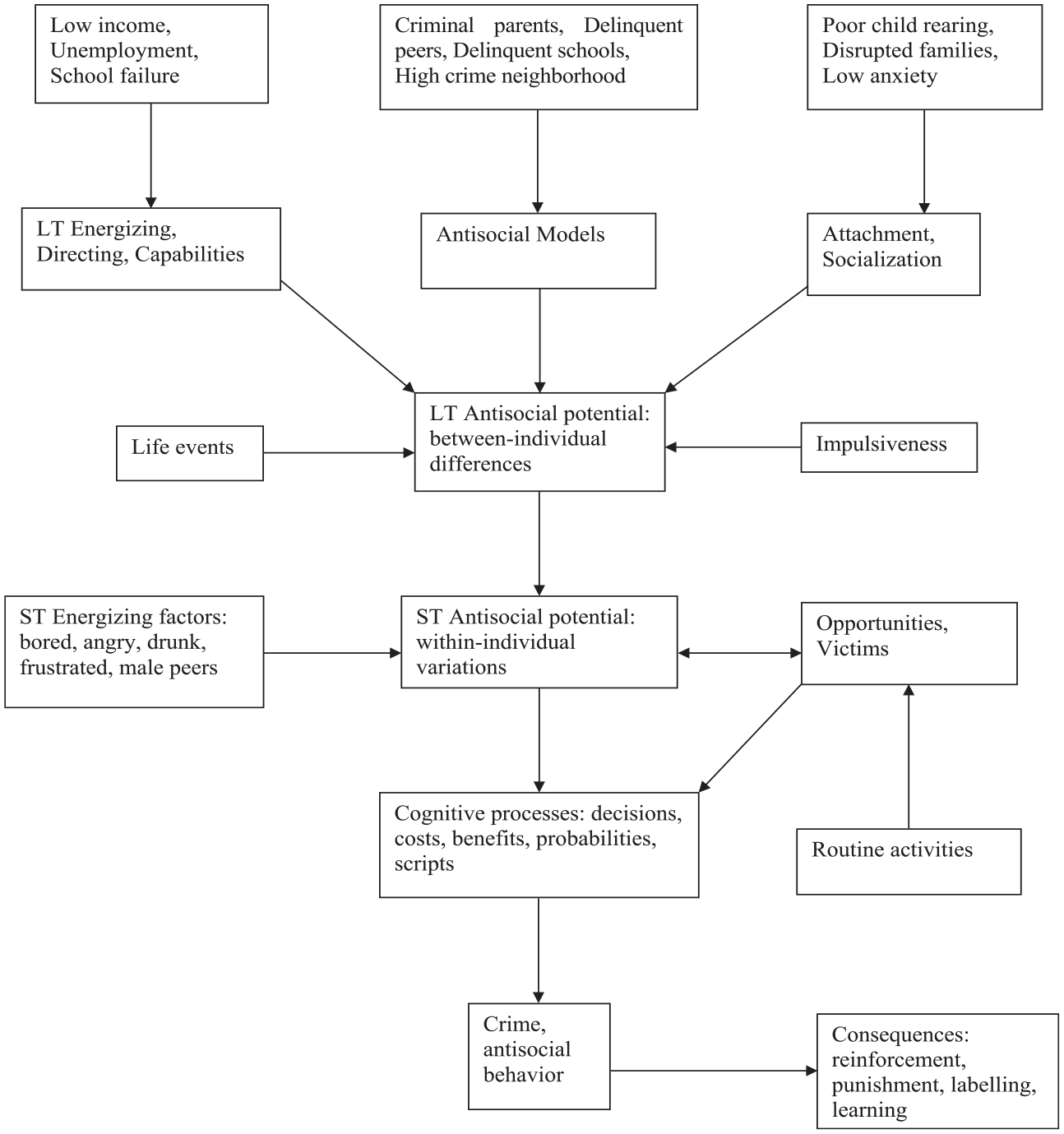
The integrated cognitive antisocial potential (ICAP) theory.
The Antisocial Attitudes (AA) scale was originally developed by West and Farrington (1977) within the Cambridge Study in Delinquent Development (CSDD) and was later revised by Farrington and McGee (2017, 2019) with the objective of assessing the crucial theoretical construct of long-term antisocial potential. The CSDD is a prospective longitudinal study of 411 London males (generation 2), their parents, and their children. In the original study, the AA scale showed acceptable internal consistency, with Cronbach’s alphas varying between .72 and .67 among the original sample of CSDD males termed generation 2 (G2; α = .72 at age 18 years, α = .67 at age 32 years, and α = .71 at age 48 years; Farrington & McGee, 2017). Among the sample of the biological children of the G2 males, termed generation 3 (G3), the internal consistency of the AA scale was somewhat lower (α = .62; Farrington & McGee, 2019). The AA scale can be divided into two main dimensions, anti-establishment (e.g., “Civil servants are too full of their own importance”) and aggressive antisocial attitudes (e.g., “Anyone who insults me is asking for a fight”).
Farrington and McGee (2017) used the AA scale and demonstrated the relative stability of Antisocial Potential from ages 18 to 48 years using the G2 (generation 2) males of the CSDD study, which is in agreement with the ICAP theory postulates. Further, and also according to the ICAP framework’s prediction, these authors showed absolute changes in Antisocial Potential at different ages, demonstrating the tendency of participants to become less antisocial as they get older. In a subsequent manuscript, Farrington and McGee (2019) also used the AA scale to further test the ICAP theory using data from the G2 and G3 (generation 3) males in the CSDD study. In this study, the authors showed how socioeconomic, parental, family, and individual factors predicted long-term antisocial potential, as well as demonstrating the relationship between Antisocial Potential and criminal convictions. These findings are summarized in Farrington (2020).
By assessing antisocial potential, the AA scale presents itself as a very useful instrument that allows an evaluation of a main predictor of deviant behavior, as well as a timely assessment of the crucial theoretical construct of the ICAP theory, which allows a straightforward process to test the ICAP theory’s predictions.
Current Study
In the present study, we aimed to test the psychometric qualities of the AA scale in the Portuguese adolescent population. In order to do so, we carried out a language adaptation process and examined the psychometric qualities of the Portuguese version of the AA scale. Similar to the original validation studies of the AA scale (Farrington & McGee, 2017, 2019), we carried out a reliability analysis and considered the removal of items that reduced the scale’s internal consistency. Further, we expected our analyses to show a good model fit of the originally proposed two-factor model (i.e., anti-establishment and aggressive antisocial attitudes) using confirmatory factor analysis. We expect to show evidence of the AA scale’s convergent validity by testing the correlation between the two dimensions of the AA scale, as well as between AA scale outcomes and the validation scales (i.e., self-serving cognitive distortions, self-control, and prosocial morality). Finally, we expected to find evidence of construct validity via testing the AA scale’s known-groups validity, by exploring its ability to accurately discriminate between a group of non-offenders and a group of offenders, using both official and self-reported delinquency, the two mainly used methods of assessing offending behavior (Gomes et al., 2018).
Method
Participants
A total of 501 participants were invited to complete the questionnaire, with 16 participants, who provided unusable questionnaires, removed. As a result, the sample was comprised of a total of 485 participants, 274 males (56.5%) and 211 females (43.5%), aged between 13 and 21 years (M = 15.56, SD = 1.68). Our sample was comprised of a community group of 383 school students (79.0%) and a forensic group of 102 (21.0%) adolescents from four Portuguese detention centers for juvenile offenders.
The community group was composed of 191 (49.9%) male and 192 (50.1%) female students from a public school in the center of Portugal, aged between 13 and 21 years (M = 15.43, SD = 1.75). Students were mostly Portuguese nationals (n = 375, 98.7%). School grades varied from the 7th grade to the 12th grade, where 156 (40.7%) students were in grades 7 to 9, while the remaining students (n = 227, 59.3%) were in grades 10 to 12. With regards to their self-reported offending behavior, the community group presented a lifetime prevalence of offending of 38.9%, with a mean variety of lifetime offending of 0.73 (SD = 1.20).
The forensic group comprised a total of 102 adolescents sentenced to a dispositional order at detention centers for juvenile offenders. This sample was composed of 83 males (81.4%) and 19 (18.6%) females, aged between 13 and 20 years (M = 16.09, SD = 1.24). A total of 86.7% of this group were Portuguese nationals. For self-reported offending, 92.9% (n = 92) of participants in the forensic group reported having committed at least one of the considered types of offenses and showed a mean of offending variety of 6.27 (SD = 3.59), which was significantly higher than the community group (t(103.78) = −15.17, p < .001).
Measures
Antisocial Attitudes Scale (AA scale)
The AA scale was originally developed by West and Farrington (1977) within the CSDD and revised by Farrington and McGee (2017). This is a self-report scale designed to assess long-term antisocial potential. It is a 24-item self-reported instrument with a 4-point response format ranging from definitely true to definitely false (see all items in Table 1). A total of 11 items provide an evaluation of anti-establishment antisocial attitudes, while the remaining 13 items evaluate aggressive antisocial attitudes. High mean scores on the AA scale correspond to high antisocial attitudes.
Descriptive Statistics and Cronbach’s Alpha for the Antisocial Attitude Scale.
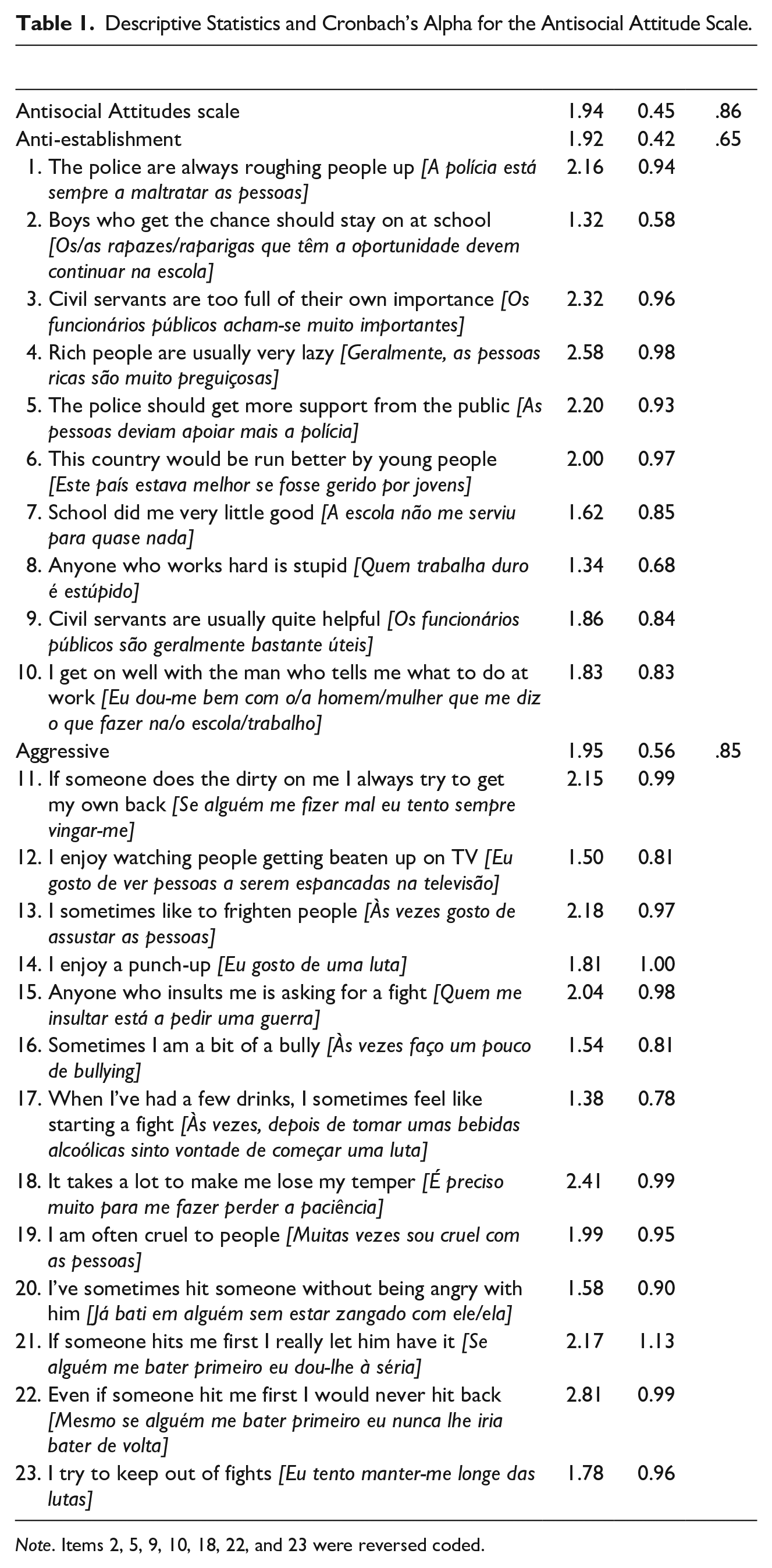
Note. Items 2, 5, 9, 10, 18, 22, and 23 were reversed coded.
How I Think Questionnaire (HIT-Q)
The HIT-Q (Barriga et al., 2001; Gomes et al., 2022) is a 54-item self-report questionnaire with a six-point response format, varying from “strongly agree” to “strongly disagree.” This instrument provides an evaluation of four categories of self-serving cognitive distortions (i.e., Self-Centered, Blaming Others, Minimizing/Mislabeling, and Assuming the Worst). Mean scores were calculated, where higher scores represent higher cognitive distortions. The Portuguese version of HIT-Q showed evidence supporting its validity and reliability. In the present study, the self-serving cognitive distortions subscales also had good internal consistency (Self-Centered α = .85, Blaming Others α = .78, Minimizing/Mislabeling α = .82, and Assuming the Worst α = .85).
The Brief Self-Control Scale (BSCS)
The BSCS is a short 13-item self-report measure of general self-control with a response format on a 5-point scale from “Not at all like me” to “Very much like me” (Pechorro et al., 2021; Tangney et al., 2004). The BSCS scores of self-control are obtained by adding up the 13 items. The BSCS showed good internal consistency (α = .70) in the present study.
Personal Morality Index (ISRD3)
The ISRD3 includes an assessment of morality (i.e., Personal morality index) that is divided into two dimensions, that is, prosocial and shame (Enzmann et al., 2018; Martins et al., 2015). This index was adapted from Wikström and Butterworth (2013) and assesses prosocial morality by asking participants to assess the wrongfulness of eight different types of deviant behaviors. Responses were given on a 4-point Likert scale from “Very wrong” to “Not wrong at all.” Shame was assessed using nine questions that asked participants whether they would feel ashamed if found committing three types of offenses by their parents, friends, or teachers. Responses were given in a three-option format, that is, “No, not at all,” “Yes, a little,” and “Yes, very much.” We calculated morality scores so that higher scores indicated higher prosocial morality and shame. In the present study, internal consistency for prosocial was α = .70 and for shame α = .88. Overall, the Morality scale presented an alpha of α = .85.
Self-Report Delinquency (ISRD3)
Delinquent behavior was assessed using the self-report delinquency scale included in the ISRD3 questionnaire (Enzmann et al., 2018; Martins et al., 2015). Respondents were asked whether or not they had ever committed each of the delinquent behaviors during their lifetime. The overall variety (i.e., the total number of types of delinquent behavior an individual has ever practiced, Sweeten, 2012) and prevalence scores of delinquency included 12 types of offending behaviors (i.e., vandalism, shoplifting, burglary, bicycle theft, car theft, stealing from a car, stealing from a person, carrying a weapon, robbery, group fight, assault, and drug sales; (Doelman et al., 2021). Also, similar to previous studies, we divided delinquency scores into two composite variables of property offenses (vandalism, shoplifting, burglary, and stealing from someone or a vehicle), and violent offenses (group fights, carrying a weapon, robbery, and assault; Doelman et al., 2021).
Procedures
The translation and cultural adaptation of the AA questionnaire was carried out by taking into consideration the guidelines of best practices for cross-cultural adaptation of self-report measures (Beaton et al., 2000). After receiving ethical permits from the University of Minho and the approval from the author of the original English version, we initiated the process of adaptation of the AA scale for the Portuguese population. The translation and back-translation processes were carried out independently by two English-speaking Portuguese researchers, taking into account the cultural adaptation of language. After completing these processes, the translation team met in order to compare the two versions and to discuss aspects related to the cultural adaptation of language in order to reach the final Portuguese version of the AA scale.
Data collection for the present study was twofold. First, data collection with the community group was carried out in a public school in the Center of Portugal. A convenience sample of students was invited to participate in this study. Participants who voluntarily agreed to be a part of this study completed the questionnaire. Second, the forensic group was accessed in four Portuguese detention centers for juvenile delinquents. Three detention centers were located in the center of Portugal, while the remaining detention center was located in the North of Portugal. Adolescents in the detention centers were invited to collaborate in this study, and those who agreed to voluntarily participate in this study completed our questionnaire. For both samples, the questionnaire was completed in a paper-and-pencil self-administered format in a classroom in the exclusive presence of the researcher. This study received ethical approvals from the University of Minho’s Ethics Committee, the Portuguese General Education Directorate of the Ministry of Education and Science, and the General Directorate of Reintegration and Prison Services (DGRSP) of the Ministry of Justice. Further, all underage participants (i.e., under 18 years) were also required to have parental consent to participate in this study.
Data Analysis
The psychometric qualities of the Portuguese version of the AA scale were assessed by testing its internal consistency, factor structure, convergent validity, and known-groups validity. Statistical analyses were undertaken using the SPSS v28 software and Amos Version 28 (IBM SPSS, Chicago, IL).
Internal consistency was assessed using Cronbach’s alpha. Convergent validity analysis was carried out in two steps. In step 1 we analyzed the intercorrelation between the two dimensions of the AA scale. In step 2 we tested the correlation between the AA scale outcomes and independent measures that are expected to be correlated with antisocial potential. In this study, we tested the correlation between the AA scale scores and cognitive distortions (i.e., self-centered, blaming others, minimizing/mislabeling, and assuming the worst), self-control, and prosocial morality (i.e., prosocial values, and level of shame). Known-groups validity was tested by carrying out discriminant analysis, testing the predictive ability of the AA scale to discriminate between a group of offenders and non-offenders, both based on (1) having been convicted to a detention center for juvenile delinquents; and (2) based on self-reports of delinquent behavior over the life-course.
A missing value analysis showed that the present sample presented a mean of 3.63 missing values per item of the AA scale (MCAR χ2(653) = 697.75, p = .109). Missing data were imputed through Bayesian Estimation. Factor structure was analyzed by Confirmatory Factor Analysis (CFA). AA items violated the assumption of the multivariate normal distribution (kuMult = 154.66). However, the AA scale’s items’ skewness (ranging between −0.43 and 2.21) and kurtosis (ranging between −1.25 and 4.75) demonstrated that the present results did not grossly violate the assumption of normal distribution (Kline, 2005). As a result, the CFA was carried out using Maximum Likelihood. Model fit was assessed by the Relative Chi-Square (χ2/df < 5), Goodness-of-Fit Index (GFI > .90), Parsimony Goodness-of-Fit Index (PGFI > 0.60), and the Root Mean Square Error of Approximation (RMSEA < 0.08; Arbuckle, 2019). When the model fit indicated unsatisfactory results on these indicators, we considered a Modification Indices (MI) analysis based on the Lagrange multiplier, which indicates the amount by which the chi-square can be reduced if a particular parameter restriction was removed (MacCallum et al., 1992).
Results
Reliability
Similar to the original validation of the AA scale (Farrington & McGee, 2017), we started by analyzing the internal consistency of each dimension. Items that reduced the internal consistency of each subscale were removed. As a result, one item (i.e., “Hard work is the only way to get on in life”/“O trabalho duro é a única maneira de ter sucesso na vida”) was removed. As illustrated in Table 1, the aggressive attitudes had very good internal consistency (α = .85), while the anti-establishment scale had lower but still acceptable reliability (α = .65). The overall AA scale had a Cronbach’s alpha of .86.
Confirmatory Factor Analysis
We carried out a CFA in order to test the original two-factor solution of the AA scale (Farrington & McGee, 2017). The results showed a generally good model fit for the original solution, with the exception of the GFI (0.87) which was slightly below the proposed threshold. According to an analysis of the MI, we have covaried three pairs of items, that is, items 1 and 5 (MI = 50.16); items 21 and 22 (MI = 44.17); and items 11 and 15 (MI = 26.08). The final solution (see Figure 2) presented scores indicating a good model fit of the Portuguese version of the AA scale (χ2(226) = 558.59, p < .001, χ2/df = 2.47, GFI = 0.90, PGFI = 0.74, RMSEA = 0.055 [RMSEA LO90 = 0.049; RMSEA HI 90 = 0.061]).
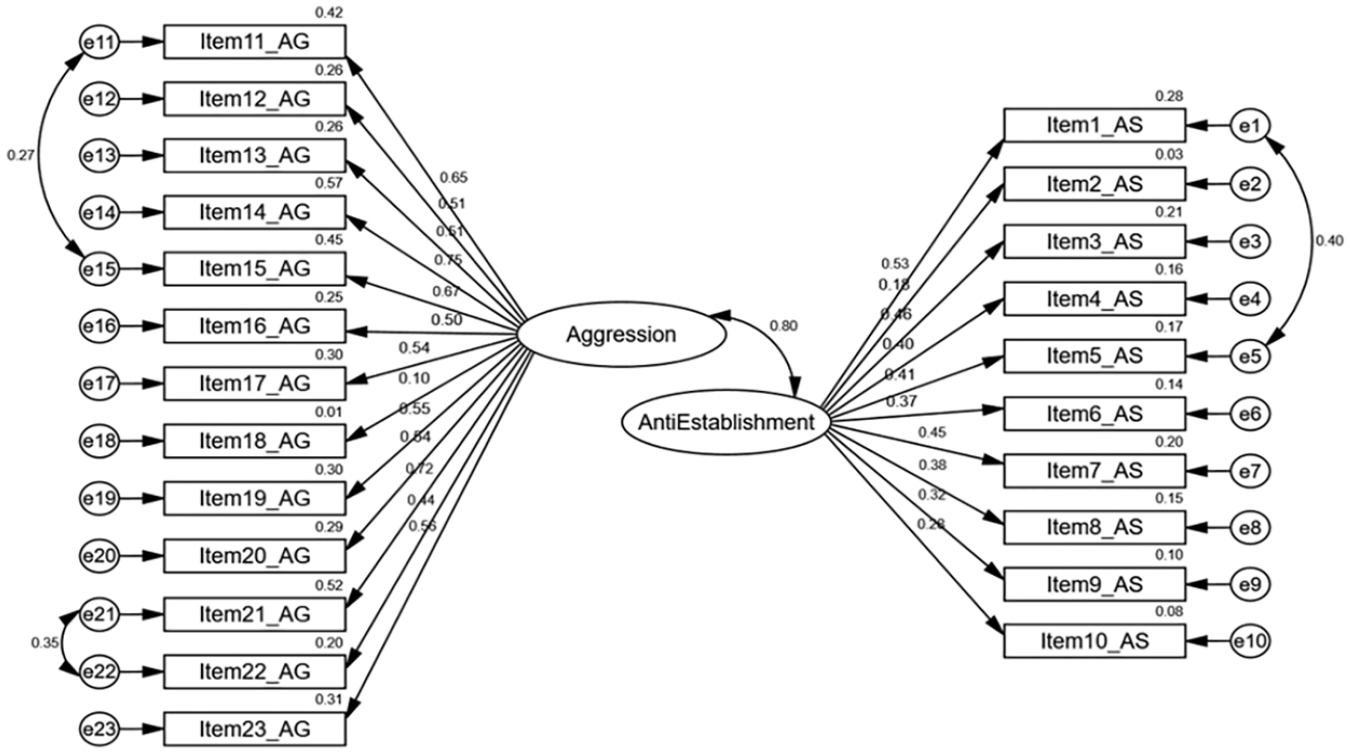
CFA for the Portuguese validation of the AA scale.
Convergent Validity
First, we tested the correlation between the two dimensions of the AA scale, which demonstrated a positive correlation between the anti-establishment attitudes and the aggressive attitudes dimensions (r = .58, p < .001). Second, Table 2 illustrates the convergent validity tests between the AA scale outcomes and the validation scales. The overall antisocial attitudes score, as well as the two dimensions separately, had large positive correlations with the various cognitive distortions. This was true for self-centered, blaming others, minimizing/mislabeling, and assuming the worst cognitive distortions, with correlations ranging from .55 to .70 (Cohen, 1992). On the other hand, antisocial potential showed medium to large negative correlations with self-control, such that, as the values of antisocial attitudes increase, self-control decreases. Similarly, AA scale scores showed negative correlations with morality scores (r ranging from −.26 to −.44), in ways that, as the antisocial attitudes increase the morality scores decrease, and vice-versa.
Correlations Between AA Scale Scores and the Validation Scales.
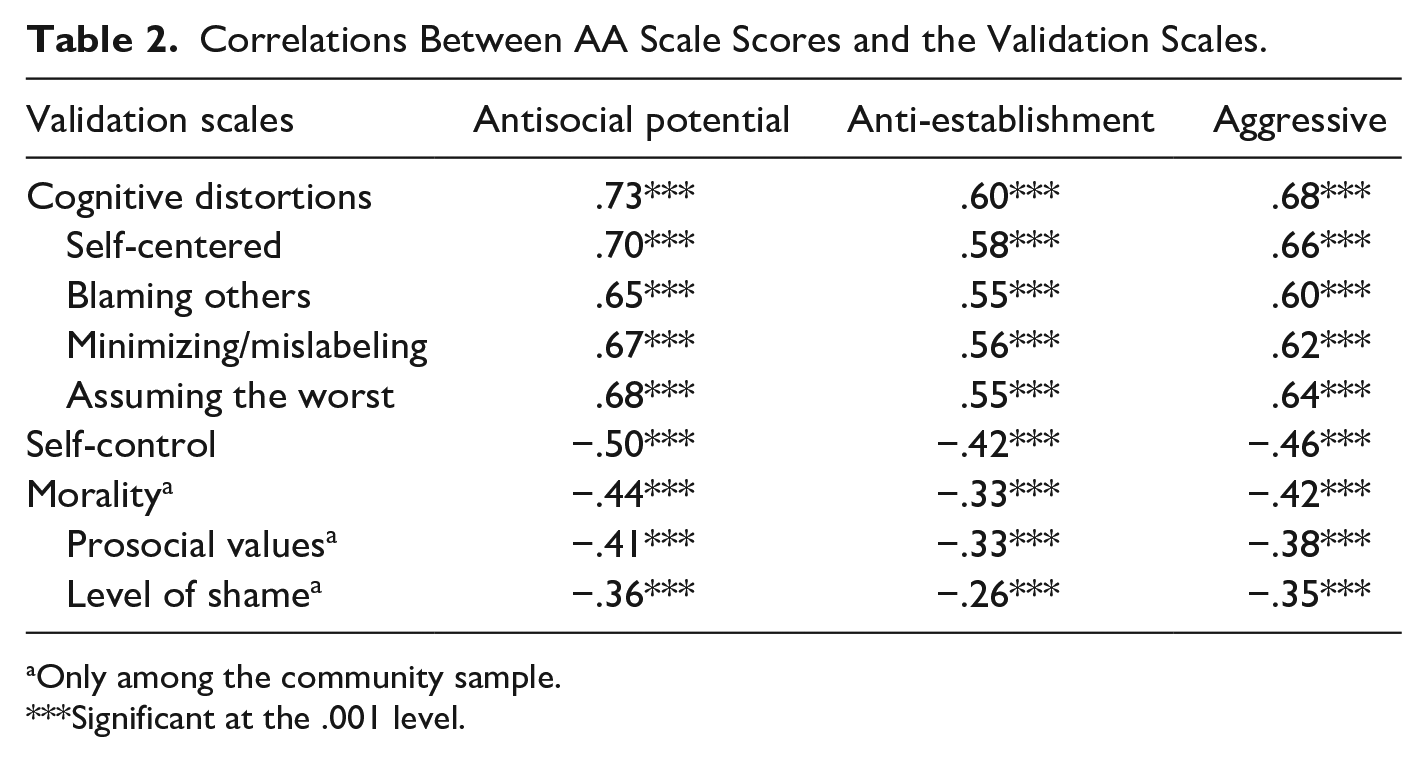
Only among the community sample.
Significant at the .001 level.
Known Groups Validity
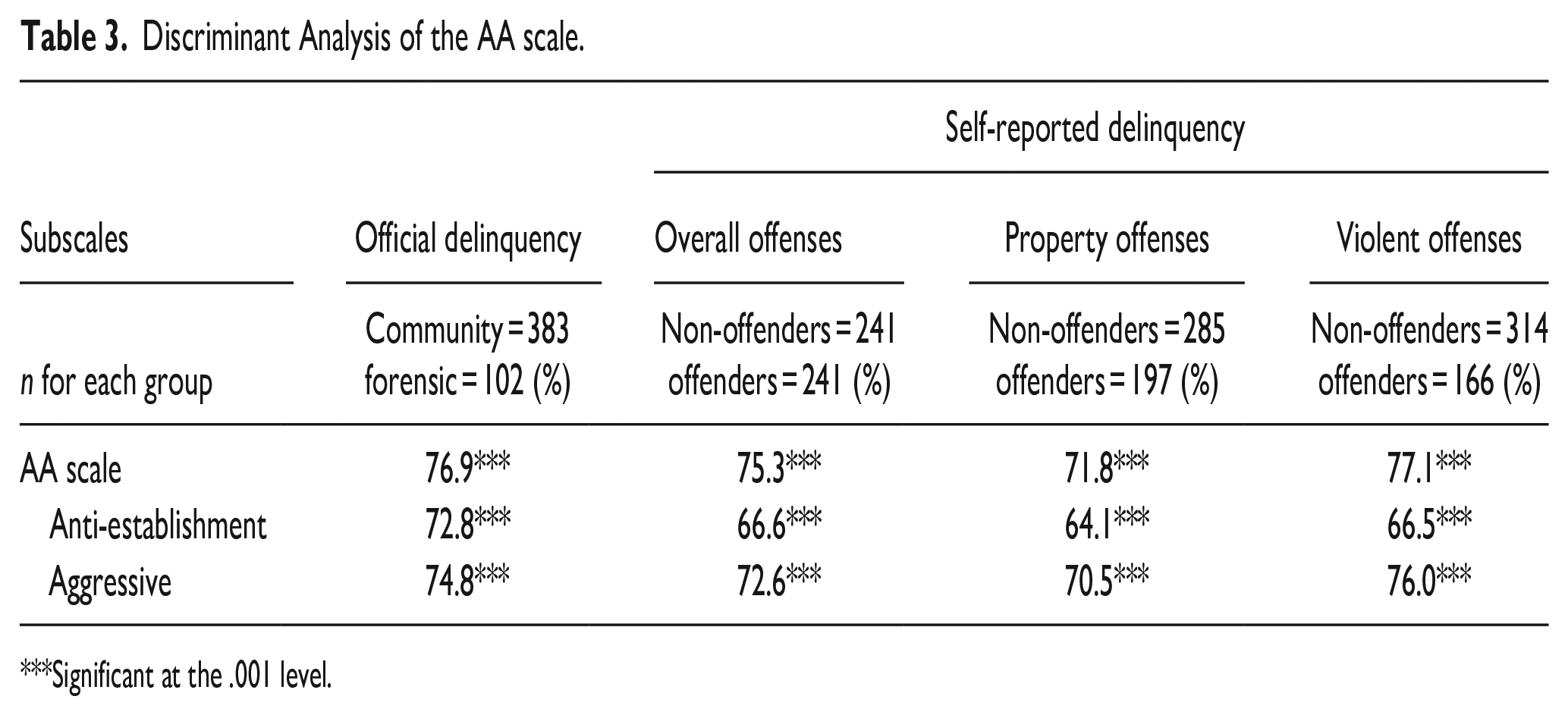
In order to test known-groups validity, we have carried out discriminant analyzes in which we tested whether the AA scale’s scores were able to correctly distinguish between offender and non-offender participants. We have compared offenders and non-offenders first based on convicted offenders placed in detention centers for juvenile delinquents, and second, we have compared offenders and non-offenders based on self-reported offending prevalence over the life course. Self-reported offending also permitted us to divide delinquent behavior based on offending types, that is, overall offending, property offending, and violent offending. As shown in Table 3, using the anti-establishment and aggressive antisocial attitudes dimensions we were able to correctly distinguish between juvenile offenders and non-offenders (p < .001). For example, the AA scale was able to predict which participants belonged to the community versus the detention sample with a correct placement rate of 76.9% of participants, which was statistically significant (Λ = .75, χ2(1) = 141.83, p < .001). The overall classification results showed that the AA scale’s outcomes were able to correctly discriminate offenders vs. non-offenders with a predictive accuracy ranging between 72.8% and 76.9% of officially-recorded offenders, and between 64.1% and 77.1% of self-reported offenders.
Discriminant Analysis of the AA scale.
Significant at the .001 level.
Descriptive Statistics of the AA Scale by Sex and Age
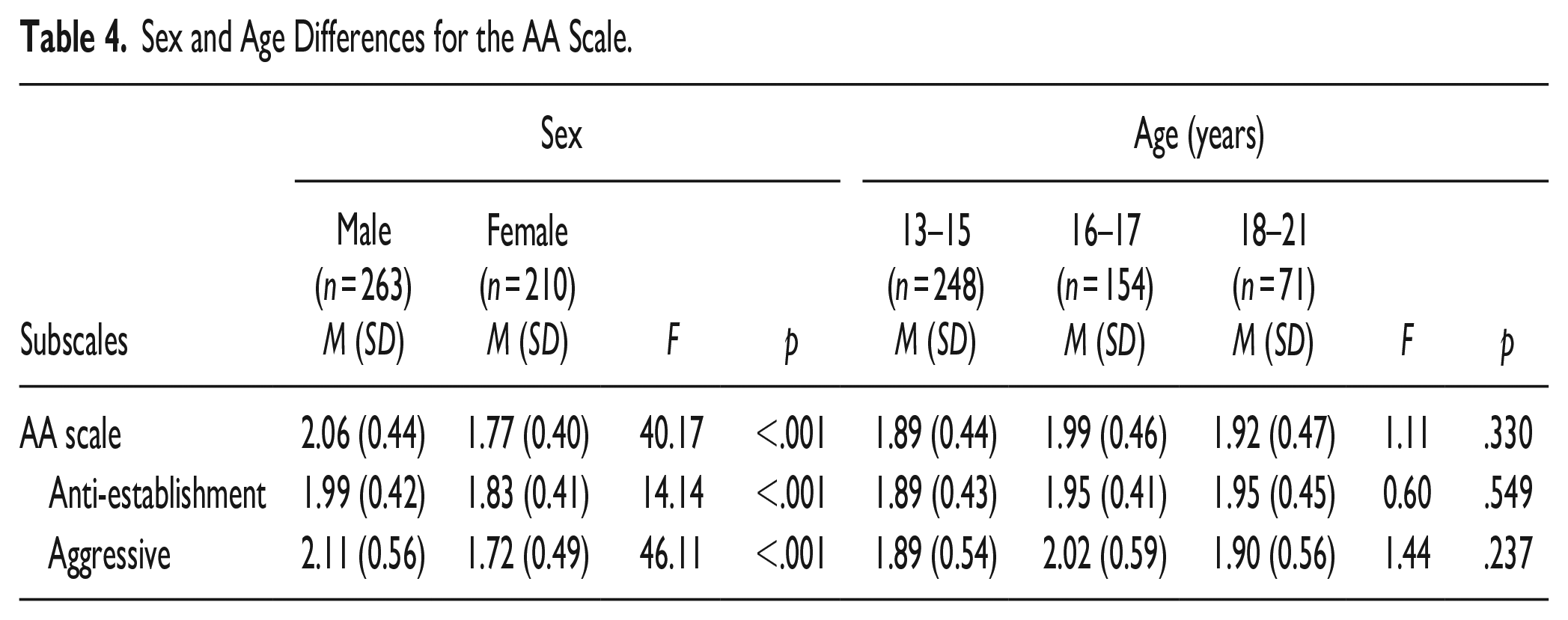
Finally, in order to provide a more in-depth descriptive analysis of the AA scale’s outcomes, we have developed a MANOVA analysis where we compared antisocial potential by sex and age (Table 4). In order to do so, we divided the age variable into three age groups, that is, 13 to 15 (n = 248), 16 to 17 (n = 154), and 18 to 21 (n = 71) years. Results showed a statistically significant difference in antisocial potential by sex (Wilks’s Lambda = .91; F(2, 466) = 23.01, p < .001), where males reported consistently higher antisocial attitudes than females. On the other hand, this analysis showed no statistically significant differences in antisocial attitudes by age (Wilks’s Lambda = .99; F(4, 932) = 1.08, p = .367). In the same way, there was no interaction effects of sex and age on the AA scale scores (Wilks’s Lambda = .97; F(4, 932) = 0.44, p = .781).
Sex and Age Differences for the AA Scale.
Discussion
The AA scale (Farrington & McGee, 2017; West & Farrington, 1977) was developed to assess the key construct of the ICAP theory, that is, Antisocial Potential (Farrington & McGee, 2019). In this study, we aimed to examine the psychometric properties of the AA scale among a sample of Portuguese adolescents. This is the first study to use the AA scale outside of the scope of the CSDD study, and it provides valuable information about how other studies (within or beyond English-speaking countries) may use the AA scale to test fundamental hypotheses derived from the ICAP theory. The Portuguese version of the AA scale has been demonstrated to be a reliable and valid measure of antisocial potential among adolescents and young adults, in a community sample of students and a forensic sample of detainee juvenile delinquents.
Similar to the original validation study of the AA scale (Farrington & McGee, 2017), we have carried out a reliability analysis and considered the removal of items that reduced the scale’s internal consistency. In the present study, only one item (i.e., “Hard work is the only way to get on in life”) was shown to reduce the scale’s internal consistency and was removed, which resulted in a final Portuguese version with 23 items. In the original validation studies of the AA scale (Farrington & McGee, 2017, 2019), this process resulted in the removal of four items, including the item removed in the Portuguese version (i.e., “Hard work is the only way to get on in life”; “I get on well with the man who tells me what to do at work”; “Even if someone hit me first I would never hit back”; “I try to keep out of fights”). The fact that the same item showed reason to be removed in the two countries may be suggestive of its problematic nature.
This study demonstrated the Portuguese version of the AA scale as a reliable measure of antisocial potential. The aggressive attitudes subscale had a very high Cronbach’s alpha, while the anti-establishment subscale showed a lower but moderate Cronbach’s alpha. Overall, the Portuguese version of the AA scale showed very good internal consistency (α = .86), which was considerably higher than the values found in the CSDD study (i.e., G2 α = .72 at age 18, α = .67 at age 32, α = .71 at age 48, and G3 α = .62).
We carried out a CFA in order to verify the original two-factor structure of the AA scale. The present findings support the AA scale’s bifactorial structure (i.e., aggressive attitudes and anti-establishment attitudes), providing evidence supportive of a good model fit. Also, as expected in the original studies of the AA scale, the intercorrelation analysis showed that aggressive attitudes and anti-establishment attitudes are correlated, suggesting that participants with antisocial attitudes in one dimension are likely to show antisocial attitudes in the other dimension, and vice-versa.
In order to test the external validity of the AA scale, we carried out convergent validity analyses with self-serving cognitive distortions, self-control, and prosocial morality. Self-serving cognitive distortions are cognitive biases that facilitate deviant behavior through egocentric and self-centered attitudes that limit the ability to consider other people’s needs or rights, as well as rationalizations that reduce feelings of empathy such as Blaming Others (i.e., misattributing blame to outside sources), Minimizing/Mislabeling (i.e., depicting antisocial behavior as causing no real harm), and Assuming the Worst (i.e., gratuitously attributing hostile intentions to others) (Barriga et al., 2008; Gibbs, 2014). On the other hand, low self-control is often defined by impulsivity and by the lack of ability to consider the full consequences of actions (Gottfredson & Hirschi, 1990). Morality, in turn, refers to the normative evaluations of right or wrong in a given society and is divided into two dimensions of morality, which are, Prosocial Values (i.e., a cognitive dimension that refers to the knowledge and recognition of ‘wrongness’) and Level of Shame (i.e., an emotional dimension that refers to the moral emotion of shame) (Marshall & Marshall, 2018).
All the validity measures of cognitive distortions (e.g., Lardén et al., 2006; Nas et al., 2005), self-control (e.g., Gomes & Gouveia-Pereira, 2020; Vazsonyi et al., 2017), and morality (e.g., Kokkalera et al., 2021; Wikström, 2010) have been consistently shown to be key explanatory factors of crime and delinquency. For these reasons, we expected to find significant correlations between the validation measures and the AA scale. In line with our expectations, AA scale scores and self-serving cognitive distortions had positive correlations, that is, as the antisocial potential increased, cognitive distortions also tended to increase, and vice-versa. Additionally, as expected, AA scale outcomes correlated negatively with self-control and prosocial morality, in the sense that, as the antisocial potential increases, self-control and morality decrease. These findings are indicative of the convergent validity of the Portuguese version of the AA scale.
Also, in testing the construct validity of the AA scale, we tested known-groups validity by analyzing its ability to correctly discriminate between groups of offenders and groups of non-offenders. This analysis showed that the AA scale’s scores, either the overall antisocial potential score or the individual dimensions of aggressive and anti-establishment attitudes, successfully discriminated between groups of offenders vs. non-offenders, both based on official records of offending (i.e., community sample vs. forensic sample) as well as on self-reports of delinquent behavior (i.e., prevalence of lifetime offending). Of note, for self-reported delinquency, the AA scale’s scores showed a slightly higher correct placement of offenders for violent offenses (ranging from 77.1% to 66.5%) compared to property offenses (ranging from 71.8% to 64.1%), although with levels of statistically significance of p < .001 in both property and violent offenses.
Finally, our comparisons of the AA scale’s scores by participants’ sex demonstrated that male participants had on average higher levels of antisocial potential than female participants. This was true both for aggressive and anti-establishment attitudes. These findings are relevant because, in the original studies, Farrington and McGee (2017, 2019) studied only male participants in the CSDD study, making this the first study to explore antisocial potential in female adolescents. However, despite being the first study to demonstrate that males had higher AA scores than females, this finding is consistent with the predictions in the ICAP theory (Farrington, 2005).
On the other hand, our analysis showed that AA did not vary as a function of participants’ age. In this analysis, we have divided the participants into three groups (13–15 years old vs. 16–17 years old vs. 18–21 years old) in order to facilitate the comprehension of these results. Findings showed that participants had similar AA scores throughout adolescence and adulthood. This finding is contradictory to the ICAP theory’s prediction, in which it would be expected that antisocial potential changed as a function of age, explaining the age-crime curve (Farrington, 2005). However, despite the lack of statistically significant results, Figure 3, in accordance with the ICAP’s predictions, shows an increase from 13–15 to 16–17 and a decrease from 16–17 to 18–21. Farrington and McGee (2017) showed how long-term antisocial potential changed throughout the life course of CSDD participants. More research is needed in this regard, especially using longitudinal studies in order to demonstrate how antisocial potential changes as participants get older through adolescence and young adulthood.
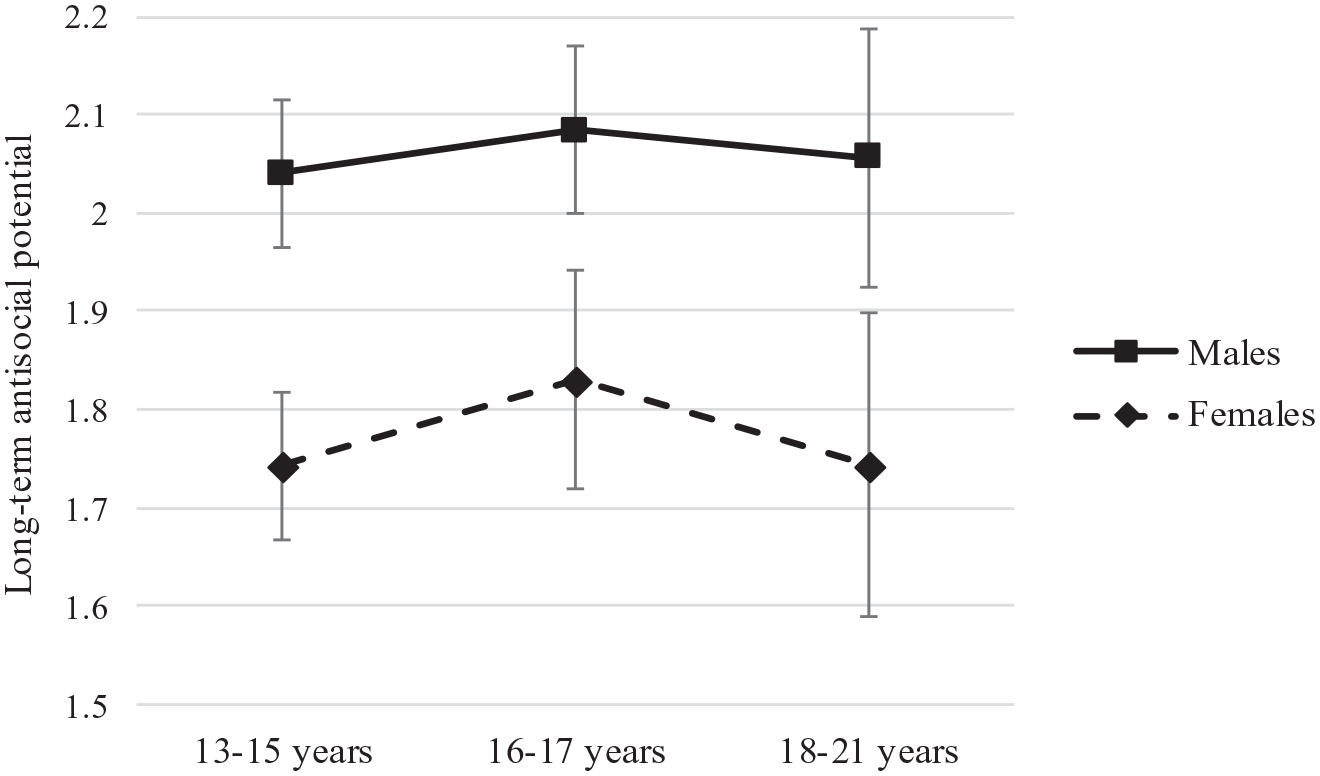
Estimated marginal means of AA scale by sex and age. Error bars represent 95% confidence intervals.
Limitations
As for the limitations, it is important to point out that the present study relied on convenience sampling which may compromise the generalizability of our findings. The forensic group was assessed in four major detention centers for juvenile delinquents (out of a total of six centers in Portugal), which included the vast majority of juvenile offenders complying with detention dispositional orders at the moment of data collection. On the other hand, the community group was assessed in a public school in the center of Portugal, which may limit its accuracy in representing the Portuguese adolescent population. Second, in our CFA we have considered post hoc modifications (i.e., MI) to improve the model fit indices, which may influence our findings (Hermida, 2015). Nevertheless, the present study considered only such specifications for pairs of items within the same factor assessing very similar constructs, namely between item 1 (i.e., “The police are always roughing people up”) and item 5 (i.e., “The police should get more support from the public”); item 11 (i.e., “If someone does the dirty on me I always try to get my own back”) and item 15 (i.e., “Anyone who insults me is asking for a fight”); item 21 (i.e., “If someone hits me first I really let him have it”) and item 22 (i.e., “Even if someone hit me first I would never hit back”). For these reasons, we believe such modifications to be theoretically justifiable. Future research should try to replicate these findings.
Third, despite this study being fit for the main objective of testing the psychometric qualities of the Portuguese version of the AA scale, it is important to point out that the cross-sectional design of the present study hinders our ability to show within-subject change in antisocial potential over adolescence (Farrington, 2005). Therefore, present between-subject findings must be considered with caution. Finally, the survey nature of this study may compromise the quality of our results as well as the accuracy of respondents’ behavior due to the general self-report limitations (Schwarz, 1999), especially when considering the sensitive nature of criminal behavior (Gomes et al., 2019, Gomes, Farrington et al., 2022; Tourangeau & Smith, 1996). Ideally, future researchers will have the creativity and ingenuity to develop evaluations of people’s antisocial potential and delinquent behavior that overcome these limitations.
Conclusion and Practical Implications
In conclusion, the Portuguese version of the AA scale showed evidence of being a valid and reliable assessment of adolescents’ and young adults’ long-term antisocial potential. The present article reports the first study exploring the AA scale outside of the scope of the CSDD and reveals antisocial potential as a strong predictor of criminal behavior that should be considered in future research. The AA scale offers a valuable evaluation of the key construct of the ICAP theory, one of the main theoretical frameworks in Developmental and Life-Course Criminology, showing it to be a very useful instrument for future research. Hopefully, our research advances knowledge about the explanation of offending. In future, the AA scale might possibly be used in risk assessment and in identifying young people for interventions.
Footnotes
Declaration of Conflicting Interests
The author(s) declared no potential conflicts of interest with respect to the research, authorship, and/or publication of this article.
Funding
The author(s) received no financial support for the research, authorship, and/or publication of this article.
