



Abstract
Affective lability is a central feature of several emotional disturbances and is linked to aggressive and risky behaviors. This study aimed to analyze the psychometric properties of the Affective Lability Scale-18 (ALS-18) among a community sample and a sample of justice-involved adults. We also aimed to test the measurement invariance between sex and sample type. Results revealed good to excellent values of internal consistency. Confirmatory factor analysis indicated that the original three-factor structure of the ALS-18 obtained good fits. The ALS-18 demonstrated measurement invariance across sex and sample type. The results support that ALS-18 is a valuable brief and useful measure of affective lability among male and female individuals for use in community and justice samples.
Introduction
Affective lability (AL) was first studied in the 1960s (e.g., Kernberg, 1967) as a central feature of borderline personality disorder. However, AL is also frequent in the general population and among people with other mental disorders than BPD, such as psychotic or anxiety disorders (Høegh et al., 2020). There are several denominations for AL: affective instability, emotional lability, emotional impulsivity, emotional instability, and lability of humor (Leaberry et al., 2017; Marwaha et al., 2014). AL is described as the tendency to fluctuate between different mood states, including depression, anger, anxiety, and hypomania (Harvey et al., 1989). It refers to frequent, rapid, and intense oscillations in outward emotional expression (Leaberry et al., 2017; Look et al., 2010), resulting in difficulties regulating these oscillations or their behavioral consequences (Marwaha et al., 2014). According to the Diagnostic and Statistical Manual of Mental Disorders (DSM-5, 2013), AL is characterized by instability of emotional experiences, and these same emotions are slightly aroused in the individual. It is generally thought of as a personality trait related to generalized anxiety disorder, psychotic disorder, obsessive-compulsive disorder, and personality disorder (DSM-5, 2013).
AL can be influenced by genetic and environmental factors (Coccaro et al., 2012). It is a form of emotional reactivity, which can trigger a prominent position in the individual with specific experiences in the past which were, in some way, emotionally striking. This fact can lead to distortions of events and experiences, triggering positive or negative emotions (Ebner-Priemer et al., 2007). AL is a multidimensional construct including three core elements: oscillation, intensity, and subjective ability to regulate affect and its behavioral consequences (Marwaha et al., 2014). It is associated with internalization and externalization problems (e.g., Skirrow & Asherson, 2013), which tend to arise as a reaction to significant events in each person’s life.
Sudden changes in mood and uncontrolled emotions, characteristics of AL, can manifest in the first year of life due to the accelerated and intense changes in the brain that occur at this stage. Childhood experiences also seem to affect the development and maintenance of self-regulation and AL (Edwards et al., 2021; Rollins & Crandal, 2021). Positive childhood experiences promote adequate emotional development (Whittle et al., 2014) and self-regulation (Rollins & Crandal, 2021). On the contrary, adverse childhood experiences can lead to emotional dysregulation and AL (Aas et al., 2014, 2016; Linehan, 2003; Marwaha et al., 2016). As affect regulation generally occurs through a developmental progression process (Aas et al., 2016), experiencing adversity in early stages deprives children of the expectable environment crucial to their adaptative development (Toth & Cicchetti, 2013). These individuals are more predisposed to develop inappropriate emotional regulation strategies and AL (Aas et al., 2016). AL leads to cognitive inconsistency (Linehan, 2003), making it challenging to regulate irritability (Anastopoulos et al., 2011) which can increase the likelihood of depression and anxiety disorders (e.g., Dixon-Gordon et al., 2018; Tampke et al., 2018). The research found sex differences in AL manifestations, with females scoring higher than men (e.g., Marwaha et al., 2013; Nora, 2013). Gunnlaugsson et al. (2011) also referred to a predisposition of women to have higher levels of AL than men. A study with university students showed that emotional instability is less pronounced among men (Mykytyuk et al., 2021). Research has shown that AL is also related to the development of aggressive behaviors, risky behaviors, and the abuse of harmful substances to mental health (Anestis et al., 2009; Donahue et al., 2014; Oliver & Simons, 2004) since emotional lability decreases individuals’ effortful control resources (Dvorak et al., 2013). Thus, AL is interactively related to aggressive behavior at an early age (e.g., Dvorak et al., 2013; Maire et al., 2017). Individuals with aggressive behaviors tend to show a lower tolerance to frustration and higher AL (O’Connor, 2018). Accordingly, different studies concluded that negative emotionality and the inability to regulate emotions are predictors of violence (Miller et al., 2019), aggression, and antisocial behaviors (e.g., Llorca-Mestre et al., 2017; Velotti et al., 2017). Furthermore, as previously mentioned, AL is common in different mental disorders (e.g., anxiety disorders; psychotic disorder; DSM-5, 2013), which, in turn, are widely reported among justice-involved individuals (e.g., Baranyi et al., 2019; Stewart et al., 2020; van Buitenen, 2020). Difficulties in emotion regulation are more evident among justice-involved populations than individuals from the community, with justice-involved individuals scoring higher in emotional regulation measures (Rogier et al., 2020). In addition, a study with the community and justice-involved individuals showed a link between emotion dysregulation and hostility and proactive aggression (Garofalo et al., 2021) since emotion dysregulation concerns difficulty refraining from impulsive behaviors (Garofalo & Neumann, 2018). The previously reported results highlight the importance of studying AL among the community and justice-involved individuals. Therefore, the existence of instruments that accurately assess this construct is of relevance. In Portugal, there are no instruments that assess this specific construct. Since AL is associated with different disorders among different groups, it is relevant to adapt and validate a tool for the Portuguese population.
The Affective Lability Scale
Several instruments assess changes in emotions, albeit in different ways. The Affective Lability Scale (ALS) is a 54-item questionnaire that evaluates lability in affect involving rapid changes between depression and hypomania and depression and anxiety (Harvey et al., 1989). Although ALS revealed satisfactory psychometric properties (Harvey et al., 1989), Oliver and Simons (2004) considered ALS too lengthy and, thus, developed a shorter version with 18 items (ALS-18). In a non-clinical sample of 592 undergraduate students, ALS-18 revealed good values of internal consistency (α = .87), significant correlations with the original ALS scale (r = .94), and with other affective functioning measures (e.g., affect intensity, r = .24; aggressive impulses, r = .19; depression, r = .47), and temporal stability (r = .73). Confirmatory factor analysis supported the adequacy of both a three-factor structure (Anxiety/Depression—AD, Depression/Elation—DE, Anger—Ang) and a six-factor model (Depression, Hypomania, Elation, Anger, Anxiety, and Anxiety/Depression) reflecting the structure of the original 54 item version. However, the six-factor model revealed lower internal consistency values than the three-factor model since the two factors included only two items.
Studies explored the psychometric properties of the ALS-18, as well as the adequacy of the three-factor model in different clinical and non-clinical populations, languages, and cultures (e.g., Aas et al., 2016; Contardi et al., 2018; Look et al., 2010; Weibel et al., 2019). For example, Look et al. (2010) examined the psychometric properties of ALS-18 in a sample of people diagnosed with personality disorders (n = 236) and healthy participants (n = 164). The authors found satisfactory internal consistency, with coefficients alpha equal to or greater than .78. The total score of the ALS-18 correlated highly with the original 54-item scale (r = .97) and with measures of affect intensity (r = .51) and trait anger (r = .62), but less strongly with trait anxiety (r = .40). ALS-18 also revealed good discriminant validity, with individuals diagnosed with DSM-IV Cluster B personality disorders reporting higher scores than individuals with Cluster A and Cluster C disorders and individuals without any psychiatric condition. Confirmatory factor analyses demonstrated a good fit for the three-factor model. Other studies also found that ALS-18 presents satisfactory psychometric properties (e.g., Aas et al., 2015; Contardi et al., 2018; Weibel et al., 2019). Discriminant validity was also supported by differentiating ADHD patients (Weibel et al., 2019) and bipolar patients (Aas et al., 2015) from healthy controls. Previous studies exploring differences among sexes on ALS-18 found no significant results (Contardi et al., 2018). However, the authors claim attention to the disproportion of female participants compared to male participants in their sample. Regarding the ALS-18 factor structure, Contardi et al. (2018) tested the fit of the three-factor model and its superiority over other models (i.e., one-factor, hierarchical three-factor, and bifactor models). Confirmatory factor analyses confirmed the advantage of the three-factor model.
The ALS-18 has also demonstrated validity as it correlates with other constructs, such as adverse childhood experiences (Aas et al., 2014, 2016). Using a small sample (n = 42) of individuals diagnosed with bipolar disorder, Aas et al. (2014) found a significant association between Childhood Trauma Questionnaire (CTQ) scores and ALS-18 (Aas et al., 2016). Although no studies analyzed the correlation between ALS-18 and positive childhood experiences, previous studies using the Benevolent Childhood Experiences Scale (BCEs) have found moderate negative correlations between positive childhood experiences and some of the features assessed by ALS-18, such as depression and anxiety (e.g., Bethell et al., 2019; Doom et al., 2021; Narayan et al., 2018).
In addition to good psychometric properties, the ALS-18 measures the concept less exhaustively than the extended version with 54 items, allowing a good and valid assessment of AL in adults in a shorter time due to the small number of items. Besides, no instruments are validated for the Portuguese population to assess AL. In this sense, it is necessary to adapt and validate an instrument that assesses AL among the Portuguese population. In the same way, there are no validation studies of ALS-18 in justice-involved samples, even though justice-involved individuals experience a higher level of affective lability. Thus, the main objectives of the current study are: (a) to analyze the factor structure and the psychometric properties of the Portuguese version of the ALS-18 by testing and comparing different competing models of ALS-18, as proposed by Contardi et al., 2018 (i.e., the three-factor, the hierarchical three-factor, the bifactor, and the one-factor); (b) to analyze the factor structure invariance between male and female individuals and between community and justice-involved populations; and (c) to examine the correlations between ALS-18 and other constructs, namely adverse and positive childhood experiences.
Method
Participants
The study integrated data from a community sample (n = 1,886) and a justice sample (n = 424). Sample sizes were determined based on the following criteria: (a) samples as representative as possible of the justice and the community populations; and (b) samples that achieve a 95% power (α-level = .05; f = 0.25) calculated a priori using the G* Power 3 (Faul et al., 2007).
The community sample comprises 411 males (21.8%) and 1,475 females (78.2%), aged between 18 and 91 years old (M = 36.36, SD = 13.66). Most participants (n = 1,106, 58.6%) completed high education, and almost half were single. This sample was recruited through an online survey.
The justice sample comprises 343 males (80.9%) and 81 (19.1%) females involved in the justice system, aged between 18 and 73 years (M = 37.88, SD = 10.56). Of them, 245 (57.8%) completed 9 to 12 years of education, and 190 (44.8%) were single. The sample was recruited in 17 national prisons in a paper-and-pencil format. The final sample was composed of 2,310 participants.
Measures
Sociodemographic questionnaire
A sociodemographic questionnaire was used to collect participants’ age, sex, nationality, education level, and marital status.
Affective Lability Scale—short version (ALS-18)
The ALS-18 is a self-report measure composed of 18 items scored on a 4-point Likert scale (0–3 scale, ranging from “Very uncharacteristic of me” to “Very characteristic of me”) (Look et al., 2010). Higher scores indicate greater affective lability, and it consists of a total score reflecting affective lability and three subscales: Anxiety/Depression (AD), Depression/Elation (DE), and Anger (Ang). The original version of ALS-18 presents good psychometric properties, with Cronbach’s alphas of .82 (AD), .78 (DE), and .84 (Ang).
Childhood Trauma Questionnaire—short version (CTQ)
CTQ is a tool for assessing exposure to abuse situations occurring up to 15 years of age (Bernstein et al., 2003; Dias et al., 2013). The Portuguese version of the CTQ (Dias et al., 2013) was used, consisting of 28 items and has five subscales of five items each, which reflect the different types of abuse: Emotional Abuse (α = .71), Physical Abuse (α = .77), Sexual Abuse (α = .71), Physical Neglect (α = .47), and Emotional Neglect (α = .79). The instrument uses a 5-point Likert scale (1–5 scale, ranging from “Never true” to “Very often true”). There is also a general indicator of exposure to abuse, which refers to the total sum of the subscales (α = .84). The internal consistency values for the present sample are .83 for Emotional Abuse, .85 for Physical Abuse, .84 for Sexual Abuse, .60 for Physical Neglect, .91 for Emotional Neglect, and .81 for the total scale.
Benevolent Childhood Experiences Scale (BCEs)
The BCEs scale is a 10-item (using a Yes/No response format) self-report instrument that assesses positive and supportive experiences from birth to 18 years of age (Almeida et al., 2021;Narayan et al., 2018). The positive experiences include internal and external safety and security, supportive relationships, and a positive and predictable quality of life. The present study used the Portuguese version of the BCEs (Almeida et al., 2021). The Portuguese version had a Cronbach alpha of .68. In this sample, the internal consistency was .70 (Almeida et al., 2021).
Procedure
The study design is cross-sectional with a non-probabilistic sample (i.e., convenience sample). First, the ALS-18 was translated from English to Portuguese by three researchers fluent in both languages and then translated from Portuguese to English by two researchers. Discrepancies were revised by two researchers fluent in both languages and resolved by consensus until no semantic differences were detected between the English and the Portuguese versions of ALS-18. This version was then tested in a group of 30 Portuguese adults to ensure that individuals fully understood the present ALS-18 version. Since the results from the pilot study were satisfactory (i.e., none of the items raised questions to the participants; Cronbach’s alphas of .96 for the ALS-18 total score), no additional changes were made to the ALS-18.
Authorization from the General Directorate of Reintegration and Prison Services—Ministry of Justice (DGRSP-MJ) was obtained to collect the justice sample. The prisons were selected to get a sample as representative as possible of the Portuguese justice-involved population. The prison staff identified individuals who fulfilled the below-mentioned eligibility criteria. They were then contacted by a researcher, received a proper explanation of the procedures, and their signed consent was collected. The researchers administered the self-report measures individually in a paper-and-pencil format in an appropriate setting. The eligibility criteria were (a) being more than 18 years old; (b) having Portuguese nationality; and (c) having sufficient intellectual and communicative skills to give answers to the instruments (i.e., to be able to read and write fluently in Portuguese).
The community sample was recruited through an online survey. The final version of the ALS-18 and the other instruments were inserted in a Google Form. To obtain a sample that includes as many participants as possible from different country regions, the online link to complete the questionnaires was disseminated by e-mail (e.g., researchers’ contacts, universities/institutional mailing lists) and social networks (e.g., LinkedIn, Facebook). Individuals with Portuguese nationality over 18 years were invited to participate in the survey. Before completing the questionnaires through the web-based survey, all participants signed an electronic informed consent.
All the instruments were applied in the Portuguese language. Participation in the study took between 10 and 15 minutes and was anonymous (i.e., no personal information was collected) and voluntary. No financial support, compensation, or incentives were granted to the participants. All the ethical principles outlined in the Declaration of Helsinki (World Medical Association, 2013) were followed. The protocol was approved by the Institutional Review Board of the Egas Moniz School of Health and Science.
Data Analysis
Descriptive statistics were used to characterize the sample. Confirmatory Factor Analyses (CFA) using the software AMOS 27 were conducted to test the factor models. The following indexes were used to assess the adjustment quality of the models: χ2/df (the ratio between chi-square and degrees of freedom) inferior to 2.0; the Comparative Fit Index (CFI) and the Non-Normed Fit Index (NFI), higher than .95; and the Root Mean Square of Approximation (RMSEA) with values between .05 and .08 indicative of adequacy of the model and values below .05 suggesting a good fit (Marôco, 2014). To compare the competing models, the Expected Cross Validation Index (ECVI) was used (Browne & Cudeck, 1989).
After that, the retaining ALS-18 model was subjected to different analyses. The invariance of the factorial model across sex (males vs. females) and setting (community vs. justice) was assessed through a Multigroup Confirmatory Factor Analysis (MCFA). Measurement invariance was analyzed by testing configural (structure equivalence), metric (factorial loadings equivalence), scalar invariance (intercept equivalence), and strict invariance (residual or invariant uniqueness). To assess the instrument invariance, the chi-square difference test (∆χ2) and the Comparative Fit Index difference test (∆CFI) were used (Cheung & Rensvold, 2002). Since ∆χ2 is sensitive to sample dimension, some authors have questioned its use in large or heterogeneous samples (Marôco, 2014). To overtake this limitation, the ∆CFI was used since it was not affected by the model specification (Cheung & Rensvold, 2002). To assume the measurement invariance, the ∆CFI value should be smaller or equal to .01, and changes in ∆RMSEA of equal to or less than .015 (Chen, 2007; Cheung & Rensvold, 2002). Correlations with other constructs were assessed by testing the Pearson correlation coefficient between ALS-18 total score and subscales and CTQ total score and subscales and BCEs. Construct validity was assessed through the Extracted Average Variance (VME; ≥.5 cf. Netemeyer et al., 2003) and Composite Reliability (CR; ≥.7 cf. Netemeyer et al., 2003). The internal consistency was calculated to analyze the instrument’s psychometric properties through Cronbach’s Alpha (≥.7; cf. Field, 2017). At last, to examine differences between the samples (i.e., males vs. females; community vs. justice), ANCOVA tests were performed. To keep the variables data preserved, participants with missing data were removed from the analysis. All the procedures were performed on the software IBM SPSS27.
Results
Confirmatory Factor Analysis
Table 1 illustrates the fit indexes of the different factorial models of the ALS-18. The analysis of the fit indices (except for χ2/df) revealed that both the bifactor model (χ2/df = 11.251, CFI = .954, NFI = .950, RMSEA = .067; 95% CI [0.063, 0.070]), and the three-factor model (χ2/df = 9.467, CFI = .966, NFI = .963, RMSEA = .061; 95% CI [0.057, 0.064]) were adequate. However, the ECVI suggested the superiority of the three-factor model (.497 vs. .632).
Fit Indices for the Competing Affective Lability Scale-18 (ALS-18) Factor Models.
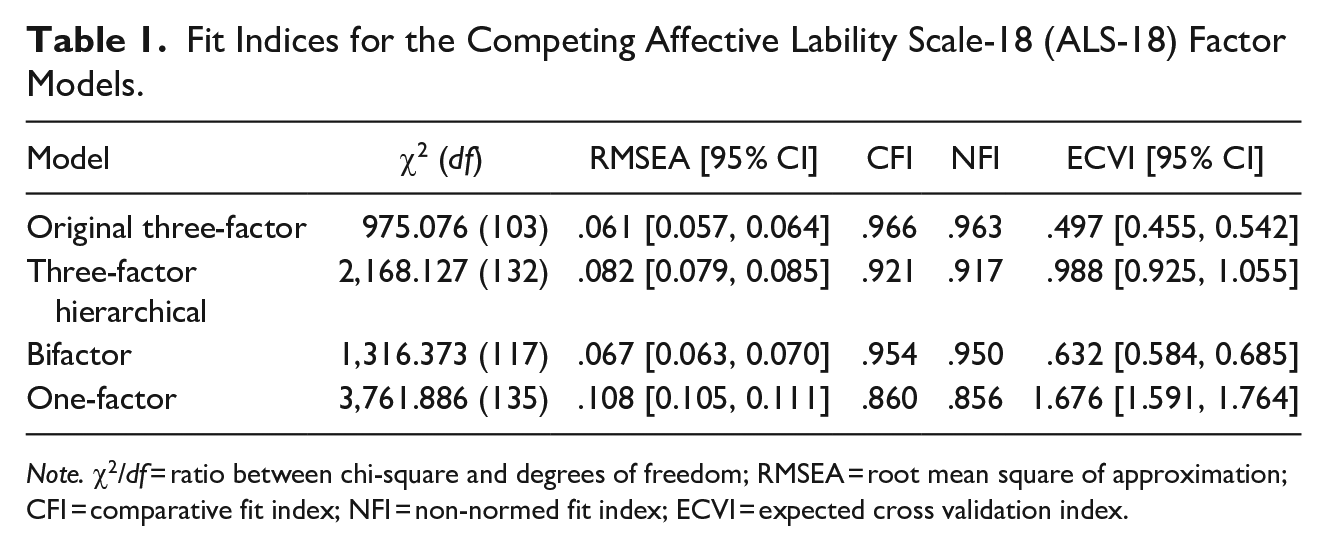
Note. χ2/df = ratio between chi-square and degrees of freedom; RMSEA = root mean square of approximation; CFI = comparative fit index; NFI = non-normed fit index; ECVI = expected cross validation index.
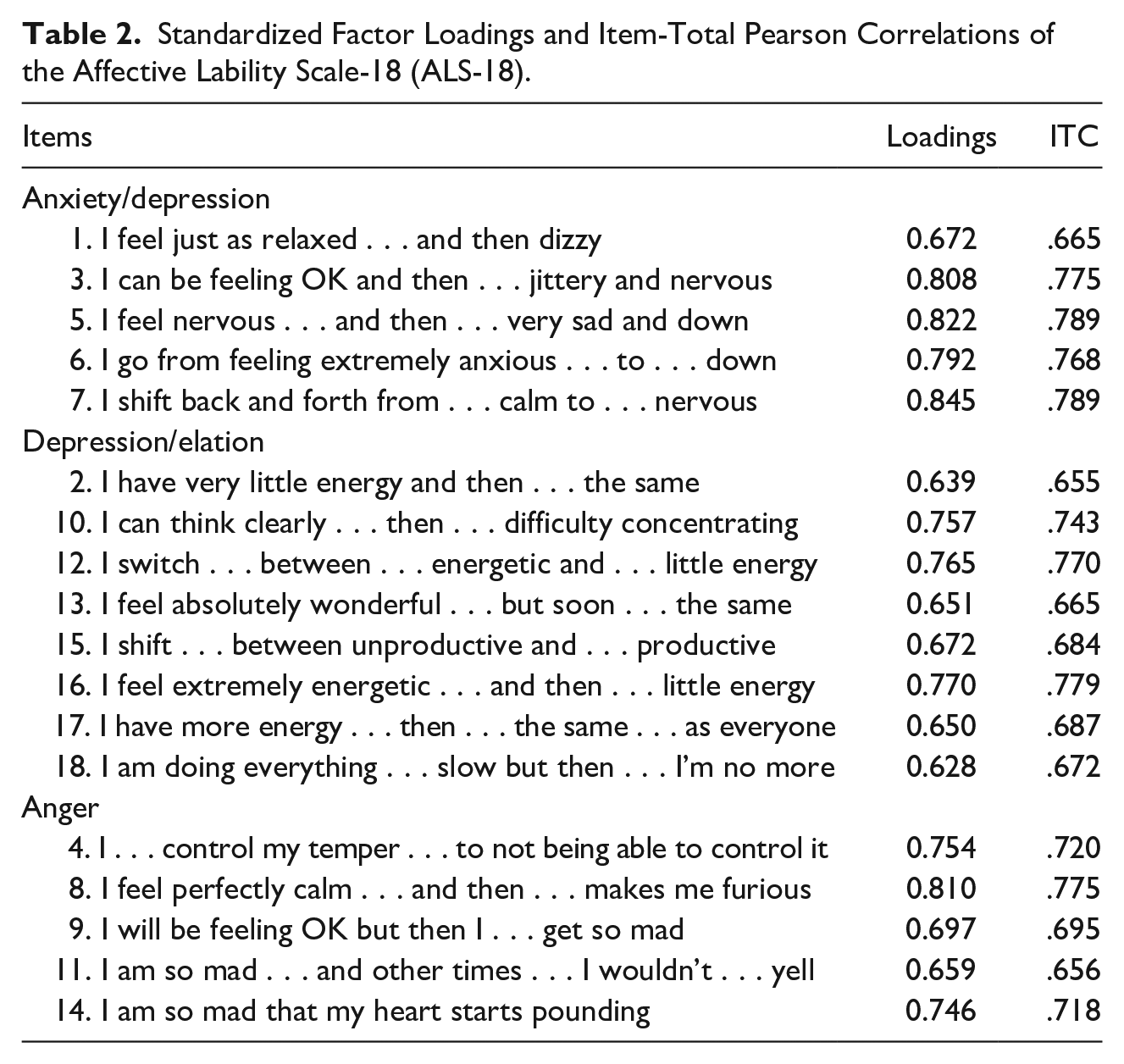
The dimensions of the three-factor model were highly correlated: AD/DE = .88; AD/Ang = .88; DE/Ang = .89. Standardized factor loadings and item-total Pearson correlations of the ALS-18 three-factor model are reported in Table 2. All the items’ factor loadings are higher than 0.50 (Marôco, 2014).
Standardized Factor Loadings and Item-Total Pearson Correlations of the Affective Lability Scale-18 (ALS-18).
Convergent and Divergent Validity
Correlations between ALS-18 total score and subscales and CTQ and BCEs are presented in Table 3. Statistically significant positive correlations between the ALS-18 total score and subscales and the CTQ total score and subscales were found. Although the small magnitude of the effect sizes, emotional abuse and total trauma revealed the strongest associations with AL. Sexual abuse showed the weakest correlations with the ALS-18 total score and all the subdimensions. ALS-18 total score and subscales revealed statistically significant negative correlations with BCEs total score. Despite the small effect sizes, ALS-18 AD showed the strongest association with BCEs.
Correlations Between Affective Lability Scale-18 (ALS-18) Total Score and Scales, Childhood Trauma Questionnaire (CTQ) Total Score and Scales, and Benevolent Childhood Experiences (BCEs) Total Score.
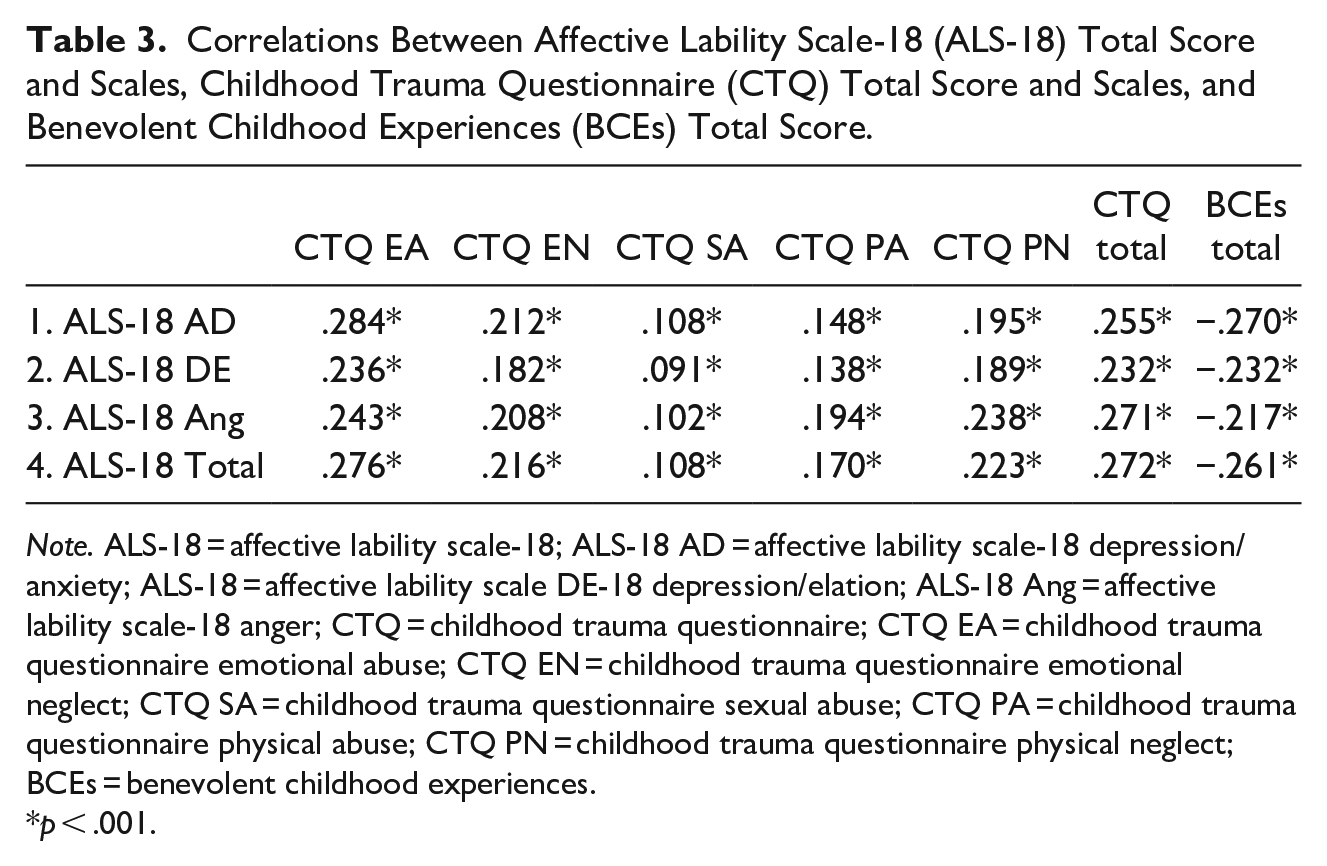
Note. ALS-18 = affective lability scale-18; ALS-18 AD = affective lability scale-18 depression/anxiety; ALS-18 = affective lability scale DE-18 depression/elation; ALS-18 Ang = affective lability scale-18 anger; CTQ = childhood trauma questionnaire; CTQ EA = childhood trauma questionnaire emotional abuse; CTQ EN = childhood trauma questionnaire emotional neglect; CTQ SA = childhood trauma questionnaire sexual abuse; CTQ PA = childhood trauma questionnaire physical abuse; CTQ PN = childhood trauma questionnaire physical neglect; BCEs = benevolent childhood experiences.
p < .001.
Construct Validity
To better explore the construct validity, the Average Variance Extracted (AVE) and the Composite Reliability (CR) of each factor were estimated. The AVE was satisfactory for all the factors except for the DE (.48) (≥.5 cf. Netemeyer et al., 2003). The values for AD and Ang were .62 and .54, respectively. The CR was above the minimum recommended for all the factors (AD = .89, DE = .88, Ang = .85; ≥.7; cf. Netemeyer et al., 2003).
Internal Consistency
In the internal consistency analysis of the ALS-18, the values of Cronbach’s alphas were good to excellent (Field, 2017): .90 for AD, .89 for DE, and .86 for Ang. The Cronbach’s alpha value for the ALS-18 total scale was excellent (.95).
Invariance of the Factor Structure Between Samples
Measurement invariance was tested across sex (males vs. females) and setting (community vs. justice; Table 4) using ALS-18 items. First, the normality assumption of the Confirmatory Factor Analysis was tested, revealing the non-normal multivariate distribution of these items (kuMult = 162.697 > 10; Kline, 2011). However, the absolute scores of skewness (ranging from .054 to 1.301) and kurtosis (ranging from −1.111 to .607) demonstrate a normal distribution of the items (Kline, 2011).
Tests of Measurement Invariance of the Affective Lability Scale-18 (ALS-18).
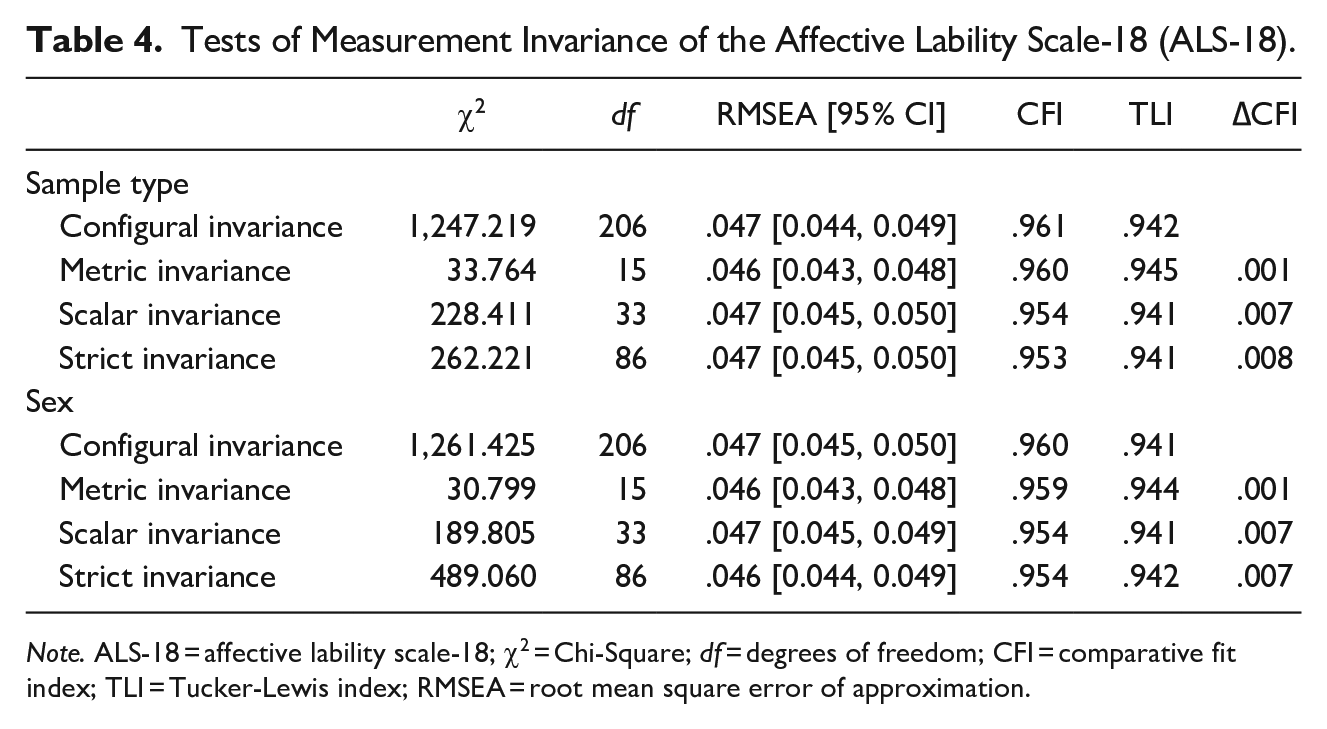
Note. ALS-18 = affective lability scale-18; χ2 = Chi-Square; df = degrees of freedom; CFI = comparative fit index; TLI = Tucker-Lewis index; RMSEA = root mean square error of approximation.
The three-factor model showed a good adjustment, χ2(206) = 1,261.425; CFI = .960; NFI = .953; RMSEA = .047; 95% CI [0.045, 0.050], to the male and female samples, showing configural invariance. The ∆χ2 and the ∆CFI revealed metric, ∆χ2(15) = 30.799, p = .009, scalar, ∆χ2(33) = 189.805, p < .001, and strict invariance, ∆χ2(86) = 489.060, p < .001. Results showed that the ∆χ2(df) values were significant, so the ΔCFI did not exceed .01, and ∆RMSEA was less than .015 (Chen, 2007). These overall results corroborate the presence of measurement invariance across sex.
Similarly, the three-factor model revealed an acceptable fit, χ2(206) = 1,247.219; CFI = .961; NFI = .954; RMSEA = .047; 95% CI [0.044, 0.049], to the community and the justice sample, showing configural invariance. The ∆χ2 and the ∆CFI revealed metric, ∆χ2(15) = 33.764, p = .004, and scalar invariance, ∆χ2(33) = 228.411, p < .001, and strict invariance, ∆χ2(86) = 262.221, p < .001. Although the results showed that the ∆χ2(df) values were significant, the ΔCFI did not exceed .01, and the ∆RMSEA was less than .015 (Chen, 2007). The overall results show the presence of measurement invariance between the type of sample.
Comparisons Between Groups
The community sample was compared with the justice sample, and the male sample was compared with the female sample (Table 5). To compare the community and the justice samples, age, sex, and education were included as covariates in the analysis. These variables have been associated with affective lability and emotional instability among the community and justice-involved individuals (e.g., Gonçalves et al., 2016; Marwaha et al., 2013; Mykytyuk et al., 2021; Vitulić & Prosen, 2016). To compare the male and the female samples, setting (community vs. justice), age, and education, were included as covariates in the analysis. Results showed that the justice sample scored significantly higher than the community sample on the ALS-18 total scale and subscales. Besides, the female sample scored significantly higher than the male sample on the ALS-18 total scale and subscales.
Descriptive Statistics and ANCOVA Tests for the Affective Lability Scale-18 (ALS-18) and its Scales.
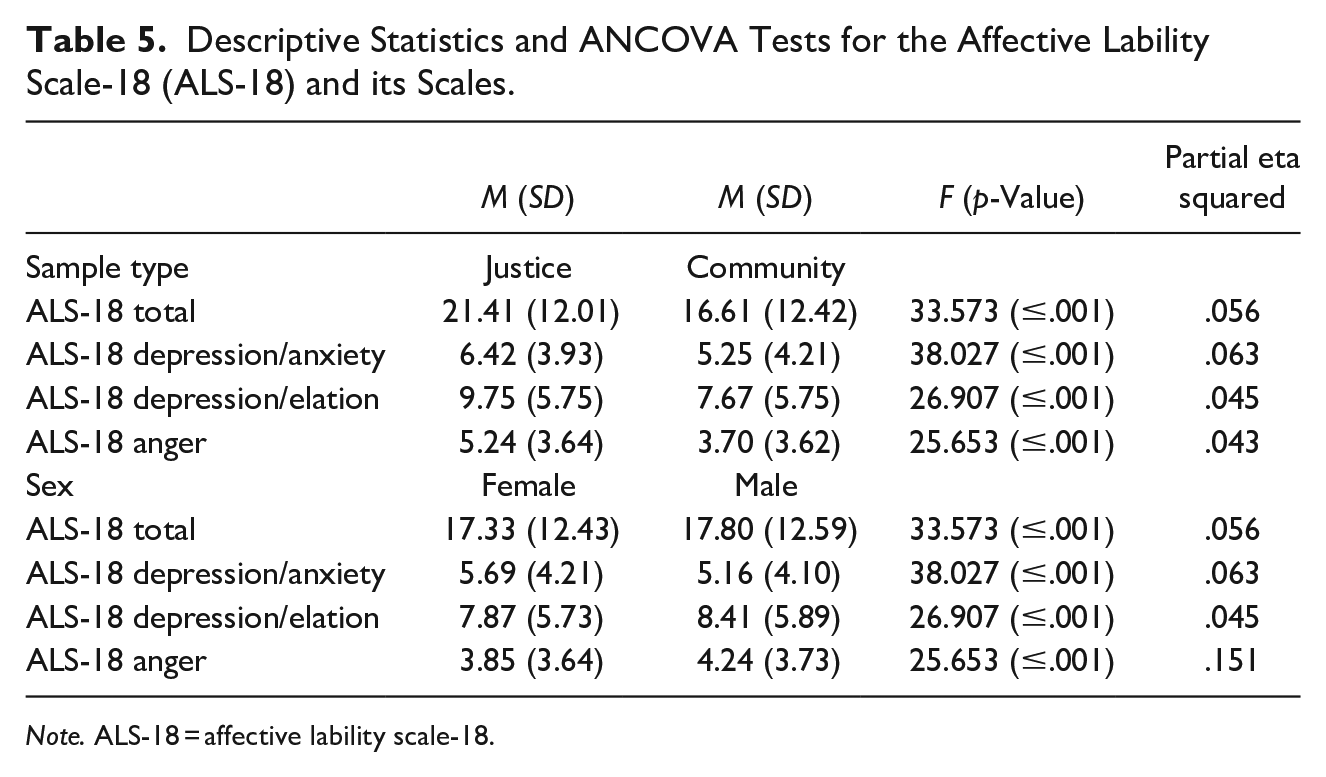
Note. ALS-18 = affective lability scale-18.
Discussion
The present study aimed to analyze the factor structure and the psychometric properties of the Portuguese version of the ALS-18. Since there were no validated AL measures for the Portuguese population, and AL has been related both with mental and personality disorders (DSM-5, 2013) and aggressive behaviors (e.g., Dvorak et al., 2013; Maire et al., 2017), the adaptation of ALS-18 for community and justice samples is of extreme importance.
Regarding statistical fit, CFA revealed that the ALS-18 bi-factor and three-factor models demonstrated a good adjustment to data. However, the three-factor model best fits the data, consistent with other studies (Aas et al., 2014; Contardi et al., 2018; Look et al., 2010; Oliver & Simons, 2004). Results also supported a bi-factor model, suggesting that each item is intercorrelated with a primary dimension (i.e., affective lability) and a specific sub-domain (Gibbons, 2014). However, when comparing the models, the three-factor model seems superior to the bi-factor model. These results reinforce that the ALS-18 original factorial structure was maintained in our sample and adequately represents the data. Also, we assessed whether the Portuguese version of ALS-18 was invariable across sex and setting. The MCFA analyses found evidence of metric, scalar, configural, and strict invariance, meaning that the different groups (males vs. females; community vs. justice sample) similarly respond to the ALS-18. It is an important finding since it gives researchers and clinicians more confidence in utilizing the ALS-18 in different groups and generalizing findings across sex and settings. Nonetheless, more research is needed to examine the measurement invariance among other groups (e.g., clinical samples, cross-cultural/language, age, and race).
The ALS-18 three subscales showed highly positive inter-correlations, as other studies found (e.g., Contardi et al., 2018; Look et al., 2010). Although expected as each factor is a specific dimension that constitutes the AL construct, these high values may indicate non-satisfactory discriminant validity of sub-dimensions scores (≥.85; Netemeyer et al., 2003). Despite the small effect sizes, ALS-18 sub-dimensions and total scores were all negatively correlated with BCEs. The depression/anxiety subdimension revealed the most meaningful correlation with BCEs. Although more modest than that found in previous studies, this result follows prior literature showing negative associations between positive childhood experiences and depression and anxiety (e.g., Bethell et al., 2019; Doom et al., 2021; Narayan et al., 2018). Besides, with small effect sizes, the ALS-18 (its total score and subscales) was significantly correlated with childhood traumatic events (i.e., CTQ total scores and subscales). The strongest associations were observed for emotional abuse and total trauma, and the weakest were found for sexual abuse. These results replicate previous studies showing a link between AL as measured by ALS and reports of childhood trauma (e.g., Aas et al., 2014, 2016).
Adverse experiences in childhood can interfere with adaptative development, predisposing individuals to develop inappropriate emotional regulation strategies and emotional dysregulation (e.g., Aas et al., 2014, 2016). Our results are particularly close to those of Aas et al. (2016), who also observed correlations of small magnitude between ALS-18 and CTQ and no correlations between sexual abuse and AL. The weakest correlations between sexual abuse and AL in our study may be explained by the low rates of reported sexual abuse. However, further studies should be conducted to better understand the correlation between childhood trauma and AL.
Regarding internal consistency, Cronbach’s alphas were good to excellent. These results are in accordance both with the original version (Oliver & Simons, 2004) and with other studies that examined ALS-18’s psychometric properties (e.g., Aas et al., 2016; Contardi et al., 2018; Look et al., 2010; Weibel et al., 2019), showing that ALS-18 is a useful measure of AL among Portuguese community individuals and justice-involved individuals.
The comparison analysis between groups revealed that, after controlling for sex, age, and education, justice-involved participants scored significantly higher on the ALS-18 total scale and all the subscales than community ones. Despite the scarcity of studies on this matter, our results follow previous studies that indicate more difficulties in emotion regulation among justice-involved samples (Rogier et al., 2020). Our results are also in line with studies that linked AL and depression/anxiety with aggressive behaviors (e.g., Dvorak et al., 2013; Fazel et al., 2015; Maire et al., 2017) and that identified emotion dysregulation as a contributor to aggression, social impairments, and risky behaviors (Velotti et al., 2017).
Concerning sex, female participants, after controlling for setting (community vs. justice), age and education, showed higher scores on the ALS-18 total scale and in all the subscales than males. These results support prior studies revealing higher levels of emotional lability among women than men (e.g., Marwaha et al., 2013; Nora, 2013) and suggesting that women may have a predisposition to have higher levels of AL (Gunnlaugsson et al., 2011), and are at greater risk of emotional disorders, such as depression and anxiety (Staugaard & Berntsen, 2021). Indeed, different studies have shown that women usually experience more frequent and stronger negative emotions than men, which may explain why women are more prone to mood disorders and oscillations (Bradley et al., 2001).
This study has some limitations that may have an impact on the results. First, the two samples were recruited using different methods, that is, online survey and paper-and-pencil, which may impact how individuals respond to the questionnaires. Second, as participants from the community responded to the protocol online, only people with access to the internet could answer it. Third, ALS-18 is a self-report questionnaire, and answers may be compromised by social desirability. Fourth, the characteristics of both samples may compromise the results: the community sample was mainly composed of young women with high levels of education, while the justice sample was mainly composed of men with lower educational levels. However, and despite these discrepancies, our findings are in line with previous literature. Fifth, our findings are based on cross-sectional data, and the invariance of the ALS-18 should be evaluated over time using longitudinal data. Sixth, the internal consistency of the CTQ physical neglect subscale in the current sample is low, which may influence its ability to assess physical neglect, thus affecting the results. Seventh, our sample is not representative of the entire Portuguese context (community and justice population), not allowing the generalization of results, despite the vast geographic regions of Portugal that it contemplates. Finally, our study lacks a measure related to emotion to analyze the convergent validity of ALS-19. Thus, in future research, we suggest using an instrument that assesses emotional regulation or emotional fluctuation to perform the convergent validity of the ALS-18.
Despite the limitations, results from this study are highly relevant because it is the first adaptation of the ALS-18 to the Portuguese population. Our results also support the utility of the ALS-18 among justice and non-justice populations since ALS-18 seems appropriate to perform valid assessments of AL. The Portuguese version of ALS-18 proved to be invariable between sex and samples. Both men and women and community and justice samples respond in the same way to the instrument allowing the generalization of results between men and women and between community and justice samples.
A short, rapidly applicable, and useful self-report measure would help professionals who work both in community and justice settings for different reasons. First, and especially in justice settings, individuals often present characteristics that limit the use of longer measures (e.g., lower education, resistance). Thus, a short questionnaire might overcome these limitations. Second, ALS-18 enables the detection of AL among the community and justice-involved individuals, providing important information to develop and perform intervention programs to reduce AL and promote emotional stability. Since AL often occurs among the community and justice-involved individuals, and deficits in emotion regulation are related to aggressive and risky behaviors, employment problems, and community maladjustment, and might precipitate reoffending (e.g., Malouf et al., 2014; Moore et al., 2018), the development and implementation of appropriate programs to intervene in this condition are of extreme relevance. On what concerns justice settings, regulating emotions and refraining from maladaptive behaviors are considered primary treatment needs among justice-involved individuals (Moore et al., 2018), specifically for violent people in the justice system who experience frequent negative emotionality. Different studies (e.g., Malouf et al., 2017) have highlighted the importance of intervening with people in the justice system, reducing their AL, and decreasing the probability of post-release risky behavior and criminal recidivism. Emotion regulation skills seem to buffer the effect of negative emotionality on aggression among violent justice-involved individuals (Garofalo & Velotti, 2017).
Overall, our findings provide additional support for the ALS-18 three-factor model of AL among justice and non-justice populations and sex, reinforcing its potential application across different settings, sexes, and cultural backgrounds. Although some limitations, the ALS-18 revealed good psychometric properties, justifying its use among Portuguese individuals (i.e., males vs. females and community vs. justice).
Footnotes
Acknowledgements
The authors would like to express the most profound gratitude to all the participants who voluntarily provided the information to this study, the DGRSP-MJ, and the national prisons that consented to participate in the study.
Declaration of Conflicting Interests
The author(s) declared no potential conflicts of interest with respect to the research, authorship, and/or publication of this article.
Funding
The author(s) disclosed receipt of the following financial support for the research, authorship, and/or publication of this article: This work was supported by the FCT – Foundation for Science and Technology, I.P., under the project UIDB/04585/2020.
