




Abstract
Youth involvement in radicalization and terrorism activity has increased over the last decade. The present study aimed to determine whether minor lone-actor terrorists feature unique individual characteristics, and identify situational factors related to these attacks. A comparative analysis was conducted with 83 minors and 82 mature lone-actor terrorists in Israel who committed terrorist attacks between January 2015 and December 2016. Results indicated significant differences between underage and adult lone-actor terrorists in three of the four “pillars of opportunity” (target, training, and facilitating conditions), as well as in the death toll. These findings suggest close affinities between the socio-psychological needs and challenges youth face in their adolescence phase and their modus operandi for terror acts. We discussed these findings in the context of existing research on youth radicalism and lone-actor terrorism, offering further directions for research.
Introduction
Lone-actor terrorist attacks have been a noteworthy and growing phenomenon over the last decade (Borum et al., 2012; Perry et al., 2018; Spaaij, 2010). The term “lone-actor terrorist” refers to terrorists who operate individually and are not part of a terrorist organization. 1 They are not directly influenced by a hierarchal or organizational system, and their tactical methods, planning, and activities are conceived without direct command and control (Bakker & De Graaf, 2011; Borum et al., 2012; Nesser, 2012; Spaaij & Hamm, 2015). However, although lone actors are not associated with any single terrorist organization, they can cooperate with others. Furthermore, lone-actor terrorists’ acts may have been inspired by an organization’s ideology or actions. Thus, lone-actor terrorists are not necessarily socially isolated (Bakker & De Graaf, 2011; Perry et al., 2018). The dimensional approach (Borum et al., 2012) proposes to examine the dimensions of lone-actor terrorists along a continuum, instead of using narrow definitions. Accordingly, three key dimensions were suggested by which to classify lone-actor attacks: the terrorist’s degree of loneness; the degree of guidance that the terrorist has received; and the clarity of their motivation to carry out that attack.
Lone-actor terrorists do not share a single profile; however, they often share several basic characteristics. They tend to be men in their 30s (Gill et al., 2014; Perry et al., 2018) who are relatively highly educated (Gill, 2015; Liem et al., 2018), inclined toward extremist ideologies (de Roy van Zuijdewijn & Bakker, 2016; Spaaij, 2010), and lonely, who have dropped out of school or university, are unemployed (Clemmow et al., 2020), and show signs of a mental illness or depression illness (Liem et al., 2018; ), often having grappled with a personal crisis prior to committing the terrorist attack (Clemmow et al., 2020). Furthermore, the lone actor’s path to carrying out a terrorist attack commonly includes prior participation in an online activity involving the consumption, interaction with, and distribution of extremist messages on various social media platforms (Bright et al., 2020; Brown & Pearson, 2018; Holbrook & Taylor, 2019; Wolfowicz et al., 2021). A comparison of lone-actor terrorists with other far-rightists has revealed that, while there are some differences between the two groups, there is a greater degree of similarity (Bouhana et al., 2018; Gruenewald et al., 2013). The main aspect of the differences is related to religion: Lone-actor terrorists are Muslims who have experienced religious radicalization and were born outside the country in which they have carried out the attack, whereas other radical extremists are more likely to be a-religious, have a history of involvement in violence, and an appetite for risk-taking (Bouhana et al., 2018).
To date, most studies have focused on adult lone-actor terrorists, whereas minors’ involvement in lone-actor attacks has received less attention. While political violence is a widespread phenomenon, interestingly, most youth living in violent conflict zones are from Asia, and yet the prevalence of youth involvement in the Middle East in violent political conflict areas is the highest compared to other conflict zones (Greenbaum et al., 2020; Østby et al., 2019). In the context of the Israeli–Palestinian conflict, studies on Palestinian young adults’ attitudes toward political violence suggest that they have the notable motivation and willingness to engage in politically ingrained criminal acts—namely, political violence (Slone & Roziner, 2013; Timor et al., 2002). Thus, the present study sought to fill those gaps by extending the focus to minor lone-actor terrorists in Israel.
An examination of youth’s engagement in terror attacks is important for several reasons. First, previous studies have found that minors’ patterns of offending differ from those of adult offenders (Carrington & Pereira, 2009; Deakin et al., 2007; Kang & Lee, 2013; Richards, 2011). Juvenile delinquency commonly occurs in small groups and as part of young adults’ social activities (Haynie & Osgood, 2005; Loeber & Farrington, 2000; Reiss, 1988; Warr, 2002), with a notable inclination among minors to take risks when committing offenses (Richards, 2011) and remain within their close geographical surroundings (Anderson & Hughes, 2009; Osgood & Anderson, 2004). Compared to minors’ patterns of criminal offending, adult offenders do not seem to take unnecessary risks (Jasko & LaFree, 2020; Kang & Lee, 2013). Their crimes appear to be less spontaneous (Deakin et al., 2007), and more thoroughly planned (Kroese & Staring, 1994). Thus, it was hypothesized that minors’ terror activity would also differ than that perpetrated by adult terrorists. Moreover, early engagement in such activity during adolescence may predict these young adults’ continued involvement in terrorism as they get older too, as studies on criminal careers demonstrate minors’ involvement in violence as predictive of their criminal engagement in adulthood (Loeber & Farrington, 2000).
Research into minors’ involvement in lone-actor terror activity may contribute to the literature on juvenile delinquency, for terrorism is a variation of crime (LaFree & Dugan, 2004), and the course of criminal careers commonly begins in adolescence (Loeber & Farrington, 2012; Moffitt et al., 2002; Piquero et al., 2007). Thus, minors’ involvement in terrorism could grow in adulthood. An affinity between the personal characteristics of these terrorists and the attacks they carry out was hypothesized. Therefore, in order to shed light on the phenomenon of minor lone-actor terrorists, the study has examined their sociodemographic characteristics, the situational characteristics of their attacks, and the latter’s lethality.
The current study drew on Clarke and Newman’s (2006) typology of four pillars of opportunity deemed essential for terrorist incidents—target, weapons, tools and training, and facilitating conditions)—to explore whether terrorist attacks perpetrated by minors share unique situational characteristics.
The study focused on minor lone-actor terrorists in Israel who committed a terror attack between January 1, 2015, and December 31, 2016. This was an intense conflict period known as the “Knives Intifada” or the “Intifada of the Individuals,” because most of the terrorist attacks were carried out by lone actors who used knives. The main cause of this conflict was the Palestinians’ concern over their rights being infringed in Temple Mount mosques due to Jews being permitted to pray on Temple Mount too (Bartal & Perish, 2017; Sela-Shayovitz & Dayan, 2021). An additional unique characteristic of this period relates to the notable participation of teenagers as lone-actor terrorists. Thus, this period provided a unique opportunity to gain insight into the minor lone actor’s profile, and the characteristics of the terrorist attacks they perpetrated.
First, the paper reviews the situational factors of terror attacks using Clarke and Newman’s (2006) typology of the four pillars of terrorist opportunity. Next, it focuses on youth radicalization and youth engagement in terror activity, while elaborating on the media’s role in lone actors’ terrorist activity. Subsequently, the paper delineates the methodology, which was based on a comparative analysis between 83 minors and 82 mature lone-actor terrorists. The results reveal significant differences between underage and adult lone-actor terrorists in three of the four “pillars of opportunity” (target, tools and training, and facilitating conditions), as well as in the death toll claimed. Finally, the discussion presents an overview of extrapolated insights from the present study findings, and ends with concluding thoughts.
Situational Aspects of Lone-Actor Terrorist Attacks
In light of the heterogeneous characteristics of lone-actor terrorists and the inability to identify a specific profile (McCauley & Moskalenko, 2014), research has focused on analyzing the characteristics of terror attacks, and whether or not they differ from those organized by terrorist organizations (Clarke & Newman, 2006; Freilich & Chermak, 2009; Gill, 2015; Perry et al., 2018, 2018; Schuurman et al., 2017). The situational approach asserts that human action is ultimately the outcome of an interaction between motivation and opportunity. Accordingly, the aim is to identify macro- and meso-level environmental dimensions, among them socioeconomic, cultural, physical, and technological factors, that appear to culminate in lax security and regulatory systems conducive to terrorist attacks (Freilich et al., 2019; Smith & Damphousse, 2009). Clarke and Newman’s (2006) typology offers four pillars of opportunity deemed essential for terrorist incidents: Target, weapons, tools and training, and facilitating conditions.
Target
Terroristic targets are not chosen solely based on ideology, but on tactical considerations as well. Such rational choice revolves around weighing various target criteria, rendering some targets as more attractive and conducive to terrorist attacks (at times divided into soft and hard targets) (Asal & Rethemeyer, 2008; Newnam & Hsu, 2012). The attractiveness of the target is weighed in terms of its attributes: exposed (visible rather than hidden or too small to hit); vital (critical to a society’s day-to-day functioning and survival, such as water supply and electricity infrastructure); iconic (targets symbolizing the enemy’s sociocultural or historical identity); legitimate (targets that will not be criticized by international public opinion, avoiding targets such as children in favor of a regime’s hated military, police, and governmental functions); destructible (can be easily damaged or even destroyed); occupied (opting for populated targets to maximize public fear); proximal (easily accessible targets); and easy (less protected and secured targets) (Clarke & Newman, 2006). Owing to their lack of resources, organization, and infrastructure, lone actors will tend to opt for easy, exposed, accessible, and nearby targets (Becker, 2014; Gill et al., 2014; Newnam & Hsu, 2012; Perry et al., 2018; Spaaij, 2010, 2012), which are more often civilian rather than the more secured military or police forces (Becker, 2014; Spaaij, 2011).
Weapons
This second factor influences the modus operandi of terrorist attacks because not all weapons are accessible to terrorists or appropriate for a particular target. Various weapons, such as explosives, guns, missiles, toxic substances, and nuclear materials, have several basic distinguishing characteristics among which the terrorist must choose. Clarke and Newman (2006) have noted several weapon criteria, among them whether or not: The weapon is multipurpose (can be used in various ways, such as explosives or guns); undetectable and concealable to avoid exposure (e.g., while going through security in an airport); removable (portable and can be reasonably transported by a small group of people); destructive (causes as much damage as possible); enjoyable (exciting or pleasurable to use, such as fireworks); reliable (technically trustworthy without expected defects or flaws); obtainable (can be easily bought, stolen, or manufactured); uncomplicated and noncomplex (does not require lengthy training to operate); and safe (would not place the user at risk). Weapons are classified into four main groups: Cold weapons (such as knives and axes, which are easy to come by, difficult to regulate, and simple to operate and dispose of after the attack); firearms; explosives; and unconventional (nuclear or chemical) (Spaaij, 2012). In the past, terrorists have tended to use explosives; however, this pattern has declined over the past decade due to the strict regulations imposed on selling materials for improvised bombmaking (Hamm & Spaaij, 2015). The latter have led terrorists to opt for removable, concealable, uncomplicated, and obtainable weapons, with firearms being the weapon of choice among lone-actor terrorists (Gill et al., 2014; Spaaij, 2010).
Tools and Training
Tools are tangible products needed to plan and prepare for the execution of a terrorist attack. Among them are cellphones, cars, and trucks, cash and credit cards, identity papers and target information, without which terrorists cannot execute their plan (Clarke & Newman, 2006; Meyer, 2013). Lone actors make extensive use of private cars for transport, as well as cellphones, and the internet for virtual interactions, support, and learning resources (Gill et al., 2014; Perry et al., 2018; Weimann, 2012).
Facilitating Conditions
This crucial factor refers to specific societal and systemic conditions that enhance the opportunity structure for terrorism (Clarke & Newman, 2006; Smith & Damphousse, 1998). These may include, for example, the vast availability of small arms or chemical materials needed for the self-manufacturing of bombs. Such features are, at times, ingrained in societal and systemic weaknesses or loopholes—regimes with high rates of governmental corruption or noncomputerized banking practices, for instance, may be more accessible to false identity cards, money laundering, or the cash flow necessary to execute a terrorist attack (Clarke & Newman, 2006). Facilitating situations may also refer to policies aiming to target terrorist group leaders, which are viewed as promoting indiscriminate organizational violence by encouraging lower level members to attack civilians rather than military targets (Abrahms & Mierau, 2017). In contrast to terrorist organizations, lone actors have more opportunities to operate under structural societal conditions that offer cultural and religious heterogeneity (Perry et al., 2018; Spaaij, 2010), as well as in stable democracies that prioritize the protection of human rights (Bakker & De Graaf, 2011; Becker, 2014; Spaaij & Hamm, 2015).
Youth Terrorist Activity
The process whereby youth may be led to engage in terrorist activity is controversial, although researchers have highlighted that the developmental characteristics of adolescence play a key role in it (Bjørgo & Carlsson, 2005; Hamm, 2004; Lynch, 2013). In the macro-level context, social, political, and economic factors such as migration processes, political changes, and economic crises could lead youth to radicalization and terrorist activity (Decker & Pyrooz, 2011). Furthermore, the link between poverty and crime was found to consistently pertain to youth’s involvement in violence in general (Fougère et al., 2009; Mazorodze, 2020; McAra & McVie, 2016), and in political violence in particular (Musa, 2016; Barakat & Urdal, 2009). Moreover, social and cultural attitudes can also contribute to the mobilization of young adults in violent conflicts (Capone, 2020; Yarrow, 2020), whereas an absence of infrastructure for their welfare and well-being, coupled with a lack of employment opportunities may also motivate youth to engage in terrorism (Ray, 2020).
On the micro level, much like juvenile delinquency, social group dynamics, social marginalization, and feelings of alienation can drive youth to turn to terrorist activity (Lynch, 2013). Furthermore, the involvement of relatives or someone in the youth’s close environment in terrorism can also serve as an inspiration model, or provide legitimacy for partaking in terrorism (Bizina & Gray, 2014). On the psychological level, various causes such as depression, a personal crisis, radical attitudes, dichotomous world views of “us” and “them,” an identity crisis, or even the mere pursuit of risk and excitement could prompt minors to become terrorists (Bjørgo & Carlsson, 2005; Hamm, 2004; Torok, 2015; Wolfowicz et al., 2021). In addition, feelings of frustration, injustice, susceptibility to moral and political change, and exposure to radicalization (which is linked to cognitive functions and skills such as decision making, moral judgment, and internalization of prosocial values) were found to be related to engagement in terrorism (Bouhana & Wikström, 2011; Stanley & Guru, 2015; Thornton & Bouhana, 2019). Furthermore, minors’ involvement in radicalism is more strongly linked to psychological vulnerability than adults’, mainly resulting from the formers’ difficulty to form their identity (Oppetit et al., 2019). Another important issue is the relationship between youth’s level of religiosit and the degree to which they are involved in political violence. Findings on Arab Muslim youth’s engagement in political violence in East Jerusalem have indicated that their level of religiosity correlates negatively with juvenile delinquency in general, and political violence in particular. Thus, the more religious an Arab young adult is, the less they tended to become involved in juvenile delinquency and political violence (Khoury-Kassabri et al., 2015). 2
Scholars have underscored the importance of intervention programs capable of contributing to lowering adolescents’ involvement in political violence. However, such programs’ success is contingent on the timing of the intervention process, as well as the implementation of legal and political aspects necessary for these programs (Capone, 2020; Greenbaum et al., 2020; Yarrow, 2020).
Thus, overall, youth in general, and deprived youth in Asian conflict zones in particular, seem to be susceptible to radicalization processes and engagement in political violence which, in turn, may then lead to a tendency to engage in terrorism. However, given prior findings on the differences between criminal patterns found among minors and adults, diversity could be observed in their patterns of engagement and execution of lone-actor terror attacks.
Youth Terrorist Activity and the Social Media
The emergence of the virtual world and related social media plays a vital role in shaping and influencing the general public’s life (Scriven, 2018), and particularly that of the younger generation (Danby et al., 2013). Social media platforms such as Facebook, Twitter, and YouTube serve to disseminate fake news, as well as terrorist incitement (Roter, 2017). Furthermore, these social networks enable right-wing terrorism to promote movement goals by maintaining collective online activities, and disseminating extremist violent content (Perry & Scrivens, 2019). This could have dire impact on youths’ radical perceptions and behavior, since the media shapes the way that reality is perceived. As a result, it can lead to distorted reality perception among youth, a loss of trust, as well as feelings of insecurity and uncertainty (Hollewell & Longpré, 2022).
The nature of lone actors’ social ties tends to be goal oriented and scattered among multiple relatively small, tight-knit groups of individuals with whom they discuss ideological concepts and seek material or nonmaterial support (Hofmann, 2020; Schuurman et al., 2019). Lone actors’ social ties are often found to be with radicalized individuals, groups, or larger “radical milieus” (Lindekilde, Malthaner et al., 2019). These interactions play a central role in providing lone actors with different levels of ideological support for their terrorist attacks (Bright et al., 2020). Another central role that social media plays pertains to copycat terrorist attacks (Gill, 2015; Hamm & Spaaij, 2015; Parker et al., 2019). Thus, despite the secrecy entailed in their interactions and terror methods, lone actors are, in fact, not alone, at least not while planning and preparing for the terrorist act (Schuurman et al., 2018).
To conclude, the above literature review suggests that it is not possible to characterize and build one consistent profile of lone-actor terrorists, and therefore, an analysis of their modus operandi using the four pillars of opportunity is imperative in the attempt to offer a broad understanding of the appropriate responses to these terrorist attacks. As noted, research to date has focused primarily on adult lone-actor terrorists, and thus, the present observational study aimed to contribute to the existing literature by exploring whether terrorist attacks carried out by minor terrorists—as opposed to adult ones—share unique situational characteristics.
When thinking about Clarke and Newman’s (2006) model of the four pillars of lone attack opportunities in the context of minor terrorists and their limited access to tools and training, it was expected that:
1. Minor terrorists would carry out the attack differently than adult terrorists would with respect to the four pillars:
a. Minor lone-actor terrorists would be more likely to choose targets in the vicinity of their residential area compared to mature terrorists.
b. Minor terrorists would be less likely to use a firearm or car to carry out their attack compared to mature terrorists.
c. Minor terrorists would be more likely to use social media for training, and copycat other terrorist attacks than adult terrorists would.
d. Minor terrorists would be less likely to use tools to carry out their attack compared to mature terrorists.
2. Terrorist attacks carried out by adult lone actors would be more lethal compared to those perpetrated by minor lone actors, which end with fewer casualties.
Method
Data
Data were mainly collected from the Meir Amit Intelligence and Terrorism Information Center. This center was established by the Israeli intelligence community to collect, investigate, and produce information on terrorism and intelligence. However, some details were supplemented by three major daily newspapers in Israel—Yedioth Ahronoth, Maariv, and Haaretz. It is important to note that media coverage is viewed as a source of data for the investigation of terrorist attacks (Pedahzur et al., 2003; Sela- Shayovitz, 2007). The sample consisted of all minor lone-actor terrorists who carried out terrorist attacks between January 1, 2015, and December 31, 2016, in Israel, amounting to a total of 83 minor lone-actor terrorists during the said period. The second group consisted of 82 3 mature lone-actor terrorists, who were selected out of 156 adult terrorists active during the study period. 4 By sampling a similar number of adult and minor terrorists the study aimed to create a match for comparison and reduce bias. This procedure was conducted using stratified random sampling by month, and included the random selection of mature terrorists who carried out their attacks from each stratum (month) on different weeks of the month and different days of the week. Thus, the overall sample contained 165 cases of lone-actor terrorists.
Coding Procedure
The coding procedure was conducted by the authors and research assistants in two stages. Initially, a pilot content analysis was conducted to identify the variables and categories. The coders participated in a practice session, and subsequently worked independently according to a list of variables. The research assistants consulted the researchers on the interpretation of specific content. They made sure that the encoding was compatible, and discrepancies were coded based on agreement. Ultimately, all cases were coded.
Variables
The dependent variable
This variable was the terrorists’ age—minors (coded as “1”) versus mature (coded as “0”).
The independent variables
The analysis included nine independent variables: (1) Target—A multinomial variable (military or police, public transportation, or public open place); (2) Attack in terrorist’s residential area (binary: yes or no); (3) Weapons—A multinomial variable (knife or sharp object, gun, or vehicle); (4) Training—The terrorist’s active Facebook account containing radical violent posts (binary: yes or no). This aspect was based on the assumption that social media is used (among other things) as a form of training for terrorist activity since it provides information, inspiration and imitations of terrorist attacks; (5) Facilitating conditions, that is, acted with partner who assisted during the execution of the attack (binary: yes or no); (6) Copycat attack—that is, took place in the same format in terms of method and place in less than 1 week (binary: yes or no); (7) Motive (multinomial: Religious or political motive due to the Palestinians’ concern that their rights to the Temple Mount mosques will be infringed, personal motive such as revenge or distress, or unknown). The motive was determined based on the content of posts uploaded by the terrorist to his Facebook account before committing the attack, or a letter that the terrorist wrote before carrying out the attack, or statements that the terrorist said during his interrogation following the terrorist attack; (8) Casualties (binary: yes or no); (9) Victims (binary: wounded or killed).
Control variables
Three control variables were used in this study: (1) Gender (binary: male or female); (2) Age of the terrorist (interval, in years); (3) The terrorist’s residential area (multinomial: East Jerusalem, inside Israel, or Judea and Samaria).
Data Analysis
The analysis was conducted on two levels. First, a chi-square test was conducted to gain an initial understanding of the similarities and differences in the characteristics of terrorist attacks carried out by minor terrorists compared to those carried out by adult terrorists. Next, based on these results, a logistic regression was conducted to assess the relationship between the dependent variable (lone-actor terrorist’s age group) and independent ones: Target; attack in terrorist’s residential area; carrying out the attack with a partner; weapons; and victims. Furthermore, the following two control variables were included in the regression model: Gender, and the terrorist’s residential area.
Results
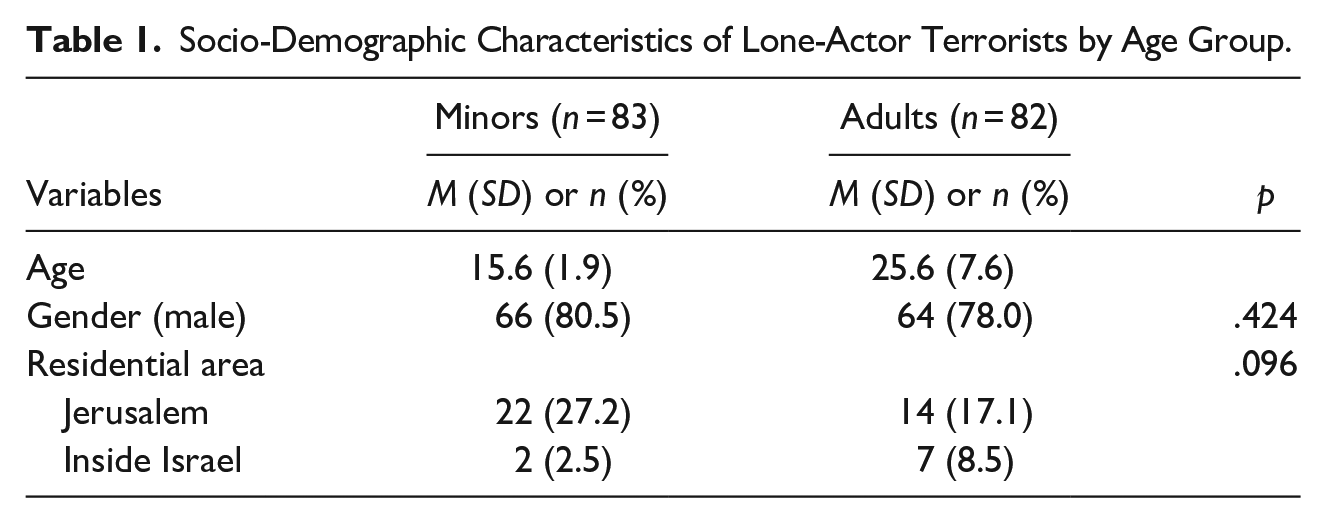
Table 1 presents the sociodemographic characteristics of lone-actor terrorists by age group. The findings show a 10-year gap between the average age of minor and adult terrorists (M = 15.6, SD = 1.9 and M = 25.6, SD = 7.6, respectively). Most terrorists were male; about one-fifth were female. No significant difference was found between the two age groups in residential area. Most terrorists in both groups lived in Judea and Samaria. However, the percentage of minor lone actors who lived in East Jerusalem was higher than the that of adult lone actors (27.2% and 17.1%, respectively). Table 2 presents the characteristics of the terrorist attacks by age group based on the four pillars of situational opportunity, the motive behind the attack, and victims.
Socio-Demographic Characteristics of Lone-Actor Terrorists by Age Group.
Characteristics of Terrorist Attack by Age Group.
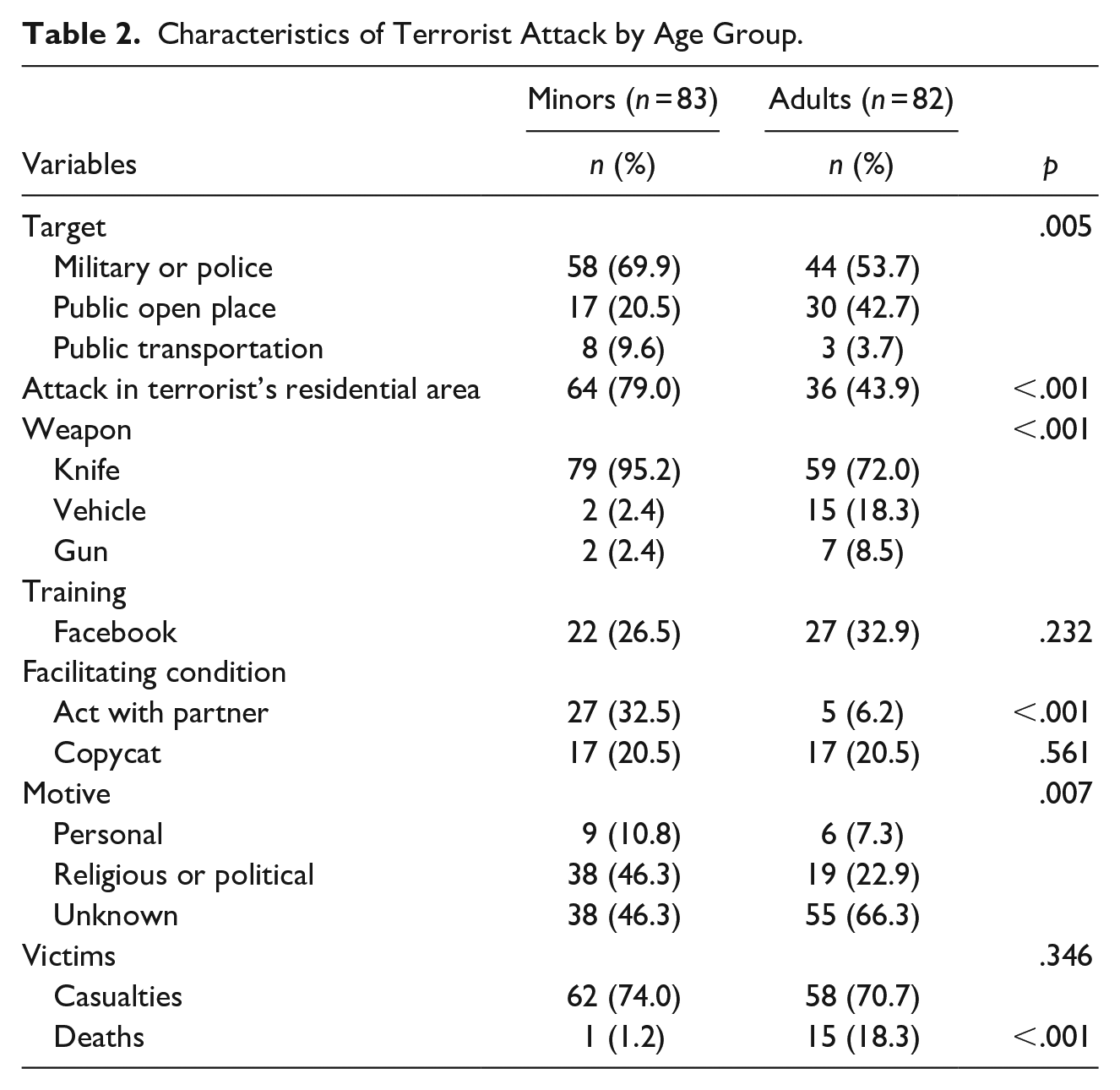
The results in Table 2 show a significant difference in the targets between the two age groups: χ2(2, 165) = 10.41, p = .005. The main targets were military or police, although this was significantly more common among minors than adult lone actors (69.9% and 53.7%, respectively). The percentage of adult terrorists who carried out attacks in public places was twice as high as that of minor terrorists who carried out attacks in these places (42.7% and 20.5%, respectively). Furthermore, a significant difference was found between minor terrorists and adults in choosing the target of their attack in their area of residence: χ2(2, 165) = 21.18, p < .001, whereby minor lone actors were more likely than mature terrorists to carry out the attack in their area of residence (79% and 43.9%, respectively).
The weapon of choice significantly differed between the two groups: χ2(2, 165 = 16.43, p < .001). Almost all minor terrorists carried out their attack using a knife (95.2%), compared to just 72% of adult terrorists. Furthermore, the use of a vehicle to carry out ramming attacks was rare among minors compared to adult terrorists (2.4% and 18.3%, respectively). Similarly, the use of a gun was infrequent among minors compared to adults (2.4% and 8.5%, respectively). As for the use of Facebook, no significant difference was found between minor and adult terrorists. These results confirm the first hypothesis, and show that minor terrorists carry out their attacks differently than adult terrorists with respect to three of the four pillars in Clarke and Newman’s (2006) model, namely target, weapons, and facilitating conditions.
As for facilitating conditions, the percentage of minor terrorists who carried out dyadic attacks was more than 5.2 times higher than that of adult lone actors (32.5% and 6.2%, respectively).
Regarding lone actors’ personal characteristics, the motive significantly differed between the two groups: χ2(2, 165) = 10.03, p = .007. A major difference was found in religious or political motivation, which was higher among minor terrorists than adult ones (46.3% and 22.9%, respectively). The key difference was found in the terror attack’s casualties—namely, the number of victims who were killed: The percentage of adult terrorists who killed their victims was 18.3%, compared to only 1% of minor lone actors. This result confirms the second hypothesis, and shows that minor terrorist attacks are less fatal than adult ones.
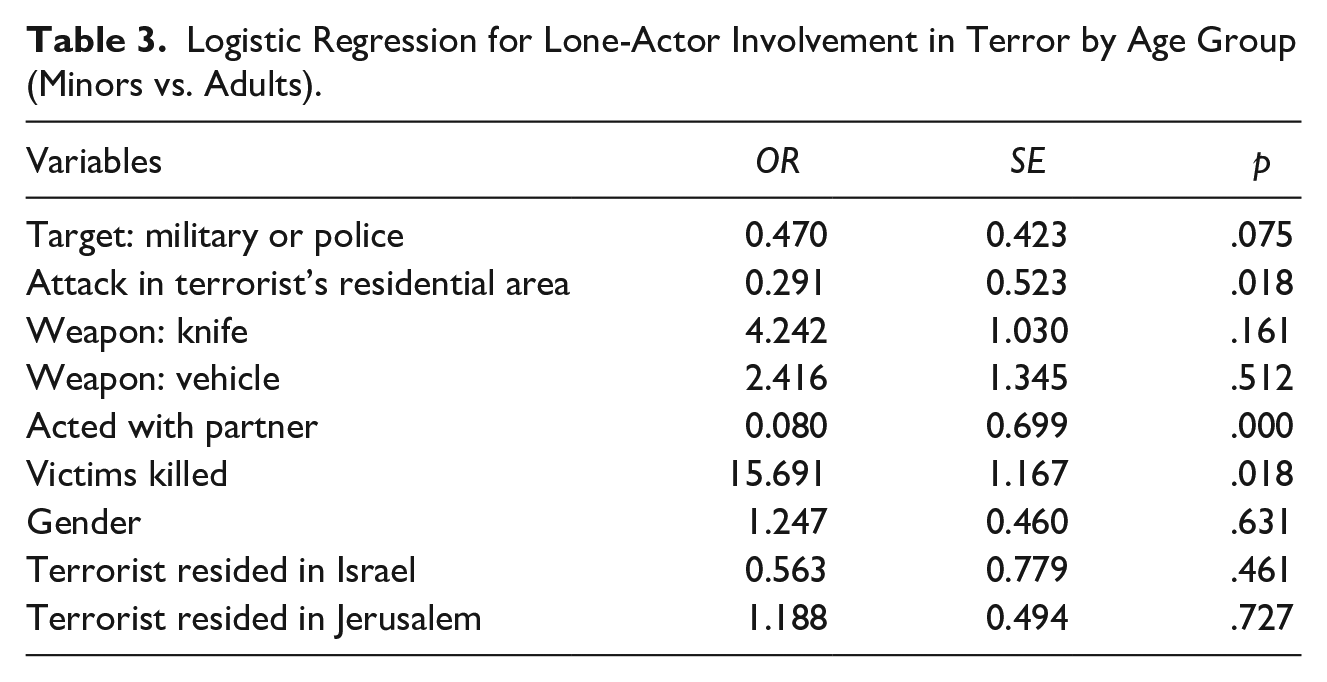
Table 3 presents the logistic regressions for lone-actor terrorists by age. The findings indicate that minors were more likely than mature terrorists to choose the target of the attack in their area of residence (OR = 0.291, p = .018). However, no significant effect was found for weapon. Furthermore, minor terrorists were more likely to carry out the attack with a partner than adult terrorists (OR = 0.079, p < .001). The results indicate that the probability of the victims of terrorist attacks committed by an adult being killed was 15.2 times higher compared to those perpetrated by minor terrorists (OR = 16.69, p = .018). No significant effect was found for the control variables, that is, the terrorist’s gender and residential area.
Logistic Regression for Lone-Actor Involvement in Terror by Age Group (Minors vs. Adults).
Discussion
Youth engagement in political violence and terrorist activity has been observed in several countries during the last decade (Bizina & Gray, 2014; Dalgaard-Nielsen, 2010; Greenbaum et al., 2020; Stanley & Guru, 2015; Torok, 2015; Østby et al., 2018). This study aimed to investigate the differences between minor and adult lone terrorists in sociodemographic characteristics, situational conditions shaping their terrorist attack, and the attack’s lethality. Several findings are noteworthy.
First, a significant difference was found in the first pillar, the target, between minor and adult lone terrorists. The analysis revealed that minor lone terrorists try to take advantage of relatively restricted situational opportunities accessible and close to their environment, opting for nearby military or police forces that are relatively easy to access, identify, and engage. Perhaps minor lone-actor terrorists choose military and police forces to express anger, distress, and frustration at their situation (Clarke, 1997; Clarke & Newman, 2006). Furthermore, the percentage of minors that choose an open public place as a target was about half of adult terrorists. This finding likely stems from a rational choice to attack in a familiar environment where they feel confident. It is important to note that approximately a fourth of the minors were residents of East Jerusalem, and therefore, they presumably had a permit to enter Israel. Nevertheless, most of them chose a target in the vicinity of their residential area. Thus, among minor terrorists, familiarity and accessibility with the target area seem to play a key role when selecting the target of the attack. Adult terrorists, in contrast, were more independent: Some of them worked in Israel and were therefore able to seize these opportunities to choose various targets to attack. In line with routine activity theory (Cohen & Felson, 1979; Felson, 2006), minor lone actors might carry out their attack as part of their daily routine, in places they are well acquainted with and in which they commonly spend time. Moreover, the tendency to choose familiar scenes suitable for terror attacks resembles youths’ tendency to commit juvenile delinquent offenses in places they know well (Anderson & Hughes, 2009; Osgood & Anderson, 2004).
At the same time, given that military and police forces are considered difficult, well-protected targets, the magnitude and severity of minors’ terror attacks are circumscribed in a way that results in their attacks being less fatal than those of adult lone terrorists (Asal & Rethemeyer, 2008; Newnam & Hsu, 2012). Furthermore, the victimological perspective on lone actors’ terror attacks shows that, despite the limited resources and opportunities available to minor terrorists, the share of wounded victims from their attacks is relatively high (74%), albeit their attacks were less lethal.
Second, a significant difference was found in the second pillar, the weapon, between minor and adult lone terrorists. Most minor lone terrorists used a knife to carry out their attack. Although the use of a cold weapon (knife) was common among adult lone actors too, they also used more lethal weapons such as firearms or vehicles to commit their terrorist attacks. Indeed, a knife, like other cold weapons, is often accessible, and easily carried and operated, whereas firearms and cars are almost inaccessible for minors, and require training. These findings corroborate previous studies reporting lone actors’ tendency to choose their weapon based primarily on tactical and practical considerations (Clarke, 1997; Perry et al., 2018; Spaaij, 2012). Furthermore, cold weapons are considered less lethal (Downs, 2007); thus, minor terror attacks generally entail less destructive consequences.
Third, the results show that 30% of all terrorists had an active Facebook account featuring posts of radical ideology and violence. No significant difference was found between minors and adults in this respect. The relatively small age gap between minors and adults suggests that both were familiar with online activity, in which social media is heavily used. It is also feasible that minor terrorists use other social media platforms, such as Instagram or Snapchat. In this context, findings from a recent study have indicated that a high level of Instagram and Snapchat use predicted higher involvement in delinquent behaviors (Vannucci & Ohannessian, 2019). Further research is therefore required in order to explore the differences in the role played by social networks among minor lone-actor terrorists.
Fourth, a significant difference was found in the third pillar, facilitating conditions, between minor and adult lone terrorists. About one-third of minor terrorists (32.5%) carried out their attacks together with a partner, compared to just 6.2% of adult terrorists. This characteristic is almost unique to minor terrorists, and is in line with the dimensional approach (Borum et al., 2012) to lone actors, which assumes possible interaction with some significant others. Furthermore, the current finding whereby minors are often not alone when carrying out attacks suggests that the social ties in adolescence, which are very important (Lynch, 2013; Precht, 2007), also affect the almost unique social modus operandi of minors as compared to mature terrorists. This finding is consistent with minors’ patterns of criminal activity in general, as most minors frequently carry out their social actions in small groups, in which their peers reward their actions, and they often seem to feel a sense of safety (Haynie & Osgood, 2005; Osgood et al., 1996; Reiss, 1988; Warr, 2002).
No significant difference was found with regard to copycat criminal patterns between the two age groups. The analysis showed that a fifth of all terrorists, be they minor or adult, carried out their attacks in a format that resonated with previous successful attacks during the week that preceded their own attacks. Indeed, the decision to choose a specific time and place may be facilitated by the perpetration of a successful terrorist attack in similar times and places (Perry et al., 2018).
Thus, overall, the main differences noted between minor and adult lone actors with regard to the four pillars theory pertained to minor lone actors’ choice to use less lethal weapons, and their tendency to opt for accessible, nearby targets. Differences were further identified in their personal characteristics (religiosity), and lesser lethality of their terror attacks in terms of casualties. While the first two differences associated with the four pillars theory (use of less destructible weapons and tendency to choose nearby targets) are somewhat expected given the fewer resources available to minors, the differences pertaining to their personal characteristics are noteworthy.
This study’s findings suggest that minor lone actors are more susceptible to radical ideologies than adult lone actors, as reflected in their motive being more religious or political compared to the latter. Given youths’ tendency to be associated with political violence (De Waele & Pauwels, 2014; Frounfelker et al., 2019; Shrestha & Jenkins, 2019), and Khoury-Kassabri et al.’s (2015) observation on the negative relations between youths’ high levels of Islamic religiosity and involvement in political violence, it is possible that our finding on higher levels of religiosity should be interpreted as a high level of radical political ideology rather than a high level of religiosity. Interpreted as such, this research finding correlates with literature describing adolescents’ tendency to engage in radical ideas (Bjørgo & Carlsson, 2005; Hamm, 2004; Maclean, 2013) and political violence (De Waele & Pauwels, 2014; Frounfelker et al., 2019; Shrestha & Jenkins, 2019), which suggests that minor lone actors’ terror attacks are, in a way, an expression of their growing-up phase. This tendency of terror attacks being affected by the nature of the socio-psychological developmental process during adolescence is also reflected in our finding relating to minor terrorists’ tendency to execute their terror attacks with a partner, as noted above.
The current study is, of course, not without limitations. It has focused on minor lone-actor terrorists during a relatively short period, and was also based on a relatively small sample, limiting the generalizability of its findings. Furthermore, the previously mentioned explanations regarding the execution of terrorist attacks with accomplices clearly indicate that further research is required. Expanding the analysis to minor lone-actor terrorists in other countries would provide better insight into this topic. Yet despite these limitations, this analysis of minor lone-actor terrorists has involved an entire population of minors, and not merely a sample, and was therefore associated with fewer methodological threats. Moreover, the study offered novel insights on youth engagement in lone-actor terrorism, a phenomenon that has received very limited research attention to date.
Conclusion
Given the recent engagement of youth in acts of terror, and the relatively scant research on their involvement in political violence, the present study has offered novel observations on youth participation in a recent terror phenomenon of terror—lone-actor terror attacks.
This research corroborates prior criminological observations on criminals and their crimes, noting the close affinity between the criminal’s personal characteristics and their choice of crime, victims, and modus operandi (Clarke & Newman, 2006) by illuminating the various ways by which youths’ engagement in lone-actor terror attacks reflect, first and foremost, their social and psychological developmental needs and challenges during adolescence. Thus, in a way, a main extrapolation from this study’s findings is the fact that youth lone actors’ terrorist acts are, first and foremost, an “act of age.”
Given that this research is the first to study youths’ involvement in terror as lone actors, its observations require further validation. As the present study findings suggest, additional studies are required to provide a comprehensive understanding of the role played by religiosity, ideological radicalization, and political violence in youths’ involvement in delinquency and violent crimes.
Footnotes
Declaration of Conflicting Interests
The author(s) declared no potential conflicts of interest with respect to the research, authorship, and/or publication of this article.
Funding
The author(s) received no financial support for the research, authorship, and/or publication of this article.
