



Abstract
This study examines how “outsider” arrests (i.e., arrests that happen in neighborhoods where defendants do not reside) and other covariates impact community-level punishment outcomes. Using census tract-level data on drug, violent, and property crime arrests occurring in Miami- Dade County (Florida) between 2012 and 2015, we estimate negative binomial regression models across three key punishment stages (pretrial detention, conviction, incarceration). Our findings suggest neighborhoods with higher levels of “outsider” cases, concentrated disadvantage, and Black defendants experience significantly higher rates of pretrial detention, conviction, and incarceration, net of controls. These findings vary across crime types, implying that such factors may also shape court actors’ focal concerns regarding neighborhood outsiders and other demographic factors. We discuss implications and directions for future research.
Introduction
Dating back to the late 1600s, John Locke described how preserving property was the government’s ultimate purpose (Platt, 2019). In recent years, security systems have proliferated in cities, neighborhoods, and homes to protect against “outsiders” who attempt to infringe on personal space or property (Kurwa, 2019). While the relationship between physical space and crime has been thoroughly theorized and tested (Krivo et al., 2009; Peterson & Krivo, 2010; Sampson, 2012), no research has directly examined how neighborhood levels of “outsider” crimes (i.e., crimes committed by people who do not reside in the neighborhood) shape punishment outcomes. Whether it be through enforced intergenerational residential segregation (Massey & Denton, 1993) or the physical demarcation of privatized land via fences or symbolic signage, residents come to form a sense of security and control over their own spaces by attempting to prevent neighborhood outsiders from intruding into their space (Newman, 1972), which is often racialized (Kadowaki, 2019; Meyer, 2001). Given strong normative orientations toward protecting one’s home and neighborhood (Kadowaki, 2019), it remains to be seen whether and to what extent the number of outsider cases in a given neighborhood influences criminal punishment outcomes for crimes committed there. We argue that criminal justice actors likely use their discretionary power to treat neighborhood outsiders as a focal concern in their decision-making process, thus offering harsher punishment outcomes across the life course of a case to defend neighborhoods against outsiders.
Our study aims to address these gaps in the literature and has important implications for understanding how criminal justice actors may differentially enforce criminal sanctions based on neighborhood context, crime type, and the presence of our novel variable, “outsider” offenders. Using census tract-level data from a racially and ethnically diverse county in Florida (Miami-Dade County) between 2012 and 2015, we estimate negative binomial regression models at the neighborhood level to examine criminal punishment outcomes for all crimes across three key criminal punishment stages (pretrial detention, conviction, and incarceration). We then examine if these punishment outcomes matter according to crime type (drug, violent, and property) and plot predicted values to visualize these relationships. Results reveal that neighborhoods with a greater proportion of outsider cases have higher rates of punishment outcomes across the life course of a case. Additionally, neighborhoods that have higher levels of concentrated disadvantage and more Black defendants experience significantly higher rates of pretrial detention, conviction, and incarceration, which may further fuel mass incarceration in low-income Black communities. The type of crime committed (e.g., drug, violence, and property) also shapes criminal justice decision-making. These patterns suggest that neighborhood outsiders may represent a key focal concern for criminal justice actors, influencing the geography of punishment.
Literature Review
Neighborhood Context and Criminal Justice Outcomes
A vast literature has examined the relationships between neighborhood conditions and crime. These studies find that higher crime rates are associated with concentrated disadvantage, rates of residential segregation, and incarceration rates in communities of color (Clear, 2008; Krivo & Peterson, 1996; Sampson et al., 2018; Sampson & Wilson, 1995; Simes, 2020). Such patterns are related to broader processes of economic disinvestment, social isolation, and other structural disadvantages (Burch, 2014; Krivo et al., 2009; Peterson & Krivo, 2010).
Neighborhood conditions are also important for police, prosecutors, and judges when considering case outcomes. Extant literature shows that crime is policed differently based on the type of crime committed, the neighborhood socioeconomic context, and the racial/ethnic background of the alleged offender(s) (Auerhahn et al., 2017; Beckett et al., 2006; Kane et al., 2013; Lynch et al., 2013; Omori, 2017; Petersen et al., 2019; Peterson & Krivo, 2010; Williams & Rosenfeld, 2016). More importantly, although criminal justice policies are seemingly race-neutral, racialized constructions of crime (Hattery & Smith, 2018) have led to stark racial disparities in arrests, detention, and incarceration (Alexander, 2012; Lynch et al., 2013; Platt, 2019). Police organizations often rely on racialized notions of space to justify socially controlling communities of color (Beckett et al., 2006; Kane et al., 2013). These neighborhood stereotypes not only shape the actions of individual officers on the beat but perhaps more critical is the institutionalization of these stereotypes into specific policies and practices. Additionally, prosecutors depend on neighborhood stereotypes to make case decisions (Frohmann, 1991, 1997; Herbert, 1997; Spohn et al., 2001). For example, while “race-neutral” stop-and-frisk policies led to disproportionally higher rates of stops and arrests for Black residents (Gelman et al., 2007), prosecutors have significant discretion at the charging and plea-bargaining stages that lead to downstream racial disparities (Davis, 2019). These policing/prosecution strategies have resulted in higher rates of arrest and incarceration in economically disadvantaged Black and Latino communities (Omori, 2017; Roberts, 2004).
Neighborhood Context and Multi-Level Criminal Justice Outcomes
Much of the research on neighborhoods and criminal justice has focused on individual-level outcomes rather than neighborhood analyses (Auerhahn et al., 2017; Pinchevsky & Steiner, 2016; Simes, 2020; St. Louis, 2020; Vilcica & Goldkamp, 2015; Wooldredge, 2007; Wooldredge et al., 2016; Wooldredge & Thistlethwaite, 2004). Drawing upon community protection arguments from the focal concerns perspective, several authors argue that prosecutors’ and judges’ decisions are impacted by neighborhood stereotypes linking the defendants’ crimes to their communities of origin (Auerhahn et al., 2017; Wooldredge et al., 2016; Wooldredge & Thistlethwaite, 2004). However, multi-level studies of case outcomes have revealed somewhat mixed findings. Some studies find that defendants from economically disadvantaged neighborhoods receive harsher punishments (Wooldredge & Thistlethwaite, 2004), while other studies find the opposite (Auerhahn et al., 2017; St. Louis, 2020; Williams & Rosenfeld, 2016; Wooldredge, 2007). The lack of attention to the spatial match/mismatch between the offender’s neighborhood and the crime scene neighborhood may help to explain these seemingly contradictory findings. For example, Wooldredge et al. (2016) find that defendants accused of committing a crime in neighborhoods that were more economically advantaged relative to their own neighborhood were more likely to be detained pretrial, highlighting the importance of examining spatial congruency between offender and crime scene neighborhoods.
In contrast, neighborhood-level studies consistently find higher rates of arrest, conviction, and incarceration in economically disadvantaged communities of color (Geller & Fagan, 2010; Gelman et al., 2007; Sampson, 2012; Sampson & Loeffler, 2010). At the front end of criminal justice interactions, Gelman et al. (2007) not only found that New York City stop-and-frisk policies disproportionately impacted communities of color but also that rates of stop-and-frisk are higher for Black and Hispanic suspects in predominately White neighborhoods, pointing to the role of “out of place” policing. Additionally, Kane et al. (2013) found that police were more likely to arrest Black and Latino residents in historically White neighborhoods, offering support for the defended neighborhood and minority group threat perspectives. Related to downstream case outcomes, similar research finds higher rates of incarceration for drug offenses in neighborhoods characterized by economic disadvantage and larger Black/Latino populations (Omori, 2017). Petersen et al. (2019) show that communities with more Black defendants experienced harsher prosecution for low-level disorder crimes in economically marginalized areas, subjecting those communities to increased punishment. They interpret their findings in terms of how stereotypical beliefs about race-ethnicity, social class, and disorder crimes in certain neighborhoods negatively affect criminal justice decision-making.
Theorizing Defended Neighborhoods
To combat crime, community members may collectively seek to “defend” their neighborhood by sealing “itself off through the efforts of delinquent gangs, by restrictive covenants, by sharp boundaries, or by a forbidding reputation” (Suttles, 1972, p. 21). Such social control efforts can occur through a wide range of pathways, including informal community actions (M. Davis, 2003; Kadowaki, 2019; Marshall, 2013; Pattillo, 1998), criminal justice actors (Hodson, 2018; Kane et al., 2013; Meehan & Ponder, 2002; Wehrman & De Angelis, 2011), and surveillance (M. Davis, 2003; Kurwa, 2019). Neighborhoods often work in tandem with criminal justice officials to ensure more formalized social control of their neighborhoods (Hodson, 2018; Kane et al., 2013; Wehrman & De Angelis, 2011). Through collaboration with police officers, some neighborhoods may experience increases in arrest rates for people whom neighbors perceive as out of place (Kadowaki, 2019; Kane et al., 2013).
Defended neighborhoods are typically organized by social and economic resources that are shared among neighbors and neighborhoods (i.e., social cohesion), allowing them to implement security mechanisms such as neighborhood watch groups, fences, and security technologies (Kadowaki, 2019; Suttles, 1972). Though social cohesion and defense mechanisms exist in some Black middle-class (Pattillo, 1998) and racially heterogeneous neighborhoods (Kadowaki, 2019), White neighborhoods are historically known for defending their communities against outsiders and working with local police to do so. During the Jim Crow era, for example, residents from predominately White neighborhoods employed discriminatory red-lining practices and violence to defend against racial diversity brought on by the introduction of new Black residents (Meyer, 2001; Reider, 1985). Likewise, some ethnic White neighborhoods (e.g., Italian) have been able to defend their neighborhoods by using their criminally-inclined status and perception to reduce crime rates in their own neighborhoods (Marshall, 2013). Other research shows predominately White neighborhoods often rely on “out of place” policing to enforce racialized notions of outsiders, where Black people occupying these spaces are more likely to be arrested because they appear “out of place” (Kadowaki, 2019; Kane et al., 2013; Meehan & Ponder, 2002). Similarly, some police and prosecutors rely on racialized criminal stereotypes to justify their efforts to “clean” up affluent White spaces by more aggressively sanctioning Black people in these areas (Beckett et al., 2005, 2006; Frohmann, 1991, 1997; Kane et al., 2013; Lynch, 2011; Lynch et al., 2013; Petersen et al., 2019; Spohn et al., 2001).
Neighborhood “Outsiders” and Focal Concerns
Focal concerns theory postulates that criminal justice outcomes are influenced by court actors’ perceptions of the defendants’ blameworthiness/culpability, desires for community protection, and practical constraints (Steffensmeier et al., 1998; Ulmer & Johnson, 2004). Court actors’ concerns about community protection can be influenced by spatial mismatches regarding where the defendant lives and where the crime occurred, utilizing harsher punishments to address residents’ concerns about crimes in their neighborhood by “outsiders” (Auerhahn et al., 2017; Wooldredge et al., 2016). Related work underscores the influence of racialized neighborhood stereotypes about crime have on criminal justice decision-making (Frohmann, 1991, 1997; Kane et al., 2013; Petersen et al., 2019; Spohn et al., 2001). Over time, court actors’ focal concerns informed by neighborhood stereotypes become institutionalized in ways that fuel economic and racial disparities in community rates of punishment (Petersen et al., 2019).
Crime type may also be a salient neighborhood focal concern for court actors (Cooney & Burt, 2008). Auerhahn et al. (2017, p. 32) describe how “the focal concern of community protection may be interpreted differently for offenses like larceny and residential burglary, where the potential victims more closely resemble the ‘broader community’ compared to crimes like homicide. . .” Similarly, scholars note criminal activity in high crime areas may become “normal” or “acceptable,” and thus receive more leniency (Browning et al., 2004; Cooney & Burt, 2008; Morenoff et al., 2001). Given that property offenses usually happen further from an offender’s residence than violence (Ackerman & Rossmo, 2015; Pyle, 1976; Rossmo, 2005), these geographic patterns may exaggerate crime-type considerations by court actors. For example, violence and property crimes committed by outsiders may threaten residents’ sense of safety within their community or homes, prompting court actors to defend these neighborhoods by enforcing stricter punishments. This line of reasoning is consistent with Steffensmeier et al.’s (1998, p. 767) original writing on community protection focal concerns. On this topic, they note that “Predictions about the dangerousness of the offender (generally defined as risk of future violence) or the risk that the offender will recidivate are therefore based on attributions predicated on the nature of the offense (e.g., violent or property)” (emphasis added). Other research on focal concerns similarly highlights the role of different crime types in shaping court actors’ perceptions of and responses to community safety concerns (Kramer & Ulmer, 2002; Spohn & Sample, 2013).
The foregoing discussion highlights the possible influence of spatial dynamics and crime type on court outcomes. We argue that neighborhood focal concerns regarding community protection may be exacerbated when crimes are committed by someone outside of the neighborhood, thereby leading to higher rates of punishment in neighborhoods characterized by more “outsider” cases. In this way, court actors’ increased use of criminal sanctions in areas with more “outsider” cases may represent the institutionalization of a defended neighborhood logic.
Present Study and Hypotheses
This study attempts to advance the literature on neighborhood context and punishment in several ways. First, it examines the influence of “outsider” cases on community-level punishment outcomes, introducing a novel concept of neighborhood outsiders. Drawing on the focal concerns and defended neighborhood perspectives, we theorize that court actors rely on neighborhood stereotypes as “perceptual shorthands” when defending neighborhoods by disproportionately enforcing harsher punishment outcomes based on race, class, and where the crime was committed (Simes, 2020; Steffensmeier et al., 1998). Second, this study examines the extent to which economic disadvantage and racial composition shape the geographic distribution of criminal sanctions. Given that prior research suggests that these factors are particularly important for shaping front- and back-end criminal justice outcomes (Donnelly & Asiedu, 2020; Kane et al., 2013; Williams & Rosenfeld, 2016; Wooldredge, 2007; Wooldredge et al., 2016; Wooldredge & Thistlethwaite, 2004), we examine how these neighborhood factors influence case outcomes. Finally, we disaggregate punishment outcomes by crime type to better understand why certain offenses may be punished more harshly based on neighborhood context (Auerhahn et al., 2017; Simes, 2020; Steen et al., 2005). Since previous neighborhood-level studies have focused on court outcomes for drug (Omori, 2017) or low-level disorder crimes (Petersen et al., 2019), it is important to examine case outcomes for other crime types like property and violent crimes, in addition to drug crimes, given research highlighting differing journey-to-crime spatial paths by crime type (Ackerman & Rossmo, 2015; Rossmo, 2005; Trinidad et al., 2020). Therefore, our approach can shed new light on how neighborhoods may be perceived by court actors based on the type of criminal activity linked to communities stereotyped as “drug-infested,” “violent,” or prone to break-ins (Beckett et al., 2006; Omori, 2017; Petersen et al., 2019).
Based on these three additions to the literature and guided by previous research, we hypothesize the following outcomes:
Research Setting: Diversity and Inequality in Miami-Dade County
Miami-Dade County, Florida is most commonly associated with its thriving nightlife and picturesque beaches, yet Miami neighborhoods are also plagued by deep-seated racial inequality. Miami’s particular patterns of racial segregation have been shaped by decades of redlining, White-flight out of the urban core to coastal areas, and economic disinvestment of the downtown area (Feldman, 2011). While much of Miami’s Hispanic population has been allowed to live across the county, much of its Black population has historically been confined to a select few neighborhoods (Feldman, 2011; Shumow, 2016), producing a “new geography of inequality” characterized by heightened levels of segregation, inequality, and gentrification (Kohn-Wood et al., 2015). As a result, low-income communities of color are now major targets of aggressive policing and punishment (Feldman, 2011). Therefore, Miami presents itself as a unique city to examine community-level punishment practices in neighborhoods. Because defended neighborhoods likely emerge in inner-cities where racial differences and poverty are prevalent (Suttles, 1972), and Miami is highly segregated based on race and class (Kohn-Wood et al., 2015), it is an ideal jurisdiction to examine how the spatial distribution of punishment varies based on the concentration of “outsider” cases and other neighborhood factors.
Data and Methods
Data on criminal justice outcomes were obtained from the Miami-Dade County Clerk of Courts for all arrests made in the county from 2012 through 2015. Individual court cases are aggregated to the census tract level by merging address information regarding where the arrest occurred and where the arrestee resides with 2010 U.S. Census data. Census tracts are used as a measure of neighborhoods because they are useful for capturing meaningful information on demographics at this level of geography and have been commonly used to measure neighborhoods in studies of crime and criminal justice (Auerhahn et al., 2017; Omori, 2017; Petersen et al., 2019; Sampson et al., 2002; Wooldredge, 2007). In our dataset, census tracts have an average population of 5,162 and an average population density of 10,734 residents per square mile, making them large enough to capture meaningful demographic variability but not too large to be geographically meaningless.
Dependent Variables
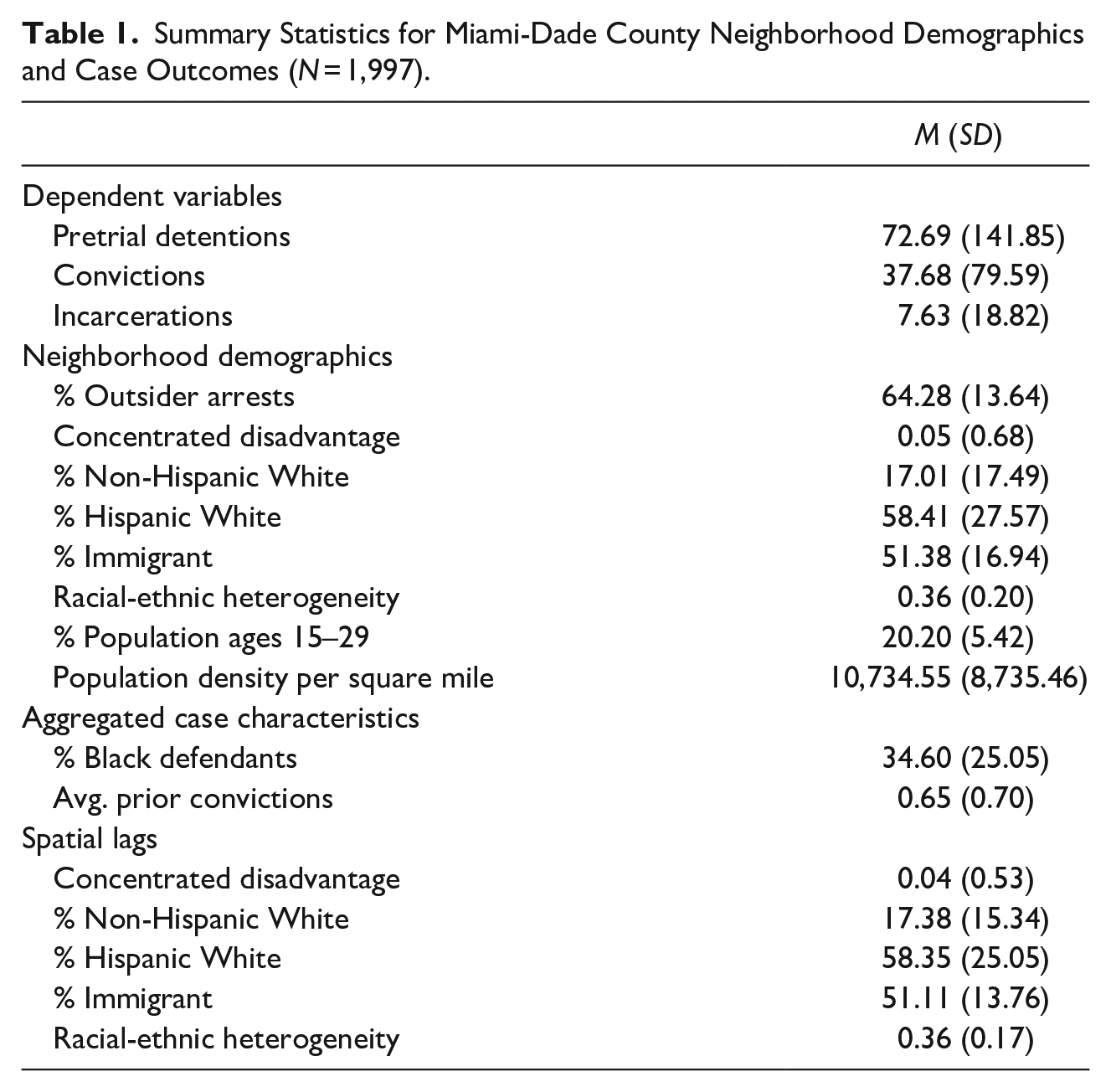
Our dependent variables focus on neighborhood-level counts for three key criminal justice punishment stages: (1) pretrial detention, (2) conviction, and (3) incarceration (jail or prison). Pretrial detention is operationalized as any detention that takes place for at least 1 day. Pretrial detention is an important outcome measure because it places defendants under emotional and financial hardship, which can cause defendants to suffer from harsher downstream effects inside and out of the criminal justice system (Menefee, 2017; Petersen et al., 2019). Second, we explore convictions as the next major stage in the criminal justice process, as a criminal conviction can trigger a range of collateral consequences, including restrictions on voting, public assistance, and employment, among others (Wakefield & Uggen, 2010). Finally, we measure the number of carceral sentences in each neighborhood because incarceration represents the most serious sanction available for most crimes aside from the death penalty. Moreover, high levels of incarceration within a community can disrupt families, local economies, and neighborhood dynamics, making it a particularly important outcome to examine (Sampson, 2012; Sampson & Loeffler, 2010). On average, Table 1 displaying summary statistics indicates that 72.69 cases per 1,000 residents result in pretrial detention, followed by 37.68 convictions per 1,000 residents and 7.63 carceral sentences per 1,000 residents.
Summary Statistics for Miami-Dade County Neighborhood Demographics and Case Outcomes (N = 1,997).
Independent Variables
To capture the spatial (mis)match between where arrests occur and defendants reside, we measure the percentage of outsider arrests by comparing geo-coded addresses for arrests and the defendants’ residence. Individuals arrested in census tracts they do not reside in were coded as 1, while people who were arrested in tracts in which they reside were coded as 0. This dummy variable was then aggregated up to the neighborhood level to construct a count of “outsider” arrests, which we divided by counts of total arrests in each census tract to calculate the percentage of outsider arrests. To bolster the external validity of the neighborhood “outsider” measure, we also coded surrounding neighborhoods of census tracts as 1, since census tracts can be small and may not neatly map onto the cultural definitions of neighborhoods in Miami and elsewhere (Hipp & Boessen, 2013; Sampson, 2012; Sampson et al., 1997). Stata’s “spmat” command was used to produce a list of neighboring census tracts for each neighborhood based on queen contiguity. Using this list of nearby neighborhoods, we defined arrests that occur in a census tract outside of where the arrestee resides, or an adjacent census tract are considered “outsider” arrests, while arrests that occur in the same census tract where the defendant lived or an adjacent census tract are not considered “outsider” arrests. This more expansive definition of neighborhoods is consistent with research conceptualizing neighborhoods more broadly than census tracts to better under the social ecology of crime and criminal justice (Hipp & Boessen, 2013; Sampson, 2012; Sampson et al., 1997; Trinidad et al., 2020).
Figure 1 visualizes this coding scheme by illustrating three different scenarios of hypothetical census tract configurations based on the crime scene and the defendants’ neighborhood. Panel A of Figure 1 shows an example of an “outsider” arrest, where the defendant does not reside inside the crime scene tract or an adjacent tract. Panel B of Figure 1 shows an “insider” arrest, given that the defendant resides inside the crime scene tract. Panel C of Figure 1 also shows an “insider” arrest, albeit based on a different spatial configuration. In Panel C, although the defendant does not directly reside in the crime scene tract, he/she resides inside an adjacent census tract, making it an “insider” arrest.
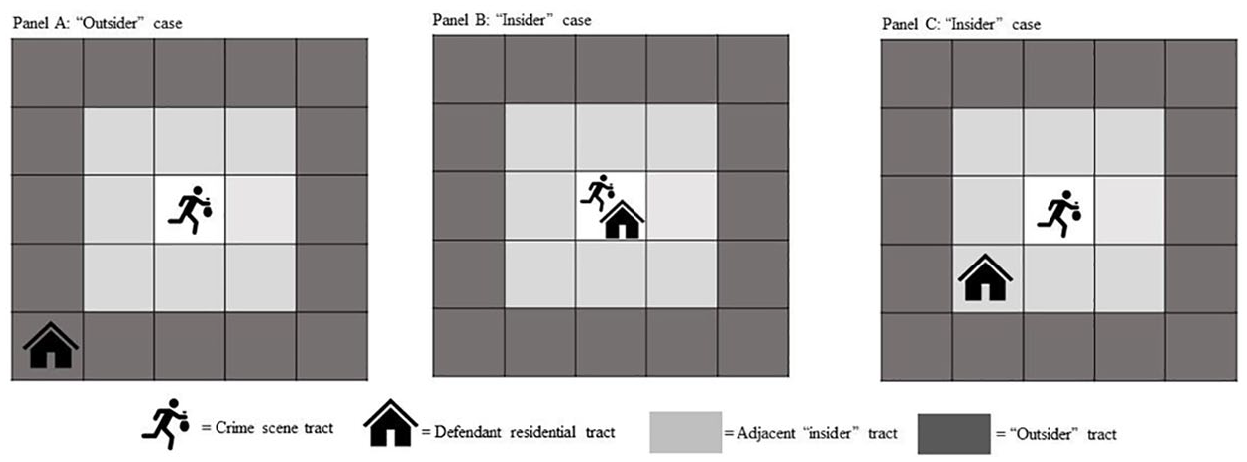
Neighborhood “outsider” coding scheme for hypothetical census tract spatial configurations.
In addition, we control for several neighborhood demographics shown to influence crime and justice outcomes. Of particular interest is concentrated disadvantage, which has been consistently linked to criminal justice outcomes (Fagan et al., 2003, 2004; Sampson, 2012). Following Sampson (1997), principal components factor analysis was used to construct an index of neighborhood concentrated disadvantage based on the following indicators: % single-parent households (λ = .74), % median household income (λ = −.88), % median home value (λ = −.80), % below the poverty line (λ = .84), and % received public assistance (λ = .58). We measure neighborhood racial/ethnic makeup as the percentage of non-Hispanic White and Hispanic White residents, with the percentage of Black residents serving as the reference group. As measures of neighborhood diversity, we measure the percent of foreign-born residents as well as racial-ethnic residential segregation using a Herfindahl dissimilarity index. Lastly, we control for the percent of residents from ages 15 to 29 years old and population density per square mile. 1
Given patterns of residential segregation in Miami (Kohn-Wood et al., 2015), we adjust for possible spatial autocorrelation by including spatial lags for key neighborhood demographics. This is done by estimating a spatial weight matrix using queen contiguity and row standardized estimates, which allows us to examine the effects of proximate neighborhoods. Spatial lags are generated for concentrated disadvantage, % White Hispanic and non-Hispanic, % immigrant, and Herfindahl dissimilarity index measuring racial-ethnic heterogeneity.
To examine whether courts are more punitive toward Black defendants, we measure the percentage of Black defendants in each tract between 2012 and 2015. Since crimes occurring in neighborhoods where defendants may have lengthier criminal histories, we control for the average number of prior convictions for individuals arrested in each community between 2012 and 2015. Doing so allows us to control for criminal history at the neighborhood level.
Analytical Strategy
Our neighborhood-level analyses are conducted in two stages, with the census tract where the arrest occurred serving as the unit of analysis. First, we estimate a series of negative binomial regressions at the census tract level to examine the geographic concentration of pretrial detention, conviction, and incarceration for all crimes. Next, we replicate these models by crime type (drug, violent, and property). We use negative binomial regression as this approach accounts for overdispersion typically found in count data like our criminal justice outcomes (Cameron & Trivedi, 2013). We calculated variance inflation factors (VIFs) in all models, excluding spatial lags, and the results reveal that multicollinearity is not an issue (VIFs <4.05).
Following our regression analyses, we plot coefficients for percent outsider arrests across all punishment outcomes and by crime types. Then, we plot predicted counts for each punishment outcome based on the percentage of outsider arrests for neighborhoods with low and high levels of concentrated disadvantage. We focus on the role of concentrated disadvantage because a large body of research has consistently revealed that economic inequality plays a pivotal role in shaping the geographic clustering of crimes and criminal justice outcomes (Fagan et al., 2003, 2004; Sampson, 2012; Sampson et al., 1997). These figures clarify how the effect of outsider arrest might vary across court outcomes and neighborhood contexts.
While much of the literature on neighborhoods and criminal justice has focused on individual-level outcomes, our analysis explicitly focuses on neighborhoods. Following calls to place neighborhoods at the center of criminological analyses (Sampson, 2012) and increased attention to the role of community context in perpetuating criminal justice disparities (Donnelly & Asiedu, 2020; Williams & Rosenfeld, 2016), we focus on neighborhood-level processes that have “their own social logic and are not reducible to individual actors” (Sampson, 2012, p. 66). Because the geography of criminal justice is not merely reducible to the number of people punished in a particular neighborhood but is instead dictated by uniquely spatial processes (Roberts, 2004; Sampson, 2012), we focus on neighborhood punishment rates rather than the outcomes of individual defendants. 2
Results
Regression Analyses for All Crimes and by Crime Type
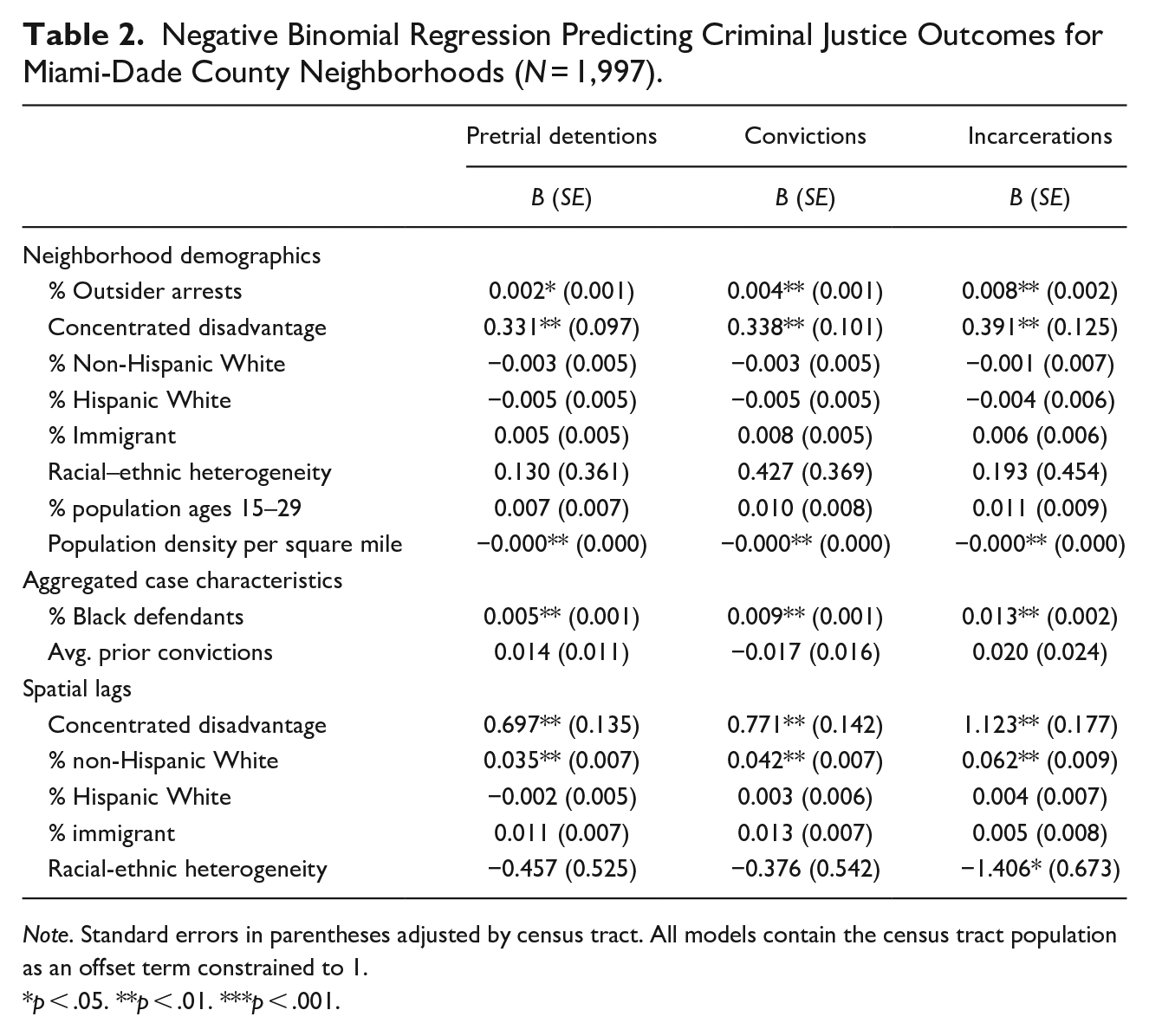
Table 2, presenting findings from negative binomial models for all crimes, indicates that neighborhood outsiders play a significant role in shaping rates of pretrial detention, conviction, and incarceration outcomes. 3 We find that the percentage of outsider arrests at the neighborhood level is associated with harsher punishment outcomes across the life course of a case, offering support for hypothesis 1. In addition, we find that neighborhoods with greater levels of concentrated disadvantage experience harsher punishment outcomes, offering support for hypothesis 2. In line with hypothesis 3, neighborhoods with a larger percentage of Black defendants experience harsher court outcomes, though we did not find that the racial composition of residents influences neighborhood punishment rates.
Negative Binomial Regression Predicting Criminal Justice Outcomes for Miami-Dade County Neighborhoods (N = 1,997).
Note. Standard errors in parentheses adjusted by census tract. All models contain the census tract population as an offset term constrained to 1.
p < .05. **p < .01. ***p < .001.
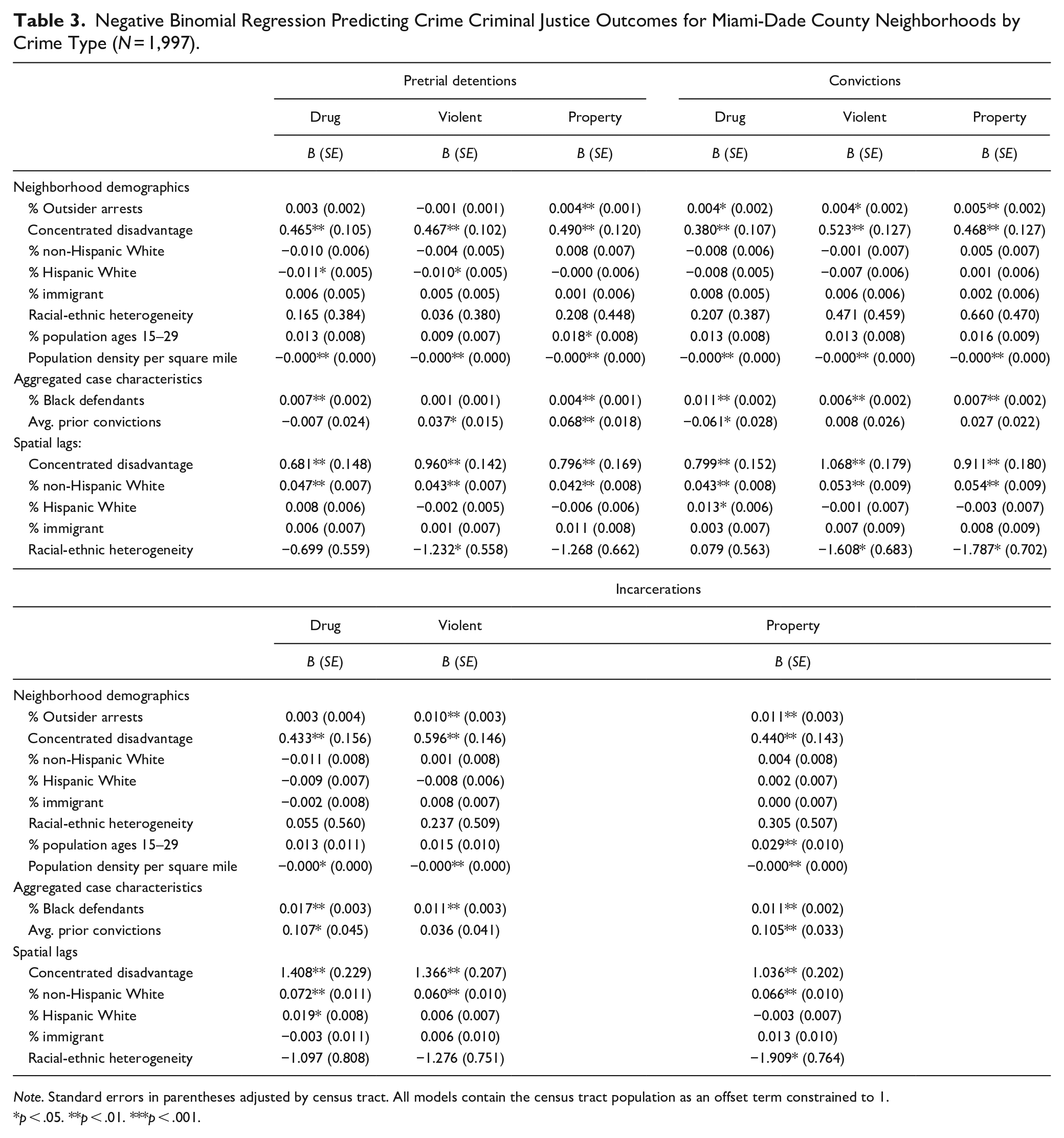
Table 3 displays results disaggregated by crime type and reveals somewhat divergent trends across offense types. The percentage of outsider arrests is associated with higher rates of pretrial detention for property crimes, higher rates of convictions for all crimes, and higher incarceration rates for violent and property crimes. In contrast, the concentration of outsider arrests for drug crimes does not predict case outcomes for pretrial detention or incarceration rates. These results provide additional evidence for hypothesis 1 in that the effect of outsider arrests on criminal justice outcomes is more pronounced for violent and property crimes.
Negative Binomial Regression Predicting Crime Criminal Justice Outcomes for Miami-Dade County Neighborhoods by Crime Type (N = 1,997).
Note. Standard errors in parentheses adjusted by census tract. All models contain the census tract population as an offset term constrained to 1.
p < .05. **p < .01. ***p < .001.
There are fewer differences in the effect of key neighborhood demographics on court outcomes by crime type. Table 3 offers additional support for hypothesis 2 by showing that, regardless of crime type, neighborhoods with increased levels of concentrated disadvantage have higher rates of pretrial detention, conviction, and incarceration outcomes. However, support for hypothesis 3 by crime type is more mixed. Neighborhoods with a greater percentage of Black defendants experience elevated rates of pretrial detention (except for violent crime), convictions, and incarceration for all crimes.
Coefficient Comparisons and Predicted Probabilities
In Figure 2, we plot the regression coefficients and 95% confidence intervals for the percentage of outsider arrests in each neighborhood for all crimes (Table 2) and by crime type (Table 3). Here, we see that the effect of outsider arrests on court outcomes does not significantly differ across models due to the overlapping confidence intervals. This suggests that the relationship between the geographic concentration of outsider arrests and criminal justice outcomes is fairly stable across different crime types.
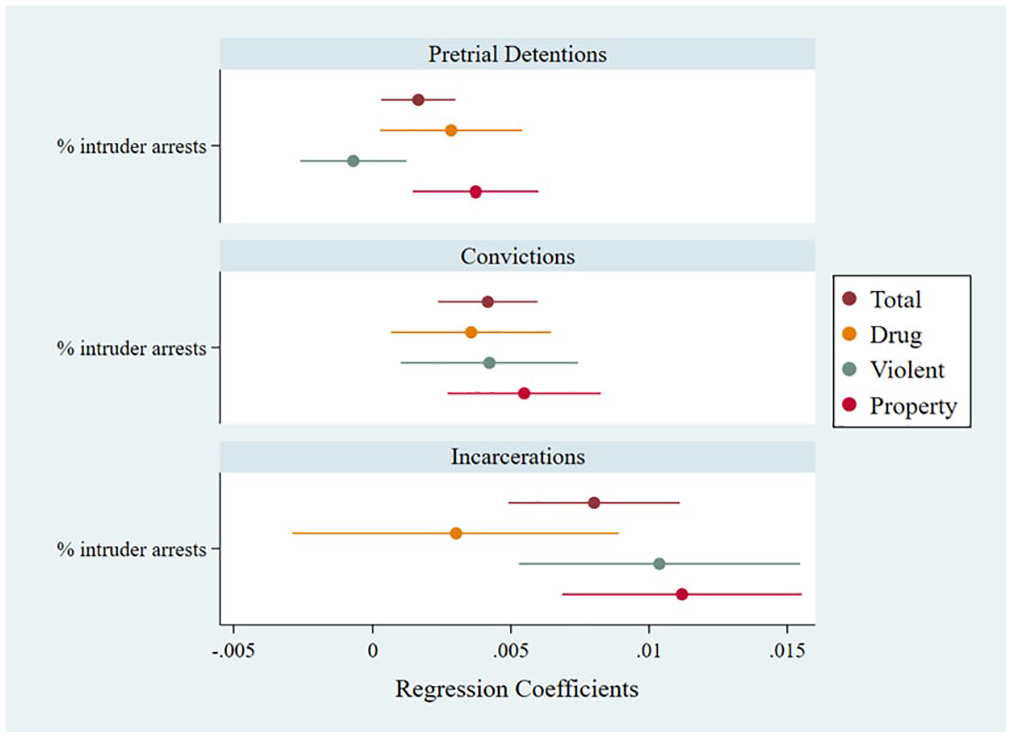
Regression coefficients for percentage of neighborhood outsider arrests for all crimes.
Next, we plot predicted values for our outcomes across neighborhoods with differing levels of outsider arrests and concentrated disadvantage using Stata’s “margins” command, with covariates held constant at mean values. Figure 3 displays predicted rates of pretrial detention for all crimes and by crime type shows no significant differences across neighborhoods with low (0%) versus high (100%) levels of outsider arrests. There are, however, differences in pretrial detention rates based on concentrated disadvantage. These findings likely reflect the high rates of pretrial detention in Miami-Dade County.
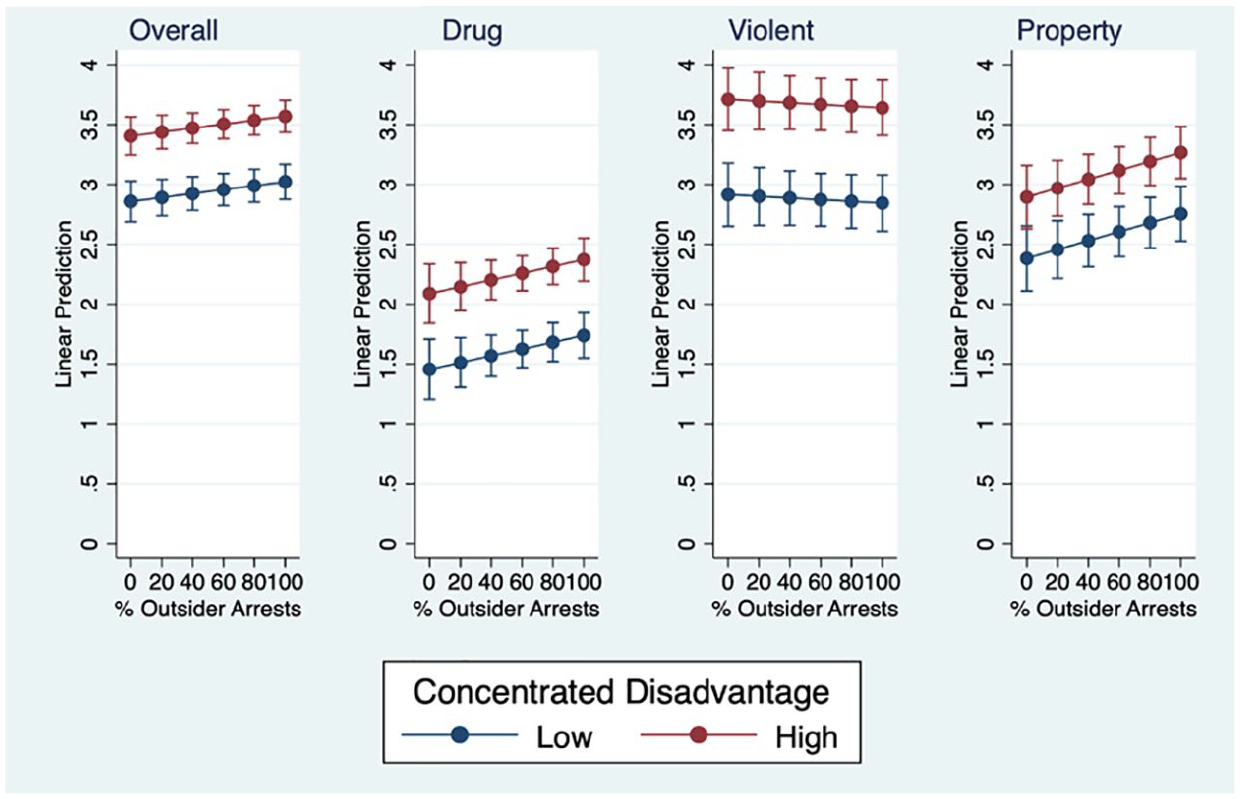
Predicted rates of pretrial detention by % outsider arrests, concentrated disadvantage, and crime type.
Figures 4 and 5 display predicted rates of conviction and incarceration by outsider arrests and concentrated disadvantage. In the overall model, Figure 4 indicates that highly disadvantaged neighborhoods with more outsider arrests have higher conviction rates. This pattern, however, does not hold up across different crime types. For example, concentrated disadvantage positively predicts conviction rates for all crimes and drug crimes, but not for violent and property crimes. In Figure 5, the relationship between the percentage of outsider arrests and incarceration rates is stronger than the relationship between the percentage of outsider arrests and conviction rates. For example, in the overall model, the predicted rate of incarceration in neighborhoods with 80% outsider arrests is significantly higher than in neighborhoods with 0% outsider arrests. A similar pattern is evidenced among violent and property charges, but only when comparing 0% and 100% outsider arrests. Thus, the effect of concentrated disadvantage on incarceration rates is primarily seen in the overall and drug models. While many of the relationships illustrated in Figures 4 and 5 are not large, they point to the role of outsider arrests in shaping neighborhood rates of conviction and incarceration.
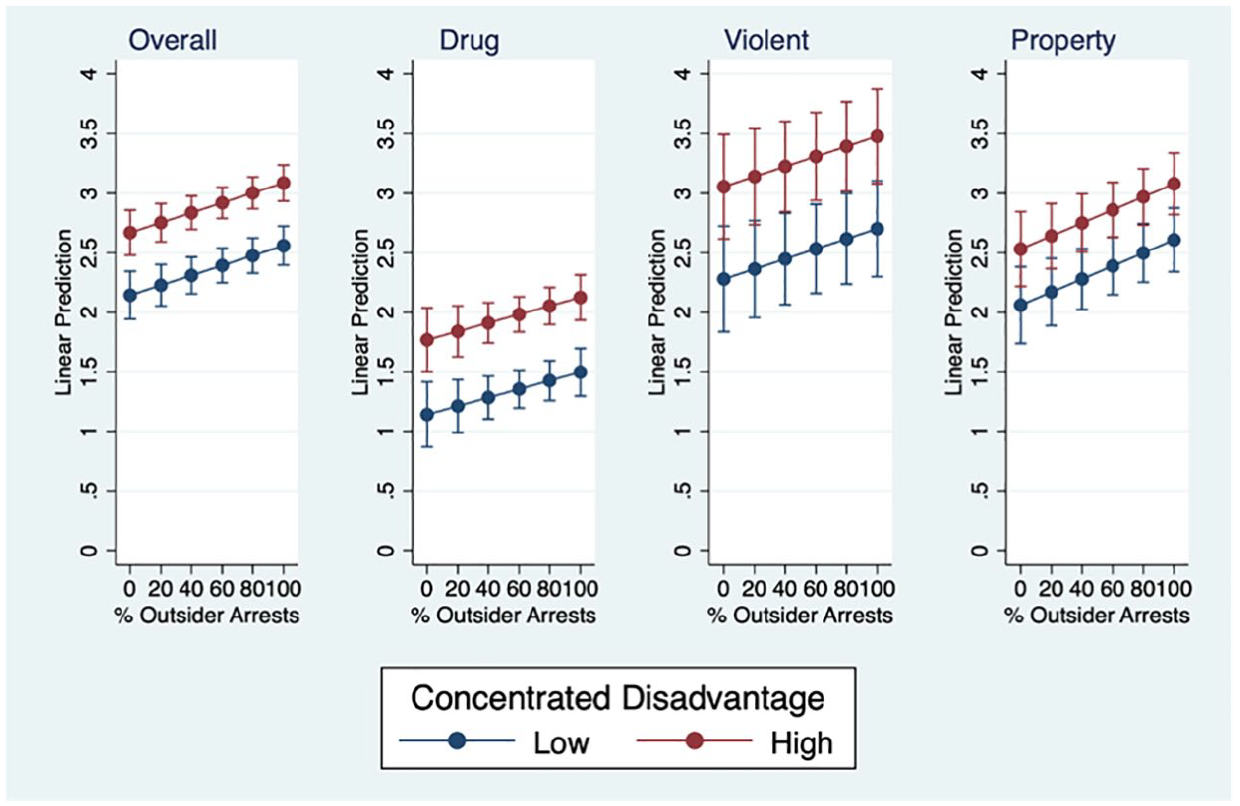
Predicted rates of conviction by % outsider arrests, concentrated disadvantage, and crime type.
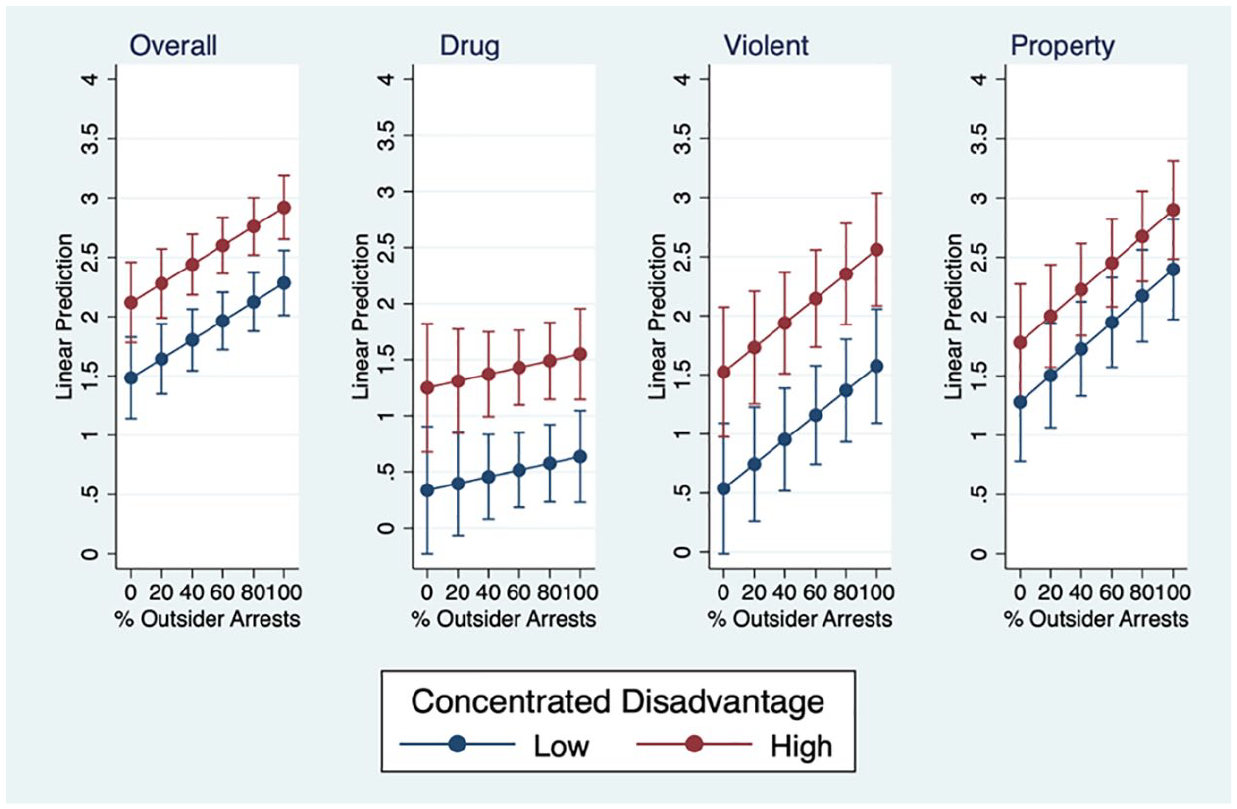
Predicted rates of incarceration by % outsider arrests, concentrated disadvantage, and crime type.
Discussion
Protecting property is a fundamental American right (Platt, 2019). This study extends the idea of protecting space and property to neighborhoods as a means for understanding the role that community demographics and the presence of outsiders shape the geography of punishment. In doing so, we attempt to address Roberts’ (2004) call for research moving beyond individual discrimination to broader macro-level disparities to better understand how structural factors contribute to mass incarceration. Furthermore, our focus on community context echoes calls to consider geography as an important predictor of punishment outcomes (Donnelly & Asiedu, 2020; Williams & Rosenfeld, 2016), especially the spatial mismatch between where offenders reside and where crimes occur (Wooldredge et al., 2016). Utilizing theoretical frameworks of defended neighborhood and neighborhood focal concerns, we seek to fill these gaps by employing negative binomial regression models to examine punishment outcomes for our novel variable, neighborhood outsiders, and other important neighborhood characteristics that likely influence criminal justice punishment outcomes by crime type (drug, violent, and property).
We find some support for all three hypotheses. The percentage of “outsider” arrests in an area—our key variable of interest—revealed itself as a salient predictor of neighborhood punishment rates. Although the coefficients for concentrated disadvantage and defendant demographics suggest they have a larger effect on case outcomes, neighborhoods with more outsider arrests nevertheless experience higher rates of pretrial detention, conviction, and incarceration, providing support for hypothesis 1. Thus, it could be that court actors’ concerns about community protection are heightened in areas characterized by more outsider cases, leading them to “defend” these neighborhoods by imposing harsher sanctions in these cases. This concern for defended neighborhoods may lead court actors (e.g., prosecutors and/or judges) to use their discretionary power to impose harsher sentences on outsiders as they represent a focal concern to protect communities.
The influence of outsider cases also varied by crime type. We found that neighborhoods with a larger proportion of outsider property cases experience significantly higher rates of punishment across all three punishment stages. This comports with Lockean conceptions of property rights, where the government’s ultimate purpose is to preserve property (Platt, 2019). As for violent crimes, conviction and incarceration rates are elevated in areas with a larger proportion of “outsider” arrests, but there is no effect on pretrial detention rates. However, for drug charges, the percentage of outsider cases was not statistically significant, which may reveal that the location of drug crimes matters less. These results comport with Cooney and Burt’s (2008) and Auerhahn et al.’s (2017) suggestion that court actors’ focal concerns to protect communities may matter differently based on crime type and neighborhood context.
Our results also show that neighborhoods with greater levels of concentrated disadvantage and a larger percentage of Black defendants have elevated rates of pretrial detention, conviction, and incarceration. In fact, the coefficient size for these variables was larger than the % outsider arrests variable. These findings not only offer support for hypothesis 2 and partial support for hypothesis 3, but largely comport with previous studies of individual-level (Auerhahn et al., 2017; Cooney & Burt, 2008; Simes, 2020; St. Louis, 2020; Vilcica & Goldkamp, 2015; Wooldredge, 2007; Wooldredge et al., 2016) and neighborhood-level case outcomes (Burch, 2014; Clear, 2008; Omori, 2017; Petersen et al., 2019; Sampson, 2012). For example, Petersen et al. (2019) argued that increased “suppression prosecution” may exist for low-level disorder crimes that are clustered in economically disadvantaged neighborhoods, suggesting these community-level outcomes may reinforce existing disparities in these already marginalized communities. In addition, the compounding disadvantages that Black defendants from low-income communities often face (e.g., inadequate legal representation, inability to post bond, etc.) may further exacerbate geographic disparities in punishment. Our study extends these findings to other crime types such as violent, property, and drug crimes, speaking to the persistent influence of economic disadvantage on the geography of punishment.
These findings add to the growing neighborhood-level punishment literature by demonstrating that the presence of outsider cases and other neighborhood factors shape court outcomes in ways that comport with the focal concerns perspective. Court actors may rely on racialized and classist “cognitive maps” when exercising their discretion, leading them to perceive certain neighborhoods as more worthy of protection than others (Auerhahn et al., 2017; Cooney & Burt, 2008; Frohmann, 1991, 1997; Herbert 1997; Spohn et al., 2001; Suttles, 1972). For example, court actors may perceive low-income communities of color as “crime-infested” and/or “disorderly” given Miami-Dade County’s high level of residential segregation (Kohn-Wood et al., 2015), and that such stereotypes are often linked to a neighborhood’s racial and economic composition (Sampson, 2012; Sampson & Raudenbush, 2004). Moreover, building on prior research arguing that focal concerns surrounding community protection contribute to geographic disparities in punishment (Auerhahn et al., 2017; Williams & Rosenfeld, 2016; Wooldredge et al., 2016), our findings suggest that protecting communities from outsiders may represent a particularly important, but often overlooked, focal concern for court actors who seek to defend neighborhoods.
Despite these contributions, our study also has several limitations. While building on prior criminal justice research employing census tracts (Petersen et al., 2019; Williams & Rosenfeld, 2016), we recognize that census tracts do not necessarily map on neatly to neighborhoods defined by residents. Similarly, although we expanded the neighborhood outsider variable to capture bordering census tracts around outsiders’ home tracts to provide a more expansive definition of neighborhoods, our measure is still reliant upon census tract boundaries. Thus, future research should replicate these findings using other neighborhood definitions, including those generated by residents.
This study is also limited to a single jurisdiction and indirect measures of focal concerns. Although focusing on a single jurisdiction offers a more nuanced examination of local practices, attending to the localization of criminal justice (Lautenschlager & Omori, 2019; Lynch, 2011, 2012), it may limit the generalizability of our findings. Despite such concerns about generalizability, we note that much of the prior research examining neighborhoods and criminal justice outcomes has also been limited to a single jurisdiction (Fagan et al., 2016; Omori, 2017; Petersen et al., 2019; Sampson, 2012; Sampson & Loeffler, 2010). Relatedly, since our regression models do not allow us to directly examine court actors’ focal concerns, we can only infer about possible focal concerns processes like much of the research in the focal concerns tradition (Lynch, 2019). Our findings are largely consistent with theoretical expectations of focal concerns regarding community protection and neighborhood dynamics, yet future research should employ qualitative methodologies to examine these processes more directly.
Notwithstanding these limitations, our study adds novel insights into the role of neighborhood outsiders and contextual factors for the spatial distribution of punishment. Guided by concerns about community protection, we argue that court actors may attempt to defend neighborhoods perceived to be under attack by outsiders through increased rates of pretrial detention, conviction, and incarceration. Moreover, we contend that these dynamics are often shaped by racialized and classist neighborhood stereotypes that influence court actors’ “cognitive maps.” As the country continues to debate the role of property protection rights (e.g., “Stand Your Ground Laws”), more attention should be paid to how the criminal justice system responds to neighborhood outsiders and how neighborhood context perpetuates disparate community punishment outcomes and mass incarceration.
Supplemental Material
sj-docx-1-cad-10.1177_00111287221117757 – Supplemental material for Punishing Neighborhood “Outsiders”: Neighborhood Punishment Rates and the Spatial Mis(match) Between Defendants’ Residence and Arrest Locations
Supplemental material, sj-docx-1-cad-10.1177_00111287221117757 for Punishing Neighborhood “Outsiders”: Neighborhood Punishment Rates and the Spatial Mis(match) Between Defendants’ Residence and Arrest Locations by Oshea D. Johnson, Nick Petersen and Brandon P. Martinez in Crime & Delinquency
Footnotes
Declaration of Conflicting Interests
The author(s) declared no potential conflicts of interest with respect to the research, authorship, and/or publication of this article.
Funding
The author(s) received no financial support for the research, authorship, and/or publication of this article.

Supplemental Material
Supplemental material for this article is available online.
Notes
Author Biographies
References
Supplementary Material
Please find the following supplemental material available below.
For Open Access articles published under a Creative Commons License, all supplemental material carries the same license as the article it is associated with.
For non-Open Access articles published, all supplemental material carries a non-exclusive license, and permission requests for re-use of supplemental material or any part of supplemental material shall be sent directly to the copyright owner as specified in the copyright notice associated with the article.
