



Abstract
This study examines whether unstructured and structured activities interact in their association with delinquency and cannabis use. We hypothesize that unstructured activities are more strongly associated with delinquency and cannabis use for those who are less engaged in structured activities. Data are drawn from three nationally representative self-report studies conducted between 2005 and 2011 in Sweden, and include 19,644 adolescents. The results support the hypothesis that unstructured activities interact with structured activities in the association with delinquency and cannabis use. The association between unstructured activities and these outcomes is stronger for those with lower levels of structured activities. Sporting activities constitute the structured activity that most clearly interacts with unstructured activities in the association with delinquency and cannabis use.
Introduction
Unstructured and Structured Activities
It is well established that adolescents who participate in unstructured activities in the presence of peers, and in the absence of authority figures, generally display higher levels of delinquency and substance use (e.g., Hoeben et al., 2016; Osgood et al., 1996). Unstructured activities include, but are not limited to, riding around in a car for fun, getting together with friends informally, going to parties, and spending evenings out for fun and recreation (e.g., Hoeben et al., 2016; Osgood et al., 1996; see also Engström, 2021). Such unstructured activities are characterized by the absence of an agenda for how time is to be spent (Osgood et al., 1996), and by a lack of parental monitoring or other forms of adult supervision. Spending time in this way exposes adolescents to settings and situations that increase the opportunities and risk for delinquency (Osgood et al., 1996; Wikström & Sampson, 2003), and for initial experimentation with alcohol and other substances (Spillane et al., 2020).
A relationship between participation in unstructured activities and delinquency and substance use has been found in studies based on both cross-sectional (e.g., Agnew & Petersen, 1989; Weerman & Hoeve, 2012) and longitudinal designs (e.g., Bernasco et al., 2013; Hoeben et al., 2021). It has also been found in different countries (e.g., Gerstner & Oberwittler, 2018; Svensson & Pauwels, 2010; Wikström et al., 2012), online (Meldrum & Clark, 2015), and for diverse outcomes, such as alcohol use, cannabis use, theft, and violence (e.g., Augustyn & McGloin, 2013; Hoeben et al., 2021; Spillane et al., 2020).
At the same time, youths tend also to spend a substantial amount of their leisure time in more organized structured activities (e.g., Vandell et al., 2015). These are defined as activities that are structured by a schedule, often involve adults, and have clearly defined goals and rules. They include, but are not limited to, sports, music, dance, theater, extracurricular school activities, etc. (e.g., Badura et al., 2018; Spillane et al., 2020; Vandell et al., 2015). As a result of the structured nature of these activities, they provide fewer opportunities for delinquency and substance use, and they are also often conducted in the presence of authority figures (de Jong et al., 2020; Osgood et al., 1996).
Theoretically, structured activities may be expected to reduce the probability of delinquency and substance use via the social bonds associated with these activities. Stated briefly, Hirschi’s (1969) theory of social bonds holds that the risk for delinquency declines the more strongly an individual is bonded to conventional society. Hirschi (1969) also elaborates on four important aspects of this social bond to society: attachment to others (which inter alia leads to the internalization of societal norms), commitment (an individual’s desire not to risk losing what has been gained, or might be gained in the future, by conventional means), involvement in conventional activities (which reduces the time available for delinquency), and belief (the extent to which individuals believe they should obey the rules of society).
On the basis of this theory, participating in structured activities would perhaps primarily be expected to reduce the likelihood of delinquency and substance use through the involvement aspect of the social bond, with Hirschi (1969) arguing that the more time a person spends involved in structured activities, the less time the person has to commit delinquent acts. At the same time, scholars have argued that structured activities may also have a positive influence on other aspects of the social bond (Agnew & Petersen, 1989; Jugl et al., 2021; Veliz & Shakib, 2012). The more strongly a person is attached to significant others (coaches, teachers, or friends) associated with the structured activity, and the more a person is committed to continued involvement in a structured activity, the more the person has to lose by engaging in delinquency. If this is the case, participation in structured activities may be expected to have a greater negative effect on the risk for delinquency than that provided by the involvement aspect alone.
Empirically, studies have found that adolescents who participate in structured activities are less involved in delinquency and substance use (e.g., Hirschi, 1969; Mahoney & Stattin, 2000; Spillane et al., 2020). Whether the associations between structured activities and delinquency and substance use vary between different types of structured activities remains rather unclear, however. Agnew and Petersen (1989) found participation in both sports and other organized activities to be negatively associated with delinquency, although no such association was found for participation in music activities. The activity that scholars have most focused on is sport. In studies among 3,400 adolescents in Iceland and 13,200 adolescents in Norway respectively, Thorlindsson and Bernburg (2006) and Torstveit et al. (2018) both found sports activities to be negatively associated with cannabis use. Similarly, in a systematic review of longitudinal studies, Kwan et al. (2014) found sports activities to be negatively associated with the use of cannabis and other illicit drugs. Further, a recent systematic review and meta-analysis concluded that “sports programs seem to be an effective measure of crime prevention” (Jugl et al., 2021, p. 1). At the same time, however, an earlier meta-analysis on the association between participation in sports activities and delinquency by Spruit et al. (2016) found no correlation between the two.
In addition, studies focused on alcohol use and well-being have frequently also analyzed correlations with other forms of structured activities. This research shows, for example, that engaging in sports activities appears to be more strongly associated with alcohol consumption than other structured activities, such as engaging in voluntary work, cultural activities, and artistic activities (Eccles et al., 2003; Prieto-Damm et al., 2019). Badura et al. (2016) found participation in sports and art activities (e.g., music, dance, and drama), to be positively associated with school-related outcomes, such as school engagement and achievement, and a number of structured activities such as sport, dance, and art activities have also been found to be positively associated with better well-being (Badura et al., 2015; Prieto-Damm et al., 2019; Rodriguez-Ayllon et al., 2019).
The Interaction Between Unstructured and Structured Activities
In line with the above discussion of the role played by unstructured and structured activities in relation to delinquency and substance use, this study primarily focuses on the way participation in unstructured activities interacts with participation in structured activities in the association with delinquency and cannabis use. Whether there is an interaction between engaging in unstructured and structured activities respectively, that is, whether participation in unstructured activities is differently associated with delinquency and cannabis use depending on whether or not youths are also involved in structured activities, is unclear. From a policy perspective, it is of interest to know whether the beneficial effects of time spent in structured activities provide some protection against delinquency and cannabis use, even for youths who spend more time in unstructured activities that involve a higher risk for these outcomes.
On the basis of social bonding theory (Hirschi, 1969), we assume that adolescents who engage in structured activities will to a greater or lesser extent be more “immune” than others to the negative influences associated with unstructured activities, that is, they will be able to spend their time in these unstructured activities without being negatively affected by them to the same extent. We thus expect to find an interaction between participation in unstructured activities and structured activities in the association with delinquency and cannabis use. We expect the association between participation in unstructured activities and delinquency and cannabis use to be stronger for those who are less involved in structured activities, and weaker for those who are more involved in structured activities.
As far as we know, only one study has examined whether there is an interaction between unstructured and structured activities in the association with delinquency and substance use (Mahoney &Stattin, 2000). In this study the authors examined the question by looking at combinations of unstructured and structured activities divided into four groups. Using cross-sectional data from 700 adolescents, they found that engaging only in unstructured activities (measured as spending time at a recreation centre), but no structured activities (measured using a combined indicator including several different structured activities), was associated with antisocial behavior. In addition, we have found two studies that examine this interaction with a focus on alcohol consumption (Badura et al., 2018; Prieto-Damm et al., 2019). In these two studies, no evidence of an interaction effect between the two forms of activities was found.
In summary, there are theoretical arguments to suggest that the association between participation in unstructured activities and delinquency and cannabis use will be stronger for those who are less involved in structured activities, and weaker for those who are more involved in structured activities. One reason for this is that these structured activities might strengthen different aspects of the social bond to conventional society. Empirically, however, the evidence is scarce.
This Study
As noted above, this study examines whether there is an interaction between participation in unstructured and structured activities in the association with delinquency and cannabis use. We will explicitly test whether structured activities might act as a “buffer” against the association between participation in unstructured activities and delinquency (measured as theft, violence, and vandalism) and cannabis use. We use a large dataset comprising 19,644 adolescents from three waves of a national self-report study on youth delinquency and drug use conducted between 2005 and 2011 in Sweden. We test the following hypotheses:
In addition to these three hypotheses, we also examine: (1) whether the association between participation in structured activities and delinquency and cannabis use varies across different types of structured activities and (2) whether unstructured activities interact differently with different types of structured activities in the association with delinquency and cannabis use.
Data and Method
Participants
This study is based on three waves of a cross-sectional, nationally representative school survey of adolescents in year 9 of compulsory education, aged 15 on average, conducted by the Swedish National Council for Crime Prevention between 2005 and 2011. All of the surveys are based on systematic samples of schools with year 9 classes. The data were primarily collected between November and January. The principal of each school distributed the questionnaires along with information about the study to teachers, and students completed the questionnaires during lesson time in the presence of the teacher. The surveys included a total of 7,449 adolescents in 2005, 6,893 in 2008, and 6,490 in 2011. In these surveys, the non-response rate was calculated in relation to the respondents in the participating classes, and amounted to 14% in 2005, 19% in 2008, and 15% in 2011. The three subsamples combined give a total sample of 20,832 adolescent from 323 schools. Following listwise deletion of missing values, the analyses below include between 19,567 and 19,644 cases depending on the outcome analyzed.
Measures
Dependent variables
We perform analyses on four binary outcomes including three delinquency measures and one substance use measure. Theft measures whether the respondent has committed any of six theft offences (“bicycle,” “moped/motorcycle,” “car theft,” “theft from car,” “stealing from pocket,” and “stealing a bag”) during the past 12 months (never = 0; 1 time or more = 1). Violence measures whether the respondent has committed any of four violent offences (“carried a knife as a weapon,” “threatened someone,” “assault,” and “injured someone with a weapon”) during the past 12 months (never = 0; 1 time or more = 1). Vandalism measures whether the respondent has committed either of two vandalism offences (“intentionally destroyed a call box, streetlamp, window, bicycle” and “written/painted graffiti”) during the past 12 months (never = 0; 1 time or more = 1). Cannabis use measures whether the respondent has used cannabis during the past 12 months (never = 0; 1 time or more = 1).
Independent variables
Unstructured activities is an additive scale based on eight items. Six of the items ask about places or facilities that the respondents usually visit during their free time at least a few times a month: “going to a disco,” “going to parties,” “going to a pool hall/games arcade,” “hamburger bar,” “hot dog stand,” or “skateboard ramp” (response alternatives: no = 0; yes = 1). Two items ask how often the respondents, alone or with friends: “spend time in the city center or at similar meeting point in the evenings” or “hang out’ on the streets without doing anything in particular” (response alternatives: 0 to 2 days per week = 0; 3 days per week or more = 1). 1 This scale is thus a variety scale of unstructured activities, measuring how many activities the respondents usually engage in a few times per month. High scores on this scale mean that the youths tend to spend their free time in several different unstructured activities.
Structured activities is an additive scale based on eight items asking about places or facilities that the respondents usually visit during their free time at least a few times a month: “sports center,” “sports field/sports track,” “dance training,” “theater group,” “church,” “music lessons,” “rehearsal rooms,” or “a scout group” (response alternatives: no = 0; yes = 1). This scale is thus a variety scale of structured activities, measuring how many activities the respondents usually engage in a few times per month. High scores on this scale mean that the youths tend to spend their free time in several different structured activities. Since we are measuring a variety of structured activities and not focusing on the intensity of participation in the respective activities, we have categorized the scale in the following way for the modeling. Those with no structured activities = 0; those with one structured activity = 1; those with two or more structured activities = 2. This means that we have three dummy coded variables, and we treat those with no structured activities as the reference category. A principal component analysis (Varimax rotation with Kaiser normalization) identified four dimensions among the eight structured activities (factor loadings in parentheses): (1) Sports activities: sports center (0.84), sports field/sports track (0.84), (2) Music activities: music lessons (0.74), rehearsal rooms (0.84), (3) Church/scout activities: church (0.67), scout group (0.81), and (4) Dance/theater activities: dance (0.80), theater (0.66). These four dimensions were dummy coded and included in the analyses presented below. 2
Control variables include both demographic variables and variables related to family and school relations, and these are adjusted for in the regression models. Gender is coded as 0 for girls and 1 for boys. Immigrant background is coded as (1) Born in Sweden to two Swedish-born parents: Native Swedish, that is, no immigrant background; (2) Born in Sweden to one Swedish-born and one foreign-born parent: second generation mixed; (3) Born in Sweden to two foreign-born parents: second generation; (4) Born abroad: first generation. Immigrant background is included in the analyses as dummy variables using category (1) Born in Sweden to two Swedish-born parents as reference category. Attachment to parents is a mean index based on four items (Table A1) measuring emotional bonds to parents, and has an alpha value of .76. Parental monitoring is an additive index based on two items (Table A1) measuring how strongly supervised the respondents are by their parents,with a Spearman’s coefficient of .44. School bonds is an additive index based on three items (Table A1) measuring the respondents’ bonds to school, and has an alpha value of .54. 3 Year of study represents the year when the study was conducted and is included in the form of dummy variables (years 2005, 2008, and 2011) using 2005 as the reference category in the analyses.
Table 1 presents descriptive statistics, which show that 12.9% had committed acts of violence, 15.6% had committed acts of theft, 20.9% had committed acts of vandalism and 5.9% of the respondents had tried cannabis. Both the unstructured and structured activity measures are rather skewed, with 59.5% of the respondents reporting participation in one or more of the unstructured activities and 69.1% participation in one or more of the structured activities. Of the different structured activities examined, 56.8% of the respondents reported that they had participated in sports activities, whereas levels of participation in the other types of structured activities were considerably lower.
Descriptive Statistics.
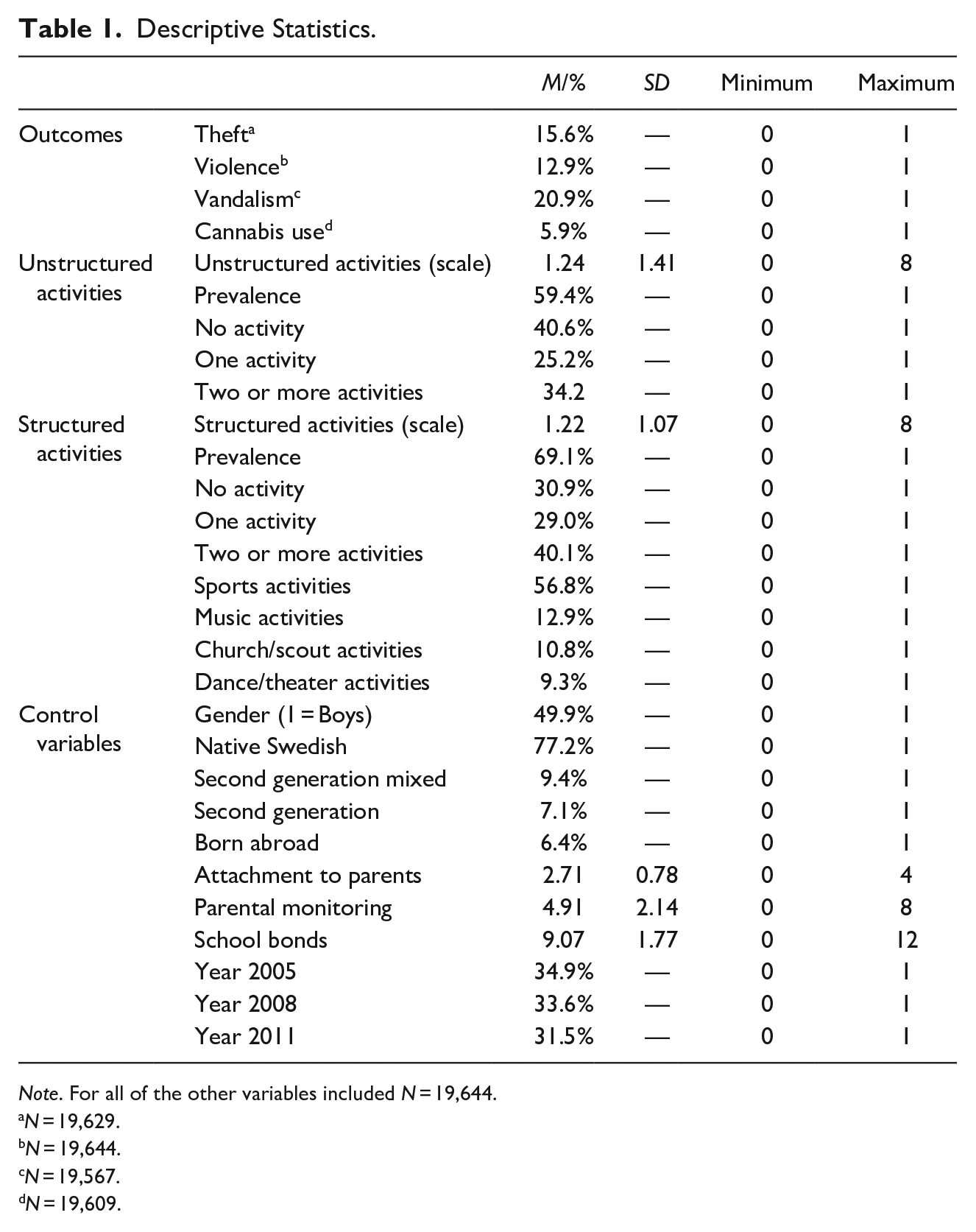
Note. For all of the other variables included N = 19,644.
N = 19,629.
N = 19,644.
N = 19,567.
N = 19,609.
Analytical strategy
We specify several linear probability models (LPM) and report robust standard errors clustered at the school level (Abadie et al., 2017). This model is increasingly considered to constitute an appropriate alternative to non-linear models such as logit and probit (Angrist & Pischke, 2009). The coefficients are interpreted as quantifying the change in the probability of the outcome examined (Wooldridge, 2016) and are interpreted as the change in the percentage point probability that
The modeling is performed in two steps. First, we estimate two models for each of the four outcomes. The first equation (used to test H1 and H2) is:

where
We then extended the analysis (to test H3) to include the two interaction terms, which gives us the following specification:

(2) where
Second, we estimate the two models (equations (1) and (2)) focusing on the various structured activities—sports, music, church/scouts, and dance/theater. The statistical analyses were conducted using Stata version 17.
Results
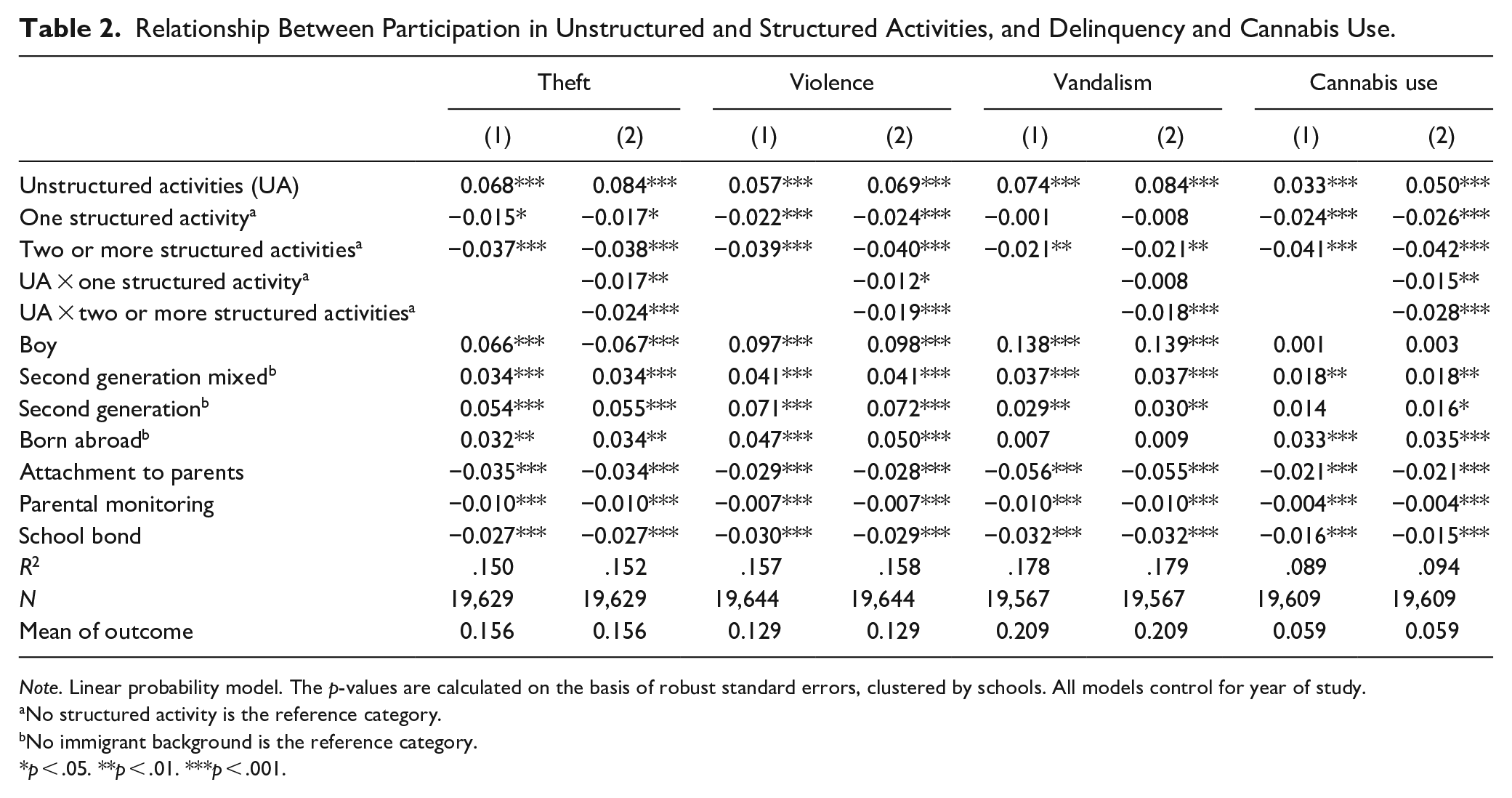
In order to examine our hypotheses, we present the regression models in Table 2. The results from the first model show that participation in unstructured activities is positively associated with all four of the outcomes. For example, unstructured activities are associated with a seven percentage point increase in the probability of vandalism. The results also show that participation in structured activities is negatively associated with the four outcomes. The more structured activities the respondents participate in, the lower the probabilities of theft, violence, vandalism, and cannabis use. For example, having one or two or more structured activities in relation to no activity is associated with a 1.5 and 3.7 percentage point decrease in the probability of theft, respectively.
Relationship Between Participation in Unstructured and Structured Activities, and Delinquency and Cannabis Use.
Note. Linear probability model. The p-values are calculated on the basis of robust standard errors, clustered by schools. All models control for year of study.
No structured activity is the reference category.
No immigrant background is the reference category.
p < .05. **p < .01. ***p < .001.
Results from the second model show that the interaction term for having one structured activity and participation in unstructured activities is negatively associated with theft, violence, and cannabis use. This indicates that the association between participation in unstructured activities and the three outcomes is stronger for those who do not participate in any structured activities. The interaction between unstructured activities and one structured activity is not statistically significant for vandalism, however. Similarly, the results show a negative interaction between participation in unstructured activities and having two or more structured activities, indicating that the association between unstructured activities with delinquency and cannabis use is more pronounced for those with no structured activities compared to those with two or more structured activities. Here the interaction is also significant in relation to vandalism.
Further, the results show that the coefficient for the interaction between participation in unstructured activities and having two or more structured activities is greater than that for the interaction with having only a single structured activity. This indicates that the association between participation in unstructured activities and the outcomes varies depending on the level of participation in structured activities; the more structured activities the respondents engage in, the weaker the association between unstructured activities and the four outcomes examined.
The control variables were in most cases associated with the different outcomes in the expected directions in both models, that is, being a boy and a member of the three immigrant groups are for the most part positively associated with the four outcomes, and attachment to parents, parental monitoring, and school bonds are all negatively associated with the outcomes.
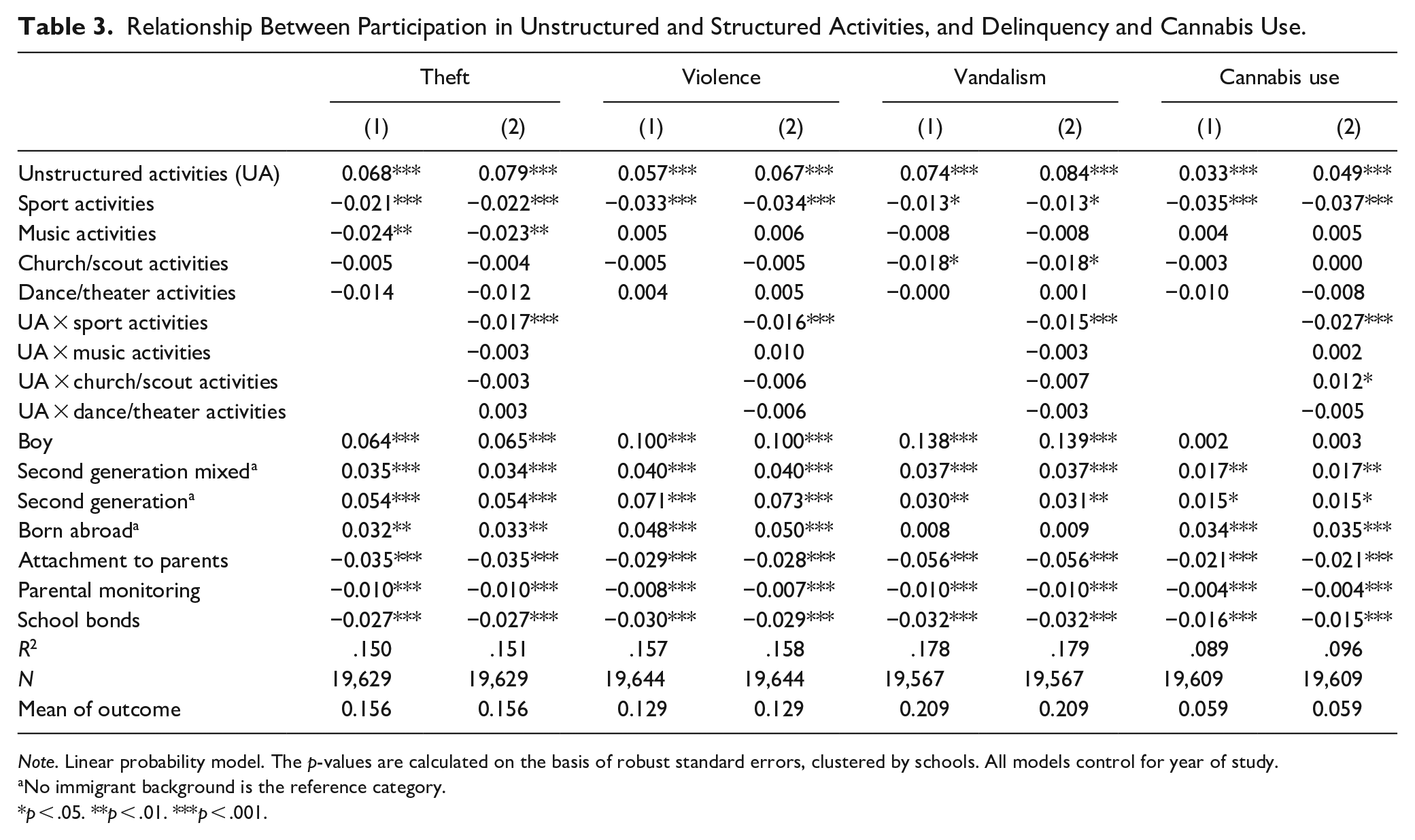
The next step of the analysis examines whether the association between participation in structured activities and the four outcomes varies across different types of structured activities, and also whether there is an interaction between unstructured activities and the different types of structured activities, see Table 3. The results show that participation in sports and music is negatively associated with theft (Model 1). On the other hand, only sports activities are negatively associated with cannabis use and violence, while participation in the other structured activities were not significantly associated with the outcomes. Finally, the results show that participation in unstructured activities mainly interacts with sports activities, and that this is the same for all four outcomes (Model 2). This indicates that participation in unstructured activities is significantly more strongly associated with delinquency and cannabis use among those who do not participate in sports activities compared to those who do participate in sports. The results also show that participation in unstructured activities interacts with church/scout activities in the association with cannabis use, indicating that the association between unstructured activities and cannabis use is slightly stronger for those with no structured activities compared to those who participate in church/scout activities.
Relationship Between Participation in Unstructured and Structured Activities, and Delinquency and Cannabis Use.
Note. Linear probability model. The p-values are calculated on the basis of robust standard errors, clustered by schools. All models control for year of study.
No immigrant background is the reference category.
p < .05. **p < .01. ***p < .001.
In order to visualize the interaction between participation in unstructured activities and sports activities, the interaction is plotted in Figure 1. The figure presents the predicted values of the four outcomes by levels of unstructured activities for those who are and those who are not involved in sports activities, respectively. As can be seen, the association between unstructured activities and delinquency and cannabis use respectively is more pronounced for those who do not participate in sports.
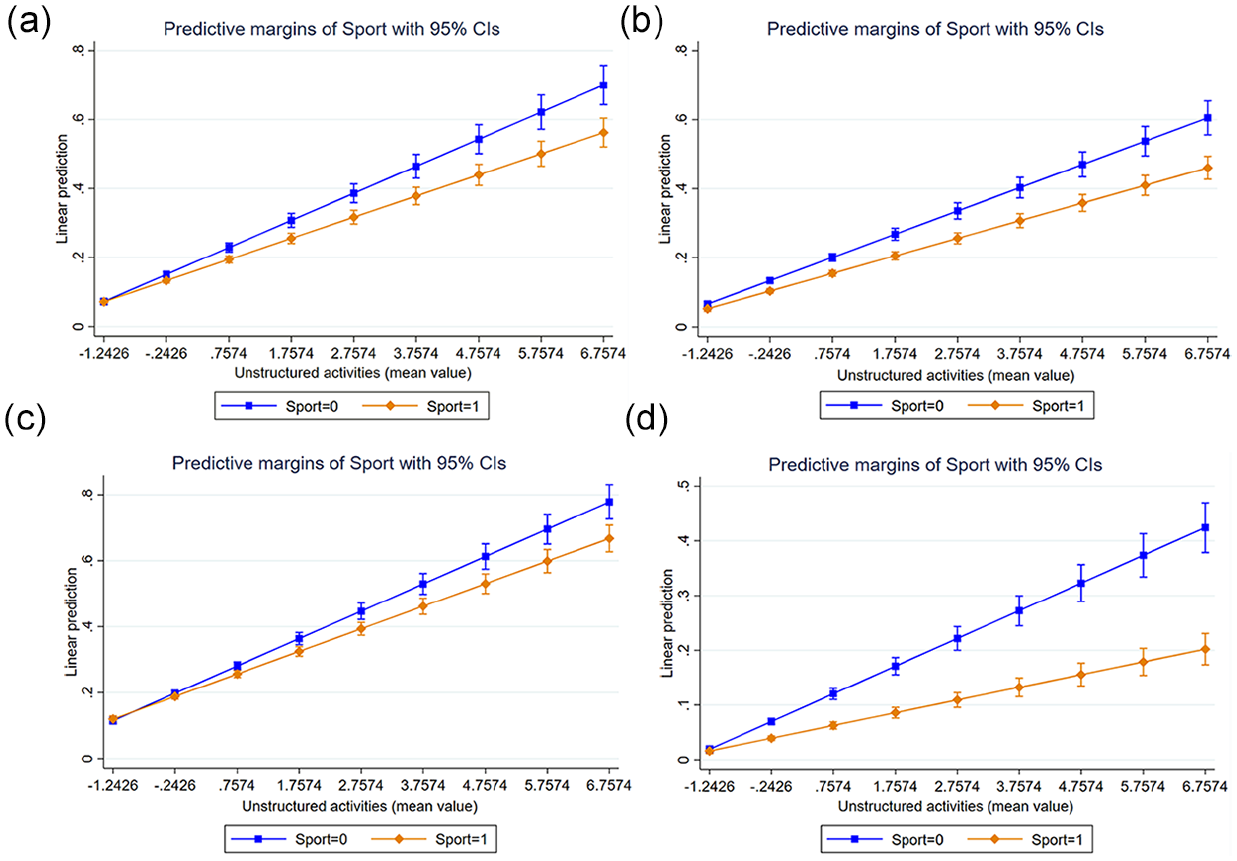
Interaction between unstructured activities (low value = few activities/high value = several activities) and sports activities (0 = no sport activity/1 = sport activity) in the association with predicted values of: (a) theft, (b) violence, (c) vandalism, and (d) cannabis use.
Sensitivity Analysis
To test the robustness of our main findings we have estimated several logistic regression models focusing on average marginal effects (AMEs). AMEs are comparable between models (Mood, 2010), and are useful for examining interactions (Hirtenlehner et al., 2022), since they produce results that are similar to those obtained using LPM (Mood, 2010). Our decision to focus on AMEs is based on an awareness of the shortcomings of logistic regression when comparing coefficients between models as a result of scaling sensitivity (Breen et al., 2018; Mood, 2010; Norton & Dowd, 2018) and of the fact that examining interactions using logistic regression may be problematic (Ai & Norton, 2003; Gomila, 2020).
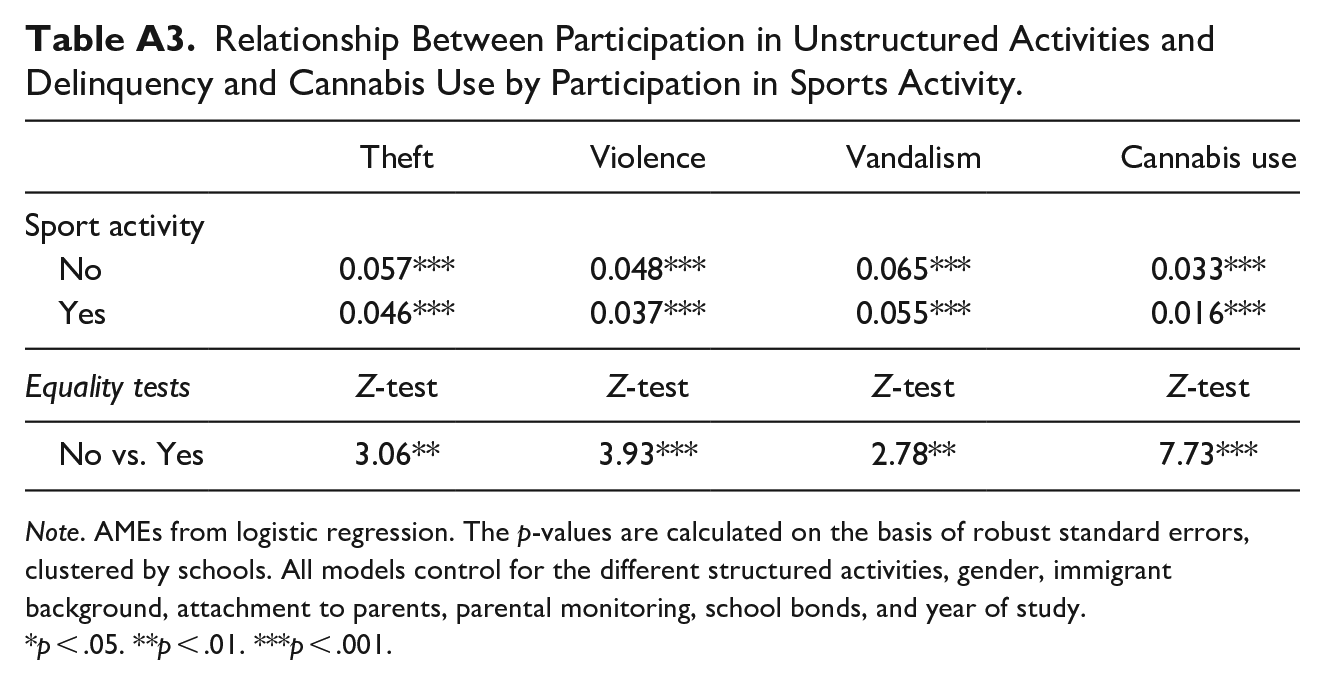
We examined whether there was an interaction between participation in unstructured and structured activities by estimating the models focused on the relationship between unstructured activities and the outcomes by different levels of involvement in structured activities—a statistical strategy that has been used by a number of scholars (e.g., Hirtenlehner et al., 2022; Schulz, 2016). We then compared the estimates for the unstructured activities between models using the Z-test (Paternoster et al., 1998; see also Hirtenlehner et al., 2022). These results showed that the association between unstructured activities and delinquency and cannabis use is significantly larger for those with no participation in structured activities than for those with one or two or more structured activities (Table A2). Finally, the association between unstructured activities and delinquency and cannabis use is also significantly stronger for those who do not participate in sports activities compared to those who do (Table A3).
Discussion and Conclusion
The current study has examined whether unstructured and structured activities (and specific structured activities) interact in their association with delinquency (theft, violence, and vandalism) and cannabis use. As far as we know, studies have only rarely focused on this interaction. To examine our three hypotheses, we used data from a large national self-report study on youth delinquency and cannabis use conducted in Sweden.
First, the expectation was to find participation in unstructured activities to be positively associated with delinquency and cannabis use. We found support for this hypothesis, indicating that the more unstructured activities young people are involved in, the higher the probability of being involved in delinquency and cannabis use. These findings are well in line with previous research (e.g., Hoeben et al., 2016; Hoeben et al., 2021; Osgood et al., 1996).
Second, the expectation was to find participation in structured activities to be negatively associated with delinquency and cannabis use. We found support for this hypothesis, with the results indicating that the more structured activities young people participate in, the lower the probability that they will engage in delinquency and cannabis use. These results are also in line with a number of previous studies (e.g., Mahoney & Stattin, 2000; Spillane et al., 2020). In line with some previous research, we also found that different structured activities are differently associated with our outcomes (Agnew & Petersen, 1989). The clearest finding in this regard was that sports activities constitute the only structured activity that is associated with all of the four outcomes examined. That participation in sports activities is negatively associated with delinquency and cannabis has also been noted in some previous studies (Jugl et al., 2021; Thorlindsson & Bernburg, 2006; Torstveit et al., 2018).
Third, the expectation was to find that unstructured activities interact with structured activities in the association with delinquency and cannabis use, indicating that participating in unstructured activities is more strongly associated with delinquency and cannabis use for those who are less engaged in structured activities. We found support for this hypothesis, with the results showing an interaction between participation in unstructured and structured activities in relation to all four outcomes. Finally, the results suggest that vandalism differs somewhat from the other outcomes examined, since the interaction is only significant when having two or more structured activities. These findings are also in line with some previous studies (cf. Mahoney & Stattin, 2000). We also examined whether there are differences in the way participation in unstructured activities interacts with participation in different types of structured activities, such as sporting activities and musical activities, in relation to delinquency and cannabis use. This is an issue that has not been examined before. Here we mainly found an interaction between levels of participation in unstructured activities and participation in sports activities in relation to delinquency and cannabis use.
This study has theoretical implications. It shows that both unstructured and structured activities are associated with delinquency and cannabis use in line with our theoretical framework. The results also show that the importance of unstructured activities varies across different individuals, depending on what else they do in their free time. Our findings show that if young people also spend time in structured activities and in structured sports activities in particular, they can spend time in unstructured activities without being as negatively “affected” by this. On the basis of social bond theory, this would be explained in terms of the structured sports activities acting as a social bond, and thus providing protection against the risks associated with participation in unstructured activities (Hirschi, 1969). Initially, we would expect the time adolescents spent in sports activities (i.e., involvement) to be associated with delinquency, since participation in sports leaves less time over for delinquent behaviors. However, involvement, and thus the time spent engaging in sports, cannot alone explain the interaction effect noted in the study. The time spent engaging in sports activities must also provide something more in order to decrease the likelihood of engaging in delinquency during the time that is not spent participating in sports but is instead spent in unstructured activities. On the basis of social bond theory, it is reasonable to speculate that participation in sports may also strengthen other aspects of the social bond, which could help us understand our findings. First, participation in sports may involve the development of emotional bonds (i.e., attachment) to other persons associated with these sports activities, that is, coaches and teammates. Second, the more an adolescent has invested time in sports activities, and the more the individual wants to continue with these activities, the more the individual has to lose by engaging in delinquency (i.e., commitment).
At the same time, our findings are less clear in relation to the effects of the other types of structured activities examined, and the reasons for this need to be studied further in future research. One possibility, for example, is that there are differences in other theoretically relevant factors, which have not been measured in this study, between the relatively large group of participants who reported participation in sports activities, and the smaller groups that reported spending time in, for example, musical activities and dance/theater. In this regard it is worth noting that a number of other studies have examined whether there is an interaction between participation in unstructured activities and other central theoretical variables, such as self-control (Hay & Forrest, 2008), morality (Gerstner & Oberwittler, 2018; Wikström et al., 2018), family relations (Janssen et al., 2017), and exposure to delinquent friends (Svensson & Oberwittler, 2010).
This study also has practical implications. From a policy perspective, the findings confirm the beneficial effects of participation in structured activities as a protective factor against involvement in delinquency and cannabis use. Importantly the findings also confirm that these benefits, at least for sports activities, extend beyond the time spent actually engaging in these activities, to provide a protective effect even in situations that lack both a structured agenda and the presence of adult supervision, and where the situational risk for delinquency and cannabis use is therefore greater.
The role of sports activities in particular is also of interest, both because it was the most widely reported form of structured activity in our data, and because this type of activity is also associated with health benefits and benefits in the areas of psychosocial and personal development (e.g., Malm et al., 2019). Organized sports activities appear also to be more widely accessible than other types of structured activities, such as music and dance, and a focus on encouraging more high-risk youth to engage in organized sports would appear to be a promising approach to risk reduction, and would also have additional benefits in other areas of these youths’ lives.
A number of limitations need to be addressed. First, our cross-sectional design constrains our ability to draw any causal conclusions. It would be useful for future research to examine the same hypotheses using longitudinal data. Second, we have not included any measures of online activities. It is important for future research to examine and include measures of young people’s online activities (e.g., Bunders & Weerman, 2020), since a number of studies have shown that there has been a decline in levels of participation in offline unstructured activities over time (Baumer et al., 2021; Svensson & Oberwittler, 2021). Third, the measures used for both unstructured and structured activities could be developed further to include other types of activities, and also to look in more detail at the effects of participation in team and individual sporting activities respectively (e.g., Badura et al., 2015). Fourth, the measures used focus only on participation in either unstructured or structured activities per se and not on the intensity of participation in these activities, which means that we are unable to examine possible differences in the effects of spending only a few or many hours in structured activities. It would be useful for future research to examine how the intensity of participation in different structured activities might serve to moderate the risks associated with involvement in unstructured activities. Finally, we lack measures of attachment, commitment, and belief in relation to structured activities. This is something that would be useful in future research, to further examine which factors lie behind the interaction effect noted here.
Despite these limitations, our study contributes to the research on structured and unstructured activities, delinquency, and cannabis use. We have examined our hypotheses using nationally representative self-report data on young people, and employing both LPM and logistic regression. Our findings indicate that different forms of leisure-time activities—unstructured and structured, and importantly, different types of structured activities—interact in different ways to affect the level of risk for delinquency and cannabis use among young people.
Footnotes
Appendix
Relationship Between Participation in Unstructured Activities and Delinquency and Cannabis Use by Participation in Sports Activity.
| Theft | Violence | Vandalism | Cannabis use | |
|---|---|---|---|---|
| Sport activity | ||||
| No | 0.057*** | 0.048*** | 0.065*** | 0.033*** |
| Yes | 0.046*** | 0.037*** | 0.055*** | 0.016*** |
| Equality tests | Z-test | Z-test | Z-test | Z-test |
| No vs. Yes | 3.06** | 3.93*** | 2.78** | 7.73*** |
Note. AMEs from logistic regression. The p-values are calculated on the basis of robust standard errors, clustered by schools. All models control for the different structured activities, gender, immigrant background, attachment to parents, parental monitoring, school bonds, and year of study.
p < .05. **p < .01. ***p < .001.
Declaration of Conflicting Interests
The author(s) declared no potential conflicts of interest with respect to the research, authorship, and/or publication of this article.
Funding
The author(s) received no financial support for the research, authorship, and/or publication of this article.
