




Abstract
Despite extensive theory and research on the geography of crime, few studies have examined the geography of commercial sex and sex trafficking through a criminological lens. As such, this study explores how social disorganization and routine activities help explain the geography of commercial sex venues, specifically illicit massage businesses (IMBs) that host commercial sex. Because IMBs have also been linked to sex trafficking, understanding which environmental contexts are conducive to their presence may also help identify sex trafficking premises. Findings from hierarchical logistic regression models indicate that both theories point to significant correlates of IMB placement in census tracts and cities, yet neither theory provides a sufficient explanation alone. Implications for future research and policy will be discussed.
Keywords
Introduction
Understanding the geographic patterning of commercial sex and sex trafficking is essential for targeted community outreach, crime prevention and crime control strategies. Although research on the geography of commercial sex and sex trafficking operations is limited (Daniel-Wrabetz & Penedo, 2015; Lopez et al., 2020; Mletzko et al., 2018), recent work has begun to suggest that there is a geographic patterning to these operations. Specifically, the locations of commercial sex and sex trafficking operations have been related to ecological and situational features of specific areas such as counties (Huff-Corzine et al., 2017; Lopez et al., 2020), census tracts (Chin et al., 2015, 2019; Crotty & Bouché, 2018), or block groups within cities (Mletzko et al., 2018). While commercial sex and sex trafficking are different practices, the vulnerability of the commercial sex industry to sex trafficking operations, which involves sexual exploitation through force, fraud, or coercion (Trafficking Victims Protection Act, TVPA, 2000), is widely recognized (De Vries & Farrell, 2019). Knowing the locations where commercial sex occurs may also be used to identify the premises that could serve as locations for sex trafficking.
Despite growing empirical support for a geographic patterning of commercial sex and sex trafficking operations, few studies have utilized criminological theory to explain this patterning further (see, for a notable exception, Mletzko et al., 2018). Considering the interdependence of most crimes with place and human activities (Hawley, 1950), a criminological perspective can help identify other geographical correlates of crime and offers theoretically-sound suggestions for why certain areas are more receptive to crime and venues hosting illicit practices.
Against that background, this study draws on criminological theories on the ecological and situational context of crime to examine the geography of illicit massage businesses (IMBs). IMBs are here defined as storefronts that host commercial sex—which is illicit in the U.S.—under the guise of legitimate massage (Crotty & Bouché, 2018; Polaris, 2018). Although not all massage parlors are explicitly sexually oriented, this study focuses on a sample of 1,368 IMBs where sexual services were offered according to online review data (explained further below). Notwithstanding differences in moral views, commercial sex in IMBs is connected to broader concerns around crimes and victimizations that have been observed in and around IMBs. For example, there is anecdotal evidence that IMBs host a wider scope of crimes such as sex and labor trafficking, assault and violence, homicides, and robberies (Dank et al., 2014; Polaris, 2018). In addition, prior research has demonstrated that the presence of IMBs can increase local levels of crime and disorder (Huff et al., 2019), similarly to how risky facilities such as bars and restaurants can have a crime-generating effect by attracting motivated offenders (Bowers, 2014; Eck et al., 2007).
There are particularly elevated concerns about human trafficking in IMBs. The largest group of citizen calls to the National Human Trafficking Hotline in 2019 concerned IMBs (National Human Trafficking Hotline, 2020). These citizen concerns about human trafficking have triggered a series of police responses using tactics similar to those that previously had been applied to control vice districts (see Farrell & Cronin, 2015), including shutdowns of IMBs, sting operations, and arrests of buyers, managers, and anyone else perceived to engage in illicit behaviors (de Vries, 2020). Despite widespread interventions against human trafficking, scholars, and practitioners have criticized the effectiveness of traditional vice tactics for not being victim-oriented nor strategically targeted at the key drivers of the problem (e.g., Farrell et al., 2019; Wilson & Dalton, 2008). Effective policing tactics are problem-oriented and target the physical and social contexts in which crime occurs (Weisburd & Eck, 2004).
Motivated in part by the limited effectiveness of current efforts against human trafficking in IMBs, this study seeks to guide more effective and targeted strategies by providing a comprehensive overview of the geographic features that are associated with the presence of IMBs. The emphasis on environmental and ecological features is an essential departure from prior research that has focused on individual-based factors for engaging in commercial sex or sex trafficking (e.g., Choi, 2015). IMBs that host commercial sex are unique venues because they are difficult to identify solely based on their exterior appearances. To then minimize the potential for IMBs to host or exacerbate crime and victimizations, it is essential to know where they are located. Before outlining further details on this study, the following sections begin with a review of the relevant background and theory.
Background and Theoretical Perspectives
Geographic Patterns of IMBs
As much as a social and physical environment can impact where commercial sex and sex trafficking occur (Huff-Corzine et al., 2017; Lopez et al., 2020; Mletzko et al., 2018), a few recent studies suggest that IMBs hosting these practices also exhibit a spatial and geographic clustering. For example, a recent study by Chin et al. (2023) using the locations of 916 online-promoted IMBs in New York (NYC) and Los Angeles (LAC) linked various geographic features of census tracts to the placement of IMBs. IMBs were more likely located in tracts with a higher proportion of Asian and Hispanic residents (in LAC)—perhaps because IMBs frequently employ Asian and Hispanic staff—or tracts with higher median incomes, proximity to a business district, and smaller average household size (in NYC). The location of IMBs in higher-income areas in NYC contradicts earlier work using similar data by Chin et al. (2015), which reported an association between high poverty rates and the presence of IMBs in LAC and Orange Counties in California. The recent placement in higher-income areas might be explained by an online facilitation of the sex industry through reviews and classifieds, which has allowed commercial sex venues to move to areas where demand for illicit services is anticipated to be higher (Chin et al., 2023, p. 5; see also Murphy & Venkatesh, 2006).
Another study by Crotty and Bouché (2018) examining the locations of 228 IMBs in census tracts in Houston (Texas) underscored the role of similar neighborhood factors, finding a clustering of IMBs in tracts with a relatively larger Asian population, smaller average household sizes, and greater employment density (although with lower education, and fewer health care service and manufacturing industry employees). While not controlling for land use, the authors conclude that several of these factors may also relate to an urban infrastructure because IMBs oftentimes operate near business districts and retail establishments (Dank et al., 2014; Polaris, 2018), where there are often smaller average household sizes and less manufactory employment.
It follows from these prior studies that several ecological and situational features may determine the placement of IMBs. Yet, none of the above studies has been guided by criminological theory, which would point to additional socio-demographic factors or choice-structuring features such as land use or the presence of law enforcement.
The Theoretical Role of the Ecological and Situational Environment
This study considers the applicability of two fundamental theories in research on the geography of crime and crime-hosting facilities: social disorganization and routine activity theory. These theories were selected primarily because several of the aforementioned geographic correlates for IMB locations align with components of both theories and recent work on the geography of sex trafficking further underscores their combined relevance (Mletzko et al., 2018).
Social disorganization theory posits that crime occurs in neighborhoods with increased social barriers and limited neighborhood relations and interactions (Shaw & McKay, 1942, 1969). Neighbors would then be less likely to act upon a set of shared values to maintain effective social controls (Bursik, 1988; Sampson & Groves, 1989). Along similar lines, Sampson et al. presented collective efficacy as the critical link between social disorganization and crime. Higher levels of collective efficacy would reduce crime through a “social cohesion among neighbors combined with their willingness to intervene on behalf of the common good” (Sampson et al., 1997, p. 918). Levels of social disorganization are commonly measured through socio-demographic proxy indices such as concentrated disadvantage and socioeconomic status, racial/ethnic heterogeneity, and residential instability (Bursik, 1988; Kubrin & Weitzer, 2003; Shaw & McKay, 1942, 1969). These factors can reduce social cohesion among neighborhood residents, making it less likely that they collectively call out crime (see, for a review, Kubrin & Wo, 2016).
While factors such as poverty or familial and residential instability have been identified as risk factors for sex trafficking (e.g., Choi, 2015), less is known about the association between neighborhood-level features of social disorganization and the likelihood of commercial sex or sex trafficking operations. An exception is a recent study by Mletzko et al. (2018), who used data about 235 sex trafficking offenses registered by the Austin Police Department (APD) between 2013 and 2015. Their study links higher levels of concentrated disadvantage at the block-group level to more registered sex trafficking offenses. However, residential instability and racial/ethnic heterogeneity had no significant effects.
Social disorganization theory offers potential explanations for the geography of venues that host commercial sex or sex trafficking, perhaps in a similar way to how the theory’s relevance extends to explanations of what a neighborhood’s residents may perceive as undesirable establishments such as sexually oriented businesses (Edwards, 2010) or liquor stores (Snowden, 2016). Low levels of community investment and informal social control may explain why residents in socially disorganized neighborhoods are less likely to report concerns about “unwanted facilities” as opposed to residents in socially organized neighborhoods who may object against their presence. Along similar lines, social disorganization can affect the placement of sexually oriented businesses through an anticipated likelihood for residents to object (Edwards, 2010; see also Hubbard et al., 2013; Prior & Crofts, 2012). Similarly, commercial sex venues tend to provoke strong local reactions (Hubbard et al., 2013), with concerns around commercial sex as a “nuisance” problem (Lopez et al., 2020). As such, the placement of IMBs in areas with smaller household sizes may “indicate massage parlors’ avoidance of areas where community opposition might be higher” (Chin et al., 2023, p. 12). However, socio-economic disadvantage has not consistently been linked to the placement of IMBs, underscoring the need to consider alternative theoretical explanations.
Rather than focusing on structural disadvantage and informal social control, crime opportunity theories—which include routine activity theory—explain the nonrandom distribution of crime through geographic differences in situational factors that influence a decision to commit a crime (Cullen, 2010; Wilcox & Cullen, 2018). Specifically, routine activity theory places crime events within a triangle of actors that include motivated offenders, suitable targets, and capable guardians such as police or others with the ability to exert formal social control. Crimes occur when the (routine) behaviors of motivated offenders and suitable targets converge in time and space under weak capable guardianship (Cohen & Felson, 1979; Felson, 1987; Felson & Clarke, 1995; Felson & Cohen, 1980), for example when both offenders and targets are likely to be co-present in busy, retail areas where their presence raises little suspicion.
Routine activity theory may explain the placement of illicit storefronts such as IMBs as it has more broadly been used to explain the geography of illicit retail markets. Prior work by Eck (1995a) suggests that areas attract illicit retail markets when they are known to buyers, sellers, and others using illicit services (e.g., storefront managers), yet suffer from limited oversight by local guardians and place managers such as landlords turning a blind eye to crime (Eck, 1995a, 1995b; Felson, 1987). Eck thus emphasizes the goal-seeking behavior of five different actors: buyers, sellers, others obtaining services or earning revenue through illicit means, capable guardians, and place managers. The commercial sex industry involves similar social actors who occupy space as they negotiate in time and place (Hubbard & Sanders, 2003; Lopez et al., 2020).
Most empirical research has tested routine activity theory, or other crime opportunity theories, through the presence or absence of spatial and physical cues. To illustrate, the presence of highways has been identified as a physical feature that is conducive to the presence of commercial sex (Lopez et al., 2020) and sex trafficking (Mletzko et al., 2018). Highways offer buyers easy access, familiarity with the area, and relative anonymity because of increased activity. The importance of ease of access also aligns with crime pattern theory, another crime opportunity theoretical perspective that argues that spatial and physical cues influence a would-be offender’s assessment of high likelihood of rewards of engaging in crime against low risk and limited efforts (Brantingham & Brantingham, 2013).
Moreover, the clustering of IMBs in areas that are easily accessible or close to business districts and retail centers (Chin et al., 2023; Crotty & Bouché, 2018) speaks to a broader theoretical argument that crime opportunities emerge along major nodes of activity where people naturally concentrate (Brantingham & Brantingham, 2013; Felson, 1987). While agglomeration effects might generally affect the location decisions of any legitimately operating retail business, crime venues also require limited oversight of capable guardians (Brantingham & Brantingham, 2013; Felson, 1987). The illicit nature of the commercial sex industry in the U.S., along with concerns about human trafficking in IMBs, suggests that IMBs may be in areas with little police presence or where landlords neglect the fact that their buildings are used for illicit purposes.
The Present Study
This study utilizes unique online location data (see below) to examine whether the placement of IMBs that host commercial sex and potentially sex trafficking is intricately linked to physical environments in a way that aligns with social disorganization and routine activity theoretical perspectives. While these theories have different explanatory and geographic foci, recent work has begun to explore their shared emphasis on geographic factors contributing to crime. In particular, neighborhood dynamics contextualize and supplement crime opportunity theories in explaining where crime occurs (Weisburd et al., 2014; Wilcox & Land, 2017). This study posits that a theoretical integration may help situate the placement of IMBs in a context of supply and demand, minimum suspicion by authorities, and little informal social control.
Consistent with theoretical expectations, the analyses examine three interrelated hypotheses. First, it is hypothesized that the placement of IMBs is more likely in socially disorganized neighborhoods—as observed through higher levels of concentrated disadvantage, residential instability, racial/ethnic heterogeneity, and income inequality. Higher levels of social disorganization may reduce informal social control, which can imply that residents are less likely to object against the presence of facilities hosting commercial sex (Edwards, 2010; Hubbard et al., 2013; Prior & Crofts, 2012). Second, given the market aspects of IMBs, it is hypothesized that IMBs are in retail centers or in proximity to a highway where buyer demand is anticipated to be higher. Third, it is expected that police have a guardianship role and that their presence in neighborhoods or cities reduces the local likelihood of IMBs.
These hypotheses are examined through online location data and spatial and geographic measures in a multilevel approach that models the placement of IMBs as a function of both neighborhood- and city-level features. While prior work has begun to address the association between neighborhood-level factors and IMB placement, the city-level context is important because the geography of commercial sex, sex trafficking, and the facilities hosting these practices can differ across cities (see e.g., Chin et al., 2023). Moreover, the response to IMBs is often initiated by city-level authorities and involves strategies such as sting operations or police investigations into sex trafficking or related crimes (Polaris, 2018).
Methods
Study Sites
To ensure geographical variation in contextual dynamics and urban infrastructure, data were collected for three states that differ in at least the number and size of cities, population density, and economic activity. All three states, Massachusetts, Washington, and Texas, have a substantive number of IMBs relative to other states and are major hubs of commercial sex and sex trafficking according to the number of citizen calls to the national hotline (Crotty & Bouché, 2018; Polaris, 2018; de Vries, 2020). Authorities in all three states have devoted significant resources to locate and respond to crime in IMBs, although the specific response to IMBs differs by state due to different legislations, training, and prioritizations (Polaris, 2018; de Vries, 2020). As a most obvious example, Massachusetts state law omits the components of force, fraud, or coercion that define human trafficking means in federal legislation, broadening the scope for human trafficking charges in comparison to other states that may target human trafficking in IMBs through alternative statutes (Coreno, 2021). Few strategies against IMBs are guided by rigorous analyses about the areas that are most likely to attract them, a gap in the current literature that this study seeks to address.
Data
Similar to prior research on the locations of illicit massage businesses (Chin et al., 2023; Crotty & Bouché, 2018; Huff et al., 2019), information about the specific locations of IMBs was extracted from a popular, publicly-accessible, and comprehensive national reviewboard. 1 Customers of commercial sex (“Johns”) use this reviewboard to search by state and city for IMBs in their area and leave reviews with graphic details about the sexual services received and other details about the costs, the venue, judgments about the appearance and perceived age and racial and ethnic backgrounds of IMB staff. While recognizing that online user-based samples do not represent all IMBs, the digitized and detailed nature of the current sample helps identify specifically those IMBs where the presence of illicit commercial sex was confirmed in customer reviews. As such, all IMBs in the current sample were reviewed for illicit sexual services. In addition, prior research has analyzed additional (implicit) concerns about human trafficking in the reviews for a substantive number of IMBs on this or alternative websites (e.g., Borrelli & Caltagirone, 2020; de Vries & Radford, 2022). More generally, online location data offer an alternative approach to using official records that may be biased by such things as expertise, willingness, capacity, or prioritization (Cockbain et al., 2020; de Vries & Radford, 2022), a limitation that particularly affects research on low-visibility crimes of which the geographies are typically difficult to discern. It is for this reason that user reviews and web forums are increasingly common in research on hard-to-reach populations, including buyers of commercial sex or potentially trafficked persons (e.g., Holt & Blevins, 2007; Holt et al., 2014).
The locations were obtained for IMBs with at least one customer review between 2015 and 2017 and in cities with a minimum population size of 50,000 to align with prior work on the situational and ecological context of crime that has focused on medium-sized and large cities. The initial sample size included a total of 1,423 IMBs in 115 cities in Massachusetts (N = 201), Texas (N = 941), and Washington (N = 281). The addresses of 99% of the facilities were successfully geocoded to coordinates and then to the 2017 census tracts and place shapefiles from the U.S. Census Bureau. Census tracts are small geographic areas with an average population size of about 5,000 residents and are frequently the unit of analysis for ecological theories of crime, including the studies mentioned above on IMBs (Chin et al., 2015, 2019; Crotty & Bouché, 2018). 2
Location data about IMBs were merged with geographically and, as far as possible, time-matching geospatial and population data for census tracts and cities. On census tract level, this included (1) demographic and socio-economic data from the 2013 to 2017 American Community Survey (ACS), which was downloaded from the National Historical Geographic Information System (Manson et al., 2018); (2) spatial adjacency and distance measures calculated from census tract shapefiles; (3) geographical coordinates of police stations in the three states using Google’s Place Application Programming Interface (API), which were geocoded to census tract shapefiles; and (4) OpenStreetMap (OSM), an open-source and collaborative platform containing geospatial data, to obtain comparable land use information across the three states. At city-level, information about population size was also obtained through the 2013 to 2017 ACS, and merged with information about the number of full-time police employees with arrest power from the 2017 Census of Governments, 3 and crime arrest data from the 2017 Uniform Crime Reporting (UCR) Program (Kaplan, 2020). After accounting for missing data on geographic information, the analytical sample size involved a total of 1,368 IMBs, 4,318 tracts, and 104 cities. Institutional Review Board approval was obtained at Northeastern University (IRB 17-11-26).
Outcome Measure
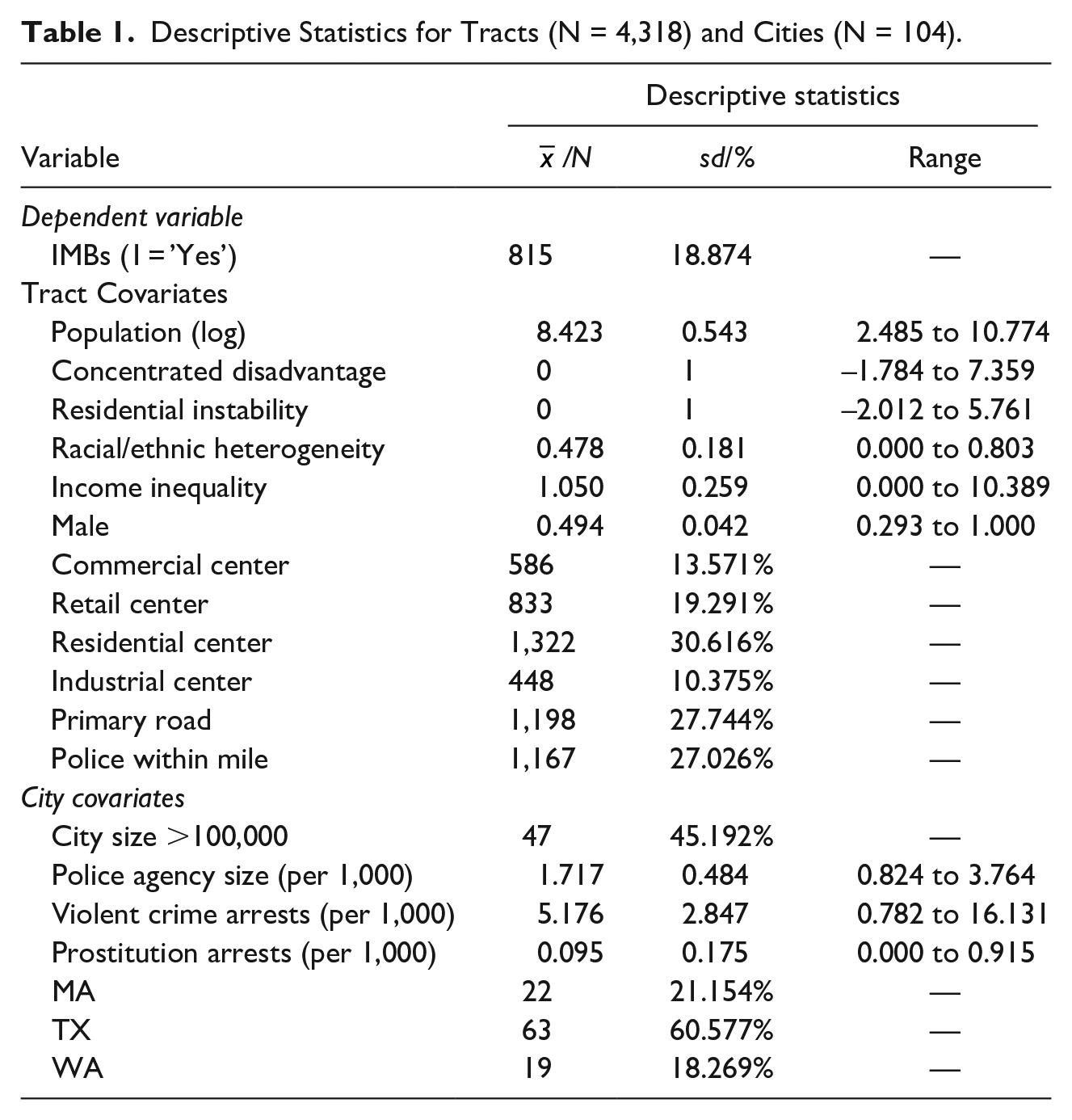
The dependent variable represents whether or not a census tract had at least one IMB where commercial sex was reported between 2015 and 2017 (1 = “Yes”). From the 4,318 census tracts, a total of 18.87% (n = 815) had at least one IMB (see Table 1). Most of these occupied census tracts had only one IMB (n = 534), compared to census tracts that had two (n = 169) or three or more (n = 112) IMBs. 4
Descriptive Statistics for Tracts (N = 4,318) and Cities (N = 104).
Tract-Level Covariates
Social Disorganization: The analyses included four measures as proxies for social disorganization: Concentrated disadvantage, residential instability, racial/ethnic heterogeneity, and income inequality. Concentrated Disadvantage was calculated by standardizing the average sum of the following standardized variables: percent families with an income below the poverty level; percent female-headed households with children; and percent of the tract population age 25 and older that was unemployed. Cronbach’s alpha between these three standardized items was .77 (95% CI [0.76, 0.78]). Residential Instability was calculated similarly using the following standardized variables: percent renters and percent of the population that changed houses in the past year (Cronbach’s alpha was .78, 95% CI [0.76, 0.79]). Racial/Ethnic Heterogeneity was calculated as 1−∑π2, where π refers to the proportion of each racial or ethnic group (Blau, 1977). A higher index represents a greater racial/ethnic heterogeneity, which for the current sample ranged between 0 (tract contains only one racial or ethnic group) to 0.803 (substantive population heterogeneity). The average was 0.478 (sd = 0.181). Income Inequality was included as the standard deviation of the household income in the past year, which was calculated using the midpoints of each census-provided income bin. These midpoints were log-transformed and multiplied by the number of observations in each bin such that means and standard deviations could be calculated (see Hipp & Kubrin, 2017). A higher standard deviation represents greater variation in mean income levels within census tracts. The average was 1.050 (sd = 0.259).
Routine Activities: Four theoretical constructs were created based on routine activity theory or broader crime opportunity theoretical perspectives. First, the percentage Male of a population was included as a proxy for potential buyer demand for sexual services in IMBs (
City-Level Covariates
Several covariates were included on city level. First, the analyses controlled for City Size, specifically whether or not (1 = “Yes”) a city had a population of 100,000 or more. This variable was included to control for nesting of IMBs in smaller cities, where theoretical mechanisms might work differently compared to larger cities that have received more empirical attention. The sample includes 47 large cities versus 57 medium-sized cities. Furthermore, Agency Size was included as the total full-time police officers with arrest power per capita, which on average was 1.717 officers per capita (sd = 0.484). In addition, Violent Crime Arrest Rates were only available at the city level and included as the per capita arrests for murder, manslaughter, rape, robbery, and assault (
Analytical Approach
Hierarchical generalized linear modeling for binary outcomes was used to examine the placement of IMBs as a function of tract and city-level variables. Multilevel techniques do not violate the assumption of independent error terms (Raudenbush & Bryk, 2002) and are more appropriate than fixed-effects models that would not allow for estimating city-level effects. To validate the relevance of a multilevel model, an unconditional model, without the independent variables, was estimated to assess whether the odds of an IMB in a census tract (level one, i) depends on the city (level two, j), such that:



Here, the error terms are denoted with r for the census tracts and µ
Next, the impact of level-one (X) and level-two (Z) variables will be estimated as follows:

Here, T refers to the census tracts for which the impact of variables X will be estimated. C refers to the cities for which the contextual effect of variables Z will be estimated. Continuous variables were centered to avoid multicollinearity between the independent variables and the intercept and to facilitate interpretation. Each main effect can be interpreted as the effect of a variable when other variables were at their means of zero. Analyses were conducted in R (R Core Team, 2021) using the lme4 package for multilevel modeling (Bates et al., 2015).
Results
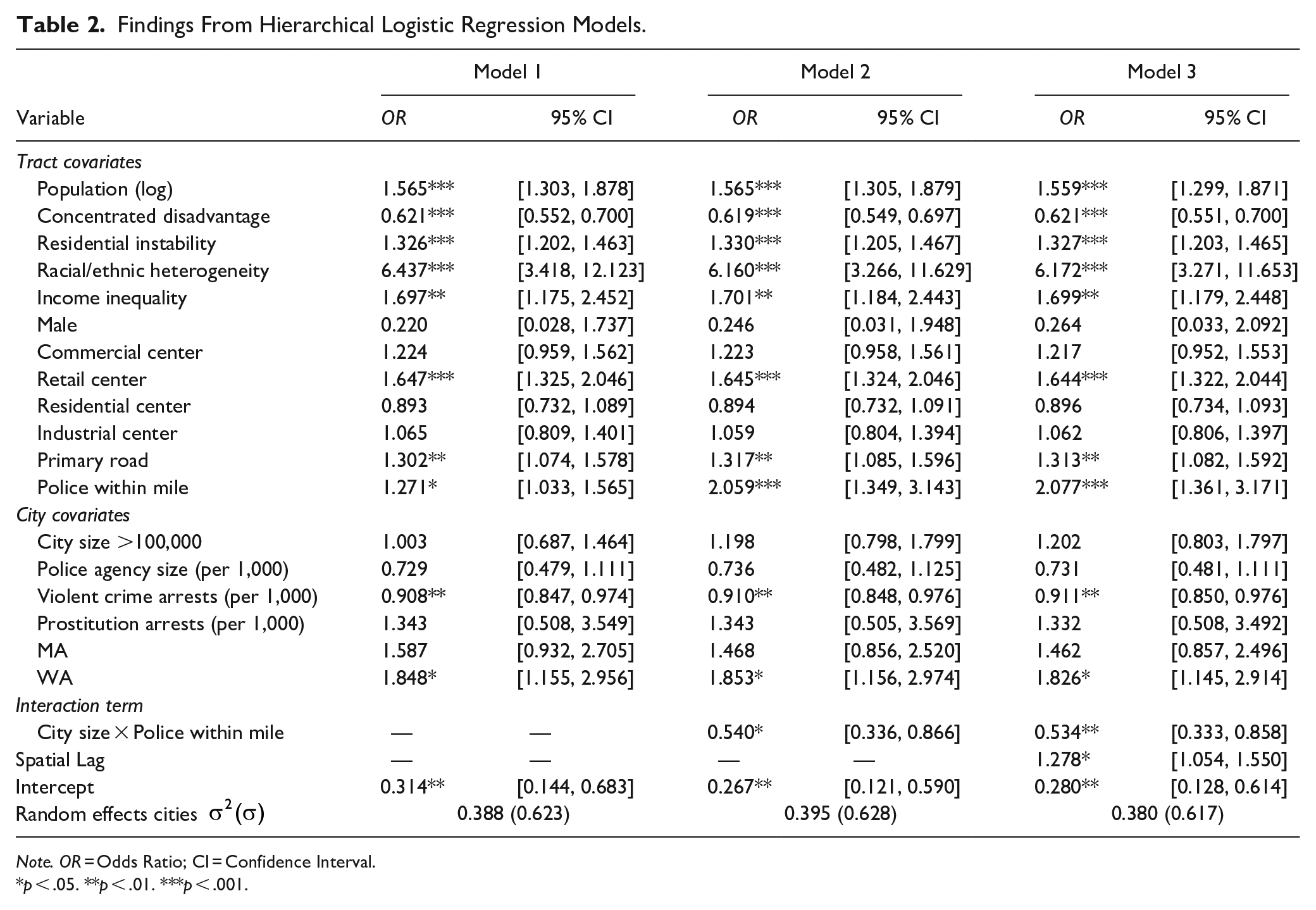
Table 2 presents the Odds Ratios (ORs) and 95% confidence intervals from the multilevel models. ORs above one are interpreted as an increased likelihood of IMBs for a census tract in a given city. ORs less than one indicate a decreased likelihood of IMBs. Model 1 presents the findings of a mixed model (equation 4). Largely consistent with social disorganization theory (hypothesis 1), the odds for IMB placement were between 1.5 and 6 times higher in census tracts with increased population (OR = 1.565, 95% CI [1.303, 1.878]), residential instability (OR = 1.326, 95% CI [1.202, 1.463]), racial/ethnic heterogeneity (OR = 6.437, 95% CI [3.418, 12.123]), and income inequality (OR = 1.697, 95% CI [1.175, 2.452]). An increase in racial and ethnic heterogeneity had a particularly substantial role as it was associated with a 544% increase in the odds for IMB placement. 6 However, the negative impact of concentrated disadvantage contradicts social disorganization theory. IMBs were, in fact, less likely to be found in disadvantaged areas, with a decreased chance of 38% (OR = 0.621, 95% CI [0.552, 0.700]). 7
Findings From Hierarchical Logistic Regression Models.
Note. OR = Odds Ratio; CI = Confidence Interval.
p < .05. **p < .01. ***p < .001.
Several other findings are consistent with routine activity theory (hypothesis 2). First, the odds for IMB placement were 65% higher in census tracts with more retail activity than the average in a city (OR = 1.647, 95% CI [1.325, 2.046]). Second, census tracts that were easily accessible through primary roads also had a significant 30% increase in the odds to have IMBs relative to those that did not directly intersect with a highway (OR = 1.302, 95% [1.074, 1.578]). However, the impact of police presence is less clear (hypothesis 3). Surprisingly, a police station within a mile distance increased the odds for a census tract to have IMBs with 27% (OR = 1.272, 95% CI [1.033, 1.565]. This effect was less pronounced in large cities, which follows from Model 2 that adds an interaction term between a police station within a mile distance and a binary variable representing city population size that was larger than 100,000. Figure 1 presents the marginal effects of the interaction term to aid the interpretation of this effect. In small cities, the probability for IMB placement was higher in census tracts within a mile distance of a police station. In large cities, the difference in probabilities for IMB placement within or beyond a mile distance of a police station was negligible. Similarly, a larger city-level police force with arrest power was not significantly associated with IMB placement. An important variable at the city level was violent crimes per capita, which decreased the odds for a tract to have IMBs with 9% (OR = 0.908, 95% CI [0.847, 0.974]). Lastly, cities in Washington State had 85% increased odds to have IMBs relative to Texas (OR = 1.848, 95% CI [1.155, 2.956]). There were no significant differences between Massachusetts and Texas.
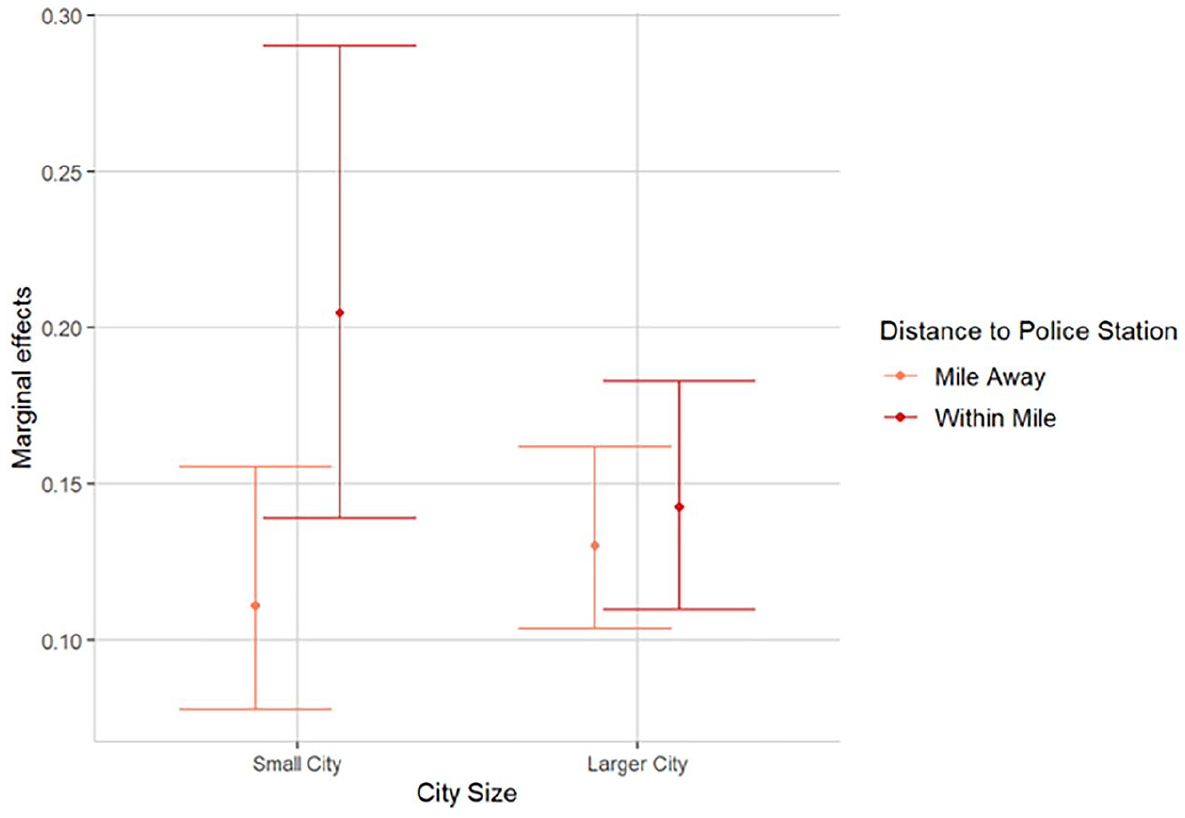
Marginal effects of the interaction between police mile away and city size.
To assess the rigor of the findings, a spatial lag of the residual errors from Model 2 (with the interaction term) was added in sensitivity analyses to control for a dependence of errors in the regression models. To determine if spatial autocorrelation between census tracts was present, a Moran’s I using the residual errors was calculated for each city separately. Spatial weight matrices were created using the spdep package in R (Bivand et al., 2013) and based on queen contiguity-based weights that consider tracts sharing a common edge or vertex as neighboring tracts. Significant spatial autocorrelation, which would occur when census tracts with IMBs would often be adjacent to each other, was identified in few cities (n = 4) and generally weak or modest (Moran’s I ≤ 0.249). However, a spatial lag in the regression model was associated with 28% increased odds for a census tract to have IMBs (OR = 1.278, 95% CI [1.054, 1.550]. This spatial effect had a negligible impact on the significance or effect sizes of other variables.
Discussion
This study examined the applicability of social disorganization and crime opportunity theoretical perspectives, specifically routine activity theory, to the geography of IMBs hosting illicit commercial sex. Nearly a fifth of a total of 4,318 tracts across 104 cities had IMBs. Hierarchical logistic regression models produced two general sets of findings regarding the geographic distribution of IMBs. First, the odds for a census tract in an average city to have IMBs were higher for census tracts with greater racial/ethnic heterogeneity, residential instability, and income inequality. These findings imply that census tracts with higher levels of social disorganization and deprivation were more receptive to IMBs, perhaps because social disorganization increases social barriers and reduces informal social control, which can make it less likely that citizens object against crime or crime-hosting facilities (Bursik, 1988; Sampson & Groves, 1989; Shaw & McKay, 1942, 1969). This explanation aligns with prior research suggesting that community opposition can indeed affect sexually oriented businesses (Edwards, 2010) or the placement of facilities hosting commercial sex (Chin et al., 2023).
However, concentrated disadvantage, a key pillar of social disorganization theory, had a theoretically (albeit perhaps not empirically) unanticipated impact. Notably, the odds for census tracts to have IMBs were lower in disadvantaged tracts. As such, the placement of IMBs was more likely in more advantaged areas, where collective efficacy tends to be higher (Sampson, 2006; Sampson et al., 1997). While this findings contradicts empirical research on the geography of commercial sex and sex trafficking operations (e.g., Mletzko et al., 2018), including an earlier study that found a significant association between poverty rates and the placement of IMBs (Chin et al., 2015), it supports more recent research that reported more IMBs in census tracts with higher median incomes (Chin et al., 2023; Crotty & Bouché, 2018).
It is possible that the promotion of commercial sex through online classifieds and reviews, which was the case for all IMBs in this study’s sample, explains the discrepancy between studies regarding the role of concentrated disadvantage. For example, prior qualitative research has described how buyers use national reviewboards for commercial sex as a new source to identify illicit opportunities in areas that match their interests and routines (Blevins & Holt, 2009; Holt & Blevins, 2007). Because buyers of commercial sex can now rely on online reviews to separate illicit venues from their legitimate counterparts, an online promotion allows commercial sex venues to move to areas where demand is anticipated to be higher such as higher-income areas (Chin et al., 2023; Murphy & Venkatesh, 2006). While demand might be higher in advantaged areas, more research is needed to understand whether potential unawareness or benign neglect toward crime and potential victimizations in IMBs bypasses the informal social control mechanisms that keep out other illicit practices in advantaged areas.
Second, notions from routine activity theory and crime opportunity theoretical perspectives more broadly strengthened explanations of the geography of IMBs by pointing to increased odds of IMBs in areas with greater population density, that intersected with a highway, and had substantive retail land use. These findings are largely consistent with prior research on commercial sex and sex trafficking operations (Chin et al., 2023; Crotty & Bouché, 2018; Lopez et al., 2020; Mletzko et al., 2018). The placement of IMBs in retail areas can be a strategy to benefit from business incentives and a shared pool of clientele from shopping malls, high-traffic areas, or retail stores (Brantingham & Brantingham, 2013). It may simultaneously be a strategy to reduce the risk of law enforcement apprehension when illicit businesses appear similar to their legitimate retail surroundings (Eck, 1995a; see also Mletzko et al., 2018). The placement of IMBs in direct proximity to a highway is consistent with routine activity theory and crime pattern theory (Brantingham & Brantingham, 2013; Cohen & Felson, 1979; Felson, 1987) and empirical research on commercial sex and sex trafficking operations (Mletzko et al., 2018). Nonetheless, while highways may be a geographical correlate for the placement of IMBs because they feature in the awareness space and routine travels of motivated offenders or buyers (Brantingham & Brantingham, 2013), proximity to a highway can also facilitate the observed inter-city and inter-state rotation of IMB staff who are frequently rotated between IMBs within and across state lines (Dank et al., 2014; Polaris, 2018).
Census tracts with the above features attracted IMBs despite potential proximity to police stations even though routine activity theory hypothesizes that capable guardianship can prevent crime (Cohen & Felson, 1979; Felson, 1987; Felson & Clarke, 1995; Felson & Cohen, 1980). A larger city-level police force also did not prevent the local likelihood of IMBs, although the role of police presence may depend on how police are deployed rather than the number of police officers (Nagin et al., 2015). Furthermore, a positive association between violent crime arrest rates and the placement of IMBs was expected considering the evidence on the variety of violent crimes occurring in IMBs (Dank et al., 2014; Polaris, 2018) and the previously-reported association between the presence of IMBs and an increase in local crime and disorder (Huff et al., 2019). However, the odds for census tracts to have IMBs were higher in cities with lower violent crime rates, perhaps because violent crimes are more often recorded in disadvantaged areas while commercial sex venues are moving toward more advantaged and under-policed areas where buyer demand is anticipated to be higher (Chin et al., 2023; Murphy & Venkatesh, 2006). Whether these areas will attract more crime due to the presence of IMBs is an outstanding empirical question that requires longitudinal data. Lastly, except for a few larger cities, the analyses did not provide ample evidence for a spatial concentration of IMBs at the census tract level, which contradicts most criminological studies and prior work on the geographical clustering of IMBs (Chin et al., 2023; Crotty & Bouché, 2018). While warranting further research, spatial dispersion has been mentioned as a strategy in illicit retail markets to avoid local competition or law enforcement attention (Eck, 1995b), which may be a likely strategy when buyers can find illicit venues online.
Several limitations may temper the conclusions of this study. First, while online reviews provided access to theoretically relevant and otherwise hard-to-identify facilities and populations, some IMBs might not have been promoted through online classifieds or reviews. The exclusion of these IMBs would introduce a bias when these premises were in systematically different areas than those observed in this study. Therefore, this study’s conclusions are limited to online-promoted IMBs, considering that the processes to explain the existence of hidden or entirely offline IMBs might be different. Second, because of the association between retail land use and the placement of IMBs, one may question whether IMBs are truly distinctive from surrounding legitimate businesses. With this question in mind, it is essential to reiterate that—while not all massage parlors host illicit commercial sex—this study examined the placement of only those IMBs where commercial sex was reported. Although IMBs may operate similarly to brick-and-mortar retail establishments (Crotty & Bouché, 2018), accounting for only situational correlates for retail establishments yields insufficient explanations for the placement of venues that also host illicit behaviors.
Third, while this study highlights that situational and ecological correlates matter for the placement of IMBs, future research is needed to disentangle the exact theoretical mechanisms through which these geographic correlates matter. For example, IMB placement in retail areas could be explained using both social disorganization and routine activity theory. Retail areas can provide a low-risk and profitable marketplace for IMBs. At the same time, informal social control tends to be lower in retail relative to residential areas because of the number of daily non-residents that are less likely to interact with each other (Wilcox et al., 2004).
Limitations notwithstanding, the findings underscore the importance of both ecological and situational correlates for the geography of commercial sex venues, supporting previous research on IMBs (Chin et al., 2023; Crotty & Bouché, 2018), commercial sex (e.g., Lopez et al., 2020), and sex trafficking operations (e.g., Mletzko et al., 2018). This study addressed the geography of IMBs through a criminological theoretical framework and a multi-level approach that included 104 cities across three U.S. states, adding theoretical and methodological rigor to prior work. In addition, this study’s framework draws on prior studies that have begun to integrate social disorganization and crime opportunity theories to explain where crime tends to concentrate (Weisburd et al., 2014; Wilcox & Land, 2017; Wilcox et al., 2003). This study extended the application of these theories to an understudied problem, underscoring the need for theoretical integration to identify those areas where illicit services meet demand under minimum suspicion by police, place managers, or residents.
On a practical level, the joint relevance of ecological and situational perspectives can direct crime-prevention and crime-control resources to areas where IMBs are most likely. Using this study’s findings, crime prevention strategies targeting IMBs can be geographically focused to raise local awareness, strengthen informal social control, and reduce crime opportunities. Both social disorganization theory and routine activity theory provide avenues for strengthening informal social control through supporting the development of neighborhood ties (Sampson & Groves, 1989), or relying on individuals and institutions that can regulate or monitor the behaviors of would-be offenders (Eck, 1995a; Felson, 1995). Measures that seek to strengthen informal social control within a community may include awareness-raising strategies among residents, landlords, business owners in retail areas, and other “place managers” regulating the establishments. Knowledge about the locations that attract IMBs can also guide proactive strategies that seek to identify and prevent sex trafficking, for example through awareness-raising and community outreach in certain areas to reduce vulnerability to sex trafficking victimizations. Altogether, this study sought to redirect the focus in research, policy, and practice from individual pathways into commercial sex and sex trafficking to the surrounding environments that are conducive to the presence of facilities that host commercial sex.
Footnotes
Acknowledgements
The author expresses gratitude to Dr. Amy Farrell, Dr. Gregory Zimmerman, Dr. Anthony Braga, Dr. Andrew Papachristos, and Dr. Nick Beauchamp for providing helpful suggestions to improve prior versions of this manuscript. The author extends her gratitude to the anonymous reviewers and editor for reviewing this manuscript.
Declaration of Conflicting Interests
The author declared no potential conflicts of interest with respect to the research, authorship, and/or publication of this article.
Funding
The author disclosed receipt of the following financial support for the research, authorship, and/or publication of this article: This project was supported by Award No. 2018-R2-CX-0005, awarded by the National Institute of Justice, Office of Justice Programs, U.S. Department of Justice. The opinions, findings, and conclusions or recommendations expressed in this publication are those of the author and do not necessarily reflect those of the Department of Justice.
