



Abstract
Contact with the justice system is associated with negative overall employment and wage outcomes. An understudied employment-based outcome of interest for justice-involved populations is occupational prestige attainment, or relative social status position based on occupation. This outcome is salient to justice-involved populations as embedment in low-quality, low-prestige work may have substantial impacts on later upward mobility. Using longitudinal data from the Panel Study of Income Dynamics (n = 1,382), we assess whether arrest, probation, and jail are differentially related to occupational prestige attainment for young adults. Results indicate that justice involvement inhibits occupational prestige attainment, and that removal from the community in the form of jail may pose particular detriments to overall occupational prestige attainment compared to arrest or probation.
Introduction
It is estimated that one in three adults in the United States have had contact with police before age 25 (Brame et al., 2012). As such, scholars aim to identify the long-term consequences of justice-involvement. Namely, criminal justice contact is known to present significant barriers to occupational prospects, including stable employment and wage mobility (Apel & Sweeten, 2010; Sampson & Laub, 1997; Uggen et al., 2014; Western & Pettit, 2010). A related but under-studied outcome salient to justice-involved populations is occupational prestige attainment, or the overall relative social status position that an individual occupies based on his or her occupation (Blau & Duncan, 1967). Though the assessment of criminal justice contact and its impact on employment and wages has revealed the detrimental nature of justice involvement on financial wellness, we contend that consequences to occupational prestige attainment may paint a more complete picture of the socioeconomic ramifications of criminal justice contact in many forms.
Scholarship notes recent expansion of the unstable “gig economy” and informal markets, which are characterized by their unstable nature and low wages (Kalleberg & Dunn, 2016; Vallas & Schor, 2020), indicative of low-prestige work. Though some suggest that these jobs offer a foothold in the labor market for marginalized groups without a strong history of employment like justice-involved persons (Rizer et al., 2018), others suggest that these jobs offer little in the way of skill building and later occupational mobility, which may trap workers in low-wage jobs (Kalleberg & Dunn, 2016; Nightingale & Wandner, 2011). Though a robust literature establishes stigma and resource barriers to stable employment for justice-involved groups, substantially less attention is paid to the importance of occupational prestige and whether these groups are chronically entrenched in low-level labor markets without hope for occupational mobility.
Life-course theories offer a processual approach to understanding long-term outcomes of criminal justice (hereafter CJ) contact (Sampson & Laub, 1997). Similarly, the path model of occupational prestige attainment conceived by Sewell et al. (1969) utilizes a longitudinal approach in which childhood factors set a structural baseline, while later social and psychological factors impact occupational growth. Criminological literature largely overlooks several criteria posed in this model, including educational and occupational aspirations which are known predictors of actualized educational and occupational outcomes (Ashby & Schoon, 2010; Watts et al., 2015). Further, studies often consider only one or two levels of CJ contact, overlooking possible variation in labor market outcomes based on type of contact. We contend that that these assessments present an unrefined understanding of CJ contact consequences and that differential types of CJ contact (i.e., arrest vs. community supervision vs. detention) offer unique obstacles to occupational prestige attainment. Using a national sample of young adults surveyed in the Panel Study of Income Dynamics (PSID), we estimate the relationship between CJ contact and occupational prestige attainment and determine whether different types of CJ contact present differential barriers to occupational prestige attainment.
Process of Occupational Prestige Attainment
Occupational prestige attainment (hereafter occupational attainment) refers to the relative social desirability ascribed to a job or profession. Traditionally, occupational attainment is measured using a socioeconomic index (SEI) of occupational status, which quantifies the social standing of occupations based on weighted averages of occupational education and earnings. Blau and Duncan (1967) proposed a path model of occupational attainment with emphasis on structural variables, such as parents’ socioeconomic status (SES). Sewell et al. (1969) expanded this original model in attempt to explain additional variance in respondents’ final occupational attainment, as children situated in low-SES circumstances may move on to higher SES structures in adulthood, and vice versa. The authors argued that social-psychological variables are necessary to predict final occupational attainment, as motivations are developed through interactions with primary caregivers 1 and subsequent personal expectations.
The authors’ model sets the importance of early structural factors that situate an individual within a certain opportunity structure. SES, a composite measure of parents’ educational and occupational attainment, and the individual’s cognitive ability are thought to be important childhood factors associated with later opportunities for encouragement and education. SES creates expectations from “persons exerting the greatest influence upon [the youth],” including parents, teachers, and friends, of future educational and occupational attainment (Sewell et al., 1970, p. 1015). High SES youth, for instance, are predicted to be treated more favorably by teachers. Primary caregivers’ influence is salient in this model, as interactions with and expectations of others inform an adolescent’s educational and occupational aspirations. Children are thought to internalize interactions with primary caregivers and the expectations derived from these interactions influence self-concept, expectations of success, and motivations for mobility. In turn, these perceptions influence aspirations which impact actions, in this case, educational attainment and occupational attainment. Prior research has found that nearly all variables in this model have consequences on occupational attainment, with SES and educational outcomes as robust predictors (Duncan et al., 1972; Wiesner et al., 2003). Yet research has not fully assessed how CJ contact may be associated with the process of occupational attainment.
The occupational attainment model as conceptualized in 1969 has since fallen out of favor, as several variables outlined above are thought to be based on structural conditions that differ from those today. However, research from many fields continues to identify variables from this model as central to educational and occupational outcomes; for instance, that childhood SES is associated with educational opportunity and attainment (Owens, 2010). Further, we find that criminological literature assessing occupational outcomes omits aspirational measures which are emphasized by Sewell et al. (1969) as predictors of occupational attainment. Use of aspirational measures in criminological literature is relegated largely to tests of strain theory and the disjunction between aspirations and expectations (Agnew, 1992). However, occupational and educational aspirations are evidenced to predict actualized occupational attainment (Ashby & Schoon, 2010; Barclay, 2004). Though we take strong guidance from these models, we recognize that the full range of variables related to occupational attainment was not yet developed in the 1960s. We add to these models through such covariates as history of expulsion and special education and improved measures of occupational attainment (discussed later).
Criminal Justice Contact and Occupational Outcomes
A robust literature establishes that CJ contact is detrimental to workforce entry, employment stability, and lifetime earned wages (Apel & Sweeten, 2010; Pager, 2003; Uggen et al., 2014; Western & Pettit, 2010). Research attributes unfavorable labor market outcomes of justice-involved persons to stigma (e.g., Pager, 2003; Uggen et al., 2014) or to the erosion of human and social capital that comes with CJ contact, especially detention and incarceration (Dobbie et al., 2018; Nagin & Waldfogel, 1998; Sampson & Laub, 1993, 1997). Though the impact of CJ contact on wages, workforce entry, and stable employment is well established, the impact of CJ contact on occupational attainment is less studied.
This gap is disappointing given knowledge of this group’s patterns of labor market participation and the long-term consequences of relegation to low-quality, low-prestige work. Individuals with a history of CJ contact are more likely to experience mixed patterns of work in which they draw income from both the traditional formal markets (characterized by stability and good wages) and informal markets (characterized by poor stability, wages, and worker protections) (Sykes & Geller, 2017). Further, this group may supplement wages earned through legal work with illicit wages (i.e., money earned from illicit activities) to maintain financial stability (Sullivan, 1989). Importantly, justice-involved persons who experience barriers to quality, stable work, and remain tied to illicit networks for financial purposes may have difficulty desisting from illicit endeavors and creating strong professional networks (Crutchfield, 2014). This literature suggests strong ties between socio-structural circumstances, cycles of CJ contact, and long-term relegation to low-prestige work on the occupational attainment scale.
We argue that occupational attainment may prove a beneficial outcome of interest in the study of consequences of CJ contact. Methodologically, studies find significant non-response bias in earnings, especially for households with extremely high or extremely low income (Bollinger et al., 2014). Moreover, information about wages and earnings are more susceptible to recall bias than information about occupation (Hauser & Warren, 1997). Occupational attainment measures can also better account for nuance in employment patterns, such as part time work (Hauser & Warren, 1997) which has become more common among low-SES and marginalized groups (Bughin et al., 2016; Koustas, 2019). Conceptually, occupational attainment tells more about accumulated human and social capital, better capturing labor market success and social hierarchy position (Hauser & Warren, 1997). Use of wages and employment status may obscure these distinctions, such that two individuals may be situated similarly in earnings or job stability but enjoy different places on the social hierarchy. Stigma associated with justice involvement and social hierarchy are intrinsically linked, as justice involvement signals to employers that the applicant is unfit for higher-status jobs, such as those with public facing or managerial roles (Pager et al., 2009; Sugie et al., 2020). Finally, occupational attainment may be an outcome salient to justice-involved populations, as research suggests that individuals with unsatisfactory low-status jobs are more likely to turn to illicit activities to augment earnings regardless of wages or benefits (Apel & Horney, 2017). Occupational attainment thus paints a broader picture regarding embeddedness in low-quality work and offending behavior for monetary gain.
Just two previous studies consider CJ contact as it relates to occupational attainment. De Li (1999) utilized latent structural modeling and found that court appearance and conviction between ages 10 and 16 had significant negative impacts on educational and occupational attainment at ages 18 and 19. Tanner et al. (1999) utilized multivariate regression models to assess the effect of contact with the justice system on educational and occupational outcomes, including the Duncan SEI, and found that justice contact is not related to occupational attainment. The studies offer mixed evidence as to the impact of CJ contact on socioeconomic achievement. We argue that large gaps remain in the assessment of this relationship, as both studies utilize the Duncan SEI which is shown to weight wages too heavily in comparison to education (Hauser & Warren, 1997), and both studies employ blunt measurement of CJ contact (i.e., no conviction or conviction in De Li; and no contact or contact in Tanner et al.) that may obfuscate the full impact of various, inequivalent types of CJ contact.
Type of Criminal Justice Contact and Occupational Outcomes
Mixed evidence arises as to the importance of type of CJ contact for later outcomes. Some scholars posit that movement “deeper” into the justice system (i.e., increasing forms of supervision and incapacitation) promotes increasingly detrimental occupational outcomes. Cumulative disadvantage perspectives (Sampson & Laub, 1993, 1997) implicate unique structural barriers to employment caused by incarceration. Sampson and Laub (1997) argue that incarceration limits access to pro-social opportunity structures that promote commitment to prosocial institutions, such as work. Removal from the community and stigma of incarceration interrupt participation in the labor market and break social ties to family and friends that produce job opportunities (Chesney-Lind & Mauer, 2003; Clear et al., 2001; Western & Pettit, 2010). Even short-term removal from the community without subsequent formal conviction is theorized to produce stigma and negative labor market consequences (Menefee, 2018). Empirical and ethnographic work chronicles the destabilizing effect that short-term, pre-trial detention jail stays produce for employment stability, employer perceptions of workers, and overall likelihood of employment after pre-trial holding (Comfort, 2016; Dobbie et al., 2018; Sullivan, 1989). Thus, though arrest and community supervision introduce barriers to employability, detention, and incarceration produce extenuating circumstances that preclude individuals from accessing even low-level markets and remaining gainfully employed.
Some evidence supports this notion of “deeper” types of CJ contact as detrimental to economic outcomes such as graduation and matriculation (Bernburg & Krohn, 2003; Hjalmarsson, 2008; Stewart & Uggen, 2020; Sweeten, 2006), job search (Smith & Broege, 2020), and SES (Dennison & Demuth, 2018). Increasingly severe types of contact have been associated with worse employment outcomes; for instance, that convictions are more detrimental for job search than arrests (Sugie et al., 2020; Uggen et al., 2014) and that lost wages are graded based on intensity of CJ contact (Craigie et al., 2020; Kerley et al., 2004). Similarly, with regard to consequences for occupational attainment, scholars find that uncertainty surrounding guilt or the nature of the crime tempers expectations about worker quality, potentially opening higher quality job opportunities for individuals with low-level contact. Uggen et al. (2014) found that employers reported greater openness to hiring an applicant with an arrest over an applicant with a felony conviction, as employers perceive ambiguity surrounding guilt for arrest but not felony convictions. Employers may also perceive detainees as untrustworthy workers (e.g., Sullivan, 1989), leading to job loss and employment gaps that reflect poorly on later job search (Holzer et al., 2006; McCall, 1970). Further, marginalized groups may preemptively remove themselves from higher-level markets based on alterations of self-identity and changing perceptions of success on the market (e.g., Goldsmith et al., 2004; Pager & Pedulla, 2015; Vishwanath, 1989). While individuals on probation expect that court-mandated stipulations make them less desirable as applicants (Capece, 2020), incarcerated individuals are documented to experience thoughts of hopelessness about job search due to stigma and extensive gaps in employment (Anazodo et al., 2019; Ispa-Landa & Loeffler, 2016). Employers may thus reevaluate the value of hiring individuals with a record based on level of contact, and job seekers may preemptively remove themselves from high-level markets based on anticipation of rejection from these markets.
Alternatively, type of CJ contact may not differentially impact occupational attainment, as “lower” types of CJ contact are more detrimental to employment than they first appear. Lower types of contact may be problematic for employment due to the “procedural hassle” that accompanies CJ contact, such as court appearance, fines and fees, and opportunity costs posed by lost work (Kohler-Hausmann, 2013). Indeed, Fernandes (2020) found that arrest, charging, conviction, jail, and prison sentences all pose severe consequences for weeks worked and earned wages, suggesting similar underlying mechanisms link various types of CJ contact as they affect employment outcomes. Studies document general reluctance to hire individuals with any record of CJ contact due to perceptions of work ethic and risk of hiring “ex-cons” (Holzer et al., 2006; Pager et al., 2009; Uggen et al., 2014), with specific reluctance to hire this group for public facing or managerial roles which offer quality pay and stability (Bendick & Cohn, 2021; Pager et al., 2009; Sugie et al., 2020). Applicants with a criminal record are also perceived as well-suited to lower-level positions involving physical work, leading to a hiring preference in low-status jobs (Holzer et al., 2004; Pager et al., 2009; Peck & Theodore, 2008). This evidence suggests that employers will bar individuals with any CJ contact from high-prestige jobs due to stigma of CJ contact, regardless of type of contact.
The Current Study
The current study seeks to add to the literature regarding CJ contact and occupational outcomes in two ways. First, we explore whether CJ contact is associated with overall occupational attainment in young adulthood. Second, we determine whether various types of CJ contact are differentially impactful to occupational outcomes. To analyze these questions, we utilize a national sample of young adults transitioning into labor market entry.
Data
The PSID is a longitudinal, national data collection effort started in 1968. From 1968 to 1997, data were collected on an annual basis from more than 18,000 individuals in 5,000 households. For this study, we draw from two PSID datasets: The Childhood Development Supplement (CDS) and the Transition to Adulthood Supplement (TAS). The CDS collects data on up to two children of the original 1968 sample. Data collection includes the years 1997, 2002, and 2007. At age 18 or upon graduating high school, respondents matriculate into the TAS and were followed until they moved into their own head of household (HOH) position or become a spouse of an HOH. Data collection for the TAS sample proceeded in 2-year intervals, producing six waves of data collection from 2005 to 2015. The total TAS sample yields 2,893 individuals interviewed at interval periods from 1997 to 2015, which yielded 8,766 valid interviews. The current study utilizes 1,382 unique respondents—corresponding to 3,142 valid person-wave observations—followed from the CDS to the TAS who report information on CJ contact and occupational attainment, and who have complete data on childhood measures. 2
Measures
Occupational attainment
Occupational attainment is operationalized as the Hauser-Warren SEI (Hauser & Warren, 1997), a continuous, composite index of occupational prestige attainment based on occupation, earnings, and required education. To construct this measure, we match the respondent’s reported occupation at each wave based on the 2000 Census Industry and Occupation Code with the corresponding Hauser-Warren SEI value. The total SEI ranges from 7.55 (corresponding to the 2000 census occupation “Shoe Machine Operators and Tenders”) to 80.50 (corresponding to the 2000 census occupation “Physicians and Surgeons”). The Hauser-Warren SEI is meant to improve on previous SEI by reducing the weight given to occupational earnings and accounting more fully for education and intergenerational relationships between education and earnings. Unfortunately, the Hauser-Warren SEI scale is unable to capture unemployment, as the SEI is intended to estimate prestige only for those who report work. Due to the nature of the Hauser-Warren SEI scale, we choose to exclude individuals who do not report any employment across the data collection period from these analyses rather than assign an arbitrary score to unemployed persons in a given wave. 3 We do so because of the ambiguous nature of unemployment with regard to this scale; assigning a score of zero to a stay-at-home parent, for instance, would not accurately reflect the social prestige associated with full-time parenting.
Criminal justice contact
Criminal justice contact is operationalized as five exclusive groups: No contact; Arrest only; Arrest–Probation; Arrest–Jail; and Arrest–Probation – Jail. 4 Individuals never reported either probation or jail without reported arrest. Respondents may report additional contact over time, at which point their reported contact may change (e.g., from arrest in 2011 to arrest-probation in 2013). A minority of respondents change their answers from wave to wave (e.g., responding “yes” to prior arrest in 2011 and “no” to prior arrest in 2013). We account for these inconsistencies using a carry-forward method. Respondents are considered to have had CJ contact if at any time in previous waves they responded affirmatively (see Bosick & Fomby, 2018 for similar method using PSID data).
We note that our measure of jail does not distinguish between pre-trial detention and sentence of conviction. This distinction is important, given that pre-trial detention can last for only a matter of days and pre-trial detention without conviction would not appear on background checks. However, methods of processing and pre-trial detention in the US vary in length, with some estimates suggesting that the average pre-trial jail stay has grown to 25 days or longer in recent decades (Huebner et al., 2021; Zeng, 2019). Further, evidence reviewed above suggests that even short-term jail stays of pre-trial detention are associated with labor market instability (e.g., Dobbie et al., 2018; Sullivan, 1989). While the data at hand do not allow us to disentangle reasons for or length of jail stay, we argue that removal from the community through jail offers a substantial barrier to stable employment prospects caused by inability to work while detained and subsequent gaps in employment history caused by displacement from the community.
SES
To capture childhood SES, we create a factor score utilizing three variables. All variables are measured in 1997 when the participant was 0 to 12 years of age. First, the HOH’s occupational prestige, indicated by their primary occupation in 1997 as codified by the 1970 Census’s Industry and Occupation Codes. We then transform these codes to corroborate with the Duncan Socioeconomic Index score, ranging from 1 to 1,000 (Duncan, 1961). 5 Second, the HOH’s educational attainment, measured in years of schooling. Finally, the number of books present in the home as reported by the primary caregiver, a known correlate of social capital (Parcel & Dufur, 2001), is included. The factor score analysis revealed that all three items loaded onto a single factor with an Eigenvalue greater than 1. This factor was retained for analysis.
Mental ability
The percentile rank for respondents’ reading scores on the Woodcock-Johnson test (administered in 1997, 2002, and 2007) was used to represent mental ability. The reading percentile score included in the models represents the respondent’s percentile rank averaged over all 3 years (1997, 2002, and 2007) to account for missingness in some years.
Academic performance
Respondents were asked to report both their graduating GPA (their final GPA at high school graduation or their last known GPA if they did not graduate) and the highest GPA possible at their school. To create a standard measure of GPA reflective of academic performance at each respondent’s respective high school, we calculate a ratio reflecting graduating GPA to highest possible GPA at the first wave after graduation. 6
Primary caregivers’ influence
The primary caregivers’ educational aspirations for their child (i.e., the respondent) were used to assess level of primary caregivers’ influence. The measure reflects caregivers’ educational aspirations averaged over 2002 and 2007, during the respondent’s childhood. We condensed these measures to reflect four categories of educational attainment: Less than high school, high school or equivalent, some college, and bachelor’s degree or higher.
Educational and occupational aspirations
Educational aspirations are drawn from the question “How far would you like to go in school?” Educational aspirations are measured on a 4-point scale: Graduate from high school, some college, 4-year college or vocational degree, and graduate school or higher (including medical and law degrees). Occupational aspirations are drawn from respondents’ desired occupation by age 30. We operationalize occupational aspirations as the Hauser-Warren SEI score corresponding to the respondent’s desired occupation.
Educational attainment
Educational attainment is measured as: Less than high school, high school or equivalent (including GED), some college (including associate’s degrees and currently enrolled in college), bachelor’s degree, and graduate or professional degree (including medical and law degrees).
Control variables
We control for sex (male/female) and race/ethnicity (Non-Hispanic White, Non-Hispanic Black, and other race/ethnicity). Age in years is considered, as older respondents are likely to have had longer to enmesh themselves in stable work. We utilize primary caregiver reports of the respondent’s history of special education services, as this group is disproportionately represented in corrections (Foley, 2001), and primary caregiver reports of respondent’s history of expulsion, as this is a known correlate of later CJ involvement (Bernburg & Krohn, 2003).
Method of Analysis
We first estimate an analysis of variance (ANOVA) model to assess the general relationship between occupational attainment and our categorical measure of CJ contact. We estimate subsequent post hoc Tukey test to determine whether the mean difference in occupational attainment between CJ contact groups is significant. Second, we estimate multivariate ordinary least squares (OLS) analyses of CJ contact as it relates to occupational attainment to assess whether these between-group differences remain when considered within the context of socio-structural and socio-psychological covariates. We choose OLS methods which are more forgiving of small cell sizes such as those presented by the combined CJ contact categories. These models also allow for greater parsimony and efficiency in estimation. Finally, we estimate fixed effects regression models to assess whether CJ contact may interrupt individual-level processes of occupational attainment to varying degrees depending on type of contact. Fixed effects regression models are commonly used to assess change over time in panel data. In fixed effects regression, individuals become their own counterfactual; effect sizes thus represent the effect of a covariate compared to the individual’s own average value over time (Allison, 2009). These models also allow us to estimate the effects of time-variant covariates on occupational attainment net of potential unobserved heterogeneity present at the within-person level. We thus choose these models to assess within-individual change in occupational attainment over time when an individual does or does not report a certain type of CJ contact, creating a more appropriate counterfactual for each individual in our data.
We use two data structures to accomplish these analyses. To assess between-group differences using OLS regression, we utilize a “wide” data format in which respondents are represented once in the data. Covariates reflect the chronological order of events presented by Sewell et al. (1969). Childhood SES is drawn from the 1997 wave of data collection. History of expulsion or special education, parents’ educational aspirations, and cognitive ability are averaged across the 1997, 2002, and 2007 waves of CDS data collection. Indices for GPA, educational aspirations, and occupational aspirations are drawn at the first wave in which respondents matriculate into the TAS sample; these covariates are always measured after childhood indicators. Finally, CJ contact, age, educational attainment, and occupational attainment are drawn from the final wave of respondent data collection in the TAS, where CJ contact is assessed within the 2 years prior to data collection, and age, education, and occupation are determined at the time of data collection. Because each respondent matriculates into and out of the TAS at different waves, we cannot state a single year in which all indicators are drawn. Instead, readers may think of this first data structure as a chronologically linear representation of the life course of an individual from childhood to final occupational attainment. To assess within-person change using fixed effects, our data are analyzed in a “long” panel format in which respondents are eligible be in the model at each wave of data collection. Data are thus structured to assess any change across waves in time-varying covariates, where covariates are measured at each wave of data collection. Fixed effects models are estimated using robust standard errors.
Results
The average Hauser-Warren SEI score for occupational attainment is 31.38 (a score corresponding to “Production Occupations” professions). The minimum occupational prestige score observed in this sample was 9.56 (i.e., “Sewing Machine Operators”) and the maximum was 79.11 (i.e., “Lawyers”). Approximately 91% of this sample did not report CJ contact at any point during their lifetime. Of the sample, 5% reported arrest only, 2% reported arrest and probation, 1% reported arrest and jail, and 1% reported arrest, probation, and jail (Table 1). 7
Descriptive Statistics of Sample of Analysis (n = 1,382).
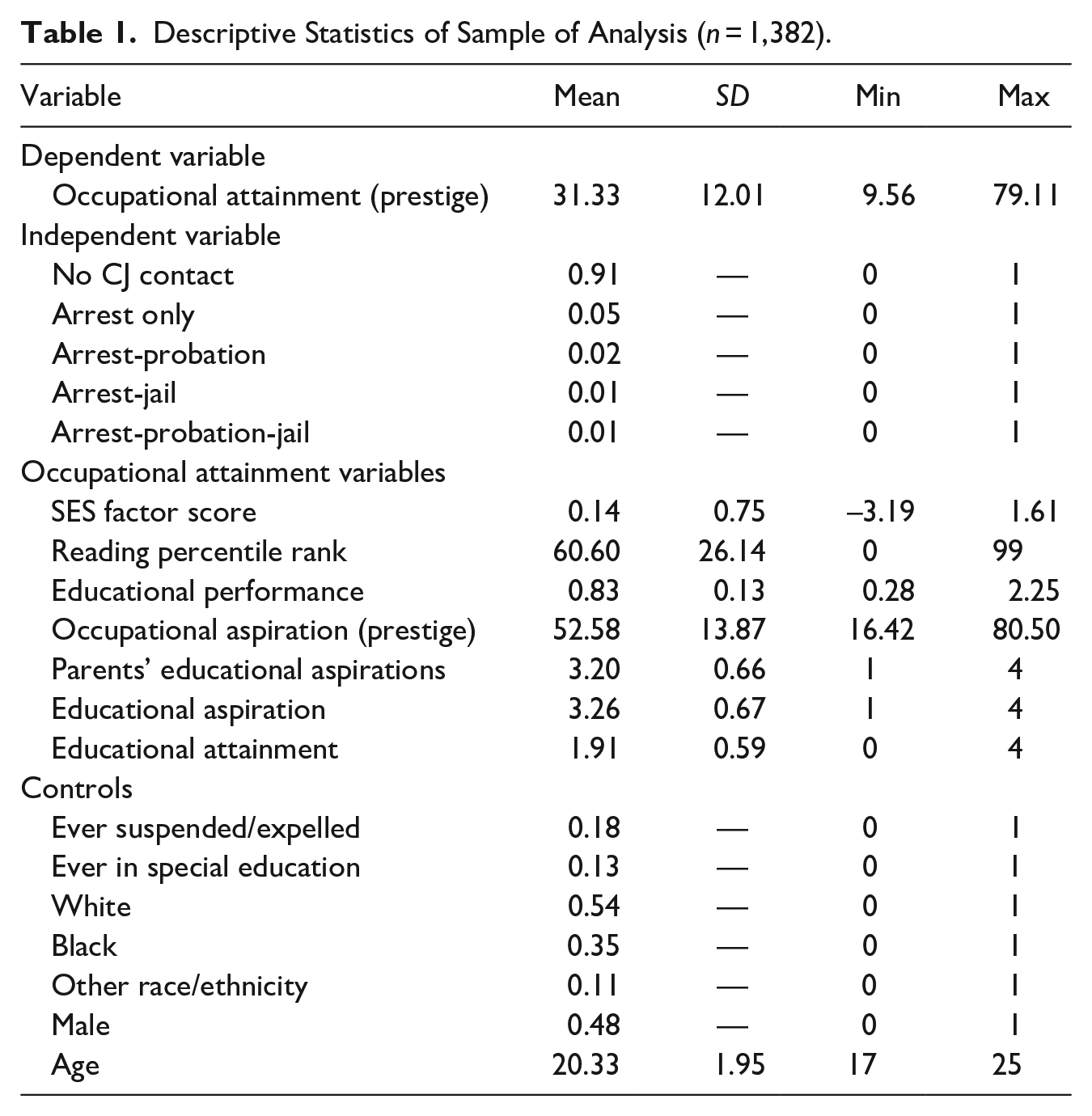
We review the items included in the SES factor analysis (not shown here). In 1997, the HOH reported an average 13.25 years of schooling and a Duncan SEI of 423.81. Most primary caregivers (78%) reported having 20 or more books in their home. The average percentile rank for mental ability in childhood was 60.60. The average Hauser-Warren SEI for occupational aspiration was 52.58 (corresponding to “Business Operations Specialists” professions); this score is, on average, higher than actual final occupational attainment (above). Parents reported that they wanted their child to receive a bachelor’s degree, and respondents mimicked their sentiment. Respondents’ actual average educational attainment was a high school degree. The sample is primarily female (52%) and White (54%) or Black (35%). A small proportion had been expelled from school as children (18%) or received special education services (13%).
Differences Among CJ Contact Groups in Occupational Attainment
We estimate a one-way ANOVA model to assess the relationship between CJ contact and occupational attainment, followed by a post hoc Tukey test (Table 2) to estimate whether significant differences exist among average occupational attainment at each type of contact.
One Way ANOVA and Post Hoc Tukey Tests Between Average Occupational Attainment of Exclusive CJ Contact Groups.
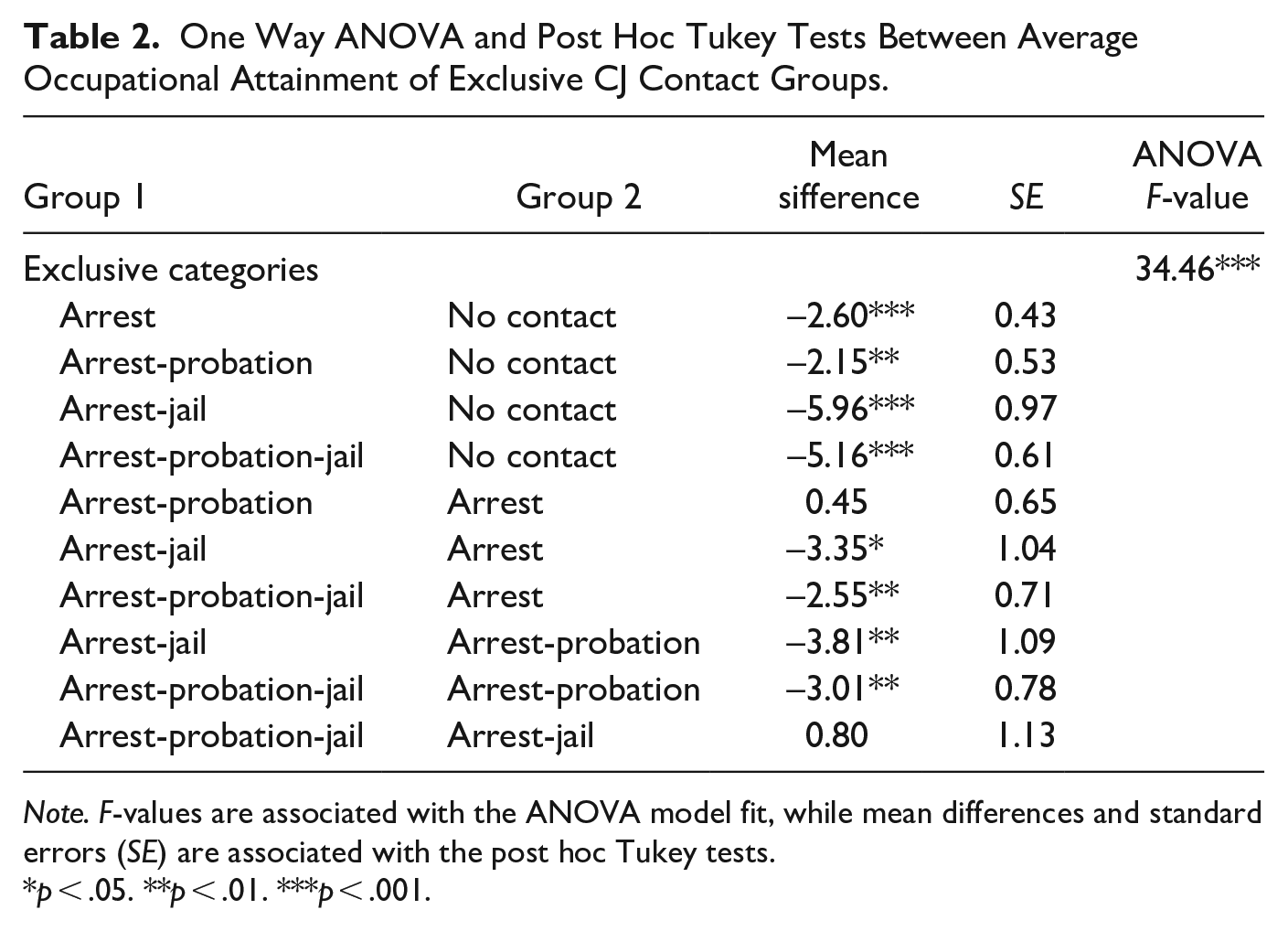
Note. F-values are associated with the ANOVA model fit, while mean differences and standard errors (SE) are associated with the post hoc Tukey tests.
*p < .05. **p < .01. ***p < .001.
Results reveal between-group patterns in occupational attainment. First, any type of CJ contact is associated with lower overall occupational attainment than no contact, as evidence by results for arrest (Mean Difference = −2.60, p < .001), arrest-probation (Mean Difference = −2.15, p < .01), arrest-jail (Mean Difference = −5.96, p < .001), and arrest-probation-jail (Mean Difference = −5.16, p < .001). Compared to groups who experienced arrest alone, groups who reported arrest and jail (Mean Difference = −3.81, p < .05) and arrest, probation, and jail (Mean Difference = −2.55, p < .01) report lower occupational attainment. However, groups who report arrest and probation do not exhibit significant differences in occupational attainment than those who experienced arrest alone. Compared to groups who report arrest and probation, those who reported arrest and jail (Mean Difference = −3.81, p < .01) and arrest, probation, and jail (Mean Difference = −3.01, p < .01) exhibit lower occupational attainment. However, those who report arrest, probation, and jail do not differ significantly than those who reported arrest and jail alone.
Table 3 presents results from multivariate OLS models of occupational attainment and CJ contact. 8 Bivariate results in Model 1, again, suggest that all types of CJ contact are related to lower overall occupational attainment as evidenced by the negative coefficients for all four types of contact. However, only groups who experienced arrest and jail (b = −9.86, p < .01) and those who experience arrest, probation, and jail (b = −6.93, p < .01) report significantly lower occupational attainment than those who did not report CJ contact. Model 2 presents multivariate results including all covariates considered in Sewell et al.’s (1969) model of occupational attainment. Results again confirm that, even when controlling for relevant covariates, individuals who report arrest and jail (b = −6.07, p < .05) exhibit lower overall occupational attainment scores. Additionally, those who report arrest, probation, and jail (b = −3.18, p < .1) exhibit lower overall occupational attainment, though only at marginal significance.
OLS Model of Final Occupational Attainment (n = 1,382).
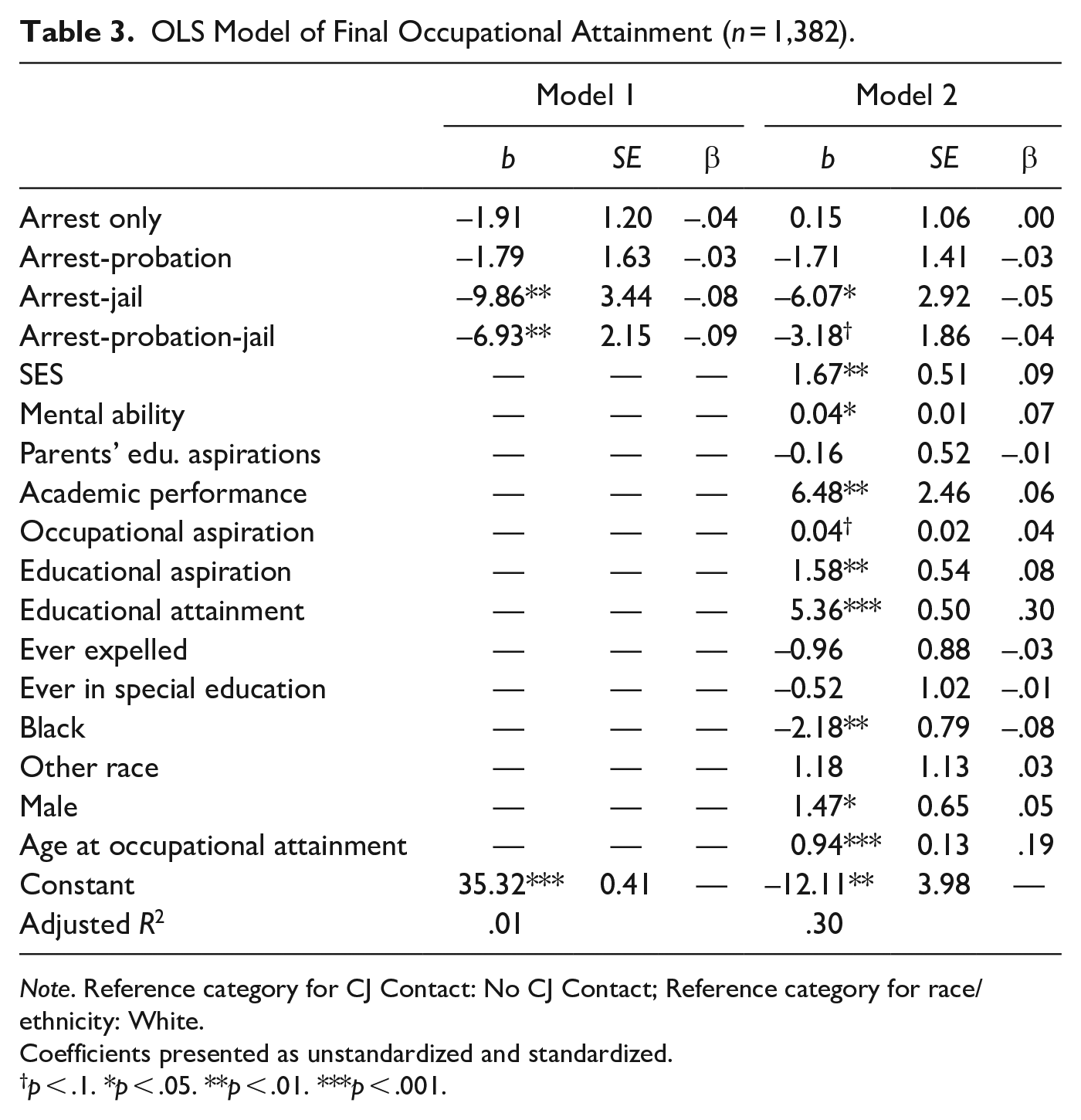
Note. Reference category for CJ Contact: No CJ Contact; Reference category for race/ethnicity: White.
Coefficients presented as unstandardized and standardized.
p < .1. *p < .05. **p < .01. ***p < .001.
Relationships between the covariates and occupational attainment behave as expected, though not all reach significance. Individuals who experienced a higher childhood SES report higher overall occupational attainment (b = 1.67, p < .01). Individuals who exhibited higher cognitive ability (b = 0.04, p < .05), better academic performance (b = 6.48, p < .01), and higher degree attainment (b = 5.36, p < .001) also report higher overall occupational attainment. Higher occupational aspirations are associated with higher occupational attainment at marginal significance (b = 0.04, p < .1) and higher educational aspirations are associated with higher occupational attainment (b = 1.58, p < .01). Further, Black respondents exhibited lower overall occupational attainment than White respondents (b = −2.18, p < .01), which may reflect discrimination on the job market and social-structural barriers to education and work for young Black persons in the U.S. (Western & Pettit, 2005). Finally, male respondents (b = 1.47, p < .05) and older respondents (b = 0.94, p < .001) report higher overall occupational attainment.
The standardized coefficients offer additional results regarding the compared importance of CJ contact and covariates relevant to occupational attainment. Standardized coefficients reveal that CJ contact is not the largest predictor of occupational attainment for this sample. The largest standardized coefficient for CJ contact, arrest, and jail, is associated with only a −0.05 unit change in occupational attainment, while a unit difference in educational attainment (i.e., one degree increment) is associated with a 0.30 unit change in occupational attainment. Indeed, Sewell et al. (1969) suggested that education is the most substantial factor associated with occupational attainment. Second, CJ contact offers equal or greater detriment to occupational attainment than some other factors known to be associated with the labor market. For instance, being male is associated with an equal and opposite 0.05 unit increase in occupational attainment, a covariate implicated in economic wellbeing and labor market success (Neumark, 2018).
Within-Person Change in Occupational Attainment
Finally, we consider how occupational attainment over time may be interrupted by varying levels of CJ contact. As shown in prior models, age is a significant predictor of occupational attainment, suggesting that as our respondents age they are climbing to higher levels of occupational attainment. Indeed, we find that on average, an 18-year-old respondent in this sample reports an average occupational attainment of 27.20, while a 25-year-old respondent reports an average occupational attainment of 34.52. Thus, occupational attainment is a process in which individuals start low on the scale and work their way up. Fixed effects models (Table 4) assess within-person change in occupational attainment that may be hindered by CJ contact.
Fixed Effects Estimators Predicting Occupational Attainment, With Robust Standard Errors.
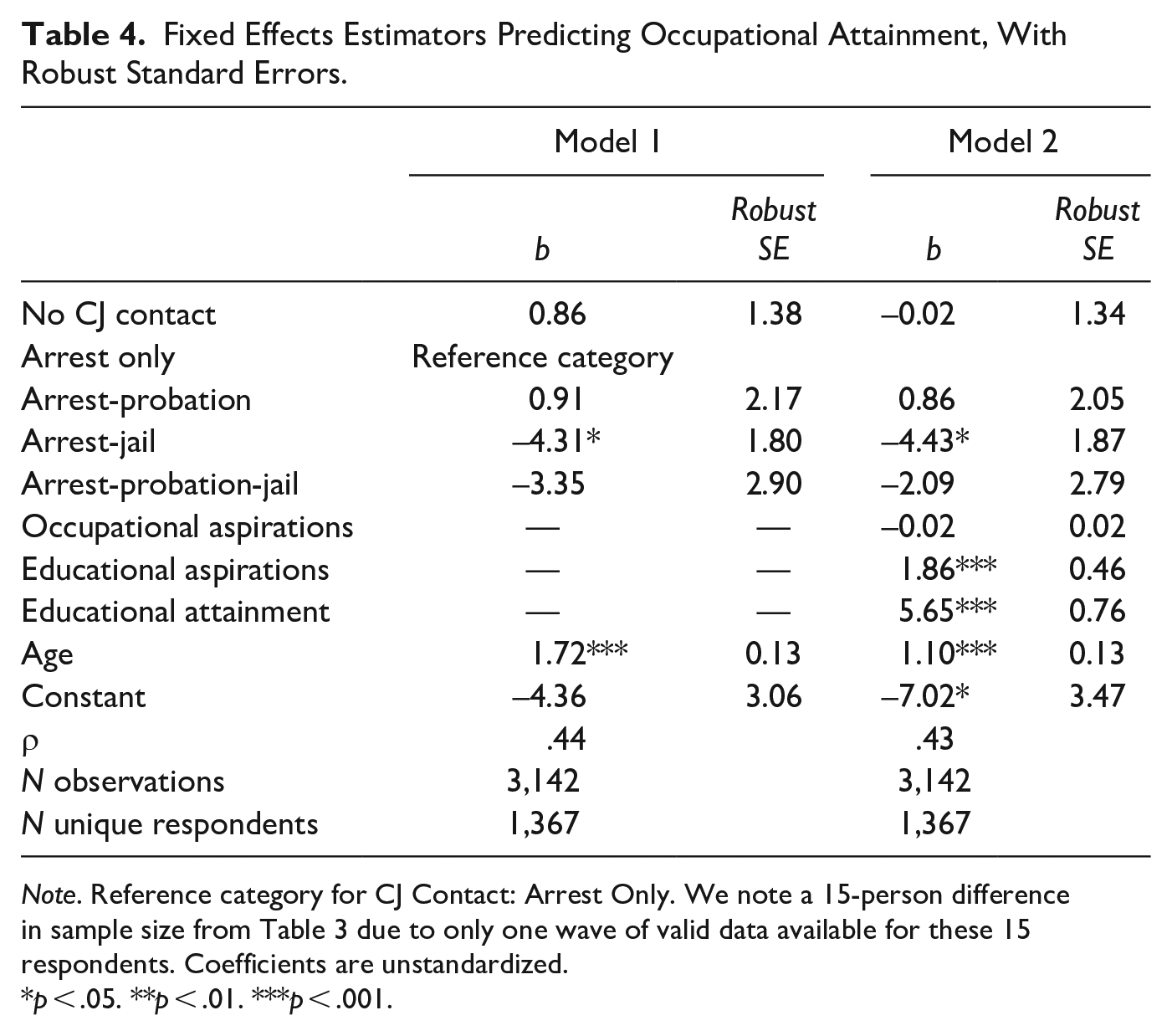
Note. Reference category for CJ Contact: Arrest Only. We note a 15-person difference in sample size from Table 3 due to only one wave of valid data available for these 15 respondents. Coefficients are unstandardized.
*p < .05. **p < .01. ***p < .001.
Model 1 presents results from a fixed effects regression including only CJ contact and age. Readers should note that the reference category for CJ contact in these models is arrest only, which we believe is a better comparison for changes in CJ contact over time. We include age to account for age trends across waves that are strongly associated with occupational attainment. Results suggest that individuals who report arrest and jail in a wave exhibit significantly lower overall occupational attainment compared to waves in which they report arrest only (b = −4.31, p < .05). When time-varying covariates are added to the model, arrest and jail, compared to arrest alone, remains detrimental to an individual’s occupational attainment (b = −4.43, p < .05). Additionally, waves in which individuals reported higher educational aspirations (b = 1.86, p < .001) and educational attainment (b = 5.65, p < .001) were associated with higher occupational attainment. Finally, as individuals increase in age they report higher occupational attainment (b = 1.10, p < .001). Results suggest that as individuals experience additional types of contact, they report lower overall occupational attainment in subsequent waves, even when controlling for socio-psychological factors and net of unobserved heterogeneity at the individual level.
Discussion
Prior work finds that CJ contact is detrimental to occupational and financial wellbeing in young adulthood due to stigma, hiring patterns, and procedural hassle that affects justice-involved persons (Kohler-Hausmann, 2013; Sugie et al., 2020; Uggen et al., 2014; Western & Pettit, 2010). However, criminological work has largely ignored occupational prestige attainment, an outcome salient for justice-involved groups who are at risk of becoming embedded in low-prestige work (e.g., Pettit & Lyons, 2009; Western & Pettit, 2010). Relegation to low-prestige work has implications for both economic wellbeing and processes of desistence which can be impeded by exposure to poorly regulated labor markets that foster illicit activities (Freeman, 1999). In examining CJ contact and occupational attainment, we come to two main conclusions.
First, individuals who report CJ contact of any type exhibit lower overall occupational attainment scores in young adulthood. Results from our one-way ANOVA model suggest that arrest, probation, jail, and combined arrest, probation, and jail all pose significant detriments to occupational attainment. These results both uphold and expand prior work assessing CJ contact and occupational outcomes. Life-course perspectives (Sampson & Laub, 1993, 1997) suggest that contact with the justice system is associated with stigma and subsequent barriers to conventional opportunity structures that impede integration into prosocial institutions, such as work. Studies assessing justice contact and employment suggests that justice-involved groups cluster in low-wage, unstable markets that impact chances for upward mobility (Pettit & Lyons, 2009; Western & Pettit, 2010). This study corroborates these findings, showing the overall negative impact of CJ contact on occupational prestige attainment.
This study also broadens the scope of prior literature by assessing occupational prestige, an occupational outcome beyond wages and likelihood or stability of employment. The implications of this outcome are salient to justice-involve groups for two primary reasons. First, low-prestige work does not only represent a class of work characterized by poor wages and instability (Le Grand & Tåhlin, 2013; Treiman, 1976), but is also perceived to be of less value and inhabited by persons of lower skill than occupations ascribed high prestige (Ganzeboom & Treiman, 2003; Magnusson, 2009). Individuals who occupy low-prestige work are thus at a significant disadvantage with regard to upward mobility. Low-wage, unstable work creates difficulty in accumulating savings, entering more favorable work, or affording the opportunity cost of education to improve credentials. Further, networking from a low-prestige job may be difficult due to social stigma ascribed to low-prestige workers, and thus bar access to knowledge of employment opportunities (Pedulla & Pager, 2019; Wheeler & Dillahunt, 2018). These issues compound already difficult labor markets for individuals with a history of justice contact, further restricting chances for upward mobility and economic stability in this group.
Second, low-wage markets, where low-prestige work clusters, are susceptible to infiltration by tangential illicit activities (Fagan & Freeman, 1999). For individuals who have experienced justice contact, exposure to illicit activities in low-wage markets may impede processes of desistance and may create cycles of justice contact that further embed this group in chronic low-prestige work. This may be especially true for groups under high supervision, such as individuals on probation for whom surveillance and the threat of detection in even the most minor deviance is high (Young & Petersilia, 2016).
Our second conclusion concerns the differential impact of various types of CJ contact. Prior literature outlines that certain types of CJ contact may be less detrimental to occupational outcomes than others (e.g., Uggen et al., 2014), though the general procedural hassle that accompanies minor types of CJ contact can create impediments to work (Kohler-Hausmann, 2013). Results from our multivariate OLS and fixed effects models suggest that there may be something specific about the restrictive nature of jail that produces more detrimental occupational attainment outcomes than arrest or probation alone. Sampson and Laub (1993, 1997) outline the damaging nature of removal from the community, stating that incapacitation can result in unfavorable events such as broken ties with networks and exclusion from prosocial institutions such as work. Recent estimates suggest that though many persons spend 1 week or less in jail, a growing number of individuals spend nearly 3 weeks or more behind jail bars (Horowitz & Velázquez, 2020; Zeng, 2019). Removal from the community for such a period of time jeopardizes current employment, creates a gap in employment that requires explanation for potential employers, and risks breaking crucial employment network ties.
Importantly, it appears that lower levels of CJ contact may be less limiting to occupational attainment than early socio-structural barriers established in childhood, such as childhood SES or educational performance. Indeed, prior work finds that individuals situated in concentrated disadvantage from an early age may become stuck in low-quality, low-wage positions that are indicative of lower occupational prestige (Chetty et al., 2016). Results from this study mirror these issues, as childhood SES is a robust predictor that poses greater overall impact to occupational attainment, illustrated through standardized coefficient comparisons. These issues are, of course, directly interrelated, as studies find that individuals from disadvantaged areas face greater levels of police supervision and sanctioning (Gustafson, 2009). It is thus imperative to consider how early socio-structural factors are intertwined with likelihood of justice contact in adolescence and early adulthood, and later economic well-being.
Future scholars may seek to improve on the limitations of this assessment in several ways. First, this analysis was unable to assess the direct and indirect effects that these variables exert on one another. We acknowledge that this is not a causal analysis and understand potential endogeneity. However, we sought to consider if and what kind of overall relationship CJ contact posed to occupational attainment. We invite scholars to explore the relationship from a causal standpoint in the future. Second, only a small portion of this sample reports experiencing probation or jail during their lifetime. It is possible that this sample was simply not large enough to reveal a true relationship between these types of contact and occupational attainment. An assessment of these questions with a sample of justice-involved populations may yield greater statistical power to assess these relative effects. Further, delineation between pre-trial detention jail stays and jail sentence of conviction was unable to be determined from these data and may lead to differing substantive conclusions regarding the impact of jail stay on occupational attainment. Finally, the Hauser-Warren SEI does not allow for assessment of unemployed populations. Unemployment is a larger issue for previously incarcerated groups, with upward of one in four released persons reporting unemployment (Couloute & Kopf, 2018). The Hauser-Warren SEI exclusively attends to individuals who report employment, and operationalizing individuals without employment as “zero” on this scale is not a widely used and potentially illogical method. We note in our data that there is an approximately even distribution of CJ contact among individuals who report employment and unemployment (χ2 = 5.58, n.s.). Future work should continue to assess the issue of CJ contact and unemployment in a larger sense; however, this question is beyond the scope of this study.
We conclude by emphasizing the overall detriment that CJ contact poses toward quality work that offers chances of financial wellbeing and upward mobility. Justice-involved groups are thought of as marginalized in the labor market, and relegation to low-prestige work compounds barriers to employment posed by the mark of a criminal record. We have shown that CJ contact of all types harms occupational prestige attainment in young adulthood, a crucial time to establish a foothold in the labor market. Future scholars may seek to determine whether this group faces chronic employment in low-prestige work, an issue that may contribute to intergenerational poverty and inequality. We offer these insights so that we may more fully understand social and occupational impacts of CJ contact.
Footnotes
Declaration of Conflicting Interests
The author(s) declared no potential conflicts of interest with respect to the research, authorship, and/or publication of this article.
Funding
The author(s) received no financial support for the research, authorship, and/or publication of this article.
