



Abstract
The pseudo-family is a longstanding carceral concept, but its existence and characteristics are uncertain in contemporary women’s prisons. This study explores pseudo-family membership and pseudo-motherhood among 132 women incarcerated in a maximum-security prison. Self-reported data reveal that the pseudo-family remains an active concept in the sampled prison, with over half of the surveyed women reporting prison family membership. Pseudo-mothers are perceived as maternal, supportive, and wise by their pseudo-children. Multivariate OLS and logistic regressions suggest that pseudo-mothers had similar relationship quality with, and visitation from, their biological children, compared to other imprisoned mothers. These findings contribute to our understanding of women’s adaptations to incarceration and have implications for family reunification policies.
Prison pseudo-families (also known as prison-, play-, or make-believe families or prison kinship networks) are among the earliest and most enduring concepts associated with women’s imprisonment. Following the functionalist tradition, early prison scholars asserted that pseudo-families substitute for valued pre-prison familial roles and help women and girls alleviate the deprivations of confinement (Giallombardo, 1966; Owen et al., 2017; Selling, 1931). Later researchers complicated this view, asserting that (1) prison families may also be coercive, exploitive, or otherwise detrimental for incarcerated women (Heffernan, 1972; Owen, 1998; Watterson, 1996), and (2) neoliberal prison regimes and changing prisoner demographics eroded the trust undergirding pseudo-families, decreasing their prevalence in contemporary women’s prisons (Greer, 2000; Kruttschnitt & Gartner, 2004). Also embedded in most prison family explanations is the supposition that women import gender identities and familial roles into prison settings (Giallombardo, 1966; Heffernan, 1972). Accordingly, prison families may reproduce or extend (rather than substitute) extra-prison familial relationships. Such contradictory conceptualizations, along with the infrequency and equivocality of past research, muddy our understanding of prison pseudo-families and their connections to the informal organization of women’s prisons. Moreover, connecting prison-based and community-based family ties has the potential to improve post-release family reunification processes, further justifying research on the topic.
In this paper, we investigate prison pseudo-families using novel survey and prison kinship nomination data collected in two units of a Pennsylvania maximum-security women’s prison. Specifically, we use nomination data from study participants to identify women who are members of prison pseudo-families and focus particular attention on those self-identifying or nominated as prison mothers (or grandmothers). We then examine pseudo-mothers’ relationships with their biological children and compare these to other mothers’ relationships on the units. Drawing on the substitution argument, we expect that pseudo-mothers will have weaker relationships with their biological children than do other incarcerated mothers. Alternatively, the reproduction hypothesis would expect pseudo-mothers to have similar, or even stronger, relationships with their biological children compared to other incarcerated mothers. We also examine the perceived qualities of prison pseudo-mothers using narrative data provided by the pseudo-children to understand if prison mother-child relationships are perceived as maternal and caring or coercive and exploitive. In sum, this mixed methods analysis helps to understand both the prevalence and meaning of prison pseudo-families in a contemporary women’s prison, along with the connection between mother-child relationships inside and outside of prison.
Background
From the outset, scholars suggested that incarcerated women form prison pseudo-families as substitutes for pre-prison family relationships. In his seminal study of a girl’s reformatory school, Selling (1931) found that many delinquent girls were organized in stable family groupings (i.e., parents, grandparents, siblings, and children) that existed even when staff matrons were assigned to the housing units. He argued that the pseudo-family “is a natural substitute for the family group which the institutional mechanism cannot supply” and that delinquent girls assume pseudo-family roles along “natural and physiological” bases (Selling, 1931, p. 247). These two ideas, that pseudo-families replace external (or “street” in Owen, 1998) family relationships and that women fill familial roles based on pre-existing traits and characteristics, endured in prison research over the subsequent decades.
Perhaps the most influential work on prison pseudo-families was Giallombardo’s (1966) immersive study of the Federal Reformatory for Women in Alderson, West Virginia. Building on emerging functionalist accounts of men’s prisons, particularly Sykes’ (1958) Society of Captives, Giallombardo (1966) connected women’s prison-based kinship networks to the alleviation of the pains of imprisonment. Specifically, she argued that prison kinship networks scaffolded same-sex marriages and originated from gender norms imported into the prison setting. She thus looked to gender socialization processes, as opposed to Selling’s (1931) essentialism, to understand how prison families replaced social relationships outside the prison walls and were more important to women than men (Giallombardo, 1966, p. 103). Giallombardo (1966) found that approximately one-third of the women at Alderson were members of pseudo-families. Subsequent surveys similarly found that between 36% and 50% of incarcerated women reported pseudo-family membership (Heffernan, 1972; LeShanna, 1969; Propper, 1982).
In the era of mass incarceration and the war on drugs, the population of imprisoned women increased dramatically and institutional environments of women’s prisons shifted. As prisons became increasingly authoritarian and punitive, they often failed to recognize the unique needs of female prisoners who, compared to their male counterparts, are more likely to have histories of trauma, substance abuse and mental health disorders, and nonviolent convictions (Carson, 2020; Green et al., 2005; Moloney et al., 2009). Some argue that these changing conditions and expanding populations of imprisoned women have shifted the society within women’s prisons, resulting in new interpersonal dynamics and social structures. Indeed, several more recent studies challenge earlier conceptions of pseudo-families as common and palliative in modern women’s prisons. For example, Greer (2000, p. 463) interviewed 35 women incarcerated in a Midwest prison and found that kinship networks were “virtually nonexistent” in the facility (see also Pollock, 1998). She pointed to several possible reasons for this absence, including changing prison physical structures, more easily maintained connections with external family members, and changing societal gender roles. She also argued that a shift from rehabilitation to custodial prison regimes likely undermined prisoner interpersonal trust, resulting in incarcerated women “doing time” in more isolated ways. Similar arguments for declining trust were later made by Kruttschnitt and Gartner (2004) and Severance (2005), both of whom returned to women’s prisons previously studied in the 1960s.
Competing Views of Prison Motherhood
Within the women’s incarceration literature, scholars have presented two intertwined, yet competing, portrayals of prison pseudo-family mothers (and grandmothers). On the one hand, stemming from the deprivation tradition (Sykes, 1958), prison motherhood has been presented as an individual-level adaptation to alleviate the pains of imprisonment. Accordingly, older and “prisonized” (Clemmer, 1958) women become surrogate parents for younger peers, creating a “substitute universe” (Giallombardo, 1966, pp. 135, 140) where “The first thing an inmate must do is divorce her mind from outside,” and pseudo-family mothers fulfill culturally-valued gender roles associated with nurturance, wisdom, and maternal caregiving. Implied in this perspective is the idea that investments in prison motherhood take the place of investments in biological families. For example, Jones (1993, p. 85) stated of the incarcerated women he observed in a Midwestern correctional institution, “The most frequently cited reasons for the inmates performing the role of mother are the respect they receive from other inmates and an opportunity to express their nurturant feelings.” Pseudo-family mothers’ expressions of maternal caregiving would also find purchase among peers whose own homelives were traumatic or neglectful, “For some women who have grown up emotionally isolated in institutions or orphanages, their prison mother becomes their first real mother—a mother who pays attention, guides, and helps set limits instead of being neglectful withholding her love and comfort” (Watterson, 1996, p. 294). Such surrogate relationships would be strongest among prison mothers with long incarceration periods, who have experienced extended separations from their “street” families, and who are strongly embedded in prison society (Giallombardo, 1966; Jones, 1993). Indeed, long periods of incarceration may make prison pseudo-motherhood even more rewarding than pre-prison motherhood, pulling prison mothers further away from their biological children.
Within deprivation narratives of prison pseudo-motherhood are descriptions focused on the characteristics women bring with them into prison. For example, Selling (1931, pp. 249, 251) first observed that “. . .those members having dominant positions such as mother and grandmother were physical and psychological types obviously suitable for such positions” and described a pseudo-family mother he observed, “In all her mannerisms she is matronly, even though she is only a year or two older than her ‘daughter’.” Likewise, Giallombardo (1966) stated that pseudo-family roles, such as motherhood, not only help women overcome the deprivations of prison but also reflect individuals’ pre-existing personalities and the cultural expectations to which they have been socialized. She thus combined the deprivation perspective with the then-emergent importation view of prison social organization (Irwin & Cressey, 1962). Owen (1998) presented similar themes in a more contemporary setting, emphasizing the salience of biological motherhood and child reunification for incarcerated women’s experiences and how this pre-prison role defines prison pseudo-families. Accordingly, prison pseudo-family motherhood is presented as a meaningful, yet more ephemeral, reproduction of existing mother-child bonds with biological children.
Whether pseudo-motherhood is a substitute for, or reproduction of, biological motherhood has importance for post-prison family reunification and reentry policy. If the substitution argument more accurately reflects motherhood in prison families, then the likelihood of successful post-release family reunification declines significantly. The logic of substitution is that pseudo-motherhood takes the place of pre-prison motherhood and that the quality of relationships with biological children correspondingly withers over time, eroding social capital resources available upon prison release and necessitating prison policy focused on reactivating such ties. Alternatively, if pseudo-motherhood reproduces pre-existing relationships with biological children, then women occupying mother roles in prison families would have equal, if not stronger, ties with their biological children as do other incarcerated mothers. Mothers in prison families would thus not be at elevated risk of weakened ties with biological children beyond the inherent challenges associated with incarceration and reentry.
Finally, some more recent carceral scholars question whether prison pseudo-families are generally positive and supportive, or are just as likely to be coercive, abusive, and exploitative. Early on, Heffernan (1972) and Foster (1975) mentioned the potential for economic exploitation in pseudo-families. Subsequently, Watterson (1996), Owen (1998), and Owen et al. (2017) emphasized the overall positive roles of prison pseudo-families but also stated that dyadic prison family relationships (e.g., parent-child) may result from resource inequalities and coercion. Forsyth and Evans (2003) went so far as to argue that pseudo-families in women’s prisons are analogous to gangs in men’s prisons, simultaneously supporting and coercing individual group members. When applied to pseudo-motherhood, these arguments open the hypothesis that prison mothers may mistreat their pseudo-children.
Data and Methods
We use data from the Women’s Prison Inmate Networks Study (WO-PINS), a project that explores informal social organization within two Pennsylvania women’s prisons (Kreager et al., 2021). The current study focuses on residents in a “good behavior” unit and a general population unit of a maximum-security state prison. The good behavior unit requires that residents are not cited for misconduct for 12 months prior to entry and remain misconduct free while living on the unit. This type of unit allows residents more privileges and freedom of movement. The general population unit does not require an application process or that residents remain misconduct-free. Each of the two units houses 76 incarcerated women, resulting in a maximum of 152 individuals housed across the two units.
Structurally, the two units in our study are mirror images of one another. The sampled units are modern, single story, and open bay designed, flanking a day room that is used on an alternating schedule. Beds are assigned within cubicles of four bunk beds, or eight women per pod. With identical physical environments, residents of the good behavior unit are afforded more privileges, such as unrestricted smoking breaks and more freedom to use the telephones. We include a unit covariate to investigate potential unobserved heterogeneity between the two settings.
Upon approval by the Pennsylvania State Institutional Review Board, the Principal Investigator (PI) and two graduate students held a focus group of five women incarcerated at another Pennsylvania prison to refine the survey instrument and gauge willingness to participate. Approximately 2 weeks prior to data collection, the PI and a co-investigator visited the sampled units and summarized the study for all eligible participants. Participation was voluntary and not shared with prison staff. No participation incentives were offered in accordance with Pennsylvania law (Smoyer et al., 2009).
Surveys were administered by graduate research assistants using Computer Assisted Personal Interview (CAPI) software. To guarantee privacy, respondents completed the informed consent process and survey with one of five graduate research assistants in a small office attached to the day room. Interviewer and interviewee sat side-by-side to permit the respondent to see the laptop screen while the interviewer entered information into the CAPI software. Interviewers reviewed the informed consent forms with interviewees and administered a capacity to consent questionnaire (University of California, San Diego Brief Assessment of Capacity to Consent, Jeste et al., 2007). UBACC responses below the threshold for inclusion in the study were removed from the survey dataset.
Over the course of 5 days, interviewers collected responses from 63 women in the good behavior unit (83% response rate), and 58 responses from the general population unit (76% response rate). Two general population surveys were subsequently dropped because the respondents did not reach the capacity to consent threshold, resulting in a final sample of 119 surveyed women (78% overall response rate). Demographic and criminal history information from the Pennsylvania Department of Corrections (PADOC) was also available for all 152 residents of the two units.
A portion of the WO-PINS survey was dedicated to measuring the prevalence and nature of pseudo-families. Respondents were prompted “Previous research has often mentioned prison families and their role within the prison” and asked, “Are you part of a prison family?” If they answered yes, they were then asked, “Who in the unit is in your prison family?” and given the opportunity to identify their family members and the role of their family members from a roster of all unit residents. Nearly two-thirds (n = 48 [76%] good behavior unit, n = 28 [50%] general population unit) of surveyed women self-identified as members of a prison family. Contrary to some recent research (e.g., Greer, 2000; Pollock, 1998), pseudo-family membership appears a common experience in our sampled units.
Of the total of 152 residents residing in both units, our analytical sample is restricted to those women identified as biological mothers. The WO-PINS survey inquired directly about biological children, yielding 99 self-reported biological mothers. Administrative visitation records identified an additional 33 women with biological children who did not complete the survey, totaling a sample of 132 women with biological children across the two units. Descriptive statistics for the sample are listed in Table 1.
Sample Descriptives.
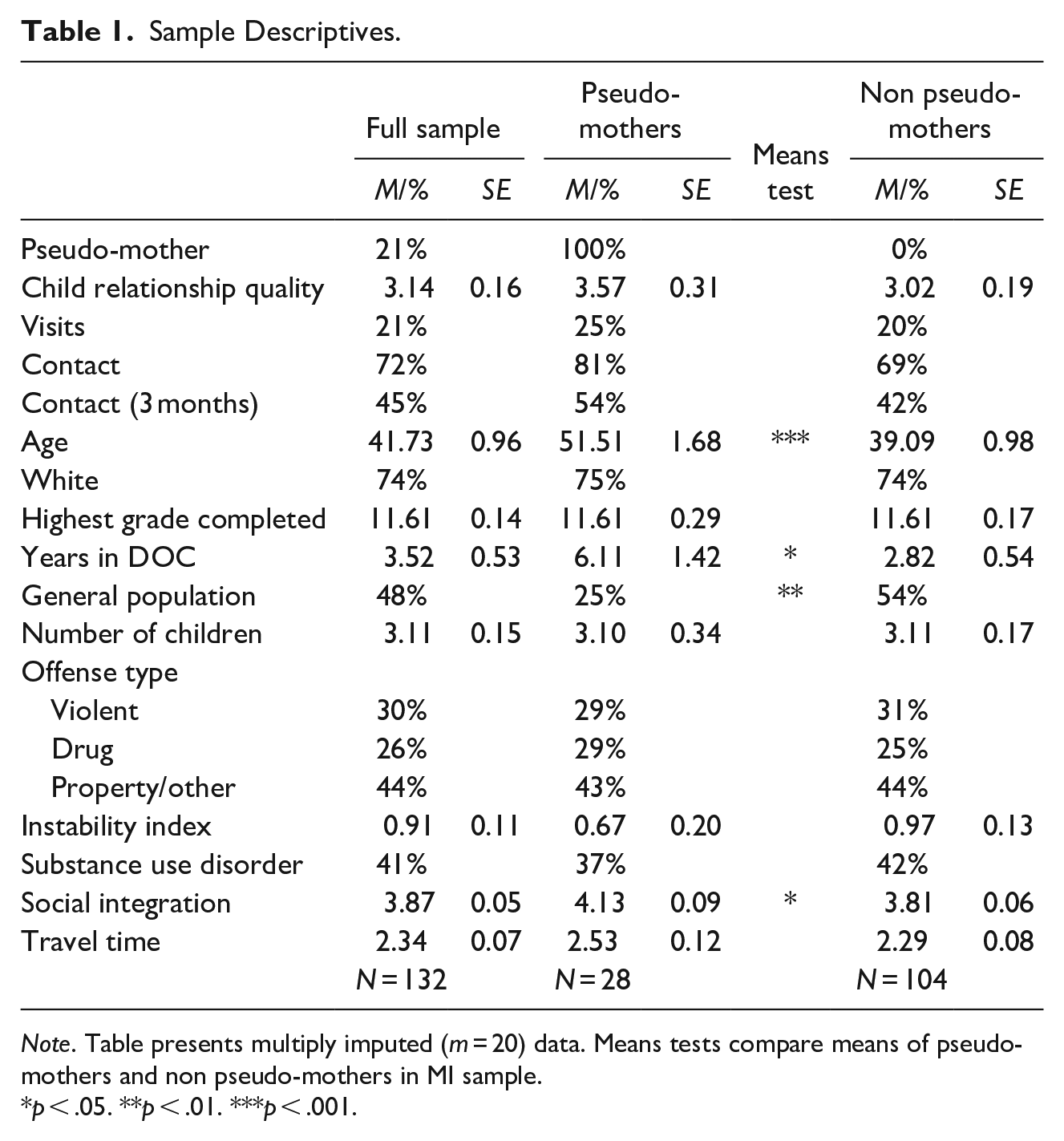
Note. Table presents multiply imputed (m = 20) data. Means tests compare means of pseudo-mothers and non pseudo-mothers in MI sample.
p < .05. **p < .01. ***p < .001.
Measures
Pseudo-motherhood
Respondents reported whether they considered themselves a member of a pseudo-family. If they self-identified as a pseudo-family member, they were prompted to answer a battery of related questions, including nominating other members of their pseudo-family, and their pseudo-family member’s roles, from a complete roster of unit residents.
From these responses, we derive the label of pseudo-mother. A respondent can be identified as a pseudo-mother in one of two ways. First, a respondent is a pseudo-mother if another unit resident nominated her as a “mother” or “grandmother” in their pseudo-family. Second, a respondent is a pseudo-mother if she identifies herself as having pseudo-children. Of the women identified as pseudo-family mothers, 19 were nominated by peers, 1 self-identified, and 8 were both nominated and self-identified. One respondent identified as a pseudo-mother was dropped from our sample because she reported not having biological children.
Of the 132 women with biological children, 28 (21%) were identified as pseudo-mothers by self or peer nomination. The other 104 women (79%) were not considered pseudo-mothers. Mean differences were tested between the pseudo-mother and other incarcerated mother samples. Significance was calculated by regressing each of the measures in the descriptive table on a binary measure where 1 indicates pseudo-motherhood and 0 indicates other incarcerated women with biological children.
Relationship outcomes
We explore three measures, one self-reported and the other from administrative data, to compare the relationships with biological children between pseudo-mothers and other incarcerated mothers. First, Child Relationship Quality is a subjective rating provided by respondents to indicate how they perceive their relationship with their youngest biological child. One of the broad objectives of WO-PINS was to explore the reunification process between imprisoned mothers and their children. Given the youngest child was the most likely to be reunited with their mother-post release, the researchers chose to focus survey questions on the youngest child. This measure is scored on a 5-point scale where 1 indicates “poor” and 5 is “excellent.” As seen in Table 1, on average, respondents report the quality of their relationship with their youngest child between “good” (3) and “very good” (4) (mean = 3.38). This does not vary significantly between pseudo-mothers and other mothers.
Next, we operationalize relational strength between imprisoned mothers and their biological children with measures of visitation and communication between mothers and their children. Taken from PADOC administrative records, Visitation is captures recent in-person contact between mothers and their children. Respondents are coded as “1” on Visitation if they had at least one visit from a biological child in the 6 months leading up to the survey date. Of the 132 women with biological children, 28 (21%) received at least one visit from a child in the 6 months leading up to the survey and the percentages did not vary significantly between pseudo-mothers and non-pseudo-mothers. Contact (Ever) shows whether the respondent reported any contact with their youngest child since being incarcerated. Contact (3 months) is a self-report measure indicating whether the mother had mail or phone contact with their youngest child in the 3 months leading up to survey administration.
Controls
We include several demographic and administrative controls that could make spurious associations between pseudo-motherhood and our dependent variables. Age and Time in DOC are measured in years. Time in DOC refers to the total amount of time a respondent has been incarcerated in PADOC in their lifetime. On average, respondents have spent 3.5 years in PADOC custody. General Population identifies the 63 women (48% of the sample) housed in the general population unit at the time of the survey administration. Residents of the general population unit, on average, were younger and had spent less time in PADOC custody compared to those in the good behavior unit.
When comparing pseudo-mothers and non-pseudo-mothers, there are statistically significant differences in the means of Age, Time in DOC, and General Population. On average, pseudo-mothers are older, have spent more time in prison in their lifetimes, and are less likely to be in the general population unit than mothers who are not members of pseudo-families.
Similar to recent work (e.g., Pennsylvania Department of Corrections [PADOC], 2016; Turanovic & Tasca, 2019) we categorized Offense Types as either violent, drug, or property/other. Violent offenses include charges like murder and manslaughter as well as offenses of lesser severity that still cause or threaten bodily harm to others. Forty respondents (30%) are incarcerated for violent offenses, 34 (26%) for drug offenses, and 58 (44%) for other offenses.
Education corresponds to the highest grade the respondent finished. Number of Children is a count of respondents’ biological children. White is a binary indicator of respondent racial category (white or nonwhite). In the sample, 99 women (74%) are white. Travel Time indicates the time in hours it would take to drive between the prison and respondents’ committing county as calculated using Google Maps. Substance Use Disorder identifies respondents classified with a substance use disorder using the Texas Christian University drug screen instrument (Knight, 2007). Fifty-five respondents (42%) meet these criteria.
The Instability Index is a self-reported indicator of material hardship and financial insecurity prior to the respondent’s incarceration. Higher scores on this 12-item index correspond with greater experiences of instability (e.g., inability to pay bills, having utilities shut off, and food or job insecurity). We use a slightly modified version of the composite measure of material hardship from the Scales Documentation and Question Sources of the ninth wave of the Fragile Families survey (Bendheim-Thoman Center for Research on Child Wellbeing, 2013), where some items have been modified to make sense in relation to incarceration (McLanahan et al., 2019). Most sampled women indicated hardship in at least one domain and there was no significant difference between the unit means.
Finally, we include a Social Integration scale. Higher scores on this 5-point scale indicate respondents felt more comfortable and welcomed on the unit. On average, respondents were either indifferent (3) or agreed (4) with statements like “Other inmates make me feel like I belong in this unit” and “I am close to other people in this unit” (mean = 3.88). Pseudo-mothers on average felt significantly more integrated than other mothers in our sample. We use a modified version of Van Orden et al. (2012) scale for belonginess, again with item wording altered to be consistent with prison relationships.
Analytic Strategy
We employ a series of logistic and ordinary least squares (OLS) regression models to evaluate (1) correlates of pseudo-motherhood and (2) associations between pseudo-motherhood and parent-child relationship quality and relationship maintenance through visitation and other contact. We estimate logistic regression models for our binary outcomes (pseudo-motherhood role and visitation) and OLS models for our continuous outcome (child relationship quality).
Due to the nature of the sample (i.e., that includes both survey and non-survey respondents), we can consider missingness in two ways—overall missingness and item non-response. The former refers to missingness resulting from a portion of unit residents not taking the survey while the latter refers to survey questions respondents refused to answer. Overall missingness ranges from 0% for administrative measures and the marker of biological motherhood to 27% for certain survey responses. Item non-response ranges from 0% to 14%.
We conducted t-tests comparing demographic and sentencing characteristics provided by PADOC of surveyed and non-surveyed mothers. None of the means of these measures were significantly different, suggesting that resulting missingness was randomly distributed. We thus retained mothers who did not take the survey and multiply imputed (m = 20) missing values using the “mi estimate” command in Stata 15 (Rubin, 1987; StataCorp, 2017).
As a supplemental investigation into the perceptions of pseudo-mothers provided by their prison children, we leverage another portion of the WO-PINS study. Alongside nominations of pseudo-family members, the WO-PINS survey also asked respondents to identify powerful and influential residents on the unit. For their top-three most influential nominations, respondents had the opportunity to elaborate on their selections. Kreager et al. (2021) presented a comprehensive coding schema for these narratives, comparing them to the thematic codes for a similar network in a men’s prison unit. In the present study, we draw on the power and influence nominations and coding schema to explore the narratives provided by pseudo-children for their pseudo-mothers. The qualitative data permit us to investigate, using first-person accounts, descriptions of influential pseudo-mothers’ qualities and characteristics.
Results
Table 2 presents results from a multivariate logistic regression model predicting pseudo-motherhood. On average, pseudo-mothers are significantly older (p < .001) than women in the sample with biological children but not identified as pseudo-mothers. The magnitude of the age coefficient is quite large, with each additional year of age increasing the odds of pseudo-motherhood by 13% (exp(.122)). Women who resided in the general population unit were less likely to be pseudo-mothers compared to women in the good behavior unit, though this coefficient was significant at p < .10. Participants in the good behavior unit are more likely to be pseudo-mothers, but the probability of pseudo-motherhood increases with age in both units. Perceived social integration is also a significant (p < .05) correlate of pseudo-motherhood. The more integrated a respondent felt in her unit, the greater her chances of being identified as a pseudo-mother. In fact, each additional point on the social integration scale leads to a nearly five-fold increase in the odds of pseudo-motherhood (exp(1.575)).
Logistic Regression Model of Prison Pseudo-Motherhood (N = 132).
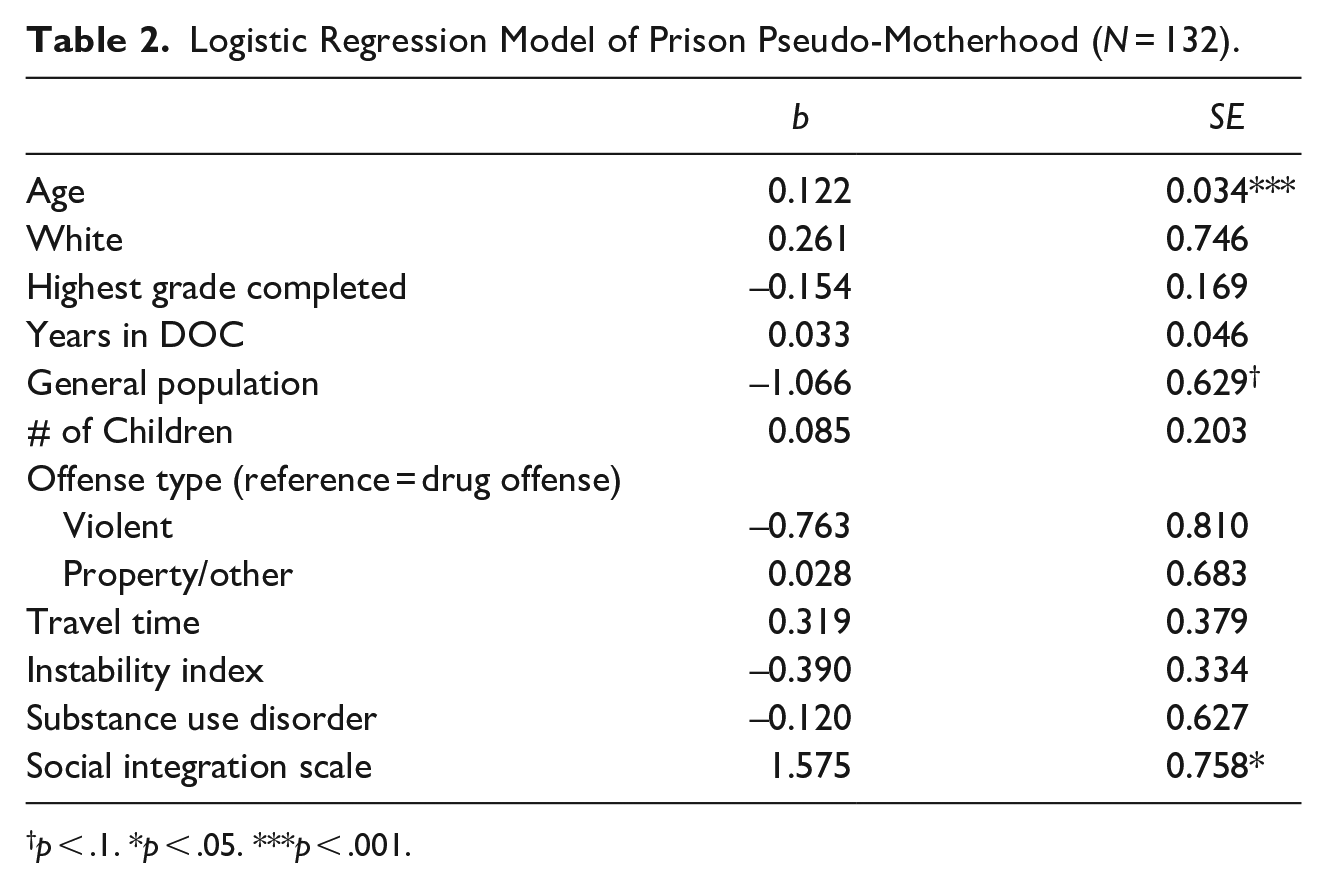
p < .1. *p < .05. ***p < .001.
Table 3 displays results from bivariate and multivariate OLS regression models predicting respondents’ perceived relationship quality with their youngest biological child. In the bivariate model, pseudo-motherhood has a positive and nonsignificant (p > .10) correlation with perceived relationship quality. In the multivariate model, this association reverses signs but remains statistically indistinguishable from zero. Of the control variables, women’s age (p < .05) and financial instability prior to incarceration are significantly (p < .10) correlated with self-reported relationship quality with their youngest biological child.
OLS Models of Child Relationship Quality (N = 132).
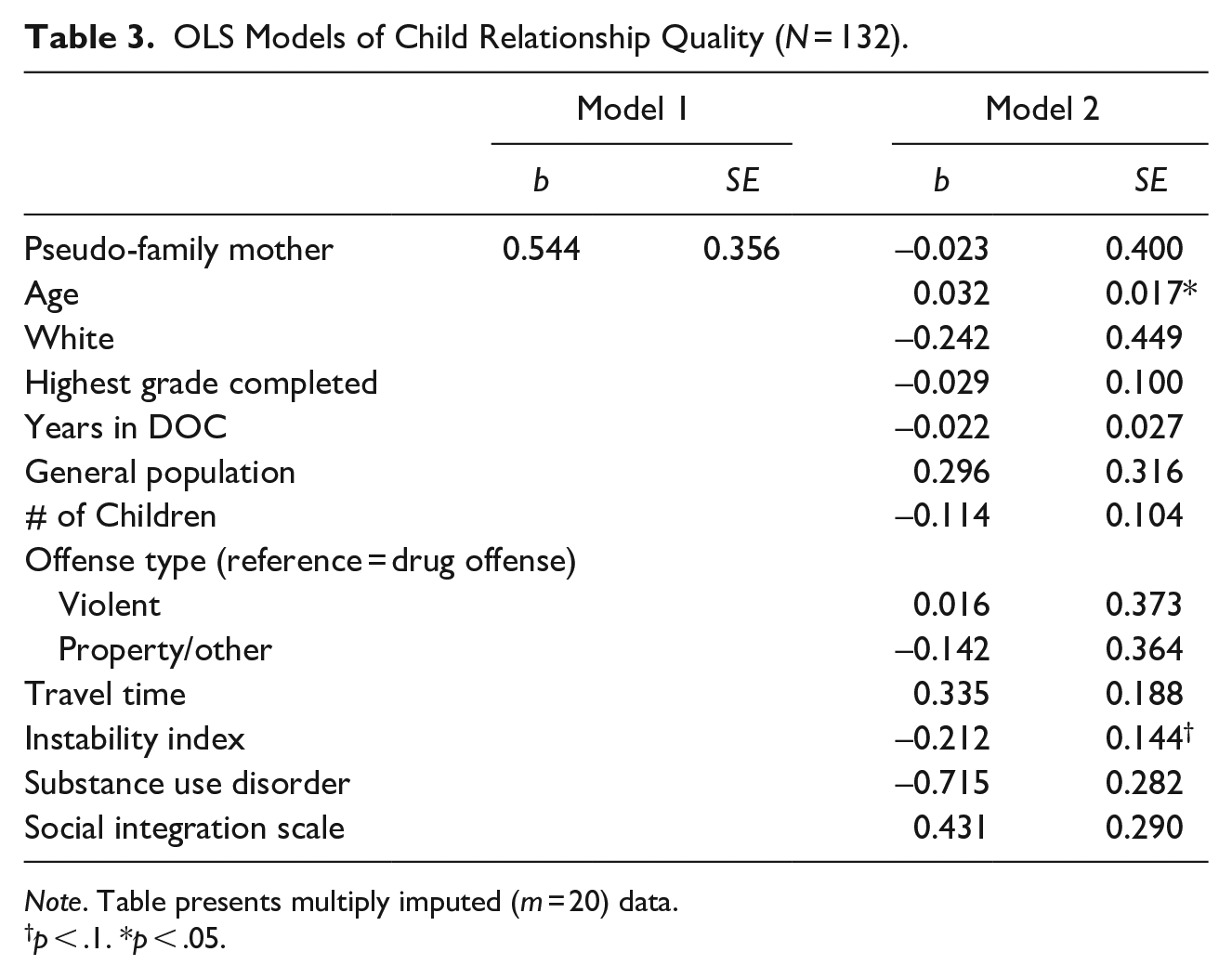
Note. Table presents multiply imputed (m = 20) data.
p < .1. *p < .05.
Table 4 presents results from multivariate logistic regression models predicting child visitation and communication. Pseudo-motherhood is not a significant predictor of any of the three outcomes in multivariate models. Model 1, which predicts the odds of visitation by any child in the last 6 months, shows that women who were incarcerated longer were significantly (p < .05) less likely to receive visits from children. Additionally, those imprisoned for violent, compared to drug crimes, were significantly (p < .05) more likely to receive visits from children. Model 2 shows that women with greater travel time to their committing county were significantly (p < .05) more likely to have received some form of contact with their youngest child during the entirety of their incarceration. Model 3, which predicts the odds of contact with the youngest child in the 3 months prior to survey administration, shows that mothers with greater scores on the instability index were less likely to have received written or phone communication (p < .10).
Logistic Regression Models of Child Contact and Visitation (N = 132).
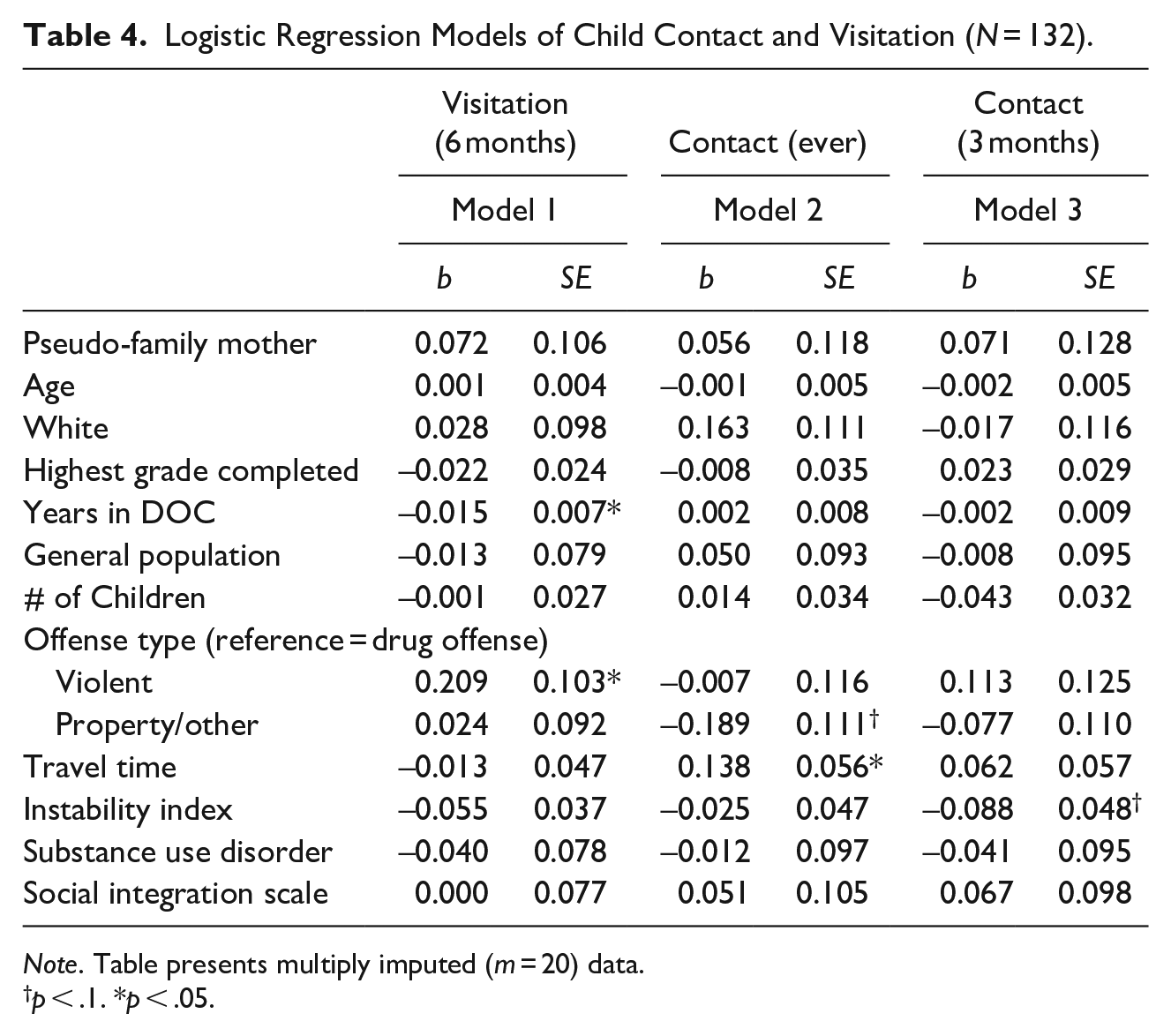
Note. Table presents multiply imputed (m = 20) data.
p < .1. *p < .05.
Results from the above regression models provide evidence suggestive that women who were in pseudo-mother roles had relationships with their biological children that were no different from the parent-child relationships of other imprisoned women. To supplement these findings and provide additional information about how pseudo-children perceive their pseudo-mothers, we examined the narratives provided when survey respondents were asked to nominate powerful and influential women on their respective units. Each respondent could nominate up to three incarcerated peers and explain why they have power or influence on the unit. Across the two units, 37 women received 135 power and influence nominations. Eighty-one nominations (60% of all nominations) were directed to 14 women (38% of all nominees) identified as pseudo-mothers, suggesting that pseudo-mothers were commonly perceived as powerful and influential by their peers. Of primary interest to this study, 11 of the 81 nominations to pseudo-mothers were provided by the mothers’ own pseudo-children. Although not focused specifically on motherhood, the narratives about power and influence provided by these pseudo-children give insight into how they perceived their pseudo-mothers and allow for general comparison to other influential women nominated on the units.
The pseudo-children universally perceived their pseudo-mothers in positive terms. We present the eleven narratives provided by pseudo children about their pseudo mothers, first from the good behavior unit then from the general population unit. Two pseudo-children in the good behavior unit said the following about their 66-year-old pseudo-mother incarcerated for 35 years: “She’s just one of them people that helps anyone in need, to not benefit for herself in any way, shape, or form. So, she’s very respected for that. She goes above and beyond.” “She is a lifer; she’s been here longer. Since she has been here longer, she has good rapport with everyone. She isn’t problematic. If I need to speak with someone, she will get it done. She has good rapport with COs [corrections officers] and psych and other staff.”
Both narratives highlight this pseudo-mother’s penchant for helping and providing guidance to others in the unit. The second response is also similar to the “old head” narratives found by Kreager et al. (2017), where the genesis of power and influence is rooted in time within the institution, the age of the person in question, and their accumulated wisdom of how to “do time.”
Three other pseudo-children provided similar positive themes in describing their 51-year-old pseudo-mother incarcerated for a total of four and a half years over multiple stints of incarceration: “She has been here a few times, so she is well acquainted with staff. She just guides me in the right direction every time.” “She looks out for everybody. No matter whether you’re new to the unit or not, she’s that motherly companion. And I don’t talk to her very much, but I can see when she interacts with other people, she’s very motherly and very concerned. It’s good to see that interaction between her and the other women.” “She is my same age and I just feel that she is also easy to communicate with, and . . . easier to discuss boyfriend things with.”
These narratives particularly focused on the guidance provided by this pseudo-mother when the nominators had all spent less time in prison than their mother.
Other narratives specifically pointed to the maternal characteristics of the pseudo-mothers that contributed to their respect. In the first quote below, a 37-year-old with 6 years in prison described her 67-year-old pseudo-mother, who had nearly 12 years in the system. In the second quote, the 22-year-old mentioned in the previous paragraph described a second woman she saw as her pseudo-mother: a 55-year-old woman with just under a year in prison. Both highlight hierarchy within the mother-child relationship in prison, demonstrating the guidance children receive from their mothers and expectations pseudo-mothers have for their children.
“She is my grandmother. Through and through. She give you that grandmother look and you know to shut up.” “She tells you how it is sometimes. And - she loves to joke around. It makes your day, if you can joke around, it makes your day so much better and smoother. And she’s just that type of person. Also like a mother to me. It’s really weird - I never experienced that. I call a lot of them mom just because it’s how it is - it’s a sign of respect.”
The preceding explanations of power and influence came from the good behavior unit and highlighted the guidance, nurturing, and care pseudo-children received from their pseudo-mothers. The following nominations came from the women living in the general population unit, where turnover was more frequent and familial bonds likely had less time to form. Two women described a 47-year-old woman who had served 15 years in prison.
“I can talk to her about anything, I did the most time with her, so she knows me. If I need help with anything, she is there for me. She knows how to uplift my spirit. And she is funny and hilarious.” “She’s not afraid to say something, or to correct something that’s going on.”
While both nominators listed the focal pseudo-mother as a mother, their power and influence narratives were less-developed and less-focused on maternal characteristics compared to the narratives from the good behavior unit. Both respondents focused on an element of helping and correcting perceived misbehavior on the unit. This suggests that, while they saw her as a mother, this role was less affective than instrumental in origin.
The final two narratives came from a 31-year-old woman with less than 5 months in prison. She identified two women as her pseudo-mothers—one was a 26-year-old with 3 years in prison and the other was a 41-year-old incarcerated for less than 2 years—and specified trustworthiness, regardless of age, as a valued trait of pseudo-mothers. While brief, it is clear that this pseudo-child values the honesty of her pseudo-mothers.
“She helps everybody. And she’s very honest.” “She’s like [another pseudo-mother], she’s very honest.”
Overall, when asked to discuss the origins of power and influence on their units, pseudo-children in both units pointed to positive personal characteristics, such as maternal caregiving, trust, instrumental benefits, and wisdom, in describing their pseudo-mothers. These descriptions differed from the narratives provided for other powerful and influential women on the units. The latter were generally described as possessing “old head” characteristics (Kreager et al., 2017), but not as maternal or caring. Moreover, none of the pseudo-children described their pseudo-mothers in negative terms, such as a Bully or Negative Personality, which was a common theme associated with power and influence (Kreager et al., 2021) and comprised approximately 10% of all narratives about biological mothers across our sampled units. The conspicuous lack of negative attributions from child to mother, alongside the themes of caretaking and mentorship, work to define the child-mother dynamic of pseudo-family relationships as one of positivity and respect.
Conclusions
This study contributes to a longstanding literature on pseudo-families and the social organization of women’s prisons. Within this tradition, scholars have argued that pseudo-families represent an important adaptation to the deprivations of prison through which incarcerated women find community and fulfilling relationships. However, some recent research on women’s incarceration suggests pseudo-families are no longer as prevalent as they once were (Greer, 2000; Pollock, 1998). Contrary to these studies, we found that the majority of our study participants reported pseudo-family membership. In the two prison units we sampled, the pseudo-family appeared alive and well.
Building on the competing views of prison pseudo-motherhood, we then investigated the association between pseudo-motherhood and relationships with biological children, operationalized as self-reported relationship quality and child visitation in the past 6 months. Our analyses support the reproduction hypothesis, in that pseudo-mothers’ relationships with their biological children appeared no different from those of other incarcerated mothers. In other words, pseudo- and biological motherhood appear to operate independently of one another, as we found no evidence that women who assume pseudo-mother roles in prison turn away from their biological children. We did find evidence that pseudo-mothers tended to be older, in prison longer, and more integrated into their unit’s social organization than their peers. They also tended to be nominated as powerful and influential on their respective units. These findings suggest that pseudo-mothers are more likely to be “prisonized” and separated from their outside lives for extended periods. However, the role of pseudo-motherhood did not translate into weakened relationships with biological children in our analyses. Other characteristics, such as age, substance use, and previous material hardship appeared stronger predictors of weak parent-child relationships.
That pseudo-motherhood is not connected to child relationships has implications for reentry and family reunification for imprisoned mothers. Most imprisoned mothers intend to reunify with their children post-release (Barnes and Stringer, 2014; Robbins et al., 2009) and many view rebuilding these relationships among the most consequential aspects of reunification (Wilson and Koons-Witt, 2021). Unfortunately, the desire to reunify is only one aspect of a process that is complex and often emotionally arduous due to the strain and trauma of long-term separation (Allen et al., 2010, Cobbina and Bender, 2012). Contact, as well as targeted support programs during incarceration, can mitigate the difficulty posed by reunification, though these are not always available (Purvis, 2011).
Reunification is always a difficult process for incarcerated women, but our results suggest that women who become pseudo-mothers during their incarcerations are not at any greater risk of parent-child reentry complications than their peers. Rather, resources should be targeted at older incarcerated women and those with substance use disorders to strengthen the quality of their relationships with children prior to reentry. In addition, women who are incarcerated for extended periods and who come from disadvantaged pre-prison settings should be assisted in connecting with their children through visitation and other communication strategies prior to prison release. Supporting and strengthening mother-child relationships from the inside may ease women’s return to their families and communities.
Pseudo-families have the potential to offer support, both relational and financial, and role fulfillment to women during their time separated from their loved ones. In recent years, however, studies have suggested that pseudo-families are no longer a positive presence in contemporary women’s prisons. Greer (2000) and Forsyth and Evans (2003) both find that informal social structures within women’s prisons have shifted from familial to coercive with high degrees of mistrust. Our supplemental investigation of the relationships between pseudo-mothers and their children yields different results. The most common reasons that pseudo-children attribute power and influence to their pseudo-mothers are those of providing caregiving and emotional support or being a positive personality in the unit. In contrast, when the narratives of pseudo-children of their pseudo-mothers are excluded, power and influence is most commonly credited to age, time spent in prison, or the accumulation of prison wisdom. Importantly, none of the reasons given by pseudo-children contain negative attributions of bullying, negative personality traits, or fear. We believe this demonstrates that the children in these pseudo-relationships do not see the prison family as a coercive bond with other members of the unit.
It is possible that our position—as non-incarcerated researchers—prohibited us from measuring the true nature of relationships between pseudo-mothers and their pseudo-children. Our measures of these relationships, taken only from a snapshot in time, extrapolate from children’s perceptions of their pseudo-mother’s influence and apply that sentiment to their relationship as a whole. Given the intimate nature of familial relationships, these answers might be open to desirability bias, leading to a suppression of less-than-positive responses in an interview setting. Additionally, the design of WO-PINS—a one-time survey questionnaire—is not equipped to infer causality or present a causal order for any of the hypotheses tested in this study. We hope future research will expand upon our findings regarding the nature of these relationships between pseudo-mothers, other pseudo-family members, and loved ones on the outside.
While we find no evidence that pseudo-mothers replace their biological children with pseudo-children, it remains possible that pseudo-mothers serve as substitute parents for their pseudo-children. Prior research suggests women join pseudo-families for several reasons, most often to cope with the pains, volatility, and trauma inherent to the prison environment. What remains unclear and beyond the scope of the present study is whether pseudo-family relationships, specifically relationships with pseudo-mothers, serve as a replacement for relationships with mothers and other loved ones on the outside. Alternatively, pseudo-children may seek out pseudo-parents quite similar to their biological parents. We encourage future research to further explore the role of pseudo-parents from the perspectives of pseudo-children.
With only 132 incarcerated mothers from two units of a single Pennsylvania prison, the generalizability of our findings to all incarcerated women is uncertain. In addition, half of our respondents resided in a good behavior unit. Residents of such units often serve long sentences, are older, and demonstrate better adjustment to prison. This provides a greater opportunity to become embedded within the social milieu of the prison unit and potentially have time to repair relationships with loved ones on the outside.
Another limitation is that our measurement of the relationship between mothers and their biological children is relatively coarse, relying solely on the mothers’ perception of the relationship with her child. We cannot know if the perception is reciprocated by the focal child or other children. Future research on maternal incarceration should investigate children’s perceptions of their own parent-child relationships. A broad body of literature details the economic, developmental, social, and educational consequences of maternal incarceration but less has explored the subjective experience of the children in question. And while visitation offers one view of the relationship, neither measure tells us about the child’s perception of the relationship with their mother. It may be that children, particularly those that have reached adulthood while their mothers were incarcerated, have very different perceptions of their relationships with their mothers than do their mothers. More research is required to understand such perceptual asymmetries.
Finally, while our study bluntly accounts for racial category and previous material hardship, there are other structural and individual factors that could, alone or in combination, impact perceptions of and relationships themselves that we could not account for due to limited data availability. We are not able to explain why a child did or did not visit their mother within the study period. A lack of visits could be due to or explain poor relationship quality, but it could also be due to myriad other reasons including continued financial hardship, strained or absent communication between a caregiver and incarcerated mother, or a mother not wanting her child exposed to the harsh prison environment.
Given the complex nature of parent-child relationships and that retention of relationships while incarcerated can positively impact reentry outcomes, it is imperative that future works consider the impact of intersecting identities and disadvantages as well as the child’s perspective when considering motherhood and pseudo-motherhood in prison. We are optimistic that future studies can build upon our work to address these limitations and expand the contemporary exploration of pseudo-families in women’s prisons.
Footnotes
Declaration of Conflicting Interests
The author(s) declared no potential conflicts of interest with respect to the research, authorship, and/or publication of this article.
Funding
The author(s) disclosed receipt of the following financial support for the research, authorship, and/or publication of this article: This research is supported by funding from the National Institute of Justice (2016-MU-MU-0011) and the Penn State Criminal Justice Research Center. The content is solely the responsibility of the authors and does not necessarily represent the official views of funders.
