



Abstract
This paper adopts a conventionalist approach to shed light on the measurement and reification problems that underlie the quantification of desistance from crime in the scientific literature. Analysis of 100 papers spanning three decades indicates that approaches based on theoretical classification have recently lost ground in favor of more sophisticated techniques aimed at empirically identifying subgroups. These techniques convey the impression of objectiveness among statistics users and consumers and, as a result, the classification “desisters” and “persisters” are increasingly reified. Findings suggest that the quantification of desistance is intimately linked to the maintenance of a classification system that constitutes delinquency as a stable category and contributes to “making” up new kinds of people over which institutions can legitimately intervene.
Some classic (Beattie, 1960; Biderman & Reiss, 1967; Kramer, 1982; Wheeler, 1967) and recent (Boucher, 2015; Lomell, 2010; Robert & Zauberman, 2011) works have examined and questioned the epistemological assumptions that underlie the quantification of crime and delinquency. Beginning with Quetelet’s (1848) dark figure of crime—that is, the “real” incidence measure of crime in a population—a considerable portion of the research conducted on crime and delinquency has historically conceived these two concepts as referring to universal, objective phenomena that could be effectively measured and asymptomatically approximated. This “metrological realism” (Desrosières, 2001, p. 340) is a common attitude within the social sciences, 1 especially when one assumes a direct, unproblematic relationship between statistics and the social realities they depict. In the context of crime studies, this metrological realism has manifested itself through debates about the “best” measures of crime and delinquency, with discussions about the reliability and validity of data coming from statistics of the court, the police, and self-reported surveys of delinquency and victimization (Lomell, 2010; Robert, 2015). Other scholars, however, have challenged the very possibility of distinguishing crime and delinquency from the tools and technics used to quantify them; in such cases, crime and delinquency are generally understood as socio-political normative concepts (Foucault, 1975; Le Breton, 2016) that are applied differentially to certain populations (Alexander, 2010; Wu, 2016) and whose meaning evolves as they circulate across institutions and expert communities (Bowker & Leigh Star, 2000; Rose, 1999).
The tension between such positivist and constructivist approaches to crime—that is, between a conception of crime as a universal, objective phenomenon that can be quantified and another in which crime has no stable reality outside that of the tools and institutions designed to measure it—underlines the importance of engaging with how crime as a concept is intimately shaped by the way it is codified, measured, operationalized, and analyzed in both social and research settings (Desrosières, 2008; Diaz-Bone & Didier, 2016). By blurring the otherwise assumed distinction between what crime is and how crime is captured as an object of study, such a “conventionalist” approach posits that “quantification is implicit [. . .] in the social process itself” (Duncan, 1984, p. 36) rather than an external process constructed by scientists. In addition to emphasizing the concrete impact of crime measurements as they become adopted by public institutions and inform public policies (Douglas, 1986; Foucault, 2004), this approach more broadly highlights how quantification, representation, and classification reify the phenomena they refer to by dictating a certain way of intervening and acting on them (Hacking, 1983).
The argument that the development of statistics (which, it must be emphasized, means literally the “science of the state”) has been historically linked to the rise of a liberal and neoliberal model of governmentality has been made before (Foucault, 2004), and sociologists such as Desrosières (2010) have subsequently argued that different forms of statistics empower different modes of governance and population management. Crime statistics, for instance, are intimately linked to the discovery and production of crime as a social phenomenon (Lomell, 2010) around certain groups construed as deviant (Hacking, 2002; Kramer, 1982). Different types of crime statistics—self-reported behavior, official arrests, charges, convictions, incarceration—often present marginalized or discriminated identities as obvious explanations to account for certain populations’ disproportionate criminal justice involvement, while at the same time obfuscating how these identities are themselves the object of a differential scrutiny and treatment by the criminal justice system (see Austin & Allen, 2000 for a review of the impacts of methodological and statistical decisions on the representation of racial disparities in the criminal justice system). In this respect, the quantification of crime is thus not only indissociable from the tools and institutions designed to measure and repress it, but also closely intertwined with the constitution of certain populations as privileged objects of surveillance and regulation.
Historically, an important portion of the mainstream, positivist literature emerging from crime studies has treated delinquency as a propensity that is either innate or irreversibly acquired at a very young age (Hacking, 2001; Jalava et al., 2015). This postulate has however been continuously challenged by growing evidence regarding the fluctuation of delinquent, antisocial, and violent behaviors through the life course (Blumstein, 1986; Farrington, 1986; Matza, 1964). Concurrent hypotheses have been advanced in the literature, resulting in the development of theoretical and empirical models of desistance from crime described as a “changing of lens” (Maruna, 2016, p. 290). In contrast with positivist approaches to crime, which came to integrate the notion of desistance as an objectively existing event or process that can be approximately measured through official or self-reported crime data; this shift promoted a more constructivist view emphasizing the importance of self-identity in the articulation of desistance. Spearheaded by narrative studies researchers, this reinterpretation suggested that “to desist from crime, ex-offenders need to develop a coherent, pro-social identity for themselves” (Maruna, 2001, p. 7), reframing desistance as an “inherently individualized and subjective process” (McNeill et al., 2012, p. 8) of which the study “forces us away from static models of people as ‘offenders’” (p. 4). By positing that a thorough and contextualized understanding of desistance from crime is only accessible through self-narratives (Maruna, 1999, 2001, 2016), this approach challenged both criminology’s positivist culture and mainstream crime studies’ individualistic, psychopathological bias, while recontextualizing the lives of justice-involved individuals within their historical, socioeconomic, and cultural context.
With the publication Making Good: How Ex-Convincts Reform and Rebuild their Lives (Maruna, 2001), qualitative research played an important role in bringing desistance to the attention of mainstream social sciences. However, there is also a stream of quantitative research on the concept of desistance, before but especially after the publication of this landmark book in desistance research. While the quantification of crime and delinquency poses obvious difficulties, both from a metrological and a conventionalist perspective, the concept of desistance multiplies the number of potential pitfalls. Debates about what constitutes desistance have lingered for several decades, resulting in hundreds of definitions that arguably fall into two broad categories. Some understand desistance as a “voluntary termination of serious criminal participation” (Shover, 1996, p. 121), suggesting that desistance is the outcome of a rational, definitive choice akin in most ways to resigning from employment (Maruna, 2001). In recent years, conversely, the understanding that desistance is rather akin to a “causal process that supports the termination of offending” (Laub & Sampson, 2001, p. 11) has gained ground in crime studies. As any experienced producer of statistics would immediately perceive, these definitions are far from easy to operationalize, generating metrological controversies (Bushway et al., 2001, 2003; Loeber & Stouthamer-Loeber, 1998) which make a conventionalist engagement with desistance both relevant and urgent to that literature (Desrosières, 2001).
The author of the aforementioned Making Good has poked fun at his past self by revealing that he once believed it would be possible to identify a sample of “desisters” and a matched sample of “persisters,” before being forced to conclude that “such classification is purely a convenience for statistical classification” (Maruna, 2001, p. 43). Indeed, the statistical techniques most easily available to researchers in the social sciences often reduce complex processes to dichotomies (e.g., t-tests, chi-squares, logistic regressions) or typologies (e.g., cluster analysis). The impact of such simplifications, however, reaches far beyond research findings: by informing society’s conceptual representations of certain individuals—particularly those who are highly vulnerable—statistical classifications have a direct influence on the self-image, identity, dignity, and livelihood of those they represent (Ben-Zeev et al., 2010; Livingston et al., 2011; Perlin, 2009) and thus directly intervene on the social realities they are generally assumed to simply model.
The above example points to the great amount of efforts and resources that are consciously or unconsciously invested in maintaining existing categories in the face of their conceptual limitations (Latour, 1987), despite the active resistance of the marginalized groups labeled by these classificatory systems they have little control over (Becker, 1963; Fanon, 1961; Goffman, 1963; Simpson, 2014). As noted by Bowker and Leigh Star (2000), classification systems embody certain moral choices, and several conceptualizations of desistance construe the “desister” as someone who has successfully embraced normative middle-class values. Indeed, many researchers have insisted that desistance does not merely involve a cessation—gradual or not—of criminal justice contacts, but a larger re-integration into a normative view of what constitutes a “good life,” including sobriety, marriage, and employment (Laub & Sampson, 2001). Quantifying desistance in this way thus also contributes to maintaining “offenders” and “delinquents” as socially stable categories by characterizing them in terms of both their contravention of legal principles and their reaffirmation of the moral values they are conceived as deviating from.
In that context, the present paper concerns the quantifications of desistance in the scientific literature and how such quantifications contribute to “making up people” (Hacking, 1985, 2006) or, more specifically, establishing “desister” as an identity that can be adopted. With the notion of “making up people,” Ian Hacking argues that the categories to which people are assigned are not so much labels retrospectively applied to existing social groups but rather prescriptive frameworks which establish specific ways of being a person. First defined by experts and subsequently circulated across institutions, such categories dictate how certain subjects are differentially treated and interacted with, to the point where they become reified into stable identities these same subjects can recognize themselves in. While the role of disciplinary discourses in circulating and naturalizing such “kinds of people” has been the object of an extensive—and often self-reflective—literature in fields like anthropology, history, and sociology (Bouk, 2015; Douglas, 1986; Fourcade & Healy, 2013), scientists have been comparatively more reluctant, with some notable exceptions (Gould, 1996), to problematize how the type of knowledge they themselves produce contribute to “making up” certain ways of being.
As researchers in the social sciences involved in the quantitative study of justice-involved individuals, we thus attempt to fill this gap as it pertains to the quantification of desistance from crime. Based on Hacking’s (2005) analytic framework, we hypothesized that the development of sophisticated statistical techniques and their increased accessibility to researchers in the social sciences would contribute to the reification and naturalization of a classification system (“desisters” and “persisters”).
Methods
This descriptive scoping review adopts the methodological framework proposed by The Joanna Briggs Institute (2015) to identify studies that answer the following research question: How has desistance been quantified and analyzed in the peer-reviewed scientific literature? Scoping reviews allow to systematically and reproducibly search and synthesize the scope of the existing literature. They are also highly flexible and may be conducted to pursue different objectives, and are thus appropriate for a review that adopts a conventionalist approach. The present paper follows the guidelines proposed by the PRISMA extension for scoping reviews (Tricco et al., 2018) to ensure transparency and reproducibility of our work.
Eligibility Criteria
We included peer-reviewed quantitative or mixed methods studies that explicitly sought to quantify desistance from crime, delinquency, aggression, or general antisocial behavior as part of their research questions or hypotheses. For example, a study that sought to identify predictors of desistance would meet this eligibility criteria, but not a study that sought to examine the unfolding of criminal careers and discuss the findings in light of desistance. While a scoping review that would adopt a metrological approach may seek to include studies that quantify desistance without explicitly calling it as such, we were interested instead specifically in how researchers and research institutions seek to conceptualize, quantify, and analyze desistance, named as such. We limited the search to peer-reviewed literature (thus excluding theses, books, book chapters, reports) in order to understand how desistance is quantified as it circulates from individual researchers to the institutions endorsing their work and back again. We identified “duplicate” publications—overlapping author group using the same dataset, with the same operationalization of desistance and analytic strategy—and included only the first one to be published. Studies with similar author lists and the same dataset but using different approaches to quantify desistance were all included.
Search Strategy and Selection
We identified studies published in English before or by December 31, 2019 through PsycINFO, MEDLINE, Sociological Abstracts, Criminal Justice Abstracts, Social Sciences Abstracts, and Web of Science, and manual scan until February 2020. In order to avoid artificially inflating the number of recent publications, we excluded pre-print publications that had not been published in print form in 2019. As advised by a librarian, we used subject headings related to crime, delinquency, and violence in combination with the truncated keyword desist* (full search strategy available from the corresponding author upon request). Two co-authors assessed the eligibility of the studies and extracted the data, resolving disagreements through discussion and consultations with a third author.
Data Collection
We extracted the following data from the included texts: discipline of first author, theoretical definition of desistance, analytic strategy, and use of labels. We categorized disciplines of the first author in the following categories, based on their departmental affiliation at the time of publication and consulting their personal webpage and curriculum vitae for additional precisions when necessary: Criminology & Criminal Justice; Sociology; Psychiatry & Addictions; Psychology & Behavioral Sciences; and other. For definitions of desistance, we sought an explicit theoretical definition, which we categorized as either “desistance as termination” or “desistance as process.” We developed categories for analytic strategies in an iterative process: theoretical classification followed by comparisons (e.g., chi-squares, analyses of variance, logistic regression); generalized linear modeling (e.g., survival analyses, linear regression, Poisson regression, with fixed and/or random effects) and growth curve modeling; and group-based trajectories (followed or not by comparisons; e.g., semiparametric group-based modeling, Nagin, 1999, growth mixture models (Muthén, 2004)). Finally, we recorded the use of labels such as “desisters” or “persisters.”
Analytic Strategy
First, we graphed the evolution over time of the annual number of papers meeting eligibility criteria by discipline, definition, and analytic strategy, adding a line of best fit based on locally weighted regressions to better highlight trends. We also computed contingency tables to show the association between disciplines of first author, theoretical definition of desistance, analytic strategy, and use of label. Because we consider that the scoping review provided a “population” (in the statistical sense) of papers quantifying desistance as defined by our eligibility criteria rather than a “sample,” conducting hypothesis tests of association (e.g., chi-squares) would not have been appropriate. However, we provided effect sizes (Cramer’s V) and conducted joint correspondence analysis on the indicator matrix, a geometric, descriptive method that highlights relations between categorical variables (Greenacre, 2017). It also provides a visual representation of the characteristics of eligible papers in bi-dimensional space. Joint correspondence analysis is a subtype of correspondence analysis that optimizes the solution on the contingency tables that are of interest instead of the whole matrix. As a result, the calculation of variance explained is improved and bias in the visual representation reduced (Greenacre, 2017). For these purposes, we categorized year of publications (<1999, 2000–2009, and 2010–2019) and excluded papers from “Other” disciplines or mobilizing “Other” analytic strategies categories.
Results
The search yielded a total of 2,331 citations. Based on the title and abstract, we reviewed the full text of 281 citations to determine eligibility. From these, 100 were eligible, all published between 1985 and 2019. Of these, 97 were exclusively quantitative whereas only 3 were mixed methods or used a combination of quantitative and qualitative methods. A list and description of all studies included in the scoping review is available from the corresponding author.
Time Trends and Contingency Tables
Findings suggest that the prominence of desistance as an explicit object of quantitative inquiry has been especially prevalent since the mid-2000s. This corresponds to a more or less sudden increase concomitant with criminologists establishing authority over the question of desistance, which was before shared across disciplines (see top graph of Figure 1).
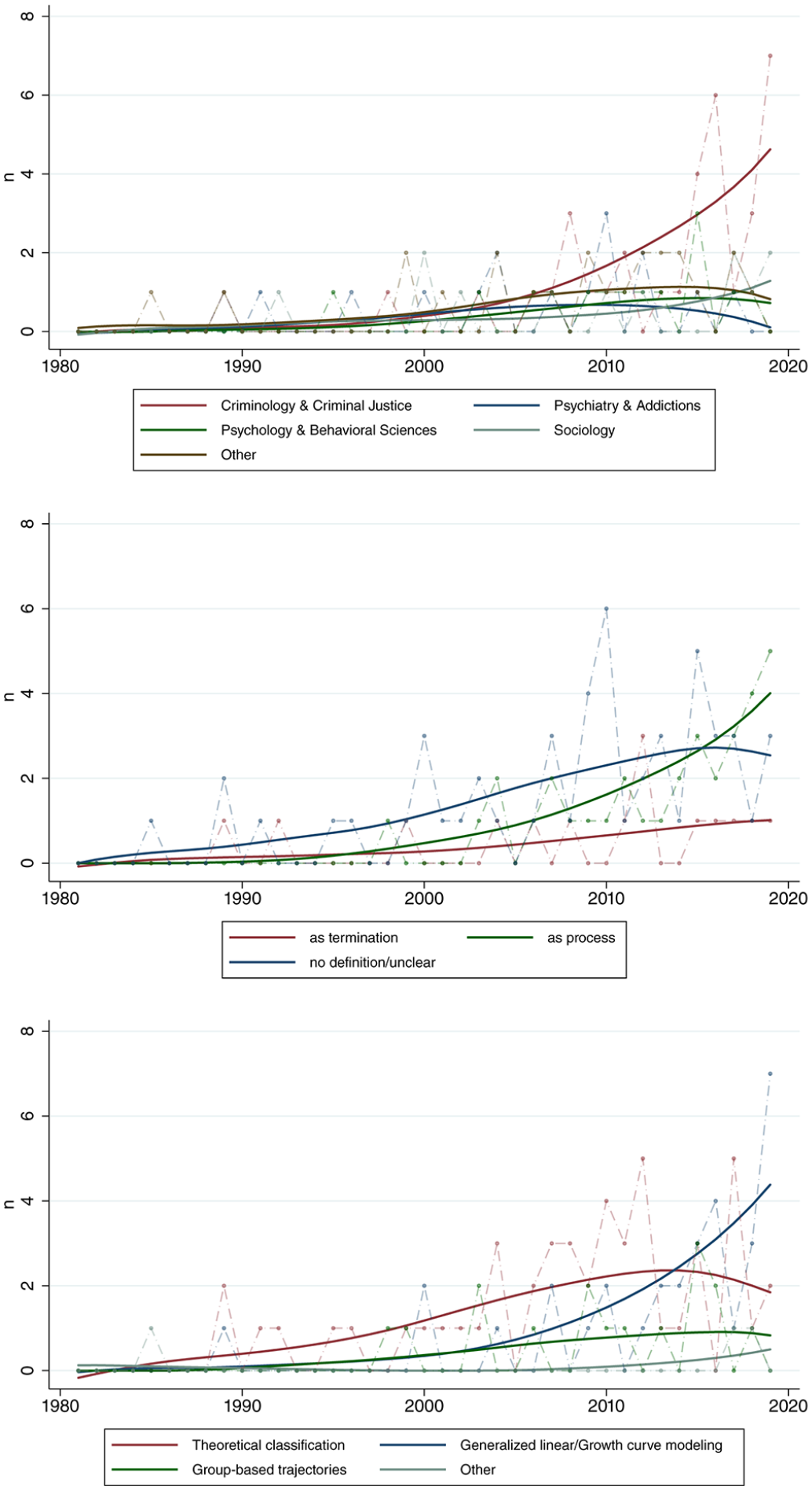
The evolution of different definitions, analytical strategies, and disciplines of the first authors of the publications, in absolute number.
The theoretical definition of desistance adopted by authors was explicitly specified in less than half (48%, n = 48) of the eligible studies (see Table 1, with effect size). When available, about twice as many studies adopted a “desistance as process” definition (33%, n = 33) rather than a “desistance as termination” definition (15%, n = 15), with considerable heterogeneity within these categories. Furthermore, the number of studies that adopted explicit “desistance as process” definitions has grown steadily over time (see middle graph of Figure 1). Publications with first authors from “Criminology & Criminal Justice” and “Sociology” were the most likely to define desistance as a process (43%, n = 15 and 46%, n = 6 respectively), as opposed to defining desistance as termination or not providing a definition. On the other hand, the vast majority of publications with first authors in the disciplines of “Psychiatry & Addictions” and “Psychology and Behavioral Sciences” did not provide a working definition of desistance (73%, n = 11 and 64%, n = 9 respectively).
The Number and Proportion of Publications Adopting Different Definitions of Desistance, by the Discipline of Their First Author.
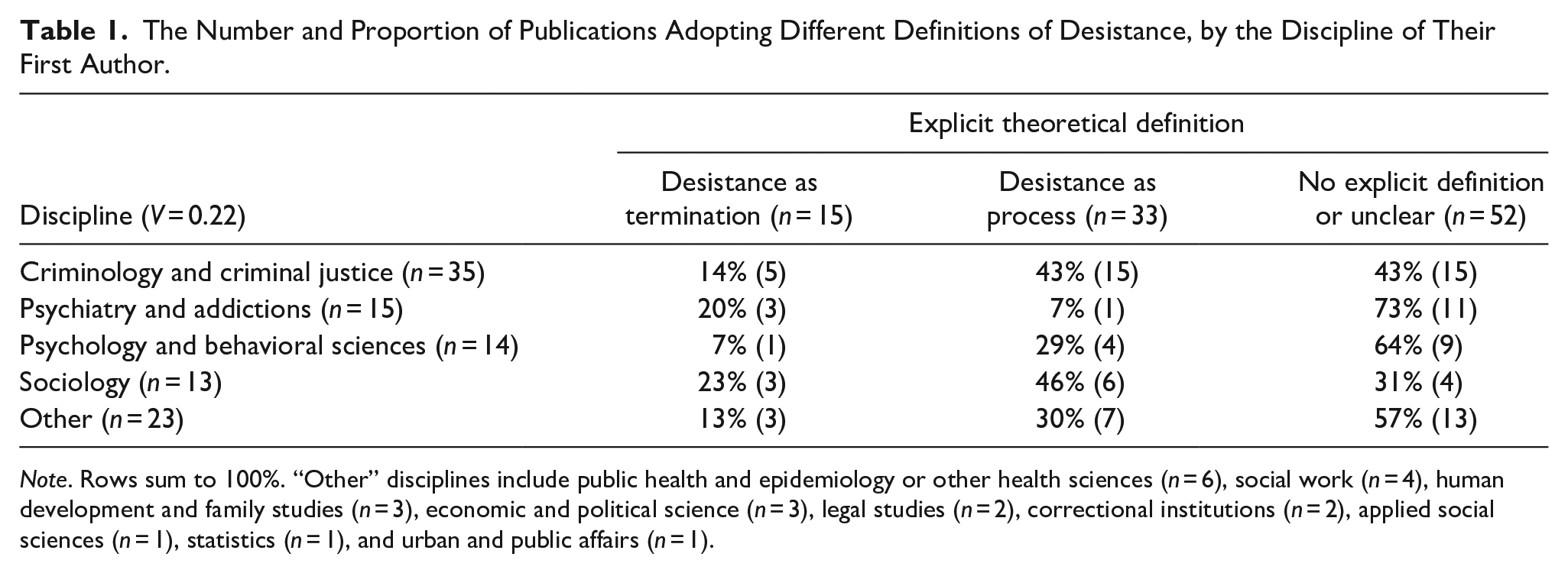
Note. Rows sum to 100%. “Other” disciplines include public health and epidemiology or other health sciences (n = 6), social work (n = 4), human development and family studies (n = 3), economic and political science (n = 3), legal studies (n = 2), correctional institutions (n = 2), applied social sciences (n = 1), statistics (n = 1), and urban and public affairs (n = 1).
Inconsistencies between theoretical definitions and concrete operationalizations and associated analytic strategies were highly frequent: among studies using a static, theoretical classification as analytic strategy (e.g., no offending over a pre-determined period of time; see Table 2), as many understood desistance as a process (24%, n = 12) compared to desistance as termination (24%, n = 12). While the strategy of theoretically classifying individuals in groups of “desisters” and “persisters” based on somewhat arbitrary cut-off points has been the most common throughout the years (49%, n = 49 of all eligible publications), the bottom graph of Figure 1 highlights a progression in the literature toward more sophisticated statistical techniques to study desistance in more recent years. In particular, modeling the heterogeneity in longitudinal trajectories was a staple of desistance research in the 2000s, as researchers—especially from the fields of criminology and psychology—used it to “empirically” classify subjects into groups of “desisters” and “persisters.” Both studies adopting an analytic strategy based on theoretical classification and studies adopting group-based trajectory modeling were highly susceptible to using the “desister” label (76%, n = 37 and 75%, n = 12 respectively). In contrast, only two studies (6.5%) that used strategies from the growth curve or generalized linear modeling family mobilized the label.
The Number and Proportion of Publications Adopting Different Analytic Strategies, by Their Adopted Theoretical Definition and the Discipline of Their First Author.
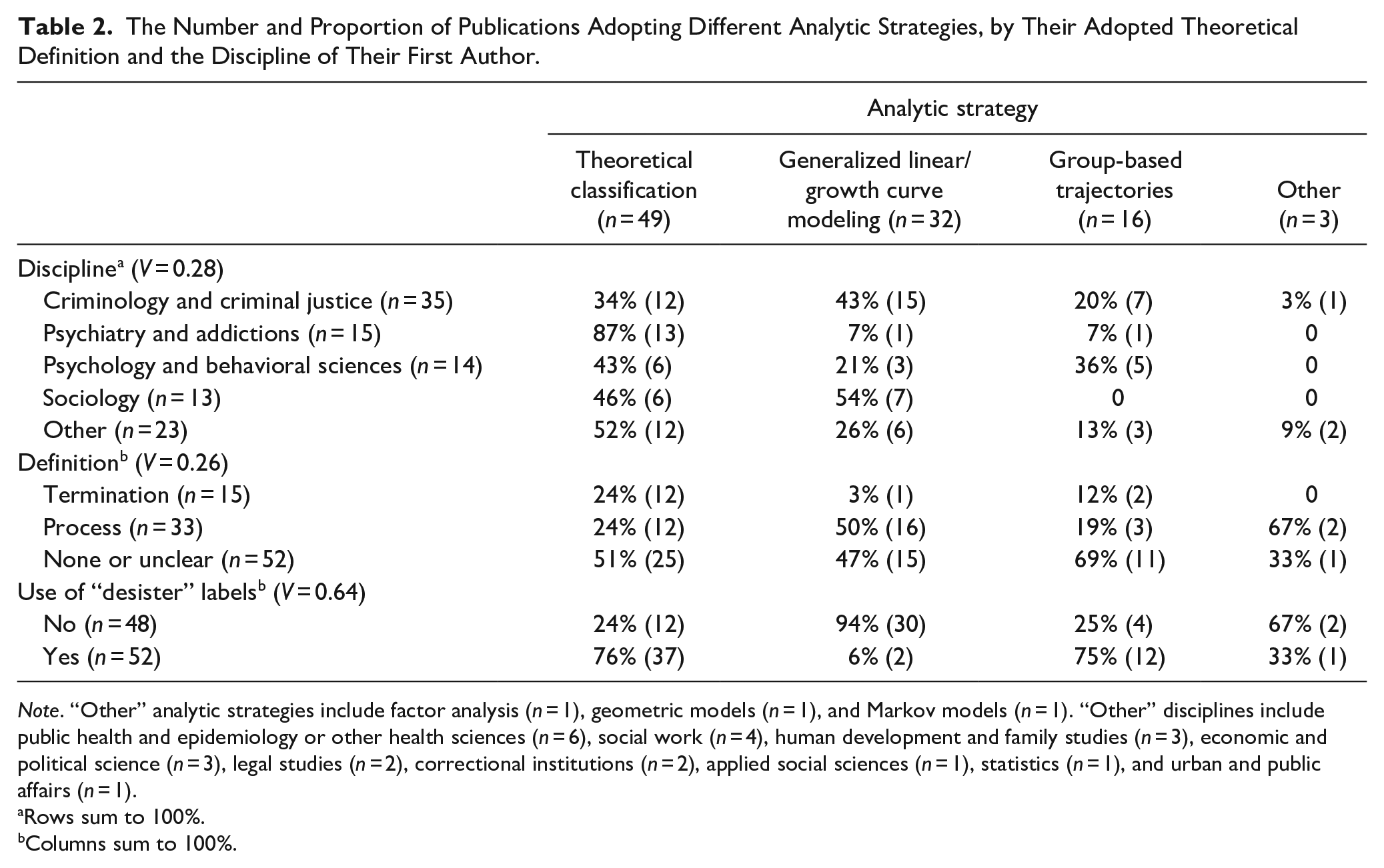
Note. “Other” analytic strategies include factor analysis (n = 1), geometric models (n = 1), and Markov models (n = 1). “Other” disciplines include public health and epidemiology or other health sciences (n = 6), social work (n = 4), human development and family studies (n = 3), economic and political science (n = 3), legal studies (n = 2), correctional institutions (n = 2), applied social sciences (n = 1), statistics (n = 1), and urban and public affairs (n = 1).
Rows sum to 100%.
Columns sum to 100%.
Joint Correspondence Analysis
The joint correspondence analysis was conducted on 76 studies, as we excluded papers from less frequent disciplines (e.g., epidemiology, social work, political science; n = 21) or using less frequent statistical strategies (e.g., factor analysis, Markov models; n = 3) to facilitate the interpretation of the dimensions. To interpret the dimensions identified by the joint correspondence analysis, we selected categories that contributed to at least 10% of a dimension (the average contribution being 6.7%). The first dimension, accounting for 75.6% of the variance, is thus most strongly represented, on the left end, by theoretical classification (0.16) and use of the “desister” label (0.14), and growth curve/generalized linear modeling (0.32) and no use of label (0.12) on the right end. The second dimension, accounting for 17.4% of the variance, is most strongly represented by group-based trajectory modeling (0.21) and psychology (0.24) on the top end, and sociology (0.21) on the lower end. Figure 2 presents a graphical representation of the characteristics of the papers according to these two dimensions. Characteristics that are graphically close to one another tend to co-occur to a greater extent than characteristics that are further away from one another. Characteristics that are close to a dimension’s zero have little discrimination power on that axis. Overall, this bi-dimensional space may be interpreted as indicative of the extent to which papers readily use classification systems to study desistance (x-axis) and the extent to which a discipline tends to implicitly or explicitly understand desistance as an individual or social phenomenon (y-axis). We argue that the left field of the graph represents a comprehension for which classifying study participants, as either “desisters” or “persisters,” is possible or even desirable, whether based on earlier practices of theoretical classifications in the field of psychiatry (bottom left) or based on “empirical” classifications (group-based trajectory modeling) in the field of psychology (top left). In contrast, the right field of the graph represents an approach where desistance is not only defined but quantified as a process that should be studied in itself, by using analytic strategies that do not attempt to identify “desisters” but emphasize within and between individual differences that promote progression on this process (e.g., hierarchical generalized linear modeling or growth curve modeling). Notably, the discipline of criminology did not characterize any of the dimensions, which is indicative of heterogeneity in the approaches adopted within the discipline. The line connecting the three timeframes suggests that desistance research has moved from a paradigm where desistance is defined as a termination, analyzed using theoretical classifications, and often studied by psychiatrists, to a paradigm where desistance is defined as a process and primarily studied by criminologists.
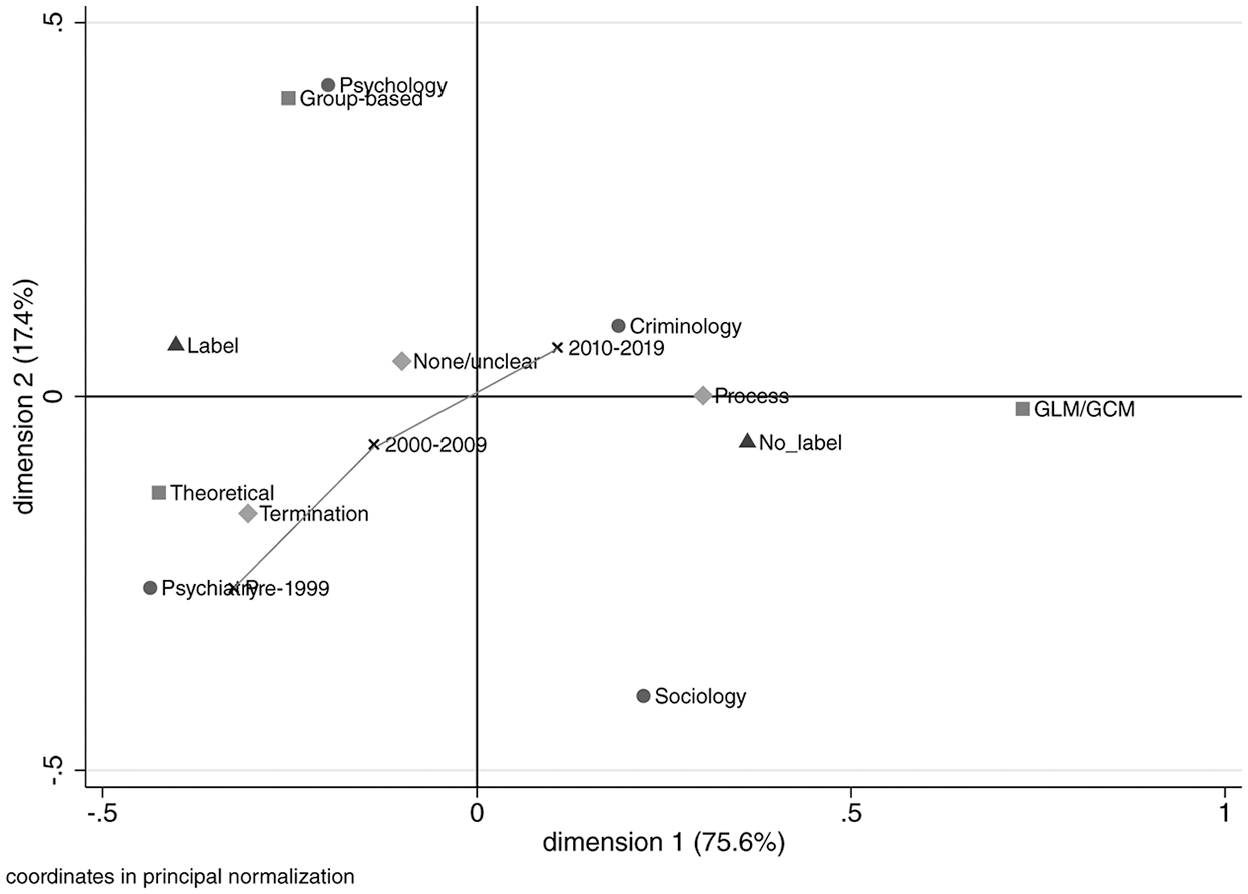
Joint correspondence coordinates plot of the characteristics of papers.
Discussion
This paper initiates an inquiry into ways statistics are used by social scientists to quantify and reify desistance, in different disciplines as well as across time. A conventionalist approach to this research question helps expose the logic underlying the production of statistics and classifications. Quantification is only one amongst many strategies that have been developed to make sense of the world in general and of human behavior in particular, but it is arguably the one that is most naturally aligned with current models of governance and that can thus have the most important consequences on public policies. Desistance, like crime, is indistinguishable from the social context in which it takes place and is reified into a coherent phenomenon at the same time as it is being quantified. Negotiations and compromises must then necessarily take place prior to the measurement for quantitative data to be extracted from qualitative information and for the production of classification systems to be ultimately possible (Moulin, 2015). This raises the question of which social groups are involved in those negotiations (e.g., scientists, policymakers, and justice-involved individuals) and what their interests are in those matters.
One of the main findings of the present scoping review is that two analytic strategies are especially likely to classify subjects into categories of “desisters” and “persisters”: theoretical classification—which considers a subject to be a “desister” if they did not reoffend for a certain lapse of time—and group-based trajectory modeling –which classifies subjects into categories of “desisters” and “persisters,” among others, based on repeated measures of crime or delinquency. Group-based trajectory modeling is a sophisticated statistical technique that first emerged in developmental psychopathology and has become a token of developmental criminology research and criminal career studies (Nagin & Odgers, 2010), and while it did not fully replace the theoretical operationalization of desistance in the literature, it most certainly competed with it. These two strategies have often been represented as two opposites in desistance research, one being labeled the “static” approach and the other the “dynamic” approach (Bushway et al., 2003); however, present findings suggest that it may not be the case. While it would have been expected that studies using a theoretical classification would be more likely to understand desistance as a cessation and that studies using group-based modeling would be more likely to understand desistance as a dynamic process, no such trends were found. The two methods were found on the same side of the joint correspondence coordinates plot, emphasizing certain epistemological similarities. The two strategies are however distinct regarding the extent to which they are willing to reify the classificatory systems they produce.
Both theoretical classification and group-based trajectory modeling assume that a population is composed of distinct subpopulations, an assumption that one of the developer of group-based trajectory modeling himself recognized as “not likely literally correct” (Nagin, 1999, p. 140). To model this heterogeneity, rather than establishing cut-off points, the producer of statistics using group-based modeling must estimate a series of models that differ in the number of groups, in the shape of each group-trajectory, and sometimes in starting values (Nagin, 1999). In practice, over a dozen models must be estimated to find the one that “best fits the data” based on indices (e.g., Bayesian information criterion), the size of each group, and theoretical interpretation. Most often, only the model selected by the scientist is presented, although several other models could arguably fit the data just as well. Subjects are then probabilistically assigned to their most likely group, which can also be interpreted as a measure of relative consistency or inconsistency of individual trajectories with the average trajectories. New methods that provide more robust estimations of the validity of a model, such as cross-validation criteria (Grimm et al., 2017; Nielsen et al., 2014), have nevertheless been developed in recent years to help address these shortcomings.
To model heterogeneity in a population is undeniably a powerful statistical technique, but one that also presents two non-negligible potential pitfalls. First, like all data analytic methods, the construction and selection of a model that “best fits the data” require arbitrary decisions by the analyst. In group-based trajectory modeling, these arbitrary decisions are highly opaque not only to readers and knowledge users, but also less experienced statistics producers. The classification of subjects into desisting trajectories, persisting trajectories and their variations thus relies on hidden decisions whose repercussions remain unclear. In the early days of the application of group-based trajectory modeling to quantified desistance, some observers argued that this method was a major improvement upon static measures of desistance, where the “selection of the cutting point to separate before and after periods is often arbitrary,” whereas “in contrast, the dynamic approach (i.e., group-based trajectory modeling) has the advantage of being inherently descriptive” (Bushway et al., 2003, p. 149). Whereas users of the static measure of desistance would often readily and transparently acknowledge the arbitrariness of its operationalization (e.g., Piquero et al., 2007), the misconception that group-based trajectory modeling allows the “distil[ation]” (Bushway et al., 2003, p. 149) of a classification system with very little intervention from the scientists is widespread in the literature.
The second potential pitfall exists precisely because of how group-based trajectory modeling renders invisible the initial conventions that allowed a social phenomenon such as desistance to be quantified. The temptation to interpret the group-trajectories as discrete entities is hard to resist: trajectories are often treated as real, and labels are assigned to trajectories based on the individuals they are envisioned to comprise. One mixed methods study, for example, has used semi-parametric group-based modeling to identify subsamples of “desisters” and “persisters,” which were later recruited for intensive qualitative interviews (Bachman et al., 2016). The developers of the technique have emphasized that trajectories are nothing but a “useful statistical fiction” (Nagin & Tremblay, 2005, p. 873), and have warned potential users against group reifications that could result from “the impression that individuals follow the trajectory average in lock step” (p. 894). Indeed, the trajectories of individual subjects are often very unlike the average group-trajectory to which they are assigned based on posterior probabilities despite the assumption of relative homogeneity, leading individual trajectories to rarely follow the average trajectories to which they are assigned. The risk of reifying desistance is therefore greater when using such empirical methods to define or “extract” desistance, compared to instances where desistance is operationalized on a theoretical basis and compromises are more explicitly acknowledged.
Such a reification has important sociopolitical impact. It may encourage a social phenomenon to be conceptualized as characteristic of distinct groups rather than as a spectrum (Nagin & Tremblay, 2005), contributing to an implicit sense of “otherness” and conferring an absolute character to categories that are highly porous. This reification perpetuates a conception of “innocents,” “desisters,” and “persisters” (Blumstein et al., 1985) as qualitatively distinct groups rather than as approximative and overlapping areas of a continuum, which has the effect of crystallizing a sense of alterity toward justice-involved people, justifying punitive and discriminatory policies and thus reproducing and furthering structural stigma (Link & Phelan, 2001). These sociopolitical implications of such reifications are especially important since the disciplines covered in this review take as their objects of study populations that are highly vulnerable and marginalized. These fields’ experts often have a very real and concrete impact on the lives and life outcomes of those they study, as they are called on by different institutions to assess risks and provide opinions on topics including the “appropriate” duration of incarceration and the possibility of liberation.
As argued elsewhere, it is thus in part the “taken-for-granted nature of [. . .] categorizations” (Link & Phelan, 2001, p. 367) that allows structural stigma to dramatically reduce the odds of positive life outcomes. Accordingly, longitudinal investigations of vulnerable populations may potentially be used for discriminatory purposes, notably through the transition from a reasoning in terms of reversible states to a reasoning in terms of irreversible states (Degenne, 2011) as exhibited by models seeking to prospectively distinguish persisters from desisters (Blumstein et al., 1985). This irreversibility is not unlike the determinism that arises from the reification of trajectories, where one might be under the impression that an individual is condemned to follow the average trajectory to which they were assigned. The impact of this reification is further amplified by the confirmation loop associated with the use of such trajectories to predict life outcomes in the criminal justice system, with applications ranging from predictive policing (Richardson et al., 2019; Saunders et al., 2016) to judicial decision-making (Carlson, 2017; McKay, 2020). After all, as Maruna playfully suggests, “to be blunt, most of the persisters one finds do not seem to really persist, most desisters do not seem to really desist, and, honestly, it is getting harder than ever to find any ‘innocents’” (Maruna, 2001, p. 43).
Limitations
The present scoping review has some limitations. Our research question required operationalization through eligibility criteria, which sometimes required that we set arbitrary boundaries. We chose, for example, to include only papers that explicitly sought to quantify desistance as part of their research question or hypotheses; studies that sought to study crime over the life course with no explicit reference to desistance in their research objectives were thus excluded, even though they labeled some of the trajectories identified as “desisters” and “persisters.” Because the objective of the present scoping review is not to produce a “real incidence measure” of papers in the literature quantifying desistance but rather to produce a global portrait of the trends in its quantification in a transparent and easily reproduceable manner, we considered this eligibility criteria to be appropriate. However, it should be emphasized that the influence of group-based trajectory modeling on desistance research as a field is likely greater than suggested by the number of studies included in the present review. Similarly, we chose to limit our search to peer-reviewed literature to investigate the circulation of the conventions underlying the quantification of desistance from individual researchers to disciplinary institutions. We believed the peer-reviewed process was an appropriate marker of knowledge that is endorsed by members of a discipline in the social sciences, more so than other markers such as conference publications, book publications, and dissertations. However, a majority of the gray literature that otherwise met eligibility criteria had also been published in a peer-reviewed journal—they were thus included indirectly in this manner. Finally, we chose departmental affiliation as reasonable proxy for discipline, but not all researchers hired in a department have been trained in the associated disciplinary framework, nor necessarily adopt the main paradigms and approaches of this discipline.
Conclusion
The social sciences mobilize a range of “engines of discovery” that attempt to “bring new kinds of people into being” (Hacking, 2006) via practices such as counting, correlating, medicalizing and finally biologizing. In that sense, these engines of discovery bring the classifications created by social sciences always closer to those that may be found in the natural sciences by naturalizing the social conventions these disciplines rely on. For Desrosières (2015), the naturalization of the quantified object is completed when the “initial conventions are forgotten [. . .] and the use of the verb ‘to measure’ comes to mind or is written with no further thought” (p. 334). We argue that the development and increased use of sophisticated statistical techniques such as group-based trajectory modeling has played an important role in the naturalization of quantified desistance and in the creation of “desisters” as a meaningful “kind of people.” If institutions are so receptive to such reified classification systems, it might very well be because, as anthropologist Douglas (1986) argues, “their claims to legitimacy [rest] on their fit with the nature of the universe” (p. 46) and thus require such naturalization. Systems of classification and their reification, in that sense, thus have for effect to validate and consolidate the sociopolitical beliefs of various institutions and their actors, to the point where they come to believe that there are indeed such people as “desisters” and “persisters.”
The growth in interest in desistance from quantitative and mixed methods researchers is concomitant with the publication of arguably one of the most influent book in contemporary crime studies (Maruna, 2001), which nevertheless called into a very different approach to desistance as to what it has become. Notably, only 3 out of the 100 included studies adopted a mixed design, symbolizing the effective silencing of people with lived experience in the quantitative enquiries of desistance. Despite claims that the study of desistance is part of a larger paradigm shift, the naturalization of the notion of “desister” appears to do little beyond further consolidating the notion of “persister” by leaving the latter’s implicit conception of delinquency as an innate propensity mostly untouched: if the “persister” is the individual with a strong propensity for delinquency and the “innocent” the one with no such a propensity, the “desister” emerges as the person who simply exhibits it to a lesser extent, turning what was once a Manichean dichotomy into a seemingly more comprehensive—and supposedly more progressive!—spectrum. The notion of “desister,” in that sense, thus appears to reinforce the stigma associated with delinquency by providing a gray zone in which those who once resisted conceptions of delinquency as innate to certain individuals can be conveniently re-classified and re-mobilized within a larger normative apparatus by the institutions, experts, and disciplines designed to measure, manage, and ultimately repress crime and delinquency.
In addition to raising these important questions, this scoping review highlights opportunities for future research on the democratization of knowledge production and the valorization of experiential knowledge in the research process. By highlighting the slippery slope from quantification to reification, from statistical fictions to “facts,” this review calls for a more sustained engagement with quantification’s implicit tendency to devalue lived experience in order to maintain the categories we, social scientists, first take for granted and then “empirically” discover.
Footnotes
Acknowledgements
Marichelle Leclair wants to express her sincere gratitude to Professor Stéphane Moulin for his insightful comments and suggestions on a preliminary version of this manuscript.
Declaration of Conflicting Interests
The author(s) declared no potential conflicts of interest with respect to the research, authorship, and/or publication of this article.
Funding
The author(s) disclosed receipt of the following financial support for the research, authorship, and/or publication of this article: Marichelle Leclair would like to acknowledge the financial support of the Canadian Institutes of Health Research in the form of a Vanier scholarship and of the Observatoire en justice et santé mentale as a bursary while working on this manuscript. Théo Lepage-Richer is grateful for the financial support of the Social Sciences and Humanities Research Council of Canada and the Fonds de Recherche du Québec – Société et Culture. Yanick Charette and Laurence Roy received salary awards from the Fonds de Recherche du Québec – Santé.
