



Abstract
We explore young people’s experiences and perceptions of knife crime, and we compare these to the understanding of police experts, to explore the perceptions shaping trust in the police and policing. We carry out an experience sampling survey deployed using a mobile application reflecting on safety and knife crime, to understand young people’s daily lived experiences. We then use the mental models approach to interview young people and police experts and construct a shared mental model which identifies mismatches between the two groups and key areas of discord related to breakdown of trust and communication. We identify gaps, misconceptions and expectations for re-establishing trust and propose strategies to tackle knife crime and improve trust between young people and the police.
Introduction
Knife crime offenses in England and Wales have hit a high not recorded since 1946 (Dearden, 2019), with an 80% increase during the last 5 years (Shaw, 2019). About a third of the nationally recorded offenses occur in London, and two-thirds of these incidents in the capital involve young people 10 to 25 years old (Bentham, 2019; Grierson, 2020). Various reasons behind knife crime have been discussed in academic and policy research, such as perceived insecurity (Traynor, 2016) and lack of trust in policing (Brennan, 2019). Research around young people’s lack of trust in policing demonstrated that it leads to an unwillingness to cooperate with the police and generates feelings of unsafety, which may result carrying a weapon for self-protection (Gladstone & Parker, 2003; Shaw et al., 2011). In the UK, the ideological emphasis is on “policing by consent” (Reiner, 2000) and a public health approach is being implemented, so this lack of trust is particularly problematic.
Trust is vital for every aspect of societal functioning and is considered the basis of social capital (Fukuyama, 1995); yet, an increasing number of studies report lower levels of public trust and confidence in institutions, governments and public services, with consequences for the willingness to engage, cooperate and participate which lies at the heart of democratic institutions. Public trust in policing is no exception; confidence has diminished since the 1980s (Cowell et al., 2012; Higgins, 2005; MORI, 2003; Reiner, 1992; Skogan, 1996).
Hobbes (1640, p. 53) defined trust as “a passion proceeding from belief of him from whom we expect or hope for good, so free from doubt that upon the same we pursue no other way”; more recent definitions refer to an “intention to accept vulnerability based upon positive expectations of the intentions or behavior of another” (Rousseau et al., 1998, p. 395). Trust is important in situations of risk and uncertainty. In such cases, a trustor (person making a trust decision) displays vulnerability by making herself vulnerable to the trustee (the party in which trust is directed—e.g., a person or an institution); she makes a decision to rely on them based on the belief that the trustee will act on her best interests (Kini & Choobineh, 1998; Skarlatidou et al., 2011). In developing trust perceptions, personality traits (trust propensity), previous personal experiences and other affective and cognitive factors play an important role, especially when assessing the trustee’s intentions and other attributes (e.g., competency, honesty, goodwill). Understanding the trustee attributes that influence the formation of trust decisions in specific contexts of risk and uncertainty provides a way to improve trust (Skarlatidou et al., 2011).
Such trustee attributes in the policing context include the belief that the police protect people from harm (Harcourt, 2006) and execute their roles fairly (Jackson & Bradford, 2010). This interplay between police effectiveness and fairness, mediated by the understanding and experience of police engagement practices and shared values on personal and institutional levels, feeds into overall trust in policing (Jackson & Bradford, 2010). These interpretations, perceptions, and people’s wider “mental models” about policing and trust may vary significantly between different localities and publics (e.g., young people, victims of crime). In this paper, we argue that by understanding perceptions of risk and trust in policing among individuals who share similar characteristics (i.e., young people living in the same area, likely sharing similar life experiences, and exposure to policing), and similar contexts of risk and uncertainty, we can uncover a “shared mental model” to explore what shapes trust in policing. Moreover, since worry about crime is situation-specific (Solymosi et al., 2015) and crime depends on neighborhood characteristics (Brennan, 2019), understanding the perceived risks and possible behavioral consequences, as well as mapping out where these perceptions and behaviors are located, can help us identify areas and situations of such high risk and uncertainty.
This paper aims to understand young people’s experiences and perceptions of knife crime, compare these to the understanding of police experts to explore the perceptions shaping trust in the police and policing, and ultimately identify effective strategies to re-establish trust between young people and the police. We present research carried out collaboratively with a community organizing group in the London Borough of Hackney, working with young people across two sixth form and community colleges. First, to explore young people’s experiences of safety in relation to knife crime in their everyday life, we carried out an experience sampling study to map where and when young people worry about knife-related incidents. We then explore (a) where young people feel unsafe and (b) what sort of incidents worry them. Then, since risk is a precondition for trust, we apply the mental model approach from the risk communication field (Morgan et al., 2002) to uncover young people’s risk perceptions of knife crime and perceptions of trust in policing and compare them with those of police officers in their local areas. In doing so, we identify gaps, misconceptions, and expectations for re-establishing trust.
The contribution of this paper is, therefore, two-fold. Firstly, we offer experience sampling as a way to illustrate how understanding the specifics of young people’s experience is required in order to gain a holistic understanding of situations of risk and uncertainty in which trust is most required. Secondly, we present the mental model framework as a way to reconcile how young people and police perceive the issue of knife crime and trust in policing in their local areas, as well as the barriers and opportunities which would enable the development of more context-appropriate strategies to tackle knife crime. This qualitative approach required the involvement of hard to reach individuals with direct lived experience of knife crime.
The rest of the paper is set out as follows. We review the state of research on violence and knife crime affecting young people, highlight the importance of trust, and outline how understanding young people’s situation-specific experience and the resulting mental models can contribute to our understanding of this issue. We then present our findings and discuss implications for building understanding and effective approaches to re-establish trust between young people and the police.
A Public Health Approach to Tackling Youth Violence and Knife Crime in London: The Importance of Trust
Overall, levels of crime in many industrialized countries have continued to fall over the last decades. Recently this drop has slowed, and some higher-harm crimes have begun to rise. In June 2019, England and Wales saw a 7% increase in the number of police-recorded offenses involving knives or sharp instruments (Elkin, 2019), resulting in a media-led alarm around knife crime (Grimshaw & Ford, 2018) and turning it into a political priority. The Violent Crime Strategy (HM Government, 2018) announced it a public health duty to combat violence and ensure the accountability of professionals across public bodies from health, education, police, and social services to protect young people at risk (Audickas et al., 2019). The strategy includes the implementation of a £100 million “Serious Violence Fund” for police operational activities alongside the establishment of local “Violence Reduction Units” (HM Government, 2018) to identify risk and protective factors, monitor changes, and develop a robust evidence base around prevention and controlling violence (Middleton & Shepherd, 2018).
Research identifying individual level risk factors associated with knife crime has highlighted gender (McVie, 2010); age (HM Government, 2018); ethnicity, financial deprivation; and socio-economic background (Brennan, 2019; Silvestri et al., 2009); exposure to violence and prior victimization (Brennan, 2019); low educational attainment and exclusion from mainstream education (Ministry of Justice, 2018). At the interpersonal and community level, risk-factors include: family background and adverse childhood experiences (McAra & McVie, 2016); lack of accessible alternative activities; gang involvement and territoriality (Wood, 2007); and deprivation and violence (McAra & McVie, 2016). Although such risk factors may apply to different contexts, working with local communities to understand their specific experiences with knife crime and risk perceptions is essential to inform effective tailored interventions. For example, research using UK major trauma data has shown that stab injuries in under 16 years old occurred most frequently in the immediate after-school period and geographically close to the school (Vulliamy et al., 2018), perhaps unsurprisingly reflecting young people’s routine activities. However, knowing that young people are at risk after and near the school has not narrowed the specifications for targeted interventions. Police might issue a Section 60, enabling stop-and-search without any suspicion in the defined area and time period. This broad-brush approach may have unintended consequences, alienating young people and lowering their trust and the perceived legitimacy of the police (Murray et al., 2020).
A trustworthy police force is perceived as effective, fair, sharing values, interests, and a strong commitment to the local community (Jackson & Bradford, 2009; Jackson & Sunshine, 2007; Sunshine & Tyler, 2003; Tyler & Huo, 2002). An erosion of trust over time or in certain groups is the focus of much research and policy (Brunson et al., 2015; Fine et al., 2003; Sharp & Atherton, 2007). Specific focus is given to young people’s “lack of trust in society’s defined protectors—the family and the police” (Shaw et al., 2011, p. 269). Lower levels of trust in police among young people have been explained in the literature with reference to their greater use of public space, resulting in heightened contact and conflict with the police (McAra & McVie, 2010).
UK-based studies exploring motivational factors for knife-carrying have found “fear, victimization, peer-group pressure and fashion are considered the prime motivations” (Harding, 2020, p. 33), alongside perceptions of insecurity (Traynor, 2016) and a lack of trust in police (Brennan, 2017). The emphasis on perceived insecurity highlights the need for “more attention to the fears and risks facing children and young people as they go about their daily lives” and “the strategies children and young people employ to feel and be safe” (Stephen, 2009, p. 195). Indeed, many young people use knife-carrying as a means for self-protection (Brennan, 2019; Marfleet, 2008; McNeill & Wheller, 2019; Wikstrom & Svensson, 2008), resulting from the combination of fear with a lack of trust in police (Brennan, 2019; Silvestri et al., 2009). When young people find themselves in high risk situations, the risk of getting caught (with a knife) seems to be outweighed by the potential of “feeling protected” (Broadhurst et al., 2008) or minimizing potential victimization, especially when neither the police nor the state are perceived to offer protection. Especially in disadvantaged communities where the available constructive social capital is low, young people may further get involved in gangs to build alternative social capital (Putnam, 2000).
Proactive policing, often exemplified by stop-and-search, is often mooted as an important answer to knife crime. However, studies examining young people’s experiences of policing strongly suggest that stop-and-search powers contribute disproportionately to building distrust towards the police (McAra & McVie, 2005). This is higher amongst males from black and other ethnic minorities and working-class youth (Crutchfield et al., 2012; UK Parliament, 2014); although other studies suggest that some ethnic minorities in the UK in general possess “more positive attitudes to the police when compared with white residents” (Sindall et al., 2017, p. 347). A recent study with young people in England and Scotland shows that not only do specific activities such as stop-and-search reduce trust in policing, generating serious concerns around its legitimacy, but that this in turn results in increased offending behavior (Murray et al., 2020) while the benefit of stop-and-search for deterring or controlling crime is at best marginal (Tiratelli et al., 2018). Directly engaging with young people may help to better understand what specific risk factors emerge during their daily activities, ultimately allowing for more focused approaches.
An example of such focused work was carried out with young victims of gunshot assault in Philadelphia. Interviewing young people, Dong et al. (2017) identified risk factors such as being with peers, without guardians, in public space, weapon carrying, or substance abuse. They found that gunshot assault victims gradually drifted into the identified high-risk circumstances and their risk increased as they went about their daily activities. Another study exploring young people’s strategies for staying safe found an overarching theme of safe and unsafe places as youth described people, places, and activities in their neighborhoods (Teitelman et al., 2010) related to their victimization. Such findings can be used to inform community-based interventions where a gradual increase of risk could be monitored and flagged.
Community involvement, which is at the heart of a public health approach, requires a “strong partnership with affected communities [. . .] addressing the needs of victims, [and] the fears of the community” (Middleton & Shepherd, 2018, p. 1967). As risk perceptions are highly subjective and formed by a wide range of influences (e.g., prior experiences of violence or indirect exposure through family members and peers, perceived uncertainty of the environment and, subsequently, the trustee), community involvement and exploring young people’s risk perceptions in specific local contexts is critical for the development of effective local strategies for tackling knife crime. Studies such as Teitelman et al. (2010), Dong et al. (2017), and Nayak (2003) suggest that young people possess a “specialist, place-specific knowledge of fear of crime” (Nayak, 2003, p. 313). By identifying how young people encounter and perceive worrying situations, we move towards reducing knife crime and harm.
Mental Model Approach
Close partnerships with communities may have the potential to re-establish trust. But while understanding risk perceptions is essential for informed public health responses, public perceptions of risks by lay people may differ significantly from expert evaluations and distrust or suspicion may result from misconceptions and knowledge gaps. If this holds true, it is essential to understand how young people’s perceptions of trust are formed and influenced, to consider their expectations and how their risk perceptions are formed to design strategies that re-establish trust and, subsequently, tackle knife crime. As a solution to this issue, we propose using the mental model methodology from the risk communication field.
Mental models are linked to theories of human memory and cognition. They are internal representations of external reality that people use to interact with the world, filter and store new information, and influence their choices and behavior (Mandler, 1988). The construction of mental representations is based on unique life experiences and perceptions. They are mostly incomplete and may contain inaccuracies. In risk communication, mental model approach is used to elicit shared representations on complex, context-dependent topics (e.g., hazardous processes, climate change). The approach can also identify misconceptions and gaps useful to develop communication materials to correct mental models so they can more effectively assist individual rational decision-making under risk and uncertainty. Understanding the perceptions and values shared mental models incorporate can further support effective policies tailored to citizens’ expectations (Shugart et al., 2020). This is particularly important as expert understanding, which is usually the basis for the development of policies and strategies, may contain inaccurate assumptions around what the public knows or expects for institutional change, especially when it comes to issues of trust (Atman et al., 1994).
The mental model methodology provides a structured approach to investigate both lay and expert perceptions on a particular topic. Through direct comparison we can identify obstacles to effective two-way communication (Morgan et al., 2002). Mental models may further assist in exploring lay people’s vocabulary, as well as what is needed from future strategies to assist in the resolution of any underlying issues (Skarlatidou et al., 2012). In this paper, we apply mental model methodology to provide an insight into knife crime risk perceptions, the trustee attributes that are part of young people’s mental models, and how their expectations differ from those of experts, which currently shape policies and practices.
Methodology and Study Design
In the first stage of this study, we conduct an experience sampling survey deployed in a mobile application to map young people’s context-specific experiences and fear of knife crime. In the second stage, we use the mental model approach for interviews with additional young people and police officials to understand their perceptions of trust and knife crime, and uncover knowledge gaps, misconceptions and expectations in terms of re-establishing trust.
Experience sampling provides an approach for collecting data about people’s daily activities and their self-reported interpretations of their emotional states in those situations (Larson & Csikszentmihalyi, 2014). The method uses a short questionnaire deployed repeatedly over the course of some pre-defined time period, reminding participants to complete this using signal-, event-, or interval contingent protocols (Reis & Gable, 2000). We use event and signal contingent sampling by asking people to tell us about instances when they felt worried (events) and by sending daily reminders (signals) to complete the survey about levels of perceived safety. We implement these protocols through a mobile application, which presents opportunities for crime data acquisition providing a deeper understanding of people’s everyday experiences (Solymosi & Bowers, 2018). Specifically, sensors such as GPS and an internal clock support smooth collection of data without overtly taxing participants’ time (Solymosi et al., 2020). This reduces burden, improves the amount of data and the quality of research insight in situational crime contexts.
The application developed for this study (CinCity App) adapted a tool previously used to survey general fear of crime called Fear of Crime Application (FOCA) (Solymosi et al., 2015). CinCity App focused specifically on young people’s experiences with knife crime by asking the question “In this moment, how worried are you about becoming a victim of a knife incident?.” Supplemental Appendix A describes the app in further detail. Volunteers from two colleges based in East London were recruited to use the app. Additionally, two workshops were held where volunteers asked people to register and share their experiences for the study. While we initially intended for each person to share experiences from their unique accounts, volunteers instead used their own accounts and devices to collect their peers’ experiences.
The second stage aimed to capture perceptions of trust in policing and around knife crime. We conducted a total of 20 interviews in the wider vicinity of Hackney, East London. Participation numbers and the interview protocol are replicated from mental model studies in other contexts (Morgan et al., 2002, Skarlatidou et al., 2012). A prerequisite for the mental model methodology is that lay and expert participants are interviewed using the same questions, so that misconceptions and gaps are revealed from both sides. The interview template was developed based on the template of Bostrom and colleagues, as it is “easier to replicate as well as less vulnerable to the criticism that the reported beliefs are a function of how they are elicited” (Bostrom et al., 1994, p. 960). This was modified to accommodate the issues of knife crime, mutual perceptions and trust in policing (see Supplemental Table 1).
Part I starts with general associations of knife crime which aimed at eliciting images of knife crime, knife carrying, and policing similar to Slovic et al. (1990). For Parts II and III, interviewees were asked to elaborate on their perceptions about drivers of knife crime and policing activities and police-community relationships. Questions were generic but prompts were used to encourage additional descriptions. Interviewees shared their perceptions of trust in Part IV and were questioned about the most important trustee attributes or behaviors for establishing trust between young people and the police in general, before focusing on the topic of trust in policing (Part V). Part VI asked participants for suggestions to improve youth safety, prevention and trust in policing. Lastly, participants were asked to share any additional information on the topic of knife crime.
Prior to the interviews, all interviewees were informed about the study and assured of their anonymity before providing consent. The duration of the interviews ranged from 25 to 55 minutes. Audio recordings from were transcribed and coded by a single researcher, using NVivo12. Key themes were identified from the expert interviews, the resulting expert mental model then guided the analysis of lay interviews. Both models were then compared to indicate gaps, similarities and critical differences in the use of vocabulary, content and the provided level of detail.
It should be noted that during the timespan of our research, various videos documenting extreme police violence against black citizens in the United States came into the international spotlight. While these videos were only explicitly referenced in three of the interviews (by one expert and two lay interviewees), young people live in a well-connected world of media resources, which likely shapes their mental models and subsequently the perception of their own everyday lives and experiences.
Results
Young People’s Experiences with Worry about Knife Crime
Volunteers used the CinCity App to report their own experiences, and to collect the experiences of their peers within the two East London Colleges over a period of 2 months, starting on 2020-01-15 and ending on 2020-03-10. Two workshops took place on 2020-03-03 and 2020-03-10, where volunteers took part in data drives approaching people in the colleges to ask about their experiences with knife incidents.
In total 85 reports were made, collected by 14 volunteers, reflecting both their own experiences and that of the peers they interviewed. While demographic information was only collected for the volunteers (not the interviewees), we feel it relevant to report here for context: 43% of our volunteers were 16 or 17 years old (n = 6), while the others were tutors in the college who were slightly older, with the oldest 33 years old (all interviewees were 16–25 years old). 36% were Male (n = 5), 43% Female (n = 6), with two “Other” and one “Trans” respondent. More than half of the volunteers (n = 8) had experienced a previous knife related incident in the past 12 months, while six had not.
When asked how worried they were about becoming a victim of a knife incident, 20 reports indicated “Not at all worried” or “Not very worried” while in 65 reports respondents were either “Fairly worried” or “Very worried” about victimization. Of these 65 cases, 18 reported: “I heard about someone having a knife,” 14 reported: “I saw a knife,” seven reported “I saw someone threaten to use a knife,” seven reported “I saw someone use a knife,” 19 reported “Other,” and 20 were cases where the person did not indicate why they felt worried. “Other” incidents included personal experiences with issues other than knife crime (e.g., “Someone drove past and shouted at me” or “Was being followed”), seeing something that evoked worry (e.g., “Saw guns”), or general knowledge of issues like gangs or drug dealing in the area.
People were also asked where the incident took place, either by providing the GPS to their location, or by retrospectively selecting the location on a map. Based on previous literature, we expected to find reports in the local area and context, however young people in our study reported experiences of worry about knife-related incidents throughout their activity spaces across London. Figure 1 shows a map of all reports, with Hackney (our study area) outlined in red. We see that we received most “safe” reports within Hackney, possibly due to familiarity with this area, and instances of worry were reported outside of this area.
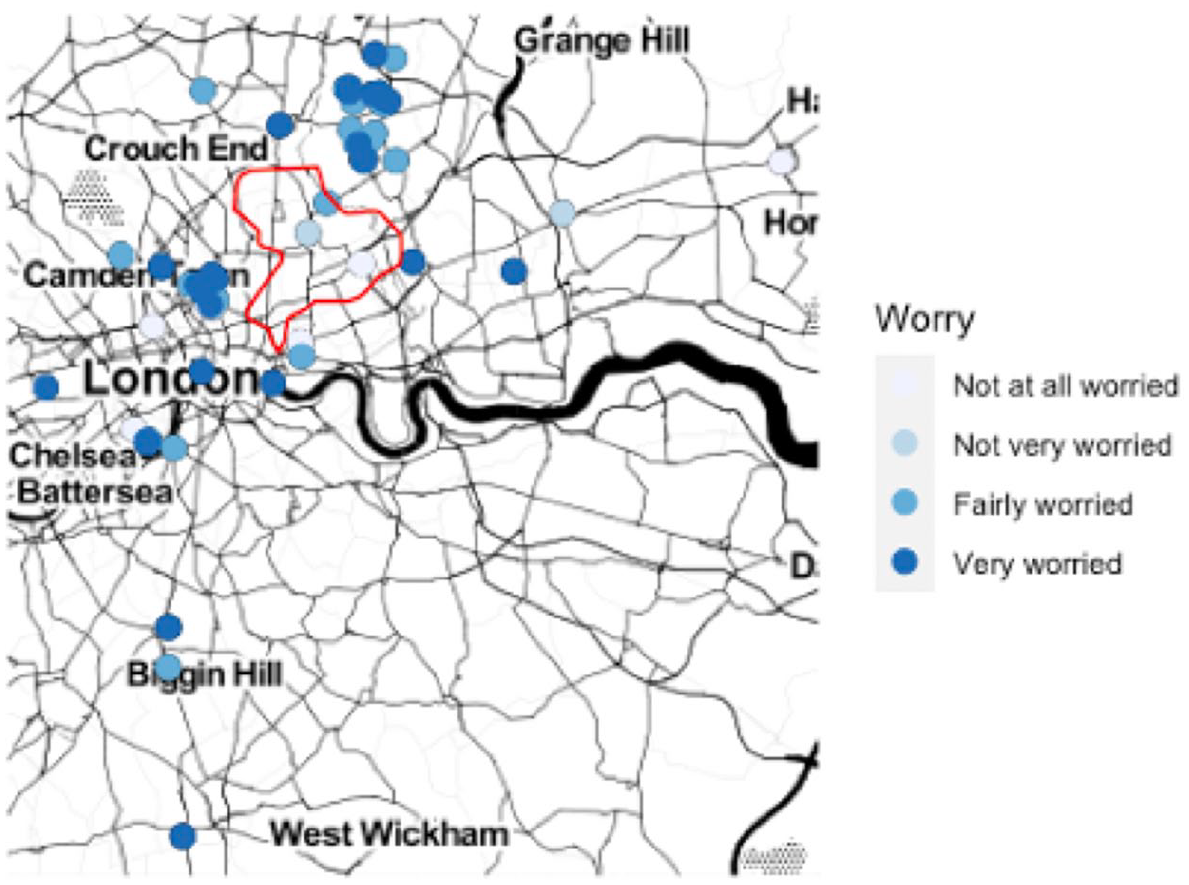
Map of young people’s experiences with worry about knife related incidents across London. Hackney borough is highlighted in red.
In fact, if we consider only the number of reports that were either “Fairly worried” or “Very worried,” Hackney does not feature as a location for many worrying incidents. Instead, it is the surrounding boroughs, Waltham Forest (22), Haringey (11), Camden (7), Islington (7), and Westminster (6) where most “worry” incidents were reported (Figure 2). Therefore, while local areas may be important in terms of influences, the specific instances where young people feel worried about knife crime are distributed all across their activity space, and are linked to where they may encounter the specific issues which make them feel worried.
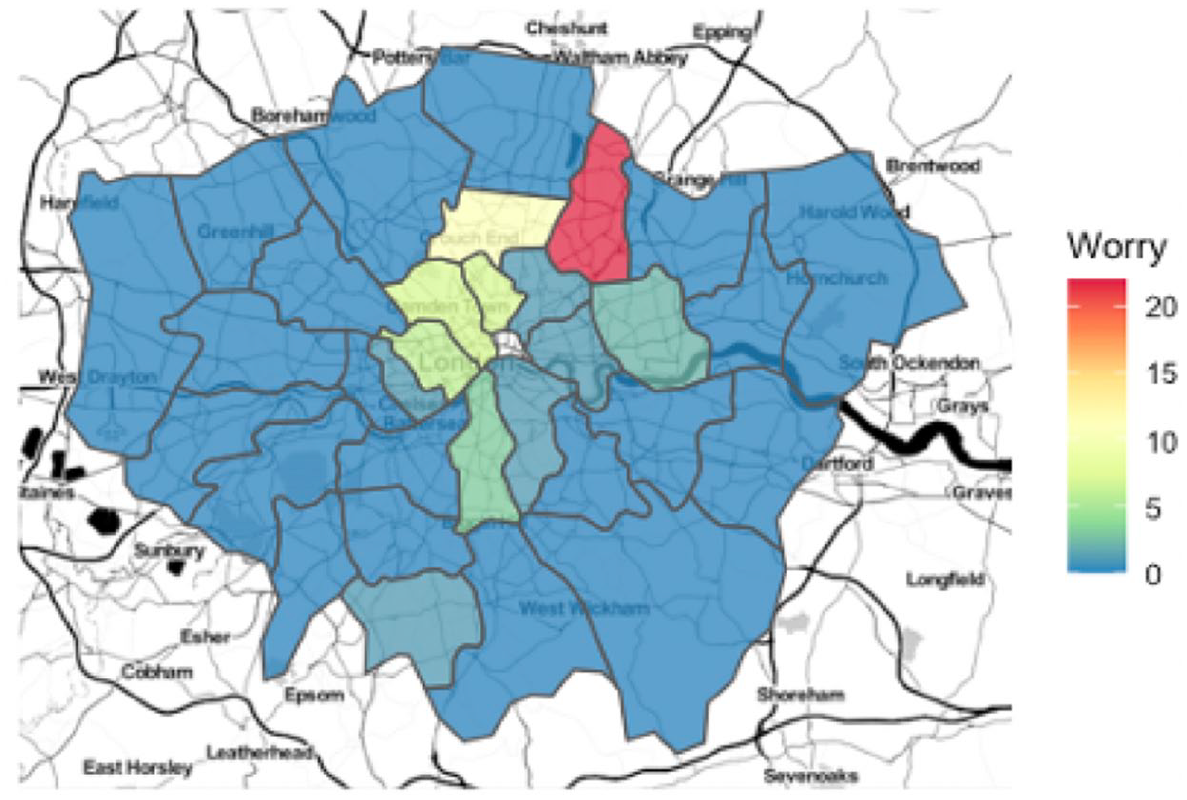
Aggregate map of count of worry incidents reported by young people by London borough.
Mental Models of young people and police experts
A total of 20 participants were interviewed; 16 young people and four police officials. Police expert interviewees work for Metropolitan Police in East London; three of them are part of a dedicated Youth Engagement team, and the fourth works within an Emergency Response team. All expert interviewees have in-depth knowledge of policing and public health initiatives that are established to tackle knife crime in London. Lay interviewees include 16 young people (eight males and females), 16 to 25 years old, who live or study in Hackney or the broader East London region; they had lived experience by virtue of their age, location and personal experiences of safety in the area. Lay interviewees were mainly recruited from two colleges based in Hackney, East London.
The general images that interviewees (young people and police officials) hold about knife crime and policing show similarities (e.g., “poverty, lack of safety”), but young people emphasize the negative effects of knife crime often in emotional tones (e.g., “shattered families, blood, pain, tragic”; “bad experiences, no trust”). In contrast, the concepts experts use mostly have a neutral affect (e.g., “age,” “male,” “deprivation”) (see Supplemental Table 2). Police experts’ models stress their dissatisfaction with current enforcement tactics (e.g., “uphill struggle, shifting goal-posts”) and the dangers of frontline work (e.g., “violence,” “fear on the frontline”).
Perceptions of Knife Crime Risks and Motives
The top-level mental model shows concepts related to knife crime risks and motives (Figure 3). Single-lined circles show concepts which exist only in experts’ mental models and dash-lined circles show young people’s concepts. It is evident from the overlap that lay interviewees were well-informed on the topic of knife crime, as most of them participate in community work on youth knife crime activism in addition to their lived experiences. Since this was not a condition for participation in the study, it is likely the result of self-selection.
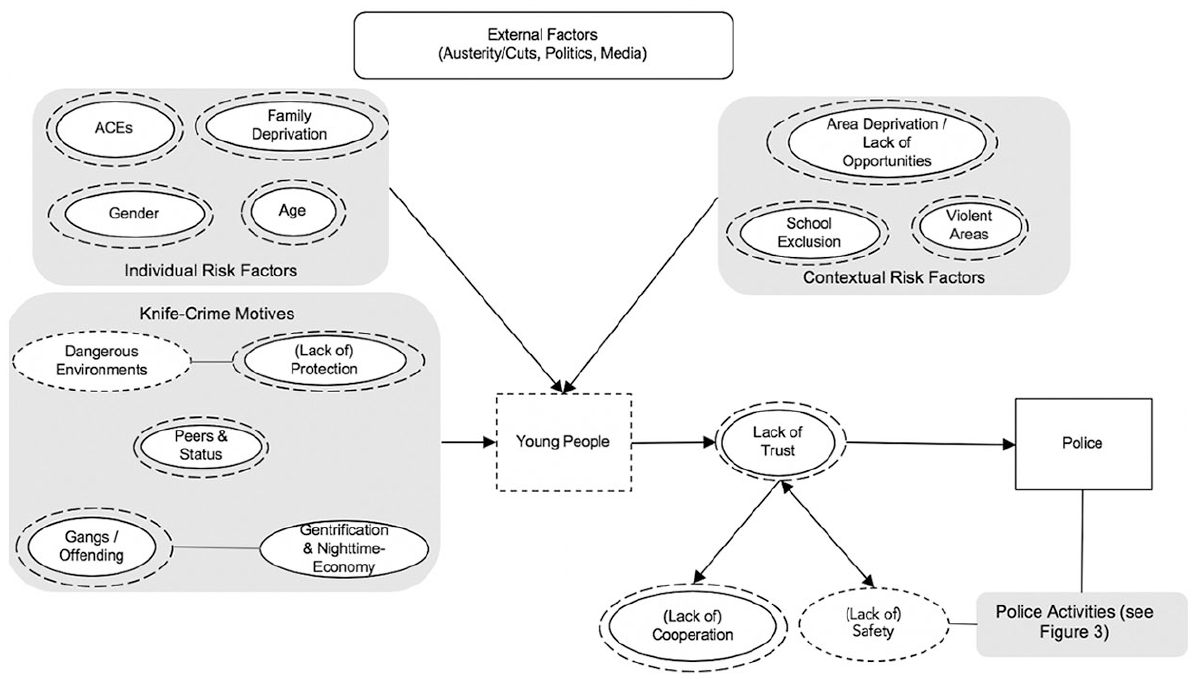
Top level mental model—Expert and young people’s perceptions of knife crime and motives. Singled-lined circles show expert concepts and dash-lined circles the concepts of young people. Squares do not symbolize concepts but they are being used to visualize how concepts are linked with each other and to whom they refer.
Regarding individual and contextual risk factors, both young people and experts identify the same concepts although they use different vocabulary to describe them (e.g., what young people describe as “not having a good family, no real parental figure” or “families with trauma and neglect,” is described by experts as “Antisocial Childhood Experiences—ACEs”). Both experts and young people identify the interplay of individual and contextual knife-carrying risks (e.g., “It’s not one cause, it’s a layered problem. There might be issues at home, poverty, the neighborhood that leave kids vulnerable”—lay interviewee). These include: “ACEs,” “Family Deprivation,” “Gender” (emphasizing that victimization disproportionately effects young men, and that female involvement was likely less visible), “Age,” “Violent Areas,” “Area Deprivation/Lack of opportunities,” “School exclusion”; factors which are also listed in the knife crime literature (HM Government, 2018; McAra & McVie, 2016; McVie, 2010; The Police Foundation, 2018). Young people also emphasize the influence of communal violence shaping their everyday lives, which is also in line with other studies (Brennan, 2019), and stress the role of previous exposure to violence in involvement with knife crime. Notably, young people share the expert understanding of risk factors as cumulative; that is, the more of these factors apply to a person, the higher the likelihood of involvement in knife violence.
Regarding motives for knife-carrying, both police experts and young people mention “Status” (“some think it’s cool to have knives”—lay interviewee) and “Belonging” (“it will get them into gangs because it feels like a family, like they are part of something”—lay interviewee). Both groups identified the impact of “Gangs”; police experts see grooming and consequential involvement in criminal offending (such as drug-selling or robbery due to material deprivation) as the most important motive, influencing their perceived legitimacy of stop-and-search as an enforcement method. These utility-based motivations as part of an offending lifestyle were less prominent in lay people’s accounts, despite mentioning proximity to criminal gangs, territoriality (“postcode wars”), as well as the glamorization of criminal activities for material gain.
An expert concept, which is not mentioned by young people, links knife crime motives to “Gentrification and night-time economy” in East London. However, young people identify “Lack of protection” including feelings of insecurity and suggesting that feeling unsupported and unprotected by police and other institutions contributes to knife-carrying, which is in line with previous studies (Palasinski, 2013). A lay interviewee mentions “There is this hyper-vigilance, of always looking over your shoulder because you are right to not feel protected. They might not carry it [knife] to hurt someone but to defend themselves, even when it’s just walking to the corner shop.”
Environmental or contextual motives (i.e., “Dangerous Environments”), which increase the likelihood of knife crime at a particular location, as mentioned by young people include prior experiences of violence or known drug abuse within the neighborhood. In their descriptions, young people give a temporal dimension to the likelihood of these (e.g., “when coming back from school”) and the strategies they develop to minimize risk (e.g., “not walking with the phone out or being home before dark”).
It comes as no surprise that “Lack of Trust” is mentioned by both groups. Notably, this lack of trust is key in young people’s conceptualizations for explaining knife-carrying and tightly linking those to their perceptions of safety (e.g., “many people do not trust the police so they will put it [knife] into their own hands again”—lay interviewee). In recounting the experience of a young boy, one lay interviewee stressed a lack of awareness of the situation by adults; “He wasn’t sure what they wanted from him and was scared to go home alone. When I voiced that to people who could have organized safe transport, nothing was done to protect him.” The next section discusses this aspect of the mental model in more detail in relation to perceptions of policing activities.
Perceptions of Policing
Participants were asked to elaborate on issues around policing and trust. Figure 4 illustrates that the majority of young people emphasize “Stop-and-Search,” “Street Patrol” (/Visibility), and police “Response”; while experts also mention “Victim Support” and other activities such as “Neighborhood Support” and “VRU” (i.e., Victim Reduction Unit). Both experts and young people understand young people to form their perceptions based on their own “Personal experiences,” “Others’ experiences,” and the “Community” (e.g., in case the community shares an anti-police sentiment as a whole). It is most noteworthy that all references to trust highlight its absence.
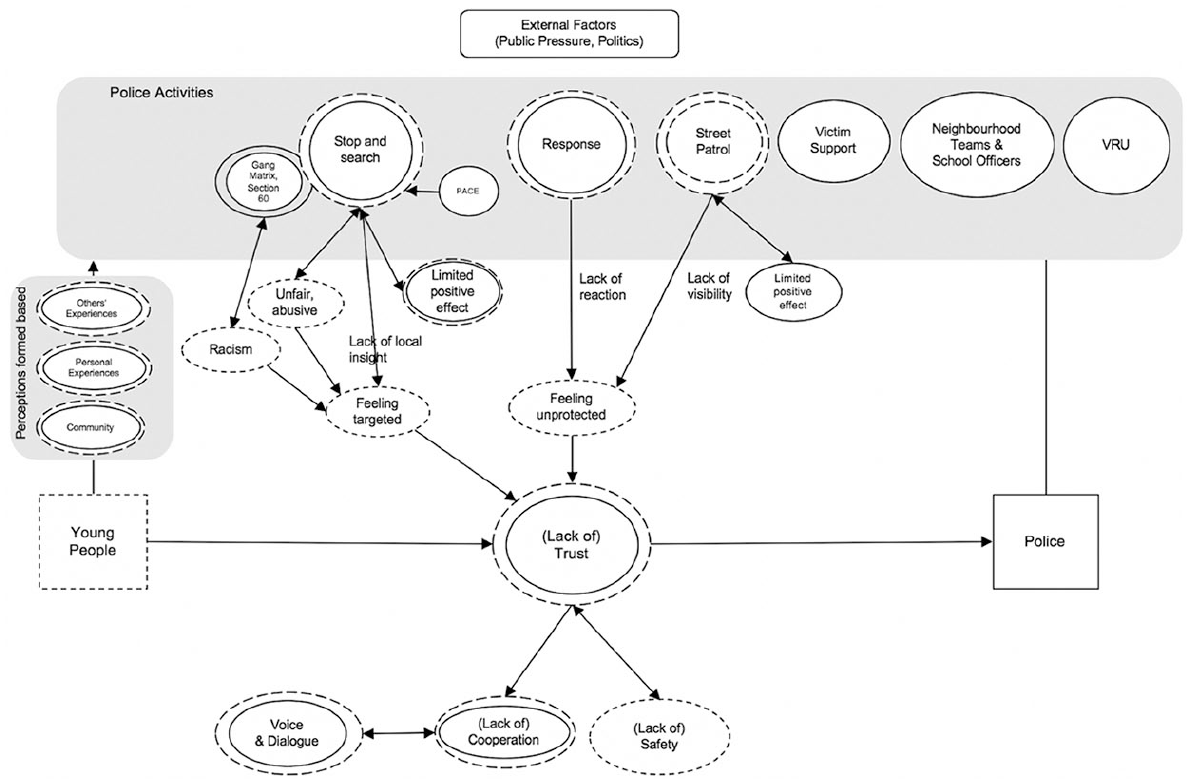
Expert and young people’s perceptions of policing activities and trust. Singled-lined circles show expert concepts and dash-lined circles the concepts of young people. Note that the size of the circle has no semantic interpretation.
Policing activities prominent in young people’s mental models are primarily associated with negative concepts (e.g., “feeling unprotected,” “feeling targeted,” “racism”). In line with other studies (Murray et al., 2020), stop-and-search appears to be the prototypical interaction and practice of policing young adults, and for many interviewees it was the only encounter that they ever had with the police or heard about most through peers. Their perception of stop-and-search is further linked to other police measures, which young people describe as discriminatory or linked to everyday or institutional “racism” (including increased police powers due to “Section 60s” or the “Gang Matrix”). Young people emphasize that the current use of these practices make them feel “unfairly treated, abused or harassed by the police” (lay interviewee) and that they target specific individuals (i.e., ethnic groups or males from specific areas), an impression that was notably also shared by white respondents (e.g., “I’ve never been searched, they always search black people”; “When I’m out and about, I wouldn’t feel like police are paying any attention to me, but that would change if I had a different skin color”; “Once I was wearing a hoodie, and I was told ‘You look like from the estate, like you just smuggled drugs. . .’ There is an image of what criminals look like and that image is majorly black and male. So, when I say police or bias, I think that the tools used to identify perpetrators have a racial bias.”—lay interviewees). The consequences are described as “humiliating and traumatic,” making them less likely to see the police as a “protector” but as another potential source of their victimization. Another negative concept attributed to the police by young people is that police officers who carry out stop-and-search in their area frequently “lack local insight” (e.g., “They have no idea what it’s like to grow up in communities like ours. They come in with no understanding of what we go through”—lay interviewee).
Interestingly, experts and young people agree that stop-and-search has limited impact in effectively tackling knife crime. Experts argue that stop-and-search does not address the root causes for violence and suggest that only a small number of cases have benefited from it (“Simple way to put it, we could take every knife off the street, and in 24 hours the same number would be back”). They further acknowledge that increases of power through “Section 60” may impact trust and “cause resentment” even when there are good reasons to search people. However, experts also mention that practices under PACE (Police and Criminal Evidence Act 1984) code of conduct ensure a certain level of accountability, transparency and proportionality that help to build trust (“We are sort of moving the goalpost, trying to explain more of our actions to people, saying these are the reasons why we did this or that, being accountable. Whereby years and years ago, we couldn’t open up about what we were doing”), a concept which is not found in young people’s mental models.
As police-initiated contact is often experienced as unfair and abusive, young people’s concepts include a lack of protection by the police, which is also in line with previous studies (Brennan, 2019). This perceived lack of protection revolves around police responses to encounters initiated by the public (“Response”) and (the lack of) visibility or presence on the streets (“Street Patrol”). Especially younger interviewees mentioned that knowing that police are close-by and seeing police more often would make them feel safer, mitigating the threatening perception of dangerous areas, and lead to shorter response-times. One lay interview mentions: “In my community, there is not much of a police presence on the streets. [. . .] They try to rob you and the police is not there. And it takes ages to just talk to the operator, they will just be like ‘hang on there, hang on’ and then later you find out they haven’t even gone through to the police yet.” This resonates with previous findings, highlighting that a majority of the public sees police presence as a key factor when they are asked about what they would improve in the police service (Roberts & Hough, 2005). Notably, young people strongly differentiate between contact initiated by the public and police-initiated activities (such as stop-and-search); and only describe the potential for positive encounters when initiated by the public.
Other initiatives or approaches that extend beyond traditional enforcement activities were not part of young people’s policing concepts, likely reinforcing their understanding of the police as involved only in enforcement work. The Metropolitan Police’s involvement or partnership with the Violence Reduction Unit for example, leading London’s public health approach through a multi-agency partnership, is only part of the expert mental model. Moreover, a key part of frontline police-work in the context of violent crime are duties relating to “Victim Support.” While police experts linked this intrinsically to the work of response teams, young people were either entirely unaware of this or mentioned a distinct lack of support (“there is no real victim support”—lay interviewee).
Young people were similarly unaware of much of the work done by police through Neighborhood Teams and Safer School Officers; although neighborhood teams exist in East London and there are 300 Safer School Officers working across London (Greater London Authority, 2017). On the other hand, experts mentioned both of these as central aspects of their work to improve communication, prevention and establishing relationships with young people. Only one lay interviewee mentioned school-police-partnerships but was unaware of the efforts to roll-out of Safer School Officers across London.
Trust: Needs and Expectations
A lack of trust is emphasized in both experts’ and young peoples’ responses throughout the interview. Experts mention trust as a prerequisite for policing by consent. Both groups recognize that this leads to a “Lack of cooperation” (e.g., “If there is no trust, how are you going to tell the police and how are they gonna resolve the situation. . .you need to be able to have trust in them. Because if it comes to a knife, you can’t do much, you’re gonna die”—lay interviewee) which in turn increases young people’s vulnerability and makes them feel unsafe (“Lack of safety”). While experts mention the 2011 London riots to demonstrate the lack of public trust and its consequences for effective policing, young people feel that the lack of trust is mutual and naturally prevents any relationship between young people and the police (“There isn’t any ‘relationship.’ It’s more like someone’s done something, and then they come to see what’s happening and that’s literally it”—lay interviewee).
An important part of our interviews was identifying young people’s and police experts’ needs and their suggestions for improving trust. Both groups emphasize the importance of “Voice and Dialogue” in building two-way communication. Young people express a distinct need to be involved in identifying suitable solutions to inform policing and the national public health approach. This would require a set of activities to enable it, but it could further contribute to re-shaping perceptions around specific attributes of policing which influence trust; “professionalism, accountability, transparency, respect and fairness” which are discussed by both experts and lay interviews and “empathy, protect and serve” identified by lay interviewees only.
Professionalism is described by participants as a prerequisite for policing by consent and essential in terms of improving accountability, building respect and promoting fairness, especially in how stop-and-search and other police-initiated encounters are practiced, which is in line with other elements proposed by procedural justice theory (Bradford et al., 2009; Sunshine & Tyler, 2003). For many young people, their own experiences or encounters with the police provide a sharp contrast to how police officials perceive these concepts. Young people further emphasize that police should be mindful of their actions and “caring” when dealing with children and teenagers to mitigate fear. They also mention the importance of respect with one young interviewee explaining that “There is no community policing relationship and there never will be. Because of how they portray youths, and literally that’s it. They have to stop trailing the youth. And then you have stuff like one police training day or they go into schools. It won’t work that way. You gotta start from the communities” (lay interviewee).
Discussion
In this paper we sought to better understand young people’s perceptions of knife-crime and identify areas of discord between their and policing experts’ mental models that may explain the breakdown of trust and communication. By mapping young people’s experiences, we find they encounter worrying events across their entire activity space, and not only, or primarily, within their local areas. Specific events like seeing or hearing about knives, experiencing threatening situations (being followed, shouted at) happen across their whole activity space, and so “local area” might need to be redefined from an administrative boundary, such as Hackney, to young people’s definitions of their neighborhoods. Accordingly, to further understand and identify patterns of worry about knife crime amongst young people in London, we propose the collection of experiential data across their entire activity spaces.
Our mental models revealed a larger overlap between the perceptions of police and young people than initially anticipated. Young people proved extremely knowledgeable, especially regarding risks and motives of knife crime and the extent to which they are embedded in deprivation and social marginalization as well as striving for social capital; a knowledge they have mostly gained through their personal experiences and those of their peers and communities, which align with both academic research and expert concepts. Our findings are in line with other studies which suggest that young people possess a highly specific knowledge of fear of crime in relation to their surroundings (Nayak, 2003), and that they use this to develop specific strategies to protect themselves (Turner et al., 2006). Police experts seem to be unaware of how much young people know about knife crime and young people’s perceptions, especially regarding experiences of racial bias and discrimination and, by extension, feeling targeted by the police. Considering how strongly all young people we interviewed felt about this, regardless of their own ethnicity or personal experience, we suggest that those shaping the broader public health approach or work at the local level take this aspect into account. Young people are willing to engage in the knife-crime debate and cooperate in identifying solutions—but only if they feel included in the process and not targeted by it.
However, young people’s understanding of policing approaches to knife crime is not equal across all initiatives; while young people know about enforcement-based activities they are mostly unaware of community-building ones. They are particularly knowledgeable of police enforcement procedures for which they carry negative perceptions, most prominently stop-and-search, “Section 60” and the “Gang Matrix”—concepts acknowledged by young people to be discriminatory against Black, Asian and Minority Ethnic (BAME) youth groups (Keeling, 2017; Williams & Clarke, 2016). We found knowledge gaps associated with non-enforcement policing activities which target building relationships with communities under the public health approach umbrella. This is not the first time that proactive “social” crime prevention strategies, such as community outreach schemes are not “in the minds of the public when they are asked to consider the police function” (Sarre & Langos, 2013, p. 2), however it is important to highlight these gaps to recommend that the police find ways to make young people aware of these activities, thereby fostering trust and engagement. It is concerning that those intended to the targets or recipients of such initiatives—young people in “the community”—were almost entirely unaware of their existence.
Both young people and police experts highlight a lack of trust that leads to a lack of cooperation. This increases feelings of unsafety, leading to more knife-carrying. Interestingly, expert and lay interviews describe trust differently. Experts focus on “effectiveness” as both a source of trust and a requirement in “fighting crime” while young people emphasize the need of “fairness” to establish trust. To build trust, mental models concerning key trustee attributes must be aligned between young people and police. Police must acknowledge young people’s need for fairness (as a requirement of both effective policing and trust) when trying to reach these communities. Work on legal socialization has long stressed that fairness perceptions are central to the developmental process through which young people come to form views on authorities such as police (Tyler & Trinkner, 2017), and for the lay interviewees in our study this was closely linked to their expectation of the police to “protect and serve” rather than coerce or control young people. Perceptions of biased behavior against young people or ethnic minority groups, particularly through stop-and-search, were commonly mentioned as the opposite of fair treatment.
Based on our findings, we suggest three approaches to re-establish and build trust. First, filling in the knowledge gaps and correcting misconceptions with trustworthy information may bring the expert and lay mental models closer together. For example, police and other services could try to build young people’s knowledge of non-enforcement policing initiatives and publicize training and other activities—that is, unconscious bias training (Berry, 2020)—which may have a positive impact in local communities. Prescriptive risk communication studies—which examine mental models and the subsequent development of information to improve awareness—could be helpful in achieving this.
Second, opportunities should be created to engage young people in shaping the debate around knife-crime prevention practices in their communities. This is in line with similar suggestions made by the All Party Parliamentary Group for Children in the 2014 report (UK Parliament, 2014) and others (e.g., Umunna, 2019).
Our third suggestion requires an in-depth understanding of those attributes and qualities which participants identify as important in promoting trust (i.e., professionalism, accountability, transparency, respect, fairness, empathy and protect, and serve attitudes). Others have demonstrated that the quality of interactions with the police influence perceptions of trust and legitimacy (e.g., Fagan & Piquero, 2005), yet it is less clear how, specifically, these attributes influence—either positively or negatively—perceptions of trust during interactions. Although there is a large social psychological literature on the effect of different aspects of procedural justice, for example, this largely relies on lab-based studies and has not been consistently applied to “real-world” policing contexts (for a recent exception see Bates et al., 2021). Further research is required to investigate the interpretations and meanings which are assigned to these (trustee) attributes by young people in specific local contexts. This may be particularly important in promoting a shared understanding and appreciation of these attributes in police forces and could be used to inform a repertoire of practices, training and guidance on the way police-youth interactions are handled.
While we support our conclusions with our empirical findings, our study is not without limitations. Our sample consisted of volunteers who may have special interest in the topic, which might explain the high levels of knowledge. However, if the highlighted gaps exist in this knowledgeable sample, they are likely present in the wider population of young people. Considering the limitations of the mental model methodology, we note that it is very sensitive to local environmental, social and economic characteristics and also linked to smaller population samples, similar to those used in our study. Therefore we suggest future work using this approach to investigate young people’s and police experts’ perceptions at a wider scale; that is, by selecting areas which share common but also different knife crime characteristics, as East London may be very different from other parts of London, which in turn may be very different from the rest of the country. Finally, while police-community interaction is one actionable element of the trust equation, the broader issues facing young people (e.g., poverty, racial inequality, and social capital) also play a part. In this study we could not collect adequate socio-demographic data, hence we propose that future work should include these in their analysis.
Conclusion
Our study provides insight into young people’s experiences, knowledge, and perceptions of knife crime, and related policing approaches. We highlight areas of overlap and discord between their mental models and those of the police experts. Our findings suggest three specific avenues to build trust and cooperation between young people and the police and partner agencies. We need to understand young people’s experiences across their entire activity space, raise awareness and engagement with non-enforcement related policing and partner activities, and encourage efforts to build trust and cooperation between young people and the police. A structured approach emphasizing young people’s risk perceptions, worries, needs, and expectations, especially about police fairness, will provide the basis for establishing a trusting relationship, paving the way for long-term, effective solutions to knife crime.
Supplemental Material
sj-docx-1-cad-10.1177_00111287211029873 – Supplemental material for Understanding Knife Crime and Trust in Police with Young People in East London
Supplemental material, sj-docx-1-cad-10.1177_00111287211029873 for Understanding Knife Crime and Trust in Police with Young People in East London by Artemis Skarlatidou, Lina Ludwig, Reka Solymosi and Ben Bradford in Crime & Delinquency
Footnotes
Acknowledgements
We would like to thank Professor Muki Haklay for his critical insight and feedback, Mr Froi Legaspi and Citizens UK for their community engagement support, as well as the police experts and all of the young people who participated in the study.
Declaration of Conflicting Interests
The author(s) declared no potential conflicts of interest with respect to the research, authorship, and/or publication of this article.
Funding
The author(s) disclosed receipt of the following financial support for the research, authorship, and/or publication of this article: This research was funded by the UKRI ESRC NetworkPlus on Social Justice through the Digital Economy (EP/R044929/1), UK.

Supplemental Material
Supplemental material for this article is available online.
Author Biographies
References
Supplementary Material
Please find the following supplemental material available below.
For Open Access articles published under a Creative Commons License, all supplemental material carries the same license as the article it is associated with.
For non-Open Access articles published, all supplemental material carries a non-exclusive license, and permission requests for re-use of supplemental material or any part of supplemental material shall be sent directly to the copyright owner as specified in the copyright notice associated with the article.
