



Abstract
This study investigates whether crime type and severity, as well as offender, observer, and victim characteristics predict public attitudes towards capital punishment in Israel. We surveyed Israeli citizens by phone. A random and representative sample of 594 participants, ages 20 to 74, read scenarios illustrating crimes and were asked about their perception of capital punishment as an appropriate punishment. The results indicate that most participants did not support capital punishment. Perceived high-crime severity, a crime that constitutes terrorism, and male observer (participant) status predicted 34% in an increased likelihood of supporting capital punishment. The discussion attributes the stronger support of capital punishment in cases of terrorism to the Israeli experience of chronic terrorism and explains gender differences by gender-role socialization.
Introduction
Since September 11, 2001, terrorist attacks in the USA, there is growing interest in research related to terrorism (Cohen-Louck & Levy, 2020; LaFree et al., 2012; Spaaij & Hamm, 2015). Terrorist acts are extreme and violent, and the related victimization is random and indiscriminate (Klar et al., 2002). Therefore, terrorism harms not only the directly affected victims, but it also harms people’s sense of safety (Cohen-Louck & Shechory-Bitton, 2019; Shechory-Bitton & Shachaf Friedman, 2018). In Israel, terrorism is a chronic threat (Cohen-Louck & Levy, 2020), and, therefore, it is a central issue on the Israeli public agenda. Many times, after terrorist attacks, the question of capital punishment for terrorists resurfaces.
In Israel, capital punishment for murder was abolished in 1954, and since then, it is a mandatory penalty only in cases of convicted Nazis and Nazi collaborators and crimes of genocide. Also, military courts can seek death penalties in cases of treason, aiding an enemy and acts of terrorism following the prosecutor’s request and unanimous consent among the judges. In practice, capital punishment was used in Israel only once—against Adolf Eichmann, the Nazi war criminal (Simha, 1990). Recently, legislation has been proposed to allow military courts to seek capital punishment for terrorists convicted by a majority (as opposed to unanimous decision) and allow criminal courts to mete out capital punishment sentences for terrorists (Azulai, 2018). Such a significant change in penal policy requires an understanding of Israeli public sentiment regarding capital punishment. However, research on Israeli public opinion toward capital punishment is scant.
Research on attitudes toward offender distinguish between the legal factors, like the type of crime and crime severity (Alderden & Ullman, 2012; Beichner & Spohn, 2005), and extralegal factors like offender, victim and observer characteristics (Levy et al., 2021; Miller & Wright, 2008), and shows that extralegal factors play an important role in attitudes towards capital punishment (Tellis & Spohn, 2008). The current study includes legal and extralegal factors and aims to examine the type of crime, crime severity and offender, observer, and victim characteristics as possible predictors of attitudes towards capital punishment.
Identifying factors associated with public support of capital punishment may be useful for Israeli practitioners and policymakers. Furthermore, such information may also facilitate a deeper understanding of public punitiveness and vindictiveness toward offenders in general and toward terrorists specifically.
Crime Type and Severity
Generally, public punitiveness toward offenders is associated with crime type and severity. The public expresses more punitive attitudes toward violent-crime offenders than property-crime offenders (Adriaenssen et al., 2020; Leeper Piquero et al., 2008). Similarly, people tend to support harsher punishments for offenders of crimes that the public perceives as more severe such as murder, rape, and violent offenses, than for perpetrators of less severely perceived crimes such as white-collar and victimless crimes (Einat & Herzog, 2011; Herzog & Einat, 2016; Michel, 2016). As for capital punishment, many express support for the death penalty for murder, terrorism (Qi & Oberwittler, 2009; Soen, 2009) and even for rape or sexual abuse (Mancini & Mears, 2010; Qi & Oberwittler, 2009). In parallel, they do not support capital punishment for less severe crimes such as robbery (Qi & Oberwittler, 2009). Research on attitudes toward capital punishment tends to focus on the American public. However, the similarities between the Israeli public and Western societies in attitudes toward offenders (Herzog, 2017; Levy & Kerschke-Risch, 2020) may reveal insights that are true for the Western world in general. We hypothesized that:
H1: Crime severity predicts support of capital punishment: Crimes rated as more severe are more likely to be regarded as eligible for capital punishment.
H2: Support for capital punishment is predicted by types of crime: In cases of rape, murder, and terrorism, the public will be more supportive of capital punishment than in cases of wrongful death and human trafficking.
Offender Characteristics
Studies on public opinion of capital punishment and offender characteristics tend to focus on the impact of gender and ethnicity. Regarding gender differences, the findings indicate that women are less likely to be charged and, therefore, have less extensive criminal records than men, decreasing their chances of being sentenced to capital punishment (Morgan, 2018). Moreover, the public is more likely to support capital punishment for males than for female offenders (Burgason & Pazzani, 2014). As for race and ethnicity, citizens support capital punishment more in cases of minority-group offenders than in cases of majority-group offenders (Cochran et al., 2019; Dotson & Carter, 2012). For example, racial bias against African Americans manifests itself in the perception that African American offenders are more dangerous, leading to the subsequent desire to impose on them harsher punishments (Eberhardt et al., 2004; Singh & Sprott, 2017). These findings imply that the death penalty is administered unfairly based on the defendant’s ethnicity. Considering that migrants tend to belong to ethnic minorities (Kushnirovich & Sherman, 2018; Oudenhoven & Eisses, 1998), the offender’s legal status as a citizen or non-citizen may also be associated with public punitiveness (Rozmann & Levy, 2019) and support for capital punishment.
Additionally, the offender age and mental health tend to be associated with capital punishment support. A majority of participants oppose the death penalty for mentally disabled or ill and juvenile offenders (Falco & Freiburger, 2011; Vollum & Buffington-Vollum, 2010). As for prior criminal records, the results are inconsistent. Some studies found that a prior record was not significantly associated with public preference for capital punishment (e.g., Boots et al., 2003). Yet, research on offenders who were sentenced to death indicates that capital punishment probability is higher for more recidivistic offenders (Behnken et al., 2011). Based on these sources, we referred to offender age, gender, marital status, citizenship and criminal record, hypothesizing that:
H3: Support for capital punishment is predicted by offender characteristics: The public supports capital punishment for older, male, ethnic-minority, single, foreign, and repeat offenders more than in cases of younger, female, ethnic-majority, married, and non-repeat offenders.
Victim Characteristics
Previous studies found that people consider crimes against females more severely than crimes against males and tend to support harsher punishments for perpetrators against women than against men (Bates et al., 2019; Falco & Freiburger, 2011). Also, the victim’s age is usually strongly associated with attitudes toward the death penalty. The emotional reaction for very young victims is especially strong, and a relatively greater priority is placed on executing those who kill or commit sex crimes against children (Falco & Freiburger, 2011; Mancini & Mears, 2010). However, this is true for male, but not for female offenders (Richards et al., 2016).
The findings on victim ethnicity and punitiveness are conflicting. Some studies suggested that a victim’s race is not associated with the use of mitigating circumstances in sentencing (e.g., Grosso et al., 2019), while studies on public punitiveness indicate higher punitiveness toward offenders who committed crimes against ethnic minorities compared to ethnic majority victims (Kahl et al., 2013; Saucier et al., 2010). However, Kramer et al. (2017) and Baldus and Woodworth’s (2003) studies focusing on capital punishment indicated that offenders who committed crimes against white victims were more likely to receive the death penalty compared to victims of any other race or ethnicity. Moreover, Cochran et al. (2019) suggested that the support for capital punishment is associated with the interaction between offender and victim ethnicity. Their findings indicate that in the southern American states, capital punishment probability is higher for black males convicted of rape and murder of a white woman than for white males convicted of rape and murder of a black woman. Based on the findings regarding capital punishment, we also focused on victim gender, age and ethnicity, with the hypothesis that:
H4: Support for capital punishment is predicted by victim characteristics: If the victims are female, young, and belong to an ethnic majority-group the public will support capital punishment more than in cases where victims are male, older, and belong to an ethnic minority-group.
Observer Characteristics
In research on observer reactions, previous studies have examined participant characteristics and indicated that participant sociodemographic characteristics, including gender, ethnicity, age, and religiosity, are associated with their attitudes toward capital punishment. Men tend to express stronger support for capital punishment than women (e.g., Adinkrah & Clemens, 2018; Anderson et al., 2017; Godcharles et al., 2019). Ethnic minorities tend to oppose the death penalty more than ethnic majorities (Peshkopia & Stephen Voss, 2016; Unnever et al., 2008; Vollum & Buffington-Vollum, 2010). As for age, the elderly less support the death penalty than young adults (Anderson et al., 2017; Oberwittler & Qi, 2008). Also, religious beliefs affect punitiveness toward offenders (e.g., Levy & Reuven, 2017) and support for capital punishment (e.g., Yelderman et al., 2019). Thus, religious participants are more punitive and expressed stronger capital-punishment support than their secular counterparts. Finally, studies indicate that participants who believe in traditional values are more punitive and support capital punishment more than liberals (e.g., Godcharles et al., 2019; Unnever & Cullen, 2005). The current study addressed the main effects of participant gender, ethnicity, religiosity, and political affiliation, hypothesizing that:
H5: Support for capital punishment is predicted by observer characteristics: Male, younger, religious, ethnic-majority group belonging, and politically right-wing participants will express higher capital-punishment support than female, older, secular, ethnic minority-group belonging, and politically left-wing participants.
The Current Research
Given the critical role public attitudes play in penalty policy and practice (Roberts & Stalans, 2018), this research aims to identify patterns in Israeli public attitudes toward capital punishment and is significant in several ways. Firstly, studies on public opinion on capital punishment usually focus on murder (e.g., Mancini & Mears, 2010), with little research focusing on a variety of other crimes (e.g., Qi & Oberwittler, 2009). This study focuses on a range of crimes, including murder, terrorism, sex crimes, and human trafficking. Secondly, attitudes toward crime and punishment depend on cultural context (e.g., Levy & Adam, 2018; Levy & Kerschke-Risch, 2020). This study intends to expand knowledge on attitudes toward capital punishment within societies that experience chronic terrorism by focusing on Israeli society. The chronic state of terrorism in Israel claimed the lives of hundreds (Israel Magen David Adom Ambulance Service, 2016), caused a significant long-term psychological effect on citizens (Mor & Dardeck, 2017) and raised the question of capital punishment for terrorists. Since most of the studies were conducted in the U.S., we based our literature review and hypotheses on these studies. Nevertheless, it is critical to expand the knowledge on the support of capital punishment in additional cultural contexts.
Finally, considering the significance of the ecological framework (McLaren & Hawe, 2005), we addressed the inter-relation between individual (participant-related variables) and contextual (situational) factors (Espelage & Swearer, 2010; Levy & Reuven, 2018; McLaren & Hawe, 2005). Observer demographic characteristics and perceptions of crime severity represent individual factors, while crime type, as well as offender and victim characteristics, represent contextual factors. Thus, the ecological framework presents a complex point of view on crime by addressing the offender, victim, and observer (Levy & Ben-David, 2008, 2015).
Furthermore, this study employed a factorial survey design which allows for exploring the combined effects of crime type and severity as well as offender, victim, and observer characteristics. The factorial survey combines a controlled, randomized quasi-experimental design with a representative sampling of a conventional survey (Herzog, 2003; Herzog, 2017). The complexity of the research design and the manipulation of multiple factors reduce social desirability effects on the participant’s judgments (Wallander, 2009).
Method
Participants
We conducted this survey between 1.8.2018 and 30.11.2018. There were 594 participants drawn from the general Israeli population. Age ranged from 20 to 74 (Mean = 42.83, SD = 13.97), and the range of years of education was 8 to 20 (Mean = 15.08, SD = 2.75). About half of the participants were male (53.2%). The ethnic makeup was Jewish (74.7%), 18.5% Arab, and ~6.8% Druze. About 11.4% defined their household’s financial situation as lower than average, 69.6% defined it as average, and about 19% defined it as higher than average. In terms of religiosity, 36.6% of the participants defined themselves as secular, 32.5% as traditional, and 30.9% as religious. Close to half the participants (47.5%) defined themselves as holding centrist political views, 35.7% belonging to right-wing parties and 16.7% to left-wing parties.
To gather the data, we conducted a telephone survey and based our sampling on the most recent Israeli telephone directories at the time of the study (2018), covering all geographical regions. Applying a systematic random sampling method assured identical inclusion probabilities of all households and persons listed (no other technique, such as interview schedule, was applied). At least 90% of the Israeli population within the Green Line limits has one active landline or cellular telephone line (Yagur-Karol, 2018), and most of these phone numbers appear in the telephone directory. Therefore, we could assume that this sampling frame was appropriate for the research purposes.
Additionally, the cellphone-numbers appear beside the landline phone-numbers under the same dialing area. Thus, using cellphone numbers to contact potential participants did not change the random and equal representation of different geographical areas. The study’s response rate was 70%. We calculated the response rate based on valid household numbers, excluding businesses, fax connections, etc. This sample’s sociodemographic characteristics are similar to the official distribution of these variables in the Israeli population (see Yagur-Karol, 2018). The sample was representative of the adult, Hebrew-speaking Israeli population regarding gender, age, education, and ethnicity. Therefore, we assumed that no important groups were underrepresented.
Measurements
The research questionnaire included the following parts (Supplemental Appendix A):
Crime scenarios
To manipulate the crime type as well as offender and victim characteristics, we created crime scenarios. Each scenario included information about the circumstances of a criminal act, details of the offense, and personal characteristics of the offender and victim. Offender and victim characteristics included gender (man/woman), ethnic affiliation (Arab/Jew), age (25/50 years old), employment (fully employed/unemployed), criminal record (existent/not stated), and citizen status (Israeli/foreign worker). Based on the offenses presented in the scenarios, we created five crime categories: (1) murder (murder of a spouse/business partner); (2) terrorist act (stabbing/shooting); (3) rape; (4) wrongful death; (5) human trafficking. We chose terrorist acts perpetrated by a single offender and with a single victim to facilitate a comparison to the other criminal scenarios in this study.
Crime severity
Participants were asked to evaluate the severity of different criminal offenses based on the scenarios. Answers ranged from “1” (not severe at all) to “11” (most severe).
Death sentence
Participants were asked to choose a preferable form of punishment for each criminal offense represented in the criminal scenarios. The options were: life imprisonment, number-of-years in prison, community service, and death sentence. The answers were recoded as 1 = capital punishment; 0 = other punishments.
Observer characteristics
The operational definition of observers refers to participants. Therefore, following the assessment of the scenarios, the participants were asked about their age, education, gender, ethnicity, financial situation, and religiosity.
Procedure
Scenario sampling
This study employed a factorial approach (see Herzog, 2017) where the selected scenarios represent a random sample of scenarios from the population of all potential scenarios (20,480), based on the combination of all the values of all the research variables (Steiner et al., 2017; Wallander, 2009). The factorial approach includes a random value selection from the various factorial variables (e.g., the random selection of gender of the offender) while controlling for the participants’ demographic characteristics (Rossi & Berk, 1997). Therefore, it allows estimating the unbiased impact of the independent variables on the participant’s judgment (Dickel & Graeff, 2018; Dülmer, 2016; Herzog, 2017). One of the important elements of this method is that it permits constructing a richly varied population of scenarios (Jasso, 2006). In the factorial survey approach, each participant is asked to rate the level of a specified outcome variable (in this study, crime severity and specific punishment) corresponding to a fictitious unit (an offender and a victim), which is described in terms of potentially relevant characteristics such as age, gender, citizen status, prior offenses, employment and the like. The participant is presented a set of these fictitious units within scenarios (Dickel & Graeff, 2018). Thus, this approach includes two surveys: population survey and scenario survey. The population survey facilitates a representative random sample from the target population. The scenario survey is manifest in sampling of scenarios from all possible variations. Before the main survey, the questionnaire was pretested with a small number of participants, to obtain both an initial test of measure reliability and test for any unexpected response patterns (none were found).
Data collection
The sole research assistant (male, Masters student) who conducted the factorial survey briefed the participants that the questionnaires are anonymous, their content confidential, and that their answers are only for research purposes. The briefing included the following statements:
Hello, I am surveying on behalf of Safed College.
The survey is about the severity of punishments. The survey is entirely anonymous: the data will be used only for academic research. Are you ready to answer a few short questions? Thanks.
I will present several short events to you, all of which are offenses in Israeli law. Please rank each of the events according to their severity and the punishment you think the offender deserves. In other words: What do you think is the severity of these acts and the punishment that the offender deserves – and not as you feel or know the law suggests?
Following the briefing, participants addressed four scenarios based on a random combination of the variable values (see example in Part 3, page 2, Supplemental Appendix A). The order of the questions regarding each scenario (crime severity and punishment) was random as well: in half of the scenarios, the assistant presented participants with the question on crime severity first, while in the other half, this question was second. Before the end of the survey, participants answered sociodemographic questions.
The telephone interviews lasted between 7 and 10 minutes. We conducted a telephone survey because they are relatively short processes of distribution and collection, affordability, relatively high response rates, low probability of biases and relatively easy access to large and diverse representative samples (including illiterate participants) of all the country’s regions. To minimize potential biases, we formulated a short questionnaire in simple language without any professional terms. The research assistant administered the questionnaires between August and November 2018, in every region of Israel, within the “Green Line” limits (i.e., not in West Bank). To boost response rates, participants who were not initially reached were contacted again. A household was replaced after three unsuccessful attempts. The research assistant called potential participants between 20:30 and 21:30 during the main Israeli news program’s commercial breaks.
Results
Crime Type and Crime Severity
The univariate ANOVA results indicate a significant difference in perception of crime severity among different types of offenses (F[4, 881] = 9.63, ή2 = .04, p < .001). The participants perceived the murder scenarios as the most severe crimes (Mean = 9.80, SE = .11]. In second place was rape (Mean = 9.52, SE = .17), in the third place were terrorist acts (Mean = 9.24, SE = .10), in fourth place human trafficking (Mean = 8.92, SE = .17), followed by wrongful murder (Mean = 8.85, SE = .16). Scheffe tests indicated that the score for murder significantly differs from all other crimes, except rape. Scores for terrorism, negligent death and human trafficking significantly differ only from murder. Scores for rape did not differ from all other crimes.
Capital Punishment Support, Crime Type, and Severity
Regarding capital-punishment support, only in 7.9% of scenarios, the participants considered capital-punishment as an appropriate punishment. We used Chi-square analysis to assess whether the support of capital-punishment was predicted by crime type and offender, victim, and observer characteristics. Capital-punishment support was significantly associated with crime type. Table 1 shows that the majority of scenarios in which participants supported capital punishment addressed terrorist acts. The t-test indicated that there was a significant difference in perceived seriousness by the support of capital punishment (t[85.81] = −5.40, p < .001). Crimes for which participants suggested capital punishment were perceived as significantly more severe (Mean = 10.29, SD = 1.49) than crimes in which participants did not suggest capital punishment (Mean = 9.28, SD = 1.73).
Associations between Perceptions of Capital-Punishment as Appropriate Punishment and Crime Type, and Offender Characteristics.
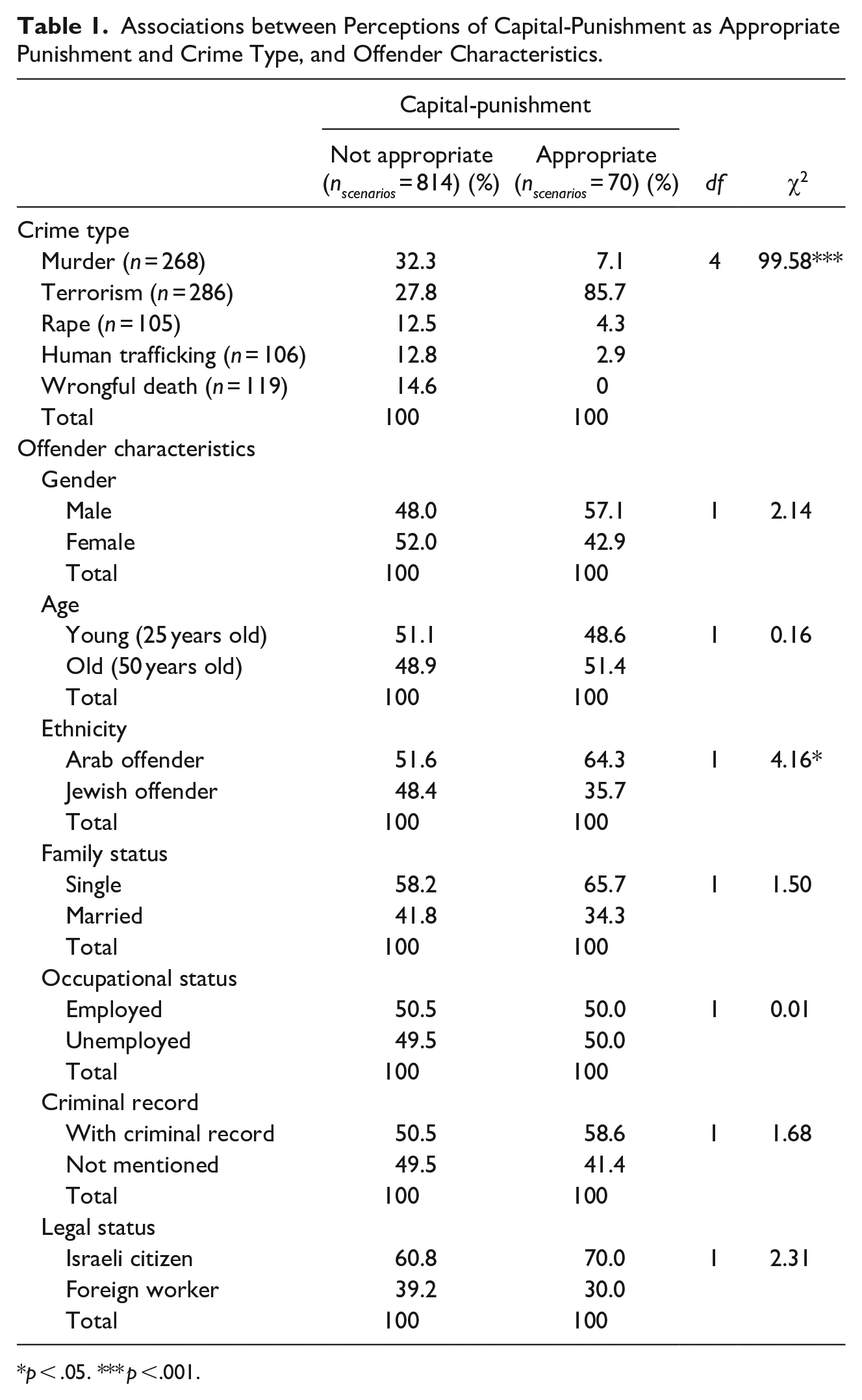
p < .05. *** p <.001.
Capital Punishment Support and Offender Characteristics
The chi-square analysis results (Table 1) show a significant association between participant support of capital punishment and ethnicity. Participants tended to significantly support capital punishment more frequently in scenarios with Arab offenders than in scenarios Jewish offenders. There was no statistically significant association between perception of capital punishment as appropriate punishment and offender age, gender, family status, occupational status, criminal record, and legal status.
Capital Punishment Support, Victim, and Observer Characteristics
As Table 2 shows, there was no statistically significant association between support for capital punishment and victim gender, ethnicity, age, and legal status. As for observer characteristics, observer gender was the only variable that was significantly associated with capital-punishment support. Male participants chose capital punishment as an appropriate punishment more frequently than female participants. The association between capital-punishment support and observer ethnicity, religiosity, economic status and political affiliation was statistically insignificant. There were also no significant differences in observer age (t[884] = 0.86, p = .39) and education (t[884] = −0.15, p = .88) by capital-punishment support.
Associations between Perceptions of Capital-Punishment as Appropriate Punishment and Victim and Observer Characteristics.
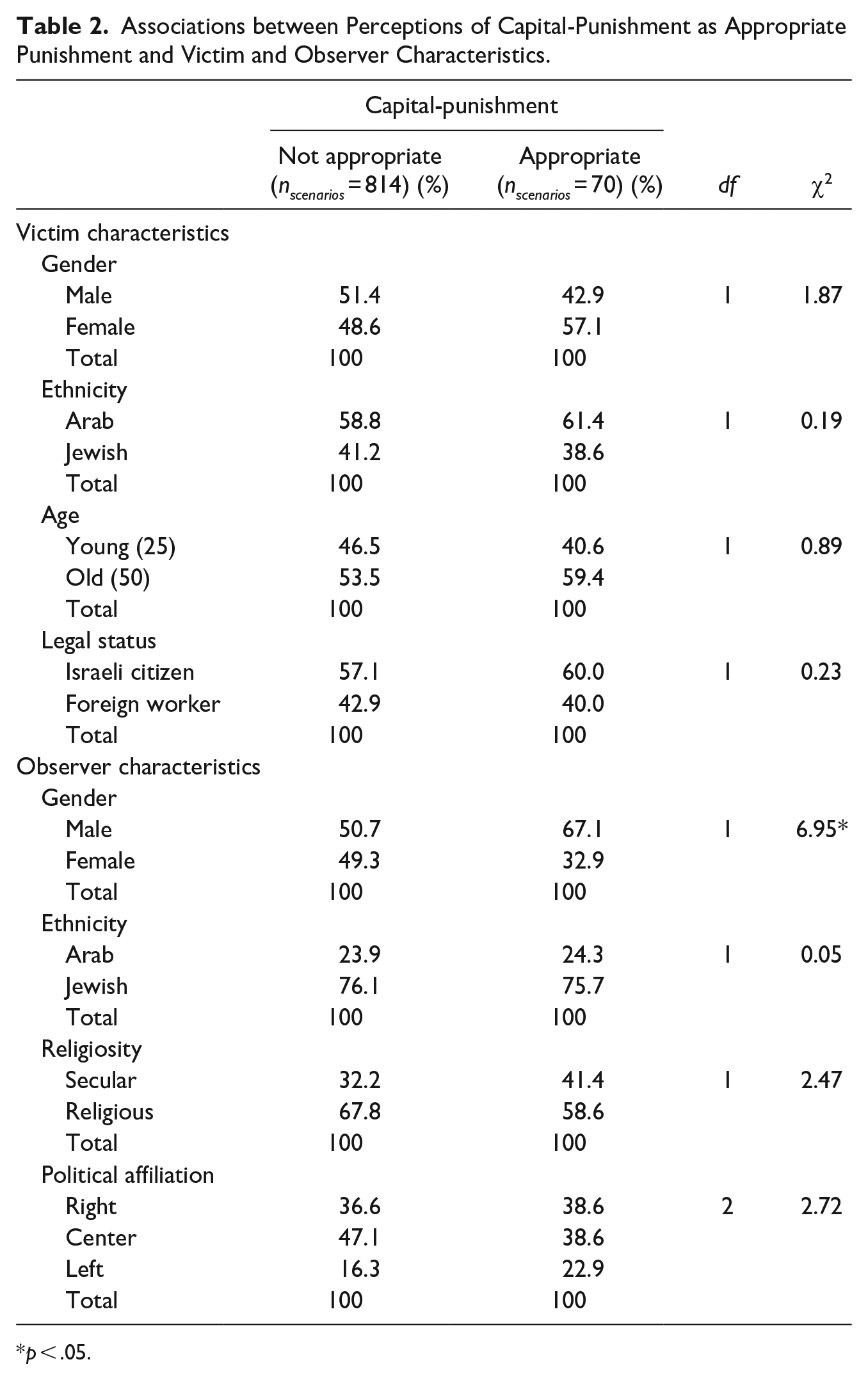
p < .05.
The Integrative Model
We initially conducted bivariate analyses, which showed, similar to Chi-square analyses, that several characteristics of the crime, offender, victim, and observer were significant regarding the appropriateness of capital punishment (1—appropriate, 0—inappropriate). These were: perceived severity of the offense (r = .16, p < .001), terrorism (1—yes, 0—no, r = .33, p < .001), murder (1—yes, 0—no, r = −.15, p < .001), rape (1—yes, 0—no, r = −.07, p < .05), offender ethnicity (1—yes, 0—no, r = −.07, p < .05), and observer gender (1—male, 0—female, r = −.09, p < .01). We did not include wrongful death in the analysis since the participants did not choose capital punishment for that crime, and variables that were not significantly associated with support of capital punishment were also not included in the integrative model. The multivariate model was then examined with logistic regression for the appropriateness of capital punishment with the predictors mentioned above (Table 3). The model was found significant (χ2[6] = 134.77, p < .001), with 34% of the variance in capital punishment being explained (Nagelkerke’s R2). Results show that perceived high crime severity, terrorism, and male observer status are related to an increased likelihood of supporting capital punishment.
Logistic Regression for Capital-Punishment’s Appropriateness and Offender, Victim and Observer Characteristics (N = 886).
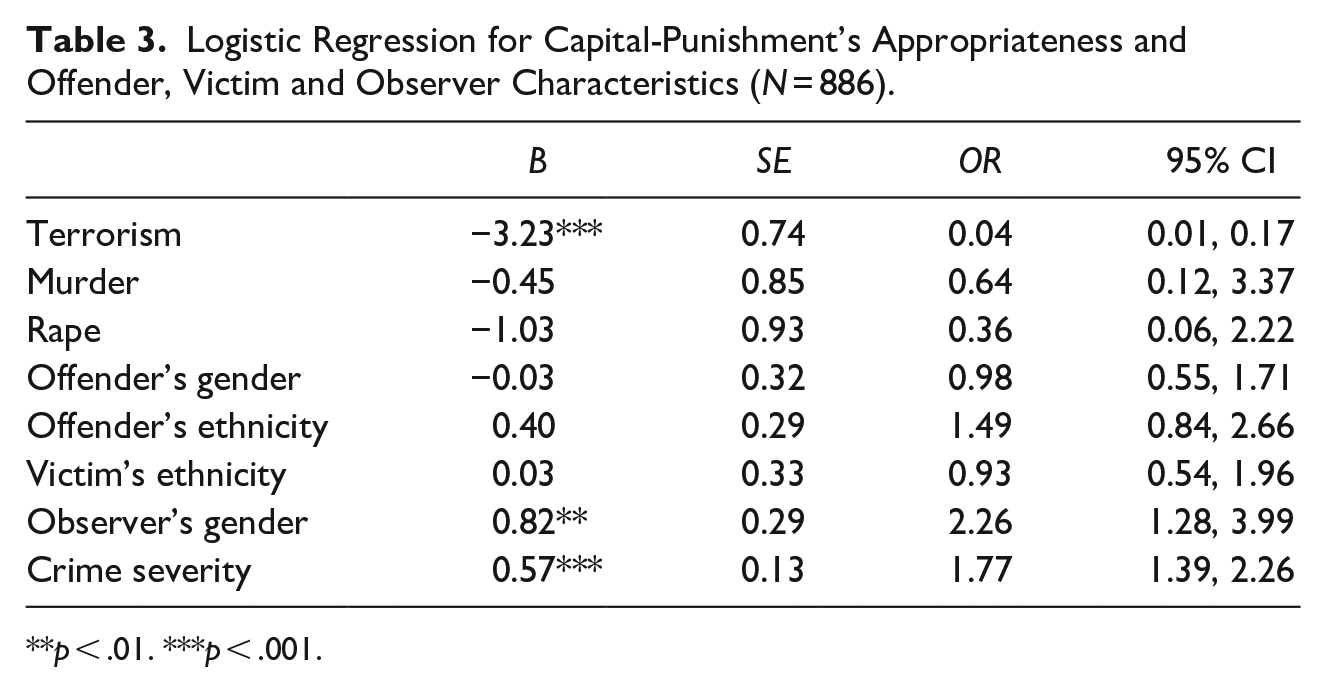
**p < .01. ***p < .001.
Discussion
The study’s main purpose was to assess how crime type, severity, offender, observer, and victim characteristics predict public support for capital-punishment. Our findings indicate that most participants (95%) did not support capital punishment as an appropriate punishment, in general, not even for acts of terrorism. This finding suggests that the general public would not support laws requiring military and criminal courts to seek the death sentence for terrorists. In comparison to prior studies (e.g., Soen, 2009), the relatively low support for capital punishment in the current study can be related to sample differences. Soen’s (2009) findings on capital-punishment support in Israel were based on a snowball sample of students, unlike our research which used data from a random representative sample of Israeli citizens.
Our study’s participants expressed very low support for capital punishment. In general, our findings about Israeli’s attitudes toward crimes and criminals are consistent with those in certain Western cultures (Herzog, 2017; Levy & Kerschke-Risch, 2020), but not with the higher support levels that U.S. studies have shown (e.g., 53% support the death penalty reinstatement in Michigan; Adinkrah & Clemens, 2018). Lower capital-punishment support may indicate that Israelis value more the sanctity of life, as expressed by basic notions of Judaism, the country’s main religion (Calvert, 2019; Halevy & Halevy, 2018). Another reason may be that the Israeli public is not used to capital punishment. Although capital punishment theoretically exists in Israel, it was used only once against Adolf Eichmann, the Nazi war criminal (Simha, 1990). Possibly, most Israeli citizens feel that no crime can ever equal the Nazi horrors. Future studies should explore which values and cultural characteristics account for supporting or opposing capital punishment.
Individual Factors
One of this study’s key findings indicates the significance of individual factors as observer perceptions and gender in predicting capital-punishment support. As we hypothesized (H1), participants more frequently supported capital punishment in scenarios they perceived as more severe. This pattern matches prior studies where people express more punitive attitudes toward the more severe and violent criminals than toward less severe and violent offenders (Einat & Herzog, 2011; Herzog & Einat, 2016; Michel, 2016). As for observer demographics (H3), contrary to our assumption, within the integrative model, the contribution of participant ethnicity, religiosity and political affiliation in predicting capital-punishment support was not significant. This pattern suggests that, contrary to other cultural settings (e.g., USA), in Israel, support and opposition to capital punishment are not drawn based on ethnic, religious, and political lines.
The only observer characteristic that was significantly associated with capital-punishment support was gender, with the majority of capital-punishment supporters being men. This gender pattern corresponds with our hypothesis (H5) and prior findings that women are more compassionate (Whitehead & Blankenship, 2000) and less supportive of harsh punitive policies (Adinkrah & Clemens, 2018; Chen, 2016; Dodd, 2018). The salience of the gender effect on attitudes toward capital punishment may also be related to biological gender differences in aggression (Stack, 2000) as well as gender role socialization which starts at early childhood (Schwarz, 2017). Women who are socialized based on traditional gender roles learn to be more nurturing and forgiving than men (Stack, 2000). Thus, it seems that in Israel, these gender-related influences are more primary and go beyond influences and differences related to ethnicity, religiosity, and political affiliation. Further research is needed to differentiate between gender effects and the effects of ethnicity, religiosity, and political affiliation regarding punitiveness and capital-punishment intolerance.
Contextual Factors
The only contextual factor that was found to be associated with attitudes toward capital punishment was participants’ differentiation between terrorist acts and other crimes. The overwhelming majority (86%) of the scenarios in which participants supported capital punishment described terrorist acts. This pattern corresponds with our hypothesis (H2) and prior research findings that capital-punishment support is stronger for highly violent crimes (Adriaenssen et al., 2018; Leeper Piquero et al., 2008). It represents “lex talionis” reasoning, which advocates that the punishment should fit the crime (Bergeron & Mckelvie, 2004; Tonry, 2018) and suggests that capital-punishment support is motivated by the need for retribution and retaliation (Sanjero, 2002; Santoro, 2013). However, this is an insufficient explanation, considering that participants ranked murder and rape as the most severe crime.
We, therefore, suggest that this is because the Israeli society lives in a chronic state of terrorism (Cohen-Louck & Levy, 2020), with citizens exposed to terrorism both directly and indirectly (Cohen-Louck, 2019). Thousands of Israeli citizens have been murdered, and many thousands have been wounded due to terrorism (Israeli Ministry of Foreign Affairs 2000). Therefore, it may be that Israeli citizens feel more vulnerable and at risk of becoming terror victims than becoming victims of other violent crimes. In the case of terrorism, imprisonment and even life sentences may not be considered adequate punishment for some citizens (Sanjero, 2002). Sometimes, terrorists are released in exchange for abducted or captured hostages. Since the death penalty constitutes absolute incapacitation (Acker, 2014), capital-punishment supporters consider it the only means of ensuring that terrorists will not commit further attacks.
As we hypothesized (H3) and in correspondence with prior research (Eberhardt et al., 2004; Singh & Sprott, 2017), the bivariate analysis showed that offender ethnicity was significantly associated with support for capital punishment. In the cases of Arab offenders, the support for capital punishment was more frequent than in the cases of Jewish offenders. This finding supports the notion of ethnic discrimination and stigmatization toward Arab offenders who may be considered more dangerous due to the ongoing Israeli-Palestinian conflict and frequent Arab convictions in security offenses (e.g., Sela-Shayovitz, 2009).
Nevertheless, within the integrative model, offender ethnicity and other offender-related characteristics (H3) did not contribute significantly to the prediction of capital punishment support. Similarly, victim characteristics (H4) also did not contribute to the prediction of capital punishment support. We suggest that a possible reason to explain such a pattern may be the complexity of the current study’s scenarios. It is possible that in such rich scenarios with variable contexts (crime type, several offenders, and victim characteristics), the participants focused on the factor that they perceived as the most critical in considering whether to support capital punishment. Thus, the saliency of the crime type, specifically the differentiation between terrorism and other crimes, may have eclipsed the impact of offender and victim characteristics.
Limitation and Future Studies
Although this research has yielded interesting results, some limitations should be noted. First, to facilitate comparison to other criminal scenarios that include one perpetrator and one victim, this study included two basic terrorist act scenarios: a stabbing and a shooting. However, terrorist attacks in Israel also include activation of explosive devices, vehicular terrorism, arson, etc. (Perry et al., 2018). Some of these terrorist acts caused serious injuries and multiple deaths (Quillen, 2002). Thus, it is possible that scenarios of more gruesome terrorist acts would have aroused higher support for capital punishment. Future studies on public support toward capital punishment for terrorists should consider manipulating types of terrorist acts (bombing, shooting, vehicular), scope of victimization (single victim vs. multiple victims), and type of victimization (injuries vs. death).
Second, some participants might have been uncomfortable admitting to the researcher that they support capital-punishment. However, the promise of anonymity and the use of a factorial survey design minimized the social desirability effect. The factorial design minimizes the effect of social desirability (Dickel & Graeff, 2018; Wallander, 2009) due to multiple simultaneous manipulations of variables. Such a design makes it harder to adjust responses to a specific manipulated variable. Third, the external validity may be limited since the sample does not completely resemble Israeli society in all characteristics. For example, the survey was conducted in Hebrew. Thus, the results do not represent the opinions of citizens who do not speak Hebrew (e.g., some immigrants and Arab citizens). Lastly, the survey methodology also includes some limitations. The short questionnaires facilitate higher response rates but do not allow gathering additional information on participants’ characteristics. Additionally, surveys are “snapshots” of public views at specific times and places (Connelly, 2016) which can change due to social and political developments.
Conclusions
This study identifies factors associated with Israeli public attitudes of capital-punishment support within the ecological framework. Our findings suggest that the combination of perceived high crime severity, terrorism, and male observer status are instructive factors in capital-punishment support prediction. To the best of our knowledge, this study is the first attempt to examine the capital-punishment support within the ecological framework (Levy & Reuven, 2018; McLaren & Hawe, 2005). The implementation of the ecological framework in this study has identified that attitudes toward capital punishment stem from interactions between contextual (e.g., crime type) and individual variables (e.g., perceived crime severity, observer gender). By addressing the crime scene as a triad that includes offender, victim, and bystander (Levy & Ben-David, 2008), this study facilitates identifying more complex patterns in public decision-making. It demonstrates the significance of the triad point-of-view for obtaining deeper and complex understandings of attitudes toward capital punishment.
Also, while prior studies that examined public support for capital punishment mainly addressed murder, this study distinguished between murder and murderous terrorist acts. This distinction is especially critical in light of the global terrorism spread. Future studies should employ this framework to explore whether this pattern repeats itself in other aspects of punitiveness and attitudes toward offenders as well as in other cultural contexts. From the practical point-of-view, since public opinion influences legislators when they are considering policy changes (e.g., Nicholson-Crotty et al., 2009), Israeli legislators should be aware that the Israeli public does not support capital punishment as an appropriate punishment.
Supplemental Material
sj-pdf-1-cad-10.1177_00111287211029859 – Supplemental material for Predicting Israeli Public Support for Capital Punishment: Crime Type and Severity, Offender, Observer, and Victim Characteristics
Supplemental material, sj-pdf-1-cad-10.1177_00111287211029859 for Predicting Israeli Public Support for Capital Punishment: Crime Type and Severity, Offender, Observer, and Victim Characteristics by Keren Cohen-Louck, Inna Levy and Sergio Herzog in Crime & Delinquency
Footnotes
Declaration of Conflicting Interests
The author(s) declared no potential conflicts of interest with respect to the research, authorship, and/or publication of this article.
Funding
The author(s) disclosed receipt of the following financial support for the research, authorship, and/or publication of this article: Ariel University funded editing and open access publishing fees.

Supplemental Material
Supplemental material for this article is available online.
Author Biographies
References
Supplementary Material
Please find the following supplemental material available below.
For Open Access articles published under a Creative Commons License, all supplemental material carries the same license as the article it is associated with.
For non-Open Access articles published, all supplemental material carries a non-exclusive license, and permission requests for re-use of supplemental material or any part of supplemental material shall be sent directly to the copyright owner as specified in the copyright notice associated with the article.
