




Abstract
This article analyzes data collected in the Cambridge Study in Delinquent Development, which is a prospective longitudinal study of 411 London males from Ages 8 to 61. It aims to investigate interactions between Age 8 and Age 10 psychosocial risk factors and a biological factor (resting heart rate), measured at Age 18, in predicting convictions up to Age 61 and high antisocial personality scores at Ages 32 and 48 (combined). The present analyses suggest that a high resting heart rate acted as a protective factor against harsh parental discipline and a depressed mother, or conversely that these childhood risk factors predicted antisocial outcomes only when they coincided with a low resting heart rate.
Introduction
The main aim of this article is to investigate interactions between childhood psychosocial risk factors and resting heart rate (RHR; a biological variable) in predicting convictions and antisocial personality (ASP) measures. This article analyses data collected in the Cambridge Study in Delinquent Development (CSDD), which is a prospective longitudinal study of the development of 411 London males from Ages 8 to 61.
Interaction Effects and Protective Factors
The idea of an interaction is very simple. A variable V1 interacts with another variable V2 in predicting offending if the relation between V1 and offending varies according to the values of V2 (or vice versa). This idea is similar to Baron and Kenny’s (1986) definition of a moderator variable. It is simplest to explain interaction effects when V1, V2, and offending are all measured dichotomously. When V1 and V2 are measured as continuous variables and the interaction effect is measured by multiplication, it is very difficult to make sense of this, especially when (as is usually true for nonbiological variables) these variables are not measured on equal-interval scales, are not normally distributed, and are not linearly related to offending.
Farrington (1994) described various types of interaction effects in predicting offending. Based on various assumptions, he specified the percent offending in four categories: (a) V1NR/V2NR, (b) V1NR/V2R, (c) V1R/V2NR, and (d) V1R/V2R, where NR is the nonrisk category and R is the risk category. When there was only one main effect of V2, the percentage of offending was (a) 17%, (b) 50%, (c) 16%, (d) 50%, and the interaction effect was zero. When V1 and V2 had additive main effects, the percentage of offending was (a) 14%, (b) 38%, (c) 30%, (d) 62%, and the interaction effect was again zero. As there is a tendency to misinterpret additive effects as interaction effects, it is important to test statistically for interaction effects. When the percentage of offending was (a) 16%, (b) 16%, (c) 20%, and (d) 80%, there was a significant interaction effect, because V2 was not related to offending in the nonrisk category of V1 but was related to offending in the risk category of V1. This could be viewed as a protective effect of the nonrisk category of V1 in nullifying the effect of V2 on offending, or as a potentiating effect of the risk category of V1 in enhancing the impact of V2 on offending (and V1 and V2 could be reversed in this explanation).
There has been some confusion in criminology about the meaning of the term “protective factor.” Some researchers have used the term to refer to the opposite end of the scale to a risk factor. Hence, just as a risk factor predicts a high rate of offending, a protective factor is said to predict a low rate of offending. The problem with this definition is that, unless the variable is nonlinearly related to offending, it seems to be using two terms to describe the same relationship. The second meaning of a protective factor is a variable that interacts with a risk factor to nullify its effect. The two types of protective factors have sometimes been given different names, such as direct protective versus buffering protective factor (e.g., Lösel & Farrington, 2012), and promotive versus interactive protective factor (e.g., Farrington & Ttofi, 2011). In the present article, the term “protective factor” refers to an interactive protective factor.
Criminological Theories, Biological Factors, and Interaction Effects
Traditional criminological theories rarely included biological factors. Farrington (1987) reviewed major theories up to that time and recommended that they should include biological constructs. He recommended (p. 49) that “ . . . a theoretical model could attempt to explain how different factors add to produce criminal acts or tendencies . . . or to explain how different factors interact to produce criminal acts or tendencies.” He noted (p. 49) that “those who have advocated theoretical models including biological and nonbiological variables have usually given interactive rather than additive examples.” He further pointed out that it was commonly suggested that biological risk factors would appear to be more important in the absence of psychosocial risk.
Later, Raine et al. (1997) reviewed different types of interaction effects, and studies of interactions between biological and psychosocial variables, in influencing antisocial, criminal, and violent behavior. They noted (p. 6) that “an important theoretical issue is whether the effects of a biological variable will be stronger in favorable social conditions (where the ‘social push’ toward violence is weaker) or whether it has stronger effects in adverse social conditions (because of multiplicative risk).” They also noted (p. 16) that “ . . . although there is a literature on social protective factors against crime development (e.g., Farrington et al., 1988), there have been only three studies to date on biological protective factors.” More recently, Barnes et al. (2020) reviewed and advocated research on biopsychosocial interaction effects, noting that “some of the most highly cited empirical studies on antisocial behavior have identified interactions between genetic and environmental factors (e.g., Caspi et al., 2002) or between psychophysiological factors and environmental risks (e.g., Portnoy & Farrington, 2015).”
More recent developmental and life-course theories are more likely to at least mention biological variables (Farrington, 2006). However, even these theories rarely include interaction effects. They mostly focus on psychosocial risk factors for offending that have been well-established and well-replicated in longitudinal studies and systematic reviews (e.g., Derzon, 2010; Farrington et al., 2017), and they generally assume that variables have additive rather than interactive effects. This may be because there are relatively few well-established interaction effects in criminology, and even fewer systematic reviews of these effects (e.g., Byrd & Manuch, 2014).
In one of the first extensive studies of interaction effects in criminology, Farrington (1994) found that the strongest interaction effect in predicting convictions between Ages 21 and 32 in the CSDD was between heavy drinking and an unskilled job at Age 18: 75% of males with both risk factors were convicted, compared with 22%–25% of those with only one of these risk factors, and 16% of those with neither. This could be viewed as a multiplicative effect, or as a potentiating effect of one risk factor on the other, or as a protective effect of the nonrisk category of one risk factor in nullifying the effect of the other. In a more recent extensive study of interaction effects in the CSDD, Farrington et al. (2016) found that the strongest interaction effect in predicting convictions between Ages 10 and 18 was between poor child-rearing and high nonverbal intelligence quotient (IQ); basically, high nonverbal IQ nullified the risk factor of poor child-rearing. It might be expected that the most important interaction effects would be between variables in different categories, such as individual versus family versus socioeconomic, rather than between variables in the same category.
RHR and Interaction Effects
Of all biological variables, low RHR has been identified as the “best-replicated biological correlate of antisocial behavior in child and adolescent populations” (Ortiz & Raine, 2004, p. 159). Portnoy and Farrington (2015) carried out a systematic review of 114 studies relating RHR to antisocial behavior and reported a summary effect size of d = −.20. They pointed out that this could correspond to 55% of those with a low RHR being violent, compared with 45% of those with a high RHR. In regard to the theoretical mechanisms underlying this relationship, it is believed that low RHR reflects low autonomic arousal, which can lead to impulsive sensation-seeking to increase arousal (e.g., Portnoy et al., 2014). Low RHR has also been studied as a mediating factor between psychosocial risk factors and antisocial behavior (e.g., Choy, Raine, et al., 2015), but that topic is beyond the scope of this article.
Farrington (1997) investigated interaction effects in the CSDD between RHR (measured at Age 18) and 48 psychosocial risk factors (measured at Ages 8–18) in predicting convictions for violence up to Age 40. RHR was corrected for smoking during the interview, which is known to increase RHR. Low RHR was significantly and comparably related to violence in both corrected (Odds Ratio [OR] = 2.8) and uncorrected (OR = 2.9) versions; the corrected RHR will be studied in this article. Importantly, low RHR predicted violence convictions and self-reported violence in regression analyses after controlling for other psychosocial risk factors, including height, weight, and participation in team games.
All possible two-way interaction effects between RHR and the 48 risk factors in predicting violence convictions were investigated. The number of significant interaction effects in analyses of variance (at p = .05, twotailed) was 11, much greater than the chance expectation of 2.4. The most significant interaction effects were with large family size at Age 10 and low nonverbal IQ at Age 14.
More recently, Jennings et al. (2013) showed that low RHR at Age 18 predicted general and violent offending in the CSDD up to Age 50 and that these relationships held up after controlling for various other factors. Also in the CSDD, Bergstrom and Farrington (2018) found that low RHR significantly predicted psychopathy (measured by the Psychopathy Checklist–Screening Version [PCL-SV]) at Age 48, especially the impulsive and antisocial facets, and that these relationships held up after controlling for various other factors. However, low RHR measured at Age 48 was not related to psychopathy at Age 48. The Age 18 RHR results were largely replicated by Kavish et al. (2020), using different methods and measures (not dichotomizing RHR and not correcting it for smoking).
There have been several other studies of the interaction effects of RHR in children, in relation to aggression (Dierckx et al., 2011; Raine et al., 2014; Scarpa et al., 2008), antisocial behavior (Sijtsema et al., 2013), and psychopathic traits (Gao et al., 2017). These studies generally show that antisocial outcomes are found only among children with a combination of psychosocial risk and low RHR. More comparably with the present research, Van de Weijer et al. (2017) in the Netherlands showed that there was intergenerational transmission of convictions for violence only among men with low RHR at Age 18. Van Hazebroek et al. (2019) completed a systematic review of biopsychosocial interaction studies and also concluded that it was the combination of social adversity and low RHR that was related to antisocial outcomes.
In the most recent CSDD analysis reported in Barnes et al. (2020), low RHR was shown to predict convictions for violence up to Age 61: 27.1% of 166 males with low RHR at Age 18 were convicted, compared with 13.6% of 221 males with high RHR (OR = 2.37, confidence interval [CI] = [1.41, 3.96]). All possible interactions between 30 psychosocial risk factors measured at Ages 8–10 and RHR at Age 18 in predicting violence convictions were investigated. Table 1 shows the nine significant (or in one case nearly significant) interaction effects, far in excess of the chance expectation of 1.5.
Biopsychosocial Interactions in the Prediction of Violence Convictions.
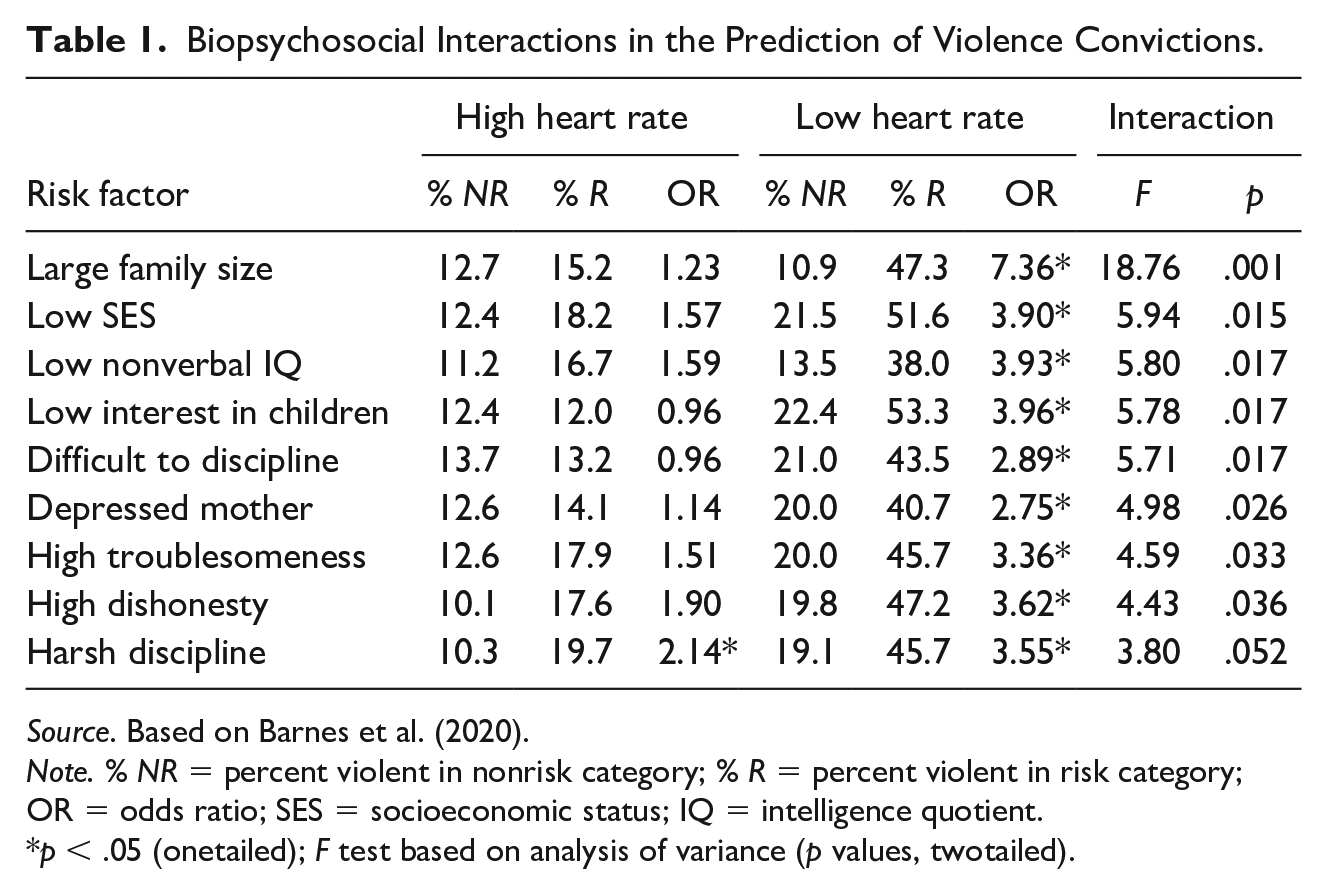
Source. Based on Barnes et al. (2020).
Note. % NR = percent violent in nonrisk category; % R = percent violent in risk category; OR = odds ratio; SES = socioeconomic status; IQ = intelligence quotient.
p < .05 (onetailed); F test based on analysis of variance (p values, twotailed).
The most significant interaction effect was with large family size. It seemed that a high RHR had a protective effect in nullifying the effect of large family size in predicting violence. Alternatively, it could be argued that the impact of large family size was potentiated by low RHR, since large family size only predicted violence among males with low RHR. All of the nine interaction effects shown in Table 1 are of the same nature. The effect of these diverse psychological and social risk factors in predicting violence is only apparent (or in the case of harsh discipline, especially apparent) among males with low RHR. High RHR seems to be a wide-ranging protective factor against the development of violence, and/or low RHR seems to be a wide-ranging potentiating factor.
Building on these previous results, the main aim of the present article is to investigate to what extent these biopsychosocial interaction effects for violence might be replicated in studying the prediction of all convictions and the prediction of high adult ASP scores. Farrington (1991) developed measures of ASP at Ages 10, 14, 18, and 32, that were closely modeled on the research of Robins (1991) and on the conduct disorder and ASP disorder definitions in the Diagnostic and Statistical Manual of Mental Disorders–third edition (DSM-III; American Psychiatric Association, 1980). For example, the indicators at Age 32 comprised convictions, self-reported offending, involved in fights, heavy drinking, drug-taking, poor relationship with a female partner, poor relationship with parents, divorced or having a child living elsewhere, high unemployment, anti-establishment attitudes, tattooed, and impulsiveness (based on items such as “I generally do and say things quickly without stopping to think”). Farrington (1996, 2000) investigated psychosocial risk factors for these ASP scales, and later Murray et al. (2014) developed a comparable ASP scale at Age 48.
Method
The CSDD is a prospective longitudinal survey of 411 London males from Age 8 to Age 61. Their parents and children have also been interviewed. The results of the CSDD have been described in six books (Farrington et al., 2013; Piquero et al., 2007; West, 1969, 1982; West & Farrington, 1973, 1977) and in six summary articles (Farrington, 1995, 2003, 2019a; Farrington et al., 2009; Farrington & West, 1981, 1990).
The Sample of Males
At the time that they were first contacted in 1961–1962, the males were all living in a working-class area of South London. The vast majority of the sample was chosen by taking all the boys who were then Aged 8 or 9 and on the registers of six state primary schools within a 1 mile radius of a research office which had been established. In addition to 399 boys from these six schools, 12 boys from a local school for children with special educational needs were included in the sample, in an attempt to make it more representative of the population of boys living in the area. Therefore, the boys were not a probability sample drawn from a population, but rather a complete population of boys of that age in that area at that time. Most boys were born in 1953.
Most of the boys (357, or 87%) were White in appearance and of British origin, in the sense that they were being brought up by parents who had themselves been brought up in England, Scotland, or Wales. Of the remaining 54 boys, 12 were African-Caribbean, having at least one parent of West Indian (usually) or African origin. Of the remaining 42 boys of non-British origin, 14 had at least one parent from the North or South of Ireland, 12 had parents from Cyprus, and the other 16 boys were White and had at least one parent from another Western industrialized country.
On the basis of their fathers’ occupations when they were Aged 8, 94% of the boys could be described as working-class (Categories III, IV, or V on the Registrar General’s scale, describing skilled, semi-skilled, or unskilled manual workers), in comparison with the national figure of 78% at that time. The majority of the boys were living in conventional two-parent families with both a father and a mother figure; at Ages 8 and 9, only 6% of the boys had no operative father and only 1% had no operative mother. This was, therefore, overwhelmingly a traditional White, urban, working class sample of British origin.
Interviews With the Males
The males have been interviewed 9 times, at Ages 8, 10, 14, 16, 18, 21, 25, 32, and 48. At all ages except 21 and 25, the aim was to interview all the males who were still alive, and it was always possible to interview a high proportion: 405 (99%) at Age 14, 399 (97%) at Age 16, 389 (95%) at Age 18, 378 (94%) at Age 32, and 365 (93%) at Age 48. At Age 48, 17 males had died, five could not be traced, and 24 refused, which meant that 365 of 394 who were still alive were interviewed. Because of limited funding, only about half of the males were interviewed at Age 21, and about a quarter at Age 25.
Criminal Record Searches
The criminal records of the males have been searched repeatedly since 1964. The most recent search was completed in April 2017 (see Farrington, 2019c). Given the typical delay of several months between the commission of an offense and a record appearing in the Police National Computer (PNC), it is likely that all offenses committed up to the end of August 2016 were recorded. Since the youngest male in the CSDD was born in August 1954, it is considered that all males have been searched in criminal records at least up to their 62nd birthday. Therefore, information is available about all offenses committed up to Age 61.99.
RHR
RHR was measured at Age 18 using a pulsimeter, which included a pressure cup that was fitted over the right middle finger. The pulse was made visible by a needle movement across a dial, and pulses were counted using a stopwatch. The readings were taken toward the end of an interview which lasted 2 hr on average, with the male sitting quietly resting his arm on a desk. The cumulative number of beats was recorded after 60 s. If the male moved, the procedure was recommenced.
The relationship between RHR and convictions for violence did not appear to be linear. The percentage convicted was 24.4% (N = 90) for RHR of 60 or less, 30.3% (N = 76) for RHR of 61–65, 20.7% (N = 82) for RHR of 66–70, 6.0% (N = 67) for RHR 71–75, and 12.5% (N = 72) for RHR of 76 or more. The Cochran–Armit age test (Agresti, 1990, pp. 100–102) showed that this trend was almost significantly nonlinear (χ2 = 6.50, 3 df, p < .09). For consistency with Farrington (1997), RHR was dichotomized into 66 or more (high) versus 65 or less (low). Some advantages of this dichotomization were reviewed by Farrington (1997).
Psychosocial Risk Factors
At Ages 8–10, before any of the males were convicted, the aim was to measure as many variables as possible that were believed (at the time) to predict delinquency. There was a concern that too many criminological studies measured and analyzed a very limited number of variables. In many CSDD analyses, the Age 8–10 variables were dichotomized into the “worst” quarter versus the remainder. This facilitated a “risk factor” approach, made all the risk factors comparable, and did not usually involve much loss of information, as many variables were originally measured on 2-, 3-, or 4-point scales (Farrington & Loeber, 2000). They were not measured on normally distributed equal-interval scales. Most importantly for the present article, dichotomized predictors and outcomes permit an easy and very understandable method of studying interaction effects.
Thirty Age 8–10 risk factors were studied in Barnes et al. (2020), and the same 30 are analyzed in the present article. Twenty of them (marked V in the tables) were shown to predict violence by Farrington (2019b) and all were dichotomized (as far as possible) into the “worst” quarter versus the remainder. In the first heart rate chapter (Farrington, 1997), the risk factors were dichotomized at the median, where possible. Of the 25 risk factors in this chapter that were measured at Ages 8–10, 16 were dichotomized at the median, and six of these are shown in the tables (marked M). Seven of the other nine risk factors (marked Q) are also shown in the tables (five of which overlap with the 20 risk factors from Farrington, 2019b). Finally, two additional risk factors (low interest in children by the father and attending a high delinquency-rate school), that have been studied in other analyses, were added (see West & Farrington, 1973, for more information about all these risk factors). The childhood risk factors were as follows.
Parental
Convictions of the father and mother up to their Age 32 (when almost all of the boys were below Age 10) were obtained from criminal record searches. Low parental interest in the boy’s education was rated by the psychiatric social workers who interviewed the boys’ parents. The rating of a depressed mother was also based on these interviews, and it took account of information about psychiatric treatment and scores on a mother’s health questionnaire. Low interest of the father in his children was also rated by the psychiatric social workers, and information obtained in these interviews was used to code young mothers (those who were teenagers when their first child was born).
Family
Uninvolved fathers were identified by a questionnaire on the extent to which the father joined in the boy’s leisure activities. The uninvolved fathers rarely or never joined the boy’s leisure activities. Harsh attitude and discipline was based on psychiatric social worker assessments of both parents, as was poor parental supervision, which referred to the extent to which the parents knew what the boy was doing when he was outside the house. Parental conflict was also rated by the psychiatric social workers based on their interviews with the parents, and it referred to chronic tension or disagreement in many fields, raging conflicts, or estrangement. A disrupted family referred to the temporary or permanent separation of a boy from a parent before the boy’s 10th birthday for reasons other than death or hospitalization.
Socioeconomic
Poor housing (very dilapidated) and low family income were rated by the psychiatric social workers. Large family size referred to five or more children born to the boy’s mother up to his 10th birthday. Low socioeconomic status referred to fathers who had an unskilled manual job. Information about high delinquency-rate schools was obtained from the local education authority.
Attainment
Low nonverbal IQ of the boy was measured by the Progressive Matrices test, while low verbal IQ was based on verbal comprehension and vocabulary tests. Low junior school attainment of the boy was based on school records of arithmetic, English, and verbal reasoning tests completed by the boys.
Impulsiveness
High daring was rated by parents and peers, and identified boys who took many risks in traffic, climbing, exploring, and so on. High hyperactivity was based on ratings by teachers of whether the boy lacked concentration or was restless in class. High impulsivity was based on psychomotor tests of clumsiness.
Behavior
High troublesomeness was rated by peers and teachers, and identified the boys who got into trouble most. Difficult to discipline was rated by teachers, while high dishonesty was rated by peers.
Results
RHR Versus Antisocial Outcomes
Table 2 shows the relation between RHR at Age 18 and the antisocial outcomes. For comparison, convictions for violence are shown as well as all convictions and ASP scores. Of 409 males at risk (excluding two who emigrated before Age 10), 76 (18.6%) were convicted for violence up to Age 61 (robbery, assault, wounding, threatening behavior, and weapons offenses: see Farrington, 2019b). Of these 409 males, 178 (43.5%) were convicted for all types of recorded offenses (excluding minor crimes such as motoring and drunkenness; the most common recorded crimes were theft, burglary, violence, fraud, vandalism, and drugs: see Farrington, 2019c). The ASP scores were based on the percentage of items on which the male was antisocial, and were dichotomized into the “worst” quarter (N = 85) versus the remainder (N = 305). The score at Ages 32–48 was based on the highest score at either age, because scores based on two ages were considered to be more valid than scores based on one age.
Resting Heart Rate at 18 Versus Antisocial Outcomes.
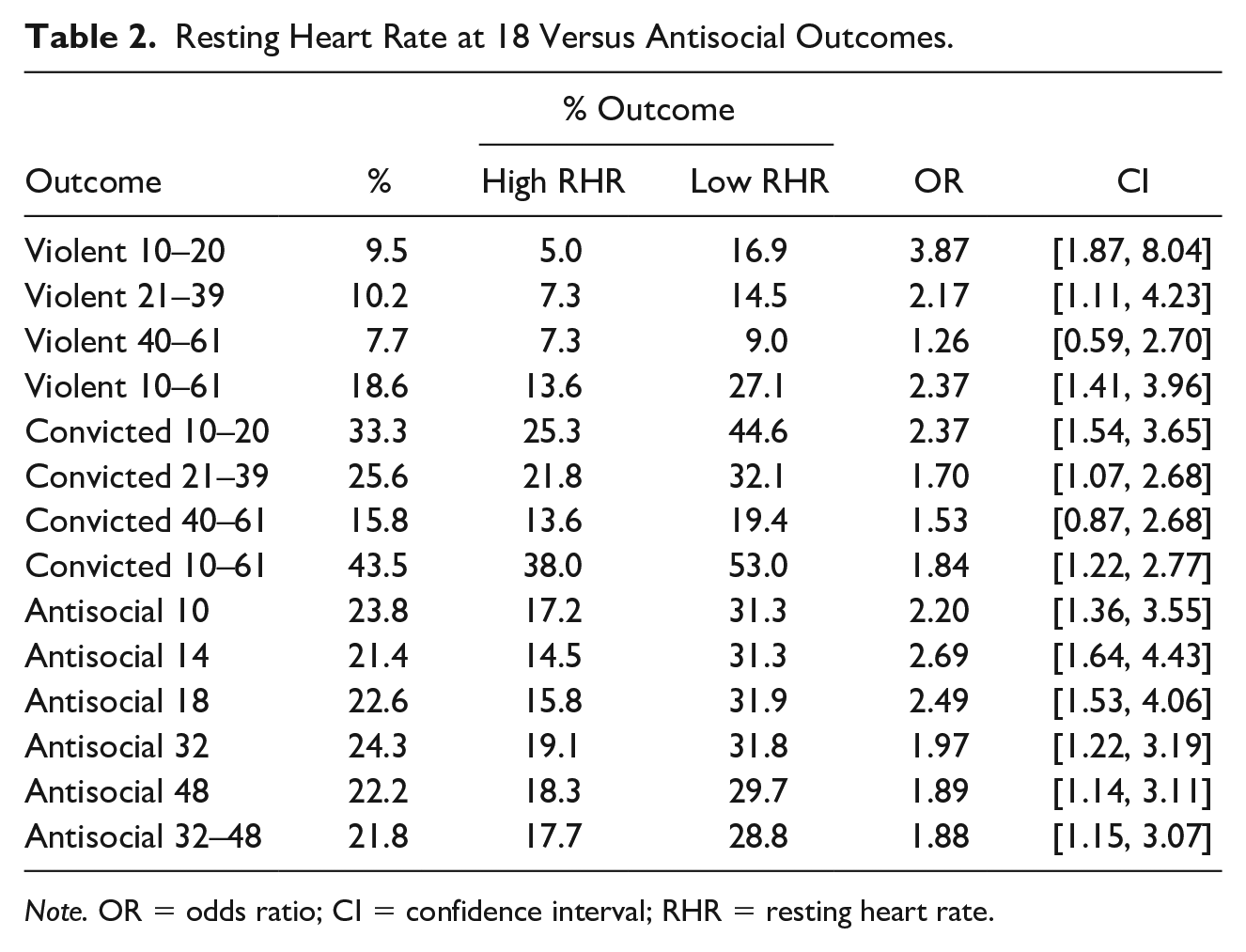
Note. OR = odds ratio; CI = confidence interval; RHR = resting heart rate.
The ASP scores were nonlinearly related to convictions for violence. The percentage convicted was 2.0% (N = 50) for a score of 0, 3.6% (N = 84) for a score of 1–9, 10.0% (N = 90) for a score of 10–19, 12.7% (N = 55) for a score of 20–29, 25.7% (N = 35) for a score of 30–39, 30.4% (N = 23) for a score of 40–49, then it increased dramatically to 60.9% (N = 23) for a score of 50–59, and 78.6% (N = 28) for a score of 60 or more. The Cochran–Armit age test showed that this was a significant nonlinear trend (χ2 = 16.01, 6 df, p = .014), and this was one reason why ASP scores were dichotomized. Nevertheless, they were also studied later as a continuous scale.
Table 2 shows that RHR at Age 18 was significantly related to violence convictions at Ages 10–20 and 21–39, but not at Ages 40–61. This was also true for all convictions. Generally, RHR was more strongly related to violence than to all convictions; for example, the OR for predicting violence at all ages was 2.37, compared with 1.84 for predicting all convictions. RHR was significantly related to high ASP scores at all ages. For example, RHR at Age 18 significantly predicted the combined Ages 32–48 ASP score (OR = 1.88).
Childhood Predictors of Antisocial Outcomes
Table 3 shows to what extent the 30 childhood risk factors predicted violence convictions, all convictions, and high ASP scores at Ages 32–48 combined. Most predictions were significant (27 for violence, 27 for convictions, 26 for ASP scores). Only one risk factor (the added variable of low paternal interest in children) did not significantly predict any of the three antisocial outcomes. The strongest predictors of violence were low verbal IQ (OR = 4.11), a convicted father (OR = 3.27), and large family size (OR = 3.03). The strongest predictors of convictions were a convicted father (OR = 4.60), high troublesomeness (OR = 3.49), and low attainment (OR = 3.14). The strongest predictors of high ASP scores at Ages 32–48 were a convicted father (OR = 4.28), high dishonesty (OR = 3.04), and low attainment (OR = 2.92). As the aim of this article is to study interaction effects, no multivariate analyses were carried out to study which childhood risk factors predicted antisocial outcomes independently of other childhood risk factors; for recent examples of such analyses in the CSDD, see Farrington (2019b), Farrington and Malvaso (2019), and Zara and Farrington (2020).
Age 8–10 Predictors of Violence, Convictions, and Antisocial Personality.
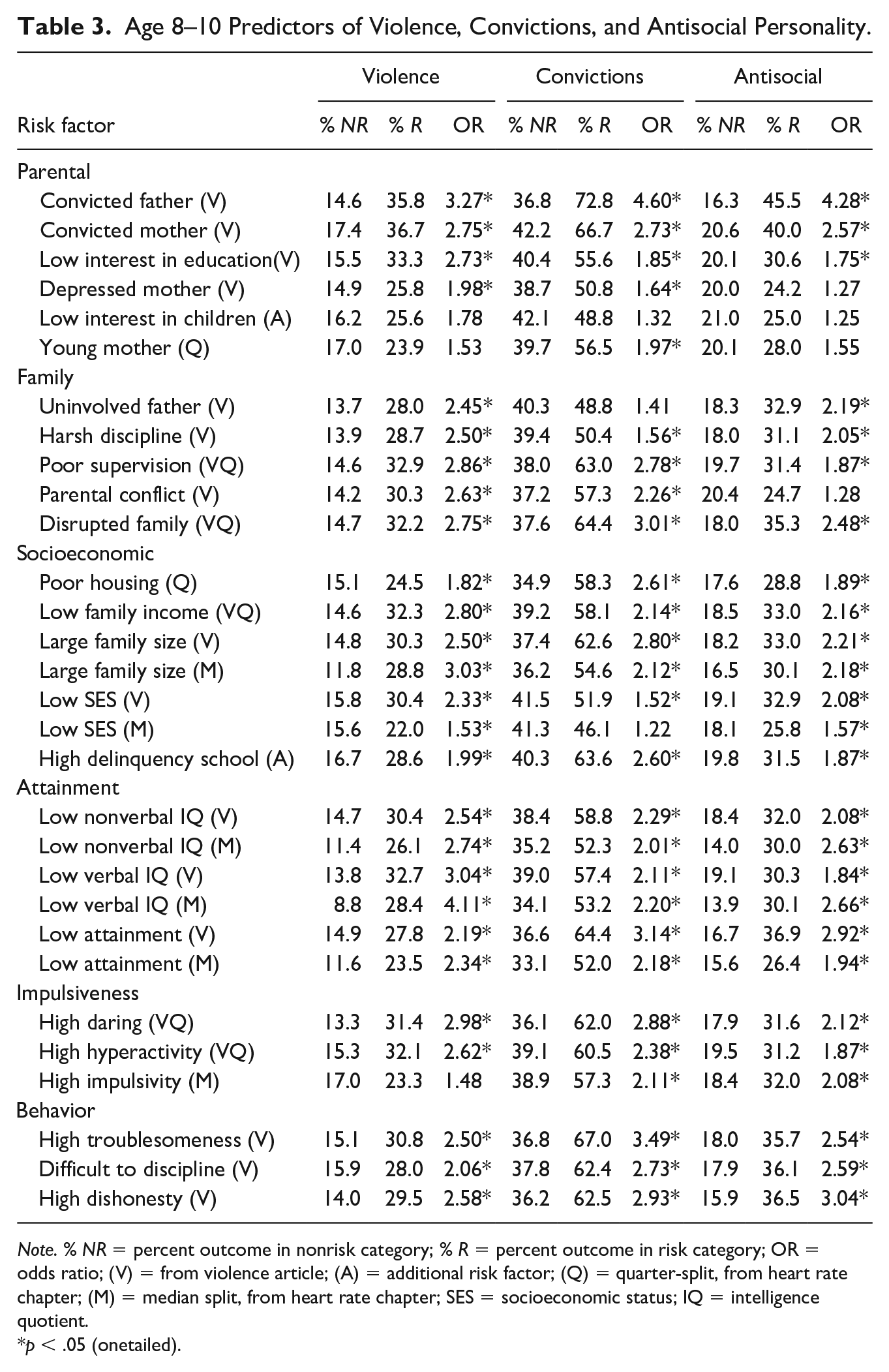
Note. % NR = percent outcome in nonrisk category; % R = percent outcome in risk category; OR = odds ratio; (V) = from violence article; (A) = additional risk factor; (Q) = quarter-split, from heart rate chapter; (M) = median split, from heart rate chapter; SES = socioeconomic status; IQ = intelligence quotient.
p < .05 (onetailed).
RHR Interactions in Predicting Convictions
Table 4 shows the relation between childhood risk factors and convictions separately for males with high versus low RHR, and the results of tests for significant interaction effects. Somewhat disappointingly, only three effects were significant at p < .05, compared with the chance expectation of 1.5. The strongest interaction was with harsh parental discipline, followed by a depressed mother and being difficult to discipline. In all three cases, a high RHR nullified the impact of the childhood risk factor, which only predicted convictions among males with low RHR. Encouragingly, all four significant and near-significant interactions for convictions were among the nine interactions shown for violence in Table 1. Therefore, four of the previously discovered protective effects of high RHR were replicated in predicting all convictions.
Interaction Effects in the Prediction of Convictions.
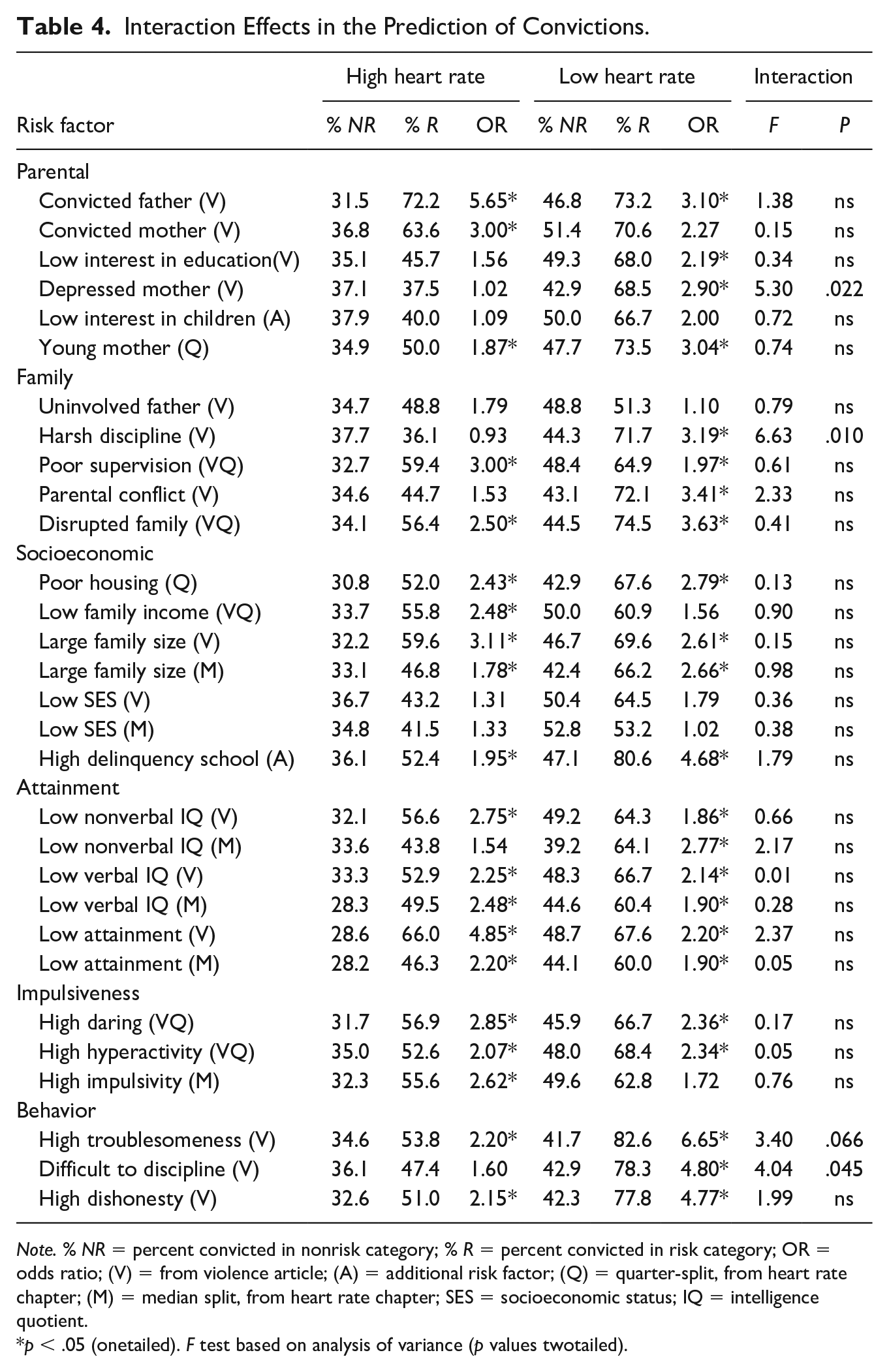
Note. % NR = percent convicted in nonrisk category; % R = percent convicted in risk category; OR = odds ratio; (V) = from violence article; (A) = additional risk factor; (Q) = quarter-split, from heart rate chapter; (M) = median split, from heart rate chapter; SES = socioeconomic status; IQ = intelligence quotient.
p < .05 (onetailed). F test based on analysis of variance (p values twotailed).
There is a possibility of Type I error (rejecting the null hypothesis when it is true) in these 30 analyses of interaction effects. Some researchers have used the Bonferroni p-value correction to deal with this problem. However, this correction has been strongly criticized, for example, because it increases Type II error (failing to reject the null hypothesis when it is false) and therefore decreases statistical power (e.g., Feise, 2002; Nakagawa, 2004; Perneger, 1998). It seems preferable to use a binomial test. In Table 4, the average p value of the four significant and near-significant interaction effects was .036. If a randomly occurring event has a probability of .036, the likelihood of it occurring at least 4 times in 30 trials by chance is .022. Therefore, it can be concluded that these four interaction effects are unlikely to have occurred by chance.
In the previously published analysis of interaction effects for violence (Barnes et al., 2020), there were many fewer significant predictors of violence among the high RHR males (16) than among the low RHR males (26), again showing the protective effect of high RHR in nullifying the impact of childhood risk factors, and/or the potentiating effect of low RHR. However, the difference between high RHR (20) and low RHR (23) in the number of significant predictors of convictions was much less, showing that the protective or potentiating effects of high RHR were less apparent in predicting convictions.
RHR Interactions in Predicting ASP Scores
Table 5 shows the relation between childhood risk factors and high ASP scores at Ages 32–48 separately for males with high versus low RHR, and the results of tests for significant interaction effects. Only two effects were significant at p < .05, but seven effects were significant at p < .10, compared with the chance expectation of three. The average p value of these seven effects was .07. If the probability of a randomly occurring event is .07, the likelihood of the event occurring at least 7 times in 30 trials by chance is .004. Therefore, these results are highly unlikely to be due to chance. The strongest interactions were with a disrupted family and (surprisingly) with low paternal interest in children. This latter risk factor did not predict high ASP scores significantly in the total sample, but it did predict high ASP scores significantly among males with low RHR. Four of the seven risk factors with significant or near-significant interaction effects (depressed mother, low paternal interest in children, harsh discipline, and large family size) were among the nine interactions shown for violence in Table 1, showing that four of the previously discovered protective effects of high RHR were replicated for high ASP scores at Ages 32–48.
Interaction Effects in the Prediction of High ASP Scores.
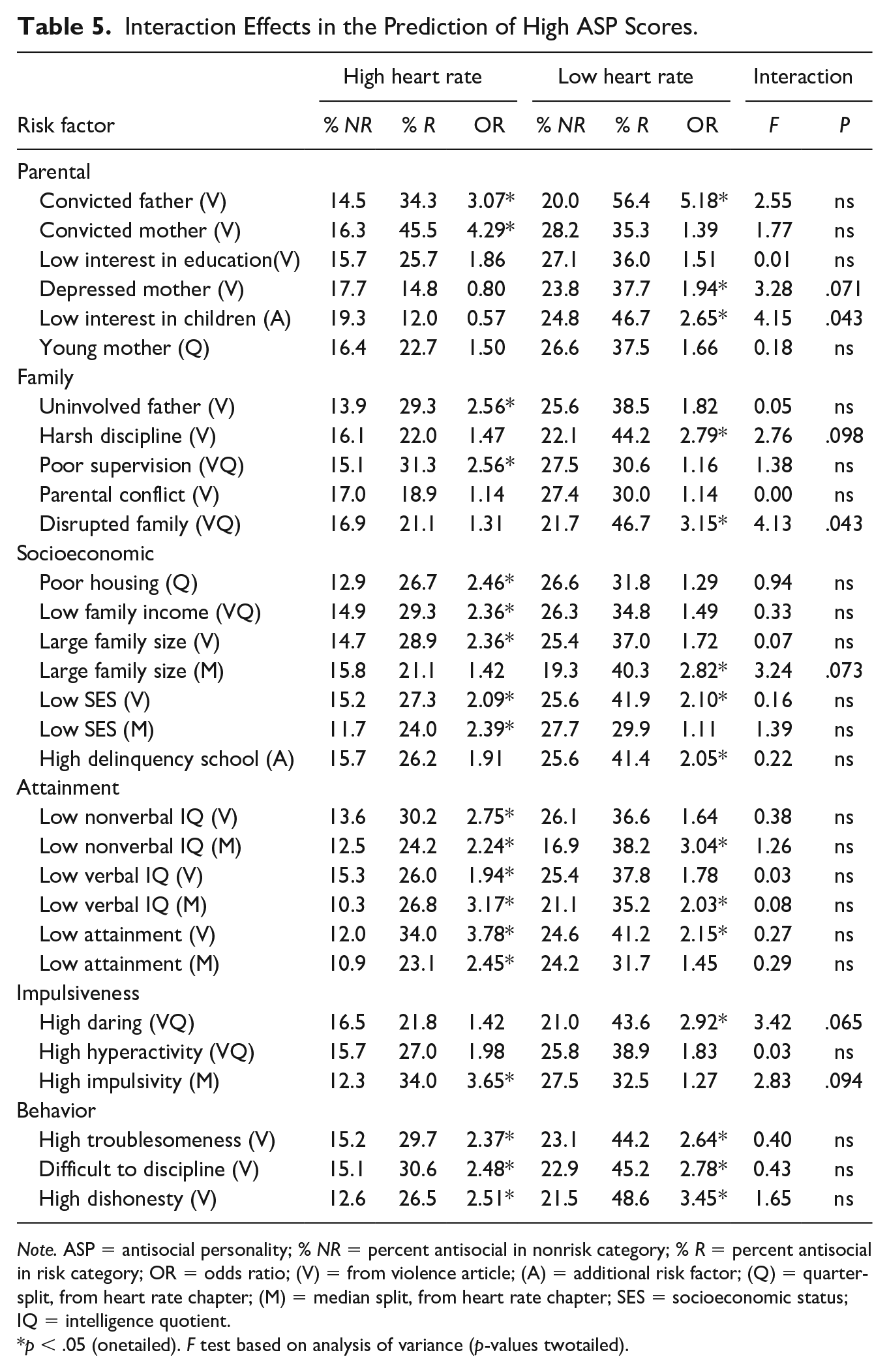
Note. ASP = antisocial personality; % NR = percent antisocial in nonrisk category; % R = percent antisocial in risk category; OR = odds ratio; (V) = from violence article; (A) = additional risk factor; (Q) = quarter-split, from heart rate chapter; (M) = median split, from heart rate chapter; SES = socioeconomic status; IQ = intelligence quotient.
p < .05 (onetailed). F test based on analysis of variance (p-values twotailed).
Surprisingly, the number of significant predictors for high RHR males (19) was not less than the number for low RHR males (15), showing that, unlike in the prediction of violence, high RHR was not generally acting as a protective factor. However, it was clearly acting as a protective factor in six of the seven identified interaction effects. Unusually, one of the interaction effects for ASP scores indicated a protective effect of low RHR. High impulsivity predicted high ASP scores only among males with high RHR. However, this result had p = .094 and was the only finding of this type, so it perhaps should not be given too much credence.
To investigate the robustness of these results, the analyses of variance were repeated for the continuous ASP scores. Of the seven significant or near-significant interactions with dichotomous ASP scores, five were significant or near-significant with continuous scores: harsh discipline (F = 7.09, p = .008), high daring (F = 5.78, p = .017), large family size (F = 5.04, p = .025), low interest in children (F = 4.55, p = .034), and a depressed mother (F = 3.11, p = .079). This replication shows that the previous results were not an artifact of dichotomization. The previously dubious result of high impulsivity was now not significant. However, high dishonesty now had a significant interaction effect (F = 3.99, p = .046). This was caused by the fact that the relation between dishonesty and ASP was much stronger for males with low RHR (mean values 39.76 vs. 23.78; t = 3.85, p = .0002) than for males with high RHR (mean values 26.04 vs. 19.85; t = 2.16, p = .032).
Conclusion
This article aimed to investigate interactions between Ages 8-10 childhood risk factors and RHR in predicting convictions up to Age 61 and high ASP scores at Ages 32–48. Previous analyses of the prediction of violence indicated that high RHR acted as a protective factor in nullifying the effect of several childhood risk factors and/or that low RHR acted as a potentiating factor. Encouragingly, some of these results were replicated in the present article. In particular, high RHR nullified the impact of harsh discipline, a depressed mother, and being difficult to discipline on later convictions. Similarly, high RHR nullified the impact of harsh discipline, a depressed mother, large family size, and low paternal interest in children on later high ASP scores. Discouragingly, the number of significant interaction effects was fewer in these analyses than in the analyses of violence convictions. However, the replicability of high RHR as a protective factor against harsh discipline and a depressed mother is noteworthy. Further research should be carried out to investigate why high RHR acts as a protective factor against some childhood risk factors but not others, and/or why low RHR acts as a potentiating factor for some childhood risk factors but not others, and how general is this interactive protective/potentiating pattern in criminological research.
Contrary to some previous arguments, the effects of the biological risk factor of low RHR were not stronger in the absence of psychosocial risk. In fact, antisocial outcomes were most frequent when the biological risk was combined with the psychosocial risk. More research is clearly needed on biopsychosocial interactions in criminology, and especially on the mechanisms and processes through which they have their effects. The present results show that biological variables should be measured more often in prospective longitudinal studies (Farrington, 2018) and should be included more often in developmental and life-course theories (Choy, Farrington, & Raine, 2015). Furthermore, knowledge about biopsychosocial interactions could be useful in increasing the effectiveness of criminological interventions; it is important to know what is likely to work with whom under what circumstances. Finally, further research on interaction effects in criminology is needed, along with systematic reviews to establish what are the most replicable interaction effects and what they mean.
Footnotes
Acknowledgements
For funding the CSDD, I am very grateful to the Home Office, the Department of Health, the Department of Education, the Rayne Foundation, the Barrow Cadbury Trust, and the Smith-Richardson Foundation. For carrying out criminal record searches, I am very grateful to Gwen Gundry in the 1960s and 1970s, Lynda Morley in the 1980s, Sandra Lambert in the 1990s, Debbie Wilson in the 2000s, Owen Thomas in 2011–2012 and Lisa Robinson in 2017. I am also very grateful to Jill Portnoy for comments and references.
Declaration of Conflicting Interests
The author(s) declared no potential conflicts of interest with respect to the research, authorship, and/or publication of this article.
Funding
The author(s) received no financial support for the research, authorship, and/or publication of this article.
