




Abstract
The aim of the current study was to examine if prisoner characteristics (personal characteristics and prison climate) and prison environment were related to prisoner misconduct, using data from a nationwide prospective cohort study examining the experience of prison climate in the Netherlands (N = 4,427). The results indicated that both personal characteristics and certain (social) domains of prison climate, such as the quality of staff–prisoner relationships, were related to prisoner misconduct, as well as prison regime. Furthermore, it was shown that registration data, which underestimate misconduct, may be (more than self-reported data) influenced by unit-level factors, such as regime characteristics. When using registration data, it is therefore particularly important to properly control for unit-level influences.
Introduction
Many European countries, influenced by several European institutions such as the Council of Europe and the European Union, show a fundamental commitment toward a humane prison system, in which imprisonment is not used to inflict additional pain, but instead is meant to contribute as much as possible to the re-integration of prisoners in the community (Snacken, 2010; Van Zyl Smit & Snacken, 2009). One of the perhaps most important aspects of a humane prison experience is to maintain a safe and stimulating prison climate.
Although referred to by different terms, such as prison climate (Ross, Diamond, Liebling, & Saylor, 2008) social climate (Moos, 1975; Schalast, Redies, Collins, Stacey, & Howells, 2008; Tonkin, 2016; Wilkinson & Reppucci, 1973), prison environment (Saylor, 1984; Wright, 1985), and moral climate (Liebling, 2011), there is a general acknowledgment that penitentiary institutions have a certain character (Moos, 1975), which influences the well-being and behavior of prisoners both during and after imprisonment (Boone, Althoff, & Koenraadt, 2016). Prison climate is an overarching term that encompasses the social, emotional, organizational, and physical characteristics of a correctional institution as perceived by inmates and staff (Ross et al., 2008). An international literature review (Boone et al., 2016) led to the identification of six primary domains of prison climate: relationships in prison, safety and order, contact with the outside world, prison facilities, meaningful activities, and autonomy. Some of these domains are related to not only the nature of relationships in prison, both with staff-members and fellow prisoners, but also the ability to maintain relationships with people on the outside. Others are related to the quality and quantity of prison facilities (such as food or cell conditions) and activities (such as sports, library, or yard time) available in the prison, the rules that govern behavior, and the extent to which prisoners still have some freedom to make their own decisions and move around the prison (autonomy). In addition, building characteristics, staff characteristics, and composition of the prisoner population were regarded as important conditions that create the circumstances necessary for a positive living environment (Boone et al., 2016).
Under conditions of severe overcrowding and budget restraints, it can, however, be challenging to maintain safe and stimulating prison environments. Prisons are complex systems, in which people of various psychological, social, and cultural backgrounds are joined, who interact in a highly restricted and deprived environment (Wenk & Moos, 1972). Such an environment can be considered stressful (Maschi, Viola, & Koskinen, 2015; Maschi, Viola, Morgen, & Koskinen, 2015). In addition, prison rules can be overly restrictive, prohibiting behavior that would be considered legal and acceptable in another context (Camp, Gaes, Langan, & Saylor, 2003). And as deviation from any of the rules that regulate behavior in prison is considered misbehavior (Eichenthal & Jacobs, 1991; Irwin, 2005; Wooldredge, 1994, 1998), functioning in this context can be difficult, perhaps particularly for a population who in the past have had difficulties abiding by societal rules. A large number of studies have consequently emphasized the importance of prison climate in relation to prisoner’s adjustment to confinement, such as the incidence of physical and verbal misconduct (Bottoms, 1999; Camp et al., 2003; Reisig & Mesko, 2009; Wright, 1991), or the possession of contrabands (Reisig & Mesko, 2009).
Maintaining order is important for correctional administrations, as misconduct poses a risk to safety and is a threat to the well-being of staff members and other prisoners. Furthermore, misconduct compromises the effective organization of prison institutions and increases institutional costs (Goetting & Howsen, 1986). For prisoners, misconduct can influence their time spent in detention (in countries where parole or early release is conditional) and/or can influence their conditions of confinement. It has even been found that prisoners who misbehaved during imprisonment were more likely to continue offending following release (Brunton-Smith & Hopkins, 2013; Cochran, Mears, Bales, & Stewart, 2014; Trulson, DeLisi, & Marquart, 2011). Knowledge on the determinants of prisoner misconduct is therefore of great importance.
Although the correctional literature abounds in studies aiming at identifying the determinants of inmate misconduct (e.g., Dhami, Ayton, & Loewenstein, 2007; Jiang & Fisher-Giorlando, 2002; Steiner, Butler, & Ellison, 2014), they suffer from two major shortcomings. Prison climate, as experienced by the individual prisoner, was seldom tested against offender misconduct. Second, prisoner misconduct was often measured using official data or (in fewer cases) self-report data (Steiner et al., 2014). This contribution aims to overcome both these issues, by studying the relation between prison climate and prisoner misconduct, using both self-report and official misconduct data. By doing so, this article represents a major advancement on existing work.
Theoretical Considerations and Previous Studies
Previous work on prisoner misconduct has mainly been inspired by two widely recognized and applied theories of adaptation to imprisonment: the deprivation and importation model. Rooted in the classic work of Sykes (1958) and Goffman (1961), the deprivation model posits that prisoner adaptation is attributable to the stressful and oppressive conditions of confinement. Prisoners are placed in an environment that is characterized by specific environmental and psychological deprivations, such as a loss of autonomy, security, freedom of movement, and access to goods and services, which can lead to prisoners responding with stress, anger, and oppositional behavior. To exemplify, prisoners who consider their environment as less safe may engage in misconduct for their own protection. The importation model argues that prisoner behavior is, in contrast to what the deprivation model proclaims, not necessarily the result of the imprisonment experience, but is instead a manifestation of an offender’s pre-institutional traits, beliefs, attitudes, and experiences (Irwin & Cressey, 1962). Generally speaking, these individual characteristics are usually related to prison misconduct in the same way that they are related to criminal behavior in society, such as age, gender, and criminal history (Berg & DeLisi, 2006; Innes, 1997).
With a relatively high level of agreement, prior research on import factors has shown that age, ethnicity, gender, and criminal history were related to misconduct (Bottoms, 1999; Goodstein & Wright, 1989; Wooldredge, 1991; Wright, 1991). These studies indicated that younger prisoners were generally more likely to misbehave (Camp et al., 2003; Cunningham & Sorensen, 2007; Fernandez & Neiman, 1998; Flanagan, 1983; Griffin & Hepburn, 2006; Harer & Steffensmeier, 1996; Innes, 1997; Lahm, 2008; Reisig & Mesko, 2009), just as prisoners from ethnic minorities were (Berg & DeLisi, 2006; Camp et al., 2003; Cao, Zhao, & Van Dine, 1997; Harer & Steffensmeier, 1996; Huebner, 2003; Innes, 1997; Jiang & Winfree, 2006; Wooldredge, 1994). Results for gender varied: some studies found that females were less often involved in (less serious) prison misconduct (Craddock, 1996; Harer & Langan, 2001), while others reported higher misconduct rates for females (Gover, Pérez, & Jennings, 2008; Jiang & Winfree, 2006). Concerning criminal history, variables such as prior imprisonment (e.g., Casper, Tyler, & Fisher, 1988; Jiang & Winfree, 2006) and a history of violent crime (Berg & DeLisi, 2006; Camp et al., 2003; Cunningham, Sorensen, & Reidy, 2005; DeLisi, 2003) were shown to be positively related to prison misconduct. Other frequently tested variables include marital status (Jiang & Fisher-Giorlando, 2002; Jiang & Winfree, 2006; Steiner & Wooldredge, 2008), parenthood status (Jiang & Fisher-Giorlando, 2002; Jiang & Winfree, 2006; Wooldredge, 1994), education (e.g., Berg & DeLisi, 2006; Porporino & Zamble, 1984), and sentence length (Berg & DeLisi, 2006; Cunningham et al., 2005; DeLisi, 2003), all with mixed, and in most cases, insignificant results (Steiner et al., 2014).
In testing the influence of specific environmental and psychological deprivations in relation to prisoner misconduct, most studies (Steiner et al., 2014) have focused on physical deprivations, such as prison (over)crowding and security level (or regime). Overcrowding is thought to cause inmate disorder and deviance, although the empirical evidence for this relationship varies greatly from study to study (Steiner et al., 2014). A meta-analytic study (Franklin, Franklin, & Pratt, 2006) indicated that prison crowding has little substantive effect on misconduct. There are also mixed results regarding the relationship between security level and misconduct. Some studies have indicated that prisoners in higher security-level units are more likely to be involved in prison misconduct (e.g., Camp et al., 2003; Craddock, 1996; Jiang & Fisher-Giorlando, 2002; R. C. McCorkle, Miethe, & Drass, 1995; Sieverdes & Bartollas, 1986; Steinke, 1991), while others have found no, or opposite, effects (e.g., Camp & Gaes, 2005; Camp et al., 2003; Cao et al., 1997). Other studied measures relating to context include institutional size, for which some studies show that size increases misconduct (e.g., Farrington & Nuttall, 1980; Ruback & Carr, 1993) and others show no significant effect (e.g., R. C. McCorkle et al., 1995), and characteristics of the prisoner population (e.g., Steiner & Wooldredge, 2009), again with varying (and often non-significant) results (Steiner et al., 2014).
A smaller amount of studies have looked at the influence of social deprivations, such as staff–prisoner relationships and visitation, on misconduct. Studies on experiences of procedural justice, for instance, indicated that prisoners who perceive their treatment by staff as more respectful and fair were less often engaged in misconduct (e.g., Beijersbergen, Dirkzwager, Eichelsheim, Van der Laan, & Nieuwbeerta, 2015; Reisig & Mesko, 2009). Also, positive communication by prison guards was found to decrease the incidence of (violent) misconduct (Harer & Steffensmeier, 1996). Furthermore, studies have indicated that prisoners who received visitors were generally less engaged in deviant behavior during imprisonment (Cochran, 2012; Hensley, Koscheski, & Tewksbury, 2002; Jiang & Winfree, 2006; Lahm, 2008), although there have also been studies that have found that visitation increased misconduct (Casey-Acevedo, Bakken, & Karle, 2004; Siennick, Mears, & Bales, 2013).
Shortcomings of Previous Research
Although it may certainly appear that there is a long-standing research tradition into the determinants of prison misconduct, both in theory and empirical studies conducted, these studies suffer from two major limitations. First, although the relation between personal characteristics and prisoner misconduct theorized by the importation model was often researched using a broad range of (appropriate) measures, the deprivation model has been poorly operationalized. This is surprising, as so many researchers place such great theoretical emphasis on the deprivation model. Most studies used prison crowding or security level as a proxy for the amount of deprivation experienced. Studies then assume that prison crowding and higher security prisons impose more deprivations and restrictions on prisoners and, therefore, create a more painful living environment. Studies have, however, indicated that the relative importance of the experienced pains of imprisonment, or deprivation, varies between prisoners (Toch, Adams, & Greene, 1987). The experienced pains not only depend on contextual, prison-level measures (such as crowding and security level) and background indicators (such as age or relationship status) but also depend largely on individual prison experiences during imprisonment (such as the relative level of isolation from others, experiences of fear, and relative suffering from restrictions in autonomy). We believe that the amount of deprivation experienced is better measured by using the subjectively experienced prison climate. More specifically, the current study will focus on the six aforementioned domains of prison life that were deemed most important in determining the quality of life in prison: relationships in prison, safety and order, contact with the outside world, prison facilities, meaningful activities, and autonomy.
A second major shortcoming of previous research is that prisoner misconduct was often measured using official data or (in fewer cases) self-report data. Only three studies (Hewitt, Poole, & Regoli, 1984; Steiner & Wooldredge, 2014; Van Voorhis, 1994), to our knowledge, use both. This is problematic for two reasons: first, because previous work has shown that official data underestimate prisoner misconduct (Hewitt et al., 1984; Steiner & Wooldredge, 2014) and, second, because registered misconduct may also reflect—to some extent—systematic bias resulting from the discretionary power of staff members (Light, 1990). This could be the result of an (unspoken) cooperation between prisoners and staff members to obtain a safe and clean prison environment. In this process, staff members attempt to impose control over the inmate population and, in return, overlook certain illicit behavior, such as the possession of contrabands (L. W. McCorkle & Korn, 1954; Sykes & Messinger, 1960). Using self-report data instead may, however, also not be optimal, as prisoners may forget (or may not agree with) having committed certain, particularly petty, offenses and may not report more serious violations (Steiner & Wooldredge, 2014). This contribution aims to overcome both these issues, by studying the relationship between individual experiences of prison climate and prisoner misconduct, using both self-report and official misconduct data.
The Current Study
Previous work has aimed to explain prisoner misconduct by two types of variables: either related to prisoner characteristics (conform the import model) or the prison environment (conform the deprivation model). This study aims to do just that, but proposes to measure deprivation by including prisoners’ perceptions of the prison climate, which is believed a better (and more accurate) representation of a prisoner’s personal experience of deprivation. Consequently, the aim of this article is to assess the extent to which prisoner characteristics (personal characteristics and prison climate) and prison environment are related to prisoner misconduct. This is studied by using data from the Life In Custody [LIC] study (van Ginneken et al., 2018), a nationwide prospective cohort study examining the experience of prison climate in the Netherlands. By using this dataset, we have access to self-report data, as well as official reports on four types (verbal, physical, property, and contraband) of prisoner misconduct. Because this study benefits from having two sources of misconduct data, the second aim of this article is to assess the extent to which there is a difference between the relation between prisoner characteristics and the prison environment, and the self-report and registered measures of prisoner misconduct.
The current study used data from Dutch correctional facilities (i.e., prisons and remand centers). Prison conditions in the Netherlands may be considered rather liberal compared with the more austere circumstances in other countries (Snacken, 2010; Subramanian & Shames, 2013). Imprisonment rates have been dropping in recent years (Dünkel, 2017). In 2017, about 33,000 (mostly male) adults were detained in the Netherlands, of which about one third in pre-trial detention (Dutch Custodial Institutions Agency, 2017). Dutch prisons run different regimes, the most common of which are pre-trial detention (for prisoners who have not [yet] been sentenced) and prison (for those who have been sentenced). Other regimes are meant for those who need extra care (based on their offense committed or psychiatric needs), for short-stay prisoners, for persistent offenders, for those who remain under minimum security (meant for prisoners who are in the final phase of their sentence), and for terrorists and other prisoners who require a maximum-security regime. There are separate facilities for men and women. Prisoners with severe mental health problems are imprisoned in psychiatric penitentiary facilities (not included in this study). Compared with other countries, prison sentences in the Netherlands are relatively short: most pre-trial detainees and those detained in short-stay custody are confined for a maximum of 3 months, while well over 60% of the full prisoner population leaves prison after a detention period of maximum 6 months (Dutch Custodial Institutions Agency, 2017). Prison layout in Dutch prisons is rather comparable with so-called new(or third/fourth)-generation jails in the United States (Potter, 2010), with open-plan living areas, in which prison staff members are not physically separated from prisoners and in which staff members and prisoners can interact freely with one another. All prisoners (including those in pre-trial detention) remain in a basic regime, which provides for 43 hr of out-of-cell time and activities per week. Convicted prisoners can, depending on good behavior and a motivation to work on their re-integration, be promoted to a “plus” regime. This regime offers five extra hours a week of out-of-cell activities. Prisoners in the plus regime are also eligible for placement in minimum-security facilities at the end of their sentence. Because of the extra amenities and privileges that can be earned or lost, certain power is given to correctional staff to control prisoners eligible for promotion (or demotion).
Method
Sample and Procedure
To examine the relation between the quality of prison life and prisoner misconduct, data from the Dutch LIC study were used. The LIC study was designed to measure the quality of life in Dutch prisons. To do so, the Prison Climate Questionnaire (PCQ; Anonymous) was administered to the full population of prisoners (males and females, pre-trial detention and convicted, in practically all regimes and populations 1 ) housed in each of the 28 prisons operational in the Netherlands between January and April 2017. An extensive overview of the LIC study can be found in van Ginneken et al. (2018).
A total of 7,109 prisoners were detained in the Netherlands during data collection. Of those, 6,088 prisoners (86%) could be reached to take part in the study; 548 could not participate, because of being released in the week of data collection; and 473 could not be invited to participate because of language difficulties, severe mental health problems, or being placed in segregation in the week of the data collection. Of the 6,088 prisoners that were approached to participate in our survey study, 4,938 took part (reasons for non-participation were “don’t want to” and a lack of trust in scientific research). The response rate was, therefore, 81%. All participants were informed of the purpose of the study and had to consent to taking part (in line with current research ethics); they were asked permission to match their survey data with administrative data (i.e., prison-registration data). Most participants did so; only 400 participants did not and participated anonymously. Therefore, both survey and registration data were available for a sample of 4,538 prisoners, who were nested in 244 units.
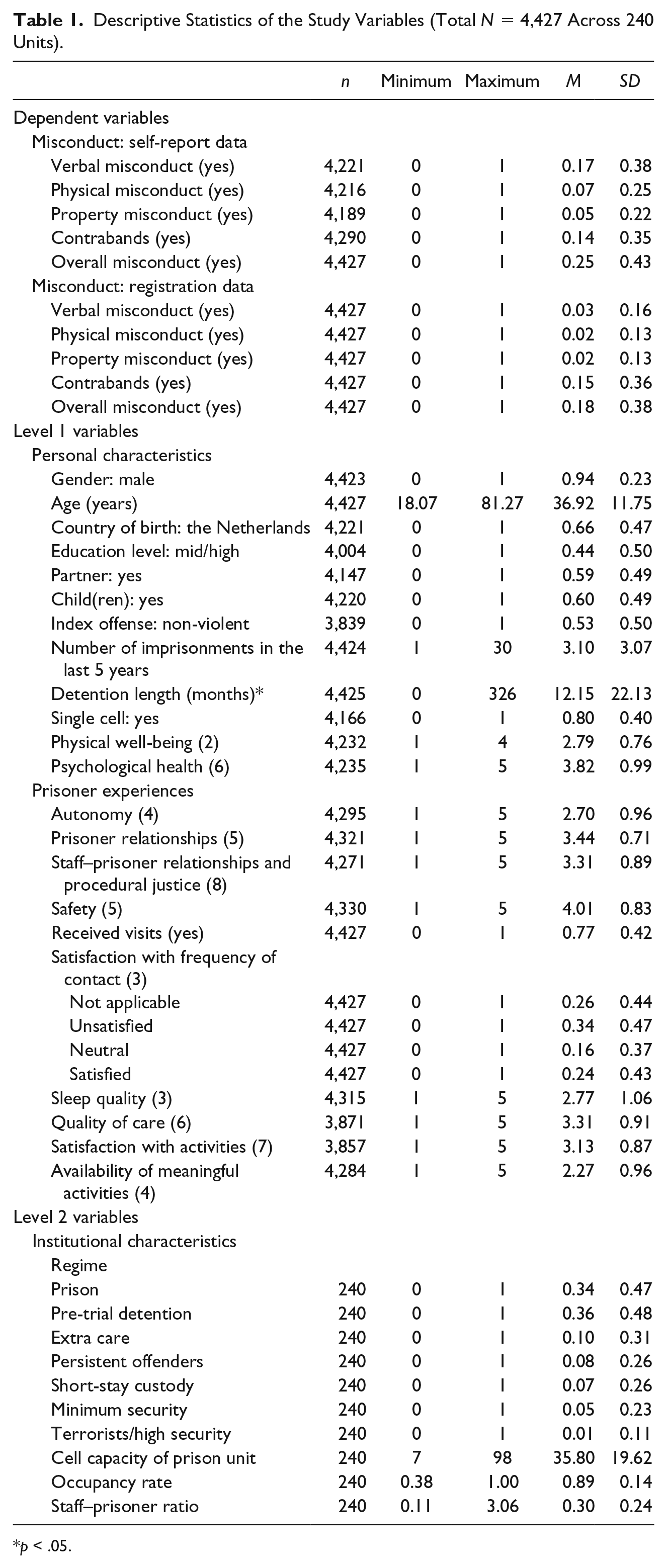
Because we were also interested in unit-level variables, we had to exclude four units (111 prisoners) from the analyses for whom no unit characteristics were available. The excluded sample did not significantly differ from the included sample regarding the proportion of prisoners who were involved in misconduct based on self-reports, χ(1) = 0.91, p = .34, and a combined group measure, χ(3) = 4.71, p = .20, but based on official records for misconduct, the proportions differed significantly in that excluded prisoners were less likely than included prisoners to have official records for misconduct, χ(1) = 4.60, p < .05. Table 1 shows relevant sample characteristics for the 4,427 study participants who came from 240 prison units (for more information regarding the representativeness of the LIC study sample, see Anonymous, 2018).
Descriptive Statistics of the Study Variables (Total N = 4,427 Across 240 Units).
p < .05.
Dependent Variables
Three dependent variables were included in this study. The first was a self-reported measure of prisoner misconduct, which was collected using the PCQ (Anonymous). The PCQ is a 136-item questionnaire that measures 21 concepts, 14 of which cover the six domains of prison climate (i.e., relationships in prison, safety and order, contact with the outside world, prison facilities, meaningful activities, and autonomy). Besides measuring the quality of prison life, the PCQ consists of additional (but related) questions concerning background characteristics (e.g., demographics), health and health care, well-being, victimization and misconduct, subjective sentence severity, and overall satisfaction with prison climate.
Prisoners were asked if they never, once, or more than twice had been engaged in a list of seven types of misconduct in the two previous months (or shorter if their detention period was shorter than 2 months): (a) yelled at or threatened a fellow prisoner; (b) punched, pushed, or kicked a fellow prisoner; (c) yelled at or threatened a staff member; (d) punched, pushed, or kicked a staff member; (e) destroyed something that was not theirs; (f) stolen something; or (g) had been in possession of contraband(s), such as a phone, drugs, illegal medication, or weapons. Because of low incident rates, variables were recoded and dichotomized to verbal misconduct (a and c; yes/no), physical misconduct (b and d; yes/no), property misconduct (d and e; yes/no), and contrabands (g; yes/no). By combining these dichotomous measures, we created one overall self-reported misconduct measure that indicated misconduct (yes/no).
The second measure of prisoner misconduct was retrieved from official prison records. The Dutch prison system uses a nationwide registration system in which each disciplinary report is documented. Disciplinary reports were provided by the Dutch Custodial Institutions Agency and came from the Central Digital Depot (CDD+) system. This system archives all documents (including reports on institutional decisions, participation in activities, reports on reintegration activities, and disciplinary infractions) concerning Dutch prisoners. Access was provided to archived documents concerning in-prison behavior for the LIC study participants (N = 4,538) from 6 months prior to the data collection (July 2016) to 1 year after the data collection (February 2018). For disciplinary infractions, the following information was coded from the reports: date of the report, prison in which the incident took place, punishment(s) given, length of the punishment, and the reason for giving the punishment. Information was coded as stated in the documents. Several checks were done to ensure that researchers coded the data in the same way. Checks made throughout the coding process revealed no substantial differences in the ways the information was being recorded.
After all the available reports from July 2016 to February 2018 were recorded, the data were cleaned. First, to make the data comparable with the self-report data, a period was selected that resembled the 2 months prior to data collection, in line with self-reported misconduct. Second, the information provided on the reason for giving the sanction was recoded into categories of infractions, similar to those gathered using the questionnaire, namely, verbal misconduct (e.g., arguing, use of insulting, cursing, provocative or racist language, and other conflicts not explicitly indicating physical violence), physical misconduct (e.g., kicking, stabbing, beating, grabbing, spitting, pushing, or throwing things toward others), property misconduct (e.g., stealing, loosing, breaking, hiding, throwing, or damaging property, including kicking or punching doors and starting fires), and contrabands (e.g., possession or use of mobile telephones, drugs, illegal medication, etc.). By combining these dichotomous measures, we created one overall official-reported misconduct measure that indicated misconduct (yes/no).
Third, we created one overall misconduct measure reflecting the (lack of) overlap between self-reports and official records, such that prisoners were categorized into four groups. The first group (Group 1: no misconduct, n = 2,978) consisted of participants who had no record of (any type of) misconduct, in both survey data and registered data. The second group (Group 2: only self-report, n = 663) consisted of participants who had self-reported (any type of) misconduct, but for whom no official record of misconduct existed. The third group (Group 3: only registered, n = 357) consisted of participants who had not reported (any type of) misconduct, but who had received an official record. And finally, the fourth group (Group 4: both, n = 429) had a record of misconduct on both self-report and official data.
Independent Variables (Level 1, Prisoner Level)
Independent variables included at Level 1 (prisoner level) are grouped under personal characteristics and prison climate.
Personal characteristics included are gender (male or female), age at the time of data collection (in years), country of birth (the Netherlands or other), education (low or medium-high), relationship status (single or other), children (yes or no), index offense (violent or non-violent), number of imprisonments in the last 5 years, time served in current detention, and residence in single versus double cell. Some of these variables were gathered by administrating the PCQ, others (gender, age, index offense, number of imprisonments in the last 5 years, time served in current detention, and single/double cell) were retrieved from official prison-registration systems, because of the difficulty and sensitive nature of some of these questions. Additional variables at the prisoner level included physical well-being and psychological health. Psychological health was measured using the Kessler Screening Scale of Psychological Distress (K6, Kessler et al., 2003). This is a six-item scale (e.g., “During the past week, about how often did you feel restless or fidgety?”) on which prisoners on a 5-point scale (1 = none of the time to 5 = all of the time) rated how often they experienced psychological symptoms (α = .91). Scores were reverse coded, so that higher scores were an indication of greater psychological health. Prisoners rated their physical well-being on two items (“Generally speaking, how would you describe your physical health?” and “Does your physical health limit you in your day-to-day activities?”). This resulted in a 4-point scale that was made combining a 5-point scale ranging from 1 (very bad) to 5 (very good) and a 3-point scale ranging from 1 (very limited) to 3 (not limited) (r = .57, p ≤ .01).
Prison climate was assessed by measuring the six scales/constructs that are believed to represent quality of prison life: autonomy, safety and order, relationships in prison, meaningful activities, contact with the outside world, and prison facilities (Boone et al., 2016). These indicators were measured using a number of subscales. Prisoners rated all quality of life items on a 5-point scale ranging from 1 (strongly disagree) to 5 (strongly agree), with higher scores reflecting more positive experiences. The first domain—autonomy—consisted of five items (e.g., “I can decide for myself on matters that are important to me”) measuring the degree of independence or autonomy experienced by prisoners. The second domain—safety—was measured by five items (e.g., “I feel unsafe in this institution”) that where reverse-coded so that high scores reflected increased feelings of safety. The third domain of prison climate involved relationships in prisons, which was measured by two subscales: one subscale examining prisoner–staff relationships and experiences of procedural justice, and one subscale measuring relationships with fellow prisoners. Staff–prisoner relationships and procedural justice were measured by four items on prisoners’ experiences with staff members (e.g., “If I have problems, the staff members in this unit help me”) and four items on procedural justice (e.g., “Staff members in this unit treat me fairly”). The subscale on relationships with fellow prisoners contained five items on relationships between prisoners and group atmosphere (e.g., “Prisoners treat each other respectfully here” and “New prisoners are quickly accepted into the group”). Meaningful activities was the fourth domain of prison climate and was measured by two subscales: a seven-item scale of satisfaction with activities (e.g., “I’m satisfied with the recreation/sports, etc.”) and a four-item scale of availability of meaningful activities (e.g., “This institute delivers an interesting and varied program”). Contact with the outside world formed the fifth domain of prison climate and was measured by two subscales: six items on satisfaction with visits (e.g., “I have sufficient privacy during visitation hours”) which taps on the experience with visits, and three items on satisfaction with frequency of visits (e.g., “I’m satisfied with how often I can see my family, friends, or partner here”). The six visitation items were recoded into one dummy variable indicating whether or not prisoners had received visits. The three items on satisfactions with contact frequency were then re-coded to four dummy variables (0 = not applicable/no visitors, 1 = unsatisfied, 2 = neutral, 3 = satisfied). The last domain measured the prisoner’s satisfaction with facilities and consisted of two subscales: sleep quality (three items; for example, “My sleep is often disturbed in this institution”) and quality of care (six items; for example, “I can get medical care here if I want to”). Analyses have shown that the internal consistency of each of the aforementioned scales was generally high, evidenced by Cronbach’s alpha statistics ranging from .78 to .92 (for a complete overview on the psychometric qualities of the PCQ, see Anonymous).
Independent Variables (Level 2, Unit Level)
Several variables were included at unit level, including regime, and some measures to determine the potential effects of social and spatial density: cell capacity of prison unit, occupancy rate, and staff–prisoner ratio. Regime was determined based on information provided by the Dutch Custodial Institutions Agency. As mentioned, in Dutch prisons, seven regimes can be distinguished: prison, pre-trial detention, extra care, short-stay custody, persistent offenders, minimum security, and terrorists/high security. Cell capacity (total number of cells in a particular unit), occupancy rate (occupancy at the time of data collection, divided by cell capacity), and staff–prisoner ratio (number of prisoners divided by the number of staff members on a unit) were also calculated using data provided by the Dutch Custodial Institutions Agency.
Analyses
Prisoners are housed in prisons that are divided in units, and respondents within that same unit may respond and behave more similarly compared with prisoners from a different unit, as they in part share a common experience. This may imply that part of the variance in the dependent variable under study (misconduct) can be attributed to (unmeasured) unit-level differences. To account for the clustered nature of our data and to correct the estimated standard errors for a certain clustering of observations, multilevel methods were applied.
Two levels of data were distinguished: the individual level (Level 1) and the unit level (Level 2). Prison was not selected as a third level, because no prison-level variables were included in the multilevel models and because particular shared influence of prison over and above the unit level was also not expected. Independent variables included at the individual level were gender (0 = female, 1 = male), age, country of birth (1 = the Netherlands, 0 = other), education level (0 = low, 1 = medium/high), partner (0 = no, 1 = yes), child(ren) (0 = no, 1 = yes), index offense (0 = non-violent, 1 = violent), number of imprisonments in the last 5 years, detention length (months), single cell (0 = no, 1 = yes), physical well-being, psychological health, and scales relating to the six domains of perceived prison climate (autonomy, prisoner relationships, staff–prisoner relationships and procedural justice, safety, visitation, satisfaction with frequency of contact, sleep quality, quality of care, satisfaction with activities and availability of meaningful activities). The independent variables included at the unit level were regime (0 = prison [reference], 1 = pre-trial detention, 2 = extra care, 3 = persistent offenders, 4 = short-stay custody, 5 = minimum security, and 6 = terrorists/high security), cell capacity of prison unit, occupancy rate, and staff–prisoner ratio. All independent continuous variables were centered around their grand mean before they were included in the multilevel models to allow for easier interpretation of effects (i.e., scores of 0 now refer to the overall sample mean of these variables).
We ran three different multilevel models, one for each outcome: two multilevel logistic regression analyses for self-reported and official-reported misconduct, respectively, and one multilevel multinomial regression analysis for the combined misconduct measure, consisting of four groups. The first step was to run a null model with random intercepts to see whether the dependent variables (self-reported and official-reported misconduct) significantly varied across prison units. With an adjusted formula for dichotomous outcomes (Wu, Crespi, & Wong, 2012), we then calculated the intraclass correlation coefficients (ICC) for each outcome to see what proportion of the variance in misconduct could be attributed to between-unit differences. Second, full models with random intercepts and fixed slopes were estimated using full information maximum likelihood with robust standard errors (MLR) estimation, which allowed for all available pieces of information to be used so that all 4,427 prisoners were included in the analyses, regardless of having missing values. All analyses were conducted in Mplus version 8.1 (Muthén & Muthén, 1998-2017).
Results
Descriptive Statistics
The descriptive statistics on each of the variables included in this study are reported in Table 1. As shown, the types of self-reported misconduct, the first dependent variable included in this study, varied between 5% (property misconduct) and 17% (verbal misconduct). Twenty-five percent of our total research sample had self-reported at least one of four types of misconduct. Figures for official registration of misconduct were slightly lower, between 2% (physical and property misconduct) and 15% (contrabands). Overall, an official registration was found for 18% of our research sample.
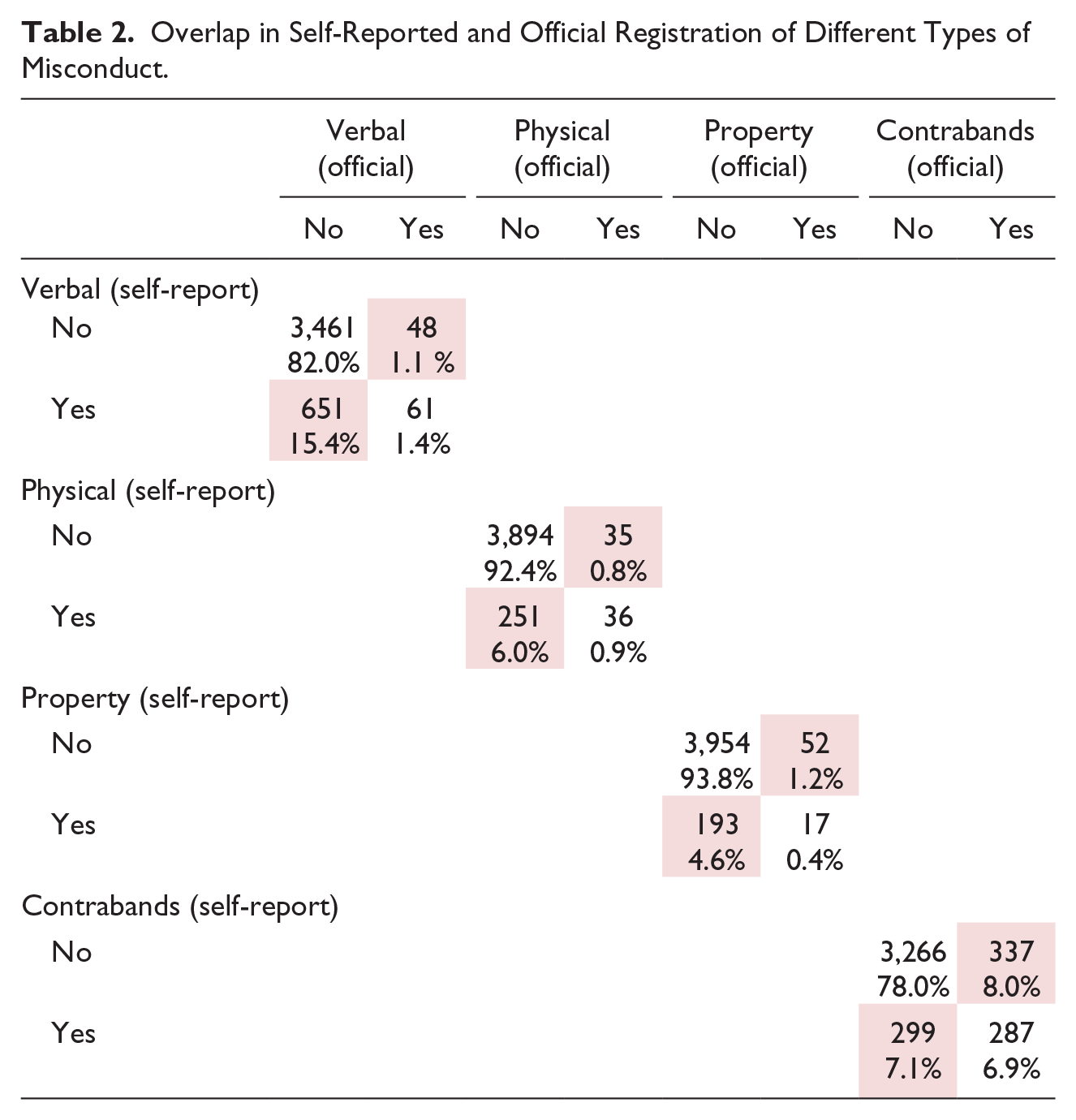
As it was shown in Table 1 that the proportion of reported misconduct differed considerably between self-reported and official registration data, it was examined if there were large discrepancies between these two sources of data. Table 2 shows the comparison between self-reported data and official registration of the four types of misconduct. As shown, the no-categories for the most part overlap. We do, however, also see that more misconduct was reported using self-report data, especially concerning verbal misconduct. For contraband-related misconduct, the discrepancies between self-report and registered data are the largest, with a lack in overlap in sources for about 15%.
Overlap in Self-Reported and Official Registration of Different Types of Misconduct.
Multilevel Analyses
Empty models
To analyze how prisoner- and unit-level characteristics contribute to the odds of displaying misconduct, we ran two multilevel logistic regression models: one for registered and one for self-reported misconduct. Before doing so, we ran an empty model for each to test the extent to which the odds of displaying misconduct varied between prison units. The ICC indicated that a significant amount of variance in misconduct could be attributed to unit differences. For registered misconduct, the ICC was .22 indicating that 22% of the variance in the odds of displaying misconduct lay between units (variance = 0.91, p < .001). For self-reported misconduct, this amount was smaller but still significant with an ICC of .05, indicating that 5% of the variance in the odds of displaying misconduct lay between units (variance = 0.19, p < .001).
Logistic regression models
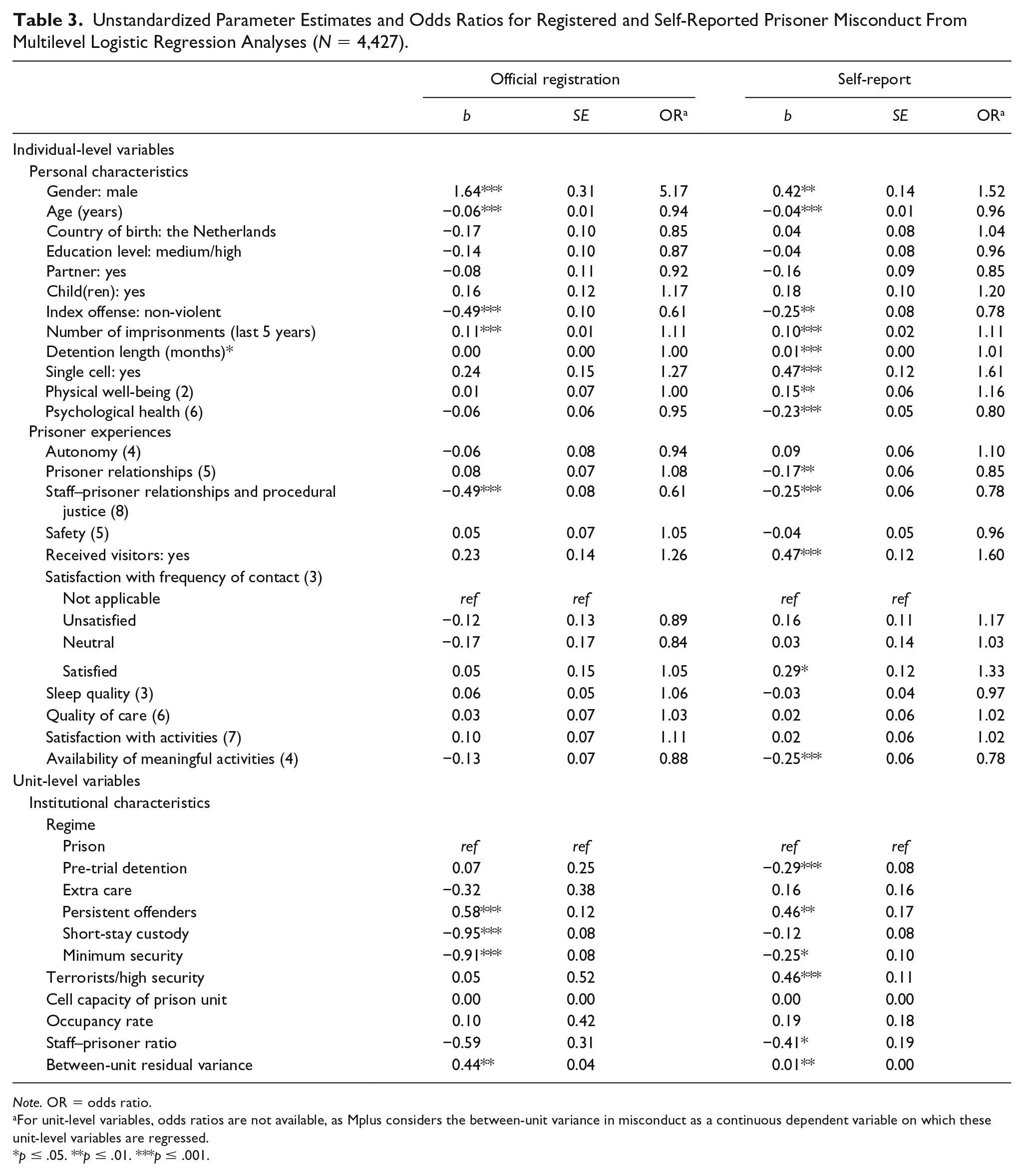
Results from the full multilevel logistic regression models containing all explanatory variables at the individual and the unit level are reported in Table 3, for registered and self-reported misconduct separately.
Unstandardized Parameter Estimates and Odds Ratios for Registered and Self-Reported Prisoner Misconduct From Multilevel Logistic Regression Analyses (N = 4,427).
Note. OR = odds ratio.
For unit-level variables, odds ratios are not available, as Mplus considers the between-unit variance in misconduct as a continuous dependent variable on which these unit-level variables are regressed.
p ≤ .05. **p ≤ .01. ***p ≤ .001.
With regard to prisoner characteristics, gender and age are shown to significantly correlate to both registered and self-reported misconduct. Males were more likely to have registered or reported misbehavior, compared with females, just as prisoners who were younger than average. Furthermore, index offense and prior imprisonment were also related to both registered and self-reported misconduct. Prisoners who were incarcerated for a violent offense were more likely to have registered or reported misconduct, just as offenders with more than average prior imprisonments. Other prisoner characteristics were only related to self-reported misconduct; higher than average detention length was related to increases in misconduct and offenders in a single cell reported more misconduct, compared with those detained in a double cell. Furthermore, an increased physical well-being was positively related to self-reported misconduct, while a higher reported psychological health decreased odds of self-reported misconduct.
With regard to our other variables included at the prisoner level, perceived prison climate, results showed that only one variable was related to both registered and self-reported misconduct. Prisoners with a more positive experience of staff–prisoner relationships and procedural justice were less likely to have registered or reported misbehavior, compared with those who had a lower than average experience. Other prison climate variables were only associated with self-reported misconduct. It was shown that a more positive experience of prisoner relationships, as well as a higher than average experience of availability of meaningful activities, was related to decreased numbers of self-reported misbehavior. On the contrary, prisoners who had received a visitor were more likely to have reported misconduct, and prisoners who were more satisfied with the frequency of contact with the outside had more often reported misbehavior, than those who had not been in contact.
With respect to the unit-level variables included, several regime differences were reported. First, compared with the prison regime, it was shown that imprisonment in persistent offender’s regimes was related to more registered as well as self-reported misbehavior, while imprisonment in minimum-security regimes was shown related to less registered and self-reported misconduct. Furthermore, prisoners in short-stay custody regimes had lower odds of being among those with a reported misconduct. And finally, two regimes only related to self-reported misconduct. Incarceration in pre-trial detention regimes decreased chances of self-reported misconduct, while prisoners in terrorists/high-security regimes had increased chances of self-reported misconduct. One final unit-level variable related to self-reported misconduct was staff–prisoner ratio. It was shown that more staff per prisoners decreased self-reported misconduct.
For both registered and self-reported misconduct, we observed a reduction in between-unit variance as compared with the null models, as would be expected after adding significant individual and unit-level variables to the model. For registered misconduct, the between-unit variance had decreased from 0.91 to 0.44 (52% reduction), and for self-reported misconduct, it decreased from 0.19 to 0.01 (94% reduction). Although our models explain a high amount of between-unit differences in the odds of displaying misconduct, the residual variances suggest there are still other explanatory unit-level variables that are currently not accounted for.
Multinomial regression model
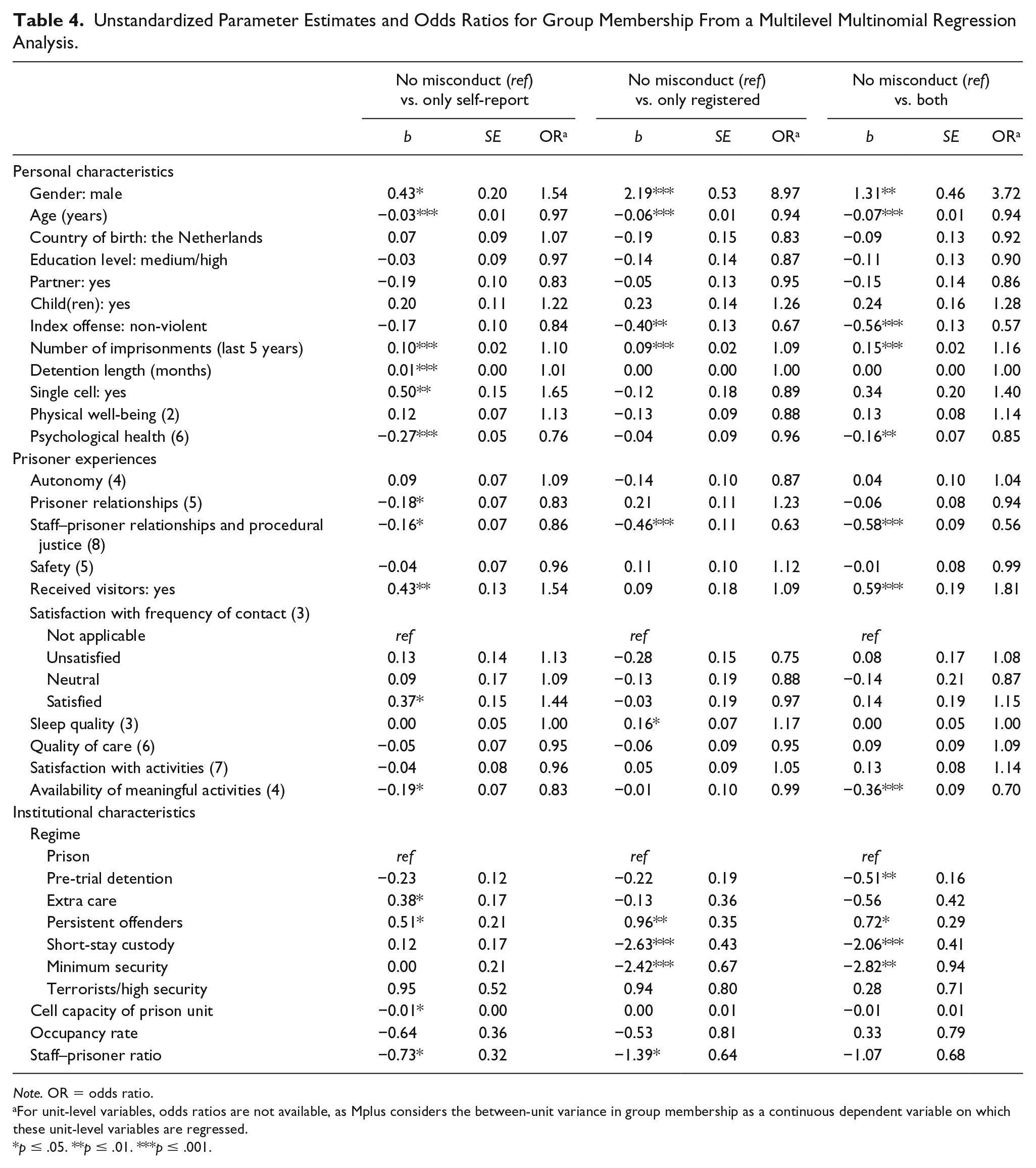
The above discussed results, presented in Table 3, contrasted the correlates of self-reported misconduct to officially registered misconduct. As shown in Table 2, there is to some extent overlap between the two misconduct measures, meaning that the effects presented in Table 3 may not be unique effects for self-reported and registered misconduct. In addition, the (lack of) overlap in the two types of misconduct measures suggests that four distinct groups can be identified, determined by self-reported misconduct no/yes, and registered misconduct no/yes. As a final step of our analyses and to better understand the (unique) correlates of registered and self-reported misconduct, we ran a multilevel multinomial regression analysis contrasting the no misconduct group with the only self-report, only registered, and both groups. The results of this model are reported in Table 4.
Unstandardized Parameter Estimates and Odds Ratios for Group Membership From a Multilevel Multinomial Regression Analysis.
Note. OR = odds ratio.
For unit-level variables, odds ratios are not available, as Mplus considers the between-unit variance in group membership as a continuous dependent variable on which these unit-level variables are regressed.
p ≤ .05. **p ≤ .01. ***p ≤ .001.
Overall, there is a high consistency in the prisoner characteristics that were significantly related to both self-reported and registered misconduct in the multinomial model and our previous analyses (namely, gender, age, and prior imprisonments). There are, however, a few exceptions. Index offense, which initially was significantly related to both self-reported and registered misconduct, was now only significantly related when contrasting prisoners who did not report any misconduct to those with registered misconduct, or both. This indicates that having committed a violent offense may not be uniquely associated to self-reported misconduct. Detention length and single cell use, which in previous analyses (Table 3) was shown to be significantly related to self-reported misconduct, also now only related to misconduct when comparing the group of prisoners that did not report any misconduct with those with self-reported misconduct. This implies that these variables were unique correlates of self-reported misconduct. Furthermore, the effect of physical well-being on self-reported misbehavior disappeared in a multinomial analysis, while psychological health was only significantly related when comparing the group of prisoners that did not report any misconduct with those with self-reported misconduct, or both. This indicates that psychological health was not uniquely correlated to registered misconduct.
Continuing to the individual prison climate experiences, while the effect of staff–prisoner relationships and procedural justice was consistent with our previous analyses, prisoner relationships was only significant when comparing the group of prisoners that did not report any misconduct with those with self-reported misconduct but whose misconduct was not registered. This also holds true for visitation, satisfaction with the frequency of contact, and the availability of meaningful activities, indicating that these variables uniquely correlated to self-reported misconduct. Finally, in contrast to the previous analyses, sleep quality now increased the odds of misconduct when comparing the group of prisoners with no misconduct with those that only had registered misconduct, but which was not self-reported.
Our final comparison is on the unit-level variables included in the models. As shown in Table 4, a number of regimes were significantly related to misconduct. For persistent offender- and short-stay custody regimes, their effect on misconduct was similar to that found in our multilevel logistic regression analyses. An effect of a pre-trial detention regime was, however, only found when comparing the prisoners who had no misconduct with those who both self-reported and had registered misconduct. The minimum-security unit, significant for registered and self-reported misconduct in Table 3, now only related to misconduct when comparing offenders who had a received a registered report of misconduct (but who did not self-report) and had self-reported and registered misconduct, versus those had neither. One final regime type, extra care units, was not significantly related in previous analyses, but now correlated positively to misconduct when comparing a group of only self-reporters with those who had not committed any misconduct.
Our multinomial regression models indicated a pattern of results that is highly similar to the logistic regression analyses presented earlier. Overall, the variables included in this study were mostly significantly related to self-reported misconduct, rather than registered misconduct.
Discussion
As misconduct poses a great risk to safety, and the well-being of staff members and other prisoners, correctional administrations strive toward maintaining order. Knowledge on the determinants of prisoner misconduct is therefore of great importance. Although there are countless studies that have examined prisoner misconduct, there is also a large gap in knowledge. First, the relative influence of prison climate as experienced by the individual prisoner was rarely tested against offender misconduct. And second, prisoner misconduct was often measured using official data or (in fewer cases) self-report data. The aim of the current study was to overcome these issues, by examining the relationship between prison climate and prisoner misconduct, using both self-report and official misconduct data. We used a dataset from the Dutch LIC study, a nationwide study designed to measure the quality of life in Dutch prisons. Multi-level analytic strategies were applied to properly account for the clustered nature of our data.
Prison Climate and Misconduct
With respect to the first aim of this study, assessing the extent to which individual characteristics and perceived prison climate were related to misconduct, it was shown that prisoners’ characteristics (male, younger age, violent index offense, and more prior imprisonments) were positively related to both self-reported and registered misconduct, while other variables (longer detention length, singe-cell use, increased physical well-being, and decreased psychological health) were related only to increases in self-reported misconduct. Some of these might sound counterintuitive, such as single cell use and physical health, but it perhaps makes sense that offenders who have more opportunity for misconduct (those who are alone in their cell and are physically fit) are more involved in deviant behavior during imprisonment. In addition, it might reveal a selection effect where those prisoners who display misconduct are detained in single cells and not in shared cells.
Compared with these personal factors, a smaller number of prison climate indicators were related to misconduct. Better perceived quality of staff–prisoner relationships were related to lower self-reported and registered misconduct, while others (better perceived prisoner relationships, and availability of meaningful activities) were again only related to lower self-reported misconduct. Visitation and contact were related to higher self-reported misconduct. Furthermore, it was shown that of the unit-level variables included, regime type was related to both types of misconduct outcomes, with harsher regimes (such as the persistent offender- and terrorist-units) relating to higher levels of misconduct. And finally, it was found that higher staff–prisoner ratios on the unit were related to lower self-reported misconduct. When studying the combined and unique effects of these variables on self-reported and registered misconduct, in a multilevel multinomial regression analysis, the results presented were mostly comparable and consistent with the separate logistic analyses. It appeared that variables related to self-reported misconduct were specifically linked to the group of offenders that reported misconduct, but whose misconduct was not registered and penalized. As such, these variables could be labeled as unique correlates of self-reported misconduct.
This study has thus shown, in line with many previous studies (e.g., Bottoms, 1999; Goodstein & Wright, 1989; Steiner et al., 2014; Wooldredge, 1991; Wright, 1991), the importance of import characteristics in explaining misconduct. Examples of such characteristics are not only age, the influence of which has been consistently demonstrated in previous research (e.g., Morris et al., 2012; Tewksbury, Connor, & Denney, 2014) with younger prisoners engaging in more misconduct than older prisoners, but also gender and criminal history. This study has also demonstrated the importance of the deprivation model in two ways. First, it was found that regime, an important indicator of physical deprivation, was related to misconduct. This is in line with a great number of studies that found that the level of security was related to misconduct (e.g., Camp et al., 2003; Craddock, 1996; Jiang & Fisher-Giorlando, 2002; R. C. McCorkle et al., 1995; Sieverdes & Bartollas, 1986; Steinke, 1991). Second, this study revealed that social deprivation can be associated with misconduct. This was, for example, shown because staff–prisoner relationships and experiences with a procedural just treatment by staff was associated to misconduct. This is consistent with studies that have focused on the influence of respectful and fair treatment by staff (e.g., Beijersbergen et al., 2015; Reisig & Mesko, 2009), and visitation (e.g., Cochran, 2012; Hensley et al., 2002; Jiang & Winfree, 2006; Lahm, 2008). Another social aspect of deprivation that was shown important in the current study was visitation and contact with the outside world, which increased the odds of displaying misconduct. This may be because contact with the outside, either in person or trough phone, could not only enhance experiences of deprivation but could also be explained by the fact that visitors may be used to traffic contrabands. This finding is, however, not in line with studies that demonstrated that visitation reduces misconduct (e.g., Cochran, 2012; Hensley et al., 2002; Jiang & Winfree, 2006; Lahm, 2008; Mears, Cochran, Siennick, & Bales, 2012). Consequently, adding prison climate variables, especially those relating to the social deprivations experienced during imprisonment (such as experiences with staff members, other prisoners, and people on the outside), is highly important when studying prisoner misconduct.
Self-Reported Versus Registered Misconduct
Quite uniquely, this study had access to two sources of misconduct data—self-reported misconduct and official registration of misconduct—both collected over the period of 2 months prior to data collection. Because of this great advantage, this study could make a comparison between both data sources. The results presented in this study first of all have shown that both self-reported and registered data of misconduct reveal low incidence rates, especially when comparing those with the incidence rates reported in other studies (e.g., Cunningham & Sorensen, 2006, 2007; Wooldredge, Griffin, & Pratt, 2001). Second, this study has demonstrated that the proportion of reported misconduct differed considerably between self-reported and official registration data. This is important because many studies use either data source. In general, it appears that verbal misconduct is underreported in official data, which is perhaps reasonable as it can be difficult to establish and penalize, and may also be more dependent on the norms and leniency of the individual staff member. The discrepancies between self-reported and officially registered misconduct with respect to contrabands were also rather large, perhaps because this type of misconduct has the highest prevalence and because it can be relatively invisible. Moreover, this study had the unique ability to eliminate overlap in self-reported and registered misconduct, examining the unique effects of prisoner and prison characteristic for either type of misconduct. It was demonstrated that within the selection of import and deprivation factors included, most of the variables were uniquely related to self-reported misconduct.
In addition, when comparing both measures using multilevel techniques, this study demonstrated that there was more variance to be explained at the unit level for registered than for self-reported misconduct. It may, therefore, be concluded that accounting for the nested structure of data and adding unit-level variables may be most relevant when using registered data (and bigger problems may occur if one does not do so). The higher between-unit-level variance that was found for officially registered misconduct can be in part the result of the staff working those units (and who are responsible for the existence of these official records, and have a certain discretionary power in interpreting and reporting the misconduct they encounter). Furthermore, this study demonstrated that there was more individual-level variance for self-reported misconduct. Importantly, this appears to imply that registered misconduct partly reflects enforcement strategies.
In conclusion, many studies conducted use either self-reported or (most often) registered misconduct data. It is recognized that official registration data may underestimate prisoner misconduct (Hewitt et al., 1984; Steiner & Wooldredge, 2014). This study certainly confirms that, and also shows that registration data may be (more than self-reported data) influenced by unit-level factors, such as regime characteristics. This means that studies using registered data should properly control for unit-level influences. Self-reported data also has certain flaws, such as underrepresentation of certain offenses (Steiner & Wooldredge, 2014). This study indicated that this is particularly the case with contraband-related misconduct: the possession of prohibited goods such as weapons or drugs. Studies relying on self-reported data should take this into account when interpreting study findings. This study, however, also indicated that self-reported misconduct, which had more unexplained variance at the individual level than registered, is perhaps a better measure to shed light on the potential individual predictors of misconduct. However, if all variables in a study are self-reported, there is chance of inflated correlations due to shared method bias.
Study Limitations and Strengths
The current study examined the relationship between prison climate and prisoner misconduct, using self-report and official misconduct data. Although it represented a major advancement on previous work, there are some limitations that are worthy to be mentioned and that deserve attention in future research.
A first shortcoming is the fact that perceived prison climate and self-reported misconduct were gathered at the same time and were reported by the same person. This is problematic, as it may have caused shared method bias (inflated correlations because both types of variables were reported by the same person) and because it is not clear if prisoner misconduct was influenced by prison climate or that a negatively perceived prison climate was caused by deviant behavior. As this study could also make use of registered misconduct, the first concern (shared method bias) may be ruled out, but the latter concern cannot be completely disregarded. A second limitation that may have hampered the current results was the fact that this study could not, because of low incident rates of self-reported and registered misconduct, differentiate between the different types of misconduct reported. It may be the case that some independent variables may be related to violent misconduct, but not to verbal misconduct, while previous work has made clear that this may in fact be the case (e.g., Steiner & Wooldredge, 2008).
Study Implications for Policy and Practice
This study has shed some light on the relatively understudied relation between perceived prison climate and prisoner misconduct, and the importance of knowing the pitfalls of dealing with self-reported or registered misconduct data. There are, however, also a number of policy recommendations that can be made based on the current study’s results. First of all, the results indicate that a certain group of offenders, younger males with an extensive criminal record who have committed a violent crime, may be more at risk for prisoner misconduct. Programming may be put in place, combined with more extensive security measures, to make sure that this group does not misbehave in prison. Second, this study has indicated that prison climate, the social, emotional, organizational, and physical characteristics of a correctional institution as perceived by inmates and staff (Ross et al., 2008), is related to prisoner misconduct. It is therefore of great importance to focus on maintaining a positive prison environment, for example, reflected in good staff–prisoner relationship and a procedurally just treatment by prison staff. And finally, it is important to know that misconduct varies between different prison regimes. Perhaps some regimes (rather strict regimes), in which a larger group of higher risk prisoners are detained, can cause higher misconduct rates. Again, this can be reason for implementing specific programs, aimed at decreasing the risk of prisoner misconduct.
Footnotes
Acknowledgements
The Life in Custody study was funded by the Dutch Custodial Institutions Agency (DJI) and Leiden University. The opinions, findings, and conclusions expressed in this article are those of the authors and do not necessarily reflect those of the DJI. The authors wish to thank the DJI for their support with the administration of the survey.
Declaration of Conflicting Interests
The author(s) declared no potential conflicts of interest with respect to the research, authorship, and/or publication of this article.
Funding
The author(s) received no financial support for the research, authorship, and/or publication of this article.
