




Abstract
Previous research suggests that participation in victim–offender mediation (VOM) can lower the risk of reoffending. However, no randomized controlled trials have been done to examine this effect of VOM. Given that participation in VOM is voluntary, previous studies likely suffer from self-selection bias. To address this bias, we compared reoffending rates of three different offender groups: offenders who participated in VOM; offenders who were willing to participate, but whose counterpart declined VOM; and offenders unwilling to participate (total N = 1,275). Results replicated that participation in VOM predicts lower reoffending rates and suggested that this effect is not solely due to a self-selection bias. Suggestions are made for future research to examine why VOM causes lower reoffending rates.
Introduction
Recidivism has a central place in research into the effects of restorative justice. One explanation for this is the growing application of restorative justice within the criminal justice system. Nowadays, restorative justice is not only used in addition to the criminal justice system but it can also be part of it (Claessen, Zeles, Zebel, & Nelen, 2015a; Kennedy, Tuliao, Flower, Tibbs, & McChargue, 2018). For example, instead of a case directly going to court or dealt with by a criminal prosecutor, victim and offender more often get the opportunity to set things right themselves and together decide how the crime can be solved (Claessen et al., 2015a). This can be done, among other things, through a constructive dialogue in presence of a trained mediator (Umbreit, Coates, & Vos, 2004), often known as victim–offender mediation (VOM), family group conferencing, and/or peacemaking circles (Bradshaw & Roseborough, 2005).
In their response to crime, it is of great value for governments and society to do this in such a way that it lowers the risk of reoffending and therefore heightens public safety. It is therefore important to examine the effects of different responses to crime. If it would turn out that using restorative justice does not decrease recidivism rates, governments might decide to not use it as a response to crime within the criminal justice system, but complementary to it. However, important to note is that reducing reoffending is not the aim of restorative justice, but an additional positive outcome (Walgrave, 2006). Even when restorative justice does not lower the risk of reoffending, it has other positive psychological outcomes for both victims and offenders (Sherman et al., 2005; Zebel, 2012).
Different scholars have already concluded that offenders who participated in restorative justice programs have a lower chance to reoffend compared with offenders who do not participate in such programs and undergo the traditional justice procedure and sanction (Claessen et al., 2015a; Claessen, Zeles, Zebel, & Nelen, 2015b; Jackson & Bonacker, 2006; Kennedy et al., 2018; Latimer, Dowden, & Muise, 2005; Sherman, Strang, Barnes, et al., 2015; Sherman, Strang, Mayo-Wilson, Woods, & Ariel, 2015). A meta-analysis of Sherman, Strang, Mayo-Wilson, Woods and Ariel (2015) of randomized controlled trials (RCTs) showed that offenders participating in restorative justice conferences have a lower risk of reoffending. However, such conferences differ from VOM in terms of inclusivity. Within conferencing, the victim, offender, and others from their community participate in the dialogue and are actively involved to come to an agreement about ways to repair the harm caused and prevent future harm between parties. In VOM, this dialogue and deliberations about reparation and prevention are confined to the victim and offender, without the community present (Bradshaw & Roseborough, 2005).
Importantly, to our knowledge, no RCTs have been done to examine the effects of VOM on reoffending. This means that after years of research the question remains whether its effects on reoffending are due to the restorative nature or to a self-selection bias, as participation in VOM is voluntary (Bradshaw & Roseborough, 2005; Latimer et al., 2005; McCold & Wachtel, 1998). This implies that offenders who are willing to participate might differ from offenders who are not. This first group might already have a (higher) motivation to desist from crime and might be more inclined to show remorse and apologize (Fellegi, 2008; Lauwaert & Aertsen, 2016). In turn, these preexisting differences might account for the beneficial effects of VOM on recidivism to date. We therefore examined in the current study to what extent the effects of VOM on recidivism are due to a self-selection bias or might be due to the VOM process itself. That is, we investigated whether offenders who were not willing to participate in VOM had a higher chance to reoffend, compared to offenders who were and actually participated as well as to offenders who were willing to participate but were not able to because the other party declined the option of VOM.
VOM
Although the conventional criminal justice system is not the opposite of restorative justice, it is often compared with each other (Zehr, 2015). In conventional justice, when responding to a crime, the main parties actively involved in this process are state and offender. 1 The victim has no or a more passive role in this type of justice (Claessen, 2017; Dhami, 2012; Zehr, 2015). The focus in this system is on determining who the offender is, whether she or he committed the punishable, charged fact(s) and what punishment fits the criminal offense (Zehr, 2015), with the aim of preventing reoffending (Garland, 2001; Muller, Van der Leun, Moerings, & Van Calster, 2010), retribution, and risk reduction (Garland, 2001). Given this offender focus, in recent decades several measures have been taken and instruments have been developed to strengthen victims’ position in the criminal justice system of many countries (Groenhuijsen & Letschert, 2008). One example of this is victims’ right to deliver a victim impact statement (VIS) during a court hearing, which may serve as an expressive function for victims as well as to influence the sentencing of the offender (Lens Pemberton & Bogaerts, 2013). However, such VISs do not allow victim and offender to resolve the harm done and restore relationships between them, as they are set up as a monologue of the victim to explain the impact of the crime.
Restorative justice, on the contrary, views crime as a violation of the relationship between people, which concerns both victim and offender, but also broader society (Wong, Bouchard, Gravel, Bouchard, & Morselli, 2016; Zehr, 2015). The active participation of the direct involved parties—most often victim and offender—in resolving the crime is considered essential for justice to be done (Bohmert, Duwe, & Hipple, 2018; Bradshaw & Roseborough, 2005; Claessen, 2017; Umbreit et al., 2004; Zehr, 2015). It focuses on the harm that has been inflicted and the needs the involved parties have, as well as its aim is to put things as right as possible. This is done by heightening responsibility taking and victim empathy among offenders and contributing to the healing process of victims (Claessen, 2017; Zehr, 2015). It is often a dialogue-driven process, in which victims have the opportunity to ask questions, offenders can make amends, and both can explain the impact of the crime to each other. Importantly, it is also a voluntary process; forcing offenders and victims to participate in restorative justice is considered counterproductive (e.g., Choi, Gilbert, & Green, 2013). A successful conversation between victim and offender in these types of programs might result in a decision of the criminal prosecutor to drop the case and withdraw from giving any further punishment (Wong et al., 2016). Internationally, jurisdictions differ with regard to the possibilities to apply restorative justice modalities and the legal consequences of these applications (Hansen & Umbreit, 2018). The findings that are presented in this article are based on research that has been conducted in the Netherlands. In this country, the public prosecutor mostly takes the outcome agreements made between victim and offender during VOM in consideration in deciding which punishment (if any) needs to be imposed (Claessen et al., 2015a; Lens Pemberton & Cleven, 2015).
VOM is an example of a restorative justice program. Within VOM, victim and offender communicate with each other, in the presence of a trained mediator (Bradshaw & Roseborough, 2005; Umbreit et al., 2004). In advance to a face-to-face meeting between victim and offender, the mediator prepares each party through an individual conversation. Most often VOM ends with a (written) agreement, but this is considered inferior to the conversation itself between victim and offender (Umbreit et al., 2004). In addition to a direct face-to-face conversation, other indirect forms of communication are also used in VOM (Bouffard, Cooper, & Bergseth, 2017; Zebel, 2012). For example, letter exchange enables victim and offender to write their questions and answers down on paper, which the mediator then delivers to the corresponding party. Another common indirect modality concerns shuttle mediation, in which the mediator orally communicates the message from one party to the other (Sherman et al., 2007). Both options enable victim and offender to communicate, without having to meet each other.
Effects of Restorative Justice Programs
Restorative justice has proven to elicit positive outcomes for both victims and offenders. Research shows that victims who participated in restorative justice report lower feelings of fear and anger afterward (Lens Pemberton & Cleven, 2015; Umbreit, Coates, & Roberts, 2000; Zebel, 2012). This is in accordance with the aim of restorative justice to be a process that fosters healing (Presser & Van Voorhis, 2002). Importantly, however, research shows that restorative justice is not healing for every victim. For example, Daly (2006) showed that victims who experienced high to moderate levels of distress after the offense remained angrier and more fearful of the offender after a restorative conference, compared to victims who experienced weaker feelings of distress after the crime.
Research also indicates consistent higher satisfaction rates among both victims and offenders who participated in a restorative justice process compared to victims and offenders whose cases were dealt within the conventional criminal justice system, without restorative justice (Boriboonthana & Sangbuangamlum, 2013; Latimer et al., 2005; Sherman et al., 2007; Umbreit et al., 2000). Both parties also experience restorative justice processes to be fairer and more just, as they have a say in the outcome and feel heard more (i.e., heightened procedural justice; Boriboonthana & Sangbuangamlum, 2013; Hayes & Daly, 2003; Miller & Hefner, 2015; Umbreit et al., 2000; Van Camp & Wemmers, 2013). As procedural justice is also related to a lower risk of reoffending (Tyler, Sherman, Strang, Barnes, & Woods, 2007), in this way restorative justice might achieve a lower risk of reoffending compared to the conventional justice system.
Different scholars also concluded that restorative justice programs are related to a lower risk of reoffending (e.g., Bradshaw & Roseborough, 2005; Claessen et al., 2015a; Sherman, Strang, Mayo-Wilson, et al., 2015). Although it is out of scope for this article to examine how participation in a restorative justice program can lower the risk of reoffending, different ideas exist on what the working elements of restorative justice could be. One of these proposed elements is the non-stigmatizing atmosphere of a restorative justice encounter (Bernburg & Krohn, 2003). Instead of labeling the offender as a criminal outcast, which is argued to occur often within contemporary justice systems (Miethe, Lu, & Reese, 2000), restorative justice focuses on reintegrating the offender back into the community (Braithwaite, 1989). Harris, Walgrave, and Braithwaite (2004) argue that when an offender experiences guilt, it is inevitable that he also experiences feelings of shame. It is important to help the offender deal with these feelings of shame, by emphasizing the positive characteristics of the offender. This so called reintegrative shaming is often considered central to restorative justice and the lower risk of reoffending that may emerge afterward (Bernburg & Krohn, 2003; Braithwaite, 1989; Shapland et al., 2008). Collins (as cited in Rossner, 2008), on the contrary, explains that the effect of restorative justice on reoffending is due to the emotional connection between victim and offender. Through the emotional atmosphere within a restorative justice interaction, attendees get entrained and in sync with each other on an emotional level, which heightens shared group emotions and solidarity. Collins argues that these shared emotions and solidarity explain a lowered risk of reoffending. Another aspect that can be related to a lower risk of reoffending is discussing the rules that have been broken, the norms that have been violated, and the harm that has been done, within a restorative justice program (Walgrave, 2001). Through this discussion the offender might grow on a moral level, and this might help prevent him or her to reoffend in the future (Fellegi, 2008). Restorative justice also enables the victim to explain the consequences of the crime and how it impacted his or her life to the offender (Umbreit et al., 2004). This might heighten the ability to take perspective and feelings of empathy for the offender (Lauwaert & Aertsen, 2016), which in turn elicits pro-social behavior (Leith & Baumeister, 1998; Martinez, Stuewig, & Tangney, 2014; Zebel, Doosje, & Spears, 2009) and therefore lowers the chance that someone reoffends.
However, concerning the observed effects of various restorative programs on reoffending, mixed results exist (Suzuki & Wood, 2017). For example, in an extensive evaluation of three restorative justice programs in England and Wales, Shapland et al. (2008) observed no differences in the prevalence of recidivism between offenders who did and did not participate in these programs, but only found a decrease in the frequency of reoffenses an offender committed after VOM. Other scholars concluded that offenders who participated in a restorative program had a lower chance to reoffend compared with offenders whose cases were solved without restorative justice (Claessen et al., 2015a; Kennedy et al., 2018; Sherman, Strang, Mayo-Wilson, et al., 2015). A very strong conclusion came from a meta-analysis of 10 different RCTs of Sherman, Strang, Mayo-Wilson, Woods and Ariel (2015), in which they found that overall, participation in conferencing caused a significant reduction in reoffending among offenders who were compared with offenders who did not participate. However, within conferencing not only victim and offender are involved but also the community actively takes part in the restorative process (Bradshaw & Roseborough, 2005). The conferencing coordinator has to make sure that the representation of the community should also include people who see the good in the offender, so that the person and the violent act can be separated from each other, which heightens the chance on reintegration back into the community (Umbreit & Stacey, 1996), through reintegrative shaming. Therefore, the dynamics in conferencing and VOM might differ, as well as the chance of getting the process of reintegrative shaming in motion. This means that results from studies into the effects of conferencing are not directly generalizable to VOM.
Bradshaw and Roseborough (2005) did perform a meta-analysis of fifteen studies and found that offenders participating in VOM had a lower chance to reoffend. These studies were however not set up as RCTs. To our knowledge, no RCT has been performed to date to examine the effects of VOM on reoffending. Therefore, the problem with most of the research into the effects of VOM on reoffending is that it lacks random assignment and a valid control condition (Latimer et al., 2005). Due to ethical reasons and the voluntariness of VOM, random assignment to experimental and control conditions is often not feasible nor desirable. For example, Stewart et al. (2018) concluded that the effect of VOM found on reoffending should be interpreted with some caution, as the control group consisted of offenders who were not willing to participate. In fact, many studies suffer from this potential bias (Latimer et al., 2005; McCold & Wachtel, 1998; Villanueva, Jara, & García-Gomis, 2014). In return, this raises the question to what degree the effects found on reoffending are due to the VOM process itself or to preexisting differences between offenders. As restorative justice becomes a more important subject within conventional criminal justice systems (Claessen et al., 2015a), it is important to examine in a systematic way whether participation in mediation can reduce the risk of reoffending and to what extent a self-selection bias explains this reduction.
This Research
This research is a follow-up of the study that Claessen and colleagues (2015a) conducted (only available in Dutch). In their research, they showed that offenders who participated in VOM—in both direct (face-to-face meeting), indirect (letter exchange or shuttle mediation), and semiforms 2 of mediation—had a lower risk to reoffend compared with offenders who did not participate in VOM. However, as in other previous VOM studies, they did not differentiate in their control group between offenders who did not want to participate in VOM and offenders who were willing but not able to participate, because the other party declined. Hence, their findings may also be confounded with a self-selection bias. In the current study, we attempt to test and eliminate this bias by differentiating between these aforementioned groups and doing in-depth, secondary analyses on their dataset.
In this study, we aim at involving a valid control group, to rule out the alternative explanation that self-selection biases underlie the reduced rates of reoffending observed after participation in VOM. We examined four different groups of offenders for this purpose. The first group consists of offenders who participated in direct or indirect forms of VOM (mediation group). The second group concerned offenders who participated in semi-mediation (semi-mediation group). Offenders who were not willing to participate in VOM, and therefore had their case dealt with by a criminal prosecutor or through a court hearing, are part of the third group (court group). The last group consisted of offenders who were willing to participate in VOM, but for whom VOM did not take place, because the other party declined (control group) and whose case was thus dealt with in the same way as the court group.
A lower predicted risk of reoffending for the (semi-)mediation group compared with the control group would point in the direction of a positive effect of the mediation process itself on reoffending, as the offenders in these three groups are all willing to participate and therefore likely to be similar in terms of preexisting factors that promote participation. A difference in reoffending risks between these groups would probably be due to the way their case was handled: through the conventional criminal justice system only or through mediation. This would confirm the claims of foregoing research that participation in mediation can reduce the risk of reoffending. In contrast, the self-selection bias is confirmed when the risk of reoffending is similar for the control group and (semi-)mediation group, but higher for the court group. In the analyses, it will be controlled for the demographic and offender-related variables.
Method
Cases
The focus of this research is a VOM program in the south of the Netherlands (Limburg). The cases involved were assigned to VOM as part of the criminal justice system. This means that the criminal prosecutor decided if a case was suitable for VOM, before she or he finalized the case or before the case went to court. When victim and offender reached an agreement through VOM and the criminal prosecutor agreed with this outcome, most often the case was dismissed, sometimes upon the condition that the offender fulfills the agreements made. However, when one of the parties declines the opportunity for mediation and no mediation occurred or VOM was unsuccessful, the case was solved through the normal criminal justice procedure.
In this study, we analyzed 1,314 criminal cases in which mediation was offered between 2000 and 2010. 3 Thirty-nine cases were excluded from the data-analysis, because it was unclear whether these cases belonged to the (semi-)mediation group, court group, or control group. This left 1,275 cases suitable for further analysis. The recidivism data collected covered the period from the date the criminal case was first entered in the judicial data system until July 2014. This means that the period at risk for offenders varied between 3.5 and 13.5 years.
Mediation, Semi-Mediation, Court, and Control Group
In 981 of these 1,275 cases, a mediation process started of which 924 were successful. 4 Claessen et al. (2015a) differentiated between three different kinds of mediation. The first one was direct mediation (336 successful cases), which consisted of a face-to-face conversation between victim and offender, in presence of a trained mediator. The outcome of this kind of mediation was either a written agreement, an oral agreement, or no agreement when parties agreed that no further arrangements were necessary from their perspective. The second option for mediation was indirect mediation (297 successful cases), which consisted of either letter exchange or shuttle mediation and yielded the same outcome as direct mediation. The last type of mediation was semi-mediation (291 successful cases). In this type of mediation, the offender had a conversation with the prosecutor and the mediator. There was no victim present, because the victim was either unwilling to participate (but agreed that the prosecutor and mediator would have a mediation session with the offender) or it concerned a victimless offense.
In the current study, we recategorized these three “mediated contact” groups Claessen et al. (2015a) differentiated into two: the mediation group with cases that were solved through direct and indirect forms of mediation between victims and offenders and the semi-mediation group. The reason why we chose not to analyze all mediated contact cases as one treatment group was that semi-mediation fundamentally differed from (in)direct forms of mediation. In semi-mediation, there was no communication between victim and offender and therefore the relationship and inflicted harm between these parties could not be restored or resolved directly by the parties itself, which is one of the key aims of mediation. 5 This restoration of the relationship and atonement between victim and offender themselves was possible within both direct and indirect forms of mediation. We therefore clustered these direct and indirect mediation cases as one mediation group and kept the semi-mediation apart. 6 The mediation group consisted of 633 cases, and the semi-mediation group consisted of 291 cases.
In total, there were 145 cases in which the offender was willing to participate in mediation, but the victim declined the option. This constituted the control group. The court group consisted of cases in which the offender was not willing to participate in mediation. As can be seen in Table 1, the amount of cases in the court group was 206.
Amount of Cases Per Offender Group.
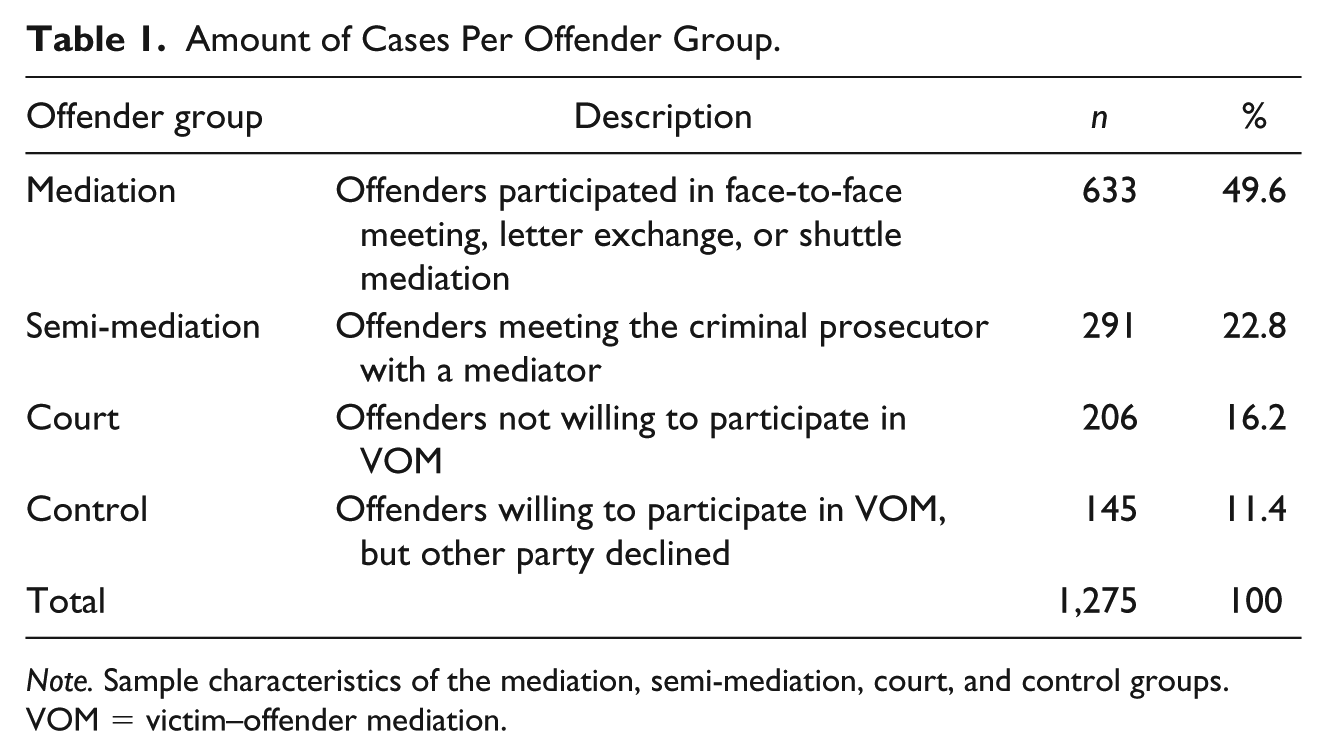
Note. Sample characteristics of the mediation, semi-mediation, court, and control groups. VOM = victim–offender mediation.
The criminal cases examined contained demographic and judicial information related to the offender (Claessen et al., 2015a). To detect a priori differences between the four offender groups, we used this information to compare the four groups. There were no significant differences between the four offender groups in gender, χ2(3, N = 1275) = 2.53, p = .471. In this sample, 1,030 cases (80.78%) concerned a male offender.
The mean age of the offender at registration of the case in which mediation was offered was 36 years (SD = 13.97; range = 13-79 years). No significant differences emerged in age between the four offender groups when the case was assigned to VOM, F(3, 1253) = 1.43, p = .233. In addition, no significant differences were found between the four offender groups in age on which they experienced their first criminal case, F(3, 1274) = 2.45, p = .062, M = 29, SD = 13.74.
Most offenders were born in the Netherlands (n = 1,097, 86.04%). A minority of offenders (n = 92, 7.22%) came from other Western countries. Other birth countries were Morocco, former Netherlands Antilles, Suriname, Turkey, and other non-Western countries (n = 96, 7.53%). No significant differences were detected in country of birth between the offender groups, χ2(18, N = 1275) = 14.93, p = .667.
We checked whether any differences existed between the offender groups in terms of the number of previous contacts with the criminal justice system \(criminal record). A previous contact indicates that there has been a notation from another criminal case of the offender in the judicial data system. Analysis showed that there were no significant differences in the number of previous contacts between groups, F(3, 1275) = 2.46, p = .061. The number of previous contacts varied between 0 and 52 (M = 2.77).
There were however significant differences in the type of offenses between the four offender groups, χ2(9, N = 1275) = 23.08, p = .006. Post hoc comparisons revealed that the mediation group consisted of relatively more violent offenses than the other groups. Offenses concerning vandalism, minor aggression, and disturbances of the public order were less common in the mediation group and more common in the court group than in the other groups.
In sum, the four offender groups showed few a priori differences in terms of gender, age, age of first contact with the criminal justice system, country of birth, and criminal record. That said, the mediation group consisted of relatively more violent offenses and less cases concerning vandalism, minor aggression, and disturbances of the public order and the court group consisted of relatively more cases concerning vandalism, minor aggression, and disturbances of the public order.
Data were retrieved through the Recidivism Monitor (RM) of the Research and Documentation Centre of the Ministry of Justice and Security in the Netherlands (Wartna, Blom, & Tollenaar, 2011). This Center has access to the national judicial database, which contains information about all criminal cases in the Netherlands since 1996. Based on the criminal case number and personal data about offenders in our data set, the RM identified cases that matched these offenders, if present in the judicial database. After this matching procedure, the RM provided us with an enriched dataset containing these criminal cases and variables that enabled us to analyze the prevalence of reoffending of the offenders (Wartna et al., 2011). To protect the privacy of the offenders in the enriched dataset, the RM has stipulated explicit conditions and regulations for researchers to be granted permission to analyze data such as those described here (see Wartna et al., 2011). The co-authors of this article fulfilled these conditions and regulations when writing the article in 2015 (Claessen et al., 2015a). The first author of this article only worked with the anonymous dataset in which no personal data of offenders were documented. In the current sample, the general prevalence of reoffending across the complete time at risk period was 35% (441 of 1,275 offenders).
Results
Differences in Prevalence of Recidivism
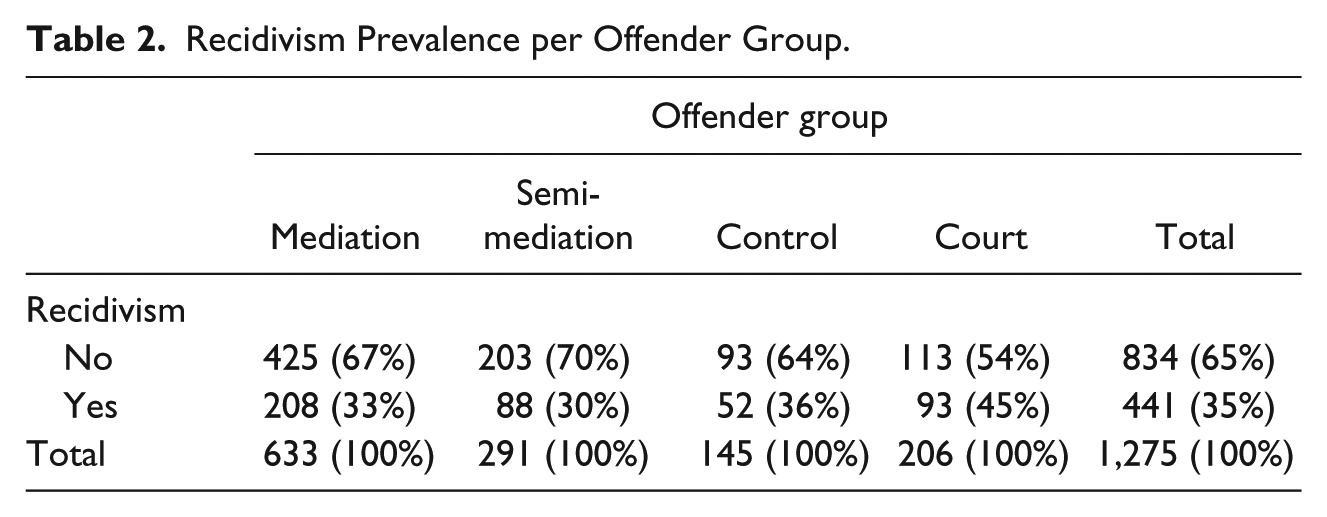
A logistic regression analysis was conducted with offender group as single predictor, to examine if there were any significant differences in the prevalence of reoffending between the four offender groups (Table 2). The analysis showed that there was an overall significant effect of offender group, exp(B) = .53, p < .005. Further analyses revealed that the court group had a significant higher chance to reoffend compared with the mediation group, exp(B) = 1.68, p = .001, and the semi-mediation group, exp(B) = 1.90, p = .001, but not to the control group, exp(B) = 1.47, p = .083. No other significant differences emerged between the groups (all ps > .20). This suggests that offenders who are not willing to participate in mediation have a higher risk to reoffend compared with offenders who participated in (semi-)mediation, but not compared to the control group of offenders who were willing but did not participate in VOM. Furthermore, offenders in the control group did not differ significantly from the mediation groups, which indicates that offenders who were willing but unable to participate in VOM occupied an intermediate position between the court and (semi-)mediation groups in terms of their prevalence rate of reoffending.
Recidivism Prevalence per Offender Group.
Controlling for the Time at Risk
As the time at risk varied between 3.5 and 13.5 years, it is possible that the above differences in prevalence rates between the four offender groups were due to differences in the time at risk between the groups. If offenders in the court group were longer at risk than the other groups, offenders in this group also had more time and therefore more opportunities to reoffend and perhaps therefore show a higher prevalence rate. We examined the influence of this time at risk variation by using a Cox survival analysis. In this analysis the time at risk—which was the period from the moment the case was entered in the judicial data until the registered date of a next offense in a new criminal case (or in case of no reoffending, time to the end of the observation period)—was set as time indicator. Whether or not someone reoffended was used as the status variable. The four offender groups were entered as the sole predictor.
The Cox survival analysis showed that adding the offender groups predictor resulted in a significant improvement of the model compared to a model without predictors, χ2(3, N = 1275) = 13.56, p = .004. When examining the differences between the groups in more detail, the analysis showed that the court group still stood out. This group had a significantly higher risk to reoffend compared to the mediation group, exp(B) = 1.54, p = .001, and the semi-mediation group, exp(B) = 1.65, p = .001, and a marginally but nonsignificant higher risk compared to the control group, exp(B) = 1.38, p = .066 (Figure 1). There was no significant difference between the semi-mediation group and the control group, exp(B) = 1.20, p = .305, between the mediation and the semi-mediation group, exp(B) = 1.07, p = .588, nor between the mediation and the control group, exp(B) = .90, p = .48. This analysis again showed that offenders not willing to participate in VOM had a higher risk to reoffend compared with offenders who did participate in (semi-)mediation. Furthermore, offenders in the control group who were willing but unable to participate in VOM again had a reoffending risk in between the court and mediation groups.
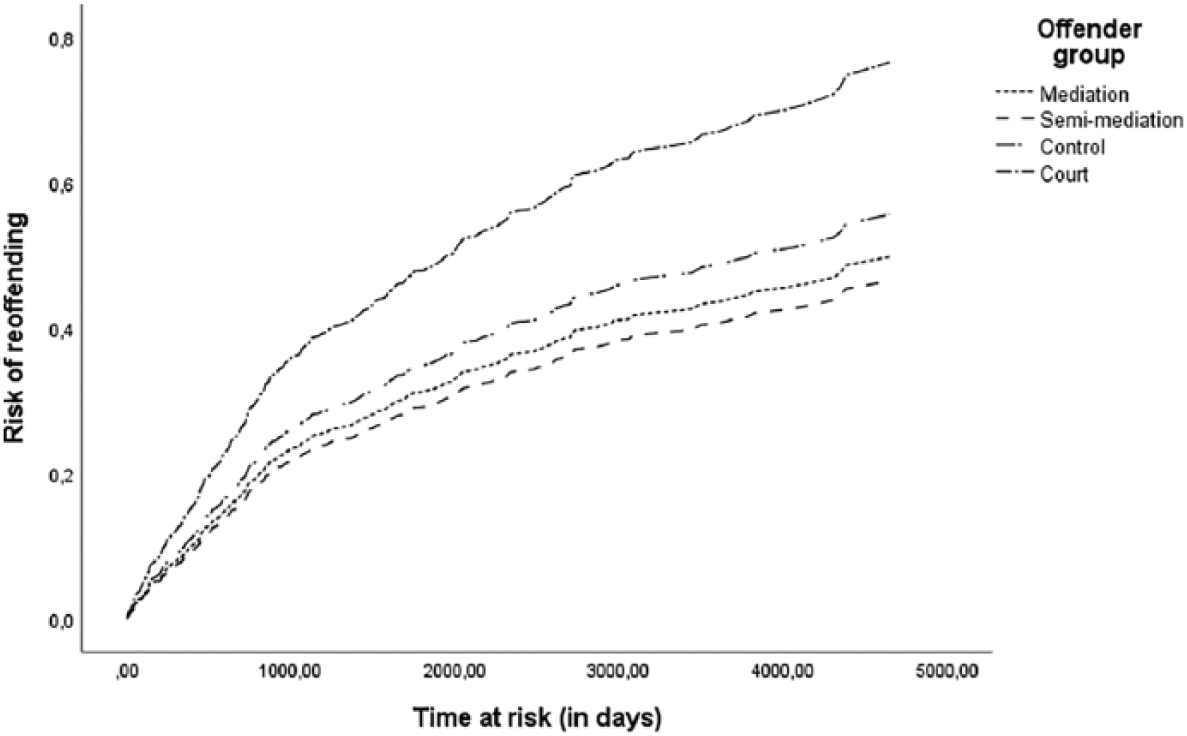
Predicted risk of recidivism (0 = 0%, 1 = 100%) per offender group, controlled for the time at risk.
Controlling for the Demographic and Offender-Related Variables
In addition to the time at risk, other background variables might constitute other, alternative explanations for the differences in the prevalence of recidivism between the offender groups observed—the descriptive analyses revealed that there were differences in the type of offense committed between the offender groups. To statistically control for the influence of the available demographic (gender, age during [VOM] case, country of birth) and offender-related variables (age during first judicial contact, criminal record, type of offense) on recidivism, we performed an additional Cox survival analysis. In Step 1 of this analysis, we first included these demographic and offender-related variables as predictors, an overview of all the exp(B) and p values can be found in Table 3. This resulted in a significantly improved model compared to a model without predictors, χ2(17, n = 1273) = 179.32, p < .005. In the second step, we added the offender group as a predictor to the model, which again resulted in a significant improvement of the model, χ2(3, n = 1273) = 11.84, p = .008. This analysis also showed the same pattern in which the court group stood out as having the highest predicted risk to reoffend over time (Figure 2). Similar to the previous analyses, the mediation, exp(B) = .72, p = .008, and the semi-mediation group, exp(B) = .64, p = .003, had a significantly lower risk to reoffend compared with the court group. 7 In addition, the control group again showed to have a recidivism risk in between the court group and (semi-)mediation groups, as this group did not differ significantly from the court group, exp(B) = .85, p = .353, nor did it differ from the mediation and semi-mediation group, exp(B) = 1.19, p = .271 and exp(B) = 1.33, p = .105 respectively. No other significant differences emerged between the offender groups (all ps > .11).
Overview of the exp(B) and p Values of the Cox Survival Analysis Controlling for Time at Risk, Demographic, and Offender-Related Variables.
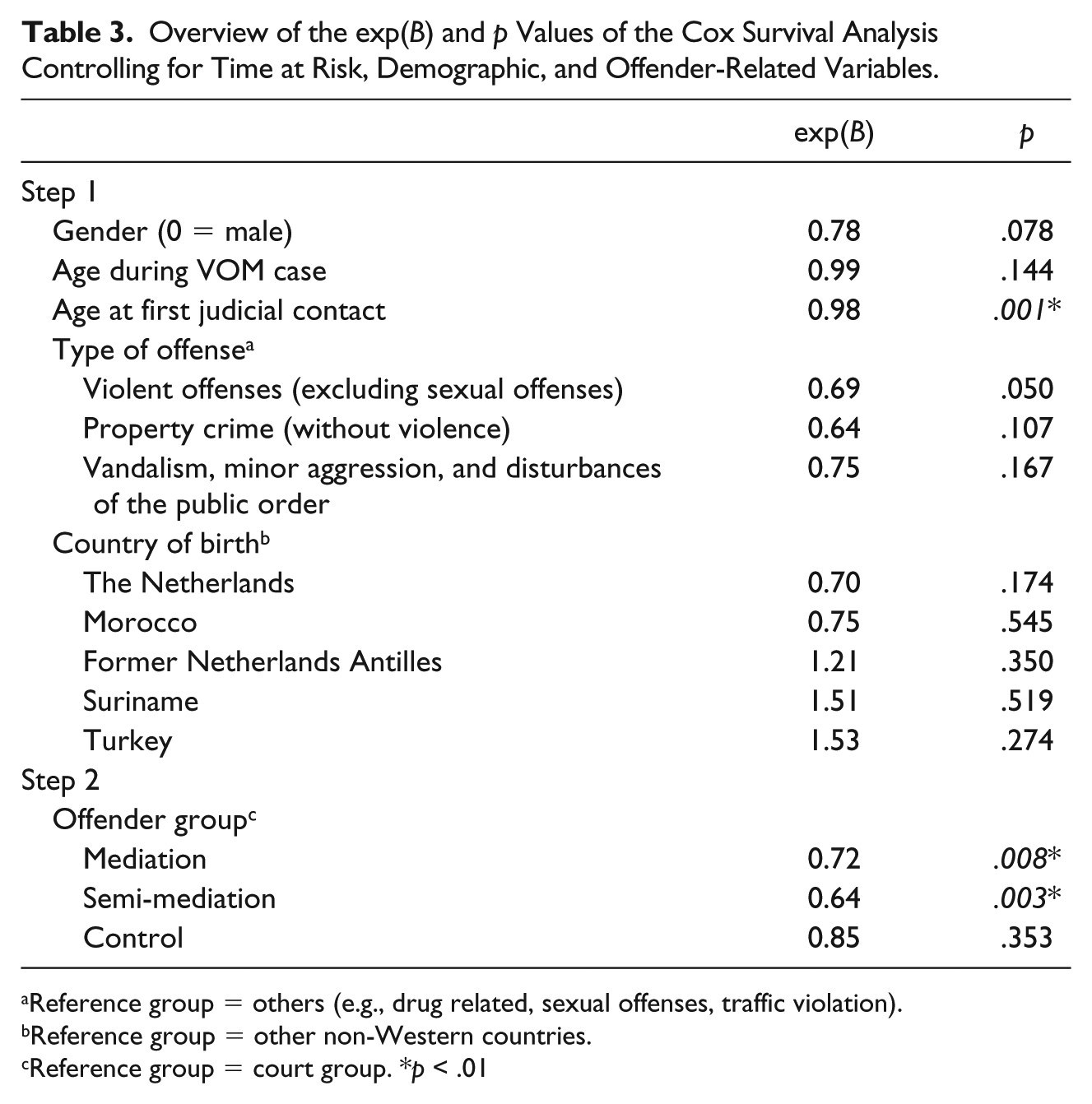
Reference group = others (e.g., drug related, sexual offenses, traffic violation).
Reference group = other non-Western countries.
Reference group = court group. *p < .01
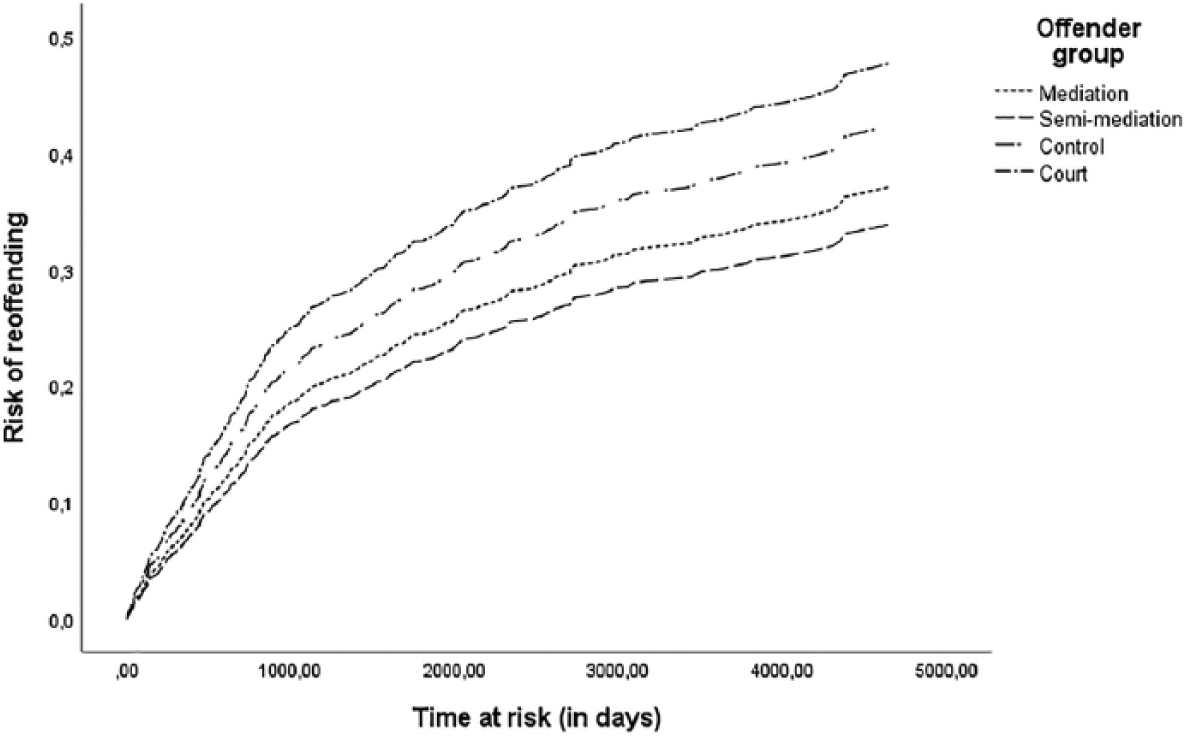
Predicted risk of recidivism (0 = 0%, 1 = 100%) per offender group, controlled for the time at risk, demographic, and offender-related variables.
To conclude, when statistically controlling for time at risk and the demographic and offender-related variables that were available in the current study, the results showed that offenders who participated in (semi-)mediation had a significantly lower chance to reoffend compared with offenders who were unwilling to participate in mediation. However, offenders who were willing to participate but for whom VOM was declined by their victim showed a risk of recidivism that was somewhat worse than offenders who received mediation and somewhat better than offenders in the court group—although not significantly so in either direction.
Discussion
Although foregoing research indicates that participation in VOM and conferencing is related to a lower chance to reoffend (Bradshaw & Roseborough, 2005; Sherman, Strang, Barnes, et al., 2015; Sherman, Strang, Mayo-Wilson, et al., 2015), for VOM it is still unclear whether this is due to the mediation process itself or due to a self-selection bias among those who participate. In the current study we zoomed in on the self-selection bias by comparing four different groups of offenders: offenders who were willing to participate in mediation and whose cases were solved through (a) mediation, (b) semi-mediation, or (c) court/the criminal prosecutors—because mediation was turned down by the other party—and (d) offenders who were not willing to participate in mediation.
When previously found effects in VOM studies are indeed due to a self-selection bias, we expected to observe that the three groups of offenders who were willing to participate in mediation, no matter if their case was solved in court or through (semi-)mediation, would have the same risk of reoffending. For these three groups, we then also expected this risk to be lower compared with offenders who were not willing to participate in mediation. This was expected because the profile of offenders who are willing to participate is likely comparable. If the effects on recidivism were the result of the process that is used to handle the case, we would expect that offenders who participated in (semi-)mediation had a lower chance to reoffend compared to both the group of offenders who were not willing to participate and the group of offenders who were willing to, but not able to participate. In addition, we would expect that the two latter groups had the same risk of reoffending.
The results of this study showed a pattern, which can be best interpreted as an outcome in between these two expectations. We found that offenders who are not willing to participate had a significantly higher risk of reoffending than the mediation groups, replicating previous findings in the domain of VOM (e.g., Bradshaw & Roseborough, 2005; Latimer et al., 2005). In principle, two factors can explain the outcome that the court group had a higher risk to reoffend compared with the (semi-)mediation group: the mediation process itself and/or preexisting differences. Removing one of these factors can enable us to examine what the effects of the other factor are. We tried to remove the self-selection bias through inclusion of a group of offenders who presumably have the same criminogenic profile (the control group) as the group of offenders who did participate in mediation. We then observed that the differences in reoffending between the court (unwilling) and control group became smaller than between the court and mediation groups: the difference between the control group and the court group was not significant. However, neither was the difference between the control group and (semi-)mediation group. This intermediate position suggests that part of the association between VOM and reduced reoffending might be due to preexisting differences between offenders who are willing to participate and offenders who are not, and part might be due to the experiences during the mediation process itself. We therefore cautiously conclude that the beneficial impact VOM seems to have on reoffending might be a combined effect of offenders’ willingness to take restorative steps and take part in VOM, as well as the VOM encounter itself (and subsequent arrangements made) with the victim (see also Lauwaert & Aertsen, 2016).
Although our findings corroborate other studies in that it showed that offenders participating in mediation have a lower risk to reoffend compared to offenders unwilling to participate in mediation and this seems to be partly due to processes during mediation, it is not clear what these processes are, which is one of the limitations of this study. The research design did not allow for deeper analyses and more nuanced outcomes, as we could not take into account the quality and content of the meetings, the outcome agreements, and whether or not someone adhered to the outcome agreements. Therefore, we can also only speculate about why semi-mediation yielded the lowest risk of reoffending of all the offender groups (although not significantly different from the mediation and control group). In this type of mediation, there was no contact between victim and offender. It only differs from the traditional justice process in that the offender had a conversation with the criminal prosecutor in presence of a mediator, to come to an agreement, instead of the offender passively accepting the punishment the prosecutor decided on or imposed through a court hearing. Although this semi-mediation might entail a victim-oriented conversation between these parties, it misses the restoration of and contact between victim and offender, which is one of the core elements of mediation and restorative justice (Umbreit et al., 2004; Zehr, 2015). The question is why this type of contact yielded this pattern of results. It might be due to the absence of a formal punishment, which might have made integration back into the community easier (Lauwaert & Aertsen, 2016), as well as made offenders not experience the negative consequences of a judicial sanction (Bernburg & Krohn, 2003). They might also have perceived the process as fairer, as they had a say in the outcome, thus increasing the procedural justice they experienced. This would also explain why there is no difference found between the semi-mediation and the other mediation groups, because in all groups the offender had an active role in deciding what happens with the case. Another aspect that might explain this outcome could be that both types of mediation might have elicited a pedagogical effect, through which offenders learned what they did wrong and in turn grew in their morality more (Fellegi, 2008). However, this remains speculation, as the processes during any of the mediation forms examined here were not studied in depth.
Further systematic research is needed to examine how mediation unfolds and how and when this has an impact on offenders. Future research could use observational studies to examine what happens during mediation and how this affects offenders in terms of, for example, victim empathy, feelings of guilt, and shame. Subsequently one can examine if this change in their “criminogenic profile” (assessed through using pre- and post-measures) explains a lower risk of reoffending. It might be possible even to discover the key working factors of mediation and in return, mediation can be further optimized. Most notably, Shapland et al. (2008) did in part adopt such a systematic approach by performing (post-mediation only) interviews with offenders and observing mediation sessions to explore how mediation works. Although limited in the number of mediation cases examined, their results suggest that for mediation to be as effective as possible it is important that the offender is actively involved, she or he wants to meet the victim, that the conference made the offender understood the harm done, and that she or he experienced the mediation as useful. More generally, different scholars propose that it is the nonstigmatizing atmosphere, the communication of emotions, the emotional connection between victim and offender, the perceived procedural justice and/or the discussion of the rules that have been broken, and the norms that have been violated are the key working factors of mediation that influence the offender (Bernburg & Krohn, 2003; Braithwaite, 1989; Miethe et al., 2000; Rossner, 2008; Shapland et al., 2008; Tyler et al., 2007).
Another limitation of this study is that conclusions are based on the assumption that the (semi-)mediation and control group share the same profile, as both groups of offenders were willing to participate in mediation. However, we could not test their motivations prior to participation, which means that there still could have been differences. For example, the victim might have declined because she or he expected the offender not to be sincere. This might have said something about the offenders’ motivations or reasons to participate. Another example to reflect on is that victims who decline the option for mediation in itself might also negatively affect offenders. This could have made the offender more angry, or it might have been an indication that the victim labels her or him as criminal, because she or he was too afraid to meet the offender, which could have impacted the risk of reoffending (Bernburg & Krohn, 2003). Future research could use a pre- and post-measure set up to examine if these group have a similar profile and how VOM and the criminal justice process have an effect on this profile.
Although we do not exactly know how VOM may bring about a lower risk of reoffending, this research is, to our knowledge, the first to show that the relation between participation in VOM and a lower risk of reoffending, found in foregoing research, is most probably not completely based on a self-selection bias. The lower risk of reoffending for offenders participating in VOM seems to be explained by both their willingness to take restorative steps and the VOM meeting as well. Being willing to participate thus does not seem to explain all the effects: there is likely to be something about VOM encounters (and its’ consequences) that influences the offender.
Footnotes
Declaration of Conflicting Interests
The author(s) declared no potential conflicts of interest with respect to the research, authorship, and/or publication of this article.
Funding
The author(s) disclosed receipt of the following financial support for the research, authorship, and/or publication of this article: This research was funded by a Research Talent Grant (406.17.555) from the Dutch Organization for Scientific Research (NWO).
