



Abstract
The social threat perspective anticipates that members of racial/ethnic out-groups might be perceived as socially, politically, or economically threatening; criminally inclined; and in need of social control via the criminal justice system. In light of this framework, the current study examines the influence of out-group animus on punitive sentiments in the rarely explored context of Latin America. Data from the 2012 AmericasBarometer survey collected in nine countries (N = 15,145) are analyzed, and the findings indicate that animus against foreigners, Blacks, and the Indigenous is positively associated with support for punitive measures. These results lend support for the social threat perspective and provide further evidence that this relationship might be a cultural universal in societies characterized by racial/ethnic conflict.
In the past several decades, many Western countries, and especially the United States, have experienced a profound shift toward more punitive approaches to crime control (Beckett & Sasson, 2000; Garland, 2001; Gottschalk, 2014). Despite evidence that such policies have questionable deterrent effects, the public is largely in favor of “law and order” criminal justice responses (Unnever, Cochran, Cullen, & Applegate, 2010), and this “penal populism” (Bottoms, 1995; Roberts, Stalans, Indermaur, & Hough, 2002) has important consequences for policy and practice. Indeed, in light of the role that public sentiments can play in the politicization of criminal justice and the expansion of “get tough” crime-control strategies (Baumer & Martin, 2013; Enns, 2014), punitive attitudes and the sources thereof are sometimes regarded as a social issue as deserving of empirical inquiry as crime itself (Cullen, Fisher, & Applegate, 2000; Unnever & Cullen, 2010b). However, much of this research attention has been focused on the United States and Europe, and very few studies have examined punitive sentiments in Latin America, which is currently experiencing a notable increase in public support for authoritarian criminal justice strategies (Holland, 2013; Swanson, 2013).
One possible antecedent to punitiveness is animus directed against various social out-groups, including the poor, foreigners and immigrants, and members of racial or ethnic minorities. Theoretically, the social threat thesis anticipates that the mobilization of social control mechanisms and public support for such activities are shaped by competition between groups for political and economic resources (Blalock, 1967; Olzak, 1992). Indeed, a “pervasive fear of downward mobility” (Simon, 2007, p. 156) and the belief that members of racial or ethnic out-groups are responsible for eroding political and economic privileges might induce people to identify members of these groups as targets for fear, suspicion, and blame (Hogan, Chiricos, & Gertz, 2005; King & Wheelock, 2007). These perceived threats are sometimes manifest in the assignment of crime-related attributions and stereotypes to members of social out-groups, which are, in turn, associated with support for the expansion of the criminal justice system (CJS), harsher punishments for offenders, and other “tough on crime” measures (Chiricos, Welch, & Gertz, 2004; Liska, 1992; Oliver & Mendelberg, 2000). The literature exploring these issues has demonstrated that animus against out-groups is present in a variety of international contexts (Ousey & Unnever, 2012; Stansfield & Stone, 2018; Unnever & Cullen, 2010a) and suggests that racial/ethnic animus or prejudice as a predictor of punitiveness might be culturally universal in societies with conflicted racial/ethnic relations.
To date, all studies in this area have been confined to the United States, Canada, Israel, and European countries, and no prior research has assessed the effects of out-group animus on punitiveness in the unique context of Latin America. An exploration of racial resentment as a source of punitiveness in this region might be highly informative, as these countries are characterized by historically persistent racial/ethnic inequality and conflict (Dixon & Telles, 2017; Silva, 2016; Telles & Garcia, 2013; Wade, 2010). The current study aims to advance the previous research on this topic by assessing the consequences of animus against the poor, foreigners, Blacks, and the Indigenous for punitive sentiments in a heretofore unexamined region. Before describing the research design and data in detail, we first review the relevant prior theoretical and empirical literature on out-group animus and punitiveness, and we describe the salience of the Latin American context for this research. Finally, we present the two hypotheses that will be tested in the current study.
The Social Threat Perspective
Many scholars have theorized that out-group animus and resentment are likely to be associated with various forms of social control, and a dominant theoretical rationale used to explain this hypothesized relationship is the social threat perspective. This framework, originally proposed by Blumer (1958) and Blalock (1967) and developed by others (e.g., Bobo & Hutchings, 1996; Liska, 1992; Olzak, 1992), posits that large and/or growing minority populations can pose perceived threats to members of the majority group, and these threats are responded to through heightened social control. For instance, minorities may present a power threat by displaying various forms of political viability or by demonstrating the ability to mobilize community resources (Horowitz, 1985; Turk, 1969). Alternatively, contexts of economic insecurity might give rise to perceptions of threat as “competition for limited resources increases during times of economic turmoil, and thus levels of prejudice and intergroup violence also increase during periods of economic decline” (King & Wheelock, 2007, p. 1258). As a result of a heightened competition for resources, members of the majority group might harbor resentment toward members of racial/ethnic minorities, immigrants, and other social out-groups, which produces a desire for increased social control (Costelloe, Chiricos, & Gertz, 2009; Garland, 2001; Hogan et al., 2005).
While the original articulation of the social threat perspective focuses largely on political and economic forms of threat, this framework has been extended to include criminal threat, which involves perceptions that members of social out-groups represent a danger to the community that warrants a CJS response (Crawford, Chiricos, & Kleck, 1998; Liska, 1992; Liska & Chamlin, 1984). Liska (1992) explicitly connects the theory of minority threat to the control mechanisms of the justice system in the United States, arguing that the expansion of police forces, the proliferation of severe criminal court sanctions, and increased reliance on incarceration are all social control mechanisms that are mobilized by the dominant racial group to contain the criminal threat purportedly posed by the minority community. Thus, in the United States context, relatively large and/or growing Black or Hispanic populations are expected to be associated with the mobilization of social control via the CJS, including arrest, sentencing, and incarceration (see, for example, Eitle, D’Alessio, & Stolzenberg, 2002; Jacobs & Carmichael, 2001; Stults & Baumer, 2007; Wang & Mears, 2010).
In addition to racial and ethnic population dynamics, scholars have emphasized the importance of the “microprocesses” (Chiricos, McEntire, & Gertz, 2001, p. 323) by which perceived political, economic, cultural, and criminal threats are realized at the individual level. Indeed, as Blalock (1967, p. 167) describes, the majority group can respond to threats by engaging various forms of discrimination, symbolic segregation, and “threat-oriented ideologies” in public discourse that justify the use of social control. In particular, the identification of racial or ethnic “others” as criminal threats might allow individuals to vent anti-minority sentiments, express frustrations with economic conditions, protect cultural hegemony, and subordinate members of out-groups to ensure that group-based interests are protected in policy (Peffley & Hurwitz, 2002; Unnever & Cullen, 2007, 2010a). Corresponding with these expectations, prior research has uncovered several mechanisms that connect social threat and punitiveness, such as fear of crime (Eitle & Taylor, 2008), perceived economic competition (King & Wheelock, 2007; Quillian, 1995), the typification of members of social out-groups as criminals (Chiricos et al., 2004; Unnever & Cullen, 2012), and general feelings of resentment or animus (Ousey & Unnever, 2012; Taylor, 1998).
The social threat framework, then, provides a clear theoretical link between perceived out-group threat and punitive attitudes (King & Wheelock, 2007; Peffley & Hurwitz, 2002). According to this perspective, members of social out-groups can be identified as “outsiders” or “others” because they pose political or economic threats and “represent potential sources of challenge and disruption to traditional morality and social solidarity” (Ousey & Unnever, 2012, p. 574). In addition, feelings of animus or resentment may be informed by typecasts that label members of these out-groups as “disorderly, drug-prone, and dangerous” (Garland, 2001, p. 148), and stereotypes that attribute criminal traits to racial, ethnic, and socioeconomic minorities may reinforce individuals’ punitive sentiments (Unnever & Cullen, 2010b). Indeed, as Unnever and Cullen (2010a) speculate, the association between members of social out-groups and crime “provides a ‘rational’ justification among members of the dominant group to support publicly punitive crime-control policies” (p. 833). Thus, out-group animus is theorized to be positively associated with punitive attitudes, as increased social control through the CJS might be viewed as needed to confront the criminal threat posed by members of these groups (Chiricos et al., 2004; Ousey & Unnever, 2012; Unnever & Cullen, 2012).
Prior Research on Out-Group Animus and Punitiveness
In accordance with the social threat perspective, much research, particularly in the United States, has found that animus against members of social out-groups is a salient predictor of punitiveness. For instance, some survey research has demonstrated that relative minority population size is associated with individual-level support for harsher criminal sanctions (e.g., Baumer, Messner, & Rosenfeld, 2003; Stewart, Martinez, Baumer, & Gertz, 2015). In addition, many studies have shown that racial resentment, especially among Whites, is predictive of support for various social control measures, including increased criminal justice spending (Barkan & Cohn, 2005; Hurwitz & Peffley, 2005), harsher criminal sentencing and the death penalty (Cohn, Barkan, & Halteman, 1991; Johnson, 2001; Soss, Langbein, & Metelko, 2003), “get tough” forms of juvenile justice (Pickett & Chiricos, 2012; Pickett, Chiricos, & Gertz, 2014), and other punitive criminal justice policies (Peffley & Hurwitz, 1998, 2002). These linkages between threat-related attitudes and punitiveness have been shown to be closely related to other sentiments, including racialized conceptions of crime, resentment stemming from economic competition with minority groups, perceptions that minority groups receive “special treatment” through government social welfare programs, and general feelings of anger or bitterness toward minorities (Baker, Cañarte, & Day, 2018; Chiricos et al., 2004; King & Wheelock, 2007; Unnever & Cullen, 2010a, 2012).
While most of the empirical work in this area has analyzed data from the United States, the findings from several international studies suggest that “racial-ethnic intolerance as a source of punitiveness is a cultural universal in countries with conflicted minority relations” (Unnever & Cullen, 2010a, p. 849). For instance, using survey data from France, Dambrun (2007) observed that anti-Arab sentiments were associated with greater support for capital punishment. Similarly, Unnever and Cullen’s (2010a) analysis of Canada and 16 European countries revealed that those with higher levels of intolerance toward foreigners, immigrants, and members of racial, ethnic, and religious out-groups were more supportive of the death penalty. The study by Wheelock, Semukhina, and Demidov (2011) using data from Russia showed that perceptions of Caucasus immigrants as economic threats were positively associated with punitiveness. Ousey and Unnever (2012) likewise found in their analysis of 27 European nations that anti-immigrant sentiments were predictive of support for harsher criminal punishments. In their study of Israeli Jews, Pickett, Baker, Metcalfe, Gertz, and Bellandi (2014) observed that perceptions of Palestinians as violence-prone and threatening to public safety were negatively associated with support for conciliatory solutions to the Israeli–Palestinian conflict. Most recently, Stansfield and Stone (2018) found in Britain that those who identified immigrants as criminally threatening were more punitive than those who did not.
In summary, cross-national studies of punitiveness have been scarce, but the limited research on this topic in the United States, Canada, Israel, Russia, and European countries has found support for the social threat perspective. This body of work lends credence to Unnever and Cullen’s (2010a) speculation that out-group animus might be a culturally universal predictor of punitive sentiments in societies characterized by racial/ethnic conflict. To more fully assess this claim, however, it is necessary to explore this relationship in regions not yet examined, including developing countries such as those in Latin America. The current research is the first study to date that investigates the relationship between various dimensions of out-group animus and punitiveness in this highly theoretically relevant context.
The Latin American Context
Latin American countries represent a unique setting in which to explore punitive crime-control policies and the consequences of out-group animus. Due to increases in violent crime associated with gang activity as well as sensationalized media reports (Hume, 2007; Krause, 2014), fear of crime in Latin America is pervasive (Dammert, 2012), and this “public insecurity shapes government agendas, as local politicians pledge a mano dura, or an iron fist, to get tough on crime” (Swanson, 2013, p. 972). Mano dura policies can include a wide range of CJS responses, such as “broken windows” policing, the constriction of offenders’ due process rights, strict anti-crime legislation, and harsher criminal sentences (Holland, 2013; Krause, 2014). These “zero tolerance” criminal justice policies have been implemented in numerous Central and South American countries, including Argentina, Brazil, Costa Rica, Chile, El Salvador, and Mexico (Bonner, 2016; Holland, 2013; Wolf, 2017). Although there is evidence that such strategies have limited effectiveness, are disproportionate responses to crime, and may exacerbate racial and socioeconomic disparities in criminal justice involvement (Holland, 2013; Hume, 2007; Peetz, 2011), public support for punitive policies is robust (Nivette, 2016; Swanson, 2013). Prior studies of Latin America have linked punitive attitudes with crime salience and victimization (Bateson, 2012; Malone, 2010; Seligson, 2003), but the effects of minority group intolerance on punitiveness in this region remain unexplored.
The context of Latin America is also theoretically relevant for the study of animus directed against social out-groups. The racial demography of Latin American countries is highly complex and is characterized by a mixing of races and ethnicities (i.e., mestizaje), and national populations are largely comprised of individuals with some combination of European, African, and Indigenous ancestry. Despite this intense racial integration as well as widespread denial of the existence of racial hierarchies, much research has demonstrated that political, economic, education, and health inequalities along the lines of race and ethnicity persist (e.g., Bailey, Saperstein, & Penner, 2014; Telles & Bailey, 2013; Wade, 2010). Indeed, “Latin American elites . . . have always prized the European antecedents of their peoples and cultures” (Nobles, 2005, p. 82), and those with lighter skin typically enjoy greater status while Blacks and Indigenous groups experience discrimination and more limited access to resources (Dixon & Telles, 2017; Villarreal, 2010). Even in Brazil, where racial inequalities are expected to be less prominent due to a relatively large Black presence and blurry “symbolic boundaries” that feed the notion of racial integration, there exist “social boundaries” between minorities and Whites that mirror disparities in socioeconomic status (Silva, 2016; Telles, 2004; Twine, 1998).
Although scholars note that “racial attitudes in Latin America have, surprisingly, been understudied” (Telles & Garcia, 2013, p. 130), it might be reasonable to expect that out-group animus will be associated with punitiveness in this region. Some evidence suggests that racial and ethnic minorities are attributed a variety of negative characteristics, with these populations often considered to be lazy, unintelligent, unattractive, undeserving of government assistance, and otherwise inferior to Whites (Castillo, Petrie, & Torero, 2010; Peña, Sidanius, & Sawyer, 2004; Telles, 2004; Uhlmann, Dasgupta, Elgueta, Greenwald, & Swanson, 2002). Theoretically, the Latin American context of racial and ethnic conflict might make members of these groups easy targets for negative attributions, resentment, and animosity. Furthermore, in many Central and South American countries, there exist stereotypes that connect racial/ethnic out-groups with criminal behavior, and the mobilization of CJSs in Latin American countries has long been understood to be directed largely against these groups (Kalunta-Crumpton, 2012; Segato, 2007). Indeed, during the advent of the modern penal system in Latin America between mid-19th and mid-20th centuries, “Latin American elites looked at, discredited, and criminalized their respective ‘lower classes’” (Salvatore & Aguirre, 1996, p. 4), and criminal punishment was disproportionately applied to immigrants, Blacks, and the Indigenous (Aguirre, 1998). Given these linkages, it is possible that social out-groups might be identified as prone to crime as well as in need of control through punitive criminal justice policy.
On the basis of the foregoing discussion, in the current study, we intend to address the following two hypotheses.
Data and Methods
The current study makes use of data from the 2012 AmericasBarometer survey, which is maintained by the Latin American Public Opinion Project (LAPOP). 1 The LAPOP has conducted this extensive biennial survey in North, Central, and South American and Caribbean countries since 2004. Respondents are selected using a multistage cluster design, which uses strata based on the sizes of municipalities, urban/rural areas, and regions as identified in the most recent national censuses. This design produces samples that are representative of the noninstitutionalized voting-age populations of each country. Face-to-face interviews are conducted with one individual per household, and quotas for age and sex are used to avoid sampling error due to differential nonresponse. The questionnaires ask respondents about their experiences, perceptions, and attitudes regarding a wide range of political, economic, and criminal justice topics. The cross-national nature of this survey and foci of the questionnaire items make these data particularly well suited to address the hypotheses of this study.
The 2012 AmericasBarometer survey was administered to 41,632 respondents in 26 countries. However, the questionnaires that were distributed varied somewhat by country, and the two questions capturing punitive attitudes, which are used as our dependent variables of interest, were not asked in Canada, the United States, and Suriname. Furthermore, the four items used to measure out-group animus were not available in an additional 14 countries. Therefore, our study is restricted to the 15,145 respondents surveyed in the following Latin American countries: Argentina, Belize, Bolivia, Brazil, Colombia, Costa Rica, Mexico, Paraguay, and Uruguay. The descriptive statistics for the study variables are presented in Table 1.
Descriptive Statistics: LAPOP AmericasBarometer Survey, 2012 (N = 15,145).
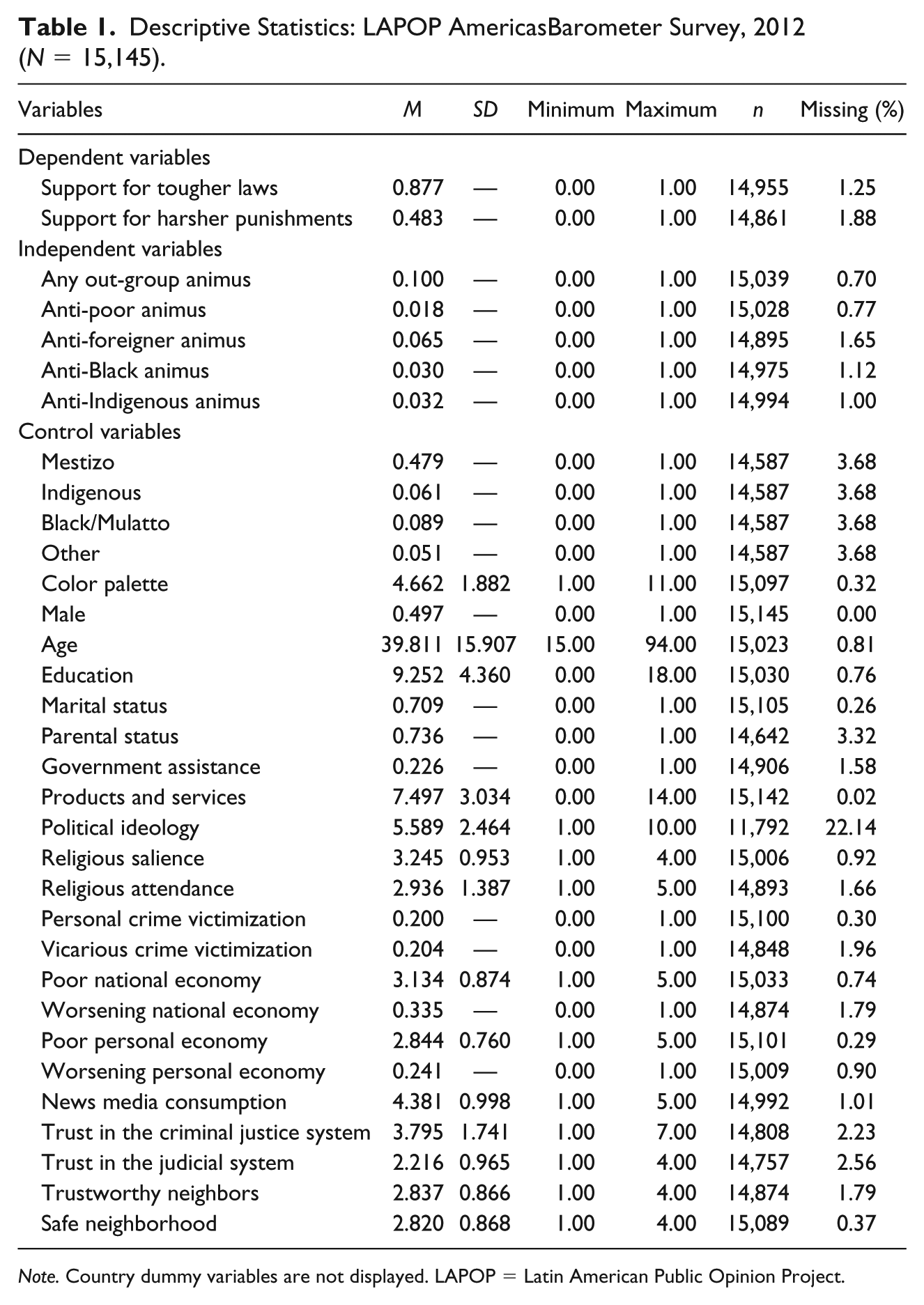
Note. Country dummy variables are not displayed. LAPOP = Latin American Public Opinion Project.
Dependent Variables
This research examines two dependent variables that relate to respondents’ punitive sentiments. The first of these variables captures support for tougher laws, and it asks participants the extent to which they agree with the statement, “The best way to fight crime is to have tougher laws against criminals.” Respondents were coded 1 if they agreed or strongly agreed with this statement (0 = disagree/strongly disagree), which included approximately 87.7% of respondents. The second dependent variable is support for harsher punishments, which originates from a survey item asking, “In your opinion, what should be done to reduce crime in a country like ours?” The two response options include “implement preventive measures” and “increase the punishment of criminals,” although some respondents indicated support for both strategies. Respondents were coded 1 if they favored harsher punishments (48.3% of participants) rather than preventive measures or both policies. Although these items are limited in some respects, they are representative of general punitive sentiments and are similar to measures used in prior research (e.g., Cohn et al., 1991; Johnson, 2001; King & Wheelock, 2007).
Independent Variables
The primary predictor of interest in the current study is out-group animus. This construct is measured using four separate items that asked respondents, “Can you tell me if there are some groups that you wouldn’t like to have as neighbors?” Respondents were then presented with a list of several social groups, including the poor, people from other counties, Afro-[country] (e.g., Afro-Brazilians)/Blacks, and the Indigenous/Native [country] (e.g., Native Brazilians)/First Peoples. Using these items, the following four measures of out-group animus were constructed: anti-poor animus, anti-foreigner animus, anti-Black animus, and anti-Indigenous animus. Respondents who mentioned that they would not want to have members of the group as neighbors were coded as 1 on that variable. Although not ideal, these measures can be useful as proxies for social distance and the explicit identification of minority group members as “outsiders” or “others.” As presented in Table 1, 1.8% of the sample reported anti-poor animus, 6.5% reported anti-foreigner animus, 3.0% reported anti-Black animus, and 3.2% reported anti-Indigenous animus. 2
In addition to the effects of each specific form of out-group animus, this study is concerned with the consequences of any out-group animus for punitive sentiments. According to Unnever and Cullen (2010a), animus against members of any racial, ethnic, or national out-group is theoretically expected to result from perceived threats to “economic, cultural, and social hegemony, especially as these subordinate groups challenge the existing racial-ethnic order” (pp. 837-838). Comparisons of Pearson correlations among the four out-group-specific animus measures indicate that each is moderately strongly and statistically significantly correlated with the others, with the coefficients ranging from .23 to .41. Therefore, we include a global measure of out-group animus, which was created as a dummy variable in which respondents who were coded as 1 on any of the other four separate out-group animus measures (approximately 10% of the sample) were coded as 1.
Control Variables
We control for several variables which prior research has identified as salient predictors of punitiveness and which might be correlated with out-group animus. First, we control for the race or ethnicity of the respondent using five mutually exclusive dummy variables: White, Mestizo, Indigenous, Black/Mulatto, and Other. Black and Mulatto respondents were combined into a single category due to the small number of participants in each category (3.2% and 5.8%, respectively). White is used as the reference category in these analyses. Also, using an 11-point color palette of increasingly dark tones, the interviewer documented the color of the respondent’s skin, and this measure was included to better capture the complexities of racial and ethnic identification in Latin America, where many residents define themselves as of mixed race (Bailey, Fialho, & Penner, 2016; Dixon & Telles, 2017). 3 Additional controls for respondents’ demographic characteristics include a dummy variable of gender with males coded as 1, a continuous variable indicating respondents’ age in years, and respondents’ education level reflecting the number of years of schooling completed (0 = none, 18 = 18 or more). Participants who reported that they had ever been married were coded as 1 on marital status, and those who said that they had any children were similarly identified in the parental status measure.
Other controls include the socioeconomic status, political ideology, and religiosity of respondents. Respondents’ socioeconomic status is measured using two variables: the first being a dummy variable reflecting whether or not the respondent receives monthly financial government assistance (1 = yes). The second is an ordinal measure that captures how many of a list of 14 products and services the respondent has in his or her home. These items include a television, a refrigerator, a landline telephone, a cellular telephone, a vehicle/car, a washing machine, a microwave oven, a motorcycle, indoor plumbing, an indoor bathroom, a computer, Internet access, a flat panel TV, and a sewage system connection. 4 Political ideology indicates where participants’ political leanings fall on a scale of left (=1) to right (=10). Using two ordinal measures, we also control for respondents’ personal religious salience (1 = religion is not at all important, 4 = religion is very important) and religious attendance (1 = never or almost never, 5 = more than once per week).
In addition, we control for any personal crime victimization in the past 12 months (=1) and any vicarious crime victimization (i.e., of another person living in the respondent’s household) in the past 12 months (=1). Next, we include four measures of economic anxieties that capture respondents’ perceptions of their national and personal economic conditions (Costelloe et al., 2009; Hogan et al., 2005; Johnson, 2001; Lehmann & Pickett, 2017). First, we measure poor national economy using the question, “How would you describe the country’s economic situation?” Responses were coded on a 5-point ordinal scale ranging from very good (=1) to very bad (=5). Second, to capture economic deterioration, we assess whether respondents perceived a worsening national economy using the survey item, “Do you think the country’s current economic situation is better than, the same as, or worse than it was 12 months ago?” Respondents were coded as 1 if they viewed the economy as getting worse (0 = the same/better). In addition, participants were posed two similar questions about their personal economic situations, with the first (poor personal economy) asking how respondents would describe their overall economic situation (1 = very good, 5 = very bad). Finally, a dummy variable indicating whether or not respondents saw themselves experiencing a worsening personal economy over the past 12 months was included as well, with those answering in the affirmative coded as 1.
To account for news media consumption, which some prior research has shown can influence punitive attitudes (Roche, Pickett, & Gertz, 2016), we control for how often respondents pay attention to the news via the TV, radio, newspapers, or the Internet (1 = never, 5 = daily). In addition, given the complex associations found in some prior research between trust in the effectiveness of the justice system and punitive attitudes (Costelloe et al., 2009; Messner, Baumer, & Rosenfeld, 2006), we account for the extent to which each respondent has trust in the CJS of his or her country (1 = not at all, 7 = a lot). Similarly, we control for trust in the judicial system, that is, how much faith the respondent has that the judicial system would punish someone guilty of robbing or assaulting the respondent (1 = none, 4 = a lot). We account for participants’ perceptions of crime victimization risk by controlling for whether respondents believe that they have trustworthy neighbors (1 = very untrustworthy, 4 = very trustworthy) and the extent to which respondents perceive that they live in a safe neighborhood (1 = very unsafe, 4 = very safe; see Singer et al., 2019). 5 Finally, to account for any between-country differences that might account for the observed effects, each of the regression models includes country fixed effects dummy variables with Brazil used as the reference group. For the sake of parsimony, the coefficients of these variables are not presented in the tables.
Analytic Strategy
The analyses proceed as follows: First, using binary logistic regression and controlling for the other covariates, we regress support for tougher laws on each of the five measures of out-group animus, namely, any out-group animus, animus against the poor, animus against foreigners, animus against Blacks, and animus against the Indigenous. Next, again using binary logistic regression, we estimate the direct effects of each of these five out-group animus measures on support for harsher criminal punishments. Finally, several sets of sensitivity analyses are conducted using alternative coding schemes of the dependent variables.
Little’s (1988) test was conducted, and the results indicate that the missing data are not missing completely at random. Therefore, the missing cases were imputed through multiple imputation using chained equations and 20 imputations (White, Royston, & Wood, 2011). The imputation model included all the variables used in the analyses, although the cases missing on either of the two dependent variables were dropped before the analyses were conducted in accordance with best practices. The final imputed sample includes 14,705 cases. For each of the covariates, the number of cases with nonmissing values and the proportion of the cases with missing data are presented in Table 1.
Results
Support for Tougher Laws
The analyses begin with a test of our first hypothesis, which anticipates that out-group animus will be positively associated with support for tougher criminal laws. To this end, presented in Table 2 are the binary logistic regressions of this measure of punitiveness on animus against any out-group, the poor, foreigners, Blacks, and the Indigenous, net of the controls. Model 1 estimates the main effect of any out-group animus, and then each of the measures of out-group-specific animus is included in a stepwise fashion in Models 2 through 5. The unstandardized logistic regression coefficients are displayed in the table, and these may be exponentiated to obtain the odds ratios (ORs). The findings shown in Model 1 demonstrate that respondents who reported animus against any of the four social groups have a 26.4% greater odds of supporting tougher laws than those without such animus (b = 0.235, p < .05). However, the findings in Model 2 indicate that animus against the poor is not significantly related to support for tougher laws. As shown in Model 3, animus against foreigners exerts a marginally significant positive effect on punitiveness (b = 0.218, OR = 1.243, p < .10). Similarly, as shown in Model 4, animus against Blacks is positively associated with support for tougher laws (b = 0.306, OR = 1.357, p < .10). Finally, in Model 5, the effect of anti-Indigenous animus on this outcome is positive but not statistically significant. Therefore, we find some support for our first hypothesis, and general out-group animus, and in particular resentment that is directed against foreigners and Blacks, is positively associated with support for tougher criminal laws.
Binary Logistic Regressions of Support for Tougher Laws on Out-Group Animus and the Controls (N = 14,705).
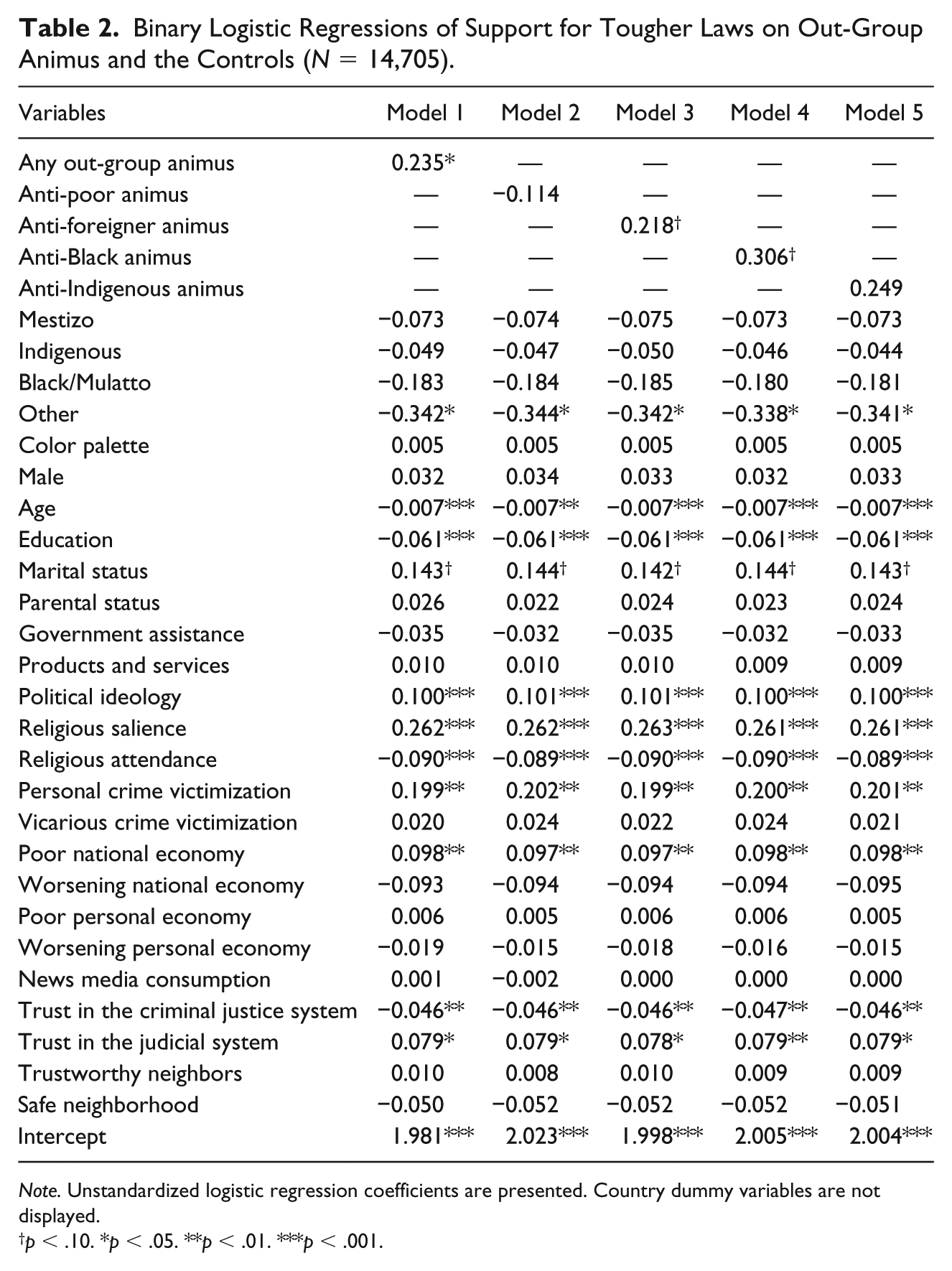
Note. Unstandardized logistic regression coefficients are presented. Country dummy variables are not displayed.
p < .10. *p < .05. **p < .01. ***p < .001.
The influence of the control variables on the outcome remains largely consistent across the five models shown in Table 2. Of note, being a racial/ethnic Other, being older, having more education, religious attendance, and trust in the CJS are significantly negatively associated with support for tougher laws. In contrast, marital status, political conservatism, religious salience, personal crime victimization, the perception that the national economy is poor, and trust in the judicial system are positively associated with this outcome.
Support for Harsher Punishments
Next, we assess whether out-group animus exerts direct effects on support for harsher criminal punishments as expected by our second hypothesis. Shown in Table 3 are the binary logistic regression estimates of each of the five animus measures on this outcome net of the other covariates. The findings from Model 1 indicate that the effect of any out-group animus is positive and significant, and respondents who reported animus against any of the four social groups have a 21.8% greater odds than those without such animus to support harsher punishments (b = 0.198, p < .001). However, as shown in Model 2, anti-poor animus is not associated with support for harsher punishments. Similar to the findings shown in Model 3 of Table 2, the effect of anti-foreigner animus in Model 3 of Table 3 is positive and marginally statistically significant (b = 0.119, OR = 1.126, p < .10). Likewise, similar to the pattern of findings presented in Table 2, the results of Model 4 in Table 3 suggest that animus against Blacks is positively associated with support for harsher punishments (b = 0.272, OR = 1.312, p < .01). Finally, in contrast to the findings from the prior table, the inclusion of animus against the Indigenous in the model (Model 5) reveals that this variable is significantly positively associated with the outcome (b = 0.323, p < .01), with respondents who are coded 1 on this variable having a 38.1% greater odds of supporting harsher punishments. Therefore, our findings generally support our second hypothesis, and out-group animus—especially against foreigners, Blacks, and the Indigenous—is positively associated with this measure of punitiveness.
Binary Logistic Regressions of Support for Harsher Punishments on Out-Group Animus and the Controls (N = 14,705).
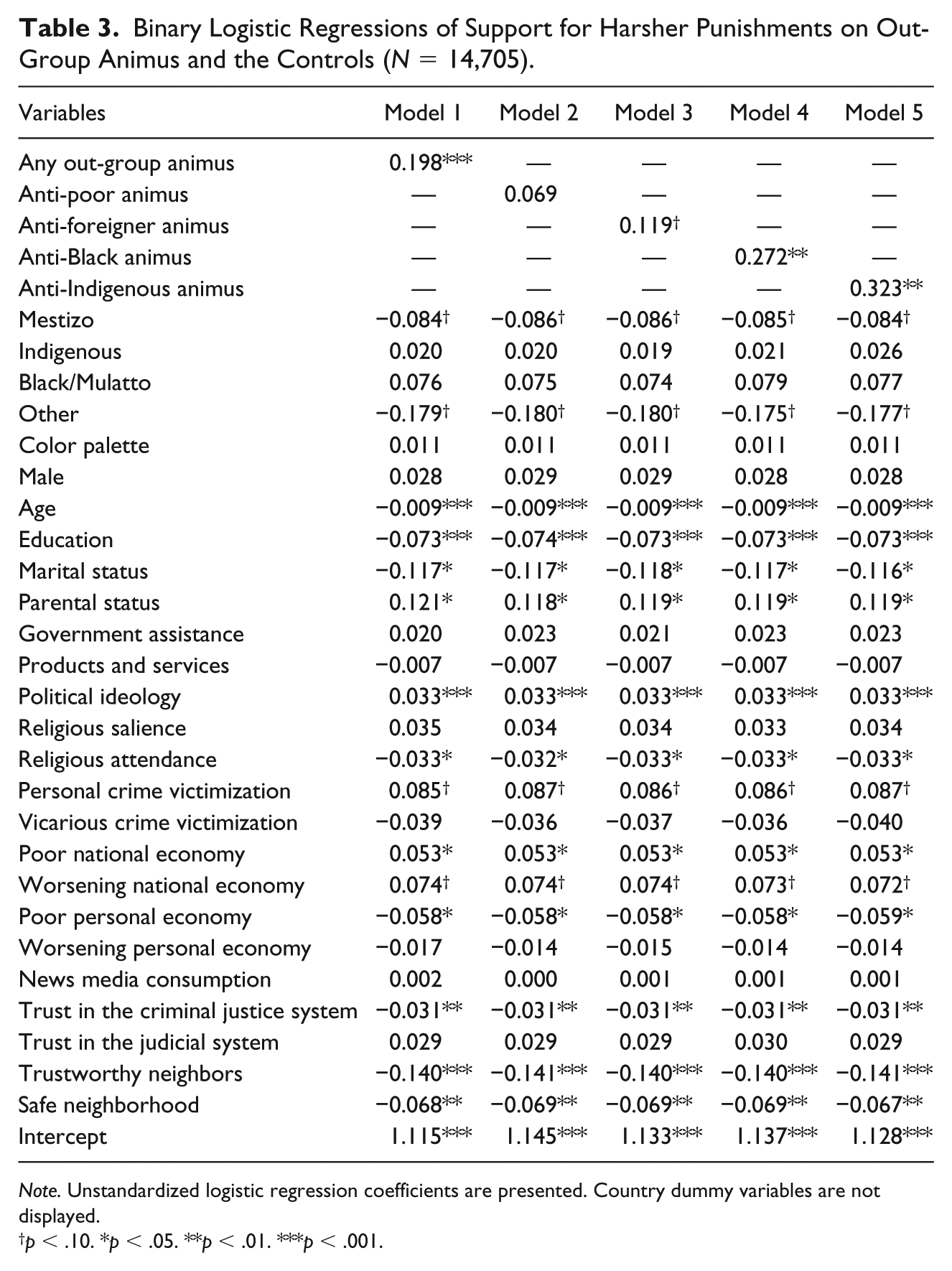
Note. Unstandardized logistic regression coefficients are presented. Country dummy variables are not displayed.
p < .10. *p < .05. **p < .01. ***p < .001.
Regarding the control variables in the five models shown in Table 3, the effects of the covariates are nearly identical across the models. Specifically, Mestizos and racial/ethnic Others, older respondents, those with more education, being married, religious attendance, the perception that one’s personal economic situation is poor, trust in the CJS, trust in one’s neighbors, and the perception that one’s neighborhood is safe are all negatively associated with support for harsher punishments. Parental status, political conservatism, personal crime victimization, and a perceived poor or worsening national economy are positively associated with this measure of punitiveness.
Sensitivity Analyses
Finally, to ensure that the findings presented herein are robust, several sensitivity analyses were conducted. First, the binary logistic regression analyses presented in Tables 2 and 3 were estimated after using listwise deletion rather than multiple imputation to handle the missing data. The findings from these models indicate that, as before, any out-group animus (b = 0.255, OR = 1.290, p < .05), anti-foreigner animus (b = 0.321, OR = 1.378, p < .05), and anti-Black animus (b = 0.417, OR = 1.517, p < .10) are positively associated with support for tougher laws, while the effects of animus against the poor and the Indigenous are not statistically significant. Similarly, in the estimates of support for harsher punishments, the positive effects of any out-group animus (b = 0.155, OR = 1.167, p < .05) and anti-Indigenous animus (b = 0.209, OR = 1.232, p < .10) remain using listwise deletion. However, as listwise deletion assumes that the data are missing completely at random and Little’s (1988) test revealed that this is not the case, we place greater emphasis on the estimates using the multiply imputed data.
Next, supplementary analyses were conducted using the original 4-point scaling of support for tougher laws (1 = strongly disagree, 4 = strongly agree), and ordinal logistic regression models were estimated using this outcome. Brant’s (1990) tests were conducted for each of the five models, and none of these tests indicated that the proportional odds assumption is violated for any of the measures of out-group animus. The findings from these models follow the same pattern as those presented in Table 2. Specifically, any out-group animus is associated with greater support for tougher laws (b = 0.122, OR = 1.129, p < .05). In addition, as before, the positive effect of anti-foreigner animus on this outcome is marginally significant (b = 0.118, OR = 1.125, p < .10), and the effect of anti-Black animus is also positive and reaches conventional thresholds of statistical significance (b = 0.256, OR = 1.291, p < .05). The nonsignificant effects of animus against the poor and the Indigenous are unchanged when support for tougher laws is examined using ordinal logistic regression.
The final set of supplementary analyses involves the estimation of support for harsher punishments using multinomial logistic regression. During the administration of the survey, respondents were presented with two response options regarding the best strategies for crime control. Although most participants expressed support for either increased punishments or preventive measures, a sizable proportion of respondents (16.3%) indicated support for both strategies. Rather than combining the respondents who favored both options with those who supported preventive measures only as shown above, these sensitivity analyses treat the three responses as separate nonordered categories. Support for preventive measures only is used as the reference outcome in the multinomial logistic regression models.
These analyses reveal that any out-group animus is positively associated with support for harsher punishments only (b = 0.277, OR = 1.319, p < .001) as well as support for both strategies (b = 0.224, OR = 1.251, p < .05). Similarly, relative to preventive measures only, those with anti-foreigner animus are more likely to support harsher punishments (b = 0.228, OR = 1.256, p < .01) and both options (b = 0.296, OR = 1.344, p < .01). Anti-Black and anti-Indigenous animus, however, are predictive of support for harsher punishments only (anti-Black animus: b = 0.242, OR = 1.273, p < .05; anti-Indigenous animus: b = 0.247, OR = 1.280, p < .05) but not support for both harsher punishments and preventive measures. The nonsignificant effects of anti-poor animus are unchanged. Thus, although these findings provide additional nuance to those presented in Table 3, the fundamental pattern of results is the same; namely, animus against foreigners, Blacks, and the Indigenous is positively associated with support for harsher punishments relative to preventive measures.
Discussion and Conclusion
Many scholars have argued that public attitudes are highly relevant for the creation and implementation of criminal justice policy (e.g., Baumer & Martin, 2013; Cullen et al., 2000; Enns, 2014; Roberts et al., 2002; Unnever et al., 2010). As a result, much research has examined the various sources of punitive sentiments, and several studies have emphasized the particular importance of individuals’ animosity or resentment against members of social out-groups. One theoretical framework that may connect out-group animus and punitiveness is the social threat perspective, which anticipates that members of the public identify racial, ethnic, and/or socioeconomic “others” as political competitors, targets of blame for worsening economic conditions, or criminally dangerous and threatening to the safety of the community (Chiricos et al., 2004; King & Wheelock, 2007; Oliver & Mendelberg, 2000; Soss et al., 2003; Unnever & Cullen, 2010a, 2012). The previous research examining the independent effects of out-group animus on punitiveness, which includes some studies conducted in international contexts (e.g., Dambrun, 2007; Ousey & Unnever, 2012; Pickett, Baker, et al., 2014; Stansfield & Stone, 2018), has revealed consistent support for the expectations of the social threat thesis, thus suggesting that this relationship might be a “cultural universal” in societies with conflicted racial/ethnic relations (Unnever & Cullen, 2010a). However, no prior research has explored whether out-group animus affects punitive sentiments within Latin American countries.
Latin America presents a particularly theoretically salient context in which to explore the social threat hypothesis. Indeed, these analyses engage data that were collected at a time in which Latin American governments have begun to propose and execute a variety of punitive mano dura criminal justice policies (Holland, 2013; Krause, 2014; Wolf, 2017), which members of the public commonly view as necessary to confront the perceived crime problem (Nivette, 2016; Swanson, 2013). Furthermore, these trends have occurred against a backdrop of persistent racial and ethnic conflict in which immigrants, Blacks, and Indigenous populations typically experience heightened levels of socioeconomic disadvantage and are attributed a variety of negative—and possibility criminal—stereotypes (Castillo et al., 2010; Kalunta-Crumpton, 2012; Segato, 2007; Telles, 2004). Our investigation of the relationships anticipated by the social threat framework involves the use of nationally representative survey data collected in nine Latin American countries, and several key conclusions can be drawn from our analyses.
First, the findings from the current research demonstrate that individuals who hold animus or resentment against members of racial or ethnic out-groups express greater support for tougher criminal laws and harsher criminal penalties than those without such resentment. Specifically, animus against foreigners, Blacks, and the Indigenous is positively associated with support for punitive measures regardless of the respondents’ own social group memberships, economic situation, and racial or ethnic identification. Indeed, despite the limited number of respondents in the survey who reported holding racially/ethnically resentful attitudes, these relationships are observed even after controlling for a host of covariates related to public opinion which have been consistently shown to predict punitive attitudes.
These observed relationships between out-group animus and punitiveness mirror prior work from the United States (Barkan & Cohn, 2005; King & Wheelock, 2007; Soss et al., 2003; Unnever & Cullen, 2010b, 2012) as well as other countries (Dambrun, 2007; Ousey & Unnever, 2012; Unnever & Cullen, 2010a; Wheelock et al., 2011). Given the extant evidence that members of racial and ethnic minorities may be conceptually connected to criminal behavior in the minds of Latin Americans (Aguirre, 1998; Kalunta-Crumpton, 2012; Peña et al., 2004), these results might be interpreted in light of the social threat perspective, which expects that members of minority groups may be perceived as criminal threats who should be confronted with punitive criminal justice responses (Chiricos et al., 2004; Unnever & Cullen, 2012). Corresponding with this framework, the findings from this study indicate that, in the racially divided context of Latin America, out-group animus is a notable source of punitiveness, and, like in the United States and other Western countries, anti-minority resentment may be manifest in enduring stereotypes that conflate racial/ethnic out-groups and crime. These findings lend some credence to Unnever and Cullen’s (2010a) hypothesis that, in contexts characterized by racial/ethnic conflict, out-group intolerance may be a culturally universal source of punitiveness.
A second important finding from this study is that anti-poor animus was not predictive of either measure of punitiveness. Although this null pattern of results was unexpected, it may not directly contradict this study’s hypotheses. At the time that these data were collected, economic growth in the region had begun to stall and political tensions surrounding the issues of wealth inequality were mounting (Bértola & Ocampo, 2012; Flores-Macias, 2012; Grugel & Riggirozzi, 2012; Reyes & Sawyer, 2016), and this insecure economic situation might have weakened anti-poor sentiments (Lehmann & Pickett, 2017; Useem, Liedka, & Piehl, 2003). While animus against members of disadvantaged socioeconomic classes might be somewhat economically contextual, resentment against racial or ethnic out-groups may instead be a more historically consistent and persistent predictor of punitiveness. Indeed, foreigners, Blacks, and the Indigenous might be specifically selected as targets of blame and resentment, as these groups demonstrate certain cultural dissimilarities, have a visible political and social presence, and are sometimes seen as unfairly benefiting from government welfare assistance (Barrientos, Gideon, & Molyneux, 2008; Hooker, 2005; Lavinas, 2015). These perceived political, economic, and cultural conflicts may foster feelings of fear and animus (Bobo & Hutchings, 1996; Kinder & Sears, 1981), which may then be expressed through the assignment of criminal attributions and a subsequent desire to exert punitive social control (Chiricos et al., 2004; King & Wheelock, 2007; Unnever & Cullen, 2012). More generally, these findings reaffirm the need to study racial/ethnic relations as distinct from class relations in Latin America, where social class tends to be considered of greater importance than race.
A third finding from this study is that some subtle differences in the results emerged between the two dependent variables. In general, the estimates of support for harsher punishments showed stronger evidence in favor of the hypothesized expectations than the estimates of support for tougher laws. Although the findings from the sensitivity analyses suggested a greater degree of concordance in these results, it is nonetheless the case that out-group animus was more consistently associated with punitiveness as measured by our second dependent variable. It is possible that this disparity may be due to the wording of these two survey items. Although the vast majority of respondents (87.7%) agreed that “tougher laws” are needed to fight crime, what specific policies are implied by this phrase is ambiguous. In contrast, in the second punitiveness item, respondents were prompted to select a preference between two specific and potentially opposing crime-control strategies, and many people reported simultaneously supporting both options (see Unnever et al., 2010). This survey item is arguably more sensitive to nuances in public attitudes and thus may more accurately capture respondents’ punitive sentiments. Unfortunately, however, multiple questions asking about support for a variety of specific criminal justice policies were not available. Therefore, future research examining punitiveness in Latin America would benefit from the incorporation of measures capturing attitudes toward specific policies.
In sum, the results from this study’s analyses demonstrate that “penal populism” (Bottoms, 1995; Roberts et al., 2002) exists in Latin America and is connected to resentment against certain social out-groups. Although this research lends credence to the notion of a “criminology of the racialized other” (Unnever & Cullen, 2010a, p. 850), additional research is needed which explores the antecedents to these attitudes as well as the specific mediating and moderating influences that link such attitudes and support for tougher crime-control measures. Some of these relevant factors may include changes in local population demographics, political viability among racial and ethnic minority groups, perceptions of racial and ethnic conflict at the local and national levels, and the role of the media in connecting crime-related fears with racialized depictions of offenders. In addition, due to limitations in the measures of animus used in this study, it is unknown whether the effects of out-group animus on punitiveness are indeed mediated by perceptions that conflate racial/ethnic minorities with criminal behavior as theoretically anticipated (Chiricos et al., 2004; Soss et al., 2003; Unnever & Cullen, 2012). Thus, subsequent research should attempt to develop a more comprehensive approach to understanding the mechanisms by which animus against social out-groups is connected to punitive sentiments in Latin America.
In conclusion, it remains to be seen whether the expansion of restrictive “zero tolerance” criminal justice policies in Latin America will continue to be energized by public support, especially in light of the heightened political discord, economic insecurity, and racial and ethnic conflict experienced by citizens of this region. As there is scarce extant research on the social sources of punitiveness in Latin America, further inquiry should be directed toward understanding these issues in this region as well as in other international contexts. Nonetheless, it is clear that the social threat thesis has great potential for understanding trends in criminal justice policy cross-nationally, and much additional research is needed to better understand how and why intolerance directed against racial or ethnic “outsiders” or “others” may fuel public support for “get tough” responses to crime in Latin America and elsewhere.
Footnotes
Acknowledgements
The authors thank the Latin American Public Opinion Project and its major supporters (the United States Agency for International Development, the Inter-American Development Bank, and Vanderbilt University) for making the data available.
Declaration of Conflicting Interests
The author(s) declared no potential conflicts of interest with respect to the research, authorship, and/or publication of this article.
Funding
The author(s) received no financial support for the research, authorship, and/or publication of this article.
