



Abstract
Research shows that cultural identity styles (CIS; i.e., hybrid identity style [HIS] vs. alternating identity style [AIS]) and cultural stressors (i.e., discrimination, negative context of reception, and bicultural stressors) are associated, but the directionality of this association remains unclear. Using a 2-wave, self-report dataset and a cross-lagged design, we examined the directionality of the associations between cultural stressors and CIS among 824 first- and second-generation U.S. Hispanic college students over a 12-day period. Across two waves, results of our path analysis indicated that in particular CIS temporally predict cultural stressors rather than vice versa. Whereas AIS predicted higher levels of perceived cultural stressors, HIS predicted lower levels of perceived cultural stressors. Moreover, contrary to our expectations, we also found a small negative effect of perceived discrimination on AIS. These findings suggest that HIS may play a more favorable role than AIS for bicultural identity formation and for decreasing cultural stressors.
Keywords
The present findings suggest that the ways in which Hispanic college students psychologically blend (or separate) their Hispanic and U.S. cultural identities may help to predict how much cultural stress they perceive. Specifically, students who blend their Hispanic and U.S. cultural identities are likely to perceive lower degrees of discrimination, exclusion, and incompatibilities between their cultural heritage and U.S. culture. In contrast, keeping one’s Hispanic and U.S. cultures separate may be predictive of greater levels of cultural stress.Significance of the Scholarship to the Public
Ethnic diversity is increasing in the United States, and Hispanics now make up over 18% of the population (United States Census Bureau, 2018, 2021). Most Hispanics reside in culturally diverse urban or suburban environments (Pew Hispanic Center, 2022), and as ethnic minorities, they are tasked with the challenge of successfully navigating both their heritage and mainstream cultures. It is well known, however, that living “between and within” two or more cultures, and thereby experiencing differences in values, attitudes, practices, traditions, and identities, can be stressful (Berry, 1997; Rodriguez et al., 2015; Sam & Berry, 2010). Such cultural stress often comes in the form of exclusionary experiences, such as ethnic discrimination, structural barriers, and hostile contexts of reception (Flores et al., 2019; Romero & Roberts, 2003; Schwartz et al., 2014; Valentín-Cortés et al., 2020).
According to cultural stress theory, scholars have posited three culturally based stressors that can adversely affect the psychological health of Hispanic populations: bicultural stressors, discrimination, and negative context of reception. Bicultural stressors refer to pressures arising from the necessity to navigate between two (or more) sets of cultural norms or values (Romero & Roberts, 2003; Ward et al., 2021). Discrimination is a general term referring to inappropriate and unjustified behavior towards persons solely because of their membership in specific social groups (de Freitas et al., 2018). A perceived negative context of reception is defined in terms of subjective perceptions that the receiving society is unwelcoming and offers limited opportunities to newcomers (Schwartz et al., 2014). Although bicultural stressors occur primarily at an intrapersonal level, discrimination entails both interpersonal and intergroup processes that are grounded in racism and xenophobia (e.g., Chavez, 2013). A negative context of reception likewise reflects elements of discrimination and structural racism that reflect the broader sociopolitical context in which Hispanic families reside.
Beyond clarifying the nature of cultural stressors, it is important to identify the antecedents and outcomes of cultural stress. To this end, integrated acculturation strategy plays a significant role. Integration (identification and engagement with both heritage and national cultures) is often preferred and associated with more adaptive mental health outcomes, compared to the other three strategies—separation, retaining one’s cultural heritage but distancing oneself from the destination culture; assimilation, embracing the destination culture but distancing oneself from one’s cultural heritage; and marginalization, distancing oneself from both the destination culture and one’s cultural heritage. Indeed, evidence suggests that integration is not only associated with lower levels of acculturative stress (Benet-Martínez & Haritatos, 2005; Berry, 2005), but it is also related to a wide range of positive affective, cognitive, and behavioral outcomes, including more favorable psychological and sociocultural adaptation (Nguyen & Benet-Martínez, 2013; Ward & Szabó, 2019; Yoon et al., 2013). Recent research on cultural identity styles (CIS), however, has noted that precisely how one integrates their heritage and national cultures has critical implications for whether positive outcomes emerge.
Cultural Identity Styles
Integrating ethnic and national cultural affiliations crosses behavioral, attitudinal, and identity domains (Berry, 2017; Ward & Kus, 2012). In each of these domains it is important not only to consider if, or to what extent, individuals have developed, maintained, and integrated their ethnic and national cultural affiliations, but also how they do so. One line of research that has examined such cultural integration involves CIS. Theory and research on CIS address how individuals with two (or more) cultural affiliations pursue integration through hybridizing and alternating their cultural identities.
The CIS construct draws from Berzonsky’s (1989) work on personal identity development. Berzonsky described identity styles as strategies that individuals use to construct, revise, and maintain their personal identities. Individuals have access to a range of identity styles and may utilize each style to varying extents; the choice and activation of these identity styles are influenced by individual differences in personality and motivation as well as environmental factors, including situational demands and cultural expectations (see Berzonsky, 2011, for a review). Moreover, the selection and activation of identity styles have been found to relate consistently to other identity processes, as well as to indices of well-being and mental health (Berzonsky, 2003).
Drawing on Berzonsky’s work with personal identity, Ward et al. (2018) introduced the concept of CIS, described as the cognitive and behavioral strategies that individuals use to manage multiple cultural identities. Based on earlier related research (LaFromboise et al., 1993; Phinney & Devich-Navarro, 1997; Stuart & Ward, 2011), they proposed two cultural identity strategies: hybridizing and alternating. The hybrid identity style (HIS) is defined in terms of choosing and blending particular cultural elements from two (or more) cultures, and the alternating identity style (AIS) entails shifting between cultural identities depending on the social context (Ward et al., 2018).
Although there is no specified amount of time during which the hybridizing or alternating is assumed to take place, the key difference between the two styles is that HIS involves blending the two cultural identities into a simultaneous self-presentation, whereas AIS involves shifting or changing cultural identities depending on the social context. Both styles are accessible to individuals who identify with multiple cultures though their activation is affected by personal preferences and social conditions, such as perceived sociopolitical norms (Qumseya, 2018; Ward et al., 2023). Some studies have shown that HIS and AIS are unrelated, but others have found them to be positively correlated, with the magnitude varying across ethnic groups and cultural contexts (Ng Tseung-Wong et al., 2022; Qumseya, 2018; Szabó & Ward, 2020; Treffers-Daller et al., 2020; Ward et al, 2018; Ye & Buchtel, 2021).
Not surprisingly, CIS are associated with bicultural identity integration (BII) (Szabó et al., 2020). The HIS is positively related to the blendedness (a cognitive appraisal of cultural identities as being integrated and overlapping) dimension and negatively, albeit weakly, associated with the harmony dimension (an affective evaluation of cultural identities as being harmonious and compatible) of BII. The AIS has a negative relationship with BII harmony and is unrelated to BII blendedness (Schwartz et al., 2019; Ward et al., 2018). Despite the links between BII and CIS, there is strong evidence that the two constructs are conceptually, empirically, and psychometrically distinct (Schwartz et al., 2019; Szabó et al., 2020; Ward et al., 2018).
Research has shown that the motivation to integrate, i.e., the desire to develop and retain ethnic and national identities, predicts the use of both the HIS and AIS in immigrant and minority group members in diverse cultural contexts (Qumseya, 2018; Ward et al., 2018, 2023). Although either dynamic process can facilitate integration, the outcomes of the two identity styles vary. The HIS has been reliably shown to promote positive outcomes such as greater cultural identity consolidation, life satisfaction, and self-esteem (Ng Tseung-Wong et al., 2022; Qumseya, 2018; Schwartz et al., 2019; Ward et al., 2018); however, the outcomes of the AIS are more variable. On one hand, the AIS has been linked to greater cultural identity conflict, more psychological symptoms, and lower levels of life satisfaction; on the other hand, immigrant and minority youth report that shifting identities, depending on the circumstances, is adaptive as it makes it easier to “fit in” and meet cultural expectations (Qumseya, 2018; Stuart & Ward, 2011; Ward et al., 2018).
Although the HIS and AIS have been investigated in relation to cultural identity and well-being outcomes, research on their relationship to cultural stressors is sparse. We briefly review existing literature below.
The Relationship Among Cultural Stressors and Cultural Identity Styles
Given that both CIS and cultural stressors are related to individuals’ well-being, it is crucial to understand the directionality between these constructs. Knowing more about their interplay may provide important insights into counseling practices that will aid students in managing their cultural stressors as well as assist them in maintaining a consolidated cultural identity.
It has been suggested that bicultural identity processes are largely shaped by societal conditions, contextual cues, and environmental factors, including social perceptions (e.g., Amiot et al., 2007; Benet-Martínez & Haritatos, 2005). For example, perceptions of threat and status differences between cultural groups, which are integral parts of negative context of reception and discrimination, could elicit reconfiguring cultural identity processes. A burgeoning body of research has suggested this pattern particularly for perceived discrimination: perceived discrimination (Amiot et al., 2007; Branscombe et al., 1999; Perozzo et al. 2016) has been shown to be related to changes in minority people’s social identities (both increases and decreases), but also with disidentification with the national culture (Jasinskaja-Lahti et al., 2009; Verkuyten & Yildiz, 2007). Although the CIS framework is still new, there is research (e.g., Qumseya, 2018; Ward et al., 2021) indicating that relations between cultural stressors and CIS may be interrelated. However, to date, only perceived discrimination has received significant attention.
Qumseya (2018) examined perceived discrimination as a predictor of CIS among New Zealand and Israeli Arabs. She found that discrimination predicted greater use of the AIS, but was unrelated to the use of the HIS, in both samples. This pattern was replicated by Ward et al. (2023) with Chinese Americans. Working with similar constructs of hybrid and alternating bicultural identity orientations (Comănaru et al., 2018), Firat and Noels (2022) found, in a cross-sectional study, that perceived discrimination was associated with a stronger alternating orientation among 1,143 undergraduate students from immigrant families in Canada. In turn, alternating orientation was associated with higher level of stress (the term stress is considered to be a generalized physiological and psychological state of individuals, whereas stressors refer to appraisals of specific events (e.g., discrimination) which can elicit stress) and more psychological symptoms. In contrast, Yampolsky and Amiot (2016), in their research with multicultural individuals living in Canada, reported that the effects of discrimination on compartmentalized, context-dependent (i.e., alternating) cultural identities were mediated by perceived stress. However, the Yampolsky and Amiot study consisted of a much smaller sample of 254 participants, combined with a very heterogeneous sample of multicultural individuals (different ethnic, national, linguistic, and religious cultural backgrounds).
Despite some congruence across these studies that posit discrimination as an antecedent to alternating identities and orientations, their reliance largely on cross-sectional data is a major limitation. Moreover, only unidirectional effects were tested from cultural stressors to CIS. It may also be the case that CIS can impact the appraisal of cultural stressors. Thus, the present study was designed to explore the directionality between cultural stressors and identity styles.
Establishing Directionality in Short-Term Study Framework and Invariance Across Gender and Nativity
It has been posited that identity-related processes operate not only across months and years, but also across days and weeks (e.g., Klimstra et al., 2010; Schwartz et al., 2011). Further, short- and long-term change processes appear to operate quite differently (Lichtwarck-Aschoff et al., 2009). Long-term changes in identity-related outcomes are characterized as occurring slowly, whereas short-term changes are often more dynamic and rapid. Supporting evidence also comes from studies exploring acculturation, which represents an identity-based process. For example, it has been suggested that cultural identity and cultural stressors may be reliably impacted by daily contexts and events that shape acculturative processes and psychological well-being among bicultural individuals (e.g., Bámaca et al., 2022; Doucerain et al., 2013; Wang, 2022; Yip et al., 2022). Moreover, Cheeks et al. (2020) found that discrimination experiences not only occurred through daily interactions, but also that the short-term predictive effects between discrimination and psychological affect and the moderating role of parental racial socialization differed from the analogous long-term processes. Similarly, Ward et al. (2021), using the same dataset as the present study, demonstrated that changes in perceived bicultural stressors and CIS occurred over a short-term period. This set of findings is also consistent with a burgeoning body of literature (e.g., Lee et al., 2023; Meca et al., 2022; Schwartz et al., 2021; Torres & Ong, 2010; Yip & Fuligni, 2002) focusing on similar constructs (e.g., ethnic identity, ethnic/U.S. belonging) suggesting that short-term changes and fluctuations also emerge for cultural identity-related outcomes and cultural stressors. Thus, examining the directionality between CIS and cultural stressors over a short span of time can represent an important contribution to the literature, while also acknowledging that these can differ from long-term processes.
Finally, exploring the consistency of the observed patterns across gender and nativity status is of utmost importance. Previous research has indicated that nativity status (Gonzales-Backen et al., 2018) and gender (Yoon et al., 2013) play influential roles in shaping individuals’ experiences of the acculturation process and cultural stressors. Particularly in certain Latin American countries, notable gender role disparities have been documented (Diekman et al., 2005) which can significantly impact how cultural stressors are perceived and responded to. Moreover, it can be speculated that second-generation immigrants in the United States may face cultural stressors at an early stage (e.g., Gonzales-Backen et al., 2018), influencing their utilization of CIS, whereas first-generation immigrant students may encounter these stressors at a later point in time. Consequently, potential variations in individuals’ evaluations may lead to structural differences in the predictive effects of cultural stressors on CIS, and vice versa. Therefore, examining the consistency of the observed patterns across nativity status and gender is essential for a comprehensive understanding of the topic.
In terms of demographic covariates, skin color and neighborhood ethnic composition are known to covary with cultural stressors and bicultural identity. For example, skin color may play an important role in shaping acculturation in Hispanics (e.g., López, 2008) due to its impact on cultural identity and the differential treatment individuals receive based on their skin color. Lighter-skinned Hispanics may have more opportunities and face less pressure to acculturate, whereas darker-skinned Hispanics may experience greater challenges, cultural stress, and pressure to assimilate into the U.S. culture.
In terms of neighborhood ethnic composition, research has indicated that the ethnic density of the communities where individuals reside may affect their acculturative and cultural stress experiences (Birman et al., 2005; Jurcik et al., 2013). Indeed, living in neighborhoods with a higher concentration of individuals from one's own ethnic background may provide a sense of community, support, and cultural continuity, potentially reducing cultural stress. Conversely, residing in neighborhoods with a lower ethnic concentration may lead to increased exposure to the dominant culture, greater pressure to acculturate, and heightened cultural stress. Thus, understanding the impact of neighborhood ethnic composition on CIS and cultural stress is essential for comprehending the contextual factors that shape the experiences of Hispanics in diverse communities.
The Present Study
In the current study, we explored the directionality of the relationship between cultural stressors and CIS in a short-term longitudinal study with a sample of Hispanic university students in Miami. Both the duration and context of the study were important considerations in the research design. With regard to the duration of the study, empirical evidence on adolescent and young adult identity development noted that meaningful changes in psychological processes, including CIS, occur over relatively short spans of time (e.g., ranging from 5–12 days; e.g., Klimstra et al., 2016; Schwartz et al., 2021). These results suggest that we could capture the dynamic relationship between cultural stressors and CIS in a short-term study. Regarding the context for the study, Miami has grown into a large enclave for the Hispanic diaspora, and is characterized by an extraordinary degree of heterogeneity within the Hispanic population. It is home to large numbers of individuals from Cuban, Colombian, Nicaraguan, Venezuelan, Peruvian, Dominican, and Honduran descent (Aranda et al., 2014). This diversity establishes Miami as an ideal context for examining the present research questions.
Three key factors underpinned the decision to study Hispanic university students. First, research has shown that Hispanics in the United States are largely open to integrating into the mainstream culture but are also simultaneously interested in maintaining their heritage culture (Schwartz & Zamboanga, 2008). Second, from a developmental perspective, emerging adulthood represents a sensitive period for identity development (spanning from about ages 18 to 29; Arnett, 2014), and this life stage serves as a period of heightened vulnerability for the onset of internalizing symptoms (Berry, 2004) and health-compromising behavior such as alcohol use or other risky behaviors (Johnston et al., 2014). Third, in the last two decades, the numbers of young Hispanics attending higher learning institutions in the United States has increased dramatically (Gramlich, 2017). Despite these promising findings, Hispanics account for only 9% of emerging adults who complete bachelor’s degrees, lagging behind all other U.S. ethnic and racial groups (Krogstad, 2016). Generally, college students often report that depression and stress negatively influence their academic performance (Brunner et al., 2014). Consequently, the knowledge gained from research on cultural stressors, specifically among Hispanic university students, may help to inform the development of culturally-sensitive interventions as well as inform practitioners about culturally relevant stressors that may adversely affect the mental health and academic success of vulnerable Hispanic students.
The aim of the present study is to examine the bidirectional relations between cultural stressors and CIS. It focuses on Hispanic university students using a (short-term) longitudinal, rather than cross-sectional, design. Furthermore, we considered multiple cultural stressors, including bicultural pressures, discrimination, and negative concept of reception, which provide a more comprehensive and nuanced perspective. This perspective can then inform effective interventions and institutional policies to assist Hispanic students in higher education to promote their well-being and mental health. This focus corresponds to one of counseling psychology’s historical emphases on identifying sources of resilience and well-being among underserved and marginalized minority populations (Delgado-Romero et al., 2012).
Taken together, based on theory and prior studies, we proposed the following exploratory research questions: (a) How do cultural stressors and identity styles influence each other within the short-term period of 12 days? and (b) Are the observed patterns equivalent across nativity and gender?
Method
Participants
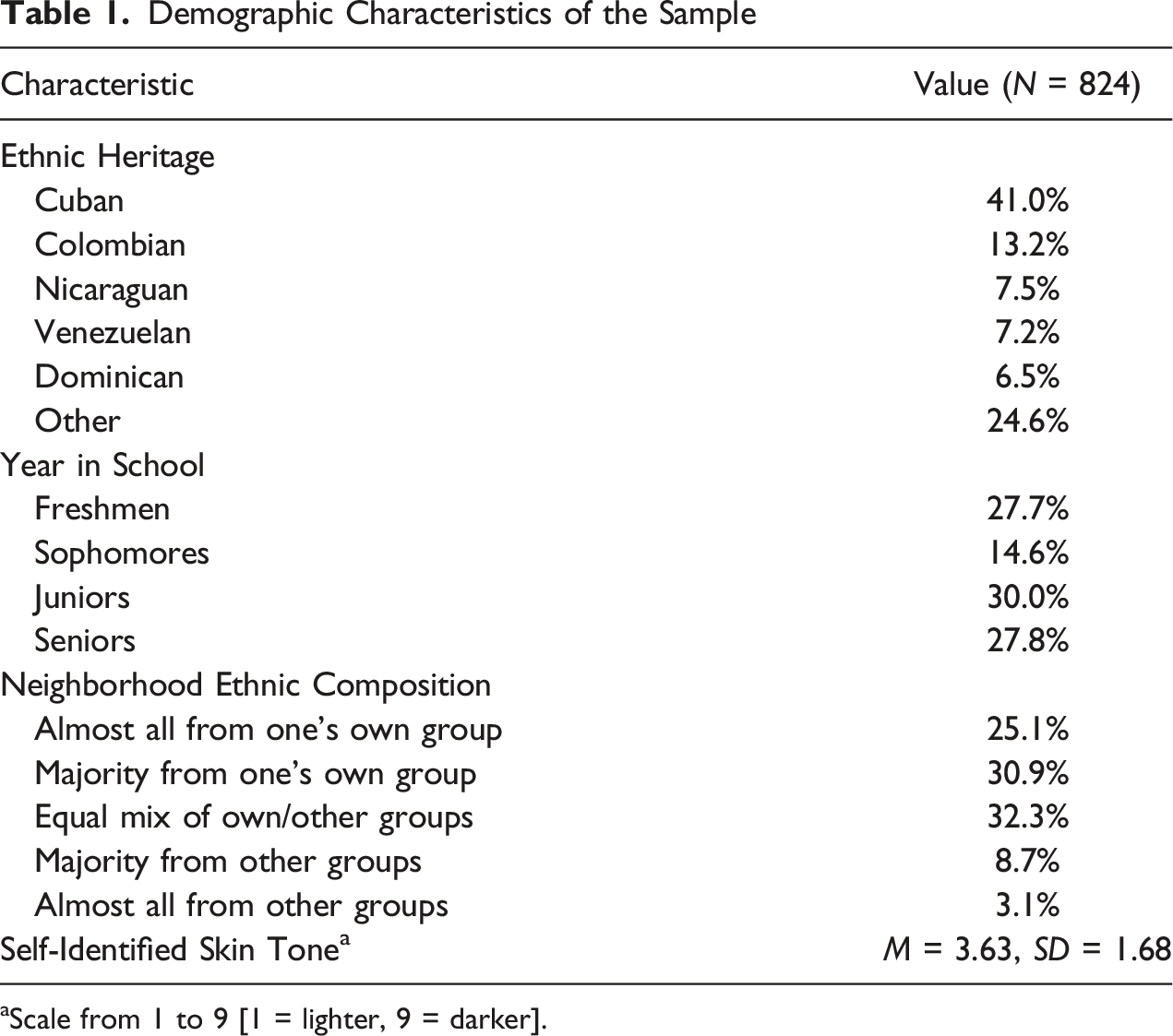
The present data were taken from a 12-day diary study of 824 Hispanic college students between the ages of 18 to 29 years (Mage = 20.9 years, SD = 2.80, 76% female). A 12-day span of time was chosen because it allows for 2 full weekends and 8 weekdays for the daily diary component of the project, which was not included in the analyses for the present article (see Meca et al., 2021; Schwartz et al., 2019; for details on the daily diary design). Approximately 65.5% of respondents were born in the United States (i.e., second-generation immigrants) and 34.5% of respondents were born outside of the United States (i.e., first-generation immigrants). Among first-generation immigrants, 71.3% arrived in the United States when they were under the age of 12 (Mage of arrival = 9.26 years old, SD = 5.88).
Demographic Characteristics of the Sample
aScale from 1 to 9 [1 = lighter, 9 = darker].
Procedure
Data were collected from undergraduate students in the psychology department at a public university in Miami whose student body is 65% Hispanic. The 12-day diary study took place in the fall of 2015. Participants completed online surveys over the course of 12 days and were divided into 10 consecutive cohorts, with approximately 90 participants in each cohort. More specifically, 12-day spans of data collection were staggered across 10 cohorts spaced about 1–2 weeks apart. For each cohort, the survey was sent out to participants at 3 AM on the first day to allow an entire day for participants to complete the surveys. The first survey was sent out on a Thursday and the last survey was completed on a Monday. Full measures were only provided on Day 1 and Day 12. All students signed an online informed consent form before participating in the study.
Measures
For assessing participant’s cultural stressors, three different measures of perceived discrimination, bicultural stress, and negative context of reception were used. Responses for each cultural stress variable were summed, whereby a higher score indicated greater levels of the corresponding cultural stressor. All measures were provided in English, given that students were attending university in English. It is important to note that, among the three indicators of cultural stress, two are aimed at the experience of the individual (discrimination and bicultural stress) and one is focused more so on prejudice from the larger society (negative context of reception).
Perceived Discrimination
The 7-item Perceived Discrimination Scale was used to measure perceptions of discrimination as a result of one’s ethnic heritage (Phinney et al., 1998). Sample items include, “How often do you feel that others behave in an unfair or negative way toward your ethnic group?” and “To what extent do you feel that you are not accepted by other Americans?” Response categories used a 5-point Likert-type scale, ranging from 0 (not at all) to 4 (almost always). On Day 1, α = .87/ω = .86, and on Day 12, α = .89/ω = .89.
Bicultural Stressors
The 20-item Bicultural Stress Scale was used to measure stress related to one’s ethnic heritage culture, as well as the national U.S. culture (Romero & Roberts, 2003). Sample items include, “I do not feel comfortable with people whose culture is different than my own,” and “I have felt that I need to speak Spanish better.” Response categories were on a 5-point Likert-type scale, ranging from 0 (Strongly disagree) to 4 (Strongly agree). On Day 1, α = .84/ω = .82, and on Day 12, α = .88/ω = .87.
Perceived Negative Context of Reception
A 6-item scale was used to determine participants’ perceived challenges and feeling unwelcome in the receiving society (Schwartz et al., 2014). Sample items include, “I don’t have the same chances in life as people from other countries,” and “People from my country are not welcome here.” Response categories were on a 5-point Likert-type scale, ranging from 0 (strongly disagree) to 4 (strongly agree). On Day 1, α = .83/ω = .81, and on Day 12, α = .87/ω = .87.
Hybrid and Alternating Cultural Identity Styles
HIS and AIS of biculturalism were assessed using the Multicultural Identity Styles Scale (Ward et al., 2018). The scale consists of two subscales: the 7-item HIS (On Day 1, α = .89/ω = .90; on Day 12, α = .93/ω = .93) and the 7-item AIS (On Day 1, α = .84/ω = .84; on Day 12, α = .87/ω = .87). Sample items for HIS include, “I see myself as a culturally unique mix of Hispanic and American,” and a sample item for AIS is, “I alternate between being Hispanic and American depending on the circumstances.” Response categories were on a 5-point Likert-type scale, ranging from 0 (strongly disagree) to 4 (strongly agree).
Covariates
Following Schwartz et al. (2019), we controlled for skin tone and neighborhood ethnic composition. Skin color was assessed using a “thermometer” with different skin tones, ranging from 1 (extremely light) to 9 (extremely dark). For neighborhood ethnic composition, students were asked about the extent to which their neighborhood was comprised of, “almost exclusively of people from their own ethnic group,” “largely of people from their own ethnic group,” “evenly mixed between their own and other ethnic groups,” “largely of people from other ethnic groups,” or “almost exclusively of people from other ethnic groups.”
Data Analysis Plan
The analytic plan proceeded in three primary steps. First, we computed bivariate correlations across study variables separately for Day 1 and Day 12. Second, we estimated a cross-lagged panel model (path analysis) using robust maximum likelihood estimation. We used robust maximum likelihood estimation to adjust for the effects of non-normality in our study variables. All constructs were included as manifest variables. Cultural identity styles on Day 12 were regressed on each of the cultural stressors on Day 1 (Figure 1, path A) and cultural stressors on Day 12 were regressed on each of the CIS on Day 1 (Figure 1, path B). Autoregressive paths were estimated, and correlations were measured among all pairs of variables for Day 1 and for Day 12. To account for covariance and correlations between variables within a wave, we specified the correlations using WITH statements in Mplus. We also included the four additional covariates (skin tone, gender, nativity, and neighborhood ethnic composition) predicting each Day 12 outcome. We then trimmed the model (for reasons of parsimony) by omitting nonsignificant demographic covariate effects. This was the case for ethnic neighborhood composition, which was neither related to cultural stressors nor CIS. Additionally, we did not specify paths or correlations from demographic covariates to Day 1 predictor variables; we did not allow Day 1 values of each cultural stressor to predict Day 12 values of other cultural stressors; we also did not allow Day 1 hybridizing to predict Day 12 alternating and vice versa. Conceptual model of the hypothesized pathways between cultural stressors and cultural identity styles (Cross Lagged Panel Models).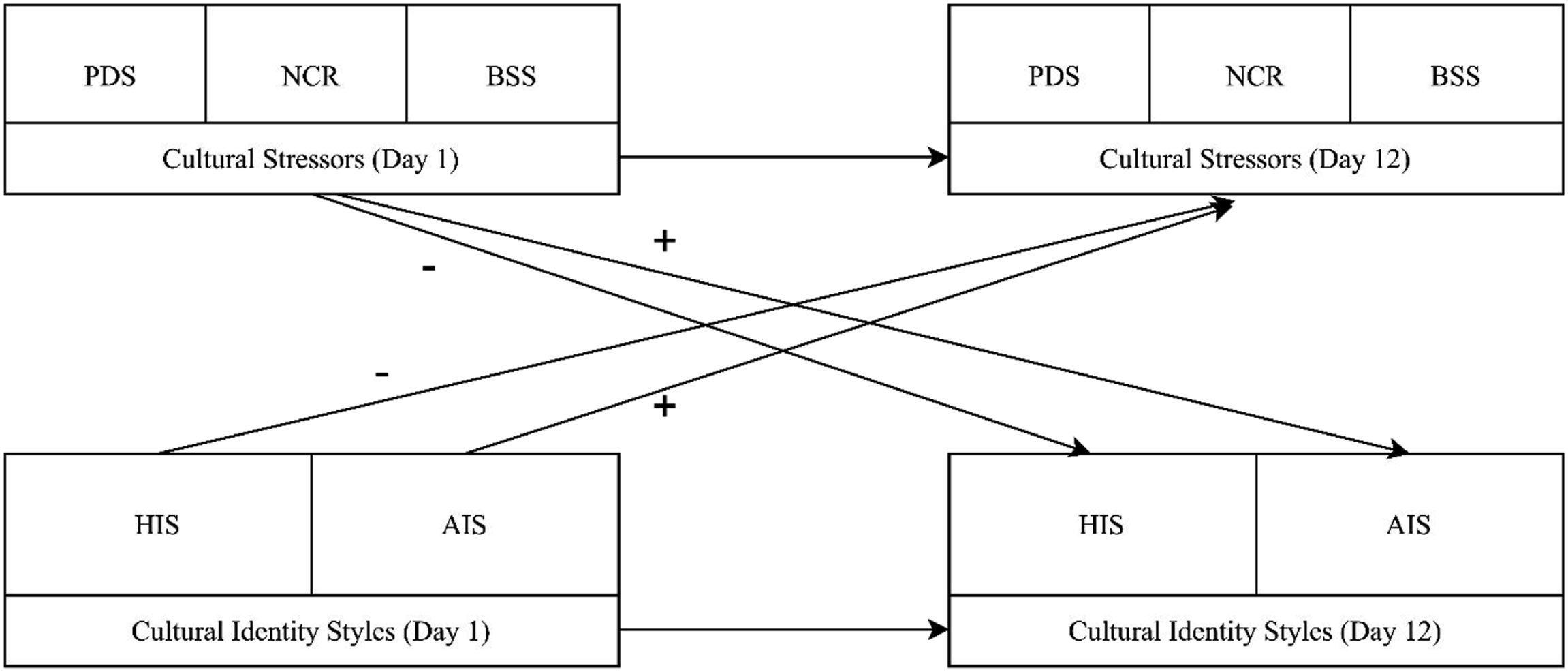
Model fit was evaluated using the chi-square statistic, the comparative fit index (CFI), the root mean square error of approximation (RMSEA), and the standardized root mean square residual (SRMR). The chi-square value tests the null hypothesis of perfect model fit; the CFI indicates the extent to which the specified model fits the data better than a null model with no paths or covariances; the RMSEA and SRMR indicate the extent to which the covariance structure implied by the model deviates from the covariance structure observed in the data. Excellent fit is represented as a nonsignificant chi-square statistic, CFI > .95, RMSEA < .05, and SRMR < .06 (Kline, 2014). Adequate fit is represented as CFI > .90, RMSEA < .08, and SRMR < .10. The chi-square statistic tends to be overpowered in all but the simplest models, so it is generally reported but not used in interpretation (Kline, 2014).
As a final step of the analysis, we conducted standard invariance analyses across gender and nativity (U.S.-born vs. foreign-born). For each of these comparisons, we estimated two models; one with all cross-lagged paths free to vary across groups, and a second with all cross-lagged paths constrained equally across groups. The difference in fit between the constrained and unconstrained models was examined using the chi-square difference test (Δx2) as well as change in CFI (ΔCFI) and RMSEA (ΔRMSEA; see Putnick & Bornstein, 2016, for a review of invariance testing procedures). The null hypothesis of invariance failed to be rejected provided that Δx2 is nonsignificant and both ΔCFI and ΔRMSEA are less than .01. All analyses were conducted using Mplus version 8 (Muthén & Muthén, 2018).
Results
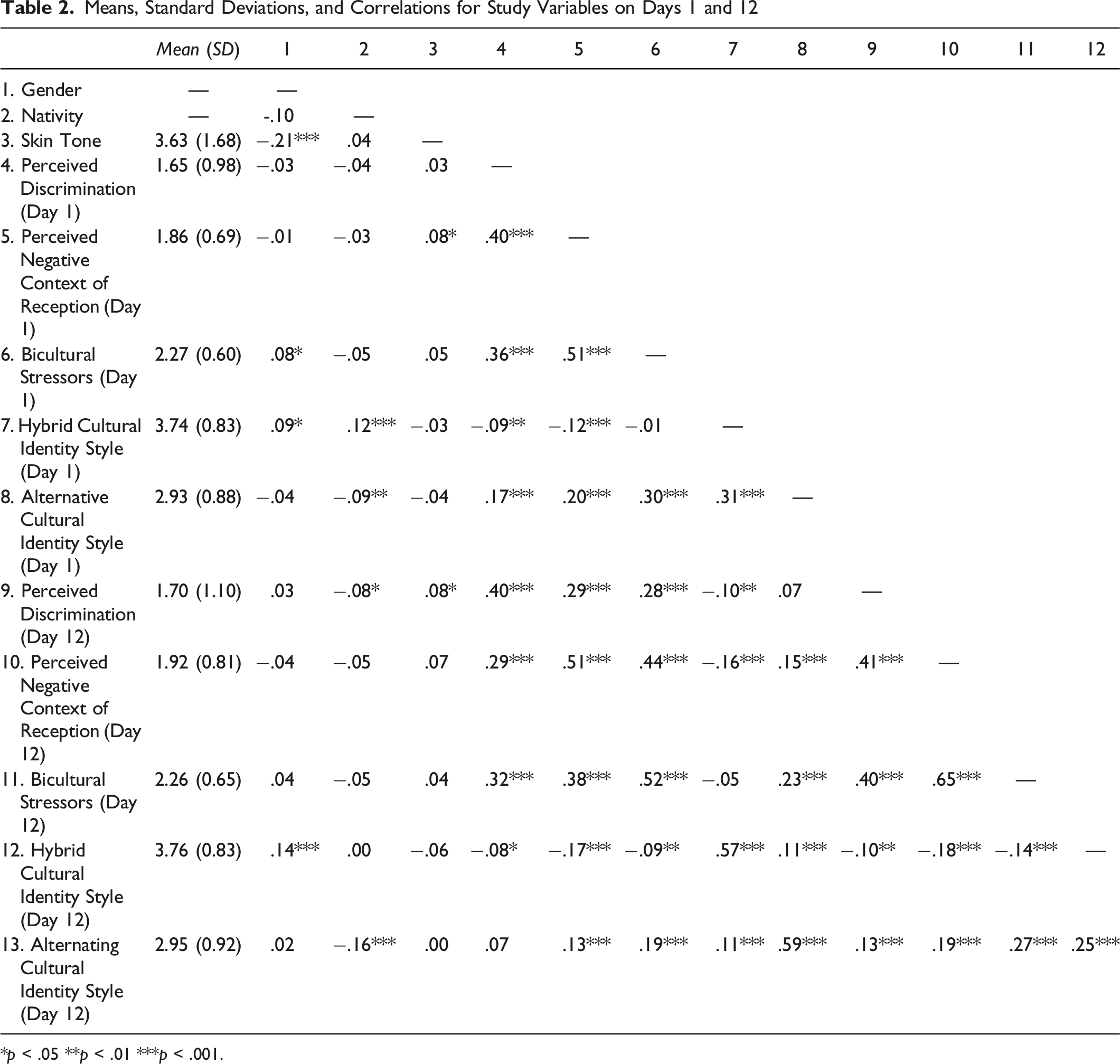
Means, Standard Deviations, and Correlations for Study Variables on Days 1 and 12
*p < .05 **p < .01 ***p < .001.
Autoregressive and Cross-Lagged Path Estimates (Controlling for Skin Tone, Gender, and Nativity)
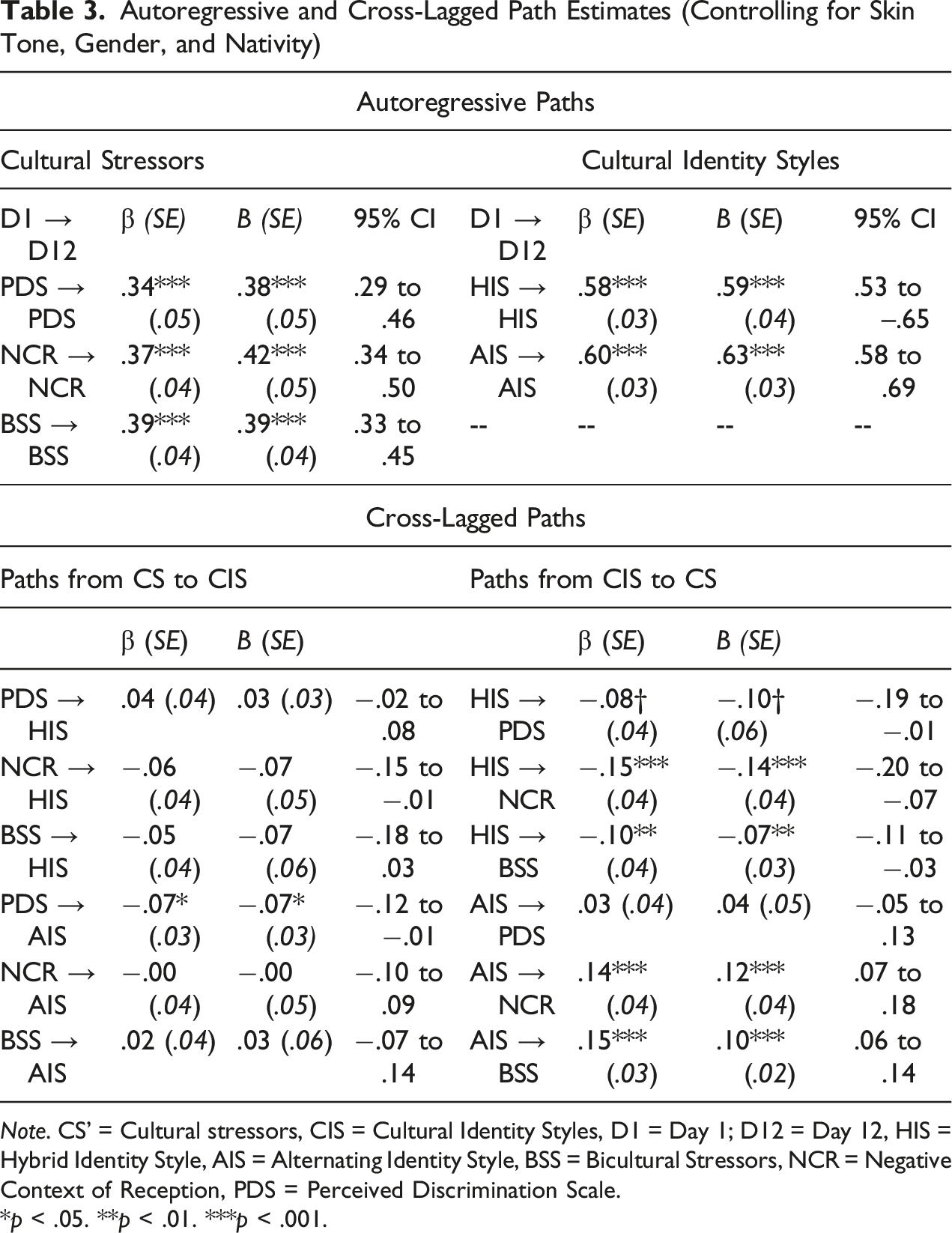
Note. CS’ = Cultural stressors, CIS = Cultural Identity Styles, D1 = Day 1; D12 = Day 12, HIS = Hybrid Identity Style, AIS = Alternating Identity Style, BSS = Bicultural Stressors, NCR = Negative Context of Reception, PDS = Perceived Discrimination Scale. *p < .05. **p < .01. ***p < .001.
In terms of covariates, our results indicated only a few significant paths: Gender was a predictor of HIS (β = .10, p = .004), and gender (β = .07, p = .090) and skin tone (β = .09, p = .047) were marginally significant predictors of discrimination. These findings suggest that female students were more likely to use HIS and that people with darker skin tones reported higher discrimination. Moreover, both HIS (β = .08, p = .017) and AIS (β = .13, p < .001) were predicted by nativity, indicating that older generations are more likely to use both CIS than first generation students. No other significant covariate effects emerged.
Finally, we examined potential variance by gender and nativity. The baseline unconstrained model (x2(36) = 119.781, p < .001; CFI = .932, RMSEA = .077) and constrained model (x2(48) = 129.583, p < .001; CFI = .934, RMSEA = .066) for gender, indicated acceptable fit to the data. Similarly, the baseline unconstrained model (x2(36) = 108.985, p < .001; CFI = .939, RMSEA = .058) and constrained model (x2(48) = 118.994, p < .001; CFI = .941, RMSEA = .060) for nativity, also provided reasonable fit to the data. Invariance tests indicated that the cross-lagged panel model fit equivalently across sex (Δx2(12) = 8.55, p = .74; ΔCFI = +.002; ΔRMSEA < .01) and nativity (Δχ2(12) = 6.30, p = .90; ΔCFI = .002; ΔRMSEA = .002). Therefore, the model parameters presented here can be assumed to be equivalent between men and women, and between U.S.-born and foreign-born participants.
Discussion
The present study was the first to use a short-term longitudinal design to examine the directional relations between cultural stressors and CIS within a sample of Hispanic college students. Overall, we found that, over a 12-day period, CIS on Day 1 predicted perceived negative context of reception, discrimination, and bicultural stressors on Day 12. Among the cultural stressors, discrimination emerged as the only significant predictor of the alternating identity style. As such, these findings provide strong empirical support for CIS as predictors of perceived cultural stressors rather than vice versa.
The auto-regressive paths within the cross-lagged panel model indicated moderate temporal stability of cultural stressors and moderately high stability of identity styles across a short time span. Theoretically, these results can imply that cultural stressors are more variable whereas CIS are a bit more stable. These results align with prior studies and theory (e.g., Szabó & Ward, 2020; Ward et al., 2018), which underscore the dynamic nature of these constructs and their susceptibility to change based on contextual and individual variables.
In terms of cross-lagged relations, we found that managing one’s cultural identity using the HIS predicted lower levels of perceived negative context of reception, perceived discrimination, and bicultural stressors 11 days later, whereas using the AIS predicted greater perceived levels of negative context of reception and bicultural stressors over time. These findings suggest that a tendency to blend one’s heritage and destination cultural identities predicts fewer feelings of unwelcomeness, discrimination, and being caught between the two cultures, whereas alternating between one’s heritage and destination cultural identities appears to predict greater subsequent perceptions of negative context of reception and bicultural stressors. Indeed, previous studies on the HIS and AIS have shown important differences vis-à-vis outcomes (Ward et al., 2018; Ward et al., 2021), suggesting a less favorable predictive effect of the AIS on immigrants’ psychological adaptation (e.g., Firat & Noels, 2022; Yampolsky & Amiot, 2016).
For individuals utilizing the HIS to greater extents, it is possible that perceiving greater congruence between their cultural identities allows for less threatening perceptions of the social context. Ward et al. (2018) found that a HIS was directly related to cultural identity consolidation and well-being. In this way, our findings add to those prior studies, suggesting that Hispanic college students with higher hybrid style scores, and therefore with more consolidated cultural identities, may perceive less threat from the larger social context and may be better able to manage and respond to social cues over short periods of time. Personal factors might also help explain these results. For example, in a study with Indian and Filipino New Zealanders, Szabó and Ward (2020) identified intercultural abilities as potential antecedents of CIS. Their findings suggested that people with higher levels of intercultural effectiveness (e.g., being able to interact effectively with people from diverse backgrounds and to manage different intercultural settings) were more likely to adopt a HIS. Thus, it is possible that more advanced intercultural abilities help people to avoid situations where discrepancies between the two groups arise and, as a result, to encounter fewer occasions where culturally stressful encounters (e.g., discriminatory behavior) and events are likely to occur.
In contrast, our findings also indicated that an AIS may be less functional for Hispanic college students and support prior work suggesting that greater discomfort with managing multiple cultural identities may predict poor psychological adjustment (Firat et al., 2022; Ward et al., 2018, 2021). In the present sample, it is possible that students who more frequently used an AIS perceived less congruence between their two cultures, and therefore tended to experience greater amounts of cultural stress. The literature highlights two aspects of alternating orientations that may carry different implications for well-being (Comănaru et al., 2018). The first aspect refers to cultural frame-switching, which is the process of shifting from one cultural knowledge system to another based on situational demands (West et al., 2017). The second aspect refers to the suppression or concealment of social identities that may be viewed as undesirable or stigmatized (Yampolsky & Amiot, 2016). If this second type of alternating occurs in a way that is not completely authentic toward the self, this alternating process can be stressful (Zhang & Noels, 2013). In turn, this resulting stress can also lead to more conflicts with family or heritage community members, which may prompt greater bicultural stress. Indeed, West et al.’s (2018) results indicated that frame-switching bicultural individuals are seen as less authentic and less likeable, trustworthy, and warm by members of the “mainstream.” Thus, it may be the case that they do actually experience more negative context of reception. Furthermore, as described above, individuals who alternate more frequently may be less interculturally competent. Intercultural competence has been positively associated with adaptive functioning, and by extension, mental health (Driscoll & Torres, 2020). Consequently, people who are less culturally effective or have difficulties while culturally frame-switching may be more likely to experience unfavorable encounters with members of the mainstream cultural group, which can trigger feelings of discrimination and marginalization.
We also found a small marginally significant negative predictive effect of discrimination on the alternating style. This was unexpected, given that correlations between perceived discrimination and AIS were positive and significant on both Days 1 and 12. These results are inconsistent with those from a study of immigrant and minority youth in New Zealand and Israel (Qumseya, 2018) identifying antecedents and outcomes of CIS. Qumseya found that perceived discrimination predicted greater AIS, but not HIS, in these national contexts. Moreover, our results also appear to partially contradict those reported by Firat & Noels (2022), who found that higher perceived discrimination predicted higher bicultural alternating among a sample of immigrants in Canada. One explanation for this discrepancy might be the fact that Firat & Noels’ (2022) study used cross-sectional data and was conducted in a different country with a different set of immigrant groups. With respect to Qumseya’s (2018) study, the effect size they reported was very small, and their work was also conducted in a different cultural context. It is possible that the setting where our study was conducted may have affected the results. Further longitudinal or experimental studies may help to elucidate the nature of the relationship between perceived discrimination and AIS both within and beyond Hispanics in the United States.
Lastly, we found that only gender and nativity status emerged as predictors of CIS. Our finding that women reported greater use of the HIS is not consistent with prior studies (e.g., Ward et al., 2018), although gender differences in acculturation processes are common (e.g., Falicov, 2013). In contrast to the United States, many Hispanic cultures are characterized by sharp distinctions in gender roles, perhaps complicating the cultural adjustment process (Diekman et al., 2005). Moreover, darker skin tones marginally predicted perceived discrimination, which is consistent with prior studies (e.g., López, 2008). This result can be explained by the assumption that darker skin tones are subjected to more negative stereotypes and, hence, to more perceived discrimination experiences (Keith et al., 2017). Finally, our results for nativity indicated that being U.S. born was associated with the use of both CIS. This result is partly consistent with Ward et al.’s (2018) results reporting that the HIS was more prevalent in second and later generation individuals. As the evidence regarding nativity status and AIS use is inconsistent, the positive relation between U.S.-born status and AIS requires replication before additional confidence can be placed in this finding. However, we assume that these findings result from the fact that foreign-born individuals have less experience negotiating bicultural identities than U.S.-born individuals, who have assumedly been managing their two cultural identities for the vast majority of their lives.
Limitations
The present findings should be interpreted in light of several limitations. First, it is important to consider the contextual factors where the study occurred. The present study was conducted among U.S. Hispanic college students within a highly bicultural context, where nearly 70% of the city’s (and university’s) population is of Hispanic descent. We do not know whether our results might have been different had we conducted the study in other parts of the United States or elsewhere in the world. It should also be noted that the sample was derived from the largest Hispanic-serving university in the United States. Miami in general is also unique in that it is home to individuals from many different Hispanic nationalities (Aranda et al., 2014), including Cubans, Colombians, Venezuelans, Nicaraguans, Hondurans, Dominicans, and Peruvians. The present results might have been different in other heavily Hispanic U.S. cities, such as New York City (where the Hispanic population is largely Puerto Rican and Dominican) or Houston or Los Angeles (where the Hispanic population is largely Mexican). Such contextual variations may apply not only to the United States but also to immigrants in other countries as well.
Second, the fact that 76% of the sample is female is an important limitation that restricts generalizability of the present results. This gender imbalance is a result of using a psychology student participant pool, in which the majority of the enrolled students in psychology programs are currently female. According to the data of the Center for Workforce Studies (2015), women are overrepresented across the social sciences. Although the over representation of women is a limitation, and although the men in our sample may not have been representative of male students from other disciplines, the size of our sample is sufficient to conduct invariance analyses (Kline, 2011). Nonetheless, we do not know whether our findings can be safely generalized to Hispanic male students from other academic majors (e.g., business, engineering, physics). Further work is necessary to examine this generalizability issue.
Third, although we used validated measures of discrimination and negative context of reception, these measures do not specify the source of the perceived discrimination or of the poor reception context. It is important for future work to distinguish between perceptions of outgroup discrimination and negative reception from other ethnic groups versus ingroup discrimination and negative reception from other Hispanic groups. It is likely that ingroup and outgroup discrimination and exclusion would have different effects on bicultural identity processes.
Fourth, as is inherent in biculturalism-based models, we implicitly assumed that participants were integrating only one heritage cultural stream and only one destination cultural stream (Schwartz et al., 2017). Such an assumption may not hold in a variety of situations, including those in which individuals may be managing multiple heritage-cultural streams (such as Japanese-origin Peruvians who migrate to the United States) or multiple destination-cultural streams (such as migrants to Montreal, who must incorporate both Anglophone and Francophone cultural streams into their sense of identity; Downie et al., 2004). Future work should examine how such tricultural individuals manage their three cultural identities across time.
Fifth, it is important to note that the cross-lagged panel analyses have been widely discussed in the literature (Hamaker et al., 2015; Mulder & Hamaker, 2021). For example, it has been criticized that cross-lagged panel models conflate within- and between-person effects (Mulder & Hamaker, 2021). Moreover, cross-lagged panel models do not control for unmeasured confounding variables that may be stable across time (Usami, 2021). Thus, it is possible that cross-lagged panel models can provide biased estimates, particularly in the presence of unmeasured confounding variables. Therefore, our results should be interpreted with caution, as alternative random-intercept cross-lagged panel models are recommended. However, for random-intercept cross-lagged panel models, at least three time points are needed. Thus, future studies with more time points applying the random-intercept-cross-lagged analyses can disentangle the directionality between CIS and cultural stressors while disentangling within- and between-person sources of variance.
Lastly, the span of time examined in the present study was brief (12 days). Although there is clearly value in examining the interplay between cultural stressors and CIS over short spans of time, it may be important for future studies to replicate our study using longer intervals of time to examine the extent to which the study findings might differ across various time spans. Therefore, future studies may investigate the interrelations between identity styles and cultural stressors in various contexts and across different time periods.
Implications for Practice, Advocacy, Education, Training, and Research
Findings from the present study carry potential implications for counseling. Specifically, we found that students’ use of a HIS was predictive of lower cultural stress experiences. To prevent feelings of unwelcomeness, perceived discrimination, and being caught between one’s two cultures, practitioners may consider utilizing interventions that promote the blending of students’ heritage and destination cultural identities. It is well-known that holding a consolidated and integrated cultural identity is the most adaptive form of cultural negotiation in terms of its consistent relationship to positive outcomes (Benet-Martínez et al., 2021; Schwartz, 2007; Ward et al., 2018). This pattern of findings is especially salient for Hispanic populations, who are tasked with negotiating multiple cultural streams and where doing so often entails frequent experiences of cultural stress based on their cultural identities (e.g., ethnicity, language, values; Chavez, 2013). Thus, psychologists may explore students’ sense of cultural identity and the ways in which they navigate multiple, often conflicting, cultural streams.
Psychologists should be aware of how their clients manage their cultural identities, understand why clients use a particular strategy in specific situations, and work to address the client’s underlying issues through cultural identity management. Understanding what is preventing someone from hybridizing and working to remove that barrier, as opposed to simply telling them to hybridize more—or helping clients to be more aware of the strategies they use and when to use them—may represent an especially efficient approach for clinicians to use with Hispanic college students. Helping clients understand how hybridizing or alternating makes them feel, the thoughts they have when they use a strategy, and the behaviors these strategies elicit could empower them to engage in these strategies more effectively. Such an approach may also help students to identify positive ways of coping with stressors that challenge their cultural identities while also identifying salient sources of support (family, peers, community) that will assist them in maintaining a consolidated cultural identity (Cobb et al., 2019). Helping students to promote a more adaptive blending of heritage and destination cultural identities can serve as an effective coping tool when faced with rejection based on one’s cultural identity.
Such an approach should also be integrated into the education and training of (prospective) counselors. It is important to convey to counselors that it is necessary to reflect on clients’ (and their own) CIS and cultural stressors as well as to be sensitive to how identity management may impact one’s perceptions of cultural stress. Integrating theoretical inputs via readings and encouraging students to discuss topics such as CIS and cultural stressors in training may enhance (prospective) counselors’ multicultural competence. In terms of research implications, we have not only demonstrated the presence of short-term dynamics between CIS and cultural stressors, but we were also able to determine the directionality of these short-term changes. Thus, these findings carry significant implications for future studies, as they shed light on the important theoretical advancements regarding short-term dynamics and directionality. To date, these variables have predominantly been assessed either cross-sectionally or over longer periods of time. However, this study demonstrates that such dynamics can occur within short timeframes and in a certain direction. Despite these potential advances, more research is needed to fully understand the patterns of associations between CIS and cultural stressors. Particularly, now that we have gained a greater understanding of shorter-term dynamics, more work examining these relations with longer-term longitudinal designs, and with experimental designs, may further elucidate the developmental links between cultural stressors and CIS among the Hispanic college student population.
Footnotes
Declaration of Conflicting Interests
The author(s) declared no potential conflicts of interest with respect to the research, authorship, and/or publication of this article.
Funding
The author(s) received no financial support for the research, authorship, and/or publication of this article.
Ethical Statement

Data Availability Statement
The data that support the findings of this study are available from the corresponding author upon reasonable request.