



Abstract
Counseling psychology increasingly centers addressing and dismantling anti-Black racism and White supremacy among its values. It is unclear, however, whether training programs are attending to antiracist paradigm shifts. We conducted a study of counseling psychology programs’ attention to antiracism and White supremacy. Students and faculty in counseling psychology programs were asked to complete an online survey. Faculty were also asked to submit multicultural course syllabi. Qualitative results demonstrate that syllabi (N = 29) generally do not reflect modern antiracist paradigms. Both faculty and student participants (N = 179) rate their programs as above-average on social justice and antiracism commitments, social justice program norms, and multicultural training, but students (n = 127) observed greater discrepancies between what their programs claim to do and what their programs actually do; and, faculty (n = 52) rate their programs more positively than students. There also appeared to be individual-level differences in ethnic-racial identity, such that White students were more critical of Whiteness.
Qualitative findings suggest that multicultural counseling syllabi in counseling psychology programs do not reflect modern advances in antiracism theory and research. Quantitative findings suggest that faculty rate their programs as above-average on social justice and antiracism commitments, social justice program norms, and multicultural training whereas students reporte greater discrepancies between what their programs claim to do and what their programs actually do. A more intentional focus on antiracism and social justice is needed in training programs.Significance of Scholarship to the Public
Introduction
Counseling psychology has long served as a leader in cultural responsiveness movements within psychology. The multicultural competence (MCC) movement, for instance—which nearly 40 years later continues to serve as the primary frame for cultural responsiveness—was first delineated by Sue et al. (1982) as part of a Society of Counseling Psychology (SCP) initiative published in The Counseling Psychologist. Counseling psychologists have since led in the research, teaching, and practice of MCC, culturally responsive care more broadly, and social justice (see DeBlaere et al., 2019, for a review). However, work in the 2000s and early 2010s began to highlight three primary concerns. The first concern was that there were serious limitations to the operationalization and implementation of MCC (e.g., Worthington & Dillon, 2011; Worthington et al., 2007). The second was that greater attention was needed not only to culturally responsive care but also social justice (e.g., Baluch et al., 2004; Speight & Vera, 2004; Vera & Speight, 2003). Third, despite these repeated concerns, training programs still often relied on the oversimplified operationalization of MCC in multicultural training, with a focus on individual differences (e.g., Pieterse et al., 2009).
Even more recently, counseling psychology scholars have critiqued not only the lack of social justice training in counseling psychology, but also the individualized and sanitizing approaches to social justice that pervade existing social justice training (DeBlaere et al., 2019; Grzanka et al., 2019; Gushue et al., 2022; Keum & Miller, 2020). There have been repeated and renewed calls for counseling psychologists to be trained to conceptualize clients and systems in the context of oppressive institutions and the structures that create the very problems upon which they seek to intervene, as well as strategies to intervene at multiple levels (e.g., DeBlaere et al., 2019; Gushue et al., 2022; Keum & Miller, 2020; Wilcox, 2023; Wilcox, Shaffer, et al., 2022). To be sure, counseling psychology has clearly adopted social justice as a central value, and many of its training programs have sought to advance social justice training (see the 2014 special issue of The Counseling Psychologist on nontraditional teaching methods for social justice; e.g., Koch & Juntunen, 2014). Some recent empirical research has identified such training program factors associated with students’ social justice advocacy intentions. For example, Keum and Miller (2020) and Keum et al. (2022) found that program-level (i.e., group-level) social justice norms influence individual students’ social justice advocacy intentions, such that the stronger the collective student and perceived faculty social justice norms, the stronger the individual student’s advocacy intention. Keum et al. (2022) also found evidence that, when a program’s students congruently perceive their program’s faculty as high in social justice norms, it positively influenced individual students’ advocacy behaviors; however, in contrast to advocacy intentions, advocacy behaviors appeared to be the hardest to predict and influence.
They and others (e.g., DeBlaere et al., 2019; Gushue et al., 2022; Keum & Miller, 2020; Wilcox, 2023; Wilcox, Shaffer, et al., 2022) have argued that the discrepancy between intention and behavior may result from inadequate training in advocacy and systems-level knowledge, especially how systems of oppression (e.g., White supremacy) operate historically and contemporarily. Gushue et al. (2022) noted that it is possible—indeed, likely the default for most people—to deeply believe in egalitarianism but lack the ability to critically analyze why racial and social inequities remain pervasive. Such uncritical egalitarianism is essentially White liberalism, a White supremacy-enabling ideology that lends an appearance of addressing racism and social inequity via vague and decontextualized descriptions of racial disparities in the absence of critical understanding or concrete solutions (Franks et al., 2021). Gushue et al. (2022) argued that the key, then, to adequate social justice training in counseling psychology is intentional critical consciousness-raising. Gushue et al. found that when counseling psychology students had higher levels of critical consciousness, they had lower levels of color-blind racial attitudes and, in turn, greater social justice self-efficacy, interests, outcome expectations, and commitment.
Reynolds (2022) and Wilcox (2023) argued that scholars of Color have provided a myriad of pedagogical tools that, despite answering repeated calls for concrete social justice recommendations, nonetheless are not integrated into the curricula and collective understanding, resulting in the lack of adequate education and training posited by the above-referenced scholars. We argue that, just as Reynolds (2022) described the SCP processes, counseling psychology training programs may make efforts toward social justice but, in the absence of structural or institutional change, they fade with time. It is perhaps for these reasons that the needle, as it pertains to outcomes, seems to have been largely stagnant for four decades.
As for training outcomes, much has been written about social justice pedagogy in counseling psychology, including a two-part special issue of The Counseling Psychologist in 2014 (see Koch & Juntunen, 2014). Yet, counseling psychology students have consistently highlighted inadequate attention to social justice training and called for greater, genuine social justice education and training (e.g., Baluch et al., 2004; Beer et al., 2012; Singh et al., 2010; Olle, 2018). As for practice outcomes, clients of Color still terminate therapy early at higher rates than White clients (Owen et al., 2011) and, despite their belief about their own MCC, many therapists do not actually integrate sociocultural factors into their client conceptualizations (Hereford et al., 2023; Monceaux et al., 2020; Wilcox et al., 2020). The lack of attention to cultural concerns in therapeutic conceptualization is not surprising. In fact, it may be considered the natural outcome of having operationalized MCC not only simply in terms of knowledge, awareness, and skills, but specifically knowledge and awareness of discrete facts about “other” groups at the individual and community levels and awareness inasmuch as we may not be aware of these “facts.” For example, a primary focus on the racial identity development stage, family structure, and spirituality of African Americans (Sue et al., 2022), rather than a focus on the ways in which structural racism and racism-related trauma have influenced their clinical concerns, keeps the focus on the individual rather than racist systems. In Sue et al.’s book (2022), there is now a chapter on systemic oppression and sections on discrimination, but this arguably is not the primary frame. If we are not teaching them to, how can therapists integrate historical and contemporary sociocultural factors into conceptualization?
Critical to note about the MCC framework, however, is that this individual difference-focused operationalization was not actually an inherent flaw. Indeed, in their original writing, Sue et al. (1982) noted: “The belief in ‘rugged individualism’ and that the person is responsible for [their] own lot in life hinders a more realistic understanding of the influence of culture and sociopolitical influences” (p. 47, italics in original). Thus, the origins of the MCC movement are rooted in understanding the link between structural oppression and individual-level maladjustment. That the model became reductionistic as it was popularized, too, is not surprising. Critical theorists Horkheimer, Adorno, and Marcuse noted that “… the extent to which a work becomes popular—regardless of its political message—is the extent to which its radical impulse will be integrated into the system” (Bronner, 2017, p. 5); and the MCC model indeed became very popular.
The squelching of the radical impulse of movements for both social justice (DeBlaere et al., 2019) and intersectionality (Grzanka, 2020; Grzanka et al., 2017) in counseling psychology as they became popularized has similarly been the case. Much has been written about the need for social justice in counseling psychology. The newest iteration of the American Psychological Association (APA) Multicultural Guidelines (APA, 2017) even advocates for a multilevel approach that both takes into consideration and addresses systems-level (which is to say, sociopolitical) concerns. Yet, again, the needle as it pertains to outcomes has barely moved (DeBlaere et al., 2019). Pieterse et al.’s (2009) review of multicultural counseling course syllabi demonstrated that although instructors were beginning to integrate content related to social justice, rarely were they addressing psychologists’ roles in actual social change. As a result of this popularizing and squelching, several movements meant to address structural oppression and sociopolitical determinants can be traced through the modern history of counseling psychology, yet the extent to which there has been actual change benefiting those they seek to serve is questionable.
We posit that these movements 1 have been, in order, the MCC movement beginning in 1982 and dominating the 1980s and 1990s (e.g., Sue et al., 1982, 1992), the Social Justice movement of the early to mid-2000s (e.g., Baluch et al., 2004; Speight & Vera, 2004), the Privilege (e.g., Hays et al., 2007; Israel, 2012), Intersectionality (e.g., Lewis et al., 2013, 2017; Parent et al., 2013; Sarno et al., 2015), and Understanding Whiteness (e.g., Spanierman et al., 2008) movements of the early and mid 2010s, the White Allyship and Critical Race/Critical Whiteness movements of the late 2010s (e.g., Liu, 2017; Olle, 2018; Spanierman & Smith, 2017a, 2017b), and the recent Multicultural Orientation (MCO; e.g., Davis et al., 2018; Hook et al., 2017) movement and the Addressing Antiracism and Anti-Black Racism (e.g., French et al., 2020; Hargons et al., 2017; Mosley et al., 2020, 2021) movements. By 2009, Pieterse et al. demonstrated in their syllabi review that the post-MCC movements had little place in multicultural training. Anecdotal information would suggest that not much has changed since then; notably, liberation psychology and other critical approaches would posit that the lack of integration of modern racial justice approaches is itself a feature of White supremacy, and a key component of liberation is the recovery of knowledge relegated to invisibility (Singh, 2020). However, that this relegation has continued to happen in counseling psychology is an assumption that must be examined. Each movement represents both an advance in theory as well as a lost opportunity to protect and implement actual radical change, but if we are not careful, the most recent movement toward addressing anti-Black racism will be no different.
Addressing Anti-Black Racism and White Supremacy
Amongst the renewed calls for counseling psychology to advance its social and racial justice work is former SCP President, Dr. Anneliese Singh (2020), urging that we “build a counseling psychology of liberation that centers Black liberation with every breath we take, because in working for Black liberation we all get free” (p. 112). Reynolds (2022) adds that although the “singular focus on anti-Black racism may make some uncomfortable” (p. 1136), anti-Black racism is the foundation of all other forms of racism and intersectional oppression. Anti-Black racism is arguably foundational to the United States due to its national origins in colonialism and slavery (Bell, 1992; Grzanka et al., 2019). Racism may further be defined as a multilevel system of structuring opportunity and assigning value based on physical characteristics stereotypically associated with race (Jones, 2002). The concept of racism has most often been applied to the negative attitudes and behaviors (which is to say, the individual level) directed at Black/African Americans in the United States, rooted in the notion that White people are superior (i.e., White supremacy) and Black people are inferior. Anti-Blackness devalues Blackness and systematically oppresses Black people. Systemic anti-Black racism is especially harmful to Black bodies and minds, as evidenced by extrajudicial killings of Black people and the historic misdiagnosis and thus over-pathologization of Black people. Wilkerson (2020) further highlighted that racism operates as a caste system, or a hierarchical system that layers the relative power, privilege, and opportunities of different groups from top to bottom (Wilkerson, 2020). In the United States, that means that Black individuals and communities are on the bottom, with White individuals and communities on the top, and all other ethnic/racial groups are in between. The result of the U.S. racial caste system is that only White people truly hold power, and only White people are not subjected to racism. Thus, in the United States, entire groups of people are denied access to equitable housing, education, jobs, healthcare, voting, careers, and more solely based on their race. Even within the field of psychology, racism has been foundational; for example, cognitive assessment in the United States began with Galton and Terman, whose goals were in the service of eugenics (APA, n.d.). Terman’s mentor in scientific racism, G. Stanley Hall, served as the first president of the APA (Hegarty, 2007; Winston, 2020). Eugenics served to institutionalize systemic racism and the erosion of social justice.
It is for these reasons that scholars have argued that, to address and uproot anti-Black racism, we must center the problematizing of White supremacy (e.g., Grzanka et al., 2019; Reynolds, 2022; Wilcox, 2023). Grzanka and colleagues note that to center White supremacy is not the same as centering Whiteness. Although Whiteness often problematically centers itself to avoid the redressing of White supremacy, centering White supremacy means directly confronting how Whiteness is working to maintain racial domination. White supremacy is defined as: a cultural, economic, and political system that sustains White people’s dominance over virtually all sectors of society and through which implicit and explicit ideas about White people’s superiority are reproduced through everyday dynamics in a wide variety of institutional and social settings. (Grzanka et al., 2019, p. 479)
Grzanka et al. go on to explain that the emphasis on language such as multicultural, rather than language that directly addresses White supremacy and racism, serve as “comforting diversionary tactics for White liberals” (p. 480). They argue that fighting White supremacy is an ethical imperative as well as absolutely necessary to realizing a true antiracist counseling psychology. Grzanka et al. (2019) and Grzanka (2020) further argue that the field must undertake a genuine integration of intersectionality from its original critical perspective, and that too often a reductionist approach to intersectionality pervades its work.
Inasmuch as racism is foundational to both U.S. society and psychology, so too is there a long history of antiracist advocacy and activism. If anti-Black racism is harmful to the mind, then psychologists must be trained to intervene in that harm as well as seek its prevention. As Grzanka et al. (2019) note, necessary for a true antiracist stance is a deep, honest exploration and understanding of Whiteness and White supremacy. Although counseling psychology assertively claimed a focus on social justice during the 2001 Houston Conference, scholars (e.g., DeBlaere et al., 2019; Hargons et al., 2017; Olle, 2018; Reynolds, 2022; Singh, 2020; Wilcox, 2023) have continuously called for greater integration of truly antiracist action, evidencing the lack of progress in current training programs.
Thus, we aimed to explore the extent to which these calls for greater attention to antiracism and, more recently, anti-Black racism are being heeded in counseling psychology training programs. Anti-Black racism cannot adequately be addressed without also addressing its systemic and structural determinants (i.e., White supremacy) and its complexity (i.e., intersectionality); and, specifically, without addressing the genuine complexity of these constructs rather than falling into the trap of popularization over radical change.
The Present Study
Previous research has demonstrated that multicultural education and training falls short even in its foundational, older requirements regarding diversity, much less the incorporation of later movements (e.g., Beer et al., 2012; Pieterse et al., 2009). Although counseling psychology educators have struggled to implement prior benchmarks and expectations regarding MCC (Sue et al., 1982, 1992) and social justice (Covey et al, 2013; Scheel et al., 2018), expectations have necessarily leapt forward again in light of greater societal understanding of antiracism and racial justice. To date, there has been no updated systematic review since Pieterse et al.’s (2009) review of multicultural training in counseling psychology despite the introduction of several modern movements. Thus, it is necessary to assess where training programs currently stand in this regard, to be able to identify the distance between theory and expectations and practice, and make recommendations to bridge these gaps.
Thus, four questions guided the present study. First, based on MCC syllabi in counseling psychology: Has training advanced with modern movements? Second, has counseling psychology training moved forward since Pieterse et al.’s (2009) review? We sought to address these first two questions through qualitative analysis. Our third question was: How do faculty and students view their programs’ attention to multicultural training and, specifically, to addressing antiracism, anti-Black racism, and White supremacy?
This third question yielded three quantitative hypotheses. First (3a), that participants’ ratings of the extent to which their programs address antiracism and White supremacy would be positively related to ratings of their programs’ social justice norms and multicultural training and education. As discussed below, we asked participants to rate the extent to which their program makes claims about their commitments to addressing White supremacy and antiracism, and to what extent their program demonstrates such commitments. Thus, the second hypothesis (3b) was that participants’ ratings of their programs’ demonstrations of commitment to addressing White supremacy and antiracism would be more strongly related to ratings of their programs’ social justice norms and multicultural education and training than ratings of programs claims. Third (3c), that greater distance perceived by participants between their programs’ claims and their programs’ commitments to addressing White supremacy and antiracism (as calculated using difference scores) would be inversely related to ratings of their programs’ social justice norms and multicultural training and education.
Our fourth and final question was: How do faculty and students differ on individual antiracism orientation and ratings of their programs? This question yielded three hypotheses: that students would rate themselves as higher in antiracism behaviors than faculty (4a); that students would rate themselves as farther along on ethnic-racial identity than faculty (4b); and that students would rate the extent to which their program addresses antiracism and White supremacy, and their programs’ social justice norms and multicultural training and education, more critically than would faculty (4c).
Method
Participants
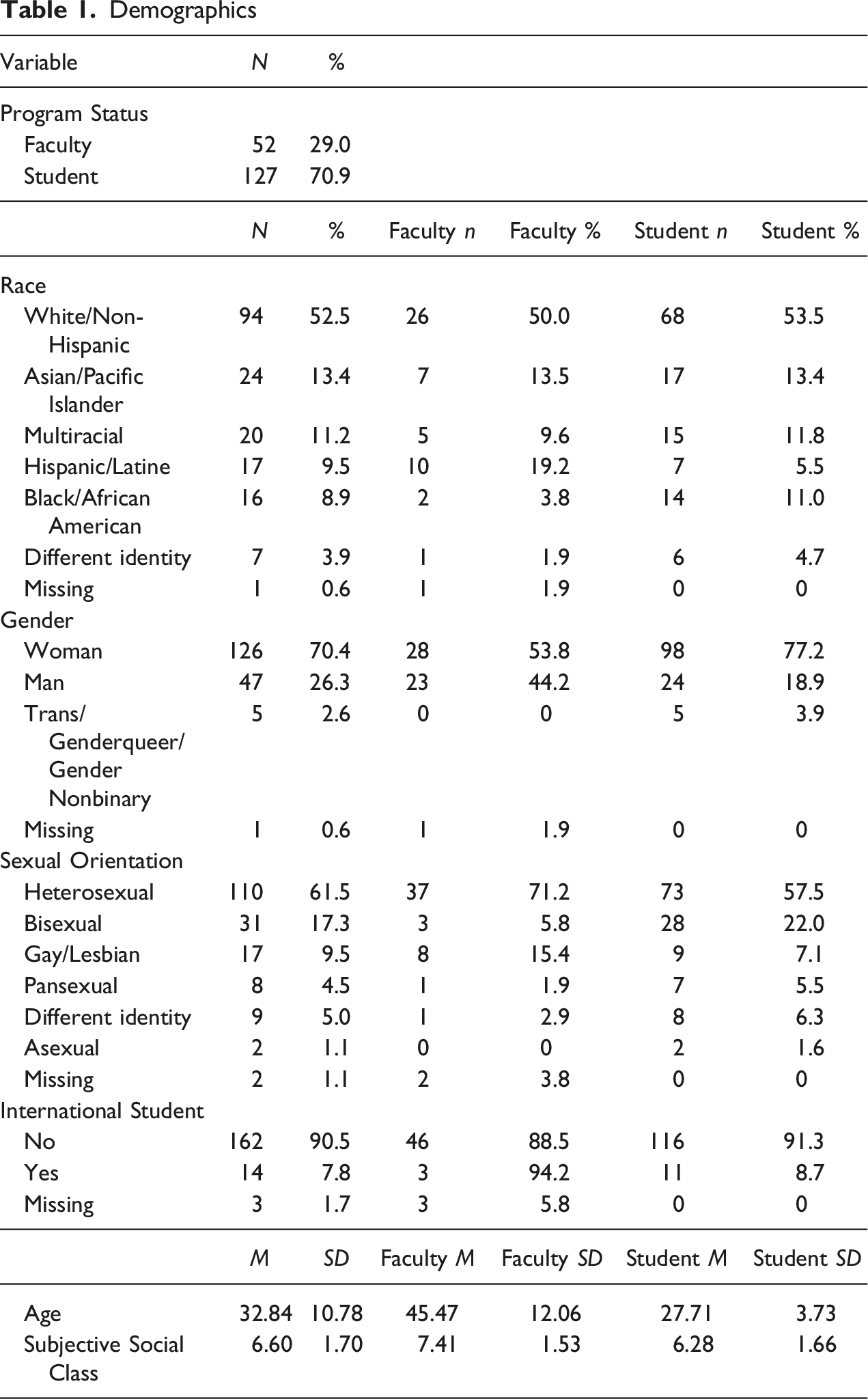
Demographics
Procedures
Upon receiving Institutional Review Board approval, we sent our recruitment email to students, faculty, and training directors at APA-accredited counseling psychology doctoral programs. Emails were sent to both individuals and listservs on numerous occasions over the course of 7 months (October 2020–April 2021). We were intentional in directly contacting at least one faculty member at each active APA-accredited counseling psychology program, including combined programs, of which there are currently 83. Although we asked participants to identify their program, we intentionally made this question optional in case some did not feel comfortable disclosing their program name; the overwhelming majority did not disclose their program, and as such we could not determine participation rates. The email to faculty and training directors asked them to also forward the recruitment email to their students. The recruitment email was also shared on the SCP Council of Counseling Psychology Training Programs (CCPTP) listservs. Participants were each asked to complete the online survey, and faculty were additionally asked to share course syllabi related to multicultural training. Participants could then enter for one of four $25 Amazon gift cards.
Measures
Multicultural Training and Education Questionnaire
To measure multicultural training at the individual level, faculty and students were asked to complete their respective version of the 22-item Multicultural Training and Education Questionnaire (MTEQ; Wilcox, Gale, et al., 2022). There are four subscales: Importance of Modelling (e.g., “My graduate training program makes clear in their written materials [e.g., handbook, website] that they consider multicultural training important.”), Clinical Application (e.g., “In my graduate program, I am/was encouraged to discuss multiculturalism with clients.”), Self-Exploration and Awareness (e.g., “My training program prompts/prompted the exploration of my own values as they relate to my clinical work.”), as well as, Education and Knowledge (e.g., “In my graduate program, I received education on social class and classism”). The scale uses a 5-point Likert-type scale ranging from 1 (strongly disagree) to 5 (strongly agree). The scale demonstrated internal consistency, divergent, and convergent validity with psychology trainees and professionals (Wilcox, Gale, et al., 2022). The Cronbach’s alphas for the subscales in the current study were .92, .92, .91, and .88, respectively.
Social Justice Subjective Norms
To measure social justice subjective norms, faculty and students were asked to complete an adapted and extended 8-item version of the Social Justice Subjective Norms (SJSN) subscale of the Social Justice Scale (Torres-Harding et al., 2012). Items were adapted to begin with “Faculty in my program…” and “Students in my program…” For example, “Other people around me are engaged in activities that address social injustices” was changed to “Faculty in my program are engaged in activities that address social injustices” and “Students in my program are engaged in activities that address social injustices.” Items are answerable on a 7-point, Likert-type scale from 1 (disagree strongly) to 7 (strongly agree), with higher scores indicating higher social justice-oriented norms. The original subscale demonstrated internal consistency, divergent, and convergent with an undergraduate and graduate student sample (Torres-Harding et al., 2012). The Cronbach’s alpha for the current study was .86.
Antiracism Behavioral Inventory
To measure antiracism awareness and behavior in study participants, we used the 21-item Antiracism Behavioral Inventory (ARBI; Pieterse et al., 2016). There are three subscales: Individual Advocacy (e.g., “I have challenged acts of racism that I have witnessed in my workplace or at school”), Awareness of Racism (e.g., “The U.S. has not acknowledged the impact of slavery.”), and Institutional Advocacy (e.g., “I give money to organizations working against racism and discrimination.”). The scale is scored on a 5-point Likert-type scale ranging from 1 (strongly disagree) to 5 (strongly agree). The original scale demonstrated sufficient reliability and validity in a sample of counseling and counseling psychology students in the United States (Pieterse et al., 2016). The Cronbach’s alpha for the subscales in the current study were .82, .83, and .45, respectively.
Cross Ethnic-Racial Identity Scale-Adult
To measure racial identity attitudes, we used the 29-item Cross Ethnic-Racial Identity Scale-Adult (Worrell et al., 2019). The scale has seven subscales: Assimilation (e.g., “I think of myself as primarily American, and seldom as a member of an ethnic or racial group”), Miseducation (e.g., “I think many of the stereotypes about my racial/ethnic group are true”), Self-Hatred (e.g., “When I look in the mirror, sometime I do not feel good about the ethnic/racial group that I belong to.”), Anti-Dominant (e.g., “I hate people from the dominant racial/ethnic group.”), Ethnocentricity (e.g., “We will never be whole until we embrace our ethnic/racial heritage.”), Multiculturalist Inclusive (e.g., “I believe it is important to have both an ethnic identity and a multicultural perspective, because this connects me to other groups [Blacks, Hispanics, Asian Americans, Whites, Jews, gays and lesbians, American Indians, etc.].”), and Ethnic-Racial Salience (e.g., “During a typical week in my life, I think about ethnic and cultural issues many, many times.”). The scale is scored on a 7-point Likert-type scale ranging from 1 (strongly disagree) to 7 (strongly agree). In a racially diverse sample, support was demonstrated for reliability and validity (Worrell et al., 2019). Observed Cronbach alphas were .91, .79, .88, .83, .73, .73, and .70, respectively.
Training Programs Questions
We developed and asked several questions related to perceptions of training programs and training programs’ claims and demonstrations of social justice and antiracism orientations. This included two items rated on a 7-point Likert-type scale ranging from 1 (disagree) to 7 (agree) the extent to which their programs claimed to be social justice-oriented and committed to antiracism, respectively, and two questions that asked participants to rate on the same scale the extent to which their programs demonstrated commitments to social justice and antiracism. We additionally presented participants with an 11-item scale written for the present study on perceptions of their graduate program’s multicultural and social justice training and environment. Participants were asked to rate on a 7-point Likert-type scale from 1 (poor) to 7 (excellent) questions such as, “How well do you feel as though your graduate program attends to and integrates antiracism education and training in the curriculum?” and, “How well do you think your program addresses systems theories related to systemic oppression, such as critical race theory or fundamental cause theory?” Internal consistency for this 11-item scale was .93.
Syllabi Review
We received 29 multicultural course syllabi and eight syllabi from other graduate-level courses. Given the small number of syllabi (n = 8) that we received from other counseling psychology courses and the diversity in those types of courses (e.g., scientific writing in counseling psychology; career development: theory, practice, and research) we opted to only use the multicultural counseling syllabi for our qualitative analyses.
Coding Team
The qualitative coding was completed by three faculty members. The first faculty member was an assistant professor in an APA-accredited combined counseling and school psychology doctoral program. The second was a full professor in an APA-accredited counseling psychology doctoral program. Finally, the third was an assistant professor in a psychology department with past experiences as a training director in an APA-accredited counseling psychology doctoral program. All three coders identified as ciswomen. Two of the coders were in their mid-30s and one in their 70s. In regard to race, one coder identified as White, one coder identified as multiracial, and one coder identified as Black.
Positionality and Reflexivity
The coding team discussed how what they knew and believed (i.e., positionality and reflexivity; Morrow, 2005) about multicultural psychology, antiracism, social justice, Whiteness studies, and intersectionality influenced the subjectivity of their coding process. They also shared how being immersed in the conversations that counseling psychology scholars are having around these topics through reading highly regarded scholarship and engaging in the SCP leadership have changed their thinking about the state of the field. Notably, two of the three coders felt that if they had coded the syllabi just 5 years ago, they would have probably coded them more favorably. Two of the coders shared that the process of coding these syllabi had led them to revise their own multicultural course syllabi to include key readings that were discussed during coding. Indeed, the process of coding provided all three authors with further movement in their own journey to train psychologists who hold these topics as core values of their personal and professional identity. Lastly, one coder shared about the generational switch when it comes to who the current experts in the field are compared to when they were in graduate school. All coders agreed that they too could improve their syllabi and would need to continuously do so as scholarship emerges within the field.
Results
Qualitative Analysis (Syllabi)
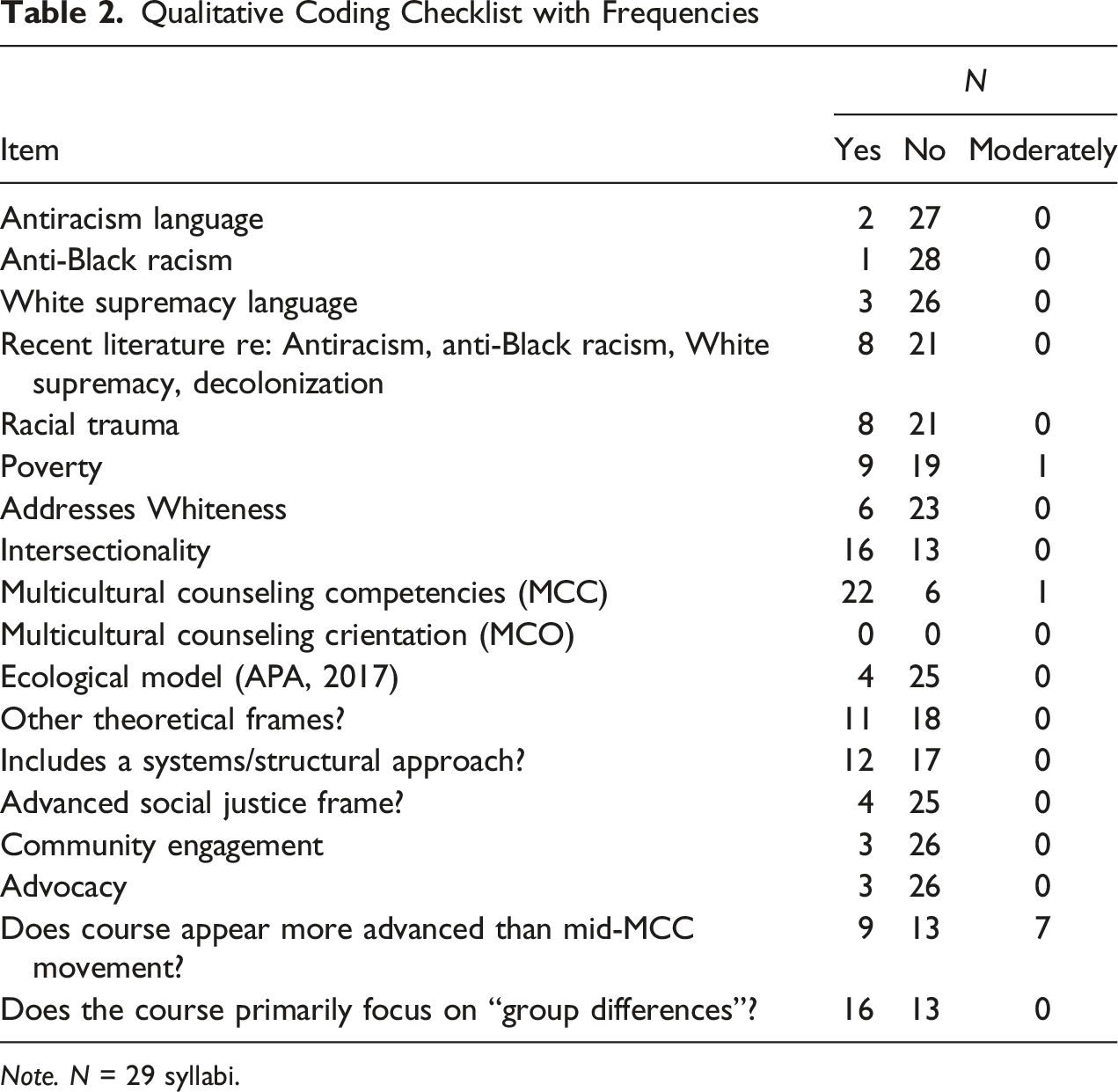
Qualitative Coding Checklist with Frequencies
Note. N = 29 syllabi.
In most instances, the coders began by searching for keywords or readings; however, the simple occurrence of the key words or readings was insufficient. Coders then looked for evidence that the concepts noted were foundational to the design and approach of the course (e.g., teaching strategies, assignments). The coders examined syllabi for evidence of training in antiracism, anti-Black racism, and White supremacy language. Specifically, they began with searching for the key words, antiracism, anti-Black racism, and White supremacy. Simply having readings on White privilege did not match this criterion. However, most syllabi did not include this language. Coders also examined syllabi for recent literature on antiracism, anti-Black racism, White supremacy, and decolonization (e.g., Mosley et al., 2021; Spanierman & Smith, 2017a). Again, these readings were not well-represented in the syllabi that were examined.
The presence of racial trauma, poverty, and Whiteness (above and beyond White privilege) were also examined and proved scant. Similarly, when reviewing the syllabi for inclusion of intersectionality, coders looked for more advanced inclusion of intersectionality per Grzanka’s (2020) recommendations (to include original writings on intersectionality by Crenshaw, or the work of Grzanka and coauthors). Intersectionality was better represented with readings by authors such as Grzanka and Moradi included in syllabi (although relatively rarely).
The coders also examined the frameworks utilized in courses (e.g., MCC, MCO, ecological model). Most courses relied primarily on the MCC (n = 22) framework. Some syllabi appeared to use other theories (n = 11), including a critical race theory or liberation theory approach. Coders also examined whether courses included systems/structural and social justice-oriented approaches. Many did (n = 12), but most courses did not (n = 17). In addition, coders examined courses for inclusion of community engagement and advocacy as both are important for the training of social justice-oriented counseling psychologists. Specifically, they looked for assignments that included community engagement and advocacy efforts above and beyond readings. However, few courses included these components. Finally, coders determined whether courses appeared to be more advanced than a foundational multicultural counseling course. They determined that nine courses did meet the criterion for an advanced level course, and that 13 were moderately advanced. Most seemed to focus primarily on group differences (n = 16), instead of a structural examination of marginalization and its effects. We encourage readers to review the visual presentation of the presence and absence of topics in Table 2.
Quantitative Analyses
Correlation Matrix and Descriptive Statistics
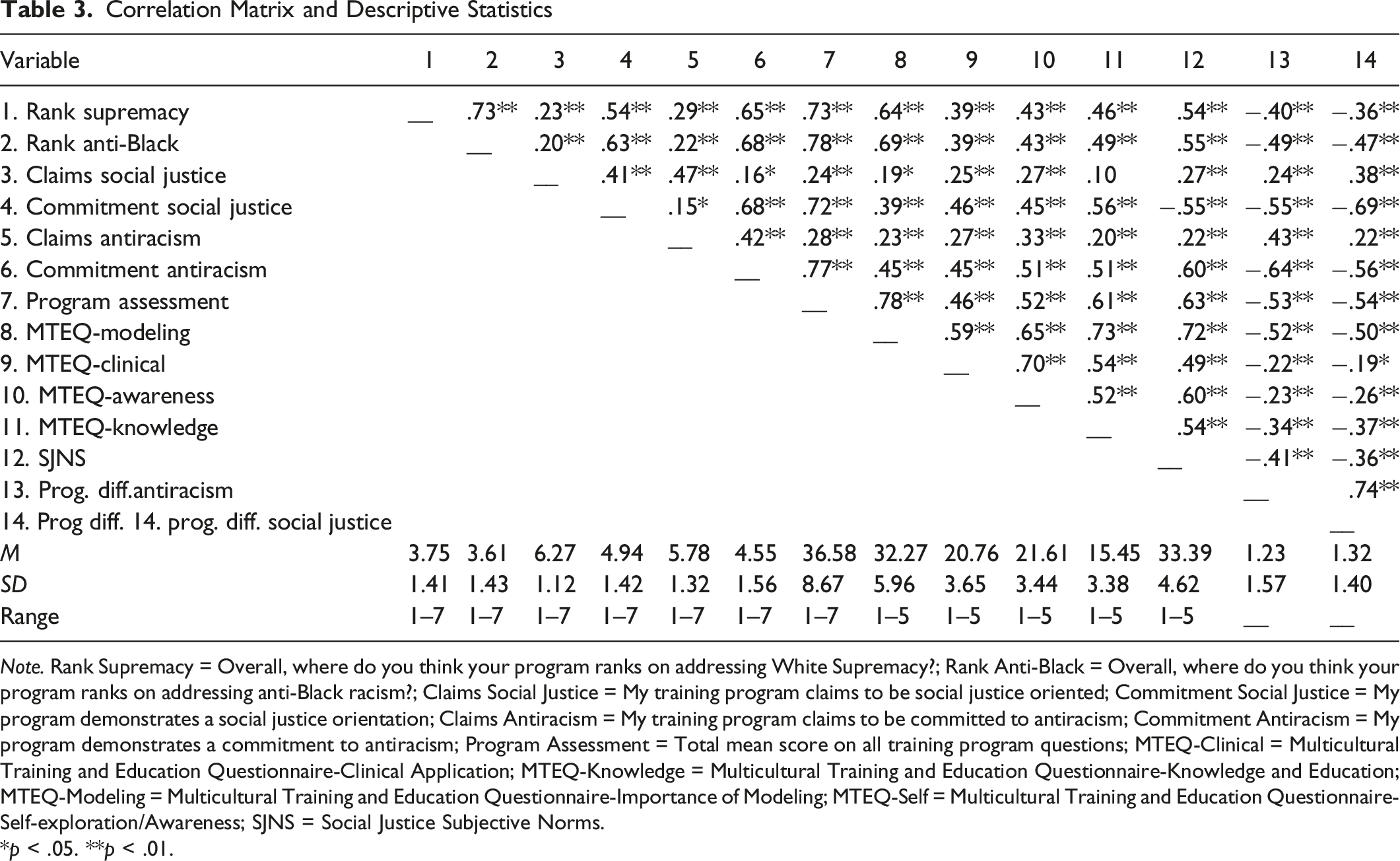
Note. Rank Supremacy = Overall, where do you think your program ranks on addressing White Supremacy?; Rank Anti-Black = Overall, where do you think your program ranks on addressing anti-Black racism?; Claims Social Justice = My training program claims to be social justice oriented; Commitment Social Justice = My program demonstrates a social justice orientation; Claims Antiracism = My training program claims to be committed to antiracism; Commitment Antiracism = My program demonstrates a commitment to antiracism; Program Assessment = Total mean score on all training program questions; MTEQ-Clinical = Multicultural Training and Education Questionnaire-Clinical Application; MTEQ-Knowledge = Multicultural Training and Education Questionnaire-Knowledge and Education; MTEQ-Modeling = Multicultural Training and Education Questionnaire-Importance of Modeling; MTEQ-Self = Multicultural Training and Education Questionnaire-Self-exploration/Awareness; SJNS = Social Justice Subjective Norms.
*p < .05. **p < .01.
Observations From Descriptive Statistics and Correlations
As seen in Table 3, participants generally rated their programs just below the midpoint in terms of addressing White supremacy and anti-Black racism. Conversely, participants generally rated their programs toward the upper-end of the scale regarding the extent to which their program claimed to be social justice-oriented, and to a slightly lesser degree, the extent to which their program claimed to be committed to antiracism. Participants generally rated their programs’ demonstrations of these commitments as lower than their programs’ claims, but still above the midpoint. Similarly, participants rated their programs toward the upper-end of the scale on the SJSN subscale. On the MTEQ, however, participants on average rated their programs at approximately the midpoints of the subscales (i.e., average on providing multicultural knowledge, fostering multicultural awareness, engaging in multicultural modeling, and teaching multicultural clinical applications). Of note is that there were significant differences between faculty and student ratings (see below).
Analyses
First, to test Hypotheses 3a–3c, we examined correlations among the study variables as well as participants’ perceptions of their program’s claims to focus on social justice, antiracism, anti-Black racism, and White supremacy and participants’ perceptions on whether or not they actually demonstrate these commitments. Correlations were generally in the expected directions: SJSN and MTEQ subscales were positively correlated with both program claims and program commitments, and negatively correlated with difference scores. That is, the higher participants rated their programs on SJSN and attention to specific facets of multicultural education and training, the higher they rated their programs in addressing social justice, antiracism, anti-Black racism, and White supremacy. Further, the greater the distance participants perceived between program claims and program demonstrated commitments, the lower participants rated their programs’ SJSN and facets of multicultural training. As hypothesized, program demonstration of commitments to social justice and antiracism were more strongly correlated with SJSN and MTEQ subscale scores than program’s stated commitment to social justice and antiracism.
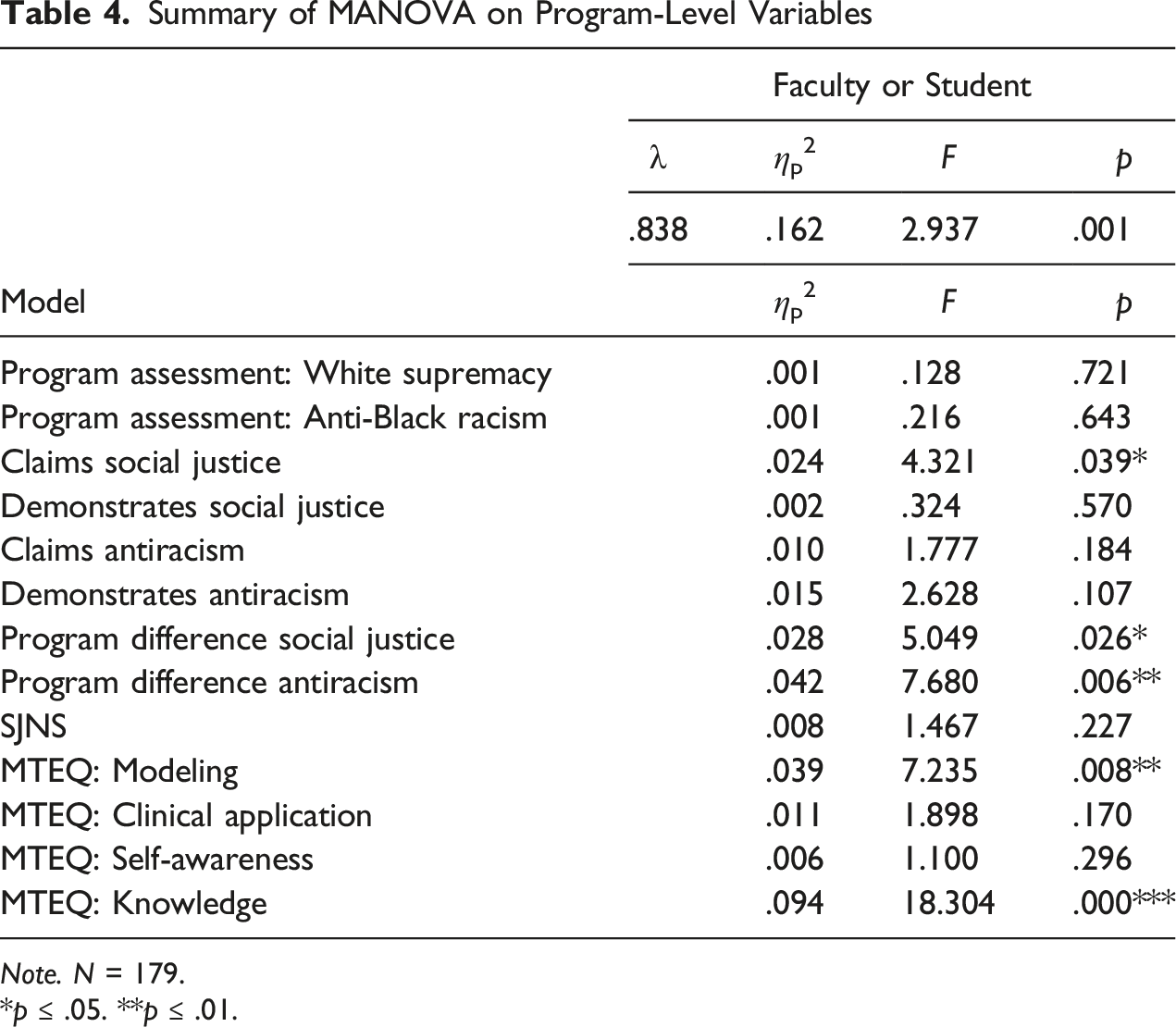
Summary of MANOVA on Program-Level Variables
Note. N = 179.
*p ≤ .05. **p ≤ .01.
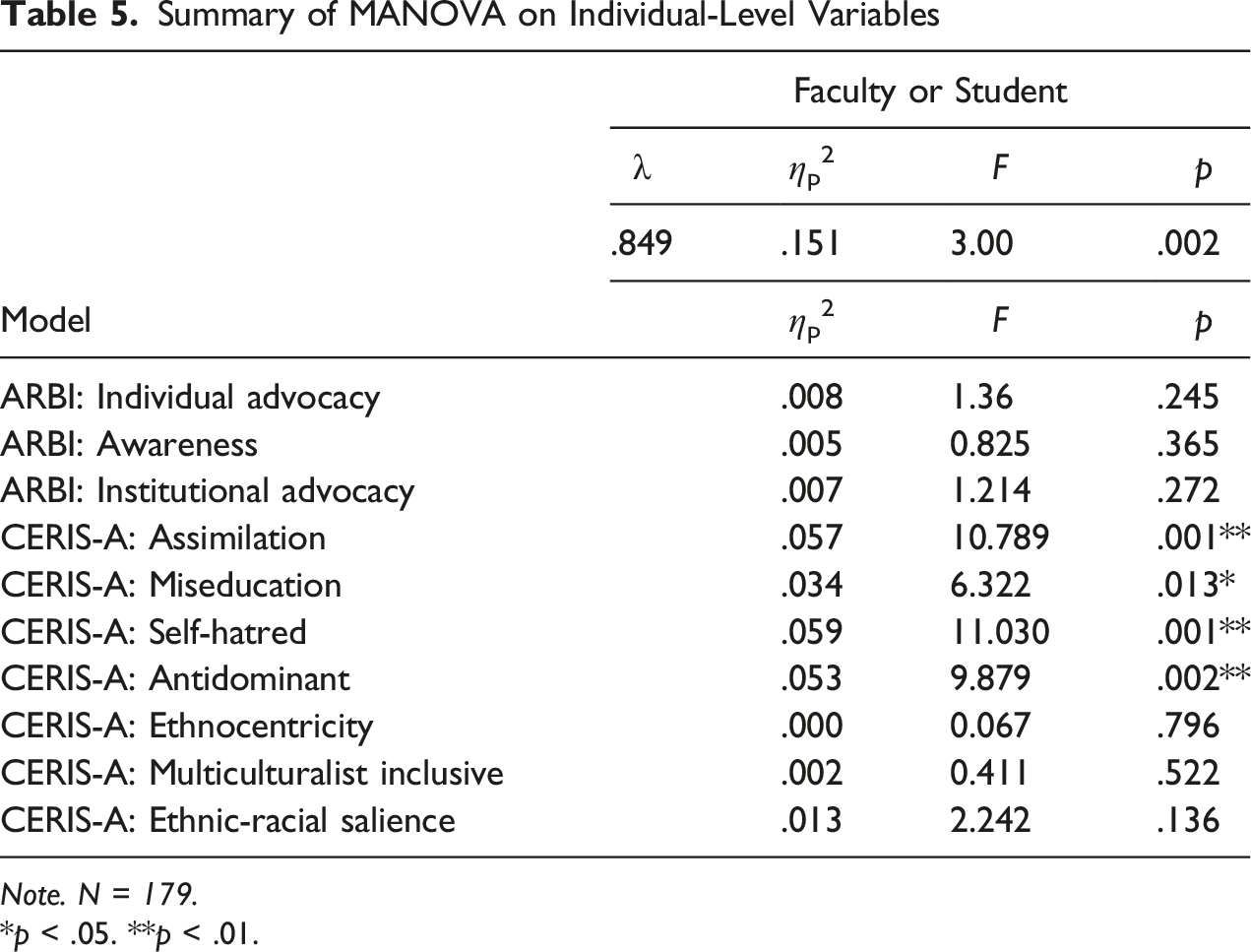
Summary of MANOVA on Individual-Level Variables
Note. N = 179.
*p < .05. **p < .01.
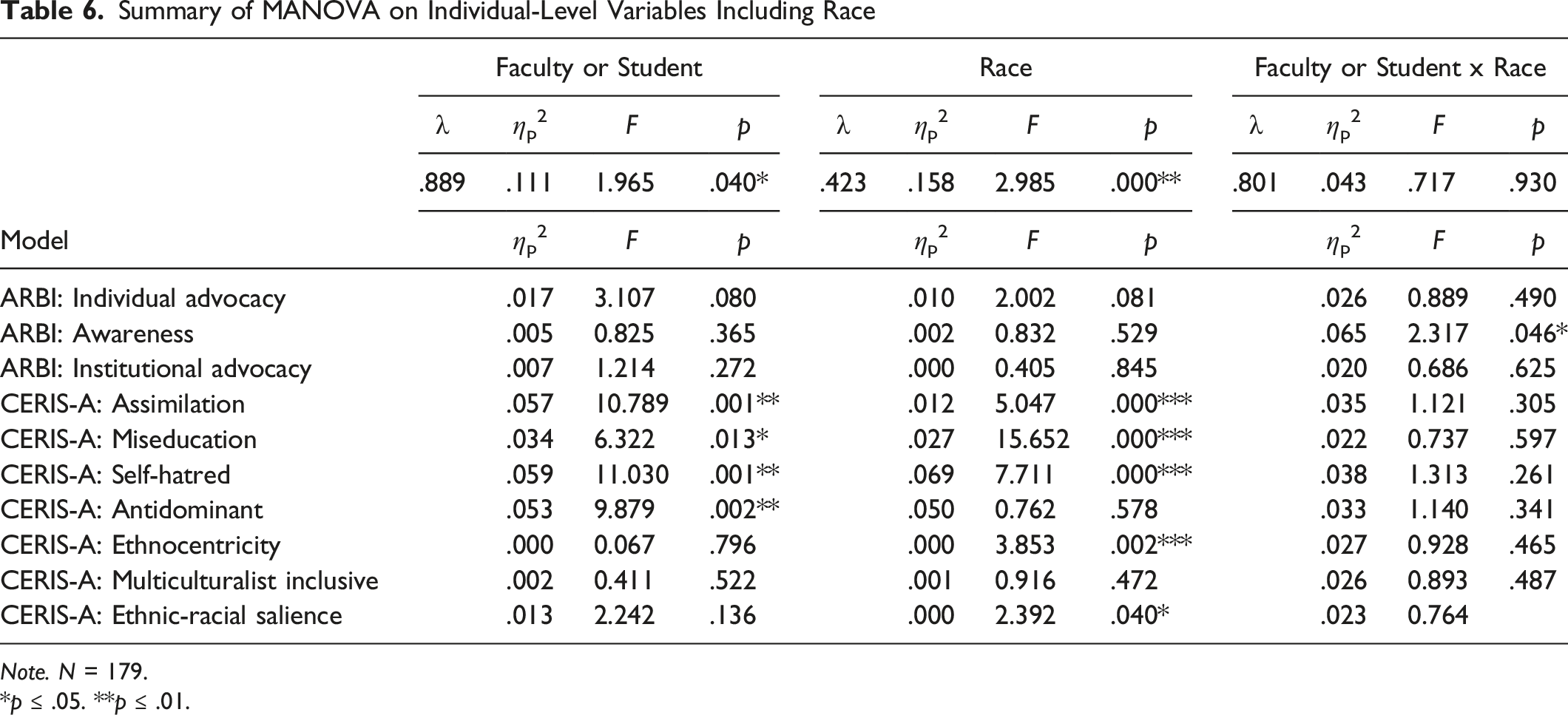
Summary of MANOVA on Individual-Level Variables Including Race
Note. N = 179.
*p ≤ .05. **p ≤ .01.
Discussion
Our results generally suggest that training in counseling psychology has not caught up with even prior advances in multicultural education and training, much less newer paradigms. We first examined whether multicultural counseling syllabi addressed modern movements within counseling psychology (e.g., anti-Blackness, critical approaches). With the one exception of intersectionality, there was scant evidence of attention to antiracism, anti-Black racism, or critical approaches. Further, syllabi generally did not adopt advanced social justice-focused approaches; approximately half did demonstrate adoption of a systems perspective, but not necessarily from a critical lens. Instead, most common was the individual differences approach of the original tripartite MCC movement. We then examined whether the state of counseling psychology multicultural training had changed since Pieterse et al.’s (2009) review. Pieterse et al. (2009) reported that the majority of their sample adopted the population-specific pedagogical approach and that a clear operationalization of social justice in counseling psychology work was missing from many syllabi. Our findings suggest that there unfortunately has been little movement since this publication more than a decade ago.
Quantitative results demonstrated that participants’ perceptions of claims made by their programs regarding their commitment to social justice, antiracism, and dismantling White supremacy were significantly related to participants’ rating of the multicultural training experience. More specifically, participants (both students and faculty) who reported that their programs claimed to be more social justice-oriented also rated their programs higher in multicultural training in terms of clinical applications, modeling, self-awareness, and social justice norms, although interestingly, not in terms of multicultural knowledge. This is particularly important given that, on the scale used in the present study, the MTEQ (Wilcox, Gale, et al., 2022), most of the knowledge items are specifically framed in terms of systems-level knowledge (e.g., the mental health consequences of oppression [e.g., racism, sexism, heterosexism, classism, xenophobia] were included in my graduate coursework). Thus, participants who rated their programs high in claiming to be social justice-oriented did not also rate their programs high in providing knowledge about oppressive systems. In contrast, participants who rated their programs high on demonstrating a social justice commitment, as well as on both claiming and demonstrating a commitment to antiracism, did also rate their programs higher on providing such multicultural knowledge. Perhaps most importantly, the perceived difference between program claims and program demonstrations (in terms of social justice and antiracism) was significantly related to every program-level variable. Throughout, the greater the distance that participants perceived between what their program claimed to value and whether it demonstrated those values and commitments, the lower they rated their program on all program-level variables.
Given the emphasis within training programs and in the counseling psychology literature on social justice broadly speaking (see DeBlaere et al., 2019; Scheel et al., 2018), this difference is striking. Do our stated commitments translate to action and, specifically, to our training practices? Do we walk the talk? Results suggest that some programs may claim social justice and antiracism as core values but do not translate them into action—and that this difference is associated with how students and faculty perceive their programs. There appear to be tangible differences in the education and training provided between programs whose faculty and students perceive them to be walking the talk, and programs whose faculty and students perceive that they do not. One such tangible difference appears to be the provision of education about systems of oppression—again, foundational to the critical consciousness-raising called for by Gushue et al. (2022). Further, Keum et al. (2020, 2022) found that stronger collective programmatic social justice norms result in stronger advocacy intentions and behaviors amongst students; thus, when programs’ behaviors are consistent with their values, it is more likely that students will become genuinely invested and engaged in antiracism and social justice work.
Our results also suggest that student and faculty perceptions of their training programs, as well as their own personal dispositions related to antiracism, were significantly different in some domains, but not others. Specifically, students observed a greater distance between program claims and program demonstrations (both in social justice and antiracism) than did faculty. Students also rated their programs lower on MTEQ-Modeling and MTEQ-Knowledge than faculty; no significant differences were observed on other program-level variables. Thus, students scored their programs lower than faculty did on what arguably are two of the variables that most address modern movements in multicultural training: process-oriented clinical applications (i.e., MCO; Davis et al., 2018) and systems-level knowledge. Taken together, these results suggest that faculty have a more positive view than students of their programs’ progress in addressing multicultural training (specifically, systems-based knowledge and clinical applications), social justice, antiracism, and White supremacy. Further, although there do not appear to be differences between faculty and students on antiracism engagement, White students may be more critical of Whiteness than are White faculty. These results again appear to be consistent with our review of syllabi in that, although there was attention to social justice and cultural considerations overall, training programs do not appear to have integrated modern multicultural movements—and students appear to be more attuned to this than faculty.
Finally, few significant differences were observed between faculty and students on the individual-level variables, with the exception of three CERIS subscales which, in the context of a predominantly White sample, appear to represent students’ more critical evaluations of Whiteness as compared to that of faculty. We have noted that modern advances in multicultural psychology include adopting a more critical psychology frame (Grzanka, 2020; Olle, 2018). Prior movements in multicultural psychology are deeply rooted in a frame of liberalism, which is characterized in part by its commitment to hyperindividualism and neutrality (Wilcox, Franks, & Azarani, 2021). These emphases, however—limitations of prior multicultural movements—serve to obscure how White supremacy operates, distracting attention from systems and harm by refocusing on individuals and “being good” (Wilcox, Franks, & Azarani, 2021). For example, Peggy McIntosh’s work on White privilege (and individual privileges more broadly) has been a staple of multicultural psychology; however, Leonardo (2009) argued that this discourse obscures the systemic view via its focus on the individual, and Lensmire et al. (2013) highlighted that understanding privilege in this way does not advance the field’s understanding of how to dismantle White supremacy. Instead, as Wilcox, Franks, and Cody (2021) noted, addressing individual White privilege may create a “feel-good illusion” (p. 387) for White people while abdicating them of responsibility for systems-level work. Given the gradual shift from more liberalism-rooted multicultural psychology movements toward a critical multicultural psychology, it is possible that students have had more opportunities to understand and critique Whiteness and White supremacy.
Strengths and Limitations
The present study had a number of strengths. First, we examined the current state of multicultural education and training through the use of both qualitative and descriptive quantitative means. Although most participants did not disclose their program name (possibly due to discomfort), the number of participants from such a small population suggests that a range of counseling psychology programs was represented. Our subsample size (faculty and students) also allowed for meaningful comparisons. However, our results should be taken in the context of the limitations as well. First, the third subscale (Institutional Advocacy) of the ARBI demonstrated very low internal consistency. Although this subscale demonstrated the lowest internal consistency (.76) in Pieterse et al’s (2016) scale development study, their results, unlike ours, demonstrated adequate psychometrics. We observed the same reliability values (.45) for both students and faculty. It is possible that the behaviors represented by the Institutional Advocacy scale do not form a cohesive construct; future research should re-examine the factor structure, and results related to the Institutional Advocacy scale should be interpreted with caution.
As for the syllabi, there may have been courses that met the criteria of addressing topics such as White supremacy and anti-Black racism but were not easily identifiable in the syllabi. It is also possible that the sample of syllabi obtained were not fully representative. We received a small number of syllabi compared to the number of existing counseling psychology training programs. Due to the small number of other courses for which we received syllabi and the diversity of courses within this group, their content is not addressed in this paper. Future research may benefit from attempting to collect even more syllabi from courses across the curriculum. Furthermore, asking instructors how they infuse multicultural counseling training in their course above and beyond what is present in their syllabus could gleam additional ways on which these concepts are taught in courses. In addition, asking both students and faculty how their programs demonstrate commitment to diversity and social justice, and including some other measure of noncourse related experiences facilitated by the program (e.g., town hall attendance, noncourse-related diversity requirements) would be important. Finally, although our coding team was racially diverse and diverse in academic rank, it only included faculty members; including a student coder may have added additional perspectives to the review of the syllabi.
Although 179 participants within a single psychology subspecialty is a lot relative to most similar samples, it nonetheless represents a very small percentage of the population of counseling psychology faculty and students. These samples are notoriously difficult to obtain, in part due to the small size of the population, and in part due to the large number of research requests this population receives. Although numerous attempts were made over a long period of time to collect more data, data were collected during a period (October of 2020–April of 2021) of substantial upheaval in higher education (e.g., COVID-19; sociopolitical stress).
As well, our quantitative sample was predominantly White, woman, heterosexual, and middle to upper-middle class. Our sample was more racially diverse than many similar samples (e.g., Gushue et al., 2022; Ramírez Stege et al., 2017; Wilcox, Franks & Azarani, 2021; Wilcox, Shaffer, et al. 2022), with the exception of Keum et al. (2022) and Keum and Miller (2020). The APA Center for Workforce Studies (APA, 2022) estimates that the psychology workforce is 84.47% White; and their most recent student data available (APA, 2023) suggests that approximately 51% of students in counseling psychology doctoral programs are White, commensurate with our sample. Still, given the subject matter of this study, a sample that is approximately half White still must be viewed cautiously. Participants’ positionality relative to intersectional White supremacy likely influenced their perceptions of themselves as well as their programs; for example, students of Color may view their programs’ demonstrations of antiracist commitment very differently than White students.
Implications for Practice, Advocacy, Education and Training, and Research
Practice
Although the population-specific approach used in most multicultural classes is helpful in allowing students to better understand the host of different clients who may present to therapy, it does not address the interpersonal aspect of therapy or how oppressive systems result in the very mental health concerns they seek to treat. Even where one could argue that classes were, by design, narrowly focused on topics such as gender, sexuality, or religion, an intersectional systems-level frame would suggest that sexism, cissexism, heterosexism, and Christonormativity have their roots in White supremacy (e.g., Grzanka et al., 2019; Liu, 2017; Reynolds, 2022). Additionally, anti-Black racism uniquely intersects with each of these axes of oppression; for example, Black women experience gendered racism which results in detriments unique from sexism alone (Lewis et al., 2013, 2017; Wright & Lewis, 2020). It did not appear as though these systemic and intersectional frames generally, nor anti-Black racism specifically, were addressed in multicultural courses based on the syllabi reviewed. That is, the foundations appear to be lacking for the necessary critical consciousness-raising Gushue et al. (2022) emphasize as necessary to be able to move beyond valuing egalitarianism to being able to critically analyze why egalitarianism, despite widely being valued, fails to take root.
Advocacy
Students and faculty need to advocate for a stronger commitment to multicultural training in programs. Too many programs are not walking the talk. In addition to advocating for a shift in programs to demonstrate commitment to diversity and social justice through coursework, noncourse related experiences facilitated by the program (e.g., town hall attendance, noncourse-related diversity requirements) should be implemented. Advocating within programs for changes would also help better prepare students for work advocating within their communities when working with clients. Further, advocacy itself needs to be better addressed in psychology programs. A myriad of antiracism and social justice scholars in counseling psychology have addressed the need for counseling psychology to move from rhetoric to action (e.g., DeBlaere et al., 2019; Gushue et al., 2022; Keum & Miller, 2020; Wilcox, 2023; Wilcox, Shaffer, et al., 2022); however, to do so requires understanding what actions to take, when, and how. Our results are consistent with scholars’ contention that rarely is social justice advocacy truly addressed in graduate education, and this is a gap that it is past time to address.
Education and Training
The results of the present study have important implications for the training of counseling psychologists. We have found that little has changed in the way that schools provide multicultural training. This is particularly troubling when considering the swift, ever-changing global landscape that trainees will soon enter as practicing psychologists. This landscape includes increased instances of racially-motivated hate crimes, increased instances of police brutality against Black and Brown individuals (Lantz et al., 2016; Taylor & Wilcox, 2021), and a global pandemic disproportionately impacting people of Color (Gravlee, 2020). If students are not trained to recognize and intervene in these systems of injustice, they will not be adequately equipped to serve the populations with whom they will work. All students and clients in the United States exist within its foundational capitalistic, patriarchal, White supremacist systems, and it is important that counseling psychology trainees and trainees in other psychology disciplines develop the skills to conceptualize clients through a systemic lens so that they can understand how systemic oppression may impact clients.
Recent theoretical publications have made helpful recommendations as to how multicultural education in counseling psychology could integrate antiracism and social justice into its curriculum. For example, DeBlaere et al. (2019) suggested, consistent with our results, that training programs should teach systems-level theoretical foundations (e.g., critical race theory, fundamental cause theory), and prepare trainees to engage in macrosystem-level interventions. As well, Grzanka (2020) and Olle (2018) invited the field to consider what a critical psychology might look like, offering the theoretical frames often lacking in modern counseling psychology training as well as calling for direct action in research and practice. Grzanka (2020) essentially delineated the ways in which intersectionality research in psychology has historically been employed through the same liberalism lens (hyperindividuality, neutrality) that has characterized the early multicultural movements, and provides a guide for steering intersectionality research back to its critical roots.
Serving as an example of not siloing a critical multicultural psychology approach as a “special interest” area or to only within the bounds of a multicultural course, Garriott (2019) delineated a critical multicultural psychology approach to vocational psychology. Specifically, Garriott’s (2019) critical cultural wealth model offers specific guidance and recommendations for understanding first-generation and economically marginalized students’ academic and vocational development through the lenses of critical theory and critical race theory. Indeed, although all of the syllabi we reviewed were for multicultural counseling courses, we did request a greater breadth of syllabi; however, few nonmulticultural counseling course syllabi were shared, most of those that were not minimally integrated modern multicultural psychology approaches. Thus, syllabi for courses other than multicultural courses were excluded from the analysis. Training and education in multicultural psychology, modern or otherwise, appears to remain siloed largely within the single multicultural course. What all of these scholars (e.g., DeBlaere et al., 2019; Grzanka, 2020; Olle, 2018; Wilcox et al., 2020; Wilcox, Franks, & Azarani, 2021; Wilcox, Franks, & Cody, 2021) call for is a focus, training or otherwise, on systems-level theory and action, including an emphasis on analysis of structural determinants.
As our results begin to demonstrate, there remains a substantial need for counseling psychology (and psychology in general) to advance its training as well as its comprehensive theory and resources (e.g., textbooks) to incorporate these systems-level and structural frames. It is difficult to make such field-wide advances; indeed, at the beginning of the MCC movement, who was to integrate this model into education and training? By definition, current faculty were not well-trained in this new multicultural movement and students are largely trained the way their faculty were trained. Thus, every component of their roles as counseling psychologists—teaching, supervision, research, clinical practice—are all self-perpetuating systems that are difficult to interrupt. This is perhaps why there remains so many missed movements in multicultural psychology.
It is imperative, however, that counseling psychology and other applied psychology disciplines (e.g., clinical psychology, school psychology, community psychology) break these cycles and allow for theory, research, education and training, and practice to catch up. Perhaps, procedures need to be developed to help support training programs’ rapid incorporation of current multicultural psychology scholarship, especially those advances that might be most uncomfortable (e.g., addressing White supremacy). Existing support structures (e.g., the CCPTP, SCP) may be instrumental in helping to ensure that training programs are interrupting, rather than perpetuating, the obscuring of advances most likely to beget systemic and structural change.
Research
Our findings have numerous implications for future research. Future research should attend to the above discussed limitations to better understand the current state of multicultural training. A larger and more diverse sample may result in a richer and more nuanced understanding of faculty and student program perceptions. Further, nested and/or mixed-methods approaches that allow for within-program analyses would allow for a better understanding of best practices as well as modal practices. Critically, it is important to remember that the purpose of multicultural training is for the improvement of process and outcomes for actual clients and communities. Thus, it is important for future research to examine the relationship between program training practices and actual outcomes for therapists, clients, and communities. As well, due to participants electing to not provide their program name, we were unable to conduct within-program or mixed-methods analyses (comparing syllabi with quantitative ratings). It is possible that within-program differences are more important. Perhaps most importantly, however, is that there is clearly a need for clearer, comprehensive, user-friendly models of a critical multicultural psychology. Although components of this have been recently addressed in the literature (e.g., academic and/or vocational, Garriott, 2019; intersectionality, Grzanka, 2020), there does not exist a comprehensive model of a critical psychology with an emphasis on structural analysis. Future research should endeavor to work toward the development of such a model.
ORCID iDs
Melanie M. Wilcox https://orcid.org/0000-0001-9712-6117
Laura Reid Marks https://orcid.org/0000-0001-6267-7760