



Abstract
We investigated the messages, ideals, and critical experiences that constitute gendered racial socialization for Asian American men (AAM) throughout their development. We employed interpretive phenomenology to analyze interview data from 15 sociodemographically diverse AAM. We identified seven themes: (a) intergenerational parental ideologies, (b) geographic and neighborhood influences, (c) multilevel gendered racism, (d) silencing of gendered racial experiences, (e) survival by identity erasure, (f) rare experiences of affirmation, and (g) fragmented masculinity. Results illustrated a social developmental ecology of highly adverse lifetime experiences—comprised of gendered racism, shame and internalized oppression, thwarted attempts to perform hegemonic masculinity ideals, and minimal access to communities and resources for AAM’s identity affirmation in the United States—that may engender fragmented masculinity, or identity disintegration beleaguered by incommensurable gendered expectations across heritage ethnic and dominant cultures. Implications include systemic interventions to eliminate gendered racism and promote narratives and socialization practices that affirm AAM.
Keywords
We explored how Asian American men (AAM) negotiate competing sociocultural messages and ideals about their masculinity, combat racist emasculation, and make sense of their gendered racial identity as they grow into adulthood. AAM reported confronting oppressive expectations to defend and prove their masculinity—across heritage ethnic and dominant cultures—yet being interpersonally and institutionally dehumanized, ignored, and obstructed in their attempts, which led to shame, internalized oppression, and numerous negative psychosocial health consequences. We propose a fragmented masculinity model to consolidate these findings, identify risk and protective factors, and inform systemic recommendations to support adaptive masculine identity formation among AAM.Significance of the Scholarship to the Public
Introduction
There are heterogeneous (Huang et al., 2013) and increasing behavioral health problems (e.g., Hai et al., 2021) among Asian American men (AAM). An analysis of 2013 to 2019 data from the National Vital Statistics System found a 40% increase in the suicide rate among AAM aged 15 to 24 years—the second highest behind Black men (47%) across all ethnic and racial groups studied (Ramchand et al., 2021). Population data show that AAM’s behavioral health service access and utilization remain low (Huang et al., 2013). It is imperative to examine these trends in a culturally responsive manner (Wong et al., 2019) that centralizes the psychology of AAM and assesses operative, protective, and risk factors considering intersectional race-related stress and key lifespan sociocultural variables. AAM-focused psychological scholarship has indeed expanded (Iwamoto & Kaya, 2016) to encompass body image (Keum, 2016; Liao et al., 2020), gendered racism (Liu & Wong, 2018; Liu et al., 2018), interpersonal shame (Wong et al., 2014), and behavioral health outcomes (Keum & Choi, 2021; Keum et al., 2022). To augment this largely correlational and adult-focused literature, we sought to empirically derive a more comprehensive, developmentally informed, and unified model of AAM’s gendered racial socialization.
Asian American Men’s Gendered Racial Socialization: A Needed Conceptualization
Generally, socialization studies have considered either race (Priest et al., 2014) or gender (Stockard, 2006). For example, many Asian American parents socialize their children to be proud of and maintain their heritage culture and ethnic identity but to also assimilate effectively into mainstream U.S. society (Juang et al., 2016). Because mono-identity models cannot fully capture the lived experience of identity intersections, scholars have devised the gendered racial socialization framework (Thomas & King, 2007) to analyze how racial socialization varies across gender and the resulting gendered racial experiences that influence identity formation. Scholars have also advanced the developmental-contextual framework (Rogers et al., 2021) to situate adolescent male gender role socialization in a system of transactional-ecological relations. Close interpersonal relationships and their reciprocal dynamics over time, with broader sociocultural messages, norms, and practices, form the bedrock of masculine socialization, where boys and men of Color “navigate masculine gender roles while concurrently having to confront prejudices directed toward their racial or ethnic groups” (Rogers et al., 2021, p. 7).
We draw from these theoretical frameworks—underutilized in research on AAM—to explore the phenomenology of gendered racial socialization in this population. More specifically, we examined the multilevel (i.e., individual, family, community, institutional, and ideological) ecology of socialization messages, sociocultural ideals, and critical racial experiences that AAM encounter in their masculine identity formation. We focally analyzed the intersection of gender and race to clarify experiential themes common to diverse AAM while considering salient sources of sociodemographic heterogeneity and the sociohistorical context of hegemonic masculinity ideals and White supremacy (Chou & Taylor, 2019; Shek, 2007).
Asian American Men’s Gendered Racial Socialization: Key Ecological Influences
In this section, we critically summarize key contextual factors that frame our investigation and findings regarding AAM’s gendered racial socialization.
Gendered Racism and “Asian Masculinity”
For AAM, gendered racism (Liu & Wong, 2018) involves an interlocking system of oppression that racializes their masculinity as absent or inferior to White hegemonic masculinity and which structurally reproduces gendered racial inequities that prevent their full and just participation in society. Gendered racist violence is both material and symbolic, and is central to the ideological formation of so-called “Asian masculinity” in the United States, but its psychological impact on AAM’s gendered racial socialization and masculine identity formation has been understudied (Chou, 2012). Next, we highlight major historical iterations of gendered racism (see Eng, 2001; Espiritu, 2008; and Shek, 2007 for critical treatments) and germane empirical works.
To reinscribe White privilege across waves of Asian labor migration, White U.S. settlers racialized AAM as the “yellow peril”—an existential threat to White Christian lifeways and a sexual danger to White women—reflecting the racial essentialism, xenophobia, and White male anxiety prevalent among Western imperialist regimes. With discriminatory citizenship, employment, and immigration laws, White U.S. settlers rendered AAM into family-separated, second-class “bachelors” and relegated them into feminized vocations—such as hospitality and other service industries—that nevertheless contributed ironically and nontrivially to building the U.S. economic infrastructure. Using the “perpetual foreigner” ideology—where “Asians” are unassimilable biologically and culturally to Western nation-states, justifying their exclusion and exploitation—the White ruling class gendered AAM as regressive yet domineering patriarchs from whom they must rescue Asian women, fetishized complementarily under the pretext of “modernity” that belied sexualized imperialist desires (Keum et al., 2018). Presently, the White dominant culture deploys the “model minority” myth (Chou & Feagin, 2015) to construct AAM as culturally, interpersonally, and sexually repulsive entities meritorious solely for disembodied and intellectualized labor to support White hegemonic interests. A critical analysis of the evolution of anti-AAM gendered racism reveals that “Asian masculinity” as conceived in mainstream U.S. society represents a racist artifact required to naturalize White male body supremacy as the defining metric of masculinity (Chou & Taylor, 2019; Eng, 2001).
Recent research has clarified the construct of gendered racism against AAM. Liu et al. (2018) developed the Gendered Racism Scales for AAM (GRSAM) and delineated three interrelated dimensions: (a) psychological emasculation—that AAM are effeminate and lack “manliness,” (b) undesirable romantic/sexual partner—that AAM are physically, sexually, and romantically deficient, and (c) lack of leadership skills—that AAM are intrinsically devoid of authority, charisma, and related socioemotional qualities. Gendered racist beliefs about AAM—especially presumptions of physical and sexual defectiveness—are pervasive across cyberspace (Azhar et al., 2021), mass media and popular culture (Besana et al., 2019), and workplaces (Huang, 2021). Gendered racism is distinct empirically from both generic gender role strain and general anti-Asian racism in predicting psychological and somatic distress (Liu et al., 2018).
AAM who experience gendered racism may internalize these negative attitudes and beliefs that compromise their masculine self-concept and precipitate identity diffusion and psychological distress (Choi et al., 2017; Chou & Taylor, 2019). Many AAM are cognizant of gendered racist stereotypes and of their racially emasculated subject position in mainstream U.S. society (Chou, 2012), and this awareness appears to be depressogenic (Wong et al., 2012). Lu & Wong (2013) found that to cope, AAM may internalize and strive to fulfill Western hegemonic masculinity ideals to mitigate the constant gendered race-related stress of anticipated and actual interpersonal, romantic, and vocational discrimination and the stereotype threat of emasculation. This compensatory pattern has recurred in studies concerning body image and self-presentation (Cheng et al., 2016; Keum, 2016; Keum et al., 2015; Liao et al., 2020) as well as “crude” (e.g., chauvinistic, tastelessly exaggerated) or interracial displays of heterosexuality (Nemoto, 2008; Tsuda, 2020). Gendered racism is thus a systemic psychiatric risk factor that racializes traditional masculine norm conformity, a primary source of gender role strain with known negative health consequences among men (Wong et al., 2017).
Hegemonic Masculinity Ideals
In the U.S. context, hegemonic masculinity ideals (see Connell & Messerschmidt, 2005) refer to male gender role norms most exalted in the dominant culture and which embody the values and imaginaries of White heterosexual men—including aggression, competition, domination, individualism, physicality, stoicism, and violence. These ideals regulate material access to (White) male power and privilege by defining the hierarchical rubric of aspirational masculinity that stratifies men per their allowance and ability to meet hegemonic standards of masculine behavior. Thus, they legitimize the subjugation of femininity and marginalized masculinities (e.g., racialized, queer, and/or working-class men) and consolidate multiple structural inequities. The emasculation of selectively targeted men (e.g., AAM) is essential to gatekeeping hegemonic masculinity and rendering its societal benefits both exclusive and illusive. Hegemonies are seldom perceived as contestable forces of domination but rather as self-evidentiary dictums (Tsuda, 2020); because ideological inculcation into hegemonic masculinity and its sociologically and psychologically deletrious implications are pervaisively normalized (if not venerated) in the dominant culture, it effectively manufactures consent to internalized oppression.
The gendered racial exploitation of AAM is an essential and functional counterpoint to the ideological reproduction of masculinity as White and heteronormative (Chou & Taylor, 2019; Eng, 2001). First, although most men cannot fully meet hegemonic masculine standards, AAM are racialized as categorically and intrinsically unmasculine (Liu & Wong, 2018), whereas masculine “failures” by White men are often considered incidental and “correctable” (Tsuda, 2020). Second, AAM are denied pathways to nonhegemonic, more ethnoculturally congruent masculinity ideals. Many AAM endorse “flexible” masculinities that encompass a caring and nurturing interpersonal style and a more egalitarian division of domestic labor (Chua & Fujino, 1999; Tsuda, 2020); social status valuation based on work ethic and fulfilling economic, family, and social obligations (Lu & Wong, 2013); and intellectual, moral, and relational discipline (Kyler-Yano & Mankowski, 2020). However, AAM embodying such holistic ideals are racialized as confirming their emasculation (Chua & Fujino, 1999) rather than “positive” masculinity (Kiselica et al., 2016). Third, AAM who “successfully” embody hegemonic masculinity are recast as anomalous or erased altogether through an attributional logic where AAM and masculine validity are mutually exclusive (Liu & Wong, 2018). These contradictory mechanisms consign AAM to a liminal state of masculine disenfranchisement and are both a precondition and functionality of hegemonic masculinity ideals as an agent of White supremacy (Chou, 2012).
Internalized Racism and White Supremacy
In childrearing, Asian American parents perpetuate gendered and racial attitudes and beliefs acquired from their countries of origin (Kim et al., 2018). Although Juang et al. (2017) suggested that Asian American parents perform more ethnocultural rather than racial socialization, the historical idealization of Whiteness (Eng & Han, 2019) and internalized racism (Choi et al., 2017) may distort this distinction for AAM. Parents who have experienced Western colonization or immigrated from postcolonial states may Eurocentrically endorse their own ethnocultural inferiority (Okazaki et al., 2008) and socialize their Asian American boys to idealize and assimilate into White dominant cultural norms that devalue and disavow them. Internalized racism is indeed associated with numerous deleterious health outcomes, including deterred ethnic and/or racial identity formation (David, 2013). Uncritical Asian Americans who accept indoctrination and assimilate into Whiteness—by internalizing the model minority myth (Chou & Feagin, 2015)—may incur complex negative characterological and psychological consequences that reinforce the naturalization of White supremacy (Eng & Han, 2019).
Cultural and Family Expectations of Success
Gender configures the ecological transmission of ethnocultural role expectations among Asian Americans (Juang et al., 2017). For instance, fathers communicate expectations about masculinity and gender relations verbally, behaviorally, and relationally, which then shapes their sons’ pertinent attitudes and beliefs (Klann et al., 2018). Many Asian American families espouse pan-ethnic cultural values (Kim et al., 2018)—including patrilineage, binarized gender roles, and veneration of familial duty and social responsibility—and an authoritarian parenting style that is distant and stern, especially with sons. Asian American parents frequently equate academic and professional success with family role fulfillment (Lee et al., 2009) and expect their male children to attain financial independence and eventually provide for others (Lu & Wong, 2013). AAM may also pursue conventional career and economic achievements to compensate for perceived failures regarding hegemonic masculinity ideals (Lu & Wong, 2013). Altogether, these ethnocultural, racial, and sociohistorical influences suggest that gendered racial socialization for AAM involves a complex system of intersectional acculturative stress (Keum, 2016).
Study Purpose
We sought to clarify the developmental ecology of socialization messages, sociocultural ideals, and critical racial experiences that shape AAM’s masculine identity formation. To this end, we employed interpretive phenomenological analysis (IPA; Smith et al., 2009) to investigate AAM’s gendered racial socialization experiences in the United States—including etiological mechanisms of gendered race-related stress that may propagate behavioral health problems—considering broader cultural, social, and political forces that undergird their lived experiences and the meanings that contour their subjectivities. Although focusing on the intersection of gender and race, we attended carefully to the within-group diversity that may moderate AAM’s socialization experiences, such as ethnocultural (e.g., East, South, and Southeast Asians) and other social identity differences (e.g., sexual orientation). Our research questions were: (a) What messages and ideals in their families, explicit and implicit, guided AAM’s negotiation of their gendered racial identity while growing up? (b) What messages and ideals outside of their families, explicit and implicit, guided AAM’s negotiation of their gendered racial identity while growing up? (c) What are the systemic factors that contextualize AAM’s gendered racial socialization? (d) What are the positive and negative outcomes of AAM’s gendered racial socialization?
Method
Interpretive Phenomenological Analysis
IPA (Smith et al., 2009) is a recommended approach for exploring emotionally charged, marginalized, and understudied lived experiences (Creswell & Poth, 2018), as it centers how participants make meaning of the studied phenomena and the multiple nuanced subjectivities involved (Alase, 2017). In IPA, researchers and participants co-construct the meaning-making process. By engaging and interpreting such meanings affirmatively, researchers provide a vital witnessing function that facilitates the exploration of challenging topics, including oppression.
Positionality, Reflexivity, and Fidelity
The research team embodied diversity in age, cultural, ethnic, and racial backgrounds as follows: the principal investigator (Brian TaeHyuk Keum), a 36-year-old Korean Canadian/American heterosexual man who is an assistant professor and counseling psychologist; Lydia HaRim Ahn, a 30-year-old Korean heterosexual woman who was a counseling psychology doctoral candidate; Gintare M. Meizys, a 24-year-old Lithuanian American woman who was an undergraduate psychology student; Adil Choudhry, a 23-year-old Indian American man who was an undergraduate philosophy student; Annalisa Chu, a 22-year-old Chinese American woman who was an undergraduate psychology student; Maynard Hearns, a 31-year-old Black/Afro-Caribbean American gay man who was a research assistant; Mary Nguyen, a 29-year-old Vietnamese American woman who was a social work graduate student; and Andrew Young Choi, a 33-year-old Korean American gay man who is an assistant faculty and licensed psychologist. All members reported previous qualitative research experience.
To strengthen the fidelity of our findings, we strove to methodically demonstrate transparency and reflexivity (Alase, 2017). We discussed personal biases and expectations to become aware of our potential influence on the data collection, analysis, and engagement with participants. Members bracketed frequently by memoing before interviews and throughout the study procedures (Creswell & Poth, 2018). Our identified biases included possibly sharing similar experiences with the participants; Whiteness and internalized racism; and stereotypes about Asian Americans (e.g., those related to model minority behavior and gendered racial essentialism) derived from interpersonal relationships, mass media, and popular culture. We expected that participants would report experiences about (a) their masculinity (e.g., denigration or affirmation), (b) conformity to hegemonic masculinity ideals, (c) ethnocultural and family expectations, (d) anti-AAM gendered racism (e.g., racist media portrayals), (e) model minority stereotypes, and (f) psychosocial health problems. Across data collection, analysis, and interpretation, we anticipated engaging these topics considering the intersectionality of our respective subject positions and the antiracist implications of our study scope.
Participants and Procedure
Participant Pseudonyms and Demographics
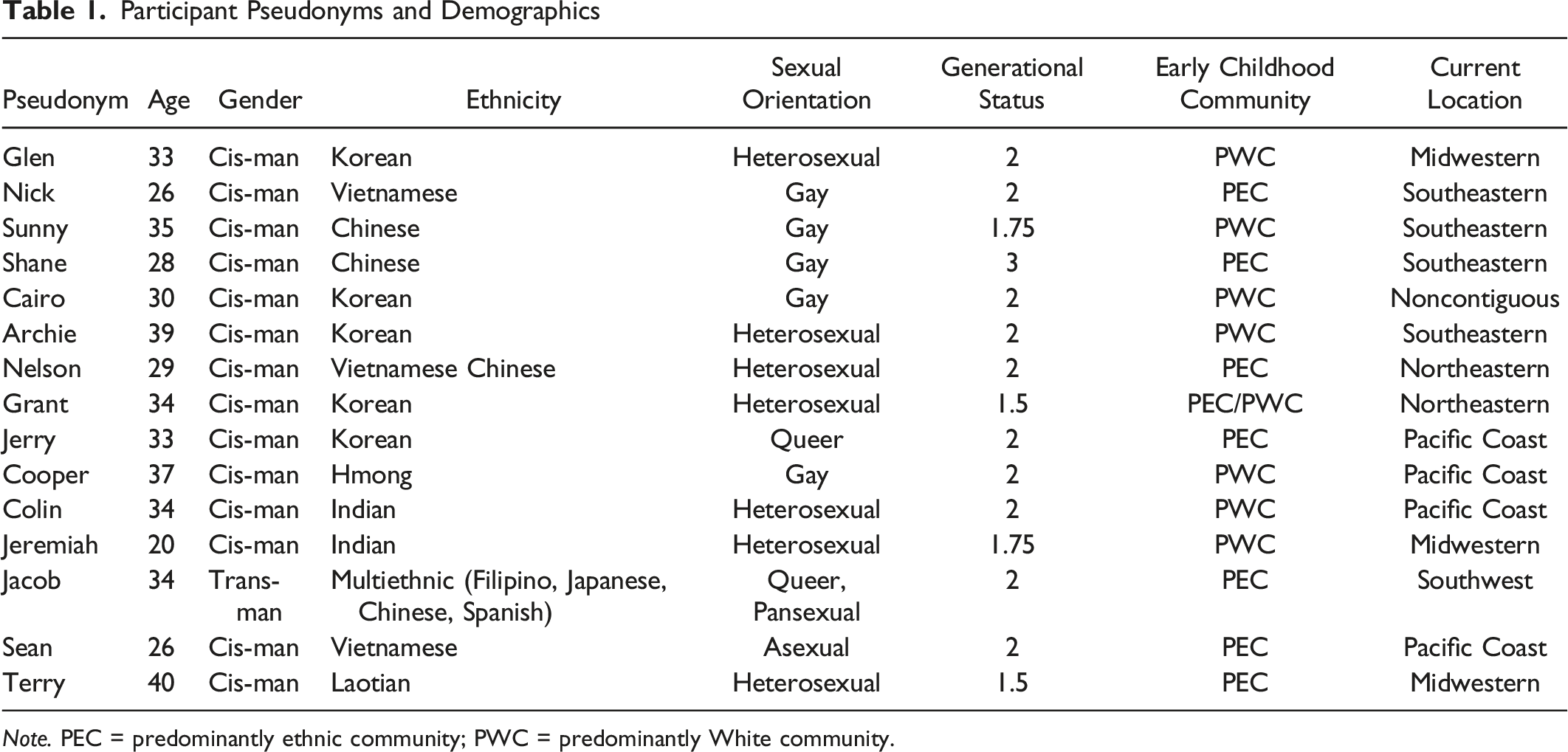
Note. PEC = predominantly ethnic community; PWC = predominantly White community.
Semi-Structured Interview Protocol
The first and second authors developed the semi-structured interview protocol (see Appendix) based on personal and professional knowledge and experiences and a focused literature review. We piloted these questions within the research team and revised them according to feedback. We selected a semi-structured format to ensure both consistency and empathic flexibility in qualitative data collection. The PI conducted audio-recorded virtual interviews with all eligible participants, ranging from 45–90 minutes. The PI built rapport with each participant by displaying cultural humility, openness, validation, and reflexivity, and proceeded at an individualized pace of discussion. Discursive engagement and interpretation provided hermeneutic containment for participants to describe emotionally vulnerable content. Indeed, participants described having felt unseen and unheard previously regarding their experiences as AAM and denoted the emotional difficulty of articulating vulnerable self-disclosure. The PI, an AAM with personal and professional familiarity with the lived experiences concerned, was uniquely positioned to create a safe and inviting environment to explore these topics. The PI bracketed reflexively before and after each interview (Alase, 2017) to ensure that the data reflected participant narratives accordingly. We transcribed the interviews verbatim, removed identifying information, and assigned pseudonyms. The PI checked the fidelity of all transcripts.
Data Analysis
We employed the procedure from Smith et al. (2009). After completing IPA coding training and acquiring a general impression of the transcript set, all members read the first transcript individually to register a holistic sense of the data and frame the study from a phenomenological perspective. We discussed our impressions of the first transcript and noted emergent meaning units, while considering our biases and expectations critically. These notations included any recurring ideas, phrases, or words in the data as well as the psychological reactions reflecting our personal engagement with participant narratives. For instance, we felt angry, sad, and helpless when appraising accounts of gendered racism, shame, and a lack of social support, and we incorporated these emotional components into our data interpretation. We repeated this process with two additional transcripts, but each member reviewed and identified meaning units and themes independently. All members then reconvened to discuss, resolve discrepancies to consensus, and begin consolidating a preliminary list of themes and categories. The first and second authors clustered these themes and categories while retaining the “essence” of the reported experiences (Smith et al., 2009). All team members provided feedback to streamline the reorganized theme structure, which guided the analysis of the remaining transcripts.
To avoid groupthink, we coded the remaining twelve transcripts in pairs. Members coded the transcripts independently and met in assigned pairs to discuss the themes and level of coding agreement. After coding every three new transcripts, we met as a team to resolve discrepancies to consensus. We employed a continuous, iterative analytic procedure to form our theme structure as we coded these additional transcripts. We ordered the themes and categories considering the ecological domains discussed in the gendered racial socialization (Thomas & King, 2007) and developmental-contextual (Rogers et al., 2021) theories. We condensed, revised, removed, and/or added themes and categories as empirically appropriate. Where we reshaped the theme structure, we revisited analyzed transcripts to ensure goodness-of-fit with the data. We solicited an external auditor—an expert in Asian American studies—for feedback to check for fidelity and refine our theme structure. Finally, we cross-checked our results with the participants for validity.
Results
We identified seven themes with subcategories: (a) intergenerational parental ideologies, (b) geographic and neighborhood influences, (c) multilevel gendered racism, (d) silencing of gendered racial experiences, (e) survival by identity erasure, (f) rare experiences of affirmation, and (g) fragmented masculinity. Figure 1 organizes these findings across time and levels of socialization and identifies negative psychosocial outcomes and protective factors. Multilevel gendered racial socialization of Asian American men.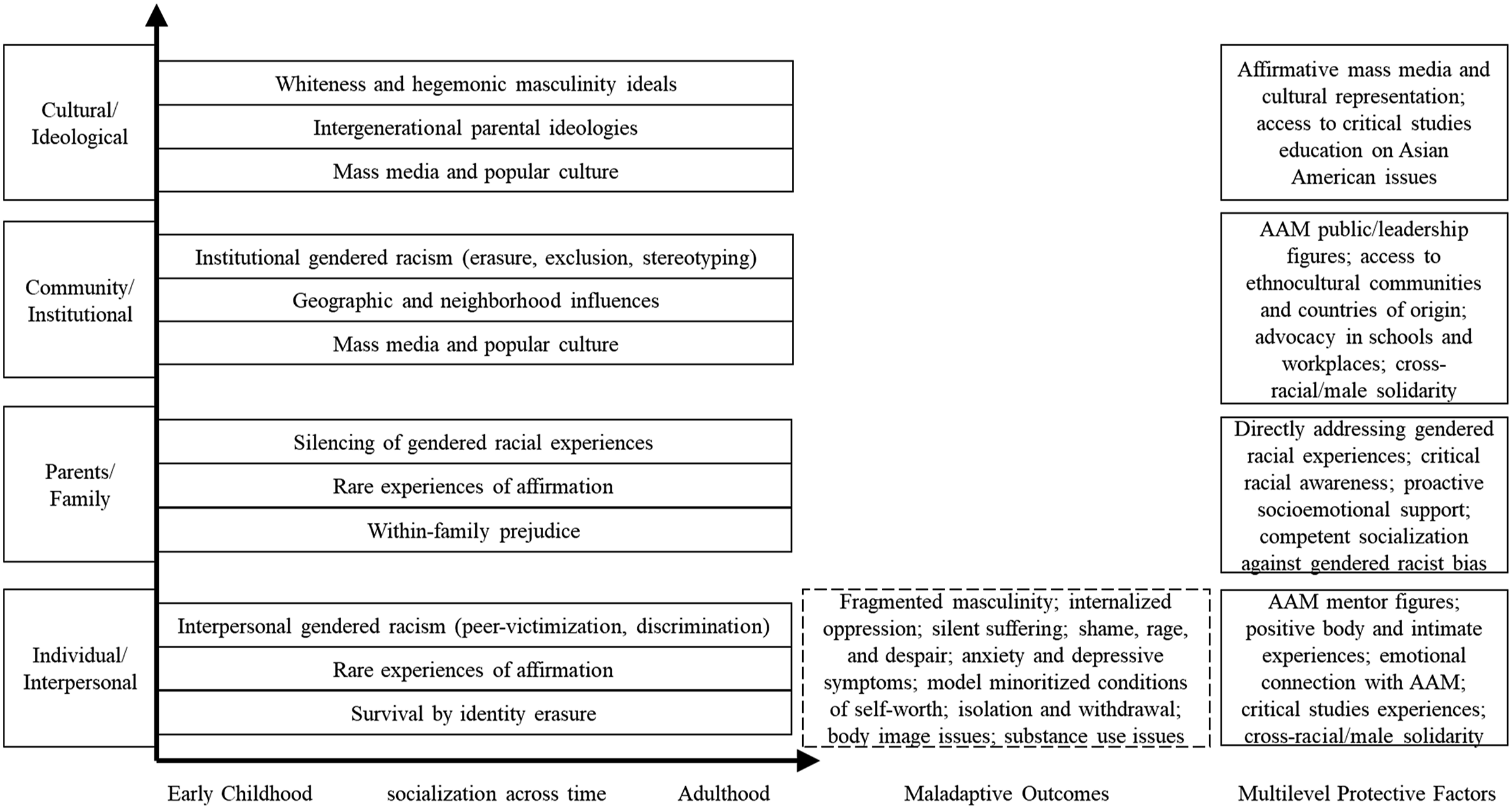
Theme 1: Intergenerational Parental Ideologies
Internalized Racism
Many participants reported that their parents often idealized people of European and White American cultures. Grant, a Korean American, said that “my mom has this wooweolhwa [belief in cultural superiority] for White people, towards White people. She thinks Whites are better than Koreans… I was used to that.” Terry said that he grew up “hating himself” given his parents’ White supremacist socialization practices: My parents are fully bought into White supremacy… My mother went to an English-Catholic school in India. She’ll never admit this, but I’m pretty sure she feels inferior as an Indian. And my grandparents, some were kind of pro-British and some were anti-British, but just being South Asian, the colonization narrative is huge, and many Indians have bought into that idea that “White is right.” That was the environment for me.
Relatedly, several South and some Southeast Asian participants reported encountering colorism within Asian American communities and the larger society. For example, Nick said that he dated a Filipina girl in high school and his mom “hated her because she was darker-skinned.” The valuation of White proximity—regarding self-presentation and social relationships—implied in parental messaging appeared to precipitate a sense of racial inferiority among our participants.
Patriarchy and Traditional Masculine Norms
Participants described internalizing the significance of patriarchal values (e.g., paternal authority) and parental expectations to conform to traditional masculine norms (e.g., restrictive emotionality). Nick recalled receiving subtle yet constant verbal messages that reified binary gender roles between men and women and naturalized male privilege. He said that “my mom would say I shouldn’t clean because my wife’s gonna do that, which didn’t make any sense.” Shane likewise said that “my mom favored me more than my sisters. [Because I am] the first-born man in the house… I got that value stuck into me.”
Heteronormativity
Participants reported that their parents socialized heteronormative values, including heterosexual marriage and nuclear family planning, which were structured by binary gender roles. Shane recounted that “same race dating and heteronormative sexual relationships was an expectation and norm that must be done.” He also said that “my mom kept commenting on how I dress, and that I come off as gay. And maybe that gay means more feminine.” Queer AAM noted additional psychological distress associated with their inability to fulfill heteronormative expectations authentically, as well as heterosexist discrimination within Asian American communities and the larger society. Cairo said, “Your average heterosexual White guy was what I was supposed to be, and I would feel quite stressed that I wasn’t. Because (a) I am not White, and (b) I am gay.”
Academic Performance Expectations Based in the Myth of Meritocracy
Participants reported that their parents considered boys’ academic accomplishments as an evidentiary vehicle for family success, particularly among parents who had internalized the myth of meritocracy and the “American dream,” and endorsed patrilineage. Jacob said, “It was very much like, work hard, keep your head down, get good grades, and achieve the American Dream. That was how you coped with things as an Asian man.” In turn, many participants described internalizing academic and career performance as primary conditions of personal worth, self-esteem, and their sense of value to others as men, as well as a means of coping with gendered racism.
Theme 2: Geographic and Neighborhood Influences
Predominantly White Neighborhoods
Participants who grew up in predominantly White neighborhoods recounted erasure and isolation punctuated by periods of voyeuristic exposure to gendered racist violence (e.g., peer-victimization). Cairo recalled a “sense of isolation or loneliness, like I was going to be the only one.” Colin similarly reported that “being South Asian in my neighborhood was an exercise in being alternately invisible and extremely visible. The extremely visible component was more obvious, just acknowledging being different and having others racialize me in that way.”
Racially and/or Ethnically Diverse Communities
Some participants who grew up in racially and/or ethnically diverse communities and/or with a predominantly Asian population reported an initial unawareness of race. Nick remembered “having a 40% Asian [population in high school]” where “half of my classes were filled with Asian students… I did not have to think about race.” Other participants reported a sense of belonging. Terry lived in “a region where there were a lot of refugees… I got to see kids who were from Laos and Laotian kids that were born here in America, so I didn’t feel isolated.”
International Trips to Countries of Origin
Some participants visited their country of ethnocultural origin, which assisted reflective integration of a positive Asian American male identity. Archie said that his “early experiences in Busan [a city in South Korea] were really important for me to have this reconnection [to the ethnic dimension of being an AAM], or just a connection to keep the door open to it.” Sunny said: What I draw on now in terms of my strength, my pride, and my resilience for being Asian American has to do with my 5 years living in China as an adult. That’s when I really dug in and came to understand my identity on my own terms.
Here, affirmative cultural representation, deracialization (e.g., reduction of exposure to gendered racism), and recognition of within-group individual differences emerged as facilitative factors.
Theme 3: Multilevel Gendered Racism
Peer-Victimization
Participants reported experiencing pervasive peer-victimization in school and elsewhere. Nelson recalled stereotypes about “the typical small penis stuff” or being “nerdy, sexless, quiet, or on the social fringes,” where these gendered racist messages typified social interactions and verbal altercations that often escalated into spectacles of public humiliation. Participants reported being racialized as unmasculine and excluded from athletic and physical extracurricular activities. Nick said, “I enjoy playing sports a lot, and there were explicit verbal slights that me being Asian [meant that] I’m not going to be good at basketball, so they were not going to pass to me.” Some South AAM noted stereotypes of hypermasculinity based on racialized Islamophobia. Jeremiah said that “something even as remotely as exercising can be seen as a potential terrorist threat” and as an Indian man, he feared being mislabeled as a terrorist, especially after the 9/11 attacks. Regarding these diverse victimization experiences, participants recalled feeling humiliated and prone to anticipatory anxiety related to stereotype threat thereafter.
Romantic and Sexual Discrimination
Heterosexual AAM described frequent romantic and sexual discrimination based on gendered racist emasculation as well as resultant feelings of unattractiveness, undesirability, and reduced relationship self-efficacy and outcome expectations. Colin said, “I was largely ignored by young women, and the few times I attempted to make any kind of connection with any, it was pretty quickly de-escalated from a sexual standpoint.” Queer AAM reported being similarly “ignored,” whereas several described sexualized emasculation by being stereotyped as “exotic” and “submissive.” Sunny said, “I’m pretty sure he [a dating prospect] had some stereotypes about gay Asian males, what kind of sexual acts I liked, positions, and all that kind of stuff.”
Within-Family Prejudice
Some participants reported that family members—particularly those highly White assimilated—perpetuated gendered racism against AAM, which increased socioemotional distance and reduced perceptions of positive regard and support within the family. Shane said, “I remember hearing my sister saying Asian boys are boring. I mean, it impacted me in some way. I think there has always been a comparison with White men… I am not White.”
Media Disfiguration of Asian American Men
Participants reported that exposure to anti-AAM gendered racism in mass media and the dominant culture compromised their self-concept and outcome expectations for vocational and relational success, and further elicited stereotype threat-related anticipatory anxiety. Cairo said: I can’t recall any Asian males or figures, you know. A couple of times there would be a caricature of an Asian man and I really saw the negative stereotypes: very awkward or nerdy or ugly, unattractive, inept socially or sexually.
Institutional Erasure and Exclusion
Participants reported gendered racist workplace discrimination—especially concerning promotion or leadership roles—which deterred their career development. Jacob described: I tried once to apply for management at this job that I had because I had the credentials that I needed, and I had the experience. And one of my other coworkers, he had the charisma. For some reason, he could make mistakes that I couldn’t make, and it was okay. And he was White. And so, everybody just assumed that he was going to be the next manager, even though he was always like, “I don’t want anything to do with that. That’s too much pressure. I’m not interested.” I was actually interested in applying and when [my coworkers] heard I was applying, they weren’t against it, but you kind of got this feeling that they weren’t sure how they felt about it, right? So, on top of that, in the company, there were no Asian men in leadership.
Theme 4: Silencing of Gendered Racial Experiences
Family Avoidance, Denial, and Emotional Suppression
Participants recalled being told by their parents to deny or suppress feelings regarding difficult life experiences, including gendered racism. Colin’s parents told him to “suppress any consistent feelings of negative emotions of sadness, anger, anxiety, and depression… Avoid those feelings or get out of those feelings and focus on whatever the positive experiences might be and focus on academic achievement.” Jeremiah denied ever discussing racial discrimination within his family: “[My parents] never told me about race, about inequality, or anything like that.” Jerry said that his family avoided discussing general and gendered racism: “It’s just a part of life. I mean, you just deal with it, you don’t talk about it, don’t say anything, and you just charge along, and it was an expected part of growing up that way.” Colin attributed the habituation of restrictive emotionality and the paucity of gendered racial socialization in his family to his parents lacking “the tools, the emotional tools to give me the support that I needed.”
Shame, Loneliness, Withdrawal, and Silent Suffering
Given the absence of socioemotional support—including masculine or paternal identificatory figures—regarding their Asian American male identity, vis-à-vis the lifetime gendered racist violence sustained, participants reported feelings of shame, rage, and despair. Jeremiah said that his “dad was more of the stoic, carrot and stick approach sort of person.” Resultantly, Jeremiah never discussed experiencing peer-victimization with his parents, despite how he “was impacted emotionally and physically,” because “that would go against what they said.” Others reported that shame from gendered racism impeded help-seeking. Colin said: Shame is the primary emotion or primary emotional experience that governed a lot of those [gendered racist] experiences. A lot of shame, and not so much guilt, but a lot of shame. And at least my own understanding of the distinction is guilt being about actions that you’ve taken, but shame being about your identity, who you are.
Participants reported that shame and the scarcity of relational support for AAM’s identity formation impaired socioemotional intelligence and promoted “silent suffering.” Cairo said: I had nothing to fall back on… There’s not a framework or allowance for a healthy Asian male identity… There was always a feeling of being anxious and dislocated in a way. And always being in a position of defending yourself and anticipating attack. And when [gendered racism] does happen, it was to ignore [it] or to minimize it or to rationalize it. I don’t think I’ve had good coping skills because I didn’t have a group of Asian American male peers to hang out with or Asian American male adult figures. And because I was socialized to be more emotionally restricted and to keep my emotional difficulties and struggles to myself, and to not even really be able to understand what I was going through emotionally, I think that was probably the biggest barrier. So, I guess the conditions of [having those] internal barriers and then also the lack of tangible social, cultural support, I think was a pretty toxic combination.
Theme 5: Survival by Identity Erasure
Internalized Gendered Racism
Participants reported internalizing a sense of gendered inferiority following negative self-comparison against the valuation of White maleness in the dominant culture. Cairo said: I don’t think I was consciously aware of it, but I definitely internalized the belief that Asian men were sitting outside the box of masculinity in this country. There was a long period of time in my adolescence where I accepted that. Like, White men and boys were normal, and what it meant to be masculine. I would feel quite stressed that I wasn’t.
Shane said: I found myself internalizing a lot of that because there still is part of me that is like, “that’s the ideal,” there is already a majority stereotype in heterosexual realms of an Asian man being less sexually appealing and less masculine, not having a large cock.
Disempowered Acceptance of Gendered Racist Stereotypes
Several participants reported resignation against gendered racist stereotypes. Colin said: I would actually say that I identify more with the notion of invisibility, and that as an Asian man especially, largely relegated to the background. I was very small physically, I didn’t like to play a lot of sports, didn’t really get in front of people, I was very studious and in the background.
Sean said that such internalization led him to foreclose romantic relationships: “I don’t fit the criteria of what it means to be physically attractive, so why bother?”
Compensatory Behaviors to Fulfill Hegemonic Masculinity Ideals
Participants reported engaging in compensatory behaviors to counteract their degradation as AAM and to seek attainment of hegemonic masculinity ideals. For example, Cairo said: In high school I was a 3- or 4-time state champion in the sport I played, and I think that helped protect me because I guess sports acted as a masculine currency. I always felt like you had to compensate in some way and to protect yourself, you had to redirect that humiliation and being a target to someone else so you can save yourself. I adopted that mindset. I’m not proud to admit it but I accepted it to survive and save myself.
Beyond athletics, participants reported diverse compensatory behaviors reflecting a shared preoccupation with embodied, performed, and White assimilationist hypermasculinity: “dressing like a White man,” “making jokes like a White man,” “weightlifting, protein shakes, protein powder,” “driving a Ford Mustang,” and “practicing facial expressions in the mirror to appear White.”
Theme 6: Rare Experiences of Affirmation
Body Positive Experiences
Some participants reported body positive experiences, which represented an unusual occurrence, but nevertheless a protective factor against gendered racism. Cairo recalled his surprise when a peer complimented his physique: Before my senior year in high school, I remember very explicitly someone commented on the shape of my definition of my lower abdomen and the width of my shoulders, and it took me by surprise, and I think the fact that I remember that almost 12 years later speaks to how striking it was.
Positive Intimate Experiences
Some participants reported that positive intimate experiences helped to affirm their masculine identity by restituting their sense of amorous desirability and mitigating internalized negative stereotypes. Archie recounted feeling surprised when a White romantic partner disclosed liking him as a Korean man: “My whole childhood I was like, ‘I can’t fucking wait to shed this thing, this identity that I have,’ and suddenly I’m being liked for that thing?” Colin reported being unable to access romantic relationships due to gendered racism until his current spouse who has “definitely been incredibly helpful at dispelling the notion that I am somehow worthless or undeserving.” Some queer AAM noted how their same-gender relationships allotted greater possibilities for accessing positive intimacy outside conventional heteronormative sexual scripts. For example, Cairo recalled an interracial hookup where he initially expressed worry about internalized gendered racist stereotypes regarding his penis size before undressing with a partner, only for the latter to exclaim, “that’s not even small!” and proceed to confirm his attraction and acknowledge his own bodily insecurities. This encounter appeared to facilitate a corrective, mutual, and simultaneous affirmation of each other’s masculine desirability and sexuality.
Asian American Male Mentors
Most participants reported experiencing their lack of AAM mentors as a developmental loss. Nick said that “if there were Asian American men who were emotionally expressive, open, then maybe I would’ve role modeled myself after them.” However, several participants recalled AAM mentors with whom they could identify. Jacob described his former boss and the significance of seeing an AAM in a leadership role: So one of my first bosses when I went to California was actually an Asian guy, and that was different for me, seeing Asian guys in leadership roles, and they weren’t light- skinned Asians, they were dark-skinned Asians, and that was a big thing too.
Nelson recounted an Asian American male teacher in high school who was able to understand his experiences: “There was something very special in seeing someone who is an older adult Asian male who is understanding of being Asian American in this community.”
Media Representation of Asian American Men Breaking Stereotypes
Participants reported feeling empowered by Asian American male figures in mass media and popular culture who strove to contravene gendered racist stereotypes. They denoted the importance of having AAM represented in an affirmative, centralized, and dimensional fashion. Colin reported how the film Harold and Kumar Go to White Castle—that despite “raunchy” themes and Kumar’s asexuality—represented a “landmark film” that “did a lot to bust Asian stereotypes,” including a scene where “Harold asserts himself to the two White guys that he works with. It’s just an incredible scene, here’s someone who’s standing up for themselves.” Jacob described the normalizing function of seeing leading Asian American male characters on television—such as Takeshi Kovacs from Altered Carbon and Glenn Rhee from The Walking Dead: “they were the first time that I saw a representation of an Asian man who wasn’t like, ‘Oh, I’m an Asian man and I do martial arts and I’m smart.’ They were just people.” Terry and Archie reported feeling inspired similarly by watching Asian American male athletes like Jeremy Lin and Michael Chang.
Critical Educational Experiences
Participants reported that postsecondary education and extracurricular social activities assisted with Asian American male identity exploration. Cooper said, “I didn’t start to really reconnect with my roots until I was in college,” where he read works by Asian American male authors and learned about Asian American social and civil rights movements, which led him to reevaluate his attitudes about being an AAM: “It [re]framed how Asian Americans are usually viewed as very passive… [but Asian American] people really stood up for what they [believed were] human rights.” Sean said that university education helped him to acquire the lexicon to frame his identity experiences: It wasn’t until in college or undergrad where I took a class on Asian American mental health and learned what prejudice means, what implicit bias and racism means, and thinking about how that fits in the Asian American lens. I realized that these are things that have happened to me in my life, and I never realized these were concepts and terms that could be defined in such a distinct way.
Emotional Connections With Other Asian American Men
Participants reported that emotional connections with other AAM were crucial facilitators of their masculine identity formation. Glen described how reconnecting with Korean male friends post-high school and spending time with them “provided that supportive, safe space where I can just be a Korean person and not be judged for it, or not be necessarily associated with only the negative stereotypes.” Jacob said: And you know, actually making friends with other Asian guys, probably for the first time in my life without feeling any shame about it, I’m noticing that talking to them, it didn't feel like I had to be anything else.
Grant said that these encounters of mutual recognition and support must be sought “intentionally” given the vulnerability associated with discussing AAM’s issues.
Cross-Racial Friendships and Male Solidarity
Several participants reported exchanging social support with male peers, which helped to mitigate feelings of emasculation. Other participants noted appreciating specific expressions of male solidarity against gendered racism. Cairo recalled a “locker room” situation where a White male teammate intervened when another was harassing him with gendered racist stereotypes: And despite me not really liking this bystander, I still appreciated the gesture… And the bystander instilled the notion that there is a different way to understand the [racist] situation, beyond it just being something I have to accept and believe.
Desire for Positive Regard, Protection, and Preparation
Participants described wanting proactive emotional support, unconditional positive regard, messages of self-acceptance, and adaptive gendered racial socialization in the family, including learning how to apprehend and respond adaptively to general and gendered racism. Glen reported wanting to feel “like there’s nothing wrong with you, you’re not falling short of things. I think those kinds of messages of acceptance would have been nice to hear.” Nick reported wishing for a “more explicit conversation about racism and Whiteness” with his parents. Sunny reported wanting constructive and validating guidance for handling gendered racist microaggressions: “I wish someone had been there to tell me that instead of just ‘they’re well-intentioned,’ talked to me about strategies on how to handle that.”
Theme 7: Fragmented Masculinity
Participants altogether described fragmented masculinity experiences akin to the fractured identity framework (Hahm et al., 2014), which describes how Asian American women may acquire an unsettled and precarious self-concept vis-à-vis competing and irreconcilable gendered expectations across their families, ethnic cultures, and the White patriarchal dominant culture. As Jacob noted, counterbalancing (a) hegemonic masculinity ideals exclusive to Whiteness and (b) family values and gendered expectations derived from their ethnic cultures represented an incommensurable state of masculine conflict and disintegration: It definitely always felt like an impossible standard because there was this big contradiction. So, on the one hand, to be as American as possible, you were supposed to be independent and loud and funny. And on the other hand, it wasn’t an experience that I understood. I always felt like I had to pretend to be two things at the same time.
Furthermore, participants felt both entrapped by yet negated from their ethnocultural communities for “trying to act White.” Jacob said, “If they told me I was acting American, it was a derogatory thing. It was always this contradiction, right? You had to be fitting in, but if you acted that way, it was also bad.”
Most participants reported that as AAM, no degree of fulfilling hegemonic masculinity ideals were sufficient to attain masculine acceptance and inclusion within the dominant culture given gendered racist appraisals of their behavior. Colin said: If Asian men attempt to act in assertive ways, it’s either minimized or sometimes even lampooned, like it’s funny when Asian men get mad… in sitcoms in the media… this concept of assertiveness versus aggression. As an Asian man, it’s difficult to strike the balance and be seen and be respected for that assertion.
However, relying solely on masculinity ideals from their ethnic cultures appeared to accentuate a sense of racialized otherness. Jeremiah noted, “I want to be more in touch with my culture but at the same time, I can’t because I’m afraid that people will see me as this deviant.”
Discussion
AAM are understudied and underserved regarding their gendered racial socialization, masculine identity formation, and pertinent behavioral health implications. To derive an intersectional model of masculinity that centers AAM’s lived experiences and is informed by gendered racial socialization (Thomas & King, 2007) and developmental-contextual (Rogers et al., 2021) theories, we qualitatively analyzed data from 15 sociodemographically diverse AAM. Our findings clarified the developmental ecology of gendered racial socialization by identifying key multilevel influences and the timing and social context of their joint operation (see Figure 1).
Although we distilled both adaptive and maladaptive components of this model, our AAM reported overwhelmingly adverse lifetime socialization experiences. We found that AAM are systematically denied access to acknowledgement, community, socioemotional support, and instrumental resources needed for autonomous masculine identity formation. The lack of affirmative socialization—including role models, constructive messages, and preparation for competently addressing gendered racist bias—was a systemic risk factor for engendering an inferior masculine identity (Keum et al., 2022) and compromising psychosocial health outcomes.
Fragmented Masculinity
We propose a model of fragmented masculinity, adapting the concept of fractured identity (Hahm et al., 2014) and extending prior work (Chen, 1999; Chou & Taylor, 2019; Lu & Wong, 2013). AAM may acquire a diffuse masculine self-concept vis-à-vis managing survival in the dominant culture—saturated with gendered racist violence, hegemonic masculinity ideals, and Whiteness—while striving to fulfill achievement-oriented family values and gender role-based expectations for material and (heteronormative) relational success, and maintaining restrictive socioemotional behavior derived from their ethnic cultures. This incommensurable predicament may further foster shame, rage, and despair; anxiety and depressive symptoms; substance use; and body image problems. Our analysis defined an intersectional framework to contextualize the emerging evidence of growing psychiatric problems among AAM (Hai et al., 2021; Ramchand et al., 2021). Our results dismantled the model minority myth (Chou & Feagin, 2015) that erases AAM, disavows their racial abuse, and perpetuates stereotypes of unconditional self-satisfaction and success—which altogether normalize and obscure the reproduction of White supremacy (Eng & Han, 2019).
Systemic Gendered Racist Barriers to Social Development
Gendered racist violence against AAM appears to begin early—including through peer-victimization characterized specifically by desexualizing, emasculating, and other disembodying stereotypes—and persists over the lifespan to disrupt their masculine identity formation and major social developmental milestones. A population data analysis spanning 2001 to 2011 found that Asian American boys were targeted by racist verbal assaults more frequently than their peers across gender and race (Cooc & Gee, 2014). Among Asian American youth, boys are more likely to be peer-victimized, especially physically (Huang & Vidourek, 2019). Large-scale studies including this group have linked peer-victimization with substance use (Stone & Carlisle, 2017) and suicidality (Wang et al., 2018), both of which are significant public health problems for AAM (Hai et al., 2021; Keum & Choi, 2022; Ramchand et al., 2021). Moreover, victimized AAM may be stereotyped as “model victims” (Takahashi, 2020) and dismissed within and across communities and institutions, potentially exacerbating help-seeking disparities (Huang et al., 2013).
For many AAM, their parents—particularly those with a colonial mentality (Okazaki et al., 2008)—socialized them to assimilate into the White dominant culture and internalize the model minority myth (Chou & Feagin, 2015). Families that avoid, disavow, silence, and suppress general and gendered racist experiences may motivate AAM to adopt an internalizing, numbing, and passive coping style, resulting in emotional distress and shame (Keum & Choi, 2021). This psychiatrically deleterious pattern of avoidant coping (Iwamoto et al., 2010), restrictive emotionality (Liu, 2002), and interpersonal shame (Wong et al., 2014) may apply especially to AAM, who may lack identificatory male mentors or have assimilationist (Chua & Fujino, 1999; Tsuda, 2020) family members. Indeed, many AAM recalled resultant developmental delays in socioemotional intelligence and critical consciousness that they restituted independently with postsecondary education (Osajima, 2007) and related peer- and community-based activities.
Chronic exposure to the humiliation and the erasure of AAM regularized in mainstream mass media and popular culture (Besana et al., 2019) may precipitate maladaptive interpersonal cascades. Many AAM reported internalizing gendered racist imagery, which fostered masculine identity diffusion, reduced relationship self-efficacy and outcome expectations, and eroded their psychological health. Extending prior work (Tsuda, 2020), we found that negative romantic and sex-related social cognitions among AAM were related to anticipated and actual rejection based on gendered racism. Large-scale studies have documented a systematic anti-AAM bias in online dating (Lin & Lundquist, 2013) including that AAM are excluded from romantic relationships from adolescence to adulthood and remain disadvantaged even when considering a wide range of covariates (Kao et al., 2018). These chronosystemic patterns are problematic, as close relationships and social integration are fundamental to human health (Holt-Lunstad et al., 2017). Furthermore, by rendering AAM into bachelors permanently ineligible for heterosexual desire, anti-AAM gendered racism may function to exclusively subsume the societal power and privilege of heteronormativity into White supremacist patriarchy, thus reinforcing the hegemony of heteronormativity itself (Eng, 2001).
Shame Survival by Hegemonic Compensation
Shame—a debilitating emotional agent associated with perceived inadequacies to satisfy important familial and societal expectations (Wong et al., 2014)—was central to AAM’s gendered racial socialization. First, shame conferred a constant and global psychological burden vis-à-vis dehumanizing lifetime experiences of gendered racism. Participants devoted significant behavioral effort to circumvent the shame from racially inevitable failures to attain hegemonic masculinity ideals, often by disavowing ethnocultural qualities and “remasculinizing” (Nguyen, 2014) themselves in appearance and behavior to emulate White heterosexual male prototypes.
Second, gendered acculturative stress motivated shame-based compensatory behavior. Participants experienced considerable pressure to fulfill cultural and familial expectations for career and socioeconomic success, and tolerated minimal opportunities for culturally congruent masculine identity affirmation (Lu & Wong, 2013). Because Asian American families generally espouse counteracting race-related stress with conventional academic and vocational achievement and lack apposite racial socialization practices (Young et al., 2021), many AAM may internalize conditions of worth and esteem indexed heavily on material success (Lu & Wong, 2013), although socioeconomic mobility does not markedly enhance their perceived masculinity (Tsuda, 2020) or intimate desirability (Lin & Lundquist, 2013). Given this gendered racial context, vocational difficulties or discrimination may elicit exceptional psychological distress among AAM. Finally, the internalization of the model minority myth and racial emasculation is inextricably linked where “self-emasculation” may represent a precondition for AAM to access acknowledgement in mainstream U.S. society (Chou & Taylor, 2019). These discrepancies suggest that conventional ethnocultural socialization is insufficient in mitigating gendered racism and may therefore explain the mixed support for ethnic identity’s buffering effect on racial discrimination (Nguyen & Wong, 2013).
Implications for Practice, Advocacy, Education, and Training
Our results emphasized how anti-AAM gendered racism consolidates the oppressive trifecta of hegemonic masculinity ideals, Whiteness, and heteronormativity in mainstream U.S. society. We revealed the deep and silent suffering among AAM that emanates from the absence of affirmative models of gendered racial socialization as well as the rarity of positive messages, ideals, and relational experiences needed for adaptive masculine identity formation. The AAM included in this study considered these uncommon incidents of identity affirmation as a lifeline for their masculine self-concept. Yet, they embodied agency and “self-socialized” independently using germane educational, multimedia, and mentoring resources, with several AAM gaining the critical consciousness that seeking an exceptionalized minority status by disproving anti-AAM stereotypes legitimates the systemic gendered racism that compelled such compensatory “hegemonic bargains” (Chen, 1999) in the first place. To bolster professional psychological efforts to assist AAM’s emancipation, we present several data-based recommendations next.
Professional Psychologists
We call professional psychologists to adopt an affirmative and reflexive attitude toward AAM and prioritize delivering systemic interventions (e.g., community organizing; consultation for families, schools, and organizations) to redress the multilevel gendered racial oppression affecting this population. Solidarity from White and White-adjacent psychologists will entail acquiring critical consciousness about their general and gendered anti-Asian racism; men should interrogate how their masculine self-concept, embodiment, and esteem are insured ideologically by anti-AAM gendered racialization and dismantle their complicity accordingly.
Because affirmative gendered racial socialization requires systemic change, we make micro-level recommendations with caution. Nevertheless, we encourage clinical efforts to develop, evaluate, and implement AAM-centric individual and group psychotherapies and psychoeducational programs. Behavioral health services should assist AAM in building networks of affirmative relationships—including with their bodies, peers, romantic partners, communities, and mentors—and to acquire dialectic skills to promote personal agency, mastery, and adaptive optimism, counterbalanced with a self-compassionate critical consciousness.
Families
We call Asian American parents to reflect critically about internalized oppression and White assimilationism in their family system. Adaptive parenting behavior for Asian American boys include providing unconditional positive regard, assured messages of their acceptance and valuation outside of conventional modes of achievement, and a sustained and emotionally supportive environment for discussing and problem-solving difficulties related to general and gendered racism. Families should attend closely to expressions of shame, internalized racism, and compensatory hegemonic masculine behavior that signal incurred gendered racial harm.
Schools
We ask school personnel to eliminate gendered racist peer-victimization targeting Asian American boys and examine their gendered racist and model minoritizing biases that likely compromise the education and services rendered for this group. Many AAM recalled that their administrators and teachers were often incompetent to handle gendered racist incidents. Educational leaders should therefore materially support curricula (e.g., critical Asian American studies), staff representation (e.g., AAM professional psychologists and teachers), and extracurricular resources (e.g., Asian American student groups) to foster AAM-affirming school environments.
Mass Media and Popular Culture
We call creative artists and media professionals to cease using gendered racist stereotypes to represent AAM uncritically. Conversely, we encourage multimedia work that affirmatively and dimensionally illustrates the diverse range of AAM’s lived experiences. We ask artistic, communication, and media institutions to materially support Asian American male creatives engaged in these transformative activities, as well as critical education in disciplinary fields charged with cultural production. Other socialization agents, including families and schools, should facilitate critical media literacy among youth to apprehend and contravene oppressive stereotypes.
Community and Population Health Interventions
We call for more organizational entities—including online platforms, support groups, and community-based organizations—that facilitate needed cultural shifts regarding AAM’s narratives. Many participants wished for organized avenues to exchange emotional and instrumental support with other AAM and work through gendered racism-related shame in a humanizing setting of mutual recognition and affirmation. For some AAM, however, shame fostered social isolation and deterred help-seeking. Fortunately, promising models of online support groups for AAM (Chang & Yeh, 2003) are available, as are social media and other virtual platforms through which to disseminate untold stories of AAM’s lived experiences (McCullough et al., 2021) while circumventing biased mainstream institutional structures.
Limitations and Research Implications
Our results should be considered with several limitations. Our retrospective data collection and study scope of shame-related topics may have moderated participant recall and disclosure. The AAM included in this study were largely cisgender, highly educated, and generally 2nd-generation or more, limiting generalizability. Their reported access to educational, intellectual, and community-based participatory opportunities for facilitating critical self-reflection and identity formation may not be available to all AAM. Similarly, although our emergent themes summarized the gendered racial experiences shared among AAM despite their significant sociodemographic variation, future work should address South Asian and queer AAM’s experiences more focally alongside covariates of ability, immigration, and social class, which will assist to extend and refine our model. Researchers should use prospective designs to make stronger developmental assertions.
Another limitation concerns our interview protocol, in which most participants were unable to recall many positive experiences of masculinity. Although the literature corroborates that such experiences are rare in a White supremacist society, an augmented interview protocol may assist more varied recollections. Future studies might consider additional interview cycles with each participant for greater analytic depth and to examine positive (and corrective) masculinity experiences among AAM—a needed research area—including positive embodiment, relationship fulfillment, pleasure and sexuality, culturally congruent masculinities, and their facilitating and impeding factors. Finally, longitudinal studies that track multilevel risk and protective factors over time (see Figure 1) will inform crucial prevention, intervention, and advocacy initiatives.
Conclusion
Our phenomenological study of gendered racial socialization among AAM yielded nuanced insight into the lived experiences of this erased population, illustrated the experiential toxicity of multilevel gendered racism over time, and highlighted expressions of AAM’s agency. We proposed the fragmented masculinity model to describe the social ecological challenges that AAM face in their masculine identity formation. We identified risk and protective factors, key psychosocial health implications, and contextualized these components critically within the societal reproduction of White supremacist heteropatriarchy. We provided recommendations to redress the systemic injustices involved as well as to foster AAM’s identity affirmation.
Footnotes
Authors' Note
Both Lydia HaRim Ahn and Andrew Young Choi are second authors on this paper.

Appendix
Semi-Structured Interview Protocol
1. What messages did you or did you not hear about your role as an Asian man? 2. What was your role in the family as an Asian man? 3. What messages did you or did you not hear from your parents/primary caregivers about your identity as an Asian man growing up? 4. What expectations/ideals did your parents/primary caregivers have of you as an Asian man? 5. What expectations/ideals did your siblings have of you as an Asian man? 6. What expectations/ideals did your peers and friends have of you as an Asian man? 7. What expectations/ideals did your romantic partner have of you as an Asian man? 8. Who was your role model? 9. Did your parents/primary caregivers talk to you about discrimination? If so, how? 1. Did your parents/primary caregivers share with you about their experiences of discrimination? 2. Did your parents/primary caregivers talk to you about how to deal with discrimination? If so, how? 10. Did your parents/primary caregivers talk to you about how to interact with people of other races/ethnicities? 11. What messages did you receive from the media about being an Asian man? 12. What messages, ideals, and critical experiences did you navigate as an Asian man in the larger communities (e.g., schools, workplaces, other communal spaces)?
Author Biographies
References
Supplementary Material
Please find the following supplemental material available below.
For Open Access articles published under a Creative Commons License, all supplemental material carries the same license as the article it is associated with.
For non-Open Access articles published, all supplemental material carries a non-exclusive license, and permission requests for re-use of supplemental material or any part of supplemental material shall be sent directly to the copyright owner as specified in the copyright notice associated with the article.
