



Abstract
Cross-cultural transitions can evoke reflections about existential concerns. Yet, the literature on international students’ adjustment has neglected this important aspect. To explore existential concerns that may arise during acculturation, we conducted semistructured interviews with six Iranian international graduate students studying in Canada. Using interpretative phenomenological analysis, we identified three overarching themes: (a) Migration as a Boundary Situation, (b) Facing Existential Concerns, and (c) Coping with Existential Concerns. Results highlighted a connection between feelings of not-being-at-home or uncanniness in an unfamiliar host culture and existential reflections. Results also revealed that existential inquiries may be masquerading as adjustment problems. Overall, the findings challenge pathologizing views of cross-cultural adjustment difficulties and highlight the lack of attention to geopolitical factors affecting international students’ experiences. We call for practitioners to consider the possible presence of existential concerns during acculturation, and the sociopolitical contexts into which international students acculturate.
Keywords
This study explored how international students make meaning of existential inquiries that often become salient in the cross-cultural transition, such as identity, meaning of life, isolation, and freedom and responsibility. Results challenged the pathologizing views of international students’ adjustment difficulties and revealed their underlying existential meaning. The findings of this study are significant in light of the unique geopolitical factors affecting Iranian students, such as the travel ban under the Trump administration and political and economic tensions within Iran.Significance of the Scholarship to the Public
Literature on the adjustment of international students has primarily focused on their general adjustment problems and acculturation stress (e.g., Moores & Popadiuk, 2011). Researchers in this area often use a correlational design to examine the relationship between adjustment-related variables (e.g., acculturation stress, language proficiency) and psychological symptoms (e.g., depression, anxiety, and social isolation; Da Silva et al., 2017). Regardless of their intention, this focus on adjustment problems has been critiqued for treating international students as deficient and pathologizing their acculturation challenges (de Araujo, 2011; Yoon & Portman, 2004). Moreover, it tends to regard international students as a homogeneous group (Wang et al., 2012), neglecting their individual and cultural differences, strengths, and resources (Moores & Popadiuk, 2011).
In the past decade, however, the narrative regarding the acculturation experience has shifted to an increasing recognition of intersectionality among international students (Heng, 2019) and the importance of understanding their subjective adjustment experiences from a strength-based perspective (Li et al., 2017). For example, a developmental perspective was used in some studies to understand the unique lived experiences of international students’ cross-cultural adjustment, with attention to both their challenges and resiliency (Lu et al., 2019). Another line of research revealed that international students used a myriad of coping strategies that included social connectedness (Du & Wei, 2015), problem-solving (Yue & Lê, 2013), and emotion-focused coping (Khawaja & Stallman, 2011) to navigate adjustment challenges. However, one aspect of the international student experience has remained under-studied: the existential anxieties that become salient in cross-cultural transitioning. The broader migration literature has shed light on the existential aspect of acculturation experiences, including: (a) loneliness (Sawir et al., 2008), (b) confusion about the sense of identity and the meaning of life (Russo-Netzer et al., 2019), and (c) having to take responsibility for one’s life (Basma & Gibbons, 2016).
Existential Concerns and Cross-Cultural Transition
Existential concerns are universal conflicts related to human experiences of living in the world (van Deurzen, 2012). Yalom (1980) identified four main existential concerns: (a) death, which threatens one’s unconscious desire for immortal life, and triggers a fear of facing the finiteness of one’s life; (b) freedom, which comes with one’s inescapable responsibility for one’s decisions and actions; (c) existential isolation, which differs from interpersonal isolation but refers to the ultimate aloneness of living one’s own unique life (i.e., no one else can live your life for you); and (d) meaninglessness, a sense of absurdity and helplessness that arises when the lack of control over one’s life triumphs over the desire to make life as meaningful as possible. Facing existential concerns may remind one of the limits in life and thus provoke anxiety. Yet reflecting on existential concerns can be a starting point for bringing growth and purpose into one’s life, in which psychotherapy is a well-suited space for such reflections (Cooper et al., 2019). Although some cross-cultural studies (e.g., Chung et al., 2020) have presented existential inquiries as a part of the human experience that cannot be avoided, there are no universal answers to the questions of meaning, freedom, isolation, and death anxiety (Hoffman et al., 2019).
Existential inquiries frequently become prominent when a person encounters a life-changing event, such as a serious illness, graduation, marriage, divorce, or starting a new career (Yalom, 1980). Such life-altering experiences in some cases are known to trigger feelings of not-being-at-home. In Being and Time, Martin Heidegger (1927/1996) introduced the notion of unheimlich, a German term that refers to a feeling of uncanniness or not-being-at-home in the world. According to Heidegger (1927/1996), people’s everyday lives are for the most part unremarkable and taken-for-granted, as people are busy with their mundane routines. The feeling of uncanniness occurs when a critical situation (e.g., accident, migration) destabilizes the familiarity of one’s everyday life, which makes the world seem unfamiliar and precarious. When faced with uncertainty and unfamiliarity in their lives, people may feel a sense of uncanniness and become aware of their existential limitations. As Yalom (1980) explained: We are surrounded, “at home in,” a stable world of familiar objects and institutions. We are lulled into a sense of cozy, familiar belongingness; the primordial world of vast emptiness and isolation is buried and silenced… Yet there are moments when the curtain of reality momentarily flutters open, and we catch a glimpse of the machinery backstage. In these moments, which I believe every self-reflective individual experiences, an instantaneous defamiliarization occurs when meanings are wrenched from objects, symbols disintegrate, and one is torn from one’s moorings of “at-homeness.” (p. 356)
For migrants, feelings of uncanniness may surface following migration due to “confrontation with the alien and the non-ordinary” environment of the new country (Madison, 2006, p. 19). Becoming a minority and facing the unfamiliarity of the host culture poses a challenge to one’s sense of meaning and can bring up the existential dilemma of meaninglessness (Basma & Gibbons, 2016). Although cross-cultural transitioning does not necessarily confront migrants with the literal experience of death, migration accompanies a range of losses. According to Seaton (2020), the term migratory grief refers to responses to “a range of losses that an individual may experience during the course of leaving behind the familiarity of ‘home,’ for a life with an uncertain future in a foreign land… [including] native language, cultural identity, family and friends, work and social status, as well as related support networks” (p. 111). These losses manifest themselves in the form of “little deaths” (Maglio et al., 2005, p. 81), which speak not to a physical death, but rather to the loss of tangible and intangible objects that previously gave them meaning.
Similar to immigrants, international students experience migration losses such as their: (a) mother language (Banjong, 2015), (b) sense of belonging and social status (van Horne et al., 2018), (c) significant relationships and community support (Khawaja & Stallman, 2011), and (d) shared values, native traditions, and sense of identity (Brown & Brown, 2012). Moreover, the nature of student life abroad has an “open, fluid, [and] flexible” element and carries within it an inherent freedom (Sawir et al., 2008, p. 157) that forces students to have to make decisions about the direction of their lives and be responsible for their choices. One such choice, for example, is the decision to stay in the host country upon graduation or return to their home country (Leung, 2007). However, little research has been conducted to explore international students’ experiences from an existential perspective.
Rationale for Current Study
Although not all adjustment challenges represent existential concerns, the dominance of a deficit model in the literature about international students may have overshadowed the possible manifestations of existential dilemmas, thus rendering issues such as meaninglessness, identity crises, and isolation resulting from cross-cultural transition as psychological pathology (Brown & Brown, 2012). Moreover, possible misinterpretation of existential concerns as pathology may have left researchers and those who work with international students remiss about the growth-promoting nature of these concerns. Thus, this qualitative study aimed to explore the existential nature of these issues, as experienced by Iranian international students, who are one of the fastest growing groups of international students in Canada (Canadian Bureau for International Education, 2016). To put the growth of this population in Canada and their experience into context, we discuss the sociopolitical tensions within Iran and between Iran and the United States.
Sociopolitical Context of Iranian International Students’ Experiences
The number of international students leaving Iran for Canada has increased rapidly since 2018 (Azadi et al., 2020). Whereas in 2015 Iran ranked among the 12 top source countries for international students, by 2017 it had risen on this list to the top three along with Vietnam and India (Canadian Bureau for International Education, 2016). The number of Iranian international students residing in Canada doubled from 4,505 in 2015 to nearly 10,000 in 2019 (Canadian Bureau for International Education, 2019). The rapid increase of this population in Canada is due in part to the travel ban the Trump Administration imposed on Iran and six other Muslim countries in 2017 (i.e., Iraq, Libya, Somalia, Sudan, Syria, and Yemen; Thrush, 2017). As a result, Iranian students who had received offers of admission from American post-secondary institutions were not able to enter the United States, and many of them in turn looked to Canada as an alternative opportunity to pursue their studies (Kane, 2017). In response, several Canadian universities waived their admission fees or re-opened their window of admission to allow for the submission of late applications for Iranian international students who had been offered admission by American universities as a welcoming gesture (Chiose, 2017).
The U.S. travel ban created numerous difficulties for Iranian international students. These students were only granted single-entry visas with which they would not be allowed to re-enter the United States if they were to travel abroad, including to their home countries (Weinstein, 2018). Some students who had been granted a U.S. visa were nonetheless sent back to Iran at the border or were banned from entering the United States for five years (Abdalla, 2020). Although the travel ban was amended in 2019 to allow international students from those affected countries, including Iran, to enter the United States, many Iranian students continued to favor other countries, such as Canada, for their educational pursuits.
The latest figures from 2020 show that among those who leave Iran to study abroad, only 10% make re-entry, compared to 90% before the 1979 Islamic revolution. This comparative difference is mainly due to sociopolitical pressures (Azadi et al., 2020). The growing economic recession and unemployment rate due to the U.S. economic sanctions, coupled with the imposed Islamic values across the political environment, educational system, and over civil liberties, are the main sociopolitical factors that influence students’ decision to leave Iran and remain abroad (Azadi et al., 2020). The low return rate of Iranian students renders their cross-cultural transition a form of diaspora (Azadi et al., 2020)—the dispersion of a people from their homeland in response to historical, political, or economic forces, ensuing dynamics of community building and identity constructions outside of their homeland (Butler, 2001). Similar to migrants who leave their country of origin to seek a better life elsewhere (Dodani & LaPorte, 2017), many Iranian students leave Iran with the intention of remaining abroad for better education and employment, greater civil liberties, and more ideological freedom (Kazemi et al., 2018). Participants of this study referred to themselves as “migrants,” pointing to their intention to seek permanent residence in Canada upon the completion of their studies. For this reason, we consider them to be student migrants.
Once out of Iran, sociopolitical pressures continue to impact the experiences of Iranian international students. Sanctions placed by the American government on Iran and the resulting currency devaluation, lead many to experience great financial hardship (Nafari et al., 2017). Additionally, some students residing in the United States reported experiences of discrimination and Islamophobia (Nahidi et al., 2018). The precarious situation of these students in the United States and elsewhere is likely to remain, fuelled by continuing economic and political instability in Iran, as well as the country’s ongoing tension with the United States. From an existential perspective, sociopolitical instability may precipitate existential concerns as their lives lose their habitual meaning and structure (van Deurzen, 2012). By linking the fields of acculturation and existential psychology, this study explored the existential experiences of Iranian sojourns. The central research question that guided this inquiry was: How do Iranian international students make sense of their existential concerns during their acculturation in Canada?
Methodology
We used interpretive phenomenological analysis (IPA), which is suited to explore individuals’ lived experiences and examines how they make meaning from particular life situations (Pietkiewicz & Smith, 2012). IPA draws on hermeneutics, the theory of interpretation and meaning, which considers interpretation to be an inevitable part of understanding (Finlay, 2011). Interpretation helps to draw out the explicit meaning of lived experiences in the context of individuals’ life circumstances (Finlay, 2011). IPA also draws on idiography, which places emphasis on detailed and in-depth descriptions of personal experiences within specific contexts (Smith & Osborn, 2015). The hermeneutic epistemology of IPA allows for the examination of the existential concerns related to the experience of being in the world (Willig & Billin, 2011). These epistemological underpinnings fit the aim of this study to explore the existential experiences of Iranian international students during their acculturation.
Researcher Positionality and Reflexivity
As qualitative researchers, reflecting on our positionality and personal experiences of the phenomenon being studied signified our commitment to understanding our impacts on the research process and analysis (Smith et al., 2009). Both authors identify as able-bodied, heterosexual, cisgendered women. We both came to Canada as international students: Mina Didehvar from Iran in 2017 and Kaori Wada from Japan in 2000. Wada has since obtained permanent residency in Canada, whereas Didehvar remained an international student throughout this study. This research was inspired by Didehvar’s subjective experiences of encountering existential concerns in her early phase of cross-cultural transitioning. As the primary researcher who spoke Farsi, she took the lead in this study. Although our first-hand experience of acculturation as international students allowed us to recognize the gap in the literature, our positionality warranted that we be reflexive about our assumptions and personal experiences to avoid distorting our interpretations of participant experiences (Finlay, 2011). It was particularly important to manage our insider knowledge during data analysis because there was a risk of overemphasizing certain topics that resonated with our own experiences (Drake, 2010). As recommended by Berger (2015), we were cautious to acknowledge our role in the research process and avoided imposing our experiences on participants’ realities. The process of reflexivity was carried out through Didehavar (a) engaging in an autoethnography of her own acculturation and existential experiences as a pilot study, (b) keeping journal entries, and (c) participating in ongoing debriefings with Wada and our research community throughout the process of inquiry and analysis (Barrett et al., 2020; Smith & Osborn, 2015).
Participants
IPA research utilizes a small sample size, as low as one, with the aim of obtaining accounts that are rich in meaning from a homogeneous group of informants (Eatough & Smith, 2017). A purposive sampling involved four inclusion criteria: being an Iranian international student who (a) was enrolled in a degree program in a Canadian university, (b) came directly from Iran with a temporary student visa, (c) was fluent in Farsi, and (d) lived in Canada for at least 6 months. Participants responded to a recruitment message we posted on Iranian students’ online group chats in Telegram—a popular instant messaging application among Iranians.
Participants’ Demographic Summary
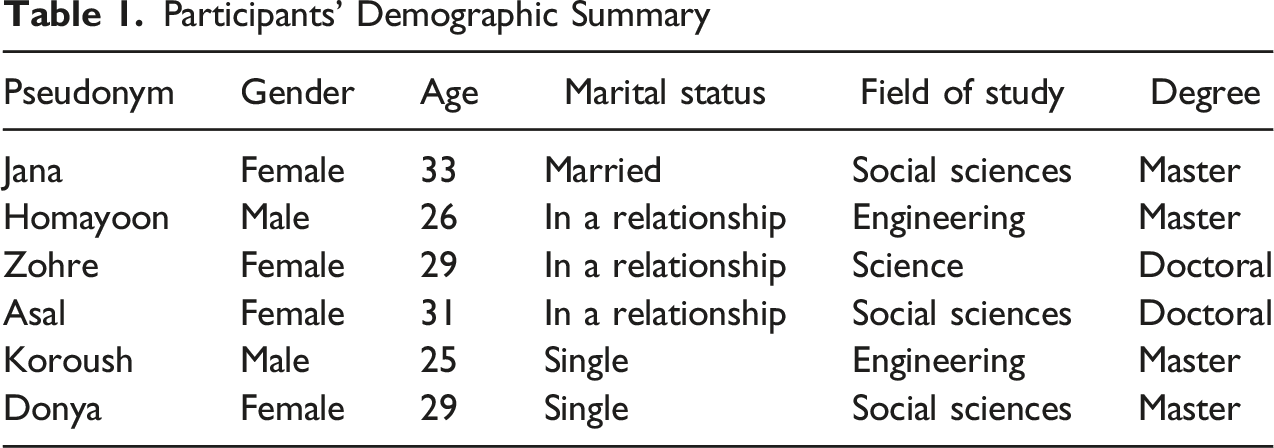
Data Collection
When designing this study, we encountered some dilemmas. The first entailed whether or not to use the term “existential concerns” in recruitment materials, because its equivalent term in Farsi sounded like overly academic jargon. We were afraid that the term may deter potential participants, as they might get intimidated by the perceived need to express their abstract thoughts in a philosophical manner. We also struggled with how to establish a relationship in which participants would feel comfortable discussing existential concerns with the researcher, whom they would be meeting for the first time. To pre-empt these challenges, we implemented the strategies described in the following paragraphs.
First, in our recruitment poster, we remained general by stating that we were “interested in hearing lived experiences as international students in Canada.” Only after potential participants contacted us in response to the recruitment poster, did we explain that the aim of the study was to explore their challenges and experiences at an existential level. Second, to reach an existential level of conversation, we decided to conduct two 90-min interviews with each participant. The first interview was aimed at getting to know the participants and their general migration experiences. At the end of the first interview, Didehvar, who conducted all the interviews, explained the focus of the second interview and asked participants to bring pieces of art (e.g., paintings, photography, poems) that represented their existential experiences (see Supplemental Appendix A for the interview guide). Art is considered a visual language that allows for the expression of people’s intentions and emotions in creative, powerful, and spontaneous ways. Asking participants the meaning of the visual and written pieces of art they brought to their second interview encouraged thoughtful reflections about their experiences (Lawson et al., 2014). Five out of the six participants brought pieces of art to the second interview: two brought poems, one music, and two keepsakes that were gifted to them by their loved ones before moving to Canada. Our intention was not to analyze the pieces of art per se, but to elicit rich interview data by inquiring about the meaning of these items for them (Reynolds et al., 2011).
Third, to facilitate conversation about existential experiences during the second interview, we used cards with existential terms written on them to prompt participants to reflect at a deeper level, so that the existential meaning of their experiences may be revealed if there was one. Each of the cards had one of the following words written on it: loneliness, anxiety, identity, meaning, freedom, death, and responsibility. To avoid confining participants to reflect only about their experiences in relation to the cards, Didehvar asked open and inviting questions such as “Is there anything else not in these cards that is relevant for you?” Further follow-up questions about their experiences, including their feelings, thoughts, and actions, directed the conversation to an existential level (see Supplemental Appendix A). In general, participants responded well to these cards, expressed their thoughts, and offered examples in a forthcoming way without much intervention on behalf of the interviewer.
Data Analysis
All the interview data were transcribed and deidentified, and pseudonyms of their choice were assigned to each participant. We followed the steps outlined by Smith et al. (2009) to analyse data: (a) multiple readings of the transcripts and making initial notes, (b) developing emergent themes, (c) connecting emergent themes, and (d) looking for patterns across cases. As a Farsi-speaking researcher, Didehvar conducted the initial stages of analysis. Through multiple readings of the transcripts, she highlighted parts of the data in which participants discussed existential experiences and their significance. The process of making notes of these highlighted parts consisted of commenting at three levels—descriptive, linguistic, and conceptual (Smith et al., 2009). Didehvar then organized her initial notes into themes for each participant, which she discussed regularly with Wada. Wada considered data within the part and whole dynamics of the hermeneutic circle (e.g., “How does this extract fit with the entire interview?” and “How does this emerging theme fit with the lifeworld of Iranian students?”). This led the authors to discuss alternative interpretations, which facilitated a deeper understanding and conceptualization of emerging themes. At this stage of the research process, Didehvar also shared deidentified initial notes and emergent themes with Farsi-speaking peers to ensure that the analysis spoke to Iranian immigrant experiences. The next stage involved listing the emergent themes in each transcript in chronological order, clustering themes, and labeling each cluster with a superordinate descriptive phrase. After creating superordinate themes, we searched for connections among them to develop overarching themes. Consistent with IPA, we completed this process for each transcript before moving to the next step. After completing within-case analyses, we sought to identify patterns across cases.
Validity and Quality of Research
To attend to the quality of our analysis and interpretation, we referred to the four criteria outlined by Yardley (2000), which Smith et al. (2009) and Smith and Osborn (2015) endorsed as appropriate for IPA. In regard to sensitivity to context, we consciously attended to the sociopolitical factors that influenced participants’ decision to migrate and which further impacted their adjustment experiences in Canada. To address the criterion of commitment and rigor, which emphasizes the thoroughness of the process of data collection and analysis, we: (a) collected an adequate amount of data from a sufficient number of participants whose experiences were relevant to the phenomenon under study, and (b) engaged with the data in a prolonged and in-depth manner. The criterion transparency and coherence refer to creating a cohesive document that provides detailed descriptions of the research process including researchers’ reflexivity. We strived to address this criterion through reflective journaling and adhering to IPA data analysis guidelines. Additionally, Didehvar engaged in an autoethnographic pilot study in which she was interviewed by a peer using an earlier version of the interview guide for this study. She analyzed the transcript and presented her findings to her research community and Wada. This pilot study not only helped to refine the interview guide, but also formed the basis for a continued conversation between the authors about their own subjectivities. Lastly, the impact and importance of this study lies in its contribution to the existing literature on existential inquiries in light of acculturation.
The Issue of Language and Translation
In this study, we collected the original data in Farsi and reported the results in English. This inevitably involved translation of the data during analysis. Although interviewing participants in their first language provided richer narratives by removing language barriers (van Nes et al., 2010), it posed the challenge of preserving the richness of cultural nuances in translation (Ho et al., 2019). The first stage of translation occurred during initial note-taking, as Didehvar read the transcripts in Farsi and made notes of participants’ accounts and statements in English. The next step of translation took place when crafting initial codes and developing emergent themes, which were based on word-to-word translation from Farsi to English. By contrast, we took a semantic approach when translating participants’ quotes, while keeping the Farsi words they used in brackets to preserve the original nuance and emotion (Goddard, 2002). Because many of the words, expressions, metaphors, and ironies that participants used were culture bound, word-by-word translation of direct quotes often did not make sense in English or capture their emotional expressions (Gales, 2010). Moreover, we removed some of the colloquial and filler words to improve the readability of quotes. We sought consultation with three Farsi-speaking graduate students (two in counseling psychology, and one in social sciences) to ensure that our analysis aligned with participants’ experiences, both when developing emerging themes and translating direct quotes. We discussed any discrepancies and sought for a better translation until resolved.
Constant Reflective Motion: Attending to Existential Issues and Overinterpretation
The nature of the phenomenon under study––existential concerns––also presented a unique challenge. Considered as part of the human experience, existential concerns are ubiquitous, something that most people face over the course of their lives; yet, too often experienced at a latent level without any awareness (Yalom, 1980). Furthermore, existential terms are overly intellectual, and not necessarily accessible to laypeople. In fact, only one of the six participants had previous knowledge of existential concepts, and most participants spoke of their experiences without labeling them as existential. This meant that our analysis involved attending to and uncovering hidden meanings. Doing so is consistent with the hermeneutic orientation of IPA; researchers adopting this approach seek to “understand the implicit meaning of things,” “particularly the hidden or so-called deep meanings” (Cooper et al., 2019, p. 5–6).
Although “mining the material for possible meaning” (Eatough & Smith, 2017, p. 198) allows for multiple layers of interpretation consistent with IPA, having such interpretive authority requires “constant reflective motion on the part of the researcher” (Eatough & Smith, 2017, p. 196). As such, we were wary of overinterpreting participants’ accounts, as we identified that our keen interest in existential psychology could become a potential source of bias. Thus, we took the following stance. We initially adopted an existential frame of mind as we read transcripts, assuming that there were latent existential meanings within participants’ narratives. When developing emerging themes and identifying patterns, however, we dropped our interpretations if examples and quotes failed to substantiate an existential interpretation. For example, some participants spoke about a lost sense of self due to being limited when expressing themselves in English (e.g., “this is not who I am”). The authors examined whether this could be interpreted as defamiliarization. We decided to exclude these instances from further analysis because participants spoke more of the inconvenience caused by insufficient language proficiency than a loss of familiarity with themselves. Regarding concerns such as these as existential would have been overinterpretation, which we refrained from through the reflective practice described previously.
Results
Summary of Overarching, Superordinate, and Subthemes
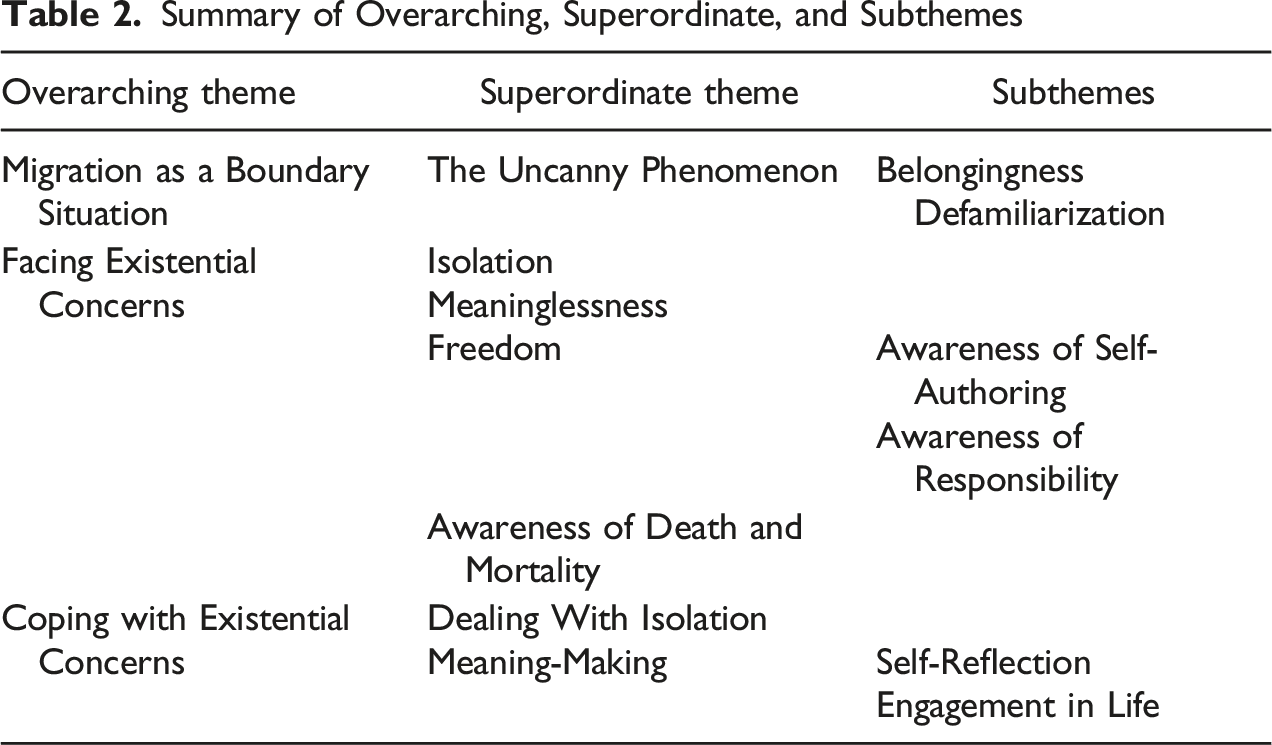
Theme 1: Migration as a Boundary Experience
Understanding the nature of existential concerns requires in-depth personal reflection (Cooper et al., 2019). This process is often catalyzed by running into a boundary situation, defined as “an event or an urgent experience, that propels one into a confrontation with one’s existential situation in the world (i.e., facing one’s own death, collapse of meaning in life)” (Yalom, 1980, p. 159). A boundary situation pulls individuals away from familiar and everyday concerns and prompts them to rethink their situation. For our participants, relocation and separation from their families and homeland served as a boundary situation, which brought existential concerns to the foreground. This overarching theme introduced feelings of uncanniness and instigated a confrontation with existential questions.
The Uncanny Phenomenon
Participants’ encounters with the unfamiliar environment of a new land and social codes evoked a sense of uncanniness captured by Yalom’s earlier quote. They dwelled on the meaning of home, belongingness, and their need for familiarity. Although such feelings are often interpreted as homesickness in the foreign country (Thurber & Walton, 2012), the critical exploration of such experiences reveals their resemblance to the feelings of uncanniness. Within the superordinate theme of the uncanny phenomenon, two subthemes—defamiliarization and belongingness—emerged.
Belongingness
Despite having left Iran voluntarily for a more fulfilling life, participants struggled with a sense of not-belonging or being not-at-home in Canada. This notion was previously conceptualized by Madison (2006), who stated: “A person may leave home yet never shake its haunting presence, long for home yet undoubtedly see no future for themselves there. Paradoxically, they maintain a ‘special connection’ to a homeland even though they may rarely have felt at-home there” (p. 18). Zohre’s account represents this struggle: In the first year [of residing in Canada], I had this feeling of being displaced. I was thinking that everyone would like to stay in their home country, and I also wanted to stay in Iran, but I had to leave because of fundamental differences in values and feeling that I didn’t have a place in Iran anymore… I don’t feel connected with Canadian society either. I don’t know what it means to be blended within Canadian society.
Zohre’s use of the English word “being displaced” describes the internal pressure she felt to leave home despite her emotional ties with Iran. Having renounced her sense of belonging to her homeland, Zohre has yet to find her place in Canada–and thus belongs nowhere.
To describe her feeling of not belonging, Jana used the word “rootless.” Root and soil metaphors in English, Persian, and some other languages speak to the seemingly universal existential need to feel grounded. As Jana noted, “Like many other migrants, I am like a plant that is pulled out of its soil and placed in water. I would grow small roots but never roots like the plants that are placed in soil.” She referred to herself as a plant not grounded in soil (her homeland), but rather placed in water, an unfamiliar environment that made her fragile. Additionally, Asal, used the metaphor of a “scar” to explain her feeling of a lack of belongingness: [Migration] has a sadness that you can’t change. I may never be able to come to terms with it completely. Like an old wound, it doesn’t bleed, but it never heals. [It] always reminds you that you don’t belong here, that you lost something, but you traded for it.
In Asal’s narrative, there is a sense of grief and loss for leaving Iran, the home which had given her the security and comfort that she had taken for granted. She understood her separation by justifying it as a “trade-off” to achieve academic success, the possibility of having financial security, and more freedom.
Defamiliarization
Defamiliarization is an existential term that explains a sense of unfamiliarity in the world when one faces the existential state of not-being-at-home. Participants shared their experiences of confronting unfamiliar situations in Canada, pointing to major differences between the climate, architecture, and spirit of Iran and Canada which made them feel not-at-home. Asal missed walking through the vibrant city streets of Tehran, which she did not experience as meaningful until she moved to Canada. For Asal, it was through her connection with the past, which was felt through abundant ancient landmarks and cultural heritage in the city streets, that she used to feel grounded in the present–people walked the same streets and passed the same historical landmarks for hundreds of years. She explained, “history connects me to the experience of living, which is less apparent here. I didn’t know it would affect me to this extent.” Her Canadian city is more car-oriented and lacks historical landmarks, creating a sense of defamiliarization and a void. Donya and Homayoon reflected on a sense of defamiliarization in their everyday interactions with the people around them. They both shared that even though they could establish friendships with their fellow Canadian peers, the relationship was not as deep as their relationships with Iranians. Homayoon noted, “I believe this, the lack of deep connection, is due to the cultural differences and lack of my fluency in English.”
Theme 2: Facing Existential Concerns
Whereas the former theme focused on the path to encountering existential concerns catalyzed by cross-cultural transition, this overarching theme elaborates upon the participants’ experiences of facing existential concerns in Canada. We represent our interpretation of participants’ existential concerns based on Yalom’s (1980) ultimate concerns, as we came to see them as useful during data analysis as a guide for probing implicit meaning.
Facing Ultimate Isolation
For the majority of participants, separation from their home and their loved ones resulted in feelings of isolation. Beyond the interpersonal isolation, which is common in acculturation, some narratives seemed to point to an underlying existential loneliness. For example, Zohre spoke of her disconnection from the entire world, which is evident in the following quote, “When I felt alone, the image I had of myself as soon as I started thinking about my life was seeing myself like a dot standing all alone on the vast map of Canada without anyone and anything.” Donya further elaborated on her existential isolation as a “big void”: When I would come home at nights, it was pure silence, pure loneliness, and nothing else. It was the hardest [part of migration]… it’s like there’s no solution for it. There were moments when I felt that if it weren’t for Netflix or music for example, I would go crazy. I couldn’t stand it, like if I tried tolerating it for one more second, I would die (laughter). It was a strange feeling.
Donya used the word “pure” (محض) to describe the intensity of her isolation. She felt powerless in managing such intense feelings and needed to distract herself from them. Koroush described his moments of loneliness as feeling “deeply alone, … like an abandoned island far away from a large continent.” His experience can be interpreted as interpersonal isolation because he grieved being far away from his family members—the large continent. However, viewed through an existential lens, Koroush’s experience may show a profound sense of separation from the world around him as an “abandoned island.”
Meaninglessness
A sense of meaninglessness in the diasporic experience manifested in various ways in most of the participants’ accounts. Donya’s experience of meaninglessness seemed to be related to the absence of “meaningful cultural elements of [her] culture” that enriched her life back home. She described her first Persian New Year away from home. Despite putting great effort into following the traditions associated with this celebration, she felt disconnected and “empty,” and realized that the meanings of her cultural traditions are lost outside of her native geographical context. Similarly, Koroush spoke about how religious practices, such as fasting during Ramadan, felt empty in Canada where he is not surrounded by his religious community. Feeling like his values were insignificant made him feel confused and led him to question his own belief system.
A sense of meaninglessness was also caused by seeing the larger picture of injustice and absurdity in the world. Koroush explained that living in Canada led to random thoughts about the living situation and struggles of people in Iran in comparison with people in North America. Reflecting on the sociopolitical problems of Iran and how wealth is unfairly distributed in the world deepened his thoughts about the absurdity of life. He explained: I was confused about the philosophy of human existence when I came to Canada. My uncertainty kind of led me to think more deeply about killing myself. I told myself, look, this world is not fair at all. So many people are poor, so many people are hungry. Why violence? Why war? Aren’t we all going to die? So, what’s going to happen?
Koroush’s questioning resulted in existential reflections about the purpose of human life. He wished to “eliminate the injustice,” but felt very insignificant in the face of the governing systems. Failing to find a meaningful reason to continue his life, he reported having had suicidal thoughts at one point. Jana reported a similar experience and how her moral thoughts alluded to doubts about the meaning of life and her migration: At some point you ask yourself, “is [migration] worth all the challenges and separation from family?” Then you generalize this feeling to your entire life and ask yourself what is the meaning (ارزش) of life?… You basically question the meaning of everything you did in life. In those months that I had these thoughts, I thought about killing myself.
Jana and Koroush’s experiences reveal a sense of existential meaninglessness, which, according to Yalom (1980) is “the most perplexing and insoluble question of all”; the failure to find meaning, goals, and values to live for can lead to an existential crisis and “in severe form it may lead to the decision to end one’s life” (p. 422).
Facing Existential Freedom
Participants discussed varying experiences related to existential freedom. Homayoon and Donya said they enjoy the freedom of making decisions about their lives more independently compared to when they were living with their parents. On the other hand, some participants realized that having more freedom also meant having more responsibility. Their accounts underscored subthemes of awareness of self-authoring and assuming responsibility.
Awareness of Self-Authoring
From an existential perspective, individuals are the authors of their own lives. Yet, arriving at this awareness can be anxiety-provoking because it requires people to face a sense of groundlessness; there is no “structure, grand design, magic, or something bigger than them” (Yalom, 1980, p. 222) that exempts them from having to create their lives. Asal’s experience may indicate her awareness of self-creation: [Lately] I have been watching very old movies, [which] take me back to my childhood memories where I had peace of mind and security because I had a caregiver. I had a mother that would take care of everything. I knew that I was not responsible for all aspects of life, I was not my own anchor in life, and did not have to think about important decisions like applying for permanent residency.
In the absence of her family, who guided her through important life decisions, Asal realized that the authorship of her life rests on her shoulders. Similarly, Homayoon pointed out his feelings of “confusion” in the absence of parental guidance and the socially accepted path that guided his decisions in Iran. He wished for that structure because it felt “overwhelming to be responsible for making every decision in life” on his own.
Awareness of Responsibility
Jana and Koroush realized the need to assume responsibility for their lives and choices following migration. Homayoon mentioned that “social rights and freedom stand side by side with responsibility and keeping them together is a very balanced dance and you have to walk carefully on the edge of it, otherwise falling to one side is dangerous.” This reflection shows his realization of the inseparability of freedom and responsibility. Koroush and Homayoon also spoke about their sense of social responsibility. They mentioned having been more involved in Iran in activities that benefited the collective, whereas the individual-centered nature of Canadian society had reportedly made them focus more on personal responsibilities. Koroush emphasized that, beyond his individual success, he feels socially responsible for making a difference in other people’s lives. From this desire arose his dream of “building a library in Iran” to promote education.
Awareness of Death and Mortality
For all participants except Homayoon, cross-cultural transitioning represented a situation in which they became aware of mortality. As Jana explained: [My parents’] physical absence was somehow similar to their death and I really grieved [this] loss, but it also made me realize that one day I may lose my loved ones for any reason. I can say that [separation from them] somehow brought me face-to-face with potentially the worst loss that I could experience, which is my parents’ death.
Donya mentioned that she did not often think about death. However, her relocation made her cognizant of the possibility of dying alone in a foreign country: If something bad happens to me and I die in my apartment, my body would decay with nobody knowing it. Then who would tell my family, what would they do? This makes me feel scared… I’m afraid that I am going to die alone. It’s as if your death doesn’t matter to anyone, that you die alone and no one understands, it’s very sad.
Donya’s quote demonstrates her fear of dying alone without anyone noticing, whereas Koroush used the metaphor of “dying and being born again” to describe the challenges and losses that he experienced during his cross-cultural transition. Similarly, Zohre said that she experienced “a complete collapse” and had to “recover” from the hardships of migration.
Theme 3: Coping With Existential Concerns
This third overarching theme, Coping with Existential Concerns, captures the ways in which participants dealt with their aforementioned concerns. Their accounts highlight superordinate themes of dealing with isolation and meaning-making.
Dealing With Isolation
Participants coped with existential isolation in different ways. Asal and Donya confronted their isolation by plunging into their feelings of loneliness and accepting it as something unavoidable. Asal mentioned, “loneliness cannot be fully shared, even with significant others.” Donya shared a story about a time when she was lonely and desperately searched for a way to escape from it. She was inspired by one of her friends who advised her to accept her feelings as an existential reality, “She would tell me that my only choice is to accept loneliness and just live with it as it is. It has to be a part of me in order for me to feel at peace.” Moreover, Donya realized that accepting loneliness helps her to develop genuine relationships: “you can truly love another human being.”
On the other hand, some participants spoke about the ways in which they distracted themselves from the discomfort of isolation. Jana reported, “I couldn’t make peace with my feelings of isolation. I constantly tried to escape it by not staying alone or going shopping.” According to Yalom (1980), distracting oneself from loneliness is a common response to existential isolation due to the difficulty of such confrontation. However, “those who can tolerate and explore their isolation can relate in a more mature loving fashion to others” (p. 399).
Meaning-Making
In response to the sense of meaninglessness that participants felt to a varying degree, participants attempted to find meaning and purpose. Meaning-making revealed two subthemes: self-reflection and engagement in life.
Self-Reflection
An unfamiliar environment and the loneliness therein instigate a process of self-reflection. All participants shared meaningful accounts of their self-reflections during their acculturation and the development of new insights about their experiences. For Zohre, adjustment challenges, such as her struggle to keep up with academic English, brought up her pre-existing issues with low self-esteem: At some point, instead of only seeing my own inadequacies, I started to observe other people and their ordinary imperfection as well, and doing this initiated my change. I was also talking to myself a lot, I was remembering my achievements. I was telling myself that if I was stupid, I couldn’t have come to Canada by myself and begun a PhD program.
Reflecting on how she has accomplished her goals and has “built [a] life in Canada from scratch” gave rise to a new narrative and meaning, which in turn improved her self-esteem. Likewise, Jana reported deriving a sense of growth from the hardships of migration, “I’ve almost learned how to live independently, but this achievement only comes true when you tolerate the pain of separation and isolation. This is a bitter reality that I learned.” According to Frankl (2006), hardship can create meaning for individuals if that experience results in positive change in their lives. For Jana, developing a sense of self-reliance was indeed a positive and meaningful outcome of her acculturation challenges.
Engagement in Life
Rather than remaining stuck in their feelings of meaninglessness, participants moved on to committing themselves to their new life in Canada, their goals, and aspirations. At the end of the interview, Homayoon reflected on the sense of meaninglessness and confusion that he had felt when he pondered the question of “so what?” about his migration. He stated, “Leaving Iran and coming to a new world in and of itself doesn’t bring meaning to your life. The choices and responsibilities that you adopt in life make your life meaningful no matter where you live.” Repeatedly during his interview, Homayoon spoke of his attempts to find meaning by being actively engaged in his day-to-day life. With regard to the lack of belonging, Zohre and Asal spoke about their desire to establish a sense of home in Canada through a variety of efforts, ranging from simple acts such as gardening to creating new networks and becoming engaged in their communities. Donya and Zohre both felt more engaged in their lives in Canadian society because they were free to lead a life that reflected their personal values as opposed to having to conform to traditional expectations of women in Iran. Donya noted, “What makes me like Canada and want to establish my life here is that I have more freedom and autonomy over my life and can live some of my values that I couldn’t live before.”
Discussion
The literature on international students has been criticized for pathologizing adjustment problems (de Araujo, 2011; Moores & Popadiuk, 2011). Thus, we adopted an alternate and novel way to conceptualize acculturation challenges by attending to participants’ underlying existential meaning. The hermeneutic approach we took allowed us to focus on the latent, but at times quite explicit, manifestations of existential concerns that could easily be misinterpreted as adjustment issues. For example, what has typically been viewed as suicidal ideation and depression among this population could in fact be a crisis of existential meaninglessness (Diamond, 2021). Upon migration, some participants experienced a disruption in what they considered to be the meaning and purpose of their lives. Asking themselves, “What should I live for now?” some of them struggled to find meaning and set goals, which resulted in a temporary loss of hope. This crisis of meaninglessness manifested itself in the form of depressive symptoms, feelings of hopelessness, and suicidal ideation, which could be mistaken as symptoms of psychological disorders (Berra, 2021; Cheung et al., 2020).
Another example of existential concerns that may be masked as adjustment problems is existential isolation (Olofsson et al., 2021). The results of this study suggest the presence of existential isolation, manifested in feelings of being alone in their own experience, away from all that is familiar. They felt groundless in the absence of the meaning structures and support systems that had thus far anchored their lives. Some participants’ accounts revealed a vague sense that their life experiences could not be fully shared with another person. However, this existential isolation was intertwined with longing for connection and a sense of home, which can be interpreted as interpersonal isolation and homesickness. This finding supports those of previous studies that demonstrated that existential isolation is often mistaken for emotional isolation in therapy (Ettema et al., 2010; Spillers, 2007). Pointing to this conceptual difference, Basma and Gibbons (2016) observed existential isolation as underlying the emotional isolation experienced by Arab refugees in the aftermath of war. Overall, our findings add to the extant literature that challenges pathologizing views of cross-cultural adjustment difficulties and instead offers a more humanizing perspective.
Our findings also indicated that feelings of uncanniness emerged from the unfamiliarity of the host culture. Participants’ encounters with their new environment and their felt sense of not-at-home served as a boundary situation, which prompted their existential concerns to surface to their awareness. In describing their feelings of uncanniness, they noted feeling “rootless,” “uprooted,” and “different” from their peers in Canada. They also felt not-at-home as a result of a climate, architecture, and language that were unfamiliar to them. Participants’ experiences of defamiliarization demonstrate a stark similarity with Albert Camus’ experience of defamiliarization in a foreign country in his essay Death in the Soul (La mort dans l’âme): Here I am defenseless in a city where I cannot read the signs… without friends to speak to, in short, without diversion. In this room penetrated by the sounds of a strange city, I know that nothing will draw me toward the more delicate light of a home or another cherished place… And now the curtain of habit, the comfortable tissue of gestures and words, wherein the heart grows sluggish, rises slowly and finally unveils the pale face of anxiety. Man [sic] is face to face with himself… (cited by Yalom, 1980, p. 358).
Camus’ narrative speaks to his encounter with a world of familiar objects (i.e., a hotel room, a city view). Paradoxically, these objects are also strangely unfamiliar to him because they are detached from the “personal and collective meaning” they had for him in his own country (Yalom, 1980, p. 358). This sense of defamiliarization, in turn, may lead to being faced with one’s own existence–face to face with oneself. Although little research exists on feelings of defamiliarization and uncanniness in the context of cross-cultural transition, Madison’s (2005) doctoral dissertation is a noteworthy exception. Our findings are consistent with Madison’s phenomenological study of 20 multinational migrants, who left their countries for Europe in a quest for new possibilities. Having voluntarily left their countries, Madison’s participants still dwelled on the meaning of home and the sense of belonging in the world. Madison emphasized how encountering an unfamiliar environment as a result of relocation could serve as a catalyst for uncanniness, which in turn prompts existential questions to surface.
The results also demonstrate participants’ resiliency, growth, awareness, and ability to reflect on their adjustment challenges and existential issues. Participants generally saw migration as a turning point despite the difficulties it brought about for them. Wrestling with the losses and stressors of migration symbolized death in many aspects of their lives, such as relationships, belonging, and language. The sense of mastery gained from overcoming these challenges was in turn embodied as being born again with more confidence and resources to further establish their lives in Canada. Moreover, despite meaninglessness and difficulties finding purpose in life, participants’ reflections about their journey of cross-cultural transition seemed to elicit a newfound sense of meaning in their struggles. In order to manage their feeling of uncanniness, they looked to create meaning by engaging with their lives in Canada.
The findings of this study reflect the heterogeneity of international students’ experiences by pointing to the unique impact of the current geopolitical context on the experiences of Iranian international students. Given their perceived lack of hope for the future in Iran and their intention to relocate permanently, their position is arguably similar to those of immigrants. Nevertheless, there are notable differences between these international students and immigrants, such as the temporary nature of international student visas and the demands of their schooling. By contrast, immigrants arrive in Canada as permanent residents and are ready to try to establish their careers (Smith & Khawaja, 2011). International students benefit from eventually obtaining a Canadian degree, which represents an advantage in the job market compared to the foreign degrees that skilled immigrants bring with themselves (Sinacore et al., 2011). These unique factors not only differentiate Iranian international students from more typical international students, but also distinguish them from other groups of newcomers, potentially leading them to feel unrecognized, and struggling to define themselves.
Limitations
This study is not without limitations. First, all six students were relatively young graduate students who had been residing in Canada for less than three years. Although the use of a homogeneous sample is appropriate for IPA, our results may have been different if the study included participants who were undergraduates, or had resided in Canada for a longer period. Second, the limited scope of this study did not allow for the examination of other factors, such as intersectionality, that may have further enriched our understanding of their experiences. Third, we relied on Western conceptualizations of existential philosophy and psychology. Although Yalom’s (1980) conceptualization of existential psychology has been translated into Farsi and is well accepted in Iranian scholarly communities, there is also literature on Persian existential philosophy (Bahram, 2011; Jaberizadeh, 2013; Saranjam & Mohammadi, 2017). Despite its importance for multicultural counselling, we thought translating and incorporating literature on Persian existential philosophy was beyond the scope of this study. Lastly, even with the careful measures we took to minimize our bias, the reader may still take issue with our interpretation of some of the participants’ experiences as existential. Admittedly, there is no objective way to distinguish existential concerns from adjustment challenges when they are not expressed explicitly. However, it was not our intention to prove that these concerns are existential in nature; rather, we aimed to offer a different perspective about acculturation challenges, which we believe would generate new possibilities in the way we counsel international students.
Implications for Practice, Research, Advocacy, Education, and Training
Based on the framework for multicultural counseling (American Psychological Association [APA], 2017; Collins & Arthur, 2010), practitioners working with international students should continuously seek training to enhance their awareness, knowledge, and skills in ways that are relevant to the needs and challenges of this population. The results of this study suggest the need for practitioners to be attentive to the possible existential concerns accompanying international students’ acculturation stress, and to provide a space that allows for authentic conversations about such concerns. We echo other scholars such as Madison (2005), Maglio et al. (2005), and Olofsson et al. (2021) who discussed the benefits of addressing existential concerns in counseling with immigrants. By doing so, practitioners are able to offer their clients an alternate perspective on their acculturation challenges that is self-compassionate and growth-promoting. Learning expressive art therapy techniques (e.g., drawing, storytelling; Buchalter, 2009) and compassion-focused exercises (e.g., compassionate attending to self-criticism, being mindful of present experiences, being attuned to one’s needs and concerns; Neff et al., 2007) are growth-promoting interventions aligned with existential therapy that practitioners can integrate into their practice.
Practitioners working with international students should also pay attention to, and seek to understand, the unique geopolitical situation their clients face (Panagiotakopoulos, 2020). For participants in this study, international affairs and the sociopolitical climate impacted their selection of host country, intention to permanently relocate, and, accordingly, their academic and career aspirations. These conditions in turn influenced their existential inquiries and meanings such as home and belonging. Their diasporic experience appears to differ from international students from other counties who, for example, grapple with the “stay or return” dilemma or issues of “reverse culture shock” (Leung, 2007), pointing to the heterogeneity within the international student population. The acculturation experiences of the Iranian students in this study seemed to fall between that of international students and immigrants, which may be similarly experienced by international students from other countries. McGill (2018) referred to this type of international student as student migrants, who have unique needs and challenges. Future studies should explore ways to help meet this population’s needs, including those that require advocacy.
As for future research, our findings offer insight into international students’ existential concerns, and make the case for developing and validating a model of acculturation that takes those into account. In assuming the possible emergence of existential inquiries in addition to cultural, behavioral, and psychological changes during migrants’ adjustment, this acculturation model can capture a deeper understanding of their experiences. Future studies should therefore aim to create existentially themed instruments suitable for international students and other groups of newcomers. These instruments could be used to investigate the relationship between existential concerns and variables such as coping and resiliency, as well as the mediative effect of existential inquiries on acculturation. Practitioners may use these instruments for focused, process-oriented dialogue with their clients, similar to Watson and McMahon (2014)’s proposal of using quantitative career inventories as a means to storytelling and meaning-making. By inviting clients to tell their stories as they go over the items together, practitioners can open up a space for connecting clients’ distress with existential inquiries and co-constructing new meanings.
Finally, the study has implications for advocacy and training. International students can be precariously positioned as their status is influenced by shifting political and economic situations. Canadian universities’ reopening of admission reviews in response to the Trump Administration’s travel ban discussed earlier, and the APA and its Division 17’s (Society of Counseling Psychology) work on the statement in opposition to the rule limiting the length of time international students are allowed to stay in the United States (APA, 2020), are excellent examples of advocacy. For training and education, the APA Multicultural Guidelines: An Ecological Approaches to Context, Identity, and Intersectionality (APA, 2017) is particularly useful. The fourth layer of its ecological model pertains to the need to attend to domestic and international climates, with specific references to international students (p. 68). Case K: Michael: Identity and Refugee Status (pp. 185–186) included in the guidelines depicts a case of an African man who entered the United States on a student visa, but who is de facto a refugee and experienced an existential crisis due to his shifting identities and precarious position in the world. The current study may supplement this case study to help trainees consider sociopolitical contexts at domestic and international levels and their link to existential issues in case formulation and intervention planning.
Conclusion
This interpretive phenomenological study explored the existential inquiries and dilemmas that arose for six Iranian international students during their acculturation in Canada. Our study presented a developmental and heterogeneous understanding of participants’ experiences by reflecting the underlying existential meaning of their adjustment challenges as well as their growth, strengths, and the political and economic tensions that affected their adjustment. Our findings indicated that existential concerns may be masked as adjustment problems. These results are important considering current literature that overemphasizes international students’ deficits and conceptualizes their acculturation challenges as pathological. We encourage practitioners to seek to understand the sociopolitical and contextual factors that may be impacting an international student’s challenges, as well as the possible existential concerns accompanying their acculturation challenges.
Supplemental Material
Supplemental Material - Uncanny Phenomenon: Existential Experiences Among Iranian International Students
Supplemental Material for Uncanny Phenomenon: Existential Experiences Among Iranian International Students by Mina Didehvar and Kaori Wada in The Counseling Psychologist
Footnotes
Acknowledgments
The authors express gratitude to Negin Saheb Javaher, Asra Milani, and Sepidar Yeganeh Farid for their assistance with the translation and for providing insightful comments and suggestions. We are also grateful to Noah Furlani and David Marulada for proofreading the manuscript.

Supplemental Material
Supplementary material for this article is available online.
Author Biographies
References
Supplementary Material
Please find the following supplemental material available below.
For Open Access articles published under a Creative Commons License, all supplemental material carries the same license as the article it is associated with.
For non-Open Access articles published, all supplemental material carries a non-exclusive license, and permission requests for re-use of supplemental material or any part of supplemental material shall be sent directly to the copyright owner as specified in the copyright notice associated with the article.
