



Abstract
Indigenous mental health research is beginning to address colonization, however, Indigenous approaches to wellness have largely been overlooked. There is a paucity of research exploring psychological trauma interventions with Indigenous peoples. The Wet’suwet’en hereditary chiefs recognize the profound impacts of historical trauma among their people and are utilizing Indigenous focusing oriented therapy (IFOT), a trauma model that is collective, land-based, and intergenerational, as a part of their wellness framework. This collaborative research study explored the question: How is IFOT shaped by Wet’suwet’en ways of knowing and mobilized by individuals, families, house groups, and the Nation? Wet’suwet’en IFOT practitioners participated in sharing circles for data collection and interpretation. The exploratory findings revealed that the strategic application of IFOT by Wet’suwet’en hereditary chiefs created a culturally relevant model for land-based healing wherein Wet’suwet’en people were able to experience greater connection with their own yintah (land) and c’idede’ (history).
Keywords
This article reflects collaborative research with the Wet'suwet'en Nation according to Indigenous methodologies and founded upon Wet’suwet’en ways. The finding articulate key aspects of healing according to the Wet’suwet’en worldview, namely, interconnection with land, belonging in community, reclamation of identity, and decolonization. The Wet’suwet’en application of IFOT provides a unique example of an Indigenous trauma therapy approach rooted in culture and community.Significance of the Scholarship to the Public
Introduction
The hereditary chiefs of the Wet’suwet’en 1 Nation, whose territory spans from Burns Lake to Hazelton in northwest British Columbia, Canada, recognize the profound impacts that historical trauma has on their people and are mobilizing a wellness framework that is rooted in their own local context to help their Nation to heal. The construct of Indigenous historical trauma elucidates the health disparities experienced by Indigenous peoples and has been described as a distinct form of psychological trauma that originated from colonization whose impacts are collective, cumulative, and span generations (Brave Heart, 1998; Gone et al., 2019). Indigenous historical trauma describes the colonial systematic destruction of Indigenous culture, spirituality, language, territory, social structures, ceremonial practices, governance, and economic stability that has carried into the present (Gone et al., 2019).
In Canada, colonization has been enacted upon Indigenous 2 peoples in many ways over the last 300 years, including but not limited to: turning Indigenous peoples into wards of the state, imposing the federal reserve system to replace traditional systems of governance, providing inadequate services to those living on reserve, racist attitudes and discrimination, obligating Indigenous peoples to forfeit status, and removing Indigenous children from their families and communities as a part of the Indian Residential Schools and the Sixties Scoop (Adelson, 2005; Bombay et al., 2009). In May 2021, the undocumented remains of 215 children were found at a mass grave at the former Kamloops Indian Residential School (Dickson & Watson, 2021). The Truth and Reconciliation Commission of Canada (TRCC) estimated that 150,000 children attended residential schools in Canada between 1830 and 1997 and based on death records, 3,200 children died; however, the actual number is likely much higher (TRCC, 2015). Furthermore, physical and sexual abuse was rampant at residential schools. (TRCC, 2015). In 2019, The National Inquiry into Missing and Murdered Indigenous Women and Girls (2019) found that violence experienced by Indigenous women, girls, and Two-Spirit, lesbian, gay, bisexual, transgender, queer, questioning, intersex, and asexual (2SLGBTQQIA) people amounted to “acts of genocide” that have been empowered by colonial structures. Duran & Duran (1995) referred to trauma experienced by Indigenous peoples through colonial processes as a “soul wound.” This language attempts to explicate the destructiveness of historical trauma on Indigenous peoples.
Some scholars argue that the impacts of historical trauma in Indigenous communities have been exacerbated by Western psychological models that have neglected Indigenous approaches to wellness (Adelson, 2005; Gone et al., 2019; McCormick, 2008). Although there is no single Indigenous worldview, the literature highlights Indigenous perspectives of wellness that value holism, relationality, spirituality, and connection to the natural world (Adelson, 2005; McCormick, 2008; Stewart, 2008). Western approaches to health that are focused on the individual within the medical system of care have often led to a cultural disconnect for Indigenous peoples resulting in alienation and limiting access to care (Stewart, 2008). According to Duran and Firehammer (2017), unless services are “deeply rooted in the life-world metaphor of the culture, effectiveness will be limited at best and more trauma will occur at worst” (p. 122).
Colonial relationships and inadequate mental health responses have shaped the disproportionate psychological distress and poor health outcomes experienced by Indigenous peoples in Canada compared with non-Indigenous peoples (Adelson, 2005; Gone et al., 2019; McIntyre et al., 2017; Statistics, 2018). Self-identified Indigenous peoples in Canada comprise 4.9% of the overall population and the Indigenous population has grown by 42.5% since 2006, which is four times faster than the overall population (Statistics, 2018). Notwithstanding the size and growth of the Indigenous populations in Canada, Smylie and Firestone (2015) warned that health assessment data for Indigenous peoples is limited and must be considered with caution. According to Statistics Canada (2011), the life expectancy of Indigenous peoples is 12 years lower than the national average. In terms of mental health status, the most commonly reported negative indicators found among Indigenous peoples in Canada are suicide, alcoholism, violence, and depression (Kirmayer et al., 2000). Bombay et al. (2009) reported that 64% of Indian Residential School survivors were diagnosed with posttraumatic stress. McIntyre et al. (2017) found that although the general mental health rates of Indigenous populations in Canada, Australia, New Zealand, and the United States were similar to the non-Indigenous population, the Indigenous people of these countries had higher rates of posttraumatic stress and inadequate mental health care. The TRCC made a call for action to close the gap between Indigenous and non-Indigenous indicators of health, particularly in mental health, by addressing the distinct health needs of Indigenous Peoples and recognizing their traditional healing practices (TRCC, 2015).
The Wet’suwet’en Nation has demonstrated resilience, despite the impacts of historical trauma, as participants in the Indigenous sovereignty movement in Canada (Smart, 2021). The Delgamuukw-Gisdaywa v. British Columbia (1997) case, in which the Wet’suwet’en joined with the neighboring Gitxsan Nation as claimants, set a precedent for the definition and content of Aboriginal title, the government’s duty to consult with Indigenous peoples, and the legal validity of oral history. From 2019 to 2020 “Wet’suwet’en Strong” protests and blockades impeded the development of a Liquid Natural Gas pipeline through Wet’suwet’en traditional territory, gained support for the Wet’suwet’en across Canada and internationally, and pre-empted negotiations between the governments of British Columbia, Canada, and the Wet’suwet’en Nation regarding right and title (Smart, 2021). Alongside the Wet’suwet’en Nation’s efforts to exercise their right and title to their traditional territory, they have developed a wellness framework based on their own traditional ways. Central to Wet’suwet’en wellness work is the adaptation and integration of Indigenous focusing oriented therapy (IFOT; Turcotte & Schiffer, 2014), a trauma therapy model that is collective, land-based, and intergenerational. This exploratory study was designed to investigate the Wet’suwet’en mobilization of IFOT to address historical trauma within the Wet’suwet’en Nation. It should be noted that this was a collaborative research project. The purpose was not to evaluate the effectiveness of IFOT, rather we were investigating how this intervention was mobilized within the Wet’suwet’en Nation according to their worldview.
Review of the Research Literature on Indigenous Mental Health
Before we designed this study, we conducted a narrative literature review (Panofsky et al., 2021) of research on Indigenous trauma interventions published in Canada (n = 11). In the review of this literature, we found that the authors advocated for local control for Indigenous communities over provincial health care systems in order to appropriately respond to the local medical needs of these communities (Kirmayer et al., 2008). Stewart and Marshall (2017) highlighted how local control promoted the individual and collective efficacy that sustained wellness, leading to the reduction of health disparities. Existing research pointed to the indelible link between cultural continuity (i.e., culture that can be continuously linked with traditions of the past) and positive health outcomes and advocated for community-based interventions that were rooted in cultural models of health and healing (Bombay et al., 2009; Chandler & Lalonde, 2008; Kirmayer et al., 2008; Stewart & Marshall, 2017). Furthermore, the literature highlighted holistic approaches that valued interconnectedness and identified connection to spirituality as a key aspect of an interventions’ effectiveness (Marsh et al., 2016; Reeves & Stewart 2017). Kirmayer et al., (2008) noted the strong sense of place that distinguishes many Indigenous traditions and recognized that connection to land has spiritual, ethical, esthetic, and historical dimensions that are central to resilience.
Extant literature on the implementation of Indigenous trauma interventions identified that individual healing and community healing were intertwined (Marsh et al., 2016). According to scholars, the emphasis on individual and community healing is echoed in Indigenous conceptions of wellness where the individual is embedded in a web of relationships of family, clan, ancestors, animals, natural world, spiritual world, and the interdependence among these elements is central to health (McCormick, 2008; Stewart & Marshall, 2017). Studies have reported that a strengthening of Indigenous cultural identities was central to healing (Gone, 2009; Marsh et al., 2016; Reeves & Stewart, 2017). Further, the researchers emphasized the need to address the effects of colonization in mental health treatment. For Duran and Firehammer (2017) this meant legitimizing Indigenous knowledge, promoting Indigenous healing practices, and supporting initiatives being driven by Indigenous communities. According to Kirmayer et al. (2000), self-determination, specifically, Indigenous rights, land claims, and self-government, held the key to healthier Indigenous communities. Given the review of the current literature, the present study aimed to address the need for culturally relevant research driven by Indigenous communities that explored healing trauma.
Present Study
We designed a collaborative narrative research study with the Office of the Wet’suwet’en (OW). Our study emerged from a long-standing relationship between the first author, Sarah Panofsky, and the Wet’suwet’en community. She had completed research with the OW 10 years prior on the topic of the Wet’suwet’en Nation’s response to the Enbridge Northern Gateway Pipeline Project (Panofsky, 2011). She lived for the following 7 years on Gitxsan and Wet’suwet’en territories in Northern British Columbia working in the field of community development. As a part of this work, she was trained in IFOT (Turcotte & Schiffer, 2014). Panofsky initiated conversations with the Wet’suwet’en hereditary chiefs regarding the possibility of further research. The result was this study.
The OW is a nonprofit society, created in 1994, as the central office for the Wet’suwet’en Nation. The OW is governed by 13 hereditary chiefs and was created during the broad community engagement and cultural revitalization that occurred during the Delgamuukw-Gisdaywa v. British Columbia court case (Office of the Wet’suwet’en, 2020). The Wet’suwet’en hereditary chiefs acknowledge the impacts that historical trauma has had on their people and are committed to building wellness within the Nation. Since 2012, the Wet’suwet’en Wellness Working Group, a collaboration between hereditary and elected chiefs as well as key organizational leaders, have been developing holistic wellness programs founded upon Wet’suwet’en traditions, principles, and values. The working group oversees the Anuk Nu’At’en Ba’glgh’ iyi z’ilhdic (ANABIP) program. ANABIP works collaboratively with the BC Ministry of Child and Family Development to support children and families in culturally meaningful ways. ANABIP represents an early example of an Indigenous community resuming jurisdiction and oversight of child welfare (Office of the Wet’suwet’en, 2012). Several key ANABIP staff members and Wet’suwet’en community members were trained in IFOT in a neighboring community in the early 2010s. The hereditary chiefs witnessed the potential of IFOT to address the Nation’s mental health issues as those individuals trained in IFOT incorporated what they learned into their own lives and counselling work. At the same time, during negotiations with the OW, the provincial Ministry of Child and Family Development suggested that all ANABIP practitioners should have a Bachelor’s of Social Work degree. The OW protested this requirement. They looked instead to the IFOT training, then offered through the Justice Institute of British Columbia, a way to prepare their practitioners for counselling practice in an Indigenous way. Since 2017, the OW has facilitated the training of 20 strategically chosen chiefs, community leaders, and front-line staff in IFOT.
Our collaborative intention in this research was to understand the Wet’suwet’en’s use of IFOT to bring health and healing to the Wet’suwet’en Nation. This research was an exploratory study and not an investigation on the efficacy of the IFOT approach. Furthermore, the research team aimed to address the need for empirical research using a collaborative, relational, and culturally relevant research design to address trauma and mental health within Indigenous communities (Adelson, 2005; Bombay et al., 2009). We sought to provide a local, collaborative analysis, rooted in Wet’suwet’en worldviews that is pertinent to broader approaches to Indigenous mental health. Our research question asked: How is IFOT shaped by Wet’suwet’en “ways of knowing and being” 3 and mobilized by individuals, families, house groups, and the Nation.
Wet’suwet’en Ways of Knowing and Being
The Wet’suwet’en people have lived in the Widzin Kwah (Bulkley River) watershed for thousands of years. The cin k’ikh (trail of songs or history) describe the Wet’suwet’en living on their territory “since the first days” (Mills, 1994, p.76). According to Mills: From the earliest time they depict the Wet’suwet’en sharing a salmon-fishing village with the Gitksan and other Athapaska groups (the Tahltan, the Carrier, and the Sekani) at Dizkle, four miles up the Bulkley River from the present site of Hagwilget. There, the Wet’suwet’en, like these other peoples, lived in large, named cedar-plank houses presided over by a head chief. The territory around the village is described as belonging to Goohlhat, a particular Wet’suwet’en chief, whose people had the sole prerogative to use it. Thus, from the most ancient history, the Wet’suwet’en describe themselves as taking part in the Northwest Coast cultural system, in which territory is held by particular, named hereditary chiefs on behalf of house members. (pp. 37–38)
The Wet’suwet’en hereditary system of governance, made up of clans, houses, feasts, and chiefly titles, structures their society. Wet’suwet’en clans are: C’ilhts’ëkhyu (Big Frog Clan), Likhsilyu (Small Frog Clan), Gidimt’en (Bear/Wolf Clan), Likhts’amisyu (Fireweed Clan), and Tsayu (Beaver Clan; Morin, 2011). A house group contains members of an extended family and two-or-more house groups make up each clan. Each house is run by a chief who is advised by wing chiefs. A head chief represents all of the clan. Those who become chiefs have been mentored in the clan system, laws, history, spirituality, and culture and lead by example (Morin, 2011). Political and social decisions are made in the balhats (feast system), which is based on a deep respect of spirituality and interconnectedness with the land, the animals, and the people. With an ongoing system of credit and debt, feasts encourage relationships of reciprocity and close ties (Mills, 1994; Morin, 2011).
Wet’suwet’en law establishes the principles which govern human relations as well as relations between humans, the land, the animals, and the spirit world. The Anuc niwh’it (our law) underlines traditional governance of house, clan, and feast system as structuring life of the Wet’suwet’en people. Connection to the land in all aspects of life is central and underlies Wet’suwet’en spirituality. Harmony and self-determination in exercising social, economic, environmental, cultural, spiritual, and political goals are valued (Mills, 1994).
The Wet’suwet’en Wellness Working Group developed a holistic conceptual framework to depict Wet’suwet’en wellness (see Figure 1). The center of the framework is yintah (land), which depicts the connection between people and the land—“we are the land and the land is us” (Office of the Wet’suwet’en, 2012, p. 3). Five themes surround yintah: “(a) Being Seen/Being Heard, (b) Hiltus (strengths), (c) Spirituality, (d) Sustainable Livelihood, and (e) Social Responsibility” (Office of the Wet’suwet’en, 2012, p. 3). Cultural competencies highlighted in the wellness framework include coming of age ceremonies, knowledge of genealogy, father and mother clan, knowledge of protocols and laws, rituals, ceremony, stories and medicines, comfort on the land, and reduction in their footprint and territory for healing. Wet’suwet’en Conceptual Wellness Framework.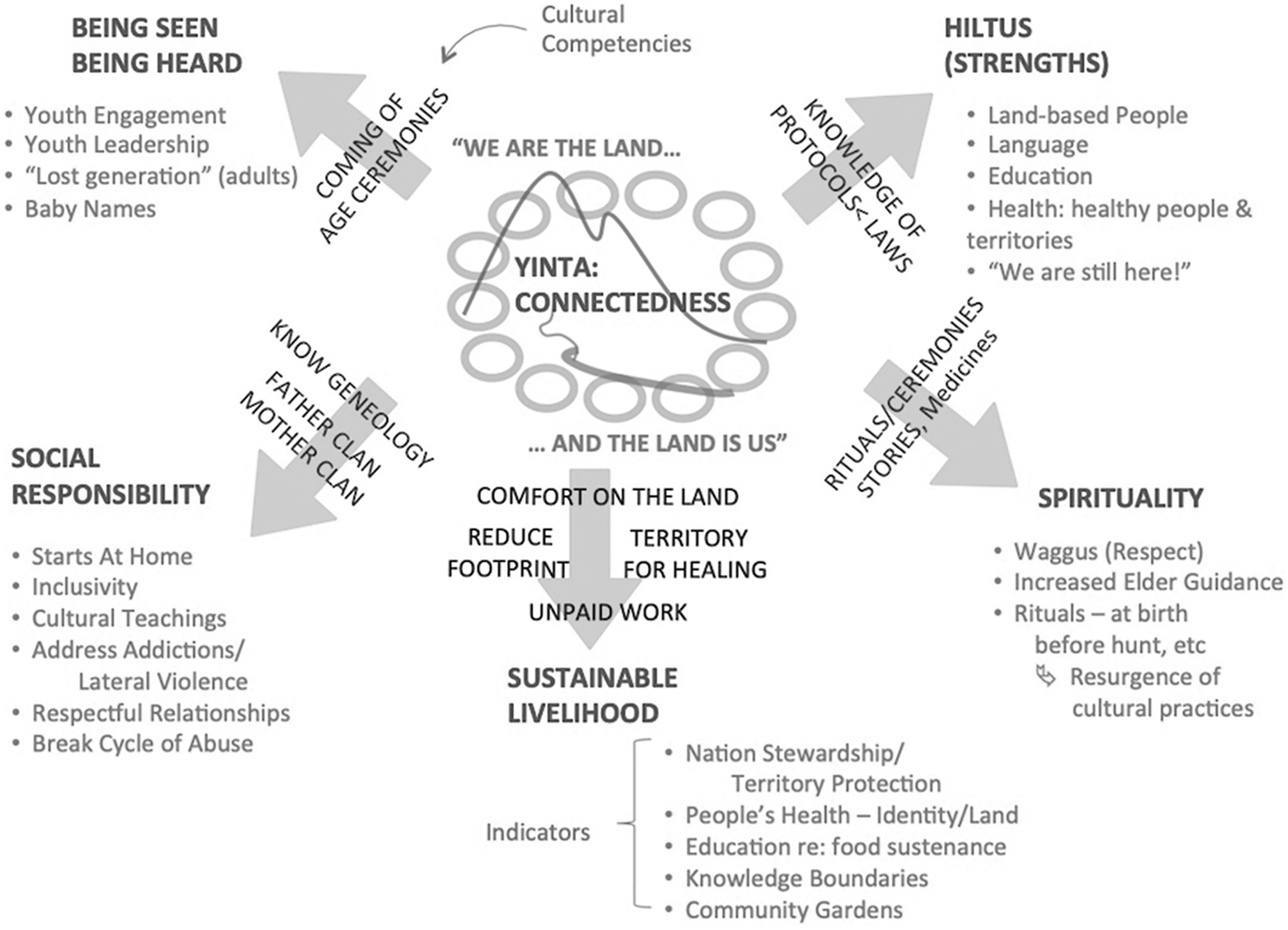
Indigenous Focusing Oriented Therapy
IFOT brings Indigenous ways of knowing to Eugene Gendlin’s focusing-oriented therapy (Gendlin, 1998. Gendlin was a colleague of Carl Rogers and focusing-oriented therapy is grounded in the person-centered approach. Focusing-oriented therapy guides a client to focus on their inward bodily experience to create therapeutic change, representing a shift from what a client discusses to how they relate to experience Gendlin, 1998). In a review of 91 research studies on focusing-oriented and experiential therapies Hendricks (2001) concluded that focusing-oriented therapy was found to correlate with positive outcomes for prison inmates, patients with psychoses, the elderly, and patients with health-related issues. Further, focusing techniques were found to deepen clients’ ability to notice internal senses and processes. IFOT was pioneered by Shirley Turcotte, a Métis knowledge keeper and registered clinical counsellor (Turcotte & Schiffer, 2014). Turcotte was a student and colleague of Gendlin and was in communication with him in the development of IFOT. IFOT borrows many of the structures of focusing-oriented therapy, particularly the “felt sense,” the six stages of the model, and the therapeutic dyad; however, these structures are embedded in the collective, intergenerational, and land-based context of Indigenous communities. IFOT aims to be a decolonizing approach to trauma repair. It attempts to challenge the historical oppression at the root of intergenerational trauma for Indigenous peoples and support the client towards healing in a way that is culturally salient and strengths-based (Turcotte & Schiffer, 2014).
IFOT brings a collective lens to therapy, following from the understanding that trauma in an Indigenous context is intergenerational and shaped by colonization. IFOT moves beyond the individual, to meet trauma from “all my relations,” an expression that encompasses the web of relationships in which an Indigenous person is embedded. From this perspective, everything is animate and interconnected across time, space, and through the generations, and so can be drawn upon for healing (Turcotte & Schiffer, 2014). In an IFOT session, the therapist may ask whether what the client is experiencing is “all theirs,” or inquire about the presence of ancestors in the therapeutic space. In IFOT, intergenerational trauma is “both uniquely individual and inextricably collective” (Turcotte & Schiffer, 2014, p. 51). In this way, IFOT is described as teaching clients that they are not alone in their experience of trauma.
IFOT sessions emphasize the body and somatic experience. A client is not encouraged to share a detailed trauma narrative. Instead, the felt sense is explored to foster therapeutic change. The felt sense in IFOT is “a bodily experience of interconnected emotion, energy and sensations that are an expression of knowledge of collective experiences through time” (Turcotte & Schiffer, 2014, p. 51). This understanding of the felt sense expands upon Gendlin’s original conception of it to include “all my relations.” In IFOT, exploring the felt sense typically leads to how the client is embedded in webs of relationships across time, to ancestors, present day family and community members, and future generations. The felt sense helps clients to connect to intergenerational and collective traumatic memory (i.e., Indian Residential Schools and removal from traditional lands). According to Turcotte and Schiffer (2014), this understanding of collective memory has the potential to heal the past, present, and future.
IFOT follows Gendlin’s six stages of focusing-oriented therapy: clearing space, felt sense, handle, resonating, asking, and receiving (Gendlin, 1998. In clearing space, a client turns their attention inward to list all the problems they are currently facing. Felt sense requires that a client selects the problem that is the biggest and senses how it feels in their body. Next, handle guides the client to capture the quality of their felt sense with a word, phrase, or image. In resonating, the client shifts back and forth between the felt sense and the handle. Asking encourages the client to inquire into what about the whole problem makes the quality they experience. Finally, in receiving, a client is receptive to a shift or release that may arrive (Gendlin, 1998).
IFOT is land-based, drawing on the principles that relationship to the earth facilitates healing and that the land can hold the trauma (Turcotte & Schiffer, 2014). The therapy room is set-up with the therapist and client sitting beside each other and the trauma story is directed at the land positioned in front of them. Medicines, for example, cedar, stones, and feathers that are meaningful to the client are called upon as their need arises. A client may be supported to visualize a place on the land that can hold a particular traumatic memory and in so doing they may become relieved of the weight of that memory (Turcotte & Schiffer, 2014). Colonization has acted to dispossess Indigenous peoples from their lands (Wildcat et al., 2014). IFOT’s land-based practices differ from “living off the land” in the sense of relying on the land for daily needs. These practices emphasize aspects of land-based pedagogy outlined by Wildcat et al., (2014), namely: reliance on the land for knowledge and understanding, revitalization of relationships between people and the land, strengthening the connection between the land and Indigenous knowledge, and understanding the land as a system of reciprocal social relationships.
IFOT is not a manualized or prescriptive therapeutic model. Instead, training instills a particular orientation to the therapeutic process and attends to the cultural context of the communities in which it is being taught. IFOT has been taught in communities across Canada and internationally through the Justice Institute of British Columbia (Young et al., 2021). Trainings are now occurring through the IFOT Teaching Collective. Indigenous Tools for Living is a shorter workshop series based on IFOT teachings that has been delivered in communities across British Columbia (Young et al, 2021).
Method
This study was informed by Indigenous methodologies (Archibald, 2008; Kovach, 2017) and narrative inquiry and analysis (Riessman, 2008). It was our aim that this study be decolonizing. A decolonizing research approach challenges the oppression and colonization of Indigenous peoples (Smith, 2013) and requires critical reflection about the Western gaze: “it must make one think deeply, feel strongly. It ought to unsettle” (Kovach, 2017, p. 217). Using a decolonizing lens, we strived to make the research supportive of Wet’suwet’en individuals, families, house groups, and Nation in ways that they determined. In practice, this meant being guided by an advisory group of hereditary chiefs, being responsive to participant feedback, using sharing circles and storytelling as data collection methods, and relying on the participant group to interpret their own stories. This study provides a Wet’suwet’en analysis of a therapeutic approach integrated in Wet’suwet’en ways of knowing and being.
Indigenous Methodologies
Indigenous methodologies are not prescriptive, rather they encourage a certain sensibility: an “exploration of identity, an ability to be vulnerable, a desire for restitution, and an opening to awakenings” (Kovach, 2017, p. 218). The four Rs of Indigenous research: respect, relevance, reciprocity, and responsibility (Kirkness & Barnhardt, 2001) provided the interrelated principles that grounded our research and were enacted in relationships. The method for this study followed Kovach’s (2017) and Archibald’s (2008) methodological approach that is based on “research as storytelling” (Archibald, 2008, p. 7) and also falls within a narrative method (Riessman, 2008). Creating a narrative is a relational process at the center of research, aligning with Indigenous worldviews that value storytelling. Storytelling is inherently relational and reciprocal (Kovach, 2017). The relationship between storyteller and researcher is “based on respect for each other, respect for the traditional cultural ways of teaching and learning, and reverence for spirituality” (Archibald, 2008, p. 10).
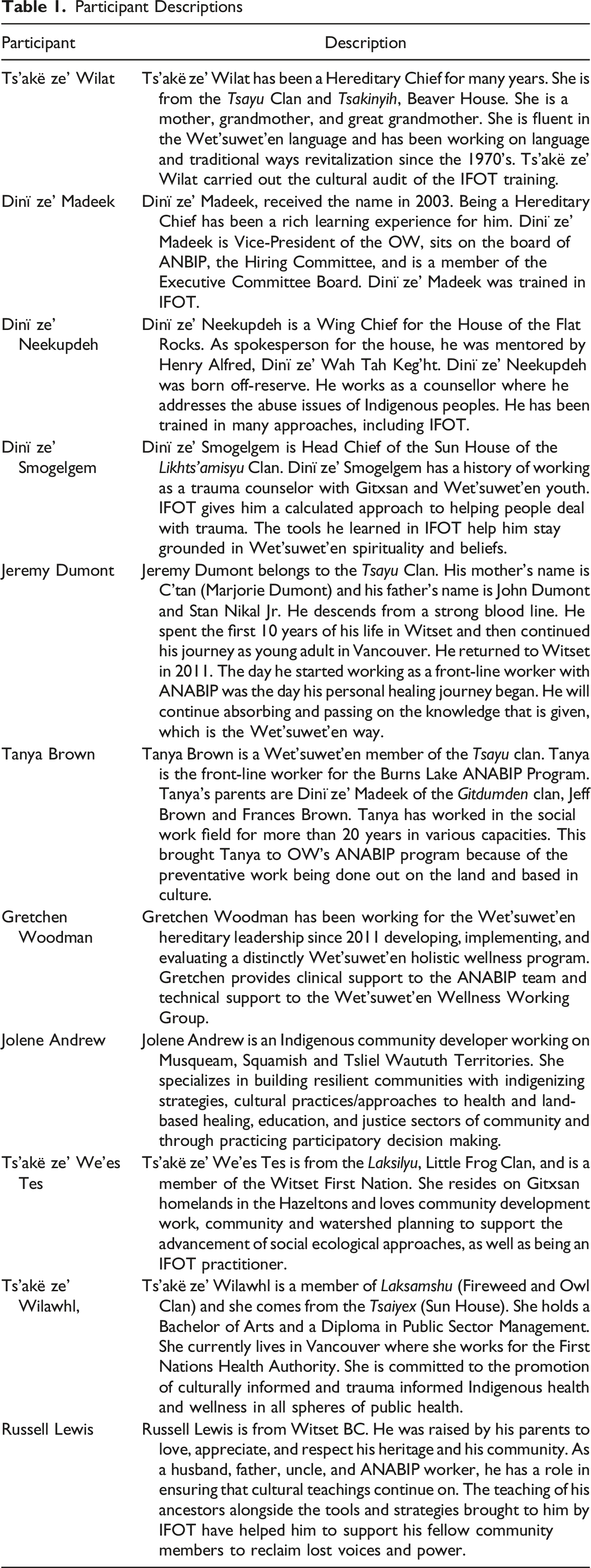
Wet’suwet’en worldviews grounded our methodology (Kovach, 2017; Smith, 2013). The research team cocreated the research process with the Wet’suwet’en advisory group made up of Hereditary Chiefs Ts’akë ze’ (female chief) 4 Wilat; Dinï ze’ (male chief) Madeek; Dinï ze’ Neekupdeh; Dinï ze’ Smogelgem; and Gretchen Woodman, the OW clinical advisor. Data collection and interpretation occurred through a sharing circle process. The hereditary chiefs of the OW and the advisory group, as well as the Behavioural Research Ethics Board of our university approved the research plan prior to commencing the project. Collaboration throughout the process helped ensure reciprocity, respect, and meaningful outcomes for the community.
University Researchers
The university research team was made up of Indigenous and non-Indigenous members. Steinhauer Steinhauer (2002) questioned the involvement of non-Indigenous peoples in conducting Indigenous methodologies, arguing that they lack the experiential knowledge of relationality required and are likely to conduct research on Indigenous peoples. For Kovach (2017), on the other hand, non-Indigenous researchers can engage in Indigenous methodologies provided they follow appropriate frameworks. We believe that for reconciliation to occur, non-Indigenous people must play a role in research with Indigenous communities. According to the Truth and Reconciliation Commission of Canada: Reconciliation is about establishing and maintaining a mutually respectful relationship between Aboriginal and non-Aboriginal peoples in this country. In order for that to happen, there has to be awareness of the past, an acknowledgement of the harm that has been inflicted, atonement for the causes, and action to change behaviour. (TRC, 2015, p. 6)
Both Indigenous and non-Indigenous peoples in Canada have a role to play in reconciliation. For non-Indigenous researchers to work with Indigenous communities in a good way, their strict adherence to Indigenous methodological frameworks is critical.
Sarah Panofsky, first author and primary university researcher, is a White settler and fourth-generation Canadian with ancestry from Great Britain and Lithuania. Marla Buchanan is a non-Indigenous professor in the counselling psychology program at the University of British Columbia with extensive experience conducting research with Indigenous communities. Buchanan oversaw the research process and collaborated with Panofsky on the writing of this article. Alanaise Ferguson is an assistant professor at Simon Fraser University, registered psychologist, and a member of the Sandy Bay Ojibway First Nation. Jan Hare is an Anishinaabe scholar and educator at the University of British Columbia from the M’Chigeeng First Nation, located in Northern Ontario. Goodwill and Hare supported the development of the study design and provided key feedback throughout the research process. Roger John is Tsalalhmec (People of the Lakes) from the St’at’imc Nation and a PhD candidate in the counselling psychology program at the University of British Columbia. John acted as an external reader on the study and provided feedback on the development of findings.
Researcher Reflexivity
The university research team discussed issues of colonialism, power, and privilege at the onset and throughout the research process. These discussions shaped how the primary researcher approached and engaged with the Wet’suwet’en advisory group and participants to facilitate their leadership in the research process. Moreover, these discussions highlighted the importance of cultivating relationships. The primary researcher connected with the advisory group members consistently by phone throughout the one-and-a-half-year research process, engaged in gift giving, and followed-up with participants upon completion of data collection, and in the writing of the research findings. Researcher reflexivity and transparency were critical to this project and the research team continually checked understandings with participants and the advisory group to ensure that they were commensurate with Wet’suwet’en ways of knowing. The primary researcher kept a research journal throughout the research process, recording her reflections on designing the study, participant concerns, data collection activities, interpretation processes, and writing up the research findings. According to Watt (2007), “an introspective record of a researcher’s work potentially helps them to take stock of biases, feelings, and thoughts, so they can understand how these may be influencing the research” (p. 84). As Kovach (2017) has described, the research did, at times, make both researchers and participants question themselves. The research process pointed to the extent to which Wet’suwet’en participants’ worldviews are deeply and fundamentally entwined with their yintah, in ways that some members of the research team, as non-Indigenous settlers, could only faintly grasp. When concerns about researcher positionality and bias were noted, the primary researcher sought guidance from the research team and advisory group, and subsequently with research participants.
Participants
Participant Descriptions
Procedures
Indigenous methodologies require methods that are congruent with Indigenous worldviews and rely on the assumption that knowledge is relational (Kovach, 2017; Smith, 2013). Panofsky approached the OW to discuss a collaborative research process. Following approval by the hereditary chiefs, an advisory group was established. Together we formalized a research agreement and established a research proposal and plan. The advisory group recommended how protocol and ceremony needed to be woven into the research process by use of Wet’suwet’en language, opening and closing prayers, experientials (guided visualizations focusing on the land and the body), gifting of medicines, and compensation in the form of honoraria.
After University Behavioural Research Ethics approval was obtained, the advisory group extended an invitation to their community to join the project. An introductory meeting with potential participants was organized to discuss their involvement and review verbal and written informed consent. All participants who engaged in this initial meeting decided to be a part of the research. Participants decided to waive confidentiality and use their names during sharing circles and for this article. Our data collection and analysis consisted of sharing circles via virtual Zoom meetings due to the COVID-19 pandemic. Sharing circles (Lavallée, 2007) were facilitated by the principal researcher and she was given permission to report on what was shared. Sharing circles are spiritual, nonjudgmental, respectful, supportive and acknowledge the energy that is created by the group of participants through their shared connections. Prior to beginning the sharing circles, a handbook outlining the process and research questions and a gift of medicines (teas and salves) were mailed to participants. The primary researcher facilitated the sharing circles and was supported by the advisory group. She was instructed in the basics of the Wet’suwet’en language and offered a welcome in Wet’suwet’en each time the group met. Participants also used the Wet’suwet’en language consistently throughout the research process, employing words and phrases and sharing stories depending on fluency. Opening and closing prayers, and experientials were facilitated by advisory group members.
In the first circle, participants considered how IFOT principles were aligned with or divergent from Wet’suwet’en ways of knowing and being. In the second circle, participants shared stories about their IFOT experiences. During the third and fourth circles participants collaboratively identified themes that answered the research question and other questions that arose during the interpretive process. In these interpretive circles participants reviewed the themes and provided feedback. The approval and feedback of participants was sought throughout.
The data was analyzed and interpreted in a recursive process. Using narrative analysis, researchers did not separate the narratives into component parts but maintained the stories intact and conducted interpretive analysis from the overall case (Riessman, 2008). The data analysis occurred in the third and fourth phases of the sharing circle. The participants and research interviewer conducted the thematic analysis together orally. This collaboration ensured that data interpretation was embedded in Wet’suwet’en worldviews. We considered several questions to guide the analysis: (a) What connections, commonalities, and agreements do you see in these stories? (b) What are the strengths and challenges of using IFOT within the Wet’suwet’en Nation? (c) Is there a relationship between IFOT and reconciliation? and (d) Are there any recommendations or changes you would like to see in future implementation of IFOT? We analyzed the stories generated and identified the patterns and themes present.
All of the sharing circle processes were video and audio recorded on Zoom. Recordings of these analytic sessions were shared with the participants for their review. The researchers wrote up the analysis from the recorded analysis sessions and sought approval from the group through a member-checking procedure. This occurred during the final sharing circle and then individually with each participant via telephone and email. Two external readers who are Indigenous scholars (Alanaise Ferguson and Roger John, the 14th and 16th authors respectively) provided feedback on the thematic interpretation of the findings. Following Indigenous methodologies, the representation of findings reflected the data collected and interpretations were rooted in Wet’suwet’en worldviews and the reflexivity of the research team. The stories represented are in the voices of participants, either directly written or approved by them. For this reason, and to respect the collective nature of the research, all participants share authorship with the academic researchers.
Findings
According to research participants, IFOT supported the healing of trauma so that intimacy could be restored, helping Wet’suwet’en people to be in connection with their own yintah (land) and c’idede’ (stories from long ago). The following themes were identified collaboratively during the sharing circle process: Foundations for IFOT Integration, Interconnection, Fostering a Wet’suwet’en Collective, Reclaiming Wet’suwet’en Identities, Supporting Helpers to do Their Work, Fostering Wet’suwet’en Well-being and Decolonization, and lastly, Strengthening Healing.
Foundations for IFOT Integration
IFOT is a therapeutic tool integrated within an overarching Wet’suwet’en wellness framework overseen by the Wet’suwet’en Wellness Working Group. The hereditary chiefs were strategic in planning the IFOT training of practitioners and the subsequent integration of IFOT in communities. Practitioners were selected for training to reflect a balance of women and men, frontline workers, chiefs, Wet’suwet’en members living across the territory and on the Lower Mainland of British Columbia, and to ensure representation from each of the five Wet’suwet’en clans. In this way, a diverse group of IFOT practitioners was trained who were representative of the Wet’suwet’en Nation.
Throughout the Wet’suwet’en IFOT training, Ts’akë ze’ Wila’at conducted a cultural audit to ensure that the group’s learning was aligned with Wet’suwet’en teachings. For Ts’akë ze’ Wila’at, IFOT aligned well with Wet’suwet’en ways of knowing and being: “IFOT brought a lot of memories back to me… The memories are when my grandmother and grandfather taught me and my siblings about our yintah, niwkinic, our language… IFOT hit home for me,” she said. Participants agreed that IFOT was adaptable to Wet’suwet’en culture and could be adaptable to other Indigenous cultures that value land-based healing and spirituality.
According to participants the ANABIP program has been central to IFOT’s adoption in the Wet’suwet’en Nation. ANABIP has supported practitioners in continuing to refine their skills via monthly practice sessions and continued training. Through ANABIP’s work with families, groups, and cultural camps, IFOT has become widely disseminated.
IFOT is being implemented through the traditional governance system of clans and house groups. Those trained in IFOT were chosen to reflect equal participation from each of the clans and to recognize clan and house group leaders. Ts’akëze’ Wilawhl stated that “IFOT has strengthened traditional rights and responsibilities by helping people to know who they are and where they come from.” The result has been a blossoming of IFOT throughout clans and house groups. Furthermore, to Ts’akëze’ Wilawhl, “It’s becoming more and more a part of how we support and help each other, from a clan-based way.” The participants concluded that IFOT was easily integrated into Wet’suwet’en communities because of its embeddedness in the overall wellness framework and these key foundational factors.
Interconnection
Within this theme, Wet’suwet’en practitioners described how IFOT brought alive connection to the land, ancestors, spirituality, the Wet’suwet’en language, stories and ceremony in a way that was holistic and rooted in Wet’suwet’en ways. Yintah, the Wet’suwet’en word for the territory means, “We are the land and the land is us.” By connecting to the land through IFOT, there was also connection to “all that is.” As Dinï ze’ Neekupdeh described, “The yintah is more than just the land; it’s everything about us, everything about Wet’suwet’en and we can’t take one thing away from it because it’s all of it.” By connecting people to yintah, participants emphasized IFOT echoed how Wet’suwet’en ancestral ways brought about healing by being on the land.
Participants explained how IFOT brought to mind the land in tangible ways. Through the use of experientials (guided visualizations focusing on the land and the body), the land was palpably brought into IFOT sessions. Tanya described how IFOT “leans into the land,” how trauma can be “laid” on the land to be safely “held,” and how medicines from the land can be drawn upon for healing, like a giving back of energy to the land. As Russell described: We can use the land to lean on. We can put things out there on the land without having to leave our offices or our homes. We can still find a place out on the territory… When we close our eyes and we're sitting and we're breathing. We… feel,… I can smell the air in the mountains. I can feel the sun on my face.
Being out on the territory is connected to the Wet’suwet’en language, ceremony, cin k’ikh (history), c’idede’ (stories from long ago), and niwhhts’ide’nï (ancestors). For Ts’akë ze’ Wilat, “Our language is connected to our land” and ceremony was woven throughout IFOT. Jolene explained that, “being close to the land was our ceremony.” Dinï ze’ Smogelgem highlighted the interconnection of yintah and ancestors in IFOT: IFOT brings us into like a mental state where we visualize the land coming to us… More often than not, our ancestors show up. And they have advice for us….IFOT opened up a treasure chest so we can access teachings from our ancestors… I had a lot of examples of doing IFOT with people where they felt the presence of a grandmother or a great aunt or an ancestor from a long time ago… Our territory is our home that belongs to us. And the ancestors are asking us to go home. To get off the reserves and go home.
According to the participants, the niwhhts’ide’nï (ancestors) were a grounding and guiding presence in IFOT and integral to Wet’suwet’en wellness.
IFOT’s ability to help bring alive connection to land and ancestors related to Wet’suwet’en understandings of time. Participants emphasized how past, present, and future coexisted in IFOT and were available to support healing and to be healed in turn. Tanya elaborated on how this happens: We talk about the intergenerational and when we’re visiting those places of trauma and guiding through looking for those medicines that we’re not just healing ourselves here today. We're healing our ancestors, we’re healing our future generations that aren’t even born yet, you know, all at the same time. So, there’s that interconnectedness, that intergenerational collective piece.
Within Wet’suwet’en and IFOT understandings, because of their belief about inherent interconnectedness of all beings across time, healing in the present extended to the past and the future.
The timeless connection that Tanya spoke about existed in the body—it could be felt. In the Wet’suwet’en application of IFOT, this occurred through the felt sense. Dinï ze’ Madeek explained: “With IFOT everything is about your body. You look into your body to see what’s bothering you, what your aches and pains are.” In this way, participants described IFOT as being inherently physical. Ts’akë ze’ We’es Tes shared a story of her own experience during a 5-minute check-in during a recent IFOT workshop, highlighting how IFOT worked from and with the body: We were practicing a check-in. This was 2 days after signing the MOU [Memorandum of Understanding with the Governments of BC and Canada regarding development on the Wet’suwet’en territory] so it was a pretty intense time. And so, when I did a check-in, I could feel a real tightness in between my shoulder blades, a real heaviness there. And so, when I checked-in I could see a colour. It was kind of a brown, tan colour and as I got to go more and more deeper, it was like cedar, colour of cedar wood. And as I got more in touch with my felt sense, I could feel like a braid, like a cord. And as soon as that image came to mind, the cedar ring, that elders used to have around their neck popped up. So, there's a cedar ring, and then a longer cord, like a braid, a cedar rope that kind of came out of the sky and came down and connected me to that. And then, it was so amazing, because all of a sudden, I felt, you know, the ancestors there. I felt Gisdaywa, because I live close to where Gisdaywa lives, or lived. Dzii, Madeline Alfred, all kinds of elders, all of a sudden, were there, people I haven't seen before. And when they did another check-in, I could feel the tightness in my chest. And so, another colour came forward and after some check-in it was like a newness, like a birthing. So, all at that one time, I could see and feel the past, but I could also feel this newness for the future, like a birthing. And it was so amazing. And, you know, those 5-minute check-ins, what happens… I could feel just this immense connection.
Ts’akë ze’ We’es Tes’s story exemplifies the interconnectedness. Starting with the body, Ts’akë ze’ We’es Teswas brought to a cedar rope, to the ancestors, to the land, where the past, present, and future all existed.
For all of the Wet’suwet’en participants, IFOT was a spiritual process, aligning with the foundation of spirituality in the Wet’suwet’en Conceptual Wellness Framework. Ts’akë ze’ We’es Tes helped to explain the spirituality that exists in the interconnection of the yintah, and how it is linked to wiggus (living in good relations): To live in a good way, with wiggus and to uphold our responsibilities… is one of our most important in our ways. And that comes from this whole-body approach body, mind, and spirit, this collected piece… Within my family, within my house. With the land, ancestors. It’s all, all together there… All times are present, the spiritual piece is there. And we, we can feel that connection and we are at peace.
For participants, healing arose from connection, peace, and spirituality that are inherent in “living in a good way.”
According to participants, IFOT helped to support interconnection in a Wet’suwet’en way. Yintah was the center of Wet’suwet’en ways of knowing and being; and it appears it was also at the center of IFOT.
Fostering a Wet’suwet’en Collective
For participants, IFOT fostered the sense of a collective amongst Wet’suwet’en people in the present and across time, reinforcing the interconnection that underlies all beings according to Wet’suwet’en ways of knowing. According to Tanya: This connectedness… is a shared experience and it’s just amazing, you know, and that all of that is—it is within me. To help heal those places, to help others and to help rebuild and revitalize that connection of my people to language and territory.
Participants described how IFOT created an embodied experience of the collective. This emphasis on the collective is an integral part of Wet’suwet’en ways of knowing and being, as Ts’akë ze’ We’es Tes explained: Sacred connection to all that is… And so, there’s a sacred responsibility there to honor that, to listen to it. It helps guide us, and it teaches us that we’re not alone… We are a collective as Indigenous people, as Wet’suwet’en people, in our families, in our house and clan, as a Nation.
Jolene highlighted how IFOT connected with wiggus. “Treating everyone respectfully,” is how IFOT approaches trauma with humility and respect.
According to participants, the emphasis on wiggus and social responsibility has strengthened the Wet’suwet’en traditional governance system by helping people to understand and carry out their clan and house group roles and responsibilities. From their participation in ANABIP cultural camps, families have learned who they are and where they come from, and have gained knowledge of the support systems of their mother and father clans. As Ts’akëze’ Wilawhl explained: The people that have had the opportunity of being, to be in a camp… they’re in the feast halls now. They’ve reclaimed their space in the feast halls. They feel like they belong there, and they know what to do. They understand their roles and they’re so open to learning… which is really important to our governance system.
Participants explained how IFOT emphasized the shared story of Wet’suwet’en people, encouraging people to not feel alone. According to Russell: It helps them to find a way that they’re not alone in it because we all share the same story in so many ways… This ongoing circle that seems to never end, just like our Chief names are passed down through the generations, that you know our ancestors are still with us.
For participants, IFOT helped Wet’suwet’en people to hold each other up, creating ways to connect with each other. Resilience was simultaneously fostered individually and collectively.
In this theme, it appears that IFOT helped to cultivate a sense of the collective amongst Wet’suwet’en participants, in the present and across time, helping people to feel part of a shared story and to take care of their sacred responsibility, wiggus. For participants, this sense of a collective helped to strengthen the traditional system of governance which relies upon Wet’suwet’en people acting on wiggus, as well as understanding and carrying-out their clan and house group roles and responsibilities.
Reclaiming Wet’suwet’en Identities
According to the participants in the study, IFOT supported them to more fully embody their Wet’suwet’en identities, reclaiming what was always inside of them. IFOT tapped into what Ts’akë ze’ We’es Tes described as “the implicit wisdom that is always there.” Ts’akë ze’ Wilat explained: When some young person went somewhere and kwin gghenen dïl? When did you come back to the fireside? When a young person goes somewhere, never comes back a few days, nk’ëdeh’ kwin ggnenïnge, their way of saying, when did you come home? And there’s another way of using fireside. When an Elder chief passes away, and a successor arrives. Everything has happened. Ne kwin dist ggan they say. The light is lit again, they use that word. Ne kwin dist ggan they say.
Ne kwin dist ggan describes returning to the Wet’suwet’en identity that creates light. Tanya described her experience of learning IFOT as a “remembering”: When I first took the training and learnt the language, right away, I felt it. They tell us it’s our own Indigenous way of knowing, our own Indigenous way of being. I wasn’t connected to my community and culture. I was raised up off-reserve. We were non-Status, you know, and I totally felt disconnected. And it wasn’t until I started learning about IFOT when it was a sense of remembering where I come from.
Participants described how “waking up” their Wet’suwet’en identities was central to healing. Dinï ze’ Neekupdeh spoke to this connection, “It’s sleeping. It’s not gone. It’s sleeping and when we need to wake it, awaken… It belongs to all of us.” By awakening their identities as Wet’suwet’en, participants felt empowered.
As this theme shows, IFOT supported practitioners to reclaim their identities as Wet’suwet’en people. This reclaiming was a source of empowerment, creating a foundation for Wet’suwet’en well-being.
Supporting Helpers
Participants spoke about how IFOT supported the personal strength needed to act as helpers in their communities. Moreover, they expressed how working with others through IFOT was enlivening. Jeremy described how IFOT has been integral to doing his work: I’m a work in progress… I wouldn’t be able to do this work if I didn’t do IFOT… Now I kind of understand who I am and how I’m supposed to help others… You know, I had lost my brother and I had a lot of guilt for feeling like he didn’t have that opportunity to be a part of our culture. So, you know, he was a little bit lost. I wasn’t there. I held on to that guilt, but… I’ve learned from IFOT that it’s just something that’s going to be beside me and that’s something that’s going to… in a weird way, it was like it was something that funneled me to do this work. And every day… I use that as an inspiration to do this kind of work for others.”
According to participants, practicing IFOT deepened over time. Ts’akëze’ Wilawhl explained, “What I’m finding is that my experience becomes richer and richer.” For Tanya, “It’s like a muscle that we have to keep working.” As Ts’akë ze’ We’es Tes explained, IFOT works with trauma by “sitting beside” and “holding each other up”, which are also strong Wet’suwet’en teachings. “Sitting beside” helped practitioners assist others process trauma by releasing them of the responsibility for their client’s healing. Instead, they trusted the body of their client to guide the process to, as Ts’akëze’ Wilawhl explained, “put it down once and for all.” Jolene elaborated on how the IFOT approach has helped her to let go of other people’s trauma: I think that’s one of the things that IFOT does for us, is we don’t hang on to it. We don’t… carry it with us. We’re taught, we’re given the good tools on how we can set it down… not carrying other people’s trauma.
For participants, IFOT was an approach that enlivened them, fostering passion and connectedness personally and professionally. They confirmed that IFOT provided them with an approach and the tools that allowed them to help others heal from trauma while preserving themselves.
Fostering Wet’suwet’en Well-being and Decolonization
Participants described how IFOT helped people of the Wet’suwet’en Nation to repair trauma so that they could heal themselves according to Wet’suwet’en ways. In so doing, according to participants, IFOT helped Wet’suwet’en people to become leaders in defining Indigenous rights and title in Canada. The healing that has occurred as a part of IFOT was both personal and collective, strengths-based, and rooted in Wet’suwet’en “’Anuc niwh’it’ën [our law], cin k’ikh [history], yintah, wiggus… our language, our feast hall,” as Ts’akë ze’ We’es Tes described. In this way, participants claimed that IFOT has been decolonizing, supporting Wet’suwet’en wellness to emerge from within the Nation. As Tanya explained, “We didn’t have the words for what we were feeling, what decolonization is, how we were still entrenched in it… but we felt it, we just didn’t have a word for it… to break free we seek out our Wet’suwet’en ways of being.”
It appears that engaging in the IFOT program encouraged Wet’suwet’en people to define themselves according to their ways. Jolene explained, “Deconstructing you know, undoing the way that we see ourselves… really undoing that Western view of what’s good and what’s bad and really putting a cultural lens on those things.” Ts’akëze’ Wilawhl described how this has been personally meaningful for her: I really had to do a lot of decolonizing of my spirituality and my beliefs. And I feel more authentic in who I am, and I feel more connected to, to our Creator. And it brings me the peace I’ve been looking for my whole life. And from a very personal perspective that decolonizing of my, my mind and my thoughts and my values has really grounded me in being who I am as a Wet’suwet’en woman.
According to Ts’akë ze’ We’es Tes, IFOT fostered, what she described as, “The freedom to be ourselves… Emancipation, it’s about freedom to be ourselves, live the life we want to live, be the people we want to be.”
As Russel explained, IFOT provided a tool for Wet’suwet’en people to heal themselves: Before IFOT I kind of had a sense that we always needed somebody from the outside to come around to help us, whereas now with IFOT, you know, my… body knows how to help myself… It’s our own people, our own grassroots, all the way up to therapists in our community that can carry this tool and be there for our people… We are the ones who have to do it for ourselves… No one’s going to do this for us as Wet’suwet’en people… IFOT is really a step in the right direction to let us do the work for ourselves.
As the participants attested, IFOT supported Wet’suwet’en people to do the work for themselves and the impacts of IFOT expanded from practitioners to their families and communities.
The 2019 to 2020 time period saw Wet’suwet’en Chiefs and leadership leading “Wet’suwet’en Strong” protests across Canada and internationally in defense of their protection of their traditional territory from the LNG pipeline development. For participants, IFOT helped to create the foundation for this leadership to be possible. Dinï ze’ Smogelgem described this as learning to “love each other again”: I could really sense that during the IFOT program itself and after the IFOT program, you look at what happened recently with the huge events around with “Wet’suwet’en Strong” all across Canada. The Chiefs all got together, the families all got together, and we decided to try and work our way through this stuff and the governments responded with the proposed MOU and the discussions that we had with them… (IFOT) practitioners that were involved in those talks, not only with the government, with their families. That helped us build that unity that we’ve been looking for. I think we would have been a lot more fractured right now.
Dinï ze’ Smogelgem and other key leaders in the Wet’suwet’en pipeline resistance were trained in IFOT. During stressful MOU negotiations with the Crown spurred by the “Wet’suwet’en Strong” movement, Ts’akë ze’ We’es Tes described how an IFOT workshop helped her to feel connection to chiefs who had passed and to medicines which gave her strength. For participants, IFOT gave Wet’suwet’en leaders the strength and connectedness to carry through and “stand up in our truth,” as Ts’akë ze’ We’es Tes described.
For participants, IFOT was decolonizing—its holistic, interconnected, and collective approach, deeply aligned with Wet’suwet’en ways of knowing and being, has supported Wet’suwet’en people to heal themselves and to develop the strength and togetherness to become leaders in defining Indigenous rights and title.
Strengthening Healing
The findings describe an opportunity for IFOT to strengthen and spread throughout Wet’suwet’en communities. Considering that learning and practicing IFOT is “a whole lifelong process” according to Ts’akë ze’ We’es Tes, its slow and steady integration is to be expected. Since being trained in IFOT, participants have experienced enormous shifts in their personal and professional lives and have witnessed the changes that it is encouraging within the Wet’suwet’en Nation.
Participants reported that the expansion of IFOT is slowed by the multiple pressures facing the Wet’suwet’en community. As Ts’akë ze’ We’es Tes explained: We end up having to… focus on the most urgent and the most important things first… It’s never enough time to do all this good work, you know, in our own families, in our house, in our clans, and our community.
Participants agreed that deepening connection to yintah, ancestors and language is important for the healing of IFOT to take place. Ts’akë ze’ Wilat, as one of the few fluent Wet’suwet’en language speakers, emphasized the importance of learning the language and incorporating sacred songs: I think we need more teaching from our ancestors. The relationship between IFOT and reconciliation is within our ancestors’ ways of living. You don’t just learn it overnight. You just keep going there, listening, learning. Actually, I was 8 years old when I started going to the feast hall and I sat under my grandma’s traditional blanket.
From the perspectives of the participants moving IFOT forward means acknowledging the “good work happening already” and “supporting one another to make the fire brighter, bigger.” According to Ts’akë ze’ We’es Tes: We’re holding each other up to all of this. These are not easy times for people. Across the world you know the Wet’suwet’en Nation is holding up the whole Indigenous rights movement around the world and we still are and that’s a lot to hold up.
Participants expressed hope that IFOT would continue to support healing throughout their Nation. They recognized that learning and practicing IFOT is a lifelong process and will deepen alongside connection to Wet’suwet’en ways of knowing and being.
Discussion
This research study provided exploratory evidence regarding the mobilization of IFOT within the Wet’suwet’en Nation. This is the first study conducted on the IFOT approach and additional research is needed to substantiate IFOT’s effectiveness. This initial study found that IFOT was connected to Wet’suwet’en conceptions of wellness and healing. The strategic implementation of IFOT by Wet’suwet’en hereditary chiefs created a pertinent model for community-based and cultural healing that was reinforced by and reinforced in turn, the traditional governance system. By implementing IFOT through the hereditary system of governance, the Wet’suwet’en Nation has mapped a new possibility for a community-based cultural model of healing, one that was embedded in the traditional structure of their society rather than imposed colonial systems.
In this study, Wet’suwet’en ways of knowing and being converged with IFOT practices to create healing experiences. For participants, IFOT’s holistic approach and the extent to which it meaningfully facilitated connection to land, ancestors, spirituality, language, stories, and ceremony for Wet’suwet’en practitioners provided a relevant model of an intervention that upholds the principle of interconnection and relationship to land. According to participants, in IFOT and following from Wet’suwet’en worldviews, healing shifted from within the individual to within the ancestral line and resilience was built collectively. Further, participants expressed how this intervention not only helped individuals to experience their belonging in the overall Indigenous cosmology, but also to act on their responsibilities as Wet’suwet’en people thereby strengthening the traditional system of governance. As the participants stated, IFOT encouraged the reclamation of Wet’suwet’en identities which they claimed provided a foundation for self-determination and social action. Ne kwin dist ggan describes the returning to Wet’suwet’en identity that was identified as central to healing. Practitioners in this study were passionate about IFOT because it allowed them to help others heal according to Wet’suwet’en ways. It appears that IFOT provided a means for the community to be responsible for its own healing and a decolonizing lens to approach their strengths and challenges. Participants also explained how IFOT helped the Wet’suwet’en Nation build the resilience and relationships necessary to become leaders in defining Indigenous right and title through the “Wet’suwet’en Strong” movement and negotiations with the Crown. For Wet’suwet’en IFOT practitioners, learning and sharing IFOT will be an iterative and gradual process, integrated in Wet’suwet’en culture and structures, and slowed by continual pressures that face the Nation.
Research participants were not critical of IFOT, despite being asked throughout the sharing circle process to speak to challenges and drawbacks of the approach. There are several possible explanations for this lack of critique. Foremost, learning and practicing IFOT was deeply personal for research participants, as well as central to their work as helpers. They described how IFOT supported their own healing journeys in a way that was ceremonial and relational. Their reticence to critique the model was likely related to the personal value they placed on IFOT. It is also possible, considering the context of formal research and the position of the primary researcher as an outsider to the community, that participants may have conceptualized a critique of IFOT as a betrayal of Wet’suwet’en and Indigenous ways of knowing and being. Participants repeatedly distinguished IFOT from Western forms of talk-therapy. For them, IFOT was fundamentally Indigenous, and upheld their ancestral ways. The vestiges of Western psychotherapy in IFOT (a professionalized approach, training through a Western institution and the framework of a therapist and client attending to client distress) were not focused on by participants. Instead, they emphasized how IFOT brought out their own Indigeneity. Wendt and Gone (2012) proposed a continuum for culturally commensurate therapies, wherein “global psychotherapeutic interventions” are on one end and “Indigenous healing traditions” (p. 214) are on the other, as a way to critically approach culture and treatment. They argued that innovative mental health interventions are fostered by cultural hybridity. This continuum is useful to understand the Wet’suwet’en mobilization of IFOT, which seems to fall relatively in the middle and closer to Indigenous healing traditions according to participants’ interpretations of the approach.
Limitations
It is critical to acknowledge that IFOT is one aspect of an overarching wellness strategy initiated by the hereditary chiefs. In this study it was at times difficult to distinguish the impacts of IFOT from Wet’suwet’en wellness work more broadly. Further, Wet’suwet’en IFOT practitioners were study participants. Considering our collaborative approach to data collection and interpretation, the findings were shaped by participants’ personal and professional attachment to IFOT. The 11 participants in the study represented half of Wet’suwet’en members trained in IFOT. The stories of the other Wet’suwet’en IFOT practitioners not included in this study may have yielded different findings.
Through our research methodology that focused on Indigenous and narrative approaches, we aimed to ensure that the findings were embedded in Wet’suwet’en ways of knowing and being. Participants’ voices formed the backbone of this study, and the collaborative interpretation of the participants’ sharing circles’ data, structured its analysis. As a non-Indigenous researcher representing a Western institution, Panofsky facilitated the research process, endeavoring to be transparent in attempts to understand the life-world metaphor of the Wet’suwet’en. This process was inherently incomplete and in development, owing to the tensions in being an outsider to the community and attempting to translate Wet’suwet’en ways of knowing and being to the Academy. Upon sharing a draft of this article with one of the participants, Panofsky was asked how this written work will benefit the Wet’suwet’en community. This participant was unconvinced of the value of this publication. Other participants described feeling a part of a community of practitioners from their engagement in this process. The advisory group described feeling affirmed and empowered having their stories shared in this way. The relationships that the Panofsky had with the Wet’suwet’en community and her desire to have this study be supportive of Wet’suwet’en collaborators encouraged a strengths-based approach that was not intended to be highly critical, and we acknowledge that this likely influenced the findings. This study reflects what we hope is an integration of Indigenous and Western ways of knowing and being that privileges Wet’suwet’en understandings.
Implications for Counselling Psychology Practice
This research provided an exploratory study of the mobilization of IFOT in the Wet’suwet’en Nation, finding that IFOT had meaningful impacts on the lives of practitioners and throughout the Wet’suwet’en community. The Wet’suwet’en application of IFOT provides a unique example of an Indigenous trauma therapy approach rooted in culture and community. Under consideration is the notion that IFOT may have promoted the healing of trauma through the development of intergenerational resilience. The findings highlight the strength of Indigenous healing for Indigenous communities through the example of the Wet’suwet’en Nation. The field of counselling with Indigenous populations may learn from the themes of this research study to support approaches that are rooted in, and aligned with local contexts; honor interconnection through relationship to land; support collective belonging; cultivate Indigenous identities; are enlivening for practitioners; and are decolonizing by their promotion of Indigenous conceptions of well-being. The findings regarding the mobilization of IFOT in the Wet’suwet’en Nation presented in this work are situated within the life-world of the Wet’suwet’en people and must be considered as such.
Future Research
There is a need for future research to continue to explore trauma interventions in Indigenous communities. It would be relevant to extend the current study to explore how the Wet’suwet’en Nation is mobilizing its wellness strategy through its enaction of traditional governance and the relationship between wellness and sovereignty. As well, the connection between healing and traditional systems of governance explored in this study has not yet been studied in the literature and deserves future scholarship. It would also be relevant to investigate the implementation of IFOT in other Indigenous communities to ascertain if the positive effects suggested by this study are generalizable. Further, an analysis of IFOT alongside other models utilized by Indigenous communities in a comparative study may prove fruitful. Finally, additional research is necessary to elaborate on Indigenous, decolonizing, and narrative methodologies, creating maps for inclusive, engaged, and empowering research with Indigenous communities.
Footnotes
Acknowledgments
We acknowledge the collaboration of the Office of the Wet’suwet’en on this project.
Funding
The author(s) disclosed receipt of the following financial support for the research, authorship, and/or publication of this article: This work was supported by the Vancouver Foundation (FOI20-3545).
