



Abstract
Generalizations about Canadian counseling psychologists have been based on research that samples members of the Canadian Psychological Association (CPA), leading to questions about the extent to which this portrayal of the profession is accurate. In this exploratory study, answers to a 61-item questionnaire representing 86 variables were compared between 78 Canadian counseling psychologists who were members of the CPA and 107 Canadian counseling psychologists who were not members of the CPA. Inferential analyses found that CPA-member and nonmember counseling psychologists differed significantly on 11 of the 86 variables assessed, indicating that the currently available portrayal of Canadian counseling psychologists used by licensure bodies, professional associations, academic programs, instructors, and researchers is not wholly accurate. Reliance on inaccurate information about the profession can hinder the future development of Canadian counseling psychology as its members strive to meet the needs of counseling psychology students, counseling psychology professionals, and the populations they serve.
Keywords
In the spirit of enabling truly informed consent, when an individual seeks services from a mental health professional, it is important that they are aware of the characteristics (e.g., training level, professional values) and disciplinary background of the professional who is providing them with services. This study found that the available depiction of Canadian counseling psychologists contains inaccuracies because it is based upon previous research that only examined members of the national professional association, who are a minority of all Canadian counseling psychologists. This study provides a more representative portrayal of Canadian counseling psychology and counseling psychologists to facilitate individuals making informed decisions when choosing to work with a counseling psychologist.Significance of the Scholarship to the Public
The recognition and status of counseling psychology in the United States is unparalleled in any other country, and the United States provides the vast majority of counseling psychology scholarship (Fatemi et al., 2019). However, this large body of knowledge is intricately tied to the U.S. national context, and therefore has varied generalizability. The more divergent a country is from U.S. intellectual traditions, sociocultural and sociopolitical contexts, the less relevant this substantial body of U.S. literature is. For example, as concluded by Hutman et al. (2016) after reviewing comparable empirical data on the profession in Australia, Canada, New Zealand, South Africa, South Korea, Taiwan, the United Kingdom, and the United States (Goodyear et al., 2016), there are differences in the training, primary work settings, roles, key activities, and values of counseling psychologists, amongst other variables, across countries.
Fortunately, there is growing global recognition of counseling psychology as a profession and a psychology specialization (Goodyear et al., 2016). Advancing our knowledge of the profession in countries beyond the United States therefore becomes an important endeavor for many reasons, including, but not limited to, fostering shared professional identity, collegially helping establish and advance the profession in nations where the profession is nonexistent or emerging, adapting the profession within a particular country based on what is known about relevant contextual factors in other similar countries, and increasing the international mobility of counseling psychology practitioners, researchers, supervisors, and instructors. Nevertheless, the relatively small amount of empirical research on how counseling psychology has developed beyond the unique U.S. context has thwarted efforts to rapidly grow the profession in other countries (Beatch et al., 2009; Bedi, Thomas, et al., 2020). Therefore, there is an important need for the collection and dissemination of information about how the profession exists in countries other than the United States (Bedi et al., 2018) in order to create a smorgasbord of ideas to help counseling psychology prosper globally.
An increase in counseling psychology research in other countries can also provide valuable insights for U.S.-based counseling psychologists. By identifying alternative possibilities for the profession, such research helps illuminate obscured or ubiquitous assumptions, historical events, and early contextual factors disproportionately or uniquely shaping the development of the profession in the United States (Lichtenberg et al., 2016). For example, although a doctorate degree is the current standard of entry into the profession in the United States (and the United Kingdom), master’s level training for psychologists is the norm in virtually every other country in the world, including other Western and non-Western high-income countries such as Australia, Canada, New Zealand, South Africa, South Korea, and Taiwan (Goodyear et al., 2016). Looking to these other countries for ideas or guidance seems sensible given the recent American Psychological Association (APA) task force to develop accreditation and oversight principles for terminal master’s degree training in psychology, seeking to legitimize master’s-level practice and licensure in professional psychology (APA, 2019a). For U.S. counseling psychologists, external information may be especially useful when learning about counseling psychology in other politically and demographically similar, high-income, Western countries, like Australia, England, and especially the geographically-connected and highly culturally similar Canada, as such information is more likely to be potentially generalizable to the U.S. context.
Counseling Psychology in Canada
Briefly contextualizing counseling psychology in Canada is important to help counseling psychologists in the United States and other countries better understand the data collected in this study and better assess the generalizability of knowledge about the profession and specialization in Canada. There are five nationally-accredited (by the Canadian Psychological Association [CPA]) doctoral programs in counseling psychology in Canada (all are PhD programs), with an estimated 167 students enrolled (based on our correspondence with representatives from each program in 2019). This is in contrast to the approximately 2,651 graduate students in 84 APA-accredited doctoral programs in counseling psychology (APA, 2019b). Each year, Canadian counseling psychology doctoral programs collectively admit only about 26 students (Bedi, 2016), compared to about 530 students in the United States (Michalski et al., 2019). Based on these metrics, counseling psychology in Canada is about 16 to 20 times smaller than in the United States.
Similar to the United States, psychologist licensure for counseling psychologists in Canada is a provincial or territorial responsibility rather than a national one. Individuals “register”—akin to licensure in the United States—as a psychologist rather than a counseling psychologist specifically. Although the terms “license” and “registration” and their derivatives are often used interchangeably in Canada, government legislation typically favors the latter term. Some jurisdictions allow for voluntary psychology specialization declarations, but only a few provinces recognize counseling psychology as a specialization area (Wada et al., 2020). Unfortunately, this means that licensure bodies do not usually have information that would allow for an accurate representation of the characteristics of counseling psychologists and counseling psychology in Canada; as a result, researchers are relied upon to describe the profession and its professionals.
Although, like the APA, the CPA promotes a doctoral degree as a national standard for entry into the profession, it is common to self-identify as a counseling psychologist in Canada with only a master’s degree (Bedi, Christiani, & Sinacore, 2020; Bedi et al., 2016). Generally speaking, master’s-level registered psychologists identifying as counseling psychologists have completed a master’s degree comparable to a typical counselor education program in Canada with the addition of coursework in the core areas of psychology (biological bases of behavior, cognitive/affective bases of behavior, social bases of behavior, and psychology of the individual), either as part of their original master’s program or in addition to it, plus an additional 1,600+ hours of supervised practice, which is analogous to a predoctoral internship (e.g., College of Alberta Psychologists, 2017). Although, against recommendations by the CPA, the abundance of counseling psychologists with only a master’s degree (Bedi, Christiani, & Sinacore, 2020) is promoted by two circumstances: first, initial registration as a psychologist is permitted by most jurisdictions with only a master’s degree (Wada et al., 2020); second, full membership in the Section of Counseling Psychology (SCP) of the CPA also only requires a master’s degree. Further, it is not uncommon to self-identify as a counseling psychologist in Canada even if one’s doctoral degree is in another psychology specialization, and occasionally even without a master’s degree in counseling psychology (Bedi, Christiani, & Sinacore, 2020; Bedi et al., 2016).
Identifying as a counseling psychologist with a PhD in another specialization of psychology (with or without a master’s degree in counseling psychology) is primarily the result of two particular opportunities. First, in those few jurisdictions (like British Columbia) that actually recognize counseling psychology as a declared specialization area of psychology practice, a doctoral degree in counseling psychology is generally not required; but rather a case can be made for practicing in an area of psychology outside of one’s doctoral degree specialization (such as through doing an internship or postdoctoral residency at a counseling psychology setting, like a university counseling center). Second, the vast majority of Canadian psychologist regulation bodies do not recognize counseling psychology as a distinct area of practice or specialization area, and thus, there is no legal restriction on its use by anyone who is already a registered psychologist.
Counseling psychology in Canada is highly intertwined with counselor education to a much greater degree than in the United States, and the Canadian Counseling and Psychotherapy Association (CCPA; Canada’s national association for counselors and counselor educators, equivalent to the American Counseling Association) experiences a highly mutually reciprocal and integrated working relationship with the SCP of the CPA. As a result, there is increased fluidity between the professions. For example, master’s-level programs in counseling psychology in Canada can and do seek accreditation from the CCPA. In addition, past research has demonstrated that (a) a notable number of those trained as counseling psychologists become registered/certified as counselors in addition to, and sometimes instead of, as psychologists, (b) a notable frequency of dual membership exists in both the CCPA and the SCP of the CPA, (c) many counseling psychologists hold executive and/or key service positions in the CCPA or in organizations primarily serving counselor/counselor educators (and many counselor educators also hold such positions in the SCP of the CPA or in counseling psychology organizations), and (d) counseling psychologists are commonly employed as faculty in counselor education programs (and vice versa for counselor educators; Bedi, Christiani, & Sinacore, 2020; Bedi et al., 2016). As such, it should come as no surprise that the latest national Canadian counseling psychology conference featured many counselor educators in keynote and leadership roles, sought formal counsel with counselors/counselor educators on the future of Canadian counseling psychology, and had its proceedings published in a Canadian counselor education journal (Bedi, Domene, et al., 2020).
Canadian counseling psychology is also frequently misunderstood in relation to clinical psychology in Canada, and quite overshadowed, in a manner sometimes considered oppressive (for example, Bedi, Christiani, & Sinacore, 2020, applied the minority identity models typically associated with racial and ethnic minorities to the relationship between counseling psychology and clinical psychology in Canada). Part of this dynamic seems related to clinical psychology establishing itself decades earlier as a psychology specialization with the CPA (Bedi et al., 2012). At present, there currently are 33 CPA-accredited graduate programs in clinical psychology in comparison to five accredited graduate programs in counseling psychology, and there are 987 members of the clinical psychology section of CPA versus 382 members of the counseling psychology section (CPA, 2020). Although counseling and clinical psychology are similar, each of their characteristics, dominant worldviews, and values distinguish these two specializations, at least as reported by Canadian counseling psychologists (e.g., Beatch et al., 2009; Bedi et al., 2011), despite this topic being ignored by clinical psychology writers. These distinct perspectives can be seen in the different emphases on training between counseling psychology and clinical psychology graduate programs. For example, counseling psychology students receive more training in assessment of normal personality traits and career/vocational variables whereas clinical students receive more training in assessment of psychopathology (Bedi et al., 2012). In addition, counseling psychology graduate training programs tend to offer more training for providing practice supervision and multicultural psychology whereas clinical psychology programs tend to offer more assessment training (Beatch et al., 2009; Bedi et al., 2011, 2012). Nevertheless, across all of Canada, both counseling psychologists and clinical psychologists obtain the same registration (psychologist), in which their scope of practice is often individually self-declared to psychology licensure bodies partially based on their internship training (Beatch et al., 2009), and often indistinguishable (Linden et al., 2005). Specializations do not exist in every province’s and territory’s psychology regulatory body and, in some, a clinical psychology specialization exists whereas a counseling psychology one does not (Bedi et al., 2011). The dramatic shortage of counseling psychology specialization internship slots contributes to most doctoral students completing their internships in traditionally clinical psychology settings, such as hospitals and correctional facilities (Haverkamp et al., 2011), and then continuing to work in these settings (Bedi, Christiani, & Sinacore, 2020; Bedi et al., 2016).
Research on Canadian Counseling Psychologists
Canadian counseling psychology has garnered extremely little empirical research. Only three peer-reviewed publications have reported on the broad characteristics and practices of a nationwide sample of Canadian counseling psychologists (Bedi, Christiani, & Sinacore, 2020; Bedi et al., 2016; Goodyear et al., 2016). As a collective, these three studies provide descriptive information about Canadian counseling psychologists and counseling psychology in Canada across nearly 100 different variables. These studies represent the only evidence-backed national portrayal of Canadian counseling psychology at the nonstudent level and are the go-to sources since, without alternatives, they are assumed to represent Canadian counseling psychology colloquially, for licensure boards, accreditation bodies, and subsequent research and scholarship (Bedi et al., 2018) 1 . The results of these three studies have numerous implications for action. However, a limitation of these studies and the implications they spawn is that the data upon which they are based relied on samples of counseling psychologists from the national association of psychology in Canada—the CPA.
It is clear that the vast majority of Canadian counseling psychologists do not belong to the CPA when one considers the number of doctoral graduates per year in counseling psychology since its emergence in the 1990s and the relatively small size of the current SCP (Bedi, Christiani, & Sinacore, 2020; Bedi et al., 2016). Therefore, sampling from the minority group of CPA members is highly problematic for generalizations to the broader population of Canadian counseling psychologists because there could be important differences between counseling psychologists who choose to affiliate with the CPA and those who do not. In other words, it is highly possible that the available portrayal of Canadian counseling psychology and psychologists is inaccurate due to its reliance on research with national association members only, and thus popular current initiatives for the profession in Canada (as listed in Bedi, Domene, et al., 2020) may be misguided.
Using National Association Members for Research
The reliance on association members for research on counseling psychologists is understandable as they are easily accessible through annually updated membership lists. It may be too time-intensive, impractical, or even impossible to obtain a list of all counseling psychologists in a country (the latter of which is the case in Canada because most provincial regulatory boards and the national association do not keep track of this information). Nevertheless, the problem of uncritical generalizations or even the lack of acknowledgement of this sampling limitation, followed by explicit or implicit generalization of findings to all counseling psychologists is a common and longstanding problem in the global counseling psychology literature that this study seeks to overcome. For example, despite the numerous counseling psychology studies in the United States, we were unable to locate any large-scale, broad nationwide surveys of U.S. counseling psychologists that did not rely exclusively on APA and/or Society of Counseling Psychology (Division 17 of APA) members. Furthermore, we were unable to locate nationwide surveys of counseling psychologists in other countries that did not rely exclusively on national association membership. The titles we did find were unfortunately misleading, referring to counseling psychologists as a whole in a country rather than the actual generalizable population of association members (e.g., Bedi et al., 2016; du Preez et al., 2016; Goodyear et al., 2008; Lichtenberg et al., 2016; Munley et al., 2008; Yamamoto, 1963). Relying on unrepresentative information, which is the case when only national association members are surveyed, is highly problematic and may hinder and even harm the future development of the profession as well as the specialization of counseling psychology.
There is one notable but small scale study that did recruit a nationwide sample of counseling psychologists that did not belong to the CPA. This qualitative study (Pradhan & Bedi, 2019) asked counseling psychologists who did not belong to the national association four open-ended questions that were also posed to CPA members in a previous study (Bedi, Christiani, & Sinacore, 2020). Although there were numerous similarities between answers across CPA-member and nonmember counseling psychologists, there were also enough differences to conclude that uncritically relying on CPA members is problematic for representing the perspectives of Canadian counseling psychologists who do not belong to the CPA, and therefore of the larger populace of Canadian counseling psychologists. Given these demonstrated differences, we expected that there would also be some differences between the characteristics and practices of non-CPA member counseling psychologists and CPA-member counseling psychologists.
Purpose of the Study
The purpose of this study was to gain a more comprehensive understanding of the specialization and profession of counseling psychology in Canada, and assess whether the available portrayal of Canadian counseling psychologists (based entirely on research with CPA members) is representative of all Canadian counseling psychologists. We mirrored the primary underlying research question of Bedi, Christiani, and Sinacore (2020): “What are the characteristics and professional practices of Canadian counseling psychologists?” We used essentially the same survey questions, but instead administered them to a sample of counseling psychologists who did not belong to the CPA. The results allow us to better characterize the population of Canadian counseling psychologists. Results that replicated those found by Bedi, Christiani, and Sinacore (2021) would indicate characteristics of the profession and its practitioners that are likely representative of both the specialization and the profession as a whole in Canada. Results that diverge would indicate how non-CPA member counseling psychologists are different from CPA psychologists, and work towards correcting inaccurate perceptions of Canadian counseling psychologists promulgated in the current literature. This is an exploratory study. It is expected that some differences between CPA and non-CPA member counseling psychologists will be found, but no specific hypotheses are advanced. This is because the lack of pre-existing research on non-CPA member counseling psychologists and of psychology theories focused on who joins national associations precludes providing evidence-backed hypotheses.
Method
Participants
The total sample size for this study is 185 people. Previously collected data on 78 Canadian counseling psychologists who belonged to the CPA was obtained with permission from the researchers (Bedi, Christiani, & Sinacore, 2020). Novel data was collected on 107 Canadian counseling psychologists who possessed at least a master’s degree, self-identified as a counseling psychologist, and were not members of the CPA
2
. A priori statistical power analysis indicated that, for interval data, a sample size of 172 is required to achieve a statistical power of 0.90 to detect a medium effect size of d = 0.5. For categorical data, to achieve the same power level, V = 1− β =
Further information for the comparison subsample of 78 Canadian counseling psychologists who belong to the CPA is available in the Supplemental Materials tables and originally in Bedi, Christiani, and Sinacore (2020). The sample characteristics presented next refer to the 107 participants who were not members of the CPA (i.e., the novel data collection). The majority of respondents sampled were female (73.8%), with 26.2% identifying as male. Participants self-identified their sexual orientation as heterosexual (88.8%), bi-sexual (5.6%), lesbian (2.8%), and queer (0.9%); and 1.9% of respondents preferred to not identify their sexual orientation. Respondents specified their ethnic ancestry as European (79.4%), Asian (7.5%), Multi-ethnic (5.6%), Aboriginal (1.9%) and Other (5.6%). The average age was 42.4 years (SD = 11.8), with participants ranging from 24 to 71 years of age. Participants obtained their degrees from 41 different universities across Canada, most commonly the University of Saskatchewan (8.4%), Université de Moncton (8.4%), McGill University (7.5%), University of British Columbia (7.5%), and University of Calgary (6.5%). Respondents practiced professionally in 11 out of the 13 provinces and territories of Canada, most commonly, British Columbia (21.9%), Alberta (17.1%), New Brunswick (17.1%), Saskatchewan (15.2%), Ontario (5.7%), and Quebec (5.7%). Further demographic data is available in the Supplemental Materials tables.
Measure
This study used a 61-item closed-ended questionnaire, derived from the quantitative questions used by Bedi, Christiani, and Sinacore (2020) to investigate the characteristics and practices of CPA member Canadian counseling psychologists. The questionnaire consisted of multiple choice, rating scale, and forced choice questions. This was a questionnaire and not a measure of one or more underlying constructs; therefore, standard indices of reliability and validity are not relevant. The measure is available in the Supplemental Materials. Bedi, Christiani, and Sinacore developed their survey as part of a large international collaborative effort to develop a pseudo-standardized, global set of surveys that were subsequently used to investigate similarities and differences between counseling psychologists in Australia, Canada, New Zealand, South Africa, South Korea, Taiwan, the United Kingdom, and the United States (Goodyear et al., 2016). In addition to utilizing the standard questions employed across the base survey for all the investigated countries, Bedi, Christiani, and Sinacore (2020) also added several additional questions and response options relevant to the Canadian context only.
Procedure
Behavioral research ethics approval was obtained from the two authors’ institution. Respondents were recruited through listservs, newsletter publications (e.g., BC Psychologist), and social media feeds (e.g., Twitter and Facebook) of 11 out of the 13 provincial and territorial professional associations (e.g., Ontario Psychological Association) across Canada (Nunavut and Yukon did not have psychology associations at the time of the study), the primary investigator’s colleagues, and the alumni and faculty list-serves of all five CPA-accredited doctoral programs in counseling psychology. Snowball sampling procedures were also employed by asking survey respondents to forward the survey on to appropriate colleagues. Four months after the initial recruitment, survey advertisements were redistributed using the same channels. Respondents were offered a $20 gift card for their participation.
For statistical comparison purposes, permission was obtained to access the raw data for the last survey of Canadian counseling psychologists (Bedi, Christiani, & Sinacore, 2020), all the participants of whom were members of the CPA. Standard inferential statistics (t-test, chi-square statistics) were used to compare the results of the current data set to the previously collected data (Bedi, Christiani, & Sinacore, 2020).
There were 87 variables compared in this study between CPA nonmember and member counseling psychologists. Being an exploratory study, we were primarily interested in minimizing Type II error. However, we also wished to control the family-wise error rate in this study; therefore, this study used a significance level of α
Results
Significant Chi-Square Results Between CPA Nonmembers and Members
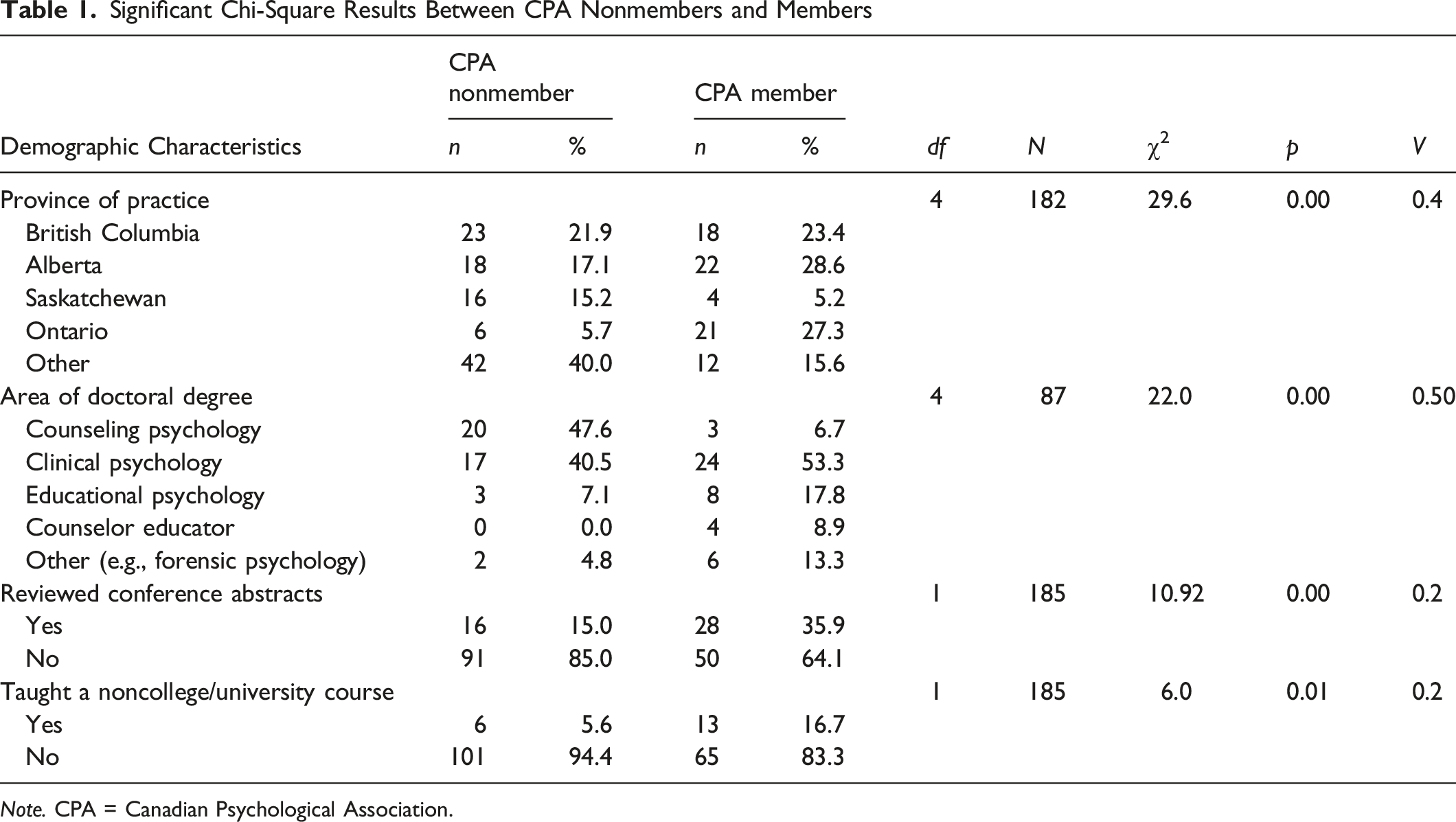
Note. CPA = Canadian Psychological Association.
Significant T-Test Results Between CPA Nonmembers and Members
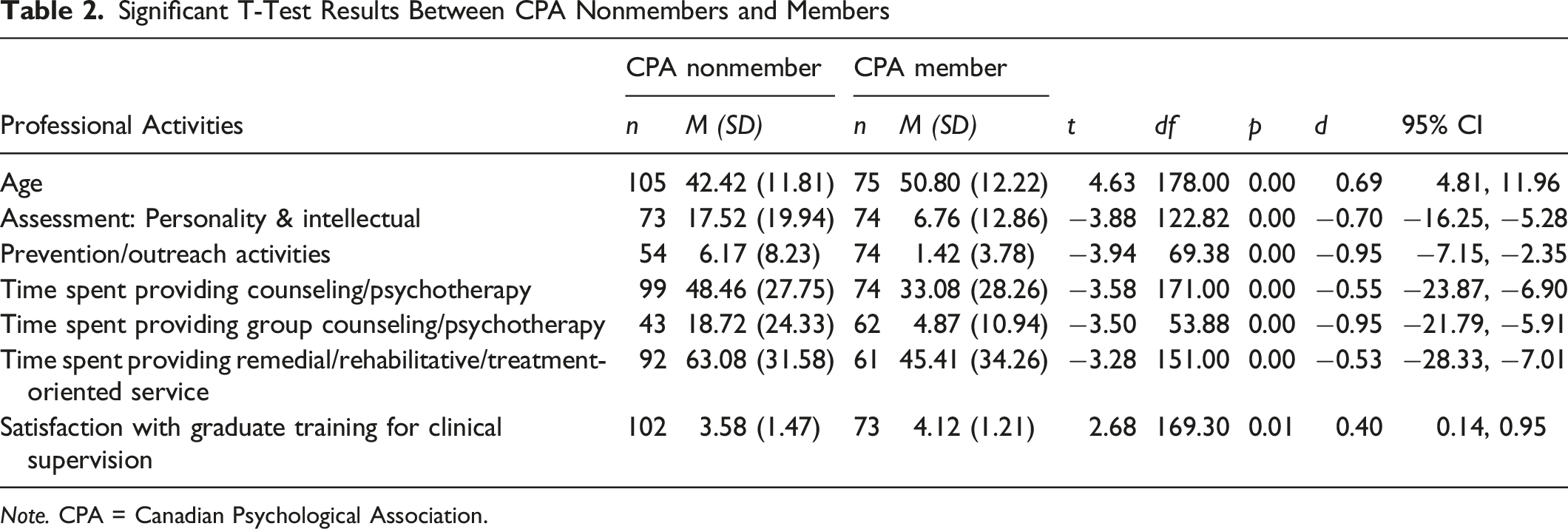
Note. CPA = Canadian Psychological Association.
Chi-square goodness-of-fit and independent sample t-test results for the other 76 variables, all found to be nonsignificant, are presented in the Supplemental Materials. The Supplemental Table 1 provides statistical results for demographic characteristics, Supplemental Table 2 for professional identity characteristics, Supplemental Table 3 for theoretical orientations, Supplemental Tables 4 and 5 for professional activities, Supplemental Tables 6 and 7 for training and career experiences, and Supplemental Table 8 for agreement with the core value statements in the definition of counseling psychology. Next, we describe each of the 76 variables that we found to be nonsignificantly different between CPA member and nonmember counseling psychologists in narrative form as a way of characterizing results that appear to describe Canadian counseling psychology and psychologists as a whole.
Demographics
Both types of respondents were similar in their biological sex assigned at birth (primarily XX chromosome women), gender (primarily female), and sexual orientation (primarily heterosexual). There was no significant difference between types of respondents on their ethnicity (with most being of European descent), the country where they were born (primarily Canada), and their citizenship (primarily Canadian). CPA nonmember and member respondents reported similar primary religious affiliations, mostly being either nonreligious or Christian.
With respect to training demographics, a similar proportion of CPA members and nonmembers obtained doctoral and master’s degree as their highest degree (average across both groups was 50.7% master’s and 49.3% doctoral). A similar proportion of CPA members and nonmembers (the majority) obtained their doctoral degree from accredited programs. Additionally, CPA nonmember and member counseling psychologists obtained their master’s degrees in similar areas (primarily counseling psychology, followed by clinical psychology). The proportion of CPA nonmembers and members did not significantly differ in the university where they obtained their degree.
With regard to professional demographic characteristics, a similar proportion of CPA nonmembers and members had licensure as a psychologist (average 77.4%), counseling therapist (average 8.6%), psychotherapist (average 5.6%), or guidance counselor (average 1.8%). Similarly, CPA nonmembers held a national Canadian Certified Counselor designation, offered by the Canadian Counseling and Psychotherapy Association, in similar proportions to CPA members (average 14.4%). A comparable proportion of CPA nonmembers and members were part of the U.S.-based National Register of Health Service Providers in Psychology or the Canadian Registrar of Health Service Providers in Psychology (average 13.0%). It was rare for both CPA nonmembers and members to have American Board of Professional Psychology (ABPP) Diplomate status in any field (average 1.9%).
Professional Identity
Overall, both CPA nonmembers and members were satisfied with their choice of counseling psychology as a career. Respondents did not significantly differ in their ratings of the extent to which counseling psychology is distinct from clinical psychology (moderate) or from counselor education (moderate) or the distinctiveness of counseling from psychotherapy (very little).
Theoretical Orientations
There was no statistically significant difference between the proportion of CPA nonmembers and members in their primary theoretical orientation (primarily eclectic/integrative or cognitive–behavioral). CPA nonmembers and members also did not differ in their secondary theoretical orientation (primarily eclectic/integrative). For those who indicated their primary or secondary theoretical orientation was eclectic/integrative, there was no significant difference on the type of eclectic/integrative orientation that best defined their practice (primarily theoretical integration or technical eclecticism).
Professional Activities
With respect to work activities, both types of respondents spent a similar percentage of their time on administration/management (average: 15.1%), vocational assessment (average: 0.8%), clinical supervision (average: 6.3%), program development and evaluation (average: 4.3%), service to profession or university (average: 3.5%), research (average: 10.3%), teaching/training (average: 11.8%), career counseling (average: 2.2%), and other activities not captured by the response options provided (average: 3.0%) during a typical work week.
Among those who provided intervention services, there was no significant difference between CPA nonmembers and members on the percentage of time focused on preventative (average: 22.9%) or developmental (average: 32.9%) services. Among those who provided counseling/psychotherapy specifically, CPA nonmembers and members provided individual counseling/psychotherapy (average: 77.7%), couples counseling/psychotherapy (average: 11.4%), and family counseling/psychotherapy (average: 10.4%).
With respect to work characteristics, most respondents held two psychology-related jobs. The primary and secondary work setting between CPA nonmembers and members did not differ significantly. Both groups were primarily and/or secondarily employed in either independent practice or an academic university department. Independent practice was the most common primary setting (average: 34.6%), followed by academic departments (average: 20.7%). Independent practice was the most common secondary setting (average: 58.0%), followed by academic department (average: 14.0%). Further, both groups of respondents worked a similar number of hours in both their primary jobs (average: 37.3 hours/week) and secondary jobs (average: 8.1 hours/week). They earned a similar average annual income from their psychology-related work in the low-$90,000s in Canadian dollars (equivalent to low-$70,000s in U.S. dollars).
There was no difference between the proportion of CPA nonmembers and members that provided counseling, psychotherapy, assessment, or professional outreach services in English (average: 98.3%), French (average: 17.5%), or Chinese (average: 4.0%). CPA nonmembers and members similarly reported rarely providing psychological services remotely through the internet. CPA nonmembers and members were both somewhat interested in obtaining the authority to prescribe psychotropic medication.
With respect to professional contributions to the field, there were no significant differences on whether participants contributed to the profession through publishing journal articles (average: 37.9%), receiving a research or professional grant (average: 22.6%), teaching a college or university course (average: 39.6%), delivering a workshop or lecture to health or mental health professionals (average: 65.5%) or nonhealth or nonmental health professionals (average: 66.4%), presenting at a conference (average: 46.2%), reviewing a manuscript (average: 98.3%), holding a leadership role in a professional or academic association (average: 29.3%), or providing clinical supervision (average: 55.1%). In terms of research, CPA nonmembers and members did not differ with experience conducting qualitative (average: 48.3%), quantitative (average: 42.5%), or mixed-methods (average: 32.7%) research.
Training and Career
There was no significant difference between CPA nonmembers and members on their moderate level of satisfaction with their: graduate training overall, research training, teaching, professional practice, and predoctoral internship. Among those who completed a predoctoral internship, CPA nonmembers and members did not differ in internship setting (primarily at a hospital, average of 44.1%, or a university counseling center, average of 27.6%); or the accreditation status of their predoctoral internship (average 48.4% accredited). Further, a similar proportion of CPA nonmembers and members (average: 83.9%) had received their own personal counseling or psychotherapy, and neither group differ in their satisfaction with their psychotherapy experiences and their beliefs that receiving personal counseling/psychotherapy was very important for the successful training of counseling psychologists.
Core Values of Canadian Counseling Psychology
CPA nonmembers and members similarly rated a very high degree of agreement on all three core value statements embedded within the official definition of counseling psychology in Canada (Bedi et al., 2011, p. 130): (a) “Counseling psychologists view individuals as agents of their own change and regard an individual’s pre-existing strengths and resourcefulness and the therapeutic relationship as central mechanisms of change,” (b) “The counseling psychology approach to assessment, diagnosis, and case conceptualization is holistic and client-centered; and it directs attention to social context and culture when considering internal factors, individual differences, and familial/systemic influences,” and (c) “The counseling process is pursued with sensitivity to diverse sociocultural factors unique to each individual.”
Discussion
This study extends past research on the characteristics of Canadian counseling psychology and psychologists by specifically recruiting counseling psychologists who do not belong to the CPA to participate in a nationwide survey in order to compare them to counseling psychologists who do belong to the CPA. In doing so, it not only helps identify the differences between CPA-member and nonmember counseling psychologists (the latter of whom are the vast majority), but also contributes to developing a more defensible portrayal of the profession and its practitioners than was previously available, which was based only on research with CPA members.
Characteristics of Canadian Counseling Psychology and Psychologists
The results (nonsignificant differences across 76 variables) support the conclusion that counseling psychologists who join and do not join the CPA are highly similar. Therefore, the available portrayal of Canadian counseling psychology concluded from past surveys of CPA members (Bedi, Christiani, & Sinacore, 2020; Bedi et al., 2016; Goodyear et al., 2016) is mostly, but not entirely, correct. Most of it can be more defensibly generalized to represent the true state of the profession and specialization in Canada. Based on these findings, the following description of the general characteristics of Canadian counseling psychology is offered.
When meeting a counseling psychologist in Canada in a professional setting, a member of the public is most likely to make their acquaintance in a private counseling office or in an academic university department. Like in the United States (Lichtenberg et al., 2018), the professional they meet is, by far, most likely to be a locally-born, heterosexual, cisgender woman of European descent who is either Christian or nonreligiously affiliated. The counseling psychologist is about equally likely to have either a master’s or doctoral degree as their highest credential. If their highest degree is a master’s degree, it is almost certainly in counseling psychology. However, if the highest degree is a doctorate, it is often but not always in counseling psychology. The self-identifying counseling psychologist is most likely a registered psychologist but could also, or instead hold, a different license or certification with an allied profession. Services will surely be available in English and perhaps French (the two national languages of Canada), and it is extremely unlikely to be in any of the other multitude of languages spoken in Canada.
Having two jobs is the norm for Canadian counseling psychologists and one’s primary and secondary job is likely to be either private work or work in an academic department. The intervention services provided are primarily remedial, rehabilitative, and treatment-oriented, but also often involve developmental and preventative services. When offering counseling or psychotherapy, it is usually of either the eclectic/integrative or cognitive–behavioral persuasion and predominantly to an individual (versus a couple, family, or group). Even though the predominant work setting for Canadian counseling psychologists is independent practice, many still remain tied to a university and/or contribute to the profession more broadly through university teaching, publishing articles, delivering workshops to mental health professionals, presenting at conferences, and providing clinical supervision. Almost all practitioners continue to peer review manuscripts, but rarely provide vocational assessment or career counseling.
University counseling centers are not high-proportion employers of Canadian counseling psychologists and surely part of this is because there are so few universities in Canada relative to counseling psychology graduates per year. At the same time, there is also a common perception amongst allied professionals that counseling psychologists in Canada are inadequately trained or not trained at all to work with individuals with serious mental disorders in comparison to clinical psychologists (Haverkamp et al., 2011). This point becomes monumental when considering the increasing frequency of serious mental health concerns on university campuses and the common Canadian perception that counseling psychologists possess little to no skills in advanced assessment, clinical diagnosis, and psychological treatment of mental health disorders (Haverkamp et al., 2011). Although this may have been true historically in Canada for some counseling psychology programs (Haverkamp et al., 2011), this is no longer the case now that training in diagnosis, psychopathology, and advanced assessment are now standard across all doctoral programs (Bedi, 2016); yet, the perception remains and contributes to the extreme shortage of internship placements for those seeking specialization training in counseling psychology as well as work in university counseling centers (Haverkamp et al., 2011). 3
With respect to training, more Canadian counseling psychologists now complete internships in hospitals than in counseling centers, which creates tension for the development of a strong counseling psychologist professional identity. Holding true to the core values of counseling psychology within a medical model environment is challenging and not lost on those who write about counseling psychology professional identity in Canada (Bedi, Christiani, & Sinacore, 2020; Haverkamp et al., 2011) or in the United States (Raque-Bogdan et al., 2020). In line with this, there have been massive efforts to promote stronger professional identity as a counseling psychologist by the SCP of the CPA, which has inevitably targeted mostly CPA-members (e.g., Beatch et al., 2009; Bedi, Domene, et al., 2020; Bedi et al., 2011). This study did not find any professional identity differences or variance in endorsement of core counseling psychology values between those who do and do not affiliate with the CPA (the latter of whom are presumed to be less exposed to these efforts). This finding therefore also leads to questions about the extent to which such time-consuming efforts are having an impact.
The current study estimates that counseling psychologists in Canada are nearly equally split between those possessing a doctorate or a master’s degree as their highest credential. In comparing the results of Bedi et al. (2016) with the present results, it seems that the proportion of master’s trained counseling psychologists is actually increasing in Canada, which is partly the result of federal government mandated interprovincial mobility for psychologists (Wada et al., 2020). With many provinces or territories only requiring a master’s degree for psychologist licensure at the time this national legislation was enacted, provinces with a doctoral entry standard have had to find ways to accommodate those seeking relocation from a jurisdiction in which they were already licensed at the master’s level (Wada et al., 2020).
Differences Between Counseling Psychologists That Do and Do Not Join the CPA
Although mostly similar, this study found that CPA nonmember and member counseling psychologists significantly differed across 11 variables, with eight being of medium or large magnitude. These variables represent inaccuracies in the previously available portrayal of Canadian counseling psychology (Bedi, Christiani, & Sinacore, 2020; Bedi et al., 2016; Goodyear et al., 2016). Based on the results of this study, we conclude that Canadian counseling psychologists as a whole are younger, on average, than previously assumed, so any worries regarding workforce turnover (Bedi, Christiani, & Sinacore, 2020) may not be as concerning as previously imagined. They are also more prevalent in Alberta and Ontario than previously reported. Furthermore, many more Canadian counseling psychologists provide intellectual and personality assessments than previously assumed. Past comments that Canadian counseling psychology has lost most of its prevention and outreach emphasis (Bedi, Christiani, & Sinacore, 2020) appear to be overstated, as non-CPA members spent, on average, more weekly/monthly hours on prevention or outreach than CPA-members (large effect size). Group counseling is also offered by Canadian counseling psychologists much more than previously reported (large effect size), and many more spend a greater proportion of their time providing counseling or psychotherapy within their work hours than previously reported. This study also found that non-CPA members are less likely to review conference abstracts, are less satisfied with their training in clinical supervision, and are less likely to teach noncollege or university courses. Finally, those who did not join the CPA were more likely to have a doctoral degree specifically in counseling psychology.
It is expected that those who belong to the CPA are more likely to review conference abstracts, presumably for the CPA, due to greater opportunity and ease of access. However, it is unclear why those who do not belong to the CPA experience less satisfaction in their training for providing clinical supervision. It is also unclear why nonmembers were less likely to ever teach a noncollege or university course, given how many remained involved in teaching part-time at a university. Future replication of these latter two findings is recommended before speculations should be made about the reasons for this difference.
A surprising finding was that CPA nonmember counseling psychologists were more likely to have obtained their doctoral degree in counseling psychology specifically, compared to CPA-members. Therefore, Bedi, Christiani, and Sinacore’s (2020) expressed concern about adverse impacts on the professional identity of Canadian counseling psychology, based on the results of their study with CPA-members, due to higher than desirable proportion of Canadian counseling psychologists with doctorates in other specializations of psychology (namely, clinical psychology) may also not be as worrisome as previously presumed. It seems that those who do not possess a counseling psychology doctoral degree may join the CPA and its SCP perhaps as a way to further their self-identification as a counseling psychologist and provide greater legitimacy to their claim of being a counseling psychologist. Those with doctoral degrees specifically in counseling psychology may not need such additional validation and thus, may be less likely to join.
Recruiting More Counseling Psychologists to the CPA
To remain in existence, national associations in psychology must not only assess the current needs and desires of its membership but also of members of the profession who have not joined. This study provides information about the characteristics of counseling psychologists who are less likely to join the CPA, presumably because they do not perceive enough benefit or perceive the cost and effort too high for those benefits (Coerver & Byers, 2011). This information presents opportunities for the CPA and the SCP to increase their membership during a time of decreasing membership (M. McDonald, Chair of SCP, personal communication, June 10, 2020, also see 2015 and 2019 annual reports of the CPA, available at https://www.cpa.ca).
Counseling psychologists who belong to the CPA are moderately older, on average, than those who do not. This could mean that the process is developmental, with those later in their careers choosing to join the national association, or that the younger generation of counseling psychologists see less value in the CPA. Review of the general literature on association membership points to the latter (Coerver & Byers, 2011). Nevertheless, the results of this study reinforce the need for evidence-based recruitment initiatives, such as reduced membership costs (Coerver & Byers, 2011) for newly-minted and early career counseling psychologists.
CPA nonmember counseling psychologists were more likely to work in all provinces or territories except Alberta and Ontario. This implies that the culture of membership may be comparatively stronger in these two provinces. Therefore, the CPA should consider better liaising with the provincial or territorial psychology associations and regulatory boards in underrepresented areas in order to recruit more counseling psychologists from these locales.
Counseling psychologists who do not join the CPA appear more involved in prevention and outreach activities, which could be because they did not perceive enough benefit from CPA initiatives in this area. Increasing resources for those offering prevention and outreach services might help attract new members to join. Nevertheless, those who do not join the CPA are more heavily involved in providing counseling or psychotherapy, particularly treatment-oriented, as their primary professional activity, with a greater proportion offered in group counseling or psychotherapy. They may therefore see the CPA as more relevant to those doing research or teaching. Providing more resources geared towards practitioners, especially those involved in group interventions, may increase the appeal of membership to more Canadian counseling psychologists.
Placing the Findings in an International Context
Although common in the United States and the United Kingdom, a doctoral standard for entry into the profession is not the norm across other countries in which counseling psychology is reasonably well-developed (Goodyear et al., 2016). It could be argued that a doctoral standard is associated with the maturation of the profession, with the United States and the United Kingdom arguably practicing counseling psychology at its most developed level. However, the profession actually started earlier in Australia than in the United Kingdom, and at about the same time in Canada, but government legislation in both Australia and Canada has persuasively countered any push for a required doctoral entry into the profession (Di Mattia & Grant, 2016; Bedi, Domene, et al., 2020). Therefore, it is not justifiable to assume doctoral entry to the profession signifies maturation of the profession in a country.
Self-identifying as a counseling psychologist without one’s highest degree being in counseling psychology has not only been frequently found in Canada but also in India (Bedi, Thomas, et al., 2020), suggesting it is not simply a degree that defines a counseling psychologist. Bedi, Thomas, et al., (2020) concluded that, in India, “a participant’s work setting or job duties often lead him or her to then identify as a counseling psychologist rather than a priori specialization education and training in the area of counseling psychology” (p. 111). Thus, an alternative conceptualization that merits further consideration is that a counseling psychologist may not be so much defined in terms of the name of their degree, but rather in terms of what a psychologist does and where (i.e., their practice and work setting), in addition to their self-identification.
The decreasing centrality of vocational psychology, career counseling, and vocational assessment to counseling psychology practice, values, and professional identity is a well-replicated finding in Canada (Bedi, Christiani, & Sinacore, 2020; Bedi et al., 2016, 2018; the present study), and a pattern that is also found in Australia, the United Kingdom, and the United States (see Goodyear et al., 2016; Lichtenberg et al., 2018). However, this stands in stark contrast to the present centrality of these activities for counseling psychology in South Africa, Taiwan, and South Korea (Goodyear et al., 2016). It appears that the longer counseling psychology has existed in a country, the more its practitioners have moved away from these historical cornerstones of the specialization. This tendency requires further scrutiny for its desirability and the extent to which this pathway has been influenced by particular country-specific sociopolitical factors rather than represent a natural evolution of the field in each country.
Limitation of the Study
We were unable to determine the extent to which the newly recruited 107 participants were representative of all non-CPA member counseling psychologists, as random sampling was impossible. No roster of Canadian counseling psychologists exists to estimate the approximate sample size nor the demographics of the entire population. The same critique does not apply to the sample of 78 CPA-member counseling psychologists used in this study, as sample demographics were comparable to population information available from the membership list (Bedi, Christiani, & Sinacore, 2020) and to the demographics reported in other research that recruited CPA member counseling psychologists (as summarized in Bedi, Christiani, & Sinacore, 2020).
Implications for Practice, Advocacy, Education, Training, and Research
With respect to practice implications, in the Canadian context, Canadian counseling psychologists now possess more accurate data about the profession in their country, which can be used to better educate clients about working with a counseling psychologist and obtaining proper informed consent. This includes accurately outlining the training and characteristics of counseling psychologists (as provided in this study) to complement what is already known about the similarities and differences between counseling psychologists and other mental health professionals (Beatch et al., 2009; Bedi et al., 2012). This empirically-derived information can also be used for marketing purposes.
In the international context, this study provides further normalization for a professional to self-identify as a counseling psychologist without a doctoral or master’s degree in counseling psychology specifically, and identifies pathways for how to develop and justify competence (also see more extensive list provided in Bedi, Thomas, et al., 2020). This seems important if the goal is to grow the profession and increase access to counseling psychologists in countries in which doctoral training is not the standard or specialized counseling psychology degree programs are rare or nonexistent (e.g., India; Bedi, Thomas, et al., 2020).
With respect to advocacy, Canadian counseling psychologists can use this data to educate licensure boards about counseling psychology and advocate that counseling psychology has developed enough to become a designated specialization area of practice in the jurisdictions where it is not recognized as such. Counseling psychologists can further use this information to substantiate to others (e.g., allied professionals, licensure bodies, and healthcare insurance companies) that they are trained in and can conduct clinical diagnosis, advanced assessment, and psychological treatment of mental disorders. This would counter long-established and widespread misconceptions held by the general health and mental health professional communities in Canada (Beatch et al., 2009) and ensure that counseling psychologists are routinely granted such scope of practice by regulatory boards across the country. In addition, the results of this study provide feedback that the longstanding education and internal advocacy campaign by the SCP of the CPA to promote differentiated professional identity in counseling psychologists (e.g., Beatch et al., 2009), which has generally been targeted at CPA members, is having minimal effect because professional identity variables were found to be the same across CPA member and nonmember counseling psychologists. Therefore, the SCP should rethink their strategies and reconsider the massive resources devoted to this effort. Furthermore, the results of this study help the CPA and its SCP to recognize which counseling psychologists are under-represented in their membership (younger generations, private practitioners, those outside of Alberta and Ontario, those doing more prevention and/or outreach work) in order to target recruitment campaigns towards more representative membership in hopes of better advancing the interests of all Canadian counseling psychologists.
In the international context, this evidence-based portrayal of the profession in Canada and the various ways in which it differs from the United States (e.g., much smaller in size, lower recognition and reputation, master’s level entry into the profession, more fluidity between counseling education and counseling psychology) provides alternatives to the plethora of information about how counseling psychology manifests in the United States, for those advocating to develop and grow the profession in other countries that lack the resources/infrastructure available in the United States, in which counseling psychology is less recognized or valued, or that have important similarities to Canada. Such information should be especially welcome in the majority of countries with a master’s entry into the profession in which the terms counselor and counseling psychologist are often used interchangeably (e.g. India; Bedi, Thomas, et al., 2020; Goodyear et al., 2016).
With respect to education and training, if Canadian counseling psychology wishes to be representative of the general population of Canada, the results of this study point to the need to create a more diverse counseling psychology workforce in Canada, with respect to gender (more males and transgendered individuals), sexual orientation (more gay, lesbian, and bisexual individuals), racial and ethnic minority status, and language fluency. In line with the social justice values of the profession (Beatch et al., 2009), an equity and inclusion argument can be made with respect to who gets admitted into programs. Thus, admissions committees may re-evaluate their recruitment and admissions evaluation strategies if they wish to help develop a more diverse workforce and fill in the gaps in representation. The results of this study also reinforce past unheeded calls for training programs to better prepare graduates for the dominant employment setting of private practice, including specific coursework in the business of psychology (e.g., Pradhan & Bedi, 2019). Moreover, with this data in hand, the CPA will have to carefully appraise its steadfast position of recommending a doctoral standard and perhaps adapt to the situation created by the federal government and many provincial/territorial licensure boards, which appear to have resulted in a rapid increase in the number of master’s level counseling psychologists in Canada (Bedi, Christiani, et al., 2020). In the international context, when coupled with information about counseling psychology in Australia, New Zealand, South Africa, South Korea, and Taiwan (Goodyear et al., 2016), the present study validates that a master’s entry into the profession is a reputable option and not only present in low- and middle-income countries or in countries in which counseling psychology is nascent.
With respect to research, future investigations should replicate this study with a larger sample size to confirm its findings and to continue to outline the characteristics of the general population of Canadian counseling psychologists over time. However, even if all provinces and territories eventually recognize counseling psychology as a distinct area of psychology specialization, a roster of the population is still unattainable as a small but notable proportion of those trained in counseling psychology choose not to license as a psychologist (but rather with an allied profession) but still choose to identify as a counseling psychologist. Therefore, accessing or identifying the full population of Canadian counseling psychologists may never be achievable. Consequently, to supplement cross-sectional surveys of Canadian counseling psychologists, we further recommend a longitudinal study of the current population of counseling psychology students to track their eventual credentials, professional activities, and values over time.
In an international context, despite the rarity with which such research is conducted, the results of this study should highlight the common problems of only sampling national association members and generalizing to all counseling psychologists within a country. Therefore, future researchers should make concerted efforts to include nonassociation members in their studies and carefully limit their generalizations to association members when they are not included; obvious recommendations that are not being adhered to in the extant literature, as outlined in the Introduction. In addition, in so much as the differences found in this study between psychology association member and nonmember counseling psychologists in Canada generalize to the general differences in other countries (and there is good reason to believe that they do; Coerver & Byers, 2011), the results of this study allow for evidence-backed suggestions on who to target in national association recruitment campaigns in other countries. We recommend other national psychological associations conduct their own research, but until that research is available, they may consider tentatively acting on the above information to increase their membership of counseling psychologists.
Conclusion
This study has provided a comprehensive examination of counseling psychologists in Canada across 87 variables and has helped correct errors in the previously available portrayal of counseling psychology and counseling psychologists in Canada. It also supports many previous findings as more defensible generalizations to the profession at large. Canadians can now be more confident in the information they rely on to understand the current state of counseling psychology in Canada. Prospective students can be better educated about the profession they are considering joining. Academic programs have information to better prepare their graduates for the true actualities of practice. Instructors can be more confident in the information that they teach about Canadian counseling psychology. Researchers have directions for needed future research on the profession and specialization. Regulatory boards that do not recognize counseling psychology as a distinct area of specialized practice can consider doing so on the basis of this study’s results. Accreditation bodies should now be better able to assess the extent to which their standards accurately reflect the specialization and profession of counseling psychology. Leaders in the CPA and its SCP can utilize this information to recruit more counseling psychologists to counter their declining membership. Consumers of services by counseling psychologists will be better able to provide informed consent for working with a counseling psychologist. And lastly, Canadian counseling psychologist have more trustworthy information to reflect upon as they develop and maintain their professional identity.
Supplemental Material
Supplemental Material - Differences between Canadian Psychological Association Non-Member and Member Counseling Psychologists
Supplemental Material for Differences between Canadian Psychological Association Non-Member and Member Counseling Psychologists by Robinder P. Bedi and Kesha Pradhan in The Counseling Psychologist
Footnotes
Author Note
We have no known conflict of interest to disclose. Portions of this paper were presented in June 2018 at the International Congress of Applied Psychology in Montreal, Quebec. We wish to thank Dr. Ed Kroc for providing statistical consultation.

Supplemental Material
Supplemental material for this article is available online.
Notes
Author Biographies
References
Supplementary Material
Please find the following supplemental material available below.
For Open Access articles published under a Creative Commons License, all supplemental material carries the same license as the article it is associated with.
For non-Open Access articles published, all supplemental material carries a non-exclusive license, and permission requests for re-use of supplemental material or any part of supplemental material shall be sent directly to the copyright owner as specified in the copyright notice associated with the article.
