




Abstract
How should the diversity of Nordic War/Military Studies be explained? Despite having experienced similar external shocks to international security since the end of the Cold War, and notwithstanding their relative cultural homogeneity, university environments throughout the Nordic states have developed diverging conceptualizations of War/Military Studies. We demonstrate that this variation can be explained in terms of supply and demand factors in relation to teacher expertise and target professions for students, with proximity to the military profession as a main factor. This affect whether the subjects focus on the conduct of war or include issues in relation to the full “conflict cycle.” In addition, whereas we identify a Nordic consensus in favor of multi-disciplinary conceptualization of War/Military Studies, we find that constraining regulations for accreditation can motivate more mono-disciplinary conceptualizations. We argue that the examined factors can explain broad categorizations of conceptualization of Nordic War/Military Studies, but that further research should investigate the role of individual entrepreneurs and bureaucracy to flesh out disciplinary trajectories at the individual institutions. In conclusion, we propose that Nordic War/Military studies have the potential to converge on a shared ontological and epistemological approach, but that the field is best served by affirming divergent disciplinary foci and breadth.
Keywords
Introduction
War, including the practice of warfare, is gaining both practical and scholarly attention in the Nordic region. Traditionally highlighted as a cluster for the practice, promotion, and study of peaceful relations, global developments following the turn of the century (e.g. the post 9/11 War on Terrorism and the 2014/2022 Russian aggression in Ukraine) have motivated increased participation of the Nordic countries in international military cooperation, as well as a growing establishment of scholarly institutions dedicated to the study of war and warfare. 1 This developing interest in War/Military Studies has however created a conundrum, in terms of how to define the emerging discipline in the Nordic context.
Regardless of if you pursue studies in Political Science in Sydney, Tromsø or Buenos Aires, there is a relatively uniform understanding that Political Science is the study of political power. The education, moreover, bears striking similarities insofar as it involves political theory, comparative politics, international politics, and public policy. However, if you enroll at a university program to study war and warfare—even in the otherwise culturally and politically homogeneous Nordic states—there will be significant variation in the content and focus of the syllabus. In some programs, as we show below, courses will cover the entire so-called “conflict cycle” of war (causes, dynamics, and resolution), whereas others will focus much more on the conduct of warfare. Chances are, moreover, that courses will differ in terms of War/Military Studies being understood as a single discipline in its own right, to being understood as a multi-disciplinary subject. How can we account for this variation in the Nordic international studies community’s most recent academic undertaking?
Standard explanations to the emergence and development of new disciplines stress the role of exogenous shocks (i.e. major societal developments) (e.g. Krishnan, 2009: 33; Smith, 1985), but the Nordic states have overall experienced the same global developments in security yet seen the development of divergent approaches to War/Military Studies. Others stress the role of academic role models, arguing that disciplines develop to mimic influential and prestigious environments at the forefront of the subject (Hoffmann, 1977; cf. Crawford and Jarvis, 2001; Waever, 1998). In the Nordic context, War/Military studies would be expected to look for King’s College, UK, for inspiration, as the oldest and largest regional institution dedicated to War Studies. Yet, the Nordic countries have developed few (if any) copies of King’s. Is this just a case of an emergent field that has yet to find its proper, homogeneous form, or is something else behind the apparent diversity?
Understanding heterogeneity of War/Military studies in the Nordic context holds great importance for society, policy, and research. Nordic War/Military studies are being developed at a time of decreasing regional security, increasing defense spending (Nato, 2023), 2 and newfound military alliances, as Sweden and Finland have joined its Nordic peers in NATO. As civil servants and officers step up Nordic cooperation in security and defense, their understanding of War/Military Studies—acquired through compulsory or voluntary university education—arguably affect preconditions for collaboration. In addition, the emergence and development of new disciplines holds both promises for rapid specialization and knowledge production, as well as potential pitfalls of fragmentation which stymies comprehension (e.g. Larsdotter, 2011: 18–19). Nordic War/Military Studies, is well served by organized intra-disciplinary self-reflection to map the opportunities, benefits and pitfalls of disciplinary homogeneity, in line with previous efforts regarding, for example, International Relations (Adler, 2012; Schmidt, 2012; Wight, 2012).
Notwithstanding this importance, there is hardly any research on the development of War/Military Studies in the Nordic states or elsewhere. Research on Nordic Political Science, Nordic International Relations or Nordic Peace Research, by comparison, are rich, theoretically sophisticated and covers longer periods (e.g. Anckar, 1991; Angstrom et al., 2003; Jönsson, 1993; Nygren, 1996; Wallensteen, 2011; Wittrock, 1992)—even if, again, by comparison, the disciplines at large have been subject to far more elaborate studies (e.g. Almond, 1989; Carlsnaes et al., 2012; Dryzek and Leonard, 1988; Farr and Seidelman, 1993; Goodin, 2009; Holsti, 1998; Knutsen, 1997; Smith, 1985, 1995; Reus Smit and Snidal, 2010). While analyses on the development of Political Science and International Relations cover issues such as degree of internationalization, spread of ideas, variation in institutionalization, and much more, debates on War/Military Studies seems to be limited to either—on rare occasions—the ethical basis of the discipline (Barkawi and Brighton, 2011a, 2011b) or—more often—the contents and direction of the discipline (e.g. Brehmer and Axberg, 2013; Christiansson, 2012; Edström and Petersson, 2013; Honig, 2011; Jakobsen, 2017; Kristiansen and Olsen, 2007; Larsdotter, 2023; Petersson and Ångström, 2007). The great empirical diversity of War/Military Studies, however, has not been subject to any systematic analysis hitherto. 3
In addressing said gap, we use a theoretical framework derived from sociology of science (e.g. Cole, 2004; Kuhn, 1996; Merton, 1973; Schmidt, 1999; Shapin, 1995; Swidler and Arditi, 1994; Wagner et al., 1991; Whitley, 1980) to explain the heterogeneity of Nordic War/Military Studies. We argue that the diversity of the study of war and warfare can be explained by (1) the relative degree of academic autonomy that universities enjoy, and (2) the relative proximity of the education to the military profession. Recognizing the role of key individuals and bureaucratic dynamics to disciplinary development—providing for important natural variation—we propose that the two identified structural factors establish foundational incentives with considerable explanatory power for understanding the heterogeneity of War/Military Studies in the Nordic countries. In short, these factors set the boundaries within which professors and educational organizations operate.
Empirically, we demonstrate that War/Military Studies environments generally tend toward a multi-disciplinary approach, but that institutions that operate in university systems with less academic autonomy sometimes adopt mono-disciplinary understandings. Although having a more conditional effect, the comparatively weak academic autonomy in Sweden can explain why the Swedish Defence University is the only defense university in the Nordic that teaches War Studies in a mono-disciplinary format, as opposed to the multi-disciplinary subject of Military Studies, found at all other defense universities. At the same time, environments that are closely linked to the military profession (in terms of both faculty and students) are more inclined to understand the empirical focus of the field as the conduct of warfare, rather than broader conceptualizations of the full conflict cycle generally espoused at more civilian-dominated environments. In hybrid settings, where for instance civilian institutions provide education for the military profession, or defense universities provide programs for civilian students, syllabuses indicate a more mixed understanding of the subject, suggesting that these academic environments are quite adaptive in the teaching of their disciplines. This corroborates our theoretical proposition that disciplinary scope follows a supply/demand logic of faculty competence and student requirements.
The article continues as follows. First, we review and outline various theories on the establishment of academic disciplines. In this section, we draw extensively on research from sociology of science. Second, we present our research design. In the third section we present our empirics and analysis. The concluding section contains implications of the diversity of Nordic War/Military Studies.
Explaining diversity and growth of disciplines
What is a discipline?
We start by defining “academic discipline.” Etymological definitions of discipline usually start out from discipulus (Latin), that is, pupil, disciplina (Latin), that is, teaching, and disciple (e.g. Krishnan, 2009: 8). As such, discipline invokes meanings of authority, submission, policing boundaries, legitimate knowledge, and—as pointed out by Foucault (1991)— a particular moral code, (symbolic) violence and power. In short, disciplines can be approached as a set of practices of how legitimate knowledge is created, disseminated, and organized.
Following the etymological definition, we define academic discipline as an institutionalized search for new knowledge about a specific substantive issue and organized dissemination of such knowledge. Sociologists of science occasionally suggest operationalized criteria of this definition entailing that disciplines have a well-developed (1) substantive focus (although this focus can be shared by others), (2) body of knowledge about this substantive focus (that is not necessarily shared by other fields), (3) set of theories and assumptions that can organize this knowledge, (4) technical language and discursive unity of quality criteria, (5) set of methods and research ethics adjusted to the particular circumstance surrounding its substantive focus, and (6) a clear and long-term institutional belonging, insofar as being organized in academic departments and well-anchored in educational programs at all levels (Krishnan, 2009: 9–10).
Traditionally, institutionalization, and the ability to reproduce and transfer knowledge within the discipline—to ensure its survival and continuation—has been considered a key defining aspect to identify scholarly disciplines (Goodlad, 1979: 11). We consequently focus on the self-identification and delimitation of a specific substantive issue for the discipline (i.e. the subject matter of the discipline), and the institutionalization of teaching in that subject area (i.e. educational programs and courses). This leaves out the research output aspect of the discipline, which admittedly constitutes an important and intriguing area of potential variation and study. However, previous research proposes that newly developed disciplines often lack solid consensus on core theoretical and methodological practices that define the subject (Barkawi and Brighton, 2011b: 129–130; Krishnan, 2009: 10). We thus expect that definitions of the scope of the subject, and the establishment of educational structures, are more likely to be accessible for meaningful comparison at this stage of the disciplinary evolution of Nordic War/Military Studies, whereas patterns in research focus and output might be more dependent on recruitment and research interests of individual researchers, rather than intentional and institutionalized agreements on disciplinary understanding. In addition, as shown later in the article, interviewed staff across the examined Nordic educational institutions generally assess a strong overlap between research and teaching. This arguably provides an empirical justification for our delimited focus.
Why war/military studies?
Why do we insist on studying both War Studies and Military Studies together, instead of treating them in isolation? As will be shown in the empirical analysis, there is certainly an argument to be made for considering Military Studies as partially distinct, in the Nordic context. Even so, we believe that the subjects overlap in terms of their primary focus on the phenomenon of war, and that they are interrelated to such a degree that they are best considered variations of the same discipline. In a 2007 edited volume dedicated to Nordic perspectives on War Studies, which engaged all defense universities in the region, several contributors treated War Studies and Military Studies interchangeably, regardless of whether their institutions formally provided education in one or the other. 4 In Denmark, Copenhagen University hosts the “Centre for Military Studies,” 5 whereas University of Southern Denmark is home to a “Center for War Studies,” 6 both of which study war more generally, but also warfare practices more specifically. Furthermore, the Finnish National Defence University appears to translate the Finnish word “sotataito” to mean both War Studies and Military Studies. 7 Last, whereas the Danish, Norwegian and Finnish defense universities all teach programs in Military Studies (to militaries and civilians), the Swedish Defence University rather offer programs in War Studies. As such, we fear that focusing on one subject over the other will risk excluding related and relevant disciplines and institutions, that are otherwise comparable and related.
Dimensions of disciplinary diversity
We examine variation in the institutionalization and delimitation of War/Military Studies along two dimensions: (1) the scope of the subject under study, that is, whether you consider a broad range of causes, dynamics and remedies to war and warfare vs a focus on military practices in relation to warfare, and (2) the theoretical/methodological heterogeneity of the subject (as taught), that is, whether you espouse a mono-disciplinary or a multi-disciplinary approach to War/Military Studies.
Starting with the scope of the subject, we are interested in whether educational institutions consider War/Military studies to cover a broad range of issues in relation to war and warfare, or if the institutions zoom in on tasks and dynamics related to the conduct of warfare. In its broadest version War/Military Studies concerns the full “conflict cycle,” including causes of, (societal) consequences of, and remedies to, war, as well as the core issue of dynamics and practices of warfare. In this incarnation, War/Military Studies overlap significantly with subject areas such as Peace Research, Political Science (IR), History, Psychology, and Sociology, to name a few, with the arguably unique aspect of placing armed practices center stage. In the other extreme, War/Military Studies trade breadth for depth, focusing on specialized knowledge of and skills in warfare related practices (e.g. preparing, planning, and performing military activities, and producing capacity for such tasks). The scope of the subject is important as it conveys what is legitimately considered part of the profession of researchers, students, and practitioners of the subject (Krishnan, 2009; Wallerstein, 2003: 453).
Second, regarding the theoretical/methodological heterogeneity of the subject, we are interested in whether War/Military Studies is presented as (best) studied with an array of theories and methods specific to the discipline (i.e. mono-disciplinary), or whether the subject is best approached with an open and permissive treatment of theories and methodologies, freely borrowed from other disciplines (i.e. multi-disciplinary). Distinct from the scope of the subject, mono-/multi-disciplinary treatment is most easily understood in terms of whether researchers in War/Military Studies retain their identity as, for example, Historians, Political Scientists and Sociologists, when they join a faculty/research center, or whether they transfer to become War/Military Studies researchers. For students, the distinction should be manifested in whether they study courses in War/Military Studies (as their main subject, for example, War Studies Methods, or Military Strategy as an advanced course in War Studies), or if they study courses in relation to war/warfare, drawing on different theories and methodologies from other subjects (e.g. method courses spanning different subjects, or courses studying war/warfare from sociological, psychological, or IR perspectives). As with the scope, the distinction between mono- and multi-disciplinary approaches is important since it has implications for how easily knowledge and expertise from other disciplines are accepted and incorporated into War/Military Studies. The distinction is also important since it tells us something about preferences and ideals concerning how new knowledge is produced and disseminated.
Internal structural explanations to disciplinary diversity
As discussed in the introduction, we find that externally focused explanations fail to account for the heterogeneity of Nordic War/Military Studies. We instead propose an internal structural explanation to the conundrum.
Traditionally, internally driven explanations rely heavily upon norms, practices, and conditions within academia (e.g. Shapin, 1995; Swidler and Arditi, 1994). These explanations highlight the impact of career opportunities, funding conditions, and the degree of freedom from the state or proximity to a well-defined profession (e.g. Anckar, 1991; Hydén et al., 2002; Westerståhl, 1990; Wittrock, 1992). We focus on the two latter of these factors, as we expect them to most clearly connect to the aspects of disciplinary heterogeneity that we investigate; subject scope self-identification and theoretical/methodological heterogeneity.
First, the degree of academic autonomy that educational environments enjoy can explain variation in whether the discipline is understood as either multi- or mono-disciplinary. More autonomous environments will develop multi-disciplinary approaches, and vice versa. We propose that this relationship is driven by two counteracting mechanisms: an overall preference across environments in favor of a multi-disciplinary approach to War/Military Studies (what we call the ontological consensus mechanism), and a counteracting effect when higher education is more tightly regulated in national law, which serves to force educational environments to adopt mono-disciplinary approaches (what we call the organizational constraints mechanism).
In short, we expect that academics and military professionals alike prefer to treat War/Military Studies as a heterogenous subject which requires a broad range of theories and methodologies to study and master. Previous research proposes that new disciplines often start out interdisciplinary or multi-disciplinary, as disciplinary entrepreneurs gather from established disciplines to carve out their new niche (Krishnan, 2009: 34). In addition, Barkawi and Brighton (2011b: 129–130) argue that war has traditionally been studied in interdisciplinary settings (e.g. at King’s College London), suggesting that this is a standard form of conceptualization. Furthermore, multi-disciplinarity ensures independence for the staff to develop their own expertise and research interests, while still ensuring that potential recipients of students (e.g. militaries and government bureaucracies) have the breadth of their educational requirements covered. Finally, we also expect multi-disciplinarity to be the preferred choice for military professionals since educational ideals in professional educations tend to premier synthesizing different forms of knowledge in a vocational context, rather than gradually acquiring a more, narrow intra-disciplinary expertise.
Counteracting this tendency toward multi-disciplinary approaches is the extent to which educational institutions are straight-jacketed into mono-disciplinary approaches by national regulation. Overall, the historical trajectory of modern university systems strongly favored mono-disciplinary organization and specialization (Krishnan, 2009: 28). Whereas educators appreciate multi-disciplinary education to foster creative and resilient students, (mono-)disciplinary education has been the traditional norm to provide stability to curriculums, and guarantees future employers that graduates have the necessary specialization for the job market (Krishnan, 2009: 43-46). We expect this tendency toward mono-disciplinarity to be especially pronounced in relation to education. Recognizing a global trend in academia toward external auditing and quality assurance, with a special focus on throughput and employability of students (Krishnan, 2009: 28), we expect that educational institutions with less academic autonomy, that is, less freedom to independently shape their education (Ekberg, 2025: 29–30), will tend toward more mono-disciplinary arrangements. We propose this effect to be especially potent through the mechanism of quality assurance, which forms part of overall academic autonomy. When quality criteria and assurance are managed by external factors, such as government agencies, educational institutions are disincentivized to stray from mono-disciplinary formats, whereas when educational environments can develop their own quality criteria and monitoring, they are freer to pursue multi-disciplinary formats.
Second, closeness to military education and the military profession can explain the subject scope of War/Military Studies. We propose that this relationship is driven by supply and demand dynamics in relation to teachers, students, and prospective employers. Overall, we expect that military-affiliated-institutions will incentivize specialization in, and focus on, the conduct of war. For students, this military demand mechanism means that the armed forces—empowered by their monopoly status as prospective employer—are more able to (indirectly) influence the focus of curriculums, even when the educating institutions are formally independent, leading to a specialization in proficiency in warfare. In terms of teaching staff, the military supply mechanism also leads to a focus on the conduct of war, as environments close to the military profession employ officers as teachers (in addition to academic civilians), which is then reflected in the curriculums when their more vocational expertise is leveraged. Conversely, more civilian institutions—again both in terms of students and teachers—will incentivize a broader focus of War/Military Studies. When programs are primarily offered to civilian students, we expect that their prospective employment (e.g. as analysts or bureaucrats in government or private sector) will incentivize a broader repertoire of knowledge and more generic analytical skills, motivating a broader approach to the subject. This we term the civilian demand mechanism. In a similar vein, we expect educational environments that are more distant to the military (e.g. civilian universities) to seldomly employ military professionals as teachers and researchers, decreasing the chance that they possess vocational skills concerning the practices of warfare. Instead, predominantly civilian staff are expected, as a collective, to possess broader expertise in relation to war and warfare, something which should translate into curriculums as teaching staff develop courses in line with their expertise. This we call the civilian supply mechanism.
Putting the pieces together, we provide a two-by-two categorization of disciplinary manifestations along the dimensions of theoretical/methodological heterogeneity and scope, explained respectively by the structural factors of academic autonomy and proximity to the military profession. Figure 1 displays the combinations. Browsing the four categories, environments operating under limited academic autonomy in close proximity to the military profession (e.g. academically constrained defense universities) will develop mono-disciplinary and focused approaches to War/Military Studies, in which the subject focus on practices associated with proficiency in warfare, but where the repertoire of skills required by the military profession will be managed by separate disciplines (e.g. War/Military Studies, Political Science, Law, Leadership/ Psychology, Systems Science). We label these “Practitioners Silos,” reflective of the stovepipe character of parallel disciplines. Educational institutions close to the military profession but enjoying more autonomy (e.g. defense universities operating in more laissez-faire environments) will retain a focus on warfare, while adopting a multi-disciplinary approach. This we call “Practitioners Colloquia,” indicating the increased opportunities for cross-disciplinary exchange. Environments with weak connections to the military profession yet operating under tighter government control (e.g. tightly regulated and monitored civilian universities), will opt for a broader conceptualization of War/Military Studies, yet be forced into mono-disciplinary organizational solutions. We label this “Academic Islands,” emphasizing the obstacles imposed on cross-disciplinary exchanges. Last, institutions operating at a distance from the military profession and enjoying academic freedom (e.g. autonomous civilian universities) will structure War/Military Studies as broad and multi-disciplinary enterprises, where the issue of war and warfare provides the nucleus around which thematically, theoretically, and methodologically diverse research and education is gathered. We call this “Academic Nexuses,” evoking the idea of a focal point for disparate knowledge and skills.
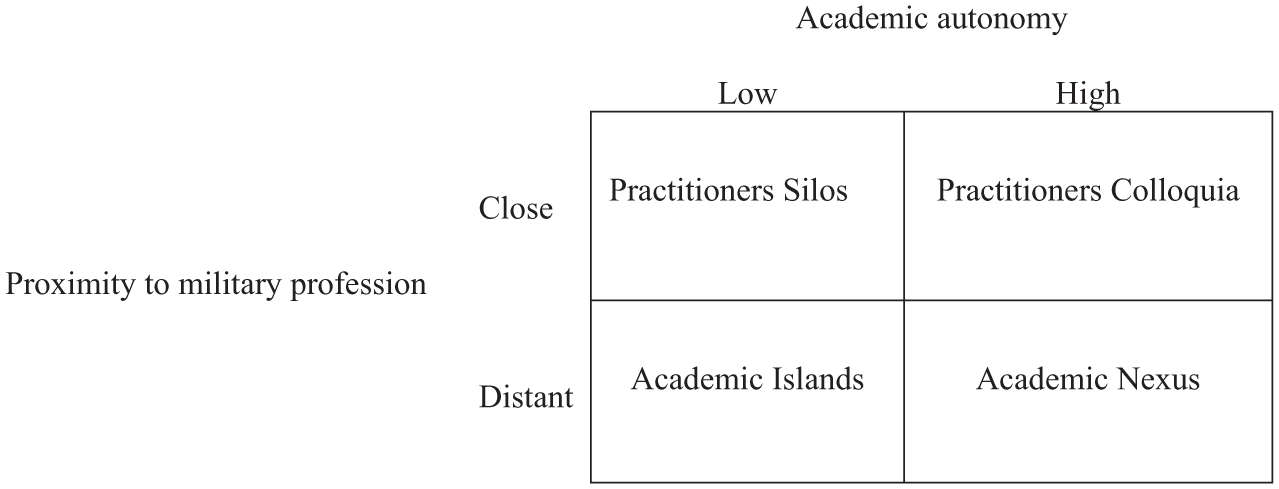
Explanations of disciplinary diversity in Nordic War/Military Studies.
Our categorization has a descriptive rather than a normative motivation. To be clear, each disciplinary arrangement comes with pros and cons. Mono-disciplinary approaches may for instance facilitate cooperation and specialization, whereas multi-disciplinary approaches are permissive for pragmatic inclusion of new methods and perspectives. Disciplinary focus on warfare can carve out niche knowledge and is key to professional competency for select professions, whereas broader conceptualization safeguards against blind spots. Also, as we do not strive to explain changes in disciplinary understanding, that is, trajectories, we do not theorize on how and why environments may move between the categories.
Research design
To map and explain the diversity of Nordic War/Military Studies, we use a comparative case-study design (George and Bennett, 2005). Aligning with our theoretical conceptualization of disciplinary variation, we focus on Nordic research environments with university accreditation which offer educational programs (bachelor’s and master’s) related to War/Military Studies, broadly conceived. This means either institutions which purports to study War/Military Studies and which have related programs (e.g. the Center of War Studies at University of Southern Denmark, with its related Master’s Programme in International Security and Law), environments which do not explicitly study War/Military Studies but which offers programs related to War/Military Studies (e.g. the Department of Modern History and Society at the Norwegian University of Science and Technology, with its Master’s Programme in War and Society), or institutions which both studies and teaches War/Military Studies (e.g. the Finnish National Defence University, with its bachelor’s and master’s degrees in Military Sciences). We exclude the many Nordic institutions and centers dedicated to Peace Research (e.g. the Peace Research Institute Oslo), university-based research centers dedicated to War/Military Studies which lack associated educational programs (e.g. the Center for Military Studies at Copenhagen University), and other research environments without bachelor’s or master’s programs (e.g. the Swedish Defence Research Agency). In addition, we include the War Studies department at King’s College, London, as point of reference, given its status as the oldest and most prestigious environment for War Studies, arguably serving as a benchmark for the younger Nordic environments. Table 1 provides a list of our included cases.
Case selection, sorted alphabetically on University/College name.
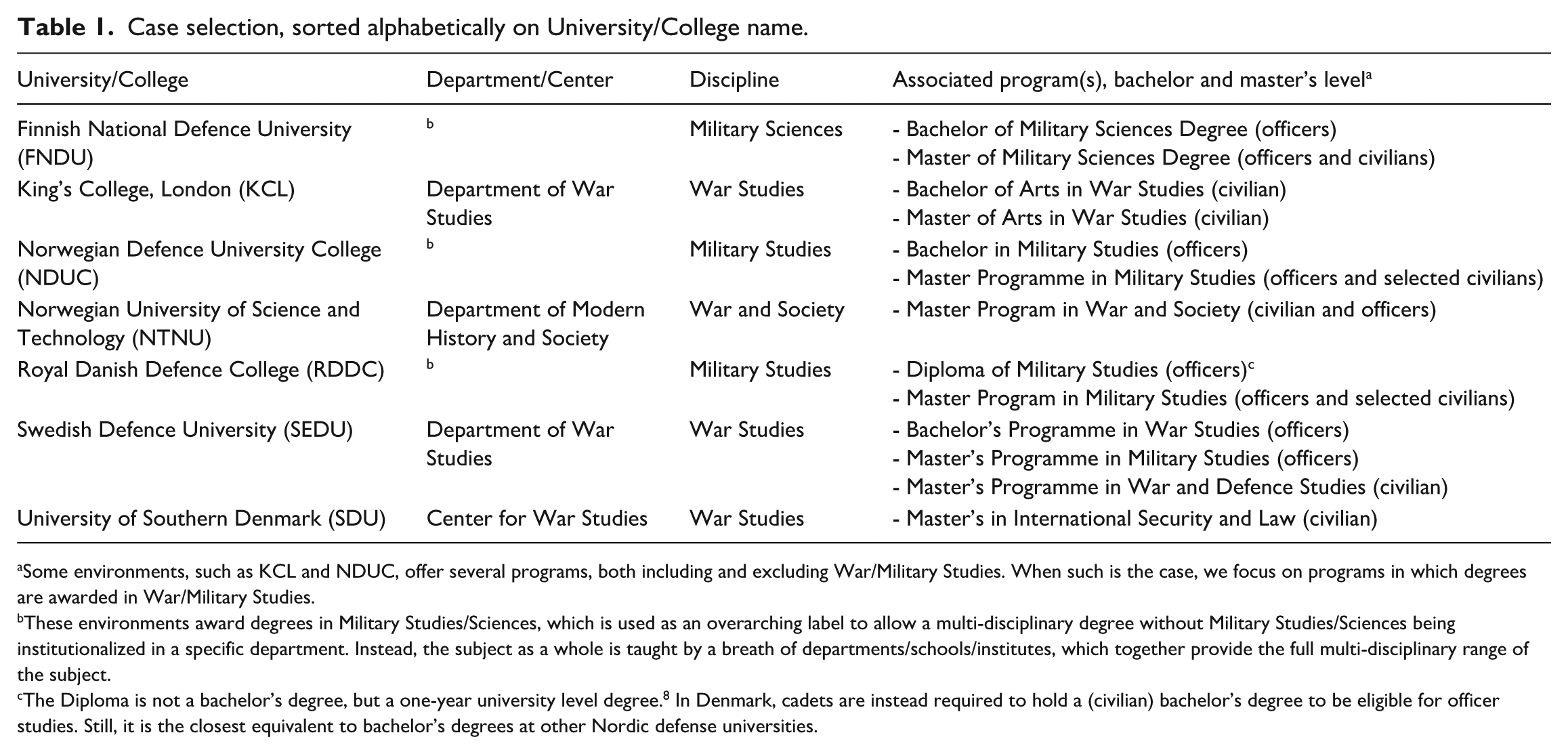
Some environments, such as KCL and NDUC, offer several programs, both including and excluding War/Military Studies. When such is the case, we focus on programs in which degrees are awarded in War/Military Studies.
These environments award degrees in Military Studies/Sciences, which is used as an overarching label to allow a multi-disciplinary degree without Military Studies/Sciences being institutionalized in a specific department. Instead, the subject as a whole is taught by a breath of departments/schools/institutes, which together provide the full multi-disciplinary range of the subject.
The Diploma is not a bachelor’s degree, but a one-year university level degree. 8 In Denmark, cadets are instead required to hold a (civilian) bachelor’s degree to be eligible for officer studies. Still, it is the closest equivalent to bachelor’s degrees at other Nordic defense universities.
To measure diversity of War Studies, we examine the various War/Military Studies environments’ (1) understanding of the substantive focus, and (2) whether one understands War/Military Studies as a uniform discipline or a multi-disciplinary undertaking. Regarding the first aspect, we focus on (i) official definitions of the subject (where available), (ii) course content of programs majoring in the subject, and (iii) informant interviews with key people in the environments (academics and/or military staff in educational/disciplinary leadership). Regarding the second aspect, we investigate (i) explicit statements on the issue (when available), (ii) whether programs on the subject are taught and organized by a single “host” department/unit, or jointly by a mix of departments/units, (iii) the organizational structure of the departments/units that form the subject, specifically whether it is clearly delineated from other subjects, or whether it gathers multiple types of expertise under one roof, and (iv) informant interviews. We base our measurements on official documentation, such as online presentations of subjects, institutions, programs, and syllabuses, as well as informant interviews. Considering that university departments need to inform prospective students about degrees, learning objectives and the contents of educational programs and courses, we expect that online data contain an accurate picture. However, online data may not always be up-to-date in all respects, why interviews supplemented online documentation. Additional empirics include media reporting and personal communication with university employees.
To measure university autonomy we primarily follow the European University Association’s (EUA) autonomy ranking. 9 This dataset covers 33 countries’ university systems and ranks them according to four autonomy-criteria: (1) organizational, that is, the capacity to decide its internal organization and decision-making processes independently, (2) financial, that is, the capacity to manage funds and allocate its budget independently, (3) staffing, that is, the capacity to recruit and manage its staff independently, and (4) academic, that is, the capacity to manage its internal academic affairs independently. Academic autonomy, arguably the most valuable indicator for this study, is measured by 12 indicators involving if the universities are allowed to accept students freely, admissions, eligibility criteria, termination procedures, quality assessment procedures, and contents of education. This indicator has been used elsewhere to capture the freedom to independently design and develop education (Ekberg, 2025: 29), and we use it as the main indicator for our theorized effect on theoretical/methodological heterogeneity, complemented by the aggregate index on autonomy (i.e. the combination of all four sub-components). In addition to the EUA data, we used informant interviews to probe perceptions of organizational constraints, and we also conducted more qualitative investigations into select environments, to gauge whether the hypothesized causal dynamics could be substantiated.
To measure relationship with the officers’ education, we examine four indicators: (1) whether the educating institution employs militaries as teaching staff, (2) the proportion of military students attending programs in War/Military Studies, (3) if programs in War/Military Studies are compulsory for officer education, and (4) the degree of formal autonomy from the armed forces, that is, is the university part of the armed forces or not. In addition, we probed the theorized supply and demand effects in the informant interviews, and we also studied select programs to gauge whether these effects appeared to have affected the syllabuses and overall scope of the disciplines. We based the latter analysis on official statistics, communication, and regulations of the examined institutions (ascertained by email communication with relevant university staff), as well as interviews.
We conducted 10 informant interviews with staff holding some form of leadership positions (NN1–10) to supplement the analysis, covering all the Nordic environments, but excluding KCL. The interviews were conducted online, in-person with one of the authors, and spanned between 25 and 70 minutes. Two of the interviews had two interviewees present, meaning that a total of 12 persons were interviewed across the ten interviews (n = 12) The interviews were conducted in line with Swedish regulations, which waive the need for ethical approval, absent the collection of sensitive personal data or criminal activities. All interviewees provided informed consent prior to the interviews, and no personal information was collected. The interviewees are pseudonymized in the study to protect their integrity. All interviews were recorded and transcribed for analysis. There was some overlap between the people interviewed, and those who had provided email information on the environments examined. Seven of the interviewees, covering all the examined Nordic environments, had, however, not provided previous email information, meaning that those interviews provided new and independent information, as compared with that ascertained through email contacts. The interviews overall corroborated online data and other documentary evidence and they also allowed for more in-depth discussions about reasons and motivations behind certain choices regarding the educational programs.
Explaining diversity in Nordic War/Military Studies
In this section we analyze the heterogeneity of Nordic War/Military Studies. We start by establishing variation in the conceptualization of the disciplines, the dependent variable. Moving on, we examine the explanatory power of our proposed independent variables: relative academic autonomy and proximity to the military profession. We find the latter to correlate closely, and as expected, with how broad War/Military Studies is conceptualized. Regarding the former, we find the overall effect to be weaker than expected, suggesting that academic autonomy might only be conditionally relevant for the conceptualization of Nordic War/Military Studies. In short, environments appear to be more multi-disciplinary than initially expected, and lack of academic autonomy only appears to have constrained the Swedish Defence University (SEDU) into adopting a relatively mono-disciplinary approach to War Studies.
Establishing variation in War/Military Studies
There is great variation in the conceptualization of War/Military Studies across the Nordic, as summarized in Figure 2. Starting with the War Studies Department at King’s College, arguably serving as a benchmark and role model in the Nordic context, this environment comes close to the theoretic ideal of an “Academic Nexus,” combining a broad understanding of the subject with a multi-disciplinary theoretical and methodological approach. The War Studies Department at KCL is explicitly multi-disciplinary, 10 houses just shy of 100 employees identified as representatives of their diverse backgrounds (e.g. International Politics, Conflict Health and Military Medicine, International History, International Law, Psychology and Security), 11 and stress the breadth of its bachelor’s and master’s programs as competitive advantages. The War Studies MA for instance allows the study of the “causes, conduct and consequences” of conflict, from “historical, political, sociological, philosophical, artistic, legal, ethical and military viewpoints,” tacitly assuming that war is so complex that it deserves to be approached from several disciplines to be fully grasped (Gow, 2017). 12 These aspects are mirrored in the curriculums of both the BA and MA programs. 13
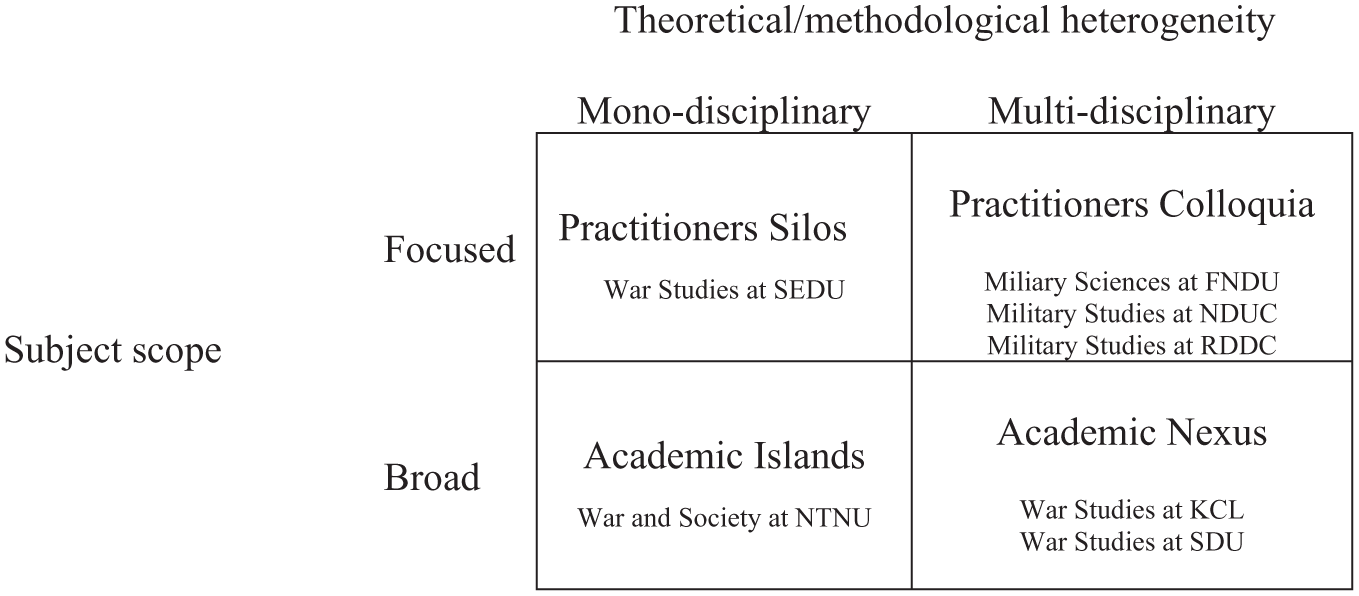
Empirical classification of Nordic disciplinary understanding of War/Military Studies.
Similarly displaying characteristics of an “Academic Nexus,” the Center for War Studies at University of Southern Denmark deserves discussion. Not being a university department in its own right, the center at the time of its creation clearly aspired for a multi-disciplinary approach to War Studies, and still profess to a broad understanding of the subject, that is, causes of war, conduct or dynamics of war, as well as conflict resolution (Rynning, 2017; NN1; NN2). 14 In line with its British counterpart, this environment officially gathers a diverse range of academics from Political Science and Public Management, Mathematics and Computer Science, Culture and Language, History, and Law, 15 although interviewees (NN1; NN2) clarified that current activities mostly engage people from the first and last of these subjects. Further nuancing its classification, CWS’ educational components is less straightforward, as the center does not host any programs in War Studies. Instead, two of its participant disciplines (International Relations and Law) run a Master’s Programme in International Security and Law (MOISL), which profess to be interdisciplinary and “grounded in the world-class research done by the Center for War Studies.” 16 While multi-disciplinary in its combination of Law and Security (NN1), and covering a broad approach to war in its coursework, 17 the program arguably have mono-disciplinary tendencies in that it is still organized around two separate subjects, and does not strictly profess to combine them into War Studies. In short, this Danish environment, while predominantly classified as an “Academic Nexus,” also displays aspects of a more mono-disciplinary organization.
Shifting focus to another quadrant in our classification scheme, we find the Department for Modern History and Society (DMHS) at NTNU, and its associated MA in War and Society, here classified as an example of an “Academic Island.” This environment is admittedly an odd bird, given that neither the department, nor the program, explicitly claim the title of War/Military Studies. It is nonetheless included because the associated master’s program is a cooperative project between NTNU and NDUC, 18 it includes courses that address, for example, military theory, 19 the Norwegian military considers the program an alternative solution to meet high demands for educating higher officers, and the founders consider it equivalent to War-Studies-environments in other countries (Mikkelsen, 2023). Importantly, the program was specifically designed to target serving officers, and the staff giving the program considers it as part of Military Studies, although with a more societal/civilian focus (NN3; NN4). Regarding disciplinary scope, the curriculum for the MA in War and Society indicates a broader approach to war and warfare, combining a limited focus on modern warfare practices with societal aspects of economy, gender, social and political relations, 20 to give “a historical understanding of various moments affecting military force and the society impacted by it.” 21 Still, even though the program is described to relate to several social sciences and disciplines in the humanities (NN3; NN4), all courses are given within the context of Modern History, and all teaching staff comes from the department, 22 indicating a predominantly mono-disciplinary approach.
The third quadrant interestingly gathers all environments in the analysis that self-label as studying/teaching Military Studies (and Sciences), that is, the Danish, Finnish, and Norwegian defense universities. Sharing key features, they are here presented together as “Practitioners Colloquia.” In short, these organizations combine a multi-disciplinary organization with a clear focus on knowledge and skills in warfare (planning, preparation, and conduct). Speaking to the multi-disciplinary character, Military Studies/Sciences are all treated as “umbrella-subjects,” gathering diverse sub-sections and subjects, covering, for example, leadership, land/sea/air-power, joint operations, military theory, and systems technology. 23 FNDU, for example, define Military Sciences as “a multidisciplinary and complex collection of subjects that study wars, crises, other threats to security and means for preventing these.” 24 Tellingly, none of the environments have actual departments for Military Studies/Sciences, instead the subjects can be considered university wide. In terms of programs and curriculums for their bachelor’s and master’s programs, these defense universities primarily focus on vocational skills. 25
In contrast to its Nordic counterparts, SEDU occupies the last quadrant, displaying characteristics of “Practitioners Silos.” Apart from the other defense universities, SEDU organize around separate disciplines and departments, separating War Studies (note, not Military Studies 26 ) from other subjects which other defense universities treat as part of Military Studies. 27 Further speaking to this mono-disciplinary approach, Swedish officers who attend the university’s bachelor’s and master’s programs major in either War Studies, or one of the other subjects, depending on their specialization. 28 In line with the other defense universities, SEDU conceptualize War Studies as predominantly focused on the conduct of war, defining the subject as “a social science whose central object of study is war and the use of force,” further specifying that the discipline concerns “how military capability is created, led, organized, maintained over time and comes into effect.” 29 That said, it also opens up for a broader perspective in stating that “War Studies also includes social and ethical aspects as well as critical perspectives in relation to war and warfare.” 30 In addition, interviewed staff propose that while the official disciplinary definition is narrower, subsequent research and teaching practices at SEDU has resulted in a broader conceptualization of the discipline, sprung out of the various disciplinary backgrounds of the academic staff (NN5). We interpret this as a predominantly focused approach to War Studies, although with tendencies of broader perspectives reminiscent of that found in civilian counterparts. This pattern is echoed in the more focused curriculum of the military programs, 31 whereas War Studies courses in the civilian master’s program instead offer a broader outlook. 32
The impact of autonomy vis-à-vis the state on War/Military Studies
In this section, we analyze the impact on academic autonomy on Nordic War/Military Studies. As suggested in the theory section above, the greater degree of academic autonomy, we expect more multi-disciplinary understandings of War/Military Studies.
In Table 2, university autonomy in Finland, the United Kingdom, Norway, Denmark, and Sweden are summarized. We start with the quantitative indicators. The data set ranks 36 units of analysis; hence, the worst possible result is 36 (i.e. being ranked lowest on that aspect). The results show substantial variation across aspects of autonomy and countries, ranging from a rank of 2 (academic autonomy ranking for Finland) to 18 (aggregate autonomy ranking for Norway). We focus on academic autonomy, as this aspect captures freedom to independently structure education, establish new programs, decide on student admission, and to internally handle quality assessment. In addition, we consider the mean ranking of aggregate autonomy (which also includes organizational, financial, and staffing autonomy), as it could capture more indirect capacity of the state to constrain the organization of multi-disciplinary disciplines. Of the five countries examined, the United Kingdom and Finland stand out as relatively more autonomous. As an example, Finnish universities are organized independently from the state, and they do not need accreditation for education. Rather, they go through external review every six years, with the primary aim of identifying strengths and weaknesses. Importantly, neither funding nor accreditation is tied to these reviews, which rather serve a supportive function (Ekberg, 2025: 70). This explains why Finland ranks second out of 36 on academic autonomy, just before the United Kingdom at third place. Regarding aggregate autonomy, the United Kingdom ranks higher (2.5 compared to Finland’s 7), given that Finnish universities (in line with its Nordic equivalents) score lower on financial autonomy (17th place for Finland) as they receive most of their funding from the government. In line with the hypothesis, KCL and FNDU are clear cases of multi-disciplinary organizations.
University autonomy in Finland, the United Kingdom, Norway, Denmark, and Sweden 2022, broadly sorted from most to least academically autonomous. Based on the European University Association’s autonomy ranking and informant interviews.
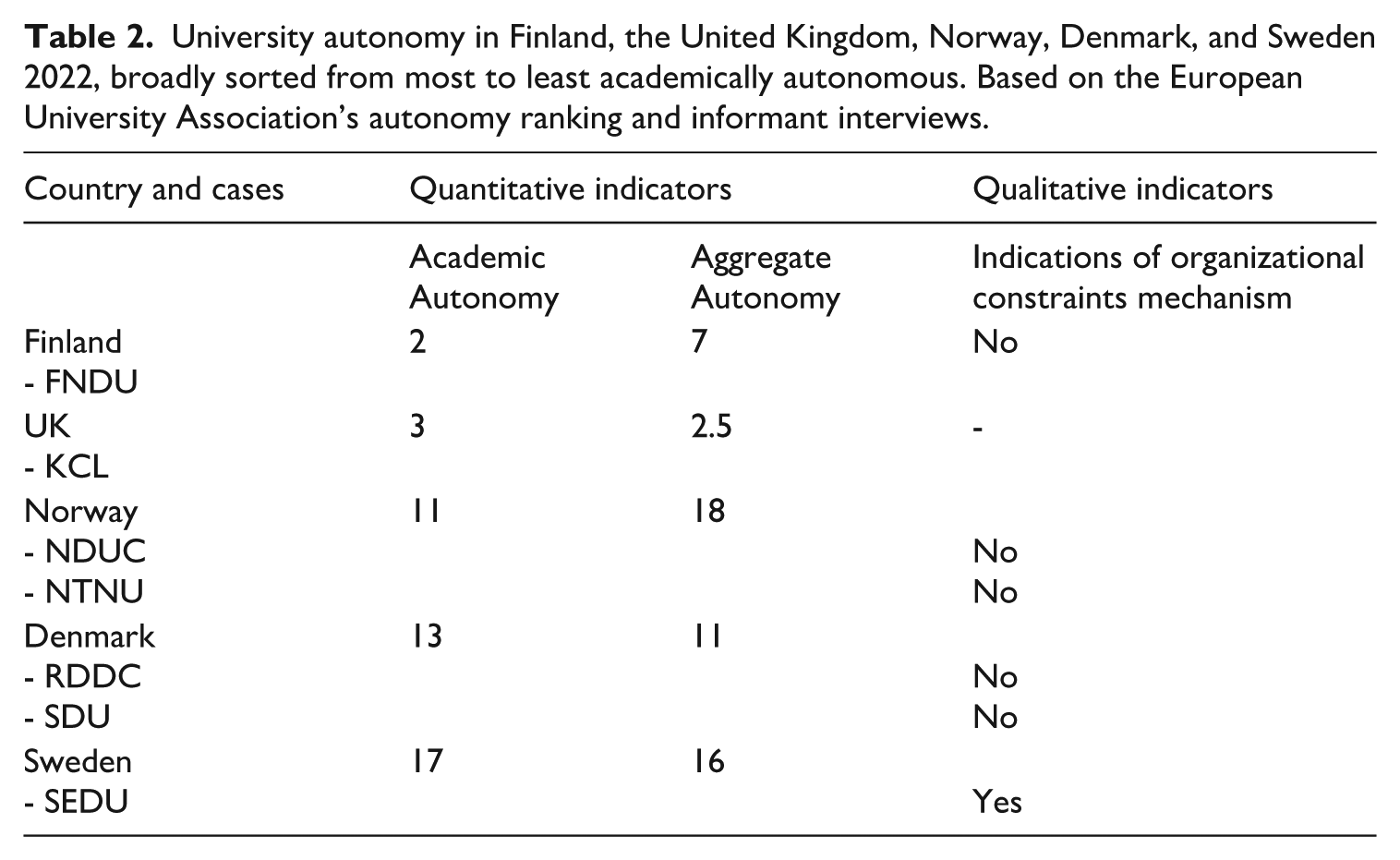
The results are more mixed for the other three countries. Denmark is arguably placed in the middle, based on a combined analysis of both academic autonomy, and aggregate ranking. Sweden has a relatively rigid and state-controlled university-system, ranking 17 and 16 for academic and aggregate autonomy respectively. Norway ranks 11 for academic autonomy, before Denmark, but has a mean aggregate ranking at the back of the pack at 18, due to its low financial and staffing autonomy. Subsequently, we expect Sweden to tend toward mono-disciplinary organizations, whereas the Norwegian and Danish contexts could go either way, given their intermediate results.
The results only weakly support our theoretical expectations, with a general deviation in favor of multi-disciplinary organization. Overall, there appears to be a strong preference for multi-disciplinary conceptualizations of War/Military Studies, indicating the applicability of our proposed ontological consensus mechanism, and possibly tempering the applicability of the organizational constraints mechanism. From a purely correlational analysis, War Studies at KCL, Military Sciences at FNDU, and War Studies at SEDU all correspond to expectations—the first two exemplify multi-disciplinary arrangements in more autonomous contexts, and the latter displaying a relatively mono-disciplinary environment operating under more constraining state control. The four environments in Denmark and Norway are less clear cut, recognizing their middle-range scores on autonomy and variation in arrangements. Here both defense universities have adopted multi-disciplinary arrangements of Military Studies, War Studies at SDU is likewise multi-disciplinary conceptualized, whereas War and Society at NTNU has adopted a mono-disciplinary approach.
Our interpretation is that military professionals and civilian academics alike prefer multi-disciplinary approaches to War/Military Studies, supporting the ontological consensus mechanism, but that the organizational constraints mechanism is more conditionally relevant than theorized. The qualitative data supports this conclusion. Comparative studies on higher education highlight that Swedish regulation provides considerably less academic autonomy than its Nordic counterparts, exemplified by strict external audit, quality assurance, and constraining rules for accreditation (Ekberg, 2025: 38). Indicatively, Swedish universities are government agencies, without special regulation to elevate their academic independence (Ekberg, 2025). This is uniquely constraining in the Nordic context. SEDU is further the only environment where indications of the organizational constraint mechanism were supported in the interviews. When asked about the potential effect of national legislation on the disciplinary conceptualization of War Studies, one centrally placed academic explained that regulation might not directly affect the subject, but that “the work to acquire accreditation includes specifying the subject, its boundaries, and its uniqueness, and this process provides a foundation for the discipline” (a process that has been done first to get accreditation for basic and advanced level and then later for the PhD-level, reinforcing its impact), and that the re-organization into mono-disciplinary and independent departments at SEDU in the late 2010s “might have been pursued to better align with the organization of other universities and colleges in Sweden, and conform to the common setup for higher education” (NN5). All other interviewees, across the other Nordic environments, proposed that they had enough academic autonomy to freely conceptualize their disciplines and design education. This included War and Society at NTNU, despite its mono-disciplinary organization of its master’s program, as well as the MOISL program at SDU, which arguably displays less multi-disciplinarity than the related CWS. For the master’s program at NTNU, the main explanations for the mono-disciplinary approach appear to be a combination of disciplinary entrepreneurship and professional networks of the founding pioneers, and the fact that the program was launched from within the pre-existing DMHS, which limited available resources for multi-disciplinary approaches (NN3; NN4).
Summarizing, we find evidence in favor of the ontological consensus mechanism across both mono-disciplinary and multi-disciplinary environments, whereas the organizational constraints mechanism appears to have been only contextually important for SEDU, delimiting its relevance to explain variation across all Nordic environments.
The impact of relation to military profession on War/Military Studies
Here we examine the impact on the substantive focus of Nordic War/Military Studies. The expectation is that closeness to the military profession motivates a narrower and deeper focus on the conduct of warfare, whereas more civilian environments adopt a broader outlook on the full conflict cycle.
Table 3 summarizes the proximity to the military profession for our seven cases. Overall, the results indicate an expected divide between defense universities and civilian environments, with the newly developed master’s program in War and Society at NTNU providing some interesting hybrid characteristics.
War/Military Studies relationship with military profession in the United Kingdom, Finland, Denmark, Sweden, and Norway, broadly sorted from closest to most distant.
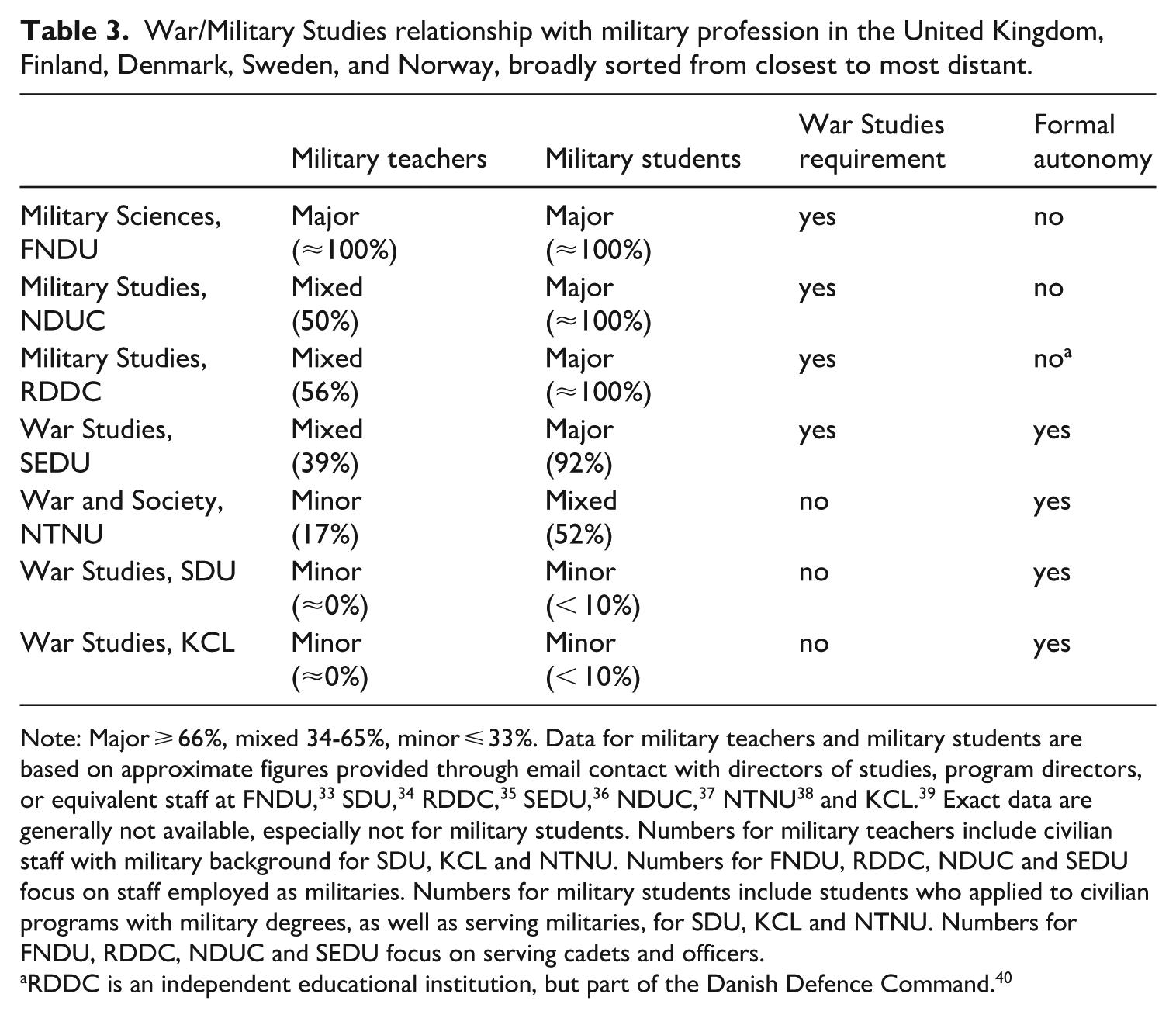
Note: Major ⩾ 66%, mixed 34-65%, minor ⩽ 33%. Data for military teachers and military students are based on approximate figures provided through email contact with directors of studies, program directors, or equivalent staff at FNDU, 33 SDU, 34 RDDC, 35 SEDU, 36 NDUC, 37 NTNU 38 and KCL. 39 Exact data are generally not available, especially not for military students. Numbers for military teachers include civilian staff with military background for SDU, KCL and NTNU. Numbers for FNDU, RDDC, NDUC and SEDU focus on staff employed as militaries. Numbers for military students include students who applied to civilian programs with military degrees, as well as serving militaries, for SDU, KCL and NTNU. Numbers for FNDU, RDDC, NDUC and SEDU focus on serving cadets and officers.
RDDC is an independent educational institution, but part of the Danish Defence Command. 40
Quite intuitively, Nordic defense universities have close relationships with the military profession. FNDU, NDUC, RDDC and SEDU all provide compulsory education for officer education. In addition, these environments have almost exclusively military students attending their programs in War/Military Studies. While all four defense universities permit a select number of civilian students to some of their War/Military Studies programs (mostly civil servants working with civilian defense issues), SEDU stands out by offering a civilian master’s in War Studies, in parallel to its military programs. Still, with a relative share of about 92% military students attending programs in War Studies, SEDU is nevertheless a far cry from the numbers of the civilian environments. While statistics for FNDU, NDUC, and RDDC are not exact, they are all assessed to be just shy of 100% military students.
In terms of teaching faculty, the examined defense universities all employ a mix of civilian academics, (ex-)militaries with civilian portfolios, and officers tasked with teaching. Separating the last category from the former two, the relative distributions range between 39% military teachers (at SEDU) and almost 100% (at FNDU). These numbers should however be treated with care, as it is nigh impossible to gain statistics on the relative distribution in terms of actual teaching (e.g. teaching hours). The numbers rather describe overall distributions of types of staff, across institutions engaged in teaching the War/Military Studies programs. That said, email contact confirms that teaching is roughly reflective of the staff distribution. Last, the defense universities showcase variation in terms of formal autonomy. FNDU and NDUC are both part of the armed forces’ structure, sorting under the Department of Defense rather than the Department of Education. For FNDU, this means that the armed forces are doing the quality assurance, but the university also voluntarily participates in the civilian review system. NDUC for its part participates in the civilian accreditation system. RDDC, while officially an independent part of the Danish Defence Command, is in practice part of the armed forces (NN6). In line with FNDU and NDUC, RDDC is governed by regulations under the Department of Defense, but they also adhere to civilian quality assurance standards (including, but not exclusively related to accreditation processes). Last, SEDU again stands out as the only Nordic defense university that is formally independent from the armed forces and sorted as an agency under the Ministry of Education. This means that education at SEDU is no different from other civilian universities in Sweden. In summary, and based on the above criteria, FNDU is considered closest to the military profession, SEDU most distant, with NDUC and RDDC in between.
Turning to the civilian environments, these neatly cluster significantly more distant from the military profession, with the relative exception of NTNU. In clear contrast to the military environments, none of NTNU, SDU and KCL offer programs in War Studies (or related subjects) that are required for officer education. In other words, none of the examined countries have outsourced compulsory education for officer training to civilian institutions. That said, armed forces can also accept civilian degrees as electable and alternative ways of professional development and qualification. This is especially true for master’s level education, which is visible in the relative share of military students at the examined civilian programs. Again, numbers for the relative distribution of military students are estimates, as these institutions do not officially track the background of the students. Even so, both SDU and NTNU report that they regularly have ex- or serving officers attending their master’s programs, and NTNU stand out by having reserved 50% of their intake for serving officers, by agreement with the Norwegian Armed Forces (NN4).
A brief discussion on KCL is warranted. In the late 1990s, KCL was contracted to provide educational support to the UK armed forces, leading to the establishment of the separate but related Defence Studies Department (DSD). 41 Given that most of the PME conducted through KCL is channeled through this environment, War Studies at King’s is probably more distant from the military profession, and broader in its scope, than what would have been the case if the education, staff, and research of the DSD had been retained within the War Studies Department. In short, while we focus on War Studies at KCL for this study, DSD and Defence Studies would probably represent an interesting case with more tendency toward what we classify as “Practitioners Colloquia,” but within a more civilian environment.
Last, whereas civilian environments engaged in teaching War Studies (or related programs) should theoretically have reasons to engage (ex-)military staff in teaching to include practitioners’ perspectives for the benefit of the students potentially starting a career in a field in which collaboration with military professionals is essential, empirically, this appears to be a limited phenomenon. We find the relative share of military teachers at the civilian institutions to be minor, ranging from an assessed 17% at NTNU, to 0% at SDU. Again, these numbers are assessments, based on contact with the teaching institutions and comparisons with faculty registries. Still, it indicates the stark difference between the relative distributions of military teachers across the civilian and military environments.
In summary, we find SDU and KCL to be most distant from the military profession, closely shadowed by NTNU, with the notable exception that the master’s program in War and Society has a split student base.
What is the relationship between proximity to the military profession and the scope of War/Military Studies? Overall, our findings corroborate our hypotheses. On aggregate, defense universities, being closely related to the military, primarily focus on core competencies of the conduct of war, whereas the civilian environments, being significantly more distant from the military profession, all espouse broader conceptualizations of War Studies. We theorized that this relationship is driven by a supply and demand logic. In our operationalizations, we consider the aspects of military students, formal autonomy, and compulsory status of War/Military Studies to capture the demand mechanisms, and the aspect of military teachers to capture the supply mechanisms. Overall, the supply and demand mechanisms found broad support, even in the more qualitative interview material. Interviewees (NN6; NN7; NN8; NN9; NN10) reported that student employability and professional qualifications served to inform curriculums, with military programs centering on the skills required to create, maintain and command armed forces, and civilian programs focusing on general analytical skills and knowledge about war and conflict environments (NN1; NN3, NN4). On the supply side, the expertise of the faculty clearly informed the disciplinary understanding and teaching content. As an example, MOISL, having previously offered course content on operational warfare practices, currently found themselves unable to provide such education because of the loss of a teacher with military background and related research focus (NN1).
Nuancing our conceptualizations, some interviewees challenged the description of Military Studies having a narrower focus than War Studies in civilian environments. Admittedly, while the military profession requires in-depth applied skills to master the command of armed forces, Military Studies can be understood as conceptually broader than War Studies, in its inclusion of administrative, psychological, and technical competencies (NN6). Arguably, conceptual breadth may be measured across several components, and not only in relation to whether the “full conflict cycle” is considered or not. In addition, interviewees at all defense universities proposed that the broader aspects of drivers of conflict, and effects of war on society, formed part of the professional requirements of officers (and Military Studies), even if this might not be as central as in more civilian approaches to War Studies (NN5; NN6; NN7; NN8; NN9; NN10).
Overall, the results line up in such a way that the mechanisms cannot easily be disentangled from each other, with supply and demand incentives strongly correlating within and across cases. FNDU, RDDC and NDUC all score high for all aspects that speak to both military supply and demand mechanisms, whereas SDU and KCL have equivalent results in line with the civilian supply and demand mechanisms. That said, SEDU and NTNU offer some interesting observations.
Focusing on the civilian master’s program in War Studies at SEDU, this program (which represents less than 8% of total students in War Studies) differs from the military programs at SEDU by having an almost exclusively civilian student base, as well as teaching staff. 42 In line with our theory, the curriculum for this program provides a broader conceptualization of War Studies (NN5), 43 like those offered at civilian environments (e.g. KCL). Further strengthening the civilian demand mechanism, moreover, is that it is only the military programs at SEDU that offer vocational, practical courses for the use of force. While the aggregate conceptualization of War Studies at SEDU appear more focused (especially on paper), this might very well be driven by the dominance of the military programs within the subject of War Studies, as well as the relative (but not complete) closeness of those military programs to the demands of Swedish Armed Forces, and the military profession. Counterfactually, if SEDU would expand its civilian program in War Studies this could well entail a conceptual broadening of War Studies at SEDU. The case of SEDU however also shows the strength of the military demand mechanism. Despite a lower degree of military teachers as compared to the other Nordic defense universities, the education in the military programs at SEDU has a similar, vocational focus.
As for the newly established master’s program in War and Society at NTNU, this offers an interesting example of a civilian environment with a predominantly civilian teaching staff (i.e. civilian supply mechanism), offering an education to a mixed student base (i.e. some expected effects of a military demand). In addition, while NTNU is clearly independent from the Norwegian armed forces and does not offer an education that is compulsory for promotion to higher officer ranks, its master program was developed in cooperation with NDUC to specifically complement the higher officer education at NDUC, further indicating its hybrid status (Haug 2025; NN4; Mikkelsen, 2023). Here, the result appear to be a program (and a subject) which is clearly within the expertise of the civilian department (i.e. Modern History and Society) but where the curriculum has been developed to fit within the discipline of Military Studies (NN3; NN4). 44 Or as put by one key academic at DMHS: “the topics that we have made are military studies,” but with a societal and historical focus (NN4). We interpret this to be the result of counteracting (or converging) effects of supply and demand, where the academic expertise of the civilian staff delimit, yet still adapt to the military demands (figuratively speaking) of the Norwegian Armed Forces. Appearing to be driven by joint interests in the development of the program (offering opportunities for a broadened student base for NTNU and a welcome solution for the Norwegian Armed Forces struggling to supply higher education for its expanding cadre of higher officers) the NTNU program showcase results of when the theorized mechanisms have competing effect in the same case. As we categorize NTNU as espousing a broad conceptualization of War Studies, this could be interpreted as that the supply mechanism is dominating the demand mechanism. We, however, opt for a more tempered interpretation, arguing that the demand side in the case is better understood as mixed, while also recognizing that NTNU appears to have been responsive to the expected demands entailed by the exposure to the military profession. As such, it appears that both mechanisms still have explanatory value, yet that the supply side might entail important constraints on how far a civilian institution may be willing and able to adapt to military demands.
Conclusion
Why are War/Military Studies conceptualized differently across the Nordic states, despite having been subject to the same broader developments in security and defense since the end of the Cold War? In this article we have proposed that academic autonomy as well as proximity to the military profession can explain the heterogeneity of Nordic War/Military Studies, although the former factor appears to have a more limited and conditional effect than first theorized. Disciplinary character and contents can thus be explained by structural, internal conditions. Environments with comparatively low degree of academic autonomy and close links to the armed forces make for “Practitioners’ Silos,” such as SEDU, where the subject is treated as mono-disciplinary and primarily focused on the conduct of war. When environments are relatively more autonomous yet still proximate to the military profession, such as FNDU, RDDC and NDUC, they conform to what we call “Practitioners’ Colloquia,” which entails a multi-disciplinary approach to War/Military Studies, focused on competency in warfare. When teaching institutions are more distant from the military, they develop broader conceptualizations of the discipline, either in the multi-disciplinary format of “Academic Nexuses,” such as at KCL and SDU, or in a more mono-disciplinary setting, such as at NTNU. However, nuancing our initial theoretical expectations, academic autonomy appears to have had a limited effect on whether Nordic environments have opted for a mono- or multi-disciplinary approach to War/Military studies, except in the case of SEDU. We thus find strongest support for the theorized mechanisms regarding supply and demand of teachers and students, as well as the joint preference for multi-disciplinary approaches to War/Military Studies.
The study offers several contributions, as well as avenues for future research. First, we want to highlight our empirical contribution. While it is clear that War/Military Studies is gaining traction throughout the Nordic states, we offer a first rigorous overview of the university environments engaged in developing these emergent fields. Mapping heterogeneity in Nordic War/Military Studies is important as it may have an impact on the long-term pursuit and dissemination of knowledge about war. With increasing challenges to the post-Second World War World Order, it is important to not only know about war, but also how the study of war is institutionalized. Skeptics may disagree with our selection of environments, or our focus on institutions that offer university programs, but we propose that the study offers a unique overview which combines and compares conceptualizations of War/Military Studies across civilian and military universities. Future research could well add perspectives on excluded environments, and/or investigate over-time developments more closely.
Second, we offer a theoretical contribution in terms of identifying the impact of internal structural factors on disciplinary conceptualization. Our argument is not that this alone explains the heterogeneity of Nordic War/Military Studies. Rather, we propose to highlight important structural aspects that may constrain attempts at a more homogeneous understanding of the discipline. We recognize and encourage that future research may elucidate the role of key individuals, bureaucratic politics, and possible interdependence between the investigated environments, in providing a fuller account of disciplinary heterogeneity. All these factors featured in the interview material that we gathered, and their explanatory power should be leveraged to complement our analysis. 45 We further identify causal mechanisms which clarify how proximity to the military profession and academic autonomy steer disciplinary development. While the overall relationships might appear mundane to the informed observer, there is interesting potential for hybrid conceptualization of War/Military Studies, driven by mixed organization of university environments, as identified at SEDU and NTNU.
We recognize that critical readers might object to our exclusion of research in our overview of disciplinary heterogeneity. As a limited attempt to control for this factor, we asked all interviewees whether there was research conducted at the respective environments which was not included in the curriculums for the respective degree programs. Interestingly, all interviewees consistently reported a major overlap between teaching and research, driven by a dynamic where faculty either develop courses on their topics of research, or where military teachers take stock of in-house research in the development of courses. Even though some research is bound to be left out of curriculums, our findings indicate that education might serve as a satisfactory proxy for the broader themes of research conducted. Future research would nonetheless do well to add comparisons of—and explanations to—patterns in research output across Nordic War/Military Studies. It would be especially interesting to investigate how drivers of research and education interact and affect each other to produce disciplinary understandings of War/Military Studies.
Third, we offer broader interpretations of our results, in relation to how Nordic War/Military Studies may develop. How do our results matter for Nordic War/Military Studies as a discipline, and Nordic security policy more broadly? We believe that there is no need for Nordic homogeneity in terms of the scope (focused vs broad) of War/Military Studies. Academic environments are probably better off choosing a focus that is appropriate for their student base and in line with their relative expertise. On an aggregate level, Nordic War/Military Studies is furthermore best served by drawing from two wells of knowledge: specialized and focused knowledge on the practice of warfare (as developed at more military universities) and broader conceptualizations of the cause, dynamics, and effects of war in relation to society (as espoused at more civilian universities). The first without the second risks over-instrumentalizing knowledge on war as primarily a vocational enterprise, whereas the latter without the former risk producing misinformed knowledge without firm foundation in the interests, tasks, and practices of the military profession. This interdependency promises rich rewards for cooperation among the Nordic environments.
The results of this study also show that while there seems to be a burgeoning, shared Nordic preference for multi-disciplinary interpretations of War/Military Studies, there are limits for how far experiences can travel. In particular the Swedish case seems to be more heavily regulated, which means that it cannot readily adopt models from its Nordic counterparts. 46 Indeed, in 2014 the Swedish government quality agency for higher education—the Swedish Higher Education Authority—threatened to withdraw SEDU’s accreditation due to problems related to too loosely defined disciplinary boundaries in the War Studies education at the time. 47 The fact that SEDU is the only Nordic defense university with a mono-disciplinary subject of War Studies can probably largely be traced to this juncture, as well as the more civilian organization, staffing and teaching at SEDU. On an aggregate level, the new Nordic War Studies/Military Studies environments thus showcase how especially vocational educations is torn between the state (and its demands for accreditation and quality systems) and the military (with its demands on professional standards, organizational needs and values, and internal control).
Still, there is ample room for collaboration. Especially in the long run, current dissimilarities may gradually lose their relevance, albeit not disappear, in favor of the plentiful incentives for cooperation. It is only natural that defense universities and civilian counterparts chose somewhat different foci for their conceptualization of—and education in—War/Military Studies. In addition, it appears that hybrid environments (as observed at NTNU and partially at SEDU) tend to converge on a more mixed understanding of the discipline, indicating a flexible disciplinary understanding across the institutions. This should bode well for cooperation. Based in the shared preference for multi-disciplinary approaches to the subject, Nordic university environments would do well to develop forums for cross-national exchanges regarding War/Military Studies as way to ensure cross-pollination, but not homogenization, as the discipline evolves.
Supplemental Material
sj-docx-1-cac-10.1177_00108367251379668 – Supplemental material for Explaining disciplinary heterogeneity in Nordic War/Military Studies
Supplemental material, sj-docx-1-cac-10.1177_00108367251379668 for Explaining disciplinary heterogeneity in Nordic War/Military Studies by Jan Angstrom and David L Gebre-Medhin in Cooperation and Conflict
Footnotes
Acknowledgements
The authors would like to thank participants and colleagues of the War Studies Seminar as well as Modern Warfare research group Seminar at the Swedish Defence University for their comments on earlier versions of the manuscript. We would also like to thank colleagues and staff at all the university environments examined, who have been kind enough to assist in data gathering. Finally, we thank the anonymous reviewers for their thoughtful comments, which served to inform important revisions of the study.
Funding
The author(s) received no financial support for the research, authorship, and/or publication of this article.
Declaration of Conflicting Interests
The author(s) declared no potential conflicts of interest with respect to the research, authorship, and/or publication of this article.
Data availability statement
Not applicable.
Ethical approval and informed consent statements
Not applicable.
Supplemental material
Supplemental material for this article is available online.
1
Whereas Nordic military academies have arguably taught “War/Military Studies” in relation to officers for considerably longer, academization of the military profession in the late 1990s arguably motivated a transformation of previously vocational knowledge into an academic format that lends for comparison with other university disciplines.
3
Note that there is a burgeoning literature on professional military education (PME). This literature (e.g. Enstad and Hagen, 2025; Gyllensporre, 2014; Higbee, 2010; Johnson-Freese, 2013; Larsson, 2024; Libel, 2016), however, focuses on reforms and pedagogy of military education. We focus on War/Military Studies, which occasionally, but not always is understood to be one part of such military education.
4
See case-section 1, 2-3 specifically, in Kristiansen and Olsen (2007).
7
Kesseli (2007) and  (accessed 12 June 2025)., as well as its counterpart in Finnish.
13
https://www.kcl.ac.uk/study/undergraduate/courses/war-studies-ba (accessed 12 June 2025), and (accessed 12 June 2025).
17
https://odin.sdu.dk/sitecore/index.php?a=sto&id=59172&listid=4707&lang=en (accessed 12 June 2025).
22
https://www.ntnu.no/studier/studieplan#programmeCode=MKRIG&year=2024 (accessed 12 June 2025).
23
https://maanpuolustuskorkeakoulu.fi/en/units (accessed 12 June 2025); https://www.fak.dk/da/om-os/organisation/ (accessed 12 June 2025); (accessed 12 June 2025).
25
https://maanpuolustuskorkeakoulu.fi/en/the-degrees-we-offer (accessed 12 June 2025); https://www.fak.dk/da/uddannelse/studieadministration/ressourcer/studieordninger/ (accessed 12 June 2025); (accessed 12 June 2025).
26
The master’s program for the officer profession is however structured as a multidisciplinary degree in Military Studies, but this program is nonetheless organized as four separate majors where students select one, along the disciplinary divides described in the section.
28
https://www.fhs.se/utbildning/officersprogrammet/programmets-utformning.html (accessed 12 June 2025); (accessed 12 June 2025).
30
See Note 30.
31
https://www.fhs.se/studentportalen/kursplan.html?query=1OPK7 (accessed 12 June 2025); (accessed 12 June 2025).
33
Email, staff at FNDU, 6 November 2024.
34
Email, program director at SDU, 1 October 2024, and 2 October 2024.
35
Email, dean at RDDC, 3 October 2024 and 8 October 2024.
36
37
Email, staff at NDUC, 2 October 2024 and 25 October 2024.
38
Email, head of department at NTNU 14 October 2024 and 1 November 2024.
39
Email, Information Compliance department at KCL, 1 November 2024.
42
Email, administrative- and teaching staff at SEDU, 2024-10-24 and 2024-10-25 respectively.
43
https://www.fhs.se/utbildningar/krig-och-forsvar—masterprogram.html (accessed 12 June 2025) and (accessed 12 June 2025).
46
Author biographies
References
Supplementary Material
Please find the following supplemental material available below.
For Open Access articles published under a Creative Commons License, all supplemental material carries the same license as the article it is associated with.
For non-Open Access articles published, all supplemental material carries a non-exclusive license, and permission requests for re-use of supplemental material or any part of supplemental material shall be sent directly to the copyright owner as specified in the copyright notice associated with the article.
