




Abstract
In November 2023, a bright yellow container appeared outside of Uppsala University’s main library. It housed part of an interactive exhibition entitled tänk om – tillsammans i krig och fred (translated to: what if – together in war and peace1). The container outside the library was designed to look like an ‘average’ student room in the aftermath of a war; burned, bombed, destroyed. Whereas the accompanying exhibition inside the library centres around Sweden’s historical encounters with war, included accounts of those who have experienced these or contributed to them in some way or another, and urged the visitor to consider how they themselves might prepare for, contribute to and be affected by war coming to Sweden in the future. As feminist researchers based in the Nordics, this exhibition spoke to our curiosity, leading us to question how affective and embodied experience is curated by and through the Tänk Om exhibition? And what role do ideas of ‘coming/ returning’ and ‘home’ play in these experiences of the exhibition? Examining these questions, we seek to make visible the mechanisms through which militarisation and martial logics become reframed as acts of peace, as well as the political curation of embodiment, anxiety and ‘home’.
Introduction
In November 2023, a yellow shipping container appeared outside Uppsala University’s main library. This container houses part of an exhibition entitled Tänk Om – tillsammans i krig och fred, which translates to what if – together in war and peace, intended to ‘raise awareness and highlight the importance of preparedness and to enhance an interest in defen[c]e’ (Uppsala university website 2023). The container and its accompanying exhibition inside the library are a collaborative project between the Swedish Armed Forces (SAF), the National Swedish Museums of Military History, the Swedish Security and Defence Industry Association and the higher education institutions that host said exhibition. 2 The container exhibition and experience of both provide the impetus for this article and our thinking around embodiment, everyday militarism and war preparedness through museum exhibitions.
Historically, Sweden has presented itself and been received by others as a ‘neutral and militarily non-aligned actor’ (Stern and Strand, 2022: 5; see also Jezierska and Towns, 2018; Larsen, 2021). In this capacity it has acted as an ambassador for the Nordic Peace model (Bergman, 2007; Browning et al., 2025), celebrated ‘200 years without war’ in 2014 (Åhäll, 2018: 154) and minimises and obscures its role within weapons manufacturing and export (Coetzee et al., 2023; Jackson, 2019). Yet, there have been increasing calls within Sweden to (re)militarise and prepare for war / crisis. These measures include a re-orienting towards territorial defence and orders to increase its operational effectiveness and warfighting capability (Government of Sweden, 2015; see also Larsson, 2021; Strand and Kehl, 2019), establishing a notion of ‘total defence’ (Ericson et al., 2023; Gotkowska, 2021) and have most recently culminated in Sweden’s accession to NATO (Billström, 2024; Thorhallsson and Stude Vidal, 2024). These developments are in parallel to and supported by advertisement campaigns, trying to make the SAF more palatable for a presumably more progressive audience and setting (Coetzee et al., 2023; Strand, 2019).
The yellow container outside the university library is but one example of these processes of (re)militarisation and its interplay between theatrics, embodied experience and militarism provide the impetus for this article. Against this backdrop, this article engages the politics of the exhibition and in particular the affective experience of the container as a site of intimate community production which unsettles and recreates different collective identities. To do so, it asks first how affective and embodied experience is curated by and through the Tänk Om exhibition? And what role do ideas of ‘coming/ returning’ and ‘home’ play in these experiences of the exhibition? Through this exploration of a single exhibition in part of wider preparedness campaigns, we seek to first name, and then problematise, the curation of ‘war’, and the possibility of preparing for it, in Sweden. We question what it means to suggest that war may come and ask civilians how they will prepare. Finally, we explore how past experiences, crises, and the attending affect are instrumentalised to encourage preparedness in the present for future ‘threats’. In so doing, we present Tänk Om as a microcosm for the increasing yet banal militarisation of history and the home in Sweden.
Tänk Om is a material representation of militarism which actively seeks to engage civilians in the production of, and preparation for, war. We argue that through the curation of the exhibition, involved parties (including the Swedish state and arms manufacturers) created an embodied experience of anxiety and a material indicator of war ‘coming home’. This curated experience in turn reflects and reproduces a sense of anticipation and insecurity which can be instrumentalised to militarise the populus as part of Sweden’s ‘total defence’ strategy. It curates an imaginary of the safe and good state, in need of protection by its citizens from an unstoppable crisis which is coming to the Swedish home. This crisis, however, is not being created, produced, or brought by any particular actor, but rather is an inevitable, apolitical, and all-consuming threat. As such, this exhibition, in tandem with wider (war) preparedness efforts in Sweden and beyond, (re)present militarism as acts of peace; the only possibility to mitigate the inescapable threat of war.
This move of associating militarisation with peace is one which is present not only in Sweden, but across the Nordics (Larsson and Rhinard, 2020; Refslund Sørensen, 2017; Thorhallsson and Stude Vidal, 2024) and Europe more widely (Berzina, 2020; Sédou et al., 2020). Feminist scholars concerned with questions of war, security, and everyday militarism have long since raised concerns about so called ‘martial peace’ (Wegner, 2023), whereby peace is promised only through the preparation for war and valorisation of the military (Millar 2019, 2021). Drawing from these insights, this article establishes the banal ways in which civilian lives are also being coopted and instrumentalised in militaristic logics of ‘threat’ and militarised war preparedness efforts. Here, we pay particular attention to the embodied and affective implications of militarising civilian life in pursuit of ‘defence’.
The article proceeds as follows: first, it introduces the yellow container and the accompanying exhibition in greater detail, provides an overview of the growing attention to emotions and museums as sites of global politics are receiving, and discusses the notion of ‘home’ within narratives of war. Following, this article analyses the exhibition and experience of the container through three steps: addressing the curation of war through museum exhibits, the affective embodiment of the experience of war, and the implications of centring the ‘home’ within these. Here, we also explore ideas of militarism and defence specifically in the Swedish context, and explore the civil-military relationship. Finally, this article concludes by discussing how this curation carefully disembodies war and violence and instead presenting war as a fully formed, agential actor. Ultimately relinquishing responsibility of war preparedness to the individual civilian through the use of affective embodiment.
The container and exhibition: feeling /experiencing war (un)preparedness
This section presents a detailed overview of both the yellow container and the accompanying exhibition to provide insight as to the material analysed and experienced in relation to this article. In addition, this section discusses the methodological approach of feminist curiosity (Enloe, 2004, 2014), as well as the roles of encounters and emotions within the research process (Åhäll, 2016; Ahmed, 2014) and in relation to museum exhibits (Poets, 2020; Reeves, 2020; Tidy and Turner, 2020). Luise Bendfeldt (LB) visited and experienced the exhibition and then relayed this experience to Louise Ridden (LR).
The Tänk Om – tillsammans i krig och fred campaign consists of two parts. They are presented here in the order in which LB encountered them. An initial curiosity was sparked when LB walked her dog through Uppsala one evening and spotted a large, yellow shipping container at the top of the hill in front of the university library. The industrial starkness and bright colour of the container stood in strong contrast with the grandeur of the library building, constructed in the 1820s. Upon closer inspection, I (LB) saw that the above title was printed onto the container and a quick web-search further emboldened my curiosity when I discovered that this container was part of a larger campaign towards war preparedness.
About a week later, I went to look at / experience both the inside of the container, designed to look like an ‘average’ student room in the aftermath of a war: burned, bombed, destroyed, and the accompanying exhibition inside the library. The exhibition was structured around a model of an average Swedish house and had several interactive features. One side gave an overview of Sweden’s history with war. It takes the audience through a timeline of Swedish preparedness, starting in 1964 when ‘The Cold War is at its coldest, and Sweden’s readiness is at its highest’ (photo 2023), ending in 2024 stating that ‘what will happen tomorrow and in the future, no one knows. But we must prepare ourselves for what may happen’. 3 In between these, it lists several incidents of crisis such as energy rationing being introduced due to the oil crisis of 1973, a Soviet submarine stranding in the Karlskrona archipelago in 1981, the earthquake and tsunami in Indonesia in 2004 (an event that impacted many Swedish tourists), or the 2014 Russian annexation of the Crimean Peninsula. On another side, the audience could watch interactive videos with four neighbours of different generations (two men and two women, all white). These videos centred around the following questions: How did/have you prepare(d) for a coming war of crisis? What was/ is your societal role if the war or crisis came/ comes? Did/ do you believe the war would/ will come? The different tenses here are respective to the videos with the older generation that has experienced both World War II and the Cold War and the younger generation that has not experienced war. The neighbours were born in 1939 and 1945 and 1999 and 2000, respectively. The final interactive feature was a quiz to find out how you as the audience could contribute to war preparedness and what your possible role within ‘total defence’ may be. The quiz asked about one’s field of education or work, whether you had some special interest (possible answers included animals, IT, shooting, cooking, construction, flying) and whether you had qualifications to drive certain vehicles (possible answers included car, boat, truck, plane). Your answers were then matched with potential volunteer organisations you could get involved with. The fourth side of the model house pictured different windows, presumably looking into peoples’ lives, but was made to look as though the house had experienced turmoil – through cracks in the façade, water stains and graffiti.
Having been given this introduction to (historical) war preparedness in Sweden, it was then time to experience the container and its immersive exhibition. The container was staffed by two female soldiers that are stationed close to Uppsala though they had no prior involvement with the exhibition. They were there to answer questions, provide further information and to talk you through and accompany you inside the container. After a quick safety talk, I was allowed into the container and quickly told off as I took a picture (Images 1-3). The inside was made to look like an ‘average’ student room yet in the aftermath of war. The furniture, decorations and books were scattered everywhere, as if thrown about after a bomb blast. The walls and furniture were blackened, books and personal belongings were on the floor, trampled. The air inside was hazy and smelled very smoky. Before the truly immersive part of the exhibition there was however a video to watch, on a massive shiny TV screen that felt odd within the destroyed container. The video presented some statistics as to how many Swedes say that they are (not) prepared for war and crises and how that constitutes a problem. Cue a dramatic cut off of the video and the beginning of the show. The smoke machine started, the lights flickered on and off, the container shook and a cacophony of sounds played through the speakers on the ceiling of the container. These included the sounds of a grenade going off, car alarms, machine gun fire and the sirens of emergency vehicles. And then, after about 2 minutes, it was all over.
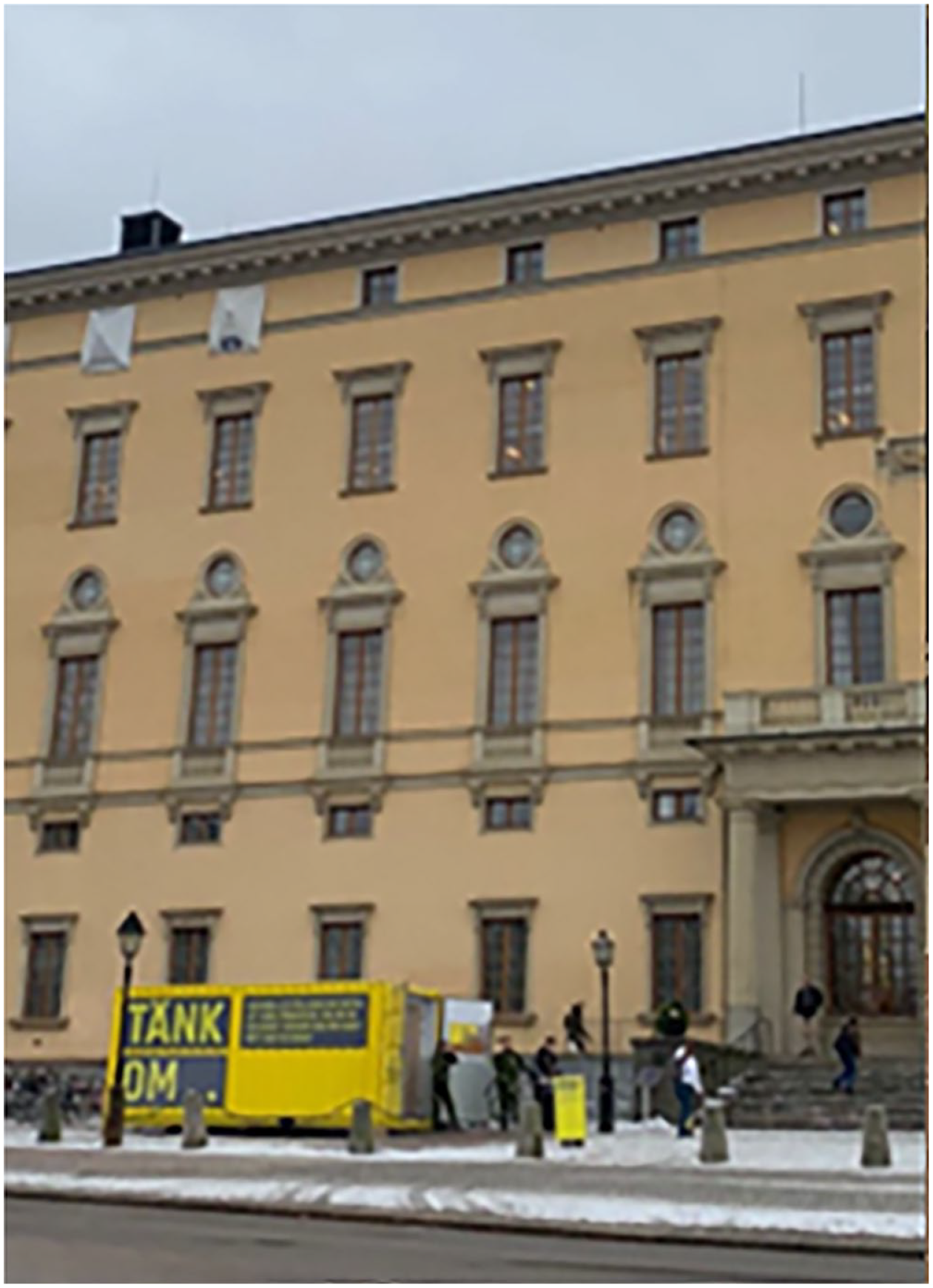
Image showing outside of library (photograph by Luise Bendfedlt 2023).
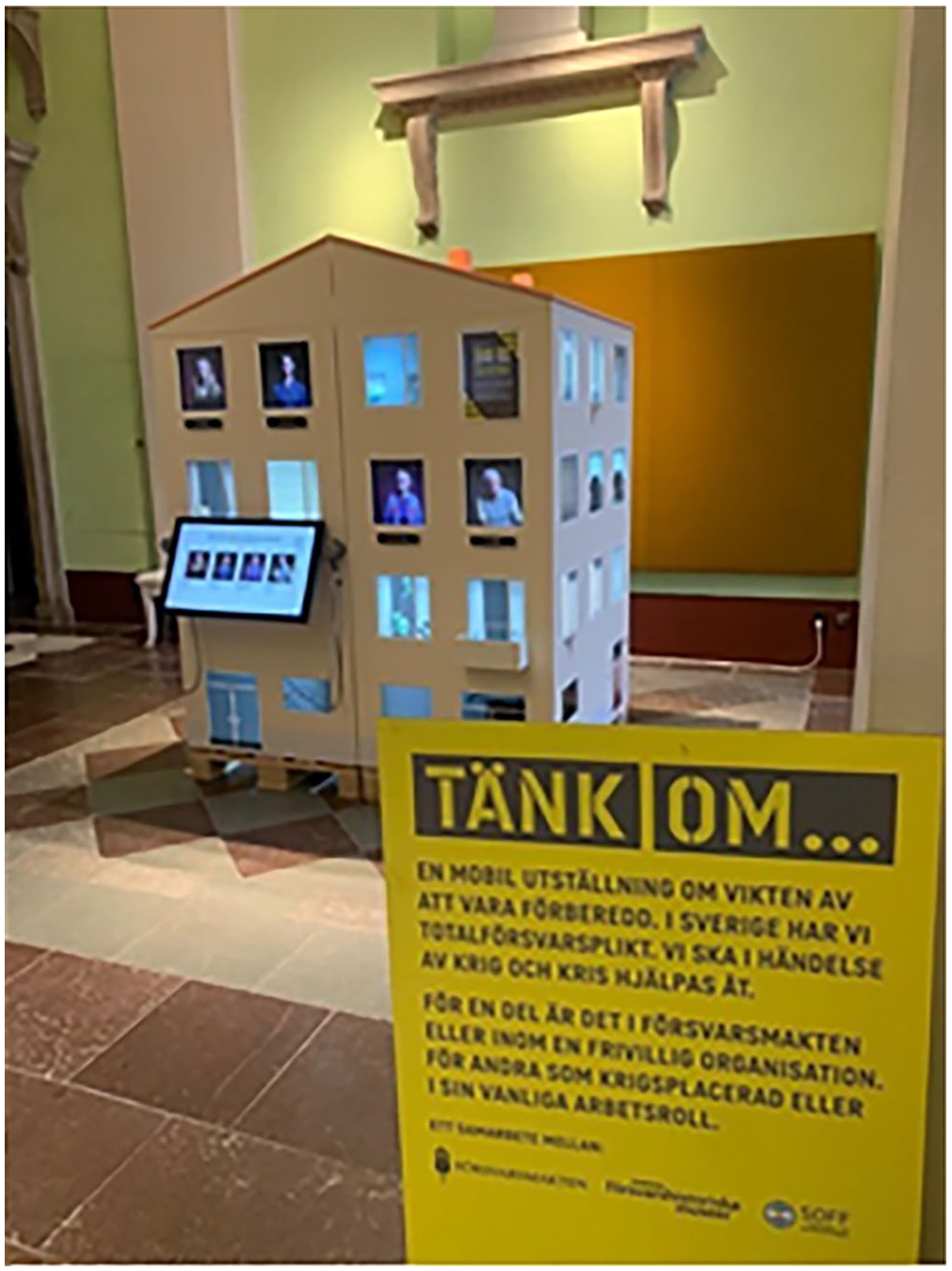
Image showing exhibition accompanying container inside of Uppsala University library (photograph by Luise Bendfeldt 2023).
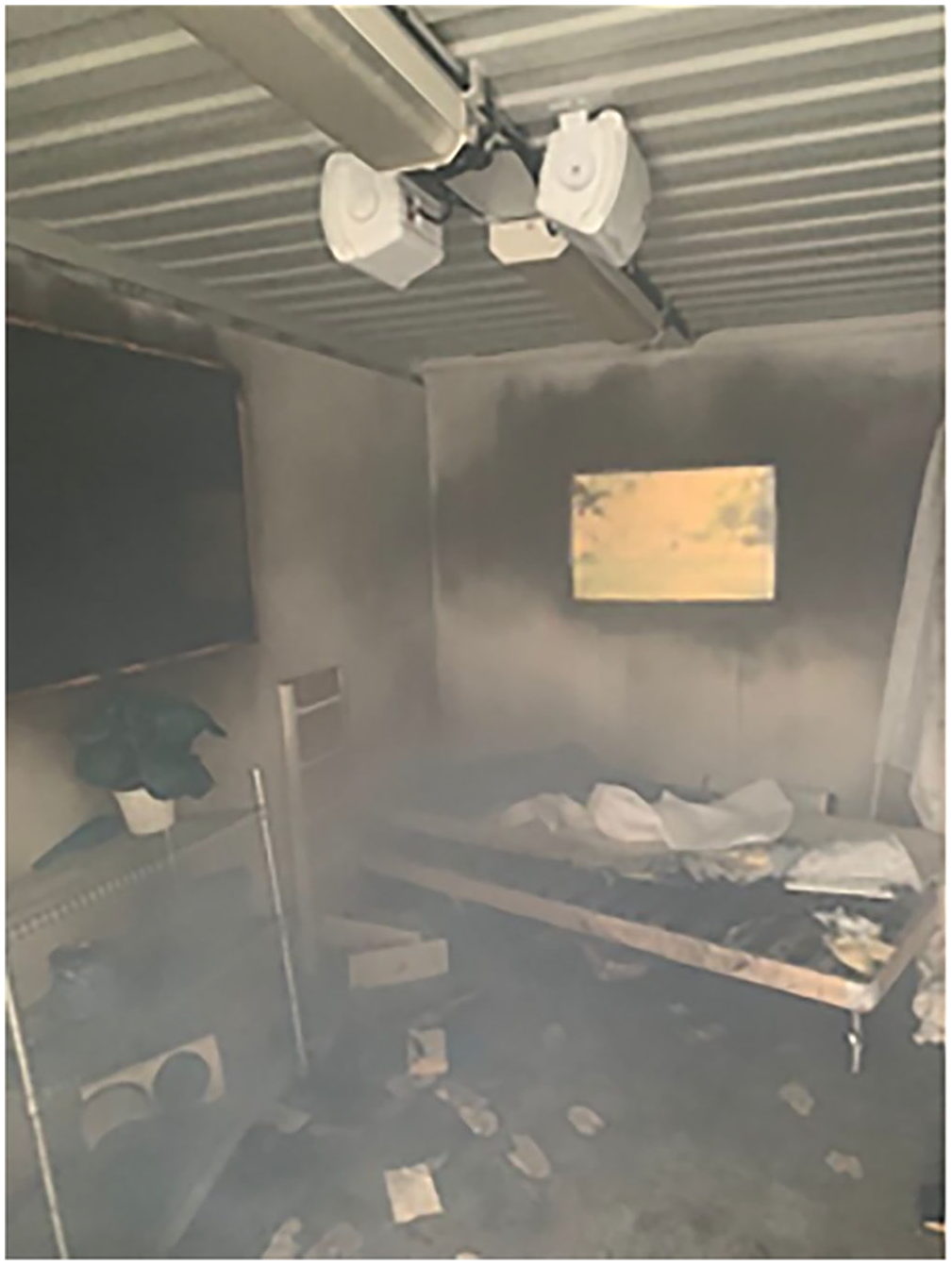
Image showing inside of container (photograph by Luise Bendfeldt 2023).
I stepped back outside into a very typical cold and rainy November afternoon and was asked to reflect on the container by the soldier that had accompanied me inside it. While it was an evocative experience, it did not so much scare me into war preparedness – which is arguably the objective. Rather, it felt distinctly uncanny (Kamal Pasha, 2011) to ‘experience’ this imaginary of war against the backdrop of the ongoing genocide in Palestine and the horrors of the full-scale Russian invasion of Ukraine. Any reconstruction of the experience of war in which the audience is physically safe is inherently false. Such a curation of war, separate from the material and bodily harm it inflicts, also serves to further obscure the role of Swedish arms manufacturing and trade, and the violence that this creates.
Emotions, methodology and material
As introduced above, this article was born out of curiosity (Enloe, 2004, 2014). Embracing curiosity in the research process opens up possibilities. It not only provides space to notice what might have been overlooked (though the bright yellow container was hard to miss), but curiosity also means needing (to tend to) an awareness of what might be lost within the everyday (Wibben, 2020). Further, curiosity calls on us to engage with and embrace what is already out there to be seen. This is echoed by Niang’s (2024) notes on scavenging as methodology. In this, she proposes engaging with scavenging as ‘a way to find, out there in the world, the elements necessary to making sense of the world around us. Everything we need is already here’ (Niang, 2024: 56, emphasis in original). The latter in particular not only offers a critique of the presumed need to generate ‘data’, but also reminds us of the importance of engaging with the world that is (already) around us. In the context of the Tänk Om campaign, this reminder applies to how militarism is (discoverable) in the banal and everyday. To some extent, it made itself known and became visible through the bright yellow container and with that offered the opportunity to be curious, go on a scavenger hunt and interrogate manoeuvres of militarism.
The appearance of the container sparked my (LB’s) curiosity, which was then reciprocated, explored and made sense of through and with LR. As such, this article is a joint scavenging and reflection on the affective embodiment of war preparedness in Sweden. While it was LB who experienced the material firsthand, it was relayed to LR through 24 photos, 17 videos and voice notes, as well as ongoing in-person discussions, the process of sharing, relaying and re-living makes the exhibition and the container both more visible / legible and accessible. As such, we conducted a discursive narrative analysis, drawing on methods which rely on collaborative reflexivity and storytelling as meaning knowledge production practices (Arias López et al., 2023; Crawley, 2012; Eriksson Baaz and Stern, 2021). Thus, LR was an integral part of the research process when sharing her responses to not only ‘facts’ of the container and the exhibition, but to LB’s retelling of and narrative imaginary of it. It was only through discussion and shared reflections that we were together able to make sense of both the container/ exhibition, efforts of war preparedness, and the politics they are imbued with.
Through this co-production of knowledge, both LB’s and LR’s experience of the curation then becomes the focus and, in conjunction with the actual container and exhibition, constitutes the material analysed in this article. As such, this article contributes to and draws from research on museums and exhibitions as intimate and everyday sites of global politics, recognising their power as sites and interlocutors of particular (national) narratives and imaginations of the global (Åse and Wendt, 2021; Reeves, 2020; Tidy and Turner, 2020; Wegner, 2024). More so, in addition to the captured material introduced above, we use a methodology of autoethnography or so-called site-specific ethnography (Lisle, 2014), paying attention to the experience of the container and the exhibition. Thereby ‘using the self as a ‘methodological resource’’ to make sense of war preparedness (Brigg and Bleiker, 2010: 788; see also Reeves, 2018). The primary reason we utilise site-specific autoethnography in this article is because doing so allowed us to engage with the container and the exhibition as they were intended. As such, we were able to experience the politics and embodiment of emotion and affect which are so central to autoethnography (Boll, 2024; Crawley, 2012; Lisle, 2014) that were curated by this exhibition. Thus, LB’s embodied experiences of the container/ exhibition in conjunction with her and LR’s collaborative reflections of the experience instrumentalised their bodies as spaces of research and meaning making.
It should be noted here that neither of the authors are Swedish, and both spent a significant portion of our childhood and adolescence in the United Kingdom. That neither of us are Swedish or socialised as ‘Swedes’ means that the intimate experience and relations this exhibition draws on and creates (such as the Cold War) do not reflect how we were socialised to think about history and war. Rather, our experience in the British education system constructed World War I and II as the focal points of history, both obscuring the violence and horrors of British colonialism while placing the United Kingdom as an unambiguously ‘good’ and war winning nation at the centre of past, present, and future. Though Sweden did not feature in our learning of history as children, as critical military scholars we engage with this exhibition with a feminist curiosity (that is, a critical engagement with the politics of the everyday world around us (Enloe, 2004)) around the curation of war making, anxieties, and intimate collectives and are thus affected by the Tänk Om exhibition which was in part targeted to all residents of Sweden, whether or not they are Swedish nationals. Our positionalities as foreign researchers based in the Nordics mean that we simultaneously occupy both insider and outsider status. The exhibition/ container was at once aimed towards LB (as a resident of Sweden), yet not created with either of us in mind.
Engaging emotion
In line with the above and following the effort to study emotions and affect in International Relations (IR) (Åhäll, 2018; Beattie et al., 2019; Gregory and Åhäll, 2015; Hutchison and Bleiker, 2014), we consider the role of emotions in the processes of nation-building and attendant narratives. In particular, we ask how fear and anxiety are instrumentalised within the war preparedness effort through the Tänk Om campaign. War preparedness, and particularly the instrumentalisation of fear and anxiety in pursuit of it, does not fit neatly in either the civilian or the military space. Instead, the everydayness and banality of this exhibition is liminal (Mälksoo, 2018); it exists between war and peace, home and away, to ensure that preparedness and martial logics permeate every aspect of Swedish life.
The container in particular relies on shocking / shaking civilians into taking war preparedness seriously, by offering the chance to ‘experience war’ for a couple of minutes – or rather a certain imagination of war / crisis. As such, the experience in the container, the exhibition and the analysis of them cannot be removed from the emotions the campaign (is meant to) provoke(s). The container thus functions as a mechanism to create what Berlant (1997) terms ‘intimate collectives’. Through the ‘war experience’ and the emotions it evokes (primarily fear and anxiety), anyone, but in particular Swedish civilians, is made part of an intimate collective. Emotions are relational (Ahmed, 2014: 8), pushing or pulling bodies together and apart. The container intends to curate a sense of a threatening Other (war and actors associated with it) that then pushes those threatened together, forming an intimate collective that relies on and confirms anxieties, militarism, and war preparedness.However, as described in LB’s retelling of her experience of the container/ exhibition, this is not always the case. Instead of creating a sense of anxiety spurring one into action, the container can also produce resentment, scepticism and frustration among audience members who are resistant to martial politics.
Affective preparedness and war coming home
Martial politics, militarism and war preparedness
Conventional understandings of war largely rest upon the assumption that war is exceptional; that it is other than and separate from ‘normal politics’ (Ciutǎ, 2009). This is based on martial politics, that is, ‘the normalization of statist war as a form of “common sense”’ (Millar, 2021: 3) which legitimises and justifies certain kinds of (state) violence while delegitimising others. This thus creates colonial and gendered power hierarchies that promote the socio-politically legitimised military violence of Western state actors (Butler, 2009; Johnson, 2017; Millar and Tidy, 2017). Martial politics in turn underpins militarism, which is the process through which martial (or state) violence leaks outside of its socio-politically legitimised containers of policing and the military to inhabit and shape seemingly non-military aspects of civilian life such as food (Dowler, 2012), sport (Åhäll, 2016; Butterworth, 2017) and fashion (Enloe, 2000; Ómarsdóttir, 2024; Shepherd, 2018).
Building on martial politics and the militarism of civilian life, war preparedness is the specific militarisation of society in the pursuit of the defence of territorial borders. As such, there is a finality to war preparedness that is lacking in militarisation. There is a defined end goal of being prepared for when war inevitably ‘comes’ and it is thus narrated as something which is both urgent and unavoidable (Millar and Tidy, 2017: 142). War preparedness is thus cyclical praxis; it is a way in which martial politics come into being and reproduces itself (McIntosh, 2020: 543). The more societies prepare for war, the more ‘real’ and material war becomes, and thus the greater the need to prepare for war.
Preparedness in the Swedish context
In contrast to larger military powers such as the United States, the USSR (and later Russia), and the United Kingdom who sought military and political expansion in the decades following the World War II, Sweden instead pursued a path of neutrality (Åse and Wendt, 2019; Åhäll, 2018; Stern and Strand, 2022). In practice, this meant two things. First, that Sweden was independent of military alliances until its 2024 accession to NATO (along with formally neutral Finland). Second, Sweden followed other small states who prioritised independence such as Switzerland in maintaining their position through the establishment of a credible defence. This defence was intended to be a ‘war deterrent’ and ‘to have the ability to defend Sweden against an armed attack and safeguard our security, freedom, independence and freedom of action’ (Regeringskansliet, 2024). Put another way, independence was established and secured through the promise of a strong military and civil defence of territorial borders (Regeringskansliet, 2024). In the case of Sweden, this resulted in the policy of total defence.
Total defence requires ‘all encompassing military preparedness’ (Åse and Wendt, 2022: 226) through all levels of society. In practice, this means that different institutions, both military and civilian, are expected to work together on issues of total defence (Ericson et al., 2023; Larsson, 2021). Total defence is not only an issue for the armed forces but is a collaborative policy in which civilians and civilian agencies also have responsibility for Swedish defence. As such, those living in Sweden are expected to be prepared and thereby contribute to the nation’s preparedness in ways other than simply joining the military. Civilians are encouraged to engage in preparedness efforts by joining voluntary organisations, completing a CPR course or donating blood (MSB, 2024: 6). Total defence combines two elements which are both reliant on civilian engagement in defence efforts thus the purpose of preparedness campaigns is not necessarily military recruitment, per se. First, from the perspective of the state, such a set up utilises all civilian bodies, not only those of military age. Second, from a civilian stand point, it offers an opportunity to be involved in preparedness and defence, and thus providing the opportunity for agency and responsibility to non-military personnel.
The civilian experience is central to the exhibition outlined earlier in this article, particularly in relation to the timeline of past events and crises. This timeline begins in 1964 where ‘the Cold War is at its coldest, and Sweden’s readiness is at its highest’ (photo 2023) and takes the audience through a number of events that impacted Swedish civilians, including the 2004 Tsunami in Indonesia. However, crises and the need for preparedness are not contained to past events. Within Sweden, crisis is firmly grounded in the present, as demonstrated by the preparedness pamphlets titled ‘Om krisen eller kriget kommer’ (translation: if crisis or war comes) which were distributed to every Swedish home in November 2024 (MSB, 2024). This pamphlet provides information to civilians on how to prepare for war or crisis, including 5 pages of checklists related to storage of food and water, preparing for evacuation, finding a nearby civil defence shelter, and how to build a makeshift toilet (MSB, 2024: 15–20). These instructions are accompanied by cartoons of children and families preparing their homes.
Returning home
A particular focus of both the container and the exhibition was the idea of war ‘coming home’. ‘War coming home’ implies that someone else is bringing war to Sweden, without much active involvement from Sweden. Both ‘coming’ as a verb and ‘home’ as a noun are evocative of action and affect which feminists in particular have paid attention to. Within the context of militarisation and ‘war’, the home serves several key functions as explained by Hedström (2022). She argues that conscription removes soldiers away from the home, and they are then expected to defend the home through war fighting and training. Here, the notion of ‘home’ represents both the family home as well as the home nation. After their service, these soldiers then return to their homes to reproduce said nation (Hedström, 2022: 67). This structure, however, produces the ‘home’ as something that remains the same upon the soldier’s return, thereby upholding the distinction and separation between war and the home. War takes place elsewhere while the home remains untouched by war, waiting to welcome the returning soldier.
Thus, ‘coming home’ implies ‘returning’, and the theme of ‘return’ is well researched in literature on memorialisation (Driessen, 2021; Edkins, 2003) and migration studies (Ahmed and Fortier, 2003; Norum, 2018). There, ‘return’ has been found to evoke feelings of nostalgia to a time pre-war as well as indicating that war is now ‘done’ and the home will go back to ‘normal’. In Sweden, it is the memory of the Cold War that (continues to) shape(s) thinking about war and the role of the home within it (Stern and Strand, 2022; Wendt, 2023). The notion of war coming home, prevalent in Sweden’s Cold War sentiment, has again become increasingly common in Sweden, with a renewed focus on securing the ‘Swedish Self’ and achieving ‘total defence’ (Strand and Kehl, 2019: 296, see also Strand, 2023).
While militarist violence may be exceptionalised in IR (Andrä, 2022), feminist scholars make clear that violence exists on a continuum (Cockburn, 2004; True, 2020; Wibben, 2020). As True (2020) and others demonstrated, the violence of war is not separable from other (colonial and patriarchal) violence(s) (Barkawi, 2017; Cockburn, 2004; Wibben, 2020) and as such, scholars highlighting the everyday, mundane, and banal violences which expand through increased militarism is essential (Väyrynen, 2019). It is within these everyday expressions of violence that we are able to see and trace militarism and the preparation for martial violence, as well as the process of depoliticising such preparations through promises of peace (Wegner, 2024). In Sweden, there has been intense (depoliticised) militarisation, building upon the notion that preparedness is essential ‘if war comes’. As Cronqvist (2012: 191) highlights, the phrase ‘if war comes’ was ‘constantly repeated in the daily lives of Swedish citizens [. . .] generating a militarization of everyday life’. The passive nature of this phrase in turn decouples militarisation from the process of war-making.
Others have also focused in on the embodied nature of violence and war, understanding both war and war preparedness as experience (Sylvester, 2013). Feminist Security Studies is particularly attentive to the affective dimension of militarisation and war preparedness (Chisholm and Ketola, 2020; Welland, 2021), and the ways in which fear and anxiety of war are channelled into feelings of national and family pride through the process of militarisation (Åhäll, 2016; Tidy, 2015). War preparedness is a process which is necessarily embodied and deeply affective, relying on the populus to take internalise securitised narratives that ‘war is coming’ and engage in the slippage between civilian and soldier (Ahmed, 2014: 65; Hutchison and Bleiker, 2014; Gorton, 2007). Sweden’s ‘total defence’ relies on the citizen-soldier being always prepared to protect Swedish security through the (gendered) ideal of the heroic civilian (Larsson, 2021; see also Sasson-Levy, 2002; Stern and Strand, 2022; Strand and Kehl, 2019).
Such notions of preparedness, anxiety, heroism, and even war and peace, are not inherently given but rather are socially and politically curated (Millar and Tidy, 2017). As such, militarisation is a curated ‘dance’ (Åhäll, 2016) where everything from the instruments of war, and the care work needed to support it, and the process of heightening war anxieties and preparedness are politically produced (Åhäll, 2016; Butler, 2020; Tidy, 2019). In this article, we focus on the curation of war and military preparedness within the Tänk Om exhibition. The curation of war in museums is a topic feminists have paid close attention to (Poets, 2020; Reeves, 2018, 2020; Reeves and Heath-Kelly, 2020; Tidy and Turner, 2020) arguing that war and violence are curated in a way which at once depoliticises war, and in particular its gendering and racialisation, while at the same time reinforcing the notion that war is necessary for peace (Howell, 2018; Wendt, 2023; Wegner, 2023, 2024; Wibben et al., 2019). Building on this work, we understand the exhibition as a curated site of war preparedness and militarisation which in turn seeks to curate a sense of anxiety in the Swedish populus to motivate / ignite a form a war preparedness. Further, it suggests an inclination that the state may not be able to provide protection to its citizens, but rather, it is the citizen’s turn to protect the state.
Curation of and through the container: anxiety, embodiment, home
Curation of the container and exhibition
The Tänk Om exhibition is a piece of interactive art which has been carefully curated. What is being curated, however, is a sense of anticipation and insecurity, a feeling of anxiety within those attending the exhibition. This curation of anticipation and anxiety happens in two distinct yet inter-related moves: evoking past insecurities through the exhibition and the container which then in turn broadens the experience to create anxiety about the present.
First, the combination of the exhibition and the container itself creates a sense of anticipation. This anticipation is heightened by the design of the container and the hidden nature of its contents from the outside observer; the outside being non-descript, eye catchingly bright yellow. Incidentally, the yellow of the container is the same shade used in Sweden’s recently distributed war preparedness pamphlet. In addition, before entering the container, and experiencing the show, the soldiers stationed outside of it ask some health- and safety-related questions, such as whether or not one is sensitive to flashing lights. Through this discussion, the anticipation of what is to happen inside the container is increased, as the soldiers do not give anything away – yet, their questions convey a sense of seriousness. Once inside the container, experiencing the show, this anticipation is converted into a very directed expectation, which is to say that the type of war (evoked through the specific noises and smoke) is reminiscent of scenes familiar from Hollywood productions and depictions of war.
The anticipation experienced in relation to the container is evoked and contextualised through the exhibition inside the library. Here, explorations of past moments in Sweden’s history, where the nation faced turmoil and anxiety associated with specific wars and crises. As discussed above, the exhibition included a timeline which explicitly invoked temporal markers, such as the height of the Cold War (1964), the tsunami in Sumatra in 2004, or the Russian annexation of Crimea in 2014. They act as reminders of a ‘violent past’ – and the feelings associated with these events: uncertainty, helplessness, fear. The invocation of such feelings for the basis of the suggestion that they may once again become reality – emphasised by a part of the exhibition that explicitly asks attendees to consider what their role will be if war comes home. As such, the audience members are not simply neutral observers of a self-contained exhibition, but are written into the story being told.
The decisions and futures of the audience make them part of the preparedness story which is central to the exhibition. Their civilian bodies are thus co-opted and militarised through the creation of affective anticipation and anxieties as the exhibition, funded and supported by the state, insists they must be prepared for war and to take on the mantle of protection. In this way, attendees co-curate the space of the container through their embodied experiences, responses, and own (future) preparedness. This affective experience lives beyond the exhibition and container themselves. It is designed in a way that it stays with the audience – the curation of both the container and the exhibition are designed to influence the audience and their behaviour long after first encountering it. Presumably, the ultimate outcome is for the anxiety and fear of material and imminent harm to convert into a desire to be prepared, affecting individual audience members’ everyday lives and choices. This is demonstrated by the very title of the exhibition ‘what if’ war comes?
Just as the container is a curated exhibition, it in turn creates and curates a specific form of insecurity. The inside of the container (Image 3) is designed to look like a Swedish student’s bedroom after an explosion, presumably from a bomb or grenade. This explosion is in turn reiterated through the show, in which the loud noises and smoke within the bombed student room created a sense of disorientation. The sensations and materiality of ‘war’ here are overwhelming; the container becomes loud and smoky, rendering attendees dazed by the ‘reality’ of war. Yet, this ‘reality’ is accompanied by a distinct sense of unreality and falseness. Within the container, there was no blood, no bodies/ body parts, no sounds of living beings crying out in pain or distress. The walls appeared charred and the room was messy, but there was no damage to the structure or to windows, raising the question of which kind of weapon could actually create this level of damage: damaging enough to instil fear, but safe enough to ensure the room remained recognisable and familiar. Thus, while the show evoked war beyond the walls of the container, as if it was happening outside, it was also contained in a very specific way – safe, elsewhere, bodiless.
The above two moves are themselves co-constitutive. The curation of anxiety within and through the container, and the curation of preparedness through a sense of anticipation and anxiety feed each other. There is also a curation of a very specific kind of preparedness for a specific kind of crisis (conventional inter-state war). Millar and Tidy (2017) demonstrate how the category of ‘combat’ is socially and politically produced, and we argue here that the imaginary of the war this exhibition seeks preparedness for is a particular curation of an imaginary of war (there are for example no mentions of trenches, nor drones or nuclear weapons; in fact, weapons of war are neither mentioned nor shown).
Embodiment and the container
While we outline above the ways in which the container and exhibition are bodiless, the show itself, and indeed the overall experience, are still deeply, and intentionally, embodied. That is to say, they are affective and embodied experiences, where anxieties are created through both the exhibition and the body. The distinction we make is that the bodies themselves are notably absent, meaning that the exhibition and experience are both deeply affective yet also bodiless. In this section, we tease out this tension and focus in particular on the embodied and affected experience while highlighting where bodies remain missing.
War is experienced by and through the body (Dyvik, 2016; Sylvester, 2012, 2013), and is thus deeply affective. War both produces and is productive of bodies in many different ways. This includes instrumentalising bodies as weapons (Wilcox, 2014), justifying war through the blood and tears of injured civilians (Dyvik, 2016), and measuring the impact and importance of war through the number of dead, missing, and injured bodies (Gregory, 2022; Noakes, 2020). Bodies can also expand beyond the confines of their skin (Shildrick, 1997, 2015). They leak, bleed, smell, and menstruate and thus trouble our neatly defined understandings of the carefully bounded individual (Stern and Strand, 2022). Paying attention to this messiness, and studying war and war preparedness through the body thus creates space to capture its own contradictions and messiness. This means that war shapes and impacts both the bodies of those producing it (Evans, 2022) as well as civilians living in the midst of, or preparing for defence from, war. The sterility of this exhibition/ container, however, means that the touch of war and its impact on the body is notably absent.
As described previously, the only bodies inside the container are those of the audience and the soldier accompanying them. Other bodies, such as the presumed enemy combatant bringing war to Sweden, other casualties of war, or those tending to and responding to those injured and killed, remain curiously absent. The shrinking of the embodiment of war onto an individual level (of the audience and to some extent the soldier accompanying them) reminds of and evokes the need for self-sufficiency and war preparedness. By asking ‘what will you do?’, the state absolves its responsibility onto the individual. In the experience, we do not see soldiers fighting wars and defending themselves and the state. Instead, it is the lone individual, and a single soldier (presumably accompanying the audience for health and safety reasons) who experience ‘war’ alone.
The violence so central to the experience, and war in general, is also bodiless. The idea that war is coming is repeated throughout the show and the exhibition, yet who is bringing or creating this war remains unnamed. In line with Sweden’s total defence policy which frames inter-state war as an external threat, and something which may be ‘brought home’ by foreign state adversaries, one presumes that the war outlined in this experience is an interstate war fought with conventional weapons. The adversaries, however, are unnamed.
War is also framed here as something fully formed. War arrives, or is brought, and the responsible citizen must be prepared to protect and defend themselves and the state. Here, war appears as a black box, rather than a process. Despite the container/ exhibition being funded in part by the Swedish Security and Defence Association (i.e. arms manufacturers), there is no mention of weapons of war, how and where they are produced and distributed, nor of military training, geopolitical strategy, or other factors which produce war into being. As Kimberley Hutchings (2017: 186) points out, however, this is not the case. War is a process, a matrix of violence which is socio-politically, and also materially, produced. Weapons of war are produced, sanctioned, sold and taxed by multinational businesses and state governments, and it is these weapons which, in part, create war as outlined in this experience. Sweden is one of the largest arms manufacturers and exporters per-capita in the world (Coetzee and Berndtsson, 2023; SIPRI, 2025). Thus, there is an explicitly political motive in the framing of war as a fully formed thing, without any indication of Sweden’s potential role in producing such war and making it possible. This also obscures the role of militarisation and war preparedness in the production of ‘war’ itself, and the continuums of violence on which war rests. Thus, war appears as an inevitable force that Swedes must be prepared for, but notions of avoiding or averting war (peace research, non-military means) are absent.
As highlighted in the previous section, the material impact of war on the body is not shown. Injured, dead and missing bodies are nowhere to be seen. Rather, the material destruction of war is demonstrated through the impact of explosives on the home, more specifically a student’s home.There is also no mention of other types of violences that we know occur and increase within the contexts of armed conflict, such as destruction of environments, restriction of freedoms and liberties or sexual violence, gendered violence and rape. Again, the body is notably absent not only from the aftermath of war, but from the actual instances of violence. Upon entering the container, one is confronted with the aftermath of an explosion, not the explosion itself. This is in part because were one to actually experience the impact of the explosion in the bedroom that is displayed, they would presumably be killed. It is also, though, because the experience is designed to curate a specific level of anxiety and encourage preparation for war, not to accurately reflect the devastating realities of warfare which may encourage opposition to, rather than preparation for, organised armed conflict.
In sum, the relationship between war and the body is carefully and politically curated. While bodies are notably absent and the war that could come is disembodied, the exhibition is simultaneously and deliberately affective and relies on those experiencing the container to be affected by it, through experiences of sound, sight, touch. There is here a curated balance where the audience is at once being reminded of the severity of being found unprepared if war comes home, yet also reassured by the absence of death and bodily harm.
If war comes home
The notion of home is central to the exhibition and experience. Within the exhibition, home is demonstrated through a model of a large apartment block with intergenerational residents, common in Swedish cities. Despite its glaring yellow exterior, the inside of the container has been designed to look like a traditional student’s bedroom in Sweden, complete with IKEA-style furniture and a single bed. Thus, there are two recognisable and familiar kinds of home presented here; student housing for young people, and an apartment for non-students, both are homes and living arrangements which are very common within Swedish cities.
The placement of the exhibition and container on a university campus, and the design of the inside of the container to look like a student’s bedroom are also interesting here. The post-bomb blast student room invokes an uncomfortably juxtaposition for both students and non-students on campus. For students, it emphasises and makes clear the idea that were war to come to Sweden, they could be implicated and at risk. University, for many young people, encapsulates a time of freedom and future possibilities, of fun, growth and self-realisation. In Sweden, however, 18 is also the age at which young people of all genders must complete a military enlistment form, following which you may be called up to mandatory military or civilian service. As such, the home of a student, or rather the home at university, represents a particular crossroads between freedom and discipline. By designing the student bedroom as the site of the ‘explosion’, this experience curates the student home, already marred by upheaval, temporariness and uncertain futures, as not only impermanent, but fundamentally at risk. The innocence of youth is placed in stark contrast to the violence of warfare, for which we all must prepare.
In addition to the student’s room inside the container, another form of home is central to the Tänk Om exhibition. Inside the library, the exhibition consists of a replica of a multi-occupancy dwelling, with several neighbours living in flats. As such, the audience can engage with a number of neighbours – of different generations and with different experiences of war. They can consult these neighbours to inform their own (potential) activities in case of war, how to prepare for it and how to contribute to the war (preparedness) effort. The sense of the multi-occupancy dwelling, of people from different families living together in the same apartment block, is reflective of and reflected by the subtitle of this initiative: tillsammans i krig och fred (together in war and peace). It is the sentiment of everyone contributing, being in it together, sharing experiences, that motivates and perpetuates the urgency of war preparedness in the context of total defence. Not only does it involve everyone, or rather everyone can take part, but it also relies on everyone contributing to the war (preparedness) effort.
The invocation of the Swedish home is deliberate. It is demonstrative of the fact that the Swedish home, and by extension the Swedish nation-state more widely, is socio-politically constituted and narrated as a safe place, or a sanctuary. Sweden’s previous history as a ‘neutral’ state within international politics has allowed the Swedish state to frame warfare as something external, existing in time and space far away from the safety of the Swedish home. However, in line with the overarching aim of war preparedness, this exhibition centres and has been curated around the notion of the home – precisely to remind the audience that war can come home. And in fact, the Swedish home is not as safe as it might appear to be. To protect this home, and by extension the Swedish nation-state, the audience and wider Swedish populations are instructed to take war and war preparedness seriously. This invocation of the possibility of the unsafe home is effective due to the notion of folkhemmet. 4 Cronqvist (2012) demonstrates that the idea of the Swedish nation-state is reliant upon constructions of the state as a being made up of homes rather than families (see also Trägårdh, 1997). As such, by centring ‘the home’ in both parts of the exhibition, anxieties and fears around Sweden not being safe are exacerbated.
Conclusion
This article has introduced the Tänk Om campaign as a way to unravel war preparedness and the curation of anxiety in the everyday in Sweden. Through an account of LB’s interaction and experience with the container and the exhibition, we have argued that the Tänk Om campaign is demonstrative of the curation of both warfare and military preparedness in Sweden which seeks to frame the threat of ‘war coming home’ as likely, immediate, and the responsibility of all Swedes to respond to, while simultaneously disguising the role of arms manufacturers in Sweden exporting weapons of war.
This exhibition is a microcosm of a wider trend across the Nordics and beyond to reframe the militarisation of societies and the co-option of civilian life by the state as acts of peace and preservation. Indeed, when we presented a draft of this article at a peace studies conference, we were asked if this preparedness could not be better understood as everyday peace rather than militarisation. However, doing so ignores the martial logics and politics at the heart of the container/ exhibition specifically and defence through war preparedness in general. We argue that the co-option of civilian life by the militarised state, demonstrated here through a site-specific autoethnographical encounter with the container/ exhibition is indicative of a growing acceptance of ‘warism’ (Cady, 2020); the notion that war is both inevitable and inescapable and that an imagined future is possible only through ‘defensive’ war preparedness and war making.
The case study presented in this article is but one of a myriad of war preparedness outreach efforts across the Nordic states. In order to fully understand the intricate logics and moves undertaken in the pursuit of ‘defence’ through preparedness, Feminist Security Studies must continue to pay close attention to the intimate, everyday curation of war. While doing so is increasingly difficult within an ever more militarised academic and political climate, it is crucial that we continue to recognise, trace and unpack the ways in which civilian life is co-opted in pursuit of martial peace.
Footnotes
Acknowledgements
We are grateful to Jana Tabak for her detailed comments on and enthusiasm for this article, as well as colleagues at the TAPRI seminar, and in particular Élise Féron, who gave in-depth and insightful feedback on an early draft of this article. Thanks also, as ever, to Emily Clifford and Hannah Richards.

Funding
The author(s) received no financial support for the research, authorship and/or publication of this article.
Declaration of conflicting interests
The author(s) declared no potential conflicts of interest with respect to the research, authorship and/or publication of this article.
1
All Swedish to English translations provided by Luise Bendfeldt.
2
We submitted a Freedom of Information request to all parties involved requesting a breakdown of costs and contributions to the container/ exhibition in August 2024. As of July 2025, we are yet to receive a response.
3
All written materials in the exhibition were in both Swedish and English. While audio was available only in Swedish, it had the option of English subtitles.
4
Folkhemmet literally translates to ‘people-home', but has implications closer to ‘the people’, as in ‘we the people’ or ‘the will of the people’ in US and UK contexts. Contextually, folkhemmet is similar to the German Volk