




Abstract
The narrative concept has gained significant traction in International Relations (IR), yet its expanding scope has raised concerns regarding conceptual ambiguity. This article provides an overview of the narrative literature in IR, categorising it into two dominant streams: agency-centric and structure-centric approaches aiming to provide clearer orientation for newcomers to the rising research agenda. While agency-centric perspectives focus on how actors construct and deploy narratives to shape political outcomes, the structure-centric approaches emphasise the broader discursive and institutional contexts that influence narrative formation and reception. Through a systematic literature review, this article highlights the need for further theorisation of the interaction between these two perspectives. As one of the possible ways forward, it suggests adopting a historical or longitudinal perspective to better understand how narratives evolve over time, capturing both their continuity and transformation within international politics.
Introduction
In recent years, a growing body of International Relations (IR) scholarship has engaged with the concept of narratives. Narratives are seen as a natural form of human communication. They help make sense of political realities, shape collective identities and structure an outlook on future actions. While the concept has gained traction within the so-called narrative turn in IR (e.g. Czarniawska, 2004) and undergone significant theoretical development, it has become ubiquitous in scholarly literature and popular discourse. As Spector-Mersel (2010) argued, such widespread adoption has blurred the boundaries of the field to the point where the common core of narrative inquiry is in question. Within the variety of narrative research in IR, there is a lack of common definitions, conceptual understanding or consensus on the methods best suited for narrative research within the discipline. For example, narratives are seen as forms of organising discourse or a type of discourse (Oppermann and Spencer, 2022; Patterson and Monroe, 1998), culture-defining tales (Reeves, 2004), cognitive schemes (Fischer, 2003), modes of knowing (Clandinin and Rosiek, 2019) or practices (De Fina and Georgakopoulou, 2008), modes of public expression (Krebs, 2015) and explanation (Spector-Mersel, 2010). Furthermore, narratives can have different roles within IR research, serving as a lens for analysing social reality, analytical tools, or data (Graef et al., 2020).
For illustration, the narrative of China’s rise as a geopolitical threat can be studied in multiple ways. It can be examined as a mode of public expression, analysing how political leaders and media articulate concerns about China’s growing influence to shape public opinion and policy debates. Alternatively, it may be viewed as a culture-defining tale, reinforcing Western identity by contrasting democratic values with an authoritarian challenger. From a cognitive perspective, the ‘China threat’ narrative could be understood as a mental framework that shapes how policymakers and the public perceive China’s global influence, potentially limiting alternative interpretations. It might also function as a mode of explanation, where scholars investigate whether this narrative accurately reflects China’s foreign policy behaviour or is shaped by deeper anxieties about shifting global power dynamics. Moreover, the ‘China threat’ narrative itself can be treated as data, with researchers analysing speeches, policy documents and media coverage to trace how the narrative evolves and influences IR.
The expanding use of narratives in IR research has sparked debates over conceptual clarity and methodological consistency. Some scholars suggest a more precise separation of narratives and other concepts, such as framing or discourse and call for increased clarity within IR (Shepherd, 2015; e.g. Colley, 2017). Moreover, given the growth of narrative approaches to IR, readers may struggle to navigate the diverse body of research, as existing review articles remain sporadic and often thematically focused (Sadriu, 2021; e.g. Gang, 2022).
Hence, this article argues that systematic categorisation of narrative research can help address these challenges by offering a clearer structure for scholars entering the field and facilitating a shift towards further theorisation. Reviewing the current literature, this article identifies two larger trends concerning their embeddedness in thick and thin constructivism: agency-centric and structure-centric approaches. Making this distinction explicit allows for more straightforward research positioning and provides a systematic framework for organising the expanding body of work. Furthermore, while these two strands of research have developed in parallel, their relationship remains under-theorised. By highlighting their distinction, this article offers a systematic overview of the research area while suggesting a possible avenue for further engagement with their interaction.
The article begins by tracing the development of narrative-focused IR scholarship and providing a minimal definition of a narrative. The discussion then turns to different theoretical perspectives, distinguishing between agency-centric and structure-centric perspectives on narrative research in IR. First, outlining their general differences before delving into each separately. Next, the article explores the potential to explore the interaction between the two perspectives. Finally, it moves beyond the agency-structure divide, considering ways to advance the study of narratives in IR.
Background of narrative studies within IR
Initially rooted in literary studies, narrative was traditionally a concept used in social sciences, such as sociology, anthropology and history (White, 1973; e.g. Bruner, 1986). In the 1970s, within the broader post-positivist turn and the rise of constructivist approaches to IR, narrative re-emerged within social sciences as a conceptual and methodological approach integrating insights from literary studies, narratology and cognitive sciences. Within IR, it has been gaining prominence since the 2000s, addressing questions about the role of narratives and narrativity in constructing norms, meaning, identities and power structures in world politics (e.g. Oppermann and Spencer, 2022).
The narrative approach in international politics emerges from discourse studies, which emphasise the role of language in shaping and constructing social reality rather than merely describing it (Sadriu, 2021). In IR, narratives are often viewed as a sub-type of discourse with distinct characteristics drawn from cognitive and literary studies. This research indicates that narratives are a universal form of human communication across cultures (e.g. Herman, 2017; White, 1984), making them valuable for comparative analysis. From a cognitive perspective, narratives are considered a unique mechanism through which humans construct and understand the world surrounding them (e.g. Bruner, 1986). This applies to everyday narratives and narratives about historical events or global politics. We build shared identities, histories and cultures through stories (Spector-Mersel, 2010).
A key characteristic of narratives is their ability to evoke emotions and affective responses as audiences immerse themselves and identify with characters more easily (Green and Brock, 2000). For instance, exposure to war narratives has been shown to elicit responses that align with the narrative framing (Crilley and Chatterje-Doody, 2020; Head, 2020). Narratives can also reduce resistance and counterarguments by captivating audiences and diverting their focus from persuasive aims (Krause and Rucker, 2020). In addition, narratives are seen as more memorable than facts, as they link to pre-existing knowledge (Herman, 2017), enhancing their persuasive power (Miskimmon et al., 2013).
What constitutes a narrative?
It has been previously argued that studies in IR sometimes take the concept of narrative for granted or use it interchangeably with concepts such as discourse, stories or scripts (Colley, 2017; Graef, Da Silva, Lemay-Hebert, 2020; Prochniak and Nitoiu, 2023), leading to conceptual ambiguity. Thus, before turning to specific theoretical treatments of narratives in the next part of the article, it is essential to establish a minimal definition of narrative to ensure a shared conceptual foundation. Often, scholars argue that advancing the understanding of the specific mechanisms that make narratives impactful in world politics requires attention to their structure. There is, however, considerable variation among authors regarding which elements and characteristics are essential for identifying narratives. The key characteristics are often seen as temporality and causality. The key elements include setting, characters and plot (e.g. Spencer, 2016).
Temporality is a core characteristic of narratives representing the sequence of events (Shenhav, 2015). It can be defined broadly as a chronological description of events, even as short as one sentence (Abbott, 2008). Temporality helps distinguish narratives from other written and spoken communication, such as laws, statistics, reports or lists (Riessman, 2008; Shenhav, 2015). Some see the temporal ordering of narratives as an analytical characteristic differentiating them from discourse or ideas, enabling certain common understandings of the past, present, and future (Considine, 2022). This allows narratives to, for example, construct national identities or shape perceptions of social continuity or change. Causality is then understood as the relationship between the temporally ordered events (Krebs, 2015). For example, narratives of national progress could link past struggles to future prosperity, creating a sense of causal continuity.
Narrative elements often involve characters enacting a specific plot within a defined setting (e.g. Mandler, 2014; Spencer, 2016). The setting establishes the context in which the narrative unfolds. Characters then serve as the primary drivers of the narrative, propelling the story forward. The emplotment interlaces the events and prompts the story towards a resolution (Lambach and Oppermann, 2023). For instance, narratives of the Cold War could cast the United States and the USSR as the main characters, set within a bipolar international system striving for victory in an ideological struggle. According to several authors, this is considered a minimal definition that is helpful for analytical purposes as it offers a relatively straightforward framework for narrative analysis (Colley, 2017; Shenhav, 2006; Spencer, 2016). Others suggest including further elements, such as events, time and space (Miskimmon et al., 2013). However, not all narratives will have all the elements in practice. Thus, the minimalistic definition offers a useful starting point for analysing narratives while providing a basis for establishing a common framework to compare different theoretical perspectives within this article.
Agency-centric and structure-centric approaches to narratives in IR
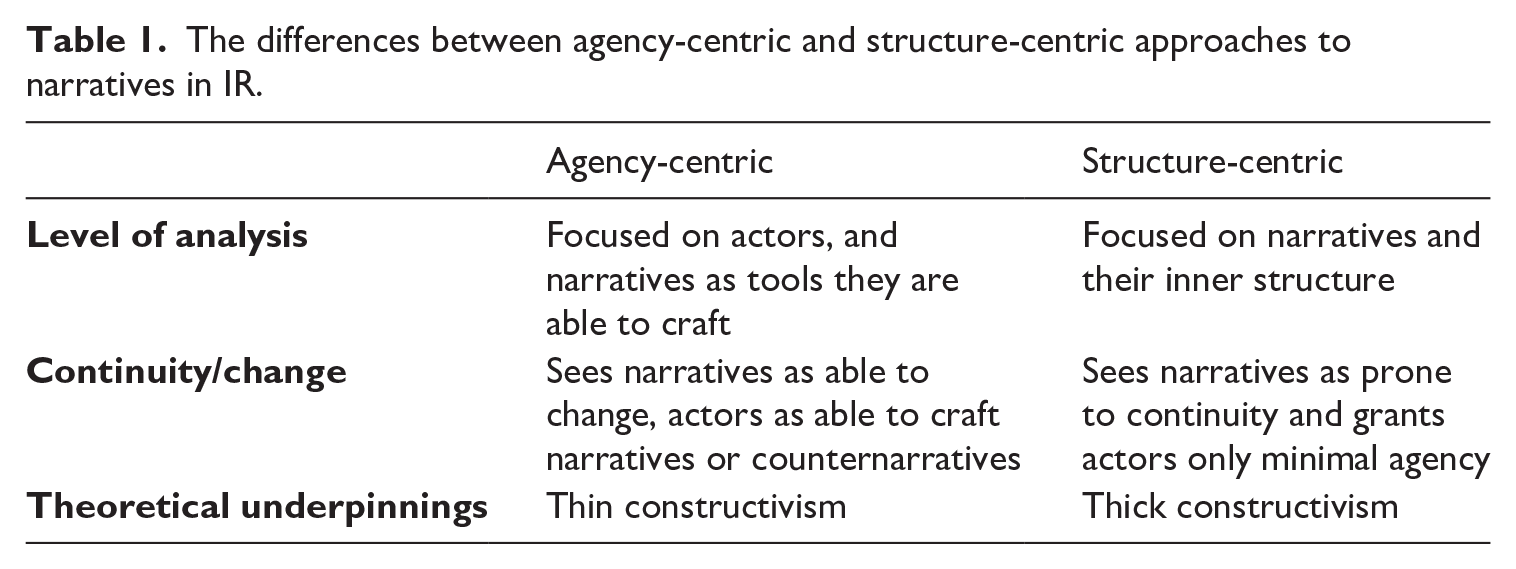
In addition to the definitional and methodological diversity in narrative research, there is a fundamental theoretical distinction underlying narrative approaches in IR. Following Holzscheiter’s (2014) differentiation within discourse studies literature, this article identifies two broad research streams within contemporary IR literature engaging with narratives. They align with thin and thick constructivism in IR. Thick constructivism views language as a constitutive element of reality, creating intersubjectively shared social worlds (Kratochwil, 2015). In contrast, thin constructivism allows social facts to exist independently of discourse, treating language as among many social logics (Wendt, 1999). This division underscores that while narratives are crucial for understanding social and political life, their impact can vary depending on whether they are seen as foundational or significant facets of social interaction. For this article, they are characterised as Agency-centric and Structure-centric approaches. This differentiation helps to illustrate that while both strands focus on similar issues, such as narrative dominance, narrative power or function, they draw on constructivist and post-structuralist ontology and epistemology. However, they focus on different levels of analysis and have a diverging relationship to the agency-structure debate within the discipline.
The agency-centric approaches are embedded in thin constructivism and posit that social facts can exist independently outside discursive practices, and thus, narratives are perceived as tools that narrators can craft, more or less, freely (Roselle, 2017; e.g. Colley and van Noort, 2022); therefore, actors have more agency in the international system. Rooted in thick constructivism, structure-centric approaches view language as constitutive of reality and narratives as organising principles that actors cannot change or manipulate at will (e.g. Lambach and Oppermann, 2023; Spencer, 2016). They generally prioritise the structure of international politics over actors. This distinction influences how each stream conceptualises narrative power, causality and the balance between continuity and change in global politics.
Within the current literature, the two streams have been referred to as thick or thin positions on the spectrum of persuasion (Miskimmon et al., 2013), narrative or individualistic ontology (Hagström and Gustafsson, 2019), or, in discourse studies, the micro-interaction and macrostructure perspective (Holzscheiter, 2014). Furthermore, thin and thick narratives are concepts used to examine the depth of narrative description (Shenhav, 2005). For this purpose, this article refers to the streams as agency-centric and structure-centric approaches to narratives in IR. Although the two streams are not exhaustive and have been previously described as a scale rather than a typology (Miskimmon et al., 2013), this article argues that situating future research along the lines of this debate more explicitly and accepting a common terminology would increase the clarity within the width of the study.
Agency-centric approaches to narrative analysis in IR
Agency-centric approaches generally focus on communicative action, and mostly perceive the actors as rational, promoting their ideas and strategies through narration, as they understand it as an effective tool to gain power or exert influence (e.g. Hagström and Gustafsson, 2019). Empirically, they tend to examine the intentions of the narrators, the content of the narratives or the communication environment (e.g. Miskimmon et al., 2013).
Although some scholars emphasise a compelling narrative as the key to shaping the political behaviour of others in world politics (e.g. O’Shea, 2019), others argue that the ability of an actor to project a powerful narrative is not always sufficient to create a direct influence (Miskimmon et al., 2013). Regarding the question of what makes some narratives more successful than others, scholars in this stream look for explanations in mostly material factors that are closer to the rationalist understanding of IR, such as the effect of the narrators’ credibility, media ecology, access to media or narrative content or a combination of factors such as a compelling narrative together with a promise of economic gains (Colley and van Noort, 2022; Miskimmon and O’Loughlin, 2017; Shanahan et al., 2011).
Within the current literature, one of the most prominent conceptualisations of agency-centric approaches is the concept of strategic narratives, where narratives are seen as tools in international politics that actors have the agency to formulate and project intentionally (Miskimmon et al., 2013). Strategic narratives are then understood as ‘a means by which political actors attempt to construct a shared meaning of international politics' past, present, and future to shape the behaviour of domestic and international actors’ (Miskimmon et al., 2017: 6). A similar conception of the ability to use narratives to exert influence appears in (Kaldor, Martin, and Selchow, 2007) or Freedman (2006), who turns to practice to illustrate that political actors' strategic use of narratives shows how important stories are in persuasive communication.
According to Miskimmon, O’Loughlin, and Roselle (2017), strategic narratives can be influential in two main ways. They can either persuade an actor directly to a specific behaviour or shape the international system in the long term by projecting a compelling narrative which other actors reproduce. For example, portraying an actor as an enemy or a powerful ally impacts the behaviour towards such an actor, which seems possible, logical or desirable. Such narrative construction of threat, self and others can help, for example, legitimise wars (e.g. Roselle, 2017).
This conceptualisation, where actor A persuades actor B to do what they otherwise would not, allows for some degree of causality in narrative impact, which appears more often within the agency-centric approaches. Even there, the approach to causality is generally cautious, as narrative approaches in both streams explain how events are understood and constituted by specific actors rather than why those events occurred in the first place (Miskimmon et al., 2013). Such a preference for actors' agency over the structure also allows for the conceptualisation and exploration of change at the level of narratives and world policy (e.g. Colley and van Noort, 2022).
Structure-centric approaches to narrative analysis in IR
Structure-centric approaches treat narratives as embedded within broader discursive structures, limiting individual actors' ability to shape or alter them. This scholarship is more connected to narrative theory or history and mostly conceptualises narratives as a sub-type of discourse. The analysis focuses on the level of narratives rather than the narrator’s intentions (Berenskoetter, 2014; Ringmar, 2006). They often examine dominant narratives, historical narratives, and their connections to contemporary politics (Oppermann and Spencer, 2022). Structure-centric approaches tend to be more interpretative, perceive the discursive space as narratively ordered, and only grant actors minimal agency over narrative construction. Examining the narrative elements, they ask questions such as the following: How does the narrative structure influence audience perception? What role do specific aspects play in the narrative construction? (e.g. Spencer, 2016). Mostly, they see narratives as continuous structures with limited possibility to change. They argue that new narratives can emerge; however, there needs to be a degree of intertextuality between new narratives and already-established narratives (Hagström and Gustafsson, 2021; Spencer, 2016).
Intertextuality highlights that narratives in IR are not isolated entities but embedded within a broader context of texts, speeches, treaties and historical documents that continuously shape each other. It emphasises these texts' reciprocal influence and interplay, illustrating how one narrative can draw upon, respond to or reinterpret elements from others (Ringmar, 2006). These can be conceptually seen as master narratives, meta-narratives, myths or dominant discourse, depending on the author’s approach (e.g. Schmitt, 2018). This also suggests that narratives are prone to continuity rather than change. Regarding the impact of narratives and causality, structure-centric approaches explore how certain decisions were made rather than why. For example, narratives impact world politics as they construct and structure understanding of the world, self and others and thus make specific behaviour or policy decisions seem logical and possible or the opposite (Spencer, 2016). Similarly, narrative power can also be defined in terms of its internal structure based on the audience’s expectation for narrative closure. As people are socialised into stories and storytelling, they expect some sort of resolution, which in turn drives the story forward (Holland and Mathieu, 2023).
A prominent example of a structure-centric approach is the literature examining the role of narrative genres in IR. Genres are narrative frameworks or templates that shape narrative structure, style and content. There are four key narrative types: romance, tragedy, satire and comedy (e.g. Ringmar, 2006; Spencer, 2016). Findings from literary theory show that narratives are organised predictably into these four types, which also applies to narratives in world politics (Ringmar, 2006). Thus, there are expectations about how narratives should be told, not only in their content but also in the formal structure (Brassett et al., 2021; Spencer, 2016). As the specific narrative type structures people’s expectations about the resolution, it leads to different calls for action and reactions from the audience. It allows for policy choices that seem appropriate within that genre (Ringmar, 2006). For example, romantic narratives about pirates present in cultural and media discourse can also be found in political discourses, making it more challenging to link these actors to terrorism or human rights abuses. This will shape policy and public perceptions and limit possible political responses of international actors to pirates in Somalia or rebel movements in Libya (Spencer, 2016).
Mapping the differences
In addition to the comparative Table 1, I include a brief illustrative example of the Chinese narrative of the Belt and Road Initiative (BRI) with a degree of simplification. The BRI is an illustrative case for engaging with this theoretical distinction because of its inherent ambiguity and discursive flexibility. As a term, the BRI lacks a clear and consistent definition, allowing it to mean different things to different audiences. This vagueness enables actors to project narratives onto the initiative that align with their strategic interests or domestic political contexts while revealing how prior narrative structures may enable or constrain such efforts. For this reason, the BRI provides a particularly useful lens for analysing how agency-centric and structure-centric approaches conceptualise the formation, circulation and limits of narratives in international politics.
The differences between agency-centric and structure-centric approaches to narratives in IR.
The BRI narrative casts China as a modern-day revivalist of the ancient Silk Road, aiming to foster global economic connectivity through extensive infrastructure projects spanning Asia, Africa and Europe. Set within a global context of economic interdependence and shifting power dynamics, China emerges as a visionary leader seeking to drive prosperity and mutual growth. Partner states are depicted as cooperative allies benefitting from Chinese investment. The narrative links past, present and future through a storyline that moves from historical Silk Road glory to present ambition towards a promised future of interconnected economies.
In an agency-centric analysis, researchers could focus on how China, as a key actor, strategically constructs and disseminates the BRI narrative to achieve its geopolitical and economic goals. The analysis would emphasise China’s deliberate efforts to portray the BRI as a modern revival of the ancient Silk Road, aiming to build economic connectivity. This approach would explore how Chinese leaders use diplomatic speeches, state media, and cultural exchanges to craft a narrative that appeals to potential partner states, framing the BRI as a win-win opportunity for development and growth. The emphasis could be on China’s agency manipulating narrative elements, adapting its messaging to specific audiences, and overcoming potential scepticism through targeted storytelling. Furthermore, the scholars could link the narrative to policy-making or Chinese soft power, with some degree of causality.
In a structure-centric analysis of the BRI narrative, researchers would examine how the existing global and regional narrative environment shapes and constrains China’s ability to construct the BRI narratively. This perspective emphasises the influence of historical narratives. Rather than focusing solely on China’s strategic intentions, this approach explores how deeply embedded cultural narratives and historical relationships impact the reception and effectiveness of the BRI narrative. It would analyse how structural forces limit or enable China’s narrative efforts, suggesting that while China may frame the BRI positively, its success is limited or enabled by pre-existing stories and perceptions that define what is credible and acceptable in a different context. For example, such a study could focus on how the narratives of the communist past limit or enable the narratives on the BRI in post-communist countries, given the specific context.
Exploring the interaction between agency and structure
This line of differentiation does not claim that there is no overlap or middle ground between the two approaches. As Hagström and Gustafsson (2019) argue, while actors can be narratively constituted and ordered, they can still exercise power within those boundaries. Several authors aimed to bridge this gap by analysing the structural factors influencing the effectiveness of strategic narratives. Schmitt (2018) demonstrates how strategic narratives become effective by drawing on already-established societal myths. Subotić (2016) argues that in crisis, policymakers can deliberately activate and deactivate parts of established narratives to frame the events as continuous to maintain ontological security. While this strand of research advances the understanding of how narrative agency and structure interact, this relationship could be theorised further. Moreover, conclusions are not always framed in terms of this interaction, limiting insights into the dynamics at play.
For example, a similar argument connecting ontological security and narrative interaction appears in Colley and van Noort’s study of the BRI. They established a ‘buy-in framework’ when states are more likely to associate with a new foreign initiative for the first time. Examining the policy responses to the BRI, they argue that an actor is more likely to associate with the BRI if it feels able to create a strategic narrative that frames the new policy in line with the state’s ontological security (in this case, viewed as a continuation of the past) while promising material gains. They argue that while narrative reception depends on myths and narratives of different levels, actors can use them strategically for their specific policy aims, implying a degree of agency. They see the past myths and narratives as material that either is or is not available to the narrators, again making an agency-centric claim. As shown in the case of Italy, ‘the ability to narrate affiliation in a way grounded in Italian nationalist myth made policymakers feel that they could explain BRI affiliation acceptably to their target audiences’ (van Noort and Colley, 2020: 30). In the case of the United Kingdom and the Netherlands, ‘These countries can readily promote free (and fair) trade materially, but their leaders feel unable to advocate aligning formally with a country seen as undermining liberal values without undermining their ontological security’ (van Noort and Colley, 2020: 35).
Although the article acknowledges resonance between different orders of narratives, it mainly makes agency-centric claims, suggesting that some states would like to join the initiative for material reasons but feel unable to formulate a congruent strategic narrative. From a more structure-centric point of view, it could be argued that if the previous narratives on China affect the ability to create congruent narratives, the actors have, in fact, limited agency over strategic narratives. Thus, what appears as a strategic choice (agency) may result from structural constraints, as states can only ‘choose’ narratives that will not disrupt ontological security. Van Noort and Colley (2020) do not explicitly engage with this debate; doing so may offer further space to make claims about ontological security’s role in structuring the narrative environment or the agency available to government-level actors.
For instance, Hagström and Gustafsson (2021) examine the international reception of competing strategic narratives of the COVID-19 pandemic crafted by the United States and China. They point out that the strategic narratives gained limited international attention, and when they did, it was because they were built on more general master narratives. Thus, they argue that while actors can project strategic narratives, their power is severely limited and may lie with more influential master narratives. This dynamic is, therefore, essential for further conceptualisation and theorisation of narrative power.
Moving the debate beyond agency and structure
While it is valuable for narrative research to examine these streams separately, their interaction remains underexplored. Shifting the focus to this dynamic presents a key opportunity to advance research, particularly in understanding the conditions under which narratives evolve, compete and reinforce structural constraints. Investigating these interactions more systematically will open new avenues for empirical analysis and contribute to the concept’s further theoretical development.
This is particularly relevant to the study of narrative contestation. Some authors argue that actors can construct counter-narratives to challenge the established narrative order (e.g. Chen and Shimizu, 2019; Hyvärinen et al., 2021). However, the conditions for successful contestation remain under-theorised. For example, in analysing nuclear politics, Considine (2022) argues that an origin myth exerts a lasting influence through repeated narration. She suggests that a fundamental change in nuclear politics must be based outside the currently established narrative, as challenging it within the same original myth is unlikely to be successful. This raises broader questions about when and how deeply embedded narratives can be disrupted and what role agency plays in such transformations.
One of the ways to move this debate further would be to adopt a longitudinal approach. Such a perspective could provide the necessary framework to address these questions by allowing scholars to distinguish between transient strategic narratives and more enduring institutionalised discourses. Short-term studies often capture strategic attempts at persuasion, but a longer-term perspective can reveal which narratives gain traction and become embedded within political discourse. Suppose strategic narratives are only effective when they align with pre-existing institutionalised narratives. In that case, a longitudinal analysis can help identify these narratives, examine how they emerge, and under what conditions they persist or shift. It can also clarify whether institutionalisation is simply a matter of repetition or whether it requires elite endorsement, legal codification or deeper historical embedding within collective memory and identity.
Furthermore, examining narratives over time makes it possible to observe how master narratives interact with more immediate strategic narratives. While master narratives may appear structurally constraining, a longitudinal study can reveal the conditions under which contestation, adaptation or rupture occur. As Krebs (2015) suggests, embedded narratives can shift significantly in moments of historical crisis when the discursive environment is unsettled, provided that agents employ the correct discursive mode to challenge the established order. A similar approach to a longer historical period would enable scholars to investigate conditions of narrative interaction more systematically, identifying patterns in narrative change and continuity across different cases.
Ultimately, a longitudinal approach offers more than a historical lens. It provides a way to theorise agency-structure dynamics more nuancedly. Rather than treating structure as a fixed constraint, this perspective highlights how narrative structures evolve and how agency operates within and against these changing conditions. Moving beyond isolated case studies of narrative deployment, such an approach allows for identifying broader trends in how agency is exercised within narrative constraints. By addressing these gaps, research on the interaction of narratives over time can push the field forward, refining our understanding of how meaning is constructed, contested and transformed in global politics.
Conclusion
This article offers an overview of the current literature on narrative approaches in IR. Introducing the distinction between agency-centric and structure-centric approaches provides a clearer framework for navigating this expanding field. While narratives are often viewed as shaped by strategic agency and structural constraints, their interaction remains underexplored. By highlighting the distinct approaches to this study and considering the middle ground between them, this article emphasises the need to move beyond these distinct approaches towards examining and theorising their interaction. A more systematic focus on these dynamics, for instance, through a longitudinal perspective, offers a valuable avenue for future research. Such an approach can yield clearer analytical results and advance theoretical understanding, ultimately ensuring that narratives remain a powerful tool for studying IR.
Footnotes
Acknowledgements
I would like to thank the two anonymous reviewers for their insightful comments, which significantly helped to refine the article. I would also like to express my gratitude to my supervisor, Tomáš Weiss, for his feedback throughout the writing process and to the participants of the EWIS 2023, where an earlier version of the article was presented.

Funding
The author disclosed receipt of the following financial support for the research, authorship and/or publication of this article: This work was supported by the European Regional Development Fund project ‘Foreign Interference in the Context of Geopolitical and Technological Change’ (reg. no.: CZ.02.01.01/00/23_025/0008692) and by Charles University, project UNCE 24/SSH/018 (Peace Research Centre Prague II).
Declaration of conflicting interests
The author declared no potential conflicts of interest with respect to the research, authorship and/or publication of this article.