




Abstract
The policy of key liberal Western states towards the latest conflagration in Israel-Gaza highlights the troubling connection between global harms and the failure to prevent mass atrocities. The Responsibility to Protect (R2P) against genocide, war crimes, crimes against humanity, and ethnic cleansing represents the acknowledgement of a cross-border duty to stop significant harm. But there is a problem: states are often themselves complicit in propagating the underlying structures of mass atrocity in other states. This means that there is a conceptual gap in the logic of R2P’s preventive agenda. The result is an R2P doctrine that misses the vitally important point that, for atrocity prevention efforts to be successful, the international community must recognise that harmful state actions have the potential to exacerbate or facilitate atrocities, and therefore part of states’ R2P must be to curb international actions that have a current or potential contribution to instances of atrocity crime. Building on research that seeks to expose the international dynamics of mass atrocity, the article utilises a cosmopolitan lens to explore the potential for connecting R2P’s pillar structure with the cosmopolitan negative duty of harm prevention, aiming to better align R2P with a coherent approach to human protection.
Keywords
Introduction
The policy of key liberal Western states towards the latest conflagration in Israel-Gaza highlights the troubling connection between global harms and the failure to prevent mass atrocities. The Gaza case is illustrative of how norms of human equality, economic liberalism, multilateralism, and limits on absolute sovereignty, supposedly the bedrock of a ‘rules-based liberal international order’ (Lake et al., 2021), have not translated into consistently ethical and cosmopolitan foreign policy. Perkins and Neumayer (2010: 249) suggest that while ‘governments will seek to meet normative expectations to protect distant strangers through symbolic politics. . . [a]ctual behaviour is likely to be largely decoupled from these commitments’. Their argument is that the gap between human rights rhetoric and reality represents a form of ‘organised hypocrisy’ (see Krasner, 1999) that enables powerful states to proclaim rhetorical interest in norms of human protection but simultaneously act in ways that contradict these claims. Similarly, Burke (2015: 195) refers to ‘the double standards inherent in much liberal intervention and foreign policy – which claims to save lives in Libya but stands idly by while Gaza is decimated’. But the problem is deeper than this: it is not simply that key Western states are ‘standing idly by’, but rather that these states are directly aiding and abetting genocidal violence.
Adopted by the United Nations (UN) in 2005, the Responsibility to Protect (R2P) is a commitment to prevent and respond to genocide, war crimes, crimes against humanity, and ethnic cleansing (UN, 2005: 138–139). UN Secretary-General Ban-Ki Moon’s 2009 report conceptualised R2P into three ‘pillars’ of responsibility (UN, 2009). Pillar one is the primary responsibility of states to prevent the four crimes from occurring in their sovereign territory. Pillar two is the responsibility of the international community to assist other states in meeting their primary responsibility. Finally, pillar three is the responsibility of the international community to consider response when a state is ‘manifestly failing’ to meet its domestic protection responsibility.
As is discussed below – with particular reference to continued support for Israel in its latest war on Gaza – there are many examples of where actors who proclaim commitment to R2P’s prevention agenda act in ways which directly undermine this. The result is an R2P doctrine that misses something vital: for atrocity prevention efforts to be successful, the international community must recognise that harmful state actions have the potential to exacerbate or facilitate atrocities, and therefore part of states’ R2P must include efforts to curb international actions that have a current or potential contribution to instances of atrocity crime. Until this connection between mass atrocity and the violation of a cosmopolitan negative duty to avoid inflicting harm on outsiders (Linklater, 2001; Shapcott, 2008) is more explicitly understood in discourse and practice, state actors charged with the implementation of R2P will remain open to the charge of hypocrisy.
These accusations of hypocrisy matter. First, they provide ammunition to those who detract from the R2P norm as a dressed-up form of interventionist power politics that enables the strong to impose their will on the weak (see Mallavarapu, 2015; Mamdani, 2010). As Lawson and Zarakol (2023: 210) have noted when discussing the issue of hypocrisy and the liberal international order, accusations of hypocrisy manifest when powerful actors lecture others for illiberal behaviours while engaging in similar practices themselves 1 ; thus, the ‘air of superiority that hypocrites are perceived to evince’ creates particularly strong feelings of resentment. Given that R2P is a product of long and protracted struggle – whose successful adoption depended heavily on the agency of non-Western actors (Pison Hindawi, 2022; Stefan, 2021) – to recognise states’ duties of mass atrocity prevention and response, acts of hypocrisy are an insult to these efforts and undermine the consensus that has been built. Second, hypocrisy fosters a normative environment where rule-breakers can detract from their own failures in human protection. How can attempts to shame and pressure states into compliance succeed when those applying the pressure are themselves part of the broader problems of atrocity prevention failures? While repressive states rarely ignore international pressure entirely, and its general effectiveness depends on a range of factors (Cronin-Furman, 2022; Terman, 2023), its impact is weakened further where those states can point at the hypocrisy of other states (Glanville, 2021: 157).
This article builds on research that seeks to expose the international dynamics (rather than local or national dynamics) of mass atrocities (Bohm and Brown, 2021; Dunford and Neu, 2019; Nanlohy, 2024; Nili, 2011; Shaw, 2012). Applying a cosmopolitan lens, focused on the provision of international duties and alleviation of cross-border global harms, the article re-examines R2P’s preventive logic. The article adds to debates on how states underwrite conditions conducive to the occurrence of mass atrocity and the extent to which this is understood in present R2P discourse. Crucially, however, the article rejects the arguments of those who view harmful state practices as a reason to abandon the R2P framework. Instead, the article seeks a more constructive route. It explores the potential for connecting R2P with the cosmopolitan negative duty of harm prevention, aiming to better align R2P with a coherent approach to human protection. The article calls, in particular, for a reframing of R2P that incorporates the cosmopolitan negative duty as the ‘foundation’ for stronger R2P pillars. Further, it calls for the UN Secretary-General and the joint Office on Genocide Prevention and the Responsibility to Protect to better explore the relationship between global harms and instances of atrocity. Alterations to R2P pillar language and advancements in the discourse surrounding states’ negative duties can help provide greater conceptual clarity of the duties owed by states and the international community. This can generate greater accountability of the wider actors charged with upholding these responsibilities, with the hope that clarifying duties which are owed can act as an important first step of an iterative process, which over time will lead to more concerted action to create new regimes and institutions for addressing these complex problems. Strengthening the R2P’s links with cosmopolitan normative demands can thus contribute to a more effective vision for R2P that fulfils its human protection aspirations.
The article proceeds in three main sections. The first looks at how the R2P doctrine has been framed around a (positive) duty of atrocity prevention and how this framing currently lacks adequate connection with the cosmopolitan negative harm duty, highlighting the gap that this presents in R2P’s conceptual logic of prevention. The second section provides some empirical discussion of relevant cases of negative duty violations in the context of mass atrocity prevention, with a particular focus on the UK’s negative duty violations regarding the latest Israel-Gaza war. The third section examines the prospect of more explicitly tying cosmopolitan negative harm logic into R2P’s framework. This argues for an explicit acknowledgement that part of states’ R2P should include the obligation to avoid harmful actions that undermine their duties to atrocity prevention and that this should be combined with a clear integration of this thinking into the UN’s R2P architecture.
The responsibility to protect and cosmopolitan harm prevention
Speaking at the June 2018 UN General Assembly (UNGA) formal dialogue on R2P, Secretary-General Guterres remarked that prevention is ‘the core of the Responsibility to Protect’ (UN, 2018), while his reports in 2019–2021 were similarly centred on prevention (UN, 2019, 2020, 2021). The rhetorical prioritisation for prevention centralises it within the R2P and mass atrocity discourse (Welsh, 2016a). The UN (2014a) Framework of Analysis for Atrocity Crimes, for instance, identifies 14 risk factors and 143 indicators which speak to underlying root causes of atrocity, as well as more specific triggering episodes. In doing so, the Framework provides states with a reference point for identifying atrocity risk, in addition to some direction on where to target preventive policies.
In addressing ‘root cause’ prevention R2P suggests a broadly cosmopolitan understanding; a moral and political duty to secure the rights of others by preventing what Linklater (2001: 273) refers to as ‘abstract’ harms that facilitate the perpetuation of mass violence. Indeed, since the four atrocity crimes constituting R2P’s protection agenda directly threaten the fundamental right to a minimally decent life – either through extreme physical and mental harms, or via the massive upheaval that they cause through displacement and economic destruction – R2P represents the acknowledgement of a thin cosmopolitan duty premised on the universal prevention of significant harm (Bellamy and Tacheva, 2019; Dahl-Eriksen, 2016; Jarvis, 2022; Roff, 2013). Under pillars two and three of R2P, the role of the international community is framed as one of a positive duty bearer that ought to take actions to assist others in upholding their domestic prevention duty, while also responding to failures.
However, for a cosmopolitan focus on structural level prevention to be coherent, R2P also needs clearer association with the preventive logic of the cosmopolitan negative duty to avoid global harm. The point here then is that while the R2P agreement of 2005 arguably represents a pragmatic, statist and flawed agreement that, given political contentions, couldn’t possibly have gone any further than it did in prescribing moral demands (Luck, 2009: 20) – and hence ultimately fell short of cosmopolitan standards – there is a compelling need to bring the R2P back towards the cosmopolitan roots that underpinned the original motivation for the norm (Welsh, 2016b: 986). Doing so would provide for a more effective R2P that connects better with its human protection goals. It is this framing around cosmopolitan standards that some have called for when advocating R2P reform efforts (Brown and Bohm, 2016; Gilmore, 2015; Illingworth, 2024; Roff, 2013).
The cosmopolitan logic of global harm holds that actors must not partake in the infringement of the basic rights and fundamental life chances of others (Pogge, 2002). The harm principle is a negative duty centred on an ethical imperative to value all human life equally; a central demand that cruelty cannot be imposed on others (Linklater, 2001: 265). Grounding the concept of harm in this way accepts a common humanity, rooted in shared vulnerabilities as a finite, needy species, that enables us to recognise harm as immoral (Jarvis, 2022). This is a cosmopolitan recognition of mutual moral respect (Shapcott, 2008: 195–196).
Held (2010: 231) writes that differing circumstances between societies should not be the result of outside agency. Taken in a minimal form, this demands that states should not pursue policies which prioritise marginal self-interests at the expense of fundamental rights in outside states. O’Neill’s (2000: 187) practical cosmopolitan account of duties owed to non-nationals stresses that ‘[h]uge numbers of distant strangers may be benefitted or harmed, even sustained or destroyed, by our action, and especially by our institutionally embodied action, or inaction’. Consequently, it becomes clear that in regarding distant strangers as active moral agents – through a multifarious web of complex globalised interactions with them – there are cosmopolitan obligations generated to foreign populations. As O’Neill (2000: 197) highlights, the exact extent of what such obligations entail remains up for contestation and metaphysical jousting. The point remains, however, that something is owed to everyone. This something can be reconciled quite easily with the idea that there is a negative duty to avoid the imposition of serious harm, with the kinds of harm associated with mass atrocity crimes clearly falling under this rubric. Therefore, a cosmopolitan duty of atrocity prevention means that harms inflicted on others must be minimised as a moral imperative. 2 It is a negative duty that means that states should not act in ways which could either knowingly or unknowingly facilitate atrocity.
Bellamy and Tacheva (2019) have claimed that R2P meets the standards of the cosmopolitan harm principle. They argue that R2P represents ‘a general agreement that, despite global cultural differences, some forms of systematic large-scale violence are universally deemed abhorrent and should be prohibited’ (Bellamy and Tacheva, 2019: 17). Since R2P is, at its core, about the protection of individuals and groups from the violence of atrocity, they see R2P as supporting a cosmopolitan consensus that states owe protection to all the world’s peoples, and not just to populations residing in one’s own territory (Bellamy and Tacheva, 2019: 17–18).
R2P is aimed at reducing ‘concrete harm’ – that is the harm that particular human agents intentionally inflict on specific others (Linklater, 2001: 269) – which is clearly evident in its preventive logic. Notably though, this only exists explicitly as a pillar one domestic responsibility which the sovereign power holds towards its own populations, rather than an acknowledgement of the duty of states to avoid harming outside populations by acting in ways that might (even unintentionally) contribute to underwriting conditions of mass atrocity. It might be possible to infer from the international community’s positive duty to prevent and react to atrocity crimes under pillars two and three of R2P that there is also a negative duty of atrocity prevention encapsulated in a demand to avoid harming others. However, the failure to make this negative duty explicit undermines the coherence of R2P’s preventive agenda.
In its internationally focused responsibilities (pillars two and three), R2P ‘entrenches the notion that existing humanitarian plight is solely about us providing assistance, satisfying our positive duty to help’ (Nili, 2011: 35). Somewhat paradoxically then, the R2P framework fails to capture the fact that mass atrocities often stem, in part, from the same international community charged with the duty of preventing them. In this way, the current framing of R2P effectively legitimises international assistance and response that comes from states complicit in damaging practices that affect states where human rights abuses are rampant, and where atrocities have the potential to occur. It is a significant flaw that the R2P framework lacks any explicit reference to the wider international community’s negative duty of prevention. If R2P’s preventive logic were coherent, it would oblige states to avoid negative duty violations (as well as actively work to address ongoing violations) that may help underwrite instances of atrocity.
Yet, as examples highlighted in the next section demonstrate, state hypocrisy is visible in negative duty violations committed in a number of global contexts. Linklater (2001: 273) refers to these negative duty violations as forms of ‘abstract’ harm that manifest within transnational economic and political institutions; forms of harm that exist despite the fact that the international community continues to rhetorically advocate atrocity prevention (Getachew, 2019: 235–236). The persistence of these negative duty violations reflects limited political will to prioritise the goal of protection against mass atrocities above that of national politics and economic self-interest.
That the harm principle is under-conceptualised in the logic of R2P is evident in the UN’s framing of the doctrine. Numerous reports of the Secretary-General take domestic actors as the central factor in atrocity prevention (Bohm and Brown, 2021; McLoughlin, 2016). The UN Secretary General’s 2014 (UN, 2014b, para. 17) report on pillar two notes that ‘poorly designed international assistance can inadvertently create or exacerbate social cleavages’, but this report fails to acknowledge that other means of engagement by the international community also exacerbate the same social cleavages. The report does make a loose reference to how neighbouring states may contribute to instability, but this lacks specificity, while also framing damaging outside practices as something that can only come from states in direct proximity to the host state. Notably, the bulk of the report focuses on how international assistance can strengthen local capacity, rather than on how international structures undermine this capacity. Further, the 2019 report on ‘Lessons Learned for Prevention’ (UN, 2019) makes a host of recommendations which speak to tackling ‘root cause’ elements of atrocity prevention, but the majority of recommendations made in the report remain focused on short-term thinking. The report seemingly does not wish to engage with the notion that the actions of wider states can exacerbate the root causes of mass atrocity.
The Secretary-General’s 2021 report on the work of the Office on Genocide Prevention and the Responsibility to Protect notes that the Office, ‘in line with pillar two. . . works to build and strengthen the prevention, early warning and response capacity of Member States, regional and subregional organisations and civil society through capacity-building activities and targeted technical assistance, among others’ (UN, 2021: 4). Again, this language frames atrocities as a domestic problem, ignoring how prevention might be strengthened by addressing ongoing negative duty violations by wider international actors. The UN Framework of Analysis for Atrocity Crimes offers, at best, marginally more promise. Risk Factor 5 (capacity to commit atrocity crimes) and Risk Factor 7 (enabling circumstances or preparatory action) both refer to the large-scale planning and support necessary for atrocities to occur (UN, 2014a: 14;16). This notes that substantial resources and support are needed to enable atrocities, including from potential ‘internal and external’ sources, which may involve the supply of arms and ammunition, links with other armed forces, and financial and political support from other actors (UN, 2014a: 14). Yet this focus on wider international actors and their role in the commission of atrocity remains seriously unaddressed.
The Secretary-General’s 2023 report on development and R2P may reflect the beginnings of a better recognition of the duty that the international community has in halting the enablers of mass atrocity. Linking pillar two with the development activities of states, international organisations and financial institutions, private sector actors, and NGOs, the report echoes the Secretary-General’s sentiment in 2014 that ‘do no harm’ ought to apply in the context of international assistance so that ‘assistance does not exacerbate atrocity risk’ (UN, 2023: 9). Perhaps even more interestingly, the report notes that
‘[m]ember States and international actors can target the illegal flows of small weapons and illicit trade to prevent actors from accumulating the means to commit atrocities. Respecting arms embargoes imposed by the United Nations plays a crucial role in this regard’ (UN, 2023: 10).
Read one way, this might represent a recognition that the global arms trade ought to be curtailed as part of states’ duties of atrocity prevention. 3 However, it seems more obvious that the language is directed at targeting identified ‘terrorist’ and/or armed groups not directly or officially tied to the state. Indeed, earlier the report refers to ‘deterring weapons flow to terrorist actors’ (UN, 2023: 9). This is important given the role that some armed groups have in the commission of atrocities globally (see Gallagher and Hinkkainen, 2023), but it does circumvent the question of arms ties between ‘legitimate’ state actors, which, as discussed below, remains central to understanding atrocity prevention efforts.
Negative duty violations and cases of mass atrocities
Some scholars have exposed these failings. Nili (2011) contends that liberal democracies take it for granted that they are simply innocent bystanders, morally compelled to step in via a positive duty, and not that they in fact violate their negative duty by driving the local conditions of mass atrocity. Brown and Bohm (2016: 909) argue that R2P is ‘insufficiently cosmopolitan’ because it locates the blame for mass atrocity violence with the political agency of the host state, ignoring how wider international causes may have underwritten the very political agency by which domestic actors become able to commit atrocities. Similarly, Shaw (2012) highlights that while genocide tends to be framed as the result of actions by ‘bad’ regimes and ‘evil’ leaders, there are, in reality, a host of international factors underpinning structures of violence that occur within states. In alignment, Dunford and Neu (2019: 1083) contend that R2P sets up the problem of mass violence as something which simply exists ‘over there’, and that the ‘R2P does not bring into the picture potentially damaging practices of intervention that exist already. Members of the international community continue to be presented as helpers or bystanders, not as potential contributors to humanitarian crises’. For Bohm and Brown (2021: 72), this means that global intervention comes to be viewed as either benign or positive, and not something that may be damaging. All this serves to highlight that powerful states are ‘responsible for perpetrating grievous violations of negative duties to refrain from harm’; the very harms that they themselves claim to wish to ameliorate (Glanville and Pattison, 2024: 176–177).
Global actors have undermined atrocity prevention through a number of damaging policies. Bohm and Brown (2021: 82–87) underscore contributions like International Monetary Fund (IMF) conditional assistance, unbalanced trade relationships, and the demand for industries linked with the perpetuation of violence. As one example, they point to the actions of the IMF’s 1990-91 ‘structural adjustment’ programme in Rwanda and how this increased poverty and horizontal inequality as a prelude to the 1994 genocide (Bohm and Brown, 2021: 83). Wenar (2008: 6) has shown how Western nations and markets are bound up in economic relations of resource exploitation and associated human rights abuse in the Democratic Republic of Congo, where, for example, the extraction of natural resources required for making things like mobile phones, laptops, and jewellery has been violently fought over by competing militias. Nili (2011: 37) highlights that US corporations purchase two-thirds of Equatorial Guinea’s oil, making them complicit in the mass human rights abuses committed by incumbent president Teodoro Obiang since 1979.
Nanlohy (2024) has shown that patron-client relations are a crucial factor in driving genocide, with military ties the most pertinent form of patron-client relations that have significant potential to influence whether genocide occurs or does not. In drawing on non-genocide in Nagorno-Karabakh (1992–1994) and genocide in Rwanda (1994) he shows that ‘patron geopolitical interests [are] incentivizing, restraining, or permissive. . . [and] an important part of explaining the variation of outcomes in high-risk cases’ (Nanlohy, 2024: 3). These relations have a significant role in effecting the cost-benefit analysis of local actors and whether to pursue a calculated policy of mass violence. In particular, he shows how Russia acted to restrain ethnic Armenian actors from committing genocide in Nagorno-Karabakh by withdrawing military support to Armenia. 4 This stood in stark contrast to the genocide in Rwanda, which was facilitated in large part by France’s role in training, shielding, and supplying the génocidaires (Cameron, 2015; Staunton, 2020; Wallis, 2006). Nanlohy’s analysis therefore shows that the role of external actors is a crucial part of the complex causal chain of atrocity outcomes; harmful policies directed by external actors is one major contributing factor to atrocity violence.
One might contend that these arguments are weakened by an undue emphasis on the explanatory power of structural dynamics, their causal role in mass atrocity situations, and the role external states play in shaping these dynamics. Indeed, one might prefer to focus on domestic variables, such as the role of ‘radical security politics’, in driving actors on the ground to pursue policies of atrocity and mass killing (Leader Maynard, 2022; Levene, 2000; Straus, 2015). The extent to which it can be said that the negative duty violations of wider external actors cause mass atrocities remains up for debate and, as Nanlohy (2024) argues, warrants much greater research and attention. Notwithstanding this point, the claim here is modest: international actors have weakened atrocity prevention efforts by violating their negative duty. Thus, global harms have been imposed on regions and societies where the risk factors for mass atrocity are high.
Hypocrisy and negative duty violations in the case of Israel-Gaza
Israel’s latest war in Gaza is a particularly telling case. 5 Around 1200 people were massacred by Hamas in an assault against Israel on 7 October 2023, with some 250 people taken as hostages during an attack which also included the deliberate targeting of children and the elderly, as well as sexual violence (Byman, 2024: 61). In the immediate aftermath of the attack, Israel’s leaders themselves made their intentions very clear. Defence Minister Yoav Gallant announced a ‘full siege’ with ‘[n]o electricity, no food, no fuel. . . [w]e are fighting human animals and will act accordingly’ (The Washington Post, 2023). President Isaac Herzog declared that ‘[i]t is an entire nation out there that is responsible’ (The Wire, 2023), suggesting that all Palestinians could be deemed legitimate targets. UN Human Rights Chief, Volker Türk, warned that dehumanising and inflammatory statements, such as these, could be viewed as incitement to atrocity (Reuters, 2023). Indeed, the International Court of Justice (ICJ, 2024) quickly issued provisional measures in the case of South Africa v. Israel, confirming the plausibility that genocidal violence by the state of Israel is placing the people of Gaza at serious risk of harm. Further, in November 2024, the International Criminal Court (ICC, 2024) issued, alongside an arrest warrant for Hamas commander, Mohammed Deif, arrest warrants for Israeli Prime Minister, Benjamin Netanyahu, and former Israeli Minister of Defence, Yoav Gallant, on charges of crimes against humanity and war crimes.
Israel Defence Forces have committed acts of mass harm, with clear violations of international law, including the ‘indiscriminate bombing of civilian areas in Gaza and infrastructure including schools and hospitals, collective punishment through the denial of food, fuel and water, and the forced displacement of 1.8 million people’ (Saferworld, 2023), with Israel’s campaign generating civilian deaths at a higher rate than any other war of the 21st century (Moses, 2024). As of late 2024, more than 45,000 people have reportedly been killed, which includes over 17,000 children (Al Jazeera, 2024b) subjected to ‘violence, destruction, starvation and dispossession’ (Wells et al., 2024: 1).
These acts have occurred against a backdrop of continued external support to Israel by powerful states (El-Affendi, 2024: 5). The article focuses here on the role of the United Kingdom, largely for the sake of brevity, though states like Germany and the United States make up the bulk of military aid to Israel. Nevertheless, the UK serves as an illustrative case of hypocrisy, especially in its defence of both R2P in official discourse, and of a ‘rules-based international order’ (Newman, 2021). The UK’s role is also especially pertinent, given that it was the former League of Nations mandate holder for the territories of Palestine – and its trend in supplying arms is closely linked to its colonial past (Stavrianakis, 2023).
6
Beyond military transfers, it is also alleged that the United Kingdom has allowed Israel to use its military base in Cyprus as a staging post for aerial bombardment of Gaza (Wells et al., 2024: 2). Furthermore, figures on the UK’s military aid to Israel are misleading and lack transparency, meaning that the numbers are likely higher than indicated by official discourse and statistics. The UK-based pressure group, The Campaign Against Arms Trade (CAAT), highlight that 15% of the parts of all the F-35 stealth combat aircraft that have been utilised in the bombardment of Gaza have been supplied to Israel by the UK (CAAT, 2024). Bearing in mind that Lockheed Martin (n.d.), producer of the F-35, proudly boast on their website that the jet is the ‘most lethal’ in the world, CAAT (2023) state that:
Between 2018 and 2022, the UK exported £146m in arms sales via Single Issue Export Licences. However, a large proportion of military equipment exported is via Open General Export Licences. These open licences, which include the F35 components, lack transparency and allow for unlimited quantities and value of exports of the specified equipment without further monitoring.
In spite of the ICJ’s ruling of provisional measures, and the 11 February 2024 decision of the Dutch Court of Appeal ordering the Netherlands government to cease its own exporting of F-35 parts to Israel, the UK has refused to halt its exports. Early in the conflict, in response to calls from several Ministers of Parliament, as well as NGO campaigners, to suspend the sale of arms to Israel, the UK government has referenced the UK’s ‘strategic export licencing system’, under which licences for exporting military technology can be amended or revoked. A December 2023 review of export licences to Israel led to no suspension of existing licences or decision to stop granting them (UK Parliament House of Commons Library, 2024). Oxfam (2024) highlight that 100 new licences for UK companies to sell arms to Israel were issued by the UK government between October 2023 and May 2024. The UK’s new Labour government conducted a fresh review of arms export licences to Israel in September 2024. This led to suspension of 30 out of 350 export licences to Israel, citing concerns about the use of exported items in the commission of serious violations of International Humanitarian Law (UK Government, 2024b). Of course, this review left around 320 of those 350 licences in place and an overall net increase in export licences since the war began. Importantly, it also omitted any genuine suspension of F-35 components, with the argument that this would have negative impacts on UK defence interests. F-35 components can no longer be shipped directly from the United Kingdom to Israel, and must instead pass via third parties; a loophole which Saferworld’s Roy Isbister refers to as ‘big enough to fly fighter aircraft through’ (Saferworld, 2024).
The position of successive UK governments has been to emphasise Israel’s right of self-defence as a legitimate response to Hamas’ October 7 attack. For instance, former UK Secretary of State for Business and Trade, and as of now the present leader of the Conservative Party, Kemi Badenoch, stated during a November 2023 Commons debate that, ‘[t]he UK supports Israel’s legitimate right to defend itself and take action against terrorism, provided that that is within the bounds of international humanitarian law’ (UK Parliament Hansard, 2023). Similarly, Labour Foreign Secretary, David Lammy, cited the UK’s continued support for Israel’s self-defence, in line with international law, and that the licence review was not be taken as a form of punishment (House of Commons Library, 2024: 6). These statements are untenable in light of the ICJ’s provisional ruling, the ICC’s issuance of arrest warrants for Israeli leaders, and the ongoing extent of suffering witnessed in Gaza. UK pilots may not be the ones dropping bombs on Palestinian civilians, but by failing to take action to halt the means by which Israel can engage in civilian harms, the UK has failed to discharge its negative duty of atrocity prevention.
In March 2024, around 150 tonnes of UK aid, including a full field hospital, arrived in Gaza, with Foreign Secretary David Cameron announcing that total spend on aid will be brought to over £100 million for the financial year (UK Government, 2024a). As CAAT figures suggest, however, the amount reaped in arms sales vastly outweighs the expenditure on aid. This approach of give with one hand, take with the other is inconsistent with the negative duty of atrocity prevention.
Ongoing diplomatic and military allegiances have emboldened the Israeli government in its violations of international law. In May 2024, Israel launched an offensive into the city of Rafah, where around 1.5 million Gazans had sought refuge, despite the United Kingdom and other Western leaders cautioning Israel against this offensive. In words echoing former US President Barrack Obama’s stance on chemical weapons usage in Syria, President Joe Biden referred to Rafah as a ‘red line’, though quickly contradicted himself by saying that the US would never drop its support for Israel (Al Jazeera, 2024a). In response, Netanyahu declared that ‘no international pressure will stop Israel’ from pursuing its war aims and that the Rafah offensive ‘will happen’ (BBC, 2024). What can be witnessed here is Israel’s emboldenment as a product of Western support. Attempts to caution and deter are meaningless when not backed up by action to cut economic and military ties – by real and genuine attempts to meet the negative duty of prevention.
It should of course be emphasised that it is not just Western actors’ support for regimes committing atrocities that constitute global negative duty violations. For instance, Myanmar has imported over $1 billion in weapons and military equipment since a military coup took place in February 2021, with the vast majority of this supply coming from Russia, China, and Singapore (CNN, 2023). Another important point to emphasise is that not all Western states can be accused of hypocrisy over proclaimed support of R2P and their policy towards Israel-Gaza. States like Spain, Ireland, and Belgium all backed the ICJ’s ruling of provisional measures over Gaza, though the European Union remains divided.
Yet hypocrisy is evident in the actions of states that consistently proclaim dedicated support to R2P in official rhetoric, framing themselves as champions of international human rights, while simultaneously helping facilitate atrocities abroad. For instance, during the 2023 UNGA formal debate on R2P, the United Kingdom (2023) representative claimed that:
As atrocities continue, we should recall our collective responsibility to protect civilians and ask ourselves what more can be done to achieve this. . . The UK remains committed to atrocity prevention and to upholding the responsibility to protect. . . turning back to the words of the 2005 World Summit Document, the UK remains committed to protecting populations from genocide, war crimes, ethnic cleansing and crimes against humanity.
The contrast between the UK’s supposed support for R2P values, and its policy of supplying arms to actors engaged in mass human rights abuses, and likely atrocity crimes, seriously undermines the veracity of its professed R2P commitments. Moses (2024: 2) has written that ‘while it is true that many have pronounced the death of R2P prior to the current violence in Gaza, its fundamental weaknesses have never been so clearly and unequivocally exposed as they are today’, suggesting that Western-liberal states are not subject to the rules espoused under R2P; Western states can only be benign interveners, rather than part of the causal mechanism of mass atrocities.
The damage and persistence of negative duty violations suggests that more needs to be done to conceptualise these violations as part of R2P’s framework of atrocity prevention. Forms of harm perpetuated through the arms industry, as well as diplomatic and economic relations with abusive regimes, provide those regimes with protection from international reprobation. These policies help to enable atrocity crimes by providing legitimacy, funds, and arms utilised by abusive regimes as instruments of harm.
Connecting R2P with the cosmopolitan negative duty of harm prevention
As argued, the failure to make an explicit connection between mass atrocity prevention and the international community’s duty to avoid the imposition of harm has meant that, conceptually, there is currently no clear link between R2P and international practices which breach the cosmopolitan harm principle. Following Shaw (2012: 664), ‘we should see the relations of global great powers, international institutions and law to [mass atrocities] not only in terms of ‘response’, but also in terms of how they enter into the production of [mass atrocities]’.
While those such as Moses (2024) or Dunford and Neu (2019) suggest that Western hypocrisy leaves R2P fatally flawed and in need of abandonment, this article adopts a stance of more optimistic and proactive engagement. Rather than trying to derail the R2P via the charge of hypocrisy, the discussion below is aimed at fostering a more open and inclusive conversation about how to strengthen the R2P commitment via a more comprehensive conceptualisation of prevention duties. As Glanville (2021: 79–80) notes, ‘R2P should be understood as part of, and compatible with, a broader conception of international responsibility. . . with efforts to end and repair the consequences of violations of negative duties’. Acknowledging that atrocity prevention is more complicated than solving domestic problems – and instead requires concerted action to address structural drivers of violence operating at the regional and global level – would serve as a step in a more cosmopolitan, and positive, direction.
Brown and Bohm’s (2016) work on a Jus ante Bellum 7 approach to humanitarian intervention is one example of where scholars have attempted to better connect atrocity prevention with cosmopolitan thinking. They argue (Brown and Bohm, 2016: 906–908) that such an approach would better align interventionism with cosmopolitan thinking by reframing ‘rightful intention’ around the establishment of a global public system of right; providing greater clarity about who holds a duty to intervene; re-conceptualising the notion of atrocity prevention in light of structural conditions; and re-thinking the conception of ‘reasonable chance of success’ of intervention when weighed against the potential success of atrocity prevention if global structural drivers of atrocity were better understood and acted on. This provides vital problem-framing in the context of mass atrocity prevention, and it offers more of a constructive engagement on how to ‘do better’ in atrocity prevention, rather than falling prey to fatalism. Nevertheless, their analysis remains abstract and stops short of addressing the practicalities of working their idea into R2P discourse. Their 2021 article in Global Responsibility to Protect does a similarly important job of highlighting how global harms are ignored in atrocity prevention thinking, and, in its final section, offers some discussion on how problems might be addressed, such as by developing more even trade relations, addressing ‘capital flight’, and reducing the global arms trade (Bohm and Brown, 2021: 89–94). By their own admission, however, their suggestions are brief and tentative, and they make no attempt to speak to feasibility.
A foundation for R2P’s pillars
The focus of this section is on how the theory of cosmopolitan harm can be better worked into R2P discourse to begin the process of addressing the current disconnect between global harms and atrocity prevention thinking. This is not intended as a comprehensive solution but nevertheless offers some provisional attempts at proactive engagement.
It is recommended here that one first positive step would be a reframing of R2P’s pillar structure. The proposal here is that the cosmopolitan negative duty of harm prevention should be the conceptual ‘foundation’ upon which R2P’s pillars stand. Without this strong foundation of global harm prevention underpinning the norm, R2P’s pillars will crumble. Global harms prevent states from meeting their domestic responsibility under pillar one and contradict the logic of protection underlying international assistance and response under pillars two and three. What framing global harm prevention as part of the R2P framework would do in real terms would be to provide R2P’s pillar structure with additional language to clarify that states hold negative duties as part of their international responsibilities. Consequently, a new ‘foundation’ as part of R2P’s pillar structure could read thusly:
States have the responsibility to avoid harmful practices that undermine global mass atrocity prevention efforts.
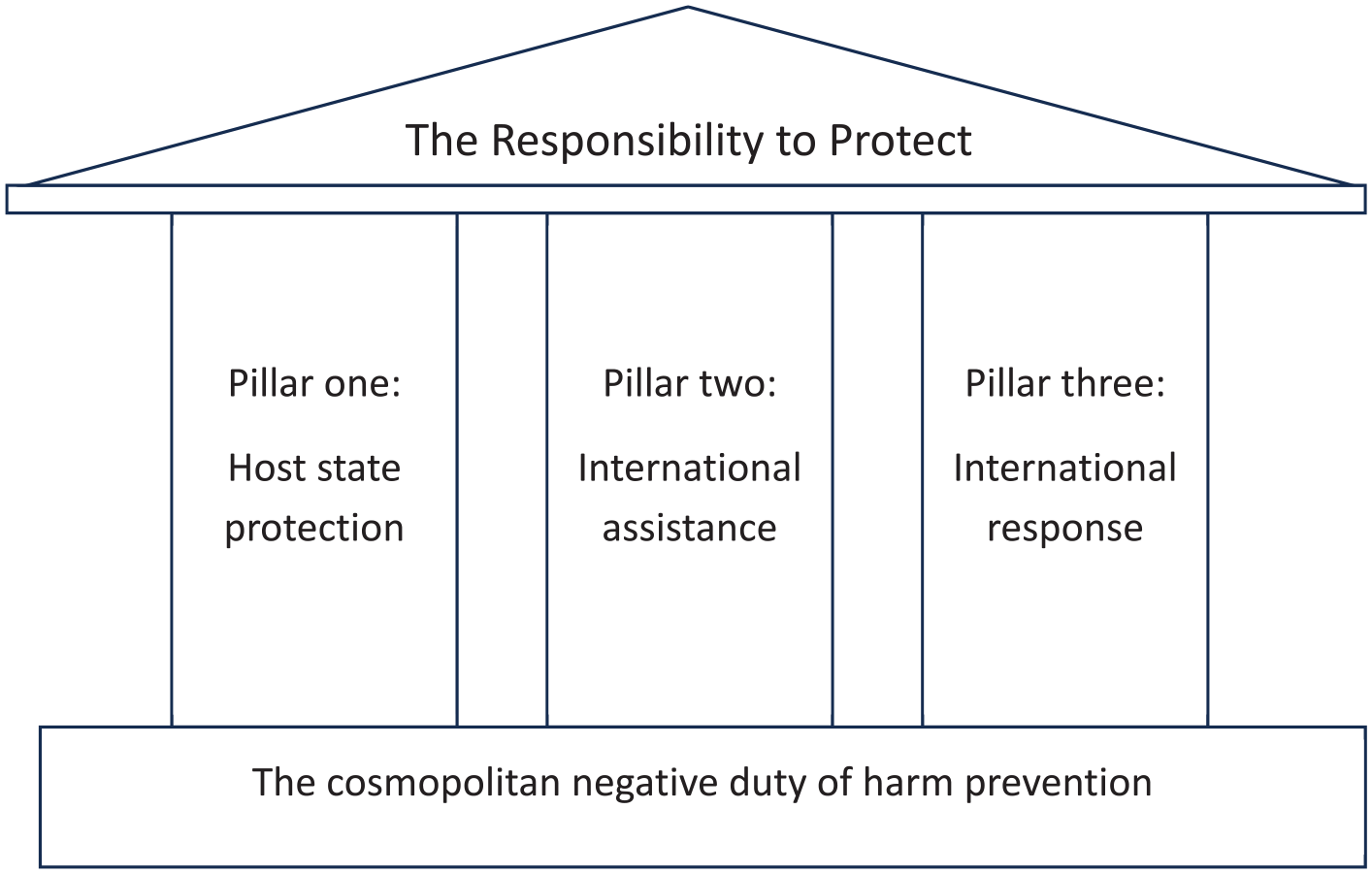
Such a recommendation would provide some notable benefits. It would offer a conceptual clarification of the negative duty owed under a more coherent vision of R2P’s protection mandate, which would improve the overall clarity of R2P by better aligning the logic of international practices and mass atrocity prevention, linking global harms and the international community’s R2P efforts. This would allow for reflection on what sort of state practices may constitute negative duty violations, providing the international community with a more comprehensive focus on the drivers of atrocity violence.
While prohibitions relevant to negative duty violations – such as regulations through the Arms Trade Treaty – do already exist, this alteration to R2P’s pillar structure would stipulate that such actions must be refrained from due to the preventive aspects of states’ R2P commitments. In doing so, this would be an important contribution to R2P’s preventive toolkit. An explicit connection between the cosmopolitan harm principle and states’ R2P duties would help foster a language of accountability wherein states would have to justify their actions in light of their responsibility to prevent atrocities. This would clarify that meeting the negative duty is part of meeting one’s obligations under R2P, thus addressing a cosmopolitan-structural gap within the doctrine’s theory. Further, following Pogge (2002), the harm principle demands not just that instances of harm are avoided, but also that reform is made to existing structures in order to rectify harms which are currently ongoing. In this way, taking the negative duty seriously also means taking action to address current injustices. Connecting negative duties with R2P would signal that there is a demand on states currently engaged in harmful practices to take actions and curb those ongoing harms. Where there is evident connection between state actions and the commission of harm, it is clear that those actions must be ceased, with steps taken to mitigate harm and rectify damage inflicted. Indeed, while the moral urgency to end cases of mass atrocity is compelling anyway, the duty to not be responsible for them is even more compelling (Nili, 2011: 39).
Connecting R2P’s pillar structure with the cosmopolitan negative duty of harm would therefore offer notable advantages, including the potential for shaming where such obligations are failed, as well as creating new dialogical interactions through the need for reason giving where states have failed in their negative duties. As Glanville (2016) argues, these forms of rhetorical engagement are an important part of strengthening R2P as a norm of appropriate state behaviour as they help socialise states into adhering to accepted standards. Such an approach is at the heart of R2P’s constructivist logic, which is designed to legitimise a shift in expectations over how the international community should respond to the problem of mass violence (Welsh, 2019: 56). This recommendation also fits with Jarvis’ (2022: 148–151) conceptualisation of R2P as a ‘negative accountability claim’. This suggests that the ‘key added value’ of the R2P is its ability to shape questions about who is responsible for failures to prevent atrocity, where actors must explain their actions (or inactions) through reason-giving and justification, rather than simply ignoring failures as if states hold no responsibilities whatsoever (Jarvis, 2022: 148–151). Jarvis’ claim is framed around the response duty under R2P, arguing that the ‘negative accountability claim’ fits most naturally around failures to respond. Yet it also has salience to debates around states’ duty of prevention in the context of global harm. Where a connection can be made between state harms and instances of atrocity, expounding the cosmopolitan harm principle as part of R2P would ‘more easily trigger debates concerning the question of why we are not protecting’ (Jarvis, 2022: 148) when protection is framed around the contribution of wider third party states in the commission of atrocity crime.
Language and framing matter in politics and international relations, highlighted by those mentioned above, as well as scholars working beyond the field of R2P and atrocity prevention. Entman (1993: 53), for instance, writes that ‘[f]rames highlight some bits of information about an item that is the subject of a communication, thereby elevating them in salience’ which aids the framer in defining problems, diagnosing causes, making judgements, and suggesting remedies. Utilising a post-structural lens, Doty (1993: 302) shows how state policy decisions are shaped via discursive practices and the construction of ‘reality’ via language and discourse: ‘discourse, i.e. a system of statements in which each individual statement makes sense, produces interpretive possibilities by making it virtually impossible to think outside of it’.. The point being here that language and framing structure how actors understand problems (like mass atrocity prevention efforts) and therefore that shifting language around global harm and R2P can influence the frames of thinking through which policymakers make decisions. Similarly, Hansen (2006) has shown through a detailed examination of the Bosnian war that foreign policy is inexorably tied to discourse: discursive practices shape the possibility of particular responses to political phenomena and events. Likewise, Campbell’s (1998) analysis of US foreign policy allows us to reflect on how states’ policy priorities are shaped by discursively shifting constructs, which in turn drive the conditions of possibility and changes in practice. The expansive literature that exists on ‘shaming’ is also relevant here as this has helped to highlight how state behaviour has the potential, though is in no way guaranteed, to be shaped by normatively expected standards, rooted as they are in discourses of ethical behaviour and appropriate conduct (see Busby and Greenhill, 2015; Krain, 2012; Risse et al., 1999; Terman, 2023). What these various analyses help to demonstrate is that language shapes the conditions of possibility for political actors; an explicit reframing of R2P’s pillar structure, drawing connection to the negative duty of global harm, can therefore help to redefine expectations, legitimate or delegitimate certain practices, and shape appropriate responsibilities around the R2P commitment. It can, as Busby and Greenhill (2015: 112) flag of the power of norms and the shaming of hypocrisy, open the ‘windows of opportunity’ to challenge the behaviour of powerful actors.
Further practical steps would be required to monitor and enforce the negative duty of atrocity prevention in practice. As Shue (2020: 168) highlights, ‘beyond a duty not to deprive people of whatever they have rights to, there must be some kind of duty to protect the victims against the violators’, meaning that institutional arrangements for securing the duty to avoid harm are needed to make a negative duty of atrocity prevention practically functional. Notably, framings of language do not influence all audiences in the same way (Entman, 1993), and rhetorical condemnations of inappropriate practice do not always generate concerted changes in state behaviour (Etone, 2019: 42). Therefore, a reframed connection between atrocity prevention and global harm will not be a panacea to all of R2P’s ills. However, establishing this explicit conceptual link between R2P and the cosmopolitan negative duty would be an important first step towards meeting the negative duty in practice and moving R2P more favourably in a cosmopolitan direction. This may serve as a useful transitional avenue, acting as an iterative mechanism for longer-term progress by bringing greater attention to the more internationally focused preventive dimensions of R2P and moving away from the overly national-centric preventive focus that remains pervasive. In the long term, this calls for effective institutionalisation of the harm principle that can serve the goal of atrocity prevention.
One challenge to institutionalising the negative duty of prevention may be the indeterminacy of what actually constitutes a harmful global practice that underwrites mass atrocity. Indeed, this calls for more research to draw out these connections, and it is not the aim of the present article to provide a full definition of what constitutes ‘global harm’ in the context of the negative duty of atrocity prevention. One useful contribution – and one that would fit with states’ approach to generating consensus and development of R2P – would be through a dedicated report of the UN Secretary-General on the connection between global harms and atrocity prevention efforts. Since 2009, the Secretary-General has published annual thematic reports on R2P, covering areas such as the role of regional organisations in R2P’s implementation (UN, 2011), international assistance efforts (UN, 2014b), early warning mechanisms (UN, 2018), and the work of the Office on Genocide Prevention and the Responsibility to Protect (UN, 2021). These reports have helped to propel the political relevance of R2P (Šimonović, 2019: 252), along with helping to deepen conceptual understandings of what R2P entails and what it demands of states (Prokhorova, 2022: 299–302). A dedicated report of the Secretary-General could therefore help deepen analysis and generate political consensus around an understanding that negative duty violations undermine atrocity prevention efforts globally, and therefore that this must be factored into atrocity prevention thinking moving forward. Such a report could subsequently be fed into the UNGA’s annual debates on R2P as a window of opportunity to further entrench this thinking, potentially criticise practice and flag violations, and strengthen the normative pull of the negative duty.
The UN Secretary-General’s annual R2P reports have increasingly focused on narrower areas of mass atrocity prevention thinking. Their thematic focus has doubtlessly been the result of the Secretary-General’s attempt to build and maintain consensus around R2P at a time when the UN, and global politics more broadly, is facing massive challenges to international cooperation. This point is not meant to downplay the importance of the thematic areas identified in recent UN Secretary-General reports. However, as the analysis above has shown, there is clearly a significant gap in current R2P logic and rhetoric. This needs to be addressed head-on. As such, addressing the issue of negative duty violations and the direct connection this has to R2P prevention efforts would be a significant contribution to R2P’s conceptual development and could set in motion a valuable reflexive process of trying to understand mass atrocity’s international components that would greatly enhance R2P. The hope is that, from this, deeper institutional commitments would be spawned that could strengthen accountability for atrocity prevention efforts, providing means to scrutinise state actions in light of understood standards, and that could begin to affect state behaviour over time as damaging practices are criticised and flagged as areas requiring change.
The aim here is not to demolish the present conceptualisation of R2P duties, for R2P’s pillars have brought some clarity to the agreement made in 2005 and set the agenda for policy steps. Rather, the goal here is to carve out some additional detailing in the framework: to clarify that underpinning successful atrocity prevention efforts must be the commitment to avoid harmful global practices; an important aspect of atrocity prevention which is, at best, only implied in the current R2P pillar structure. The recommendation made here does not seek to fundamentally re-write the three-pillar framework that states have come to accept, and it is difficult to imagine many states outrightly opposing a clarification of the duties of the international community to avoid committing to actions which undermine the goal of mass atrocity prevention.
There is another important point about feasibility here which is that reforming the conceptualisation of R2P prevention efforts fits with pragmatic thinking by keeping focus away from contentious intervention debates – typically, if unreasonably, associated with the practice of Western states – related to responding to crisis events. Instead, this reform is focused on the significantly less (though not entirely non-) contentious preventive dimension of R2P. Negative duties should therefore be less politically divisive than positive duties of intervention because any ethical worldview would accept that inflicting harm on others is unacceptable (Shapcott, 2008: 199). In contrast, the role of the international community in intervening in specific instances of atrocity remains heavily contested (Morris, 2016; Scherzinger, 2023; Welsh, 2019). The recommendation offered here therefore fits with accepted discourses on R2P, including discourse around halting structural drivers of atrocity violence, and with those of international assistance for prevention under the rubric of state responsibility. This focus fits with existing discourse, though it seeks to extend this discourse by providing a clearer link between R2P and a cosmopolitan negative duty of prevention. This is important because it demonstrates an increased feasibility of uptake, as the reform looks to strengthen rather than fundamentally overhaul the currently accepted approach.
Conversely, it might be argued that states violating the negative duty of atrocity prevention are likely to try and deflect any accusations of negligence made against them, subsequently undermining the feasibility of reframing R2P’s pillar structure, as well as the practical efficacy of addressing global harms. As discussed, these states are often those with powerful global reach and interests that span across different regions. It may be the case that these states would oppose such an alteration to the conceptualisation of atrocity prevention efforts in order to avoid accusations against their own harmful international practices. Nonetheless, it would be diplomatically difficult for any state to challenge the idea that a negative duty exists to avoid actions which undermine mass atrocity prevention. To argue otherwise would be to essentially denounce any duty of responsible international citizenship or atrocity prevention and to present oneself as an international pariah. Powerful states will often violate the negative duty, but they are unlikely to try and argue that the duty does not exist in the first place, which, as discussed above, at least creates the space in which to critique practice, hold actors accountable, and shape political discourse around atrocity prevention.
What also needs to be stressed here is that there has been ‘growing recognition of the hypocrisies of powerful Western states regarding matters of international human protection’, which has weakened the legitimacy and compliance pull of the R2P norm (Glanville, 2021: 80) and of the rules-based international order in general. While states remain engaged in harmful practices, they are rightly open to the charge of hypocrisy (Nili, 2011: 42); a fact exacerbated when these states claim moral superiority by framing themselves as ‘good international citizens’ despite their practices violating cosmopolitan ends (Burke, 2013: 15–16). The case of Gaza discussed above has perhaps drawn out this charge of hypocrisy to its greatest ever level. The proposal made here would help to address this problem and would potentially appeal to a wide number of states who are concerned that R2P is currently framed as a means for the West to critique the practice of the non-West, by instead acknowledging that atrocities are facilitated by a multitude of global practices and not only violations of rights at the domestic level. Linking harms at the international level and mass atrocity can therefore help deepen consensus around R2P by promoting a more coherent version of the norm that is more cosmopolitan and consistently applied to all international state actors.
Conclusion
If there is to be a rules-based international order that upholds inclusive, accountable, and equitable human relations, then Western states must follow the rules themselves. If they do not, then the future of global order, and their place within it, will continue to diminish. This also has long-term implications for the survival of R2P (Pattison, 2021; Peak, 2023), and so if liberal Western states wish to see the R2P survive (as their rhetoric indicates), then they need to alter their own practices to align better with the logic of protection underpinning the norm. As El-Affendi (2024: 7) writes of the study of genocide, ‘[w]hat then remains for a field whose core mission is genocide prevention if major ‘democracies’ see quasi-genocidal acts as valid policy options?’.
This article analysed the connection between mass atrocity prevention efforts under R2P and the cosmopolitan negative duty to avoid the imposition of harm. It argued that R2P does not contain a clear and direct acknowledgement of states’ negative responsibility to avoid acting in ways which might underwrite conditions of atrocity in other states. This undermines R2P’s preventive logic for it surely does not make sense to charge international actors with duties of assistance and response without also stipulating that those same actors hold the duty to avoid facilitating atrocities themselves.
The Gaza case and others well expose the fallacy of thinking about episodes of mass atrocity only in terms of domestic rights violations, or in terms of who is pulling the trigger. In Gaza, we can see how outside actors like the United Kingdom, though not directly engaged in serious violations of human rights and humanitarian law themselves, have helped to facilitate the conditions in which other actors have been able to engage in such violations.
In making a case for establishing a clearer conceptual link between R2P and a cosmopolitan negative duty of atrocity prevention, the article called for a reframing of R2P’s pillar structure that would place R2P’s pillars on a more solid foundation of cosmopolitan harm prevention. This attempts to expand the present discourse on the role of wider international practices and the commission of mass atrocity. Rather than calling for disengagement with R2P, it emphasises how R2P’s preventive framework can be made more cosmopolitan and logically coherent. Such a link can strengthen the relationship between R2P and cosmopolitan protection duties in a way that is not overly demanding. What this offers is the first steps at enhancing R2P discourse by better aligning the logics of R2P with the negative duty of human protection.
The arguments made above will leave some unsatisfied, but they fit with a logic of transitional cosmopolitan progress that is rooted in structural realities while seeking transformation and change (see Brown and Hobbs, 2022; Gilabert, 2017). In Kaldor’s (2013: 44) words – drawing on Kant’s notion that we ought to ‘promote the impractical’ in order to galvanise change – ‘there is an ethical responsibility to continue to debate and propose [ideas]’. This article suggests one such idea; one that would strengthen debates around the R2P by fostering a more ethical and cosmopolitan-centred vision of global harm.
Footnotes
Acknowledgements
This article was made stronger by the feedback from helpful colleagues. This includes members of the University of Glasgow International Relations Cluster, the BISA Human Rights, Humanitarianism and the Responsibility to Protect Working Group, and the European Centre for the Responsibility to Protect. I would also like the thank the anonymous reviewers for their critical but actionable advice.
Funding
The author(s) received no financial support for the research, authorship, and/or publication of this article.
